ISRO Achieves Milestone in Gaganyaan Mission with Successful Escape System Test

In a remarkable display of precision and determination, the Indian Space Research Organisation (ISRO) achieved a significant milestone in its ambitious Gaganyaan Mission – the endeavour to send Indian astronauts into space. The latest test, part of this mission, involved the launch of the Test Vehicle (TV-D1), powered by a liquid-propelled single-stage rocket, from the Satish Dhawan Space Centre.

The focus of this mission was the validation of the Crew Escape System, a critical component for the safety of Indian astronauts during spaceflight. This system comprises various motors, including low-altitude, high-altitude, and jettisoning motors, designed to safely eject astronauts from the vehicle in case of an emergency. ISRO Chief S. Somnath declared the mission complete with all objectives achieved.

“Im very happy to announce the completion of TV-D1 mission,” said the ISRO chief, addressing the team dedicated to the launch.

Quick Challenge Recovery

The journey to this moment was not without its challenges. Initially scheduled for launch at 8:00 a.m., the mission experienced a delay due to adverse weather conditions. However, what transpired next is a testament to the dedication and problem-solving capabilities of the ISRO team.

Within an hour of experiencing a glitch during the first launch attempt, ISRO identified and resolved the issue. The team’s swift response and ability to rectify the problem within such a short timeframe were truly remarkable.

The flight sequence for TV-D1 commenced with the launch, and six seconds into the flight, the fin-enabling system was activated. The Crew Escape System Pillbox was triggered at a speed of Mach 1.25, approximately 11.8 km above the Earth’s surface. The High Energy Motor (HEM) fired to propel the vehicle further into the atmosphere.

At about 61.1 seconds after launch, when the vehicle reached a Mach number of 1.21 at an altitude of 11.9 km, the Crew Escape System separated from the rocket booster. The Crew Module then separated from the Crew Escape System at an altitude of 16.9 km, travelling at a speed of 550 km per hour. Subsequently, the drogue parachute deployed, slowing the vehicle’s descent.

“Mission Gaganyaan TV D1 Test Flight is accomplished. Crew Escape System performed as intended. Mission Gaganyaan gets off on a successful note,” ISRO announced.

The Crew Escape System, akin to fighter jet ejection seats, plays a vital role in safeguarding astronauts during spaceflight anomalies. It operates automatically, detecting malfunctions or issues immediately after liftoff, prior to rocket stage separation. This rapid ejection minimises potential risks during the early phases of ascent.

The successful test launch was crucial for validating the system that would be indispensable during the Gaganyaan Mission‘s initial phase. It will be responsible for jettisoning the Crew Module, with astronauts on board, to a safe distance in the event of a critical problem. The Crew Module will then separate and safely splash down in the sea, aided by parachutes.

Data gathered from this test will further enhance the system’s development, ensuring its reliability when astronauts embark on the Gaganyaan Mission.

This achievement underscores India’s progress toward realizing its dream of sending its first astronauts into space from its own territory. The Indian space agency plans to launch its first astronauts, who are currently undergoing training, into space by 2025 and aims to reach the Moon by 2040.

ISRO’s unwavering commitment, ability to overcome challenges, and rapid problem-solving abilities have taken India one step closer to a historic space mission, marking a significant milestone in the country’s space exploration journey.

The post ISRO Achieves Milestone in Gaganyaan Mission with Successful Escape System Test appeared first on Analytics India Magazine.

Baidu’s Ernie 4 Aims to Outshine GPT-4

“It is not inferior in any aspect to GPT-4,” Baidu’s CEO Robin Li boldly claimed, stating that the latest model was “significantly improved” compared to its original Ernie Bot, at the recent launch of Ernie 4.0.

Robin Li demonstrated Ernie 4.0 at the company’s annual Baidu World conference in Beijing. He said the model has achieved comprehension, reasoning, memory and generation, which uses algorithms to produce and create new content. Li said that Ernie 4.0 was able to understand complex questions and instructions and apply reasoning and logic to generate answers to questions.

While many speculated that OpenAI’s challenger might emerge from the United States, it seems the competition has arisen from China, Baidu’s Ernie 4. Ernie, not to be confused with the friendly Sesame Street character, has been making waves in the AI community, and this latest iteration promises to be a game-changer.

ERNIE 4.0’s performance has improved by nearly 30% since its beta testing in September and is currently available in an invitation-only beta.

How Far Has Ernie Actually Come

What sets Ernie 4 apart from its predecessors is its planned integration into almost all of Baidu’s products. This includes prominent services like search engines, maps, and cloud computing. Such widespread integration is a significant move in the AI world, underlining Baidu’s confidence in Ernie 4’s abilities.

ERNIE 4.0 and the user-facing text chatbot, ERNIE Bot, were designed for understanding, generating, reasoning, and memorising. Live demonstrations showcased ERNIE Bot’s ability to understand complex human requests and generate various types of content, such as text, images, and videos. Clearly, Baidu realises that the multimodal race is on.

In a live demonstration, Li prompted Ernie 4.0 to generate advertising materials including advertising posters and a marketing video. He also asked Ernie 4.0 to come up with a martial arts novel complete with characters with various personalities.

The architecture of Ernie 4 is a topic of interest. The model relies on self-supervised pre-training and innovative techniques for data processing. It involves a unique approach to constructing datasets and employs techniques such as natural language processing. The model is said to harness massive datasets, including the impressive A3 Corpus, comprising around 10 billion parameters.

Notably, Ernie 4 emphasises green and sustainable AI. It adopts an online distillation technique, which seeks to transfer knowledge signals from a “teacher model” to multiple “student models” of varying sizes. This approach results in significant power savings compared to traditional distillation methods. Ernie 4 even introduces a “teacher assistant model” to bridge the knowledge gap between deep and shallow models.

Moreover, the model boasts an end-to-end adaptive distributed training framework, designed for versatile and adaptive usage in industrial applications and production environments. This framework considers resource allocation, model partition, task placement, and distributed execution, making it an attractive choice for various real-world scenarios.

Lukewarm at Best

Baidu introduced its first Ernie Bot in March. However, there is a notable challenge when it comes to Ernie 4. Unlike its competitors, it is not yet publicly available, which has left tech enthusiasts and developers eager for a glimpse of its capabilities. Access to source code or demos has been limited, leaving much to the imagination.

However, analysts expressed disappointment with the launch of Ernie 4.0, highlighting a lack of major improvements compared to its previous version. Baidu’s Hong Kong shares also fell by 1.32% during morning trading, underperforming the broader Hang Seng Index’s 0.7% rise.

According to Lu Yanxia, an analyst at IDC, while substantial enhancements may become evident with hands-on use, specific upgrades in Ernie 4.0 are not immediately apparent.

Potential Disruption

China has recently sought to regulate the generative AI industry, requiring companies to carry out security reviews and obtain approvals before publicly launching their products. Companies that provide such AI services must also comply with government requests for technology and data.

Regardless, Baidu had also recently raised $140 million, however, analysts’ and market reaction to the announcement indicates that the Chinese giant has a long way to go.

Baidu also announced the integration of AI technology into its suite of products, including Baidu Search, Baidu GBI, Infoflow, Baidu Wenku, Baidu Maps, Baidu Drive, and its business intelligence offerings for enterprise customers—to enhance user experiences and productivity.

However, one thing is clear, through its integration into a variety of Baidu’s offerings it will look to challenge various entities. For instance, many believe Ernie 4.0 is set to disrupt marketing, and will challenge traditional creative platforms like Adobe and Canva—-who will have to step up their game.

The post Baidu’s Ernie 4 Aims to Outshine GPT-4 appeared first on Analytics India Magazine.

6 Must-Know Autonomous AI Agents

In the last few months, there has been a significant rise in the research work related to autonomous AI agents, particularly in the context of large language models (LLMs), changing the way one interacts with the internet or web – be it sending emails, negotiating, making products, purchases, fulfilling orders, or even booking flight tickets, or even how LLMs are going to be built in the near future.

LLMs currently depend on human guidance and lack autonomous reasoning, whereas autonomous agents can operate independently, making real-time decisions and adapting to changing scenarios. One exciting application of autonomous agents is their ability to enhance LLMs’ performance. They collaborate in multi-agent conversations, enabling LLMs to improve through feedback and reasoning exchange.

Microsoft recently came up with AutoGen, a framework that enables building LLM applications using multiple agents that would be able to talk to each other. Similarly, Google DeepMind recently published a paper ‘How FaR Are Large Language Models From Agents with Theory-of-Mind?​’ Even Meta’s Shepherd: A Critic for Language Model Generation​ talks about the same autonomous AI agents augmenting and doing tasks all by themselves.

Other papers also include SELF: Language-Driven Self-Evolution for Large Language Model and SelfEvolve: A Code Evolution Framework via Large Language Models.

OpenAI is also gearing up to launch something similar next month at DevDay, touted to be called JARVIS.

Here is a list of most recent autonomous AI agents:.

AutoGen

Microsoft’s AutoGen, for instance, leverages LLMs to create versatile agents capable of learning, adapting, and even coding. This fusion of abilities, coupled with features like caching and human intervention, empowers AI systems to evolve and thrive.

AutoGen simplifies the creation of next-gen LLM applications, automating and optimising complex workflows. This AI agent supports diverse conversation patterns, and developers can customise agent interactions. It offers a variety of working systems for different applications and can replace OpenAI’s tools for enhanced inference APIs.

MusicAgent

Microsoft researchers recently introduced MusicAgent, an LLM-powered autonomous agent in the music domain. This AI agent is said to help developers to automatically analyse user requests and select appropriate tools as solutions. Their new framework directly integrates numerous music-related tools from various sources, including Hugging Face, GitHub, Web search, etc.

In addition to this, the researchers have also adapted the autonomous workflow to enable better compatibility in musical tasks, allowing users to extend its toolset. Looks to integrate more music-related functions into MusicAgent.

Mini AGI

MiniAGI is a straightforward autonomous agent that works seamlessly with GPT-3.5-Turbo and GPT-4. It utilises a sturdy prompt along with a minimal toolkit, a chain of thoughts, and a short-term memory incorporating summarization. Additionally, it has the ability for inner monologue and self-critique.

MultiGPT

Multi-GPT is an experimental multi-agent system featuring “expertGPTs” that collaborate to accomplish tasks. Each expertGPT possesses individual short and long-term memory and the ability to communicate with others. Users can assign tasks, and the expertGPTs will work together to complete them.

The system offers internet access for information gathering and searching. It manages short and long-term memory efficiently. It uses GPT-4 instances for text generation, provides access to popular websites and platforms, and includes file storage and summarization using GPT-3.5. This makes Multi-GPT a versatile tool for various tasks and data management needs.

BeeBot

BeeBot is an autonomous AI assistant designed to streamline and automate a wide range of practical tasks. With BeeBot, users can experience the convenience of selecting tools via AutoPack, offering the flexibility to acquire additional tools as tasks evolve. Moreover, the inclusion of built-in persistence ensures that BeeBot can remember and recall information, making it an even more reliable assistant.

It can easily work with different systems and services thanks to its REST API, which follows a common standard called e2b. BeeBot also keeps you in the loop by using a websocket server to share updates in real-time. It’s adaptable for different ways of storing files, like in memory, on your computer, or in a database.

BabyAGI

Baby AGI, a Python script, streamlines task management by using OpenAI and Pinecone APIs alongside the LangChain framework. This AI-driven system excels in creating, organising, prioritising, and executing tasks based on predefined objectives, all learned from past tasks.

Baby AGI leverages OpenAI’s natural language processing (NLP) capabilities to craft new tasks that align with set objectives. Pinecone serves as the repository for storing task results and retrieving context, while the LangChain framework handles decision-making.

The post 6 Must-Know Autonomous AI Agents appeared first on Analytics India Magazine.

AI brings a lot more to the DevOps experience than meets the eye

AI concept

DevOps is getting a welcome boost. Technology teams have a special appreciation for the power of artificial intelligence in assisting and automating code development and deployment, and this may make collaborative practices such as DevOps even more, well, collaborative.

For instance, virtually all DevOps leaders (97%) are using generative AI to some degree, according to a survey of 800 DevOps leaders by Sonatype. Nearly one in three leads (31%) report they have already implemented generative AI into their software development processes.

Also: Generative AI and machine learning are engineering the future in these 9 disciplines

Industry leaders agree that AI is revolutionizing — or promises to revolutionize — the DevOps experience. For starters, one of the most common use cases is in continuous integration and continuous delivery or deployment (CI/CD), according to an analysis published by GitLab: "AI helps to automate the process of building, testing, and deploying code so that any changes that pass appropriate tests can then be integrated into the existing codebase and deployed to production environments right away. This process can help reduce the risk of errors and improves the overall quality of the software being developed."

The advantages of AI go deeper than producing better software — it is helping to bring teams involved in development, operations, and the business — closer together. "Many IT teams need to have access to testing and production environments for their business data," says Jeremy Rambarran, professor at Touro University Graduate School of Technology. "AI can help strengthen these existing approaches. In an AI-driven environment — critical thinking, teamwork, design, visual information display, and independent thinking — are among the other talents that are required."

How, exactly, does this AI advantage come about? "AI contributes to bridging communication gaps between different teams in a project," says Ronen Slavin, co-founder and CTO at Cycode. "By automating responses to routine queries and explicating issues based on existing knowledge, AI reduces the manual burden of explanation and problem-solving for common issues."

Also: Here come the 'custobots': AI pervades Gartner's top 10 strategic technology trends

The automation enabled by AI helps "decrease time spent on mundane tasks, enabling teams to focus on strategic communication and initiatives," Slavin adds. "This reduction in routine communication fosters an environment for more meaningful discussions among developers, operations, business teams, and executives."

AI and generative AI "makes it easier for many employees to work together, no matter where they may be located," Rambarran agrees. Plus, it's a creativity booster, which helps users formulate novel ideas and challenge conventional wisdom.

In the immediate future, AI may open the way to a rapid acceleration of software deployments. "AI-driven bots aiding in code reviews or automatic bug detection and resolution accelerate the development process and foster a collaborative environment by reducing manual error identification and rectification," says Slavin. "Moreover, the concept of AI teammates working alongside human developers in routine tasks like updating dependencies or addressing bug bounty reports exemplifies greater collaborative possibilities."

Artificial Intelligence

How to Disable Windows 11 Copilot Through Registry File or Group Policy Editor

With the release of update 23H2, computers running Windows 11 will now have Microsoft’s generative AI platform Copilot installed and ready for user interaction. For many, this is something to celebrate, but for others, Windows Copilot is something to be dreaded and disabled as soon as possible.

Although disabling Windows Copilot is possible, it isn’t as easy as flipping a toggle switch on a settings menu. The procedure requires the editing of the Windows Registry File or a modification to default settings through the Group Policy Editor. We walk you step-by-step through both processes.

Jump to:

  • Why would someone want to disable Windows Copilot?
  • How to disable Windows Copilot through the Windows Registry File Editor
  • How to disable Windows Copilot through the Group Policy Editor

Why would someone want to disable Windows Copilot?

There are several reasons why some individuals and businesses may choose to disable generative AIs in general and Windows Copilot specifically.

1. Philosophical reasons

Many people and organizations are opposed to generative AI platforms such as Windows Copilot because they find artificial intelligence dangerous, unpredictable and morally questionable. These people and organizations often want to avoid AI completely on these philosophical grounds.

2. Data protection

Some businesses and organizations operate under strict data protection rules and regulations that must be complied with at all times and in all cases. For those businesses, AI in its current iteration is too unpredictable and too prone to unforeseen biases. In addition, not enough is known about how such platforms use and share sensitive internal data. The security of AI-generated results cannot be trusted and verified properly to meet compliance requirements. Therefore, AI must be eliminated from all production and primary systems in these organizations, at least for now.

3. Practical reasons such as computing resources and power

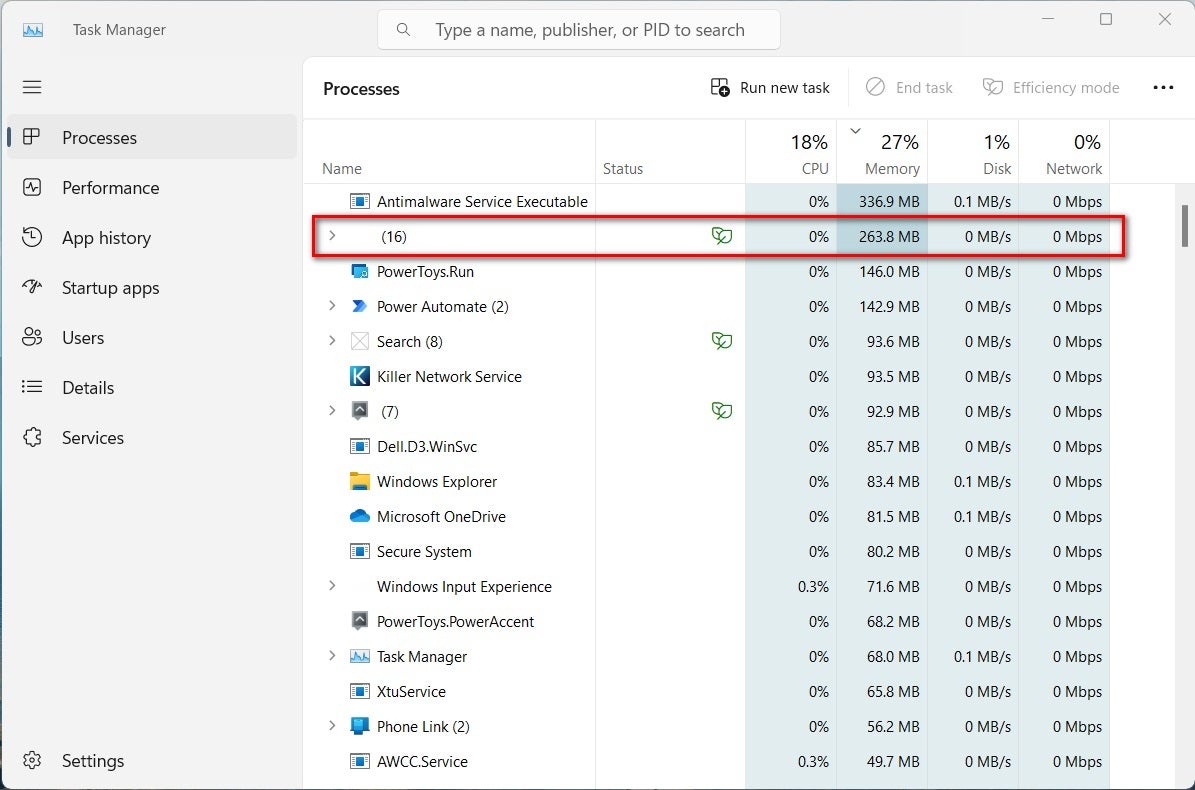
For other individuals and businesses, disabling Windows Copilot is merely a practical matter. Copilot, like all generative AI platforms, requires a considerable amount of computing resources and power. According to the Windows 11 Task Manager (Figure A), Copilot uses over 260MB of RAM while running in the background, which doesn’t include the potential use of CPU and networking resources during an inquiry. Depending on the computer equipment involved, these resource requirements could be enough to slow down performance to an unacceptable level. In such cases, Windows Copilot may be a background process that needs to be disabled.

Figure A

Disable windows copilot
Windows Task Manager showing Copilot’s memory usage. Image: Mark Kaelin/TechRepublic

How to disable Windows Copilot through the Windows Registry File Editor

Disclaimer: Editing the Windows Registry file is a serious undertaking. A corrupted Windows Registry file could render your computer inoperable, requiring a reinstallation of the Windows operating system and potential loss of data. Back up the Windows Registry file and create a valid restore point before you proceed.

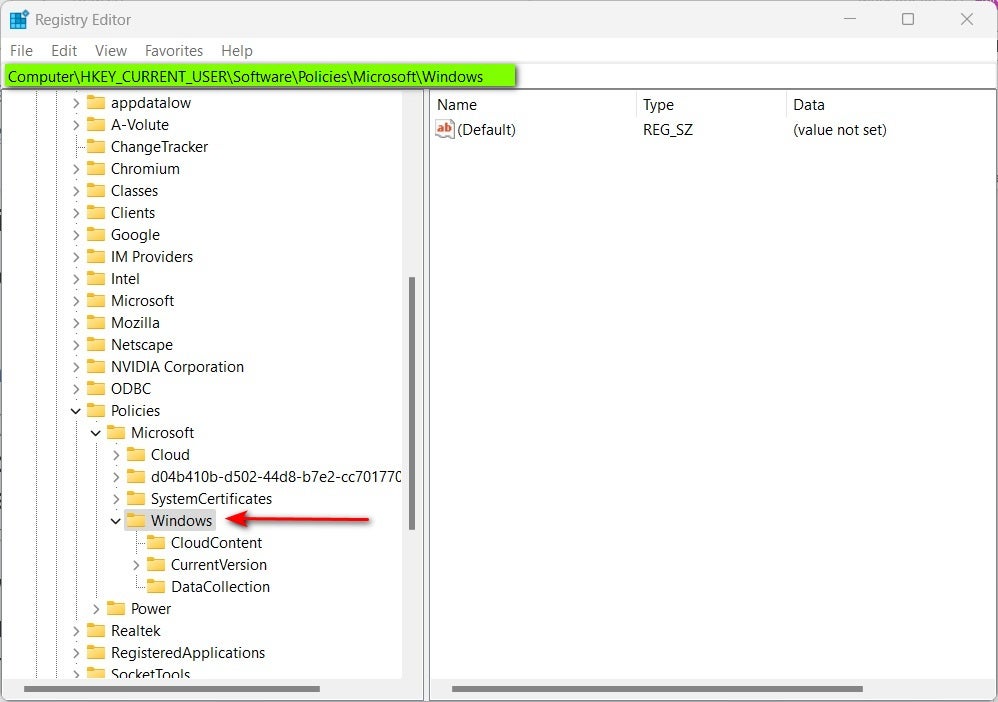
To make edits in the Windows 11 Registry File, type “regedit” into the Windows 11 search tool. From the results, choose the Regedit app and then use the left-hand window to navigate to this key HKEY_CURRENT_USERSoftwarePoliciesMicrosoftWindows (Figure B).

Figure B

Registry editor
Editing Windows Registry File for Copilot. Image: Mark Kaelin/TechRepublic

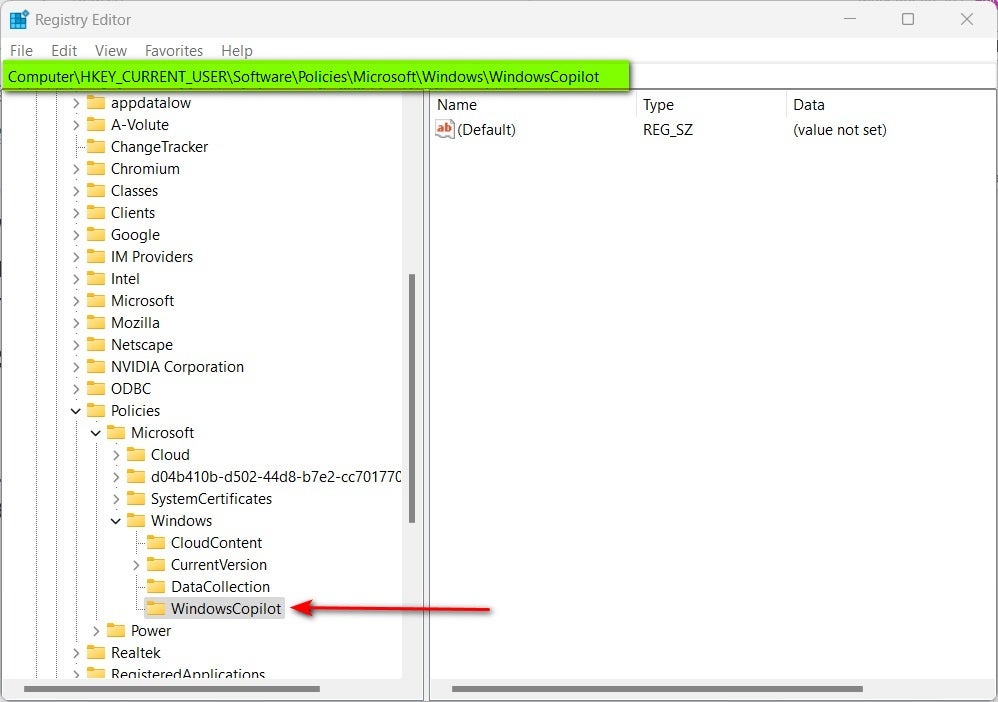
We must create a new key. In the left-hand navigation window, right click the Windows key and select New | Key from the context menu and give it the name WindowsCopilot (Figure C).

Figure C

windows copilot
Add the WindowsCopilot key. Image: Mark Kaelin/TechRepublic

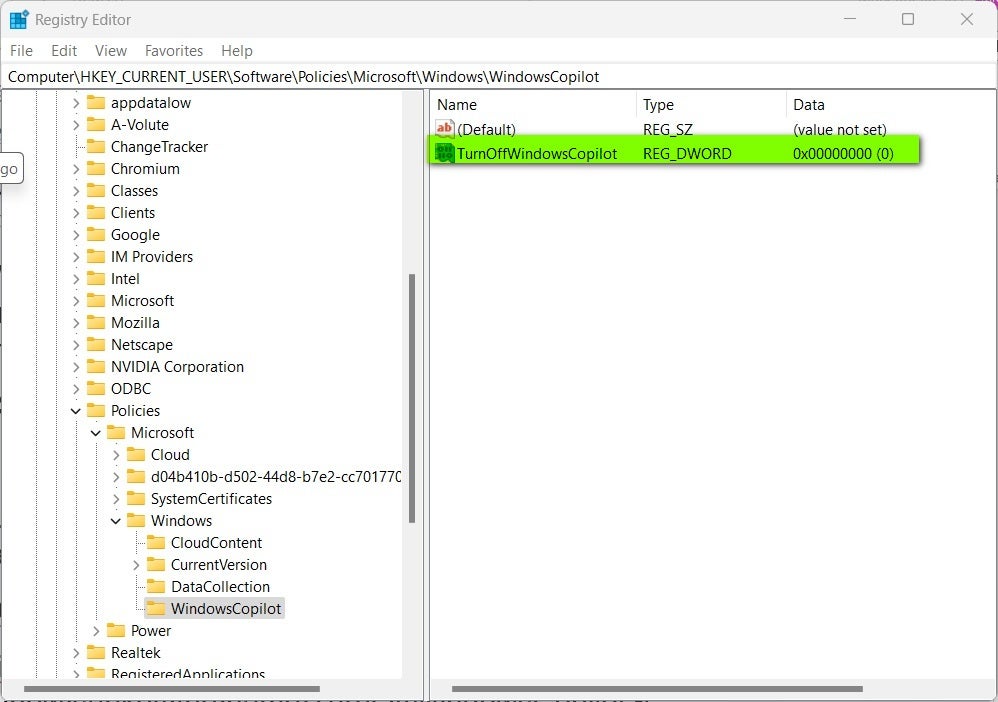
Now, right click the new WindowsCopilot key you just created and select New | DWORD (32-bit) Value from the context menu and give this new subkey the name TurnOffWindowsCopilot (Figure D).

Figure D

Turn off
Add TurnOffWindowsCopilot. Image: Mark Kaelin/TechRepublic

Now, double-click the TurnOffWindowsCopilot subkey you just created and change the Value Data entry to 1 and click OK (Figure E).

Figure E

Data value
Change the Data value of TurnOffWindowsCopilot to 1. Image: Mark Kaelin/TechRepublic

Exit out of Regedit and restart your computer to disable Windows Copilot.

If you want to reverse the process and enable Windows Copilot again, change the Data value of the TurnOffWindowsCopilot subkey to 0.

How to disable Windows Copilot through the Group Policy Editor

If you are using Windows 11 Pro or an Enterprise version of the operating system, you can use the Group Policy Editor to disable Windows Copilot. Type “group policy editor” into the Windows search tool and select the correct app from the results.

Using the left-hand window, navigate to this policy: User Configuration | Administrative Templates | Windows Components | Windows Copilot (Figure F).

Figure F

Local group policy editor
Group Policy Editor. Image: Mark Kaelin/TechRepublic

In the right-hand window, double-click the Turn Off Windows Copilot policy, select the Enabled radio button, click Apply (Figure G) and then click OK.

Figure G

Enable radio button
Select the Enabled radio button. Image: Mark Kaelin/TechRepublic

Exit the Group Policy Editor and restart your computer. With this policy enabled, Windows Copilot will be disabled.

To re-enable Windows Copilot with the Group Policy Editor, change this setting to Disabled and restart your computer.

Subscribe to the Microsoft Weekly Newsletter

Be your company's Microsoft insider by reading these Windows and Office tips, tricks, and cheat sheets.

Delivered Mondays and Wednesdays Sign up today

A new robot vacuum that connects to your home’s water supply is now on Kickstarter

SwitchBot S10

If you're looking for a way to automate your window curtains or blinds, get a button-pushing robot, or a smart lock without changing your existing lock, you'll do well to go with SwitchBot's products. But one thing you may not associate SwitchBot with is the robot vacuum and mop market — until now.

SwitchBot's Switchbot S10 connects to your home's plumbing to refill its water tank and drain dirty water so you don't have to empty a dirty tank or worry about refilling it with clean water. It can also autonomously add water to a new SwitchBot Humidifier 2 to complete the Jetsons reenactment.

Also: The best robot vacuum mops right now: Expert tested and reviewed

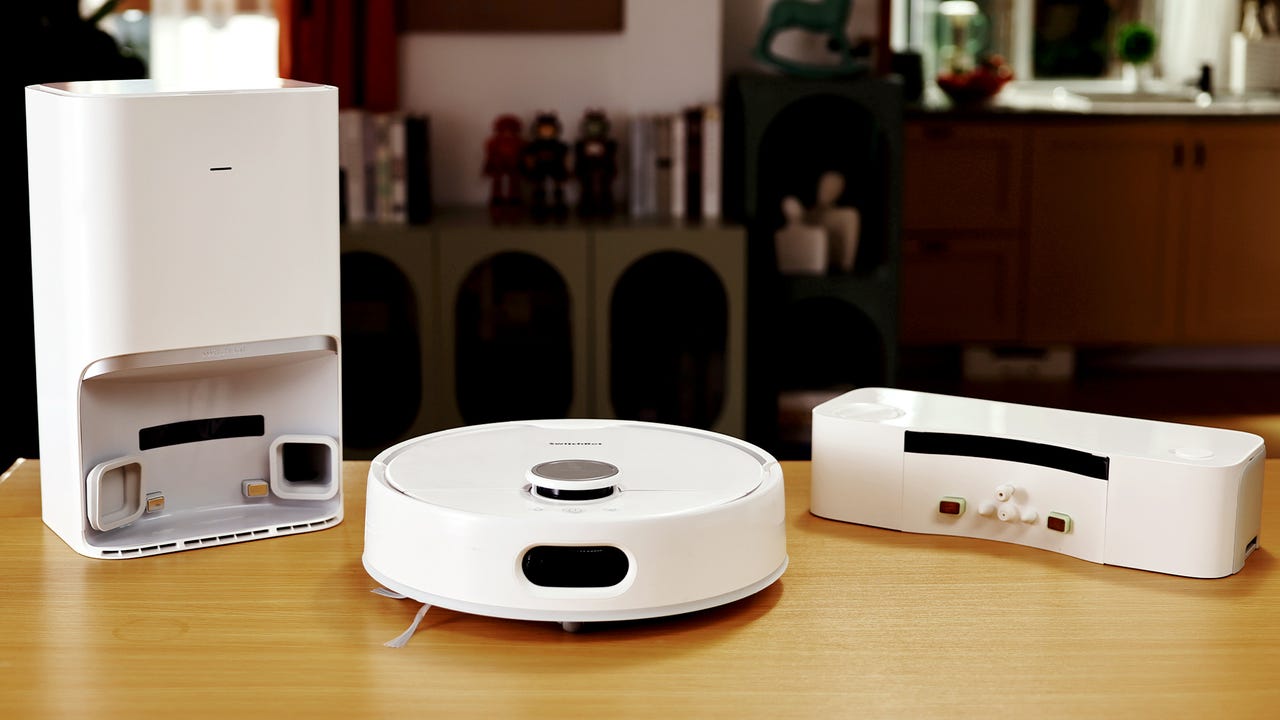
The S10 comes with a charging dock where the robot automatically empties the dustbin after vacuuming and a separate station that you can set up in a bathroom or kitchen to connect to the water supply. The robot goes out to clean and stops by the plumbed station to refill and drain, powering this station with its built-in battery.

The Switchbot S10 launched on Kickstarter just days ago with a $10,000 goal and is now nearing the $1 million mark in pledges. Though it's set to retail for $1,200, it's being offered at an early bird price of $799 through the crowdfunding site. It's worth noting that, while SwitchBot has launched previous products through Kickstarter, these crowdfunding ventures carry risks and don't offer guarantees.

The SwitchBot S10 will boast some high-end features for a robot-vacuum-and-mop combo, like lidar mapping, obstacle avoidance, virtual no-go zones, and room-specific cleaning. It will also detect carpets automatically, then lift its mop roller and stop spraying water until it's back on hard floors.

Instead of mop pads, the SwitchBot S10 will have a rolling mop accessory that won't need to be removed for everyday cleaning, as it will be continuously washed while cleaning. The rolling mop accessory can be cleaned 300 times per minute, with a constant spray of clean water and a built-in scrubber to remove dust and any small debris. The roller can be easily removed or replaced with a hatch on the side.

Also: 5 things I learned while building my smart home

SwitchBot will launch a new Humidifier 2 to work seamlessly with the S10, as the robot vacuum will be able to fill it with fresh water from the water station. The SwitchBot S10 will be the company's first robot vacuum in the US market, with orders scheduled to ship beginning in March 2024.

See also

Tape It’s software for musicians aims to deliver studio-quality noise reduction via AI

Tape It’s software for musicians aims to deliver studio-quality noise reduction via AI Sarah Perez @sarahintampa / 10 hours

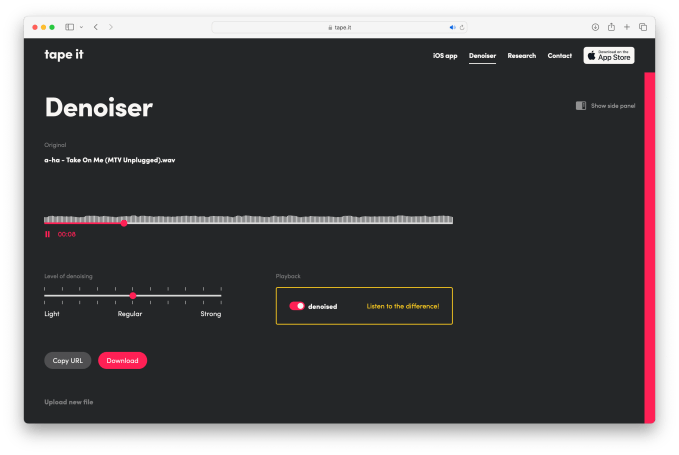
After Apple discontinued its Music Memos app favored by musicians for developing song ideas, a new startup called Tape It stepped in to fill the void with an app that leveraged AI to automatically detect the instrument and annotate the recording. Now that startup is taking the next step in its journey to improve the audio-recording process with the introduction of an automatic, studio quality noise reduction algorithm, also powered by AI, that works on any audio — not just speech.

The AI denoiser shipped this week as a free web app, with a plan to license the technology to vendors in the future. It will also later be integrated into the company’s flagship Tape It app, the company says.

Founded in 2020 by musicians and friends Thomas Walther and Jan Nash, Tape It’s initial focus was on an iOS recording app for musicians. Before creating Tape It, Walther had spent three and a half years at Spotify after it acquired his audio detection startup Sonalytic. Nash, meanwhile, is a classically trained opera singer, who’s also a bassist and engineer. The duo were originally inspired to build Tape It because it was something they wanted for themselves as fellow bandmates that would be as simple to use as Apple’s Music Memos, but made more powerful through the use of AI.

The original version of the app was able to automatically detect the instrument, and then annotate the recording with a visual indication to make those recordings easier to find by looking for the colorful icon. Musicians could also add their own markers to the files, as well as notes, and photos to review later on.

The app has since gained traction with around 10,000 monthly active users, the company says.

But as Walther told TechCrunch at the time of Tape It’s 2021 debut, the team aimed to broaden their use of AI over time.

Image Credits: Tape It

That led to the startup’s latest development — an AI-powered denoiser they’ve been building over the past two years. The challenge with recordings, the company explains, is background noise. In order to reduce environmental noise and electrical interference, musicians record in studios and leverage complex software. Tape It wants to provide a more affordable alternative using AI. Their software automatically removes noise like hums and hisses, not only spoken word, with the goal of producing studio-quality results on songs, single-instrument tracks and field recordings.

“What we developed is we created an automatic version of the denoising software that you have been finding in professional recording studios in the last 15 years,” explains Walther.

To verify its results, Tape It is releasing an academic study with a scientific listening test that shows the software’s quality in competing with industry-leading denoisers.

In a video, the company explains that while speech enhancement systems have advanced significantly, they generally only work for speech and distort or corrupt music signals. Meanwhile, professional denoising systems require manual control of complex software by professional users. Tape It’s technology involves connecting a neural network controller to a signal processing-based noise reduction algorithm. This allowed for automatic denoising of general audio signals, including music. The company plans to present its work at the AES conference next week.

“The reason people haven’t automated those [professional systems] is because you can’t traditionally put them into a neural network…you can’t train such a system,” notes Walther. “We are actually the first ones to train such a system and that’s why we’re quite excited about this larger area.”

He adds that the academic community will most likely be less interested in the denoising product itself but more in how they managed to get it to work this way because of the implications it has for other applications of automating studio software.

Still, the denoising software already has some interested potential customers, including a large studio software vendor and a large hardware manufacturer. In those cases, enterprise pricing will be made available but for smaller startups, less expensive plans will be offered.

“Everyone is excited about AI being creative,” said Walther, when announcing the news. “We are excited about AI solving boring problems. We take care of background noise, so you can entirely focus on the creative parts and write more songs,” he said.

AI technologies aren’t only being used to reduce background noise for musicians, of course, other companies are also turning to AI to create near-studio quality sound for podcasters too. For example, Podcastle just this month launched its Magic Dust AI, a generative AI tool that eliminates background noise and enhances its dynamic range.

Tape It’s five-person team is based in Berlin, London, Los Angeles and Stockholm, and includes designer and musician Christian Crusius, previously of the design consultancy Fjord, which was acquired by Accenture. The bulk of the work on the denoising software was done by Christian Steinmetz, a PhD researcher in AI and audio.

The company is continuing to bootstrap, having previously turned down offers of funding.

“This is fundamental research and we just didn’t know how long it would take,” Walther explained as to why they went this route. “We thought it was a bit risky if you get an investor who isn’t that patient — [they’d push you to ] just take an open source model and move on. But we wanted to have a larger technological advantage,” he said.

The company is now considering raising funds and is having those discussions, given the pace of the AI market, but hasn’t made any formal decision as of yet.

Tape It launches an AI-powered music recording app for iPhone

3 Ways to Make Money with ChatGPT and AI

3 Ways to Make Money with ChatGPT and AI
Image by Editor

As someone who has a full-time job by day and works on multiple side hustles by night (ranging from creating written content, online courses, and more recently, a tech YouTube channel), I am always looking for new ways to generate passive income.

So when ChatGPT was released, I was the first to scour the Internet for advice on using the tool to make more money.

Unsurprisingly, much of the recommendations I found online ranged from vague and unactionable to downright unethical.

Apparently, thousands of people have started flooding Amazon with AI-generated books, causing the platform to impose self-publishing restrictions and remove suspected AI-generated content in droves.

After weeding through the sea of bad advice on the Internet, however, I did find some pretty useful ways in which people have monetized ChatGPT and generative AI tools.

I’ve even started incorporating some of this advice into my own workflows (and managed to almost double my online income in the past month).

In this article, I will share my learnings and provide you with 3 realistic ways in which you can start making money with ChatGPT.

1. Create Faceless Social Media Content

The creator economy is exploding.

There is tremendous opportunity to make money by building a personal brand and generating content that others find valuable.

However, a lot of time (and money) goes into content creation.

A single YouTube video requires coming up with a topic idea, writing a script, spending hours speaking in front of a camera, and editing in post-production.

It also takes a lot of trial and error to figure out the ideal video background, lighting, and audio. And for many of us, it can seem daunting and unnatural to sit down and speak to a camera.

Generative AI is a game-changer in the content creation space. You can use ChatGPT to perform topic research, generate a compelling “hook” for your YouTube video, and even optimize your content so that it ranks well on Google.

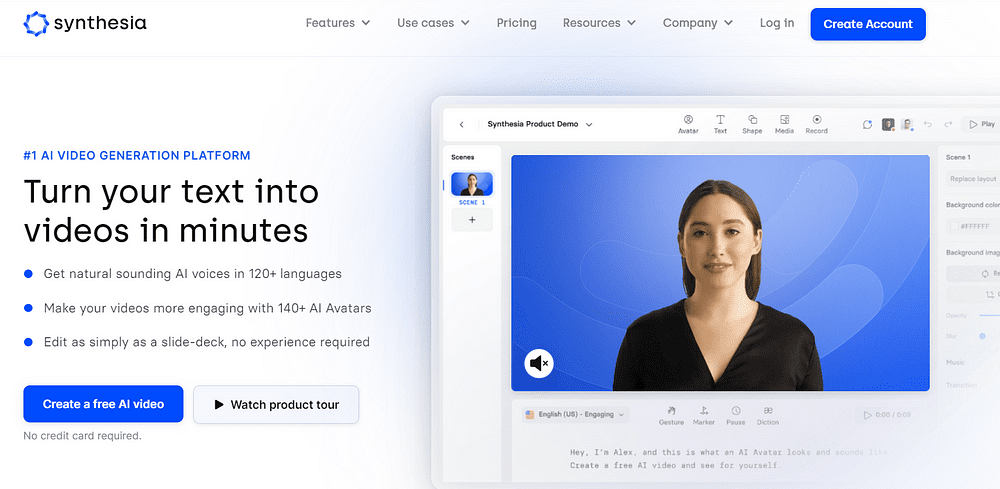
Then, you can use a tool like Synthesia to create an AI avatar and voiceover for your videos, removing the need for you to appear in them yourself:
3 Ways to Make Money with ChatGPT and AI
Image by Author

Finally, to promote your content across various platforms, simply use a tool like Opus AI to take parts of your YouTube video and transform it into short-form content which can be reused across sites like TikTok and Instagram.

Of course, you want to set yourself apart from the AI-generated content flooding the Internet, which means putting in a decent amount of research into your videos and selecting a niche.

ChatGPT and generative AI should speed up the content creation process, and isn’t meant to replace your creativity and unique voice.

2. Online Courses

Online courses on generative AI tools like ChatGPT, Midjourney, and DALLE are exploding in popularity.

Note: Top Udemy instructors make over $1 million on the platform, while the average creator earns around $3,306 annually.

Here are some popular, beginner-friendly generative AI courses on Udemy:

3 Ways to Make Money with ChatGPT and AI
Image by Author

Look at the number of students enrolled into the above online courses!

This should tell you that individuals and organizations are willing to invest heavily in learning more about AI.

Of course, this doesn’t mean that just anyone can go about creating an introductory ChatGPT course with regurgitated content.

What you should do is this:

Find a niche

If you work in marketing, for example, you already have subject matter expertise that sets you apart from an everyday person.

Now, start learning to incorporate ChatGPT into your daily workflows. Is there an aspect of your job that generative AI can automate?

For instance, AI has become really good at generating SEO-friendly content that even Google cannot reliably tell apart from human written articles.

Using this knowledge, can you teach small business owners to market their products effectively without having to hire a content creator or SEO expert?

This is a skill that many people will pay to learn, because it teaches them to save money and enhance business outcomes in the long term.

With less than 2 hours of video content, for instance, this Udemy course already has 5,000 students by simply teaching people how to learn programming with ChatGPT:

3 Ways to Make Money with ChatGPT and AI
Image by Author

If you already have a marketable skill, you can make a lot of money by teaching other people how to hone that skill with ChatGPT.

And in today’s creator economy, it’s never been easier to start!

All you need to do is enroll into a platform like Udemy or Teachable and start building the course.

3. Prompt Engineering and AI Consultation

If you’ve been following announcements in the field of AI lately, you might have heard of the hot new job in the market called a “prompt engineer.”

According to Business Insider, these roles pay up to $375,000/year and don’t even require a tech degree.

So… does this mean that anyone can make this kind of money by simply typing prompts into ChatGPT? What’s the catch?

Although it’s a relatively new field that will continue to evolve in the next few years, the main role of a prompt engineer is to improve business outcomes and maximize efficiency with generative AI.

Most prompt engineering roles require subject matter expertise. You must be able to apply prompting techniques to solve industry-specific problems.

For instance, if you work in marketing, you might be hired to get ChatGPT to create SEO-friendly content that is relevant to the business and accurate.

AI research company, Anthropic, is actively hiring prompt engineers and don’t have a fixed set of requirements that you need to meet to apply for the job.

The job listing states that they will consider applicants who are able to make strong enough cases for themselves, saying,

“if you haven’t done much in the way of prompt engineering yet, you can best demonstrate your prompt engineering skills by spending some time experimenting with Claude or GPT3 and showing that you’ve managed to get complex behaviors from a series of well crafted prompts.”

The company’s representatives go on to mention that logic and reasoning capabilities are the most important traits of a prompt engineer, and that having programming knowledge or a machine learning background is an added advantage when applying for this position.

And although many of these requirements seem extremely vague, it does seem like prompt engineering is a lucrative skill that people in various domains will benefit from.

Even if you don’t actually end up getting a job as a prompt engineer, this is a skill that businesses will pay to learn, since employees are still struggling with AI adoption.

You can offer consulting services around generative AI and prompt engineering in a specific niche like marketing or finance.

As someone who has offered data and machine learning consulting services to organizations in the past, I successfully got clients by building an online presence and creating a website, which I talk about in a separate article.

Also, if building a brand from scratch seems daunting, here is a list of AI tools that can help you automate the process.

This Guy Used ChatGPT to Turn $100 Into a Business in One Day

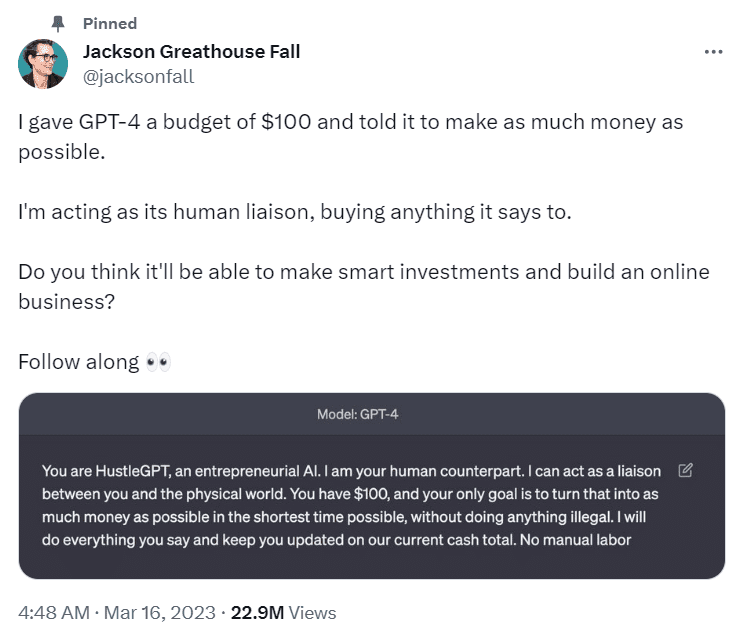
I’d like to end this article by pointing you to the story of Jackson Greathouse Fall, the guy who used generative AI to launch his business in one day by asking ChatGPT to turn $100 into “as much money as possible.”
3 Ways to Make Money with ChatGPT and AI

He followed the chatbot’s instructions and managed to raise $1378 for his company in just one day. As of mid-March, the company was valued at $25,000.

You can read the entire story on Business Insider.

Natassha Selvaraj is a self-taught data scientist with a passion for writing. You can connect with her on LinkedIn.

More On This Topic

  • Who Will Make Money from the Generative AI Gold Rush?
  • eBook: 101 Ways to Use Third-Party Data to Make Smarter Decisions
  • 7 Ways ChatGPT Makes You Code Better and Faster
  • 4 Ways to Generate Passive Income Using ChatGPT
  • 5 Ways You Can Use ChatGPT's Code Interpreter For Data Science
  • Visual ChatGPT: Microsoft Combine ChatGPT and VFMs

This AI development bundle is only $50 through Oct. 23

stack-social

This AI developer bundle is just $50 through Oct. 23.

Artificial intelligence is a hot topic of conversation around the world right now as it is changing how every single industry operates. For developers, this fact makes it an appealing niche to hone in on.

If you want to learn more about artificial intelligence development, online courses can be a great place to start. This artificial intelligence and automation developer bundle is only $50 now until Oct. 23.

This bundle comes with thirteen courses and nearly 50 hours of content on AI development and automation. The first course is called Introduction to the Latest Artificial Intelligence Tools and it features twenty lessons across a single hour. In that time, you can learn more about the newest AI tools made available to the market, how to use them, how to use AI to approach solving complex problems, and more. This course and others are taught by Bryan Guerra of eCommerce & Entrepreneurship Made Simple.

The bundle also has courses on ChatGPT, Midjourney, DALL-E, and more.

Other courses include Solidity Essentials: Web3 Development Blockchain Programming, a course with 19 lessons on fantastic tools like writing basic Solidity code and defining Solidity contracts. The course goes on to cover error management, understanding Remix IDE and .SOL files, and a lot more.

This in-depth bundle is available for life, so grab it now and consider gifting it to yourself or a friend who is interested in development this holiday season.

ZDNET Recommends

These 27 robotics companies are hiring

These 27 robotics companies are hiring Brian Heater @bheater / 8 hours

[These listings originally appeared in TechCrunch’s robotics newsletter, Actuator. Subscribe here.]

Every time I put out a call for robotics jobs, I’m bombarded. It’s a beautiful thing. In spite of various economic slowdowns and investment freezes, it seems like there are always dozens of companies trying to hire in the space. That’s surely a sign of a category that has expertly weathered a lot of recent storms.

This time out, we have just under 30 companies looking to increase their headcount.

Agtonomy (10 roles)

Aigen (24 roles)

Ascento (1 role)

Autonomo Technologies (4 roles)

AWL Automation (3 roles)

Baubot (11 roles)

Berkshire Grey (20 roles)

Bonsai Robotics (6 roles)

Boston Dynamics (17 roles)

Bot-Hive (1 role)

Brain Corp (3 roles)

Chef Robotics (5 roles)

Dexterity (28 roles)

Enchanted Tools (16 roles)

Engineered Arts (9 roles)

Exotec (13 roles)

Formic (11 roles)

Infinite Food (5 roles)

LYRO (5 roles)

Machina Labs (20 roles)

Neya Systems (6 roles)

Nimble Robotics (2 roles)

Sanctuary AI (31 roles)

scaledrive.ai (1 role)

Scythe Robotics (5 roles)

Sutro (1 roles)

Vention (15 roles)