9 Must Apply Summer 2024 Internship Programs

Attention to all techies pursuing a master’s degree. Several leading tech companies are offering internships, and we’ve put together a list of opportunities you won’t want to miss.

These internship roles are apt for those on the verge of completing their studies. They provide a chance to step into the tech industry and learn firsthand. From big AI companies to retail leaders, these companies are welcoming new talent.

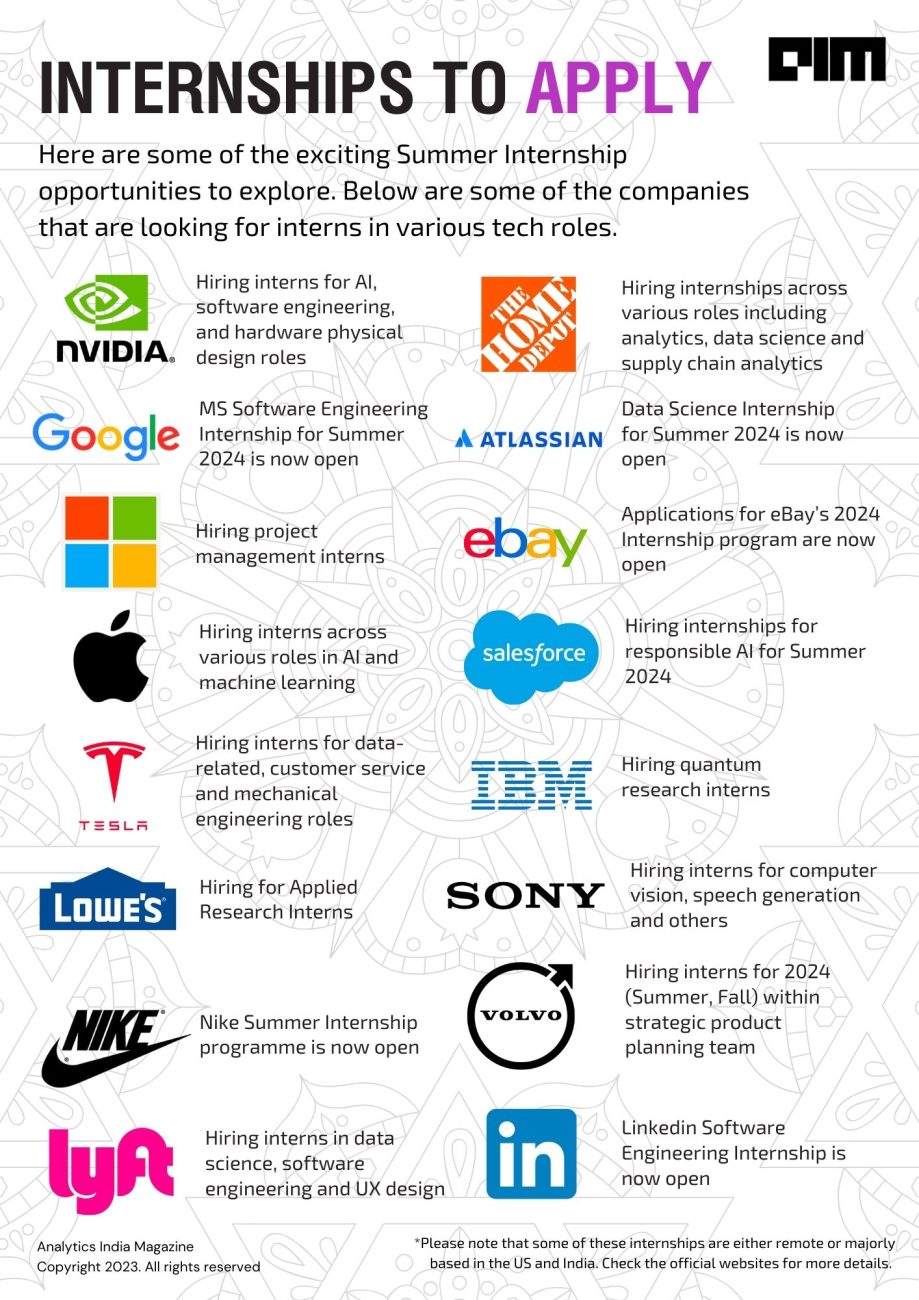
The options are limitless so don’t miss out. Here’s a compiled list of 9 companies offering tech internships for summer 2024.

NVIDIA

NVIDIA, a leader in AI and hardware, is on the lookout for software engineering interns for their BLAS and Linear Algebra teams which are a key part of high-performance computing and deep learning software stacks.

The interns will prototype and develop numerical algorithms for high-performance math libraries in the areas of dense and sparse linear algebra for single-node and multi-GPU clusters. Their role includes analyzing the performance of GPU or CPU implementations and understanding software use cases and requirements.

Check out the role here.

Google

The search giant has released its MS Software Engineering Internship for Summer 2024 located in the Playa Vista, CA campus. The candidates should be currently attending a degree program in the US and available to work full-time for 12 weeks outside of university term time.

The interns will be involved in tasks from developing scripts for automating routine tasks to choosing the best solution to problems based on information analysis.

Interested candidates can check out the application here.

Tesla

Tesla, the Elon-run AI company, is looking for more than 120 summer interns, spanning from vehicle software roles to mechanical engineering. Given Musk’s lack of enthusiasm towards working from home, these jobs are available at different offices across the state.

For graduates looking to be a part of the electric vehicle industry, this is your golden ticket!

Check out the roles here.

Salesforce

Salesforce is looking for interns interested in Responsible AI and Tech. Be a part of a company committed to ethical tech practices and responsible AI development.

The interns will work with several teams to conduct ethical reviews of net-new features to spot where there might be unintended negative consequences in a roadmap specification or mockup. They will also deliver recommendations for how negative consequences might be mitigated.

The role also requires research and making recommendations for what should be included and the creation of a standardized template or a model card/system card generator (tool).

Check out the role here.

Lowe’s Companies, Inc.

Lowe’s is on the hunt for interns in a variety of areas, including Information Retrieval, Semantic Product Search, Conversational Systems, Recommender Systems and personalisation, Computer Vision, and Generative AI.

Whether you’re into language processing or computer vision check out the roles here.

Atlassian

Software giant Atlassian has announced its Data Science Internship for Summer 2024. The program has opened its doors to interns, with seven roles up for grabs. Whether you’re into research, software engineering, or site reliability engineering, Atlassian has something for everyone.

Check out Atlassian’s internships here.

Sam’s Club

Sam’s Club has got you covered for tech internships. This American retail giant offers various opportunities for 2024 including data science and supply chain roles.

The role surrounds skills like model analysis, data source identification and so on. During the 11-week program, interns will work directly with leadership teams across the enterprise.

Check out the internships here.

A*STAR

A*STAR’s lead scientist is offering a unique internship opportunity in quantum computing. He is looking for two interns, preferably Masters or PhD students with prior experience in quantum computing, to collaborate with on projects related to quantum error correction.

Interested and eligible candidates can check out the LinkedIn post for more details.

eBay Tech

eBay, the global commerce leader, is on the lookout for interns in various technical and non-technical roles. Whether you’re an applied researcher, data scientist, or software engineer in the US, eBay has a spot for you.

Check out the roles here.

The post 9 Must Apply Summer 2024 Internship Programs appeared first on Analytics India Magazine.

Are You A Techno Optimist or Pessimist? 

Marc Andreessen, the tech billionaire who is a little bit too optimistic with technology, more specifically AI, is being heavily appreciated and also sincerely criticised. Pointing out his recent “Techno-Optimist Manifesto,” people have been calling him to change the title to “Techno-Billionaire Manifesto.” But is the manifesto really that deluded?

As with any spirited debate, there are those who offer a more cautious perspective. Sam Altman, CEO of OpenAI, has always acknowledged that, “every technological revolution affects the job market. I’m not afraid of that at all. That’s the way of progress. And we’ll find new and better jobs.” The optimism is clearly visible.

Before dismissing Andreessen’s views as an investor and billionaire, another investor has been weighing in similar thoughts. Vinod Khosla, the founder of Khosla Ventures, the first investors of OpenAI, also offers a stern warning, suggesting that most AI investments today will lead to losses. He likens AI investing to a hype cycle, cautioning that only disciplined investors will reap the benefits.

Active vs Normative optimists, not libertarian

Amongst all the voices, Andreessen may be one of the most vocal proponents of AI’s potential, but he’s far from alone in his convictions. Yann LeCun’s words, like Andreessen’s, resonate with a core truth – AI is unlikely to cause instant mass unemployment. Instead, it will displace jobs over time and, ideally, make people more productive. While declaring that slowing down AI is tantamount to murder might be hyperbolic, it’s undeniable that we’re in the midst of remarkable AI advancements, and optimism isn’t unwarranted.

Furthermore, LeCun points out, “a few of my famous friends and colleagues have expressed hesitations about technological risks. It is not because they are techno-pessimists. They do believe in the ability of technological progress, and AI in particular, to improve the human condition. But they doubt that current economic and political institutions, and humanity as a whole, will be capable of using it for good.”

A good counterpoint to the libertarian aspects of Marc @pmarca Andreessen's Techno-Optimist Manifesto.
One can believe in the intrinsic value of technological progress and economic growth, while not believing in libertarianism and knowing that markets need to be regulated to be… https://t.co/wF5RCC0PS9

— Yann LeCun (@ylecun) October 19, 2023

“We believe any deceleration of AI will cost lives. Deaths that were preventable by the AI that was prevented from existing is a form of murder,” read Andreessen’s 5000-word blog, decided by the enemies and friends of AI.

The people criticising Andreessen’s views are most concerned with the list of institutions that he calls are enemies of AI. Sustainability is one of them. Noah Smith argues for this in his blog saying, “But while he might be referring to people who cloak degrowth ideas under a false banner of sustainability, actual sustainability is not an enemy of techno-optimism. Indeed, it’s a core part of it. Being able to sustain technological society into the indefinite future is, itself, a fundamental goal of innovation. And the way to accomplish that sustenance is almost always more innovation, not less.”

Adam Wenchel, chief executive of AI company Arthur, said: “These systems are going to roll out over time, very gradually, people are going to adapt to them and it’s going to be OK.”

Chis Cox, Meta Platforms’ Chief Product Officer, highlights the positive impact of AI on business efficiency, citing AI chatbots based on celebrities as examples. These applications, while promising, also raise ethical questions about deep fakes and data privacy. Michael Wolf, co-founder and CEO of Activate, predicts a significant shift in the search industry driven by open-source AI models. While his vision is exciting, it underscores the profound changes AI will bring.

Is Andreessen right then?

Andreessen asserts that we are all being fed a steady diet of falsehoods, with claims that technology is a harbinger of doom, poised to steal our jobs, reduce our wages, increase inequality, and wreak havoc on our society. He argues, “our civilisation was built on technology. Our civilisation is built on technology. Technology is the glory of human ambition and achievement, the spearhead of progress, and the realisation of our potential.” While this perspective is undeniably enticing, it’s not immune to scrutiny.

The notion that technology is the magic elixir for all our woes has its detractors, and they’re not entirely wrong. Concerns raised by luminaries like Elon Musk and Gary Gensler about the unbridled growth of AI and its potential consequences are far from baseless. Mustafa Suleyman, CEO of Inflection AI, likens the rush to “build AI chatbots is reminiscent of the rush to build websites at the dawn of the internet or apps after the advent of smartphones.” This analogy draws attention to the fast-paced nature of AI innovation and its potential pitfalls.

The enemy of techno-optimism isn’t sustainability; it’s short-termism.
Humanity should not build new things to pump up quarterly earnings; we should build them so that our descendants, in whatever form they come, will own the worlds and the stars. https://t.co/08PLizJ093

— Noah Smith 🐇🇺🇸🇺🇦 (@Noahpinion) October 21, 2023

Apart from these tech leaders, Indian IT has been also deeply integrating generative AI in its services and profiting off of it. For example, TCS has been integrating generative AI in its services after being a little sceptical till last year. EXL chief said that the company is looking to hit a $2 billion revenue mark in the next two years, led by its focus on digital businesses and significant upcoming investments in generative AI.

Similarly, Genpact, which shys away from disclosing bookings outlook, in the recent quarter, revealed that it expects full-year bookings growth of 25-30% above last year’s level of $3.9 billion, banking on generative AI projects and initiatives.

Clearly, there is real impact on the ground of this generative AI revolution, which is not just driven by investors and billionaires.

So, what’s the conclusion here? While Marc Andreessen’s manifesto might be fittingly labelled as “The Techno-Billionaire Manifesto” by some, it’s essential to critically examine the claims of unbridled techno-optimism. Regardless of that, it is up to you to decide if you are a techno-optimist or a techno-pessimist.

The post Are You A Techno Optimist or Pessimist? appeared first on Analytics India Magazine.

While tech companies play with OpenAI’s API, this startup believes small, in-house AI models will win

While tech companies play with OpenAI’s API, this startup believes small, in-house AI models will win Romain Dillet @romaindillet / 7 hours

ZenML wants to be the glue that makes all the open-source AI tools stick together. This open-source framework lets you build pipelines that will be used by data scientists, machine-learning engineers and platform engineers to collaborate and build new AI models.

The reason why ZenML is interesting is that it empowers companies so they can build their own private models. Of course, companies likely won’t build a GPT 4 competitor. But they could build smaller models that work particularly well for their needs. And it would reduce their dependence on API providers, such as OpenAI and Anthropic.

“The idea is that, once the first wave of hype with everyone using OpenAI or closed-source APIs is over, [ZenML] will enable people to build their own stack,” Louis Coppey, a partner at VC firm Point Nine, told me.

Earlier this year, ZenML raised an extension of its seed round from Point Nine with existing investor Crane also participating. Overall, the startup based in Munich, Germany has secured $6.4 million since its inception.

Adam Probst and Hamza Tahir, the founders of ZenML, previously worked together on a company that was building ML pipelines for other companies in a specific industry. “Day in, day out, we needed to build machine learning models and bring machine learning into production,” ZenML CEO Adam Probst told me.

From this work, the duo started designing a modular system that would adapt to different circumstances, environments and customers so that they wouldn’t have to repeat the same work over and over again — this led to ZenML.

At the same time, engineers who are getting started with machine learning could get a head start by using this modular system. The ZenML team calls this space MLOps — it’s a bit like DevOps, but applied to ML in particular.

“We are connecting the open-source tools that are focusing on specific steps of the value chain to build a machine learning pipeline — everything on the back of the hyperscalers, so everything on the back of AWS and Google — and also on-prem solutions,” Probst said.

The main concept of ZenML is pipelines. When you write a pipeline, you can then run it locally or deploy it using open-source tools like Airflow or Kubeflow. You can also take advantage of managed cloud services, such as EC2, Vertex Pipelines and Sagemaker. ZenML also integrates with open-source ML tools from Hugging Face, MLflow, TensorFlow, PyTorch, etc.

“ZenML is sort of the thing that brings everything together into one single unified experience — it’s multi-vendor, multi-cloud,” ZenML CTO Hamza Tahir said. It brings connectors, observability and auditability to ML workflows.

The company first released its framework on GitHub as an open-source tool. The team has amassed more than 3,000 stars on the coding platform. ZenML also recently started offering a cloud version with managed servers — triggers for continuous integrations and deployment (CI/CD) are coming soon.

Some companies have been using ZenML for industrial use cases, e-commerce recommendation systems, image recognition in a medical environment, etc. Clients include Rivian, Playtika and Leroy Merlin.

Private, industry-specific models

The success of ZenML will depend on how the AI ecosystem is evolving. Right now, many companies are adding AI features here and there by querying OpenAI’s API. In this product, you now have a new magic button that can summarize large chunks of text. In that product, you now have pre-written answers for customer support interactions.

“OpenAI will have a future, but we think the majority of the market will have to have its own solution” Adam Probst

But there are a couple of issues with these APIs — they are too sophisticated and too expensive. “OpenAI, or these large language models built behind closed doors are built for general use cases — not for specific use cases. So currently it’s way too trained and way too expensive for specific use cases,” Probst said.

“OpenAI will have a future, but we think the majority of the market will have to have its own solution. And this is why open source is very appealing to them,” he added.

OpenAI’s CEO Sam Altman also believes that AI models won’t be a one-size-fits-all situation. “I think both have an important role. We’re interested in both and the future will be a hybrid of both,” Altman said when answering a question about small, specialized models versus broad models during a Q&A session at Station F earlier this year.

There are also ethical and legal implications with AI usage. Regulation is still very much evolving in real time, but European legislation in particular could encourage companies to use AI models trained on very specific data sets and in very specific ways.

“Gartner says that 75% of enterprises are shifting from [proofs of concept] to production in 2024. So the next year or two are probably some of the most seminal moments in the history of AI, where we are finally getting into production using probably a mixture of open-source foundational models fine tuned on proprietary data,” Tahir told me.

“The value of MLOps is that we believe that 99% of AI use cases will be driven by more specialized, cheaper, smaller models that will be trained in house,” he added later in the conversation.

Image Credits: ZenML

Can 1X Break SoftBank’s Robotics Curse?

SoftBank’s Pursuit of AI-ness

Despite SoftBank‘s less-than-stellar track record in robotics, recent reports suggest that the Japanese investment firm is not giving up on the industry. SoftBank is currently in discussions to acquire shares of 1X Technologies, a Norwegian humanoid robotics company previously backed by OpenAI.

SoftBank aims to invest between $75 million and $100 million, valuing it at $375 million pre-investment, according to the latest reports.

Initially, it was expected that SoftBank might directly invest in OpenAI. However, it now seems that the Japanese investor is exploring the robotics route once again. It is highly anticipated that the next big thing following generative AI will be its application with the help of robots. SoftBank’s pursuit of AI is evident as the Japanese investor is making significant efforts to profit from AI.

Robotics is about to experience its ‘genAI’ moment in terms of attracting investments.

— Ishan (@ishan_desai_) October 20, 2023

1X faces tough competition

Earlier this year, 1X Technologies raised $23.5 million in a Series A2 funding round, with primary backing from the OpenAI Startup Fund. Other notable participation came from investors such as Tiger Global, alongside a group of Norwegian investors including Sandwater, Alliance Ventures, and Skagerak Capital.

Presently, 1X has EVE, a humanoid robot which operates autonomously. It can handle various door types, recognize people and objects from a distance, and manoeuvre through unstructured spaces, mimicking human capabilities. However, the company has yet to introduce highly competitive products in the market.

With OpenAI’s investment, 1X plans to come up with a bipedal robot called NEO. However, when compared to robots from Google DeepMind and Tesla, it appears to be very basic. Google Deepmind is pretty bullish on developing a general purpose robot.

Recently, the tech giant introduced RT-1-X, a robotics transformer (RT) model developed from RT-1 and trained on its dataset. This model demonstrates the transfer of skills across various robot forms.

Similarly, Tesla recently announced major improvements in its humanoid robots and it looks like it is moving closer to what Musk has envisioned for Optimus. Last year, Optimus just waved on the stage. Now, it can pick up and sort objects, do yoga, and navigate through surroundings.

Moreover, compared to others such as Boston Dynamics that work on rule-based systems, Optimus works on neural networks.

Of late, Amazon too has been experimenting with humanoid robots in select US warehouses, marking a significant step in its automation endeavours. The tech giant aims to optimise efficiency by introducing these robots, named ‘Digit’, which emulate human movements for tasks such as moving and handling items.

SoftBank has a less-than-ideal track record

It is crucial for SoftBank that the 1X bet pays off. SoftBank Group Corp’s Vision Fund unit reported a record annual profit of $32 billion in the year ended March 2023. To overcome losses, the investment firm is now looking at AI to generate returns. This is not the first time SoftBank has ventured into robotics.

SoftBank acquired Boston Dynamics in 2017 for $1.1 billion from Google. However, in 2021, it sold a controlling stake in Boston Dynamics to Hyundai Motor Group. In 2021, SoftBank also halted the production of Pepper, hailed as the first robot with “a heart”. Manufactured by Foxconn in China, Pepper was designed to address labor shortages but faced challenges in finding a widespread global customer base.

Similar to SoftBank, OpenAI’s past in robotics hasn’t been an impressive one. In 2021, the company disbanded its robotics team after years of research into machines that can learn to perform tasks, like solving a Rubik’s Cube.

Will Fortunes Change?

Currently, 1X hasn’t disclosed much about the technology they will use to build the NEO robot. The website just says, “Using embodied artificial intelligence, NEO will understand its environment deeper, thanks to the fusion of their AI “senses” and their physical body.”

However, if the company collaborates with OpenAI’s LLMs, who knows, they might end up building the best humanoid robot. Not to forget, GPT-4 is now truly multimodal as well, with vision capabilities.

Also, NVIDIA Research made a recent announcement about their AI agent, Eureka. This agent has the unique ability to automatically generate algorithms for training robots. According to the research paper released by NVIDIA, Eureka combines the natural language capabilities of GPT-4 with reinforcement learning, allowing robots to acquire complex skills autonomously.

Who knows with this investment, SoftBank might eventually emerge as a winner in the field of AI and robotics, or just look for a way to exit at the right time.

The post Can 1X Break SoftBank’s Robotics Curse? appeared first on Analytics India Magazine.

TCS’ Obsession With Generative AI

TCS

“We have over 100,000 GenAI-ready employees today, and we are now investing in deepening their expertise further on with exciting new technology,” said TCS’ executive vice president and global head – human resource, Milind Lakkad, at the recent earnings call.

TCS, the IT giant was catching up with generative AI, but now it has gone all in on AI in the last couple of months. In May, it announced that it is developing a ChatGPT-like tool for generating code using in-house algorithms. This would be followed by integration of the tool in MasterCraft, the low-code software development platform.

The recent Q2 report highlights the firm’s further commitments for generative AI with the launch of AI.Cloud. This unit brings together TCS’ three hyperscale-dedicated cloud units and specialists in data sciences and AI/ML. TCS mentions that they are a launch partner for hyperscalers in multiple new technology launches, including generative AI.

Strengthening partners and clients

CEO K Krithivasan mentioned, “Our robust pipeline of opportunities, coupled with the integration of generative AI solutions, plays a pivotal role in securing significant contracts.” He further emphasised that generative AI remains a central topic in discussions with IT and business leaders across various markets, where they actively engage in co-innovation and experiment with new Proof of Concepts (PoCs) and innovative ideas.

The IT giant has been partnering with cloud providers like Google and Microsoft for providing generative AI services for its customers. Recently, TCS has decided to strengthen its partnership with Microsoft to develop AI-based software services. The collaboration with Azure OpenAI, formed by Microsoft and OpenAI, involves using the cloud-based AI tool GitHub Copilot.

In May, TCS also announced that it is partnering with Google to offer its cloud generative AI services, Vertex AI, for its Model Garden, and offering solutions for its customers.

Furthermore, TCS Interactive, which provides digital interactive services, experienced strong growth driven by clients’ investments in experience-led transformation initiatives and marketing effectiveness, with significant experimentation with generative AI enabled customer experiences. This indicates that TCS is actively using generative AI to enhance customer experiences and marketing strategies, reflecting the practical applications of this technology.

The financial report also mentions that TCS is partnering with a leading electricity distributor AEMO in APAC to deploy a secure, enterprise generative AI platform on Azure to respond to user queries on health and safety relating to electrical equipment. This demonstrates the practical implementation of generative AI in addressing safety and operational concerns in specific industries.

Krithivasan said that they won six large operating model transformation deals with TCS Cognix at their core. TCS Cognix embeds AI, machine learning, and increasingly generative AI, to enable business outcomes and decision-making via dashboards and predictive analytics.

The best part is Krithivasan also said that TCS is now seeing a progressive increase in the complexity and sophistication of generative AI use cases, including augmentation solutions for financial advisors and wealth management strategies, automated underwriting for insurance policies, AI-lead molecule discovery, as well as engineering design space explorations for automotive and gas turbines.

Training and hiring employees

Apart from its investment in generative AI, TCS is one of the IT leaders which is ready to hire more people, instead of laying them off like the others. It has announced that it is planning to hire around 35,000-40,000 freshers in FY24, just as it does every year.

TCS COO, NG Subramaniam said, “We usually hire between 35,000 to 40,000 people and those plans are intact.” Additionally, the company wants to train the hires and reduce the bench size. TCS is focusing on improving the utilisation of its employees amid the slowdown in the sector. “All these people were going through training, induction, and upskilling in the last 12 months. They’re available as a productive pool to be deployed into various projects,” Subramaniam added.

TCS announced in July its plans to significantly scale its Azure OpenAI expertise and plans to get 25,000 associates trained and certified on Azure OpenAI to help clients accelerate their adoption.

TCS has also launched an AI playground, where its employees can now safely and securely access various generative AI platforms and a curated set of startup technologies from their COIN, or Co-Innovation Network partner, experiment with large language models, alongside trying out new ideas and building out solutions to real-life business problems without exposing data in their network.

“Over time, we plan to hold hackathons in the playground, throwing challenges for TCS’ best and brightest to solve using these opportunities to identify the most talented engineers within the organisation and further our talent,” said Krithivasan, saying that their various product and platform teams are working towards leveraging generative AI to create differentiating capabilities in their respective products.

The post TCS’ Obsession With Generative AI appeared first on Analytics India Magazine.

Zoho Craves NVIDIA GPUs

Silicon valley GPU conversation has now shifted to India, with Zoho Corporation also looking to acquire some. Last week, Sridhar Vembu, co-founder and CEO of Zoho, confirmed that Zoho is in talks to buy GPUs from NVIDIA.

At the sidelines of Zoholics event in Bengaluru, Vembu briefly mentioned that they are in the process of acquiring GPUs. “Today, for any kind of AI, you need GPUs, and one company controls all of the GPU, and that is NVIDIA,” said Vembu.

He also spoke about the short supply of NVIDIA GPUs, and a “wait of six months to get them.” He expects the wait time to ease soon. However, Vembu did not dwell into the details of the type of GPUs that the company is looking to acquire. Looking at NVIDIA’s market, server manufacturers have said to have waited for more than six months for NVIDIA’s H100.

Furthermore, he even spoke about AMD coming up in a big way and that Zoho is working on some of that software too.

India is NVIDIA’s Choice

Selling like hot cakes, NVIDIA’s planned production of 2 million GPUs for 2024 is already sold out. However, NVIDIA has a structured plan for India.

NVIDIA Chief Huang, spoke to AIM last month, where he estimated that India will get about 10s of thousands of GPUs, in order to build infrastructure. He even mentioned that India will be one of the first countries that will receive NVIDIA’s fastest supercomputers in the world, which are not even in production. By the end of next year, India will have AI supercomputers that will be 50-100 times faster, and will lower the cost of training foundational models.

With the ongoing geopolitical conflicts, the recent one being the US banning NVIDIA AI chip export to China, India is the next best market.

Indian Tech Biggies and NVIDIA

With Zoho’s announcement, the company which is one of the biggest SaaS players in the world, adds to the list of other Indian big tech companies who have already announced their GPU acquisition plans and strategic partnerships with NVIDIA.

In September, following Jensen Huang’s India visit, Reliance Industries announced its partnership with NVIDIA to develop India’s foundational large language model. The NVIDIA Reliance Jio Infocomm will aim to serve 450 million Jio customers with AI applications and provide energy-efficient AI resources for Indian researchers and startups. Furthermore, NVIDIA will also provide GH200 Grace Hopper Superchip and NVIDIA DGX Cloud to Reliance for exceptional performance.

Adding to the list, two major IT companies also announced their plans to partner with NVIDIA : TCS and Infosys. The TCS-NVIDIA partnership will provide advanced AI capabilities to various organisations, AI researchers and other businesses in India. Furthermore, the companies will work together to build a high-performance AI supercomputer using NVIDIA GH200 Grace Hopper Superchip.

Following closely behind is Infosys, who also announced its partnership with NVIDIA. The partnership involves merging NVIDIA’s AI Enterprise ecosystem, including various components like models, tools, runtimes, and GPU systems, into Infosys’ AI-focused suite called Topaz.

Zoho Going Big on AI

Sridhar Vembu at Zoholics press conference in Bengaluru. Source: Zoho

Zoho is already going heavy with AI integration, by offering a number of AI-assisted products. The company is also working on a Github-like product that will assist programmers. The product-in-works will involve parameter training approach along with compiler technology. Furthermore, earlier this year, Zoho had announced its plan to work on its own large language model, and will be building domain-specific ones.

Zoho has even integrated their AI engine Zia with OpenAI. The company has 13 generative AI application extensions that are powered by ChatGPT, including Zoho CRM and Zoho Analytics

Despite calling AI a bubble, and throwing caution around it, Vembu’s investment in AI is to understand all its capabilities and keep problems to a minimum. With proprietary projects in the pipeline, that obviously requires large compute, Zoho’s talk to acquire GPUs is not surprising. It is likely that more companies might follow suit.

The post Zoho Craves NVIDIA GPUs appeared first on Analytics India Magazine.

Grade School & Preteen AI & Data Literacy

Slide1-6

I recently wrote the book “AI & Data Literacy: Empowering Citizens of Data Science” to help non-data scientists – which is most of the world – understand the risks associated with how companies capture and use your personal data to influence your viewing and buying habits… and even your political and societal beliefs. And while I have gotten great feedback on my mission, I’ve also realized that I am missing a critical audience – grade schoolers and preteens.

Consequently, I wanted to create a short yet engaging blog for that audience to ensure that our future leaders are aware and prepared for tomorrow’s world of AI and data.

Your Digital Fingerprints

Slide2-3

You’re watching a movie on cable or streaming service – and they are capturing your personal data. You’re playing your favorite video games on your phone or tablet – and they are capturing your personal data. You’re sharing your thoughts on last night’s basketball game on social media – and they are capturing your personal data. You’re walking through the mall – and they are capturing your personal data.

It seems that every organization is after your personal data. And your personal data isn’t just your name, address, phone number, email address, age, and gender. Companies are also collecting data about your interests, preferences, relationships, and much more from a wide variety of everyday sources, including:

  • Smartphones and smartphone apps
  • Websites and search engines
  • ChatGPT, Bing AI, and Dall-e
  • Uber Eats, Grubhub, and other home delivery services
  • Uber, Lyft, and other ride-sharing services
  • Fitness trackers and smartwatches
  • Surveillance cameras and facial recognition
  • TikTok, Instagram, Snapchat, and other social media apps
  • Credit cards and digital payment apps
  • Loyalty programs
  • Voice-activated digital assistants like Siri and Alexa
  • Smart home devices and appliances
  • Public and school records
  • Email tracking
  • Mobile carriers & wifi routers

What are Companies Doing With Your Data?

Slide3-4

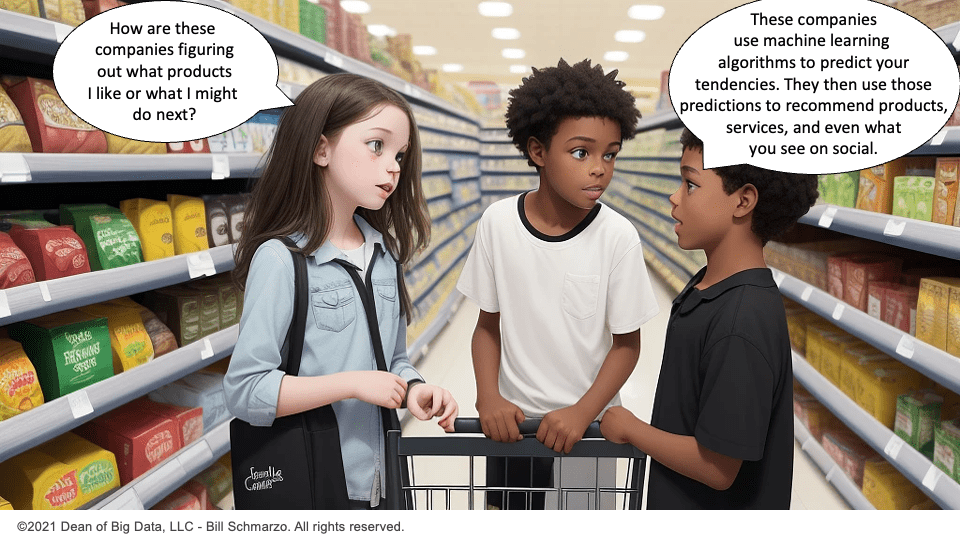
Companies are using Artificial Intelligence (AI) and machine learning algorithms to mine your personal data to create a digital profile that they will use to recommend products, movies, food, TV shows, and even friends that they think you might like. They want you to buy their products, watch their movies, play their video games, and read their content. At times, it’ll seem like these companies know more about you and what you want than you even know about yourself. It can be very disturbing and confusing.

What Are The Risks?

Slide4

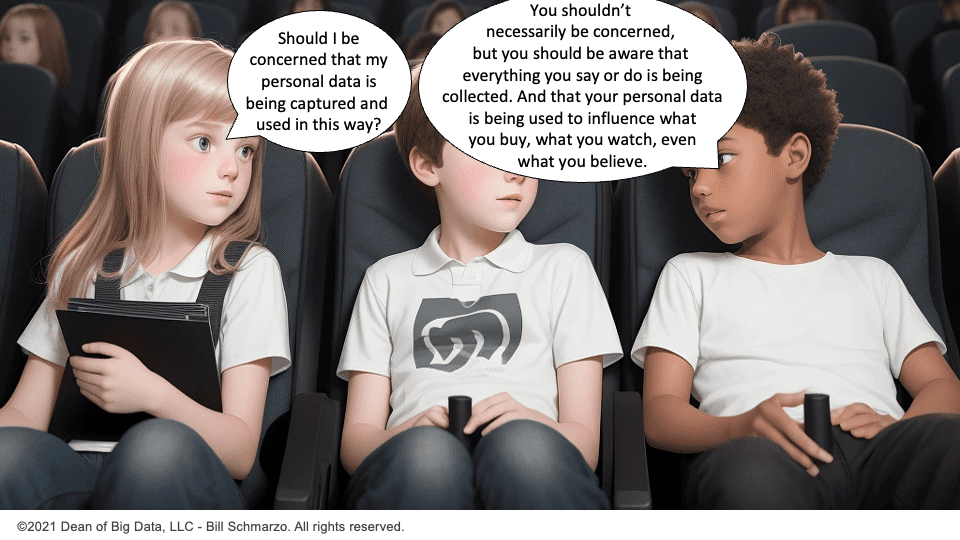
Companies can use your personal data to manipulate you by showing you ads and content designed to influence your actions, selections, decisions, behaviors, and even your beliefs. They might show you an ad for a shirt you don’t really need but might buy because your favorite sports star is wearing it. They might show you ads for products similar to those you’ve already bought, hoping you’ll also buy these. They might show you ads for products that your friends have bought, hoping you’ll also buy them.

Companies can use your personal data to influence your political and societal beliefs by showing only articles and videos supporting your views. This can create “echo chambers” where you become inundated with articles and videos reinforcing your existing beliefs, making it harder to see other perspectives.

What Can You Do to Protect Yourself?

Slide5

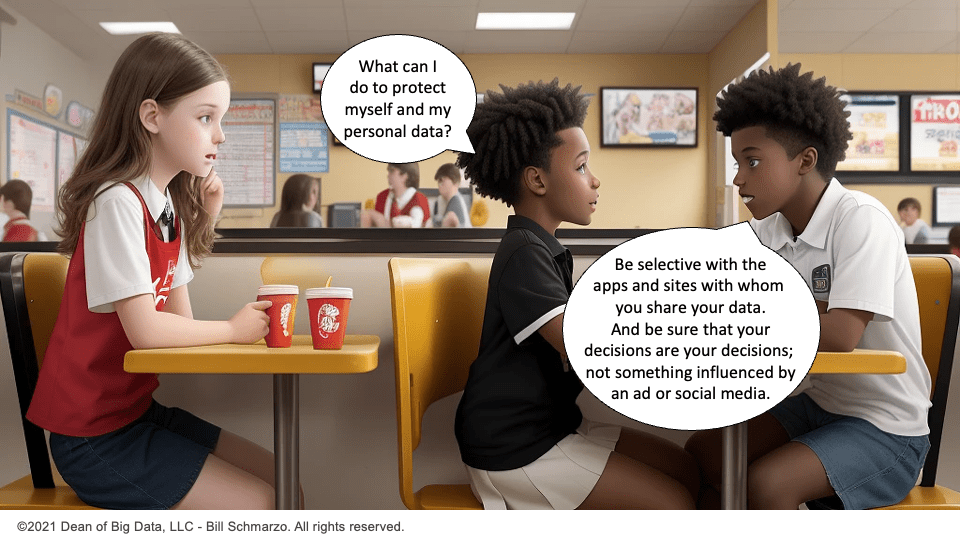
You can protect your personal data by being careful about what information you share online and with whom you share your personal data. You should only share your personal data with companies, websites, and apps that you trust. You should also be very cautious about what you post or share on social media and other websites.

There are data privacy laws like the General Data Protection Regulation (GDPR) and the California Consumer Privacy Act (CCPA) to which responsible organizations will adhere. However, nefarious organizations will ignore these laws and resort to illegal techniques such as fake news, fake videos, SPAM, phishing, and other deceptive methods to steal your personal data and influence your beliefs and perspectives.

You should always make your own decisions and not let someone or something else overly influence your decisions. You can make informed decisions by conducting your own research before acting, buying, or deciding. You should read articles and watch videos from a variety of trusted sources to get a balanced view of important societal and cultural issues.

It’s also crucial to be aware of confirmation bias, which occurs when you only look for information supporting your current beliefs. To avoid confirmation bias, actively seek out different views and perspectives and try to understand the reasoning and rationale of people with different opinions or perspectives than you.

Grade School & Preteen AI & Data Literacy Summary

Slide6

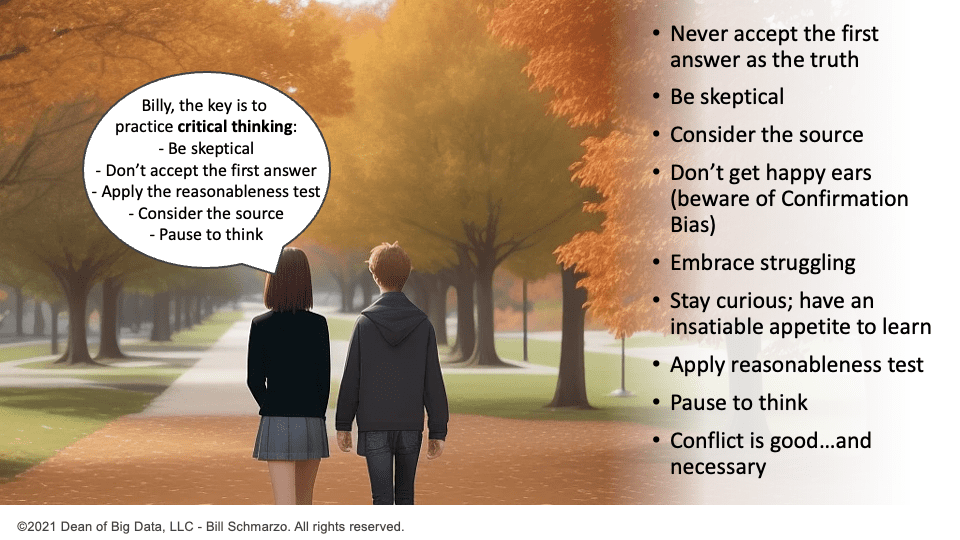
You are our future. Knowing how companies are collecting, analyzing, and using your personal data to influence your buying habits and potentially manipulate your social and political beliefs is critical. Master the art of critical thinking, including:

  • Never accept the first answer as the truth; validate, validate, validate
  • Be skeptical of the information that you are being fed
  • Always consider the source of the content that you are viewing or reading; consider what their intentions might be
  • Don’t get happy ears (that is, beware of Confirmation Bias)
  • Embrace struggling as a way to learn and understand complex subjects and situations
  • Stay curious; have an insatiable appetite to learn
  • Apply the reasonableness test; does that statement even make sense
  • Pause to think and contemplate
  • Conflict is good…and necessary, so don’t run away from it

Hopefully, you’ll see this blog as a step toward taking control of your life in a world more and more dominated by data and AI.

Greening AI: 7 Strategies to Make Applications More Sustainable

Greening AI: 7 Strategies to Make Applications More Sustainable
Image by Editor

AI applications possess unparalleled computational capabilities that can propel progress at an unprecedented pace. Nevertheless, these tools rely heavily on energy-intensive data centers for their operations, resulting in a concerning lack of energy sensitivity that contributes significantly to their carbon footprint. Surprisingly, these AI applications already account for a substantial 2.5 to 3.7 percent of global greenhouse gas emissions, surpassing the emissions from the aviation industry.

And unfortunately, this carbon footprint is increasing at a fast pace.

Presently, the pressing need is to measure the carbon footprint of machine learning applications, as emphasized by Peter Drucker's wisdom that "You can't manage what you can't measure." Currently, there exists a significant lack of clarity in quantifying the environmental impact of AI, with precise figures eluding us.

In addition to measuring the carbon footprint, the AI industry's leaders must actively focus on optimizing it. This dual approach is vital to addressing the environmental concerns surrounding AI applications and ensuring a more sustainable path forward.

What factors contribute to the carbon footprint of AI applications

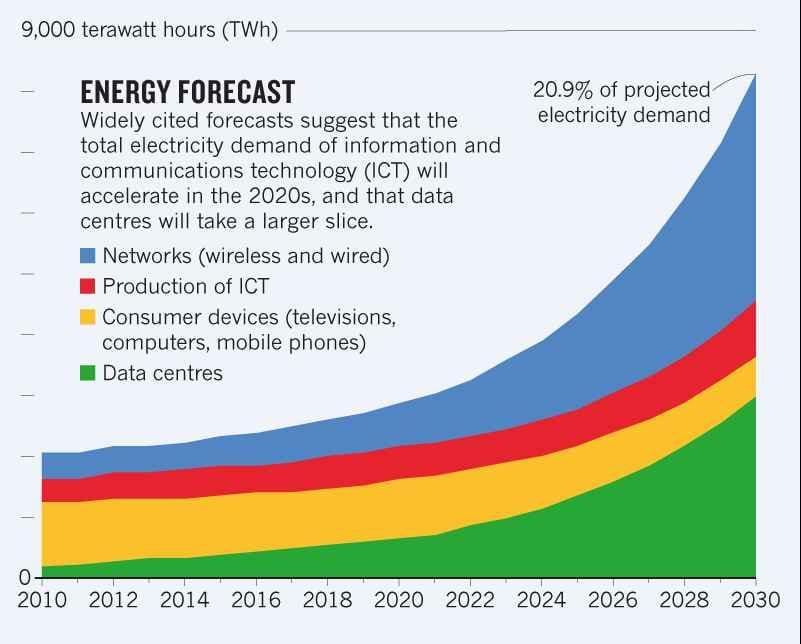
The increased use of machine learning requires increased data centers, many of which are power hungry and thus have a significant carbon footprint. The global electricity usage by data centers amounted to 0.9 to 1.3 percent in 2021.

A 2021 study estimated that this usage can increase to 1.86 percent by 2030. This figure represents the increasing trend of energy demand due to data centers
Greening AI: 7 Strategies to Make Applications More Sustainable
© Energy consumption trend and share of use for data centers

Notably, the higher the energy consumption is, the higher the carbon footprint will be. Data centers heat up during processing and can become faulty and even stop functioning due to overheating. Hence, they need cooling, which requires additional energy. Around 40 percent of the electricity consumed by data centers is for air conditioning.

Computing Carbon Intensity for AI Applications

Given the increasing footprint of AI usage, these tools’ carbon intensity needs to be accounted for. Currently, the research on this subject is limited to analyses of a few models and does not adequately address the diversity of the said models.

Here is an evolved methodology and a few effective tools to compute carbon intensity of AI systems.

Methodology for estimating carbon intensity of AI

The Software Carbon Intensity (SCI) standard is an effective approach for estimating carbon intensity of AI systems. Unlike the conventional methodologies that employ attributional carbon accounting approach, it uses a consequential computing approach.

Consequential approach attempts to calculate the marginal change in emissions arising from an intervention or decision, such as the decision to generate an extra unit. Whereas, attribution refers to accounting average intensity data or static inventories of emissions.

A paper on “Measuring the Carbon Intensity of AI in Cloud Instances” by Jesse Doge et al. has employed this methodology to bring in more informed research. Since a significant amount of AI model training is conducted on cloud computing instances, it can be a valid framework to compute the carbon footprint of AI models. The paper refines SCI formula for such estimations as:

Greening AI: 7 Strategies to Make Applications More Sustainable

which is refined from:

Greening AI: 7 Strategies to Make Applications More Sustainable that derives from Greening AI: 7 Strategies to Make Applications More Sustainable

where:

E: Energy consumed by a software system, primarily of graphical processing units-GPUs which is specialized ML hardware.

I: Location-based marginal carbon emissions by the grid powering the datacenter.

M: Embedded or embodied carbon, which is the carbon emitted during usage, creation, and disposal of hardware.

R: Functional unit, which in this case is one machine learning training task.

C= O+M, where O equals E*I

The paper uses the formula to estimate electricity usage of a single cloud instance. In ML systems based on deep learning, major electricity consumption owes it to the GPU, which is included in this formula. They trained a BERT-base model using a single NVIDIA TITAN X GPU (12 GB) in a commodity server with two Intel Xeon E5-2630 v3 CPUs (2.4GHz) and 256GB RAM (16x16GB DIMMs) to experiment the application of this formula. The following figure shows the results of this experiment:

Greening AI: 7 Strategies to Make Applications More Sustainable
© Energy consumption and split between components of a server

The GPU claims 74 percent of the energy consumption. Although it is still claimed as an underestimation by the paper’s authors, inclusion of GPU is the step in the right direction. It is not the focus of the conventional estimation techniques, which means that a major contributor of carbon footprint is being overlooked in the estimations. Evidently, SCI offers a more wholesome and reliable computation of carbon intensity.

Approaches to measure real-time carbon footprint of cloud computing

AI model training is often conducted on cloud compute instances, as cloud makes it flexible, accessible, and cost-efficient. Cloud computing provides the infrastructure and resources to deploy and train AI models at scale. That’s why model training on cloud computing is increasing gradually.

It’s important to measure the real-time carbon intensity of cloud compute instances to identify areas suitable for mitigation efforts. Accounting time-based and location-specific marginal emissions per unit of energy can help calculate operational carbon emissions, as done by a 2022 paper.

An opensource tool, Cloud Carbon Footprint (CCF) software is also available to compute the impact of cloud instances.

Improving the carbon efficiency of AI applications

Here are 7 ways to optimize the carbon intensity of AI systems.

1. Write better, more efficient code

Optimized codes can reduce energy consumption by 30 percent through decreased memory and processor usage. Writing a carbon-efficient code involves optimizing algorithms for faster execution, reducing unnecessary computations, and selecting energy-efficient hardware to perform tasks with less power.

Developers can use profiling tools to identify performance bottlenecks and areas for optimization in their code. This process can lead to more energy-efficient software. Also, consider implementing energy-aware programming techniques, where code is designed to adapt to the available resources and prioritize energy-efficient execution paths.

2. Select more efficient model

Choosing the right algorithms and data structures is crucial. Developers should opt for algorithms that minimize computational complexity and consequently, energy consumption. If the more complex model only yields 3-5% improvement but takes 2-3x more time to train; then pick the simpler and faster model.

Model distillation is another technique for condensing large models into smaller versions to make them more efficient while retaining essential knowledge. It can be achieved by training a small model to mimic the large one or removing unnecessary connections from a neural network.

3. Tune model parameters

Tune hyperparameters for the model using dual-objective optimization that balance model performance (e.g., accuracy) and energy consumption. This dual-objective approach ensures that you are not sacrificing one for the other, making your models more efficient.

Leverage techniques like Parameter-Efficient Fine-Tuning (PEFT) whose goal is to attain performance similar to traditional fine-tuning but with a reduced number of trainable parameters. This approach involves fine-tuning a small subset of model parameters while keeping the majority of the pre-trained Large Language Models (LLMs) frozen, resulting in significant reductions in computational resources and energy consumption.

4. Compress data and use low-energy storage

Implement data compression techniques to reduce the amount of data transmitted. Compressed data requires less energy to transfer and occupies lower space on disk. During the model serving phase, using a cache can help reduce the calls made to the online storage layer thereby reducing

Additionally, picking the right storage technology can result in significant gains. For eg. AWS Glacier is an efficient data archiving solution and can be a more sustainable approach than using S3 if the data does not need to be accessed frequently.

5. Train models on cleaner energy

If you are using a cloud service for model training, you can choose the region to operate computations. Choose a region that employs renewable energy sources for this purpose, and you can reduce the emissions by up to 30 times. AWS blog post outlines the balance between optimizing for business and sustainability goals.

Another option is to select the opportune time to run the model. At certain times of the day; the energy is cleaner and such data can be acquired through a paid service such as Electricity Map, which offers access to real-time data and future predictions regarding the carbon intensity of electricity in different regions.

6. Use specialized data centers and hardware for model training

Choosing more efficient data centers and hardware can make a huge difference on carbon intensity. ML-specific data centers and hardware can be 1.4-2 and 2-5 times more energy efficient than the general ones.

7. Use serverless deployments like AWS Lambda, Azure Functions

Traditional deployments require the server to be always on, which means 24×7 energy consumption. Serverless deployments like AWS Lambda and Azure Functions work just fine with minimal carbon intensity.

Final Notes

The AI sector is experiencing exponential growth, permeating every facet of business and daily existence. However, this expansion comes at a cost—a burgeoning carbon footprint that threatens to steer us further away from the goal of limiting global temperature increases to just 1°C.

This carbon footprint is not just a present concern; its repercussions may extend across generations, affecting those who bear no responsibility for its creation. Therefore, it becomes imperative to take decisive actions to mitigate AI-related carbon emissions and explore sustainable avenues for harnessing its potential. It is crucial to ensure that AI's benefits do not come at the expense of the environment and the well-being of future generations.

Ankur Gupta is an engineering leader with a decade of experience spanning sustainability, transportation, telecommunication and infrastructure domains; currently holds the position of Engineering Manager at Uber. In this role, he plays a pivotal role in driving the advancement of Uber's Vehicles Platform, leading the charge towards a zero-emissions future through the integration of cutting-edge electric and connected vehicles.

More On This Topic

  • One question to make your data project 10x more valuable
  • Using Data Science to Make Clean Energy More Equitable
  • Data Masking: The Core of Ensuring GDPR and other Regulatory Compliance…
  • Feature Store Summit 2023: Practical Strategies for Deploying ML Models in…
  • 10 Real-Life Applications of Reinforcement Learning
  • Cloud Based Web Scraping for Big Data Applications

AI the Muse for Modern Artists

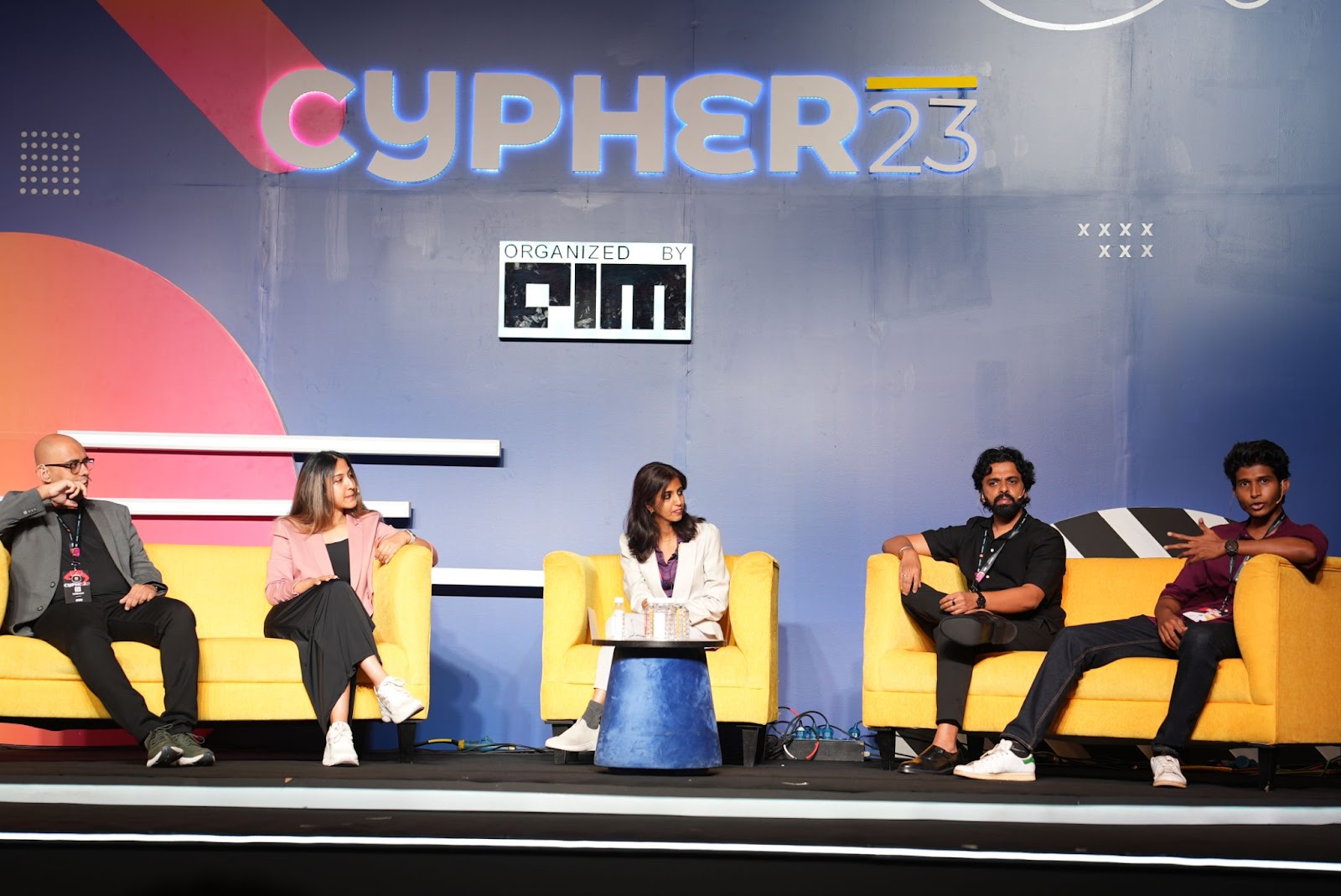
“It is foolish to resist AI while creating art,” said Sneha Chakraborty, a muralist, said, at Cypher 2023. She was one of the panellists who discussed the fusion of AI in art, alongside Gokul Pillai, Vimal Chandran and Tapan Aslot, who’s mind-boggling artworks took centre stage at the event.

AI art display at Cypher 2023 captivated attendees.

When Douglas Hofstader wrote the book Gödel, Escher, Bach, he was convinced that the creative pursuits were intrinsically linked to humanity and not machines. That, however, is not the case today. “The current AI systems, especially language models and diffusion models, which are used for visual arts are perfectly suited to creative pursuits,” said Sentience Institute’s co-founder Jacy Reese Anthis, saying that many of the scientists misjudged AI, thinking that the first breakthrough would be in area of self-driving vehicles. Now, it looks like generative AI is turning that dream into a reality as well.

AI tools that create ‘art’

Instead of painstakingly making the piece of art, now technology has democratised the product giving access to anyone to come up with brilliant images from mere prompts. Ryan Murdoch an artist said, “So, I think it will shift our values away from, ‘Is this stunning image with the colours that I want?’ to ‘Is this image really clever, meaningful, or special in some other way?’”

Source: https://x.com/emaweirdd/status/1682405777170989058?s=20

The tools though can be used by anyone will be different when employed by an artist with skill and finesse. “We all have cameras but we still employ a professional photographer when it comes to capturing special moments,” reasoned Gokul Pillai, a photographer turned AI artist, who spoke at Cypher 2023.

Panelists: Tapan Aslot, Sneha Chakraborty, Vimal Chandran and Gokul Pillai

Text to image tools released by OpenAI’s unleashed an entire collage of similar tools. DALL.E progressively improved with its next iterations. The quality of images, the intricacies of the background, understanding detailed and long prompts got better and they’ve even released it for ChatGPT enterprise and plus users. Midjourney, Stable Diffusion, Imagen are all similar platforms and the most popular ones among the many available online that do the same thing.

Unfazed by this photo editing softwares like Adobe, Figma, Blender and CorelDraw are pushing ahead with their own AI suites. All of them are constantly updating their AI features to their already existing quiver.

Delegating all the repetitive and uninspiring work to the computer, Adobe aims to automate routine or “busy work” tasks, such as removing stray hairs in Photoshop and editing filler words in videos. At Adobe Max, their annual conference, the company appeased their uses with new announcements like the Generative Colour for Illustrator. With simple prompts users can ask Firefly to generate and apply new colour palettes to existing work in seconds

Canva on the other hand launched ‘Magic Studio’ and true to its name even non experts can work on the platform with AI tools thanks to their partnership with OpenAI, Runway and Google Imagen’s datasets.

Is it really art?

There is no doubt that art has been constantly changing. From paintbrushes to digital canvases, the tool used by humans to express themselves has only evolved over time. The AI systems built on top of billions of images that were made by humans are now the building blocks to the art that will be created in the future.

The view that somehow this will destroy human creativity or it’s going to take the soul from it is misplaced fear. It will multiply the number of mediocre art on the internet by nature of experimentation but the artists will finally benefit from not having to work on mundane tasks. Vimal Chandran, explained how this works for him, saying, “ When I’m beginning to make a movie, it used to take a long time to make a mood board of the initial sketches for all the frames. This is a lengthy and somewhat tedious aspect of the movie-making process. Now I outsource this to AI which has improved my productivity, allowing me to concentrate more on the main aspects of movie production.”

Artist: Mario Klingemann (Botto)

Another interesting example of how Japanese anime Akira 1988 took three years of work from 70+ of artists working round the clock to create one masterpiece but today to be able to do the same within months doesn’t take away anything from the original. The period of turmoil that musicians inflicted upon themselves when they denied P2P file sharing and then digital music decimated the piracy laws finally embracing digital music is where we stand with AI art.

The post AI the Muse for Modern Artists appeared first on Analytics India Magazine.

10 Basic Statistical Concepts in Plain English

10 Basic Statistical Concepts in Plain English
Image by Author

Statistics plays a pivotal role across numerous fields including data science, business, social sciences, and more. However, many of the foundational statistical concepts can seem complex and intimidating, especially for beginners without a strong math background. This article will look at 10 foundational statistical concepts in simple, non-technical terms, with the goal of conveying these concepts in an accessible and approachable manner.

1. Probability Distributions

A probability distribution shows the likelihood of different outcomes occurring in a process. For example, say we have a bag with an equal number of red, blue, and green marbles. If we draw marbles randomly, the probability distribution tells us the chances of drawing each color. It would show that there's an equal 1/3 chance or 33% probability of getting red, blue, or green. Many types of real-world data can often be modeled using known probability distributions, although this is not always the case.

2. Hypothesis Testing

Hypothesis testing allows us to make claims based on data, similar to how a courtroom trial aims to prove guilt or innocence based on available evidence. We start with a hypothesis or claim, called the null hypothesis. Then we check if the observed data supports or refutes this claim within a certain confidence level. For example, a drug manufacturer may claim their new medicine reduces pain faster than existing ones. Researchers can test this claim by analyzing results from clinical trials. Based on the data, they can either reject the claim if evidence is lacking or fail to reject the null hypothesis, indicating that there isn't enough evidence to say the new drug does not reduce pain faster.

3. Confidence Intervals

When sampling data from a population, confidence intervals provide a range of values within which we can be reasonably sure that the true mean of the population lies. For example, if we state that the average height of men in a country is 172 cm with a 95% confidence interval of 170 cm to 174 cm, then we are 95% confident that the mean height for all men lies between 170 cm and 174 cm. The confidence interval generally gets smaller with larger sample sizes, assuming other factors like variability remain constant.

4. Regression Analysis

Regression analysis helps us understand how changes in one variable impact another variable. For instance, we can analyze data to see how sales are impacted by advertising expenditure. The regression equation then quantifies the relationship, allowing us to predict future sales based on projected ad spends. Beyond two variables, multiple regression incorporates several explanatory variables to isolate their individual effects on the outcome variable.

5. ANOVA (Analysis of Variance)

ANOVA lets us compare means across multiple groups to see if they are significantly different. For example, a retailer might test customer satisfaction with three packaging designs. By analyzing survey ratings, ANOVA can confirm whether satisfaction levels differ across the three groups. If differences exist, it means not all designs lead to equal satisfaction. This insight helps choose the optimal packaging.

6. P-value

The p-value indicates the probability of getting results at least as extreme as the observed data, assuming the null hypothesis is true. A small p-value provides strong evidence against the null hypothesis, so you may consider rejecting it in favor of the alternative hypothesis. Going back to the clinical trials example, a small p-value when comparing pain relief of the new and standard drugs would indicate strong statistical evidence that the new drug does act faster.

7. Bayesian Statistics

While frequentist statistics relies solely on data, Bayesian statistics incorporates existing beliefs along with new evidence. As we get more data, we update our beliefs. For example, say the probability of actually raining today based on forecasts is 50%. If we then notice dark clouds overhead, Bayes' theorem tells us how to update this probability to say 70% based on the new evidence. Bayesian methods, which can be computationally intensive, can be popular in aspects of data science.

8. Standard Deviation

The standard deviation quantifies how dispersed or spread out data is from the mean. A low standard deviation means points cluster closely around the mean, while a high standard deviation indicates wider variation. For example, test scores of 85, 88, 89, 90 have a lower standard deviation than scores of 60, 75, 90, 100. Standard deviation is extremely useful in statistics and forms the basis of many analyses.

9. Correlation Coefficient

The correlation coefficient measures how strongly two variables are linearly related, from -1 to +1. Values close to +/-1 indicate a strong correlation, while values near 0 mean a weak correlation. For example, we can calculate the correlation between house size and price. A strong positive correlation implies larger houses tend to have higher prices. It's important to note that while correlation measures a relationship, it does not imply that one variable causes the other to occur. 10. Central Limit Theorem

The central limit theorem is more accurate when the sample size is large and states that when we take such samples from a population and calculate sample means, these means follow a normal distribution pattern, regardless of the original distribution. For example, if we survey groups of people about movie preferences, plot the average for each group, and repeat this process, the averages form a bell curve, even if individual opinions vary.

Understanding statistical concepts provides an analytical lens through which to view the world and begin to interpret data so that we are able to make informed, evidence-based decisions. Be it in data science, business, school, or our everyday lives, statistics is a powerful set of tools that can provide us seemingly endless insight into how the world works. I hope this article has provided an intuitive yet comprehensive introduction to some of these ideas.

Matthew Mayo (@mattmayo13) holds a Master's degree in computer science and a graduate diploma in data mining. As Editor-in-Chief of KDnuggets, Matthew aims to make complex data science concepts accessible. His professional interests include natural language processing, machine learning algorithms, and exploring emerging AI. He is driven by a mission to democratize knowledge in the data science community. Matthew has been coding since he was 6 years old.

More On This Topic

  • Ensemble Methods Explained in Plain English: Bagging
  • The 8 Basic Statistics Concepts for Data Science
  • Advanced Statistical Concepts in Data Science
  • 10 Statistical Concepts You Should Know For Data Science Interviews
  • 10 Must-Know Statistical Concepts for Data Scientists
  • Four Basic Steps in Data Preparation