Apple Accepts Right-to-Repair Legislation

Apple Accepts Right-to-Repair Legislation

During the White House Convening on Right to Repair, the Biden administration announced on Tuesday that Apple is set to unveil a plan that will make components, tools, and repair documentation for its products available to both independent repair shops and consumers across the nation at fair and reasonable prices.

This announcement was made by National Economic Council Director Lael Brainard during a White House event focused on the “right to repair,” urging Congress to pass nationwide legislation necessitating such action.

The event, in line with President Joe Biden’s drive to boost competition and combat practices that inflate consumer prices, aims to provide consumers with greater autonomy in repairing their possessions, spanning from tractors to smartphones. Brainard highlighted that California, Colorado, New York, and Minnesota have already enacted right-to-repair laws, while an additional 30 states have introduced similar legislation.

She noted that Apple is in support of a nationwide law and has previously endorsed the California law, which mandates companies to provide necessary parts, tools, and documentation for repairing consumer electronic devices and appliances to both independent repair shops and consumers at equitable and reasonable rates. The tech giant has committed to extending this approach across the entire nation.

In the past, Apple faced criticism from right-to-repair advocates who argued that their sleek devices were challenging to repair, with insufficient company support. However, in recent years, Apple has shifted its stance, emphasizing the longevity and resale value of its products while simplifying the repair process and increasing accessibility to spare parts.

Notably, Apple began distributing parts and manuals to select independent repair shops back in 2019, and in August, the company officially supported right-to-repair legislation within its home state of California.

The post Apple Accepts Right-to-Repair Legislation appeared first on Analytics India Magazine.

5 Ways Generative AI Will Impact Culture & Society: What Tech Leaders Need to Know

An AI hand and a human hand touching a brain.
Image: peshkova/Adobe Stock

Generative AI is making waves in the tech industry, but its impact will be felt and accelerated far beyond the technology world. Generative AI comes with significant impacts across technological, political, economic, social, cultural, ethical, regulatory, legal and environmental domains.

As a key part of their strategic planning, technology leaders need to understand the full breadth and scope of the influence that generative AI may have on their organizations, as well as the profound impact of generative AI on our society and how society will impact the adoption of generative AI. This will paint a more holistic picture and enhance leaders’ strategic decision making.

Here are five areas generative AI is impacting or will impact from a social and cultural perspective that technology leaders should be considering. While this isn’t a comprehensive list, by understanding these impacts and taking proactive measures, leaders can harness the potential of generative AI while addressing its challenges.

Visit Gartner

Jump to:

  • Collaboration
  • Dehumanization
  • Social media
  • AI natives
  • Visual and performing arts

Collaboration

Generative AI is poised to have a transformative impact on collaboration, revolutionizing how teams work together and with technology. By leveraging deep learning algorithms, generative AI can mimic human creativity and generate new content in various forms, such as text, speech, images, music and video.

In addition, generative AI plays a vital role in the creation of digital human assistants, which can aid in tasks such as answering queries, summarizing and producing reports, facilitating data analysis, delivering tailored suggestions and automating activities such as meeting scheduling, email management and document organization. Digital assistants learn from user interactions over time, enabling them to handle more complex tasks and freeing human workers to focus on higher-level work.

Generative AI’s impact on collaboration isn’t without challenges and potential adverse effects; this includes concerns about bias and fairness, security of user data, people’s privacy, content manipulation and integration difficulties. Organizations must address these issues responsibly through diverse and curated training data, robust data protection measures, ethical guidelines, fostering user engagement and providing adequate training and support.

Dehumanization

Generative AI shouldn’t be viewed as a replacement for human judgment but rather as a tool to enhance creativity and innovation. Gartner predicts that by 2036, the incremental spending for products, services and hybrid offerings to deliver AI solutions will exceed $50 trillion. Technology leaders should be aware of the psychology of the new diversity that will emerge as teams become composed of humans and nonhumans working together.

Technology and innovation leaders should engage in open dialogue with stakeholders to ensure that generative AI is developed and deployed in a way that optimizes their operations and processes while also demonstrating a commitment to valuing and supporting employees. While AI-based machines are fast, accurate and consistently rational, they lack the intuitive, emotional and culturally sensitive abilities that humans possess. Organizations that integrate generative AI with human input can create more personalized and authentic experiences while also preserving cultural diversity and individuality.

The integration of generative AI into social media platforms has profound implications for technology innovation leaders. Platforms such as Snapchat, Meta, YouTube and Reddit are investing in generative AI, and users are exploring it for content creation and real-time language translation.

However, the prevalence of AI-generated content raises concerns about the spread of fake information and the erosion of trust in social media platforms and digital interactions. The dissemination of misleading or manipulated content can further diminish public trust in the authenticity of information shared on social media, undermining the credibility of these platforms and media sources overall.

For technology leaders, understanding the implications of generative AI on social media is essential; it offers opportunities for enhanced user experiences, improved ad targeting and data-driven strategies. However, it also demands ethical considerations, responsible implementation and proactive measures to address challenges such as algorithmic bias, polarization, misinformation and privacy concerns.

AI natives

Although AI natives will include a generation that has grown up with AI, the starting point of that generation remains uncertain — AI has been around for decades but has simmered for a long time. We will all need to adapt to AI’s growing pervasiveness, and the term “AI natives” will be used broadly to indicate those to whom AI is second nature.

As AI systems become integrated into our daily lives, AI natives will have a natural affinity for and adeptness with AI. Their inherent familiarity will reshape communication, work preferences, socialization, entertainment and their interactions with technology. For instance, there’s a potential decrease in critical thinking and problem-solving abilities as AI natives heavily depend on AI for information and decision making, diminishing their need to analyze situations independently.

SEE: Hiring kit: Prompt engineer (TechRepublic Premium)

The arrival of AI natives will bring new expectations to the workforce, much as digital natives did. AI natives will entrust AI systems with tasks and rely on them, viewing this as a competitive requirement. Blurring boundaries between human- and AI-created content will be commonplace, and the reliance on generative AI tools will shape their long-term thinking. Moreover, the widespread adoption of AI will give rise to new job opportunities and necessitate re-evaluating the conventional notion of jobs, demanding a more flexible and adaptable skill set.

Adapting to the demands of AI natives and embracing continuous reinvention will be essential for technology leaders to consider in their long-term strategies.

Visual and performing arts

Until recently, creativity and art were the exclusive domain of humans. Generative AI challenges that by democratizing the creation of art, offering new artistic frontiers while disrupting traditional installations.

For instance, with the help of AI-generated algorithms, musicians are exploring new sounds and styles; performers are creating interactive and immersive performances; and screenplay writers are generating new scripts. These disruptions could lead to new business models and revenue streams for artists and entities that utilize generative AI for creating, distributing and monetizing artwork.

Simultaneously, AI is creating legal and ethical considerations around authorship, copyright, ownership and authenticity. Technology leaders must work with their legal and regulatory teams to ensure their organizations are managing the risks of AI-generated works of art and graphic design.

Issa Kerremans, Principal Analyst at Gartner.
Issa Kerremans, Principal Analyst at Gartner. Image: Gartner

Issa Kerremans is a Principal Analyst at Gartner, Inc. researching artificial intelligence and digital transformation, specializing in generative AI, process mining, task mining and digital twin of an organization (DTO).

Subscribe to the Executive Briefing Newsletter

Discover the secrets to IT leadership success with these tips on project management, budgets, and dealing with day-to-day challenges.

Delivered Tuesdays and Thursdays Sign up today

Data poisoning tool lets artists fight back against AI scraping. Here’s how

Messy paint tubes

A major issue plaguing generative AI models is AI scraping, the process used by AI companies to train their AI models by capturing data from internet sources without the owners' permission. AI scraping can have an especially negative impact on visual artists, whose work is scraped to generate new art in text-to-image models. Now, however, there may be a solution.

Researchers at the University of Chicago have created Nightshade, a new tool that gives artists the ability to "poison" their digital art in order to prevent developers from training AI tools on their work.

Also: More fun with DALL-E 3 in ChatGPT: Can it design a T-shirt?

Using Nightshade, artists can make changes to the pixels in their art that are invisible to the human eye, but cause the generative AI model to break in "chaotic" and "unpredictable" ways, according to the MIT Technology Review, which got an exclusive preview of the research.

The prompt-specific attack causes generative AI models to render useless outputs due to manipulating the model's learning, which causes the model to confuse subjects for each other.

For example, it may learn that a dog is actually a cat, which would, in turn, cause the model to produce incorrect images that don't match the text prompt.

According to the research paper, Nightshade poison samples can corrupt a Stable Diffusion prompt in under 100 samples, as seen in the image below.

In addition to poisoning the specific term, the poisoning also bleeds through associated terms.

For example, in the example above, the term "dog" would not only be impacted but also synonyms like "puppy," "hound," and "husky," according to the research paper.

The correlation between the terms doesn't have to be as direct as the example above either. For example, the paper delineates how when the term "fantasy art" was poisoned, so was the related phrase "a painting by Michael Whelan," a well-known creator of fantasy art.

There are different potential defenses that the model trainers could deploy, including filtering high-loss data, position detection methods, and poison removal methods, but all three aren't entirely effective.

Also: Apple will soon bring AI to its devices, according to reports. Here's where

Furthermore, the poisoned data is complicated to remove from the model since the AI company would have to go in and individually delete each corrupted sample.

Nightshade not only has the potential to deter AI companies from using data without asking for permission but also encourages users to use precaution when employing any of these generative AI models.

Other attempts have been made to mitigate the issue of artists' work being used without their permission. Some AI image-generating models, such as Getty Images' image generator and Adobe Firefly, use only images that are approved by the artist or are open-sourced to train their models and have a compensation program in place in return.

Lenovo and NVIDIA Expand Generative AI Services Partnership

Sign of Lenovo at Lenovo Canada head office near Toronto in Markham. Lenovo is a Chinese technology company with headquarters in Beijing, China.
Image: JHVEPhoto/Adobe Stock

NVIDIA generative AI enhancements and hardware are now available through Lenovo’s AI Professional Services Practice, Lenovo Chairman and CEO Yuanqing Yang and NVIDIA Founder and CEO Jensen Huang announced today during the Lenovo Tech World 2023 keynote in Austin, Texas. TechRepublic reported on this event remotely.

Many of the products resulting from the partnership between NVIDIA and Lenovo are available now. The Lenovo ThinkSystem SR675 V3 server will fall under NVIDIA’s MGX modular reference design framework going forward, and the Lenovo ThinkStation PX workstation, which is on sale today, is available in a bundled package with NVIDIA’s AI Enterprise solution.

More products resulting from the engineering partnership between NVIDIA and Lenovo will be announced at GTC 2024, held March 18 to 21.

“Our goal for the initiative is just to deliver AI so that it’s much easier to consume. People may not be buying AI; they’re going to be buying capability that AI unlocks for them,” said Scott Tease, general manager of Lenovo’s high performance computing and artificial intelligence business, in a phone interview with TechRepublic.

All of the products discussed in this article are available internationally wherever NVIDIA and Lenovo products and services are supported.

Jump to:

  • The partnership targets organizations looking for fine-tuned generative AI models
  • Lenovo workstations and NVIDIA AI Enterprise will be bundled
  • Lenovo expands its use of NVIDIA’s MGX modular design framework

The partnership targets organizations looking for fine-tuned generative AI models

The Lenovo AI Professional Services Practice currently offers a variety of generative AI, high-performance computing and hybrid cloud services; the NVIDIA partnership adds the ability to create custom AI models using the NVIDIA AI Foundations cloud service. From there, those custom generative AI models can be run on on-prem Lenovo systems with NVIDIA software and hardware.

“What we’re announcing this week is a new era of partnership that’s going to help drive this new era of what we’re calling hybrid AI,” said Tease. “A lot of our customers are creating lots of data at their desktop or next to their desk or in an edge location … It’s not cost effective to move the data. There could be regulations on data moving across country lines, things like that. There could be latency issues. We want to be able to do a portion of that AI value chain right there locally where the data is being created or being stored.”

The professional services — which include everything from sharing ideas about generative AI deployment to data architecture, model building, proof-of-concept deployment and ongoing management of that deployment — will be enabled by capacity sourced from NVIDIA. Lenovo professional services team members are being trained jointly with NVIDIA to help customers engage in AI activities from Lenovo and NVIDIA.

“(NVIDIA is) the vision behind a lot of the AI goodness that we’re seeing in the world, but we’ve got more feet on the street all around the world calling in end users,” Tease said. “We want to be able to combine forces and be able to tell this story more often. No matter where our customer is on their AI journey, we want to meet them together and help accelerate their journey forward.”

SEE: AWS and IBM Consulting are mobilizing 10,000 consultants to train customers how to use their joint generative AI offerings. (TechRepublic)

Bob Pette, general manager for enterprise platforms at NVIDIA, pointed out that many of NVIDIA’s customers want finely tuned models that contain their own company’s or own department’s data.

“Right now, we’re seeing huge interest in building the foundational models themselves,” Pette said in a phone interview with TechRepublic. “Once we have licensable large language models and we can access this technology, what we’ve basically done is we’ve risen the tide for everybody. What used to be out of reach for a lot of customers is now pretty easily in reach by just taking a large language model, presenting it with your own data, (and) creating a private model to go answer questions that matter to you.”

Lenovo isn’t replacing its focus on cloud with a focus on AI, Pette said, but rather adding foundational model creation for organizations that want to run private generative AI models.

Lenovo workstations and NVIDIA AI Enterprise will be bundled

The Lenovo ThinkSystem SR675 V3 server and ThinkStation PX workstation are both optimized for production AI. Some ThinkStation PX workstations will be bundled with NVIDIA AI Enterprise.

NVIDIA AI Enterprise includes the NVIDIA NeMo framework, which lets customers access NVIDIA AI Foundations to customize enterprise-grade large language models. Retrieval-augmented generation and fine-tuning will help enterprises build generative AI models around their own data.

The ThinkSystem SR675 V3 will come with NVIDIA L40S GPUs, NVIDIA BlueField-3 DPUs and NVIDIA Spectrum-X networking.

In the future, Tease predicted, ” … almost none of these customers are going to think they’re buying AI. We’re going to ingrain (generative AI) capability so deep into the function that they’re seeing that people don’t think about buying AI, they’re just thinking about buying this capability.”

Lenovo expands its use of NVIDIA’s MGX modular design framework

Going forward, the Lenovo ThinkSystem SR675 V3 will move to the MGX modular design, said Pette. The modular reference design is a document made to assist with modular server design, particularly for generative AI workloads.

The MGX reference architecture is ” … really our AI reference architecture for the future, taking into account latency, node interconnects, and all the things that, if we were a manufacturer, we would suggest,” said Pette. “We get with companies like Lenovo. They have their own suggestions. And what we want to get out of this is a long lead time to put everything down on the motherboard … You’re not re-engineering sheet metal and motherboards.”

Subscribe to the Innovation Insider Newsletter

Catch up on the latest tech innovations that are changing the world, including IoT, 5G, the latest about phones, security, smart cities, AI, robotics, and more.

Delivered Tuesdays and Fridays Sign up today

DSC Weekly 24 October 2023

Announcements

  • Cloud computing offers benefits like scalability, cost efficiency and storage capacity, but can introduce many security threats due to its large attack surface and overall complexity. Register for the Building a Secure Cloud Environment summit to hear leading experts discuss security strategies for multi-cloud architecture, best practices to tackle the challenges of securing the multi cloud, and leading tools and platforms to ward off common threats and keep cloud environments safe.
  • Traditional methods of cyberattack such as ransomware, malware, and email phishing will persist, but security strategies must now address emerging concerns like the growing prevalence of AI and the near-universal employee use of mobile and IoT devices. Tune into our virtual summit on The 2024 ThreatScape to gain insights from renowned industry experts into the risks that lie ahead and discover the most effective preventive and defensive measures against potentially catastrophic attacks.

Top Stories

  • Seamless integration of data from unconventional source systems into Business Intelligence using data science techniques
    October 24, 2023
    by Venkata Nori and Kshitij Gopali
    As technology is evolving, most companies in the world are adopting advanced mechanisms for their daily tasks of storing/updating data, project management & tracking, incident management, version control, etc. Periodically, these companies’ business stakeholders would want to extract and analyze the data to see how the business is performing and improvement areas.
  • Grade School & Preteen AI & Data Literacy
    October 21, 2023
    by Bill Schmarzo
    I recently wrote the book “AI & Data Literacy: Empowering Citizens of Data Science” to help non-data scientists – which is most of the world – understand the risks associated with how companies capture and use your personal data to influence your viewing and buying habits… and even your political and societal beliefs.
  • Internet Of Things (IOT): Application In Hazardous Locations
    October 17, 2023
    by Kartik Gandhi, Dr. Suraj Pardeshi
    Internet of Things (IoT) represents the fourth-generation technology that facilitates the connection and transformation of products into smart, intelligent and communicative entities. IoT has already established its footprint in various business verticals such as medical, heath care, automobile, and industrial applications. IoT empowers the collection, analysis, and transmission of information across various networks, encompassing both server and edge devices. This information can then undergo further processing and distribution to multiple inter-connected devices through cloud connectivity.
Education_DSC_160x600-2

In-Depth

  • How data science and medical device cybersecurity cross paths to protect patients and enhance healthcare
    October 24, 2023
    by Evan Morris
    A recent interview by Medical Device Network with GlobalData medical analyst Alexandra Murdoch shares interesting insights into cybersecurity for medical devices. Murdoch said that one of the reasons why most organizations have a hard time securing their devices is the rapid adoption of new technologies, which has not been accompanied by the aggressive establishment of cyber defenses.
  • Skills required to excel in a business analytics career
    October 24, 2023
    by Erika Balla
    In the contemporary business landscape, where data is heralded as the new oil, Business Analytics has emerged as a pivotal domain, steering organizations towards informed decision-making and strategic planning. business analytics encompasses the utilization of data, statistical algorithms, and machine learning techniques to comprehend the business context, forecast future trends, and facilitate optimal decision-making.
  • GenAI: The game-changer in data analytics
    October 24, 2023
    by Yana Ihnatchyck
    In an era where data drives decisions, GenAI emerges as a prodigy force in the realm of data analytics. According to Statista, LLM’s market size is expected to show an annual growth rate of 24%, resulting in a market volume of $207 bn by the end of 2030.
  • DSC Weekly 17 October 2023
    October 17, 2023
    by Scott Thompson
    Read more of the top articles from the Data Science Central community.
  • Uncharted digital landscapes and the quest for timeless identity
    October 17, 2023
    by Michael Peres
    In a recent podcast episode, Lex Freedman and Mark Zuckerberg convened in the Metaverse, where the digital realm intertwines with reality. Their astonishingly realistic interaction, while highlighting technological advancements, also prompted deeper contemplations. As the line between digital recreations and reality becomes increasingly blurred, it beckons questions about the definitions of identity and consciousness.
  • The digital evolution in aviation: how big data and analytics are transforming the industry
    October 17, 2023
    by Jeremy Bowen
    Long before passengers sit back, relax, and enjoy their flight, data has played a critical role in getting them to their seats. It has been a cornerstone of the aviation industry since the early days of air travel. Indeed, from the early 20th century, data was collected through manual processes such as pilots logging information about weather conditions, navigation, and aircraft performance, and design engineers using this information to improve aircraft design and maintenance procedures.

GenAI: The game-changer in data analytics

AI

In an era where data drives decisions, GenAI emerges as a prodigy force in the realm of data analytics. According to Statista, LLM’s market size is expected to show an annual growth rate of 24%, resulting in a market volume of $207 bn by the end of 2030.

This cutting-edge technology, built on sophisticated algorithms and advanced machine learning, is redefining how businesses interpret vast volumes of data, uncovering insights with unprecedented accuracy and speed. As companies navigate through an ocean of information, GenAI stands as a beacon, illuminating the path to informed decisions and strategic foresight.

In this article, we delve into the mechanics of GenAI, exploring its transformative impact on data analytics. We will guide you through practical ways to harness its power, enabling your business not only to keep pace with the digital revolution but also to propel itself forward. Let’s start!

The concept of GenAI: What is it?

In the simplest terms, generative AI (GenAI) represents the next evolutionary step in artificial intelligence, specifically designed to elevate data analytics to unprecedented levels. Originating from the need to process exponentially growing data with precision, GenAI was conceptualized as a solution to the modern-day data conundrum that businesses face.

GenAI works by ingesting a wide array of data, breaking down information silos, and analyzing data points in a holistic manner. It transcends surface-level analysis, diving deep into data subtleties, and unearthing correlations that are not readily apparent.

By employing GenAI, businesses are equipped to make predictions about the future, anticipate market shifts, and understand consumer behavior intricately, giving them a vantage point that was not possible before.

AI vs. GenAI: What’s the difference?

The mechanics of GenAI are rooted in advanced machine learning and artificial intelligence algorithms. Unlike standard AI, GenAI autonomously evolves, learning continuously from data interactions. It integrates new information, optimizes its analytical methodologies, and adapts its operations to deliver more refined, accurate, and insightful outcomes.

This self-evolving capacity is crucial, allowing GenAI to tackle complex and dynamic data landscapes that characterize today’s business environments. In an environment where traditional data analysis methods falter, GenAI thrives, adeptly handling vast datasets while revealing patterns and insights that would remain obscured otherwise.

How to use the potential of GenAI for your business growth

At its core, GenAI is more than just a tool — it’s a game-changer. It empowers businesses to navigate through the noise of unstructured data, drawing out actionable insights, and guiding strategic initiatives in the most impactful direction.

Here’s how various industries can utilize GenAI to transform their business processes:

  • Enhanced Customer Service

In the realm of customer support and engagement, GenAI revolutionizes the efficiency of businesses through intelligent chatbots, like Aurora Borea – a highly advanced chatbot by InData Labs. Powered by GenAI, it can understand and process user queries in real time, offering immediate, accurate, and context-aware responses. Beyond mere pre-programmed replies, GenAI chatbots can handle complex customer inquiries, and provide assistance akin to a live agent.

  • Data-Driven Decision-Making

Whether in finance, healthcare, or retail, GenAI facilitates data-driven decision-making by providing comprehensive insights derived from an exhaustive analysis of diverse data sets. It allows for predictive analysis, forecasting trends, and potential scenarios that assist leaders in making informed, strategic decisions, reducing risks, and capitalizing on opportunities.

  • Personalized User Experiences

For businesses in e-commerce, hospitality, or service sectors, GenAI enables the creation of hyper-personalized customer experiences. By analyzing customer data, purchasing behaviors, and preferences, GenAI helps tailor services, products, and interactions to meet individual customer needs, thereby enhancing satisfaction and loyalty.

  • Optimized Operational Efficiency

Industries reliant on supply chains, like manufacturing or logistics, can leverage GenAI to optimize operations. From predictive maintenance of machinery to streamlined inventory management based on accurate demand forecasts, generative AI ensures smoother, more efficient processes that save time and reduce costs.

  • Advanced Financial Analysis

In the financial sector, GenAI revolutionizes fraud detection, risk management, and investment strategies. By processing colossal amounts of transactional data, it identifies anomalies, evaluates market risks, and uncovers investment opportunities with a precision that surpasses traditional methods.

GenAI: The game-changer in data analytics

  • Innovative Health Solutions

The healthcare sector benefits from generative AI through improved diagnostics, patient treatment, and personalized medicine. GenAI analyzes vast datasets of patient information, helping medical professionals diagnose conditions more accurately, predict potential health risks, and customize patient treatment plans.

  • Real Estate Market Insights

GenAI transforms the real estate industry by offering precise market analysis, property valuations, and investment safety evaluations. By analyzing trends, property data, and economic factors, GenAI assists investors and real estate professionals in identifying lucrative opportunities and understanding market dynamics.

  • Cybersecurity and Threat Mitigation

For businesses prioritizing cybersecurity, GenAI is indispensable. It proactively identifies potential threats and anomalies by continuously learning from data patterns, thereby enhancing security protocols and response strategies to emerging cyber threats.

  • Educational Personalization and Assessment

Educational institutions and e-learning platforms can implement GenAI to assess student performance, tailor educational content, and identify learning gaps. It personalizes educational experiences, ensuring more effective learning outcomes and student progress tracking.

By integrating GenAI into any of these specific processes, businesses across various sectors can anticipate significant growth, not just through increased efficiency but also through innovative solutions and services that meet the ever-evolving demands of the marketplace.

Unleash the power of GenAI today

In harnessing GenAI, companies are not merely adopting new technology; they are redefining their pathways to success, investing in a future where decisions are not just informed but are predictive, where customer satisfaction is not just managed but anticipated, and where growth and innovation are constants.

The opportunity to optimize every facet of your business operations with unparalleled precision, from nuanced customer interactions to vast supply chain logistics and data analytics, is not just promising; it’s within reach. GenAI offers a convergence of learning, adaptability, and predictive prowess, which are critical in maneuvering the complexities and dynamics of modern marketplaces.

The moment to harness the extraordinary capabilities of GenAI is now. Unleash the full potential of your business, and embrace the GenAI revolution today to witness a horizon of possibilities, and unfold unlimited growth potential.

Skills required to excel in a business analytics career

Business Analytics Career

In the contemporary business landscape, where data is heralded as the new oil, Business Analytics has emerged as a pivotal domain, steering organizations towards informed decision-making and strategic planning. business analytics encompasses the utilization of data, statistical algorithms, and machine learning techniques to comprehend the business context, forecast future trends, and facilitate optimal decision-making. The multifaceted nature of business analytics necessitates a blend of various technical, analytical, and soft skills, each contributing uniquely to deciphering the complex tapestry of data and deriving actionable insights.

Core skills in business analytics

  • Statistical Analysis

Statistical analysis, the bedrock upon which business analytics is built, involves scrutinizing data, identifying patterns, and interpreting results to facilitate informed decision-making. It is not merely about crunching numbers but understanding the story they tell and the implications thereof. Tools like SPSS, renowned for its user-friendly interface, and R, celebrated for its statistical packages, are instrumental in performing intricate analyses, from regression to hypothesis testing.

  • Data Management

Data, in its raw form, is often messy and unstructured. Data management involves cleaning, transforming, and organizing this data to ensure accuracy and consistency, thereby ensuring that the subsequent analyses and insights derived are reliable and valid. This involves handling missing data, detecting outliers, and transforming variables to create a clean, usable dataset.

  • Data Visualization

Data visualization transcends the mere representation of data and ventures into the realm of making data comprehensible and accessible. Tools like Tableau and Power BI enable analysts to create compelling, interactive visualizations, ensuring that the insights are not confined to the technical team but permeate throughout the organization, facilitating data-driven decision-making at every echelon.

Skills required to excel in a business analytics career

Technical skills

  • Programming Languages
image-6

In the realm of business analytics, programming languages like Python, celebrated for its simplicity and robust libraries like Pandas and Seaborn, and R, with its unparalleled statistical packages, are indispensable. SQL, with its capability to retrieve, manipulate, and manage data stored in relational databases, is another pivotal skill, ensuring analysts can efficiently interact with and extract data.

  • Business Intelligence Tools

Business Intelligence tools like Tableau and Power BI facilitate the creation of interactive, shareable dashboards, ensuring that insights derived from analyses are accessible and actionable across the organization. These tools, with their intuitive interfaces and powerful visualization capabilities, bridge the gap between technical analysts and non-technical stakeholders, ensuring that data-driven insights permeate throughout the organizational structure.

Business acumen

Understanding the business context, including the operations, challenges, and strategic objectives, is paramount for ensuring that the analyses and insights are relevant and actionable and are solid business analytics essentials. This involves not merely understanding the data but comprehending the broader business ecosystem, ensuring that the insights derived align with the organizational objectives and facilitate strategic decision-making.

Communication skills

  • Importance in Data Interpretation

In the intricate world of business analytics, the ability to translate complex data into comprehensible insights is paramount. Analysts must not only decipher data but also communicate their findings in a manner that is accessible to non-technical stakeholders, ensuring that insights are not lost in translation and facilitating informed, data-driven decision-making across the organization.

  • Tailoring Communication

Effective communication in business analytics is not monolithic but must be tailored to cater to diverse audiences. This involves adapting the language, medium, and format to ensure that the insights are not merely communicated but are also understood and actionable, whether it be a technical team, managerial personnel, or executive leadership.

Problem-solving skills

  • Critical Thinking
image-7

Critical thinking in business analytics involves not merely accepting data at face value but scrutinizing it, questioning assumptions, and validating findings. It is about navigating through the myriad of data, identifying patterns and anomalies, and ensuring that the insights derived are robust, reliable, and valid.

  • Analytical & Creative Problem Solving

Analytical skills involve dissecting problems, identifying underlying patterns, and deriving insights, while creative problem-solving involves thinking outside the box, devising innovative solutions, and navigating through challenges in a manner that is not merely effective but also efficient and innovative.

Industry knowledge

  • Importance of Domain Expertise

Domain expertise ensures that the analyses and insights are not merely technically sound but are also relevant and applicable in the specific industry context. It involves understanding the unique challenges, opportunities, and nuances of the industry, ensuring that the business analytics practices are aligned with the industry-specific context.

  • Adapting Analytics

Different industries, from healthcare to finance, present unique challenges and opportunities. Adapting analytical approaches to cater to these unique demands ensures that the insights derived are not merely theoretically sound but are also practically applicable and facilitate industry-specific strategic decision-making.

Continuous learning and adaptability

  • Keeping Up with Trends

The dynamic, evolving realm of business analytics necessitates continuous learning and adaptability, ensuring that practices, tools, and methodologies are not obsolete but are in tandem with the latest market trends, technologies, and industry standards.

  • Engaging in Continuous Education

This involves pursuing further education, data science and business analytics course certifications, and training, not as a mere formality but as a commitment to continuous learning, ensuring that the skills and knowledge are not stagnant but are continuously evolving and adapting to the dynamic business analytics landscape.

  • Workshops and Seminars

Engage in workshops and seminars, not merely as passive participants but as active learners, networking with peers, engaging with experts, and continuously exploring, learning, and adapting to the ever-evolving realm of Business Analytics.

Ethical considerations in business analytics

  • Data Privacy

In an era where data breaches are rampant, upholding data privacy, ensuring that data is handled, processed, and stored securely and is in compliance with legal and ethical standards, is paramount.

  • Ethical Use of Data

Ensuring that data is utilized ethically, avoiding biases, ensuring fairness and transparency, and ensuring that the insights and practices are not merely legally compliant but are also ethically sound, is crucial in the responsible practice of business analytics.

image-8

Conclusion

Excelling in a Business Analytics career is not merely about mastering a specific tool or technology but involves a holistic blend of various technical, analytical, and soft skills. It is about navigating through complex, dynamic data, deriving insights, and ensuring that these insights are communicated effectively, are ethically sound, and facilitate strategic, informed decision-making.

Seamless integration of data from unconventional source systems into Business Intelligence using data science techniques

Introduction

As technology is evolving, most companies in the world are adopting advanced mechanisms for their daily tasks of storing/updating data, project management & tracking, incident management, version control, etc. Periodically, these companies’ business stakeholders would want to extract and analyze the data to see how the business is performing and improvement areas. Some of the frequently used agile and cloud systems are Jira, ServiceNow, Git, and Cloud data storage technologies like Box, Snowflake, Cloud Object Storage, Amazon S3, etc. Ironically, I still find many stakeholders of these organizations who hold responsible positions in each of the departments in an organization, following the conventional way of processing tasks of manually exporting data into large excel sheets, layering data, applying complicated and lengthy excel formulae, pivoting, ending up with days amount of work and laborious tasks of maintaining, analyzing their data. The conventional solutions also come with the price of being extremely slow in background processing which makes it further difficult to analyze data. Apparently, the technological advancements that the organizations have adapted are still not catering to age-old employees. This article focuses on how new-age phenomena like data science and analytics can bridge this gap and seamlessly integrate & process data from multiple unconventional source systems in a format suitable for data analytics.

Leveraging Data Science with Analytics

As a senior data scientist, my job is to understand the source ecosystems of my organization – what kind of data exists, and KPIs that are part of metrics measurement and analysis. So as part of the research, I unleased the capabilities of data science technologies like Python which has a myriad of modules and libraries that it can use to connect to these source systems. Before delving deeper, I would like to summarize the prerequisites that I gathered for an end-to-end implementation of an analytics solution.

Domain: HR

Business Goal: Improving the hiring efficiency, Trend analysis of headcount data across time/region/department, Retention management, effective utilization of annual hiring budget, talent development, and increasing productivity of employees and managers.

Data type: Hiring & Head Count, Incident Management, Project Management, Issue tracking.

KPIs: Headcount, # of Incidents, # of issues, # of commits, Purchase Order rate.

Solutioning

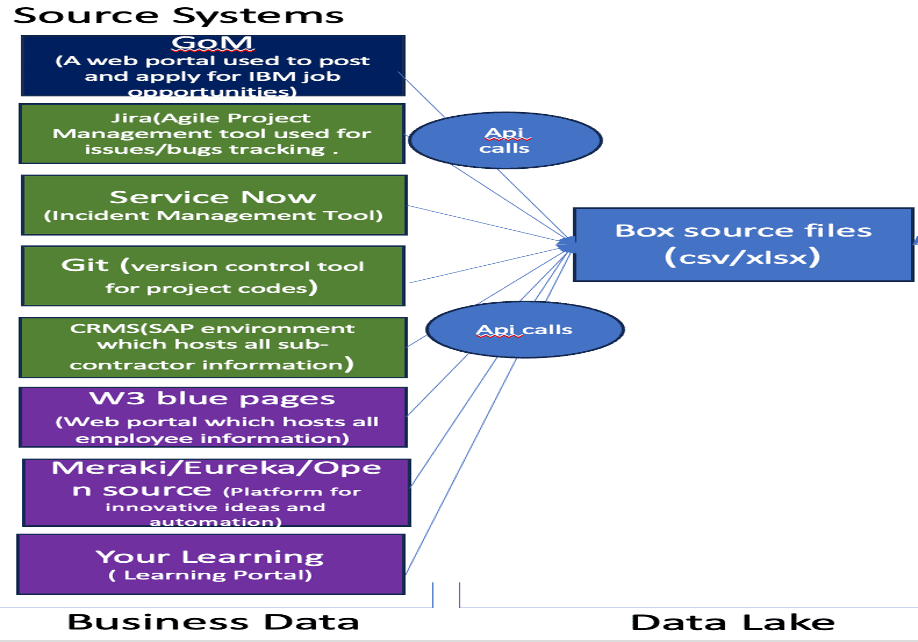
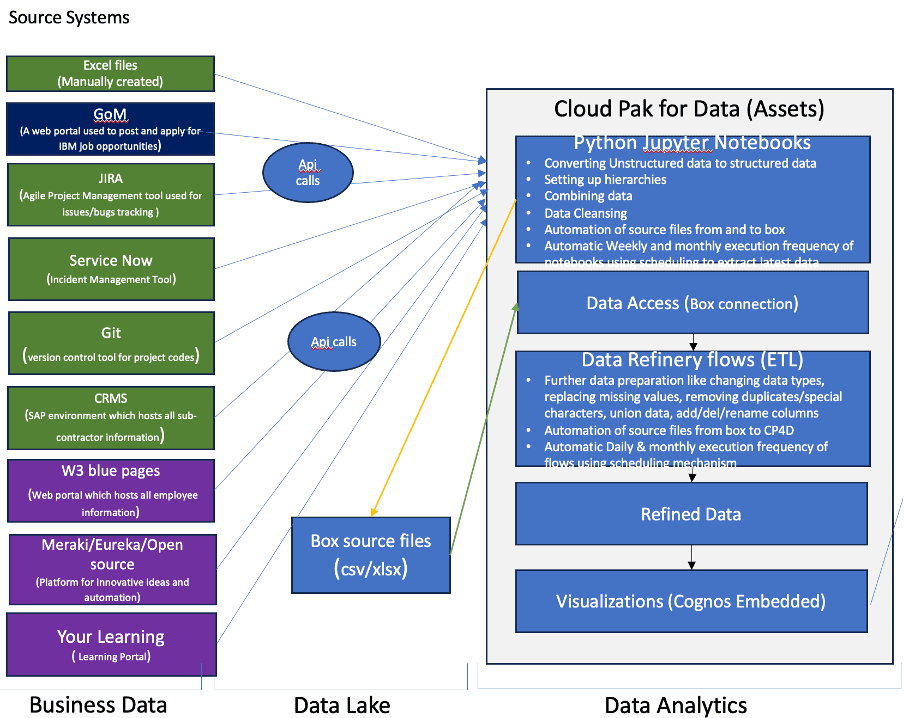
The very first part of my “solutioning,” a recently coined word in the IT space, involved identifying the source systems from where all this data is sourced. Not to my surprise, these are the source systems that are widely used: Jira, ServiceNow, GIT, Job Portal, Companies blue pages, and SAP source that hosts subcontractor data. The below diagram depicts the first part of the solutioning architecture

Picture-1

The second part of solution architecture involves extracting the data from various source systems depicted in the above diagram. To accomplish the task of extracting data, I have used Python programming language, which is one of the most powerful and user-friendly Data Science tools. Python has several of these source applications in-built libraries that it can use to fetch data via REST APIs. All the source data applications in turn support REST API where they have the ability to integrate with other applications, in this case, Python. These applications have multiple endpoints which define the level at which the information is extracted. Let me take an example of JIRA to illustrate the extraction process further. JIRA supports REST API, and it has several endpoints that are at the project level, issue level, sprint level, etc. Python, in turn, has a Jira library that it uses to connect to the JIRA tool via the REST API. The API calling can be as simple as providing inputs to Python code such as source application server name, API key, and username to login for authentication and can be a little more complicated like persisting token keys and refreshing them periodically along with authentication information for a few other applications. The complexity of API calling might vary based on the application type.

Seamless integration of data from unconventional source systems into Business Intelligence using data science techniques
The above diagram illustrates connection parameters used for API calls:

The above code snippet uses the Client function from the Python box SDK to connect to box cloud storage by authorizing the user with the help of an access token. An access token expires after 60 minutes. This access token can be re-generated periodically using a refresh token. The above code connects to an IBM NoSQL database called Cloudant which is being used to persist the previous access token and refresh token pair. Once fetched, this pair is used to generate a new set of access tokens and refresh tokens which is then used to authorize the box SDK Client and is then stored back into the Cloudant Database.

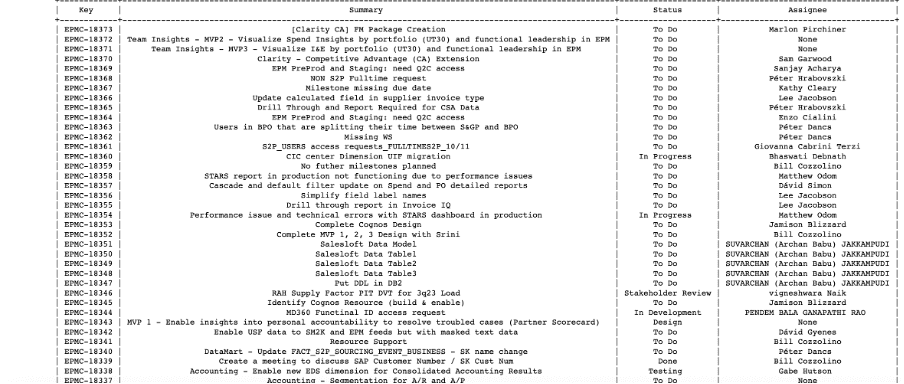
The extracted data from some of these web applications can be as clean as tabular data.

Picture-3
Example data output from Jira

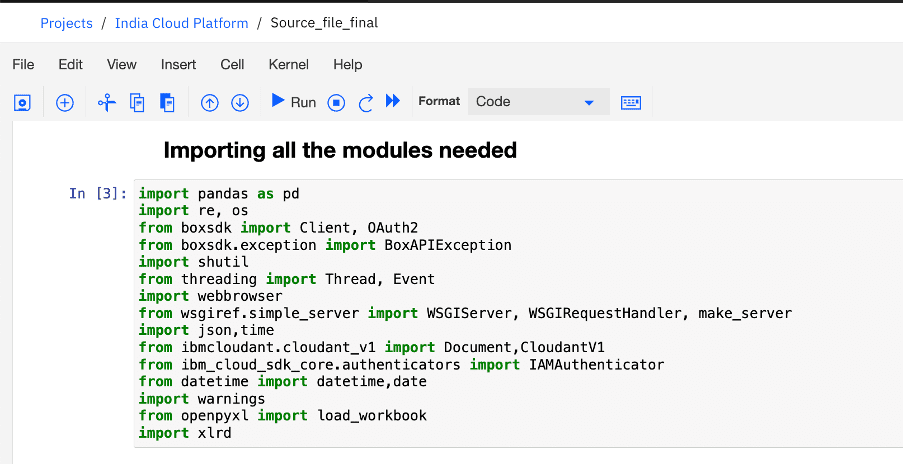
Once the data is extracted, the third part of the solutioning includes refining of the data. Often, the data that is extracted comes in an unstructured format with special characters, lists in cells, free text, measures/dates in column format, duplicates, incorrect data types, etc. Python supports very powerful and efficient libraries to convert this data into a more structured format suitable for further OLAP-style data analysis. Below are some of the libraries and functions used in accomplishing the task of refining & structuring the data

  • Pandas
  • re
  • Numpy
  • Glob
  • Excel libraries (openpyxl,xlrd)
  • Application libraries (jira, requests,git)
  • Explode
  • Groupby
  • Json
  • Boxsdk
  • PrettyTable
  • Datetime
Picture-4
diagram illustrates the cell in a Jupyter notebook where the Python libraries/modules are imported

Example scenario of refining data.

A source extract can have lot of special characters and free-form text. Using a combination of Regex patterns and explode function can fix these issues.

Seamless integration of data from unconventional source systems into Business Intelligence using data science techniques
Sample code used to clean the data

The given code snippet takes care of the process of data cleaning and data preparation. It is used for the source files which have a high level of data inconsistency. The first part of the code is used to convert all different types of datetime formats to a standardized Date format. The next step uses regex to clean the different issues identified in the files. The pattern variable stores the pattern which is matched in all the respective columns of each sheet and the apply function uses the regex matching to create a list of all the matches per row. These matches are then separated into individual rows using the explode function. The final generated data frame is then sent back to the main function and stored as an Excel sheet which is then uploaded to the box storage.

The fourth step of a solution architecture is to identify the target data system where the refined data can be loaded. This can be thought of as a data lake. It can be an Azure data lake, or a simple cloud storage application like Box, Snowflake, etc. Take the example of Box. It is a cloud storage system and I have used this as my data lake. All the refined data is loaded into the Box in the form of flat files. This can further be fed into RDBMS tables and use data warehousing principles (Star Schema, Primary Key/Foreign Key, Dimensions, Facts) or can be directly consumed by one of the Business Intelligence tools. I took the latter approach.

The fifth part of solutioning involves feeding the data into an ETL tool or a business intelligence tool directly like Power BI or Tableau where ELT(Extract Load Transform) process can be performed. I adapted the first approach of loading the data from refined files from previous steps into an ETL(Extract Transform Load) tool. This process involves creating a connection to the source data lake (in this case Box). Further transformation steps can be applied like renaming the columns, adding/removing columns, calculations, setting up aggregation properties, and Unioning data. This whole process of feeding the data from data lake into ETL, applying transformation steps and creating data assets is performed in IBM Cloud technology called Cloud Pak for Data (CP4D) as shown below in the updated architecture. This is a single centralized platform of Jupyter Notebooks, Data Connections, Data refinery flows, Data Assets, Visualizations.

Picture-6

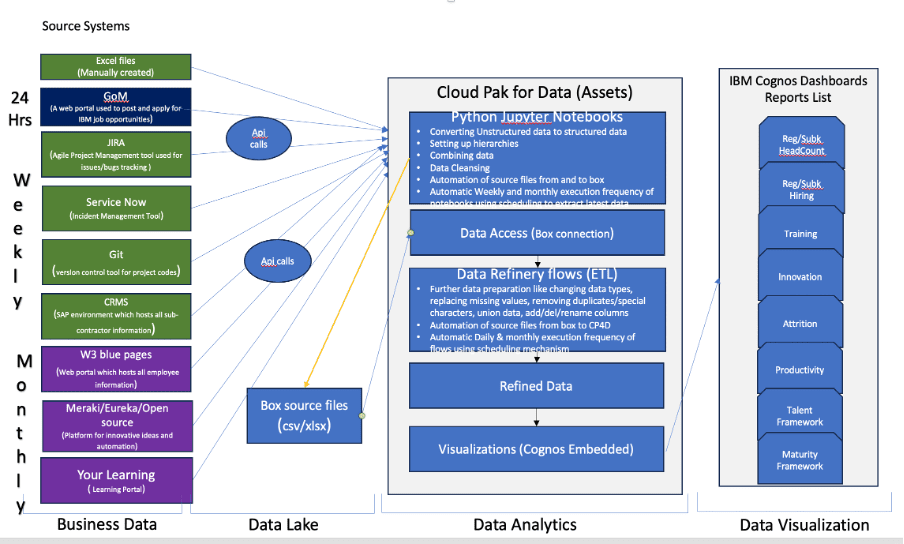
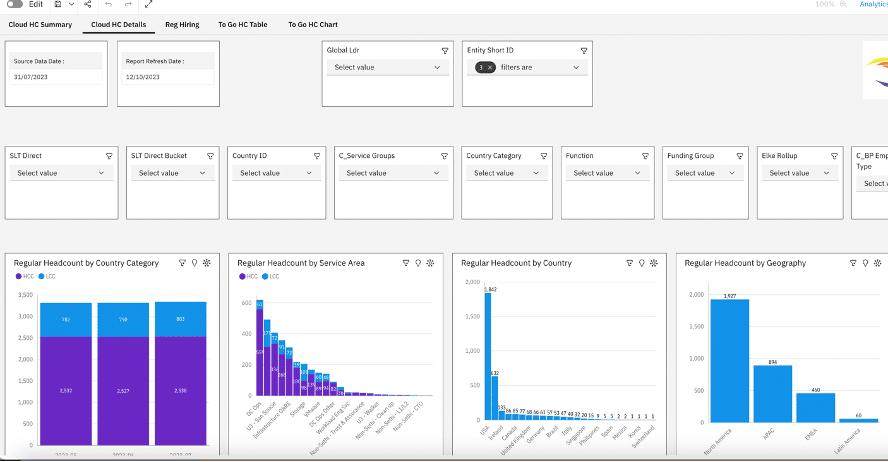
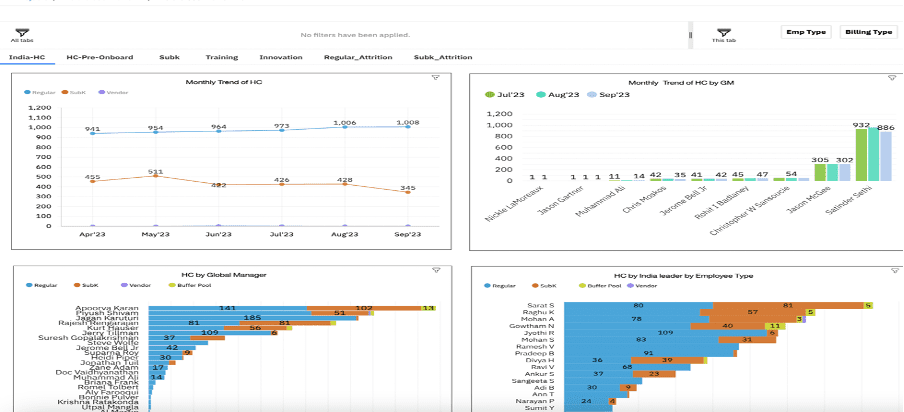
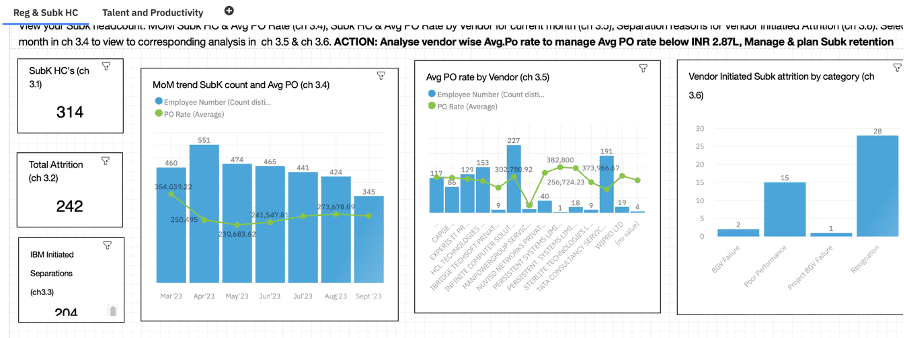
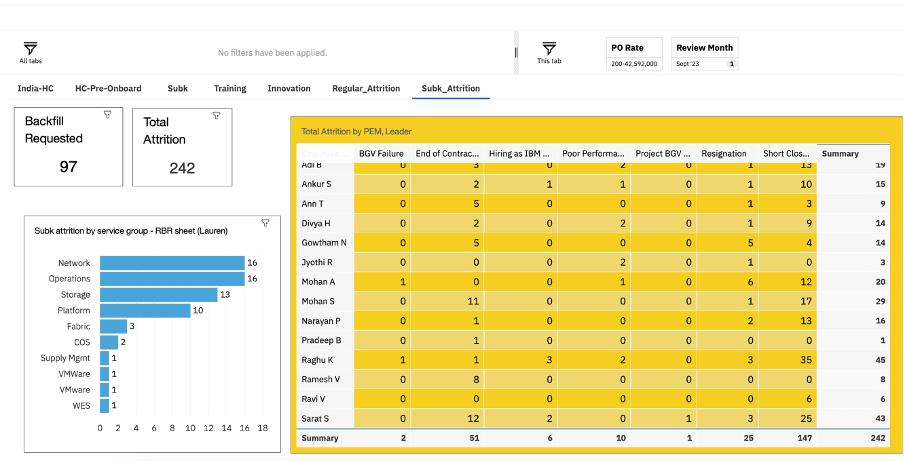
The final part of solutioning architecture is drawing visualizations from data assets. Data assets are synonymous with target tables that you can connect to any Visualization tool like Power BI, Tableau, or Cognos. In our case, there is an in-built Cognos dashboarding and visualizations provision available in CP4D, Cognos Embedded, which can be leveraged to create data visualizations. This is like an end product where stakeholders, leaders, and management of the business, department of an organization can view the data in graphical representation and make strategic and informed decisions. Various visualizations like MoM (Month-on-Month) trend line charts, tabular view, Heatmaps, Geography maps, Column, Stacked Column, Bar, and Stacked Bar, Combination charts can be used to show KPI information in combination with different attributes or dimensions of data like Leader, Manager, Global Manager, Region, Country Category, Business Unit, Service groups etc. End users are given options to select filters which helps them narrow down the scope specific to their departments or business units. Furthermore, the data refresh frequencies of these dashboards, reports, and visualizations can be set at different levels of the implementation process like Jupyter Notebooks or ETL flows using the in-built scheduling mechanisms. Below are the complete Architecture and sample dashboard visualizations.

Picture-7
End to End analytics solution architecture:

Outcome:

Data Visualizations as shown below empower and enable management/ leadership to make informed business decisions on various areas of HR like Headcount forecasting, Market Entry & exit strategy, Retention management planning, Headcount cost management, and so forth. This solution can be extended to different domains like banking, manufacturing, pharma, health care, etc.

Picture-8
Picture-9
Above visualizations illustrates Heacount trends across different dimensions like months of an year, Region, Department etc
Picture-10
Picture-11
Above visualizations illustrates Sub-Contractor Heacount trends across different dimensions like months of an year/Region/vendor, Purchase Order information, Retention management etc

In conclusion

Leveraging data science with analytics technologies can help organizations in a paradigm shift from PowerPoints and Excel analysis to advanced visualizations, statistical analysis, and even predictive models by consistent integration of data from many source systems like a simple text file to complicated big data coming from social media. With correct expertise and skillset around these areas and with proper exploration of capabilities of such advanced technologies, data analysis from hidden KPIs has made it possible for businesses to identify the gaps, find solutions, and make them more profitable.

As Databricks touts demand for AI services, all eyes are on Microsoft’s and Alphabet’s Q3 results

As Databricks touts demand for AI services, all eyes are on Microsoft’s and Alphabet’s Q3 results Alex Wilhelm 8 hours

Earnings season is officially here, folks!

Microsoft and Alphabet will report their third-quarter financial results after the bell today, and Meta and Amazon will report later this week. And we can’t wait to find out if these companies will report a material improvement from their investments in AI-related computing tasks and products.

The Exchange explores startups, markets and money.

Read it every morning on TechCrunch+ or get The Exchange newsletter every Saturday.

We asked a similar question before Q2 2023 results came out and found that while the costs related to AI work were piling up, the resulting revenue was more a fact of the future than the present. Will we see similar themes this time as well?

You see, there’s a big difference between customers being excited about a new technology and tech actually bringing in gobs of revenue. We’re hoping to find out how quickly some of the largest and richest tech companies are able to convert this market interest around AI to revenue.

Big Tech’s ability to sell AI-powered tools and services will tell us pretty clearly just how ready the tech-buying market is to spend on new software. For startups, then, a solid result from Microsoft and Alphabet on the AI front would be great news. On the other hand, yet another quarter of Big Tech companies spending heavily on infrastructure paired with discussions of future revenue would be less bullish.

LoRa, QLoRA and QA-LoRA: Efficient Adaptability in Large Language Models Through Low-Rank Matrix Factorization

LoRA : Low-Rank Adaptation of Large Language Models

Large Language Models (LLMs) have carved a unique niche, offering unparalleled capabilities in understanding and generating human-like text. The power of LLMs can be traced back to their enormous size, often having billions of parameters. While this huge scale fuels their performance, it simultaneously births challenges, especially when it comes to model adaptation for specific tasks or domains. The conventional pathways of managing LLMs, such as fine-tuning all parameters, present a heavy computational and financial toll, thus posing a significant barrier to their widespread adoption in real-world applications.

In a previous article, we delved into fine-tuning Large Language Models (LLMs) to tailor them to specific requirements. We explored various fine-tuning methodologies such as Instruction-Based Fine-Tuning, Single-Task Fine-Tuning, and Parameter Efficient Fine-Tuning (PEFT), each with its unique approach towards optimizing LLMs for distinct tasks. Central to the discussion was the transformer architecture, the backbone of LLMs, and the challenges posed by the computational and memory demands of handling a vast number of parameters during fine-tuning.

Parameters in LLM

https://huggingface.co/blog/hf-bitsandbytes-integration

The above image represents the scale of various large language models, sorted by their number of parameters. Notably: PaLM, BLOOM, etc.

As of this year, there have been advancements leading to even way larger models. However, tuning such gigantic, open-source models on standard systems is unfeasible without specialized optimization techniques.

Enter Low-Rank Adaptation (LoRA) was introduced by Microsoft in this paper, aiming to mitigate these challenges and render LLMs more accessible and adaptable.

The crux of LoRA lies in its approach towards model adaptation without delving into the intricacies of re-training the entire model. Unlike traditional fine-tuning, where every parameter is subject to change, LoRA adopts a smarter route. It freezes the pre-trained model weights and introduces trainable rank decomposition matrices into each layer of the Transformer architecture. This approach drastically trims down the number of trainable parameters, ensuring a more efficient adaptation process.

The Evolution of LLM tuning Strategies

Reflecting upon the journey of LLM tuning, one can identify several strategies employed by practitioners over the years. Initially, the spotlight was on fine-tuning the pre-trained models, a strategy that entails a comprehensive alteration of model parameters to suit the specific task at hand. However, as the models grew in size and complexity, so did the computational demands of this approach.

The next strategy that gained traction was subset fine-tuning, a more restrained version of its predecessor. Here, only a subset of the model's parameters is fine-tuned, reducing the computational burden to some extent. Despite its merits, subset fine-tuning still was not able to keep up with the rate of growth in size of LLMs.

As practitioners ventured to explore more efficient avenues, full fine-tuning emerged as a rigorous yet rewarding approach.

Introduction to LoRA

The rank of a matrix gives us a glimpse into the dimensions created by its columns, being determined by the number of unique rows or columns it has.

  • Full-Rank Matrix: Its rank matches the lesser number between its rows or columns.
  • Low-Rank Matrix: With a rank notably smaller than both its row and column count, it captures fewer features.

Now, big models grasp a broad understanding of their domain, like language in language models. But, fine-tuning them for specific tasks often only needs highlighting a small part of these understandings. Here's where LoRA shines. It suggests that the matrix showcasing these weight adjustments can be a low-rank one, thus capturing fewer features.

LoRA smartly limits the rank of this update matrix by splitting it into two smaller rank matrices. So instead of altering the whole weight matrix, it changes just a part of it, making the fine-tuning task more efficient.

Applying LoRA to Transformers

LoRA helps minimize the training load in neural networks by focusing on specific weight matrices. Under Transformer architecture, certain weight matrices are linked with the self-attention mechanism, namely Wq, Wk, Wv, and Wo, besides two more in the Multi-Layer Perceptron (MLP) module.

Transformers-architecture

Transformers Architecture

transformer attention heads

Transformer Attention Heads

Mathematical Explanation behing LoRA

Let's break down the maths behind LoRA:

  1. Pre-trained Weight Matrix W0​:
    • It starts with a pre-trained weight matrix W0​ of dimensions d×k. This means the matrix has d rows and k columns.
  2. Low-rank Decomposition:
    • Instead of directly updating the entire matrix W0​, which can be computationally expensive, the method proposes a low-rank decomposition approach.
    • The update ΔW to W0​ can be represented as a product of two matrices: B and A.
      • B has dimensions d×r
      • A has dimensions r×k
    • The key point here is that the rank r is much smaller than both d and k, which allows for a more computationally efficient representation.
  3. Training:
    • During the training process, W0​ remains unchanged. This is referred to as “freezing” the weights.
    • On the other hand, A and B are the trainable parameters. This means that, during training, adjustments are made to the matrices A and B to improve the model's performance.
  4. Multiplication and Addition:
    • Both W0​ and the update ΔW (which is the product of B and A) are multiplied by the same input (denoted as x).
    • The outputs of these multiplications are then added together.
    • This process is summarized in the equation: h=W0​x+ΔWx=W0​x+BAx. Here, h represents the final output after applying the updates to the input x.

In short, this method allows for a more efficient way to update a large weight matrix by representing the updates using a low-rank decomposition, which can be beneficial in terms of computational efficiency and memory usage.
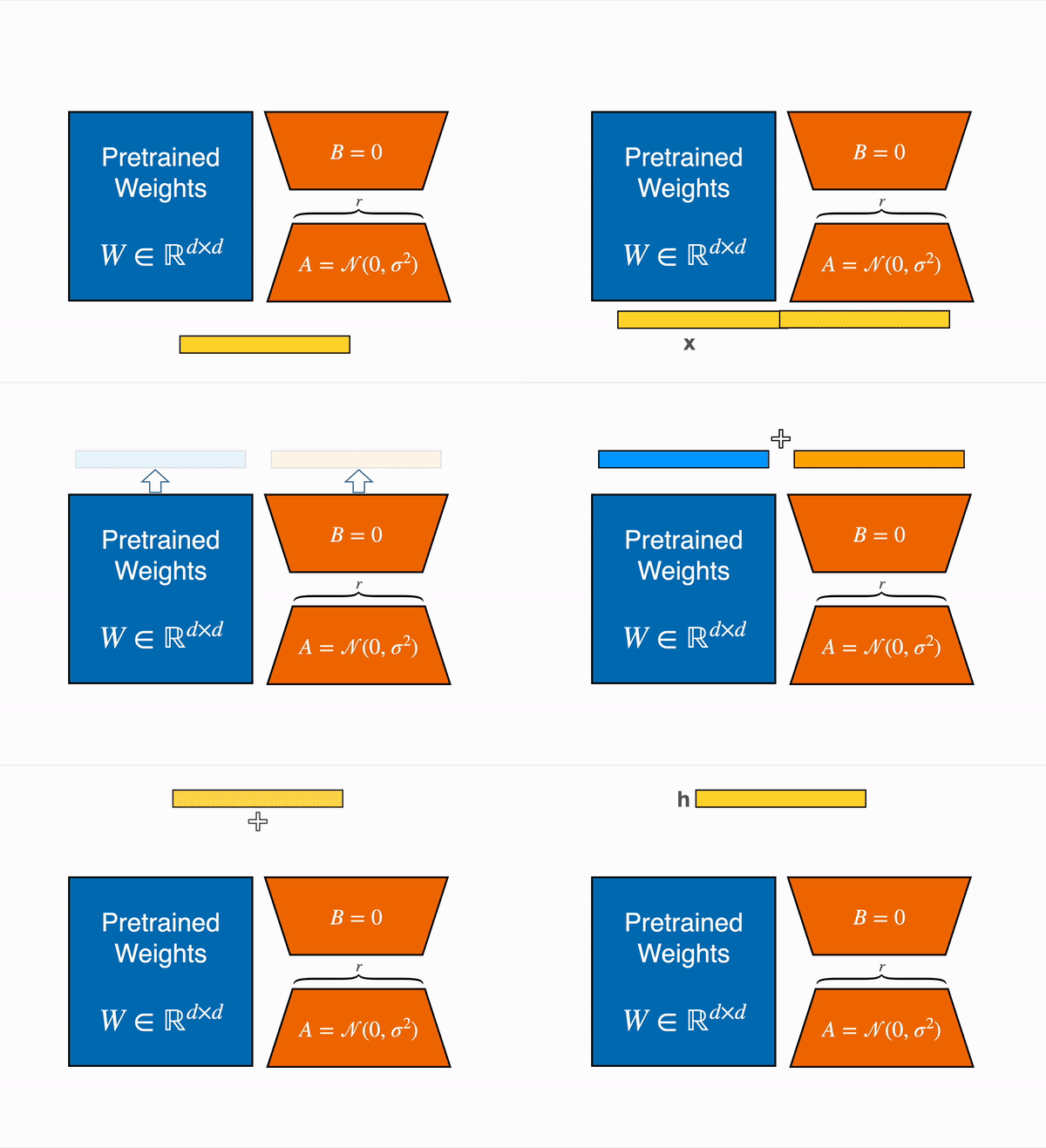
LORA Animation

LORA

Initialization and Scaling:

When training models, how we initialize the parameters can significantly affect the efficiency and effectiveness of the learning process. In the context of our weight matrix update using A and B:

  1. Initialization of Matrices A and B:
    • Matrix A: This matrix is initialized with random Gaussian values, also known as a normal distribution. The rationale behind using Gaussian initialization is to break the symmetry: different neurons in the same layer will learn different features when they have different initial weights.
    • Matrix B: This matrix is initialized with zeros. By doing this, the update ΔW=BA starts as zero at the beginning of training. It ensures that there's no abrupt change in the model's behavior at the start, allowing the model to gradually adapt as B learns appropriate values during training.
  2. Scaling the Output from ΔW:
    • After computing the update ΔW, its output is scaled by a factor of rα​ where α is a constant. By scaling, the magnitude of the updates is controlled.
    • The scaling is especially crucial when the rank r changes. For instance, if you decide to increase the rank for more accuracy (at the cost of computation), the scaling ensures that you don't need to adjust many other hyperparameters in the process. It provides a level of stability to the model.

LoRA's Practical Impact

LoRA has demonstrated its potential to tune LLMs to specific artistic styles efficiently by peoplr from AI community. This was notably showcased in the adaptation of a model to mimic the artistic style of Greg Rutkowski.

As highlighed in the paper with GPT-3 175B as an example. Having individual instances of fine-tuned models with 175B parameters each is quite costly. But, with LoRA, the trainable parameters drop by 10,000 times, and GPU memory usage is trimmed down to a third.

LoRa impact on GPT-3 Tuning

LoRa impact on GPT-3 Fine Tuning

The LoRA methodology not only embodies a significant stride towards making LLMs more accessible but also underscores the potential to bridge the gap between theoretical advancements and practical applications in the AI domain. By alleviating the computational hurdles and fostering a more efficient model adaptation process, LoRA is poised to play a pivotal role in the broader adoption and deployment of LLMs in real-world scenarios.

QLoRA (Quantized)

While LoRA is a game-changer in reducing storage needs, it still demands a hefty GPU to load the model for training. Here's where QLoRA, or Quantized LoRA, steps in, blending LoRA with Quantization for a smarter approach.

Quantization

Quantization

Normally, weight parameters are stored in a 32-bit format (FP32), meaning each element in the matrix takes up 32 bits of space. Imagine if we could squeeze the same info into just 8 or even 4 bits. That's the core idea behind QLoRA. Quantization referes to the process of mapping continuous infinite values to a smaller set of discrete finite values. In the context of LLMs, it refers to the process of converting the weights of the model from higher precision data types to lower-precision ones.

Quantization in LLM

Quantization in LLM

Here’s a simpler breakdown of QLoRA:

  1. Initial Quantization: First, the Large Language Model (LLM) is quantized down to 4 bits, significantly reducing the memory footprint.
  2. LoRA Training: Then, LoRA training is performed, but in the standard 32-bit precision (FP32).

Now, you might wonder, why go back to 32 bits for training after shrinking down to 4 bits? Well, to effectively train LoRA adapters in FP32, the model weights need to revert to FP32 too. This switch back and forth is done in a smart, step-by-step manner to avoid overwhelming the GPU memory.

LoRA finds its practical application in the Hugging Face Parameter Efficient Fine-Tuning (PEFT) library, simplifying its utilization. For those looking to use QLoRA, it's accessible through a combination of the bitsandbytes and PEFT libraries. Additionally, the HuggingFace Transformer Reinforcement Learning (TRL) library facilitates supervised fine-tuning with an integrated support for LoRA. Together, these three libraries furnish the essential toolkit for fine-tuning a selected pre-trained model, enabling the generation of persuasive and coherent product descriptions when prompted with specific attribute instructions.

Post fine-tuning from QLoRA, the weights has to revert back to a high-precision format, which can lead to accuracy loss and lacks optimization for speeding up the process.

A proposed solution is to group the weight matrix into smaller segments and apply quantization and low-rank adaptation to each group individually. A new method, named QA-LoRA, tries to blend the benefits of quantization and low-rank adaptation while keeping the process efficient and the model effective for the desired tasks.

Conclusion

In this article we touched on the challenges posed by their enormous parameter size. We delved into traditional fine-tuning practices and their associated computational and financial demands. The crux of LoRA lies in its capability to modify pre-trained models without retraining them entirely, thereby reducing the trainable parameters and making the adaptation process more cost-effective.

We also delved briefly into Quantized LoRA (QLoRA), a blend of LoRA and Quantization which reduces the memory footprint of the model while retaining the essential precision for training. With these advanced techniques, practitioners are now equipped with a robust libraries, facilitating the easier adoption and deployment of LLMs across a spectrum of real-world scenarios.

Matrix

Matrix

These strategies are crafted to balance between making LLMs adaptable for specific tasks and ensuring the fine-tuning and deployment processes are not overly demanding in terms of computation and storage resources.