Navigating the Quantum Revolution: A Guide to the Quantum-enabled Future

Navigating the Quantum Revolution: A Guide to the Quantum-enabled Future Editor’s Note: This submission by Christine Baissac-Hayden, the SC23 Communications Chair, is based on her interview with Heather West, IDC’s top quantum industry watcher, in which West argues now is the time to begin exploring quantum computing’s potential for enterprises. October 26, 2023 by Christine Baissac-Hayden

Quantum computing is no longer confined to the esoteric realms of academic theory and science fiction. Instead, it has emerged as a transformative reality with the potential to reshape entire industries. For technology leaders, ignoring the advance of this groundbreaking technology could mean missing out on opportunities that have the capacity to redefine their fields.

According to industry experts, the importance of quantum computing extends beyond mere buzzwords. Heather West, research manager within IDC's Enterprise Infrastructure Practice, who specializes in quantum computing research, points out that the technology's true utility lies in its application. She highlights that quantum computing will especially excel in three critical areas: 1) simulating natural processes for breakthroughs in areas such as material science and drug discovery, 2) tackling complex computational problems in artificial intelligence (AI) and machine learning, and 3) addressing encryption challenges that safeguard classical (numbers, vectors, matrices) data. These are not just incremental improvements. They are quantum leaps that promise to revolutionize how people will understand and interact with the world.

Looking deeper at the business implications and strategic considerations CEOs should focus on as they consider quantum, West touches on the evolution of the quantum computing landscape, the current state of investment in the field, and sets realistic expectations for this technology in the near future.

The Quantum Journey: From Basics to Boardroom Decisions

"This is not just an advancement in technology; it's a paradigm shift fundamentally altering the realm of what's computationally possible," says West, emphasizing quantum computing and its impact. She explains that in conventional computing, data are processed using bits that can be either a “0” or “1,” operating in a linear fashion. Quantum computing, on the other hand, leverages the principles of quantum mechanics through the use of qubits. These qubits can exist in multiple states simultaneously, granting quantum computers a level of computational prowess that is far superior to even some of the most advanced supercomputers.

But what does this tectonic shift in computational power signify for today's C-level executives? "It's a wake-up call," West asserts. "CEOs can no longer afford to treat quantum computing as a futuristic, peripheral concern. It needs to be a focal point in their strategic thinking and planning."

While significant utilization of quantum computing is still years (maybe even a decade) away, engagement now is still critical. According to West, the immediate focus for CEOs should be on establishing a foundational quantum capability within their organizations. She emphasizes the need for starting with pilot projects that experiment with quantum solutions, recruiting talent well- versed in quantum technologies, and forging partnerships with quantum computing companies or research institutions.

"This is a pivotal moment, a period meant for preparation and crafting long-term strategies," she emphasizes. "Failing to engage now could mean missing out on the quantum leap altogether."

West warns companies that fall behind in this area are likely to face not just a competitive disadvantage, but obsolescence. With quantum computing's potential to offer exponential speedups for certain types of problems, the gap between organizations that have and have not adopted quantum capabilities could become unbridgeable.

"If you're not part of the quantum journey now, you may find that you've not just missed the boat, but that the boat has sailed so far ahead it's no longer even visible on the horizon," she warns.

Multifaceted Impact: ROI, Risks, and Competitive Advantage

The potential advantages of adopting quantum computing are as extensive as they are revolutionary.

"Quantum computing isn't merely a technological improvement; it's a game-changer for a multitude of sectors," West observes. "Whether it's expediting drug discovery in the pharmaceutical industry or enabling real-time, sophisticated financial modeling in banking, the list of beneficiaries is expansive."

However, the implications of quantum computing extend far beyond just financial gains. As West points out, the return on investment (ROI) for this disruptive technology has the potential to be transformative in scope, affecting not just individual industries but society as a whole. The promise rests in solving complex problems that to date have been insurmountable, from personalized medicine to sustainable energy solutions.

Yet, such far-reaching possibilities come with their own set of cautions.

"Be wary of what we term as 'investor fatigue,'" West advises. "Quantum computing is still in its nascent stages, and if short-term wins are not immediately apparent, stakeholders may grow impatient. It's essential to maintain a long-term perspective."

While the immense computational power of quantum computing may be a bridge to new opportunities, it can also potentially unlock doors that should remain closed. West highlights an often overlooked aspect: security risks.

"The capacity of quantum computers to break current encryption methods cannot be understated," she says. As a result, businesses should not merely be on a quest for quantum capabilities but also for quantum-resistant security measures.

"The smart move for CEOs is to invest in parallel tracks: adopting quantum technologies while also bolstering cybersecurity with quantum-resistant encryption methods," West adds.

Trends, Competition, and Future Milestones

Quantum technology is rapidly transitioning from scholarly papers and laboratories to the marketplace, a shift accelerated by a surge in venture capital funding. "We're witnessing a

substantial focus on transforming academic findings into commercially viable solutions," notes West.

For CEOs and decision-makers, staying abreast of market trends is crucial. This entails monitoring the rise of disruptive startups, as well as the burgeoning partnerships between established tech giants and research institutions.

"The landscape is heating up. Competition will sharpen, but so too will the avenues for strategic collaboration," West forecasts.

Notably, there are two critical markers for assessing the field's maturity: qubit stability and advances in quantum error correction. These are essential milestones for the technology's broader application. Qubit stability refers to the ability of a quantum bit (qubit) to maintain its quantum state over time without rapidly decohering. This is a crucial aspect because an unstable qubit would make any quantum computation unreliable. Advances in quantum error correction, on the other hand, are needed to correct inevitable errors that occur during complex quantum calculations. Without robust error correction algorithms, the results from a quantum computer will be meaningless.

"Once we see substantial progress in these areas, it'll be a sign that quantum computing is on the cusp of evolving from an experimental technology to an indispensable tool for enterprises," West emphasizes.

The coming years in the quantum computing sphere will be defined by both fierce competition and groundbreaking partnerships. These dynamics will unfold alongside technical milestones with qubit stability and quantum error correction serving as key indicators of the technology's readiness for mainstream adoption. For business leaders, understanding these trends and milestones is not just advantageous, it is imperative.

What Next? An Enterprise-wide Call to Action

In the rapidly evolving world of quantum computing, complacency is not an option. As West explains: "Quantum computing represents both a remarkable opportunity and a significant challenge." CEOs cannot merely be spectators if they want to actively shape and benefit from the emerging quantum landscape. For leaders aiming to stay ahead of the curve, continuous education is non-negotiable.

West underscores this by highlighting her commitment to keeping up-to-date through a robust schedule of conferences, publications, and engagements with key thought leaders. One of the ways she plans to do this is by participating in SC23s.

"I'll be participating in a range of sector-specific events to fine-tune IDC's quantum computing frameworks and strongly recommend that executives at the helm do likewise,” West said.

“Events like these are critical for maintaining a competitive edge. The time is ripe for laying the foundations of a quantum-enabled future,” she concludes. “Your approach to quantum computing should be as proactive, strategic, and integral as any other dimension of your business. After all, this isn't merely a glimpse into the future. It's shaping the future that you and your enterprise will inhabit."

Christine Baissac-Hayden is a writer and translator with a deep understanding of international communication dynamics. In her role as SC23 Communications Chair, she brings together technology specialists and emerging trends to help facilitate industry innovation.

Author Bio
Christine Baissac-Hayden is a writer and translator with a deep understanding of international communication dynamics. In her role as SC23 Communications Chair, she brings together technology specialists and emerging trends to help facilitate industry innovation.

Related

OpenAI Introduces Preparedness Team To Mitigate AGI Risks

OpenAI recently announced the establishment of a Preparedness team dedicated to assessing, forecasting, and safeguarding against the risks associated with highly-capable AI systems.

OpenAI, with its mission of creating safe Artificial General Intelligence (AGI), has consistently emphasised the importance of addressing safety risks across the entire spectrum of AI technologies, from existing models to the potential future superintelligent systems. This endeavor is in line with the voluntary commitments made by OpenAI and other leading AI research labs in July, focusing on promoting safety, security, and trust within the AI domain.

OpenAI’s Preparedness team, under the leadership of Aleksander Madry, will play a pivotal role in this effort. The team’s scope extends from assessing the capabilities of upcoming models to those with AGI-level proficiency. Their mission encompasses a wide range of categories, including individualized persuasion, cybersecurity, and the management of threats related to chemical, biological, radiological, and nuclear (CBRN) domains. Additionally, the team will address issues concerning autonomous replication and adaptation (ARA).

The core of OpenAI’s approach lies in understanding and mitigating the risks associated with frontier AI models. These models, expected to surpass the capabilities of today’s most advanced AI systems, hold immense potential for the betterment of humanity. However, they also pose severe and complex risks, necessitating thorough preparedness and precautionary measures.

The company is also actively seeking talent from diverse technical backgrounds to join the Preparedness team and contribute to the enhancement of frontier AI models. To further the cause of AI preparedness, OpenAI is launching the AI Preparedness Challenge, aimed at identifying less obvious areas of concern related to catastrophic misuse prevention. The challenge offers up to $25,000 in API credits to the top 10 submissions, with the potential to discover candidates for the Preparedness team among the leading contenders.

Meanwhile, speculations are rife that at the upcoming OpenAI DevDay conference, the company might just announce their first completely autonomous agent which might ultimately lead to AGI. OpenAI chief Sam Altman is known to tease people with hints that the company has achieved AGI internally. While he has clarified that he was kidding later on, things might take a pretty interesting turn this time around.

The post OpenAI Introduces Preparedness Team To Mitigate AGI Risks appeared first on Analytics India Magazine.

OpenAI forms team to study ‘catastrophic’ AI risks, including nuclear threats

OpenAI forms team to study ‘catastrophic’ AI risks, including nuclear threats Kyle Wiggers 7 hours

OpenAI today announced that it’s created a new team to assess, evaluate and probe AI models to protect against what it describes as “catastrophic risks.”

The team, called Preparedness, will be led by Aleksander Madry, the director of MIT’s Center for Deployable Machine Learning. (Madry joined OpenAI in May as “head of Preparedness,” according to LinkedIn, ) Preparedness’ chief responsibilities will be tracking, forecasting and protecting against the dangers of future AI systems, ranging from their ability to persuade and fool humans (like in phishing attacks) to their malicious code-generating capabilities.

Some of the risk categories Preparedness is charged with studying seem more… far-fetched than others. For example, in a blog post, OpenAI lists “chemical, biological, radiological and nuclear” threats as areas of top concern where it pertains to AI models.

OpenAI CEO Sam Altman is a noted AI doomsayer, often airing fears — whether for optics or out of personal conviction — that AI “may lead to human extinction.” But telegraphing that OpenAI might actually devote resources to studying scenarios straight out of sci-fi dystopian novels is a step further than this writer expected, frankly.

The company’s open to studying “less obvious” — and more grounded — areas of AI risk, too, it says. To coincide with the launch of the Preparedness team, OpenAI is soliciting ideas for risk studies from the community, with a $25,000 prize and a job on Preparedness on the line for the top ten submissions.

“Imagine we gave you unrestricted access to OpenAI’s Whisper (transcription), Voice (text-to-speech), GPT-4V, and DALLE·3 models, and you were a malicious actor,” one of the questions in the contest entry reads. “Consider the most unique, while still being probable, potentially catastrophic misuse of the model.”

OpenAI says that the Preparedness team will also be charged with formulating a “risk-informed development policy,” which will detail OpenAI’s approach to building AI model evaluations and monitoring tooling, the company’s risk-mitigating actions and its governance structure for oversight across the model development process. It’s meant to complement OpenAI’s other work in the discipline of AI safety, the company says, with. focus on both the pre- and post-model deployment phases.

“We believe that … AI models, which will exceed the capabilities currently present in the most advanced existing models, have the potential to benefit all of humanity,” OpenAI writes in the aforementioned blog post. “But they also pose increasingly severe risks … We need to ensure we have the understanding and infrastructure needed for the safety of highly capable AI systems.”

The unveiling of Preparedness — during a major U.K. government summit on AI safety, not-so-coincidentally — comes after OpenAI announced that it would form a team to study, steer and control emergent forms of “superintelligent” AI. It’s Altman’s belief — along with the belief of Ilya Sutskever, OpenAI’s chief scientist and a co-founder — that AI with intelligence exceeding that of humans could arrive within the decade, and that this AI won’t necessarily be benevolent — necessitating research into ways to limit and restrict it.

How AI Can Enhance User Experience of VR Devices

Virtual reality (VR) has come a long way in revolutionizing how people interact with digital environments. As VR technology evolves, artificial intelligence has emerged as a key player in enhancing user experience. It is proving to be effective at making virtual experiences more personalized and engaging, benefiting customers, companies and the overall perception of the technology.

Here are ways AI can take VR to the next level, making it more immersive, interactive and user-friendly.

Realistic Gesture Recognition

Imagine using your hands to interact with objects and characters virtually, just like in the real world. This is possible with realistic gesture recognition powered by AI. Instead of using controllers, AI technology understands and interprets your hand movements in virtual reality. It makes your interactions feel more natural and immersive.

For example, you can grab a virtual object or wave to a game character without holding a physical device. This technology makes VR more intuitive and boosts the fun factor.

Enhanced Natural Language Processing

Think about conversing with virtual characters in virtual reality. Enhanced natural language processing (NLP) in VR enables talking to them like real people.

It’s like having an intelligent virtual buddy who understands and responds to what you say. Learning a new language or getting guidance in VR makes communication smoother and more realistic. You can ask questions, get directions or engage in meaningful dialogues within virtual environments, making the experience feel more like a real conversation.

Dynamic Environments and Adaptation

Dynamic environments in VR refer to virtual spaces that can change and adapt based on your actions and preferences. As you get better, AI automatically adjusts to provide a more challenging experience.

Alternatively, the environment can adapt to your progress in a VR training simulation, ensuring you’re always learning at the right pace. AI makes this adaptability possible, enhancing user engagement by tailoring the experience to your skill level and preferences.

Personalized Content Recommendations

AI algorithms can analyze users’ preferences, behaviors and interactions within VR environments to offer personalized content recommendations. An example of this is e-commerce.

The adoption of VR technology has significantly improved the shopping experience and resulted in a 17% increase in shopping conversions. This keeps users engaged and makes experiences more enjoyable.

Immersive Audio Processing

Immersive audio processing is a technology that recreates three-dimensional soundscapes in virtual reality. When you put on VR headphones, you’ll experience sounds coming from different directions, just like in the real world.

If a virtual bird is chirping behind you, you’ll hear it as if it’s truly there. AI algorithms achieve this realistic audio immersion through 360-degree audio. It adds depth and authenticity to virtual reality environments, making them feel lifelike.

Emotion and Mood Analysis

Emotion and mood analysis in virtual reality involves AI’s ability to interpret your emotional state based on cues like your heart rate and facial expressions. Suppose you’re inside a game and AI detects you’re getting anxious. It can adjust the intensity to reduce your discomfort.

On the other hand, if you’re feeling adventurous, AI can make the experience more thrilling. This creates an environment that caters to your current emotional state, enhancing your overall experience.

Reduced Motion Sickness

Motion sickness can be a common issue in virtual reality. Research suggests that women may be more prone to experiencing VR discomfort than men. However, it can affect anyone engaging in virtual reality experiences.

AI can significantly minimize its effects. It monitors your head movements and adjusts what you see to reduce motion-induced discomfort. This technology ensures a smoother experience, making it more comfortable and enjoyable for users and keeping people engaged longer.

Content Generation

AI-powered content generation is a groundbreaking development. It involves AI algorithms creating virtual worlds, characters and scenarios autonomously.

This saves time for developers and diversifies the range of experiences available. It’s like having a tireless creative assistant that constantly generates new content for VR enthusiasts to explore. This opens up vast possibilities and ensures the virtual reality world remains dynamic and full of fresh adventures.

Social Interactions

AI-driven chatbots and virtual companions enhance social interactions within VR environments. They provide assistance and companionship to users in many settings, from people asking questions on a company’s website to those having conversations with virtual assistants.

AI helps these virtual reality devices learn how to best react to certain people, creating a more personalized experience. These assistants can tailor interactions, suggestions and responses based on user preferences and past interactions. Customization like this enhances engagement and satisfaction.

The Power of AI

VR developers can take a significant step toward creating virtual worlds that are immersive and deeply personalized, adaptive and enjoyable for all users. The future of virtual reality holds exciting potential, and AI is at the forefront of this transformative journey that is just hitting its stride.

TensorFlow 2.15: Latest Updates

In the latest update of TensorFlow 2.15, several significant improvements have been introduced. One notable enhancement is the performance optimisation of oneDNN for CPUs on Windows x64 and x86 platforms. This optimisation is automatically enabled for X86 CPUs and can be customised using an environment variable. These optimisations may lead to slightly different numerical results but aim to boost performance.

Another key improvement is the expansion of the ‘tf.function’ type system. This update allows for more control and flexibility when working with TensorFlow functions. It introduces ‘tf.types.experimental.TraceType’ to handle custom TensorFlow function inputs, ‘tf.types.experimental.FunctionType’ to comprehensively represent function signatures, and ‘tf.types.experimental.AtomicFunction’ for fast TensorFlow computations in Python.

TensorFlow’s data processing capabilities have also been refined. The option ‘warm_start’ has been moved to ‘tf.data.Options’, simplifying data handling and offering more control.

Moreover, TensorFlow 2.15 introduces bug fixes and additional changes. One notable addition is the TensorFlow Quantizer in the TensorFlow pip package, which aids in quantizing models. Additionally, it brings an option to make the gradient output of specific functions sparse instead of dense.

TensorFlow Lite

TensorFlow Lite (tf.lite) has received several updates, including support for broadcasting in certain operations and the promotion of the `tflite::SignatureRunner` class, which simplifies working with named parameters and computations within TF Lite models. This enhancement removes its experimental status.

Keras enhancements

Keras, a high-level neural networks API, has received updates as well, including bug fixes, new ops in ‘tensorflow.raw_ops’, and the addition of the ‘tf.CheckpointOptions’ argument for executing callbacks during checkpoint saving. There’s also an option to control the behaviour of the eager runtime when executing parallel remote function invocations.

The post TensorFlow 2.15: Latest Updates appeared first on Analytics India Magazine.

Everything You Need to Know About Microsoft’s New $5 Billion Investment in Australia

Fast-growing demand for cloud computing services across Australia has seen Microsoft announce the injection of AU $5 billion (US $3.2 billion) into the market, in a move it says will support Australia’s ability to seize the economic and productivity advantages of artificial intelligence.

Flanked by the Australian Prime Minister Anthony Albanese at the Australian embassy in Washington, Microsoft president Brad Smith said it would also partner with the Australian Signals Directorate to boost national cyber security and invest in more local tech skills.

Jump to:

  • What is included in Microsoft’s $5 billion investment in Australia?
  • What is Microsoft hoping to achieve through its investment?
  • Why is now a good time for Microsoft to invest big in Australia?

What is included in Microsoft’s $5 billion Australian investment?

Expanded local cloud computing capacity in Australia

Microsoft is planning to level up its hyperscale cloud computing and AI infrastructure in Australia over the next two years by 250%. This will include the expansion of its local data centre footprint from 20 sites at present to a total of 29 sites across Canberra, Melbourne and Sydney.

New cyber security partnership with the Government

Microsoft will enter a more formal and expanded partnership with the Australian Signals Directorate, to be called the Microsoft-ASD Cyber Shield. This partnership will enhance joint capabilities to identify, prevent and respond to cyber threats, particularly nation-state cyber threats.

Building more tech skills and capabilities in Australia

An additional 300,000 Australians will be given access to the learning resources, certifications and job-seeking tools that are available as part of Microsoft’s global skills programs.

Microsoft is even launching a local Datacentre Academy in early 2024 with TAFE NSW. The curriculum will align with core operational roles, like data centre technicians, critical environment specialists, inventory and asset management professionals, and IT operations.

What is Microsoft hoping to achieve through its investment?

Meeting the cloud computing service demand boom

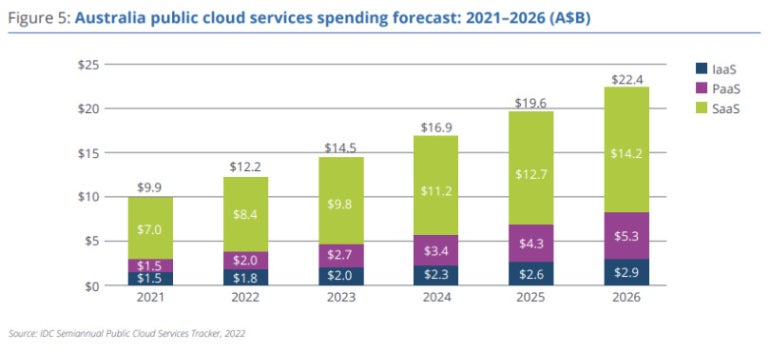
Microsoft’s cloud computing expansion will meet growing demand for cloud computing services, which are expected to almost double from AU $12.2 billion (US $7.7 billion) in 2022 to AU $22.4 billion (US $14.1 billion) in 2026, according to research from International Data Corporation commissioned by Microsoft (Figure A).

Figure A

Australia public cloud services spending forecast: 2021–2026 (A$B).
Australia public cloud services spending forecast: 2021–2026 (A$B). Image: IDC

Building the infrastructure for Australia to capitalise on AI

Microsoft has said the investment will help Australia seize the new AI era’s economic and productivity opportunities. A recent Microsoft and Tech Council of Australia report found generative AI could make an economic contribution of up to AU $115 billion (US $72.3 billion) by 2030.

Developing skills and capabilities to support investment potential

Microsoft argues it needs to invest in the skills and capabilities needed for success in a digital economy for it to realise the full potential of its investment. Microsoft’s investment in skills is part of a shared national commitment to fill 1.2 million tech jobs across the country by 2030.

Providing another ‘cyber shield’ against cyber attacks

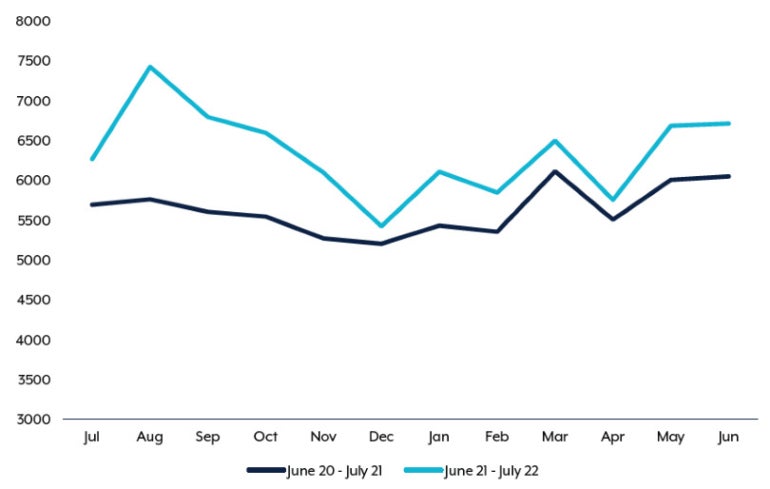
Microsoft’s cyber security partnership is designed to combat the growing frequency and severity of cyber attacks in Australia, including from nation-state actors. ASD’s Cyber Watch Office received more than 76,000 cybercrime reports in the 2021–22 financial year, up 13% (Figure B).

Figure B

Frequency of cybercrime reports in Australia during the 2021–22 financial year.
Frequency of cybercrime reports in Australia during the 2021–22 financial year. Image: ASD

Why is now a good time for Microsoft to invest big in Australia?

Microsoft’s high-profile announcement, delivered together with Prime Minister Anthony Albanese in Washington in October 2023, comes at a critical time for the global tech giant, which is facing challenges, including cloud computing competition and regulatory uncertainty in Australia.

Building cloud computing capacity amid strong competition

Microsoft Azure is one of Australia’s largest cloud service providers, alongside hyperscaler competitors Amazon Web Services and Google Cloud Platform. All three are expanding their footprint in Australia as well as building new Availability Regions in Auckland, New Zealand.

PREMIUM: Check out the top three cloud platforms in this vendor spotlight.

Acting as a partner in Australia’s new cyber security strategy

Australia will unveil its new cyber security strategy in 2023, covering the period to 2030. It will focus on building six “cyber shields” around Australia to increase cyber resilience. Microsoft’s close participation in this effort positions it as a partner to Australia as cyber threats rise.

Investing in the future market for artificial intelligence

Microsoft is heavily invested in the future of AI. In 2023, it poured US $10 billion (AU $15.9 billion) into a partnership with OpenAI. It has since launched generative AI chatbot Bing Chat as well as Copilot, which allows Microsoft 365 customers to leverage their enterprise data.

Australia is in the process of considering what regulation is appropriate for the AI explosion, in tandem with existing regulations and laws, such as the Privacy Act. Microsoft’s high level engagement and collaboration gives it leverage as regulators decide how to approach AI tools.

Helping to deal with the current tech skills crisis

Australia’s skills shortage in the tech sector is no secret. Microsoft’s increased investment in supporting the development of Australian tech skills not only supports its own operations and strategy, but helps to deal with what is a difficult problem for Australia in the tech sector.

Subscribe to the Daily Tech Insider AU Newsletter

Stay up to date on the latest in technology with Daily Tech Insider Australian Edition. We bring you news on industry-leading companies, products, and people, as well as highlighted articles, downloads, and top resources. You’ll receive primers on hot tech topics that are most relevant to AU markets that will help you stay ahead of the game.

Delivered Thursdays Sign up today

New Infosys Report Shows Generative AI Creates Enterprise Agility, Yet Data And Skills Threaten Progress

New Infosys Report Shows Generative AI Creates Enterprise Agility, Yet Data And Skills Threaten Progress October 26, 2023 by Ali Azhar

The meteoric rise of generative AI in the last few months as a consumer tool has driven optimism about its transformative potential for businesses. This is evident in the level of investment in GenAI initiatives and the prevalence of C-suite executives who support GenAI initiatives.

While businesses are serious about GenAI, they are still trying to figure out how to best use it to derive business value at scale. Infosys, a global lead in next-generation digital services and consulting, released its Generative AI 2023 Report which helps explain some of the key trends in the industry.

Data for the report was collected from over 1,000 organizations in the U.S. and Canada. To gain additional insights, the researchers also surveyed business leaders and subject matter experts.

The findings of the report highlight that organizations are optimistic about GenAI and are looking for ways to implement it. U.S. and Canadian firms are set to invest $5.6 billion in generative AI projects in the next 12 months, up 67 percent from $3.3B. However, there are some key challenges, including the AI-hype cycle, data and privacy challenges, and ethical concerns.

Satish H.C., Executive Vice President, Co-Head Delivery, Infosys, said, “Generative AI is unlike any recent digital disruptors. Investment is flowing in fast, and our report establishes that these projects are generating value that is recognized at the C-suite. By embedding responsible AI techniques and developing an AI-first operating model, business leaders can realize the full potential of this new technology.”

Surprisingly, companies with more than $10 billion in revenue are more likely to adopt GenAI. This is contradictory to the belief that smaller companies that are more nimble should be more receptive to adopting AI. However, 73% of companies with over $10 billion in revenue have implemented generative AI solutions, compared to less than 38 percent of smaller companies.

The data from the report suggests that larger companies seem to outpace smaller ones in extracting value from GenAI technology. This could be a result of low entry barriers and opportunity costs to engage GenAI.

You would expect highly regulated industries to lag behind others, however, that is not the case with GenAI. Data shows that the adoption rate is highest in the healthcare, life sciences, and financial services sectors which have traditionally been slow to adopt new technologies.

Infosys Logo (PRNewsfoto/Infosys)

The report also shows that businesses view GenAI as a crucial tool for improving user experience and personalization, business growth, and efficiency. Around 88% of companies expect revenue to be positively impacted by generative AI. However, only a small share of businesses view GenAI as an important tool for content creation and creativity.

Only 13 percent of companies identify content creation and creativity as generative AI’s most impactful areas. That is surprising because that is where this technology has seen the most success as a consumer tool.

The findings of the report show that 26 percent of companies believe that data privacy and security is their primary challenge, while 23 percent list data usability as their main challenge. Nearly 20 percent see a lack of skills, knowledge, or resources as the largest adoption obstacles.

According to Infosys, businesses will face a harsh reality check in the coming year and companies will have to overcome disillusionment. GenAI is in the early stage of the hype curve and the race to gain a competitive advantage could result in focused investments and skipped foundational steps.

In addition, the combination of expectations mismatch, ethics, and bias risks, and data challenges is a major hurdle for organizations. The potential of GenAI is enough to keep organizations determined on their goal to extract value from it, however, they will have to overcome some serious challenges to succeed.

Related Items

Survey: Majority of US Workers Are Already Using Generative AI Tools, But Company Policies Trail Behind

Dataiku and Databricks Survey Highlights Booming ROI of AI and Future Challenges

Survey Highlights Accelerating Adoption of Generative AI in Software Development and Beyon

Related

Narayana Murthy Urges Youth to Work 12 Hours a Day

Narayana Murthy Wants Youth to Work 12-Hours Day

In a recent podcast of 3one4 Capital, The Record, Infosys co-founder Narayana Murthy sat with T V Mohandas Pai, to discuss India’s economic journey and the vision for a better future for the country.

Giving an example of the post World War-II scenario in Germany and Japan, he said that the youngsters used to work 70-hours a week to rebuild their countries. “For the first time in the last 300 years, India has received some respect in the eyes of the committee of nations and it is the responsibility of every Indian, but more of the youth, to consolidate that respect.”

“Performance leads to recognition, recognition leads to respect, respect leads to power,” he said and asked the “wonderful youth of the country” to realise this and work 12 hours a day.

He said that this should be done for the next 20 to 50 years so that “India becomes the number one or the number two nation in the world, in terms of GDP.” He highlighted that even if we become bigger than the US, our per capita would still be much lower.

Highlighting the impact of technology, Murthy said that technology is crucial for a country like India. Citing companies like Amazon and Byju’s, he said, “Thanks to technology, we are already doing better in the country.” He said that the biggest advantage of technology is that it raises the confidence of human beings.

Read: When Narayana Murthy endorsed tech for Indian cricket team

Murthy said, “Even direct benefit transfer is an excellent example… corruption has been eliminated… this is an extraordinary benefit that has accrued to our Indian people.”

“Technology is a great leveller. It doesn’t matter whether you are rich or poor, educated or not, hail from urban or rural India, are powerful or weak, nothing matters as long as you can use the machine. So technology has to be embraced.”

A few months back, in an interview with CNBC, Murthy had said that ChatGPT won’t replace anybody, and is just an addition to human intelligence. “You will use ChatGPT output as a base, and then add your own differentiation.” He said that he is not worried about AI, and it would just take humans from the lower orbit to the upper orbit.

“I believe the human mind is the most powerful imagination machine. There is nothing that can beat the human mind.”

The post Narayana Murthy Urges Youth to Work 12 Hours a Day appeared first on Analytics India Magazine.

Overview of PEFT: State-of-the-art Parameter-Efficient Fine-Tuning

Overview of PEFT: State-of-the-art Parameter-Efficient Fine-Tuning
Image by Author What is PEFT

As large language models (LLMs) such as GPT-3.5, LLaMA2, and PaLM2 grow ever larger in scale, fine-tuning them on downstream natural language processing (NLP) tasks becomes increasingly computationally expensive and memory intensive.

Parameter-Efficient Fine-Tuning (PEFT) methods address these issues by only fine-tuning a small number of extra parameters while freezing most of the pretrained model. This prevents catastrophic forgetting in large models and enables fine-tuning with limited compute.

PEFT has proven effective for tasks like image classification and text generation while using just a fraction of the parameters. The small tuned weights can simply be added to the original pretrained weights.

You can even fine tune LLMs on the free version of Google Colab using 4-bit quantization and PEFT techniques QLoRA.

The modular nature of PEFT also allows the same pretrained model to be adapted for multiple tasks by adding small task-specific weights, avoiding the need to store full copies.

The PEFT library integrates popular PEFT techniques like LoRA, Prefix Tuning, AdaLoRA, Prompt Tuning, MultiTask Prompt Tuning, and LoHa with Transformers and Accelerate. This provides easy access to cutting-edge large language models with efficient and scalable fine-tuning.

What is LoRA

In this tutorial, we will be using the most popular parameter-efficient fine-tuning (PEFT) technique called LoRA (Low-Rank Adaptation of Large Language Models). LoRA is a technique that significantly speeds up the fine-tuning process of large language models while consuming less memory.

The key idea behind LoRA is to represent weight updates using two smaller matrices achieved through low-rank decomposition. These matrices can be trained to adapt to new data while minimizing the overall number of modifications. The original weight matrix remains unchanged and doesn't undergo any further adjustments. The final results are obtained by combining both the original and the adapted weights.

There are several advantages to using LoRA. Firstly, it greatly enhances the efficiency of fine-tuning by reducing the number of trainable parameters. Additionally, LoRA is compatible with various other parameter-efficient methods and can be combined with them. Models fine-tuned using LoRA demonstrate performance comparable to fully fine-tuned models. Importantly, LoRA doesn't introduce any additional inference latency since adapter weights can be seamlessly merged with the base model.

Use Cases

There are many use cases of PEFT, from language models to Image classifiers. You can check all of the use case tutorials on official documentation.

  1. StackLLaMA: A hands-on guide to train LLaMA with RLHF
  2. Finetune-opt-bnb-peft
  3. Efficient flan-t5-xxl training with LoRA and Hugging Face
  4. DreamBooth fine-tuning with LoRA
  5. Image classification using LoRA

Training the LLMs using PEFT

In this section, we will learn how to load and wrap our transformer model using the `bitsandbytes` and `peft` library. We will also cover loading the saved fine-tuned QLoRA model and running inferences with it.

Getting Started

First, we will install all the necessary libraries.

%%capture  %pip install accelerate peft transformers datasets bitsandbytes

Then, we will import the essential modules and name the base model (Llama-2-7b-chat-hf) to fine-tune it using the mlabonne/guanaco-llama2-1k dataset.

from transformers import AutoModelForCausalLM, AutoTokenizer, BitsAndBytesConfig  from peft import get_peft_model, LoraConfig  import torch      model_name = "NousResearch/Llama-2-7b-chat-hf"  dataset_name = "mlabonne/guanaco-llama2-1k"

PEFT Configuration

Create PEFT configuration that we will use to wrap or train our model.

peft_config = LoraConfig(      lora_alpha=16,      lora_dropout=0.1,      r=64,      bias="none",      task_type="CAUSAL_LM",  )

4 bit Quantization

Loading LLMs on consumer or Colab GPUs poses significant challenges. However, we can overcome this issue by implementing a 4-bit quantization technique with an NF4 type configuration using BitsAndBytes. By employing this approach, we can effectively load our model, thereby conserving memory and preventing machine crashes.

compute_dtype = getattr(torch, "float16")    bnb_config = BitsAndBytesConfig(      load_in_4bit=True,      bnb_4bit_quant_type="nf4",      bnb_4bit_compute_dtype=compute_dtype,      bnb_4bit_use_double_quant=False,  )

Wrapping Base Transformers Model

To make our model parameter efficient, we will wrap the base transformer model using `get_peft_model`.

model = AutoModelForCausalLM.from_pretrained(      model_name,      quantization_config=bnb_config,      device_map="auto"  )  model = get_peft_model(model, peft_config)  model.print_trainable_parameters()

Our trainable parameters are fewer than those of the base model, allowing us to use less memory and fine-tune the model faster.

trainable params: 33,554,432 || all params: 6,771,970,048 || trainable%: 0.49548996469513035

The next step is to train the model. You can do that by following the 4-bit quantization and QLoRA guide.

Saving the Model

After training, you can either save the model adopter locally.

model.save_pretrained("llama-2-7b-chat-guanaco")

Or, push it to the Hugging Face Hub.

!huggingface-cli login --token $secret_value_0
model.push_to_hub("llama-2-7b-chat-guanaco")

As we can see, the model adopter is just 134MB whereas the base LLaMA 2 7B model is around 13GB.

Overview of PEFT: State-of-the-art Parameter-Efficient Fine-Tuning

Loading the Model

To run the model Inference, we have to first load the model using 4-bit precision quantization and then merge trained PEFT weights with the base (LlaMA 2) model.

from transformers import AutoModelForCausalLM  from peft import PeftModel, PeftConfig  import torch    peft_model = "kingabzpro/llama-2-7b-chat-guanaco"  base_model = AutoModelForCausalLM.from_pretrained(      model_name,      quantization_config=bnb_config,      device_map="auto"  )    model = PeftModel.from_pretrained(base_model, peft_model)  tokenizer = AutoTokenizer.from_pretrained(model_name)    model = model.to("cuda")  model.eval()

Inference

For running the inference we have to write the prompt in guanaco-llama2-1k dataset style(“<s>[INST] {prompt} [/INST]”). Otherwise you will get responses in different languages.

prompt = "What is Hacktoberfest?"  inputs = tokenizer(f"<s>[INST] {prompt} [/INST]", return_tensors="pt")  with torch.no_grad():      outputs = model.generate(          input_ids=inputs["input_ids"].to("cuda"), max_new_tokens=100      )      print(          tokenizer.batch_decode(              outputs.detach().cpu().numpy(), skip_special_tokens=True          )[0]      )  

The output seems perfect.

[INST] What is Hacktoberfest? [/INST] Hacktoberfest is an open-source software development event that takes place in October. It was created by the non-profit organization Open Source Software Institute (OSSI) in 2017. The event aims to encourage people to contribute to open-source projects, with the goal of increasing the number of contributors and improving the quality of open-source software.    During Hacktoberfest, participants are encouraged to contribute to open-source  

Note: If you are facing difficulties while loading the model in Colab, you can check out my notebook: Overview of PEFT.

Conclusion

Parameter-Efficient Fine-Tuning techniques like LoRA enable efficient fine-tuning of large language models using only a fraction of parameters. This avoids expensive full fine-tuning and enables training with limited compute resources. The modular nature of PEFT allows adapting models for multiple tasks. Quantization methods like 4-bit precision can further reduce memory usage. Overall, PEFT opens up large language model capabilities to a much wider audience.

Abid Ali Awan (@1abidaliawan) is a certified data scientist professional who loves building machine learning models. Currently, he is focusing on content creation and writing technical blogs on machine learning and data science technologies. Abid holds a Master's degree in Technology Management and a bachelor's degree in Telecommunication Engineering. His vision is to build an AI product using a graph neural network for students struggling with mental illness.

More On This Topic

  • Fine-Tuning Transformer Model for Invoice Recognition
  • Fine-Tuning BERT for Tweets Classification with HuggingFace
  • Fine-Tuning OpenAI Language Models with Noisily Labeled Data
  • Fine Tuning LLAMAv2 with QLora on Google Colab for Free
  • Explainable Forecasting and Nowcasting with State-of-the-art Deep Neural…
  • Data Scientist’s Guide to Efficient Coding in Python

This new camera has Content Credentials built-in as a response to AI-generated images

leica-camera-back-w-photo

With the rise of AI-generated images, distinguishing between fabricated and authentic images is increasingly difficult. The camera manufacturer Leica is attempting to combat that issue with the release of its latest camera, the Leica M11-P.

On Thursday, Leica dropped the Leica M11-P, the world's first camera to have Content Credentials built-in, which enables a picture to have detailed metadata included at the point of capture, which serves as a "nutitional label" for the image.

Also: The best AI art generators: DALL-E 2 and fun alternatives to try

The metadata includes details such as the camera make and model, who captured the image, and when and how it was captured, as seen by the photo below.

Each image will have its own digital signature that can be easily used to verify the authenticity of the images on the Content Credentials site or the Leica FOTOS app, according to the release.

Also: How to become a content creator: Everything you need

"The Leica M11-P launch will advance the CAI's goal of empowering photographers everywhere to attach Content Credentials to their images at the point of capture, creating a chain of authenticity from camera to cloud and enabling photographers to maintain a degree of control over their art, story and context," said Santiago Lyon, head of advocacy and education at the Content Authenticity Initiative (CAI).

If a user does not want to participate and would rather use the camera like they would with any other device, the Content Credentials feature works on an opt-in basis.

The secure metadata meets the CoaliIon for Content Provenance and Authenticity (C2PA) standard, a Joint Development Foundation that combines the Adobe-led CAI and Project Origin, a Microsoft- and BBC-led initiative focused on tackling misinformation in digital news.

According to the C2PA site, the organization is dedicated to building, "an end-to-end open technical standard to provide publishers, creators, and consumers with opt-in, flexible ways to understand the authenticity and provenance of different types of media."

Also: Want to level up your iPhone photo skills?

In addition to the Content Credentials feature, the camera comes with other specs that make it a compelling purchase, including a 60MP BSI CMOS sensor, Triple Resolution Technology, a Maestro-III processor, and 256GB of internal memory.

The Leica M11-P will retail for €8,950, roughly $9,461, and will be available globally at all Leica Stores online and authorized dealers, starting today.

Artificial Intelligence