Shutterstock’s images will now be fully customizable with these new AI features

AI creative tools

When thinking of ways to use generative AI to find the perfect stock image, many companies like Adobe, Getty Images, and Shutterstock have opted for commercially safe AI image generators. However, Shutterstock is now taking a more unique approach with its newest application of generative AI to the platform.

On Thursday, Shutterstock introduced new creative AI-powered editing features to its platform to help users refine the over 700 million stock images in its library, in addition to the tool it already had to create entirely new ones.

Also: This new camera has Content Credentials built in as a response to AI-generated images

The creative AI editing features, now in beta, leverage OpenAI technology to edit and transform any image in the library, including tools such as Magic Brush, Variations, Expand Image, Smart Resize, and Background Remover.

"This is an unprecedented offering in the stock photography industry," said Paul Hennessy, Chief Executive Officer for Shutterstock. "Now, creatives have everything they need to craft the perfect content for any project with AI-powered design capabilities that you can use to edit stock images within Shutterstock's library, presenting infinite possibilities to make stock your own."

Also: Mid-career professionals, watch out. You're the most exposed to AI

The Magic Brush tool can be used to modify an image by brushing over the part of the image you'd like to tweak and then using text to describe how you'd like to replace, erase, or add to the image.

The Variations tool allows users to generate alternate versions of an already existing stock image. If you prefer to create something from scratch, you can use the AI Image Generator, originally launched in beta in January and will be upgraded to the latest version of DALL-E soon.

To tweak an image's sizing, Shutterstock has two tools: Expand Image, which can broaden the view of an image, and Smart Resize, which automatically resizes any image to the dimensions you need.

Also: I took this free AI course for developers in one weekend and highly recommend it

Lastly, Background Remover helps users isolate the subject of any image when the background doesn't fit their needs.

To support the artists who help power some of these tools, Shutterstock shares that artists will be compensated if their images are licensed after editing.

Although the company doesn't share specific details on how to join the beta, Shutterstock is scheduled to give a live demo of these features on Nov. 9 at 12 p.m. ET at the Shutterstock Showcase: Creative AI, which you can RSVP for.

Artificial Intelligence

A group behind Stable Diffusion wants to open source emotion-detecting AI

A group behind Stable Diffusion wants to open source emotion-detecting AI Kyle Wiggers 8 hours

In 2019, Amazon upgraded its Alexa assistant with a feature that enabled it to detect when a customer was likely frustrated — and respond with proportionately more sympathy. If a customer asked Alexa to play a song and it queued up the wrong one, for example, and then the customer said “No, Alexa” in an upset tone, Alexa might apologize — and a request a clarification.

Now, the group behind one of the data sets used to train the text-to-image model Stable Diffusion wants to bring similar emotion-detecting capabilities to every developer — at no cost.

This week, LAION, the nonprofit building image and text data sets for training generative AI, including Stable Diffusion, announced the Open Empathic project. Open Empathic aims to “equip open source AI systems with empathy and emotional intelligence,” in the group’s words.

“The LAION team, with backgrounds in healthcare, education and machine learning research, saw a gap in the open source community: emotional AI was largely overlooked,” Christoph Schuhmann, a LAION co-founder, told TechCrunch via email. “Much like our concerns about non-transparent AI monopolies that led to the birth of LAION, we felt a similar urgency here.”

Through Open Empathic, LAION is recruiting volunteers to submit audio clips to a database that can be used to create AI, including chatbots and text-to-speech models, that “understands” human emotions.

“With OpenEmpathic, our goal is to create an AI that goes beyond understanding just words,” Schuhmann added. “We aim for it to grasp the nuances in expressions and tone shifts, making human-AI interactions more authentic and empathetic.”

LAION, an acronym for “Large-scale Artificial Intelligence Open Network,” was founded in early 2021 by Schuhmann, who’s a German high school teacher by day, and several members of a Discord server for AI enthusiasts. Funded by donations and public research grants, including from AI startup Hugging Face and Stability AI, the vendor behind Stable Diffusion, LAION’s stated mission is to democratize AI research and development resources — starting with training data.

“We’re driven by a clear mission: to harness the power of AI in ways that can genuinely benefit society,” Kari Noriy, an open source contributor to LAION and a Ph.D. student at Bournemouth University, told TechCrunch via email. “We’re passionate about transparency and believe that the best way to shape AI is out in the open.”

Hence Open Empathic.

For the project’s initial phase, LAION has created a website that tasks volunteers with annotating YouTube clips — some pre-selected by the LAION team, others by volunteers — of an individual person speaking. For each clip, volunteers can fill out a detailed list of fields, including a transcription for the clip, an audio and video description and the person in the clip’s age, gender, accent (e.g. “British English”), arousal level (alertness — not sexual, to be clear) and valence level (“pleasantness” versus “unpleasantness”).

Other fields in the form pertain to the clip’s audio quality and the presence (or absence) of loud background noises. But the bulk focus on the person’s emotions — or at least, the emotions that volunteers perceive them to have.

From an array of drop-down menus, volunteers can select individual — or multiple — emotions ranging from “chirpy,” “brisk” and “beguiling” to “reflective” and “engaging.” Kari says that the idea was to solicit “rich” and “emotive” annotations while capturing expressions in a range of languages and cultures.

“We’re setting our sights on training AI models that can grasp a wide variety of languages and truly understand different cultural settings,” Kari said. “We’re working on creating models that ‘get’ languages and cultures, using videos that show real emotions and expressions.

Once volunteers submit a clip to LAION’s database, they can repeat the process anew — there’s no limit to the number of clips a single volunteer can annotate. LAION hopes to gather roughly 10,000 samples over the next few months, and — optimistically — between 100,000 to 1 million by next year.

“We have passionate community members who, driven by the vision of democratizing AI models and data sets, willingly contribute annotations in their free time,” Kari said. “Their motivation is the shared dream of creating an empathic and emotionally intelligent open source AI that’s accessible to all.”

The pitfalls of emotion detection

Aside from Amazon’s attempts with Alexa, startups and tech giants alike have explored developing AI that can detect emotions — for purposes ranging from sales training to preventing drowsiness-induced accidents.

In 2016, Apple acquired Emotient, a San Diego firm working on AI algorithms that analyze facial expressions. Snatched up by Sweden-based Smart Eye last May, Affectiva — an MIT spin-out — once claimed its technology could detect anger or frustration in speech in 1.2 seconds. And speech recognition platform Nuance, which Microsoft purchased in April 2021, has demoed a product for cars that analyzes driver emotions from their facial cues.

Other players in the budding emotion detection and recognition space include Hume, HireVue and Realeyes, whose technology is being applied to gauge how certain segments of viewers respond to certain ads. Some employers are using emotion-detecting tech to evaluate potential employees by scoring them on empathy and emotional intelligence. Schools have deployed it to monitor students’ engagement in the classroom — and remotely at home. And emotion-detecting AI has been used by governments to identify “dangerous people” and tested at border control stops in the U.S., Hungary, Latvia, and Greece.

The LAION team envisions, for their part, helpful, unproblematic applications of the tech across robotics, psychology, professional training, education and even gaming. Christoph paints a picture of robots that offer support and companionship, virtual assistants that sense when someone feels lonely or anxious and tools that aid in diagnosing psychological disorders.

It’s a techno utopia. The problem is, most emotion detection is on shaky scientific ground.

Few, if any, universal markers of emotion exist — putting the accuracy of emotion-detecting AI into question. The majority of emotion-detecting systems were built on the work on psychologist Paul Ekman, published in the ’70s. But subsequent research — including Ekman’s own — supports the common-sense notion that there’s major differences in the way people from different backgrounds express how they’re feeling.

For example, the expression supposedly universal for fear is a stereotype for a threat or anger in Malaysia. In one of his later works, Ekman suggested that American and Japanese students tend to react to violent films very differently, with Japanese students adopting “a completely different set of expressions” if someone else is in the room — particularly an authority figure.

Voices, too, cover a broad range of characteristics, including those of people with disabilities, conditions like autism and who speak in other languages and dialects such as African-American Vernacular English (AAVE). A native French speaker taking a survey in English might pause or pronounce a word with some uncertainty — which could be misconstrued by someone unfamiliar as an emotion marker.

Indeed, a big part of the problem with emotion-detecting AI is bias — implicit and explicit bias brought by the annotators whose contributions are used to train emotion-detecting models.

In a 2019 study, for instance, scientists found that labelers are more likely to annotate phrases in AAVE more toxic than their general American English equivalents. Sexual orientation and gender identity can heavily influence which words and phrases an annotator perceives as toxic as well — as can outright prejudice. Several commonly-used open source image data sets have been found to contain racist, sexist and otherwise offensive labels from annotators.

The downstream effects can be quite dramatic.

Retorio, an AI hiring platform, was found to react differently to the same candidate in different outfits, such as glasses and headscarves. In a 2020 MIT study, researchers showed that face-analyzing algorithms could become biased toward certain facial expressions, like smiling — reducing their accuracy. More recent work implies that popular emotional analysis tools tend to assign more negative emotions to Black men’s faces than white faces.

Respecting the process

So how will the LAION team combat these biases — making certain, for instance, that white people don’t outnumber Black people in the data set; that nonbinary people aren’t assigned the wrong gender; and that those with mood disorders aren’t mislabeled with emotions they didn’t intend to express?

It’s not totally clear.

Christoph claims the training data submission process for Open Empathic isn’t an “open door” and that LAION has systems in place to “ensure the integrity of contributions.”

“We can validate a user’s intention and consistently check for the quality of annotations,” he added.

But LAION’s previous data sets haven’t exactly been pristine.

Some analyses of LAION ~400M — one of LAION image training sets, which the group attempted to curate with automated tools — turned up photos depicting sexual assault, rape, hate symbols and graphic violence. LAION ~400M is also rife with bias, for example returning images of men but not women for words like “CEO” and pictures of Middle Eastern Men for “terrorist.”

Christoph’s placing trust in the community to serve as a check this go-around.

“We believe in the power of hobby scientists and enthusiasts from all over the world coming together and contributing to our data sets,” he said. “While we’re open and collaborative, we prioritize quality and authenticity in our data.”

As far as how any emotion-detecting AI trained on the Open Empathic data set — biased or no — is used, LAION is intent on upholding its open source philosophy — even if that means the AI might be abused.

“Using AI to understand emotions is a powerful venture, but it’s not without its challenges,” Robert Kaczmarczyk, a LAION co-founder and physician at the Technical University of Munich, said via email. “Like any tool out there, it can be used for both good and bad. Imagine if just a small group had access to advanced technology, while most of the public was in the dark. This imbalance could lead to misuse or even manipulation by the few who have control over this technology.”

Where it concerns AI, laissez faire approaches sometimes come back to bite model’s creators — as evidenced by how Stable Diffusion is now being used to create child sexual abuse material and nonconsensual deepfakes.

Certain privacy and human rights advocates, including European Digital Rights and Access Now, have called for a blanket ban on emotion recognition. The EU AI Act, the recently-enacted European Union law that establishes a governance framework for AI, bars the use of emotion recognition in policing, border management, workplaces and schools. And some companies have voluntarily pulled their emotion-detecting AI, like Microsoft, in the face of public blowback.

LAION seems comfortable with the level of risk involved, though — and has faith in the open development process.

“We welcome researchers to poke around, suggest changes, and spot issues,” Kaczmarczyk said. “And just like how Wikipedia thrives on its community contributions, OpenEmpathic is fueled by community involvement, making sure it’s transparent and safe.”

Transparent? Sure. Safe? Time will tell.

Microsoft Wins the Cloud Battle, Again 

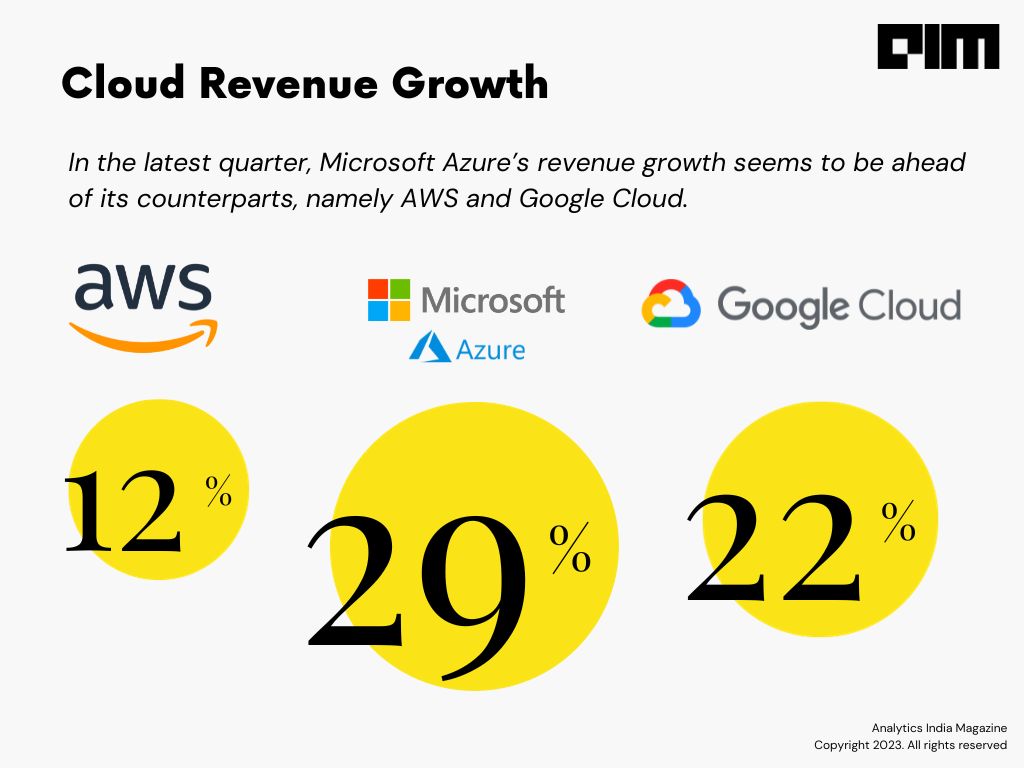
During the previous quarter, we had predicted that AWS might take over Microsoft’s Azure in terms of revenue growth. However, going by the latest quarterly results, it is observed that Microsoft Azure is performing strongly in the market and it is giving tough competition to both Google Cloud and AWS.

Azure’s revenue experienced a robust 29% surge in the quarter, outpacing the 26% consensus among analysts polled by CNBC and StreetAccount. It’s important to note that Microsoft does not disclose Azure revenue in dollars.

However, during the earnings call Microsoft chief Satya Nadella said that “We are off to a strong start to the fiscal year driven by the continued strength of Microsoft Cloud, which surpassed $31.8 billion in quarterly revenue, up 24%.”

In comparison, AWS recorded a 12% growth, reaching $21.3 billion, up from $20.53 billion in the corresponding quarter last year. Meanwhile, Google reported a substantial 22% revenue growth, totaling $8.41 billion.

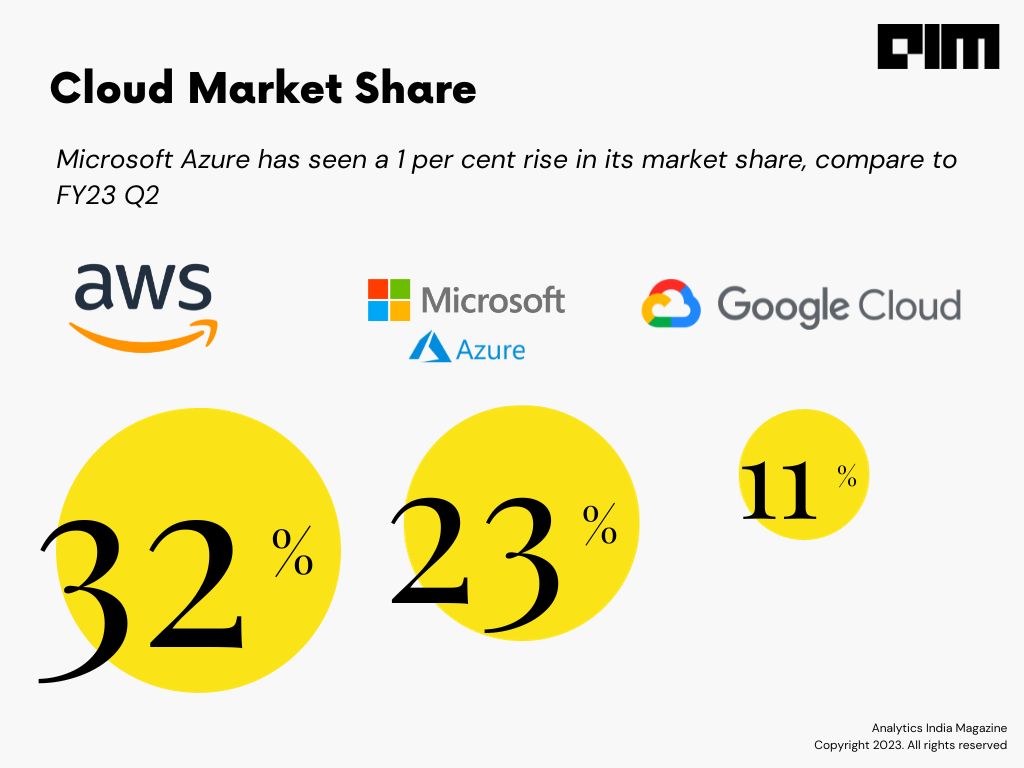
Amazon is really trying hard to maintain its position in the cloud market. According to estimates from Synergy Research Group, Amazon’s market share in the worldwide cloud infrastructure market stood at 32 percent in the third quarter of 2023, followed by Azure at 23%. Microsoft has seen a 1% rise in market share compared to FY23 Q2. Amazon and Google, on the other hand, seem to be losing market share.

Microsoft Azure’s “OOM” Strategy

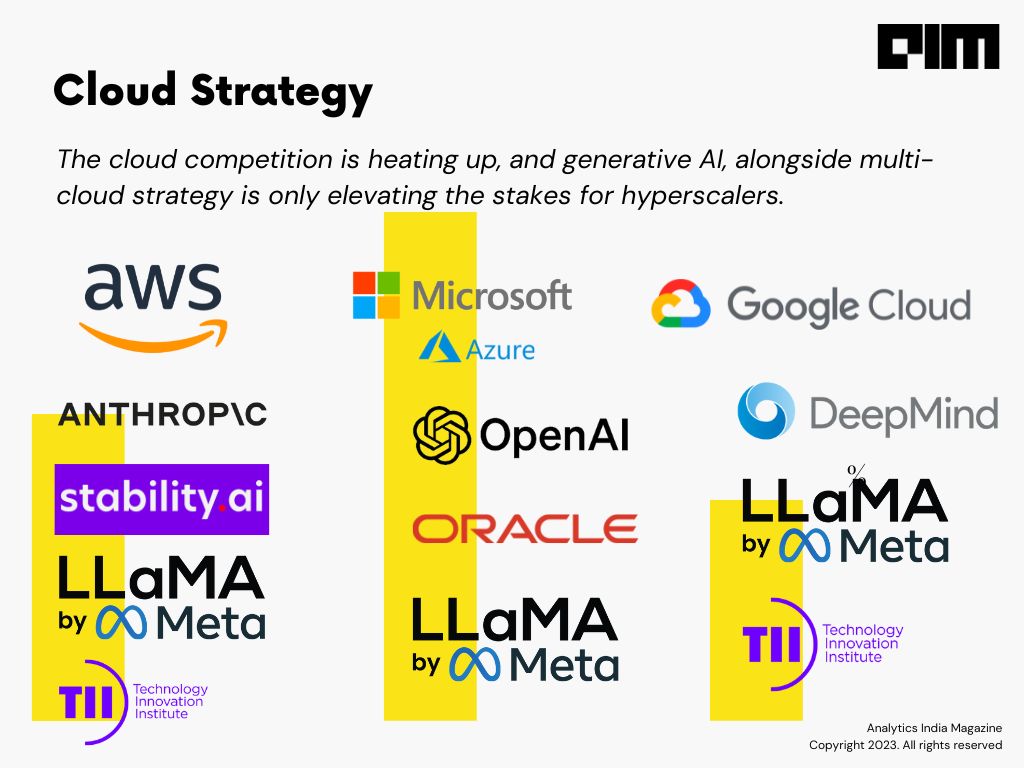
If we look at all the three hyperscalers, they are trying their best to provide both cloud as well as generative AI solutions, however that might not be enough for them. Currently, most enterprise customers are transitioning towards a multi-cloud strategy, and the one player that is enabling this ecosystem is Oracle (O), and only Microsoft seems to be benefiting from that.

During the recent earnings call Microsoft chief Satya Nadella said

“We are meeting customers where they are, helping them run apps across on-prem, edge, and multi cloud environments. We now have 21,000 Arc customers, up 140% year over year. We are the only other cloud provider to run Oracle’s database services, making it simpler for customers to migrate their on-prem Oracle databases to our cloud.”

He further added that customers like PepsiCo and Vodafone will have access to a seamless, fully integrated experience for deploying, managing, and using Oracle database instances on Azure.

To match Azure’s success, both AWS and Google might need to embrace a multi-cloud strategy eventually. It’s only a matter of time before AWS and Google Cloud joins Oracle, making them the NVIDIA of Cloud.

“It’s not a matter of if; it’s a matter of when it’s going to happen,” said SVP of Oracle Cloud Infrastructure, Karan Batta, in an exclusive interaction with AIM.

Beyond its collaboration with Oracle, Microsoft’s partnership with OpenAI (O) continues to work well for them. According to Nadella, Azure OpenAI serves over 18,000 customers, a number that includes new Azure clients as well.

Not to forget its open-source efforts, and its recent partnership with Meta (M), where the company is offering Meta’s Llama 2 to its cloud customers.

Around 3 percentage points of the quarter’s Azure growth was tied to AI, chief financial officer Amy Hood said. Three months ago, the company had forecast 2 points of Azure growth in that area. This number is only going to grow in the coming months, giving wider options for its customers.

Meanwhile AWS is optimistic about its partnership with Anthropic. It recently announced that it will invest about $4 billion in Anthropic. Anthropic chose AWS as its primary cloud provider and will use Trainium and Inferentia to build, train and deploy its future LLMs. As part of this partnership, AWS and Anthropic will collaborate on the future development of Trainium and Inferentia technology.

AWS joined the party late, and now hosts Meta’s Llama 2 in Bedrock, along with models from AI21 Labs, Anthropic, Cohere, and Stability AI. AWS claims itself to be the pioneer in offering Llama 2 (13-billion- and 70-billion-parameter versions) as a fully managed generative AI service.

Amazon chief Andy Jassy at the earnings call said that “Bedrock has added several new compelling features, including the ability to create agents which can be programmed to accomplish tasks like answering questions or automating workflows.” This will further boost AWS’s as now the conversation has moved on Autonomous AI agents.

Same goes for Google as well. It recently added Meta’s Llama 2 and TII’s Falcon, in addition to BERT, T-5 FLAN, ViT, and EfficientNet. Unfortunately, it appears that Google was too late to realise that hosting just PaLM was not enough for the enterprises.

The cloud competition is heating up, and generative AI, alongside multi-cloud strategy is only elevating the stakes for hyperscalers. It is only going to intensify here onwards.

The post Microsoft Wins the Cloud Battle, Again appeared first on Analytics India Magazine.

Generative AI: The First Draft, Not Final

By: Numa Dhamani & Maggie Engler

Generative AI: The First Draft, Not Final

It's safe to say that AI is having a moment. Ever since OpenAI's conversational agent ChatGPT went unexpectedly viral late last year, the tech industry has been buzzing about large language models (LLMs), the technology behind ChatGPT. Google, Meta, and Microsoft, in addition to well-funded startups like Anthropic and Cohere, have all released LLM products of their own. Companies across sectors have rushed to integrate LLMs into their services: OpenAI alone boasts customers ranging from fintechs like Stripe powering customer service chatbots, to edtechs like Duolingo and Khan Academy generating educational material, to video game companies such as Inworld leveraging LLMs to provide dialogue for NPCs (non-playable characters) on the fly. On the strength of these partnerships and widespread adoption, OpenAI is reported to be on pace to achieve more than a billion dollars in annual revenue. It's easy to be impressed by the dynamism of these models: the technical report on GPT-4, the latest of OpenAI's LLMs, shows that the model achieves impressive scores on a wide range of academic and professional benchmarks, including the bar exam; the SAT, LSAT, and GRE; and AP exams in subjects including art history, psychology, statistics, biology, and economics.

These splashy results might suggest the end of the knowledge worker, but there is a key difference between GPT-4 and a human expert: GPT-4 has no understanding. The responses that GPT-4 and all LLMs generate do not derive from logical reasoning processes but from statistical operations. Large language models are trained on vast quantities of data from the internet. Web crawlers –– bots that visit millions of web pages and download their contents –– produce datasets of text from all manner of sites: social media, wikis and forums, news and entertainment websites. These text datasets contain billions or trillions of words, which are for the most part arranged in natural language: words forming sentences, sentences forming paragraphs.

In order to learn how to produce coherent text, the models train themselves on this data on millions of text completion examples. For instance, the dataset for a given model might contain sentences like, "It was a dark and stormy night," and "The capital of Spain is Madrid." Over and over again, the model tries to predict the next word after seeing "It was a dark and" or "The capital of Spain is," then checks to see whether it was correct or not, updating itself each time it's wrong. Over time, the model becomes better and better at this text completion task, such that for many contexts — especially ones where the next word is nearly always the same, like "The capital of Spain is" — the response considered most likely by the model is what a human would consider the "correct" response. In the contexts where the next word might be several different things, like "It was a dark and," the model will learn to select what humans would deem to be at least a reasonable choice, maybe "stormy," but maybe "sinister" or "musty" instead. This phase of the LLM lifecycle, where the model trains itself on large text datasets, is referred to as pretraining. For some contexts, simply predicting what word should come next won't necessarily yield the desired results; the model might not be able to understand that it should respond to instructions like "Write a poem about a dog" with a poem rather than continuing on with the instruction. To produce certain behaviors like instruction-following and to improve the model's ability to do particular tasks, like writing code or having casual conversations with people, the LLMs are then trained on targeted datasets designed to include examples of those tasks.

However, the very task of LLMs being trained to generate text by predicting likely next words leads to a phenomenon known as hallucinations, a well-documented technical pitfall where LLMs confidently make up incorrect information and explanations when prompted. The ability of LLMs to predict and complete text is based on patterns learned during the training process, but when faced with uncertain or multiple possible completions, LLMs select the option that seems the most plausible, even if it lacks any basis in reality.

For example, when Google launched its chatbot, Bard, it made a factual error in its first-ever public demo. Bard infamously stated that the James Webb Space Telescope (JWST) “took the very first pictures of a planet outside of our own solar system.” But in reality, the first image of an exoplanet was taken in 2004 by the Very Large Telescope (VLT) while JWST wasn’t launched until 2021.

Hallucinations aren’t the only shortcoming of LLMs –– training on massive amounts of internet data also directly results in bias and copyright issues. First, let’s discuss bias, which refers to disparate outputs from a model across attributes of personal identity, such as race, gender, class, or religion. Given that LLMs learn characteristics and patterns from internet data, they also unfortunately inherent human-like prejudices, historical injustice, and cultural associations. While humans are biased, LLMs are even worse as they tend to amplify the biases present in the training data. For LLMs, men are successful doctors, engineers, and CEOs, women are supportive, beautiful receptionists and nurses, and LGBTQ people don't exist.

Training LLMs on unfathomable amounts of internet data also raises questions about copyright issues. Copyrights are exclusive rights to a piece of creative work, where the copyright holder is the sole entity with the authority to reproduce, distribute, exhibit, or perform the work for a defined duration.

Right now, the primary legal concern regarding LLMs isn't centered on the copyrightability of their outputs, but rather on the potential infringement of existing copyrights from the artists and writers whose creations contribute to their training datasets. The Authors Guild has called upon OpenAI, Google, Meta, and Microsoft, amongst others, to consent, credit, and fairly compensate writers for the use of copyrighted materials in training LLMs. Some authors and publishers have also taken this matter into their own hands.

LLM developers are presently facing several lawsuits from individuals and groups over copyright concerns –– Sarah Silverman, a comedian and actor, joined a class of authors and publishers filing a lawsuit against OpenAI claiming that they never granted permission for their copyrighted books to be used for training LLMs.

While concerns pertaining to hallucinations, bias, and copyright are among the most well-documented issues associated with LLMs, they are by no means the sole concerns. To name a few, LLMs encode sensitive information, produce undesirable or toxic outputs, and can be exploited by adversaries. Undoubtedly, LLMs excel at generating coherent and contextually relevant text and should certainly be leveraged to improve efficiency, among other benefits, in a multitude of tasks and scenarios.

Researchers are also working to address some of these issues, but how to best control model outputs remains an open research question, so existing LLMs are far from infallible. Their outputs should always be examined for accuracy, factuality, and potential biases. If you get an output that is just too good to be true, it should tingle your spider senses to exercise caution and scrutinize further. The responsibility lies with the users to validate and revise any text generated from LLMs, or as we like to say, generative AI: it’s your first draft, not the final.

Maggie Engler is an engineer and researcher currently working on safety for large language models. She focuses on applying data science and machine learning to abuses in the online ecosystem, and is a domain expert in cybersecurity and trust and safety. Maggie is a committed educator and communicator, teaching as an adjunct instructor at the University of Texas at Austin School of Information.

Numa Dhamani is an engineer and researcher working at the intersection of technology and society. She is a natural language processing expert with domain expertise in influence operations, security, and privacy. Numa has developed machine learning systems for Fortune 500 companies and social media platforms, as well as for start-ups and nonprofits. She has advised companies and organizations, served as the Principal Investigator on the United States Department of Defense’s research programs, and contributed to multiple international peer-reviewed journals.

More On This Topic

  • 5 Portfolio Projects for Final Year Data Science Students
  • Build Your First Data Science Application
  • Prefect: How to Write and Schedule Your First ETL Pipeline with Python
  • Writing Your First Distributed Python Application with Ray
  • Deploying Your First Machine Learning API
  • 4 Machine Learning Concepts I Wish I Knew When I Built My First Model

Qualcomm to Collaborate with Airtel and Jio for 6G Network Deployment

Qualcomm

Qualcomm’s chief financial officer, Akash Palkhiwala, has revealed the company’s plans to spearhead the 6G market once the technology becomes a reality. The company is set to work closely with major Indian telecom operators, Airtel and Jio, for the implementation of 6G networks. Palkhiwala emphasised Qualcomm’s close collaboration with the Indian government on spectrum allocation and network deployment requirements.

Qualcomm is already engaged in deploying 5G networks in collaboration with telecom operators, and plans to extend its leadership to the 6G realm. While specific details were not provided, Qualcomm highlighted ongoing activities related to 6G standards. The company emphasized the necessity of global coordination among operators and vendors for successful 6G implementation.

Key discussions with the Indian government have revolved around spectrum allocation, focusing on identifying suitable frequency bands for 6G networks. While the current focus remains on 5G deployment, Qualcomm’s strategic initiatives signal a proactive approach towards the future of telecommunications in India.

Moreover, Qualcomm is also collaborating closely with the Indian government and Tata Group to investigate the possibility of locally packaging its latest AI PC chip in the near future.

Palkhiwala said that Qualcomm has established a strong collaboration with the Prime Minister’s Office (PMO) and Tata Group to explore the utilization of Indian manufacturing facilities for our chips.

Palkhiwala emphasised Qualcomm’s substantial presence in India, underscoring its pivotal role within the company. The dedicated India team is integral to the development of our entire roadmap, with their significant contributions, particularly in shaping this crucial chip.

Qualcomm recently announced that its redesigned Snapdragon Elite X chip, optimised for handling AI tasks such as summarising emails, text generation, and image creation, will be available in laptops from next year. Qualcomm also claims that its chip will deliver “50% faster peak multi-thread performance” than Apple’s M2 chip.

The post Qualcomm to Collaborate with Airtel and Jio for 6G Network Deployment appeared first on Analytics India Magazine.

EXL’s Data-Driven Strategy Leads to Consistent Growth

ExlService Holdings, Inc., a leading data analytics and digital solutions company, announced its financial results for the quarter ending on September 30, 2023. The company reported a robust performance with third-quarter revenue reaching $411.0 million, showcasing a remarkable year-over-year increase of 13.7%. This growth is a testament to the company’s resilience and strategic prowess, particularly in unpredictable business environments.

The Chief Executive Officer of ExlService Holdings, Rohit Kapoor, expressed his satisfaction, stating, “We achieved another robust quarter, with year-over-year revenue growth of 13.7% and adjusted diluted EPS growth of 21.3%. Our data-led strategy and balanced portfolio of businesses, bolstered by our unique digital/AI capabilities, position us well to deliver superior growth in an unpredictable environment.”

EXL’s strategic focus on AI is at the core of its consistent growth. Kapoor also highlighted the pivotal role of data, digital, and AI capabilities in their strong third-quarter performance. They’ve invested significantly in these technologies, positioning them as a market leader.

Their emphasis on integrated digital operations, driven by clients seeking cost-efficiency and productivity, has resulted in a robust pipeline of large deals exceeding $50 million in total value, demonstrating the value of their end-to-end solutions. EXL is also capitalizing on generative AI, engaging with clients on over 200 use cases, allowing them to venture into new market areas. Their commitment to innovation and plans for an international operations headquarters in Dublin exemplify their dedication to advancing AI and expanding their global footprint. These initiatives, coupled with their strong digital capabilities, make EXL a key player in the industry, poised for continued growth.

ExlService Holdings also benefited from the strong leadership of its CFO, Maurizio Nicolelli, who commented, “While we remain prudent in our outlook given the current uncertain environment, we are increasing our revenue and EPS guidance for the full year 2023 based on our strong momentum year to date and current visibility for the remainder of the year.”

The updated revenue guidance now places the expected revenue range between $1.620 billion to $1.628 billion, up from the previous guidance of $1.605 billion to $1.625 billion. This adjusted revenue guidance represents a remarkable 15% year-over-year growth on a reported basis and 15% to 16% growth on a constant currency basis. Additionally, the company has increased its adjusted diluted earnings per share guidance for 2023 to a range of $1.40 to $1.42, which signifies growth of 16% to 18% over the prior year.

ExlService Holdings, Inc. reported revenue growth across all its segments, including insurance, healthcare, emerging business, and analytics. The company’s robust operating income margin in the third quarter, coupled with its ability to effectively manage costs, contributed to its impressive performance.

The post EXL’s Data-Driven Strategy Leads to Consistent Growth appeared first on Analytics India Magazine.

Future-Proof Your Data Game: Top Skills Every Data Scientist Needs in 2023

Future-Proof Your Data Game: Top Skills Every Data Scientist Needs in 2023
Image by Editor

If you haven’t already heard, in the next 3 years, 40% of the workforce is expected to upskill. This is natural to keep up with the continuous growth in technology, specifically generative AI.

However, the IBM report stated that executives estimate that 40% of their workforce will need to reskill due to AI and automation. However, it also states that analytical skills with business acumen and a bunch of soft skills will be highly desirable in the next 3 years.

In this article, I will go through the top sought-after skills in 2023 and how these will benefit your career in the future.

So let’s get into it…

Data Science Skills for 2023

As we can see, a lot of things are changing due to technology and the rise of generative AI. If you’re thinking about starting or upskilling in your data science career, here are the most sought-after skills for 2023.

Programming language

Let’s start with the foundations for those looking to start a new career in data science.

Choose a programming language to learn and learn it well. Learn the ins and outs, all the nooks and crannies, everything you can know about it. It’s better to be a master in one thing than a jack of all trades.

Many organizations want to know that when they employ somebody, they can reap more than one benefit from them. For example, this employee is very proficient in data wrangling, however, they are amazing at creating data visualizations for our board meetings.

If you are unsure of what programming language to choose, have a read of 8 Programming Languages For Data Science to Learn in 2023.

Data Cleaning & Wrangling

Now let’s get into what tasks you will be assigned as a data scientist. There’s a lot of data out there, and with the rise of BigData and its use for generative AI, organizations are going to want to make use of it. Data cleaning and wrangling consist of transforming raw data into a format that can be later used for analysis.

Whilst some say that data scientists spend up to 80% of their time cleaning data, it’s not always true. It is a time-consuming task, however, it doesn’t take up to 80% of a data scientist's time — all the time.

With that being said, it’s still a sought-after skill for data scientists in 2023. Why’s that? Because data seldom comes nice and clean. Especially now with organizations skimming through old data that has collected dust and are trying to find ways that they can use it. Get your dustpan and brush out, because there’s definitely some cleaning to do.

Analytical Skills

As I mentioned before, employees who have strong analytical skills are what executives in the next 3 years will be looking out for. According to the IBM report, at the top of executives' list is to upskill employees in a variety of soft skills such as time management, and communication. After this comes analytics skills with business acumen.

Areas of analytical skills include:

  • Statistical Analysis
  • Data Exploration
  • Feature Selection and Engineering
  • Machine Learning
  • Model Evaluation
  • Data Visualization

Let’s take statistical analysis for example, it is known as the bedrock of data science and allows you to explore data through descriptive statistics, understand your data better and represent it through visualizations. They work hand-in-hand with elements in the data cleaning and wrangling phase such as missing values and addressing anomalies.

Analytical skills underpin the life of a data scientist, therefore the same rule applies — know the ins and outs, nooks and crannies, and you will excel as a data scientist.

Machine & Deep Learning

As we’re living in times where organizations are pushing towards using data to provide them insight and using data to automate tasks for them — having proficient knowledge of the elements of machine and deep learning will be paramount.

Areas of machine and deep learning skills include:

  • Mathematics and statistics
  • Machine learning algorithms
  • Deep learning architectures
  • Neural networks
  • GPUs and computing frameworks
  • Deployment

Both machine and deep learning have been shown to have amazing capabilities when extracting insights from data, allowing data scientists to build models that can automatically learn.

Organizations are competitively looking at ways to build state-of-the-art models with great performance in various industries. As a data scientist, you will have the ability to handle complex problems, improve accuracy, build models that increase the organization's competitiveness, and continuously drive innovation.

If you have discovered an area in machine learning or deep learning that you’re really good at and enjoy, then run with that. As I said, it’s better to be a master in one than a jack of all trades.

Soft Skills

As part of the IBM report, the most critical skills required of the workforce included:

  • Time management
  • Ability to prioritize
  • Effectively work in team environments
  • Communicate effectively
  • Flexible, agile, and adaptable to change

My personal opinion is that executives have seen that the shift in remote work has possibly put a constraint on these areas. Or it could generally be a bunch of skills that can effectively turn ideas into realities.

To keep up with generative AI, executives are looking for employees who can do something that generative AI tools aren’t able to achieve right now. Technology can help us automate tasks and we can use data analysis to see what is working, and what isn’t.

However, if employees do not use their time wisely, and be able to work in a team environment in an agile and flexible manner — all those insights go down the drain. The employees are the drivers of the innovation, the generative AI systems are tools that will aid us.

Conclusion

This article aimed to keep you focused on what’s yet to come in the next few years and what a study of executives has stated they are seeking. If you are new to data science, you will definitely have a lot of study and work to do — however having a good knowledge of all the elements will make you more competitive in the future.

If you currently are a data scientist, I hope this article has provided you with insight that more organizations are looking for candidates with great soft skills that can complement their hard skills.

We all need to keep up with how the world is moving, therefore embracing reskilling or upskilling with the use of AI tools will be very beneficial.

Nisha Arya is a Data Scientist and Freelance Technical Writer. She is particularly interested in providing Data Science career advice or tutorials and theory based knowledge around Data Science. She also wishes to explore the different ways Artificial Intelligence is/can benefit the longevity of human life. A keen learner, seeking to broaden her tech knowledge and writing skills, whilst helping guide others.

More On This Topic

  • Python f-Strings Magic: 5 Game-Changing Tricks Every Coder Needs to Know
  • 5 Machine Learning Skills Every Machine Learning Engineer Should Know in…
  • Top 13 Skills That Every Data Scientist Should Have
  • KDnuggets News March 30: The Most Popular Intro to Programming Course From…
  • Top 19 Skills You Need to Know in 2023 to Be a Data Scientist
  • Tailor ChatGPT to Fit Your Needs with Custom Instructions

User Engagement Thrives as Meta’s AI Recommendations Shine

Meta recently reported robust Q3 results, showcasing a 23% surge in revenue, signalling the revival of its core digital ads business after a challenging 2022. The company exceeded expectations with earnings per share reaching $4.39. Moreover, Meta boasts impressive user numbers with 2.09 billion daily active users and 3.05 billion monthly active users. This remarkable growth is setting the social media giant ahead of competitors like Google and Snap, especially in terms of ad revenue.

However, despite these impressive financial results, Meta’s stock initially experienced a boost in after-hours trading but took a sudden downturn, plunging by more than 3%. The shift came in response to cautionary statements made by Meta’s finance chief, Susan Li, who expressed concerns about potential ad vulnerabilities linked to the Middle East conflict.

A notable highlight from Meta’s recent performance is the increasing importance of Generative AI within the company. AI-driven recommendation systems are making significant strides in improving feeds, Reels, ads, and content integrity. Notably, these recommendations have contributed to a 7% increase in the time users spend on Facebook and a 6% increase on Instagram. Over half of Meta’s advertisers are actively utilising their AI tools, and the Advantage+ Shopping Campaigns have achieved an impressive $10 billion run rate.

Particularly in India, WhatsApp is thriving, with 60% of users regularly messaging business accounts each week. This increased engagement has translated into substantial growth, with Click-to-Message ads revenue in India doubling year on year. This emphasises the growing significance of AI-driven technologies in Meta’s operations, reflecting the company’s commitment to enhancing user experiences and its advertising ecosystem.

Addictive Trouble

These numbers come at the heel of 33 American states jointly filing a lawsuit against Meta Platforms in California, the parent company of Facebook and Instagram, accusing the social media giant of harming young people and contributing to a mental health crisis among its users. The lawsuit specifically alleges that Meta knowingly and deliberately designed features that addict children to its platforms. The suit claims that platforms like Instagram are linked to issues such as depression, anxiety, and insomnia in kids.

According to the lawsuit filed in California, Meta has been collecting data on children under 13 without their parents’ consent, which is a violation of US law, specifically the Children’s Online Privacy Protection Act.

The origins of these claims lie in the release of documents by Frances Haugen, a whistleblower in 2021. These documents, known as the “Facebook Files,” were based on Meta’s own research and revealed that the company was aware of the negative impact of Instagram on teenagers’ mental health and self-esteem. For example, one internal study found that a significant percentage of teen girls reported that Instagram worsened their mental health.

Amid the row in US Union Minister Rajeev Chandrasekhar announced that social media platforms will no longer enjoy “free pass” or “immunity” and emphasized that strict accountability will be enforced in India and globally.

The post User Engagement Thrives as Meta’s AI Recommendations Shine appeared first on Analytics India Magazine.

AI at the edge: Fast times ahead for 5G and the Internet of Things

5G in city

Connected devices linked to the Internet of Things (IoT) — in association with 5G network technology — are now everywhere. But just wait until next-generation applications, such as artificial intelligence (AI), start running within these edge devices. Meanwhile, the low latency and higher data speeds of 5G and IoT will add a new real-time dimension to AI.

Consider an extended reality (XR) headset that not only provides a 3D view of the inside of an aircraft engine, but which also has on-board intelligence to point you to problem areas or to information on anomalies in that engine, which are immediately and automatically recognized and adjusted.

Also: Ahead of AI, this other technology wave is sweeping in fast

Chipmakers are already developing powerful yet energy-efficient processors — or "systems on a chip" — that can deliver AI processing within a small footprint device. For instance, Qualcomm just announced AI-capable Snapdragon chips that run on smartphones and PCs. Also on the horizon are a generation of NeuRRAM chips, developed at the University of California San Diego, which are capable of running sizeable AI algorithms on smaller devices.

Overall, the global number of connected IoT devices is projected to surpass 29 billion by 2027, which is more than 16.7 billion at the present time, a recent analysis from zScaler shows. "Consumer devices are smart and most common, but business process-oriented IoT generated the most transactions," the report's authors point out. "Manufacturing and retail devices accounted for 50%-plus of transactions, highlighting their widespread adoption and business-critical function in these sectors. Enterprise, home automation, and entertainment devices are generating the highest counts of plaintext transactions."

Now, 5G and IoT technologies are opening new doors to innovation within AI — and vice versa. AI "will be more effective when enabled with a local-level decision-making framework and with near real-time data," says Arun Santhanam, vice president and head of telecommunications at Capgemini Americas. "5G low latency innovation will be key for enabling the outcome of real-time data coming from relatively inexpensive IoT solutions."

Also: If AI is the future of your business, should the CIO be the one in control?

Most viable edge and AI use cases have been in the enterprise and IoT space, within industries such as healthcare and manufacturing, says Haifa El Ashkar, director of strategy of the telecommunications market and solutions at CSG. These companies "need to offer faster data transmission and real-time communication," he says. "5G's lower latency and faster processing capabilities, coupled with edge architectures, have proven crucial for applications that require quick decision making and responsiveness."

In healthcare, for example, "there are now AI-edge-supported medical devices such as laparoscopes, allowing surgeons to leverage real-time insights and make faster decisions on life-saving measures such as identifying anomalies that might otherwise have been missed or detecting bleeding in real time," says El Ashkar. "Without 5G, these industries would be unable to tap into edge networks and offer the services needed to meet the needs of powerful critical IoT uses cases such as these."

The proliferation of AI-enabled applications and services is also amplifying the power of 5G edge applications, El Ashkar continues. "When you combine the low latency of 5G networks and AI capabilities at the edge, enterprises can access real-time decision-making," he says. "With less time needed for data to travel back and forth between devices and data centers, AI algorithms running on edge devices are now offering real-time insights and actions that can improve response and increase the amount of valuable data available to the enterprise."

AI also improves connectivity, as it "can have a dramatic impact on the reliability and efficiency of wireless networks and enable new ways of staying connected," says Milind Kulkarni, vice president and head of InterDigital's Wireless Lab. "For example, the combination of 5G, cloud, and edge computing is crucial for empowering immersive experiences on new devices in more places and the development of connected ecosystems such as the metaverse. Innovations in 5G and computing capabilities help make these experiences a reality."

Also: Businesses need a new operating model to compete in an AI-powered economy
While more centralized environments — cloud and data centers — may provide computing power for immersive experiences, "they may be too far from where low-latency resources are located," says Kulkarni. "So, to take advantage of the ultra-low latency that is one of the key benefits of 5G, edge computing plays a vital role by offering smaller amounts of storage and computation much closer to the device where it's needed. In addition, edge computing can be customized to support specific use cases such as storing content for delivery of video on demand or running AI algorithms for fast decision making on incoming data."

XR is an area where the capabilities of 5G are being pushed to the limit. "Currently there is a large amount of ongoing work within 3GPP that is focused on enhancing current networks to be more aware of and better support XR traffic," says Kulkarni. "XR pushes the limits of 5G in terms of latency at very high data rates, efficient video coding and network architecture, for example by taking advantage of edge computing's benefits."

5G's high speeds and low latency "will be required for industries to transition into the next stage of digital transformation," says El Ashkar. "This is critical to industries such as supply chain, healthcare and manufacturing, where increasingly more AI-infused and connected devices are becoming vital to daily operations."

Artificial Intelligence

Tech Mahindra Takes a Quarterly Dip Sportively

Amid a not-so-good quarter, owing to increasing expenses and reduced client spending in a challenging macroeconomic environment, the companies’ profits dropped by 62% from Q2 of previous year, Tech Mahindra seems cheerful. The company, at the latest earnings call, emphasised on the need for innovation and diversification, and shifted its focus towards sports, chess and cricket.

Cricket Connection

In collaboration with BCCI, Tech Mahindra set up an innovation lab to enhance fan experience at the Ahmedabad stadium. The innovation centre was first launched during the IPL finals of this year.

Tech Mahindra Sports Tech launched a joint Innovation center at @IPL 2023 finals at the world’s biggest cricket stadium to bring fans closer to the game and action. Here's a glimpse!📸🏏#UnlockTheNXT #FanExperience #IPL @C_P_Gurnani @jagdishmitra @manishups08 @JayShah… pic.twitter.com/ZRuBjQM4k2

— Tech Mahindra (@tech_mahindra) May 31, 2023

The Joint Innovation Center is set up in Narendra Modi stadium, and Gurnani confirmed that a similar innovation lab will come up in two more stadiums. One in Dharamshala and another in Wankhede stadium, Mumbai.

Interestingly, the Narendra Modi stadium in Ahmedabad, which is the largest cricket stadium in the world, where the IPL finals for 2022 and 2023 was held, witnessed over 1 lakh spectators. This is also where the World Cup Finals for this year will be held, thereby, proving to be an optimum place for Tech Mahindra’s fan centre.

The company’s foray into cricket vertical is not a new development. In 2020, during the pandemic, Tech Mahindra, partnered with IPL team Kings XI Punjab, to enhance the fan experience and reach a wide audience. It launched an engagement app on Android and iOS for fans to connect with the team, and were also working on introducing holographic virtual fans in the stadium.

Furthermore, the company also collaborated with another IPL team in 2021. Team Rajasthan Royals partnered with the company to enhance fan loyalty and monetisation. The collab looked to triple the value of the team’s fan base by using Tech Mahindra’s digital platform, and also find ways to create revenue streams for the team. Digital campaigns via social media, email and other avenues were part of the plan.

Sporting Revolution

Moving beyond cricket, Tech Mahindra’s sports vertical has invested and partnered with companies from diverse sports companies and even universities too. In the earnings call, Gurnani confirmed that they are working with NFL (National Football League) and ‘Mahindra Racing’ that competes in electric FIA Formula E Championship (a motor racing team competing with an Indian racing licence), and have branded the platform as Fan NXT.NOW.

In 2021, Tech Mahindra partnered with Loughborough University in England, whose expertise lies in exceptional athletes, world-class facilities, top-tier coaching, research capabilities, and active collaborations with sports entities. The partnership focussed to combine both their prowess by jointly advancing sports innovation and exploring options around 5G, AR,VR and further research on shaping the future of sports consumption.

A few years ago, Tech Mahindra partnered with Fanisko, a fan engagement platform that enhances mobile fan retention and digital engagement. The collaboration was aimed to leverage cutting-edge technologies to improve fan engagement and introduce innovative monetisation models for sports organisations globally.

Tech Mahindra is also synonymous with Chess. The company is preparing to grow the league by introducing four additional teams in response to interest from both international and Indian businesses looking to invest in the franchise-based competition – Global Chess League. In June 2022, Tech Mahindra was the first corporate organisation to back the FIDE Chess Olympiad.

Towards Diversification and Innovation

“We as a company will continue to invest in innovation, we’ll continue to invest in new verticals, and we’ll continue to diversify,” said the CEO and MD of Tech Mahindra, C.P. Gurnani, during the company’s earnings call.

Tech Mahindra’s focus on generative AI has been rampant this year, with the company seeing it as means for talent utilisation and innovative work. The company announced its plans to train 8000 employees to cater to the demand of generative AI and quantum computing. This year, the company announced a number of initiatives such as Generative AI Studio, to drive customer excellence, and have even announced the Indus Project, which is working towards building an Indic language model, an effort towards making an indigenous language model for Indian context.

The post Tech Mahindra Takes a Quarterly Dip Sportively appeared first on Analytics India Magazine.