Why Biden’s AI order is hamstrung by unavoidable vagueness

biden-ai-order-gettyimages-1765553141

US President Joseph Biden on Monday issued an executive order on artificial intelligence that — the order states — "establishes new standards for AI safety and security" and a variety of other laudable goals.

The order's pitfalls, unfortunately, are many, mostly having to do with an unavoidable vagueness.

Also: The ethics of generative AI: How we can harness this powerful technology

Granted, the Biden Administration's order is somewhat more specific and concrete than some other government position statements, such as one issued in March by the United Kingdom's Secretary of State for Science, Innovation, and Technology, which is so general as to be potentially meaningless.

But the Biden plan also leaves a lot of loopholes that will be hard to close. One proposal is to require companies to report to the government on "red-teaming" efforts, the process of assessing dangers in AI programs. But that directive doesn't explicitly require red-teaming. It seems to leave it up to the companies whether or not they will red-team at all. The companies "must share the results of all red-team safety tests," it states. But how often and how extensively companies must test is not clear.

There is a reference to the US Department of Commerce's National Institute of Standards and Technology, NIST, setting "rigorous standards for extensive red-team testing to ensure safety before public release." But does that mean red-testing will be required? Again, it's not clear.

There is language about countering deep fakes by watermarking generative AI content. "The Department of Commerce will develop guidance for content authentication and watermarking to clearly label AI-generated content," the directive states. This is not a bad idea, except that malicious actors will obviously seek to avoid such watermarking, and it's not clear what will compel them otherwise, or how the watermarking of legitimately generated content might curtail illegitimately generated content.

Also: With GPT-4, OpenAI opts for secrecy versus disclosure

There is an extensive discussion of protecting privacy, but it's entirely open-ended and vague. "The President calls on Congress to pass bipartisan data privacy legislation to protect all Americans, especially kids," the text reads. But the willingness to protect kids, while laudable, is so general it's not clear what policy choices should emerge from it. Clearly, both sides of the aisle in US politics can get behind child protection, but that hasn't helped produce much legislative substance in the past. It's not clear how putting AI in the mix will change that.

The language about equal rights and protecting against discrimination is similarly open-ended. The executive order refers to "developing best practices on the use of AI in sentencing, parole and probation, pretrial release and detention." But best practices are simply a placeholder in this case. Probably, such practices emerge precisely from the many cases that will go on the docket and reveal how AI can help or harm outcomes that are just.

The positive assertions of the initiative, such as driving research breakthroughs in AI — "Catalyze AI research across the United States" — are similarly vague.

Also: Organizations are fighting for the ethical adoption of AI. Here's how you can help

The over-arching problem the Biden administration is up against — the same problem that affects all regulators — is that AI is a blanket term so broad that it covers just about anything, which makes it hard to be specific about AI.

The term artificial intelligence was invented by a young computer scientist, John McCarthy, in 1956. At the time, it was simply a branding exercise on his part, a way to get grant funding. It didn't refer to anything specific.

Years later, McCarthy's collaborator, Marvin Minsky of MIT, told an interviewer, "I never used the word AI." The term, he said, had no real meaning, it was simply applied to anyone trying to "get machines to do more."

"AI is just the most forward-looking part of computer science," said Minsky. "That's the definition that makes sense in terms of the history."

Also: OpenAI assembles team of experts to fight 'catastrophic' AI risks — including nuclear war

In other words, trying to regulate AI is trying to regulate something that is so broad — all of the latest computer science — that it risks being meaningless.

The Biden executive order comes at a time when numerous parties who are actually involved in the work of building computer systems are sounding an alarm. They include companies trying to be on the right side of public opinion and also get out in front of any potential regulation, such as OpenAI, with its team of experts approach.

The efforts also include concerned scientists working to avert an apparent Oppenheimer moment, a catastrophic release of deadly technology. That is the stated intention of the authors of the effort Managing AI Risks, including Turing Award-winning AI pioneers Geoffrey Hinton and Yoshua Bengio.

Also: There's a big risk in not knowing what OpenAI is building in the cloud, warn Oxford scholars

Those parties, both corporations and concerned scientists, know very well what they're working on. Unlike the government, they are not vague in their understanding. But there's a huge gulf between their very specific concerns and the government discussion that is broad and very shallow.

Some of the responsibility for the gap lies with the scientists themselves, who have done far too little to educate the public about what this "AI" stuff is. Responsibility also rests with corporations such as OpenAI that have increasingly shrouded what they do in secrecy.

Crossing that comprehension gap will be essential to producing regulation that has any teeth to it. It's not yet clear what will bridge that gap.

Artificial Intelligence

10 Best AI Email Generators (October 2023)

In an era where digital communication reigns supreme, AI email generators have become indispensable tools for professionals across various industries. These innovative platforms leverage artificial intelligence to craft compelling, personalized, and efficient email content, revolutionizing the way businesses and individuals communicate with their audience. The significance of AI in email generation extends beyond mere automation; it encompasses a deep understanding of language nuances, audience preferences, and effective communication strategies.

AI email generators are not just about crafting quick responses or generating standard email templates; they represent a sophisticated blend of technology and creativity, aiming to enhance the effectiveness of digital communication. These tools are capable of adapting to different contexts, understanding the subtleties of human interaction, and providing insights that can significantly improve engagement rates. From marketing campaigns to customer service inquiries, AI email generators are redefining the landscape of email communication.

In this guide, we delve into the top AI email generators that stand out in the market today. Each tool will be thoroughly examined, highlighting its unique features, capabilities, and the specific needs it addresses. Whether you're a marketer seeking to optimize your email campaigns, a business owner looking to improve customer engagement, or anyone in between, this list is designed to provide valuable insights into the world of AI-driven email communication.

1. GetResponse AI

AI Email Generator: A Step-by-Step TutorialAI Email Generator: A Step-by-Step Tutorial
Watch this video on YouTube

The GetResponse AI Email Generator is at the forefront of email marketing innovation, incorporating the sophisticated GPT-3.5 technology. This tool is a game-changer for businesses and marketers struggling with creating compelling email content. It addresses the core challenges of email marketing, such as crafting engaging subject lines and generating content that resonates with specific audiences.

What makes the GetResponse AI Email Generator particularly noteworthy is its range of intelligent features. It offers AI-optimized subject lines that are designed to boost open rates by capturing the recipient's attention immediately. The generator also excels in creating industry-specific content, ensuring that each email is tailored to the unique trends and keywords of your business sector.

The tool simplifies the email creation process significantly. Users can define their email goals, choose an industry and tone, customize the layout, and then review and send their AI-crafted emails. This streamlined process is not only user-friendly but also highly efficient, saving valuable time and resources.

By leveraging the GetResponse AI Email Generator, businesses can harness the power of AI to enhance their email marketing strategies. This leads to not just time savings, but also the creation of more engaging, relevant, and effective email campaigns that resonate with the audience and drive conversions.

Key Features:

  • AI-Optimized Subject Lines: Leverage AI to create subject lines that increase open rates.
  • Industry-Specific Content Creation: Generate relevant and engaging emails based on industry trends and keywords.
  • User-Friendly Email Creation Process: Easily define goals, select industry and tone, and customize design to create complete email campaigns.
  • Resource Efficiency: Save time and enhance the quality of your emails with AI-powered content suggestions.

By integrating the GetResponse AI Email Generator into your marketing strategy, you can tap into the vast potential of AI to elevate your email campaigns, ensuring they are not only efficient but also highly effective in engaging your audience.

2. LongShot AI

LongShot AI Sales EmailLongShot AI Sales Email
Watch this video on YouTube

LongShot AI stands out in the AI email generator landscape with its smart integration with SemRush and a suite of advanced features. It's an invaluable tool for those aiming to enhance their email marketing with smarter, more impactful content. This tool is especially beneficial for content creators looking to improve the effectiveness of their email communications.

LongShot AI is notable for its wide range of functionalities. From generating creative blog ideas to crafting comprehensive summaries, it serves as a versatile tool in any content marketer's arsenal. Its emphasis on ease of use, factual accuracy, and high-quality content production makes it particularly appealing, ensuring the output is not only engaging but also credible and informative.

Key Features:

  • SemRush Integration: Provides data-driven insights to enhance writing capabilities.
  • Diverse Writing Tools: Offers a variety of features for different content creation needs.
  • Factual Accuracy: Ensures the reliability and trustworthiness of the content.
  • Email Generator with Machine Learning: Analyzes email content and suggests improvements using advanced machine learning techniques.
  • Natural Language Processing: Employs NLP to generate personalized, relevant emails automatically.

With LongShot AI, users gain access to a tool that not only streamlines content creation but also elevates the quality and effectiveness of their email marketing efforts. Its blend of smart technology and user-friendly design makes it a standout choice for creating impactful email communications.

3. Copy AI

#161: Write Amazing Cold Outreach Emails with Copy.ai's AI Cold Email Generator#161: Write Amazing Cold Outreach Emails with Copy.ai's AI Cold Email Generator
Watch this video on YouTube

Copy AI positions itself as a one-stop solution for a wide range of copywriting and sales requirements. It caters to various needs, from crafting compelling product descriptions and ads to creating engaging website copy and emails. This tool is particularly valuable for those who require a versatile and efficient solution for their email marketing campaigns.

What sets Copy AI apart is its array of features designed to refine and enhance writing. These include a sentence rephraser to rework content, a formatting tool to ensure clarity and readability, and a tone checker to align the message with the intended sentiment. The autocorrect feature is an added benefit, helping to eliminate common writing errors, thereby ensuring a professional finish to all written communications.

Key Features:

  • Versatile Writing Assistance: Offers tools for a wide array of copywriting needs.
  • Advanced Editing Features: Includes a sentence rephraser, formatting tool, and tone checker.
  • Autocorrect Functionality: Automatically fixes common mistakes in writing.
  • Professional Email Generator: Enables the creation of professional-looking emails quickly and efficiently.
  • Variety of Email Templates: Provides templates for different email types, including welcome emails, product descriptions, confirmations, and subscriptions.

Copy AI makes creating email pitches straightforward and efficient, integrating data from multiple sources and offering a range of templates. Its user-friendly interface allows users to input recipient details, subject, and message body, and the tool takes care of the rest, crafting professional and effective emails.

4. Rytr

Rytr AI Writing Assistant — promotional, demo, intro video!Rytr AI Writing Assistant - promotional, demo, intro video!
Watch this video on YouTube

Rytr AI stands out as a powerful tool for creating a variety of content, including ad copy and short-form pieces. While it currently lacks specific SEO features and third-party integrations, its strengths in content creation are undeniable. This tool is suited for those who need a versatile assistant for their writing needs, particularly in email marketing.

Rytr excels in offering options for various writing needs. It supports over 30 languages and provides more than 30 use cases and templates, along with formatting options and a plagiarism checker. For users requiring custom solutions, Rytr allows the creation of custom use cases, similar to its counterpart Jasper, offering flexibility and adaptability in content creation.

Key Features:

  • Multi-Language Support: Works across more than 30 languages.
  • Diverse Templates and Use Cases: Offers over 30 templates for different writing requirements.
  • Custom Use Case Creation: Allows for the development of tailored writing solutions.
  • Formatting Options and Plagiarism Checker: Ensures the originality and readability of content.
  • Effective Email Generation: Utilizes NLP and machine learning to produce personalized and effective emails.

Rytr’s email generation capabilities are bolstered by its natural language processing and machine learning technologies, enabling it to generate personalized and impactful emails based on user inputs. The availability of an email template library further aids users in quickly starting their email writing tasks, making Rytr a practical and efficient choice for diverse email marketing needs.

5. Jasper AI

Write a Compelling Email with Jasper — Jasper UniversityWrite a Compelling Email with Jasper - Jasper University
Watch this video on YouTube

Jasper AI stands as an ideal solution for businesses seeking high-quality, original content at an accelerated pace. It boasts the capability to curate content five times faster than an average human copywriter, making it a valuable asset for businesses that require swift content generation.

Jasper AI's strengths lie in its array of pre-written templates, enabling the quick and easy generation of clever, well-crafted copy for various purposes including emails, ads, websites, listings, and blogs. This feature is key in engaging readers and maintaining their interest.

Key Features:

  • Rapid Content Generation: Produces content at a significantly faster rate than manual writing.
  • Pre-Written Templates: Offers a variety of templates for different content needs.
  • AI Email Generator: Creates realistic emails for various purposes, enhancing email marketing campaigns.
  • Automation in Email Marketing: Useful for automating business communication, customer support, and lead generation.
  • Versatility in Content Creation: Suitable for a wide range of applications beyond email marketing.

Jasper AI’s AI Email Generator is designed to assist businesses in automating their email marketing campaigns. It also serves well in customer support or lead generation, demonstrating Jasper AI’s versatility in meeting diverse content creation needs.

6. Writesonic

How to Write Cold Emails That Book Meetings With Clients Using AIHow to Write Cold Emails That Book Meetings With Clients Using AI
Watch this video on YouTube

Writesonic emerges as a comprehensive solution for quickly creating outstanding marketing content. It caters to a broad spectrum of business needs, ensuring that users have access to quick and efficient content-generation tools.

While the selection of email templates in Writesonic might be limited, they are effectively designed to cater to regular business, marketing, and sales emails. The platform offers specialized generators like a sales email generator, cold email generator, and email subject line generator, enhancing the impact of email campaigns.

Key Features:

  • Diverse Content Tools: Equipped for various marketing content needs.
  • Specialized Email Generators: Includes tools for sales, cold emails, and catchy subject lines.
  • Multi-Language Support: Offers content generation in 25 global languages.
  • Introductory Offer: Provides 2,500 free words for new users to explore its capabilities.
  • Flexible Billing and Quality Options: Features monthly and yearly plans with different content generation credits for varied content lengths.

Writesonic also makes it appealing for new users by offering 2,500 free words, allowing them to explore its diverse copywriting tools in any language. The platform’s flexibility in billing and quality options further enhances its appeal to a wide range of users.

7. Peppertype AI

Peppertype.ai | Create Quality Content Faster!Peppertype.ai | Create Quality Content Faster!
Watch this video on YouTube

Peppertype AI emerges as a dynamic and versatile AI-powered tool, designed to cater to the diverse needs of content creators and brands. As part of PepperContent, a content marketplace, Peppertype AI is well-equipped to help scale content needs across various domains.

Built on OpenAI's GPT-3 model and enhanced with machine learning algorithms, Peppertype AI excels in generating a wide range of content, including blog posts, social media ads, Quora answers, product descriptions, and other website content. Its use of advanced AI technologies ensures the creation of compelling and engaging copy.

Key Features:

  • Based on GPT-3 Model: Utilizes the latest AI model for high-quality content generation.
  • Machine Learning Enhancement: Further refines content output with machine learning.
  • 33+ Copywriting Modules: Offers a broad range of options for diverse content needs.
  • Versatility in Content Types: Capable of generating various forms of digital content.
  • Focused on Engagement: Prioritizes the creation of engaging and compelling copy.

Peppertype AI's offering of over 33 copywriting modules demonstrates its commitment to providing a comprehensive suite of tools for content creators, making it a go-to solution for those seeking efficient and varied content production capabilities.

8. Anyword

Anyword Workshop: Let's Create a Cold EmailAnyword Workshop: Let's Create a Cold Email
Watch this video on YouTube

Anyword is distinguished as the first AI-powered copywriting tool to introduce a Predictive Performance Score, a feature that evaluates the potential of AI-generated content to engage with audiences. This innovative approach adds a strategic layer to content creation, helping users gauge the effectiveness of their communications.

Alongside its unique performance scoring feature, Anyword also provides a variety of generators, including cold email, sales email, and content marketing tools. These facilities enable users to generate email copy that is not only compelling but also optimized for audience engagement.

Key Features:

  • Predictive Performance Score: Evaluates and predicts content engagement potential.
  • Diverse Email Generators: Includes tools for cold emails, sales emails, and more.
  • Content Marketing Tool: Assists in creating effective marketing content.
  • Multi-Language Generation: Capable of producing content in multiple languages.
  • AI-Powered Flexibility: Utilizes GPT-3 and other AI technologies for versatile content creation.

Anyword’s capacity to predict the engagement level of AI-generated content sets it apart, offering users valuable insights into the potential impact of their email campaigns.

9. SmartWriter

SmartWriter OnboardingSmartWriter Onboarding
Watch this video on YouTube

SmartWriter specializes in creating unique and personalized sales emails by leveraging a variety of publicly available data sources. It focuses on making each communication distinct and relevant, complete with personalized icebreakers and targeted content.

Primarily concentrating on email copy for cold outreach, SmartWriter offers a range of templates specifically designed for this purpose. These templates are crafted to help users make a lasting impression and establish a meaningful connection with their target audience.

Key Features:

  • Personalized Email Generation: Creates customized emails for each prospect.
  • Focused on Cold Outreach: Specializes in cold email content and LinkedIn outreach messages.
  • Data-Driven Personalization: Uses public data to tailor emails to individual recipients.
  • Integration with Outreach Platforms: Compatible with platforms like Lemlist, Reply, Mailshake, and Woodpecker.
  • Automated SEO Backlink Outreach: Assists in generating outreach content for SEO purposes.

SmartWriter's ability to generate personalized emails and integrate with popular outreach platforms makes it a powerful tool for those aiming to enhance their email marketing and outreach strategies with a personal touch.

10. AISEO

The most advanced AI writing assistant from AISEO.aiThe most advanced AI writing assistant from AISEO.ai
Watch this video on YouTube

AISEO stands out as a versatile and user-friendly tool in the realm of AI email generators, particularly appealing to those seeking a cost-effective solution. As a free email generator, AISEO empowers users to craft personalized emails effortlessly, a crucial factor in increasing sales and expanding customer reach.

What makes AISEO particularly compelling is its broad range of options for email creation. Users have access to a variety of templates, each designed to cater to different purposes, from promotional to informational emails. This versatility ensures that no matter the objective, AISEO can facilitate the creation of an email that aligns with the user's goals.

Key Features:

  • Cost-Effective Solution: A free tool that offers efficient email generation capabilities.
  • Wide Range of Templates: Includes templates for various purposes, enhancing the relevance of each email.
  • Custom Email Creation: Allows users to craft emails tailored to specific needs.
  • User-Friendly Interface: Easy to navigate, making email creation straightforward and hassle-free.
  • Preview and Draft Management: Enables users to preview emails before sending and manage drafts effectively.

AISEO's user-friendly interface adds significant value, with features like email previewing before sending and efficient management of drafts. These functionalities not only streamline the email creation process but also ensure that each communication is refined and ready for the intended audience. For businesses and individuals looking for a free, efficient, and versatile email generator, AISEO offers an appealing solution that combines ease of use with the power of personalization.

Empowering Your Email Marketing with Cutting-Edge AI Tools

The landscape of email marketing is evolving rapidly, and AI-powered email generators are at the forefront of this transformation. As we've explored in this guide, each tool offers unique features and capabilities, catering to a wide array of content creation and marketing needs.

Whether you need to create content at scale, personalize your outreach, or evaluate the potential impact of your emails, these top AI email generators provide the solution. They not only save time and resources but also enhance the effectiveness and engagement of your email campaigns. By leveraging the power of AI, these tools ensure that your emails are not just sent but significantly resonate with your audience.

In an era where digital communication is key, equipping yourself with the right AI email generator can be a game-changer for your business or personal brand. As you navigate the choices, consider your specific needs, audience, and the unique features each platform offers. Embracing these AI advancements will undoubtedly elevate your email marketing strategy, helping you achieve better engagement, conversion, and ultimately, success in your digital communication efforts.

Generative AI ethics: Navigating the boundary between human and machine creativity

Generative AI Ethics- Tredence
Generative AI Ethics

Generative AI is revolutionizing our creative landscape, unlocking unprecedented possibilities. But at what cost? Dive into the ethical dilemmas of this transformative technology, exploring the fine line between innovation and ethical consideration.

2022 was a huge year for Generative AI. The release of DALL-E 2 in April showed the public the possibilities of text-to-image Gen AI, while the real game changer arrived in November with the launch of ChatGPT. Both AI-powered tools are developed by OpenAI and have quickly gained attention from the mainstream media and social media because of the incredible possibilities offered and the ease of use. Their human-like output has opened exciting doors in various creative fields but also steered in a host of ethical challenges that society must navigate.

One of the primary differences between more traditional AI and Generative AI is that the latter can create novel output that appears to be generated by humans. Read the high-impact use cases across six major industries by Deloitte AI Institute.

This opens up exciting opportunities in creative industries and poses some ethical challenges. Let’s have a look at them.

Is Generative AI ethical?

The answer is: That it depends! Gen AI has the potential to enhance and elevate human creativity, helping artists find their unique style and creating art in virtually any form, from poetry to music, from digital art to 3D models.

Research in Generative AI has been going on since the 1950s but has gained popularity just very recently; for this reason, there is still a concerning lack of regulations surrounding it. We must quickly address the ethical issues posed by Gen AI and embed it in our society sustainably.

Why Gen AI poses a serious issue of copyright violations

Many digital artists are fervently complaining against Generative AI tools like Midjourney and DALL-E, which are able to create in seconds what takes them hours and hours of hard work and years of practice. And some of them are even taking legal action for copyright infringement. The problem lies in the datasets used to train these models: hundreds of thousands of digital artworks are used for training Gen AI without the artists’ consent and knowledge. With DALL-E and other tools, it is even possible to create content by copying the style of a particular artist, posing a serious plagiarism issue.

But the issues regarding copyright don’t end here. Another important question still open to debate is whether content created by Gen AI should be eligible for copyright protection. Many countries currently don’t consider AI-generated artworks to apply to copyright protection requirements because they do not result from human creativity. However, what if such artworks entail substantial human involvement? In this case, they could be eligible for copyright protection, but it is not so simple to determine who should be the owner. There are three different possibilities:

  • AI itself is the creator of the work, in which case the AI owner would have the copyright.
  • AI model’s human programmer is the creator, in which case the programmer would be the copyright owner.
  • Humans who prepared the AI model’s training data are the creators and copyright owners.

Read the full article here- Generative AI Copyright Concerns & 3 Best Practices in 2023

Data privacy violations concerns for Gen AI

In April 2023, the Italian Data Protection Authority temporarily blocked ChatGPT in the country because of privacy violation concerns. Even though the tool has been restored in Italy after a month, those concerns remain valid, and experts worldwide are still examining the question.

What privacy concerns does ChatGPT pose?

Generative AI large language models are trained on data sets that sometimes include personally identifiable information (PII) about individuals. Read the article- Generative AI ethics: 8 biggest concerns.

Compared to traditional search engines, this data can be elicited more simply while at the same time being more difficult to locate and request removal. To comply with privacy laws, companies building and training the models must ensure that PII isn’t embedded in the language models and that it’s easy to remove it upon request.

Read- Entity Language Models: Monetizing Language Models – Part 2 – DataScienceCentral

Is Generative AI going to steal our jobs?

This is perhaps the most asked question since the advent of automation and Artificial Intelligence, and the fear has grown exponentially bigger with the boom of Generative AI trends in the last year. The ethics of human replacement by algorithms and machines is a topic that must be discussed if we want to ensure the sustainable and positive development of these advanced technologies.

Responses to the issue of unemployment from AI have ranged from the alarmed to the optimistic. What is clear is that the effect of Artificial Intelligence on the market will be disruptive and require huge abilities to adapt. Companies and professionals need to be ready to not be made superfluous and obsolete by the upcoming AI revolution.

Why it’s important to discuss ethical concerns regarding Generative AI right now?

Gen AI is an extremely powerful tool able to transform your business, optimize costs and increase efficiency in the workplace. To avoid being left behind and be able to thrive in an ever-changing environment, businesses need to leverage generative AI solutions, invest in new technologies and take the leap towards digitalization.

But Gen AI also poses major ethical concerns and risks regarding privacy, copyright, and human replacement. Those risks require a comprehensive approach, including a clearly defined strategy, good governance, and a commitment to responsible AI. Generative AI shouldn’t be seen as a threat to human creativity or a competitor but instead as a powerful ally to open up possibilities that weren’t even considered possible.

Generative AI FAQs

What is Generative AI, and how does it relate to human creativity?

Gen AI is a type of Machine Learning able to produce human-like content. It is extremely valuable in creative industries, as it can support artists in generating texts, images, music, video, and other media.

What are the key ethical concerns surrounding Gen AI in the context of creativity?

The key ethical concerns surrounding Generative AI in creative fields are mainly related to intellectual property rights, ownership, and privacy. There is also a major concern about the possibility that the use of Generative AI in creativity could lead to the loss of jobs for human creators and the devaluation of their skills and expertise.

Is Generative AI genuinely creative or mimicking human creativity?

According to MIT Technology Review, Generative AI is becoming better and better at mimicking human creativity, but this does not necessarily indicate that it is actually developing this ability, which seems to remain uniquely human for the present moment. To quote Ryan Burnell, senior research associate at the Alan Turing Institute:

“Proving that machines can perform well in tasks designed for measuring creativity in humans doesn’t demonstrate that they’re capable of anything approaching original thought.”

How does Generative AI affect creative job markets?

It is unclear what kind of impact Gen AI will have on the creative industries and the creative job markets. Machines shouldn’t be seen as a threat stealing humans’ jobs but rather as a powerful ally able to enhance human creativity and support artists in their work.

What are the pros and cons of using Generative AI in creative fields?

The main pros are:

  • Efficiency: Gen AI is much faster than humans, creating artwork in a couple of seconds or minutes.
  • Versatility: Gen AI can range across all kinds of media (audio, image, text, video, 3D).
  • Cost-effectiveness: Using generative AI can be cost-effective as it reduces the need for hiring additional staff or freelancers for creative projects.

Cons of using Generative AI in creative fields are:

  • Limited creativity: Generative AI mimics human creativity, but it is limited by the data used for its training.
  • Lack of human touch: Gen AI lacks the empathy and sensitivity of humans, which may result in weaker art.
  • Ethical concerns: all the ethical issues we have explored in this article are risks companies should be aware of when employing Gen AI.

Read the blog- Technology Backbone for Generative AI Customer Use Cases- 5 Challenges to Solve to Get ChatGPT Ready for Primetime

What’s the long-term impact of Generative AI on human creativity?

Nobody knows the long-term impact of Gen AI on human creativity. We will have to find a sustainable and ethical way to live with machines and Artificial Intelligence to create a future in which Generative AI enhances human creativity without replacing it.

How technical program managers can build a robust Generative AI future

Project team of engineers development program software

The modern digital ecosystem, buzzing with the chatter of data and algorithms, presents both promises and challenges. In this intricate web, generative artificial intelligence (GenAI) shines as a beacon of innovation. To harness this power, enterprises need more than just cutting-edge technology. They need a bridge between ambition and realization—a role aptly filled by a technical program manager (TPM).

Now is the time to harness the role of the TPM in businesses due to the ever-growing size and scope of the artificial intelligence market, which is both innovative and disruptive. GenAI is distinct in its ability to produce new content based on patterns it learns. It doesn’t simply analyze or classify; it also has the ability to create—including everything from synthesizing music and emulating artistic styles to fabricating text content.

According to a recent Markets and Markets report, the global AI market is currently valued at $150.2 billion and is expected to reach $1,345.2 billion (an 800 percent increase) by 2030. These numbers aren’t simply reflective of a tech trend. They also underscore the weaving of generative models into the very fabric of industries.

TPMs and the deployment of AI

TPMs are the perfect professionals to help take AI to the next level in business because of their vast skills in overseeing the essential components required to successfully deploy GenAI-based programs. This includes their ability to straddle everything from technical aspects and resources to the timelines and milestones of a GenAI project or program. TPMs can help with delivery and bridge the gap between a business’s technical and non-technical stakeholders. For example, one of the most significant issues with generative AI is hallucinations—when a large language model (LLM) creates false information that can appear to be true. TPMs can address these concerns by understanding the nature of temperature settings when coding, and knowing when and how to direct the technical and engineering teams to implement them. This is just one of the many issues that need to be explained to non-technical stakeholders, and TPMs are the ones who can explain things in simple language to those without engineering expertise.

The core pillars

To ensure that the work is integrated correctly, efficiently, and ethically when deploying AI, it is critical for TPMs to understand several core pillars of a GenAI framework. This means constructing a robust infrastructure rather than simply cherry-picking algorithms. The core pillars are:

  • crucial for companies to succeed. A healthcare provider, for example, has myriad data—everything from member and provider data to claims, product, and communication data. How those large volumes of data are maintained is crucial to ensure the data’s quality, accuracy, and versatility. Flexibility is critical to adapting to the applications to integrate new data sources, be architecturally sound to bring in those resources, and adjust to the changes in requirements and increasing demands.
  • concocting deepfakes to inadvertently fostering misinformation. Today, apps exist that can create a five-second video showing someone saying things they never said, and it’s impossible to tell that it’s a deep fake. There are also hallucinations, which bring up issues of bias and fairness in how AI responds, particularly in an industry such as healthcare, where personal identifiable information (PII), personal health information (PHI) and payment card industry (PCI) to name a few, are prevalent.

The future of GenAI in business

While remaining mindful of and addressing the potential pitfalls of GenAI, the future for this ever-evolving technology is nonetheless poised to be transformative at the outset. The possibilities are limitless in a variety of settings, including:

  • higher engagement and conversion rates. It will assist with creating advertisements, articles, social media posts, and more at a more targeted and faster pace.

Harnessing TPM talents

TPMs will be on the frontlines as GenAI evolves and grows. As they continue to develop the skills required to analyze and mitigate risk, they will help implement the numerous necessary changes. TPMs will also be instrumental in using methodologies such as Agile, to ensure incremental delivery. They will also utilize their experience in end-to-end planning, deploy on time with the required guardrails in place, track metrics, and be at the forefront of communicating with technical and non-technical stakeholders.

The future is bright

Embracing GenAI means engaging with this new technology and its endless potential. It is also about understanding GenAI’s cultural, transformational impact that will allow it to be employed across multiple industries with multiple functions, including marketing, design, supply chains, and beyond. GenAI promises a world where machines aren’t just tools but collaborators. This collaboration, however, hinges on working closely with TPMs who can create meticulously crafted strategies, continuous oversight, and real-time iterations.

About the Author:

Kanamangalam Chakaravarthi “KC” Lakshminarasimhamis a program director with 17 years of strategic project, program, and portfolio management experience in a variety of sectors, including finance, technology, healthcare, banking, and retail. He has led teams of project and program managers, overseeing all aspects of complex technical projects, including technology transitions, business transformations, and efficiency improvements. For more information, email [email protected].

How AI reshapes the IT industry will be ‘fast and dramatic’

aiforecastgettyimages-1244482898

Artificial intelligence is poised to reshape the IT industry and the way businesses operate. That new forecast comes from market intelligence firm IDC, which predicts that enterprise spending on generative AI (GenAI) from now through 2027 will be 13 times greater than the growth rate for overall worldwide IT spending.

IDC forecasts enterprise spending on GenAI services, software and infrastructure will grow from $16 billion in 2023 to $143 billion in 2027. Spending on generative AI over the four-year period to 2027 is expected to reach a compound annual growth rate (CAGR) of 73.3%.

Also: If AI is the future of your business, should the CIO be the one in control?

To help organizations better understand how to leverage GenAI technology for business success, IDC developed a new framework – the Generative AI Path to Impact – that explains key activities and elements along the path.

The Generative AI Path to Impact

Before any of the core technologies of GenAI are explored, IDC believes that the following key activities need to be put in place:

  • Establish a Responsible AI Policy: This must include defined principles around fairness, transparency, protections, and accountability relating to the data used to train models, as well as how the results are used. A responsible AI policy should also provide transparency on the roles and responsibilities of developers, users, and other stakeholders, while addressing legal and compliance issues.

  • Build an AI Strategy and Road Map: A set of defined, measurable, and prioritized GenAI use cases is required to align the organization on the key areas that will deliver the maximum business impact in the short, medium, and long term.

  • Design an Intelligence Architecture: Managing the life cycle and governance of data, models, and business context for every use case is critical. The architecture should also include protocols for data privacy, security, and intellectual property protection.

  • Reskill and Train Staff: New competencies will be required to build and use GenAI models, such as prompt engineers to write and test prompts for GenAI systems. Every organization must create a new skills map for core AI technologies and business capabilities to deploy GenAI at scale across the organization. Organizations should also build personalized training programs for key roles.

The next step in defining the path to GenAI impact is prioritizing an identified set of use cases. IDC defines a use case as a business-funded initiative enabled by technology that delivers a measurable outcome. There are three broad types of GenAI use cases that need to be assessed:

  • Industry: These involve more custom work and, in some cases, may require organizations to build their own GenAI models. Examples include generative drug discovery in life sciences and generative material design for manufacturing. Specialized use cases tend to be built around specific models and model providers, with custom integration architectures designed for individual clients.

  • Business Function: These use cases typically involve integrating a model (or multiple models) with corporate data for use by specific departments or business functions, such as Marketing, Sales, and Procurement. Many organizations are already testing these types of use cases but are concerned about intellectual property leakage and data governance.

  • Productivity: These use cases are aligned with work tasks, such as summarizing reports, creating job descriptions, or generating Java code. GenAI functionality for productivity improvement is being infused into existing applications, such as Microsoft 360 Copilot or Duet AI for Google. For many of these use cases, business value can be delivered through the content and data that the underlying foundation models have been pre-trained on.

IDC recommends adopting a "three horizons" framework to help organizations transform their business models using GenAI.

  • Horizon 1 focuses on near-term, incremental innovation.
  • Horizon 2 focuses on disruptive innovation in the medium term.
  • Horizon 3 focuses on long-term business model transformation.

The framework drives alignment across all business domains and helps prioritize key initiatives.

IDC's predictions for 2024 are largely centered around the emergence of AI as a major inflection point in the technology industry. "Every IT provider will incorporate AI into the core of their business, investing treasure, brain power, and time," said Rick Villars, group vice president, Worldwide Research at IDC. Here are IDC's 2024 top ten worldwide IT industry predictions:

1. Core IT Shift: IDC expects the shift in IT spending toward AI will be fast and dramatic, impacting nearly every industry and application. By 2025, Global 2000 organizations will allocate over 40% of their core IT spend to AI-related initiatives, leading to a double-digit increase in the rate of product and process innovations.

2. IT Industry AI Pivot: The IT industry will feel the impact of the AI watershed more than any other industry, as every company races to introduce AI-enhanced products/services and to assist their customers with AI implementations. For most, AI will replace cloud as the lead motivator of innovation.

3. Infrastructure Turbulence: The rate of AI spending for many enterprises will be constrained through 2025 due to major workload and resource shifts in corporate and cloud data centers. Uncertainty about silicon supply will be joined by shortcomings in networking, facilities, model confidence, and AI skills.

4. Great Data Grab: In an AI Everywhere world, data is a crucial asset, feeding AI models and applications. Technology suppliers and service providers recognize this and will accelerate investments in additional data assets that they believe will improve their competitive position.

5. IT Skills Mismatch: Inadequate training in AI, cloud, data, security, and emerging tech fields will directly and negatively impact enterprise attempts to succeed in efforts that rely on such technologies. Through 2026, underfunded skilling initiatives will prevent 65% of enterprises from achieving full value from those tech investments.

Also: Businesses need a new operating model to compete in an AI-powered economy

6. Services Industry Transformation: GenAI will trigger a shift in human-delivered services for strategy, change, and training. By 2025, 40% of service engagements will include GenAI-enabled delivery, impacting everything from contract negotiations to IT Ops to risk assessment.

7. Unified Control: One of the most challenging tasks for IT teams in the next several years will be navigating the maturation of control platforms as they evolve from addressing a few basic systems to becoming a standard platform that orchestrates operations across infrastructure, data, AI services, and business applications/processes.

8. Converged AI: Today's fascination with GenAI should not delay or derail existing or other AI investments. Organizations must contemplate, trial, and bring to production fully converged AI solutions that allow them to address new use cases and customer personas at significantly lower price points.

9. Locational Experience: The accelerated adoption of Gen AI will enable organizations to enhance their edge computing use cases with contextual experiences that better align business outcomes with customer expectations.

10. Digital High Frontier: Satellite-based Internet connectivity will deliver broadband everywhere, helping to bridge the digital divide and enabling a host of new capabilities and business models. By 2028, 80% of enterprises will integrate LEO satellite connectivity, creating a unified digital service fabric that ensures resilient ubiquitous access and guarantees data fluidity.

Artificial Intelligence

How hybrid AI can help LLMs become more trustworthy

How hybrid AI can help LLMs become more trustworthy
Image by Anemone123 from Pixabay

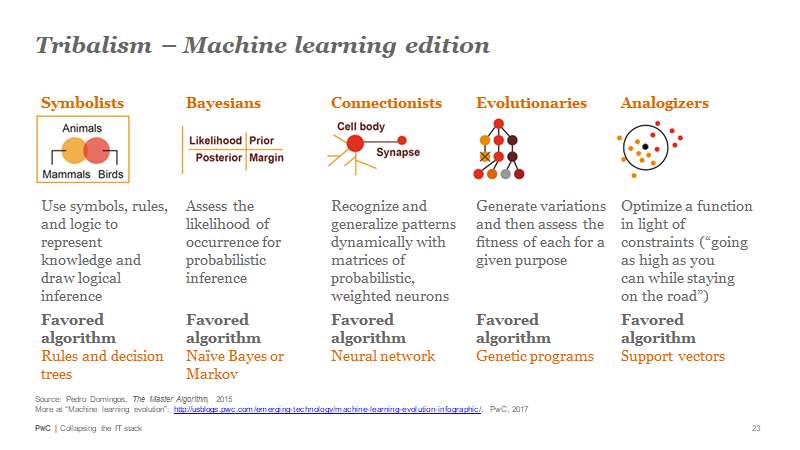
Back in 2015, Pedro Domingos of the University of Washington’s computer science department published The Master Algorithm. In the book, Domingos explored the possibility that one master algorithm could indeed rule them all. The main challenge, he said, was to bring the AI tribes together so that the strengths of the various approaches could be combined.

In 2023, more data scientists and engineers are understanding the value of bringing together the reasoning capabilities of the Symbolists and the predictive prowess of the Connectionists–Domingos’ name for the neural network tribe.

How hybrid AI can help LLMs become more trustworthy

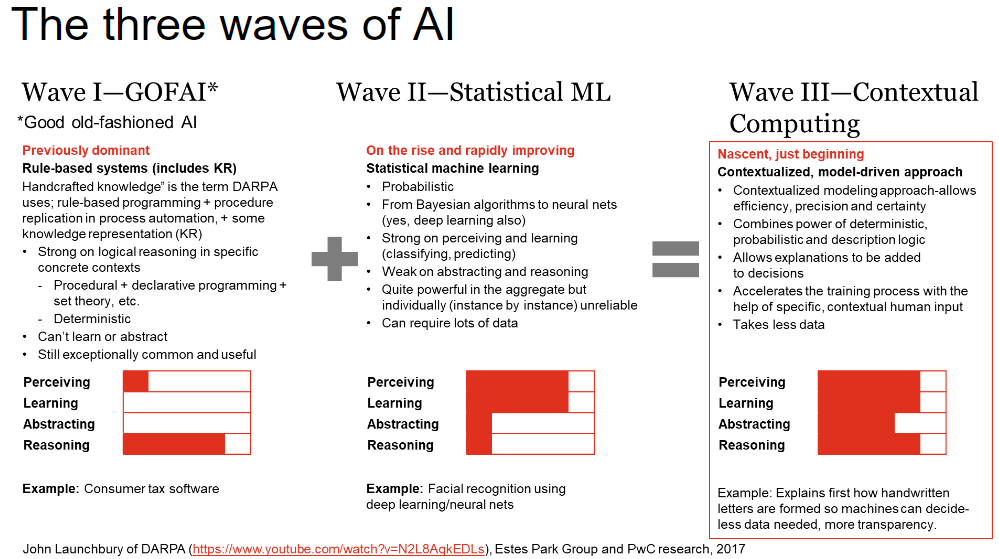
In 2017, John Launchbury, then head of DARPA’s Information Innovation Office, echoed Domingos’ thinking about bringing the Symbolists and the Connectionists together. Launchbury posted a video that explained the evolution of AI in terms of three different waves:

  • Wave I is Good Old Fashioned AI (GOFAI). The Symbolists dominated GOFAI, and actually made good progress on the reasoning front using knowledge representation (declarations of facts, for example) and rules. No wonder Boolean logic is still so commonly used in commercial software.
  • Wave II is Statistical Machine Learning. He pointed out that statistical machine learning (ML), like symbolic approaches, had actually been around since the 1950s. But ML didn’t come into its own until the 1990s because it took forty years for compute, networking and storage to improve enough for ML to scale.
  • Wave III is a form of Contextual Computing. Launchbury’s vision was that GOFAI and statistical machine learning (particularly neural nets) could complement one another by bringing together the power of deterministic, probabilistic and description logic.

To my mind, generative AI’s challenges can be traced back to the tribalism of Waves I and II. Some data scientists tend to be dismissive of the symbolic logic approaches. The truth is that statistical machine learning alone just doesn’t bring enough logic on its own into the mix to be able to create machine understandable context.

How hybrid AI can help LLMs become more trustworthy

The continuing influence of Doug Lenat and Cyc

I met the late Doug Lenat, the founder of Cycorp, at my first TTI/Vanguard event, which as I recall was in 2009. I was gathering research for an issue of the PwC Technology Forecast quarterly at the time. TTI/Vanguard at that time had many computer science luminaries including Lenat on its board. For example:

  • (The late) John Perry Barlow, founder of the Electronic Frontier Foundation and board member of the pre-web but post-internet online community The Well
  • Gordon Bell, former VAX minicomputer lead at Digital Equipment Corporation and then Microsoft advocate for the fully recordable life
  • Alan Kay, Xerox PARC GUI and Smalltalk OOP pioneer
  • Len Kleinrock, UCLA professor known for packet switching technology used in the ARPANET and today’s internet

These were the folks whose company Lenat kept. Most had their heyday during the 1970s and 80s and were semi-retired by the 2000s. But they were still really curious about emerging technology, which is why they helped out with the TTI/Vanguard events and in the process made them worthwhile.

One of the main points Lenat made during my interview with him had to do with the pervasive observational bias in enterprise business intelligence systems, also known as the Streetlight Effect. A drunk has lost his keys. He is looking for his keys under the streetlight, even though he actually thinks he lost the keys somewhere else. Why? “Because that’s where the light is,” the drunk says.

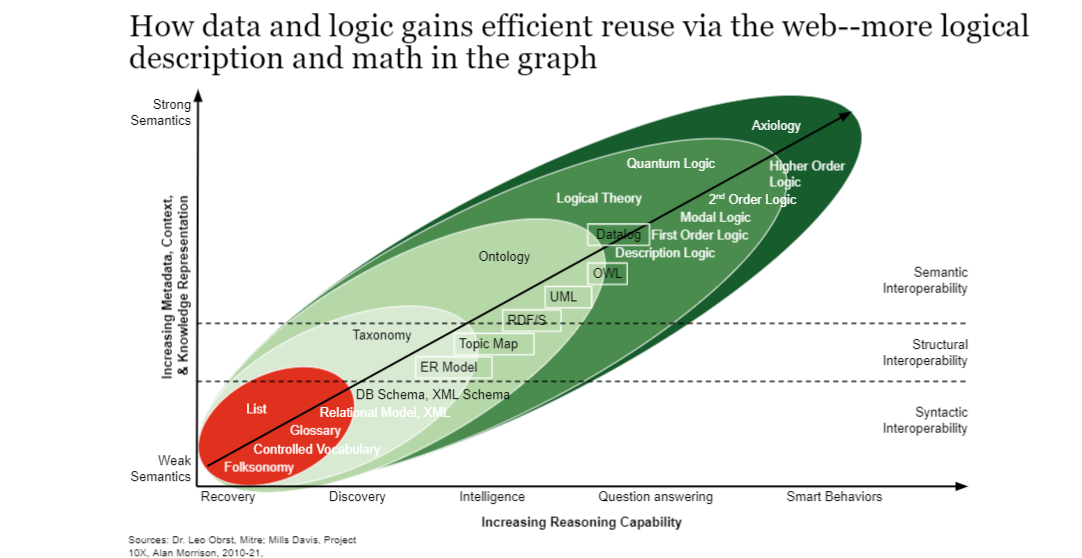
Over the years, I’ve used the Streetlight Effect metaphor to support an argument for scalable semantic graph integration or knowledge graph-based systems along the lines of what web pioneer Tim Berners-Lee has advocated. While application-centric architecture and relational database management systems by design can undermine the process of large scale integration, semantic graphs are all about starting with and adding to logical connections between entities.

Hybrid AI: More math in the knowledge graph

Before he passed away in August 2023, Lenat co-published a paper with cognitive scientist Gary Marcus titled “From Generative AI to Trustworthy AI: What LLMs Might Learn from Cyc”. The paper enumerates the various kinds of reasoning the Cyc project (a symbolic machine learning system, Lenat and Marcus point out) and its ontology and knowledge base harness that LLMs (statistical language models that predict the next tokens in a sequence) do not: Explanation, deduction, induction, analogy, abductive reasoning, and theory of mind, to name some examples.

Lenat’s legacy isn’t merely forty years of Cyc and counting. The legacy includes all the ontologists who worked at Cycorp and the influence those people are having at other companies when adding more reasoning capability to knowledge graphs, for example.

How hybrid AI can help LLMs become more trustworthy

That capability is what makes machine understanding possible, which in turn is what allows knowledge graphs to become a findable, accessible, interoperable, and reusable (FAIR) resource. There’s a reason FAIR knowledge has taken so long to get to this point. True artificial general intelligence isn’t easy. It requires all sorts of thinking, trial and error, and collaboration, across tribes.

Approaches to creating virtual fitting room software using AR and AI

Approaches to Creating Virtual Fitting Room Software

Virtual fitting room software with AR and AI is the next best alternative to physical stores. With many different kinds of virtual fitting room solutions on offer though, it can be hard to know which ones are the most feasible for your business. Let’s talk about the various approaches to developing such solutions.

Types of virtual try-on solutions

There are several different approaches for virtual try-on for various settings. Each approach provides for different business purposes and features and has its own pros and cons.

In-store virtual dressing solutions

Also known as smart mirrors, this solution shows a reflection of the user with overlaid augmented reality (AR) elements to show them as if they were wearing products of their choice, like clothing or accessories. A smart mirror could also include prices, color variations, stock availability, and other information that they might need to know.

Online virtual fitting room solutions

Especially important for ecommerce outlets and physical stores looking to expand online, virtual fitting room technologies can be extended to at-home experiences on mobile and desktop devices. This can either work through 3D rendering on digital mannequins, or through AR techniques.

When using digital mannequins, shoppers can specify dimensions and body types to get a better understanding of how products may look on them. AR can allow them to try on clothes in real-time and provide a more personalized experience.

Body sizing solutions

One of the greatest causes for skepticism and concern from shoppers is choosing a size for products. This is one of the most important advantages of in-person fitting rooms. However, other solutions do exist. For example, photo-based size recommendation solutions use customer images to calculate measurements with AI. With more powerful depth sensors being available in more modern smartphones than ever, this becomes even more feasible for many customers.

Apps with body measurements

These kinds of apps provide accurate measurements for users to help them with more personalized apparel shopping experiences. By tailoring online experiences to a user’s body type, ecommerce sites can increase sales, engagement, and customer loyalty.

There are some ready-made options available out there, but often times when you’re making and selling your own products, you’re going to need more flexibility than those solutions can provide.

A fundamental part of measuring bodies is pose estimation, detecting key body points and their positions. Body segmentation models create pixel masks of the human body and convert those pixels into measurement units. This can be done in 2D or 3D, depending on the project requirements.

2D pose estimation models aren’t as accurate as 3D methods, as 3D solutions incorporate depth into the model. To get a better understanding of measurements in the photos, body segmentation can take place through user images. However, the user should also provide their height to the application, as the app can use their height as a reference measurement and as the basis for measurement of other elements of the images.

There will always be some room for error. It’s a good idea to consider allowing the user to manually adjust some AI-generated measurements throughout the process to get more accurate results.

Apps with 3D models of clothes and a body

Another solution is to use a 3D model mannequin that can wear renders of clothes sold by your business. The model could be made with an entirely fictional character, or it could be created using images from the user themselves.

The resulting mannequin would be a 3D mesh, and models of clothes would be able to fit over the top of this mesh. Product renders may need to scale up and down. This is especially important if you want to give the user the power to adjust the body type, size, and height of the mannequin to better match their body type.

Apps based on latent diffusions

Another approach that can be used for virtual fitting room technology is generative AI. Specifically, latent diffusion can be used with an appropriate dataset of around 50 photos of particular products from different angles. Preprocessing is used to get masks and text descriptions. As the model is set up, connections are made between clothes and text descriptions. The input interface is composed of:

  • A base picture where the clothes will be swapped
  • The mask where the change occurs
  • A text prompt that matches the clothes we want to add

Every application is different, so keep in mind that your goals, resources, limitations, and other factors will influence how successful latent diffusion will be in virtual fitting room applications.

Wrapping Up

With different ways to approach virtual fitting room technologies, it’s up to business leaders to decide which technique is best for their customers. AI and AR technologies are also constantly changing, so innovations create new possibilities with each passing day. The most important part is having a vision for what you want to achieve and partnering with experienced software engineers who understand your needs and help you realize that vision.

Image credit

How Microsoft’s AI teaching assistant helps generate classroom materials

Classroom and technology illustration

To maintain a classroom properly running, teachers are responsible for many behind-the-scenes tasks in addition to the actual in-classroom time spent with their students. As a result, teachers could benefit greatly from some assistance, and Microsoft Research's new AI project aims to provide just that.

Shiksha copilot is an AI-powered digital assistant that helps teachers with their needs by leveraging generative AI.

Also: Why Biden's AI order is hamstrung by unavoidable vagueness

For example, the copilot will help teachers with behind-the-classroom prep, such as developing personalized learning experiences, designing assignments, creating hands-on activities, lesson planning, and more.

One teacher in Bengaluru found that by leveraging Shiksha copilot, she could reduce her lesson planning time from 60 to 90 minutes a day to 60 to 90 seconds.

The research project is an interdisciplinary collaboration between Microsoft Research India —as part of their Project VeLLM (aka, "Universal Empowerment with Large Language Models") — and teams across Microsoft.

The Sikshana Foundation, a local organization focused on improving public education, is also involved, helping pilot the program at more than 10 public schools in and around Bengaluru, India. The goal of the pilot program is to collect feedback from teachers that will be used to refine and further build out the tool.

So far, the results of the pilot seem promising.

Lesson planning is a vital part of a teacher's role because it helps them prepare the materials needed to properly execute the next day's lessons, including setting clear objectives and planning specific learning activities.

This task can be time-consuming because teachers often have to parse through many different materials to put together a well-thought-out lesson plan. Shiksha copilot can help make that task significantly easier.

One teacher in Bengaluru, Parimala H V, found that by leveraging Shiksha copilot, she could reduce her lesson planning time from 60 to 90 minutes a day to 60 to 90 seconds.

The demo of the copilot [see video below] shows how simple it is to create classroom materials. After the teacher selects several options — such as grade, language, curriculum, subject, and topics — Shiksha automatically generates the relevant content, including PowerPoints, take-home assignments, lesson plans, and more.

Another teacher, Gireesh K S, found that Shiksha copilot can identify activities that help him better engage with his students, which can be especially challenging in a class of 40-plus students.

Also: The safety of OpenAI's GPT-4 gets lost in translation

The AI tool supports connectivity to both public and private resource content, enabling the teachers to access an array of different resources they need to build their classroom content.

"Shiksha copilot is very easy to use when compared to other AI we have tried because it is mapped with our own syllabus and our own curriculum, " said Gireesh.

Shiksha is available via different modalities, including WhatsApp, Telegram, and web applications to make it easily accessible for teachers.

Microsoft plans on expanding the pilot to more schools across the state of Karnataka and beyond.

Artificial Intelligence

New nonprofit backed by crypto billionaire scores AI chips worth $500M

New nonprofit backed by crypto billionaire scores AI chips worth $500M Kyle Wiggers 12 hours

It’s strange times we’re living in when a blockchain billionaire, not the usual Big Tech suspects, is the one supplying the compute capacity needed to develop generative AI.

It was revealed yesterday that Jed McCaleb, the co-founder of blockchain startups Stellar, Ripple and Mt Gox and aerospace company Vast, launched a 501(c)(3) nonprofit that purchased 24,000 Nvidia H100 GPUs to build data centers that’ll lease capacity to AI projects.

Already, the cluster of GPUs — worth an estimated half a billion dollars and among the largest in the world — is being used by startups Imbue and Character.ai for AI model experimentation, claims Eric Park, the CEO of a newly formed organization, Voltage Park, that’s charged with running and managing the data centers.

“The goal was to unlock access to startups, scale-ups and research organizations that are currently blocked from this space due to restrictive contracts, the scarcity of GPUs and high minimum purchase thresholds so that they can access the vital resources they need to innovate,” Park told TechCrunch in an email interview. “We’re continuing to speak with folks in the industry to understand their needs and are using what we learn to inform how we build out our remaining clusters so that they’re useful to as many customers as possible.”

Most companies training models, particularly generative AI models like ChatGPT and Stable Diffusion, heavily rely on GPU-based hardware. GPUs’ ability to perform many computations in parallel make them well-suited to training — and serving — today’s most capable AI.

But there aren’t enough chips to go around.

Microsoft is facing a shortage of the server hardware needed to run AI so severe that it might lead to service disruptions, the company warned in a summer earnings report. And some of Nvidia’s best-performing AI cards are reportedly sold out until 2024.

“The shortage for cutting-edge compute is dire,” Park said. “I have conversations with companies of all sizes — startups, scale-ups and big labs — and pretty much every single one tells me they can’t get enough H100s to train their models. There’s a compounding difficulty for startups and scale-ups who can’t sign the large contracts many clouds require to access these chips, and that’s really limiting AI innovation.”

Voltage Park was established under a somewhat unusual structure.

McCaleb started a nonprofit called the Navigation Fund to whose endowment he donated. The Navigation Fund then purchased the aforementioned H100s — paying “full sales and use taxes,” despite the Navigation Fund’s ostensible nonprofit status — and transferred ownership of the GPUs to for-profit Voltage Park, which is technically a subsidiary of the Navigation Fund.

“Navigation’s board determined that a for-profit subsidiary would be better able to set up specialized operations to manage a cluster of this scale,” a Navigation Fund spokesperson told TechCrunch in an email. “They created Voltage Park to do that, and transferred ownership of the GPUs as part of the initial capital contribution. There was good strategic reason for doing this. A subsidiary would be better placed to pursue the market opportunity around cutting-edge compute, while the Navigation Fund would be able to focus exclusively on its mission and charitable grant-making.”

The spokesperson went on to say that McCaleb doesn’t own, run or earn profits from the Brooklyn, New York-based Navigation Fund or Voltage Park, which are run by separate executive teams and have independent boards of directors. Presumably, there’s a considerable tax benefit to McCaleb’s donation — even if the nonprofit recipient immediately re-gifted the assets to Voltage Park.

Voltage Park won’t be the Navigation Fund’s only project. The spokesperson described it as a “long-term” nonprofit foundation with interests in a range of sectors, including farmed animal welfare, criminal justice reform, open science, climate and AI safety, that’ll support “organizations, activists, advocates and entrepreneurs.”

The Navigation Fund’s got a ways to go before it embarks on any of those endeavors, though. It doesn’t appear to be formally registered as a nonprofit yet; when TechCrunch consulted an expert last week to perform a search for the Navigation Fund on two industry-standard databases, Charity Navigator and GuideStar, the expert couldn’t find a listing. And the Navigation Fund’s president, David Coman-Hidy, only joined in August.

That’s not to suggest impropriety. The Navigation Fund might well have its paperwork in order and filed, but the IRS simply hasn’t gotten around to processing it yet.

Whatever the Navigation Fund’s tax status, a percentage of Voltage Park’s profits will go to the Navigation Fund to support its philanthropic mission, the spokesperson said.

Voltage Park’s full cluster isn’t online. But once it is closer to the end of the year (assuming all goes according to plan), it’ll be live across three states — Texas, Virginia and Washington. Park says that a “significant portion” will be reserved for early-stage startups and developers and that capacity will be available both for short-term leases and hourly billing.

“We set up Voltage Park to help ensure a broad range of companies have a seat at the [AI] table,” Park said. “We currently offer bare-metal machine learning training infrastructure, but our mission is broader — we want to make machine learning accessible to a wider audience by lowering the barrier to entry. This may include additional services built on top of our infrastructure. We’re still in the early days of this industry and we’ll adapt as the field develops and matures.”

DSC Weekly 31 October 2023

Announcements

  • Traditional methods of cyberattack such as ransomware, malware, and email phishing will persist, but security strategies must now address emerging concerns like the growing prevalence of AI and the near-universal employee use of mobile and IoT devices. Tune into our virtual summit on The 2024 ThreatScape to gain insights from renowned industry experts into the risks that lie ahead and discover the most effective preventive and defensive measures against potentially catastrophic attacks.
  • Containerization is an effective way to develop and deploy applications, but they can quickly become unwieldly without the proper orchestration and management. To avoid canceling out containers many benefits, companies must stay on top of orchestration products and best practices to secure and monitor container management. Tune into the Containers in the Enterprise virtual summit to hear leading experts explore top tools to orchestrate and automate containers as well as general best practices for working with and managing containers.

Top Stories

  • Data engineering career guide
    October 31, 2023
    by Dr. Andy Drotos
    From ensuring that mobile apps function smoothly to facilitating personalized recommendations and targeted ads, data engineering powers the digital experiences that have become part of many of our day-to-day lives. There is currently a major need for knowledgeable and skilled professionals to fill open data engineer roles.
  • How hybrid AI can help LLMs become more trustworthy
    October 31, 2023
    by Alan Morrison
    Back in 2015, Pedro Domingos of the University of Washington’s computer science department published The Master Algorithm. In the book, Domingos explored the possibility that one master algorithm could indeed rule them all.
  • How technical program managers can build a robust Generative AI future
    October 31, 2023
    by Kannamangalam Chakaravarthi Lakshminarasimham
    The modern digital ecosystem, buzzing with the chatter of data and algorithms, presents both promises and challenges. In this intricate web, generative artificial intelligence (GenAI) shines as a beacon of innovation. To harness this power, enterprises need more than just cutting-edge technology.
Education_DSC_160x600-2

In-Depth

  • Approaches to creating virtual fitting room software using AR and AI
    October 31, 2023
    by Anastasia Molodoria
    Virtual fitting room software with AR and AI is the next best alternative to physical stores. With many different kinds of virtual fitting room solutions on offer though, it can be hard to know which ones are the most feasible for your business. Let’s talk about the various approaches to developing such solutions.
  • AGI Jesse and the future of finance
    October 31, 2023
    by Alice Huang
    The financial world is on the cusp of a remarkable transformation, thanks to the integration of advanced AI models like GPT-4. In this article, we delve into the evolving landscape of Machine Learning (ML) in finance and explore the potential impact of these cutting-edge AI systems.
  • How AI chatbots are transforming the world?
    October 31, 2023
    by Arshima Siddikee
    AI chatbot technology has taken the world by storm. From assisting individuals with their content requirements to facilitating top-notch customer service for businesses, AI chatbot technology offers it all. The technology has penetrated multiple prominent industries. And rightly so.
  • Generative AI ethics: Navigating the boundary between human and machine creativity
    October 31, 2023
    by Tredence Analytics
    Generative AI is revolutionizing our creative landscape, unlocking unprecedented possibilities. But at what cost? Dive into the ethical dilemmas of this transformative technology, exploring the fine line between innovation and ethical consideration. 2022 was a huge year for Generative AI.
  • FAIR knowledge: The key precondition for trusted generative AI
    October 30, 2023
    by Alan Morrison
    Two roads diverged in a wood, and I;I took the one less traveled by,And that has made all the difference. — Robert Frost At certain points in the evolution of enterprise artificial intelligence, there’s been a fork in the road.
  • 6 tips to navigate AI adoption
    October 30, 2023
    by Evan Morris
    Unlock Success in AI Adoption: Discover 6 Essential Tips for Business Leaders to Navigate Artificial Intelligence Integration Smoothly. The post 6 tips to navigate AI adoption appeared first on Data Science Central.
  • DSC Weekly 24 October 2023
    October 24, 2023
    by Scott Thompson
    Read more of the top articles from the Data Science Central community.