LinkedIn unveils a new, AI-infused Premium experience

LinkedIn app on a phone

LinkedIn has added a series of generative AI tools this year that have helped to improve the job-search experience for candidates and employers. These refinements culminate today in the latest development — a brand-new Premium experience.

The compay has announced it will be rolling out the new experience, which includes personalization and interaction features, to a select group of LinkedIn subscribers.

Also: Why Biden's AI order is hamstrung by unavoidable vagueness

In the announcement, LinkedIn shares a sneak peek of both AI-powered features: a new job seeker coach, and a new AI feed summarization experience.

The job seeker coach helps users find their dream job with insights, such as whether a job is a good fit, how to position themselves for the role, how to prepare for interviews, and more.

Also: LinkedIn just added AI-powered coaching and recruiting tools to make your job easier

LinkedIn is also introducing an AI-powered summarization experience that analyzes posts from a user's feed, including articles and commentary, and presents the key information in one click.

The aim is to prevent users having to consume lots of lengthy content, such as reading long articles or watching a ton of videos. It's hoped the tool will pull together key insights that users can then use for their own career growth.

Also: How Microsoft's AI teaching assistant helps generate classroom materials

The summarization experience also leverages Microsoft Bing to provide users with timely and comprehensive information about what's happening in the world at the present moment. If users have questions about topics, they can ask LinkedIn and are presented with resources from across the platform and the web.

These new AI-enabled tools build on the existing Premium-exclusive features on LinkedIn, including AI-powered profile writing assistance, Top Choice jobs signals, and more.

The new features will begin rolling out to LinkedIn subscribers at no additional cost. If you want to try the features out for yourself, you can join a one-month LinkedIn Premium free trial or sign up for a LinkedIn Premium Career account for $39.99 per month.

Artificial Intelligence

Yahoo spin-out Vespa lands $31M investment from Blossom

Yahoo spin-out Vespa lands $31M investment from Blossom Kyle Wiggers 7 hours

Vespa.ai, the big data serving engine that just a few weeks ago spun out from Yahoo (full disclosure: TechCrunch’s parent company) into an independent venture, has raised a new round of funds.

Blossom Capital led a $31 million investment in Vespa — money that Vespa CEO Jon Bratseth says will be put toward growing Vespa as a standalone business, strengthening the company’s engineering functions and “delivering more features faster to all Vespa’s users.”

“In particular, we’ll speed up the development of features that’ll make it easier for developers to create apps that combine AI models with proprietary data sets,” Bratseth told TechCrunch in an email interview. “Vespa has been around for over 20 years, and we’re set up to be around for a lot longer.”

Yahoo created Vespa back in 2005 after acquiring paid search service provider Overture, and, through it, a Norwegian search engine called AlltheWeb.com. Working with the e-commerce division within Yahoo, the AllTheWeb team retooled its search tech into a more general-purpose tool that Yahoo developers could use internally to compute over large-scale datasets in real time.

Over the next decade or so, Yahoo expanded Vespa along several axes, enabling the tool to handle input beyond text strings, personalize content based on users’ click-through histories and take direction from machine learning algorithms. Then, in 2017, Yahoo open sourced Vespa, hoping to rally developer support behind the software — and foster something of an ecosystem both internally and externally.

Evidently, it paid off.

Thousands of brands including Spotify, OkCupid and Wix now use either the open source release of Vespa or Vespa’s cloud-hosted, fully managed product, Vespa Cloud. Vespa still drives searches and related-article recommendations on many Yahoo-owned sites — performing ad targeting on Yahoo-branded web properties such as Yahoo Sports, Yahoo Finance, Yahoo News and Yahoo’s advertising network.

“Well-known use cases of Vespa include search (for both humans and AI), online personalization recommendation and ad serving,” Bratseth said. “Essentially, Vespa applies AI to store, sift through and apply data to meet any number of needs, and it’s currently being used for everything from helping a global financial services company instantly search through billions of documents … to serving one billion users processing 800,000 queries per second across 150 applications to deliver content and offering targeted ads for Yahoo.”

While there’s a number of open source alternatives to Vespa available, including Solr and Elasticsearch, Bratseth makes the case that Vespa goes several steps beyond what’s on the market. For example, he says, Vespa offers a mode, “vector streaming search,” that can “dramatically” cut the cost of an app retrieving personal data such as emails and documents.

“Vespa [provides] end-to-end services that allow clients to use any combination of text and structured data to provide quality results with sophisticated scoring and relevance at scale,” Bratseth said. “Vespa solves the problem many AI applications, including large language models [along the lines of ChatGPT], are starting to face as they increase the amount of customers and data needed to function while also allowing Fortune 500 and enterprise customers to leverage AI to streamline their operations and improve their bottom line.”

Free of Yahoo (except for Yahoo’s stake in Vespa and seat on Vespa’s board of directors), Bratseth says that Vespa, whose team now stands at 29 people, has the capability to expand its cloud services.

“Those who already use Vespa now have the opportunity to move to Vespa Cloud,” he said. “Vespa is a startup with a huge growth potential from our large base of open source enterprise usage, which would benefit greatly from moving to our managed version of the platform.”

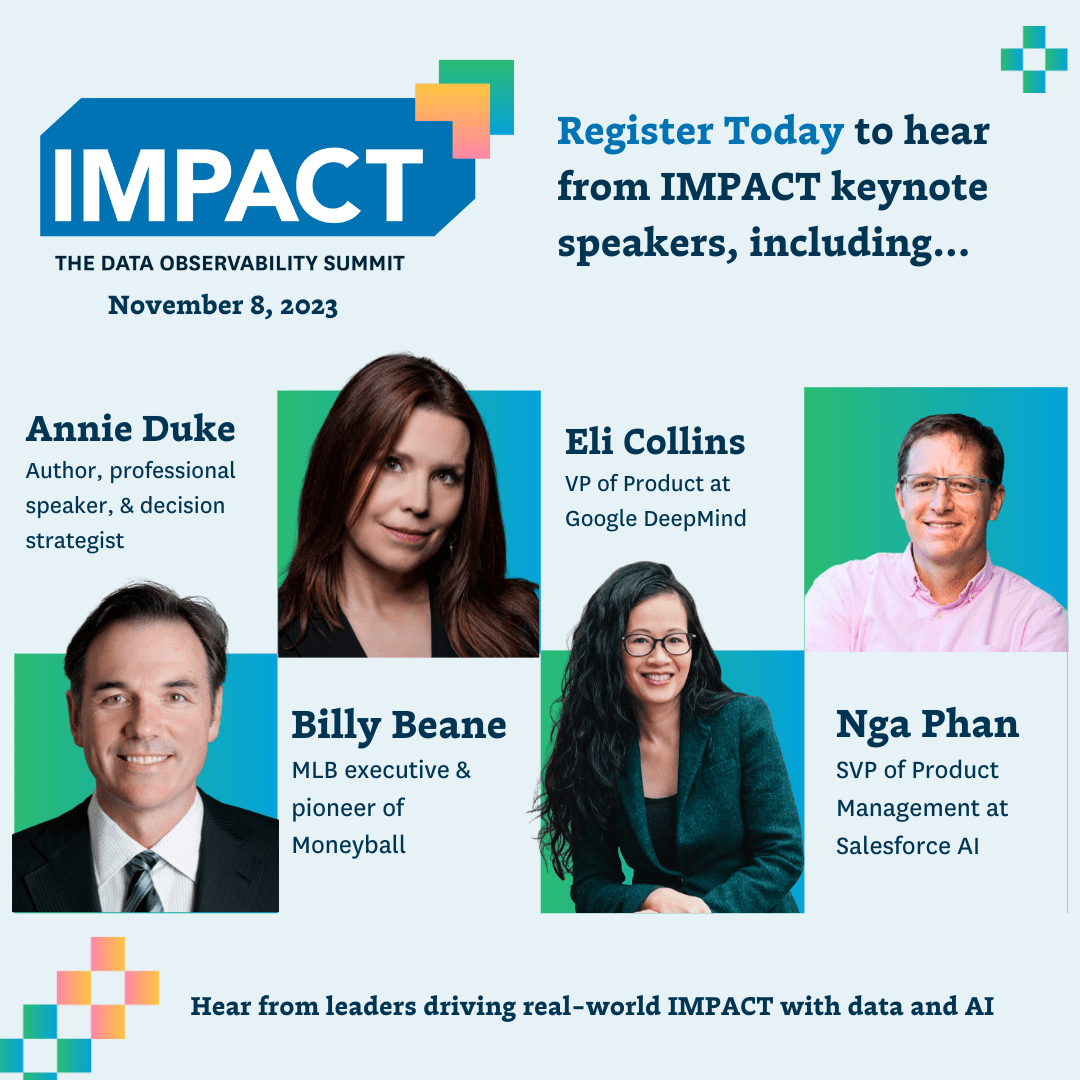
Monte Carlo is Kicking Off IMPACT 2023, Keynotes From Data & AI Pioneers

Sponsored Content

Monte Carlo is Kicking Off IMPACT 2023 on Nov 8, Keynotes From Data & AI Pioneers

Monte Carlo is kicking off IMPACT 2023 on Nov. 8th with keynotes from four data & AI pioneers, moneyball expert Billy Beane, poker legend Annie Duke, VP of Product at Google Deepmind Eli Collins and SVP of Product Management at Salesforce AI, Nga Phan!

Register today for the day-long virtual summit packed with amazing speakers and thought-provoking topics such as Generative AI, data products, and more!

More On This Topic

  • Sky's the Limit: Learn how JetBlue uses Monte Carlo and Snowflake…
  • Level-Up This November with the ODSC West 2021 Keynotes and…
  • How I Got 4 Data Science Offers and Doubled My Income 2 Months…
  • Get World-class Data Science Learning with DataCamp at 25% off
  • Understanding Bias-Variance Trade-Off in 3 Minutes
  • The Bias-Variance Trade-off

Is Academia Obsessing Over Methodology at the Cost of True Insights?

Is Academia Obsessing Over Methodology at the Cost of True Insights?
Photo by Kampus Production

When it comes to increasing your knowledge and skill set, a lot of people think about seeing academia, research and other forms of core learning as the foundations of all forms of knowledge. Behind a lot of this knowledge is methodology and processes to get to the point of it becoming knowledge. But a question that keeps circulating in the academic community is ‘Does academia focus too much on methodology over insights?”.

Some say yes, some say no. Let’s dive into it…

Methodology in Academia

Before we get into it, let’s first define what ‘Methodology’ is. Methodology in an academic context refers to a system of approaches used to carry out research, using a variety of tools and techniques to gather and analyze data.

Methodology is a key element when it comes to research. Research is used to support a statement or look further into a specific statement that does not have enough backing. Therefore when it comes to research, there needs to be a high degree of precision and reliability to it. Without precision and reliability, the research industry's reputation will lose credibility.

Insights in Academia

As you can see with the rise of AI systems, insights have shown us a lot. Things we couldn’t have even imagined. Insight focuses on the discoveries that emerge from all the research, which have later been used to innovate, solve problems and create a different type of future for us ourselves.

You can imagine that in this day and age, more organizations are caring about the value that they can get from insights over methodology.

Methodology vs Insights

With the development of technology in the past 10 years alone, would you say that insights have proven to be more useful than methodology?

But then some might say that insights will never have been derived if it wasn’t for methodology.

It’s not a question of ‘what came first, the chicken or the egg?’. We know that methodologies and processes came first, the question now is does academia focus too much on methodology over insight?

Insights wouldn’t be here if we didn’t have rigorous systematic frameworks in place for research. These have played an integral role in the years of innovation the world has seen, however have these approaches caused people to focus on what’s right in front of them rather than seeing the bigger picture.

We have been taught for so long that education and knowledge is your road to success. You have parents pushing their children to be the best they can be, go to the best universities, and land amazing jobs. Yes, every parent wants their children to be successful, but don’t you think times have changed. There are less and less students wanting to pursue studying at universities, and more and more young millionaires. Something doesn’t seem to be adding up, right?

Well, no — everything's adding up perfectly fine. Not only do the younger generation have better access to the world, education, and resources to learn whatever they want. The one big thing they do have that was not so prominent in previous generations was being creative and unapologetically nurturing it.

Thinking outside of the box makes you tap into your creative side, your unconventional thinking side. This is what has led to breakthroughs, multi-million ideas and a whole paradigm shift. Is methodology killing open-mindedness? Or does academia need to adopt a more creative and interdisciplinary approach?

Finding the Right Balance

Are there dangers of sidelining one over the other? Of course. Sidelining insights to push the rigid process of methodologies can kill peoples creative spirit when it comes to academia. As we mentioned, groundbreaking discoveries have happened due to creative spirit, does it make sense to kill it?

Both methodology insights are interdependent. Academia needs to be flexible and find the balance between embracing different values that insights can bring to the table, without completely taking methodology off the table. You can still have rigorous methods that do not negate or overshadow the potential of what insights can tell us.

The same way we were cautious about electricity for the first time but saw its benefits, or the first telephone. We learnt to adapt to the times we are currently living in. Academia has seen a sharp drop in young people who want to continue higher education. This could be for various reasons, but one naturally is that the learning methods are ‘old school’. It does not resonate with the new generations, because they are living in a completely different time.

We’re going to be surrounded by AI babies who only understand insight and what they can do with that insight. Therefore, it is important for academia to shift in encouraging new creative approaches to research as well as ensuring to teach the importance of robust methodologies.

Wrapping it up

This is my opinion as a millennial, somebody who has had insightful conversations with the baby boomers, Gen X and went to school with millennials. Change does not always have to be bad, and in this case I personally think change within academia will be highly beneficial for the next generations.

Finding the right balance between the two rather than having them do a tug-of-war is the only way to continuously drive progression within academia and innovation to create a better world.

Nisha Arya is a Data Scientist and Freelance Technical Writer. She is particularly interested in providing Data Science career advice or tutorials and theory based knowledge around Data Science. She also wishes to explore the different ways Artificial Intelligence is/can benefit the longevity of human life. A keen learner, seeking to broaden her tech knowledge and writing skills, whilst helping guide others.

More On This Topic

  • Dream Come True: Building websites by thinking about them
  • Clustering in Crowdsourcing: Methodology and Applications
  • How I Redesigned over 100 ETL into ELT Data Pipelines
  • Machine Learning Over Encrypted Data
  • For SQL, or why I'm so over-protective of my data people
  • 5 Concepts You Should Know About Gradient Descent and Cost Function

Global players look to create baseline to evaluate generative AI applications

Lightbulb on puzzles

Efforts are underway to provide a common set of benchmarks to assess generative artificial intelligence (AI) products and to create a "body of knowledge" on how these tools should be tested.

The aim is to provide a standard approach to the evaluation of generative AI applications and to galvanize efforts to address the risks. This common approach is a shift away from existing "piecemeal" efforts.

Also: Six skills you need to become an AI prompt engineer

Dubbed Sandbox, the initiative is led by Singapore's Infocomm Media Development Authority (IMDA) and AI Verify Foundation, and has garnered support from global market players, such as Amazon Web Services (AWS), Anthropic, Google, and Microsoft. These organizations are part of a current group of 15 participants, which also comprises Deloitte, EY, and IBM, as well as Singapore-based OCBC Bank and telco Singtel.

Sandbox is guided by a new draft catalog that categorizes current benchmarks and methods used to evaluate large language models (LLMs). The catalog compiles commonly used technical testing tools, organizing these according to what they test for and their methods, and recommends a baseline set of tests to evaluate generative AI products, IMDA said.

Also: Want a job in AI? These are the skills you need

The goal is to establish a common language and support "broader, safe and trustworthy adoption of generative AI", it said.

"Systematic and robust evaluation of models is a critical component of LLM governance and helps form the bedrock of trust in the use of these technologies," IMDA said.

"Through rigorous evaluation, the capabilities of a model are revealed, which can assist in determining its intended uses and potential limitations. Evaluation [also] provides a vital roadmap for developers to make improvements."

Achieving this common language requires a standardized taxonomy and baseline set of pre-deployment safety evaluations for LLMs, it noted. The Singapore government agency hopes the draft catalog offers a starting point for global discussions, with the aim of driving consensus on safety standards for LLMs.

Also: How to write better ChatGPT prompts (and this applies to most other text-based AIs, too)

Moving toward common standards also means involving other stakeholders in the ecosystem, beyond the model developers, such as application developers that build on top of the models and developers of third-party testing tools.

Through Sandbox, IMDA wants to offer use cases that include a generative AI model developer, application deployer, and third-party tester to demonstrate how the different players can work together. For instance, model developers, such as Anthropic or Google, can work with app developers OCBC or Singtel, alongside third-party testers, such as Deloitte and EY, and on generative AI use cases for the financial services or telecommunications sector.

Regulators, such as Singapore's Personal Data Protection Commission, should also be involved, so Sandbox can provide an environment for experimentation and development where all parties in the ecosystem can be "transparent" about their needs, IMDA said.

IMDA expects Sandbox to uncover gaps in the current state of generative AI evaluations, including domain-specific applications, such as human resources and cultural-specific areas, which are currently under-developed.

"Sandbox will develop benchmarks for evaluating model performance in specific areas that are important for use cases, and for countries like Singapore because of cultural and language specificities," IMDA said.

Also: 6 things ChatGPT can't do (and another 20 it refuses to do)

The Singapore agency said it is collaborating with Anthropic on a Sandbox project that uses the catalog to identify aspects for red teaming, which looks to challenge policies and assumptions used in AI systems by taking on an adversarial approach.

IMDA will tap Anthropic's models and research tooling platform to develop red-teaming methodologies customized for Singapore's diverse linguistic and cultural landscape. For instance, AI models will be evaluated for their abilities to perform within the country's multi-lingual context.

In July, the Singapore government launched two sandboxes running on Google Cloud's generative AI toolsets, one of which is used exclusively by government agencies to develop and test generative AI applications. The other sandbox is available to local organizations and provided at no cost for three months, for up to 100 use cases.

Artificial Intelligence

How Google Will Change Search Forever

While Google might be embroiled in an ongoing antitrust case on one end, on the other end, the tech giant is soaring with its recent Q3 earnings. Alphabet, Google’s parent company, saw an 11% revenue growth, returning to double-digit figures after a year. CEO Sundar Pichai was not only pleased with the results but emphasised on the robust growth of ‘Search’ feature, which was the largest contributor to revenue growth.

With AI capabilities being brought through search generative experience (SGE), the company is on path to change the search feature forever.

SGE to Lead the Way

Google continues to dominate the search engine market by a huge difference, and is still building features to push it ahead. With 8.5 billion searches on Google every single day, and a 90% market share of the search engine market, the company is comfortably placed way ahead of its competitors. And, they are not stopping at that.

Source: Similarweb

In the recent earnings call, Google mentioned how with generative AI being integrated in search, SGE which is currently available in the US, Japan and India, a broader range of queries with multiple perspectives can be addressed. Google is also now linking to a wider range of sources on the results page, for pushing content discovery. Interestingly, their improved search feature will bolster their advertiser revenue.

Google Search Generative Experience gains "supportive" links in the AI-generated description of the source https://t.co/1vkrGS7BMQ pic.twitter.com/caJTQ3bLy3

— Barry Schwartz (@rustybrick) October 26, 2023

Search And Advertisers Go Hand-in-Hand

In May, Google had launched SGE, an experiment in Search Labs, in the US alone, to test AI integration on search, and the goal was to get user feedback and further build on it. The experiment seemed to have paid off with Pichai expressing his pleasure on the positive feedback received from SGE users, and also confirming about rolling it out to more users. Interestingly, out of $76.69 billion revenue for Q3, the advertising business accounted for $59.65 billion.

Pichai also emphasised on how ads will continue to ‘play an important role’ in this new search experience. The company will continue to experiment with new formats in SGE to create relevant, high-quality ads that are customised at every stage of the search journey. Lead tech analyst a​t I/O, Beth Kindig mentioned that SGE will promise advertisers better ROI.

Google’s Search revenue of $44B increased +11.3% YoY, the highest growth rate since Q2 ‘22.
In August, I wrote about Google's dominance in search amidst the buzz around ChatGPT. Alphabet's upcoming Search Generative Experience (SGE) promises advertisers better ROI, poised to…

— Beth Kindig (@Beth_Kindig) October 26, 2023

Google had suggested their plan to introduce ads in SGE during the I/O event in May, showing a glimpse of how ads will look in the future. Integrating ads into AI search, akin to how Microsoft pushed ads into their AI-powered Bing Chat, Google looks to make the platform wholesome. The company is also building Generative AI templates that combine the capabilities of LLMs with Google APIs to solve industry-specific use cases such as travel.

There’s More…

While Google is working on enhancing its existing search experience, its large language model Bard continues to progress on the sideline. Recently, Google introduced browser extensions for Google apps such as YouTube, Google Flights, Google Maps, and Google Drive, Google Docs, and Gmail on Bard. Furthermore, Google also announced the integration of Bard on Google Assistant, in an attempt to provide a more intuitive, intelligent and personalised digital assistant.

While OpenAI only recently went completely multimodal, allowing voice and image input, and even released an update on allowing upload of any form of documents including PDFs, Bard was multimodal way before that. Furthermore, Pichai spoke about the much-anticipated Project Gemini. “I’m very excited at the progress there and as we’re working through getting the model ready.” He also hinted at it being multimodal, and ‘highly efficient with tool and API integrations’.

With AI being the main focus, and even making it to big tech companies’ quarterly earnings (Google said AI at least 76 times), the road ahead is laden with AI-driven developments and integration for these companies. Search being the key revenue driver, Google’s efforts to make it more enhanced is undeniable.

The post How Google Will Change Search Forever appeared first on Analytics India Magazine.

Google Offers Bug Bounties for Generative AI Security Vulnerabilities

Google logo at Googleplex Silicon Valley Mountain View in California.
Image: Markus Mainka/Adobe Stock

Google expanded its Vulnerability Rewards Program to include bugs and vulnerabilities that could be found in generative AI. Specifically, Google is looking for bug hunters for its own generative AI, products such as Google Bard, which is available in many countries, or Google Cloud’s Contact Center AI, Agent Assist.

“We believe this will incentivize research around AI safety and security, and bring potential issues to light that will ultimately make AI safer for everyone,” Google’s Vice President of Trust and Safety Laurie Richardson and Vice President of Privacy, Safety and Security Engineering Royal Hansen wrote in an Oct. 26 blog post. “We’re also expanding our open source security work to make information about AI supply chain security universally discoverable and verifiable.”

Jump to:

  • Google’s bug bounty program
  • Other bug bounties and common attack types in generative AI
  • How to learn generative AI

Google’s bug bounty program: Limitations and rewards

There are limitations as to what counts as a vulnerability in generative AI; a complete list of what vulnerabilities Google considers in scope or out of scope for the Vulnerability Rewards Program is in this Google security blog.

Generative AI introduces risks traditional computing doesn’t; these risks include unfair bias, model manipulation and misinterpretations of data, Richardson and Hansen wrote. Notably, AI “hallucinations” — misinformation generated within a private browsing session — do not count as vulnerabilities for the purposes of the Vulnerability Rewards Program. Attacks that expose sensitive information, change the state of a Google user’s account without their consent or provide backdoors into a generative AI model are within scope.

Ultimately, anyone participating in the bug bounty needs to prove that the vulnerability they discover could “pose a compelling attack scenario or feasible path to Google or user harm,” according to the Google security blog.

Possible Google AI bug bounty rewards

Rewards for the Vulnerability Rewards Program range from $100 to $31,337, depending on the type of vulnerability. Details on rewards, payouts can be found on Google’s Bug Hunters site.

Other bug bounties and common attack types in generative AI

OpenAI, Microsoft and other organizations offer bug bounties for white hat hackers who find vulnerabilities in generative AI systems. Microsoft offers between $2,000 and $15,000 for qualifying bugs. OpenAI’s bug bounty program will give between $200 and $20,000.

SEE: IBM X-Force researchers found phishing emails written by people are slightly more likely to get clicks than those written by ChatGPT. (TechRepublic)

In an October 26 report, HackerOne and OWASP found that the most common vulnerability in generative AI was prompt injection (i.e., using prompts to make the AI model do something it was not intended to do), followed by insecure output handling (i.e., when LLM output is accepted without scrutiny) and the manipulation of training data.

How to learn to use generative AI

Developers and security researchers just starting out with generative AI have plenty of options when it comes to learning how to use it, from experimenting with free applications such as ChatGPT to taking professional courses. DeepLearning.AI has courses at both beginner and advanced levels for professionals who want to learn how to use and develop for artificial intelligence and machine learning.

Google Weekly

Subscribe to the Google Weekly Newsletter

Learn how to get the most out of Google Docs, Google Cloud Platform, Google Apps, Chrome OS, and all the other Google products used in business environments.

Delivered Fridays Sign up today

Generative AI can’t find its own errors. Do we need better prompts?

Abstract AI deep learning

The field of deep learning artificial intelligence, especially the area of "large language models," is trying to determine why the programs notoriously lapse into inaccuracies, often referred to as "hallucinations."

Google's DeepMind unit tackles the question in a recent report, framing the matter as a paradox: If a large language model can conceivably "self-correct," meaning, figure out where it has erred, why doesn't it just give the right answer to begin with?

Also: 8 ways to reduce ChatGPT hallucinations

The recent AI literature is replete with notions of self-correction, but when you look closer, they don't really work, argue DeepMind's scientists.

"LLMs are not yet capable of self-correcting their reasoning," write Jie Huang and colleagues at DeepMind, in the paper "Large Language Models Cannot Self-Correct Reasoning yet," posted on the arXiv pre-print server.

Huang and team consider the notion of self-correction to not be a new thing but rather a long-standing area of research in machine learning AI. Because machine learning programs, including large language models such as GPT-4, use a form of error correction via feedback, known as back-propagation via gradient descent, self-correction has been inherent to the discipline for a long while, they argue.

Also: Overseeing generative AI: New software leadership roles emerge

"The concept of self-correction can be traced back to the foundational principles of machine learning and adaptive systems," they write. As they note, self-correction has supposedly been enhanced in recent years by soliciting feedback from humans interacting with a program, the prime example is OpenAI's ChatGPT, which used a technique called "reinforcement learning from human feedback."

The latest development is to use prompts to get a program such as ChatGPT to go back over the answers it has produced and check whether they are accurate. Huang and team are calling into question those studies that claim to make generative AI employ reason.

Also: With GPT-4, OpenAI opts for secrecy versus disclosure

Those studies include one from University of California at Irvine this year, and another one this year from Northeastern University, both of which test large language models on benchmarks for question-answering of things such as grade-school math word problems.

The studies try to enact self-correction by employing special prompt phrases such as, "review your previous answer and find problems with your answer."

Both studies report improvements in test performance using the extra prompts. However, in the current paper, Huang and team recreate those experiments with OpenAI's GPT-3.5 and GPT-4, but with a crucial difference: They remove the ground-truth label that tells the programs when to stop seeking answers, so that they can watch what happens when the program keeps re-evaluating its answers again and again.

What they observe is that the question-answering gets worse, on average, not better. "The model is more likely to modify a correct answer to an incorrect one than to revise an incorrect answer to a correct one," they observe. "The primary reason for this is that false answer options […] often appear somewhat relevant to the question, and using the self-correction prompt might bias the model to choose another option, leading to a high 'correct ⇒ incorrect' ratio."

Also: Companies aren't spending big on AI. Here's why that cautious approach makes sense

In other words, without a clue, simply reevaluating can do more harm than good. "A feedback prompt such as 'Review your previous answer and find problems with your answer' does not necessarily provide tangible benefits for reasoning," as they put it.

Large language models such as GPT-4 are supposed to be able to review their answers for errors and make adjustments to get back on track. DeepMind scientists say that doesn't necessarily work in practice. Examples of successful self-correction of GPT-4, left, and failure to self-correct properly, right.

The takeaway of Huang and team is that rather than giving feedback prompts, more work should be invested in refining the initial prompt. "Instead of feeding these requirements as feedback in the post-hoc prompt, a more cost-effective alternative strategy is to embed these requirements directly (and explicitly) into the pre-hoc prompt," they write, referring to the requirements for a correct answer.

Self-correction, they conclude, is not a panacea. Employing things such as external sources of correct information, should be considered among many other ways to fix the output of the programs. "Expecting these models to inherently recognize and rectify their inaccuracies might be overly optimistic, at least with the current state of technology," they conclude.

Artificial Intelligence

Who’s going (and who’s not) to the AI Safety Summit at Bletchley Park?

Who’s going (and who’s not) to the AI Safety Summit at Bletchley Park? Ingrid Lunden @ingridlunden / 9 hours

Ahead of the AI Safety Summit starting tomorrow morning taking place outside of London in Bletchley Park, today, the U.K. government has confirmed more details about who is actually going to be attending the event. The list’s publication comes after weeks of speculation and criticism that the event’s line up — both in terms of topics and attendees — would fall short of giving a full representation of the different stakeholders and issues at play.

Organizers have said that some of the headline conversation topics will include the idea of catastrophic risk in AI; how to identify and respond to it; and establishing an agreed concept of “frontier AI”.

Depending on how close you think those risks are to reality, some of the ideas might appear more abstract, and less about some of the more specific and pressing worries people have voiced about the role AI is playing right now, for example in furthering misinformation, or offering a helping hand to malicious hackers looking for ways to break into networks.

As we wrote yesterday, the U.K. is partly using this event — the first of its kind, as it has pointed out — to stake out a territory for itself on the AI map — both as a place to build AI businesses, but also as an authority in the overall field.

That, coupled with the fact that the topics and approach are focused on potential issues, the affair feel like one very grand photo opportunity and PR exercise, a way for the government to show itself off in the most positive way at the same time that it slides down in the polls and it also faces a disastrous, bad-look inquiry into how it handled the Covid-19 pandemic. On the other hand, the U.K. does have the credentials for a seat at the table, so if the government is playing a hand here, it’s able to do it because its cards are strong.

The subsequent guest list, predictably, leans more towards organizations and attendees from the U.K.. It’s also almost as revealing to see who is not participating.

The 46 academic and civil society institutions include national universities such as Oxford and Birmingham (but not Cambridge); alongside international institutions like Stanford and several other U.S. universities (but not some you might have expected, like MIT); China’s Academy of Sciences will be present. Groups like the Alan Turing Institute, the Ada Lovelace institute, the Mozilla Foundation and the Rand Corporation will also be present.

Countries participating include the U.S. (represented by Vice President Kamala Harris); a number of European countries (but curiously none from the Nordics); Ukraine but not Russia (yes, it’s sanctioned, but that hasn’t stopped individuals from the country competing in sports, and AI academics are, basically, athletes of another kind). Brazil is the sole representative of Latin America among a smattering of countries from the Global South.

The 40 businesses include several heavy hitters like Google, Meta, Microsoft and Salesforce but not Apple nor Amazon (AWS will be there, however); OpenAI and Elon Musk’s X AI will also be there; players in the world of processors including ARM, Nvidia and Graphcore are participating; along with several startups. And it will also include a handful of multilateral organizations, including the United Nations and some of its agencies.

6 tips to navigate AI adoption

pexels-fauxels-3184298

In the rapidly changing economic and technology sector, artificial intelligence (AI) has emerged as a formidable tool capable of boosting innovation, production, and development of cloud data management. Executives using AI may want to consider the proper repercussions. There are several obstacles on this street. Business leaders need thorough training and the right credentials to use artificial intelligence (AI) technology effectively and effortlessly. This article offers six doable suggestions for using artificial intelligence.

Recognize your company’s needs

To be successful in the field of artificial intelligence, one must have a solid understanding of the unique needs and expectations of the company. Artificial intelligence activity displays variation. Customer service, automation, and logistic network operations all have room for improvement. You can create a unique strategy framework targeted at achieving your corporate goals by overseeing an accurate study of your company’s weaknesses and identifying certain domains in which artificial intelligence (AI) can potentially have sufficient influence.

Frost an effective team

The education and experience of your staff play a significant part in the joint effort needed to adopt AI successfully. Make sure your company has managers, deployers, and developers who are skilled and knowledgeable about the artificial intelligence (AI) platform. The engagement of data scientists, machine learning engineers, and AI specialists may be regarded as important in addition to providing training and instruction to staff. Businesses may successfully and wisely use artificial intelligence (AI) if they have a thorough grasp of the technology.

Put money on cloud data management.

The basis of artificial intelligence is data. Large-scale, high-quality data collection is necessary for artificial intelligence; hence, effective data management is crucial. Scalability and agility are enabled via cloud data management. AI algorithms need to be optimized for the storage, processing, and analysis of data. Cloud-based solutions are more dependable for companies of all sizes because of the security and compliance measures they include.

There is a possibility that the architecture, data processing, and storage technologies that are a part of cloud data management may make it simpler to apply artificial intelligence. Both structured and unstructured data are handled in the cloud using the appropriate file formats for each type of data. Scalable cloud-based systems are a fantastic option for long-term investments since they can expand in parallel with the businesses that utilize them. This makes them an ideal choice for long-term investments.

Key performance indicators and clearly stated objectives

Any artificial intelligence (AI) application must have clear objectives and key performance indicators (KPIs) to be evaluated. What objectives do you pursue using artificial intelligence? Increased financial resources, lower financial resources, or improved levels of customer satisfaction, which has a greater impact? The goals of this context may be used as a guide to steer AI behaviors, and their long-term effects can be assessed. Key performance indicators (KPIs) must have the qualities of explicitness, measurability, and realism to measure performance successfully. It is advised to evaluate and adjust these key performance indicators (KPIs) regularly.

Ethical AI and data privacy

A variety of ethical and privacy problems are raised by the incorporation of artificial intelligence (AI) inside the corporate sector. It is crucial to make sure AI efforts put user data protection first and follow moral and legal guidelines. The use of transparent and ethical artificial intelligence (AI) algorithms promotes consumer and stakeholder confidence. Sensitive data must be protected, and artificial intelligence systems must undergo regular audits in order to spot any instances of unethical behavior.

Start small and gradually expand.

Companies without prior experience in cloud data management may get uneasy about the usage of artificial intelligence (AI). Start by using simpler risk-reduction and assurance-boosting tactics. Developing strategic methods, understanding real-world problems, and demonstrating the benefits of artificial intelligence to the right people are all facilitated by preliminary efforts. After gaining knowledge and observing promising outcomes, one may utilize a progressive approach to growing AI efforts.

Conclusion

Artificial intelligence (AI) integration into corporate processes has the potential to improve operational effectiveness. To be successful, this integration must be approached with careful planning and implementation techniques. Executives of companies must clearly state their organizational goals, build a skilled workforce, devote resources to cloud data management, specify benchmarks and KPIs, give priority to the ethical application of AI, and launch small-scale pilot projects to successfully navigate the AI landscape.

Both cultural and technological changes are required for the strategic strategy of an organization to include artificial intelligence. Understanding developing technologies and adjusting to a society that depends more and more on data-driven processes and artificial intelligence are prerequisites for this technique. The use of these ideal approaches can help organizational leaders accept artificial intelligence (AI) and fully utilize its potential, promote innovation, and keep a competitive edge in an AI-centric environment.