Google has rolled out a bunch of generative AI features for its Performance Max ad platform. The launch comes a few weeks after Meta released (much) the same tool trio allowing advertisers to create visuals and multiple versions of ad text based using AI. The new internet darling OpenAI also unleashed its latest AI model, GPT-4 Turbo.
All of these move hints towards Google’s position in the market – a mere runner up struggling to regain its position in tech.
This is not the first case of Google releasing an identical product right after a competitor releases their version first. So was also the case for introducing its AI chatbot contender Bard after OpenAI took everyone by storm with ChatGPT last November.
OpenAI’s product caused Google to issue code red. The search giant also combined with its sister companies Brain and DeepMind to build the next big thing in AI. They even turned to the company’s founder Sergey Brin who started lurking at the company headquarters to help them build Gemini.
While the project under construction has made it to headlines very often over the recent past, no particular timeline has been issued for the release of the AI model nor has there been any substantial information about the tool yet.
Mad Ad Lads
The recent moves by both the tech companies shows their confidence in generative AI’s potential to assist brands and enterprises that constitute a major chunk of their revenue streams. Both Meta and Google have been heavily dependent on their advertising vertical of the business for earnings.
In the latest earning report, Sundar Pichai, the Google chief emphasised on how ads will ‘play an important role’ in the new search experience which the company is currently betting big on with generative AI. Notably, for his company out of the $76.69 billion revenue for Q3, the advertising business accounted for $59.65 billion.
Notably, the Mark Zuckerberg company’s digital ad revenue increased 12% in the quarter ended June 30, driving its share price to an 18-month high. Meta also predicted as much as 20% sales growth in the period that ended in September, driven by spending on AI, revenue from short-form video known as Reels and improvements in ad targeting.
Even Meta’s generative AI attempts to boost its revenue through ads appears to be working in favour of the company which has sidelined its Metaverse. Previously in May, the company also introduced Meta Lattice, to help businesses predict the performance of ads. Similar updates for advertisers is expected as the company has officially stated there are more AI features to come.
Google is an NPC
Google has too much institutional history to just roll over but in recent years the company appears to have fallen behind in its agenda to keep up with human mimicking technology. One summer the company spent dealing with ‘Is LaMDA sentient?’ fiasco and during the next summer it lost $102 billion in market value after Bard answered a basic general knowledge question inaccurately during the live public demo.
The company which has a household name on the internet has been scrambling to play catch up in delivering AI products. Another issue it has been dealing with is of the talent migrating to build their own startups as they found it difficult to pitch their billion dollar ideas to the upper management of the corporate.
Google has been trying to revive its search engine and voice assistant with generative AI but has not been able to deliver up to the mark results as of now. Even though Pichai has not missed a chance to call Google an ‘AI-first’ company, its actions speak otherwise.
As Google continues to integrate AI in every nook and cranny of its business, it is a wait and watch scenario since it is too early to know whether the company will benefit from the technology. While the company is going all in on the generative AI wave, the much-anticipated Gemini will be the deciding factor of its dependency on the technology.
The post Runner up, Google appeared first on Analytics India Magazine.
When ChatGPT burst on the scene almost a year ago, generative AI went from curiosity to broad adoption. Many employers and workers embraced these artificial intelligence tools immediately. Now, as generative AI begins its slide from the peak of inflated expectations to the trough of disillusionment, what real changes are we seeing with jobs?
You've seen the headlines: AI is designed to help us, but also leads to people losing their jobs. For example, both IBM and BT Group recently cited AI when announcing job cuts. According to the outplacement firm Challenger, Gray & Christmas, almost 4,000 jobs were lost to AI in May 2023. This trend, while small now — roughly 5% of all jobs lost were due to our chip-powered competitors — will only grow larger.
Looking ahead, a Goldman Sachs report stated generative AI could replace up to a quarter of current work tasks. The good news for workers? "Although the impact of AI on the labor market is likely to be significant, most jobs and industries are only partially exposed to automation and are thus more likely to be complemented rather than substituted by AI."
The younger you are, the more likely it appears that you'll see AI as a help to your work rather than a threat. For example, Luke Lintz, the Gen-Z founder of social media agency HighKey Enterprises, observed that, "Working with AI should feel comfortable because it makes people more efficient. With this new generation on the brink of making up one-third of the workforce, it is important to note their ability to adapt and to use new technology, like AI, to their advantage."
Dr. Michael Everest, a generation older, agrees. Everest, the founder of edYOU, an AI platform designed to be a 24/7 study buddy, argues that "our platform can help humans do more, without taking away jobs from teachers or writers."
Also: Two-thirds of professionals think AI will increase their skills' value
Iliya Rybchin, a partner and AI expert at management consulting firm Elixirr, also agrees:
"The key to the future job market is not about upskilling employees as much as it is about 'co-skilling.' Co-skilling will involve humans combining their skills with AI to create 1+1=3 productivity. Calculators did not replace accountants, spell checkers did not replace editors, and video replays did not replace coaches. These are all examples of tools that made the results more impactful when held in capable hands."
Other people like what generative AI can do for their business, but they're in no way ready to replace workers with AI. Stefan Lederer, the CEO and founder of Bitmovin, an Emmy award-winning start-up that provides video streaming infrastructure services to companies like the BBC and The New York Times, said, "Our engineering team has been trialing GitHub Copilot to build video-streaming innovations, and it's a cool tool that has helped our team become more efficient — up to an extent."
Up to an extent? Lederer explained:
"Like most AI tools at the moment, it provides a good starting point, but our engineers need to double-check it's doing what is required. Sometimes, it will suggest things that must be corrected or are completely wrong. Sure, Copilot is helpful for boilerplate code and things that are easy to check because it saves a ton of work and typing, but if it's relied on too much, then you can run into subtle bugs. When it comes to innovation, coding still requires a human touch."
Lederer is far from the only person who believes AI still needs a human touch when it comes to work.
Also: CIOs assess generative AI's risk and reward for software engineers
Vince Cole, CEO of Ontellus, a procurer of billing records and claims-related data services, said, "AI has revolutionized the insurance industry by expediting legacy business processes such as claims processing and customer service. This technology enables us to reduce turnaround, improve customer satisfaction, and enhance operational efficiency." In addition, "Generative AI, especially in HR and billing, has gained traction due to its ability to automate tasks like document generation and data entry. It offers the promise of streamlining back-office processes, ultimately cutting costs and increasing productivity."
In other words, the transition will lead to some job losses.
Yet Cole added: "While generative AI has potential, it's crucial to exercise caution. Clients emphasize the importance of human oversight to validate AI-generated outputs. Relying solely on AI in critical processes without proper checks can lead to costly errors and compliance issues."
Aaron Benanav, a Syracuse University sociology professor and senior research associate at the Autonomous Systems Policy Institute, observed, "White collar workers in a variety of fields are going to see more automation, due to the adoption of new, generative AI technologies like ChatGPT. These include jobs like computer programmer, technical writer, call center worker, and paralegal or lawyer. The factor widely shared across these jobs seems to be that many of their tasks involve something like adapting an existing template to a set of specific cases in routine ways."
Also: With AI, organizations are now seeing software developers as great collaborators
Benanav continued: "However, it is important to note that there is as yet little evidence that computers can fully replace people in these occupations. That could mean that these technologies lead to more hiring rather than less. For example, as computers make it easier and cheaper to do computer programming, businesses might hire more programmers."
Does that last comment seem counterintuitive? It's an example of what's known as Jevons Paradox, which states that when technological progress increases the efficiency with which a resource — such as labor hours — is used, the resulting falling cost increases demand so that more hours are actually being used. Whether that will prove true for AI's impact on work remains to be seen.
Here's what is certain: CIOs see AI as being useful, but not replacing higher-level workers. JetRockets recently surveyed US CIOs. In its report, How Generative AI is Impacting IT Leaders & Organizations, the custom-software firm found that CIOs are primarily using AI for cybersecurity and threat detection (81%), with predictive maintenance and equipment monitoring (69%) and software development/product development (68%) in second and third place, respectively.
Also: How AI can improve cybersecurity by harnessing diversity
Security, you ask? Yes, security. CrowdStrike, a security company, sees a huge demand building for AI-based security virtual assistants. A Gartner study on virtual assistants predicted, "By 2024, 40% of advanced virtual assistants will be industry-domain-specific; by 2025, advanced virtual assistants will provide advisory and intervention roles for 30% of knowledge workers, up from 5% in 2021." By CrowdStrike's reckoning, AI will "help organizations scale their cybersecurity workforce by three times and reduce operating costs by close to half a million dollars." That's serious cash.
That doesn't mean companies will be replacing workers with AI. Instead, JetRockets saw 88% of IT leaders needing staffers who can work well with AI as their greatest hiring challenge. As a result, "92% of IT leaders say they are upskilling existing staff to bridge the expertise gap, rather than replacing them." AI-driven virtual assistants will assist workers, not replace them.
They're not the only ones who don't see workers being turned away from jobs in large numbers anytime soon. Jeremiah Stone, CTO of SnapLogic, a technology company already utilizing AI in its daily work, cautioned, "If your company deals with data and you're not thinking about how AI will increase your competitiveness, then your risk of being leapfrogged by your competitors is coming sooner than you think."
But, don't let that need to beat your rivals make you replace workers with AI routines. Stone again warned: "If your goal for AI is to replace your workforce rather than serve as an accelerant, which is a seamless extension of it, then you're going about it the wrong way. AI can lighten employees' workloads and handle repetitive tasks, allowing them to focus on more critical tasks."
Also: The best AI chatbots: ChatGPT and other noteworthy alternatives
AI also can benefit workers in areas that appear at first to be far afield from white-collar jobs. Take construction, for example. Oleg Pravdin, head of product at Lumber, a construction-support company, explained:
"The appropriate application of AI can actually increase efficiency and reduce unemployment. Today, most construction companies go out of business within the first three years. Largely, this is due to inefficiency and not truly understanding project costs and profitability in real time. That means that there is organic turnover for workers at construction companies in different phases that shut down. By enabling real-time true project delivery cost and profitability analysis, AI can help companies remain in business, increasing the demand for workforce."
That's not to say AI isn't a threat to some jobs. As the recent Writers Guild and Screen Actors Guild strikes showed, we need boundaries in place to ensure job security. And, as Pravdin's construction example shows, AI spans all industries. It's not just an issue for a few workers. It's an issue for all of us who labor for our daily bread.
So far, wiser heads appear to recognize that companies aren't ready to turn all possible work over to our silicon-based competitors. Excuse me, our silicon-based associates.
If your company isn't already implementing artificial intelligence (AI) technology, then it will be during the next few years.
Also: AI at the edge: Fast times ahead for 5G and the Internet of Things
From machine learning and analytics to bots and generative tools, AI is being embedded in technologies and businesses around the globe.
Someone senior in the organization will need to oversee these implementations.
So, what are the five essential characteristics that make up a successful AI leader?
Five executives suggest the capabilities that will define the role.
1. Visionary
Mukul Agrawal, director of technology at Vistaprint, says the great AI leaders of the future will not be your typical IT chiefs.
"These are going to be very different roles," he says. "You'll have to think about things from a very deep perspective. Any director of AI will need to be more technical than a director of engineering."
Agrawal says in a video interview with ZDNET that future AI leaders will also need to have a clear viewpoint on future directions.
"And not just one year, but five years or 10 years," he says. "And they'll have to have expertise in these emerging areas as well."
Agrawal says it's crucial to remember that AI technologies aren't built overnight. While the rise of ChatGPT and other generative AIs during the past year has been remarkable, their emergence was prefaced by many years of development and refinement.
"The journey takes time," he says. "People will need to have patience and better long-term vision in these roles, and they will have to be more technical in nature than anything else."
Also: Your AI experiments will fail if you don't focus on this special ingredient
However, Agrawal says the opportunities are considerable for senior professionals who have patience, an awareness of the total cost of ownership, and an eye on value-generating opportunities.
"People in these roles can be very successful," he says. "You will have to be ahead of the curve in technology to be a director of AI."
2. Influencer
Lily Haake, head of technology and digital executive search at recruiter Harvey Nash, also believes a technical grounding is important for successful AI chiefs.
"A successful AI leader will need to have a technical grounding that most of us just don't have," she says. "They'll need to understand AI technologies, machine learning, computer vision, AI frameworks, and algorithms."
However, Haake says technical aptitude must be allied to soft skills: "Amazing commercial acumen, strategic ability, spotting opportunities, horizon scanning, and then leadership."
Also: Six skills you need to become an AI prompt engineer
In fact, she believes one leadership skill is going to be crucial: influence.
"This person is going to have to influence their peer group, right across every department," she says in a video conversation with ZDNET.
"Those soft skills and that ability to drive change — without having direct line-management accountability — is going to be important. It's quite a person we're describing because they're a techie, but with phenomenal leadership skills."
3. Builder
Nigel Richardson, SVP & CIO Europe at PepsiCo, says successful digital leaders today understand business operations and possess the leadership skills to inspire others across the organization.
Future AI leaders will need to understand what really drives competitive advantage — and that's going to involve a blend of traditional and emerging technologies.
"Spending time getting to know all areas of their business end to end is critical," he says, replying to ZDNET via email.
"You'll need to think strategically about where the business is heading and look into the future — whatever that may look like."
Also: Leadership alert: The dust will never settle and generative AI can help
Richardson says successful leaders will be the ones who continually build talent and find the balance between ground-breaking technologies that have tangible business impact, while retaining the core skills needed to run flawless day-to-day operations.
"To do so, we need to fully embrace modern technology and processes to increase the pace at which new capabilities are deployed. We're already making huge strides in this area," he says.
"From the widespread adoption of cloud and software as a service to rapidly embedding AI/ML into solutions, we are developing advanced capabilities at an incredible rate. Understanding how to build robust, secure, and scalable platforms on which all teams can build digital products will also be a key capability."
4. Connector
Great ideas for digital innovation don't come just from the IT department. Lisa Diehl, director of consumer care at Freshpet, is considering how a generative AI tool like ChatGPT might be used to help bolster customer service.
"I'd like to be able to integrate some of what we're doing today to make things a little bit easier," she says to ZDNET in a one-to-one video interview.
Also: AI safety and bias: Untangling the complex chain of AI training
"I know there's a lot of concern around IT and security issues. Everyone's understandably moving at a snail's pace on AI right now to make sure they think very carefully about how we might use it."
Diehl is no stranger to AI-enabled applications. She's already using Emplifi's AI-powered chatbot technology to answer customer queries automatically and to allow employees to focus on high-priority consumer issues that need a human touch.
She says AI leadership success will rely on someone being able to connect the dots in terms of challenges and opportunities.
Also: Two divergent skills that matter in an AI world: Math and business development
"We collect a lot of data around consumer care and the voice of the consumer," she says.
"That information goes down our innovation pipeline and over to our marketing teams. It's critical that the data we are collecting is making its way through our organization."
5. All-rounder
Sasha Jory, CIO at insurance firm Hastings Direct, says the AI leader of the future will need a kitbag of skills.
"They'll need to be adaptable," she says. "The business will require a person who has experience with customers, who understands the market, and who knows their work colleagues."
Jory, who spoke with ZDNET at the recent London leg of Snowflake's Data Cloud World Tour, also points to the importance of understanding new risks and challenges in a fast-moving marketplace, and the ability to consider how these threats and opportunities related to work activities.
Also: Nearly 10% of people ask AI chatbots for explicit content. Will it lead LLMs astray?
"They'll need to understand good behaviors and bad behaviors," she says. "They'll need to understand that success in AI is such an important thing to be able to achieve. But they'll also need to recognize how bad AI could be bad for everybody; bad for business, bad for customers, bad for colleagues."
Jory says the upshot is the successful AI leader is going to require more skills than just an aptitude for emerging technologies: "I think that would be somebody who's more of an all-rounder than somebody who's just a technologist."
EarnBetter applies generative AI to writing resumes and cover letters Kyle Wiggers 20 hours
Will AI make resumes and cover letters even less useful than they were before? Quite possibly.
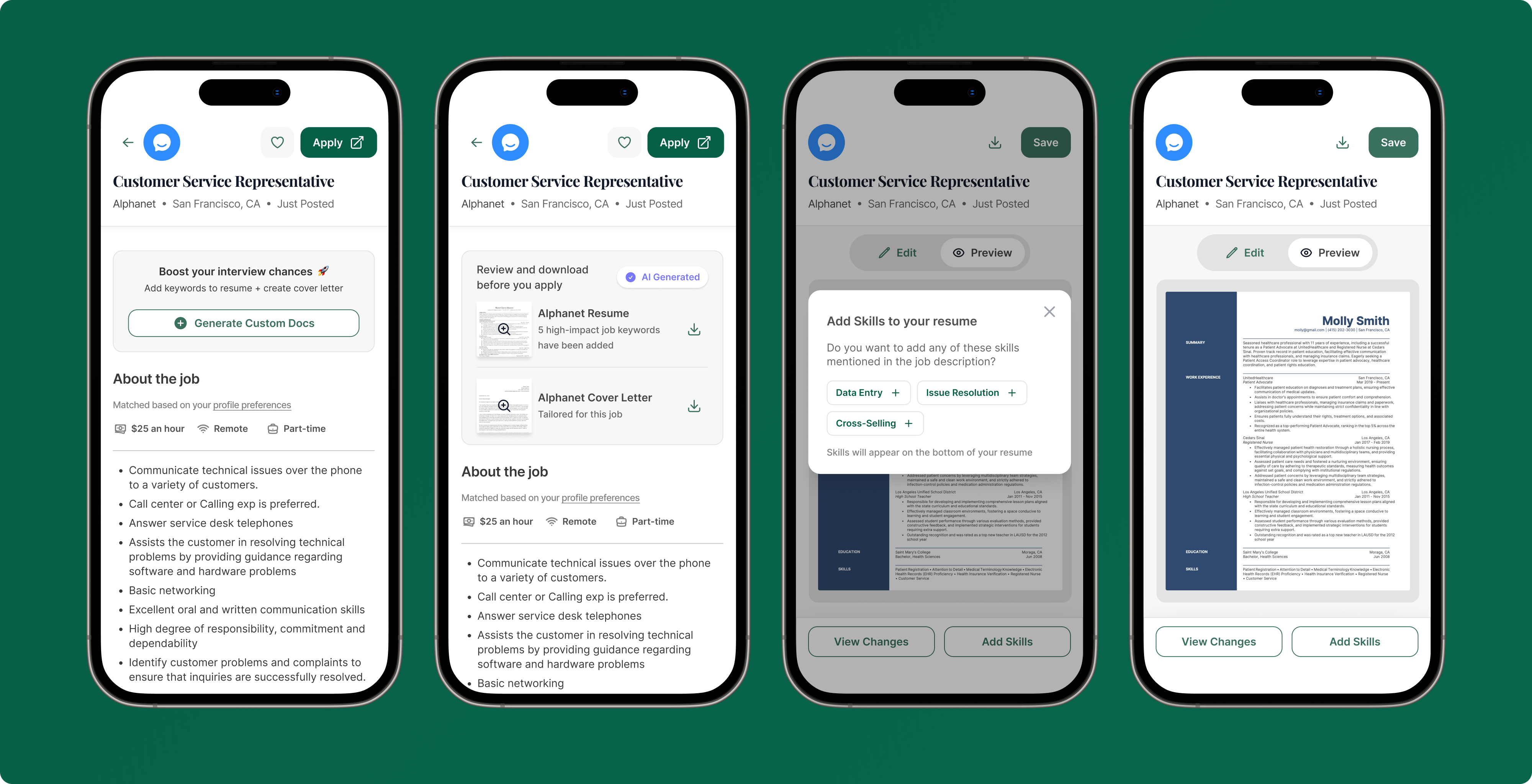
Case in point, EarnBetter, a startup founded by former Credit Karma employees, is developing a platform that lets users upload an existing resume or cover letter and have AI reformat and rewrite it for a particular job listing. Co-founder and CEO Tuck Hauptfuhrer pitches EarnBetter, which is currently free to use, as a way to “level the playing field for job seekers.”
“We’ve always felt strongly that job seekers need more support, not another expense,” Hauptfuhrer told TechCrunch in an email interview. “And you don’t have to be tech savvy to use the AI job search assistant. For example, there isn’t a long or complex onboarding flow or a prerequisite of knowing how to prompt AI. In order to get a new resume, you simply upload your existing resume and EarnBetter will reformat it and rewrite it in minutes.”
EarnBetter also provides a job search tool and an editing suite for cover letters and resumes that automatically highlights skills and experiences potentially relevant to available roles. Users can save openings for later, indicate a role isn’t of interest or send a job application through EarnBetter.
EarnBetter makes money by charging employers when people find and send job applications through the platform. Hauptfuhrer claims that people created more than 100,000 resumes and cover letters during EarnBetter’s beta period.
“The job search market is large. Traditional job boards, staffing companies and others are all competing to help people find work and employers hire talent,” he said. “EarnBetter is uniquely focused on supporting job seekers by harnessing generative AI to deliver a product that’s free, fast and easy to use.”
Image Credits: EarnBetter
But what about those poor souls spending ages crafting and refining their resume and cover letter drafts? Well, they might soon be in the minority. According to a recent poll from Resume Builder, nearly half of current and recent job seekers were using OpenAI’s AI-powered chatbot, ChatGPT, to write their resumes or cover letters.
Even before the advent of job-application-generating AI, candidates writing letters and resumes from scratch might’ve been behind the times.
Only around 2% of the millions of listings on the job-finding platform Indeed mentioned a cover letter as of March 2023, according to Vox. And many hiring managers report not actually reading cover letters — only checking to see whether they’re included if a listing asks for it. In the rare instances where hiring managers do review resumes and cover letters, they’re not necessarily fixating on them — one study found that recruiters spend an average of six seconds on a cover letter.
Be this as it may, one could argue that AI-powered tools like EarnBetter give those with access to them — which isn’t everyone — an unfair advantage in job searches, at least in the sense that they save time on applications that require resumes and cover letters.
Hauptfuhrer doesn’t see it that way, however — and argues that EarnBetter provides a service to employers as well as job seekers by not only matching them with candidates but ensuring that resumes and cover letters are “professionally written, cleanly formatted and tailored to [each] position” (although “professionally written” is in the eye of the beholder, I’d strongly assert).
“In this way, we’re helping employers initially evaluate candidates based on the relevance of their skills and experiences as opposed to their ability to format a resume,” Hauptfuhrer said. “EarnBetter’s AI job search assistant can also help identify roles that a job seeker may qualify for beyond what they are searching for. By doing so, EarnBetter can help broaden the aperture of someone’s search, and expand the talent pool for employers.”
In any case, VCs evidently see promise in EarnBetter’s business model. Andreessen Horowitz, Abstract Ventures and Figma founder Dylan Field are among the investors in the startup’s $4.5 million seed round, the proceeds from which Hauptfuhrer says will be put toward expanding EarnBetter’s eight-person team and building new AI-powered products and services.
“EarnBetter is an AI-native company, and we’re obsessed with thinking about how advancements in AI can benefit job seekers,” Hauptfuhrer said. “Generative AI is exceptionally powerful. By designing a product that is free, fast and easy-to-use, we aspire to make the power of AI accessible to all job seekers.”
Genpact has unveiled its leadership succession plan. Tiger Tyagarajan, who currently serves as the President and CEO, has informed the company’s Board of Directors of his retirement intentions, which will take effect on February 9, 2024. In response to Tyagarajan’s retirement, the Board has appointed Balkrishan “BK” Kalra, Genpact’s Global Business Leader for Financial Services and Consumer & Healthcare, as the next CEO.
Kalra is set to join the Board on the same date, while Tyagarajan will continue as a member of the Board of Directors. BK Kalra is a seasoned business leader with over three decades of experience in aiding companies’ growth, from their early stages to becoming global competitive enterprises.
Having joined Genpact in 1999, he has held various leadership roles within the organisation. Kalra is responsible for overseeing Genpact’s global transformation efforts in industries such as banking, capital markets, consumer goods, retail, life sciences, and healthcare, facilitating companies in effectively harnessing technology and AI-enabled solutions.
James Madden, Chairman of Genpact’s Board of Directors, expressed his satisfaction with the leadership change, stating, “We are delighted to announce BK as Genpact’s next CEO, a leader with a proven track record of delivering business results and fostering deep client relationships. In planning for Tiger’s retirement, the Board undertook a robust process, assessing a number of internal and external candidates. In the end, BK stood out as the natural successor.
Madden highlighted that Kalra understands the importance of investing in emerging trends and technologies with a particular focus on Genpact’s efforts around advanced analytics and AI-enabled solutions. “BK’s strategic vision and deep understanding of our clients and business is exactly what Genpact needs as we enter this new chapter.”
Expressing his enthusiasm, Kalra said, “I am honoured to assume the CEO role and appreciate the confidence and trust that Tiger and the Board have placed in me. With an immensely talented workforce and a deep history of developing innovative solutions for our clients, Genpact has a unique opportunity to lead our industry. I look forward to working closely with the Board and our leadership team to accelerate a new chapter of growth for Genpact, one with technology at the forefront of everything we do to unlock tremendous potential for our clients, employees, and shareholders alike.”
Tiger Tyagarajan, who took on the CEO role in 2011, has played a pivotal role in leading Genpact through a period of remarkable growth. Under his leadership, the company transformed into an industry leader with annual revenue exceeding $4.3 billion in 2022, primarily by leveraging data and technology to enhance client services.
James Madden acknowledged Tyagarajan’s contributions, stating, “On behalf of the Board and the entire organisation, I would like to express our sincere appreciation for Tiger’s leadership of Genpact over the last 12 years. Tiger has built a strong, diverse, and global team, focused on a clear set of prioritised verticals, geographic markets, and services. We look forward to his continued contributions on the Board.”
Tyagarajan expressed his gratitude, saying, “Leading Genpact has been the highlight of my career, and I would like to thank the entire team for their support. The world is rapidly changing around us, and I am incredibly proud of what we have achieved, staying ahead of the curve as a true partner to our clients around the world, empowering our employees, and transforming the communities in which we live and operate. BK has been an integral part of Genpact’s success, and I am confident that, under his leadership, we are well positioned for the next phase of our journey and future growth.”
It's taken just a year since the launch of ChatGPT for generative artificial intelligence (AI) to create a step change in how we view work and complete our tasks every day.
Also: 6 AI tools to supercharge your work and everyday life
Depending on who you believe, generative AI is going to either help us work more efficiently or leave most of us unemployed.
The key task for professionals and their businesses right now is to explore how generative AI can be used to make us more productive.
Six business leaders talk about how organizations are beginning to explore and exploit generative AI — and they suggest six ways that you can get involved, too.
1. Play with the technology
Adam Warne, CIO at retailer River Island, says his organization is already beginning to "play" with GPT — and before those explorations go to the next stage, he wants to make sure the technology is ready for customer-facing services.
"I think we are probably in a similar place to lots of people," he says. "We're using it to generate content ideas, whether it's blog posts, marketing posts, or product descriptions. But we're not putting it into a production environment."
Like other CIOs, Warne is cautious about using AI. Right now, he says there needs to be a "human, fleshy thing" between whatever generative AI is doing within the business and what the customer sees externally.
But he expects to see rapid progress in the level of automation — and he advises all professionals to start exploring generative AI.
"I think the speed at which it's come to market and is developing means that everybody should be keeping an eye on it," he says. "It's a way of being mainstream, but I think it's going to be production-ready very, very quickly."
2. Use it to make you more efficient
Brad Woodward, head of data at women's lifestyle retailer Hush, says he believes generative AI tools could provide a big boost in productivity for all kinds of professionals, particularly IT developers — and he's already exploring how.
"The way in which we'll be looking at it, and the way we'll train other people to use it, is how we can be more efficient at our jobs," he says.
"The really interesting thing about tools like ChatGPT is about how they can help us do things more efficiently, like writing code and interrogating databases."
Woodward gives an example from his own working life, where he recently had to create a prototype of a reporting model.
He didn't want to use live data and, not so long ago, he would have had to produce the sample data for the model by hand. Instead, he just turned to AI.
"I just said to ChatGPT, 'Can you generate me a bunch of database tables and some sample data for this model?' And it gave me 100 rows. And I then said, 'Can I have some more?' And it gave me 1,000 rows," he says.
"It was as easy as that. Whereas in the past, it would have taken maybe an hour or two. Now, I can automate that task. So, the way that we're talking about generative AI within the team is, how do we use this tool to make us more efficient?"
3. Take baby steps
Lily Haake, head of technology and digital executive search at recruiter Harvey Nash, says the best starting point for professionals who are thinking about exploring generative AI is to look for a knowledgeable partner from beyond the enterprise firewall.
"One of our clients was working with a third party," she says. "If you're at a certain scale, you don't necessarily need to build the capability in-house. You can rely on a third party that really does have the expertise." In fact, Haake suggests that smart professionals will probably opt to cover their bases and work with more than one external partner.
"Maybe search for a few third parties to make sure that you've got legal covered and that you've got ethics covered as well," she says. "Having someone with that helicopter view can be really helpful."
Also: The ethics of generative AI: How we can harness this powerful technology
Companies that find a strong partner will bolster their depth of understanding of emerging technology. With that kind of knowledge, it becomes possible to start exploring — or as Haake suggests, taking "baby steps" — and establishing generative AI use cases.
However, she also issues a word of warning: Professionals who want to explore generative AI must ensure their information is ready.
"You can't automate and you can't drive amazing AI initiatives without the basics of data management and governance in place," says Haake. "If you're not sure whether you have good quality data, that has to be the starting point."
4. Focus on the business use case
Prakash Rao, group head of supply chain projects at retail and hospitality giant Landmark Group, says ChatGPT has huge potential, but it's crucial to focus on the business case. "Otherwise, it's just jargon," he says.
Also: Here's why generative AI will far surpass what ChatGPT can do
Rao likens the rise of generative AI to innovations plotted on analyst Gartner's Hype Cycle for Emerging Technologies. Every innovation goes through a peak of inflated expectations, where people across the IT industry and other lines of business see the technology as a panacea.
Right now, Rao says he's anticipating a "trough of disillusionment," where the hype around AI begins to drop off before reaching a plateau, where widespread acceptance, adoption, and exploitation are commonplace.
"The technologies that really have a business application reach a level where all these use cases come out of this technology," he says. "There are a lot of useful business cases that will emerge, and we're going to see multiplier effects in terms of the benefits for these technologies, too."
Rao says business functions across Landmark Group will be exploring ChatGPT, particularly marketing, and sales, where AI could offer new levels of customer service and interaction. "And, of course, ChatGPT is something we'll also be evaluating in supply chain," he says. "But right now, I have not seen any useful applications."
5. Explore enterprise-ready tools
Robyn Furby, technology adoption manager at insurance firm NFU Mutual, says ChatGPT should be explored cautiously, but she's enthusiastic about the potential for enterprise-ready adaptations from Microsoft.
"We're looking at it in the context of understanding what it means," she says. "Naturally, in any financial services organization, we're going to be cautious. And as a tech enthusiast, I'm interested in supporting people to use it in a safe way. So right now, our focus is around how you can use it in a way that's appropriate today."
Furby believes the real power from ChatGPT will arrive when it's embedded into enterprise-ready AI services, such as Microsoft Copilot, which will use current language models like OpenAI's GPT-4 to offer help for specific tasks, such as answering questions, providing information, and generating content.
"I think it will be really interesting to see how it's used," she says. Microsoft's AI Copilot began rolling out to devices running Windows 11 version 22H2 at the end of September. "In the meantime, we need to educate people about the differences between all these AI tools — what can you use external tools like ChatGPT and Bing for, and what can you use Copilot for? And I think that period of education is going to be a massive process."
6. Don't forget to look at other areas of AI
Stephen Wild, engineering manager for observability and automation at 888 William Hill, has started dabbling with ChatGPT, as have other people on his team, particularly younger members of staff.
However, experimentation does not mean production. Wild says professionals must be careful to ensure generative AI is producing strong business benefits. "It's more of a worry at the moment," he says, reflecting on the fast-moving pace of developments. "The biggest problem I can see with the free version of ChatGPT is that it only really goes to 2021."
Also: Five ways to use AI responsibly
Like other digital leaders, Wild believes the launch of enterprise-ready applications will be a tipping point. "It'll be interesting when Microsoft goes beyond Bing and starts incorporating the technology into the likes of Teams. That will probably be the next big revolution in tech," Wild says.
He also says it's also important to recognize that the influence of AI is not just confined to generative systems. For example, his organization is using New Relic's automated application-monitoring and observability platform.
"Machine learning is already very important to us. We use AI through New Relic and its alerting service, which allows us to cut down on the sheer number of alerts we have to look out for," he says. "We also use it in terms of checking for bots that are constantly looking for our odds and are trying to take liberties with our promotions. The more bots we can find, the better."
Sutro introduces AI-powered app creation with no coding required Sarah Perez @sarahintampa / 17 hours
AI is already transforming the way we search, gather information, create, code, decipher data and more, and now it may democratize the process of building an app, too. A new AI-powered startup called Sutro promises the ability to build entire production-ready apps — including those for web, iOS and Android — in a matter of minutes, with no coding experience required.
The idea is to allow founders to focus on their unique ideas by leaning on Sutro to automate other aspects of app building, including the necessary AI expertise, product management and design, hosting, use of domain-specific languages, compiling and scaling.
The company was founded in late 2021 by Tomas Halgas, who sold his previous startup, the group chat app Sphere, to Twitter, alongside former Google and Facebook Product Manager Owen Campbell-Moore. The two have taken turns running the company, with Campbell-Moore at the head while Halgas worked at Twitter in its chaotic days leading up to Elon Musk’s takeover. Now, with Halgas having departed Twitter, he’s acting as CEO as Campbell-Moore has shifted to a day job at OpenAI.
Halgas, whose background is in machine learning and compilers, imagines Sutro as something that functions as your entire product team — something that would allow app building to become as simple as creating a website.
“Since university, we’ve always talked about how antiquated the craft of software engineering is,” Halgas tells TechCrunch. “We spent so much time thinking and working on technical minutiae, rather than thinking about what would make a technical product unique.”
For example, when starting a new project, Halgas says developers have to spend days figuring out things like infrastructure, authentication, security and other “data plumbing” before they can actually begin working on their idea.
“It’s completely insane — there has to be a way to basically automate all the stuff that’s common,” he had thought to himself.
Image Credits: Sutro
At the same time, the founders were watching the developments of GPT with interest, realizing that something transformative was coming our way, that would be part of the future. They imagined building a platform that could stand in as your product managers, marketers, engineers and data scientists, where you could present your idea and your target market and the team would get to work mocking up a product, tweaking the design, deploying the servers, patching the vulnerabilities, getting the analytics working and then scaling its seamlessly as it grows.
AI, however, is not yet capable of doing all the heavy lifting here, especially when you’re looking at building an app, which may include tens of thousands of lines of code. So Sutro instead combines the best of AI — GPT-4 and other LLMs to build the web, mobile and back end of apps — with the best of rule-based compilers. On the AI side, most of the work is handled via GPT, though the team has also tapped into open source models in some areas.
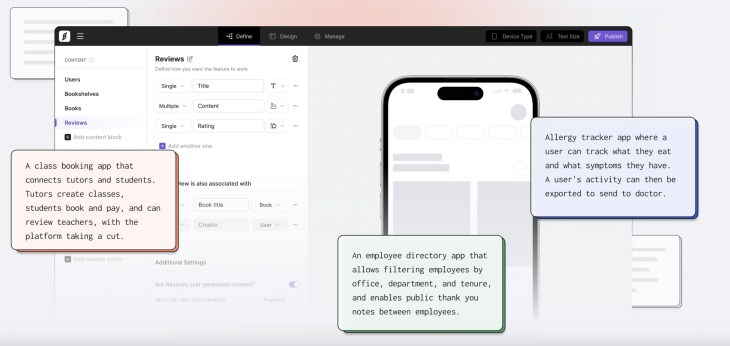
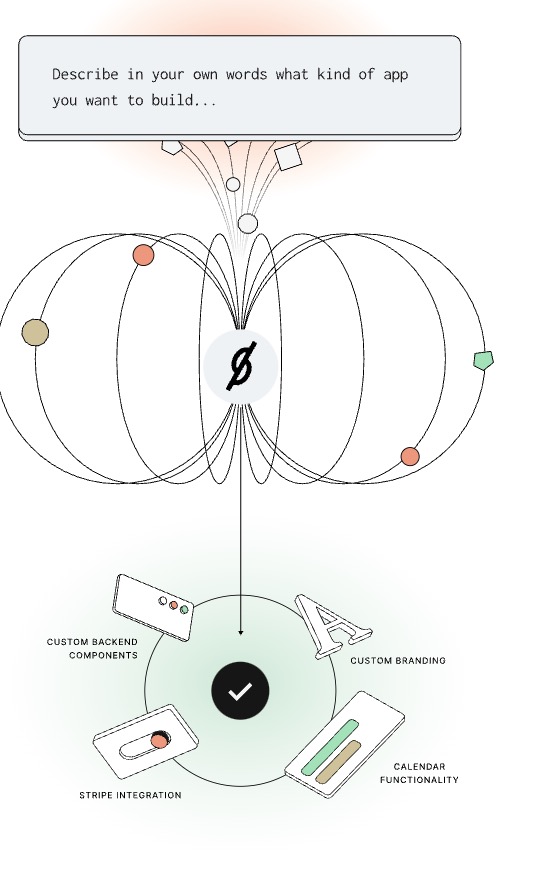
Then, on the compiler side, they’ve built proprietary technology that allows you to begin the process of app development via a prompt, where you describe the product you want to make.
After prompting, Sutro will then apply its LLM-powered AI to generate your iOS, Android and web clients and set up the production back end. There’s also a studio toolkit where you have abilities to change things to meet your needs, including the visual style and other aspects of the app’s function and design. Customers can either access the product themselves in a self-serve mode, or they can work in tandem with Sutro’s team to develop their apps. When the project is complete, users can publish the app and continue to edit, maintain and upgrade it as needed.
“What I’d like to highlight is that this is not just another no-code platform,” notes Halgas. “In a no-code platform, you usually come in and you drag and drop something, and it’s still very low level. It’s still a lot of work to get anything working. We are much more like your entire development or your entire product team rather than another no-code tool,” he says.
That is, users can make high-level changes without much effort. For example, you could ask the product to add ratings to posts in an app and Sutro is then able to know where it needs to add the ratings feature, introduce a ranking algorithm or perform aggregation of those ratings, Halgas explains. Users can also enter their own custom code, custom components, and custom integrations.
The company has a demo where they build a basic version of Pinterest in about 60 seconds (see below).
Because Sutro is handling the hosting and all the work under the hood of app building, the company charges its customers on a subscription basis, depending on the size and complexity of the project and how difficult it is to maintain. The startup isn’t yet ready to disclose its pricing, which is currently being discussed with vetted customers in private, but notes that it’s “a fraction” of hiring a development team.
Currently, Sutro is being used by 715 makers who have now built 934 apps using its system.
A small team based in London and San Francisco, Sutro includes those with engineering backgrounds from Uber, Twitter, Meta and Google. The company this week has published its new landing page, and is now open to requests for access from interested parties.
Sutro previously raised $2.2 million from Eniac Ventures and other angel investors, including Peter Welinder, VP of Product and Partnerships at OpenAI.
Samsung Research has revealed a generative AI assistant called Samsung Gauss that the research group uses internally but may eventually appear in Samsung’s consumer phones. Samsung Gauss is intended to improve work efficiency by making composing emails, writing code and generating images easier and faster. Samsung Research presented details about Gauss on day two of the Samsung AI Forum 2023 on Nov. 8, 2023 in Gyeonggi-do, Korea.
On-device AI has rapidly become a must-have for major tech makers. Samsung’s Gauss will compete with Google Assistant, which runs on Pixel devices and Meta’s Llama 2, which will live on-device in certain Qualcomm-powered smartphones and PCs starting in 2024.
Jump to:
What is Samsung Gauss?
What are the three Samsung Gauss models’ various capabilities?
Samsung makes reassurances regarding security
What is Samsung Gauss?
Samsung Gauss is a large language model associated with several on-device AI technologies for Samsung mobile devices. Samsung Gauss will be included on ” … a variety of Samsung product applications … ” in the near future, Samsung Research said in a blog post. The Korea Times said Gauss may first appear on the Samsung Galaxy S24 in early 2024. For now, the Samsung Research group is using Gauss for ” … employee productivity.”
SEE: Switching from an Apple iPhone to a Samsung Galaxy phone? Samsung makes an easy transfer tool. (TechRepublic)
Samsung Gauss is named after Carl Friedrich Gauss, the mathematician who developed normal distribution theory, which is a key part of machine learning and AI.
“The name reflects Samsung’s ultimate vision for the models, which is to draw from all the phenomena and knowledge in the world in order to harness the power of AI to improve the lives of consumers everywhere,” Samsung Research stated in the blog post.
What are the three Samsung Gauss models’ various capabilities?
Samsung Gauss has three models with varying capabilities:
Samsung Gauss Language is a generative language model that can compose emails, summarize documents and translate content. It can be integrated into device control. (Samsung currently has Bixby in place for voice control of mobile devices.)
Samsung Gauss Code is a software development tool that can perform functions such as code description and test case generation. Samsung Gauss Code enables code.i, a coding assistant.
Samsung Gauss Image creates or enhances images.
Samsung makes reassurances regarding security
Samsung, which temporarily banned employees’ use of generative AI products including OpenAI’s ChatGPT and Google’s Bard earlier this year after an internal data leak, emphasized in the press release that its AI Red Team is hard at work on security. The security team monitors AI for privacy and ethical issues including ” … data collection to AI model development, service deployment and AI-generated results … ” Samsung Research wrote in their blog post.
Note: TechRepublic has reached out to Samsung Research for more information about Samsung Gauss.
The role of a software developer is in transition — and it's all due to the impact of artificial intelligence (AI). It's now clear that generative AI models and assistants, such as OpenAI's GPT-4 and Microsoft's Copilot, are adept at churning out code almost instantly in any language, for any purpose.
This tech-enabled capability means software developers will face retrenchment. The key debate, right now, is "how much?"
The current verdict from industry observers: So far, so good.
But there are mixed reactions when it comes to whether it will help developers succeed or displace many of their roles.
It could even serve to smooth the way to application modernization.
Also: AI at the edge: Fast times ahead for 5G and the Internet of Things
"Generative AI is dramatically transforming the way developers approach their roles, ushering in nothing short of a revolution in productivity," says Joe Welch, principal and technology leader of Launch Consulting, a division of The Planet Group. "By incorporating GitHub Copilot into VS Code for a recent project, we saw programmers reduce ten-minute tasks, such as writing a small function, down to the 30 seconds it took to simply write out a comment that explains the function. The actual code for the functions is written by Copilot, and often these functions will work out-of-the-box without any need for changes. It's hard to understate the game changer this is."
While generative AI tools might replace a lot of the head-down grunt work of developers, the rise of these technologies also opens opportunities for elevating their roles within their organizations. In short, retrenchment in an age of AI and automation might be no bad thing — and might lead to new, more interesting roles.
Right now, the industry is abuzz with the power and productivity that generative AI platforms are bringing to the software development profession. "For many developers, generative AI will become the most valuable coding partner they will ever know," according to a report from consultant KMPG. The technology may finally help overworked and stressed IT professionals abstract the more mundane aspects of their jobs away and help them focus on bigger problems more relevant to their businesses.
At a basic level, it means the ability to deliver on greater volumes of project work. The increasing use of AI will "make developers more fungible across frameworks, platforms, products, and systems of record," the KPMG report authors indicate. "Generative AI will provide the scaffolding and guidance they need to work on a wider range of projects than they would normally be able to handle."
Also: Want a job in AI? These are the skills you need But a rise in productivity is just the starting point when it comes to the future impact of AI and automation on jobs. The increased adoption of generative AI will also mean developers are expected to act in a higher-level role, pulling AI-delivered resources together to map to the requirements of the business. "What will become increasingly important is for developers to be able to clearly articulate how they want a piece of code to perform," says Mahesh Saptharishi, chief technology officer for Motorola Solutions. "A good user story should feed AI the right information to get to a desired answer, while knowing how to ask questions and test results," says Saptharishi. "As the speed of translating a user story to a feature or a product increases, agile methodologies will need to adapt. In many ways, descriptions of what software should do in the form of user stories might become the new code." This shift in emphasis will lead to a retrenchment that means actual programming roles will diminish, and more business-focused developers will be focused on assembling the capabilities they require for particular applications.
As the technology evolves, "I believe human programming skills will fade in necessity, and eventually be replaced with human-prompt engineers," Duncan Angove, CEO at Blue Yonder, predicts.
For his part, Angove foresees actual programming roles diminishing, and more business-focused developers assembling the capabilities they require for particular applications. As the technology evolves, "I believe human programming skills will fade in necessity, and eventually be replaced with human-prompt engineers," he predicts.
"Business analysts and product managers will be the new prompt engineers, translating business needs into prompts that generate the code we need. In the short term, we will also still need programmers to quality check the code, but over time that, too, will fade."
Also: Six skills you need to become an AI prompt engineer
Of course, some sense of perspective on the scale of this retrenchment is also crucial. Developers won't be using AI to write entire applications overnight, says Saptharishi: "AI will help developers do their jobs faster, and make fewer mistakes, and over time, AI will play a larger role in app development. In a more AI-intensive environment, IT professionals' creativity, problem-solving skills, and ability to train and explain concepts to others will still play a key role in their success."
A potential showstopper for the actual generation of code — versus helping developers be more productive in doing so — are the legal implications of freely using code that is essentially designed elsewhere. "Intellectual property issues around generative AI remain unresolved," the KPMG authors caution. "These models are trained on open-source code, with many different types of licenses, and it remains to be seen what will happen if the software they generate is deemed too similar to open-source code."
While it's highly debatable what kind of retrenchment there will be for developer roles, Launch's Welch foresees many positive impacts on developers' abilities to deliver results far more quickly and expediently for their ever-demanding businesses:
As a recommendation engine: An important benefit will be "integrating AI recommendations into the code development process or providing AI recommendations on code check-in," he states. "GitHub Copilot is a great example of this and provides recommendations and suggestions as developers type. Developers can also indicate that code that they are trying to write in a specially formatted comment and Copilot will provide a sample implementation of that function."
Creating documentation for existing code to help new developers onboard: "We have used AI to provide top-level summaries of sub-systems and then more detailed descriptions of individual modules," says Welch. "After reading these overviews, the developers can then interact directly with the AI chatbot to ask detailed questions about the use-specific functions or sections of code. This can greatly reduce the overall time it takes to understand a new codebase."
Updating deprecated libraries: "One of our ongoing challenges is to keep third-party libraries updated to supported versions in accordance with the appropriate security guidelines," says Welch. "Often, it is unclear the level of risk in upgrading these libraries. Generative AI is great at predicting the overall effort, identifying specific code patterns which need to be modified, and helping to ensure that these libraries and frameworks are kept up to date with the least amount of effort and business risk possible."
Migrating applications from legacy languages: "AI can greatly ease the migration of a large codebase from an older language such as Cobol into a more modern language such as Java or C#," says Welch. "These migrations can often be challenging as they require developers who are fluent in both the older language and the newer language."
But let's be clear: the retrenchment in software development roles in an age of AI and automation is already underway. Ultimately, opportunities for developers and other IT professionals will be abundant in "things that can't be easily copied or taught," Angove predicts. "Think about what large language models can't do, and do that. The value of fresh thinking also becomes even more valuable. Develop skills that help build the tools — LLMs themselves — versus the now-free applications."
Robotics funding saw another dip in 2023 Brian Heater @bheater / 9 hours
In 2021, robotics startups were flying high. Unlike other categories that had buckled under the strains of a global pandemic, interest in automation was at an all-time high, as companies attempted to navigate supply chain issues and ongoing labor shortages. Robotics and automation were insulated from broader investment slowdowns, but eventually, they, too, were impacted.
It’s not as though the signs haven’t been there. I kicked off the year with a post titled, “The thing we thought was happening with robotic investments is definitely happening.” That thing being investment slowdowns. After a banner year, 2022 was the second-worst year for robotics investments in the past five.
It was second only to 2020, which was one of those once in a life time global anomalies. Totally understandable in that case. That figure represented the five straight quarters of decline in VC money.
Image Credits: Crunchbase
Today, new numbers from Crunchbase point to another annual decline for 2023. The year isn’t quite over, of course, but year-to-date investments in the U.S. market are at $2.7 billion, down from $5 billion last year, $9.1 billion in 2021 and even the $3.4 billion that came through in 2020.
There are a couple of things at play here. First, we knew that initial excitement wouldn’t last forever. Some of the world has gotten back to normal, relieving some of the pressure to automate as soon as possible. Second, there are macro trends to contend with.
VC investments have slowed more broadly, and that’s now touching on robotics. The good news, however, is that the category has remained steady relative to the rest of the landscape. The spike in interest around generative AI — and all things artificial intelligence — has been a piece of maintaining its place.
The last few years have also afforded robotics firms a chance to prove their efficacy in the real world, demonstrating the value of automation beyond the manufacturing sector that we’ve been seeing for several decades now.
Robot sales also recently saw a decrease, courtesy of economic headwinds following the initial pandemic surge.