AI-Powered Innovation: Lentra’s Role in Shaping the Future of Indian Banking

Dealing with highly critical data and being one of the most regulated industries, the digital lending space has massively transformed in India. While AI and ML models have been part of such platforms, the evolution and advancement of generative AI is finding its way here as well. With more than a decade-long experience in the digital lending space, digital lending SaaS platform, Lentra AI has been a prominent player in empowering major banks including HDFC, Standard Chartered, Federal Bank, and many more in India.

AI Enabling Nuanced Personalisation

In an exclusive interaction with AIM, Rangarajan Vasudevan, chief data officer at Lentra, spoke about the involvement of machine learning models in the field of digital payments, which have been implemented for credit scoring and credit decisioning for over decades. “It’s not new. CitiBank pioneered it a long time ago, and now everybody is caught up on it. However, I think what’s changing off late is the emphasis on how we create these persona-specific positioning models,” he said.

From a generic approach that used to exist earlier, where a scorecard is created, that applies different ML models, and is pushed to specific demographics, it has become a more nuanced method now. For instance, a Gen Z from tier two or tier three city or town is different from a GenZ in the urban sector, so the score card you apply, will not be the same, and you have to make it tailor-made to individual personal types. This shows the importance of how to break down an ML model and create a “consortium of models’ that can be applied in different personnel categories.

Vasudevan goes on to explain how nuanced models are already in place at Lentra, and spoke about how one of their flagship case studies which has not been released yet, is in the agri space. “There was a big push by the government earlier on what credit scheme to have for the Kisaan sector (farmers), and we were one of the pioneers to have worked with our major client in rolling out a version which is highly tailor-made in terms of positioning to that sector. The models are very different from what you would normally do when you try to push these kinds of products,” he said.

Consortium of ML Models

A mix of models is something that Lentra has always worked on. “We are a VC-backed company, so our core USP is the innovation that we keep having to do, otherwise there’s not much to it. The models are ours and are proprietary to us, and it’s something that we have grown in-house,” he said.

Vasudevan also mentioned that they work on top of open source platforms too. “There are platforms on top of which we build our own models. We use Sci-kit learn, Py-Spark, along with corresponding bindings to TensorFlow, Py-torch and others.”

Working in one of the most regulated spaces in the industry, Lentra has to ensure that their models are ethically fair, right and the models have to be explainable. For instance, the reasoning for lending to specific categories of population, should be explainable to a non-techie or regulator. Furthermore, keeping this motive behind, Lentra has restricted itself to using models such as XGBoost and random forests which make it easy for them to explain things.

“A consortium of models where the models themselves are orchestrated using elaborate business logic, which makes it slightly more complex than just directly using an XGBoost,” he said. For cases where the regulatory burden is less, they resort to deep learning models where they don’t have to worry about explainability.

Vasudevan concluded with the need for a collaborative innovative approach and bringing a vernacular angle to the models, so as to bring a far more meaningful and practical change for us in geography. “The vernacular angle is just starting to get tapped into that too only because folks like Microsoft or Amazon are releasing expansions of those models to the local market,” he said.

Generative AI With Caveats

While Lentra has been pioneering their in-house ML models along with continuous work on open-source platforms, the company has also experimented with generative AI. In addition to improved productivity among employees, the maximum use-cases for generative AI are for identifying test cases. “What we’ve seen with generative AI is the ability for it to seemingly reason about what could be interesting test scenarios that you might have missed,” said Vasudevan.

Speaking about a request form where a user needs to enter an income range and age bracket, generative AI has helped in coming up with test cases. “It’s a very simple form and if I give that kind of a form to GenAI, it is exactly able to reason around 15 different test scenarios that you’ve got to work through and make sure that your product is capable of handling those test scenarios. For instance, what if we give an age group such as 15 to 18 where lending is not legally permitted in some countries, what would we do in this case?” explained Vasudevan.

Discussing the limitations based on the experiments Lentra conducted on ‘ChatGPT family of GenAI tools’, consistency was the biggest problem. “So to be able to have a specific type of output consistently, for the same or similar type of input is like a given in the world of software like this one, the software is deterministic. We would give an input with a stimuli, and we’ll get some output. That’s very, very common, people just take it for granted. But with this particular experiment, what we saw was the same input in an experiment benchmark that we did back in February or March resulting in a sudden accuracy coverage of our test case which was then repeated in June, giving different results. The numbers were completely off,” said Vasudevan.

The experiment that gave close to 80% accuracy earlier, gave only 10% accuracy when tested in June. “There was a lot of theorising at that stage because I think it is not just us, but a couple of other companies, who had also highlighted this, but nobody got an answer clearly from OpenAI. So we wouldn’t know if it’s a case of the model itself performing badly or OpenAI did something with transformer models and decided to compress them or, whatnot,” added Vasudevan.

However, having said that, Vasudevan confirmed that they are in the middle of further experimenting and that in the long run, they should be building their own internally trained language models.

The post AI-Powered Innovation: Lentra’s Role in Shaping the Future of Indian Banking appeared first on Analytics India Magazine.


Behind the Controversy: Why Artists Hate AI Art

AI-generated art has gained massive popularity in recent years. Nowadays, you don’t need to be a skilled artist to create artwork — non-artists can easily enter a text prompt into a text-to-image generator. With the click of a button, it generates a masterpiece in seconds or minutes.

This allows individuals to generate and post more artwork than they’ve been known to have the skills for, leading to both excitement and controversy. Advocates of AI-generated art argue that it opens up new possibilities and expands the definition of what art can be. However, critics are skeptical of the hype, and some believe AI produces poor-quality art.

How did we go from masterpiece to controversy? Well, AI-generated artwork has been accused of lacking creativity and artistic depth. There’s also the concern about copyright infringement, and some even perceive this kind of art as a devaluation of human talent.

Jump to:

  • Legal considerations for AI art
  • Why do artists hate AI art?
  • Controversial AI artworks

Legal considerations for AI art

Legal frameworks are still evolving to keep pace with advancements in AI technology, particularly the generative AI space, which have made it possible to create complex, abstract or photorealistic art using text prompts.

The legalities of using AI-generated art can vary depending on the jurisdiction and specific circumstances.

Who owns AI art?

Concerns have been raised about the ethical implications of AI-generated art, especially regarding who owns the copyright of AI-generated artwork. Is it the artist who created the prompt, the AI algorithm or the company that developed the AI?

PREMIUM: Use this artificial intelligence ethics policy.

This question becomes even more complicated when the AI is trained on copyrighted works or uses existing images as a base for generating new ones. This has sparked many legal cases, as artists and businesses rush to protect their rights over their digital assets.

One notable example of this is Getty Images’ suit against Stability AI, which was accused of having “unlawfully copied and processed millions of images protected by copyright and the associated metadata owned or represented by Getty Images.” Though this is a licensing issue, the fact that Getty Images is suing Stability AI shows how serious the case of copyright infringement by AI-generated artwork can be.

Can AI art be copyrighted?

Different countries have different laws and interpretations regarding copyright and intellectual property. For example, the United States views AI-generated art as the output of a machine and that it is not eligible for copyright protection, according to federal copyright standards set by the Register of Copyrights. The ruling requires “human authorship” for a work of art to be considered for copyright.

Is AI art legal to use?

AI art is generally legal to use unless it infringes upon someone else’s copyright or intellectual property rights. To avoid any legal complications when using AI art generator tools, it is recommended to avoid tools that use copyrighted material for their training data. Some AI art generators, such as Deep AI, indicate in their terms of service whether their tools are free of copyright.

On the other side of things, Spawning AI recently launched a tool named Have I Been Trained. The tool allows artists to check if their works were used to train models like Stable Diffusion and Imagen — and flag them for removal.

Organizations are banning AI art to stay ahead of legal issues

Because of copyright concerns, some organizations have taken steps to ban the use of AI-generated art. For instance, Getty Images has banned the upload and sale of illustrations generated using AI art tools like DALL-E, Midjourney and Stable Diffusion.

“AI art is now BANNED by many major game dev studios due to ‘possible legal copyright issues,’” said Trent Kaniuga, a professional video game designer and artist, on X (formerly Twitter). “Many old clients are amending contracts recently to end the use of AI art.”

Nature, a scientific journal, also announced in June 2023 that it will not publish images or videos created using generative AI tools.

Why do artists hate AI art?

Artists may have various reasons for being wary or disapproving of AI-generated art. The skepticism and resistance towards AI art stem from artists’ desire to protect and preserve the integrity, authenticity and creative spirit that make art a profoundly human endeavor.

Artists worry that the ease with which AI-generated art can be created and shared may lead to an oversaturation of mediocre artwork, making it harder for skilled artists to stand out and make a living.

Artists pride themselves on their ability to express themselves, tap into emotions and create unique and personal works of art. The idea that an AI can replicate or mimic these abilities, potentially diminishing the value of artistic endeavors and the artistic process, can be perceived as a threat to their professional identity.

Furthermore, artists believe the essence of art lies in the human touch, emotions and subjective interpretation. Many artists view AI-generated art as lacking the depth, complexity and storytelling of human imagination and intuition.

Controversial AI artworks

The controversy surrounding AI-generated art stems from concerns about creativity, originality, copyright and the impact on the art market. There are several controversial AI artworks that have gained popularity in recent times.

Théâtre D’opéra Spatial

In 2022, Jason M. Allen created the piece called “Théâtre D’opéra Spatial,” or Space Opera Theater, using the Midjourney AI art generator (Figure A). Allen submitted the art as an entrant to the Colorado State Fair’s annual art competition and won first place blue ribbon. Many artists were not happy about this.

Figure A

Jason Allen, Théâtre D’opéra Spatial.
Jason Allen, Théâtre D’opéra Spatial. Image: Jason Allen

In response to the award, an X (formerly Twitter) user, WillibrordusART said, “This is outrageous. Prompting a machine to make you something does not make you an artist. As an artist of any style/technique we put in the time to hands on create something. The guy can type and refresh the process a few times, and that is being compared to craftsmanship???”

This attracted public criticism — when reached by a New York Times reporter, Allen said, “I’m not going to apologize for it. I won, and I didn’t break any rules.” He made it known that he submitted the artwork under the name “Jason M. Allen via Midjourney,” stating that the art was created using the Midjourney AI tool.

Boris Eldagsen, The Electrician

Similarly, Boris Eldagsen won the World Photography Organization’s Sony World Photography Awards for a piece titled The Electrician (Figure B).

Figure B

Boris Eldagsen, The Electrician via Eldagsen blog.
Boris Eldagsen, The Electrician via Eldagsen blog. Image: Boris Eldagsen

The art resembles an old picture of two ladies, one of whom is crouched behind the other. Another individual reaches their hand near the front woman’s body. The German artist rejected the prize after revealing that his submission was generated by artificial intelligence.

Portrait of Edmond Belamy

The “Portrait of Edmond Belamy” is considered the first artwork created by an algorithm to be sold at auction (Figure B). It was created using a deep learning algorithm known as a generative adversarial network by Hugo Caselles-Dupré, Pierre Fautrel and Gauthier Vernier, known as Obvious (Collective).

Figure C

Portrait of Edmond Belamy, 2018, created using GAN by Obvious Art.
Portrait of Edmond Belamy, 2018, created using GAN by Obvious Art. Image: Obvious

The artwork gained significant attention and was sold at a Christie’s auction in October 2018 for $432,500. The sale sparked a debate about the role of artificial intelligence in the art world and raised questions about authorship and creativity.

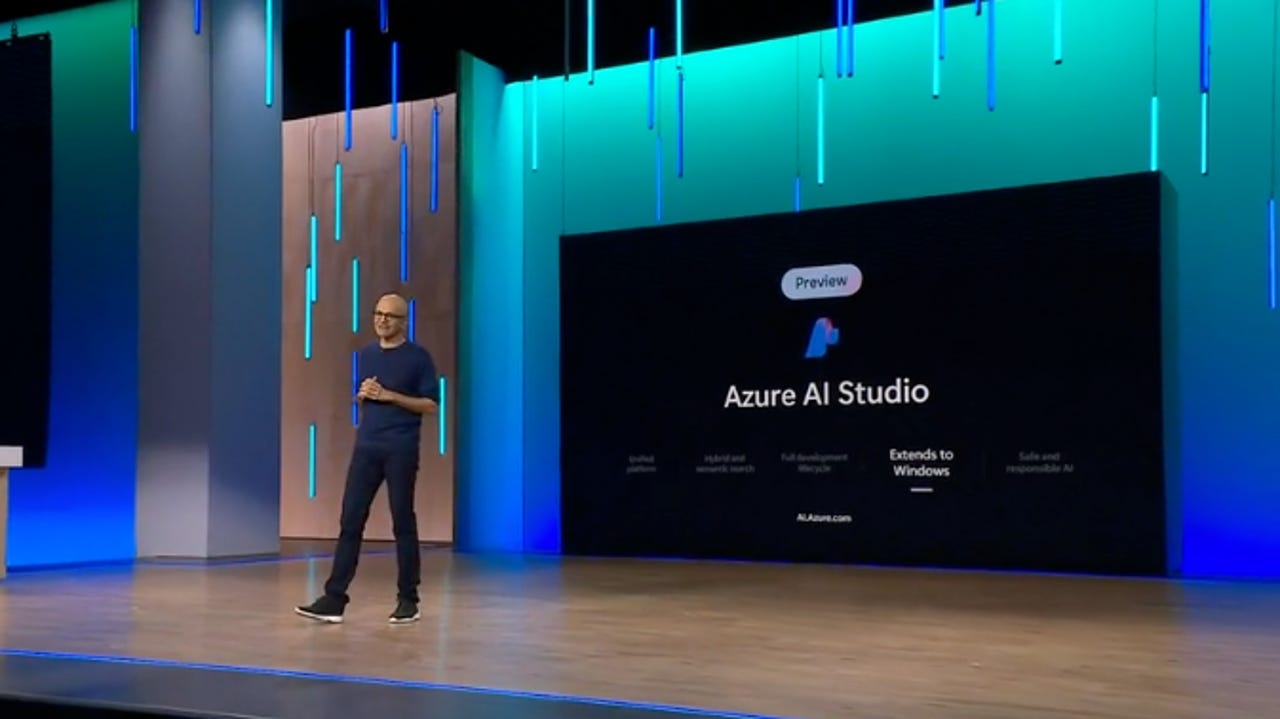
Azure AI Studio takes the stage at Ignite 2023: Unlock the potential of this AI toolkit

Azure AI Studio

At Microsoft's Ignite event, Microsoft CEO Satya Nadella unveils Azure AI Studio.

Microsoft is today announcing a public preview for Azure AI Studio at Ignite 2023. Microsoft describes Azure AI Studio as an end-to-end platform that allows developers to build, explore, test, and deploy AI applications at scale.

I prefer thinking about Azure AI Studio as a toolkit for building enterprise-level AI applications and solutions. Like a real-world toolkit, Azure AI Studio helps developers build pretty much whatever they want except, in this case, using AI and software solutions instead of wood, fasteners, and glue.

Also: Here's how to create your own custom chatbots using ChatGPT

Like a woodworker's workshop has different categories of tools for accomplishing different categories of tasks (hammers for bashing things, screwdrivers for tightening things, saws for cutting things, etc.), so does Azure AI Studio.

Power tools included

Data analysis tools: If you want to make sense of giant data sets, find patterns, or gain insights, these tools can help.

Predictive modeling tools: By feeding in historical data, these tools help forecast future customer demand, identify market trends, or predict needs like future maintenance requirements.

Natural language processing tools: If you want your solution to have the ability to understand natural language, Azure AI Studio natural language tools will prove invaluable.

Computer vision tools: Using these tools, your solutions can interpret the contents of still images and some video. This kind of technology is particularly valuable on the production line, but can be used for many other applications as well.

Recommendation engines: If you're into providing upsell or cross-sell opportunities to customers of your larger product lines, recommendation engines can process purchaser preferences and behavior, and relate that to products on offer.

Custom model building tools: If your business needs to do intelligent processing based on confidential information, unique domain expertise, unique trade secret information, or any other body of knowledge that may not be in an existing large language model, Azure AI Studio will help you to build your own.

In addition to the specific power tools, Azure AI Studio includes automation tools that use AI to automate and operate workflows and repetitive tasks. An entire suite of monitoring and reporting tools is also available to help you keep track of all of these wonderful toys and how they perform.

What you can build with Azure AI Studio

Here are some examples that Microsoft thinks will provide value to its enterprise customers.

Custom copilots: As we've been covering, Microsoft has introduced a wide range of copilots which are essentially AI-powered assistants that work with users to help with a variety of different tasks. Azure AI Studio gives developers the opportunity to build their own intelligent copilots that work with their specific projects and help solve their unique-to-their-own-business needs.

Call center AI helpers: These allow Microsoft customers to build custom virtual agents and chatbots that respond to customers, handle inquiries, provide more helpful value during off hours, and increase responsiveness. The addition of natural language processing and speech recognition capabilities will make these much more powerful for customer use.

Custom applications: One of the key benefits of Azure AI Studio is that it allows developers to build custom applications, ranging from automated repetitive tasks to generating content specific to given subject areas to chomping through very large data sets. Whether your business is in healthcare, finance, scientific analysis, publishing, or even education or entertainment, Microsoft intends Azure AI Studio to augment your offerings.

Multimodal experiences: One of the capabilities of Azure AI Studio that takes this all up a notch is that any of these solutions can be multimodal. This is driven by multimodal models like GPT-4 Turbo with Vision, which allows both text and image processing to be combined to result in custom applications. In other words, the age of letting your computer write your PowerPoint is upon us!

Speech analytics: Fictional radio therapist Fraser Crane used to answer his call-in listeners with the phrase, "I am listening." Now, so is Azure AI Studio. Microsoft customers can build solutions that recognize spoken language and audio data. Systems can analyze customer calls, interviews, and other voice recordings to perform sentiment analysis and voice recognition, which supports customer service, market research, healthcare, and other applications.

Businesses developing custom AI solutions have had a bit of a learning curve when it comes to applying prompt engineering (which involves the very careful design of input queries), vector search engines (which can find relevant, but unobvious data stored in vast data sets), and retrieval augmented generation (for generating coherent and truly context-appropriate responses) to their applications.

What Azure AI Studio does is raise the level of AI development from using technologies to using a platform of related, integrated, and accessible tools.

Also: I spent a weekend with Amazon's free AI courses, and highly recommend you do too

The benefits to businesses of having better access to the building blocks of AI are tremendous: fully customized solutions, unique competitive advantages, domain expertise, data privacy and security, performance optimized to the application, the ability to manage real-world data, scalability at the pace of the business, providing enhanced customer experiences, aligning with business goals, the ability to adapt based on changing business conditions, potential mitigation of bias, and ownership of intellectual property.

It will be interesting to see what companies create during the public preview, and once Azure AI Studio is fully released.

You can follow my day-to-day project updates on social media. Be sure to subscribe to my weekly update newsletter on Substack, and follow me on Twitter at @DavidGewirtz, on Facebook at Facebook.com/DavidGewirtz, on Instagram at Instagram.com/DavidGewirtz, and on YouTube at YouTube.com/DavidGewirtzTV.

More Microsoft

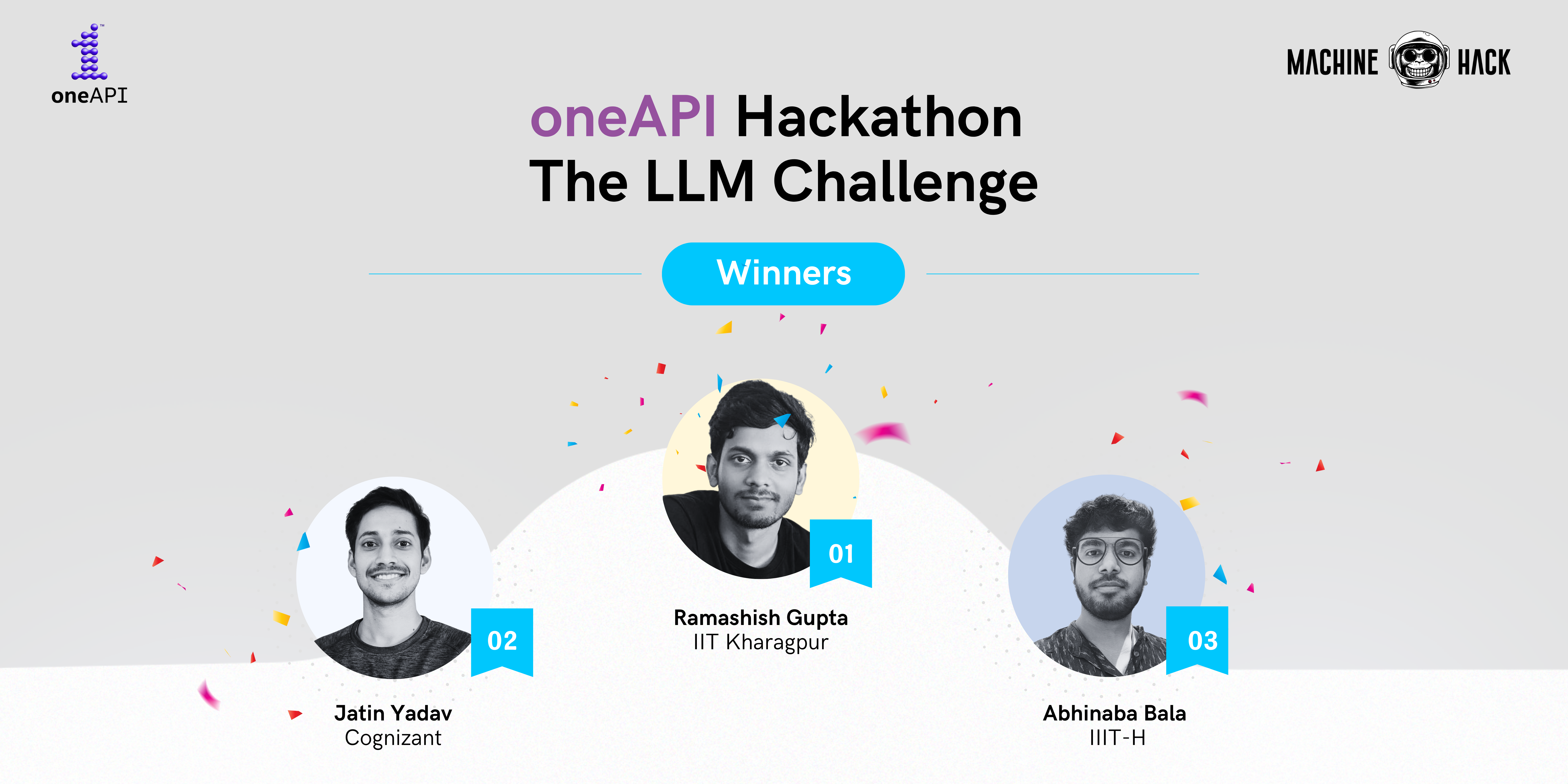
From Data to Glory: Celebrating the Champions of ‘oneAPI Hackathon: The LLM Challenge’ with Intel® and MachineHack!

From Data to Glory: Celebrating the Champions of 'oneAPI Hackathon: The LLM Challenge' with Intel® and MachineHack!

Taking the advancements in large language models a notch further, MachineHack joined hands with Intel® to host the oneAPI Hackathon: The LLM Challenge, which concluded on October 8, 2023.

oneAPI is an open, cross-industry, standards-based, unified, multi-architecture, multi-vendor programming model that delivers a common developer experience across accelerator architectures – for faster application performance, more productivity, and greater innovation. The oneAPI initiative encourages collaboration on the oneAPI specification and compatible oneAPI implementations across the ecosystem.

The competition boasted a slick line of prizes, including the iPhone 14, iPad Air, and Samsung Galaxy Watch, among others, drawing registrations from the global AI and machine learning community.

The participants delved into Intel’s oneAPI, a standards-based programming model designed for versatile use across multiple architectures, such as CPU, GPU, FPGA, and other accelerators, ensuring accelerated computations without the constraints of vendor lock-in, as highlighted by a winning participant.

The challenge posed to contestants was to devise a model capable of generating responses in alignment with the provided ‘Answer’ for each question. The outcomes from participating candidates went through two phases, which included documentation of their hackathon journey in insightful blogs.

The task of singling out the top three contenders fell to the jury, who meticulously studied the outcomes. To get insights from their processes, AIM spoke to the champions of the LLM Challenge, who recounted their experiences with MachineHack and shed light on the approaches that led to their outcomes.

Rank 01

Securing the first rank was Ramashish Gupta, a fourth-year undergraduate student from IIT Kharagpur.

Reflecting on the initial phase of the process, Ramashish blogged, “This dataset defies the conventions of a typical extractive question-answering dataset, where answers are readily found verbatim within the context. A comprehensive analysis revealed that a substantial 35% of the answers eluded direct contextual extraction.”

Ramashish further emphasised the inadequacy of traditional encoder models designed to pinpoint the start and end indices of answer text for such a distinctive dataset. He proposed the necessity of a generative question-answering model, employing an encoder-decoder architecture.

Furthermore, Ramashish cautioned against the complication of training separate models for yes-no and true-false questions.

The model crafted under Ramashish’s expertise not only secured the lead position on the leaderboard with an impressive score of 0.376 but also exceeded these numerical accomplishments in terms of actual capabilities, as highlighted by the ambitious student.

For an in-depth exploration of Ramashish’s journey through the LLM Challenge, read the complete blog here.

Check out the solution here.

Rank 02

Runner-up Jatin Yadav’s journey with MachineHack began a few months ago. However, his tryst with data engineering began during a college session, where he first encountered the concepts that would later become his expertise. Jatin’s commitment to expanding his knowledge is evident in the courses he pursued in data science.

The LLM Challenge judge’s commentary on his achievement highlighted the excellence in his work. The judge particularly lauded Jatin for his articulate explanations of optimizations, the reusability of his GitHub repository, and the performance of his model on the designated task.

The highlight of the hackathon, as per Jatin, was the opportunity to utilize Intel’s latest graphic processors at no cost – a benefit that would have incurred significant expenses if employed on alternative cloud platforms.

Check out the solution here.

Rank 03

Abhinaba Bala, a research scholar at the International Institute of Information Technology, Hyderabad, secured the third position in the LLM Challenge.

Bala is an accomplished NLP researcher dedicated to the development of datasets and tools tailored for low-resource languages, showcasing expertise in the multi-modal domain and news article enrichment.

With a robust background in 3D computer vision, he thrives on collaborative endeavours and actively seeks out opportunities to contribute to interdisciplinary projects.

For this hackathon, he used SimpleT5, a Python library designed to simplify T5 models, which he chose as the foundation.

Check out the solution here.

Concluding on a Successful Note

Beyond the top three winners, the competition witnessed talent across the board. It is noteworthy to highlight the performances of the runner-ups: Ashwin Kanth, Pratik Davidson Deogam, and Padmakumar. Their contributions added depth to the hackathon, showcasing diverse approaches and solutions.

Read Ashwin Kanth’s blog here.

Read Pratik Davidson Deogam’s blog here.

Read Padmakumar’s blog here.

The hackathon also boasted a distinguished panel of judges, featuring Kavita Aroor, Developer Marketing Lead for the Asia-Pacific and Japan region at Intel, Anish Kumar, AI Software Solutions Engineering Manager for the Asia-Pacific region at Intel®, and Vishnu Madhu, an AI Software Solutions Engineer at Intel. Their collective judgement brought a wealth of expertise and insight, adding an extra layer of prestige to the event.

The ‘oneAPI Hackathon: The LLM Challenge’ marks a pivotal moment in the large language models landscape, which is currently dominating the tech world.

The hackathon not only showcased advancements in LLMs but also the evolving dynamics between tech powerhouses and AI developers. The event marked a leap forward in pushing the boundaries of what LLMs can achieve when built on the oneAPI framework.

The post From Data to Glory: Celebrating the Champions of ‘oneAPI Hackathon: The LLM Challenge’ with Intel® and MachineHack! appeared first on Analytics India Magazine.

Bing Chat No More

At Ignite 2023, Microsoft announced that it will be renaming its AI search-engine-based chatbot Bing Chat to Copilot. This strategic overhaul aims to revolutionise user experiences, embracing a more conversational and intelligent interface reminiscent of ChatGPT.

The rebranding of Bing Chat to Copilot signifies a pivotal moment in Microsoft’s commitment to providing a seamless and engaging search experience globally. Simply put, Microsoft looks to provide unified Copilot experience to its consumers as well as enterprise customers.

Microsoft’s CEO, Satya Nadella, emphasised the importance of this transformation, and said: “This is clearly the age of the Copilot.” on Wednesday at Microsoft Ignite. The renaming of Bing Chat to Copilot is not merely a cosmetic change; it represents a commitment to creating a more dynamic and responsive search platform, catering to the evolving expectations of users worldwide.

Moreover, it marks a shift towards a more conversational and intelligent user interface, aligning with the global initiative to enhance user engagement and search functionality.

The no-cost version of Copilot will remain available in Bing and Windows, and it will also have a dedicated domain at copilot.microsoft.com, similar to the structure of ChatGPT. Business users will log in to Copilot using an Entra ID, whereas consumers will require a Microsoft Account to utilise the free Copilot service.

Official support for Microsoft Copilot is currently limited to Microsoft Edge or Chrome, and it is accessible on Windows or macOS.

Microsoft vs the World

Earlier this year, Microsoft CEO Satya Nadella expressed his desire to make Google dance, which he referred to as an 800-pound gorilla, to embrace AI more actively in its search functionality.

At the same time, Microsoft has been acquising Google for following unfair tactics that led to its dominance as a search engine, and the battle seems to continue to this day. Not to forget the rising popularity of OpenAI’s ChatGPT.

This rebranding could have been done to differentiate itself from ChatGPT and Google Bard, and positioning itself as a productivity tool for both personal as well as professional use, rather than just experimentation or conversing platform with the web. Interestingly, the rebranding of Bing Chat follows closely on the heels of OpenAI’s announcement that ChatGPT is being used by 100 million people on a weekly basis.

One of the key highlights of Copilot is its focus on creating a personalised and engaging interaction with the search engine. Drawing inspiration from ChatGPT, Copilot goes beyond traditional search functionality, offering users a platform where they can converse with the search engine in a more human-like manner.

The enhanced language understanding capabilities of Copilot enable it to grasp user queries with nuance, providing more accurate and relevant results. This move towards a more conversational platform signifies a departure from Google’s conventional search engine model, as Microsoft endeavors to make the interaction with Copilot feel less like a query and more like a conversation.

Why Copilot?

By infusing Copilot with ChatGPT-inspired features, Microsoft is not only keeping pace with evolving user expectations but also setting new standards for what a search engine can offer. The goal is to create a platform that not only provides information but does so in a way that feels natural, interactive, and tailored to individual preferences.

Microsoft’s strategic shift towards a more conversational and intelligent interface underscores the company’s dedication to enhancing user experiences globally. As Copilot rolls out to users worldwide, the impact of this transformation is expected to redefine the way people interact with search engines, making information retrieval a more intuitive, personalised, and engaging process. The age of the Copilot has dawned, promising a new era in the world of search engine technology.

Name change certainly makes sense for Microsoft as users can now anticipate a more intuitive information retrieval process, where Copilot adapts to individual preferences and provides a more dynamic search experience.

The post Bing Chat No More appeared first on Analytics India Magazine.

Boosting cybersecurity: Microsoft’s AI-driven Security Copilot unveiled at Ignite 2023

Person looking at screen

At Ignite 2023, Microsoft is introducing a brand new security offering. Security Copilot joins Microsoft's other AI Copilot offerings, which bring considerable new capabilities to existing key Microsoft offerings.

Tools like Microsoft Sentinel, which monitors and analyzes data across an organization, and Microsoft Defender XDR, which currently provides a wide range of threat detection and responses across an organization's network and end points, have long provided solid security defense mitigation for Microsoft customers.

Also: What is Microsoft Copilot? Here's everything you need to know

While Microsoft AI offerings will provide functional boosts to these existing tools, the real innovation is Security Copilot, a major new offering in Microsoft's security kit bag.

The key idea is the merging of two very important technologies: Cybersecurity and artificial intelligence. By integrating these two foundational technologies, Microsoft's intent is to not only filter and process enormous amounts of data, both in real time and at rest, but to also find patterns of illicit behavior and identify and mitigate potential threats at a far greater speed, and with far greater accuracy than has been possible before.

Microsoft's Security Copilot announcements do not specify the actual AI technology they're putting to use, but by looking at their offerings, it's fair to guess that some or all of the following are being utilized under the hood:

Machine learning algorithms: These learning models, trained on vast data sets, are able to recognize patterns and problems that may indicate security threats. They may also include a combination of supervised and unsupervised learning to develop approaches for searching for, detecting, qualifying, and mitigating new and Zero-Day threats.

Neural networks and deep learning: These allow for the processing of unstructured data, which is often a key component of cybersecurity issues and traffic. In addition, deep learning can help figure out what normal behavior looks like, and identify patterns of traffic that deviate from what would otherwise be considered safe behavior.

Data fusion and integration: This is a big part of where AI can help, because it's necessary to bring in a wide range of disparate data (network blogs, system logs, details about user activity, and any externally acquired threat intelligence) and then integrate all of that into insights and operational behavior.

Automated response mechanisms: When bad actors are using AI technology to generate attacks, it becomes impossible for humans to respond as quickly as the machines that are doing the attacking. Building up AI-driven automated response mechanisms might have a Forbin Project feel to it but might also be the only way to defend against attackers operating at advanced processor speeds.

Continuous learning and adaption: Cybersecurity is an arms race in which both attackers and defenders are racing to develop new technologies before their opponents have developed countermeasures. One area where AI excels is in the ability to increase its warning model, and take into account new information and new behaviors on a constant basis.

So what does all this mean for Microsoft's Security Copilot offerings? At a fairly high level, Microsoft is showing that Security Copilot taps into AI technology to provide the following fundamental benefits:

Identifying patterns of illicit behavior: Throughout the network, and throughout all of Microsoft's solutions, Security Copilot can process and analyze normal data sets. Once what's normal has been established, those data sets can be used to detect patterns that are nonstandard, unusual, unexpected, or in other ways deviate from normal network behavior. This can help recognize cyberattacks, new worm infections, and data breaches that might not otherwise surface using non-AI-assisted resources.

Substantially increases in speed and accuracy: We talked about human speed and computer speed earlier. The benefit of active real time response cannot be overstated. If there are good automated response mechanisms built into Security Copilot, that will likely give Microsoft's customers a tactical advantage.

Microsoft is clearly hoping customers view and use Security Copilot as an extremely intelligent security professional that can help in responding to cyber threats.

Also: How to lock down your Microsoft account and guard it from attackers

Microsoft is also reinforcing the idea of a unified security operations platform that brings together some of the existing security services that we discussed earlier. This is a much more streamlined approach for businesses that allows them to operate what is essentially a central command center across operations.

In addition, Microsoft is also embedding Security Copilot into its other non-security services, so you can even expect to find the technology in services like Microsoft 365 and Azure.

The bottom line for businesses and managers is not just enhanced security that covers the ongoing onslaught of new and, frankly terrifying, security threats. It's also a substantial increase in efficiency, which reduces costs and increases speed. It's a hefty boon for integration, reducing security silos across the enterprise. The support capability provided by the AI will allow enterprise IT managers to have a much bigger, better, and more accurate picture of the threat landscape facing their organizations, and provide those managers with the tools to ensure their organizations' safety from those threats.

You can follow my day-to-day project updates on social media. Be sure to subscribe to my weekly update newsletter on Substack, and follow me on Twitter at @DavidGewirtz, on Facebook at Facebook.com/DavidGewirtz, on Instagram at Instagram.com/DavidGewirtz, and on YouTube at YouTube.com/DavidGewirtzTV.

Artificial Intelligence

Microsoft Silently Unveils Llama 2 Open-Source Alternative  

Microsoft is Hell Bent on Bringing AI to Windows

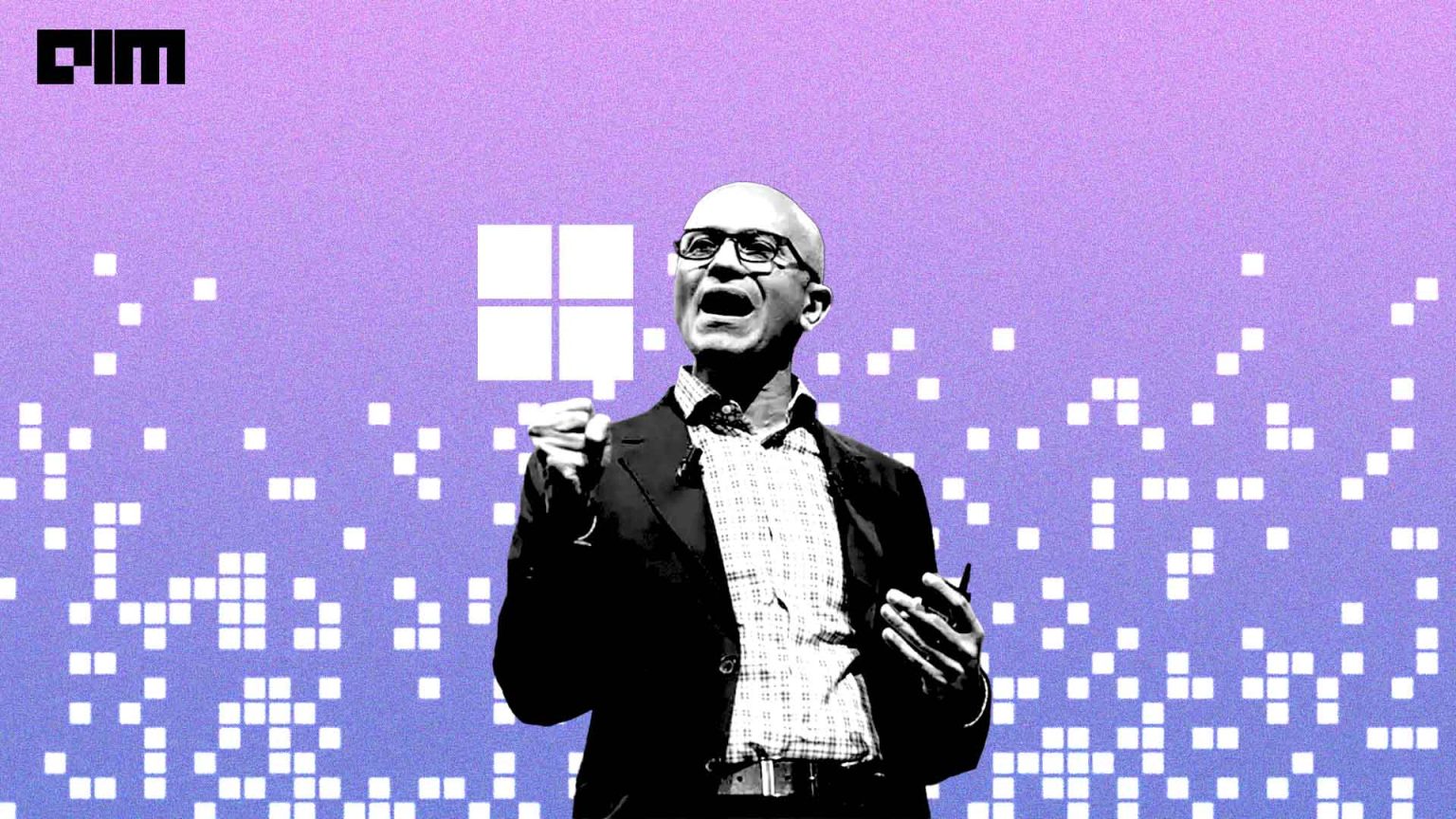
Microsoft’s chief Satya Nadella, announced Phi-2, an open-source model at Microsoft’s event Ignite. He highlighted Phi-2 as an enhanced iteration of Phi-1.5, displaying superior capabilities across various benchmarks while maintaining a relatively compact size with 2.7 billion parameters.

“Phi-2 exhibits a 50% improvement in mathematical reasoning. This open-source model, Phi-2, will soon be accessible through Microsoft’s catalog and model-as-a-service offerings.” added Nadella.

At Microsoft Ignite, Microsoft unveiled ‘Models as a Service,’ granting users access to open-source models through hosted APIs. In addition to Phi-2, Microsoft will provide Llama2, Mistral, and Jais on its Model Catalog, as part of this service.

Llama as a service on Azure.
Mistral as a service on Azure.
Thrilled to see that Microsoft and @satyanadella are supporting open source AI platforms for their customers. https://t.co/z40iLq0Igy

— Yann LeCun (@ylecun) November 16, 2023

“You can fine-tune Llama 2 with your data to enhance the model’s understanding of your domain and generate more accurate predictions,” Nadella explained. He also emphasized Microsoft’s dedication to supporting models in all languages and across every country, citing the collaboration with G42 to bring the first Arabic model, Jais, onto Azure AI Studio.

Azure AI Studio is a comprehensive toolchain, enabling users to seamlessly navigate the entire lifecycle of building, customizing, training, evaluating, and deploying next-generation models. With built-in safety tools, prioritizing safety as a paramount feature of our platform, Azure AI Studio empowers users to identify and filter harmful content, whether generated by users or AI, in your applications and services.

In September, Microsoft introduced Phi-1.5 which outperformed Llama 2’s 7-billion parameters model on several benchmarks.

The post Microsoft Silently Unveils Llama 2 Open-Source Alternative appeared first on Analytics India Magazine.
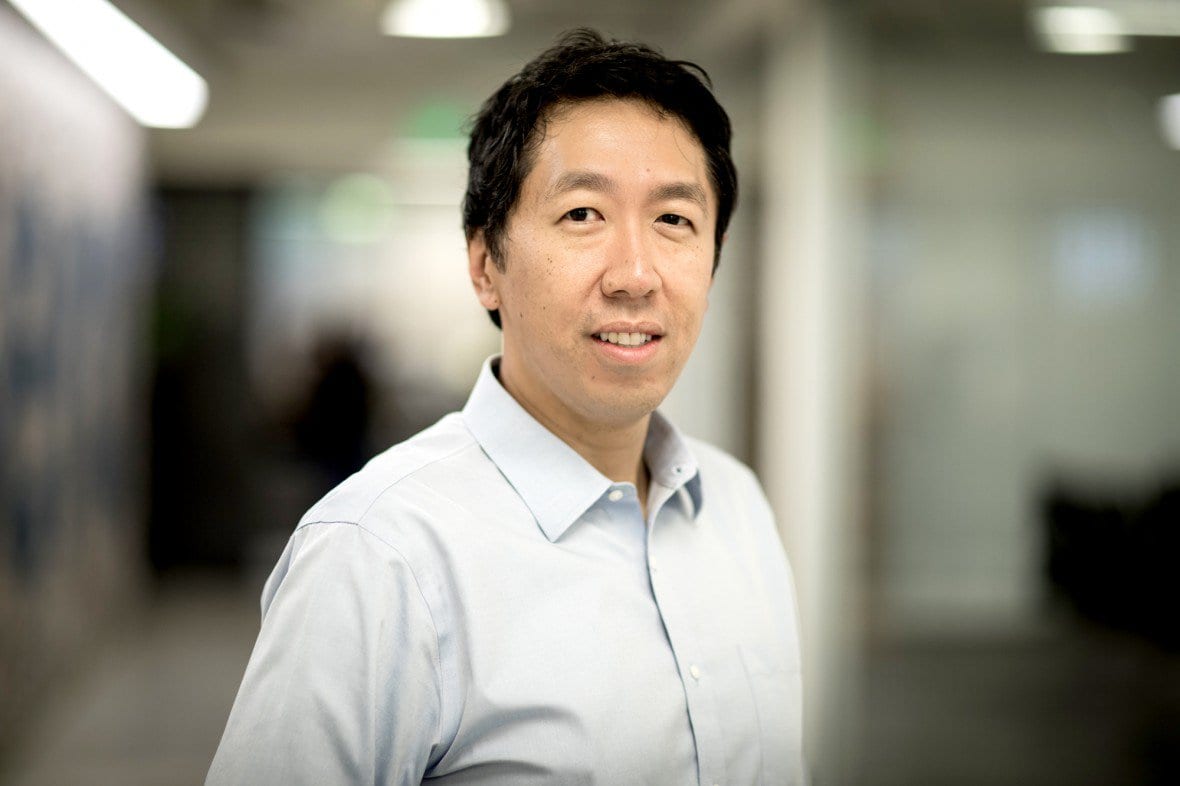
Andrew Ng Launches A New Course on LLM Quality and Security 

DeepLearning.ai’s Andrew Ng recently launched a new course that focuses on quality and safety for LLM applications, in collaboration with WhyLabs (an AI Fund portfolio company).

This one hour long course would be led by Bernease Herman, a senior data scientist at WhyLabs, where she will be focusing on the best practices to monitor LLM systems, alongside showcasing how you can mitigate hallucinations, data leakage, and jailbreaks among others.

You can join the course here.

New course with WhyLabs: Quality and Safety for LLM Applications

With the open source community booming, developers can prototype LLM applications quickly. In the introductory video Andrew Ng explained,“One huge barrier to the practical deployment has been quality and safety.”

For a company that aims to launch a chatbot or a QA system, there is a good possibility that the LLM would hallucinate or mislead users. “It can say something inappropriate or can open up a new security loophole where a user can input a tricky prompt called the prompt injection that makes the LLM do something bad,” Andrew elaborated.

The course explains what can go wrong and the best practices to mitigate the problems including prompt injections, hallucinations, leakage of confidential PII like personal identifiable information, such as email or government ID numbers, and toxic or other inappropriate outputs. Bernease said, “This course is designed to help you discover and create metrics needed to monitor your LLM systems. For both safety and quality issues.”

Andrew Ng has consistently released courses on his DeepLearning.ai over the past year on Generative AI and its applications. These courses have helped learners increase their knowledge and expertise in AI and deep learning.

The post Andrew Ng Launches A New Course on LLM Quality and Security appeared first on Analytics India Magazine.

Supercomputing ‘23: NVIDIA High-Performance Chips Power AI Workloads

At the Supercomputing ‘23 conference in Denver on Nov. 13, NVIDIA announced expanded availability of the NVIDIA GH200 Grace Hopper Superchip for high-performance computing and HGX H200 Systems and Cloud Instances for AI training.

Jump to:

  • NVIDIA HGX GH200 supercomputer enhances generative AI and high-performance computing workloads
  • NVIDIA’s GH200 chip is suited to supercomputing and AI training

NVIDIA HGX GH200 supercomputer enhances generative AI and high-performance computing workloads

The HGX GH200 supercomputing platform, which is built on the NVIDIA H200 Tensor Core GPU, will be available through server manufacturers and hardware providers that have partnered with NVIDIA. The HGX GH200 is expected to start shipping from cloud providers and manufacturers in Q2 2024.

Amazon Web Services, Google Cloud, Microsoft Azure, CoreWeave, Lambda, Vultr and Oracle Cloud Infrastructure will offer H200-based instances in 2024.

NVIDIA HGX H200 features the following:

  • NVIDIA H200 Tensor Core GPU for generative AI and high-performance computing workloads that require massive amounts of memory (141 GB of memory at 4.8 terabytes per second).
  • Doubling inference speed on Llama 2, a 70 billion-parameter LLM, compared to the NVIDIA H100.
  • Interoperable with the NVIDIA GH200 Grace Hopper Superchip with HBM3e.
  • Deployable in any type of data center, including on servers with existing partners ASRock Rack, ASUS, Dell Technologies, Eviden, GIGABYTE, Hewlett Packard Enterprise, Ingrasys, Lenovo, QCT, Supermicro, Wistron and Wiwynn.
  • Can provide inference and training for the largest LLM models beyond 175 billion parameters.
  • Over 32 petaflops of FP8 deep learning compute and 1.1TB of aggregate high-bandwidth memory.

“To create intelligence with generative AI and HPC applications, vast amounts of data must be efficiently processed at high speed using large, fast GPU memory,” said Ian Buck, vice president of hyperscale and HPC at NVIDIA, in a press release.

NVIDIA’s GH200 chip is suited to supercomputing and AI training

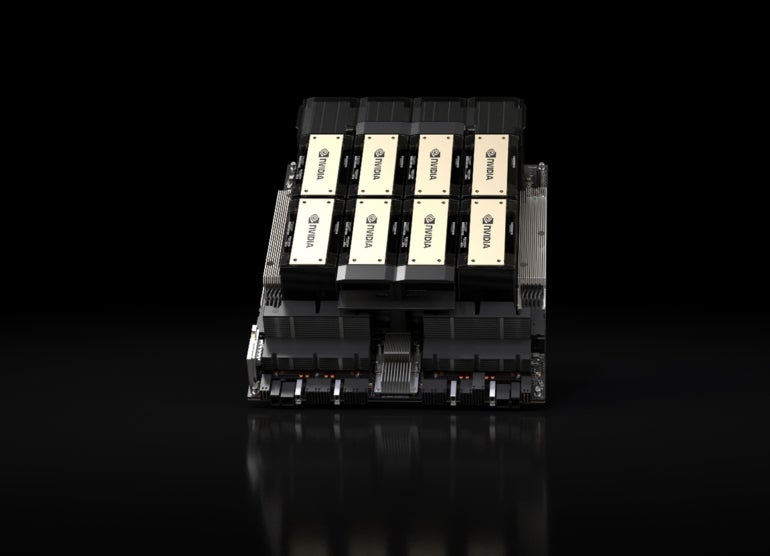
NVIDIA will now offer HPE Cray EX2500 supercomputers with the GH200 chip (Figure A) for enhanced supercomputing and AI training. HPE announced a supercomputing solution for generative AI made up in part of NVIDIA’s HPE Cray EX2500 supercomputer configuration.

Figure A

Multiple NVIDIA GH200 chips working together.
Multiple NVIDIA GH200 chips working together. Image: NVIDIA

The GH200 includes Arm-based NVIDIA Grace CPU and Hopper GPU architectures using NVIDIA NVLink-C2C interconnect technology. The GH200 will be packaged inside systems from Dell Technologies, Eviden, Hewlett Packard Enterprise, Lenovo, QCT and Supermicro, NVIDIA announced at Supercomputing ’23.

SEE: NVIDIA announced AI training-as-a-service in July (TechRepublic)

“Organizations are rapidly adopting generative AI to accelerate business transformations and technological breakthroughs,” said Justin Hotard, executive vice president and general manager of HPC, AI and Labs at HPE, in a blog post. “Working with NVIDIA, we’re excited to deliver a full supercomputing solution for generative AI, powered by technologies like Grace Hopper, which will make it easy for customers to accelerate large-scale AI model training and tuning at new levels of efficiency.”

What can the GH200 enable?

Projects like HPE’s show that supercomputing has applications for generative AI training, which could be used in enterprise computing. The GH200 interoperates with the NVIDIA AI Enterprise suite of software for workloads such as speech, recommender systems and hyperscale inference. It could be used in conjunction with an enterprise’s data to run large language models trained on the enterprise’s data.

NVIDIA makes new supercomputing research center partnerships

NVIDIA announced partnerships with supercomputing centers around the world. Germany’s Jülich Supercomputing Centre’s scientific supercomputer, JUPITER, will use GH200 superchips. JUPITER will be used to create AI foundation models for climate and weather research, material science, drug discovery, industrial engineering and quantum computing for the scientific community. The Texas Advanced Computing Center’s Vista supercomputer and the University of Bristol’s upcoming Isambard-AI supercomputer will also use GH200 superchips.

A variety of cloud providers offer GH200 access

Cloud providers Lambda and Vultr offer NVIDIA GH200 in early access now. Oracle Cloud Infrastructure and CoreWeave plan to offer NVIDIA GH200 instances in the future, starting in Q1 2024 for CoreWeave; Oracle did not specify a date.

Kubernetes made simple? Microsoft adds AI toolchain operator to Azure service

abstract3dgettyimages-1404344027

If you want to run artificial intelligence (AI) and machine learning applications such as large language models (LLMs) at scale, you must run them on Kubernetes. However, mastering Kubernetes — everyone's favorite container orchestrator — isn't easy. That's where Kubernetes Al toolchain operator — the latest addition to Microsoft's Azure Kubernetes Service (AKS) — comes in.

Also: Microsoft Azure introduces Radius open-source development platform

AKS already makes Kubernetes on Azure easier. Instead of working it out by hand, AKS's built-in code-to-cloud pipelines and guardrails give you a faster way to start developing and deploying cloud-native apps in Azure. With its unified management and governance for on-premises, edge, and multi-cloud Kubernetes clusters, AKS also makes it simpler (there's no such thing as "simple" when it comes to Kubernetes) to integrate with Azure security, identity, cost management, and migration services.

What Kubernetes AI toolchain operator brings to the table are automated ways to run open-source software AI/ML workloads cost-effectively and with less manual configuration. It also automates LLM model deployment on AKS across available CPU and GPU resources by selecting the optimally sized infrastructure for your LLM or other project.

AI toolchain operator does this by automatically provisioning the necessary GPU nodes and setting up the associated inference server as an endpoint server to your AI models. An inference server, such as Hugging Face's 7B or NVIDIA Triton Inference Server, applies trained AI models to incoming data to make real-time decisions. Inference is the process of running live data through a trained AI model to make a prediction or solve a task. Using this add-on reduces your onboarding time and enables you to focus on AI model usage and development rather than infrastructure setup.

It also makes it possible to easily split inferencing across multiple lower-GPU-count virtual machines (VMs). This means you can run your LLMs on more Azure regions, thus eliminating wait times for Azure regions with higher GPU-count VMs and lowering overall cost. In other words, you can automatically run your LLMs on lower-power, less-expensive regions. Yes, you may lose processing power, but not all jobs require higher horsepower.

Also: I went hands-on with Microsoft's new AI features, and these 5 are the most useful

Making it easier to set up, you can also choose from preset models with AKS-hosted images. This significantly reduces your overall service setup time. Once it's been up and running for a while, you can then adjust your Azure model to better fit your workload.

Additionally, Azure Kubernetes Fleet Manager enables multi-cluster and at-scale scenarios for AKS clusters. Platform admins who are managing Kubernetes fleets with many clusters often face challenges staging their updates in a safe and predictable way. This allows admins to orchestrate updates across multiple clusters by using update runs, stages, and groups. Since AI/ML workloads tend to be very demanding, this makes managing them much easier.

In short, if you want to do serious work with AI/ML on Azure, the Kubernetes Al toolchain operator demands your attention.

More Microsoft