Google has postponed the release of Gemini to the first quarter of the next year, according to sources cited by The Information. The delay suggests that Google is facing challenges in the development of Gemini, putting it in a catch-up position with OpenAI.
Initial expectations had pointed to a fall release for Gemini, but it seems Google failed to deliver that.
Google has created multiple iterations of Gemini to address varying tasks based on their complexity. External developers have already examined smaller versions of the model, quantified by the number of parameters or calculations they perform. However, the company is still in the process of completing the main and largest version of Gemini, the report added.
At the recent earnings call, Google chief spoke about Project Gemini, briefly. “We are just really laying the foundation of what I think of as the next-generation series of models we’ll be launching all throughout 2024,” shared Pichai, hinting that it would be multimodal – highly efficient with the tool and API integrations – and is going to be available in various sizes and capabilities.
He said that Gemini would be used immediately across all their products internally as well as bringing it out for both developers and cloud customers via Vertex AI.
No Improvement in Bard
In the meantime, Google’s counterpart to ChatGPT, Bard, has struggled to gain traction. This poses a challenge for Google, as ChatGPT’s numerous users contribute valuable data crucial for OpenAI to monitor and enhance the quality of its products. ChatGPT has over 100 million weekly users as of now.
Furthermore, compounding Google’s challenges, according to Vectara’s Hallucination Leaderboard, both Google’s PaLM 2 and PaLM Chat ranked the lowest, with hallucination rates of 12.1% and 27.2%, respectively, in contrast to GPT-4, which has a hallucination rate of 3%.
The post Google Delays Gemini While Bard Continues to Hallucinate appeared first on Analytics India Magazine.
Learn how to get the most out of ChatGPT with these courses.
Maybe you've played around with ChatGPT, to see what exactly the artificial intelligence chatbot is capable of doing. But if you're looking to get more out of the tool, you'll want to learn how to effectively structure your prompts — what you're actually asking it to do.
That's what the ultimate ChatGPT prompts guide is for. Not only will you get lifetime access to over 3,000 optimized inputs, but also a multi-chapter book on best practices. StackSocial currently has the best price found across the web for this deal at just $20 (reg. $119).
Get more out of the hottest open-source AI tool
First, you should understand what ChatGPT has to offer. If you're only using it to ask questions or tell jokes, you might be surprised to learn that it can be used for research, marketing, brainstorming ideas, business planning, SEO optimization, content creation, problem-solving, copywriting, and so much more. Students, business owners, working professionals, and creatives all have this free AI tool right at their fingertips.
The ultimate ChatGPT prompts guide could help you effectively structure inputs to generate better content. For example, you might just be writing prompts in the form of questions, but that may not be the best way to get your desired output.
On top of direct instruction, you also get access to over 3,000 ready-to-use prompts. These are highly optimized and proven to have great results, just input your own details and see what ChatGPT generates. These prompts are all in a user-friendly layout so you can quickly find what you're looking for and get back to streamlining your work.
Unlock ChatGPT's fullest potential with a lifetime subscription to the ultimate ChatGPT prompts guide, now available on StackSocial for just $20 (reg. $119).
Salesforce, the leading AI CRM provider, has soared beyond its initial commitment and delivered over 3 million upskilling opportunities for women within the Indo-Pacific Economic Framework for Prosperity (IPEF) Upskilling Initiative, surpassing its goal of 500,000 offerings.
Launched by the U.S. Department of Commerce in September 2022, the IPEF initiative aims to furnish women across the Indo-Pacific region with essential digital skills to bolster sustainable economic growth. Salesforce’s contributions spanned India, Indonesia, Thailand, the Philippines, and more, addressing the glaring gender disparity highlighted by the International Labour Organisation (ILO), where women constitute only 25.1% of IT employment in the Asia Pacific region.
Through collaborations with governments, public entities, and non-profits, Salesforce provided diverse upskilling opportunities for women. These initiatives were disseminated via Trailhead, Salesforce‘s free online learning platform, and inclusive programs encompassing expert-led training events, self-paced e-learning courses, and certifications tailored for the Salesforce ecosystem.
Salesforce’s Trailhead Academy, in partnership with governmental bodies and educational institutions, spearheaded these programs. Noteworthy collaborations include initiatives with NASSCOM, Giftabled, Skillible, Pride Circle in India, Nokentech, Indonesia’s Ministry of Communication and Informatics (KOMINFO), and Ayala Foundation in the Philippines.
“By delivering on — and exceeding — our commitment to provide half a million upskilling opportunities, we are demonstrating a tangible impact on the lives and careers of countless individuals in these communities, and helping to unlock the potential of digital economies in the region,” said William Sim, Vice President of Trailhead Academy, Asia-Pacific, Salesforce.
U.S. Secretary of Commerce, Gina M. Raimondo, commended Salesforce’s strides under the IPEF Upskilling Initiative, acknowledging the pivotal role of private entities in empowering women and nurturing global economic prosperity.
This comes on the heels of Salesforce’s recent announcement that it would be partnering with the Ministry of Education to upskill 100K students in AI.
The post Salesforce Delivers 3M Upskilling Opportunities for Women in Indo-Pacific appeared first on Analytics India Magazine.
Despite rumours of its one-sided love, at Ignite 2023, Microsoft’s chief Satya Nadella didn’t hesitate in showering unlimited affection and praises for OpenAI and how it is grateful to have in its life, alongside showcasing how it is ready to give up everything it has built so far. This includes rebranding its search engine to revamping its Azure cloud infrastructure and more.
Nadella is just madly in love. On many instances, he has expressed his feelings towards OpenAI – even at DevDay, he said – “We love you guys… You guys have built something magical.”
The praise doesn’t end there. At Ignite, he reinforced it even further, and said: “As OpenAI innovates, we will deliver all of that as Azure AI. We are bringing the very latest of GPT4, including GPT4 Turbo, GPT4 Turbo With Vision to Azure OpenAI Service…”
He also said that it will be fine-tuning Azure OpenAI Service, alongside helping customers bring their own data to create custom versions of GPT-4.
Actually, Microsoft ️Everyone
All of this paints a romantic picture of how Microsoft is so in love with OpenAI. But, the reality is quite the opposite. The tech giant actually loves everyone who can bring new customers – the likes of Meta, Mistral AI, and G42 among other open-source, as well as, in desperate cases, even other closed-door companies (Cohere and others), LLM-enablers like LangChain, and not to forget investments in Inflection AI and HuggingFace.
“We are all-in on open source and want to bring the best selection of open source models to Azure and do so responsibly,” said Nadella. A day later, Cohere also silently announced that its flagship enterprise AI model, Command, would soon be available though Azure AI Model Catalog and Marketplace.
Microsoft is not limited to LLMs; at Ignite, it also announced the newest iteration of the Phi Small Language Models (SLMs) series, termed Phi-2.
All for the sake of Azure
In its latest earnings report, Microsoft experienced a robust 29% surge in the quarter, surpassing both AWS and Google Cloud. The tech giant is dedicated to making Azure the best cloud service provider and is willing to go to any extent to achieve this, even partnering with its cloud competitor.
OCI is 18 months ahead of its competitors, including Azure, AWS, and Google Cloud in terms of infrastructure said Oracle in recent interview with AIM.
The company said that OCI is a second-generation cloud, which means that networks built on it are not shared between tenants in the cloud. “The network serves as the bottleneck for the cloud. OCI was designed with a distinctly different network compared to other players.” said Christopher G. Chelliah, senior vice president, technology & customer strategy, JAPAC.
Now as Microsoft is set to host numerous models on Azure, infrastructure changes are essential to support all its partners and customers. On the hardware side, strategic partnerships with AMD, Intel, and NVIDIA have been forged to acquire brand new GPUs with advanced capabilities.
Besides this, most of Microsoft’s recent investments point at improving Azure capabilities, where it has invested in AI chip startup d-Matrix, alongside acquiring hollow core fiber startup Lumenisity.
Interestingly, the tech giant is building its very first custom in-house CPU series, the Microsoft Azure Cobalt CPU—an Arm-based processor tailored to run general-purpose compute workloads on the Microsoft Cloud.
“Cobalt is the first CPU designed by us specifically for the Microsoft Cloud, and this 64-bit, 128-core Arm-based chip is the fastest among any cloud provider,” said Nadella. It’s already powering parts of Microsoft Teams, Azure Communication Services, as well as Azure SQL as we speak,” he added.
Apart from the CPUs, Microsoft has also introduced an AI accelerator chip named Maia, for running cloud AI workloads. This chip is manufactured on a 5-nanometer process and has 105 billion transistors, “making it one of the largest chips that can be made with current technology,” emphasised Nadella.
Nadella also announced Azure Boost’s general availability, offloading server virtualisation processes to purpose-built software and hardware for significant networking improvements and enhanced storage throughput.
Clearly, Microsoft’s true love is always going to be Azure, everyone else just a cloud, lost in the crowd.
The post Microsoft 💔 OpenAI appeared first on Analytics India Magazine.
Accelerating the progress on generative AI, Mark Zuckerberg’s Meta has introduced new text to video and editing models called Emu Video and Emu Edit, respectively.
Emu Video is a new text-to-video generation model involving two steps: generating an image based on the text and then creating a video using both the text and the generated image. The model achieves high-quality, high-resolution videos through optimised noise schedules for diffusion and multi-stage training.
Human evaluations demonstrate superior quality compared to existing works, with preferences of 81% over Google’s Imagen Video, 90% over NVIDIA’s PYOCO, and 96% over Meta’s Make-A-Video. The model also outperforms commercial solutions like RunwayML’s Gen2 and Pika Labs. Notably, their factorizing approach is well-suited for animating images based on user text prompts, surpassing prior works by 96%.
On the other hand, Emu Edit is a multi-task image editing model demonstrating superior performance in instruction-based image editing. It outperforms existing models by training across various tasks like region-based editing, free-form editing, and computer vision tasks.
Emu Edit’s success is attributed to its multi-task learning, using learned task embeddings to guide the generation process accurately. The model proves its versatility by successfully generalising to new tasks with minimal labeled examples, addressing scenarios with limited high-quality samples. Additionally, a comprehensive benchmark with seven diverse image editing tasks is introduced for a thorough evaluation of instructable image editing models.
The model addresses the limitations of existing generative AI models in image editing. It focuses on precise control and enhanced capabilities by incorporating computer vision tasks as instructions. The model handles free-form editing, including tasks like background manipulation, color transformations, and object detection.
Unlike many existing models, it follows instructions precisely, ensuring that only pixels relevant to the edit request are altered. The model is trained on a large dataset of 10 million synthesized samples, presenting unprecedented results in terms of instruction faithfulness and image quality. Emu Edit surpasses current methods in both qualitative and quantitative evaluations for various image editing tasks, establishing new state-of-the-art performance.
The post Meta Introduces New Generative AI Models, Emu Video & Emu Edit appeared first on Analytics India Magazine.
Automation use cases like intelligent document processing and communications mining could help organisations fast-track artificial intelligence operationalisation in 2024, according to a report from UiPath, as businesses seek to combine AI with automation to improve processes.
Mark Fioretto, area vice president and managing director at UiPath
Mark Fioretto, area vice president and managing director at AI-powered automation software company UiPath, said 2024 would see businesses in the Australasian region taking advantage of technologies in the traditional automation space but using AI to supercharge their results.
UiPath also predicts automation will drive process improvements in a number of areas together with AI, including improving AI safety processes by keeping humans in the loop and enabling environmental, social and governance data capture and reporting to be streamlined.
Jump to:
C-suite sees operationalisation of AI as leading priority for 2024
Multiple AI and automation combinations expected to grow
AI safety success will lean on practical automation capabilities
ESG reporting another application for AI-powered automation
AI and automation to redefine work as we know it
C-suite sees operationalisation of AI as leading priority for 2024
The drive to commercialise generative AI capabilities inside products or processes inside organisations is the biggest AI trend UiPath is seeing among Australia’s C-level executives.
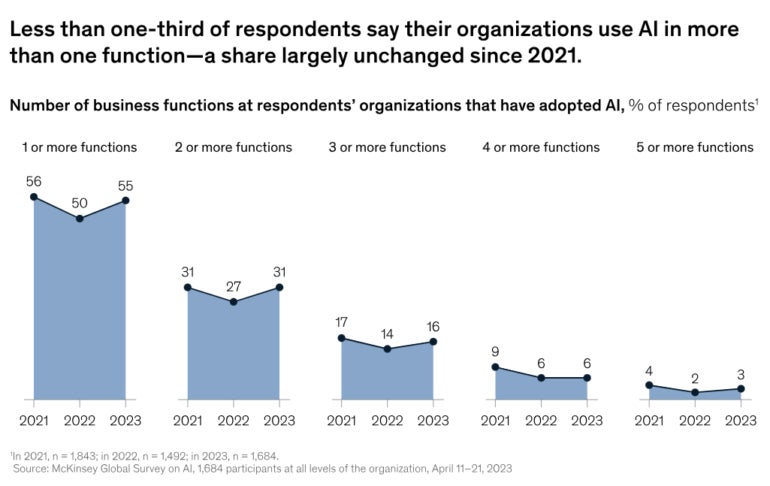
This comes as organisations struggle to adopt AI across their enterprises. A global report from McKinsey, for example, found almost half of organisations (45%) have no AI at scale (Figure A).
Figure A: Organisations are yet to adopt AI across multiple functions. Source: McKinsey
Fioretto said operationalisation required businesses to put AI-sourced information into practice, which was likely to increase the market’s embrace of AI and automation combinations in 2024.
SEE: How Australia is adapting fast to a generative AI World.
“The C-suite really wants to operationalise AI and drive productivity in different ways within their organisations, as well as servicing customers in an improved manner,” Fioretto said. “This is making the combination of AI and automation really top of mind in C-suites right now.”
AI-powered automation to deliver productivity advantages
A global UiPath-commissioned survey of 200 companies, conducted by Bain & Company, found 70% of executives think AI-driven automation — combining both AI and automation components — would be “very important” or “critical” in fulfilling their business’ strategic objectives.
Most executives (85%) singled out higher productivity and efficiency as the primary advantages. McKinsey’s research estimates that, when generative AI is combined with other technologies, work automation could boost annual productivity growth by 0.2 to 3.3 percentage points.
“Having generative AI available in a more consumable way for the broader market means we are now seeing a combination of generative AI with specialised AI as customers adapt or use generative AI and different commercial models to commercialise AI inside processes,” Fioretto said.
Multiple AI and automation combinations are expected to rise
With executives seeking to implement use cases that can quickly generate value from AI, UiPath expects an uptick in Australian companies using AI and automation opportunities in 2024.
Intelligent document processing
UiPath singles out intelligent document processing as a key use case. IDP allows industries using lots of documents, such as the banking, healthcare, insurance and legal sectors, to improve their speed, capacity and costs.
“IDP is a great example of creating a huge amount of efficiency combining generative AI and specialist AI with automation,” Fioretto said.
For example, Heritage Bank’s 2017 commitment to go digital and scale back- and middle-office processes has led to 90% process automation in some areas, including the compiling of living expense reports for loan applications. The bank, which is a UiPath customer, has also achieved a 98% accuracy in machine learning across its banking and wealth management businesses.
Communications mining
AI and automation can be paired to help organisations understand and act on emails, texts and unstructured data. For example, many organisations have contact centres with general or unmanned inboxes for inquiries, which need to be categorised and routed to the right person.
SEE: Australia’s telcos are deploying generative AI to improve productivity.
“You are able to take the logic generated by large language models and through available information in the marketplace, but then, you are using specialised AI to route or enable the processing of the customer request efficiently within an organisation,” Fioretto said.
Automating automation
The natural language processing power of AI will “automate automation.” In the coming year, UiPath said developers and business users will increasingly ask their automation platform to build automations using natural language or no-code inputs. The platforms will be able to convert these prompts into real workflows, test cases, process mining and individual tasks.
AI safety success will lean on practical automation capabilities
The push to enhance AI safety will continue during 2024, according to UiPath, as the market seeks to mitigate the potential for misuse and miscalculation in the use of the technology. Fioretto said this will require guardrails and controls, supported by automation capabilities.
Human in the loop
Organisations are likely to expand “human in the loop” capabilities through “exception tagging,” which creates automated notifications if a process is not followed by flagging it as an exception. Humans can either be brought into the loop, or a reason can be captured for the exception.
Task mining
Task mining can be used to unearth or identify processes that are aged or not constructed correctly. This can create a “hidden floor” ensuring problem processes can be identified for discussion and uplifting the way AI governance processes or policies will be applied.
ESG reporting another application for AI-powered automation
The requirement for Australian organisations to report under new ESG standards from the International Sustainability Standards Board beginning on July 1, 2024, could drive further use of AI-powered data and reporting automations within organisations.
SEE: Explore the benefits of applying ESG standards to business processes.
Fioretto said new sustainability-related disclosures would require the collection, compilation, validation and reporting of ESG data across complex organisations, including supply chains, in an environment where managing this ESG data collection process is proving challenging.
AI-powered automation could help monitor metrics like carbon emissions, streamline data collection, processing, analysis and reporting, and reduce the likelihood of mistakes. Data could also be extracted, interpreted and processed from structured and unstructured documents.
AI and automation to redefine work as we know it
A recent report from the Australian Computer Society found that up to 90% of workers could be affected by artificial intelligence. UiPath expects 2024 to be characterised by a growing understanding of how humans will work collaboratively together with machines in the future.
“If I go back in time and think about when the internet was made usable and accessible to the general public, no one would have guessed the impact that was going to have in our work lives over time, or the way we interacted with each other,” Fioretto said. “We are in a similar situation now in terms of how AI will coexist with how we operate as humans.
SEE: AI is ranked one of the most important technologies for 2024, says IEEE.
“Over time, we will see an evolution in how it gets applied to how we work, but I think AI will be embedded in the way we interact with each other on a personal level and business level.”
Automation and AI will augment our human capacities
AI and automation is not about replacing humans, Fioretto said, but augmenting our capacities with data from the internet and other models. Human logic will still need to be applied to ensure AI models are responsible and fit within the parameters of how we interact with each other.
“Take no-code or low-code applications and technology and how they will apply in the workplace — the opportunity is enormous, not just in terms of efficiency but in creating a more satisfying time at work, where we are more focused on high value tasks,” Fioretto said.
Micron Technology’s latest breakthroughs in memory technology have hit the spotlight with its announcement of the 32Gb monolithic die-based 128GB DDR5 RDIMM memory. Set to redefine data center capabilities, these modules boast an unprecedented performance of up to 8000 MT/s, elevating the standards for memory-intensive applications like generative AI.
Powered by Micron’s 1β technology, these DRAM die-based 128GB DDR5 RDIMMs offer significant enhancements over competitive 3DS through silicon via (TSV) products. The improvements include more than a 45% boost in bit density, up to 24% improved energy efficiency, up to 16% lower latency, and an impressive up to 28% enhancement in AI training performance.
Micron’s vice president and general manager of Compute Products Group, Praveen Vaidyanathan expressed pride stating, “We are proud to set a new standard for high-capacity, high-speed memory in the data center with Micron’s 128GB DDR5 RDIMMs, which delivers the memory bandwidth and capacity required for increasingly compute-intensive workloads.”
“Micron continues to enable improvements to the data center ecosystem with early access to our advanced technologies and support in the design and integration of leading-edge high-capacity memory Solutions,” he added.
These memory solutions leverage a sophisticated die architecture that prioritises array efficiency and denser monolithic DRAM. Alongside architectural advancements, voltage domain and refresh management features optimize the power delivery network, significantly enhancing energy efficiency.
Micron’s 1β process technology node driven by AI-powered smart manufacturing methods has reached unprecedented yield maturity. The company plans to ship the 128GB RDIMMs in platforms capable of 4800 MT/s, 5600 MT/s, and 6400 MT/s by 2024, setting the stage for future platforms reaching up to 8000MT/s.
Industry leaders such as AMD and Intel have acknowledged the potential impact of Micron’s 128GB RDIMMs on enterprise workloads. Dan McNamara, senior vice president and general manager of AMD’s Server Business Unit, said, “As AMD advances compute with our next-gen EPYC processors, Micron’s 128GB RDIMMs will likely become one of the main memory options to deliver high-capacity and bandwidth per core capabilities to address the demands of memory-intensive applications.”
Additionally, Dr. Dimitrios Ziakas, vice president of Intel’s Memory and IO Technologies, expressed Intel’s interest in evaluating Micron’s 32Gb memory offering for key DDR5 server platforms, citing potential total cost of ownership benefits for cloud, AI, and enterprise customers.
Micron aims to empower customers to integrate optimized solutions tailored to their specific bandwidth, capacity, and power optimization needs for AI and high-performance computing applications.
The post Micron Unveils 128GB DDR5 RDIMMs, Transforming Data Center Performance appeared first on Analytics India Magazine.
Amazon’s Project Kuiper has achieved a 100% success rate in its Protoflight mission, validating all systems and subsystems on board its prototype satellites. Project Kuiper is a long-term initiative to launch a constellation of Low Earth Orbit satellites that will provide low-latency, high-speed broadband connectivity to unserved and underserved communities around the world.
The primary goal of this project is to provide high-speed, low-latency broadband internet service to underserved and unserved communities around the world, including in rural and remote areas.
Launched on October 6, 2023, the Atlas V rocket carried two satellites into space, marking a significant step toward Project Kuiper’s goal of providing fast and affordable broadband to underserved communities globally.
Within 30 days of launch, all major components, including flight computers, solar arrays, propulsion systems, and advanced RF communications, demonstrated nominal or better performance.
The successful tests allowed Project Kuiper to validate the satellite constellation’s architecture, conduct 4K video streaming, and showcase two-way video calls over the network. The team is now poised to enter mass satellite production, with a full-scale deployment scheduled for the first half of 2024, followed by beta testing later in the year.
Rajeev Badyal, VP of Technology for Project Kuiper, acknowledged the team’s dedication and expertise, emphasizing the rapid success achieved on the first mission.
Recent Protoflight tests focused on the RF communications payload, demonstrating end-to-end network functionality through experiments involving Amazon Prime transactions, 4K video streaming, and a two-way video call using Amazon Chime. These tests highlighted network throughput, low latency, and full-duplex performance.
The mission also provided valuable experience for satellite processing, launch, and mission operations, essential for the planned rapid launch cadence starting in 2024.
Project Kuiper aims to serve millions of customers worldwide, ranging from individual households to large enterprises and government agencies. Beta testing, scheduled for the second half of next year, will include early partners such as Vodafone and Verizon.
In 2018, Amazon initiated the development of Project Kuiper and received FCC authorisation in July 2020 to deploy and operate its satellites. Additionally, the AWS Space Accelerator, introduced by AWS in 2023, is dedicated to advancing the global space industry. It leverages Amazon’s resources to aid emerging startups, emphasising the creation of cloud-powered solutions for sustainable space use, aiming to positively impact life on Earth. The accelerator supports 14 global space startups by providing technical, business, and mentorship assistance to enhance their space solutions and accelerate growth through cloud technology.
The post Amazon’s Project Kuiper Achieves 100% Success in Low Earth Orbit Satellite Mission appeared first on Analytics India Magazine.
Microsoft is bringing a preview of its generative AI Copilot tool to Windows 10 for businesses and home users to start; Copilot will come to managed PCs later when IT pros get the tools to support and manage it.
While Copilot won’t be in today’s Windows 10 update, as it requires additional testing before release, Microsoft will be using it to refine the update experience for what it calls “seekers,” adding a new Get The Latest Updates As Soon As They’re Available toggle to Windows Update. Selecting this will opt you into early access to non-security updates, including Windows Copilot as soon as it is available.
The arrival of Copilot in Windows 10 isn’t changing the operating system’s end-of-life date, which is still scheduled for Oct. 14, 2025. Microsoft is describing this release as about “bringing the value of AI and specifically Copilot” to Windows 10.
Jump to:
An unexpected Windows 10 update
Who can access Windows Copilot in Windows 10
How to access Windows Copilot in Windows 10
Windows 10 Copilot vs Windows 11 Copilot
Why Windows 10 Copilot makes sense
An unexpected Windows 10 update
During his Microsoft Ignite keynote on Nov. 15, Microsoft CEO Satya Nadella called this the “age of copilots.” Microsoft is now delivering its AI assistants to places we weren’t expecting; Windows Copilot is coming to Windows 10 (Figure A).
Figure A
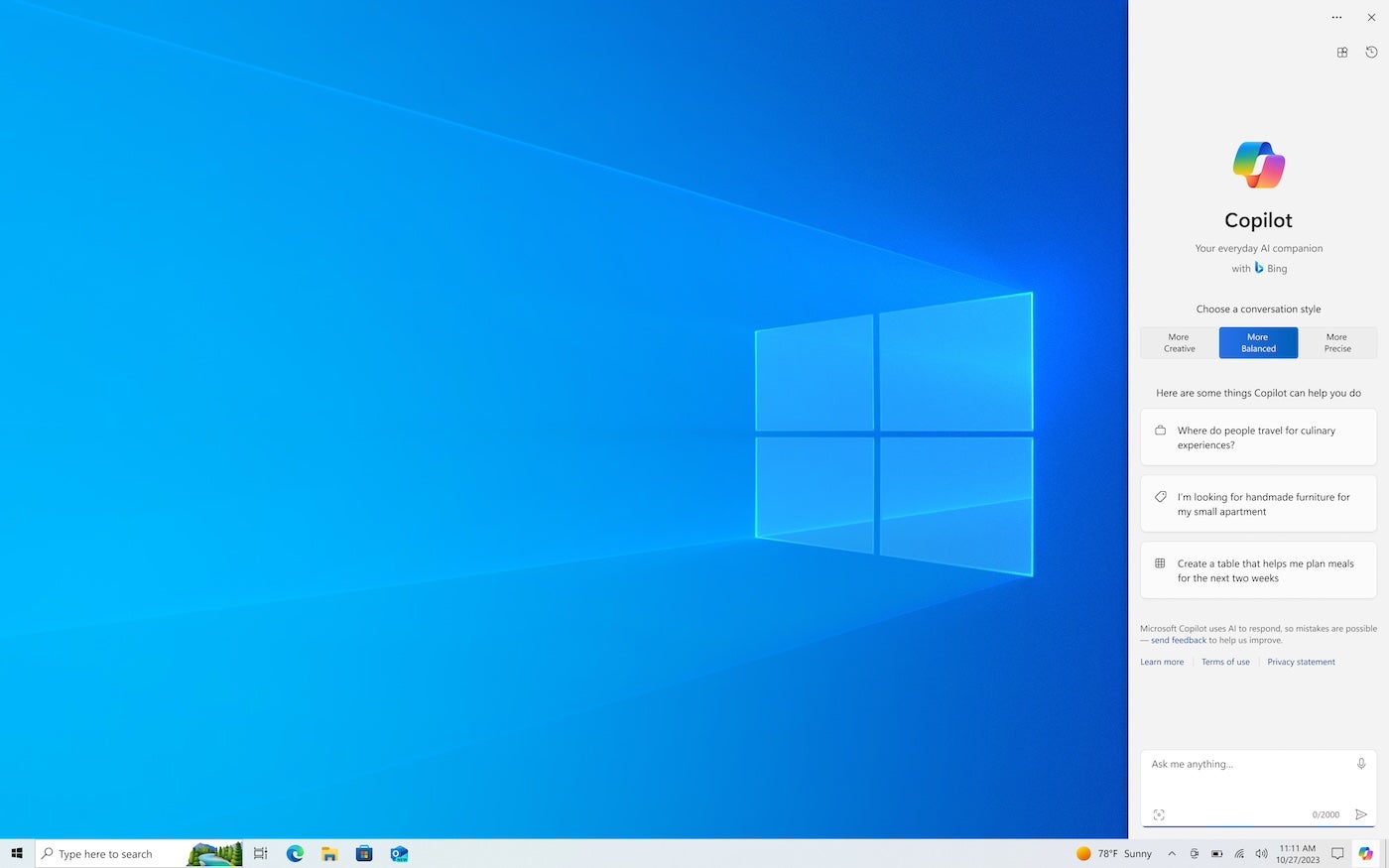
Windows Copilot in use in Windows 10. Image: Microsoft
When Microsoft rolled out the 22H2 update to Windows 10 in October 2022, it was expected to be the last major update to Windows 10 before its support lifecycle ends in 2025. Microsoft has announced that it is bringing at least some of the features of its Copilot AI assistant to Windows 10, launching it in a Windows Insider build, as well as teasing possible additional changes in the future. However, the arrival of this update doesn’t mean that Microsoft is changing when support ends.
Microsoft’s growing family of Copilots launched in February 2023 as Bing Chat, which has since been rebranded as part of Microsoft’s suite of AI assistant tools. It builds on top of Microsoft’s OpenAI partnerships and the GPT-series of large language models, delivering on Microsoft’s long-held ambition of adding natural user interfaces to Windows. Windows Copilot uses a mix of GPT’s language parsing capabilities and its summarization tools to give answers to questions, using the database behind the Bing search engine as a source of information beyond GPT’s own training data, with other data sources and services where needed.
As a result, it has been rolling out different Copilots, focusing on specific tasks: coding, business applications, security and more. Copilot for Windows is intended to help you find things on and about your PC that you might not find by other means, where they might be buried several layers down in Settings, as well as give you quick access to chat-powered services. Windows 11’s Copilot rolled out as part of the 22H2 Moment 4 update earlier this fall, with access to Bing search and to a subset of Windows features and system applications. You can use it to open tools like Focus or change between light and dark modes.
Who can access Windows Copilot in Windows 10
Access to the preview of Windows Copilot in Windows 10 will be via a non-security update, initially for Windows Insiders in the Release Preview channel. There are hardware limitations, too: You will need at least 4 GB of RAM and a 720p display to use Copilot. Not all countries will get access to this first release, with it being limited to North America and parts of Asia and South America.
The initial release will only be available for consumer PCs that have opted in to the Windows Insider program, applicable to Home and Pro installs that aren’t managed by an IT department. This will allow IT professionals to try it out on sandboxed PCs before Microsoft makes it available to all Windows 10 devices.
How to access Windows Copilot in Windows 10
Like the Windows 11 Copilot, the Windows 10 version will be an embedded web view launched via a Copilot button in the taskbar. Unlike Windows 11, this button will be at the far right of the taskbar, next to the date and time. Click the button, and Copilot will open on the right of your screen without overlaying your other windows, which will be resized and moved.
You will be able to open Copilot using the familiar Win C shortcut used to launch Cortana.
Windows 10 Copilot vs Windows 11 Copilot
Not all the features and skills in the Windows 11 version of Copilot will be available in the Windows 10 version of the AI assistant because the APIs those features use aren’t part of Windows 10, and there are no plans to add them. Where APIs are available, additional skills will be added in future updates to Windows 10’s Copilot. Other Copilot features that depend on Windows 11 hardware capabilities are unlikely to be delivered because Microsoft can’t guarantee their availability on older devices.
One important aspect of this update is that many Windows Copilot features depend on information that’s associated with a user’s Microsoft account. An account wasn’t necessary for Windows 10, so users will need to create one to get the most from the service.
Why Windows 10 Copilot makes sense
While adding Copilot to Windows 10 is an unexpected change, it’s one that makes sense for Microsoft and its users. Adding AI to Windows 10 will give older PCs a new lease of life, and Microsoft will get more data on how people use AI while refining its growing natural language capabilities.
More news from Microsoft Ignite: Microsoft Copilot Announced for Azure and New Solutions Offer More Security and Productivity from Windows in the Cloud
Codegen raises new cash to automate software engineering tasks Kyle Wiggers 18 hours
Jay Hack, an AI researcher with a background in natural language processing and computer vision, came to the realization several years ago that large language models (LLMs) — think OpenAI’s GPT-4 or ChatGPT — have the potential to make developers more productive by translating natural language requests into code.
After working at Palantir as a machine learning engineer and building and selling Mira, an AI-powered shopping startup for cosmetics, Hack began experimenting with LLMs to execute pull requests — the process of merging new code changes with main project repositories. With the help of a small team, Hack slowly expanded these experiments into a platform, Codegen, that attempts to automate as many mundane, repetitive software engineering tasks as possible leveraging LLMs.
“Codegen automates the menial labor out of software engineering by empowering AI agents to ship code,” Hack told TechCrunch in an email interview. “The platform enables companies to move significantly quicker and eliminates costs from tech debt and maintenance, allowing companies to focus on product innovation.”
So, one might wonder, what sets Codegen apart from code-generating AI like GitHub Copilot, Amazon CodeWhisperer and the Salesforce model with which Codegen shares a name? For one, the challenges that Codegen’s tackling, Hack says. Whereas Copilot, CodeWhisperer and others focus on code autocompletion, Codegen sees to “codebase-wide” issues like large migrations and refactoring (i.e. restructuring an app’s code without altering its functionality).
“Codegen leverages a multi-agent system for complex code generation,” Hack explained. “This entails orchestrating a swarm of agents that collaboratively decompose and solve large tasks. Many LLMs effectively deliberate and build upon each other’s work, [which] yields significantly better outputs.”
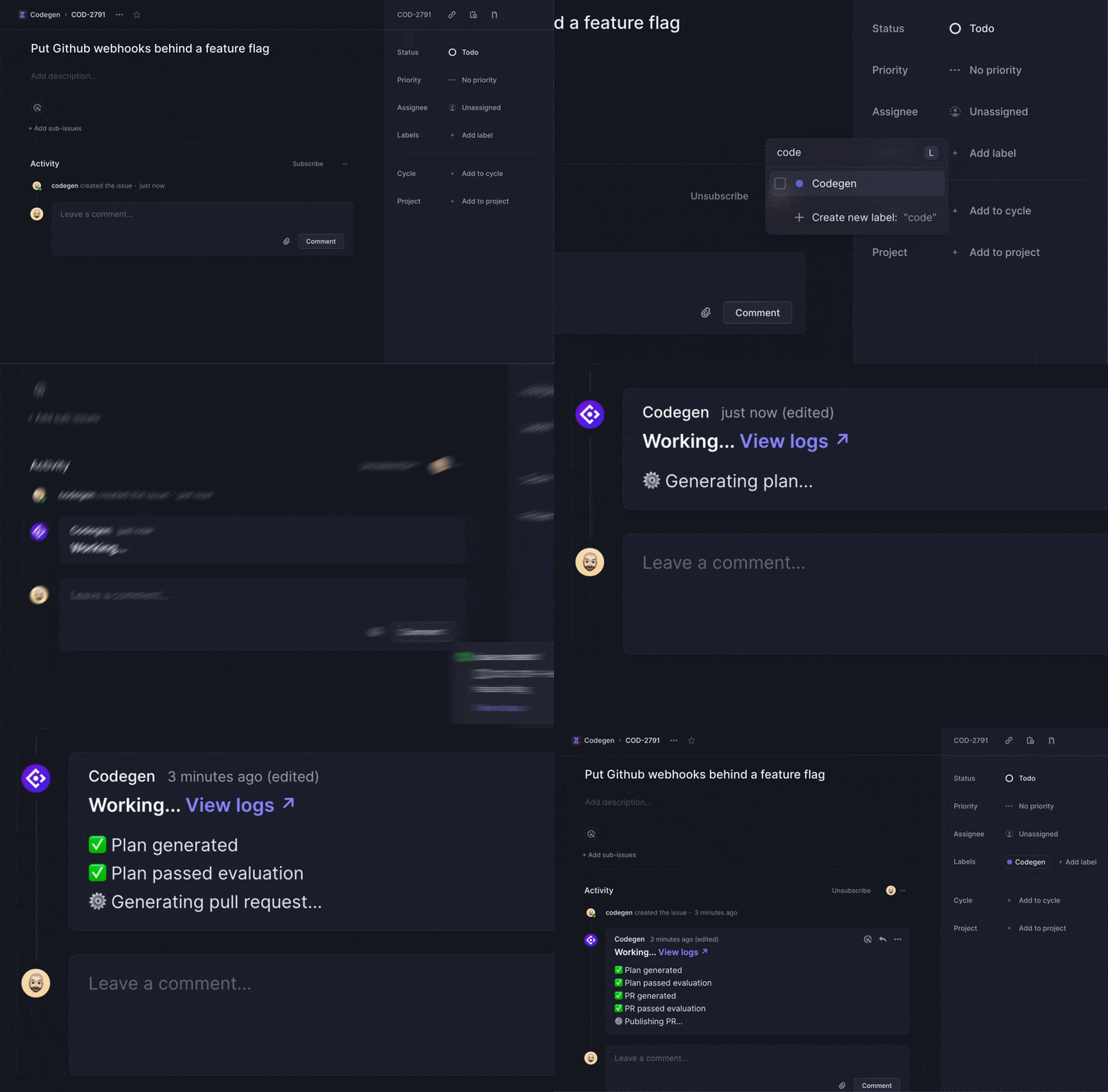
Image Credits: Codegen
Codegen’s core product is a cloud and on-premises tool that connects to codebases and project management boards, such as Jira and Linear, and automatically generates pull requests to address support tickets. The platform can even set up some of the necessary code infrastructure and logging, Hack says — although it wasn’t clear to this reporter what Hack meant by “infrastructure.”
“In contrast to other solutions, Codegen provides a higher level of automation in executing entire tasks on behalf of developers,” Hack said. “We scrape a company’s backlog, find the solvable tickets, then spin up an army of agents to find the relevant code and produce a pull request.”
Now, Codegen’s promising a lot considering even the best AI models today make major mistakes. For example, it’s well-established that generative coding tools can introduce insecure code, with one Stanford study suggesting that software engineers who use code-generating AI are more likely to cause security vulnerabilities in the apps they develop.
Hack says that Codegen, for its part, is trying to strike “the right balance” of human oversight and best practices surrounding monitoring LLM-generated code.
“This is important work, and the entire development ecosystem would benefit from a better understanding of how to evaluate and verify LLM output,” Hack said. “Significant advances will need to occur for there to be widespread developer trust in generalized, automated code generation systems.”
Investors seem to think that Codegen’s going places, for what it’s worth.
The company this week announced that it closed a $16 million seed round led by Thrive Capital with participation from angel investors including Quora CEO Adam D’Angelo and Instagram co-founder Mike Krieger. The tranche brings Codegen’s total raised to $16.2 million and values the startup at $60 million post-money, Hack claims.
Thrive’s Philip Clark had this to say via email: “In 2023, most developers still spend an unreasonable share of their time writing code to deal with low-level tasks like migrations, refactors, integrations and bug fixes. Companies like Codegen are leveraging LLMs to build AI agents that free engineers from this drudgery. Developers will soon be able to hand off jobs to agents so that they can stop worrying about software toil and stay focused on creating new products.”
San Francisco-based Codegen doesn’t have paying customers yet — it’s currently incubating the platform with two “large-scale” enterprise partners. But Hack’s anticipating growth into the next year.
“We’re raising significant capital as the opportunity to make such a substantial and ambitious product has only recently emerged, and we want to sprint full force towards the market,” he said, adding that Codegen plans to grow its workforce from six employees to 10 by the end of the year. “The funds will be used to scale our workforce and support our infrastructure.”



 ️Everyone