Microsoft Appoints Aparna Gupta as Global Delivery Center Leader

Microsoft has announced the appointment of Aparna Gupta as the new leader of its Global Delivery Center (GDC), a critical part of the Industry Solutions Delivery under Microsoft Customer and Partner Solutions (MCAPS).

The Global Delivery Center (GDC), initially established in Hyderabad in 2005 and later expanded to Bangalore and Noida, serves as the delivery arm for Microsoft’s Industry Solutions. It integrates the expertise of architects, consultants, and project managers to provide top-notch delivery solutions worldwide. In her new role, Gupta aims to drive customer innovation, promote delivery excellence, and accelerate cloud growth by leveraging top-tier talent and a robust partner ecosystem.

Gupta commented on her appointment saying, “I am looking forward to working with the teams at GDC to deepen technical expertise across solution areas and build a strong team culture to deliver excellence to our customers. Adding that she’ll look to further bolster the strong foundation within the team to the next level.

Gupta, with over 25 years of industry expertise and a comprehensive background in Microsoft technologies, is poised to lead the GDC team to further accomplishments.

Gupta has been associated with Microsoft for six years, initially leading the Commercial Software Engineering (CSE) division in India, which is now ISE. Throughout her tenure, she has demonstrated a keen acumen for driving business outcomes, establishing the Customer Success Unit (CSU) as a new segment within MCAPS India.

Gupta’s contributions spanned beyond business achievements; she advocated for diversity and inclusion, served as the Executive Sponsor for the Women’s ERG Charter, and championed building a diverse team. Her most recent role involved serving as the Customer Success Leader for the India and South Asia Area.

Prior to joining Microsoft, Gupta held pivotal positions at Bristlecone, a Mahindra group company, where she served as Vice President for Customer Experience. Additionally, she held positions in the Mahindra Group’s Strategy Office and as Co-Chair of the NASSCOM Region Council, solidifying her extensive career trajectory.

Microsoft’s India and South Asia President, Puneet Chandok, expressing confidence in her leadership playing a vital role in regional and global success said, “Her extensive experience and deep knowledge of Microsoft technologies will help customers plan and deploy future-ready solutions, especially in the age of AI.”

The post Microsoft Appoints Aparna Gupta as Global Delivery Center Leader appeared first on Analytics India Magazine.

8 AI Projects Microsoft Open-Sourced in 2023

Microsoft has come a long way since 2001 when the software giant’s former CEO Steve Ballmer made a snarky remark against open source – particularly Linux. Followed by ChatGPT’s public release late last year 2023 was all about giving the technology to the people, especially developers and researchers.

Microsoft did its bit by releasing several AI and machine learning models, projects and libraries all round the year.

From the slew of products the company released under Satya Nadella’s leadership, here are the 8 projects you should check out:

Orca and Orca 2

Today the company led by Nadella, has released Orca 2. These are a duo of small language models that, in tests involving intricate reasoning tasks in zero-shot settings, prove to be on par with or even surpass language models much larger in size – we’re talking about five to ten times larger, including Meta’s Llama-2 Chat-70B.

These Orca 2 models come in two versions: one with 7 billion parameters and another with 13 billion parameters. They are an evolution of the original 13 billion parameter Orca model, building upon the groundwork laid by its predecessor.

Terminal Chat

One of the freshest additions to Microsoft’s open-source lineup is Terminal Chat. Right now, it’s hanging out in Windows Terminal Canary, giving users the ability to chat with an AI service right there in the terminal.

This nifty feature lets users tap into smart suggestions, like getting help with commands or figuring out those pesky error messages, all without losing track of what’s going on in their terminal session.

Phi-2

At the recent Ignite conference, Microsoft introduced its new small language model called Phi-2. It’s the successor to versions 1 and 1.5 released earlier this year. Phi-2, with its 2.7 billion parameters, is better than the Llama-2-7B model in maths and coding.

There’s also talk of a chat version of Phi-2 in the works to fix some of its weaknesses in these areas.During the same conference, Nadella announced something called ‘Models as a Service.’ This means users can now access open-source models through hosted APIs. It’s like getting to use fancy tech tools without having to set them up yourself.

Radius

At the Linux Foundation Members Summit, Mark Russinovich, the Chief Technology Officer of Microsoft Azure, introduced an open-source initiative known as Radius. This platform is designed for cloud-native applications, allowing developers and operators to create, deploy, and work together on such applications across both public clouds and private infrastructure.

Radius comes packed with handy features like Recipes and Connections. These elements play a crucial role in streamlining deployments and automating the process of setting up resources. Essentially, Radius offers teams a centralised toolkit, making collaboration more effective and efficient.

Visual ChatGPT

In April of 2023, OpenAI introduced Visual ChatGPT, a chatbot designed to create and manipulate images in response to text inputs from users. This innovative system merges OpenAI’s ChatGPT with 22 distinct visual foundation models (VFM), enhancing its capabilities to facilitate multi-modal interactions.

Notably, the bot has the ability to produce images in two ways: it can either generate images from the ground up using a textual prompt or tweak existing images from the chat history. This dual functionality adds a dynamic dimension to its image-related responses.

Semantic Kernel

In March, the company decided to make public an internal project aimed at helping developers incorporate advanced AI models into their applications.

This project, named Semantic Kernel (SK), available on GitHub is described as “a lightweight SDK that facilitates the integration of large language models with traditional programming languages.”

By open-sourcing SK, the company not only expedites the process of developing AI-centric applications but also provides developers with a peek into the inner workings of the SDK. This transparency is in contrast to OpenAI’s approach with GPT-4, where the release of technical details has been withheld, deviating from past practices.

Olive

Microsoft has made Olive open source to provide users with a level of access to AI tooling similar to what Microsoft’s Windows team enjoys.

Once integrated into the user’s development environment, Olive becomes a handy tool for automating the tuning and optimization of models tailored for specific hardware targets. Olive offers a variety of tuning options, each designed for different model types.

For instance, if you’re working with a transformer, Olive can implement relevant optimizations and assist in striking a balance between the constraints on your model, effectively managing both latency and accuracy.

Feathr 1.0

The company has announced the renewed version of Feathr a year after it was released in 2023. This latest iteration has a host of new features and improvements, including online transformation, a fast sandbox environment, integration with the MLOPs V2 accelerator, and numerous other enhancements. These additions are geared towards expediting the development and deployment of machine learning projects on an enterprise scale.

The post 8 AI Projects Microsoft Open-Sourced in 2023 appeared first on Analytics India Magazine.

How To Write Efficient Python Code: A Tutorial for Beginners

How To Write Efficient Python Code: A Tutorial for Beginners
Image by Author

Beginner programmers enjoy coding in Python because of its simplicity and easy-to-read syntax. Writing efficient Python code, however, is more involved than you think. It requires understanding of some of the features of the language (they’re just as simple to pick up, though).

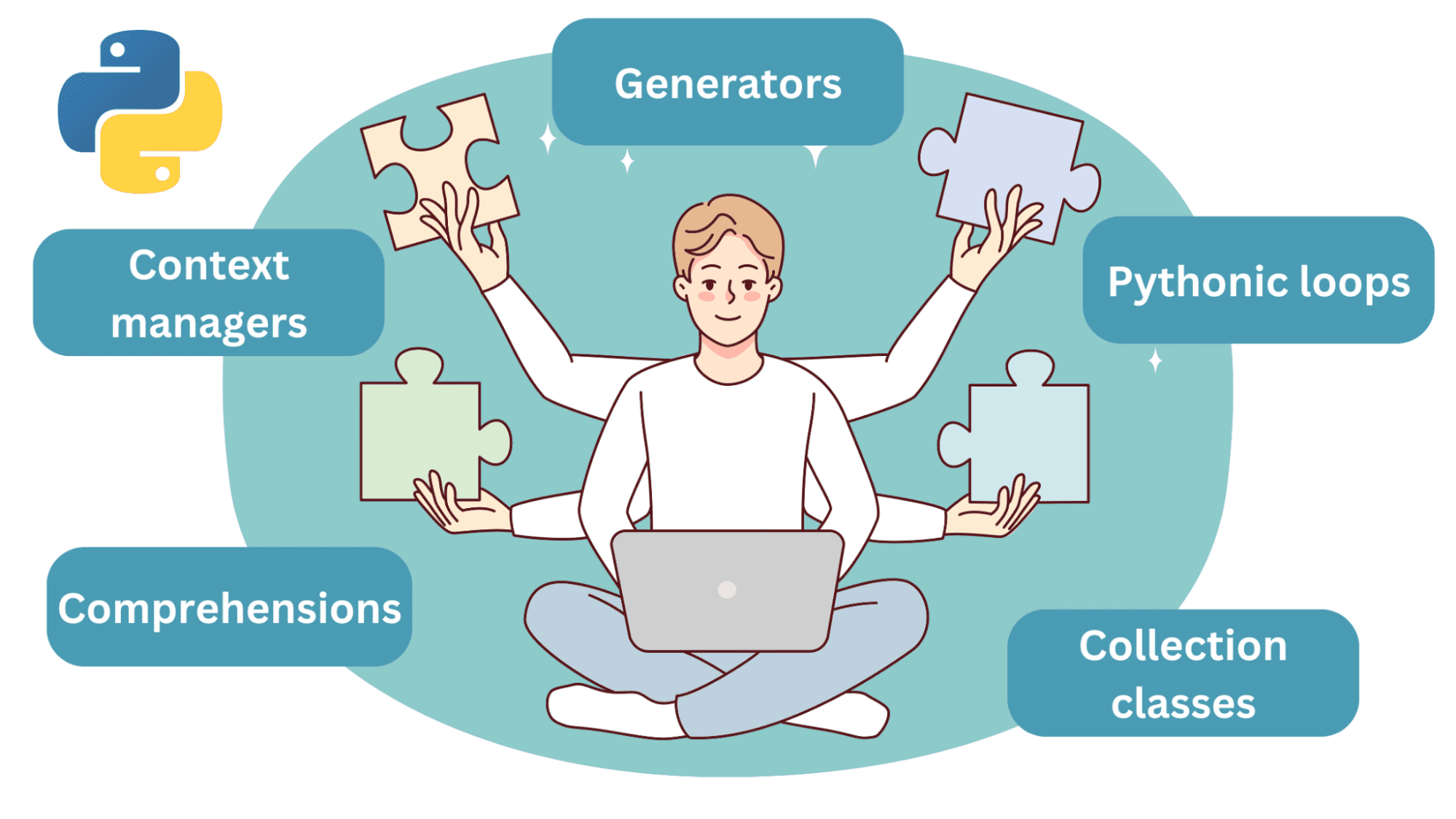
If you’re coming from another programming language such as C++ or JavaScript, this tutorial is for you to learn some tips to write efficient code in Python. But if you are a beginner—learning Python as your first (programming) language—then this tutorial will help you write Pythonic code from the get go.

We’ll focus on the following:

  • Pythonic loops
  • List and dictionary comprehension
  • Context managers
  • Generators
  • Collection classes

So let's dive in!

1. Write Pythonic Loops

Understanding loop constructs is important regardless of the language you’re programming in. If you’re coming from languages such as C++ or JavaScript, it's helpful to learn how to write Pythonic loops.

Generate a Sequence of Numbers with range

The range() function generates a sequence of numbers, often used as an iterator in loops.

The range() function returns a range object that starts from 0 by default and goes up to (but doesn't include) the specified number.

Here’s an example:

for i in range(5):      print(i)
Output >>>    0  1  2  3  4

When using the range() function, you can customize the starting point, ending point, and step size as needed.

Access Both Index and Item with enumerate

The enumerate() function is useful when you want both the index and the value of each element in an iterable.

In this example, we use the index to tap into the fruits list:

fruits = ["apple", "banana", "cherry"]    for i in range(len(fruits)):      print(f"Index {i}: {fruits[i]}")
Output >>>    Index 0: apple  Index 1: banana  Index 2: cherry

But with the enumerate() function, you can access both the index and the element like so:

fruits = ["apple", "banana", "cherry"]    for i, fruit in enumerate(fruits):      print(f"Index {i}: {fruit}")
Output >>>    Index 0: apple  Index 1: banana  Index 2: cherry

Iterate in Parallel Over Multiple Iterables with zip

The zip() function is used to iterate over multiple iterables in parallel. It pairs corresponding elements from different iterables together.

Consider the following example where you need to loop through both names and scores list:

names = ["Alice", "Bob", "Charlie"]  scores = [95, 89, 78]    for i in range(len(names)):      print(f"{names[i]} scored {scores[i]} points.")

This outputs:

Output >>>    Alice scored 95 points.  Bob scored 89 points.  Charlie scored 78 points.

Here's a much more readable loop with the zip() function:

names = ["Alice", "Bob", "Charlie"]  scores = [95, 89, 78]    for name, score in zip(names, scores):      print(f"{name} scored {score} points.")
Output >>>    Alice scored 95 points.  Bob scored 89 points.  Charlie scored 78 points.

The Pythonic version using zip() is more elegant and avoids the need for manual indexing—making the code cleaner and more readable.

2. Use List and Dictionary Comprehensions

In Python, list comprehensions and dictionary comprehensions are concise one-liners to create lists and dictionaries, respectively. They can also include conditional statements to filter items based on certain conditions.

Let's start with the loop version and then move on to comprehension expressions for both lists and dictionaries.

List Comprehension in Python

Say you have a numbers list. And you’d like to create a squared_numbers list. You can use a for loop like so:

numbers = [1, 2, 3, 4, 5]  squared_numbers = []    for num in numbers:      squared_numbers.append(num ** 2)    print(squared_numbers)
Output >>> [1, 4, 9, 16, 25]

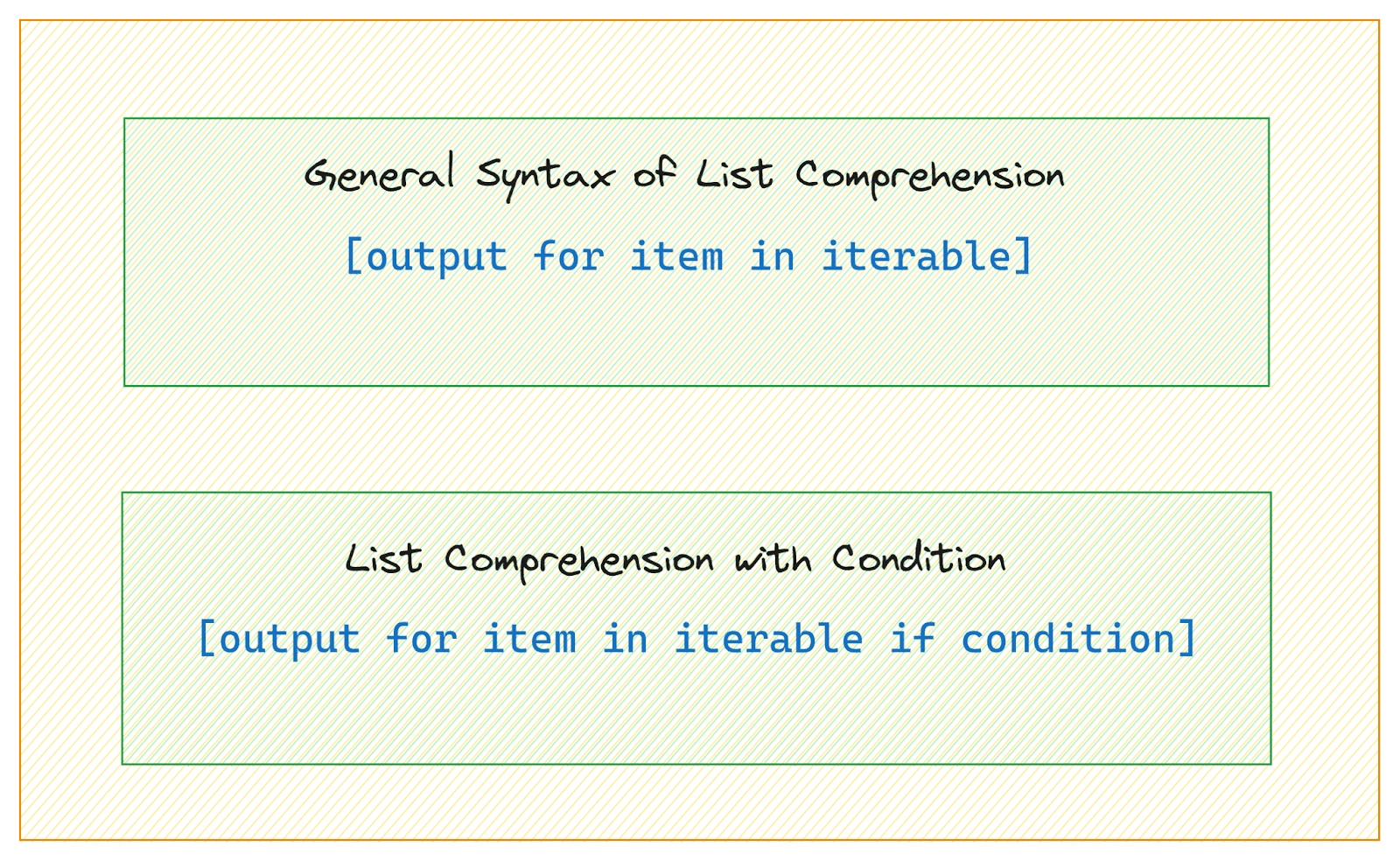
But list comprehensions provide a cleaner and simpler syntax to do this. They allow you to create a new list by applying an expression to each item in an iterable.
How To Write Efficient Python Code: A Tutorial for Beginners
List Comprehension Syntax | Image by Author

Here’s a concise alternative using a list comprehension expression:

numbers = [1, 2, 3, 4, 5]  squared_numbers = [num ** 2 for num in numbers]    print(squared_numbers)
Output >>> [1, 4, 9, 16, 25]

Here, the list comprehension creates a new list containing the squares of each number in the numbers list.

List Comprehension with Conditional Filtering

You can also add filtering conditions within the list comprehension expression. Consider this example:

numbers = [1, 2, 3, 4, 5]  odd_numbers = [num for num in numbers if num % 2 != 0]    print(odd_numbers)
Output >>> [1, 3, 5]

In this example, the list comprehension creates a new list containing only the odd numbers from the numbers list.

Dictionary Comprehension in Python

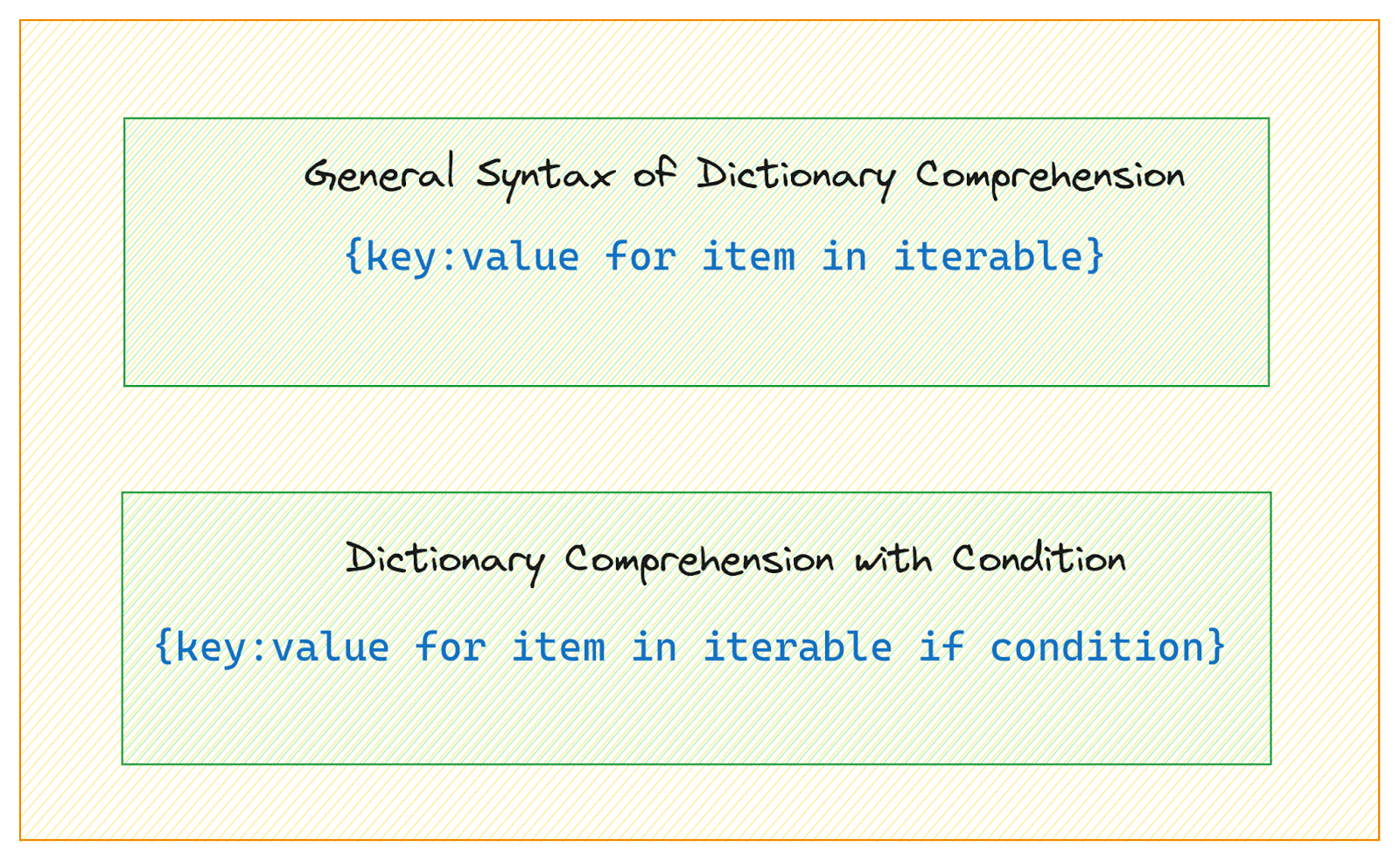
With a syntax similar to list comprehension, dictionary comprehension allows you to create dictionaries from existing iterables.
How To Write Efficient Python Code: A Tutorial for Beginners
Dictionary Comprehension Syntax | Image by Author

Say you have a fruits list. You’d like to create a dictionary with fruit:len(fruit) key-value pairs.

Here’s how you can do this with a for loop:

fruits = ["apple", "banana", "cherry", "date"]  fruit_lengths = {}    for fruit in fruits:      fruit_lengths[fruit] = len(fruit)    print(fruit_lengths)
Output >>> {'apple': 5, 'banana': 6, 'cherry': 6, 'date': 4}

Let’s now write the dictionary comprehension equivalent:

fruits = ["apple", "banana", "cherry", "date"]  fruit_lengths = {fruit: len(fruit) for fruit in fruits}    print(fruit_lengths)
Output >>> {'apple': 5, 'banana': 6, 'cherry': 6, 'date': 4}

This dictionary comprehension creates a dictionary where keys are the fruits and values are the lengths of the fruit names.

Dictionary Comprehension with Conditional Filtering

Let’s modify our dictionary comprehension expression to include a condition:

fruits = ["apple", "banana", "cherry", "date"]  long_fruit_names = {fruit: len(fruit) for fruit in fruits if len(fruit) > 5}    print(long_fruit_names)
Output >>> {'banana': 6, 'cherry': 6}

Here, the dictionary comprehension creates a dictionary with fruit names as keys and their lengths as values, but only for fruits with names longer than 5 characters.

3. Use Context Managers for Effective Resource Handling

Context managers in Python help you manage resources efficiently. With context managers, you can set up and tear down (clean up) resources easily. The simplest and the most common example of context managers is in file handling.

Look at the code snippet below:

filename = 'somefile.txt'  file = open(filename,'w')  file.write('Something')

It doesn't close the file descriptor resulting in resource leakage.

print(file.closed)  Output >>> False

You’ll probably come up with the following:

filename = 'somefile.txt'  file = open(filename,'w')  file.write('Something')  file.close()

While this attempts to close the descriptor, it does not account for the errors that may arise during the write operation.

Well, you may now implement exception handling to try to open a file and write something in the absence of any errors:

filename = 'somefile.txt'  file = open(filename,'w')  try:      file.write('Something')  finally:      file.close()

But this is verbose. Now look at the following version using the with statement that supports open() function which is a context manager:

filename = 'somefile.txt'  with open(filename, 'w') as file:      file.write('Something')    print(file.closed)
Output >>> True

We use the with statement to create a context in which the file is opened. This ensures that the file is properly closed when the execution exits the with block—even if an exception is raised during the operation.

4. Use Generators for Memory-Efficient Processing

Generators provide an elegant way to work with large datasets or infinite sequences—improving code efficiency and reducing memory consumption.

What Are Generators?

Generators are functions that use the yield keyword to return values one at a time, preserving their internal state between invocations. Unlike regular functions that compute all values at once and return a complete list, generators compute and yield values on-the-fly as they are requested, making them suitable for processing large sequences.

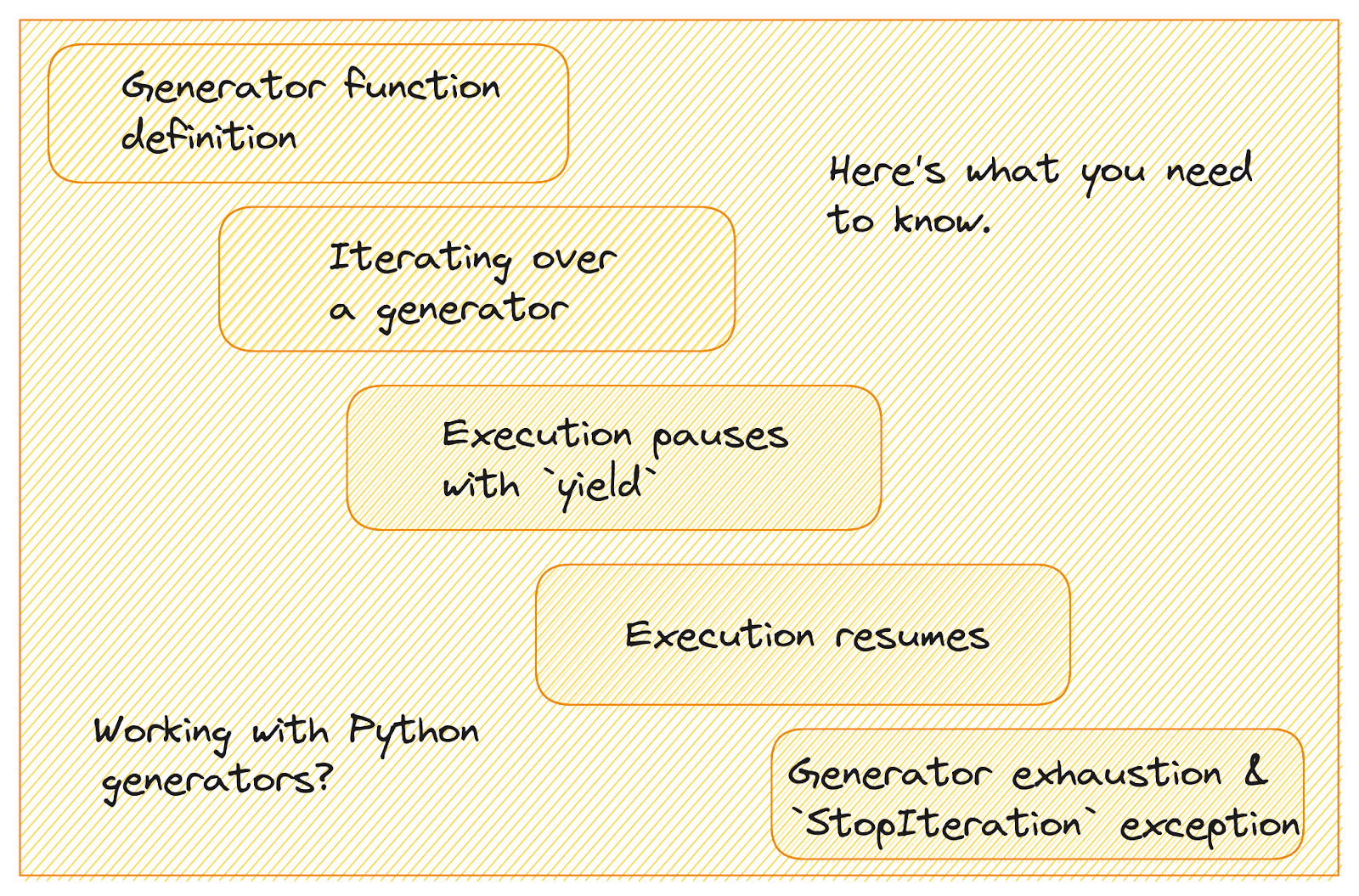
How Do Generators Work?
How To Write Efficient Python Code: A Tutorial for Beginners
Image by Author

Let’s learn how generators work:

  • A generator function is defined like a regular function, but instead of using the return keyword, you’ll use yield to yield a value.
  • When you call a generator function, it returns a generator object. Which you can iterate over using a loop or by calling next().
  • When the yield statement is encountered, the function's state is saved, and the yielded value is returned to the caller. The function's execution pauses, but its local variables and state are retained.
  • When the generator's next() method is called again, execution resumes from where it was paused, and the function continues until the next yield statement.
  • When the function exits or raises a StopIterationexception, the generator is considered exhausted, and further calls to next() will raise StopIteration.

Creating Generators

You can create generators using either generator functions or generator expressions.

Here’s an example generator function:

def countdown(n):      while n > 0:          yield n          n -= 1    # Using the generator function  for num in countdown(5):      print(num)
Output >>>     5   4   3   2   1

Generator expressions are similar to list comprehension but they create generators instead of lists.

# Generator expression to create a sequence of squares  squares = (x ** 2 for x in range(1, 6))    # Using the generator expression  for square in squares:      print(square)
Output >>>     1   4   9   16   25

5. Leverage Collection Classes

We’ll wrap up the tutorial by learning about two useful collection classes:

  • NamedTuple
  • Counter

More Readable Tuples with NamedTuple

In Python, a namedtuple in the collections module is a subclass of the built-in tuple class. But it provides named fields. Which makes it more readable and self-documenting than regular tuples.

Here’s an example of creating a simple tuple for a point in 3D space and accessing the individual elements:

# 3D point tuple  coordinate = (1, 2, 3)    # Accessing data using tuple unpacking   x, y, z = coordinate  print(f"X-coordinate: {x}, Y-coordinate: {y}, Z-coordinate: {z}")
Output >>> X-coordinate: 1, Y-coordinate: 2, Z-coordinate: 3

And here’s the namedtuple version:

from collections import namedtuple    # Define a Coordinate3D namedtuple  Coordinate3D = namedtuple("Coordinate3D", ["x", "y", "z"])    # Creating a Coordinate3D object  coordinate = Coordinate3D(1, 2, 3)    print(coordinate)    # Accessing data using named fields  print(f"X-coordinate: {coordinate.x}, Y-coordinate: {coordinate.y}, Z-coordinate: {coordinate.z}")
Output >>>    Coordinate3D(x=1, y=2, z=3)  X-coordinate: 1, Y-coordinate: 2, Z-coordinate: 3

NamedTuples, therefore, let you write cleaner and more maintainable code than regular tuples.

Use Counter to Simplify Counting

Counter is a class in the collections module that is designed for counting the frequency of elements in an iterable such as a list or a string). It returns a Counter object with {element:count} key-value pairs.

Let’s take the example of counting character frequencies in a long string.

Here’s the conventional approach to counting character frequencies using loops:

word = "incomprehensibilities"    # initialize an empty dictionary to count characters  char_counts = {}    # Count character frequencies  for char in word:      if char in char_counts:          char_counts[char] += 1      else:           char_counts[char] = 1    # print out the char_counts dictionary  print(char_counts)    # find the most common character  most_common = max(char_counts, key=char_counts.get)    print(f"Most Common Character: '{most_common}' (appears {char_counts[most_common]} times)")

We manually iterate through the string, update a dictionary to count character frequencies, and find the most common character.

Output >>>    {'i': 5, 'n': 2, 'c': 1, 'o': 1, 'm': 1, 'p': 1, 'r': 1, 'e': 3, 'h': 1, 's': 2, 'b': 1, 'l': 1, 't': 1}    Most Common Character: 'i' (appears 5 times)

Now, let's achieve the same task using the Counter class using the syntax Counter(iterable):

from collections import Counter    word = "incomprehensibilities"    # Count character frequencies using Counter  char_counts = Counter(word)    print(char_counts)    # Find the most common character  most_common = char_counts.most_common(1)    print(f"Most Common Character: '{most_common[0][0]}' (appears {most_common[0][1]} times)")
Output >>>    Counter({'i': 5, 'e': 3, 'n': 2, 's': 2, 'c': 1, 'o': 1, 'm': 1, 'p': 1, 'r': 1, 'h': 1, 'b': 1, 'l': 1, 't': 1})  Most Common Character: 'i' (appears 5 times)

So Counter provides a much simpler way to count character frequencies without the need for manual iteration and dictionary management.

Wrapping Up

I hope you found a few useful tips to add to your Python toolbox. If you are looking to learn Python or are preparing for coding interviews, here are a couple of resources to help you in your journey:

  • 5 Free Books to Help You Master Python
  • 7 Must-Know Python Tips for Coding Interviews

Happy learning!

Bala Priya C is a developer and technical writer from India. She likes working at the intersection of math, programming, data science, and content creation. Her areas of interest and expertise include DevOps, data science, and natural language processing. She enjoys reading, writing, coding, and coffee! Currently, she's working on learning and sharing her knowledge with the developer community by authoring tutorials, how-to guides, opinion pieces, and more.

More On This Topic

  • Write Clean Python Code Using Pipes
  • Pydon'ts — Write elegant Python code: Free Book Review
  • Data Scientist’s Guide to Efficient Coding in Python
  • Prefect: How to Write and Schedule Your First ETL Pipeline with Python
  • How to Write SQL in Native Python
  • Essential Features of An Efficient Data Integration Solution

Can Elon Musk Save OpenAI?

Can Elon Musk Save OpenAI?

“At any point Microsoft could cut off OpenAI,” said Elon Musk, six months ago.

Musk, the original founder of the company, always knew that Microsoft could do what it is already doing. He was always scared that Microsoft has a lot more control over OpenAI than it should. Musk has been on a spree for the longest time calling out the shift from nonprofit to for maximum profit of the company. He even called the shift “not good karma.”

Microsoft is, unofficially, the new OpenAI for profit. Its chief Satya Nadella, in a recent interview, called OpenAI a “a company with little tech,” and it seems like it was all along the plan to cull OpenAI’s AGI ambitions.

Nadella’s plan seems to be coming true after it successfully roped in Sam Altman and Co., leaving the company in shambles, even after Ilya Sutskever’s attempt to reunite the team, and apologising for his actions, publicly.

This is definitely concerning for OpenAI. Almost every minute an employee is leaving in solidarity with Altman, nearly 90% of the team has already quit, joining Microsoft, and even NVIDIA, Google, and Anthropic.

Musk’s xAI has also opened hiring for roles and has posted job openings on X.com/jobs.

Musk ♥️ Sutskever

Unlike everyone else who has been critical of the OpenAI board firing Altman, Musk has shown support for the move. “I am very worried,” Musk posted to X. “Ilya has a good moral compass and does not seek power. He would not take such drastic action unless he felt it was absolutely necessary.”

I am very worried.
Ilya has a good moral compass and does not seek power.
He would not take such drastic action unless he felt it was absolutely necessary.

— Elon Musk (@elonmusk) November 19, 2023

Ilya Sutskever was the person who told Altman to leave OpenAI on a Google Meet call. Interestingly, Musk was the one who was desperate to hire Sutskever since the formation of OpenAI in 2016.

Coincidently, in the Lex Fridman podcast, Musk said that the breaking of his friendship with Larry Page was because of OpenAI and Sutskever.

“The key moment was recruiting Ilya Sutskever. He is brilliant, a good human, and has a great heart” he added about the co-founder and chief scientist at OpenAI. Recruiting Sutskever was a battle between Musk and Demis Hassabis, the founder of DeepMind. “Ilya went back and forth between staying at Google or joining OpenAI. Finally, he agreed to join OpenAI. That was the toughest recruiting battle we have ever had.”

Musk further said that Sutskever is the linchpin of OpenAI. A conspiratorial take of this could be that Musk was the one who instigated the firing of Altman, just to be able to buy back his AI research company, and possibly merge it with his new one, xAI. He asked Sutskever if OpenAI was actually doing something potentially dangerous to humanity.

Why did you take such a drastic action?
If OpenAI is doing something potentially dangerous to humanity, the world needs to know.

— Elon Musk (@elonmusk) November 21, 2023

Musk ♥️ OpenAI

Nadella, however, believes that it is impossible to buy OpenAI, when comparing it with buying the Australian cricket team. “But we can partner well with OpenAI and watch Aussies play cricket.”

Hopefully, Musk can prove ‘em wrong, as he is known for “accomplishing’ the impossible.

The AI safety bit that was highlighted during the departure of Altman is also a focal point of what Musk and OpenAI’s board’s principles align on. Musk has been concerned about the approach of OpenAI for a long time, and Sutskever also believes in slowing down the pace of AI. Moreover, the new interim CEO Emmett Sphear also is somewhat of an AI doomer, according to several of his past opinions.

As usual, for now, Musk seems to be enjoying the OpenAI soap opera on X, which seems to have overpowered his recent Starship launch.

pic.twitter.com/aeg2gV04Aw

— Elon Musk (@elonmusk) November 20, 2023

It all started when Musk criticised ChatGPT for being too woke, during Altman’s tenure, and wanted to build his own based chatbot. He bought X, linked it with his AI model, and made it work with Grok. Then he allegedly bought ai.com from OpenAI, and redirected it from ChatGPT to xAI. He has been fighting the battle on several different fronts.

Back when OpenAI was trying to mark ‘GPT’ as a trademark, AIM called it the beginning of the end of OpenAI, highlighting the closed source approach the company is taking with its products and the technology as well. Then we predicted that OpenAI would go bankrupt soon, which should not be the case.

So while Altman is saying that OpenAI team is doing an “incredible job through this that will be in the history books,” Musk is the answer to revive its open ethos, and make OpenAI great again!

The post Can Elon Musk Save OpenAI? appeared first on Analytics India Magazine.

Tesla’s $2 Billion Foray Into India with EV Shipments, and New Plant 

Insider sources familiar with the Indian government’s discussions have revealed that a deal with Tesla Inc. appears to be inching closer.

The proposed deal outlines an initial investment of approximately $2 billion from Tesla into the plant and an ambitious plan to boost auto part purchases from India by up to $15 billion. To cut costs, Tesla aims to manufacture some batteries within India. However, the specifics are subject to change, caution the sources.

While a formal announcement is anticipated at the Vibrant Gujarat Global Summit in January, no decision has been finalized. The states of Gujarat, Maharashtra, and Tamil Nadu are being weighed as potential locations for the plant due to their established electric vehicle ecosystems and export capabilities.

Elon Musk, Tesla’s CEO, previously expressed plans for a significant investment in India and a potential visit in 2024. Yet, both Tesla and Indian government representatives refrained from commenting on the ongoing negotiations.

For Tesla, penetrating the Indian market, marked by a burgeoning interest in electric vehicles among the middle class, presents a lucrative opportunity. Despite India’s push for domestic EV manufacturing and cleaner transport adoption, the EV market has struggled to gain traction due to high upfront costs and inadequate charging infrastructure.

Tesla currently avoids direct car imports to India due to steep tariffs. Once locally manufactured, these cars might hit the market with price tags as low as $20,000, sources suggest. Piyush Goyal, India’s Trade Minister, previously announced Tesla’s intentions to increase auto part purchases from India substantially.

The renewed discussions between Tesla and India mark a pivotal turnaround after a year-long deadlock, marked by Elon Musk’s critiques of India’s import taxes and EV policies. India is reportedly considering reduced import taxes for international EV manufacturers who commit to establishing local production units.

The post Tesla’s $2 Billion Foray Into India with EV Shipments, and New Plant appeared first on Analytics India Magazine.

Microsoft Doesn’t Really Need OpenAI, it Wants AGI

Satya Nadella, chairman and CEO at Microsoft, was quick to onboard Altman at Microsoft after his negotiations with the OpenAI board of directors went stale. Altman will be joined by Greg Brockman and a few other researchers from OpenAI, notably Jakub Pachocki, the person leading GPT-4.

Absorbing Altman and his team into Microsoft could possibly be the biggest bet Nadella has made in this nearly decade-long stint as the CEO of Microsoft, bigger than its billions of dollars of investment in OpenAI.

However, by the time I conclude this article, Altman might have returned to OpenAI, rendering the arguments I presented potentially irrelevant. Reports suggest, despite announcements, Altman to Microsoft is not a done deal. Satya Nadella, in a recent interview with Bloomberg, stated that he will continue to support him and his team irrespective of where Altman is.

But it would make more sense for Microsoft to have Sam Altman and the team at Microsoft rather than OpenAI. The startup’s faith currently remains undecided, even though they have a new CEO in Emmett Shear. Nadella, on the other hand, would want to get as much as OpenAI folks to join this new AI group led by Altman at Microsoft.

The end game

OpenAI, which started off in 2015 as a non-profit, is focussed on achieving Artificial General Intelligence (AGI). As stated in one of their blogs, their mission has been “to build artificial general intelligence (AGI) that is safe and benefits all of humanity.”

However, interestingly, according to OpenAI, Microsoft will not have exclusive rights to use OpenAI’s post-AGI model. Due to their USD 13 billion dollar investment in the company, currently, Microsoft has exclusive rights to use its models like GPT-4 and GPT-4 turbo.

( Source: OpenAI blog)

Once AGI emerges, whether in the form of GPT-5, GPT-6, or an entirely new model, Microsoft will not possess exclusive rights to utilise that technology. Given Microsoft’s corporate nature driven by financial interests, it would want exclusive access to the technology and seek opportunities for monetisation regardless of its origin.

“Reality is that an in-house lab led by Sam and Greg might be better for Microsoft than the existing arrangement given the AGI clause,” Gavin Baker, managing partner & CIO at Atreides Management, said in an X post.

Even if Microsoft successfully acquires this cutting-edge technology from OpenAI, the blog goes on to clarify that in a for-profit structure, there would be equity caps. These limits are designed to prioritise a balance between commercial objectives and considerations of safety and sustainability, rather than solely pursuing profit maximisation.

Achieve AGI at Microsoft

Nevertheless, if Altman and his top team collaborate at Microsoft within a carefully selected group, there’s a potential scenario where Altman could achieve AGI at Microsoft rather than at OpenAI.

This scenario would grant Microsoft exclusive access to this technology, providing it with the opportunity to maximise its monetisation—an unsettling but plausible prospect.

This could be another reason Nadella was quick to get Altman and Brockman on board at Microsoft as soon as negotiations with the OpenAI board of directors faltered. After all, it was Altman who started the generative AI explosion by releasing ChatGPT to the world nearly a year ago.

Come achieve AGI at Microsoft might possibly be the exact words Nadella expressed when he tabled the offer to Altman. So far, besides Altman, Brockman, and Pachocki, Aleksander Madry, and Szymon Sidor, all previously working for OpenAI, have agreed to join Altman’s new AI group.

So, to sum it up, MSFT now has:
• OpenAI’s CEO
• OpenAI’s President
• The guy who lead GPT-4
• The guy who made GPT-4 work
• The guy who polished models for release
💀

— Mark Tenenholtz (@marktenenholtz) November 20, 2023

Appearing optimistic, Brockman also announced on X ( previously Twitter) that they are going to build something new and it will be incredible.

So far, not much is known about this newly formed group, which Altman will lead, besides that it will be a new advanced research team (possibly mission AGI). But it would be interesting to see how much of their work aligns with OpenAI’s.

Microsoft does not really need OpenAI

‘OpenAI is nothing without its people,’ almost all OpenAI employees tweeted yesterday in a synchronised manner resembling a coordinated X campaign, expressing solidarity with those who departed from the company. Moreover, nearly all of them have also threatened to resign.

Given the turmoil, many other companies working in AI are reportedly trying to poach OpenAI employees. Salesforce CEO Marc Benioff also posted on X, “Salesforce will match any OpenAI researcher who has tendered their resignation full cash & equity OTE to immediately join our Salesforce Einstein Trusted AI research team.”

“That talent is the crown jewel of the organisation,” Tammy Madsen, professor of management in the Leavey School of Business at Santa Clara University told TechCrunch.

Given that Atlman is already on board, Microsoft would want to get more talents onboard from OpenAI and continue their pursuit of AGI at Microsoft. Brockman also declared on X that more will follow suit.

This remains a likely scenario, however, these are uncertain times, and we will have to see how the whole situation pans out. But, Nadella, so far, has said that Microsoft remains committed to its partnership with OpenAI.

“We look forward to getting to know Emmett Shear and OpenAI’s new leadership team and working with them,” he posted on X.

Currently, Microsoft is banking heavily on OpenAI’s models such as GPT-4 and will continue to need them until Altman’s AI group comes up with newer and better models. Moreover, the intricate nature of the clauses of the deal between Microsoft and OpenAI is not public yet.

Interestingly, Altman’s new AI team could be working on exactly the same thing OpenAI is, and a future scenario, where Altman’s team has achieved AGI, then Microsoft, could not possibly need OpenAI anymore.

Furthermore, the duration of Microsoft’s ongoing financial support for OpenAI and potential shifts in strategy amid significant reshuffling pose intriguing uncertainties.

The dynamics could again shift significantly, especially if the board at OpenAI resigns and Altman is reinstated as the CEO, altering the entire landscape of these arguments.

The post Microsoft Doesn’t Really Need OpenAI, it Wants AGI appeared first on Analytics India Magazine.

How Kyndryl is Charting Its Course in IT and AI

Two years ago, Kyndryl started as a separate company after breaking away from IBM. The reason for the split from the Big Blue was that as a piece the division didn’t fit with CEO Arvind Krishna’s hybrid and AI-focused vision. The company set on its own path to ‘become the technology services employer of choice’.

Today, Kyndryl helps companies modernise by designing and managing IT infrastructure systems involving massive amounts of data. To understand how this American IT infrastructure provider is doing its own thing with automation and tech, especially in India, AIM had a chat with Naveen Kamat the Vice President & CTO of Data and AI Services at their Bangalore office.

“Most organisations have multiple data stores and data pipelines which causes redundancy over time for various reasons. The same data is replicated leading to multiple copies which is not needed,” he elaborated. A part of their approach is to reduce all this duplication and redundancy. Another aspect is, ‘technical debt’ caused by legacy code that leads to more data incidents and downtime that leads to data breaches.

“In that context, data becomes more of a liability,” Kamat stated. “Having the right data foundation cuts down the cycle time that goes into data engineering that can be then used across the lines of business,” mentioned the IT leader who has been in the industry for over two decades working across several roles.

Without disclosing one of Kyndryl’s clients which is a large healthcare enterprise Kamat explained the need for data foundation in terms of pharmacy application. He recalled that major incidents were causing the application to be down. “These are very critical situations, particularly if the patient is in the ICU. So, we worked on the right data foundation to make sure that the various log metrics from various parts of the stack are all ingested into this data lake,” he said. Kamat also mentioned a ballpark figure of nearly 80% reduction in major outages across verticals including healthcare.

A Diverse Clientele

Today, the company boasts of a fairly large client base across industries. “Apart from our skills, experience and resources, we also have been investing into our partner ecosystem, which includes Microsoft, and AWS, apart from data platforms like CloudEra and Databricks. We bring in additional differentiation when we work with clients with our IP, assets and accelerators,” mentioned Kamat. The company also announced banking and financial industry services for Google Cloud customers strengthening its existing partnership with the cloud provider.

Talking about how Kyndryl works with clients of different tiers, Kamat stated, “From a data foundation standpoint, we engage depending on the client’s maturity. We offer tailor made options to our customers that fit their purpose, be it a solution or architecture. Based on their budgets and business goals, we align the data strategy and data foundation that is the most relevant for them. A lot of times large enterprises make investments in technologies and tools, and we protect that investment, modernise and help them go to the next generation.”

Generative AI

No conversation around tech has happened without generative AI being mentioned. Commenting on the phenomenon, Kamat mentioned that data is the key element. “With this [generative AI] wave we are seeing innovation on steroids. A lot of agility has come into the ecosystem. A task that would earlier take months to be done is now crunched to a few weeks. The turnaround time is rapid,” he added.

The company is currently focused on a few aspects of generative AI. It is working with its customers by helping them prioritise what use cases can be looked at from a quick win standpoint. “The good thing is that a lot of the hype has settled down now and there is a lot more awareness around the options that are available in terms of large language models,” said Kamat.

“You can use different language models to get the same outcome with more or less the same accuracy, but much less carbon footprint and resource consumption. It is not only sustainable and optimal as a prototype, but also from a longer-term deployment standpoint,” he added.

With great power comes great responsibility. As Kyndryl is helping various clients from pharmaceutical companies to international airports deploy generative AI, it is making sure the digitization is done in the right manner. “Across the organisation, we are ensuring that not only the right policies are established, but those are followed as the standard data stewardship comes into play. Data security and privacy need to be organisation-wide programmes.”

That’s where Kamat recommends data literacy programmes across enterprise for a broader awareness of how data can be used or misused. “You can’t just have a strategy, it has to be an ongoing operation, whether it’s data security, privacy or observability,” he stated.

The post How Kyndryl is Charting Its Course in IT and AI appeared first on Analytics India Magazine.

Google Might Just Have a Chance

Several industries, including tech and finance, are closely observing OpenAI’s leadership crisis unfold. The situation has raised concern amongst these companies, whose AI roadmaps relied on OpenAI’s technology. Their worries stem from the perception that the startup’s board doesn’t seem aligned with the interests of its customers or shareholders.

However, the whole ecosystem seems to be missing one aspect, while the upheaval and drama has slowed down the development at OpenAI, Google is silently working towards its competing model Gemini. Not just that, it seems to be taking the battle to its competitors on many fronts, including talent acquisition and having an additional player in the game through hefty investment in startups like Anthropic.

The tech giant is looking to poach a few OpenAI researchers to further their cause—because they’re like hotcakes on the market that everyone’s looking at with hopeful eyes.

Google and OpenAI fiercely compete for AI talent due to a shortage of experts for LLM development. While OpenAI had tried to lure in Google researchers, offering significant pay packages over $10 million for some—Google has an edge with the availability of computing resources for more specialized servers for AI model development. Despite OpenAI’s plans, CEO Sam Altman himself believes that Google is poised to maintain this advantage into the next year, despite Microsoft’s server aid,

The recent chaos has also resulted in a lot of enterprises looking outside of OpenAI at other avenues and this is the right time for competitors like Google to sweep into the conversation. Reportedly, more than 100 OpenAI customers turned to Anthropic, a competitor backed by Amazon and Google, following recent events. Additionally, others sought alternatives like Google Cloud and Cohere, signalling a shift away from OpenAI.

Smaller AI startups, which were using OpenAI for testing new tools, also expressed uncertainty amid these changes, mentioning their outreach to Anthropic for access. Platforms like EvaBot, which internally use OpenAI’s GPT-4 for data analysis to enhance sales prospecting calls, now intend to diversify its platform by exploring alternatives such as Google’s Bard and Meta Platforms’ Llama 2.

As indicated by several reports Google is set to make the model available to their clients in the first quarter of 2024—as opposed to their promise of November this year. While that was seen as a move which would affect their position in the market adversely, this drama has given space to a lot of deliberation on the need for closed as well as open-source options.

While Google made a mess with Bard’s hurried release—which fell short of expectations, it is likely taking extra precautions to ensure that Gemini meets the high expectations set for it. Moreover, if it can pull it off, it will stand a chance to carve out a space for itself.

Looking Far & Beyond

Moreover, Google is looking beyond just enhancing enterprise software sales with Gemini. It aims to empower YouTube creators with custom video backgrounds and bolster Bard and Google Assistant. Different versions of Gemini are in the works, each tailored for specific tasks based on complexity.

Advertising stands as another vital application for Gemini, proposed to automate ad campaign generation. This spans from static images to potential expansion into audio and video ads. Gemini boasts a longer memory than prior Google models, potentially allowing advertisers to assess campaign performance over time.

According to people familiar with the project, outside developers have experimented with scaled-down versions of the model, gauged by their parameter count or computational complexity. However, the company is currently fine-tuning the primary and largest version of Gemini. However, they need to ensure that the primary Gemini model matches or surpasses OpenAI’s GPT-4 model.

And to enable this tall order Google has had to bring its Google Brain unit and DeepMind teams together. The team has also had support from one of Google’s co-founders, Sergey Brin—who has reengaged with the company and is actively collaborating with the Gemini developers at Google’s Mountain View headquarters.

While not holding a formal decision-making role, Brin has dedicated four to five days a week to working closely with the model’s developers. In recent weeks, he has provided valuable criticism, and feedback, and played a pivotal role in orchestrating collaboration among various teams involved in the project.

The post Google Might Just Have a Chance appeared first on Analytics India Magazine.

Indian IT’s Stride Towards LGBTQ+ Inclusivity

The prevalence of LGBTQ+ networks has seen a substantial rise, with 82.5% of companies in the Most Inclusive Companies Index 2022 featuring such networks—a stark contrast to the less than 25% reported seven years ago. Indian IT companies are slowly warming up to breaking the stigma and introducing LGBTQ+ inclusive policies.

While Indian IT is at it, notable challenges persist, as merely 9.5% of Indian organisations have actively undertaken substantial initiatives in LGBTQ+ inclusivity, and recruitment efforts are predominantly concentrated at junior and middle management levels. These policies not only nurture a workplace that embraces diversity and inclusivity but also position companies in accordance with global norms, making them more attractive to top-tier talent while enhancing the overall work experience for LGBTQ+ employees.

Interestingly, Tech Mahindra has a proactive policy for its queer community and is actively making efforts to make it inclusive and diverse. On the other hand, the rest of the Indian IT companies are catching up with new policies to support a diverse class of employees.

Tech Mahindra

Tech Mahindra is an “Intentionally Diverse and Globally Inclusive” organisation that values and celebrates the uniqueness of every individual by fostering an environment of inclusion and empowerment. The company’s policies and practices are gender agnostic, with specific initiatives directed towards women and LGBTQ+ individuals. Tech Mahindra has a policy that offers adoption leave for same-sex couples, allowing them to avail 12-week paid adoption leave.

The organization’s focus on diversity extends to gender, generation, differently-abled individuals, culture, and LGBTQ+ community, and it encourages all employees to be themselves and feel valued for their uniqueness.

C.P. Gurnani, the MD and CEO of Tech Mahindra, has expressed commitment to diversity and inclusion within the organisation. He highlighted that “Diversity is at the heart of every successful & connected organization,” and recognized the richness and strength brought by the diversity of thought, culture, and abilities of colleagues from over 90 countries at Tech Mahindra​​.

Tech Mahindra’s commitment to diversity and inclusion is reflected in its hiring practices, career development programs, flexible policies, and initiatives aimed at promoting the physical and financial well-being of its employees. The team organized a pride walk in June at their Bengaluru campus to celebrate Pride month and show support and solidarity to the LGBTQIA+ community.

Wipro

Wipro too has a comprehensive Global Policy to prevent LGBTQ+ discrimination, aiming for a discrimination-free work environment. The policy underscores equal rights and the need to uphold the dignity of LGBTQ+ individuals, with clear consequences for employees engaging in discrimination. The company’s “Pride” framework guides LGBTQ+ initiatives, focusing on equity, policy review, leadership involvement, awareness sessions, and community engagement.

Their Global Policy on Inclusion and Diversity further commits to fostering an inclusive and equitable culture, eliminating discrimination, and treating everyone with respect. Wipro aligns with the United Nations Standards of Conduct for Business against LGBTI discrimination, and their Pride Employee Resource Group provides a platform for LGBTQ+ employees and allies to share information and engage in discussions. Overall, Wipro’s D&I policy demonstrates a dedicated effort toward LGBTQ+ inclusion, incorporating specific measures to ensure a safe and respectful workplace.

The company also received a very high score of 100 on the Human Rights Campaign Foundation’s 2022 Corporate Equality Index (CEI) 2022. Talking about the same, Sunita Cherian, Chief Culture Officer and SVP, Corporate HR, Wipro, said, “At Wipro, we are committed to creating an equitable and inclusive environment for the LGBTQ+ community. We are honoured to be recognized by the Human Rights Campaign Foundation and applaud their efforts in supporting organizations to become more inclusive,”

Infosys

Like its other competitors, Salil Parikh led Infosys has also a comprehensive policy to support LGBTQIA+ employees. Their DEI Charter, integral to the Code of Conduct, enforces respect for each individual and upholds Equal Employment Opportunity practices, preventing discrimination, including on sexual orientation and gender identity grounds.

“Our D&I charter draws inspiration from our values.Acting on the Code, policies and practices, and leadership behavior are important facets of an inclusive ecosystem.Cultures get built and cemented in the micro ecosystems we each work in—our teams,” said Aruna Newton, Global Head of Diversity & Inclusion at Infosys.

Infosys has inclusive employee policies, such as health insurance in India that supports same-sex partners and covers gender confirmation surgeries, surrogacy, egg freezing, and mental health therapy. The company runs the #AllyForChange program, fostering allyship through self-reflection exercises, personal stories, and global practices.

The team also celebrates diversity through events like Pride Month and National Coming Out Day, using storytelling, expert talks, and activities like Rainbow Dressing and Paint for PRIDE. The IPRIDE Employee Resource Group is committed to a safe, inclusive workplace, focusing on education about sexual orientation, gender identity, and anti-discrimination policies.

TCS

Tata Consultancy Services (TCS) has been actively engaged in enhancing diversity and inclusion for LGBTQ+ employees since 2014. Their efforts include comprehensive support for transgender employees during their transition, featuring orientation sessions to facilitate understanding and acceptance among teams. TCS’s employment policies are inclusive and gender-neutral, focusing on preventing discrimination across various grounds, including gender identity.

On Sensitisation Programmes, Sheetal Rajani, Head of Diversity & Inclusion, TCS, said, “Sensitisation programmes go a long way in promoting an intrinsic culture of diversity and inclusion within an organisation… At TCS, we were focused on building a culture of gender intelligence, and what inclusion really means”​​.

They work closely with NGOs like Humsafar Trust to provide sensitization training and share job opportunities, further cementing their commitment to LGBTQ+ rights. Initiatives like the Qolors network and storytelling sessions during Pride month promote a culture of empathy and understanding, contributing to a safe and respectful work environment. This holistic approach underscores TCS’s dedication to creating an inclusive workplace that respects and supports the unique needs of its LGBTQ+ employees, fostering a sense of equality and belonging.

HCL Tech

HCL Technologies has established comprehensive support for its LGBTQ+ employees. Key elements include the Pride@HCL ERG, a group dedicated to fostering a diverse, safe, and inclusive work environment. This ERG is active globally and focuses on education, policy guidance, and creating inclusive spaces.

“Diversity is the most sustainable driver of innovation and a primary genome of resilience. It is no surprise, therefore, that teams and organizations with a higher degree of diversity and inclusion almost always outperform those without them. At HCL, this has been one of our core guiding principles as a team, and a cultural differentiator that we are most proud of,” says C Vijayakumar.

HCL’s partnership with the Out & Equal Workplace Summit, the largest LGBTQ conference globally, further demonstrates its commitment to inclusive workplaces. The company also operates the Pride@HCL Network, enhancing workplace diversity and inclusion. Additionally, HCL’s Inclusion Lab works to ensure equality and respect for all employees, reflecting its broader commitment to diversity, equity, and inclusion.

Read more: Indian Tech is Still Oblivious to Gender Inclusivity

The post Indian IT’s Stride Towards LGBTQ+ Inclusivity appeared first on Analytics India Magazine.

Kaspersky’s Advanced Persistent Threats Predictions for 2024

Kaspersky’s new report provides the company’s view on the advanced persistent threats landscape for 2024. Existing APT techniques will keep being used, and new ones will likely emerge, such as the increase in AI usage, hacktivism and targeting of smart home tech. New botnets and rootkits will also likely appear, and hacker-for-hire services might increase, as will supply chain attacks, which might be provided as a service on cybercriminals’ underground forums.

Jump to:

  • More exploitation of mobile devices and smart home tech
  • New botnets will emerge
  • More kernel-level code will be deployed
  • More hacktivism tied to APTs
  • Supply chain attacks as a service
  • More groups in the hack-for-hire business
  • Increase in AI use for spearphishing
  • MFT systems targeting will grow
  • How to mitigate these APT threats

More exploitation of mobile devices and smart home tech

Operation Triangulation, as exposed in the past year, revealed a very sophisticated cyberespionage campaign mostly operated by targeting iOS devices and leveraging five vulnerabilities — including four zero-day vulnerabilities.

A remarkable characteristic of those exploits is that they did not just target Apple smartphones, but also tablets, laptops, wearable devices, Apple TV and Apple Watch devices and might be used for eavesdropping.

Igor Kuznetsov, director, Global Research and Analysis Team at Kaspersky, told TechRepublic in a written interview: “Malware can indeed be used for eavesdropping. A recent example is the microphone-recording module in Operation Triangulation. Its features do not confine to the expected ones, such as how long to record for; it includes sophisticated functions like stopping recording when the device screen activates or stopping recording when system logs are captured.”

According to Kaspersky, APT attackers might expand their surveillance efforts to include more smart home technology devices, such as smart home cameras and connected car systems. This is particularly interesting for attackers because those devices are often uncontrolled, not updated or patched and subject to misconfigurations. This is also a concern because more people work from home nowadays, and their companies could be targeted via weak points in the home worker devices.

New botnets will emerge

Botnets are typically more prevalent in cybercrime activities compared to APT, yet Kaspersky expects the latter to start using them more.

The first reason is to bring more confusion for the defense. Attacks leveraging botnets might “obscure the targeted nature of the attack behind seemingly widespread assaults,” according to the researchers. In that case, defenders might find it more challenging to attribute the attack to a threat actor and might believe they face a generic widespread attack.

The second reason is to mask the attackers’ infrastructure. The botnet can act as a network of proxies, but also as intermediate command and control servers.

Kaspersky mentions the ZuoRAT case that exploited small office / home office routers to infect the devices with malware and expects to see new attacks of this kind in 2024.

More kernel-level code will be deployed

Microsoft increased the Windows protections against rootkits, those malicious pieces of code running code at the kernel-level, with a number of security measures such as Kernel Mode Code Signing or the Secure Kernel architecture, to name a few.

From the attacker’s point of view, it became harder to run code at kernel-level but remained possible. Kaspersky has seen numerous APT and cybercrime threat actors execute code in the kernel-mode of targeted systems, despite all the new security measures from Microsoft. Recent examples include the Netfilter rootkit, the FiveSys rootkit and the POORTRY malware.

Kaspersky believes three factors will empower threat actors with the capability of running kernel-level code within Windows operating systems:

  • Extended validation certificates and stolen code-signing certificates will be increasingly spread/sold on underground markets.
  • More abuse of developer accounts to get malicious code signed through Microsoft code-signing services such as Windows Hardware Compatibility Program.
  • An increase in BYOVD (Bring Your Own Vulnerable Driver) attacks in threat actors’ arsenals

More hacktivism tied to APTs

Kaspersky states that “it is hard to imagine any future conflict without hacktivist involvement,” which can be done in several ways. Running Distributed Denial of Service attacks has become increasingly common, along with false hack claims that lead to unnecessary investigations for cybersecurity researchers and incident handlers.

Deepfakes and impersonation/disinformation tools are also increasingly used by threat actors.

In addition, destructive and disruptive operations can be done. The use of wipers in several current political conflicts or the disruption of power in Ukraine are good examples of both types of operations.

Supply chain attacks as a service

Small and medium-sized businesses often lack robust security against APT attacks and are used as gateways for hackers to access the data and infrastructure of their real targets.

As a striking example, the data breach of Okta, an identity management company, in 2022 and 2023, affected more than 18,000 customers worldwide, who could potentially be compromised later.

Kaspersky believes the supply chain attack trend might evolve in various ways. For starters, open source software could be compromised by target organizations. Then, underground marketplaces might introduce new offerings such as full access packages providing access to various software vendors or IT service suppliers, offering real supply chain attacks as a service.

More groups in the hack-for-hire business

Kaspersky expects to see more groups working the same way as DeathStalker, an infamous threat actor who targets law firms and financial companies, providing hacking services and acting as an information broker rather than operating as a traditional APT threat actor, according to the researchers.

Some APT groups are expected to leverage hack-for-hire services and expand their activities to sell such services because it might be a way to generate income to sustain all their cyberespionage activities.

Kuznetsov told TechRepublic that, “We’ve seen APT actors target developers, for example, during the Winnti attacks on gaming companies. This hacking group is notorious for precise attacks on global private companies, particularly in gaming. Their main objective is to steal source codes for online gaming projects and digital certificates of legitimate software vendors. While it’s speculative at this point, there should not be any hinders for such threat actors from expanding their services if there is a market demand.”

Increase in AI use for spearphishing

The global increase in using chatbots and generative AI tools has been beneficial in many sectors over the last year. Cybercriminals and APT threat actors have started using generative AI in their activities, with large language models explicitly designed for malicious purposes. These generative AI tools lack the ethical constraints and content restrictions inherent in authentic AI implementations.

Cybercriminals found out that such tools facilitate the mass production of spearphishing email content, which is often used as the initial vector of infection when targeting organizations. The messages written by the tools are more persuasive and well-written when compared to the ones written by cybercriminals. It might also mimic the writing style of specific individuals.

Kaspersky expects attackers to develop new methods for automating cyberespionage. One method could be to automate the collection of information related to victims in every aspect of their online presence: social media, websites and more, as long as it relates to the victims’ identity.

MFT systems targeting will grow

Managed File Transfer systems have become mandatory for many organizations to safely transfer data, including intellectual property or financial records.

In 2023, attacks on MOVEit and GoAnywhere revealed that ransomware actors were particularly interested in targeting those systems, but other threat actors might be as interested in compromising MFTs.

As mentioned by Kaspersky, “the intricate architecture of MFT systems, coupled with their integration into broader business networks, potentially harbors security weaknesses that are ripe for exploitation. As cyber-adversaries continue to hone their skills, the exploitation of vulnerabilities within MFT systems is anticipated to become a more pronounced threat vector.”

How to protect from these APT threats

To protect against APT attacks, it is necessary to protect personal and corporate devices and systems.

In a corporate environment, using solutions such as extended detection and response, security information and event management and mobile device management systems greatly helps detect threats, centralize data, accelerate analysis and correlate security events from various sources.

Implementing strict access controls is highly recommended. The principle of least privilege should always be in use for any resource. Multifactor authentication should be deployed wherever possible.

Network segmentation might limit an attacker’s exploration of compromised networks. Critical systems in particular should be totally isolated from the rest of the corporate network.

Organizations should have an up to date incident response plan that will help in case of an APT attack. The plan should contain steps to take, as well as a list of people and services to reach in case of emergency. This plan should be regularly tested by conducting attack simulations.

DOWNLOAD this Incident Response Policy from TechRepublic Premium

Regular audits and assessments must be conducted to identify potential vulnerabilities and weaknesses in the corporate infrastructure. Unnecessary or unknown devices found within the infrastructure should be disabled to reduce the attack surface.

IT teams should have access to Cyber Threat Intelligence feeds that contain the latest APT tactics, techniques and procedures but also the latest Indicators of Compromise. Those should be run against the corporate environment to constantly check that there is no sign of compromise from an APT threat actor.

Collaboration with industry peers is also recommended to enhance collective defense against APTs and exchange best practices and thoughts.

All systems and devices must be up to date and patched to avoid being compromised by a common vulnerability.

Users must be trained to detect cyberattacks, particularly spearphishing. They also need an easy way to report suspected fraud to the IT department, such as a clickable button in their email client or in their browser.

Disclosure: I work for Trend Micro, but the views expressed in this article are mine.