Your pitch deck needs to be machine-readable

Your pitch deck needs to be machine-readable Haje Jan Kamps 10 hours

A while ago, I built a tool that uses AI to give feedback on hundreds of pitch decks. Every morning, I skim through the pitch deck reviews my little ‘bot makes without really looking at the decks. Every now and again, it’s stratospherically effusive in its praise, and I brace myself: What if the deck isn’t that good?

To my relief, it usually gets it right.

Similarly, sometimes it completely slaughters a deck. That’s when I get worried about the ‘bot missing something that’s actually good, but the vast majority of the time, it gets it right. The feedback can be harsh, but fair.

Last week, I had to send an apology to a founder because their deck was absolutely massacred by the ‘bot but it was utterly off base. I was confused at first, but after a while, I realized that the founders chose to turn the text into images to be more design-forward with the titles, and the bot failed to correctly identify the slides. Consequently, the ‘bot gave feedback on the team slide as if it were the competitor slide.

All this is to say that in these days of AI being used for almost everything, founders should try to ensure their decks can be accessible to a less-obvious audience: AI bots.

Here are some tips to put you in the right direction.

How NVIDIA is Helping Foxconn Unleash its EV Ambitions

Foxconn, the largest electronics manufacturer and the supplier of Apple, has taken a natural drift towards producing electric vehicles (EVs) this year. NVIDIA is helping them bring this to life, alongside developing automated and autonomous vehicle platforms.

“This partnership will provide scale for volume manufacturing to meet growing demand for the NVIDIA DRIVE platform,” said its chief Huang Jensen, in its recent record-breaking earnings.

He said that Foxconn will be using the NVIDIA DRIVE Hyperion, and sensor architecture for its electric vehicles. Further, he said the company would be a Tier 1 manufacturer producing electronic control units based on NVIDIA DRIVE Orin for global automotive vehicles.

This also comes in the backdrop of the NVIDIA DRIVE operating system receiving safety certification from TUV SUD. “One of the most experienced and rigorous assessment bodies in the automotive industry,” said Jensen, saying that their platform meets the higher standards required for autonomous transportation.

The alliance of NVIDIA and Foxconn is unique, and the partnership initiates the establishment of AI factories, utilising NVIDIA’s GPU computing infrastructure explicitly designed for processing, refining, and converting extensive datasets into valuable AI models and tokens.

Powering AI Innovation Together

“Foxconn, the world’s largest manufacturer, has the expertise and scale to build AI factories globally. We are delighted to expand our decade-long partnership with Foxconn to accelerate the AI industrial revolution,” Huang, CEO of NVIDIA, said about their collaboration with Foxconn.

Foxconn is also leveraging NVIDIA Omniverse for the manufacturing of EVs. With the support of an extensive partner network, manufacturers strengthen their workflow to plan, build, operate, and optimize their factories using a range of NVIDIA technologies.

Why is everyone making EVs?

Apple, Oppo, Xiaomi, Samsung, Huawei, and almost everyone are looking to make EVs. Now, Foxconn also joins that list. Driven by government incentives promoting the production of eco-friendly vehicles, these companies have opted to transition into the automotive sector.

All of this comes in the backdrop of the United Nations issuing a red alert on climate change, and a lot of transport aggregators have also made commitments to achieve its sustainable goals. For instance, Uber said that it would be going carbon neutral by 2025.

In light of these events, a lot of smartphone manufacturers and electronic manufacturers are transitioning to bridge the supply and demand gap, and EVs just make it more lucrative than ever. NVIDIA is making it much easier for all of them.

The post How NVIDIA is Helping Foxconn Unleash its EV Ambitions appeared first on Analytics India Magazine.

NVIDIA Rides High on InfiniBands

NVIDIA has been shining all along with the latest Q3 earnings reflecting the unstoppable growth of the tech giant. The latest earnings reported a revenue of $18.12 billion which was a 206% increase YoY and 34% from the previous quarter. The company even attributed the phenomenal growth in revenue to its continued ramp of NVIDIA HGX platform along with end-to-end networking via InfiniBand.

NVIDIA has called out the contribution of networking that has now exceeded $10 billion annualised revenue run rate, nearly tripling from the previous year. This is attributed to the rising demand for InfiniBand which witnessed a fivefold increase YoY.

A Complete Architecture

InfiniBand, which is considered critical for gaining the scale and performance needed for training LLMs, when combined with NVIDIA HGX forms the foundational architecture for AI supercomputers and data centre infrastructures. InfiniBand is commonly used in supercomputing environments for interconnecting servers. The biggest advantage is its ability to provide low latency and high-bandwidth communication that is crucial for parallel processing tasks. With extreme-size datasets and ultra-fast processing of high-resolution simulations, NVIDIA’s Quantum InfiniBand Switches are said to match these needs with lower cost and complexity.

A few months ago, NVIDIA had reached breakthrough performance with their leading H100 chip. The tests were run on 3,584 H100 GPUs that were connected with InfiniBand as they allowed GPUs to deliver performance at standalone and scale levels. Thereby, proving its prowess when combined with high performing networking capabilities.

InfiniBands : The Preferred Choice

Speaking about the future of InfiniBands, Jensen Huang said that the vast majority of the dedicated large scale AI factories standardise on InfiniBand, and it’s not only because of data rate and latency but “the way traffic moves around the network” is important. He also called it a ‘computing fabric.”

Comparing it to Ethernet, Huang talks about the huge difference between the two. With NVIDIA investing $2 billion in infrastructure for AI factories, any form of variance, such as 20 or 30% in overall effectiveness will result in millions of dollars of change in value which accumulate as significant costs over the next 4-5 years.

Huang calls InfiniBand’s value proposition ‘undeniable for AI factories.’ However, Ethernet is not ruled out. While Infinibands are used for cases that require high bandwidths with low latency, ethernet finds applicability in other scenarios.

Ethernet, a widely used general-purpose networking technology for wired local area networks (LAN), is suitable for a broad range of applications, more geared towards connecting terminal devices. However, its capabilities cannot be matched with InfiniBands.

Interestingly, NVIDIA also offers gateway appliances connecting InfiniBand data centres to Ethernet-based infrastructures and storage. NVIDIA will also release Spectrum-X in Q1 next year, an Ethernet offering that is said to achieve 1.6x higher networking performance when compared to other available Ethernet technologies.

In terms of functionality, Intel’s Omni Path Architecture (OPA) was designed for high-speed data transfer and low latency communication in HPC environments. It was released in 2016, however, it was discontinued in 2019. Cisco on the other hand, has ethernet-based switches but nothing in the HPC space.

An Integrated Expansion

With GPU and networking offerings, enterprises are now given the choice of integrating their whole architectural framework from NVIDIA products. In addition to speaking about NVIDIA’s partnerships with Reliance, Infosys and Tata, the company mentioned their collaborations with organisations for optimising InfiniBands in their AI compute needs.

In the earnings call, NVIDIA spoke about its partnership with Scaleway, a French private cloud provider that will build their regional AI cloud based on NVIDIA H100 InfiniBand and AI Enterprise Software to power AI advancements across Europe.

Furthermore, Julich, a German supercomputing centre, also announced its plans to build their next-gen AI supercomputer using close to 24,000 Grace Hopper Superchips and Quantum-2 InfiniBand, elevating it to world’s most powerful AI supercomputer with over 90 exaflops of AI performance.

Interestingly, Microsoft Azure uses over 29,000 miles of InfiniBand cabling. Infiniband enabled HB and N-series’ virtual machines are utilised by Microsoft for achieving HPC with cost efficiency.

Bundling networking and GPU, NVIDIA is boosting its growth and stance in the supercomputer market. Going by the lack of alternatives to NVIDIA Infinibands, it looks like the company’s dominance is going to be further enhanced, ultimately making it indispensable for companies looking to utilise GPU and networking.

The post NVIDIA Rides High on InfiniBands appeared first on Analytics India Magazine.

Back to Basics Week 4: Advanced Topics and Deployment

Back to Basics Week 4: Advanced Topics and Deployment
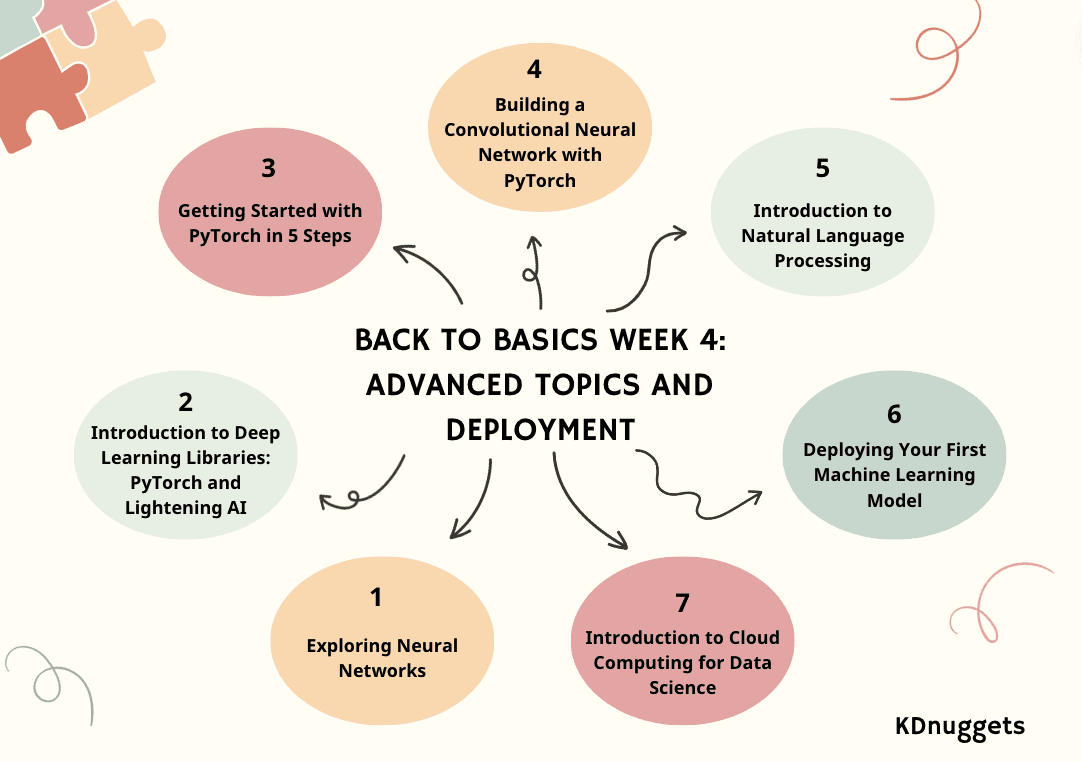
Image by Author

Join KDnuggets with our Back to Basics pathway to get you kickstarted with a new career or a brush up on your data science skills. The Back to Basics pathway is split up into 4 weeks with a bonus week. We hope you can use these blogs as a course guide.

If you haven’t already, have a look at:

  • Week 1: Python Programming & Data Science Foundations
  • Week 2: Database, SQL, Data Management and Statistical Concepts
  • Week 3: Back to Basics Week 3: Introduction to Machine Learning

Moving onto the third week, we will dive into advanced topics and deployment.

  • Day 1: Exploring Neural Networks
  • Day 2: Introduction to Deep Learning Libraries: PyTorch and Lightening AI
  • Day 3: Getting Started with PyTorch in 5 Steps
  • Day 4: Building a Convolutional Neural Network with PyTorch
  • Day 5: Introduction to Natural Language Processing
  • Day 6: Deploying Your First Machine Learning Model
  • Day 7: Introduction to Cloud Computing for Data Science

Exploring Neural Networks

Week 4 — Part 1: Exploring Neural Networks

Unlocking the power of AI: a guide to neural networks and their applications.

Imagine a machine thinking, learning, and adapting like the human brain and discovering hidden patterns within data.

This technology, Neural Networks (NN), algorithms are mimicking cognition. We'll explore what NNs are and how they function later.

In this article, I'll explain to you the Neural Networks (NN) fundamental aspects — structure, types, real-life applications, and key terms defining operation.

Introduction to Deep Learning Libraries: PyTorch and Lightening AI

Week 4 — Part 2: Introduction to Deep Learning Libraries: PyTorch and Lightning AI

A simple explanation of PyTorch and Lightning AI.

Deep learning is a branch of the machine learning model based on neural networks. In the other machine model, the data processing to find the meaningful features is often done manually or relying on domain expertise; however, deep learning can mimic the human brain to discover the essential features, increasing the model performance.

There are many applications for deep learning models, including facial recognition, fraud detection, speech-to-text, text generation, and many more. Deep learning has become a standard approach in many advanced machine learning applications, and we have nothing to lose by learning about them.

To develop this deep learning model, there are various library frameworks we can rely upon rather than working from scratch. In this article, we will discuss two different libraries we can use to develop deep learning models: PyTorch and Lighting AI.

Getting Started with PyTorch in 5 Steps

Week 4 — Part 3: Getting Started with PyTorch in 5 Steps

This tutorial provides an in-depth introduction to machine learning using PyTorch and its high-level wrapper, PyTorch Lightning. The article covers essential steps from installation to advanced topics, offering a hands-on approach to building and training neural networks, and emphasizing the benefits of using Lightning.

PyTorch is a popular open-source machine learning framework based on Python and optimized for GPU-accelerated computing. Originally developed by Meta AI in 2016 and now part of the Linux Foundation, PyTorch has quickly become one of the most widely used frameworks for deep learning research and applications.

PyTorch Lightning is a lightweight wrapper built on top of PyTorch that further simplifies the process of researcher workflow and model development. With Lightning, data scientists can focus more on designing models rather than boilerplate code.

Building a Convolutional Neural Network with PyTorch

Week 4 — Part 4: Building a Convolutional Neural Network with PyTorch

This blog post provides a tutorial on constructing a convolutional neural network for image classification in PyTorch, leveraging convolutional and pooling layers for feature extraction as well as fully connected layers for prediction.

A Convolutional Neural Network (CNN or ConvNet) is a deep learning algorithm specifically designed for tasks where object recognition is crucial — like image classification, detection, and segmentation. CNNs are able to achieve state-of-the-art accuracy on complex vision tasks, powering many real-life applications such as surveillance systems, warehouse management, and more.

As humans, we can easily recognize objects in images by analyzing patterns, shapes, and colors. CNNs can be trained to perform this recognition too, by learning which patterns are important for differentiation. For example, when trying to distinguish between a photo of a Cat versus a Dog, our brain focuses on unique shape, textures, and facial features. A CNN learns to pick up on these same types of distinguishing characteristics. Even for very fine-grained categorization tasks, CNNs are able to learn complex feature representations directly from pixels.

Introduction to Natural Language Processing

Week 4 — Part 5: Introduction to Natural Language Processing

An overview of Natural Language Processing (NLP) and its applications.

We’re learning a lot about ChatGPT and large language models (LLMs). Natural Language Processing has been an interesting topic, a topic that is currently taking the AI and tech world by storm. Yes, LLMs like ChatGPT have helped their growth, but wouldn’t it be good to understand where it all comes from? So let’s go back to the basics — NLP.

NLP is a subfield of artificial intelligence, and it is the ability of a computer to detect and understand human language, through speech and text just the way we humans can. NLP helps models process, understand and output the human language.

The goal of NLP is to bridge the communication gap between humans and computers. NLP models are typically trained on tasks such as next word prediction which allow them to build contextual dependencies and then be able to generate relevant outputs.

Deploying Your First Machine Learning Model

Week 4 — Part 6: Deploying Your First Machine Learning Model

With just 3 simple steps, you can build & deploy a glass classification model faster than you can say…glass classification model!

In this tutorial, we will learn how to build a simple multi-classification model using the Glass Classification dataset. Our goal is to develop and deploy a web application that can predict various types of glass, such as:

  1. Building Windows Float Processed
  2. Building Windows Non-Float Processed
  3. Vehicle Windows Float Processed
  4. Vehicle Windows Non Float Processed (missing in the dataset)
  5. Containers
  6. Tableware
  7. Headlamps

Moreover, we will learn about:

  • Skops: Share your scikit-learn based models and put them in production.
  • Gradio: ML web applications framework.
  • HuggingFace Spaces: free machine learning model and application hosting platform.

By the end of this tutorial, you will have hands-on experience building, training, and deploying a basic machine learning model as a web application.

Introduction to Cloud Computing for Data Science

Week 4 — Part 7: Introduction to Cloud Computing for Data Science

And the Power Duo of Modern Tech.

In today’s world, two main forces have emerged as game-changers: Data Science and Cloud Computing.

Imagine a world where colossal amounts of data are generated every second. Well… you do not have to imagine… It is our world!

From social media interactions to financial transactions, from healthcare records to e-commerce preferences, data is everywhere.

But what’s the use of this data if we can’t get value? That’s exactly what Data Science does.

And where do we store, process, and analyze this data? That’s where Cloud Computing shines.

Let’s embark on a journey to understand the intertwined relationship between these two technological marvels. Let’s (try) to discover it all together!

Wrapping it Up

Congratulations on completing week 4!!

The team at KDnuggets hope that the Back to Basics pathway has provided readers with a comprehensive and structured approach to mastering the fundamentals of data science.

Bonus week will be posted next week on Monday — stay tuned!

Nisha Arya is a Data Scientist and Freelance Technical Writer. She is particularly interested in providing Data Science career advice or tutorials and theory based knowledge around Data Science. She also wishes to explore the different ways Artificial Intelligence is/can benefit the longevity of human life. A keen learner, seeking to broaden her tech knowledge and writing skills, whilst helping guide others.

More On This Topic

  • Back to Basics Week 2: Database, SQL, Data Management and…
  • Back to Basics Week 1: Python Programming & Data Science Foundations
  • Back to Basics Week 3: Introduction to Machine Learning
  • Back To Basics, Part Dos: Gradient Descent
  • SAS Analytics Pro – now available for on-site or containerized…
  • A Full End-to-End Deployment of a Machine Learning Algorithm into a…

Pixxel’s Hyperspectral Odyssey

Bengaluru-based, Pixxel—India’s first company to launch private commercial satellites in space, is all set to launch Firefly—world’s first high-resolution hyperspectral satellites constellation (consists of six satellites) by 2024, specifically for geospatial study and analysis.

Over the past two years, Pixxel has deployed three highly functional satellites in orbit, each meticulously designed to decipher and convert vast data streams of Earth into actionable insights.

While conventional satellites captured data within a limited range, multispectral satellites added a few infrared bands, enabling observations beyond RGB. “Hyperspectral imagery enables us to capture information in hundreds of wavelengths, in our case about 300 units,” Awais Ahmed, Pixxel’s CEO and Founder, told AIM in an exclusive interview.

Simply put, Pixxel’s hyperspectral imaging system can discern a wide array of information from the electromagnetic spectrum captured by sensors. “Light is broken down into very minor, very thin sliced wavelength bands and depending on wavelength bands or data channels, you can decipher different information,” explained Ahmed.

The use cases are plenty. In agriculture, Pixxel’s satellites identify crops and discern nutrient content in soils, gauge moisture levels, and assess chlorophyll content, enabling precision farming and crop management. These satellites detect methane leaks and differentiate between minerals for oil and gas sectors, offering unprecedented insights for mining companies. In forestry, they monitor pollution levels, track biodiversity changes, and identify pest infestations and tree species.

Pixxel’s hyperspectral satellite also helps in providing global coverage with the capability to revisit any location on Earth within a 24-hour cycle. “The goal is clear: We’re not just observing; we’re transforming the way industries operate, offering insights that empower decision-makers worldwide,” added Ahmed.

Solving One Pixxel at a Time

The journey to harnessing this vast amount of data hasn’t been without challenges. Managing the deluge of information, from capturing and storing it to processing it in real-time, has demanded technological upgrades. Pixxel’s edge computing capabilities, compression algorithms, and optimised storage systems have mitigated these hurdles, ensuring the reliability and accuracy of insights delivered.

Ahmed outlined three key issues in handling this immense data volume: capturing the vast amounts of data from the satellite, storing and downlinking, and caching it for quick access once available on the ground.

Pixxel has evolved its hardware over three years to resolve the data capture issue. Compression algorithms and on-board edge computing mitigate the challenge of downlinking vast data within limited satellite-ground station communication windows. This innovation significantly reduces the data needing transmission, optimising efficiency through increased downlink capacity or by processing data in space itself.

Moreover, on-ground storage strategies involve short- and long-term storage solutions tailored to varying data access needs. Pixxel’s approach involves innovative hardware solutions, compression algorithms, and a strategic mix of cloud-based storage to ensure efficient management and swift access to copious amounts of captured hyperspectral data.

“We are a vertically integrated company… from designing of the satellite to testing and building and operating is something that we do, including the edge computing parts of it,” explained Ahmed, highlighting the self-sufficiency in processing data for hyperspectral imagery.

Pixxel in Short

Founded in 2019 by Ahmed and co-founder CTO Kshitij Khandelwal, Pixxel has raised upwards of $70 million. The company, now comprising 175 employees globally, primarily centred in Bangalore, is extending operations to the US and Europe to cater to local needs.

The recent funding will also fuel the advancement of Aurora, Pixxel’s AI-driven analytics platform. This initiative seeks to democratise hyperspectral analysis, making it more accessible to a broader audience.

“We’ve been focusing on the Aurora platform, adding more features such as mathematical and statistical models, AI, and deep learning, supervised and unsupervised, to extract insights. For instance, land use and land cover classification can classify images in Asia into trees, water bodies, crops, and buildings, almost in real-time, without extensive training. There are other models like crop stress identification, biodiversity assessment, and oil and gas leak detection, among others,” said Ahmed.

Pixxel also boasts its partnerships with tech giants like Google, Microsoft, and Amazon. “The biggest thing that we depend on these companies for, first and foremost, is the cloud infrastructure.” This infrastructure and data marketplace access is crucial for storing and analysing vast amounts of data, enhancing data delivery and accessibility for users worldwide.

“Google Earth is used by 10s of 1000s of developers on the geospatial side to analyse satellite imagery,” said Ahmed. Meanwhile, Microsoft’s planetary computer and Amazon’s geospatial data marketplace cater to diverse user bases, enabling Pixxel to reach end-users efficiently.

What’s next?

With the Firefly series poised to embody the culmination of years of research and learning. These larger, more advanced satellites promise enhanced resolution, extended lifespans, and superior performance, setting the stage for a quantum leap in global-scale commercial operations.

With a global expansion strategy, Pixxel has set its sights on key markets, primarily in the United States and Europe. These regions, coupled with partnerships in Canada and Australia, form the crux of their customer base, with plans for further penetration into emerging markets in the years ahead.

Moreover, the $36 million in Series B funding will be used to deploy an additional 18 satellites by 2025, amplifying its capacity for data collection.

The post Pixxel’s Hyperspectral Odyssey appeared first on Analytics India Magazine.

Synthetic Data Alone Won’t Achieve AGI 

It all began with the reports of OpenAI’s latest model called Q*, which could reportedly solve math problems and demonstrated superior reasoning capabilities. Created by OpenAI’s chief scientist Ilya Sutskevar, one notable aspect of Q* is that its research incorporated the use of computer-generated data or synthetic data. This is in contrast to methods that rely on real-world information, such as text or images sourced from the internet, as done in the training of GPT.

This has triggered a discussion within the tech community about whether synthetic data is the path toward achieving AGI.

Not everyone believes in Synthetic data

Meta’s AI scientist Yann LeCun has a very different viewpoint from OpenAI and believes that the combination of LLMs and synthetic data may not necessarily lead to AGI.

To put his viewpoint across, he expressed dissatisfaction with OpenAI’s Q*. “Please ignore the deluge of complete nonsense about Q*. One of the main challenges to improve LLM reliability is to replace Auto-Regressive token prediction with planning,” he posted on X. LeCun has been consistently vouching for quite some time that, in order to achieve AGI, the reasoning capability of LLMs needs improvement rather than simply bringing in more data.

Citing examples of animals and humans, he said that they get smarter with vastly smaller amounts of training data. LeCun is betting on new architectures that would learn as efficiently as animals and humans. “Using more data (synthetic or not) is a temporary stopgap made necessary by the limitations of our current approaches,” he added in his post on X.

To add to LeCun’s argument, Bojan Tunguz, machine learning scientist at NVIDIA, stated, “For tabular datasets, with which I have the most experience, synthetic data is worse than useless. I’ve heard similar stories from people who use it for training autonomous vehicles.” Likewise, according to Jim Fan, Senior AI Scientist at NVIDIA, synthetic data is anticipated to play a significant role, but will not be sufficient to get there to AGI just by blind scaling.

Moreover, unlike human generated data, which is limited in quantity, synthetic data will far surpass it. Musk remarked, “It’s a little sad that you can fit the text of every book ever written by humans on one hard drive(sigh). Synthetic data will exceed that by a zillion.” bringing back the question whether LLMs can fit in enough data.

OpenAI might be onto something big

Two years ago, Andrej Karpathy, as Tesla’s head of AI and computer vision, began working with synthetic data for auto-labeling, involving the tagging of information in the images collected by Tesla’s fleet.

Interestingly, now at OpenAI, Andrej Karpathy might be on to something big, as his latest cryptic post, ‘X,’ said, “Thinking of centralisation and decentralisation lately.” He hinted that he might as well be thinking of building an AI system that uses both centralised and decentralised LLM models to give better results. At AIM, we would like to refer to this new architecture as Hybrid LLMs, which might utilise synthetic data based on the requirements between two LLMs and may not necessarily involve the entire dataset.

Damn it, why does @karpathy have to blow my mind at 9 pm the night before Thanksgiving pic.twitter.com/D6y6ps5kQA

— Peter Yang (@petergyang) November 23, 2023

Meanwhile, LeCun thinks that Q* might be OpenAI’s attempt at “Planning”—which refers to a branch of AI that involves creating a sequence of actions or decisions to achieve a specific goal. Unlike some other machine learning approaches that focus on learning from data (like supervised learning), planning is more concerned with generating a series of steps or actions to reach a desired outcome.

Interestingly, OpenAI is exploring something similar like ‘Planning’ with Q-learning and PPO, for a model-free approach. Q-learning doesn’t require a pre-defined model, allowing the AI agent to autonomously learn and predict by iterating in the environment. Here, synthetic data can be used to generate realistic training environments for Q-learning agents, which can help them to learn more effectively.

Furthermore, LeCun mentioned that OpenAI recently hired former Meta research scientist Noam Brown. Interestingly, two months ago, Brown posted on LinkedIn that OpenAI is hiring ML engineers for research on multi-step reasoning with LLMs. He added that OpenAI recently achieved a new state-of-the-art result in math problem-solving (78% on the Hendrycks MATH benchmark), similar to what Q* recently accomplished.

It is evident that synthetic data might require a new architecture, distinct from an LLM, to better enable reasoning and progress toward AGI.

The post Synthetic Data Alone Won’t Achieve AGI appeared first on Analytics India Magazine.

Why Meta Ray-Ban Will Fail

Why Meta Ray-Ban Will Fail

“Glasses are things that have come and gone. A lot of people have attempted them,” said Imran Chaudhri, the co-founder of Humane, the startup developing the Ai Pin. In a recent live on Meta’s Instagram, Chaudhri and Bethany Bongiorno, the co-founders discussed with the audience the reasons behind why they chose the Ai Pin as the form factors of their product.

Meta has come up with its Ray-Ban smart glasses that gives almost the same functionality as the Ai Pin, but with a form factor of glasses. Until the Humane Ai Pin was announced, it seemed like a gadget of the future, that everyone would be wearing them, and recording the world around them. But now, investing in a Glasses seems to be outdated altogether.

“One of the reasons they [Glasses] are questionable is that only some of them actually wear glasses,” continued Chaudhri. Glasses come as an addition to someone’s fashion choices, which a lot of people don’t really want. “If you wear glasses, you do that to essentially see, and protect your eyes. There is a lot of consideration that goes into that,” Chaudhri added.

Ergo, an Ai pin

Chaudhri said that one of the most important things when it comes to building these products is how they would understand the context around them. He said that glasses are not the only way to give you context, and that is why the team explored the Ai Pin. Furthermore, providing additional inputs and ways to interact with the computer is also very necessary, which Chaudhri claims his product is better at.

“We were able to pack a lot of technology into something really small. AI can create an experience that allows the computer to essentially take a back seat” said Chaudhari in the demo video. “Ai Pin has replaced a lot of things I do on my smartphone,” he said drawing parallels to how smartphones did not replace laptops.

On the other hand, “There is only one way to use glasses, or any handheld device. But when it comes to the Pin you can do it anyway you want,” said Chaudhri. Though this adds to the accessibility of the device. At least when it comes to Apple Vision Pro, it is right there on the person’s face, not trying to hide in plain sight like the other two products.

“Ai Pin is the embodiment of our vision to integrate AI into the fabric of daily life, enhancing our capabilities without overshadowing our humanity,” the founders said during the release.

Focus on transparency

Bongiorno emphasises that the Ai Pin is not filming all the time when addressing people concerned about privacy. “The goal has always been to be more transparent than the devices that are present today.”

She said that Imran’s biggest concern since the beginning was ensuring privacy, and that is why the team developed the trust light which turns on every time an optical sensor is being used. “Others should know that you are wearing them, which glasses don’t really do that well,” Chaudhri explained.

To mitigate this privacy risk, Meta had introduced a white light that indicates to the people around that it is recording. The Ai Pin also has a similar mechanism with its trust light. Just like Meta Glasses would be on our noses and watching everything we see, the same can be said about the Ai Pin, but it is clear that the founders have taken measures to mitigate it.

Mark Zuckerberg was confident about the future of Metaverse with such glasses. “I think we’re moving towards a world where we’re gonna have something that looks like normal glasses where you see the physical world, but you’ll see holograms.”

Concerns with Meta Glasses

The reason these products are coming up in the market are all about how users can access AI and compute in their lives, while also being more present in real lives, as highlighted by Bongiorno in the live sessions.

People have been using the Meta Smart Glasses now, and are encountering all kinds of concerns with the product. A user David Wong on X points out that though the camera and microphone is insanely good, he said that “it’s hard to know when I am recording or not.”

Though the Meta AI assistant feels like a dive into the future of conversations with computers, “I’ve been wearing the glasses on my head (not eyes) for a long time. They will usually go in standby mode, and then I don’t know how to reactivate. I sometimes wait, but most of the time it feels like I need to restart them. Then it’s not clear when I can start recording again,” he posted.

I've been wearing the glasses on my head (not eyes) for a long time. They will usually go in standby mode, and then I don't know how to reactivate. I sometimes wait, but most of the time it feels like I need to restart them. Then it's not clear when I can start recording again

— David Wong (@cryptodavidw) November 26, 2023

These concerns are completely removed when it comes to the Ai Pin form factor. One might say that the Glasses are a bad idea, the same can be said about the Ai Pin, only when it comes to privacy though. The Humane team has made sure that its product does not interfere in the users’ lives, which essentially kills what Meta has been trying to do with its smart glasses, while also staying up with fashion.

The post Why Meta Ray-Ban Will Fail appeared first on Analytics India Magazine.

From Maps to Impact: Esri India’s Journey in Shaping the Geospatial Landscape

The geospatial infrastructure is swiftly evolving with the integration of AI, which enables automated data analysis, pattern recognition, and predictive modelling. AI significantly enhances spatial analysis and decision support systems by processing large volumes of geospatial data, extracting valuable insights, and enabling advanced applications.

Into this rapidly evolving landscape steps Esri, a company that has become synonymous with the advancement of geospatial technology. Established in 1996, Esri India Technologies Pvt. Ltd. (Esri India) is an end-to-end Geographic Information Systems (GIS) solutions provider which has successfully delivered GIS solutions to more than 350,000 organisations globally with over 5000 customers in India.

“Esri offers GeoAI within ArcGIS, providing ready-to-use models for working with various data types, including vector, tabular, imagery, and text. This combination of AI and spatial analysis enables industries to simulate outcomes in diverse scenarios,” Agendra Kumar, Managing Director, Esri India, told AIM.

GIS to benefit significantly from generative AI

According to Kumar, the industry also stands to benefit significantly from the integration of generative AI. “With generative AI we can enhance terrain modelling, land classification, and natural disaster prediction, improving urban planning and precision agriculture. It empowers us to generate detailed urban development plans, optimise transportation networks, and simulate urban expansion,” Kumar said.

Moreover, it aids in data augmentation, providing synthetic geospatial data for better machine learning models, enhances infrastructure asset management, and supports real-time geospatial insights through IoT data analysis.

“With generative AI, we’re better equipped to tackle climate change modelling, crisis mapping, and complex indoor mapping. It’s a pivotal tool for our field, elevating our capabilities and enabling more informed decision-making across various sectors.”

Tying-up with Governments

Under Kumar’s leadership, Esri India has partnered with numerous government and private organisations to execute critical and transformative projects using Esri’s GIS (Geographic Information System) technology.

ESRI India has been working closely with many government departments and agencies over the years. “In India, government organisations have been using Esri’s software since the 1980s,” Kumaer said.

Esri (the Environmental Systems Research Institute) was founded in Redlands, California in 1969. Today, with a fairly large customer base, Esri India works with national mapping organisations like the Survey of India, Geological Survey of India, and National Thematic Mapping Organisation, which prepare authoritative maps of a country for the use of the people in the country.

“Many divisions operating under the Department of Science and Technology, DRDO, defence organisations, Forest Survey of India, and several statistics organisations are using Esri’s software. In fact, we work closely with the states like Rajasthan, Jharkhand, Orissa, Punjab, Haryana and West Bengal,” Kumar added.

Esri India has provided state governments with GIS software for managing water resources, forests, road transportation, electricity distribution, and much more. For instance, under the Smart Cities Mission, around 45 Smart Cities use Esri’s ArcGIS for everything from city management to providing high-quality citizen-centric services.

“From aiding in solid waste management, improving the traffic situation, managing road conditions and drainage systems to supervising intelligent water distribution, our software platforms have been helping in all aspects.”

Municipal corporations like Gurugram Metropolitan Development Authority (GMDA), and Municipal Corporation of Greater Mumbai (MCGM) have also been using Esri’s software for quite some time.

Indo ArcGIS

Esri’s GIS Solutions are powered by ArcGIS, which is a comprehensive software suite for mapping, analysing, and managing geographic information. However, to better serve its long list of clientele in India, the company developed Indo ArcGIS, which specifically aims to help Indian organisations solve the most pressing social and business challenges of the country.

“It includes more than 750 data layers, including data layers about road networks, railway stations, railway tracks, etc. We’ve also put together accurate information about the boundaries at different levels by working with various government organisations,” Kumar said.

Some of these data sets are important for a variety of geospatial applications, not only in the government sector but also in the private sector.

Indo ArcGIS includes solutions and data products in the areas of Air Quality Index, Burnt Area Assessment, Disaster Management, E Forest Fire Management, Forest Incidents, Jal Jeevan Mission, Land Records Management, Locust Watch, Water Connection Management, Water Quality Index and more.

“We recently launched ArcGIS Business Analyst, which is a location intelligence solution suite designed to aid organisations in making data-driven smart decisions.”

Some of the target markets for this solution include banking and financial services companies, retail, manufacturing, real estate companies, insurance, transportation and logistics, and healthcare companies, among others.

The Indian Geospatial Economy

The Indian Geospatial Economy is expected to reach INR 63,100 crore by 2025, growing at an impressive rate of about 13-14%. To keep up with the changing scenario, the government of India last year, introduced the New National Geospatial Policy 2022, replacing the National Map Policy 2005.

Kumar believes the new policy is extremely progressive, well-structured, and enabling for the geospatial industry and user segments. “With its focus on innovation, public-private partnership, and strengthening the geospatial infrastructure with new data sets and technologies, it offers a complete bouquet that establishes geospatial as the key enabler of India’s ‘$5 trillion economy’ vision,” Kumar said.

The new policy has covered the overall geospatial spectrum, be it geospatial education and skill development, formation of the Geospatial Industrial Development Board, incubation centres, or surveyors’ registration and certification.

“In fact, the democratisation of data has not only increased the adoption of technology within the government sector but is also allowing the industry and academia to adopt GIS to innovate and develop solutions for various purposes.”

The post From Maps to Impact: Esri India’s Journey in Shaping the Geospatial Landscape appeared first on Analytics India Magazine.

Tata to Double its iPhone Casing Unit in Hosur

Tata to Double its iPhone Casing Unit in Hosur

According to reports, Tata Electronics is gearing up to significantly expand its iPhone-casing facility in Hosur, with plans to double its current size.

The expansion comes on the heels of Tata Electronics’ recent acquisition of Wistron’s iPhone assembly plant in Karnataka, showcasing the company’s strategic move to bolster its contract manufacturing capabilities for premium electronic devices and accessories.

The existing Hosur unit, established with a substantial investment of Rs 5,000 crore, spans across 500 acres and houses over 15,000 employees. The proposed expansion, slated to be completed within the next 12-18 months, is expected to lead to a substantial surge in the workforce, reaching an estimated 25,000-28,000 individuals at the consolidated site.

A senior government official quoted in the report revealed, “The company is looking to expand the unit to 1.5-2 times the current size and capacity.” While there are speculations that the new facility may primarily focus on manufacturing components for Apple phones, there is also a possibility of catering to other high-end smartphone manufacturers.

Tata Electronics, being the sole Indian company shortlisted by Apple as a vendor, is playing a crucial role in diversifying Apple’s manufacturing operations away from China, especially in the production of iPhone enclosures. This expansion aligns seamlessly with Apple’s overarching strategy to bolster smartphone manufacturing within India.

Industry insiders have long believed that Tata Electronics is planning to establish a major plant in Hosur, underscoring its commitment to manufacturing phone components and potentially aligning with Apple’s ambitious export targets from India.

Apple’s growing reliance on Tata Electronics is evident, with the Cupertino-based tech giant steadily increasing its exports from India. In the second quarter of this year, Apple surpassed Samsung to become the leading smartphone exporter from India, commanding 49 per cent of the country’s total shipments compared to its Korean counterpart’s 45 per cent.

Estimates indicate that Apple has exported iPhones worth over $5 billion in the first seven months of FY24 (April-October) from India, marking a remarkable year-on-year growth of 177 per cent. This underscores the mutually beneficial partnership between Tata Electronics and Apple, further solidifying India’s role in global smartphone manufacturing.

The post Tata to Double its iPhone Casing Unit in Hosur appeared first on Analytics India Magazine.

DIRFA Transforms Audio Clips into Lifelike Digital Faces

In a remarkable leap forward for artificial intelligence and multimedia communication, a team of researchers at Nanyang Technological University, Singapore (NTU Singapore) has unveiled an innovative computer program named DIRFA (Diverse yet Realistic Facial Animations).

This AI-based breakthrough demonstrates a stunning capability: transforming a simple audio clip and a static facial photo into realistic, 3D animated videos. The videos exhibit not just accurate lip synchronization with the audio, but also a rich array of facial expressions and natural head movements, pushing the boundaries of digital media creation.

Development of DIRFA

The core functionality of DIRFA lies in its advanced algorithm that seamlessly blends audio input with photographic imagery to generate three-dimensional videos. By meticulously analyzing the speech patterns and tones in the audio, DIRFA intelligently predicts and replicates corresponding facial expressions and head movements. This means that the resultant video portrays the speaker with a high degree of realism, their facial movements perfectly synced with the nuances of their spoken words.

DIRFA's development marks a significant improvement over previous technologies in this space, which often grappled with the complexities of varying poses and emotional expressions.

Traditional methods typically struggled to accurately replicate the subtleties of human emotions or were limited in their ability to handle different head poses. DIRFA, however, excels in capturing a wide range of emotional nuances and can adapt to various head orientations, offering a much more versatile and realistic output.

This advancement is not just a step forward in AI technology, but it also opens up new horizons in how we can interact with and utilize digital media, offering a glimpse into a future where digital communication takes on a more personal and expressive nature.

This AI program creates 3D videos from a photo and an audio clipThis AI program creates 3D videos from a photo and an audio clip
Watch this video on YouTube

Training and Technology Behind DIRFA

DIRFA's capability to replicate human-like facial expressions and head movements with such accuracy is a result of an extensive training process. The team at NTU Singapore trained the program on a massive dataset – over one million audiovisual clips sourced from the VoxCeleb2 Dataset.

This dataset encompasses a diverse range of facial expressions, head movements, and speech patterns from over 6,000 individuals. By exposing DIRFA to such a vast and varied collection of audiovisual data, the program learned to identify and replicate the subtle nuances that characterize human expressions and speech.

Associate Professor Lu Shijian, the corresponding author of the study, and Dr. Wu Rongliang, the first author, have shared valuable insights into the significance of their work.

“The impact of our study could be profound and far-reaching, as it revolutionizes the realm of multimedia communication by enabling the creation of highly realistic videos of individuals speaking, combining techniques such as AI and machine learning,” Assoc. Prof. Lu said. “Our program also builds on previous studies and represents an advancement in the technology, as videos created with our program are complete with accurate lip movements, vivid facial expressions and natural head poses, using only their audio recordings and static images.”

Dr. Wu Rongliang added, “Speech exhibits a multitude of variations. Individuals pronounce the same words differently in diverse contexts, encompassing variations in duration, amplitude, tone, and more. Furthermore, beyond its linguistic content, speech conveys rich information about the speaker's emotional state and identity factors such as gender, age, ethnicity, and even personality traits. Our approach represents a pioneering effort in enhancing performance from the perspective of audio representation learning in AI and machine learning.”

Comparisons of DIRFA with state-of-the-art audio-driven talking face generation approaches. (NTU Singapore)

Potential Applications

One of the most promising applications of DIRFA is in the healthcare industry, particularly in the development of sophisticated virtual assistants and chatbots. With its ability to create realistic and responsive facial animations, DIRFA could significantly enhance the user experience in digital healthcare platforms, making interactions more personal and engaging. This technology could be pivotal in providing emotional comfort and personalized care through virtual mediums, a crucial aspect often missing in current digital healthcare solutions.

DIRFA also holds immense potential in assisting individuals with speech or facial disabilities. For those who face challenges in verbal communication or facial expressions, DIRFA could serve as a powerful tool, enabling them to convey their thoughts and emotions through expressive avatars or digital representations. It can enhance their ability to communicate effectively, bridging the gap between their intentions and expressions. By providing a digital means of expression, DIRFA could play a crucial role in empowering these individuals, offering them a new avenue to interact and express themselves in the digital world.

Challenges and Future Directions

Creating lifelike facial expressions solely from audio input presents a complex challenge in the field of AI and multimedia communication. DIRFA's current success in this area is notable, yet the intricacies of human expressions mean there is always room for refinement. Each individual's speech pattern is unique, and their facial expressions can vary dramatically even with the same audio input. Capturing this diversity and subtlety remains a key challenge for the DIRFA team.

Dr. Wu acknowledges certain limitations in DIRFA's current iteration. Specifically, the program's interface and the degree of control it offers over output expressions need enhancement. For instance, the inability to adjust specific expressions, like changing a frown to a smile, is a constraint they aim to overcome. Addressing these limitations is crucial for broadening DIRFA's applicability and user accessibility.

Looking ahead, the NTU team plans to enhance DIRFA with a more diverse range of datasets, incorporating a wider array of facial expressions and voice audio clips. This expansion is expected to further refine the accuracy and realism of the facial animations generated by DIRFA, making them more versatile and adaptable to various contexts and applications.

The Impact and Potential of DIRFA

DIRFA, with its groundbreaking approach to synthesizing realistic facial animations from audio, is set to revolutionize the realm of multimedia communication. This technology pushes the boundaries of digital interaction, blurring the line between the digital and physical worlds. By enabling the creation of accurate, lifelike digital representations, DIRFA enhances the quality and authenticity of digital communication.

The future of technologies like DIRFA in enhancing digital communication and representation is vast and exciting. As these technologies continue to evolve, they promise to offer more immersive, personalized, and expressive ways of interacting in the digital space.

You can find the published study here.