It sometimes feels like everyone everywhere is dabbling in generative artificial intelligence (AI). From developers who are producing code to marketers who are creating content, people in all kinds of roles are finding ways to boost their productivity with emerging technology.
The rush to take advantage of AI means analyst Gartner believes more than 80% of enterprises will be using generative AI application programming interfaces, models, and software in production environments by 2026.
Also: AI is transforming organizations everywhere. How these 6 companies are leading the way
But it's worth remembering that, despite the hype associated with generative AI, many enterprises are not dabbling in the technology — at least not officially.
Generative AI is still at the exploratory stage for most businesses, with Gartner reporting that less than 5% of enterprises use the technology in production
Lily Haake, head of technology and digital executive search at recruiter Harvey Nash, says in a video chat with ZDNET that her work with clients suggests big-bang AI projects are off the agenda for now.
"I'm seeing really impressive small pilots, such as legal clients using AI to generate documents to scan caseloads and make people more productive," she says. "It's all very exciting and positive. But it's at a small scale. And that's because my clients don't seem to be exploring generative AI on such a major scale that it's transformative for the entire business."
Rather than using AI to change organizational operations and improve customer services, most digital leaders are experimenting at the edges of the enterprise before thinking about how to bring new generative services into the core.
However, just because the business hasn't mandated the use of generative AI doesn't mean professionals aren't already using the technology — with or without the say-so of the boss.
Also: Generative AI advancements will force companies to think big and move fast
Research by technology specialist O'Reilly suggests 44% of IT professionals already use AI in their programming work, and 34% are experimenting with it. Almost a third (32%) of IT professionals are using AI for data analytics, and 38% are experimenting with it.
Mike Loukides, author of the report, says O'Reilly is surprised at the level of adoption.
But while he describes the growth of generative AI as "explosive", Loukides says enterprises could slide into an "AI winter" if they ignore the risks and hazards that come with hurried adoption of the technology.
That's a sentiment that resonates with Avivah Litan, distinguished VP analyst at Gartner, who suggests CIOs and their C-suite peers can't afford to just sit back and wait.
Also: The best AI chatbots: ChatGPT and other noteworthy alternatives
"You need to manage the risks before they manage you," she says in a one-to-one video interview with ZDNET.
Litan says Gartner polled 700-plus executives about the risks of generative AI in a webinar recently and discovered CIOs are most concerned about data privacy, followed by hallucinations, and then security.
Let's consider each of those areas in turn.
1. Privacy and data protection risks
CIOs and other senior managers who implement an enterprise version of generative AI will likely send their data to their vendor's hosted environments.
Litan acknowledges that kind of arrangement is nothing new — organizations have been sending data to the cloud and software-as-a-service providers for a decade or more.
However, she says, CIOs believe AI involves a different kind of risk, particularly around how vendors store and use information, such as for training their own large language models.
Also: Cybersecurity 101: Everything on how to protect your privacy and stay safe online
Litan says Gartner has completed a detailed analysis of many of the IT vendors that are offering AI-enabled services.
"The bottom line with data protection is that, if you're using a third-party foundation model, it's all about trust, but you can't verify," she says. "So, you must trust that the vendors have good security practices in place and your data is not going to leak. And we all know mistakes are made in cloud systems. If your confidential data leaks, the vendors won't be liable — you will."
2. Input and output risks
As well as assessing data protection risks across external processes, organizations need to be aware of how employees use data in generative AI applications and models.
Litan says these kinds of risks cover the unacceptable use of data, which can compromise the decision-making process, including being slack with confidential inputs, producing inaccurate hallucinations as outputs, and using intellectual property from another company.
Also: The ethics of generative AI: How we can harness this powerful technology
Add in ethical issues and fears that models can be biased, and business leaders face a confluence of input and output risks.
Litan says executives managing the rollout of generative AI must ensure people across the business take nothing for granted.
"You've got to make sure that you're using data and generative AI in a way that's acceptable to your organization; you're not giving away the keys to your kingdom, and that what's coming back is vetted for inaccuracies and hallucinations," she says.
3. New cybersecurity risks
Businesses deal with a range of cybersecurity risks on a day-to-day basis, such as hackers gaining access to enterprise data due to a system vulnerability or an error by an employee.
However, Litan says AI represents a different threat vector.
"These are new risks," she says. "There's prompt injection attacks, vector database attacks, and hackers can get access to model states and parameters."
Also: How AI can improve cybersecurity by harnessing diversity
While potential risks include data and money loss, attackers could also choose to manipulate models and swap out good data for bad.
Litan says this new threat vector means businesses can't deal with new risks by simply using old, tried-and-tested measures.
"Attackers can poison the model," she says. "You'll have to put security around the model and it's a different kind of security. Endpoint protection is not going to help you with data model protection."
What your business needs to do now
This combination of risks from generative AI might seem like an intractable challenge for CIOs and other senior executives.
However, Litan says there are new solutions evolving as quickly as the risks and opportunities associated with generative AI are emerging.
"You don't need to sit there and panic," she says.
"There is a new market that's evolving. As you can imagine, when there are problems, there are entrepreneurs who want to make money off those problems."
Also: AI and automation: Business leaders adopt small-scale solutions for greater impact
The good news is that workable solutions are on their way. And while the technology market settles, Litan says business leaders should get prepared.
"The bottom-line advice we give CIOs is, "Get organized, then define your acceptable use policies. Make sure your data is classified and you have access management." she says.
"Set up a system where users can send in their application requests, you know what data they're using, the right people approve these requests, and you check the process twice a year to make sure it's being enforced correctly. Just take generative AI one step at a time."
A recent global survey of working professionals reveals that nearly 1 in 3 workers are using generative AI at the workplace.
Forrester predicts that enterprise AI initiatives will boost productivity and creative problem-solving by 50%. Current AI projects already cite improvements of up to 40% in software development tasks. We also know that all AI projects begin as data projects. So what happens to industries or job functions that are not data-rich or mature? What other workforce dynamics come into play as businesses ready themselves for competing in an AI-led economy? Do the best algorithms — using the highest quality data, and advanced analytical skillsets — win?
Also: If AI is the future of your business, should the CIO be the one in control?
By 2025, according to IDC, organizations will allocate over 40% of their core IT spending to AI-related initiatives, leading to a double-digit increase in the rate of product and process innovations. Furthermore, IDC predicts that enterprise spending on generative AI from now through 2027 will be 13 times greater than the growth rate for overall worldwide IT spending.
Gartner predicts that the democratization of generative AI will occur due to the confluence of massively pre-trained models, cloud computing, and open source — making these models accessible to workers worldwide. By 2026, Gartner predicts, over 80% of enterprises will have used GenAI APIs and models and/or deployed GenAI-enabled applications in production environments, up from less than 5% in early 2023.
The adoption of AI will lead to what Gartner calls the augmented-connected workforce (ACWF), a strategy for optimizing the value derived from human workers. The need to accelerate and scale talent is driving the ACWF trend. The ACWF uses intelligent applications and workforce analytics to provide everyday context and guidance to support the workforce's experience, well-being, and ability to develop its own skills. At the same time, the ACWF drives business results and positive impact for key stakeholders. Through 2027, 25% of CIOs will use ACWF initiatives to reduce time to competency by 50% for key roles.
Do all of these predictions around the adoption of generative AI timelines apply to all industries? Do businesses need a new operating model to compete in an AI-powered economy? What about cultural norms in certain industries that are not leading transformation with new emerging technologies?
Gyner Ozgul, president and chief operating officer, Smart Care Solutions
To better understand the impact of generative AI on the service industry, I reached out to a truly innovative executive who is transforming his company and how it serves its stakeholders. Gyner Ozgul is president and chief operating officer of Smart Care Solutions, a national repair and service provider for commercial food service, refrigeration, and cold storage equipment. Smart Care ensures America's grocery stores, restaurants, and commercial kitchens receive the food service equipment repair and maintenance services they need to stay up and running.
Here is Gyner's point of view on the impact of automation and generative AI on the trade industry.
In the ever-changing landscape of the trade (aka, blue-collar) industry, businesses are encountering a myriad of challenges that go beyond the mere numbers of a shrinking workforce. From concerns about knowledge transfer among tenured tradesmen to the evolving expectations of younger generations and the overwhelming influx of data, the trade industry is at a pivotal moment. In this exploration, we'll delve into these multifaceted challenges and discuss personalized strategies that not only overcome obstacles but foster a culture of innovation and resilience.
Workforce Dynamics
As technology advances, tenured tradesmen grapple with the looming fear that automation will make their skills redundant. They wish to protect the years of assumed skill and knowledge that they have rightfully earned without the convenience of currently available technologies. Some would argue this to be a selfish view; however, their historical struggle to learn and become successful created a justified bias against knowledge transfer. Although technology has become a proxy for the unwillingness to assist, the outcomes impact the growing shortage of skilled tradesmen and the crucial transfer of experience to the next generation. It's not merely about replacing but evolving, and for this, mentorship programs and personalized training initiatives must bridge the generational gap during this customer time in transition.
Also: Will AI hurt or help workers? It's complicated
Younger tradesmen, on the other hand, crave more than just technical prowess; they seek confidence in navigating the ever-changing technological landscape. For them, technology is not an option but a necessary tool. They have had technology as a part of most of their lives. In fact, some could argue that — without a successful technology component — attracting new and younger talent will continue to be a challenge in the trade industries. Fostering collaboration between tradesman groups and offering personalized training paths can instill the required confidence in both technical and technological spheres. Also, companies will need to start to build the data infrastructure to bridge the aforementioned knowledge gaps and enable newer talent to accelerate skill development and help to merchandise the virtuous interest of future talent.
In a world drowning in data, companies are challenged with extracting meaningful insights and generating a defined return on investment. The key is not to see data as an obstacle but as a strategic asset. Tailoring data analytics strategies to individual business goals and investing in personalized training empowers employees to extract value relevant to their roles.
Data and customers
Standing out in a crowded market requires more than just offering products or services. It's about understanding and meeting the individual needs of customers. This demands a personalized approach to customer engagement, incorporating feedback loops for continuous improvement and refining services based on the unique preferences of each customer. In short, simply delivering great service will not be enough moving forward; building data differentiation will enable and foster market leadership in service industries.
The shift from reactive to proactive measures is paramount in today's fast-paced environment. Predictive maintenance, for example, goes beyond fixing problems; it anticipates and prevents them. Tailoring prescriptive action plans to specific business processes and encouraging a culture where employees feel empowered to contribute their unique insights fosters a personalized approach to problem-solving. The value provided to the customer is peace of mind that their business will deliver on its goals efficiently without concern about the uncertainty of process or product failures. In addition to data, the Internet of Things (IoT) can help bridge some of those customer needs.
Also: 7 ways to make sure your data is ready for generative AI
The integration of the IoT into asset management is crucial for various industries. IoT enables assets to be connected to the internet, allowing for real-time monitoring and tracking. This connectivity facilitates predictive maintenance, helping organizations schedule repairs efficiently and reduce downtime. The data collected by IoT devices enables data-driven decision-making, which in turn optimizes asset utilization and streamlines operations. This approach leads to cost savings, improved security through real-time asset tracking, and efficient resource utilization.
Furthermore, IoT contributes to compliance with regulatory standards, enhances customer service by ensuring reliable asset availability, and aids in supply chain optimization. Environmental monitoring is another key aspect, particularly for assets with environmental impact, as IoT sensors can track and ensure compliance with environmental standards. Overall, the incorporation of IoT into asset management practices provides organizations with valuable insights, leading to increased efficiency, reduced costs, and improved overall performance.
Data and efficiency
In the dynamic landscape of service trade, harnessing the power of data is pivotal for businesses aiming to enhance efficiency and deliver exceptional service. Through data-driven insights, service trade enterprises can optimize their operations in several key areas. Efficient resource allocation is achieved by analyzing data to understand service demand, ensuring the right deployment of staff, equipment, and materials. Streamlining scheduling and dispatching processes becomes possible with real-time information, minimizing travel times and improving response times to customer requests.
CRM systems fueled by data enable businesses to tailor services to customer preferences, fostering satisfaction and loyalty. Automated billing systems, driven by accurate data, simplify invoicing processes, contributing to improved cash flow and reduced administrative overhead. Data analytics also plays a crucial role in inventory management, preventing overstocking or stockouts by providing insights into usage patterns and demand fluctuations. Monitoring performance through key metrics allows businesses to continually enhance the efficiency of field service operations.
Also: Every AI project begins as a data project, but it's a long, winding road
Moreover, self-help efficiency for customers is facilitated through data-driven approaches. Online portals and knowledge bases, powered by insights into customer behavior, empower clients to troubleshoot issues independently, reducing the need for extensive support and enhancing overall customer satisfaction. Staying competitive in the market is facilitated by analyzing trends and customer behavior. This insight enables businesses to adapt services to evolving customer needs and preferences.
In essence, the integration of data-driven approaches empowers service trade businesses to make informed decisions, optimize resource utilization, enhance self-help options for customers, and navigate the evolving landscape of customer expectations, ultimately contributing to improved overall efficiency and competitiveness.
Embracing generative AI
In the not-so-distant present, the winds of change are sweeping through service trades, carried on the wings of generative AI. Picture this: a world where the tedious shackles of repetitive tasks are loosened, where service professionals are liberated to focus on the essence of their craft. In the here and now, generative AI is weaving itself into the fabric of service trades, automating the mundane. Mundane tasks, such as scheduling and invoicing, are handled effortlessly by AI, allowing plumbers and electricians to redirect their expertise where it matters most.
Yet, this is just the beginning of the narrative. As the tale unfolds, generative AI evolves into a bespoke storyteller, crafting customized solutions tailored to the unique needs of each customer. In construction, for instance, AI becomes the architect of innovation, sketching structures that defy convention. The plot thickens with the anticipation of predictive maintenance. Today, AI pores over sensor data, predicting equipment hiccups before they morph into disasters. Tomorrow, the narrative deepens, algorithms predicting with surgical precision, orchestrating maintenance schedules like a maestro conducting a symphony.
Also: The 3 biggest risks from generative AI — and how to deal with them
On the training grounds, generative AI acts as a mentor, immersing service professionals in lifelike scenarios. The training is not just about mastering skills but about stepping into a virtual realm where mistakes are a safe prelude to real-world mastery. The narrative of skill development unfolds, augmented by VR and AR applications, creating a tapestry of expertise. As our story ventures into the realm of customer service, AI dons the hat of a conversational maestro. Chatbots evolve into virtual assistants capable of engaging in nuanced conversations, enhancing the service experience. The dialogue is no longer scripted; it's a dynamic exchange, a dance of words choreographed by natural language processing.
Resource allocation becomes a subplot in this grand narrative. AI, armed with historical insights, guides service businesses in optimizing their resources. Yet, as the narrative evolves, AI becomes a dynamic conductor, adjusting resources on the fly in response to the ever-shifting cadence of market demands and unforeseen disruptions. The narrative arc extends to collaboration and knowledge sharing, where AI becomes the glue binding professionals in a global network. It recommends solutions, shares best practices, and connects experts across geographical boundaries, fostering a collaborative symphony of expertise.
In the epilogue, sustainability takes center stage. AI emerges as a guardian of eco-conscious practices, guiding service trades toward greener pastures. The narrative concludes with a vision of service industries harmonizing with the environment, a finale where generative AI plays a pivotal role in orchestrating a sustainable future.
Thus, the story of generative AI in service trades unfolds, a narrative rich with automation, customization, and innovation. The characters in this tale — the service professionals, the customers, and the AI itself — are woven into a tapestry of progress, with each chapter promising new dimensions to the evolving narrative of transformative technologies.
Also: Generative AI is a developer's delight. Now, let's find some other use cases
In the ever-evolving trade industry, businesses face challenges beyond a diminishing workforce, encompassing issues such as knowledge transfer, changing expectations among generations, and a deluge of data. The tension between tenured tradesmen and technology is palpable, as fears of automation creating redundancy clash with the necessity of embracing technological tools.
Mentorship programs and personalized training initiatives are crucial for bridging the generational gap, fostering a culture of evolution rather than replacement. Simultaneously, younger tradesmen, born into a world saturated with technology, necessitate collaborative efforts and tailored training to build confidence in both technical and technological realms. Furthermore, companies must invest in robust data infrastructure to facilitate knowledge transfer and accelerate skill development for the incoming workforce.
In the landscape of service trade, data emerges as a strategic asset rather than an obstacle. Tailoring data analytics strategies to individual business goals empowers employees, leading to meaningful insights and a defined return on investment. Customer engagement becomes personalized through data differentiation, incorporating feedback loops for continuous improvement. Shifting from reactive to proactive measures, predictive maintenance, and the integration of the Internet of Things (IoT) into asset management emerge as essential strategies for optimizing operations, reducing costs, and enhancing overall performance.
Harnessing data-driven approaches allows service trade businesses to make informed decisions, optimize resource utilization, and stay competitive in a rapidly changing market. As the winds of change sweep through service trades, generative AI emerges as a transformative force, automating mundane tasks, crafting customized solutions, and playing a pivotal role in the narrative of progress. This narrative encompasses skill development, resource allocation, collaboration, and sustainability, promising a future where generative AI orchestrates a sustainable and innovative path forward for service trades.
This week in AI: The OpenAI debacle shows the perils of going commercial Devin Coldewey Kyle Wiggers 10 hours
Keeping up with an industry as fast-moving as AI is a tall order. So until an AI can do it for you, here’s a handy roundup of recent stories in the world of machine learning, along with notable research and experiments we didn’t cover on their own.
This week, it was impossible to tune out — for this reporter included, much to my sleep-deprived brain’s dismay — the leadership controversy surrounding AI startup OpenAI. The board ousted Sam Altman, CEO and a co-founder, allegedly over what they saw as misplaced priorities on his part: commercializing AI at the expense of safety.
Altman was — in large part thanks to the efforts of Microsoft, a major OpenAI backer — reinstated as CEO and most of the original board replaced. But the saga illustrates the perils of AI companies, even those as large and influential as OpenAI, as the temptation to tap into… monetization-oriented sources of funding grows ever-stronger.
It’s not that AI labs necessarily want to become enmeshed with commercially-aligned, hungry-for-returns venture firms and tech giants. It’s that the sky-high costs of training and developing AI models makes it nigh impossible to avoid this fate.
According to CNBC, the process of training a large language model such as GPT-3, the predecessor to OpenAI’s flagship text-generating AI model, GPT-4, could cost over $4 million. That estimate doesn’t factor in the cost of hiring data scientists, AI experts and software engineers — all of whom command high salaries.
It’s no accident that many large AI labs have strategic agreements with public cloud providers; compute, especially at a time when the chips to train AI models are in short supply (benefitting vendors like Nvidia), has become more valuable than gold to these labs. Chief OpenAI rival Anthropic has taken on investments from both Google and Amazon. Cohere and Character.ai, meanwhile, have the backing of Google Cloud, which is also their exclusive compute infrastructure provider.
But, as this week showed, these investments come at a risk. Tech giants have their own agendas — and the weight to throw around to see their bidding done.
OpenAI attempted to maintain some independence with a unique, “capped-profit” structure that limits investors’ total returns. But Microsoft showed that compute can be just as valuable as capital in bringing a startup to heel; much of Microsoft’s investment in OpenAI is in the form of Azure cloud credits, and the threat of withholding these credits would be enough to get any board’s attention.
Barring massively increased investments in public supercomputing resources or AI grant programs, the status quo doesn’t look likely to change soon. AI startups of a certain size — like most startups — are forced to cede control over their destinies if they wish to grow. Hopefully, unlike OpenAI, they make a deal with the devil they know.
Here are some other AI stories of note from the past few days:
OpenAI isn’t going to destroy humanity: Has OpenAI invented AI tech with the potential to “threaten humanity”? From some of the recent headlines, you might be inclined to think so. But there’s no cause for alarm, experts say.
California eyes AI rules: California’s Privacy Protection Agency is preparing for its next trick: Putting guardrails on AI. Natasha writes that the state privacy regulator recently published draft regulations for how people’s data can be used for AI, taking inspiration from existing rules in the European Union.
Bard answers YouTube questions: Google has announced that its Bard AI chatbot can now answer questions about YouTube videos. Although Bard already had the ability to analyze YouTube videos with the launch of the YouTube Extension back in September, the chatbot can now give you specific answers about queries related to the content of a video.
X’s Grok set to launch: Shortly after screenshots emerged showing xAI’s chatbot Grok appearing on X’s web app, X owner Elon Musk confirmed that Grok would be available to all of the company’s Premium+ subscribers sometime this week. While Musk’s pronouncements about time frames for product deliveries haven’t always held up, code developments in X’s own app reveal that Grok integration is well underway.
Stability AI releases a video generator: AI startup Stability AI last week announced Stable Video Diffusion, an AI model that generates videos by animating existing images. Based on Stability’s existing Stable Diffusion text-to-image model, Stable Video Diffusion is one of the few video-generating models available in open source — or commercially, for that matter.
Anthropic releases Claude 2.1: Anthropic recently released Claude 2.1, an improvement on its flagship large language model that keeps it competitive with OpenAI’s GPT series. Devin writes that the new update to Claude has three major improvements: context window, accuracy and extensibility.
OpenAI and open AI: Paul writes that the OpenAI debacle has shone a spotlight on the forces that control the burgeoning AI revolution, leading many to question what happens if you go all-in on a centralized proprietary player — and what happens if things then go belly-up.
AI21 Labs raises cash: AI21 Labs, a company developing generative AI products along the lines of OpenAI’s GPT-4 and ChatGPT, last week raised $53 million — bringing its total raised to $336 million. A Tel Aviv-based startup creating a range of text-generating AI tools, AI21 Labs was founded in 2017 by Mobileye co-founder Amnon Shashua, Goshen and Yoav Shoham, the startup’s other co-CEO.
More machine learnings
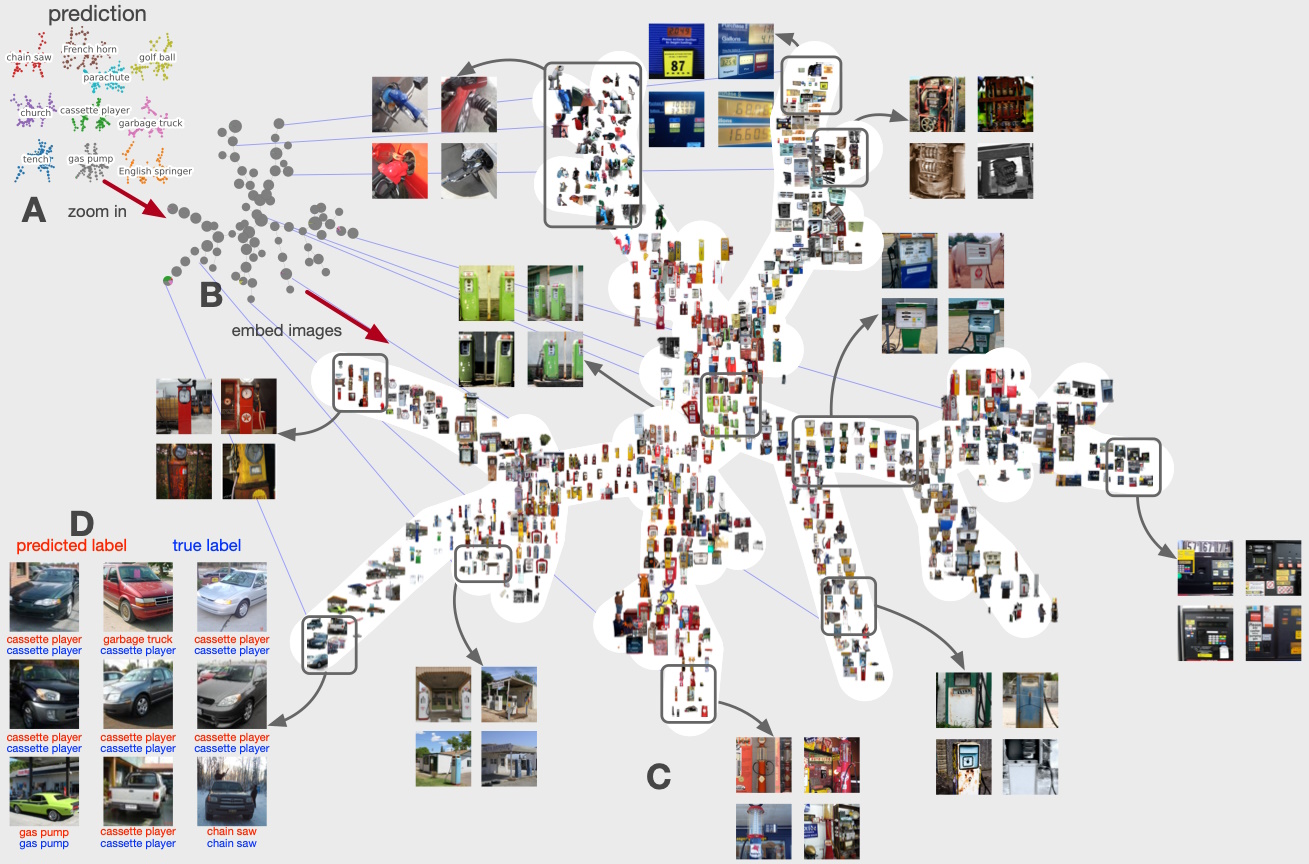
Making AI models more candid about when they need more information to produce a confident answer is a difficult problem, since really, the model doesn’t know the difference between right and wrong. But by making the model expose its inner workings a bit, you can get a better sense of when it’s more likely to be fibbing.
Image Credits: Purdue University
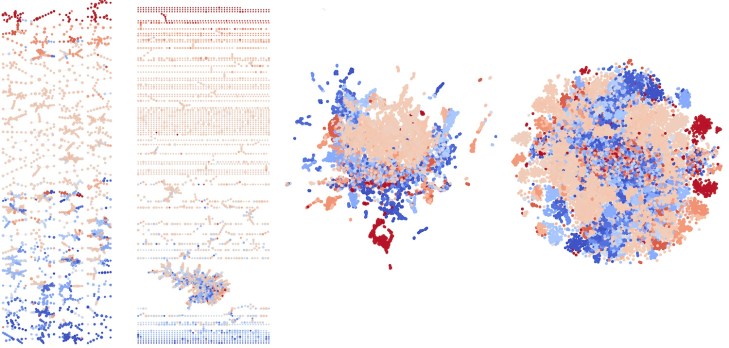
This work by Purdue creates a human-readable “Reeb map” of how the neural network represents visual concepts in its vector space. Items it deems similar are grouped together, and overlaps with other areas could indicate either similarities between those groups or confusion on the model’s part. “What we’re doing is taking these complicated sets of information coming out of the network and giving people an ‘in’ into how the network sees the data at a macroscopic level,” said lead researcher David Gleich.
Image Credits: Los Alamos National Lab
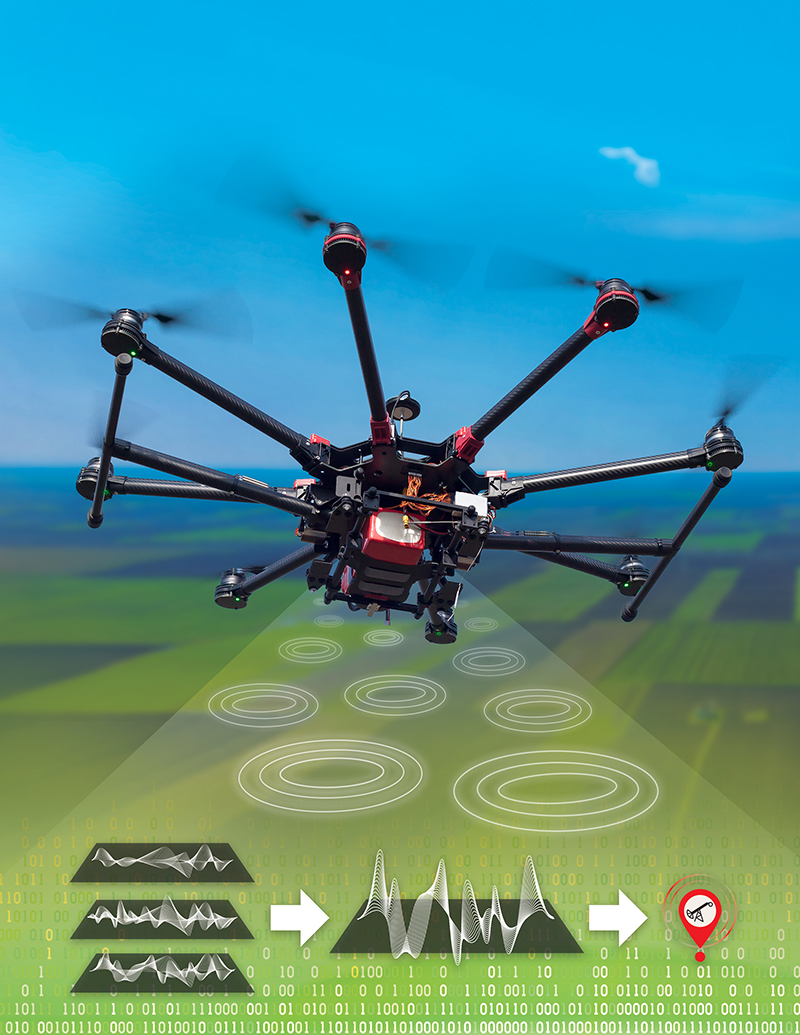
If your dataset is limited, it might be best if you don’t extrapolate too far from it, but if you must… perhaps a tool like “Senseiver,” from Los Alamos National Lab, is your best bet. The model is based on Google’s Perceiver, and is able to take a handful of sparse measurements and — apparently — surprisingly accurate predictions by filling in the gaps.
This could be for things like climate measurements, other scientific readings, or even 3D data like low-fidelity maps created by high-altitude scanners. The model can run on edge computers, like drones, which may now be able to perform searches for specific features (in their test case, methane leaks) instead of just reading the data then bringing it back to be analyzed later.
Meanwhile, researchers are working on making the hardware that runs these neural networks more like a neural network itself. They made a 16-electrode array and then covered it with a bed of conductive fibers in a random but consistently dense network. where they overlap, these fibers can either form connections or break them, depending on a number of factors. In a way it’s lot like the way neurons in our brains form connections and then dynamically reinforce or abandon those connections.
The UCLA/University of Sydney team said the network was able to identify hand-written numbers with 93.4% accuracy, which actually outperformed a more conventional approach at a similar scale. It’s fascinating for sure but a long way from practical use, though self-organizing networks are probably going to find their way into the toolbox eventually.
Image Credits: UCLA/University of Sydney
It’s nice to see machine learning models helping people out, and we’ve got a few examples of that this week.
A group of Stanford researchers are working on a tool called GeoMatch intended to help refugees and immigrants find the right location for their situation and skills. It’s not some automated procedure — right now these decisions are made by placement officers and other officials who, while experienced and informed, can’t always be sure their choices are backed up by data. The GeoMatch model takes a number of characteristics and suggests a location where the person is likely to find solid employment.
“What once took multiple people hours of research can now be done in minutes,” said the project’s leader, Michael Hotard. “GeoMatch can be incredibly useful as a tool that simplifies the process of gathering information and making connections.”
At University of Washington, robotics researchers just presented their work on creating an automated feeding system for people who can’t eat on their own. The system has gone through lots of versions and evolved with feedback from the community, and “we’ve gotten to the point where we can pick up nearly everything a fork can handle. So we can’t pick up soup, for example. But the robot can handle everything from mashed potatoes or noodles to a fruit salad to an actual vegetable salad, as well as pre-cut pizza or a sandwich or pieces of meat,” said co-lead Ethan K. Gordon in a Q&A posted by the university.
Image Credits: University of Washington
It’s an interesting chat, showing how projects like these are never really “done,” but at every stage they can help more and more people.
There are a few projects out there for helping blind folks make their way around the world, from Be My AI (powered by GPT-4V) to Microsoft’s Seeing AI, a collection of purpose-built models for everyday tasks. Google had its own, a pathfinding app called Project Guideline that was intended to help keep people on track when walking or jogging down a path. Google just made it open source, which generally means they’re giving up on something — but their loss is other researchers’ gain, because the work done at the billion-dollar company can now be used in a personal project.
Last up, a bit of fun in FathomVerse, a game/tool for identifying sea creatures the way apps like iNaturalist and so on identify leaves and plants. It needs your help, though, because animals like anemones and octopi are squishy and hard to ID. So sign up for the beta and see if you can help get this thing off the ground!
Amazon's Cyber Monday sale is on, and the Ecovacs Deebot X2 Omni is a whopping $455 off for a limited time.
Why this deal is ZDNET-recommended
You know that gratifying feeling of coming home to a clean house? With a family of five, that's not a feeling I often get, if at all. Enter the Ecovacs Deebot X2 Omni.
Also: Ecovacs announced a new robot vacuum that squares up to the competition
I've tested a fair share of robot vacuum and mop combinations, so I quite appreciate the experience of having a robot roaming around my home that picks up crumbs, dust, and everything in between. But the Deebot X2 Omni is the best robot vacuum and mop I've tried.
ZDNET RECOMMENDS
Ecovacs Deebot X2 Omni
This high-end robot vacuum and mop has been engineered to give users a hands-free cleaning experience.
View at Amazon
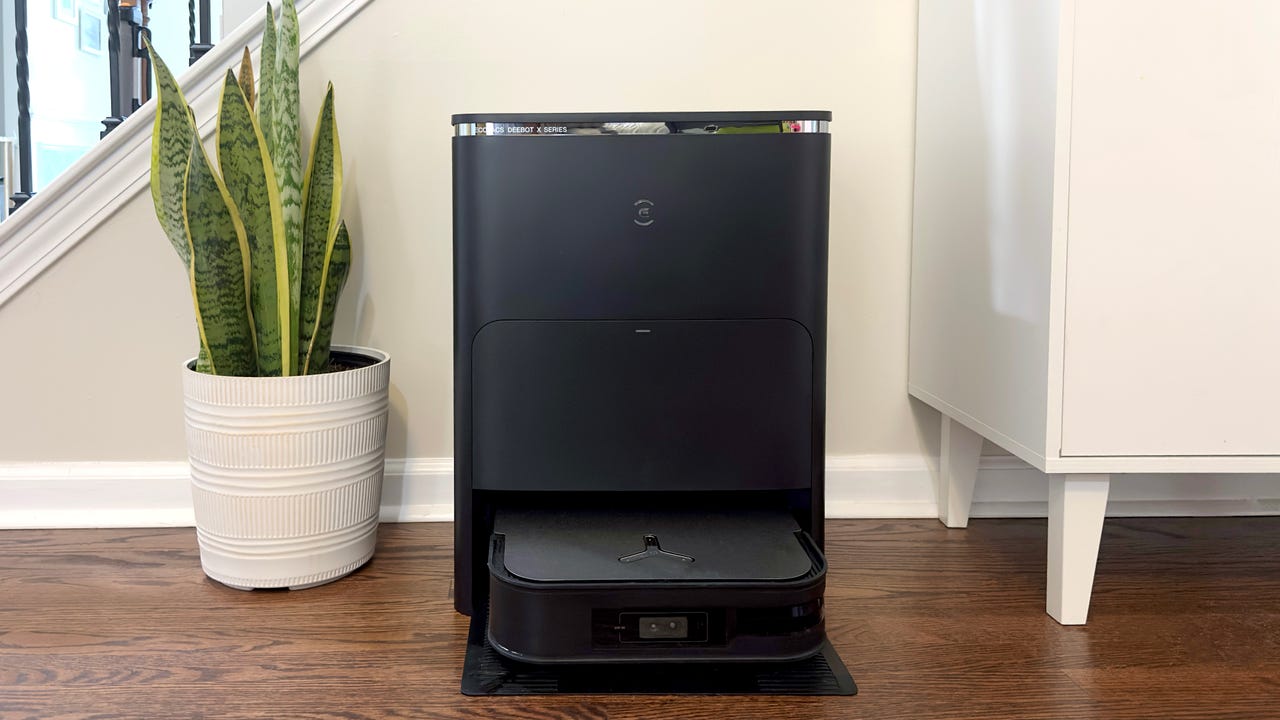
Ecovacs launched the Deebot X2 Omni today, a new flagship robot vacuum and mop combo with a clear edge. After testing it out for a couple of weeks, I've found room for improvement in some tasks — largely outweighed by its long list of strengths.
The X2 Omni checks all the specs boxes for a high-end robot vacuum and mop. It has 8,000Pa of suction power, higher than the 6,000Pa of the current market leader, the Roborock S8 Pro Ultra. Using artificial intelligence (AI), the robot can detect and avoid objects strewn about the floor, such as socks and charging cables, and has a mopping pad that automatically lifts 15mm when carpets or rugs are detected.
The Omni station charges the robot vacuum and mop and works as a base where it empties its dustbin and self-washes and dries its mop pads. This feature means you only have to worry about keeping the base station's clean water tank filled and its dirty water tank empty, which you must complete every few cleaning cycles.
Designed to be a hands-free experience, the base station is also self-cleaning. Running the self-cleaning option in the Ecovacs app will clean the base plate in the station — the spot where your mops are cleaned that typically sees water and dirt accumulation. This feature is a level above competitors like Yeedi, which requires users to periodically clean dirty water at the bottom of the docking station.
The dust bag holds everything the Deebot X2 sweeps from your floors and only needs emptying about once a month, although your mileage may vary.
This closure is supposed to hold four liters of clean water when you carry the clean water tank by the handle.
One of my only gripes is that the clean water tank feels awkward to hold when filled — it almost feels like it's not built to last, although I won't know for certain until I've used it for several months. It's a four-liter water tank with a handle to carry it on the lid, held shut by a plastic clip. I hold the tank from the bottom because I feel like using the handle to carry the full tank around will result in the closure failing and four liters of water going everywhere.
About the square shape
The Deebot X2 Omni has several superpowers, starting with its compact package. The squared edges stood out to me as a feature when I unpacked the device, along with how narrow and short it was. At only 12.6 inches wide, it's about 0.3 inches narrower than the Eufy X9 Pro robot vacuum mop, which had been my super mop until the X2 Omni arrived.
Although 0.3 inches sounds like a small difference in size, it's proven to be considerable when a robot has to navigate through furniture legs. Case in point: the Eufy X9 Pro uses AI to avoid objects, but whenever I sent it to clean the first floor, it'd get stuck between the kitchen barstools legs. The stools are fairly lightweight, so the robot would drag them around instead of signaling it was stuck. I'd see my kitchen barstools gliding around my floor or randomly find one hanging out by the shoe bench.
This isn't a big deal and is highly subjective, so it's not something I included in my Eufy review; it's not the robot's fault that it's the exact size as the width of the distance between my barstool's legs. But the narrower Deebot X2 Omni can clean under the barstools and figure its way back out, which means no more 'guess where the barstools are today' games.
The Ecovacs Deebot X2 Omni making its way out of the traveling barstools.
The Deebot X2 is also almost an inch shorter than my Eufy robot vacuum, at 3.7 inches in height. The lower dimensions and narrow build allow the Deebot X2 to clean in places other robots typically can't reach or navigate under.
Some AI-powered features
The Deebot X2 leverages Ecovacs' AIVI 3D 2.0 and combines an AI processor with 3D-structured light sensors with dual-laser LiDAR technology. The result is efficient maps that allow the robot to detect objects during navigation and clean around them intelligently. This feature set means you won't have to ensure your floors are free of charging cables, toys, or shoes before sending out the X2.
The AI-powered navigation and obstacle avoidance, backed by Ecovacs' proprietary AINA Model, uses visual recognition and reinforcement learning based on sensor information.
Also: 6 things to know about robot vacuums before you buy one
The Deebot X2's clever technology also makes for a customized cleaning process if that's your thing. The device's AI-powered visual recognition, ability to detect floor type, and historical cleaning logs let the robot infer which room it's cleaning, such as the kitchen, living room, or bedroom, and adjust its suction power and mopping mode.
A new level of voice control
Voice control makes everything in my home easier. Countless robot vacuums let you use a third-party virtual assistant for voice control, such as Amazon Alexa, Google Assistant, or Siri. Saying, "Alexa, clean the floors" in my house dispatches the Eufy X9 Pro to clean my bedroom and hallway. However, these assistants are limited in the functions they can make the robot perform.
Sure, you can dispatch your robot with Alexa or Google, but have you ever been able to tell it to "turn right, move three meters forward, turn left, and clean there"?
Also: This robot vacuum connects to your home's water supply for full automation
Ecovacs robot vacuums have a built-in voice assistant named YIKO that users can talk with to control the robot directly — and it works swimmingly. Saying "OK, YIKO" wakes up the voice assistant. If your robot is out cleaning, you can ask it to return and clean the dining room again or give it multiple commands in one sentence without pulling up the app.
ZDNET's buying advice
The Ecovacs Deebot X2 Omni is the company's new flagship robot with all the smart features and a price to match, at $1,500, though $455 off right now for Cyber Monday. Over the past few weeks, it's gained a top-dog position in our home, becoming the main robot to clean the downstairs floor — and that's saying a lot.
The great thing about an all-in-one, self-emptying, and self-cleaning robot vacuum and mop is that it's not best suited for some circumstances — it's suited for all. Some mid-range models might be great at mopping but suffer from not having strong or effective suction, making them best suited for homes with hard floors. Others might boast great suction power, okay mopping, and short battery life, making them best for mostly carpeted apartments or small homes.
The Deebot X2 Omni is great at all of these things. The biggest challenge in our home is downstairs because it's mostly hardwood and tile with some area rugs — it's where the dog comes in and out from the yard, where we cook, and where the toddler drops most of the crumbs.
Also: Skip the Dyson: This $150 stick vacuum is just as powerful (and can mop, too)
The X2 Omni's MSRP of $1,500 compares to $1,600 for the Roborock S8 Pro Ultra (also discounted at $400 off). Suppose I were looking for a hands-free robot vacuum and mop suitable for my home's complex needs. In that case, I'd have to choose the Deebot X2 Omni over the Roborock's flagship because the extra features, like the self-cleaning station and stronger suction, set it apart.
Google’s new tools help discussion forums and social media platforms rank higher in search results Sarah Perez @sarahintampa / 8 hours
Google today introduced new tools for website owners, including those running social media sites and discussion forums, who want to better elevate their content in Google’s search results. The feature follows Google’s reprioritization of user-generated web content over SEO-optimized junk, which has increasingly become a problem on today’s modern web. In May, Google first rolled out a new “Perspectives” search filter that would highlight posts from discussion boards like Reddit, Q&A sites like Quora, and social media platforms in its search results. The feature, which first arrived on mobile, was launched to desktop users earlier this month along with other search changes.
The company also said its ranking algorithm was being updated to push more of these first-hand perspectives higher in search results so they’re easier to find.
With the new tools, Google is giving websites hosting first-person perspectives the ability to signal to the search engine how their data is structured so their content will be featured both accurately and “as complete as possible” in Google’s Search Results, the company explains.
For example, with the new ProfilePage markup, any site where creators post content will be able to showcase their creators’ profiles directly in Google Search results, including information like their name, handle, profile photo, follower count, or the popularity of their content. Both Google’s Perspectives feature and its Discussions and Forums feature can make use of this type of markup.
Meanwhile, the DiscussionForumPosting markup will help Google to better recognize the conversations that are coming from any online forum or discussion site around the web. While Google can already identify a number of top forums, like Reddit, in its Search Results, this markup would allow other, smaller sites to be better indexed, categorized, and ranked by Google’s new algorithm, as well.
Image Credits: Google
This includes Q&A sites, which have their own markup, as well as general discussion forums.
To support site owners in implementing these changes, Google is updating its Search Console with new reporting that will show things like errors, warnings, and valid items related to their marked-up pages. Both features will also be available in the Rich Results Test so site owners can test and validate any markup changes.
Google’s changes to how it categorizes and ranks content come at a time when there’s a growing number of complaints about the search engine’s usefulness.
Though Google arguably outperforms many of its search competitors, its results are now often littered with SEO-optimized, machine-written content, and there’s a real fear that as AI advances take over, that problem will only get worse. Case in point: this post circulating on X today describes an “SEO heist” that stole 3.6 million in search traffic from a competitor by creating articles based on the competitor’s sitemap using AI. While a horrible, worst-case scenario for AI (and an unverified one at that), it’s creating a buzz because it exemplifies what many think will be the end of Google: faked, AI-written garbage prioritized over the work, thoughts, and opinions of real people.
We pulled off an SEO heist that stole 3.6M total traffic from a competitor.
We got 489,509 traffic in October alone.
Here's how we did it: pic.twitter.com/sTJ7xbRjrT
— Jake Ward (@jakezward) November 24, 2023
Whether or not this example becomes a reality — the proverbial canary in the coal mine — remains to be seen.
But this is precisely what Google’s ranking changes aim to address as the search engine attempts to better index, surface and categorize forums and social sites in search results.
Of course, Google’s experiments with next-generation search don’t end there. The company is also testing its own generative AI answer engine, Search Generative Experience, and recently announced an experiment that will let users annotate web pages with notes — likely, a hedge against Reddit choosing to lock down its site behind an API so as not be the source for AI training data without payment. If annotations took off, Google will have effectively built its own Reddit on Google directly, but the feature is still an opt-in experiment for now.
Google overhauls Search with tools to follow interests, annotate web pages and more
Google overhauls Search with tools to follow interests, annotate web pages and more
Something is happening in the design of AI models right now that — unless it's fixed soon — may have disastrous consequences for us humans, according to a recent experiment by an inter-university team of computer scientists from the University of Toronto (UoT) and the Massachusetts Institute of Technology (MIT).
All AI models need to be trained on vast amounts of data. However, there are reports that the way this is being done is deeply flawed.
Also: The ethics of generative AI: How we can harness this powerful technology
Take a look around you and behold the many major and minor ways that AI has already insinuated itself into your existence. Alexa reminds you about your appointments, health bots diagnose your fatigue, sentencing algorithms suggest prison time, and many AI tools have begun screening financial loans, to name just a few.
Imagine a decade from now when practically everything you do will have an algorithm as gatekeeper.
So, when you send in your application for a home rental or loan, or are waiting to be selected for a surgical procedure or a job that you are perfect for — and are repeatedly rejected for all of them, it may not be simply a mysterious and unfortunate spate of bad luck.
Instead, the cause of these negative outcomes could be that the company behind the AI algorithms did a shoddy job in training them.
Specifically, as these scientists (Aparna Balagopalan, David Madras, David H. Yang, Dylan Hadfield-Menell, Gillian Hadfield, and Marzyeh Ghassemi) have highlighted in their recent paper in Science, AI systems trained on descriptive data invariably make much harsher decisions than humans would make.
Unless corrected, these findings suggest, such AI systems could cause havoc in areas of decision-making.
Training daze
In an earlier project that focused on how AI models justify their predictions, the aforementioned scientists became aware that humans in the study sometimes gave different responses when they were asked to attach descriptive versus normative labels to the data.
Normative claims are statements that flat out say what should or shouldn't happen ("He should study much harder to pass the exam.") What is at work here is a value judgment. Descriptive claims dwell on the 'is' with no opinion attached. ("The rose is red.")
Also: AI can be creative, ethical when applied humanly
This puzzled the team, so they decided to probe further with another experiment; this time they put together four different datasets to test drive different policies.
One was a data set of dog images used toward a hypothetical apartment's rule against allowing aggressive canines in.
The scientists then assembled a bunch of study participants to attach "descriptive" or " normative" labels on the data in a process that mirrors how data is trained.
Here's where things got interesting.
The descriptive labelers were asked to decide whether certain factual features were present or not – such as whether the dog was aggressive or unkempt. If the answer was "yes," then the rule was essentially violated — but the participants had no idea that this rule existed when weighing in and therefore weren't aware that their answer would eject a hapless canine from the apartment.
Also: Organizations are fighting for the ethical adoption of AI. Here's how you can help
Meanwhile, another group of normative labelers were told about the policy prohibiting aggressive dogs, and then asked to stand judgment on each image.
It turns out that humans are far less likely to label an object as a violation when aware of a rule and much more likely to register a dog as aggressive (albeit unknowingly ) when asked to label things descriptively.
The difference wasn't by a small margin either. Descriptive labelers (those who didn't know the apartment rule but were asked to weigh in on aggressiveness) had unwittingly condemned 20% more dogs to doggy jail than those who were asked if the same image of the pooch broke the apartment rule or not.
Machine mayhem
The results of this experiment has serious implications for practically every aspect of how humans live, and especially so if you are not in a dominant sub-group.
For instance, consider the dangers of a "machine learning loop" where an algorithm is designed to evaluate Phd candidates. The algorithm is fed thousands of previous applications and — under supervision — learns who are successful candidates and who are not.
It then distills what a successful candidate should look like: High grades, top university pedigree, and racially white.
Also: Elon Musk's new AI bot has an attitude — but only for these X subscribers
The algorithm isn't racist, but the data that has been fed to it is biased in such a manner as to further perpetuate the same skewed view "whereby, for example, poor people have less access to credit because they are poor; and because they have less access to credit, they remain poor," says legal scholar Francisco de Abreu Duarte.
Today, this problem is all around us.
ProPublica, for instance, has reported about how an algorithm used widely in the US for sentencing defendants would falsely pick black defendants as most likely to re-offend at almost twice the rate as white defendants even though all evidence was to the contrary both at the time of sentencing and in years to come.
Five years ago, MIT researcher Joy Buolamwini exposed how the university lab's algorithms that are in use globally could not actually detect a black face, including hers. This changed only when she wore a white mask.
Also: AI at the edge: Fast times ahead for 5G and the Internet of Things
Other biases, against gender, ethnicity, or age are rife in AI — but there's one big difference that makes them even more dangerous than biased human judgment.
"I think most artificial intelligence/machine-learning researchers assume that the human judgments in data and labels are biased, but this result is saying something worse," says Marzyeh Ghassemi, an assistant professor at MIT in Electrical Engineering and Computer Science and Institute for Medical Engineering & Science.
"These models are not even reproducing already-biased human judgments because the data they're being trained on has a flaw: Humans would label the features of images and text differently if they knew those features would be used for a judgment," she adds.
They are in fact delivering verdicts that are much worse than existing societal biases and that makes the relatively rudimentary process of AI data set labeling a ticking time bomb if done improperly.
Contrary to reports, OpenAI probably isn’t building humanity-threatening AI Kyle Wiggers 8 hours
Has OpenAI invented an AI technology with the potential to “threaten humanity”? From some of the recent headlines, you might be inclined to think so.
Reuters and The Information first reported last week that several OpenAI staff members had, in a letter to the AI startup’s board of directors, flagged the “prowess” and “potential danger” of an internal research project known as “Q*.” This AI project, according to the reporting, could solve certain math problems — albeit only at grade-school level — but had in the researchers’ opinion a chance of building toward an elusive technical breakthrough.
There’s now debate as to whether OpenAI’s board ever received such a letter — The Verge cites a source suggesting that it didn’t. But the framing of Q* aside, Q* in actuality might not be as monumental — or threatening — as it sounds. It might not even be new.
AI researchers on X (formerly Twitter) including Yann LeCun, Meta’s chief AI scientist Yann LeCun, were immediately skeptical that Q* was anything more than an extension of existing work at OpenAI — and other AI research labs besides. In a post on X, Rick Lamers, who writes the Substack newsletter Coding with Intelligence, pointed to an MIT guest lecture OpenAI co-founder John Schulman gave seven years ago during which he described a mathematical function called “Q*.”
Several researchers believe the “Q” in the name “Q*” refers to “Q-learning,” an AI technique that helps a model learn and improve at a particular task by taking — and being rewarded for — specific “correct” actions. Researchers say the asterisk, meanwhile, could be a reference to A*, an algorithm for checking the nodes that make up a graph and exploring the routes between these nodes.
Please ignore the deluge of complete nonsense about Q*. One of the main challenges to improve LLM reliability is to replace Auto-Regressive token prediction with planning.
Pretty much every top lab (FAIR, DeepMind, OpenAI etc) is working on that and some have already published…
— Yann LeCun (@ylecun) November 24, 2023
Both have been around a while.
Google DeepMind applied Q-learning to build an AI algorithm that could play Atari 2600 games at human level… in 2014. A* has its origins in an academic paper published in 1968. And researchers at UC Irvine several years ago explored improving A* with Q-learning — which might be exactly what OpenAI’s now pursuing.
Tweets by RickLamers
Nathan Lambert, a research scientist at the Allen Institute for AI, told TechCrunch he believes that Q* is connected to approaches in AI “mostly [for] studying high school math problems” — not destroying humanity.
“OpenAI even shared work earlier this year improving the mathematical reasoning of language models with a technique called process reward models,” Lambert said, “but what remains to be seen is how better math abilities do anything other than make [OpenAI’s AI-powered chatbot] ChatGPT a better code assistant.”
Mark Riedl, a computer science professor at Georgia Tech, was similarly critical of Reuters’ and The Information’s reporting on Q* — and the broader media narrative around OpenAI and its quest toward artificial general intelligence (i.e. AI that can perform any task as well as a human can). Reuters, citing a source, implied that Q* could be a step toward artificial general intelligence (AGI). But researchers — including Riedl — dispute this.
People are saying this is Q*https://t.co/rI5dz0Maf7 Seems plausible, though it’s from May 2023 and no one lost their minds over this, nor should they.
— Mark Riedl (@mark_riedl) November 25, 2023
“There’s no evidence that suggests that large language models [like ChatGPT] or any other technology under development at OpenAI are on a path to AGI or any of the doom scenarios,” Riedl told TechCrunch. “OpenAI itself has at best been a ‘fast follower,’ having taken existing ideas … and found ways to scale them up. While OpenAI hires top-rate researchers, much of what they’ve done can be done by researchers at other organizations. It could also be done if OpenAI researchers were at a different organization.
Riedl, like Lambert, didn’t guess at whether Q* might entail Q-learning or A*. But if it involved either — or a combination of the two — it’d be consistent with the current trends in AI research, he said.
“These are all ideas being actively pursued by other researchers across academia and industry, with dozens of papers on these topics in the last six months or more,” Riedl added. “It’s unlikely that researchers at OpenAI have had ideas that have not also been had by the substantial number of researchers also pursuing advances in AI.”
That’s not to suggest that Q* — which reportedly had the involvement of Ilya Sutskever, OpenAI’s chief scientist — might not move the needle forward.
Lamers asserts that, if Q* uses some of the techniques described in a paper published by OpenAI researchers in May, it could “significantly” increase the capabilities of language models. Based on the paper, OpenAI might’ve discovered a way to control the “reasoning chains” of language models, Lamers says — enabling them to guide models to follow more desirable and logically sound “paths” to reach outcomes.
“This would make it less likely that models follow ‘foreign to human thinking’ and spurious-patterns to reach malicious or wrong conclusions,” Lamers said. “I think this is actually a win for OpenAI in terms of alignment … Most AI researchers agree we need better ways to train these large models, such that they can more efficiently consume information
But whatever emerges of Q*, it — and the relatively simple math equations it solves — won’t spell doom for humanity.
No matter what business you are in, knowing how to analyze data is more important than ever in the data-driven era. Data analysis would enable businesses to stay competitive and provide the ability to make better decisions.
The importance of data analysis drives every individual to know how to perform data analysis. However, sometimes it takes too much time to conduct data analysis. That’s why we could rely on ChatGPT to create a complete report from our data file.
This article will explore five simple steps to create complete analytical reports from your CSV file. These five steps include:
Step 1: Importing the CSV File
Step 2: Data Summary and Preprocessing
Step 3: Data Analysis
Step 4: Data Visualization
Step 5: Report Generation
As a prerequisite, this article assumes that the reader has subscribed to ChatGPT Plus. With that in mind, let’s get started.
Importing the CSV File
The first step is to prepare the CSV file that you want to analyze and create a report. This file could come from any trustworthy source, but this article would use the Telecom Churn dataset from Kaggle.
Ensure the data is structured, organized, and has a clear header. If you have a certain target that you want to analyze, then don’t forget to include that data in the file. In our example, we would try to perform an analysis for the churn column.
With the data ready, attach them to the ChatGPT and let the model do their work.
Data Summary and Preprocessing
The next step is to get the data summary from our CSV file and preprocess them. Input the following prompt while you upload the data.
Provide the data summary to this file and perform appropriate data processing for the dataset.
Missing Values: There are no missing values in any of the columns.
ChatGPT clearly could read the data well and was able to provide the given dataset. The next result is the data preprocessing from the ChatGPT.
Since there are no missing values in the dataset, the main focus of data cleaning and preprocessing will be on:
Checking for any outliers or anomalies in the data.
Normalizing or standardizing the data if required, especially for columns with continuous numerical values.
Converting categorical data into a format suitable for analysis, if necessary.
Let's proceed with these steps.
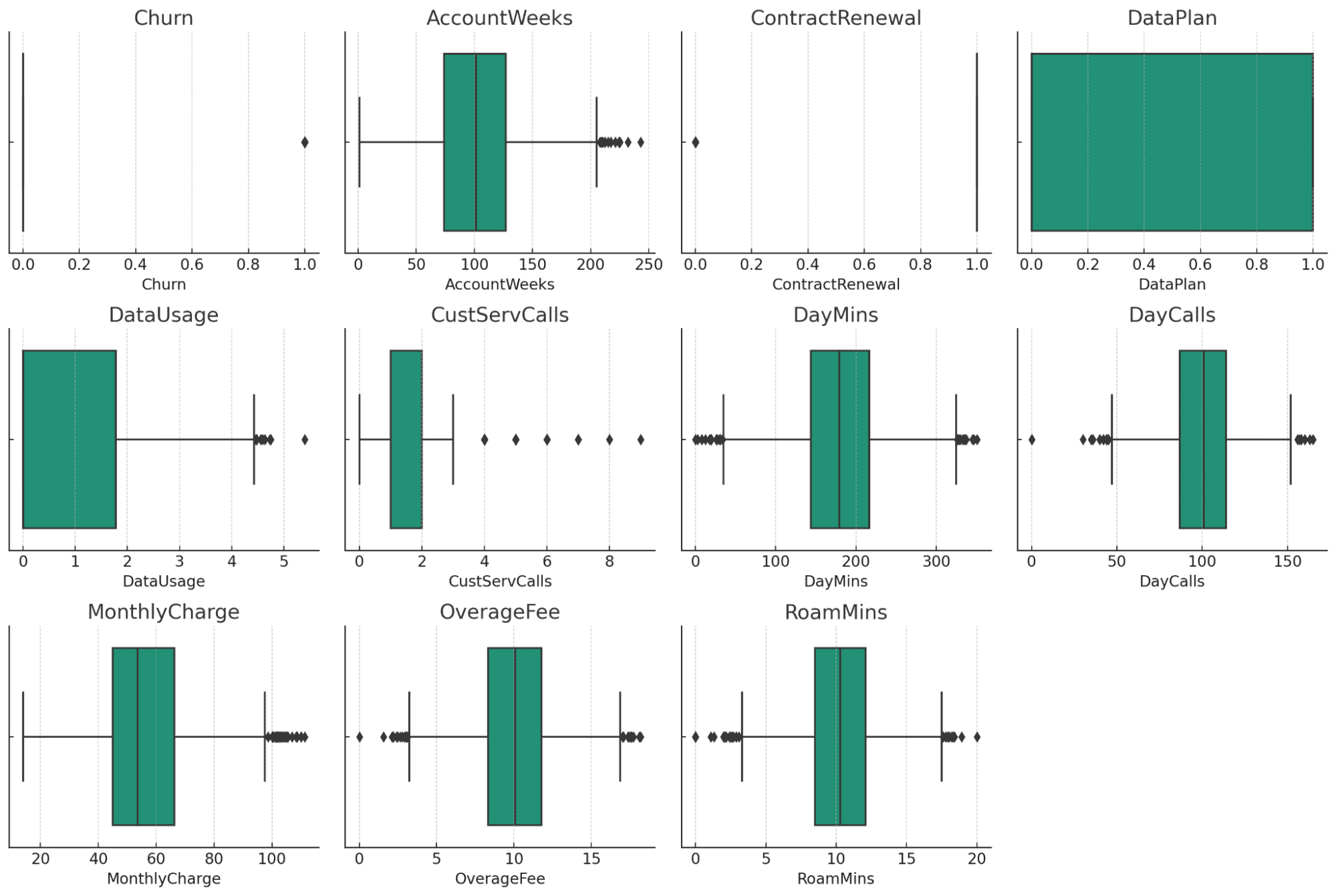
The boxplots provide a visual overview of potential outliers in each numerical column of your dataset. Here are some observations:
AccountWeeks, CustServCalls, DayCalls: These columns show a fairly normal distribution with a few outliers.
DataUsage, DayMins, MonthlyCharge, OverageFee, RoamMins: These columns also show some outliers, but they seem to be within a reasonable range, considering the nature of the data.
Churn, ContractRenewal, DataPlan: Being categorical/binary data, these columns don't show traditional outliers.
Given this information, the next steps in data cleaning and preprocessing could include:
Handling Outliers: We can decide whether to remove, cap, or otherwise handle outliers based on your specific analytical needs and domain knowledge.
Data Transformation: If needed, we can normalize or standardize columns like DayMins, MonthlyCharge, etc., especially if you plan to use algorithms that are sensitive to the scale of data.
Categorical Data Encoding: Convert categorical data into a format suitable for analysis, if any such transformation is required.
You can let the ChatGPT perform additional steps for the data cleaning and preprocessing or let it be as it is. For this example, we would continue to the next steps.
Data Analysis
Next, we would perform data analysis with ChatGPT. The data analysis is depending on what you want to achieve. In our case, we want to perform data analysis from the Churn POV.
We use the following prompt to execute the data analysis with ChatGPT for the above case.
Please perform the data analysis based on the data above with respect to the churn data.
The data analysis can be seen in the following result.
To perform data analysis with respect to the churn data, we'll focus on understanding how different factors relate to customer churn. Churn, being a binary variable (0 for no churn, 1 for churn), is typically analyzed through classification methods and by examining relationships with other variables. Here's the plan:
Correlation Analysis: To start, we'll look at how each numerical feature correlates with churn. This gives us an initial understanding of which factors might be more closely related to churn.
Statistical Tests: For categorical variables like ContractRenewal and DataPlan, we can use statistical tests to see if there are significant differences in churn rates across different categories.
Visual Analysis: We'll create some visualizations to further explore these relationships. This includes comparing churn rates across different groups and plotting key variables against churn.
Summary Statistics: We'll provide summary statistics for different groups based on churn status to see if there are noticeable differences in means or distributions.
Let's start with the correlation analysis and then move on to the next steps.
Correlation Analysis with Churn
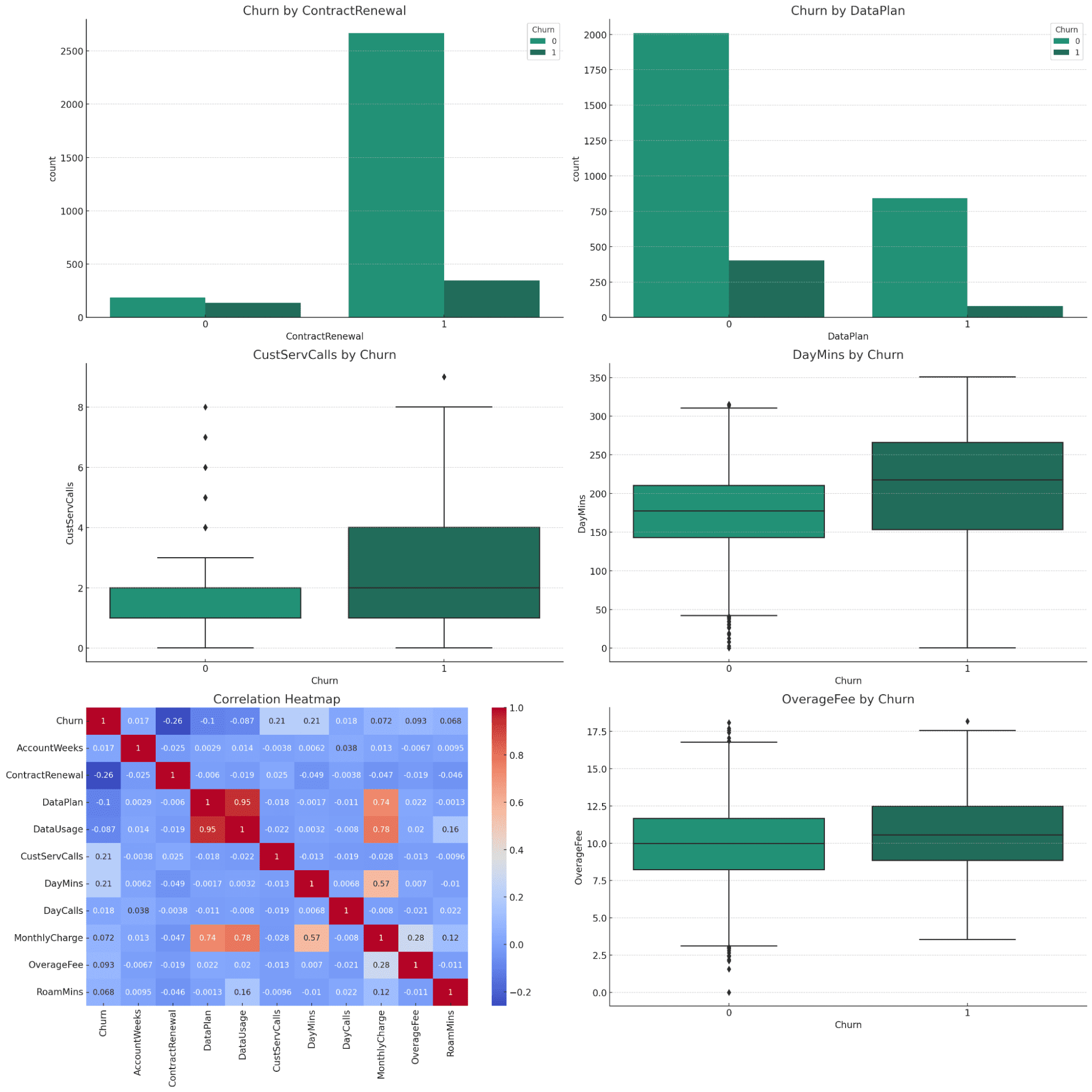
The correlation of different variables with churn is as follows (from strongest negative to strongest positive correlation):
Negative Correlation:
ContractRenewal: Strongest negative correlation. Indicates that customers who do not renew their contracts are more likely to churn.
DataPlan: Customers without a data plan are slightly more likely to churn.
DataUsage: Higher data usage slightly decreases the likelihood of churn.
Positive Correlation:
AccountWeeks, DayCalls: Very weak positive correlation, suggesting minimal impact on churn.
RoamMins: A slight increase in churn likelihood with increased roaming minutes.
MonthlyCharge: Slightly higher churn rates with increased monthly charges.
OverageFee: Higher overage fees are moderately correlated with increased churn.
DayMins: Higher daily minutes are moderately correlated with increased churn.
CustServCalls: Strong positive correlation. More customer service calls are associated with higher churn rates.
Based on these correlations, it seems that factors like contract renewal, customer service calls, daily minutes, and overage fees are more closely related to churn. We can further explore these factors through visual analysis and statistical tests, especially for categorical variables like ContractRenewal and DataPlan.
Visual Analysis
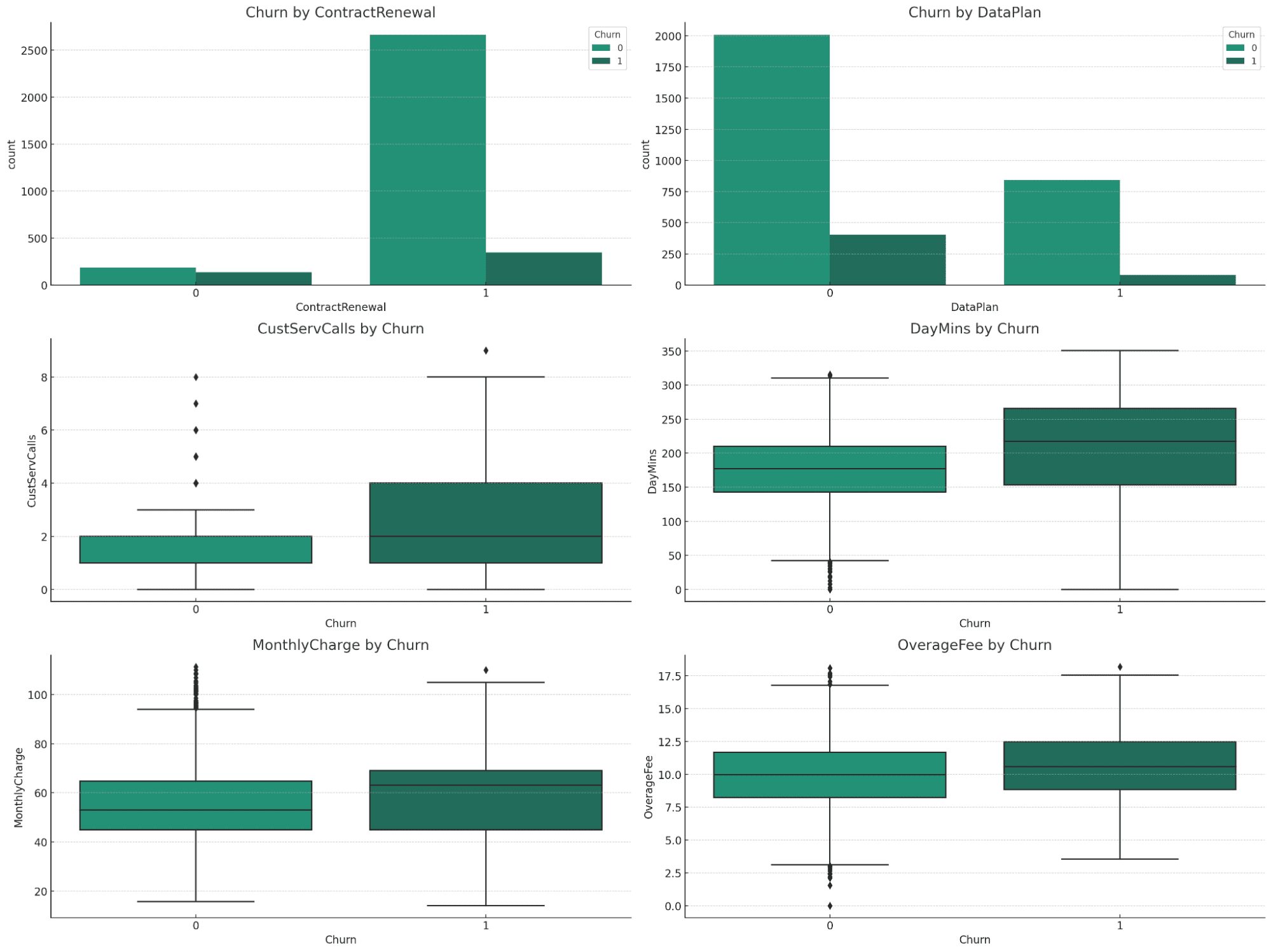
The visualizations offer valuable insights into the relationship between different variables and churn:
Churn by ContractRenewal and DataPlan:
ContractRenewal: A significant difference in churn rates is evident. Customers who did not renew their contracts show a higher rate of churn.
DataPlan: There is a noticeable difference in churn rates based on whether customers have a data plan or not, with those without a data plan showing higher churn.
Numerical Variables (CustServCalls, DayMins, MonthlyCharge, OverageFee) by Churn:
CustServCalls: Customers with higher numbers of customer service calls tend to churn more.
DayMins: Higher daily minutes are associated with a greater likelihood of churn.
MonthlyCharge: Higher monthly charges correlate with an increased churn rate.
OverageFee: Higher overage fees are also associated with increased churn.
Conclusions from the Analysis
Contract renewal status and the presence of a data plan are significant factors in customer churn.
High usage (in terms of day minutes) and high charges (monthly charges and overage fees) are associated with higher churn rates.
A higher number of customer service calls is a strong indicator of potential churn.
Next Steps
Based on these insights, targeted strategies can be developed to reduce churn, such as improving customer service, revising pricing strategies, or offering incentives for contract renewal and data plan subscriptions.
With a single prompt, we can see how well ChatGPT could give us the complete data analysis and come up with insight from the data. You can tweak the analysis aims and start from there.
Data Visualization
The data visualization is a supportive activity to improve the data analysis and overall report. By having the visualization, we can have a more comprehensive report to understand our data.
Using the following prompt, we can perform the data visualization with ChatGPT.
Please perform data visualization from the data analysis to explain the data better.
To enhance the understanding of the data analysis results, I'll create a series of visualizations that clearly depict the key findings related to customer churn. These visualizations will include:
Bar Plots for Categorical Variables:
Comparing churn rates for customers with and without contract renewal.
Comparing churn rates for customers with and without a data plan.
Box Plots for Key Numerical Variables:
Customer Service Calls vs Churn.
Daily Minutes vs Churn.
Monthly Charges vs Churn.
Overage Fees vs Churn.
Heatmap of Correlation:
To visualize the correlation of all variables with churn.
The visualization would show all the important plots that encapsulate the whole dataset. We can ask for more detailed descriptions for each plot, which you can try independently.
Report Generation
The last step is to generate the report based on the previous steps. Unfortunately, ChatGPT might not capture all the description and insight from the data analysis, but we can still have the simple version of the report.
Use the following prompt to generate a PDF report based on the previous analysis.
Please provide me with the pdf report from the first step to the last step.
You will get the PDF link result with your previous analysis covered. Try to iterate the steps if you feel the result is inadequate or if there are things you want to change.
Conclusion
Data analysis is an activity that everyone should know as it’s one of the most required skills in the current era. However, learning about performing data analysis could take a long time. With ChatGPT, we can minimize all that activity time.
In this article, we have discussed how to generate a complete analytical report from CSV files in 5 steps. ChatGPT provides users with end-to-end data analysis activity, from importing the file to producing the report.
Cornellius Yudha Wijaya is a data science assistant manager and data writer. While working full-time at Allianz Indonesia, he loves to share Python and Data tips via social media and writing media.
More On This Topic
CSV Files for Storage? No Thanks. There’s a Better Option
How to Auto-Detect the Date/Datetime Columns and Set Their Datatype…
TC Startup Battlefield master class with Lightspeed Ventures: Use generative AI to supercharge efficiency Neesha A. Tambe 9 hours
Generative AI is the hot topic in tech right now, but how can you as a startup founder take full advantage of it?
Every year, TechCrunch highlights the most promising 200 early-stage founders from around the world to showcase at TechCrunch Disrupt in San Francisco. As part of our programming, we host master classes with industry experts and venture investors to provide tactical advice and insights to these founders.
This is the third installment of a four-part series of master classes that cover a wide range of practical and tactical advice to founders on how to build their companies. In this session, Raviraj Jain, partner at Lightspeed Ventures, explores how early-stage startups will be impacted by GenAI, how they can utilize the new tech to supercharge their efficiency, and what to look out for when adopting various forms of AI across your business.
This private session was held in August, and we’re sharing this now so TechCrunch+ subscribers can also reap the benefits of Startup Battlefield.
Narayana Murthy, the founder of Infosys, recently urged the youth of India to work 70 hours in a week, or 12 hours a day so that India becomes the top country in the world in terms of GDP. On the contrary, in a recent episode of Trevor Noah’s “What Now?” Bill Gates, the Microsoft co-founder said that people need to eventually work only three days a week or something, highlighting that AI will do the rest of the work, freeing up labour.
“The purpose of life is not just to do jobs. So if you eventually get a society where you only have to work three days a week or something, that’s probably OK,” said Gates.
This obviously sparked debates around the world, some siding with Murthy, others with Gates.
Weighing in his thoughts on the issue, Shashi Tharoor, member of Lok Sabha, posted on X, “In other words, if Mr Gates and Mr Narayana Murthy sit down together and work out a compromise, we will end up exactly where we are, with a five-day work week!”
“@BillGates says a three-day work-week ought to be possible”. In other words, if Mr Gates and Mr Narayana Murthy sit down together and work out a compromise, we will end up exactly where we are, with a five-day work week!https://t.co/2Id9GEf1KC
— Shashi Tharoor (@ShashiTharoor) November 26, 2023
Quiet quitting is the state quo
This year, after moonlighting, a new term was coined called quiet quitting, where employees would do the bare minimum, and are not putting in any efforts to boost productivity. AI is just making it more and more easier.
Since the beginning of the year, Indian companies have also been requested by their employees to follow a four day week, following the footsteps of the UK, where some companies have started it. While Gates recommends a three day week, the debate has been a long running one.
Murthy has said in 2020, “We should take a pledge that we will work 10 hours a day, six days a week – as against 40 hours a week – for the next 2-3 years so that we can fast-track and grow the economy much faster.”
Closer to a relaxed working pace, JPMorgan CEO Jamie Dimon says that the next generation of workers will only have to do their jobs for 3.5 days in a week, while also living up to an age of 100 because of the developing technology.
Similarly, Elon Musk, the proponent of working hard and burning the midnight oil, told the Prime Minister of Britain Rishi Sunak, “You can have a job if you want to have it for personal pleasure. But AI could do everything.” He also added that this will create a universally higher income.
Unfortunately, a lot of people are just lazy. Following the footsteps of what Gates said a few years ago, “I choose a lazy person to do a hard job. Because a lazy person will find an easy way to do it,” Microsoft, under Satya Nadella, is making everyone lazy, even its own employees.
“77% of people who use Copilot told us that they just don’t want to go back to working without it,” said a confident Jared Spataro, CVP Modern Work and Business Applications of Microsoft, at the company’s annual conference for developers and IT professionals – Microsoft Ignite 2023.
Richard Baldwin, at a panel at 2023 World Economic Forum’s Growth Summit said, “AI won’t take your job, It’s somebody using AI that will take your job.” And while you think that if AI does everyone’s job, the beach would be filled with everyone doing absolutely nothing.
Designed by Diksha Mishra
So, how many hours?
If an entire generation is studying for jobs that won’t exist, we might not even have jobs left to do in the future. Then the point comes, would anyone even want to work if AI can replace their jobs? The trend seems to be emerging.
In a Reddit discussion, people discuss, instead of worrying about AI stealing your job, you should rather say, “I want AI to steal our jobs.” People are so frustrated with this phenomenon of discussing work hours, they are just giving up to AI to do their jobs, and want to enjoy doing something else.
“Instead of starting to protest ‘We want to work’ and ‘AI steals our jobs’, why don’t we take a book and go to the park to read ? Or a cocktail on the beach ? Or to spend time with our loved ones?” said the Reddit user. Though unrealistic, the idea does not seem that bad.
Contrary to this, Murthy’s point was never about making people work for 70 hours in a week, but it was about urging the youth of India, specifically, to take examples from foreign countries and work towards building our own. Moreover, Gates was focusing on the Western countries, not Indian ones.
But not to forget AI is already earning money now. For example, a Spanish influencer agency called The Clueless created Aitana Lopez, a Spanish AI model that earns over 3 lakhs per month. So instead of thinking of working less hours, upskilling might be the need to compete against AI.
Considering all this, it seems clear that the idea of Universal Basic Income (UBI) seems to be inching closer than expected. No one would work, and focus on doing better things. That is until “People’s wishes vastly outgrow the available resources,” as a user pointed out.
Sam Altman’s Worldcoin is already underway, with the same intention. Musk has also been a proponent of UBI.
The post Good News: Nobody Has to Work Anymore appeared first on Analytics India Magazine.