Together lands $102.5M investment to grow its cloud for training generative AI

Together lands $102.5M investment to grow its cloud for training generative AI Kyle Wiggers 14 hours

Generative AI companies continue to raise huge amounts of capital to fuel their commercial — and, in some cases, open source — ambitions.

See Together, a startup creating open source generative AI and AI model development infrastructure, which today announced that it closed a $102.5 million Series A funding round led by Kleiner Perkins with participation from Nvidia and Emergence Capital. The tranche — over five times the size of the company’s previous round — will be put toward expanding Together’s cloud platform that lets developers build on open and custom AI models, co-founder and CEO Vipul Ved Prakash says.

“Startups and enterprises alike are looking to build a generative AI strategy for their business that is free from lock-in to a single vendor,” Prakash wrote in a blog post published on Together’s website this morning. “Open source AI provides a strong foundation for these applications with increasingly powerful generative models being released almost weekly … We believe generative AI is a platform technology, a new operating system for applications, and will have a long-range impact on human society. The AI ecosystem will consist of proprietary models and open models, and it’s incredibly important that this future has choice and options.”

Vipul co-founded Together, launched in June 2022, with Ce Zhang, Chris Re and Percy Liang. Prakash previously founded social media search platform Topsy, which was acquired in 2013 by Apple, where he later became a senior director.

With Together, Prakash, Zhang, Re and Liang aim to create open source models and services that help organizations incorporate AI into their applications. To that end, Together has built a cloud platform for running, training and fine-tuning models that the co-founders claim offers scalable compute at lower prices than the dominant vendors (e.g., Google Cloud, AWS, Azure).

As Together explains in a blog post: “We’re achieving and offering significant reductions in cost of interactive inference workloads on large models. We optimize down the stack, with thousands of GPUs located in multiple secure facilities, software for virtualization, scheduling and model optimizations that significantly bring down operating costs.”

At present, Together operates a cloud spanning datacenters in the U.S. and EU, including servers operated by partners Crusoe Cloud and Vultr, that delivers around 20 exaflops of compute in total — scaling in clusters from 16 GPUs to 2,048 GPUs. Customers include NexusFlow, Voyage AI and Cartesia, some of whom also leverage Together’s APIs for serving models.

Pika Labs, which coincidentally raised $55 million this week, also built a model — a text-to-video model — on Together’s GPU clusters. Pika’s recently trained new iterations of the model from scratch with the clusters, which it uses to run its models to generate millions of videos per month for its early access users.

“By creating custom infrastructure, we can offer significantly better economics,” Vipul continued. “The Together platform allows developers to quickly and easily integrate leading open source models or create their own models through pre-training or fine-tuning. Our customers choose to bring their generative AI workloads to Together owing to our industry-leading performance and reliability, while still having comfort that they own the result of their investment in AI and are always free to run their model on any platform.”

To complement the cloud service, Together offers what it calls Custom Models, a consulting offering that allows customers to bring their own data to the Together cloud platform and have Together’s team work to design, build and test a model.

Together also heavily invests in open source AI research. One of the company’s first projects, RedPajama, sought to foster a set of open source generative AI models including “chat” models along the lines of OpenAI’s ChatGPT. Together’s also released a fine-tuned version of Meta’s Llama 2 text-generating model; GPT-JT, a fork of the open source text-analyzing model GPT-J-6B (from the open research group EleutherAI); and OpenChatKit, an attempt at a ChatGPT equivalent.

Companies — and investors — are hungry for generative AI of all sorts. According to IDC, generative AI investments will rise from $16 billion this year to a whopping $143 billion in 2027. Generative AI firms are monopolizing venture capital investments, having attracted about 40% of all startup rounds — $11.9 billion — in the first six months of 2023.

But generative AI is far from a sure bet. Stability AI, for example, once the darling of VC firms including Lightspeed Venture Partners, O’Shaughnessy Ventures and Coatue, is said to be exploring a sale as profits fail to materialize and the company’s financial position worsens.

AWS re:Invent: Text and Image Generative AI Embeddings Come to Amazon Titan

After the AWS announcements yesterday about the Amazon Q chatbot for enterprise and powerful new chips for AI workloads, Vice President of Databases, Analytics and Machine Learning at AWS Swami Sivasubramanian took the stage at the AWS re:Invent conference in Las Vegas on Nov. 29 to dive deeper into AWS AI offerings. Sivasubramanian announced new generative AI models coming to Amazon Bedrock, multimodal searching available for Amazon Titan in Amazon Bedrock and many other new enterprise software features and tools related to using generative AI for work.

Jump to:

  • Amazon Titan can now run searches based on text and images
  • Titan Text Lite and Titan Text Express added to Amazon Bedrock
  • Claude 2.1 and Llama 2 70B now hosted on Amazon Bedrock
  • Additional Amazon Q use cases announced
  • Training and model evaluation tools added to Amazon SageMaker
  • Vector capabilities and data management tools added to many AWS services

Amazon Titan can now run searches based on text and images

Amazon Titan Multimodal embeddings are now in general availability in Amazon Bedrock, the AWS tool for building and scaling AI applications. Multimodal embeddings allow organizations to build applications that let users search using text and images for richer search and recommendation options, said Sivasubramanian.

“They (AWS customers) want to enable their customers to search for furniture using a phrase, image or even both,” said Sivasubramanian. “They could use instructions like ‘show me what works well with my sofa’.”

SEE: Are AWS or Google Cloud right for your business? (TechRepublic)

Titan Text Lite and Titan Text Express added to Amazon Bedrock

Titan Text Lite and Titan Text Express are now generally available in Amazon Bedrock to help optimize for accuracy, performance and cost, depending on their use cases. Titan Text Lite is a very small model for text and can be fine-tuned. Titan Text Express is a model that can do a wider range of text-based generative AI tasks, such as conversational chat and open-ended questions.

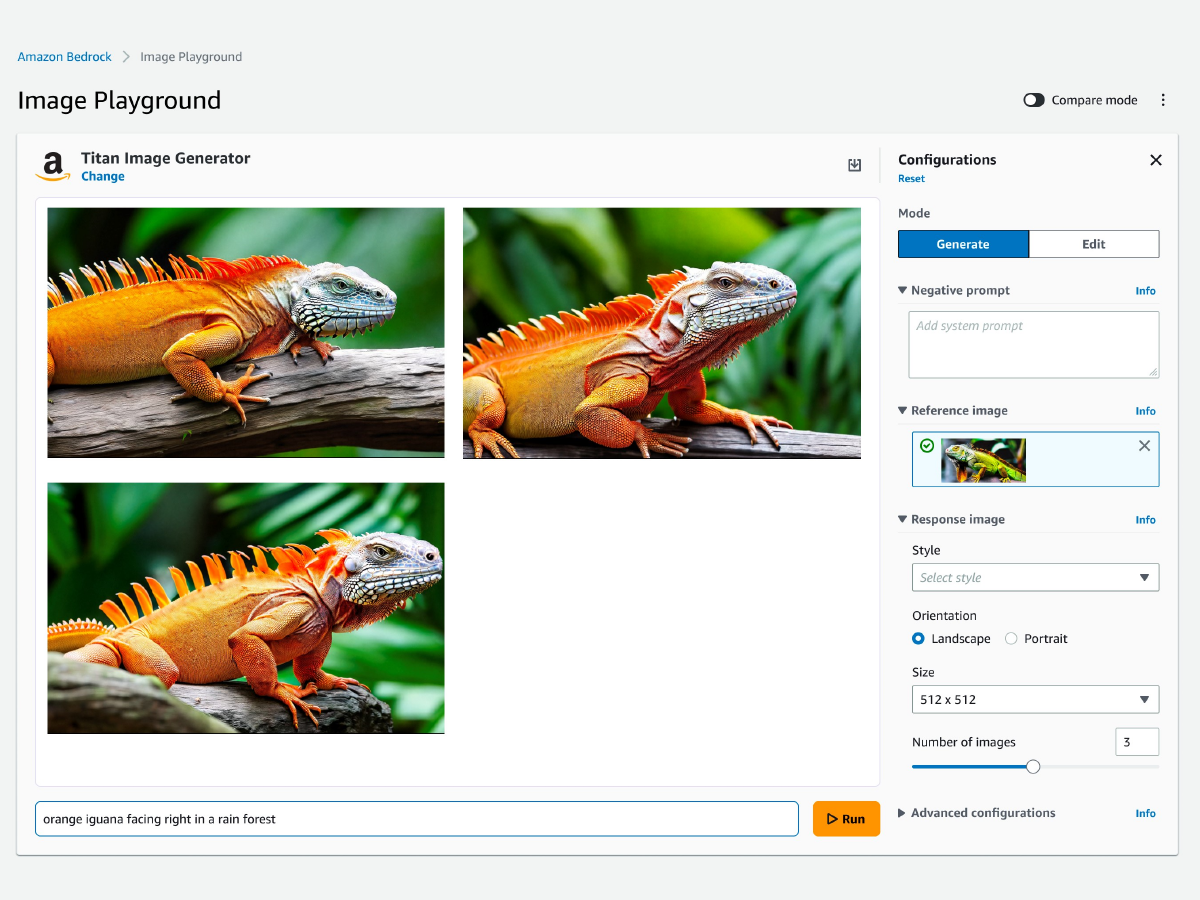
Titan Image Generator (Figure A) is now available in public preview in the U.S. It can be used to create images using natural language prompts. Organizations can customize images with proprietary data to match their industry and brand. Images will be invisibly watermarked by default to help avoid disinformation.

Figure A

An image created by Titan Image Generator.
An image created by Titan Image Generator. Image: AWS

Claude 2.1 and Llama 2 70B now hosted on Amazon Bedrock

Amazon Bedrock will now support Anthropic’s Claude 2.1 for users in the U.S. This version of the Claude generative AI offers advancements in a 20,000 context window, improved accuracy, 50% fewer hallucinations even during adversarial prompt attacks and two times reduction in false statements in open-ended conversations compared to Claude 2. Tool use for function calling and workflow orchestration in Claude 2.1 are available in beta for select early access partners.

Meta’s Llama 2 70B, a public large language model fine-tuned for chat-based use cases and large-scale tasks, is available today in Amazon Bedrock.

Claude assistance available in AWS Generative AI Innovation Center

The AWS Generative AI Innovation Center will expand early in 2024 with a custom model program for Anthropic Claude. The AWS Generative AI Innovation Center is designed to help people work with AWS’ team of experts to customize Claude needs for one’s own proprietary business data.

Additional Amazon Q use cases announced

Sivasubramanian announced a preview of Amazon Q, the AWS natural language chatbot, in Amazon Redshift, which can provide help with writing SQL. Amazon Redshift with Amazon Q lets developers ask natural language questions, which the AI translates into a SQL query. Then, they can run that query and adjust it as necessary.

Plus, Amazon Q for data integration pipelines is now available on the serverless computing platform AWS Glue for building data integration jobs in natural language.

Training and model evaluation tools added to Amazon SageMaker

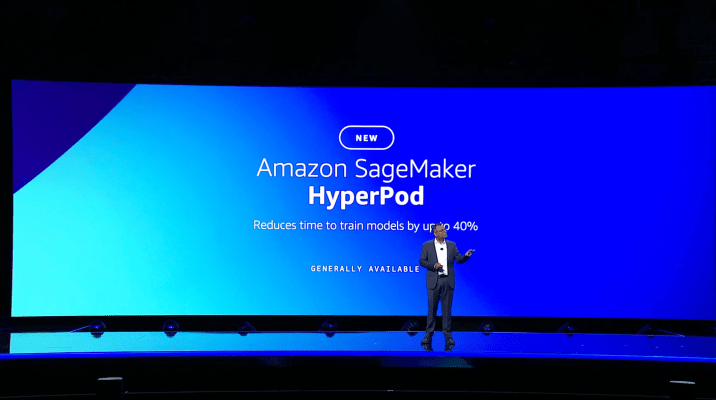
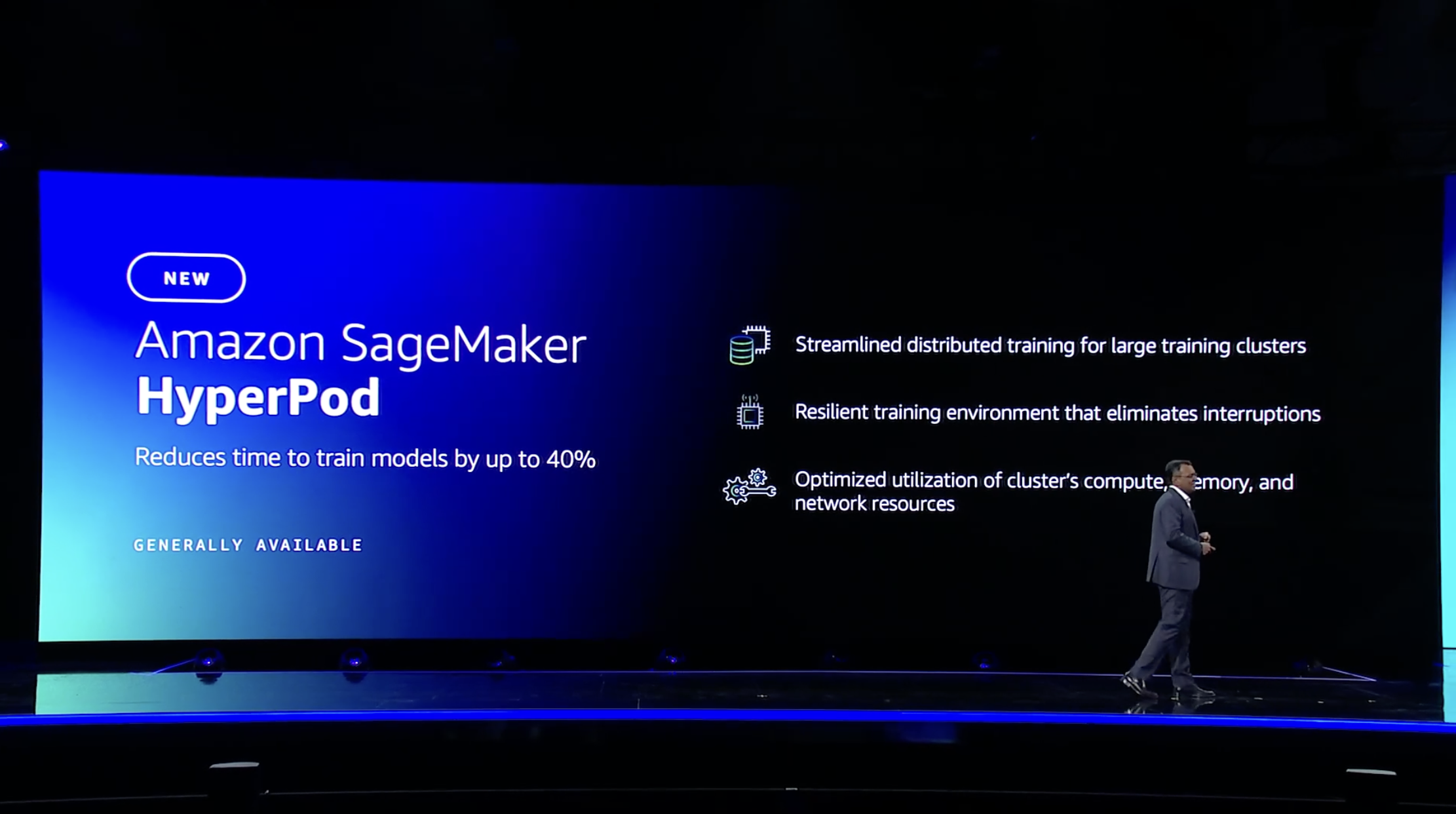
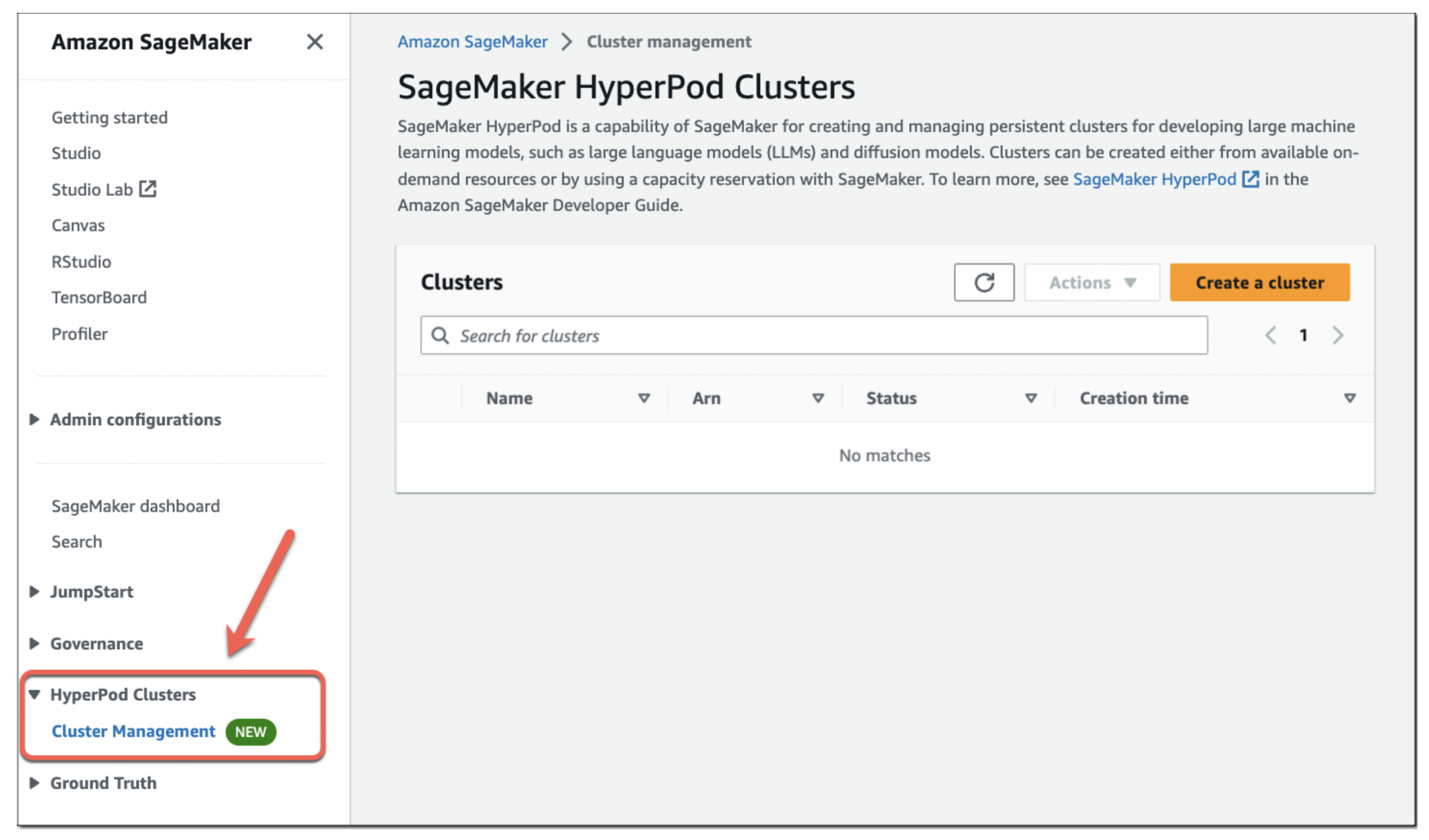
Sivasubramanian announced the general availability of SageMaker HyperPod, a new distributed generative AI training capability to reduce model training time up to 40%. SageMaker HyperPod can train generative AI models on its own for weeks or months, automating the tasks of splitting data into chunks and loading that data onto individual chips in a training cluster. SageMaker HyperPod includes SageMaker’s distributed training pods, managed checkpoints for optimization, the ability to detect and reroute around hardware failures. Other new SageMaker features include SageMaker inference for faster optimization and a new user experience in SageMaker Studio.

Amazon SageMaker and Bedrock now have Model Evaluation, which lets customers assess different foundation models to find which is the best for their use case. Model Evaluation is available in preview.

Vector capabilities and data management tools added to many AWS services

Sivasubramanian announced more new tools around vectors and data management that are suitable for a variety of enterprise use cases, including generative AI.

  • Vector Engine for OpenSearch Serverless is now generally available.
  • Vector capabilities are coming to Amazon DocumentDB and Amazon DynamoDB (out now in all regions where Amazon DocumentDB is available) and Amazon MemoryDB for Redis (now in preview).
  • Amazon Neptune Analytics, an analytics database engine for Amazon Neptune or Amazon S3, is available today in certain regions.
  • Amazon OpenSearch service zero-ETL integration with Amazon S3.
  • AWS Clean Rooms ML, which lets organizations share machine learning models with partners without sharing their underlying data.

“While gen AI still needs a strong foundation, we can also use this technology to address some of the big challenges in data management, like making data easier to use, making it more intuitive and making data more valuable,” Sivasubramanian said.

Note: TechRepublic is covering AWS re:Invent virtually.

How Google and OpenAI prompted GPT-4 to deliver more timely answers

exclamation-gettyimages-171158764

A hallmark of popular generative artificial intelligence programs such as ChatGPT is that they have a time cut-off in terms of which facts they have absorbed. For example, OpenAI recently updated its GPT-4 program to have access to data about events that took place up until April 2023; prior to that update, the tool was trained only on data from as recently as 2021.

AI scientists, however, are working on ways to allow generative AI programs to reliably access ever-changing data about timely and pressing questions, such as, "What is King Gizzard's most recent studio album?" (Answer: The Silver Cord.)

Also: ChatGPT is no longer as clueless about recent events

In that spirit, Google and OpenAI this month published a joint effort called FreshLLM that induces GPT-4 to use information retrieved from Google searches. The core of FreshLLM is a new method for prompting a language model, called "FreshPrompt," which includes results from a search engine.

By including in the input prompt for GPT-4 the top search results from Google, and then showing a valid answer to a query based on those search results, GPT-4 was induced to use evidence from the Web search to craft its output. The result significantly improved the program's answer to questions involving timely information.

"FreshPrompt significantly improves performance over competing search engine-augmented approaches," write lead author Tu Vu of Google and colleagues, in the research paper, "FreshLLMs: Refreshing large language models with search engine augmentation," which is posted on the arXiv pre-print server.

The FreshPrompt technique, however, is only one part of the story. In order to test how GPT-4 and competing programs perform when using Web data, Vu and colleagues had to come up with a list of questions that would pose a challenge with real-world, up-to-date facts.

Also: Generative AI can easily be made malicious despite guardrails, say scholars

To do so, the team — with the help of colleagues and online freelancers —wrote questions about "developments in the world" that were crafted to include what they call "fresh knowledge"— meaning, "knowledge that has changed recently or new events" — and that were also questions "plausible for a real person to type into a search engine."

Examples of some of the 600 questions created by Google and OpenAI scholars to test generative AI's knowledge of fast-changing facts.

They came up with 600 questions, called FreshAQ, that range from never-changing — "Has Virginia Woolf's novel about the Ramsay family entered the public domain in the United States?" — to fast-changing — such as "What is Brad Pitt's most recent movie as an actor?" Most but not all answers are sourced from Wikipedia.

The GitHub code for the project links to a Google Doc spreadsheet of the entire FreshQA database of questions. Reading the list of 600 is an instant shot of trivia immersion. "Which author had the most bestselling novels in the United States last year according to Publishers Weekly?" (Answer: Colleen Hoover.) "How many accounts have exceeded 100 million followers on Instagram?" (Answer: 38).

Also: AWS unveils an AI chatbot for enterprises — here's how to try it out for free

The authors compiled false-premise questions as well, because you have to know that what is asserted in the question itself is not actually the case, such as "What year did the first human land on Mars?"

Predictably, GPT-4, and other large language models tested, such as Google's Pathways Language Model, PaLM, struggled with the FreshQA questions, and did better when they were given the help of FreshPrompt. "This is mainly due to the lack of access to up-to-date information, as they produce 'outdated' answers," note Vu and team. Many programs will refuse to provide an answer.

Adding the FreshPrompt, they relate, "significantly improves FreshQA accuracy" on GPT-4. The technique "dramatically diminishes the presence of outdated and hallucinated answers," they add. On questions of facts beyond 2022, GPT-4's score goes from an abysmal 8% accuracy to 70.2%, they relate. Across all the FreshQA questions, including for older facts, the accuracy rises from 28.6% to 75.6%.

For the false-premise questions, the difference is night and day. The language model has to assert that the question is a false one in order to receive credit. Using the FreshPrompt, GPT-4 went from 33.9% accuracy on false-premise questions to 71%. Granted, that means GPT-4 can still be duped into accepting a false-premise question almost a third of the time.

Also: Is AI lying to us? These researchers built an LLM lie detector of sorts to find out

The authors found that FreshPrompt was able to surpass other research that also uses search engine queries to "augment" language models. That includes, for example, Perplexity.ai, a combination of GPT-3.5 and Bing Search. The average accuracy on Perplexity, across all FreshQA questions, was 52.2% accurate, only a little bit better than random chance. Again, for GPT-4, using FreshPrompt, the authors were able to get 75.6% accuracy.

One important difference, they note, is how many bits of evidence are included in the FreshPrompt from the Web search. More is better, in general. "Our results suggest that the number of retrieved evidences for each question is the most important ingredient for achieving highest accuracy."

The authors note there are some real challenges moving forward. For one thing, it's time-consuming to keep updating FreshPrompt, which involves checking that the answers are still relevant. The team expresses a hope that the open-source community can help, or that updating can be automated by generative AI. For the time being, Vu and team have committed to keeping FreshQA fresh.

Disclosure:Tiernan Ray owns no stock in anything that he writes about, and there is no business relationship between Tiernan Ray LLC, the publisher of The Technology Letter, and any of the companies covered.

Artificial Intelligence

Amazon finally releases its own AI-powered image generator

Amazon finally releases its own AI-powered image generator Kyle Wiggers 11 hours

Amazon is releasing an image generator — joining the ranks of the many, many other tech giants and startups that have already done so.

During a keynote at its re:Invent conference this morning, Amazon debuted Titan Image Generator, which is now available in preview for AWS customers on Bedrock, Amazon’s AI development platform. A part of Amazon’s Titan family of generative AI models, Titan Image Generator can create new images (given a text description) or customize existing images.

“[You] can use the model to easily swap out an existing [image] background to a background of a rainforest [for example],” Swami Sivasubramanian, VP for data and machine learning services at AWS, said onstage. “[And you] can use the model to seamlessly swap out backgrounds to generate lifestyle images, all while retaining the main subject of the image and to create a few more options.”

Amazon says that Titan Image Generator was trained on a “diverse set of datasets” across a “broad range of domains” and can be optionally fine-tuned on custom datasets, and includes built-in mitigations for toxicity and bias. (Barring testing, the jury’s out on just how effective those mitigations are, of course.) The company declined to say exactly where those datasets came from however — and whether it obtained permission from or is compensating all the creators of the images used to train Titan Image Generator.

AWS Titan Image Generator

Image Credits: AWS

Some companies developing image generators, like Stability AI and — as of a few months ago — OpenAI, allow creators to opt out of training datasets if they so choose. Others, including Adobe and Getty Images, are establishing compensation schemes for creators — albeit not always well-paying or transparent ones.

Sivasubramanian did claim onstage, however, that Amazon will protect customers accused of violating copyright with images generated by Titan Image Generator — in keeping with its AI indemnification policy. That’s surely music to the ears of AWS customers worried about regurgitation, or when a generative model spits out a mirror copy of a training example.

In a recent survey of Fortune 500 companies by Acrolinx, nearly a third said that intellectual property was their biggest concern about the use of generative AI. Another poll found that nine out of 10 developers “heavily consider” IP protection when making decisions on whether to use generative AI.

AWS Titan Image Generator

Images generated using AWS’ Titan Image Generator. Image Credits: AWS

“We’re carefully choosing how we train our models and the data we use to do so,” he said. “With these investments, our customers will have the flexibility to select the best models for their requirements even as their needs grow and change.”

Images created with Titan Image Generator will also come with a “tamper-resistant” invisible watermark by default — an attempt to mitigate the spread of AI-generated misinformation and abuse imagery, Sivasubramanian says. (Deepfakes from the Gaza war and AI-generated child abuse images are the latest illustrations of how major the threat’s become.) It’s not clear exactly what sort of watermarking technique Amazon’s using and which tools beyond Amazon’s own API will be able to detect it; we’ve reached out to Amazon for clarification.

Sivasubramanian noted watermarks are a part of the voluntary commitment around AI that Amazon signed with the White House in July. Other signatories, among them Google and Microsoft, have adopted the Content Credentials system developed by the Coalition for Content Provenance and Authenticity or developed their own solutions.

Read more about AWS re:Invent 2023 on TechCrunch

Zephyr: Direct Distillation of LLM Alignment

The ability and performance of smaller, open large language models have advanced significantly in recent years, and we have witnessed the progress from early GPT-2 models to more compact, accurate, and effective LLM frameworks that make use of a considerably larger amount of tokens that the “compute-optimal” amount of tokens recommended by the Chinchilla scaling laws. Furthermore, developers have demonstrated that these smaller LLM frameworks can be trained further using a proprietary-models based dSFT or Distilled Supervised Fine-Tuning approach, that uses the output from an effective teacher model as supervised data for the student model in an attempt to boost the accuracy.

In this article, we will be talking about the Zephyr-7B framework, a state of the art chat benchmark for 7B parameter models that does not require human annotations. The primary aim of the framework is to enable developers to produce smaller large language models that are aligned to the user intent closer than ever before. The Zephyr-7B framework not only examines the application of current approaches for larger LLM frameworks like dSFT, but also explores the possibility of using other approaches to learn a chat model with better alignment with the user intent. We will be taking a deeper dive into the Zephyr framework, and explore its architecture, working, and results. So let’s get started.

Zephyr-7B : An Introduction to Direct Distillation of Alignment in Language Models

As mentioned earlier, language models have progressed rapidly in recent years, from the earlier GPT-2 frameworks to current GPT-4 and MiniGPT-5 LLM frameworks that although are highly token exhaustive, are now more accurate, and much more efficient. A major highlight of these advanced LLM frameworks is that they incorporate a significantly higher amount of tokens than the number of tokens that were earlier considered to be computationally optimal under the Chinchilla scaling laws. Furthermore, developers and researchers working on LLM frameworks have learned that these smaller LLM frameworks can be trained further using a proprietary-models based dSFT or Distilled Supervised Fine-Tuning approach, that uses the output from an effective teacher model as supervised data for the student model in an attempt to boost the accuracy. The distillation strategy has proven itself to be a highly effective, and useful tool to maximize the potential and abilities of open models on a wide array of tasks, although it yet cannot replicate the performance achieved by the teacher model. Additionally, users have often reported that these models often display “intent misalignment”, meaning the models do not behave in a manner that aligns with the requirements of the end users, leading to incorrect outputs that do not provide the right output or responses to the user inputs or queries.

Intent alignment has always been a major challenge for developers with recent works focusing on development of benchmarks like AlpacaEval and MT-Bench developed to target the misalignment. The motivation for developing the Zephyr framework can be credited to the problem of using distillation to align a small open LLM framework entirely where the primary step is to utilize an AIF or Artificial Intelligence Feedback to obtain preference data from an ensemble of the teacher model, and then applying distilled preference optimization directly as the primary learning objective, an approach that is referred to as dDPO or Denoising Diffusion Policy Optimization. The main highlight of the dDPO approach is that unlike its predecessors like PPO or Proximal Preference Optimization, it does not require human sampling or annotations, and also reduces the time it takes to train a language model. Furthermore, it also allows developers to maximize the rewards of the final sample by paying close attention to the sequence of the denoising steps right from the beginning till the end, in other words, throughout its entirety.

Developers have developed the Zephyr-7B framework to validate this approach, and in some ways, it is an aligned version of the state of the art Mistral-7B framework. The framework first uses dSFT or Distilled Supervised Fine-Tuning based on the UltraChat dataset, and applies the dDPO or Denoising Diffusion Policy Optimization approach on the feedback data. Experiments indicate that the Zephyr-7B framework with 7 billion parameters delivers results comparable to the one delivered by human-feedback aligned chat models with over 70 billion parameters. Furthermore, experiments also indicate that results can be improved both in terms of benchmarks that take conversational capabilities into account, as well as standard academic benchmarks, and the use of preference learning is critical to achieve the desired results.

The above figure demonstrates the performance of various language models on the MT-bench benchmark. The Zephyr-7B framework that is trained using the dDPO approach is put up against proprietary as well as open-access, larger language models like GPT-3.5 turbo, Llama-2-70B, and more that were trained using additional reinforcement learning, and also included a huge amount of human feedback. As it can be clearly seen that despite the sheer difference in the number of parameters that these frameworks use, the Zephyr-7B framework delivers comparable results against most of them, and outperforms several frameworks in different domains.

Zephyr-7B : Method, Working and Architecture

The primary goal of the Zephyr-7B framework is to help an open-source large language model align as close as possible to the user intent, and throughout its entirety, the Zephyr-7B framework assumes access to a large teacher model that is queried using prompt generation. The Zephyr-7B follows an approach similar to the one used in the InstructGPT framework, and aims to generate an effective, and accurate student model.

The following figure briefly demonstrates the three primary steps involved in the working of the Zephyr-7B framework.

  1. dSFT for large-scale dataset construction using a self-instruction style.
  2. AIF collection using an ensemble of completing chat models followed by preference binarization, and scoring by GPT-4.
  3. dPO of the dSFT model by making use of the feedback data.

dSFT or Distilled Supervised Fine-Tuning

The framework starts with a raw Large Language Model that first needs to be trained to respond to user prompts. Traditionally, training these LLM frameworks to respond to user prompts is done using SFT or Supervised Fine Tuning on a dataset consisting of high-quality instructions, and their corresponding responses. Since, the Zephyr-7B framework has access to a teacher language model, the framework can generate instructions and responses, and train the model directly on these instructions and responses, and this approach is known as dSFT or distilled SFT. The following figure demonstrates the distillation performed by SFT where x represents a set of seed prompts constructed with the primary purpose of representing a diverse set of topical domains, y represents the sample response, that is refined using a new sample instruction represented by x1 and C represents the end point in the final dataset.

AI Feedback through Preferences

Human feedback is used to assign Large Language Models as they can provide the required additional signals, and these human feedbacks are traditionally provided through preferences on the quality of the responses generated by the LLM frameworks. However, the Zephyr framework uses AI Feedback from the teacher model on other models’ generated outputs instead of human feedback for distillation purposes. The approach followed by the Zephyr framework is influenced by the one used by the UltraFeedback framework that uses the teacher model to provide preferences on the outputs of the model.

Similar to the SFT or Supervised Fine Tuning approach, it starts with a set of prompts, where x represents every individual prompt that is then fed to a collection of four models like Llama, Falcon, Claude, and more, each of which generate a response of their own. These responses are then fed as an input to the teacher model like GPT-3 or GPT-4, and the model outputs a score for the input response. After collecting the output scores, the model saves the response with the highest score.

dDPO or Distilled Direct Preference Optimization

dDPO is the final step of the Zephyr framework, and its primary goal is to refine the dSFT teacher model by maximizing the probability of ranking the preferred response in a preference model that is determined by a reward function by utilizing the student language model. The previous step involving the use of AI feedback focussed primarily on using Reinforcement Learning methods like PPO or Proximal Policy Optimization for maximum optimization with respect to the reward generated. In this step, the reward is first trained, and then sampled from the current policy to calculate the updates, and thus maximizing the optimization. DPO or Direct Preference Optimization follows a similar approach to optimize the preference model directly using the static data. The objective after plugging the reward function into preference model can be written as

Zephyr-7B : Experiments, Benchmarks and Results

The Zephyr framework conducts its fine-tuning experiments on the current state of the art Mistral-7B framework that delivers comparable performance to much larger language models on a wide array of natural language processing or NLP tasks.

Datasets

The Zephyr framework makes use of two dialogue datasets that have been distilled from a mixture of proprietary and open models, that have previously proved themselves to be effective in producing effective chat models.

UltraChat

UltraChat is a self-refinement dataset that consists of nearly 1.5 million multi-turn dialogues spread over 30 topics, and 20 text materials generated by the GPT-3.5-Turbo framework. To tackle the incorrect capitalization issue faced by the UltraChat dataset, the framework applies a truecasing heuristics approach to get rid of the grammatical errors.

UltraFeedback

The UltraFeedback is a prompt dataset with over 64k prompts, with each of these prompts having four individual LLM responses. The Zephyr framework uses the highest mean score obtained from the UltraFeedback dataset to construct binary preferences, and one of the remaining three LLM responses is rejected as random.

Evaluation

To evaluate the performance of the Zephyr framework, developers have opted for two chat benchmarks, one single-turn, and one multi-turn, in an attempt to evaluate the ability of the model to follow user instructions, and respond accordingly.

MT-Bench

The MT-Bench evaluation benchmark consists of 160 questions spread over 8 unique knowledge areas, and under the MT-Bench benchmark, the model has to answer an initial question, and provide a response on the follow-up question.

AlpacaEval

AlpacaEval is a single-turn benchmark under which the model or the framework generates user responses to over 800 questions spread across different topics with the primary focus being on helpfulness.

In addition to these two primary benchmarks, the Zephyr-7B framework is also evaluated on Open LLM Leaderboard for multiclass classification tasks, ARC, HellaSwag, MMLU, and more. Furthermore, regardless of what benchmark the Zephyr-7B framework is evaluated on, it is compared against a range of proprietary and open models, with their alignment procedures being the only differentiating factor.

Results

Let’s now have a look at how the Zephyr-7B framework performs, and compares against current state of the art language models.

Implementation of dDPO Approach Boosts Chat Capabilities

The following table compares the performance of the Zephyr-7B framework against state of the art language models on the AlpacaEval, and MT-Bench benchmarks.

As it can be clearly seen, when put against open 7B models, the Zephyr-7B framework not only significantly outperforms dSFT models across the two benchmarks, but also sets new state of the art standards. Furthermore, the Zephyr-7B framework also manages to outscore the XWIN-LM-7B framework, which is one of the rare models trained on the dPPO or distilled PPO approach. Furthermore, the performance delivered by the Zephyr-7B framework is comparable to the results delivered by much larger language models like Llama2-Chat with over 70B parameters.

dDPO Boosts Academic Task Performance

The following figure compares the performance of the Zephyr-7B framework against a wide array of open-source, and proprietary LLM frameworks.

As it can be seen, the Zephyr-7B framework significantly outperforms LLM frameworks with 7B parameters, and the gap between its performance, and the one delivered by the best performing dSFT models is also noticeable. As the number of parameters increases, the Zephyr-7B framework does fall short, although it matches the performance delivered by frameworks with 40 billion parameters.

Preference Optimization

In the following figure, we evaluate how the different steps followed in the alignment process impacts the performance. As it can be observed, the dDPO approach when combined with dSFT significantly boosts the performance on both the MT-Bench and AlpacaEval datasets.

Finally, in the following figure we can see the testing and training accuracies during the DPO implementation. As it can be seen, the DPO approach does not affect the performance of the model on downstream tasks.

Conclusion

In this article, we have talked about the Zephyr-7B framework based on the current state of the art Mistral-7B framework that aims to solve the current challenge of alignment distillation from a large language model to a much smaller pretrained framework. The primary aim of the framework is to enable developers to produce smaller large language models that are aligned to the user intent closer than ever before. The Zephyr-7B framework not only examines the application of current approaches for larger LLM frameworks like dSFT, but also explores the possibility of using other approaches to learn a chat model with better alignment with the user intent.

However, despite the promising results, the Zephyr-7B framework is not perfect, and some work still needs to be done. One of the obvious limitations is using the GPT-4 framework to evaluate MT-Bench and AlpacaEval benchmarks, which has often been biased towards the models it distills itself. However, the Zephyr-7B framework hopes to carve a way for exploring the capabilities of smaller open models that are capable of aligning with the user intent and interactions.

Perplexity AI Introduces New Online LLMs for Real-Time Information Access 

Perplexity AI Seeks Funds for $500 Mn Valuation

AI Startup Perplexity AI has introduced two new PPLX online models: pplx-7b-online and pplx-70b-online, which can tap into real time information from the internet, enabling them to deliver accurate responses to time sensitive queries.

For instance, these models can provide up-to-date information on sports scores, stock prices, or the latest developments from Google News.

Excited to announce that pplx-api is coming out of beta and moving to usage based pricing, along with the first-ever live LLM APIs that are grounded with web search data and have no knowledge cutoff! https://t.co/VYXIjqdLy9

— Aravind Srinivas (@AravSrinivas) November 29, 2023

The models are publicly available via pplx-api, making it a first-of-its-kind API. pplx-7b-online and pplx-70b-online are also accessible via Perplexity Labs, our LLM playground.

The operational framework of Perplexity’s online LLMs involves leveraging open-sourced models, specifically the mistral-7b and llama2-70b base models. Moreover, the process includes utilising in-house search technology and fine-tuning the models to achieve enhanced performance.

The integration of an in-house search infrastructure facilitates the extraction of the most relevant and up-to-date information from the web. The snippets, or website excerpts, obtained through this process play a pivotal role in informing the responses generated by the models.

Initial tests conducted by the company show that Perplexity’s online LLMs not only match but also surpass the capabilities of leading proprietary LLMs, such as GPT-3.5. These assessments cover benchmarks evaluating robustness, helpfulness, and knowledge across various academic subjects.

Traditional LLMs often struggle to provide up-to-date information and are susceptible to generating inaccurate statements, commonly referred to as “hallucinations. The newly introduced pplx-7b-online and pplx-70b-online models aim to overcome these hurdles by not only offering helpful and factual responses but also ensuring the information is current.

CEO Aravind Srinivas, a former research scientist at OpenAI, co-founded Perplexity with former Meta research scientist Denis Yarats, who now serves as the company’s CTO. The company’s user base has recently reached 15,000 paying customers.

The post Perplexity AI Introduces New Online LLMs for Real-Time Information Access appeared first on Analytics India Magazine.

KDnuggets News, November 29: 5 Free Courses to Master Machine Learning • Stunning Data Viz with ChatGPT

Visit KDnuggets for more Data Science, Machine Learning, AI & Analytics, including:

Features 5 Free Courses to Master Machine Learning
Bala Priya C Create Stunning Data Viz in Seconds with ChatGPT
Abid Ali Awan

This Week's Posts

Will AI Replace Humanity?
Vidhi Chugh Soft Skills Every Data Scientist Needs
Nate Rosidi A Comprehensive List of Resources to Master Large Language Models
Kanwal Mehreen Remote Work in Data Science: Pros and Cons
Nahla Davies Back to Basics Week 4: Advanced Topics and Deployment
Nisha Arya From CSV to Complete Analytical Report with ChatGPT in 5 Simple Steps
Cornellius Yudha Wijaya Mastering Web Scraping with BeautifulSoup
Nate Rosidi How Big Data Is Saving Lives in Real Time: IoV Data Analytics Helps Prevent Accidents
Zaki Lu 11 Python Magic Methods Every Programmer Should Know
Bala Priya C

More On This Topic

  • Create Stunning Data Viz in Seconds with ChatGPT
  • KDnuggets News, November 2: The Current State of Data Science…
  • KDnuggets News, December 14: 3 Free Machine Learning Courses for…
  • 365 Data Science courses free until 18 November
  • 365 Data Science courses free until November 21
  • 5 Free Courses to Master Machine Learning

I tested Doritos Silent and the AI-powered app did indeed cancel all my crunches

Doritos Silent app

If you've ever been tempted to sneak a snack during a work call but were scared your crunch would give you away, there could be an answer

Available today, Doritos has launched what it calls "Doritos Silent" — an AI-powered crunch-canceling app.

Also: The 5 best gaming PCs you can buy

How do you train AI to cancel crunches? According to the company, Doritos enlisted approximately 500 people to crunch chips (official Doritos, of course) into a microphone 10 times each. These 5,000 crunches were fed into an AI to train it to identify what that sounded like, in order to ensure that the noise could be isolated. Then those sounds were mixed with the sounds of people talking to simulate what it would sound like if someone was munching while talking.

While the app is intended for gamers who may spend hours at a time communicating through headsets, it claims to work on anything that accepts a microphone, including Zoom, Google Voice, and Discord. Once the app is installed, it functions by essentially replacing your default microphone. You'll need to head into the settings of whatever program you're using and switch the mic to "Doritos Silent" to take advantage of the feature.

It also works, the company said, on any crunchy snack — not just Doritos.

As silly as this is, I had to test it for myself. After installing the program, I fired up Google Voice and gave my cell phone a call. Under normal conditions, my chip crunching did admittedly get annoying fast. But when I flipped the switch, the sounds disappeared. I tried several snacks, and each one was now perfectly silent over the call.

Also: 4 Zoom alternatives with better video conferencing privacy policies

I tried to trick the program with what I felt was a pretty convincing fake crunch sound, but the AI didn't believe me and let the sound slide.

Unfortunately, the app is only available right now for Windows PCs, but support for other devices is coming. Equally unfortunate, there's no AI answer yet for the video of you stuffing your face on a Zoom call — but that's what the "Camera off" button is for.

Artificial Intelligence

Amazon SageMaker HyperPod makes it easier to train and fine-tune LLMs

Amazon SageMaker HyperPod makes it easier to train and fine-tune LLMs Frederic Lardinois @fredericl / 9 hours

At its re:Invent conference today, Amazon’s AWS cloud arm announced the launch of SageMaker HyperPod, a new purpose-built service for training and fine-tuning large language models (LLMs). SageMaker HyperPod is now generally available.

Amazon has long bet on SageMaker, its service for building, training and deploying machine learning models, as the backbone of its machine learning strategy. Now, with the advent of generative AI, it’s maybe no surprise that it is also leaning on SageMaker as the core product to make it easier for its users to train and fine-tune LLMs.

Image Credits: AWS

“SageMaker HyperPod gives you the ability to create a distributed cluster with accelerated instances that’s optimized for disputed training,” Ankur Mehrotra, AWS’ general manager for SageMaker, told me in an interview ahead of today’s announcement. “It gives you the tools to efficiently distribute models and data across your cluster — and that speeds up your training process.”

He also noted that SageMaker HyperPod allows users to frequently save checkpoints, allowing them to pause, analyze and optimize the training process without having to start over. The service also includes a number of fail-safes so that when a GPUs goes down for some reason, the entire training process doesn’t fail, too.

“For an ML team, for instance, that’s just interested in training the model — for them, it becomes like a zero-touch experience and the cluster becomes sort of a self-healing cluster in some sense,” Mehrotra explained. “Overall, these capabilities can help you train foundation models up to 40% faster, which, if you think about the cost and the time to market, is a huge differentiator.”

Image Credits: AWS

Users can opt to train on Amazon’s own custom Trainium (and now Trainium 2) chips or Nvidia-based GPU instances, including those using the H100 processor. The company promises that HyperPod can speed up the training process by up to 40%.

The company already has some experience with this using SageMaker for building LLMs. The Falcon 180B model, for example, was trained on SageMaker, using a cluster of thousands of A100 GPUs. Mehrotra noted that AWS was able to take what it learned from that and its previous experience with scaling SageMaker to build HyperPod.

Image Credits: AWS

Perplexity AI’s co-founder and CEO Aravind Srinivas told me that his company got early access to the service during its private beta. He noted that his team was initially skeptical about using AWS for training and fine-tuning its models.

“We did not work with AWS before,” he said. “There was a myth — it’s a myth, it’s not a fact — that AWS does not have great infrastructure for large model training and obviously we didn’t have time to do due diligence, so we believed it.” The team got connected with AWS, though, and the engineers there asked them to test the service out (for free). He also noted that he has found it easy to get support from AWS — and access to enough GPUs for Perplexity’s use case. It obviously helped that the team was already familiar with doing inference on AWS.

Srinivas also stressed that the AWS HyperPod team focused strongly on speeding up the interconnects that link Nvidia’s graphics cards. “They went and optimized the primitives — Nvidia’s various primitives — that allow you to communicate these gradients and parameters across different nodes,” he explained.

Read more about AWS re:Invent 2023 on TechCrunch

Google DeepMind Unveils New AI Tool to Discover New Materials 

Google DeepMind and Lawrence Berkeley National Laboratory researchers recently introduced Graph Networks for Materials Exploration (GNoME), an AI tool to discover new materials and predict material stability.

“We are releasing 381K stable materials to help scientists pursue materials discovery breakthroughs,” said Pushmeet Kohli, head of research (AI for science, robustness and reliability) at DeepMind.

Check out the GitHub repository here.

With this, Google DeepMind looks to accelerate the discovery of stable materials for new technologies, alongside eliminating the need for slow and expensive traditional methods of material discovery.

So far, GNoME is said to have discovered over 2.2 million new materials, including 380,000 stable materials – i.e. equivalent to nearly 800 years’ worth of knowledge. It is said that these materials could power future technologies like superconductors, supercomputers, next-generation batteries and more.

(Source: Google DeepMind)

Interestingly, the team boosted the discovery rate of materials stability prediction from around 50% to 80%. Moreover, the GNoME project looks to drive down the cost of discovering new materials significantly.

(Source: Google DeepMind)

GNoME uses graph networks and deep learning to predict the stability of new materials. It is said to combine two pipelines: structural (creating candidates with structures similar to known crystals) and compositional (a randomised approach based on chemical formulas). The predictions are evaluated using Density Functional Theory calculations.

The post Google DeepMind Unveils New AI Tool to Discover New Materials appeared first on Analytics India Magazine.