Indian Railways Introduces ‘Gajraj Suraksha’ AI to Prevent Elephant-Train Collisions

Indian Railways Introduces 'Gajraj Suraksha' AI to Prevent Elephant-Train Collisions

To address the alarming rise in elephant casualties due to train collisions, Indian Railways has unveiled ‘Gajraj Suraksha,’ an indigenously developed AI-based technology. Over the past decade, approximately 200 elephants have lost their lives in such accidents, posing a dual threat to wildlife and railway operations.

The urgency of the situation is underscored by a recent tragic incident. Three elephants were killed in a collision with a parcel train in the forest of Buxa Tiger Reserve in West Bengal. The incident occurred early in the morning between Rajabhatkhawa and Kalchini railway stations, emphasising the critical need for proactive measures to safeguard wildlife and improve railway safety.

Gajraj Suraksha functions as an Intrusion Detection System (IDS) and employs an AI algorithm along with a network of Optical Fibre Cables (OFC). Boasting a detection rate of 99.5%, it aims to provide a swift and effective solution to the long-standing issue of elephant-train collisions.

It operates by sensing pressure waves generated by the movement of elephants along railway tracks. Optical fibres, strategically placed, detect vibrations caused by the footsteps of elephants. These vibrations trigger signals within the OFC network, enabling the system to identify the presence of elephants up to 200 metres ahead of their arrival on the track.

Union Minister of Railways, Ashwini Vaishnaw, has announced plans to deploy Gajraj Suraksha in key regions, including West Bengal, Odisha, Jharkhand, Assam, Kerala, certain parts of Chhattisgarh, and Tamil Nadu. The Northeast Frontier Railways has been chosen to pilot the program in some of the worst-affected areas.

The technology is not only effective but also cost-efficient. With an estimated implementation cost of Rs 181 crores for a vast network spanning 700 kilometres of railway tracks, it presents a viable and scalable solution for Indian Railways. The goal is to deploy Gajraj Suraksha across all elephant corridors in the country within the next 8 months.

Gajraj Suraksha ensures a quick and accurate communication chain. The system sends alarms to station masters whenever movement is detected along the tracks, allowing them to promptly inform locomotive drivers in the affected areas. This proactive approach aims to reduce the number of elephant casualties caused by train accidents significantly.

The technology is already fully operational along a specific stretch covering approximately 70 kilometres in the Northeast Frontier Railways. Authorities believe that this indigenous solution will mark a significant stride in protecting wildlife and enhancing the safety of railway operations.

The post Indian Railways Introduces ‘Gajraj Suraksha’ AI to Prevent Elephant-Train Collisions appeared first on Analytics India Magazine.

Business Intelligence vs Data Analytics vs Artificial Intelligence: What are the differences?

Defining the differences between business intelligence, artificial intelligence and analytics often poses a challenge to many people. For many business processes, there seems to be so much overlap that it’s difficult to know where one technology ends and the other begins — or even whether these technologies can be used concurrently.

What is business intelligence?

Business intelligence is a broad category of information management, analysis and reporting that operates on both structured and unstructured data. BI can also yield insights for organizations about their markets, the “fit” of their products and services in these markets and the effectiveness of their internal operations.

SEE: Explore our list of the best business intelligence tools.

The business intelligence toolkit is far-reaching. It can include:

  • Standard reporting is the generation of regular, routine reports, such as financial statements, sales performance and other key metrics, that provide ongoing insights into business operations.
  • Analytics reporting goes beyond standard reporting by analyzing data to uncover deeper insights, trends and patterns.
  • Data mining involves exploring large datasets to discover meaningful patterns, correlations and insights, often utilizing statistical methods and machine learning.
  • Dashboards are user-friendly, visual representations of key metrics and data points that provide a quick and easy way to monitor business performance at a glance.
  • Performance management involves tracking and managing the performance of the organization against its objectives.
  • Implementations of artificial intelligence in BI involve using machine learning algorithms and other AI technologies to automate data analysis.

Collectively, it is the orchestration and implementation of all of these technologies that comprise the operations of business intelligence for an organization.

What is artificial intelligence?

Artificial intelligence is a technology that uses pattern-recognition to perform tasks that require human intelligence at a scale that would be difficult or impossible for humans. In business intelligence, AI often combines insights from human experts, including subject matter experts and research, with machine learning algorithms to identify patterns in data. The AI then begins to draw inferences based on this.

PREMIUM: Take advantage of this AI architect hiring kit.

AI relies heavily on complex statistical algorithms developed by data scientists to interrogate an array of both structured and unstructured data. In this way, AI can produce insights for decision support. It can even be used to autonomously operate processes without human intervention.

For example, one use case for AI is in the credit card industry, where a system is trained to look at consumer card usage patterns and identify possibly fraudulent behavior.

What is analytics?

Analytics operates on both structured and unstructured data to support corporate decision-making. It uses standard report-style queries as well as more complex AI algorithms that find unique patterns in data and deduce insights from them.

Several types of analytics are widely used across organizations — from marketing, to operations, finance, customer service, IT and human resources. Analytics can be:

  • Diagnostic: This type of analytics investigates the causes of past events or outcomes, which helps users understand the factors or actions that gave rise to a particular result. For example, a rise in sales in the last quarter.
  • Descriptive: In descriptive analytics, historical data is summarized and interpreted to understand an event or outcome. For instance, did the company meet its KPIs?
  • Predictive: This type of analytics uses data statistical methods and machine learning algorithms to predict future outcomes based on historical data. For example, manufacturers can use predictive algorithms to monitor for infrastructure failure.
  • Prescriptive: Prescriptive analytics goes beyond predicting future events to suggesting actions that can be taken to influence desired outcomes. For example, analyzing online past buyer behavior and influences.

What are the differences between BI, AI and analytics?

BI, AI and analytics all deliver insights that enable organizations to perform better, predict the future and meet the needs of their markets. However, there are some fundamental differences between these concepts in scope and function.

Business intelligence is an overarching framework for analytics and AI. In contrast, analytics can be used in more of a stand-alone fashion if desired. For instance, a sales team may purchase analytics software, so it can assess markets.

AI automates reasoning processes to either eliminate or reduce human work. For example, an industrial robot with onboard AI may perform an operation on a manufacturing assembly line that a human formerly carried out.

Can you use BI, AI and analytics together?

Analytics and AI can be integrated into a larger BI framework, but they don’t have to be. The advantage of integrating analytics tools and AI into a BI tech stack is that you have an end-to-end data management, decision-making and operational infrastructure for your enterprise.

If you choose to do this, the first step is to develop the BI framework that will accommodate both the analytics and the AI. The next step is to populate this framework. For example, where in your organization are you going to use analytics, where will you automate with AI and how will you facilitate data sharing throughout your entire company?

Sam Altman’s officially back at OpenAI — and the board gains a Microsoft observer

Sam Altman’s officially back at OpenAI — and the board gains a Microsoft observer Kyle Wiggers 10 hours

Sam Altman is officially back as OpenAI’s CEO after a tumultuous week and change. And OpenAI officially has a new board of directors, replacing most of the board that attempted to oust Altman in the days leading up to Thanksgiving.

In a letter circulated internally at OpenAI and subsequently published to the OpenAI blog, Altman announced that Mira Murati, who was briefly appointed interim CEO by the previous board, will return to her role as CTO, and confirmed that the initial new board will consist of Bret Taylor, the former co-CEO of Salesforce; Quora CEO D’Angelo, who served on the previous board; and economist and political veteran Larry Summers.

Microsoft will also gain representation on the board in the form of a non-voting observer. (Microsoft is a major investor in OpenAI, with a 49% stake in the for-profit OpenAI entity that a nonprofit to which the board belongs controls.) It wasn’t immediately clear who this observer might be — only that they won’t have an official vote in board business.

“I’ve never been more excited about the future,” Altman wrote. “I’m extremely grateful for everyone’s hard work in an unclear and unprecedented situation, and I believe our resilience and spirit set us apart in the industry.”

In the letter, Altman lays out OpenAI’s priorities going forward, chiefly advancing OpenAI’s research plan and “further investing” in its AI safety efforts. The initial board’s members will also work to build out a board of “diverse perspectives,” Altman promises, making unspecified “improvements” to OpenAI’s governance structure and overseeing an independent review of recent events.

“It’s important that people get to experience the benefits and promise of AI, and have the opportunity to shape it,” Altman said. “We continue to believe that great products are the best way to do this. I’ll work with [OpenAI leadership] to ensure our unwavering commitment to users, customers, partners and governments around the world is clear.”

The turbulent recent saga at OpenAI began when the old board — Altman, OpenAI chief scientist Ilya Sutskever, OpenAI president Greg Brockman, tech entrepreneur Tasha McCauley, D’Angelo and Helen Toner, director at Georgetown’s Center for Security and Emerging Technologies — abruptly canned Altman without notifying just about anyone, including the bulk of OpenAI’s 770-person workforce. The move infuriated Microsoft and OpenAI’s other investors, put the company’s rumored stock sale at risk and led to the vast majority of OpenAI employees, including Sutskever, pledging to quit unless Altman was swiftly reinstated.

At issue, reportedly, were disputes between the previous board and Altman over OpenAI’s direction. Publicly, that board accused Altman of “not [being] consistently candid” with board members. Privately, Altman was said to have been critical of Toner over a paper she co-authored that cast OpenAI’s approach to safety in a critical light and frustrated Sutskever by rushing the launch of AI-powered features at OpenAI’s first developer conference, DevDay.

In a post on X (formerly Twitter), Altman specifically addressed reporting that D’Angelo had a conflict of interest that might’ve spurred Altman’s removal, saying that D’Angelo has “always been very clear … about the potential conflict” and “[done] whatever he needed to do … to avoid conflicted decision-making.” (Quora’s Poe chatbot-aggregating service is perceived by some as competing with OpenAI’s products.)

“We expect that if OpenAI is as successful as we hope, it will touch many parts of the economy and have complex relationships with many other entities in the world, resulting in various potential conflicts of interest,” Altman continued in the post. “The way we plan to deal with this is with full disclosure and leaving decisions about how to manage situations like these up to the board.”

Couchbase Announces Capella for Real-Time Data Analytics

Couchbase Announces Capella for Real-Time Data Analytics

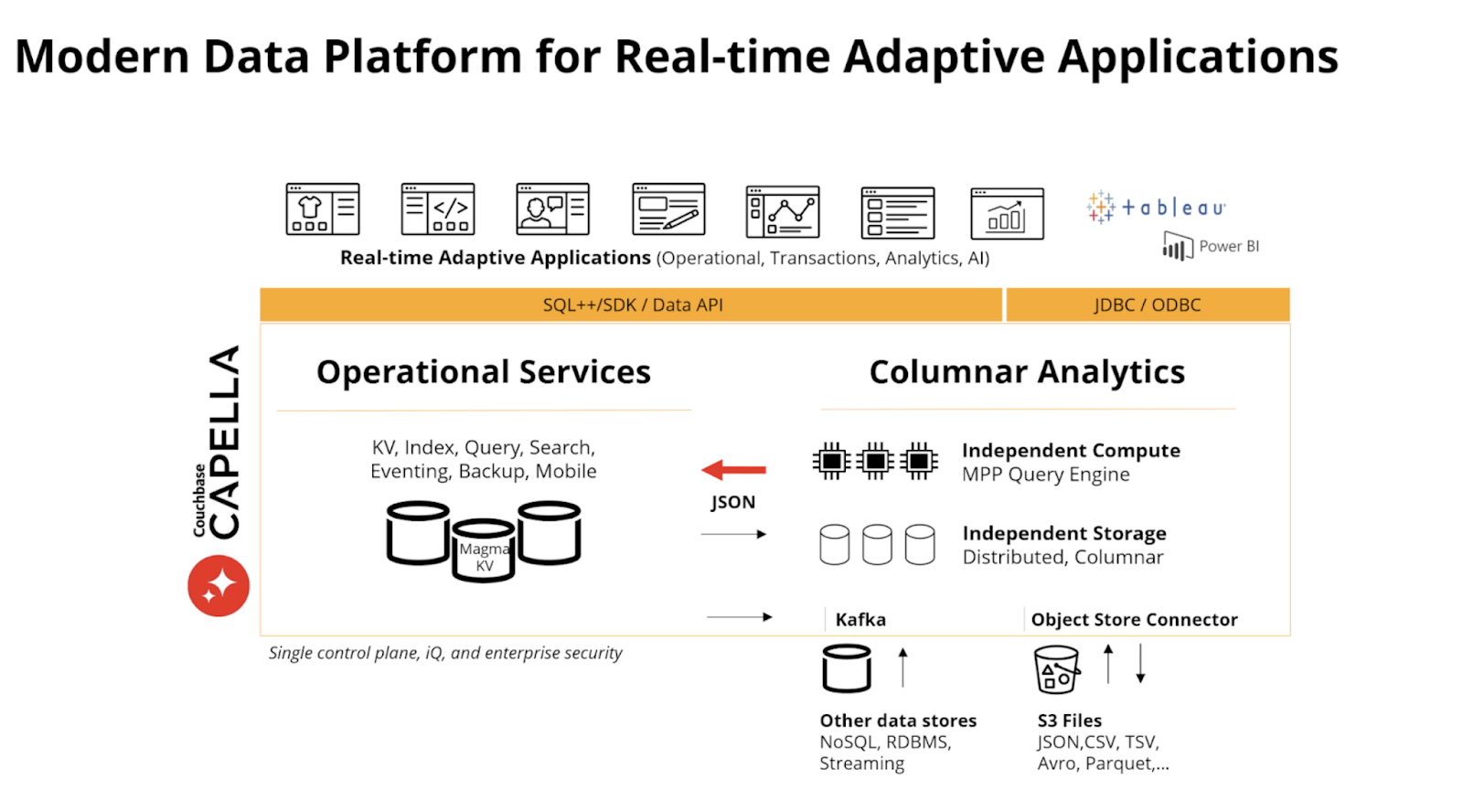
At AWS re:Invent, Couchbase has introduced the Capella columnar service, a revolutionary addition to its cloud data platform aimed at empowering organisations to construct modern, real-time adaptive applications. The Capella columnar service, revealed today, incorporates a columnar store and extensive data integration within Couchbase’s database-as-a-service (DBaaS).

This integration facilitates real-time data analysis on the same platform utilised for operational application workloads.

Traditional hurdles in the database industry surrounding the reconciliation of real-time analytics and operational applications have impeded true real-time data analytics. Couchbase acknowledges this longstanding problem and strives to overcome it through the Capella columnar service.

Capella columnar emerges as a game-changer by seamlessly integrating operational and real-time analytic applications into a unified database platform. This convergence eliminates friction, enabling the delivery of superior customer experiences, particularly those involving artificial intelligence. These experiences, termed “adaptive applications,” offer contextualised hyper-personalization driven by real-time analytic calculations.

A major innovation of the Capella columnar service is its ability to eliminate the write-back latency gap for operational applications. This entails writing back real-time analytic results immediately to the operational database and the associated applications it serves.

Key Features of Capella Columnar

A column-oriented, Log-Structured Merge (LSM) plus B-tree structured storage engine for expanded analytic performance and capacity. Enhanced MPP-based computation engine supporting real-time calculations regardless of data size.

Real-time ingestion capabilities powered by Apache Kafka for seamless data capture and extraction. File-based reads, imports, and exports for data stored in AWS S3, supporting various formats. Conversational coding using Capella iQ for natural language interactions with ChatGPT for SQL++ development.

Native support for Tableau and PowerBI for analytic development and visualisation. New data APIs to read and write analytic measures back to operational applications.

Addressing a potential comparison, Couchbase emphasises that Capella Columnar offers specialised and optimised storage containers for both transactional operational data and analytic data, providing better performance and scalability compared to MongoDB Atlas.

The announcement also delves into the concept of adaptive applications, which dynamically adjust behaviour and features based on user preferences, environmental conditions, and real-time data inputs. Couchbase’s Capella columnar service aims to support the development of adaptive applications with its unique capabilities.

Capella Columnar promises to deliver tangible benefits to customers.

  • Improved agility and performance with fast, schemaless ingestion within Capella-powered applications.
  • Stream ingestion from enterprise data sources in real time, allowing for a variety of data analysis in a single statement.
  • Increased ease of use for developers with a unified SQL++ query language across operational and analytic applications.
  • Reduced complexity and cost by converging operational and real-time analytics in one data platform.

The post Couchbase Announces Capella for Real-Time Data Analytics appeared first on Analytics India Magazine.

AWS and Nvidia Talk 65 Exaflop ‘Ultra-Cluster’ at re:Invent

AWS and Nvidia Talk 65 Exaflop ‘Ultra-Cluster’ at re:Invent November 29, 2023 by Alex Woodie

AWS yesterday unveiled new EC2 instances geared toward tackling some of the fastest growing workloads, including AI training and big data analytics. During his re:Invent keynote, CEO Adam Selipsky also welcomed Nvidia founder Jensen Huang onto the stage to discuss the latest in GPU computing, including the forthcoming 65 exaflop “ultra-cluster.”

Selipsky unveiled Graviton4, the fourth-generation of the efficient 64-bit ARM processor that AWS first launched in 2018 for general-purpose workloads, such as database serving and running Java applications.

According to AWS, Graviton4 offers 2 MB of L2 cache per core, for a total of 192 MB, and 12 DDR5-5600 memory channels. All told, the new chip offers 50% more cores and 75% more memory bandwidth than Graviton3, driving 40% better price-performance for database workloads and a 45% improvement for Java, AWS says. You can read more about the Graviton4 chip on this AWS blog.

“We were the first to develop and offer our own server processors,” Selipsky said. “We’re now on our fourth generation in just five years. Other cloud providers have not even delivered on their first server processors.”

AWS CEO Adam Selipsky (left) talks with Nvidia CEO Jensen Huang at re:Invent 2023

AWS also launched R8G, the first EC2 (Elastic Compute Cluster) instances based on Graviton4, adding to the 150-plus Graviton-based instances already in the barn for the cloud big.

“R8G are part of our memory-optimized instance family, design to deliver fast performance for workloads that process large datasets in memory, like database or real time big data analytics,” Selipsky said. “R8G instances provide the best price-performance energy efficiency for memory-intensive workloads, and there are many, many more Graviton instances coming.”

The launch of ChatGPT 364 days ago kicked off a Gold Rush mentality to train and deploy large language models (LLMs) in support of Generative AI applications. That’s pure gold for cloud providers like AWS, which are more than happy to supply the enormous amounts of compute and storage required.

AWS also has a chip for that, dubbed Trainium. And yesterday at re:Invent, AWS unveiled the second generation of its Trainum offering. When the Trainium2-based EC2 instances come online in 2024, they will deliver more bang for GenAI developer bucks.

“Trainium2 is designed to deliver four times faster performance compared to first generation chips, and makes it ideal for training foundation models with hundreds of billions or even trillions of parameters,” he said. “Trainium2 is going to power the next generation of the EC2 ultra-cluster that will deliver up to 65 exaflops of aggregate compute.”

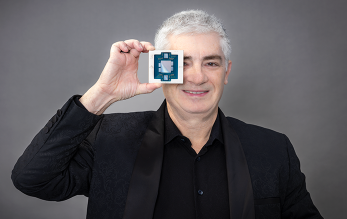
AWS Chief Evangelist Jeff Barr shows off the Graviton4 chip (Image courtesy AWS)

Speaking of ultra-clusters, AWS continues to work with Nvidia to bring its latest GPUs into the AWS cloud. During his conversation on stage with Nvidia CEO Huang, re:Invent attendees got a teaser about the ultra-cluster coming down the pike.

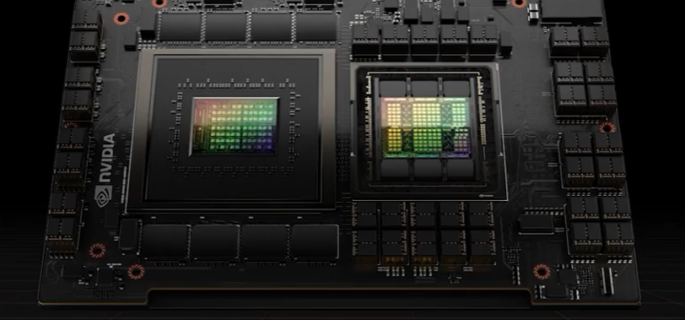
All of the attention was on the Grace Hopper superchip, or the GH200, which pairs two GH100 chips together with the NVLink chip-to-chip interconnect. Nvidia is also working on an NVLink switch that allows up to 32 Grace Hopper superchips to be connected together. When paired with AWS Nitro and Elastic Fabric Adapter (EFA) networking technology, it enables the aforementioned ultra-cluster.

“With AWS Intro, that becomes basically one giant virtual GPU instance,” Huang said. “You’ve got to imagine, you’ve got 32 H200s, incredible horsepower, in one virtual instance because of AWS Nitro. Then we connect with AWS EFA, your incredibly fast networking. All of these units now can lead into an ultra-cluster, an AWS ultra-cluster. I can’t wait until all this come together.”

“How customers are going to use this stuff, I can only imagine,” Selipsky responded. “I know the GH200s are really going to supercharge what customers are doing. It’s going to be available–of course EC2 instances are coming soon.”

The coming H200 supercluster will sport 16,000 GPUs and offer 65 exaflops of computing power, or “one giant AI supercomputer,” Huang said.

“This is utterly incredible. We’re going to be able to reduce the training time of the largest language models, the next generation MoE, these extremely large mixture of experts models,” he continued. “I can’t wait for us to stand this up. Our AI researchers are champing at the bit.”

This article first appeared in Datanami.

Related

About the author: Alex Woodie

Alex Woodie has written about IT as a technology journalist for more than a decade. He brings extensive experience from the IBM midrange marketplace, including topics such as servers, ERP applications, programming, databases, security, high availability, storage, business intelligence, cloud, and mobile enablement. He resides in the San Diego area.

A timeline of Sam Altman’s firing from OpenAI — and the fallout

A timeline of Sam Altman’s firing from OpenAI — and the fallout Kyle Wiggers 8 hours
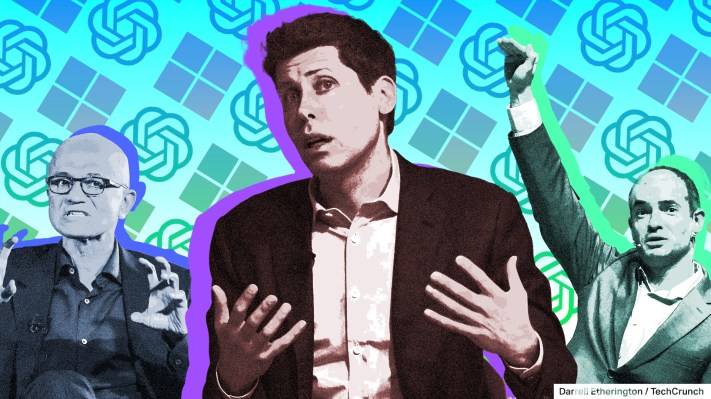
In a dramatic turn of events late Friday, ex-Y Combinator president Sam Altman was fired as CEO of AI startup OpenAI, the company behind viral AI hits like ChatGPT, GPT-4 and DALL-E 3, by OpenAI’s board of directors. Then, the company’s longtime president and co-founder, Greg Brockman, resigned — as did three senior OpenAI researchers. And the fallout continues.

Tip TechCrunch

Do you work at OpenAI and know more about Sam Altman’s departure? Get in touch with TechCrunch.

It’s a fast-moving situation that we’re still trying to get to the bottom of. No doubt more will become clear as time goes on. To make it easier to follow all that’s happened in the meantime, though, we’ve put together a timeline; we’ll do our best to keep it current.

Timeline of Sam Altman’s firing from OpenAI

November 29

Microsoft gains a board observer

Microsoft will gain representation on the new initial board of directors in the form of a non-voting observer, OpenAI announced. It wasn’t immediately clear who this observer might be — only that they won’t have an official vote in board business.

November 21

Sam Altman, OpenAI reach agreement on return as CEO and ‘initial’ new board

In a sudden late announcement, OpenAI revealed that it and Altman “have reached an agreement in principle” for him to return as the company’s CEO. In addition to Altman’s return, its new “initial” board will include former Salesforce chief executive Bret Taylor, former US Secretary of the Treasury Larry Summers and Quora founder Adam D’Angelo.

We have reached an agreement in principle for Sam Altman to return to OpenAI as CEO with a new initial board of Bret Taylor (Chair), Larry Summers, and Adam D'Angelo.

We are collaborating to figure out the details. Thank you so much for your patience through this.

— OpenAI (@OpenAI) November 22, 2023

Altman also posted about the new deal, giving some insight into the roller coaster that we’ve all been riding since his firing was revealed Friday. In his words, his decision to join Microsoft on Sunday “was the best path for me and the team.” Since then, the new board’s composition and Microsoft’s support appear to have been enough to bring him back to the AI company he co-founded.

Altman and board in talks

OpenAI’s board of directors is reportedly in talks with Sam Altman, ex-Y Combinator president and an OpenAI co-founder, to return to OpenAI as CEO as soon as this week. That’s according to Bloomberg, which in a brief — citing sources close to the matter — said that discussions are happening between Quora CEO Adam D’Angelo, one current member of the OpenAI board, and Altman — and possibly other board members as well.

Board tensions boil over

The New York Times reports that, before his ousting, Sam Altman made a move to push out board member Helen Toner because he thought a paper she had co-written was overly critical of OpenAI. That, among other issues, led to OpenAI’s current predicament. Speaking of, The Times indicates that negotiations to hire Altman back continue — but that one major sticking point remaining is “guardrails” meant to improve Altman’s communication with the board.

View this post on Instagram

A post shared by TechCrunch (@techcrunch)

November 20

Altman joins Microsoft

Sam Altman, Greg Brockman and colleagues announce that they’ll join Microsoft to lead a new AI research team. Nadella leaves the door open to other OpenAI staffers, saying that they’ll be given the resources they need should they choose to join.

Sutskever’s mea culpa

Sutskever publishes a post on X suggesting that he regrets his decision to remove Altman and that he’ll do everything in his power to reinstate Altman as CEO.

I deeply regret my participation in the board's actions. I never intended to harm OpenAI. I love everything we've built together and I will do everything I can to reunite the company.

— Ilya Sutskever (@ilyasut) November 20, 2023

Employees threaten to resign

Nearly 500 of OpenAI’s roughly 770 employees — including, remarkably, Sutskever — publish a letter saying that they might quit unless the startup’s board resigns and reappoints the ousted Altman. Later Monday, that number climbed to over 650.

Altman and Brockman considering return

As reported by The Verge, Altman’s move to Microsoft isn’t a done deal — and both Altman and Brockman are still open to returning to OpenAI. That is, if the remaining board members who initially fired him step aside.

OpenAI board considers merger

OpenAI’s board of directors approached Dario Amodei, the co-founder and CEO of rival large-language model developer Anthropic, about a potential merger of the two companies, The Information reports. The approach was part of an effort by OpenAI to persuade Amodei to replace Altman as CEO — but Amodei quickly turned down the CEO offer.

November 19

Altman to meet at OpenAI HQ

According to The Information, Altman is expected to meet at OpenAI’s San Francisco headquarters as executives at OpenAI push to have him reinstated as CEO. Brockman was invited to join — but it’s unclear whether he’ll take execs up on that invitation.

Board negotiations hit a snag

Bloomberg reports that Lightcap and Murati, among others, are pushing the board to reinstate Altman. But unsurprisingly, the directors are resisting. As of midday Sunday, the board hadn’t resigned out of concern over who could replace them, and were vetting candidates. One possible new addition could be Salesforce co-CEO Bret Taylor.

Altman out, Shear in

Altman won’t be returning as CEO, according to a report in The Information citing an internal memo sent by Sutskever. As the search for a new permanent CEO continues, OpenAI has appointed Emmett Shear, the co-founder of video streaming site Twitch, as interim CEO — replacing Murati.

November 18

“Not … in response to malfeasance”

In an internal memo obtained by Axios sent Saturday morning, OpenAI COO Brad Lightcap said yesterday’s announcement “took [the management team] by surprise” and that management had had “multiple conversations with the board to try to better understand the reasons and process behind their decision.” Discussions were ongoing as of Saturday morning, per the memo.

“We can say definitively that the board’s decision was not made in response to malfeasance or anything related to our financial, business, safety, or security/privacy practices,” Lightcap added. “This was a breakdown in communication between Sam and the board … We still share your concerns about how the process has been handled, are working to resolve the situation, and will provide updates as we’re able.”

OpenAI’s funding in jeopardy

The planned sale of OpenAI employee shares that would value the startup at about $86 billion could be in jeopardy. The Information, speaking to three sources formerly with the company, reports that they no longer expect the sale — led by Thrive Capital — to happen, or, if it does, to come with a lesser valuation because of the recent turn of events.

Altman planning new venture

Altman has been telling investors that he’s planning to launch a new venture, according to The Information. Brockman is expected to join the effort — whatever form it takes. (Possibly an AI chip startup.)

i love you all.

today was a weird experience in many ways. but one unexpected one is that it has been sorta like reading your own eulogy while you’re still alive. the outpouring of love is awesome.

one takeaway: go tell your friends how great you think they are.

— Sam Altman (@sama) November 18, 2023

Investors pushing for Altman’s return

Investors — furious at the turn of events — are reportedly exerting pressure on OpenAI’s board to reinstate Altman, going so far as to recruit Microsoft. Nadella is said to be sympathetic.

Board agrees to reverse course — in principle

The Verge reports that the board agreed in principle to resign and to allow Altman and Brockman to return. It waffled, however, missing a deadline yesterday by which many OpenAI staffers were set to leave the company. Altman is said to be ambivalent about coming back and asking for “significant” governance changes.

November 17

Brockman demoted

Brockman says he got a text from Sutskever shortly after noon on Friday asking for a quick call. After sending a Google Meet link, Brockman was told that he was being removed from the board as chairman “but was vital to the company and would retain his role” as president, and that Altman had been fired.

Altman’s firing publicly announced

OpenAI published a post on its blog announcing the executive shake-up. The company’s management team was aware shortly after.

i loved my time at openai. it was transformative for me personally, and hopefully the world a little bit. most of all i loved working with such talented people.

will have more to say about what’s next later.

🫡

— Sam Altman (@sama) November 17, 2023

All-hands meeting

OpenAI held an all-hands meeting Friday afternoon during which Sutskever defended Altman’s ouster. He dismissed suggestions that pushing Altman out amounted to a “hostile takeover,” and claimed that it was necessary to protect OpenAI’s mission of “making AI beneficial to humanity.”

Microsoft releases a statement

Satya Nadella, the CEO of Microsoft, a major investor in — and partner with — OpenAI, published a statement about Altman’s firing:

“As you saw at Microsoft Ignite this week, we’re continuing to rapidly innovate for this era of AI, with over 100 announcements across the full tech stack from AI systems, models and tools in Azure, to Copilot. Most importantly, we’re committed to delivering all of this to our customers while building for the future. We have a long-term agreement with OpenAI with full access to everything we need to deliver on our innovation agenda and an exciting product roadmap; and remain committed to our partnership, and to Mira and the team. Together, we will continue to deliver the meaningful benefits of this technology to the world.”

Brockman quits

Brockman announced his resignation from OpenAI, citing “today’s news.” After sending a memo internally, he published the text on X.

After learning today’s news, this is the message I sent to the OpenAI team: https://t.co/NMnG16yFmm pic.twitter.com/8x39P0ejOM

— Greg Brockman (@gdb) November 18, 2023

Senior OpenAI researchers resign

Three senior OpenAI researchers resign after Brockman, including the director of research Jakub Pachocki and head of preparedness Aleksander Madry.

November 16

Ilya Sutskever schedules call with Altman

According to a post on X (formerly Twitter) from Brockman, Ilya Sutskever, the chief scientist at OpenAI and a co-founder, texted Altman on Thursday evening about scheduling a Friday noon call.

Sam and I are shocked and saddened by what the board did today.

Let us first say thank you to all the incredible people who we have worked with at OpenAI, our customers, our investors, and all of those who have been reaching out.

We too are still trying to figure out exactly…

— Greg Brockman (@gdb) November 18, 2023

Murati told of Altman’s firing

Brockman alleges that Mira Murati, OpenAI’s CTO and now interim CEO, was informed on Thursday night that Altman would be fired.


Microsoft Gets a Seat At OpenAI’s Board as a Non-Voting Observer

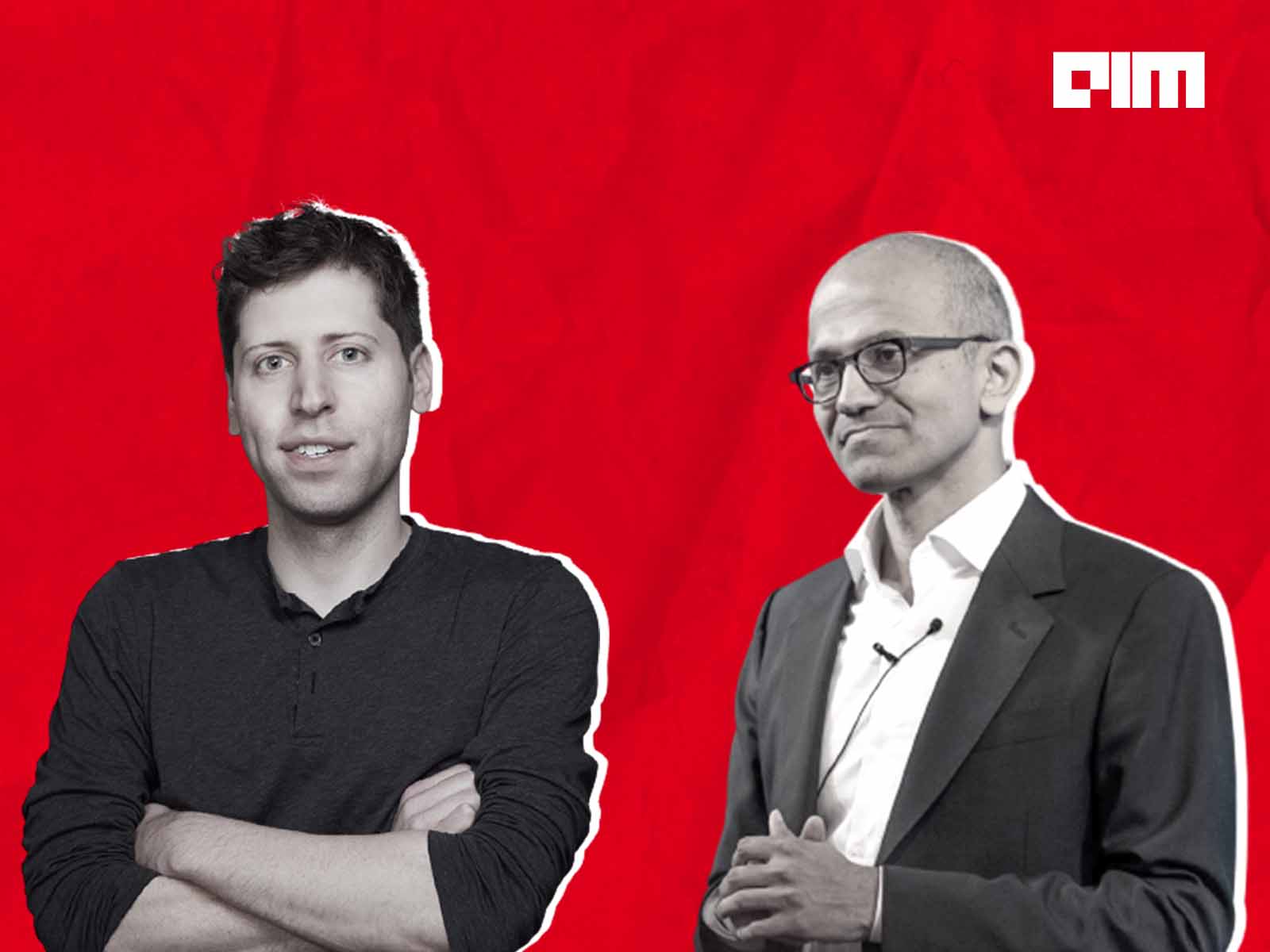
Microsoft has secured a board seat at OpenAI as a non-voting observer, as announced by Sam Altman in the company’s blog post upon his return as CEO. OpenAI, in its blog post, further revealed the return of Greg Brockman as president, with Bret Taylor assuming the role of board chair.

“I have never been more excited about the future. I am extremely grateful for everyone’s hard work in an unclear and unprecedented situation, and I believe our resilience and spirit set us apart in the industry. I feel so good about our probability of success in achieving our mission.” said Altman.

In his message, Altman said that he harbors “zero ill will” towards Ilya Sutskever, OpenAI’s co-founder and chief scientist who initially participated in the board coup but later reversed his decision when almost all of the company’s employees threatened to resign unless Altman returned.

“While Ilya will no longer serve on the board, we hope to continue our working relationship and are discussing how he can continue his work at OpenAI.” Altman said.

Regarding the organization’s structure, Altman said “Greg and I are partners in running this company. We have never quite figured out how to communicate that on the org chart, but we will.”

After the departure of three out of the four board members who played a role in the abrupt decision to terminate Altman, OpenAI’s current board is composed of Chair Bret Taylor, Larry Summers, and Adam D’Angelo—the sole remaining member from the previous board.

Board Chair Bret Taylor stated that OpenAI will establish a new qualified, diverse board of exceptional individuals whose collective experience represents the breadth of OpenAI’s mission – from technology to safety to policy.

“We will further stabilize the OpenAI organization so that we can continue to serve our mission. This will include convening an independent committee of the Board to oversee a review of the recent events” he said.

The post Microsoft Gets a Seat At OpenAI’s Board as a Non-Voting Observer appeared first on Analytics India Magazine.

New AI Security Guidelines Published by NCSC, CISA & More International Agencies

The U.K.’s National Cyber Security Centre, the U.S.’s Cybersecurity and Infrastructure Security Agency and international agencies from 16 other countries have released new guidelines on the security of artificial intelligence systems.

The Guidelines for Secure AI System Development are designed to guide developers in particular through the design, development, deployment and operation of AI systems and ensure that security remains a core component throughout their life cycle. However, other stakeholders in AI projects should find this information helpful, too.

These guidelines have been published soon after world leaders committed to the safe and responsible development of artificial intelligence at the AI Safety Summit in early November.

Jump to:

  • At a glance: The Guidelines for Secure AI System Development
  • Securing the four key stages of the AI development life cycle
  • Guidance for all AI systems and related stakeholders
  • Building on the outcomes of the AI Safety Summit
  • Reactions to these AI guidelines from the cybersecurity industry

At a glance: The Guidelines for Secure AI System Development

The Guidelines for Secure AI System Development set out recommendations to ensure that AI models – whether built from scratch or based on existing models or APIs from other companies – “function as intended, are available when needed and work without revealing sensitive data to unauthorized parties.”

SEE: Hiring kit: Prompt engineer (TechRepublic Premium)

Key to this is the “secure by default” approach advocated by the NCSC, CISA, the National Institute of Standards and Technology and various other international cybersecurity agencies in existing frameworks. Principles of these frameworks include:

  • Taking ownership of security outcomes for customers.
  • Embracing radical transparency and accountability.
  • Building organizational structure and leadership so that “secure by design” is a top business priority.

A combined 21 agencies and ministries from a total of 18 countries have confirmed they will endorse and co-seal the new guidelines, according to the NCSC. This includes the National Security Agency and the Federal Bureau of Investigations in the U.S., as well as the Canadian Centre for Cyber Security, the French Cybersecurity Agency, Germany’s Federal Office for Information Security, the Cyber Security Agency of Singapore and Japan’s National Center of Incident Readiness and Strategy for Cybersecurity.

Lindy Cameron, chief executive officer of the NCSC, said in a press release: “We know that AI is developing at a phenomenal pace and there is a need for concerted international action, across governments and industry, to keep up. These guidelines mark a significant step in shaping a truly global, common understanding of the cyber risks and mitigation strategies around AI to ensure that security is not a postscript to development but a core requirement throughout.”

The Guidelines for Secure AI System Development are structured into four sections, each corresponding to different stages of the AI system development life cycle: secure design, secure development, secure deployment and secure operation and maintenance.

  • Secure design offers guidance specific to the design phase of the AI system development life cycle. It emphasizes the importance of recognizing risks and conducting threat modeling, along with considering various topics and trade-offs in system and model design.
  • Secure development covers the development phase of the AI system life cycle. Recommendations include ensuring supply chain security, maintaining thorough documentation and managing assets and technical debt effectively.
  • Secure deployment addresses the deployment phase of AI systems. Guidelines here involve safeguarding infrastructure and models against compromise, threat or loss, establishing processes for incident management and adopting principles of responsible release.
  • Secure operation and maintenance contains guidance around the operation and maintenance phase post-deployment of AI models. It covers aspects such as effective logging and monitoring, managing updates and sharing information responsibly.

Guidance for all AI systems and related stakeholders

The guidelines are applicable to all types of AI systems, and not just the “frontier” models that were heavily discussed during the AI Safety Summit hosted in the U.K. on Nov. 1-2, 2023. The guidelines are also applicable to all professionals working in and around artificial intelligence, including developers, data scientists, managers, decision-makers and other AI “risk owners.”

“We’ve aimed the guidelines primarily at providers of AI systems who are using models hosted by an organization (or are using external APIs), but we urge all stakeholders…to read these guidelines to help them make informed decisions about the design, development, deployment and operation of their AI systems,” the NCSC said.

The Guidelines for Secure AI System Development align with the G7 Hiroshima AI Process published at the end of October 2023, as well as the U.S.’s Voluntary AI Commitments and the Executive Order on Safe, Secure and Trustworthy Artificial Intelligence.

Together, these guidelines signify a growing recognition amongst world leaders of the importance of identifying and mitigating the risks posed by artificial intelligence, particularly following the explosive growth of generative AI.

Building on the outcomes of the AI Safety Summit

During the AI Safety Summit, held at the historic site of Bletchley Park in Buckinghamshire, England, representatives from 28 countries signed the Bletchley Declaration on AI safety, which underlines the importance of designing and deploying AI systems safely and responsibly, with an emphasis on collaboration and transparency.

The declaration acknowledges the need to address the risks associated with cutting-edge AI models, particularly in sectors like cybersecurity and biotechnology, and advocates for enhanced international collaboration to ensure the safe, ethical and beneficial use of AI.

Michelle Donelan, the U.K. science and technology secretary, said the newly published guidelines would “put cybersecurity at the heart of AI development” from inception to deployment.

“Just weeks after we brought world-leaders together at Bletchley Park to reach the first international agreement on safe and responsible AI, we are once again uniting nations and companies in this truly global effort,” Donelan said in the NCSC press release.

“In doing so, we are driving forward in our mission to harness this decade-defining technology and seize its potential to transform our NHS, revolutionize our public services and create the new, high-skilled, high-paid jobs of the future.”

Reactions to these AI guidelines from the cybersecurity industry

The publication of the AI guidelines has been welcomed by cybersecurity experts and analysts.

Toby Lewis, global head of threat analysis at Darktrace, called the guidance “a welcome blueprint” for safety and trustworthy artificial intelligence systems.

Commenting via email, Lewis said: “I’m glad to see the guidelines emphasize the need for AI providers to secure their data and models from attackers, and for AI users to apply the right AI for the right task. Those building AI should go further and build trust by taking users on the journey of how their AI reaches its answers. With security and trust, we’ll realize the benefits of AI faster and for more people.”

Meanwhile, Georges Anidjar, Southern Europe vice president at Informatica, said the publication of the guidelines marked “a significant step towards addressing the cybersecurity challenges inherent in this rapidly evolving field.”

Anidjar said in a statement received via email: “This international commitment acknowledges the critical intersection between AI and data security, reinforcing the need for a comprehensive and responsible approach to both technological innovation and safeguarding sensitive information. It is encouraging to see global recognition of the importance of instilling security measures at the core of AI development, fostering a safer digital landscape for businesses and individuals alike.”

He added: “Building security into AI systems from their inception resonates deeply with the principles of secure data management. As organizations increasingly harness the power of AI, it is imperative the data underpinning these systems is handled with the utmost security and integrity.”

Tola Capital, investing in AI-enabled enterprise software, closes largest fund at $230M

Tola Capital, investing in AI-enabled enterprise software, closes largest fund at $230M Christine Hall 18 hours

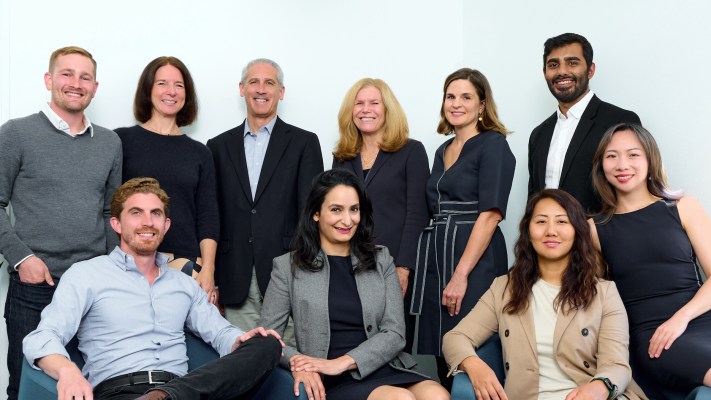
Tola Capital, investing in AI-enabled enterprise software, is the latest venture capital firm to announce its new fund, securing $230 million in capital commitments for its third fund, raising the largest amount to date.

It’s been a great couple of weeks for new VC funds. Tola joins firms like NXTP, Saviu Ventures, Kinterra Capital, Riverwood Capital, Twelve Below, SEVA, Ballistic Ventures, Founders Fund and Avra in raising funds with some significant capital behind them.

Despite that lengthy list, most VCs say this past year’s fundraising environment was a tough one. However, with the massive interest in all things artificial intelligence, it was still a good time to raise a new fund, Sheila Gulati, co-founder and managing director of Tola Capital, told TechCrunch.

Gulati started Tola Capital in 2010 with a group of experienced enterprise software operators just as cloud computing was gaining steam. Gulati herself previously led the enterprise IT strategy for Microsoft. During that she launched the Microsoft Azure cloud platform and ran the database and developer tools businesses.

“I thought nothing would excite me more than cloud computing, but I was wrong,” Gulati said. “AI is so big, so interesting, so game changing. The opportunities that we have to fully change the way of work is truly mind-blowing. People investing into this AI paradigm shift, especially early-stage, is truly unmatched.”

Microsoft acquires video creation and editing software maker Clipchamp

Eyes on AI

Nothing has stirred up the topic of AI more in the past weeks than the chaos over at OpenAI. Many of Tola Capital’s portfolio companies build on GPT, and the firm proactively worked with them on contingency plans, Gulati said.

During that time, Gulati weighed in on the subject of OpenAI’s nonprofit governance model. She noted “how we do governance is suboptimal,” and the way decisions are made on boards can “kill innovation across the spectrum.” However, now that the matter is settled, Gulati believes OpenAI “is in a better place, which is great for the whole industry.”

Meanwhile, including the new fund, Tola Capital raised $688 million in total funds to date. It invests at the seed and early-stage levels in startups innovating the enterprise software industry with the use of AI. IDC forecasts the global AI software market to bring in nearly $792 billion in revenue in 2025.

The firm doesn’t invest at the foundational level of AI, but more on that next layer, what Gulati called the “enterprise scaffolding” of AI. For example, responsible AI, AI security and app layer AI.

Investors are souring on OpenAI’s nonprofit governance model

What Tola Capital is looking for in a startup

That thesis has proved successful. The firm’s previous two funds yielded over a dozen exits, including Clipchamp, a video software company acquired by Microsoft; OSIsoft, a data management company acquired by AVEVA; and Hybris, an e-commerce customer tool acquired by SAP.

Tola Capital III will invest in between 25 and 30 companies globally. Average check sizes will range from $1 million to $4 million for seed-stage companies and $5 million to $15 million for Series A and B. The firm has already deployed capital into eight companies, including Arcus, ESG Flo, FeatureByte, Fetcher, Holistic AI, Langsafe, Lumeus and Zilla.

The firm likes to invest in companies with “real invention.” Gulati describes that as having the right team, the invention, the total addressable market and then the culture of how they’re going to put all of that together into a company that is a talent attractor.

“We write deep and long hypotheses that we think should exist in the enterprise software market,” Gulati said. “Then we chase those things down. We want people who want to build massive game-changing businesses. They have that ambition, and we want to be on a journey with someone who’s not afraid to scale and run multibillion-dollar businesses.”

What startup founders need to know about AI heading into 2024

8 ways AI and 5G are pushing the boundaries of innovation together

sphere-gettyimages-1457039319

When 5G is combined with artificial intelligence and augmented reality, the result can be a powerful one-two punch for innovation, both technical- and business-focused. When designing systems or architectures for offices, factories, and homes of the future, the power of AI over 5G — or 5G enhanced by AI — cannot be ignored, industry experts point out.

First, there's what 5G can do for AI. "Scaling AI to reach its full potential is no trivial undertaking. To do so efficiently, it's imperative for AI processing to be intelligently distributed between the cloud and edge devices," writes Taesang Yoo, senior director of technology for Qualcomm, in a recent blog post. "That's why we believe the future of AI is hybrid. AI computation is split where and when appropriate, to provide enhanced experiences and ensure efficient use of resources."

Also: AI at the edge: Fast times ahead for 5G and the Internet of Things

Then, there's what AI can do for 5G. AI technologies will serve to "supercharge 5G use cases and amplify 5G's native capabilities to deliver ultra-low latency, fast throughput, and massive device support," says Will Townsend, vice president and principal analyst at Moor Insights & Strategy. "AI has the potential to improve security postures, business outcomes and improve network resiliency. Edge computing can provide analytics on data produced by objects in motion at creation points for real-time decisioning."

It's a symbiotic relationship between 5G and AI. Either way, it means interesting new use cases. As AI expands, "the cost of connectivity continues to decline," says Olu Adegoke, global managing partner at Infosys Consulting. "5G's distributed architecture, multi-access edge compute and private network capabilities are enabling ultra-reliable, low-latency use cases."

But AI on 5G is so much more than technical advancements. The convergence of 5G and AI "is not just about speed; it's the first time we witness mobile broadband catering to the demands of next-gen activities," says Anthony Goonetilleke, group president at Amdocs. "From extended reality to augment reality to generative AI, leveraging this connectivity foundation paves the way for transformative experiences. When these technologies converge, like AI accessing connectivity to redefine connected cars, it generates a new dimension of possibilities."

The integration of ubiquitous broadband, edge, and hybrid cloud, along with innovation catalysts like eSIM, "forms a dynamic canvas for visionaries to create their imaginative solutions," Goonetilleke adds. "I see these technologies like a kid going out into a Lego store and letting their imagination run wild."
Central to 5G's power "is its ability to amass vast troves of data from a multitude of connected devices," says Marc Rohleder, vice president of technology strategy at Boldyn Networks. Combined with AI's data-crunching capabilities, "5G unlocks avenues for data-driven applications, spanning manufacturing processes that maximize efficiency and precision, to smart cities optimizing urban life."

Also: Companies aren't spending big on AI. Here's why that cautious approach makes sense

Increasing proximity and reduced round-trip latency within networks "enables the migration of intelligence from devices to a distributed cloud infrastructure and significantly reduces operations costs," says Adegoke. At the same time, the user experience can be significantly improved, especially for use cases such as augmented reality and streaming, he adds.

"While 5G can transmit information quickly and at low latency, AI minimizes operational complexity by utilizing efficient algorithms to automate a wide range of processes — meaning more speed, efficiency, and cost-saving," says Samer Tikoo, senior vice president and general manager at GlobalLogic, a Hitachi Group Company. "Edge computing brings the compute to the point of data creation and data consumption, rather than moving the data itself. This means there's no transference of the data itself, increasing the security and safety."

This makes the concept of elastic computing a reality, says Tikoo. "When you're running a network in a cloud and you have flexibility in terms of compute power, you have the opportunity to respond to the market faster and not risk lagging behind."

The powerful combination of 5G and AI means greater innovation opportunities — and some very interesting applications. Deploying AI applications at the edge with 5G "brings opportunities across industries including smart manufacturing, smart cities, media, retail logistics, and automated warehouses, among others," says Tikoo. Here are some examples cited:

Also: AI and automation: Business leaders adopt small-scale solutions for greater impact

Drones: "5G enables commercial drones to be flown beyond visible line of sight with remote control stations and AR-enabled piloting for purposes such as rescue operations, thermal imaging, aerial inspections, surveys, tracking, and more," says Adegoke.

Precision-controlled activities: Another example, Adegoke continues, is applying augmented reality "in conjunction with ultra-reliable, low-latency 5G networks enables remote surgery and patient care, precision-controlled construction, and mining."

Sports and entertainment: The power of converged 5G and technologies also can make a difference in things more fun than mining and surgery. "In the realm of 5G innovation, sports and entertainment venues are undergoing a revolution," says Boldyn Networks' Rohleder. "Fans no longer want to be just observers, but active participants. The blend of augmented reality with real-time information overlays doesn't just enhance the fan experience; it elevates it to an entirely new dimension of immersion and excitement."
Wireless real-time video feeds from performers "sweep the audience into a whirlwind of sights and sounds, offering panoramic 360-degree views," says Rohleder. "Every seat becomes the best seat in the house, regardless of fans' actual location."

Also: The search for a 5G killer app that's 'bigger than connectivity'

Digital twins: 5G with multi-access edge computing (MEC) also enables "digital twin capabilities for high-velocity applications such as windmills and manufacturing equipment," Adegoke continues. This enables "training, condition-based maintenance, and problem resolution while filtering most of the data at the edge without flooding the enterprise with insignificant data," he points out.

Autonomous manufacturing and mining: These, says Townsend, "are excellent examples of 5G's ability to enable tactile operations, improve efficiency and ensure worker safety through automation. More broadly, network slicing enabled by 5G standalone public and private network deployments (marrying 5G core and RAN) will unlock innovative use cases by tailoring latency and throughput to discrete workloads and applications."

Autonomous driving: "We are working on AI algorithms that detect humans, cars, and other objects on the road to develop collision avoidance systems that makes autonomous driving safer," says Tikoo. "This is a perfect example of leveraging the 5G multi-access edge compute, where you need compute power at the edge and make real-time decisions in a low latency environment."

Smart manufacturing: "A combination of computer vision, edge compute and AI is improving defect detection, enhancing productivity and worker safety," says Tikoo. "Manufacturing setups leverage high fidelity cameras to continuously and securely stream video data to a 5G MEC environment for further analysis using AI/ML and provide real-time feedback to a production line. This enables making quick corrections, improving quality, and enhancing productivity."

Education: "One striking instance is revolutionizing education. Imagine medical students immersed in full VR environments, experiencing surgeries as if they were truly present," says Goonetilleke. "This redefines the learning landscape. Industry pioneers like Apple are on the verge of making these experiences effortless. Moreover, in healthcare, remote surgeries guided by experts from afar, real-time computer vision for personalized services, AR-assisted field support, and automated quality control in manufacturing showcase the transformative potential of 5G."

Artificial Intelligence