Microsoft Seeing AI app lands on Android to help blind and visually impaired users

The Seeing AI in action

Navigating the world around you is certainly challenging if you're blind or sight impaired. One tool that can help is a free mobile app from Microsoft called Seeing AI. Designed to alert and inform people about their environment, the app is now accessible to Android users after having been limited to iOS.

In a blog post published Monday, Saqib Shaikh, founder and lead for Microsoft Seeing AI, announced the expansion to Android and highlighted some of the app's latest features.

Also: Generative AI advancements will force companies to think big and move fast

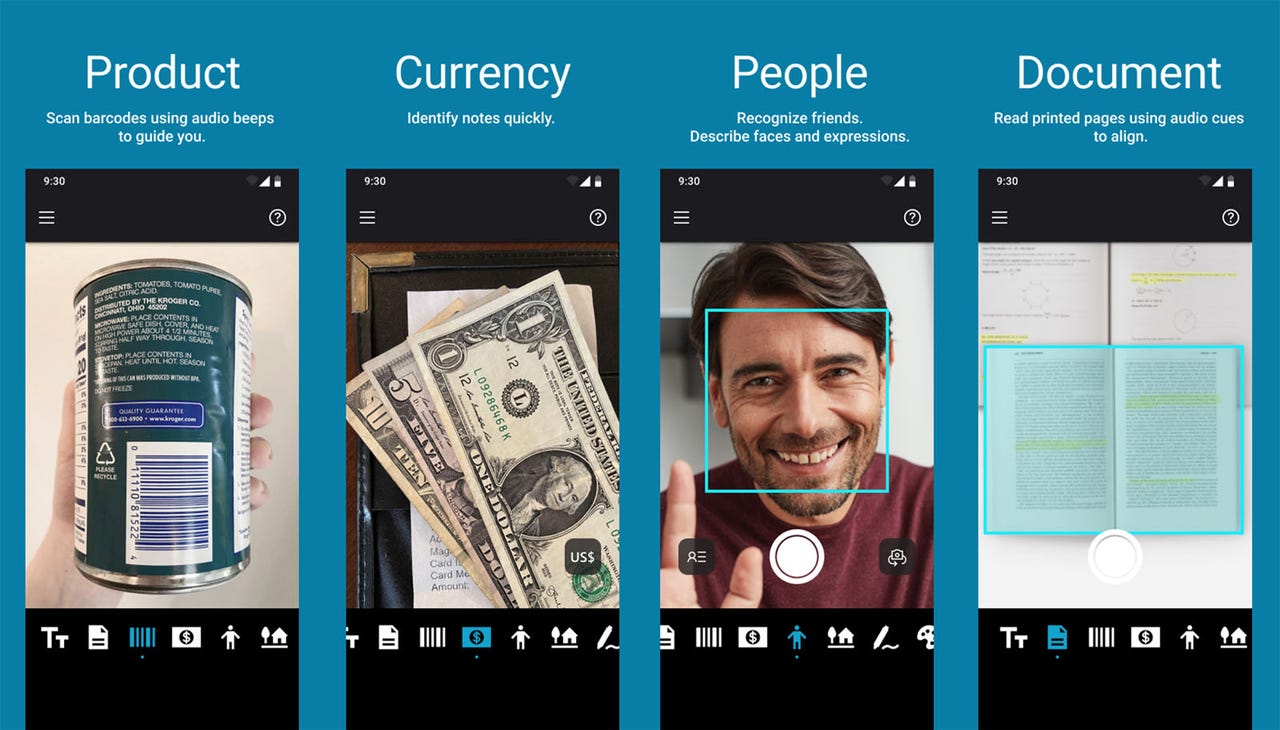
Available in the App Store and Google Play, Seeing AI works by identifying and describing people, objects, text, and other elements around you. The goal is to help you better navigate your surroundings and understand documents and other physical items by hearing them read aloud.

First up is text recognition. Fire up the app and hold your phone over a piece of printed or written text. Upon recognition, Seeing AI will start reading the text aloud until it gets to the end.

Next is document recognition. Hold your phone over a full document, and the app will scan and display the words. You can then listen to the document read aloud by playing, pausing, skipping ahead, or going back as needed.

Also: You can send a hug through the internet with this haptic invention

Another handy feature is a barcode reader that will identify and speak information about a product based on the code scan. Next, you can snap a photo of your surrounding environment, and the app will describe the overall scene as well as individual items in the photo.

A people reader will scan a person captured by the camera and then highlight their visual characteristics, adding in their distance away from you. Finally, a currency scanner will analyze a bill or coin to tell you its value.

As part of the transition to Android, the app also sports a couple of recent enhancements.

Scanning a photo now provides richer descriptions of the details captured in the image. Plus, you're now able to ask Seeing AI more questions about a scanned document. As a few examples, you can learn about dishes on a menu, get the prices of items on a catalog page, or hear a summary of an article.

Also: The best smart glasses you can buy

"There are over 3 billion active Android users worldwide, and bringing Seeing AI to this platform will provide so many more people in the blind and low vision community the ability to utilize this technology in their everyday lives," Shaikh said in the blog post. "We will continue to work with the community to understand feedback to improve the app. And as additional versions roll out, customer feedback will continue to be critical for new AI-powered enhancements to future versions of the Seeing AI app."

Shaikh, who lost his sight at the age of seven, said that the Android version and new features were launched in celebration of International Day of Persons with Disabilities (IDPD). Seeing AI is now available in 18 languages including Czech, Danish, English, French, German, Greek, Italian, Japanese, Korean, Polish, Portuguese, Russian, Spanish, and Swedish. Microsoft plans to expand support to 36 languages in 2024.

Meta and IBM form an AI Alliance, but to what end?

Meta and IBM form an AI Alliance, but to what end? Kyle Wiggers 10 hours

Meta, on an open source tear, wants to spread its influence further and wider in the ongoing battle for AI mindshare.

This morning, the social network announced that it’s teaming up with IBM, whose audience is decidedly more corporate and enterprise, to launch the AI Alliance, a industry body to support “open innovation” and “open science” in AI.

So what will the AI Alliance do exactly — and how will its work differ from the quite similar (at least in terms of its overarching mission, members and tenets) Partnership on AI? The Partnership on AI years ago promised to publish research using open source licenses and minutes from its meetings to, as the AI Alliance purportedly seeks to do, educate the public on pressing AI issues of the day.

Well — confusingly — the Partnership on AI is in fact a member of the AI Alliance. The Alliance says that it plans to “utilize pre-existing collaborations” (including the Partnership on AI’s, presumably) to “identify opportunities that develop open AI resources that meet the needs of business and society equally and responsibly,” a press release shared last week with TechCrunch reads.

The AI Alliance’s members will first form working groups, a governing board and a technical oversight committee dedicated to advancing areas like AI “trust and validation” metrics, hardware and infrastructure that supports AI training and open source AI models and frameworks. They’ll also establish project standards and guidelines, and then partner with “important existing initiatives” — initiatives conspicuously not named in the press release — from government, nonprofit and civil society organizations “who are doing valuable and aligned work in the AI space.”

If that sounds a lot like what the inaugural members of the Alliance were already doing independently, you’re not wrong. But in the release, the AI Alliance stresses that its work — whatever form it ultimately takes — is intended to be complementary and additive rather than needlessly duplicative.

“[M]ore collaboration and information sharing will help the community innovate faster and more inclusively, and identify specific risks and mitigate those risks before putting a product into the world,” the release reads. “This stands in contrast to a vision that aims to relegate AI innovation and value creation to a small number of companies with a closed, proprietary vision for the AI industry.”

Key subtext

That jab at the end says a lot about Meta’s ulterior motives, here.

Google, OpenAI and Microsoft, a close OpenAI partner and investor, have been among the chief critics of Meta’s open source AI approach, arguing that it’s potentially dangerous and disinformation-encouraging. (Unsurprisingly, none are members of the AI Alliance despite being longtime members of the Partnership on AI.) Now, those companies have a clear horse in the race and perhaps regulatory capture on the mind… but they’re not wrong entirely. Meta continues to take calculated open-sourcing risks (within the bounds of regulators’ tolerances), releasing text-generating models like Llama that bad actors have gone on to abuse but which plenty of developers have built useful apps upon.

“The platform that will win will be the open one,” Yann LeCun, Meta’s chief AI scientist, was quoted as saying in an interview with the New York Times — and who’s among the more than 70 influential signers of a letter calling for more openness in AI development. LeCun has a point; according to one estimate, Stability AI’s open source AI-powered image generator, Stable Diffusion, released last August, is now responsible for 80% of all AI-generated imagery.

But wait, you might say — what does IBM gain from the AI Alliance? It’s a co-founder with Meta after all. I’d venture to guess more exposure for its burgeoning generative AI platform. IBM’s most recent earnings were boosted by enterprises’ interest in generative AI, but the company has stiff competition in Microsoft and OpenAI (and to a lesser extent Google), which are jointly developing enterprise-focused AI services that directly compete with IBM’s.

I’ve asked IBM’s PR, which first informed me of the AI Alliance’s founding, about the curious omissions from the early membership, like Stanford (which has a prominent AI research lab, Stanford HAI), MIT (which is at the forefront of robotics research) and high-profile AI startups like Anthropic, Cohere and Adept. A press rep didn’t respond as of publication time. But the same philosophical differences that kept Google and Microsoft away likely were at play; I’d wager it’s no accident that Anthropic, Cohere and Adept have relatively few open source AI projects to their names.

I’ll note that Nvidia isn’t a member of the AI Alliance, either — a suspect absence given that the company is by far the dominant provider of AI chips and a maintainer of many open source models in its own right. Perhaps the chipmaker perceived a conflict of interest in collaborating with Intel and AMD. Or perhaps it decided to cast its lot with Microsoft, Google and the rest of the tech giants opting out of the Alliance for strategic reasons. Who can say?

Sriram Raghavan, VP of IBM’s research AI division, told me via email that the Alliance is, for now, focused on “members that are strongly committed to open innovation and open source AI” — implying that those who aren’t participating aren’t as strongly committed. I’m not sure they’d agree.

“This of course is just the starting point,” he added. “We welcome and expect more organizations to join in the future.”

A broad assembly

Counting around 45 organizations among its membership, including AMD and Intel, the research lab CERN, universities like Yale and the Imperial College London and AI startups Stability AI and Hugging Face, the AI Alliance will focus on fostering an “open” community and enabling developers and researchers to “accelerate responsible innovation in AI” while “ensuring scientific rigor, trust, safety, security, diversity and economic competitiveness,” according to the release.

“By bringing together leading developers, scientists, academic institutions, companies and other innovators, we’ll pool resources and knowledge to address safety concerns while providing a platform for sharing and developing solutions that fit the needs of researchers, developers and adopters around the world,” the release reads.

The AI Alliance’s initial cohort is exceptionally broad — sitting at the intersection of not just AI and enterprise but healthcare, silicon and software-as-a-service as well. In addition to academic partners such as the University of Tokyo, UC Berkeley, the University of Illinois, Cornell and the aforementioned Imperial College London and Yale, Sony, ServiceNow, the National Science Foundation, NASA, Oracle, the Cleveland Clinic and Dell have pledged their participation in some form.

MLCommons, the engineering consortium behind MLPerf, the benchmarking suite used by major chip manufacturers to evaluate their hardware’s AI performance, is also a founding AI Alliance member. So are LangChain and LlamaIndex, two creators behind some of the more widely-used tools and frameworks for building apps powered by text-generating AI models.

But without the participation of so many major AI industry players — and lacking deadlines or even concrete objectives — can the AI Alliance succeed? What would success look like, even?

Beats me.

The vast number of competing interests — from healthcare networks (Cleveland Clinic) to insurance providers (Roadzen) — won’t make it easy for the Alliance’s members to coalesce around a single, united front. And for all their talk of openness, IBM and Meta aren’t exactly the poster children for the future that the Alliance’s release depicts — casting doubt on their sincerity.

Perhaps I’m wrong and the AI Alliance will be a smash success. Or perhaps it’ll crumble under mistrust and its own bureaucracy. We’ll see; time will tell.
The IBM-Meta AI Alliance Promotes Safe and Open AI Progress

The IBM-Meta AI Alliance Promotes Safe and Open AI Progress December 5, 2023 by Doug Eadline

IBM and Meta have co-launched a massive industry-academic-government alliance to shepherd AI development. The new group has united under the AI Alliance banner to promote responsible innovation in AI. Historically, technical alliances often come and go depending on the economic climate. This one seems a bit different. The AI Alliance started with over 50 members from worldwide government, academic, and industry partners. For example, heavyweights like AMD, Dell, IBM, Intel, Meta, Oracle, Red Hat, HugginFace, Sony, NASA, NSF, and CERN have all agreed to join the Alliance. (See below for a full list of members) ,

The AI Alliance is focused on fostering an open community and enabling developers and researchers to accelerate responsible innovation in AI while ensuring scientific rigor, trust, safety, security, diversity, and economic competitiveness. By bringing together leading developers, scientists, academic institutions, companies, and other innovators, we will pool resources and knowledge to address safety concerns while providing a platform for sharing and developing solutions that fit the needs of researchers, developers, and adopters worldwide.

As stated by IBM Chairman and CEO Arvind Krishna, "The progress we continue to witness in AI is a testament to open innovation and collaboration across communities of creators, scientists, academics, and business leaders. This alliance is a pivotal moment in defining the future of AI. IBM is proud to partner with like-minded organizations through the AI Alliance to ensure this open ecosystem drives an innovative AI agenda underpinned by safety, accountability, and scientific rigor."

Some notable players are not members of the AI alliance, namely, OpenAI, Microsoft, Nvidia, Google, Apple, and AWS. In addition, major Chinese hyperscalers are not listed as members.

There have been concerns about the safety of AI in recent years, particularly with Large Language Models (LLMs) like OpenAI's closed-source ChatGPT, and the AI Alliance addresses some of these issues by proposing a public open development approach with resources to develop a safe ecosystem of open foundational models (LLMs).

To accomplish its goals, the AI Alliance plans to start or enhance projects that meet the following objectives:

  • Develop and deploy benchmarks and evaluation standards, tools, and other resources that enable the responsible development and use of AI systems globally, including creating a catalog of vetted safety, security, and trust tools. Support the advocacy and enablement of these tools with the developer community for model and application development.
  • Responsibly advance the ecosystem of open foundation models with diverse modalities, including highly capable multilingual, multi-modal, and science models that can help address society-wide challenges in climate, education, and beyond.
  • Foster a vibrant AI hardware accelerator ecosystem by boosting contributions and adopting essential enabling software technology.
  • Support global AI skills-building and exploratory research. Engage the academic community to support researchers and students in learning and contributing to essential AI model and tool research projects.
  • Develop educational content and resources to inform the public discourse and policymakers on benefits, risks, solutions, and precision regulation for AI.
  • Launch initiatives that encourage open development of AI in safe and beneficial ways, and host events to explore AI use cases and showcase how Alliance members are using open technology in AI responsibly and for good.

Nick Clegg, President of Global Affairs for Meta, shared the following thoughts on the need for the AI Alliance, "We believe it's better when AI is developed openly – more people can access the benefits, build innovative products, and work on safety. The AI Alliance brings together researchers, developers, and companies to share tools and knowledge to help us all progress, whether models are shared openly or not. We're looking forward to working with partners to advance the state-of-the-art in AI and help everyone build responsibly."

AI Street Cred

The Alliance members have credibility in the AI sector. To ensure open innovation in AI benefits everyone and that it is built responsibly, the AI Alliance consists of a range of experienced organizations working across aspects of AI education, research, development and deployment, and governance.

· The creators of the tooling driving AI benchmarking, trust and validation metrics and best practices, and application creation such as MLPerf, Hugging Face, LangChain, LlamaIndex, and open-source AI toolkits for explainability, privacy, adversarial robustness, and fairness evaluation.

  • The universities and science agencies that educate and support generation after generation of AI scientists and engineers push the frontiers of AI research through open science.
  • The builders of the hardware and infrastructure that supports AI training and applications – from the needed GPUs to custom AI accelerators and cloud platforms;
  • The champions of frameworks that drive platform software, including PyTorch, Transformers, Diffusers, Kubernetes, Ray, Hugging Face Text generation inference, and Parameter Efficient Fine Tuning.
  • The creators of some of today's most used open models, including Llama2, Stable Diffusion, StarCoder, Bloom, etc.

First Steps

The AI Alliance will begin its work by forming member-driven working groups across all major topical areas listed above. The Alliance will also establish a governing board and technical oversight committee dedicated to advancing the above project areas and establishing overall project standards and guidelines.

In addition to bringing together leading developers, scientists, academics, students, and business leaders in artificial intelligence, the AI Alliance will partner with important existing initiatives from governments, non-profit, and civil society organizations who are doing valuable and aligned work in the AI space.

To learn more about the Alliance, visit here: https://thealliance.ai

Alliance Members

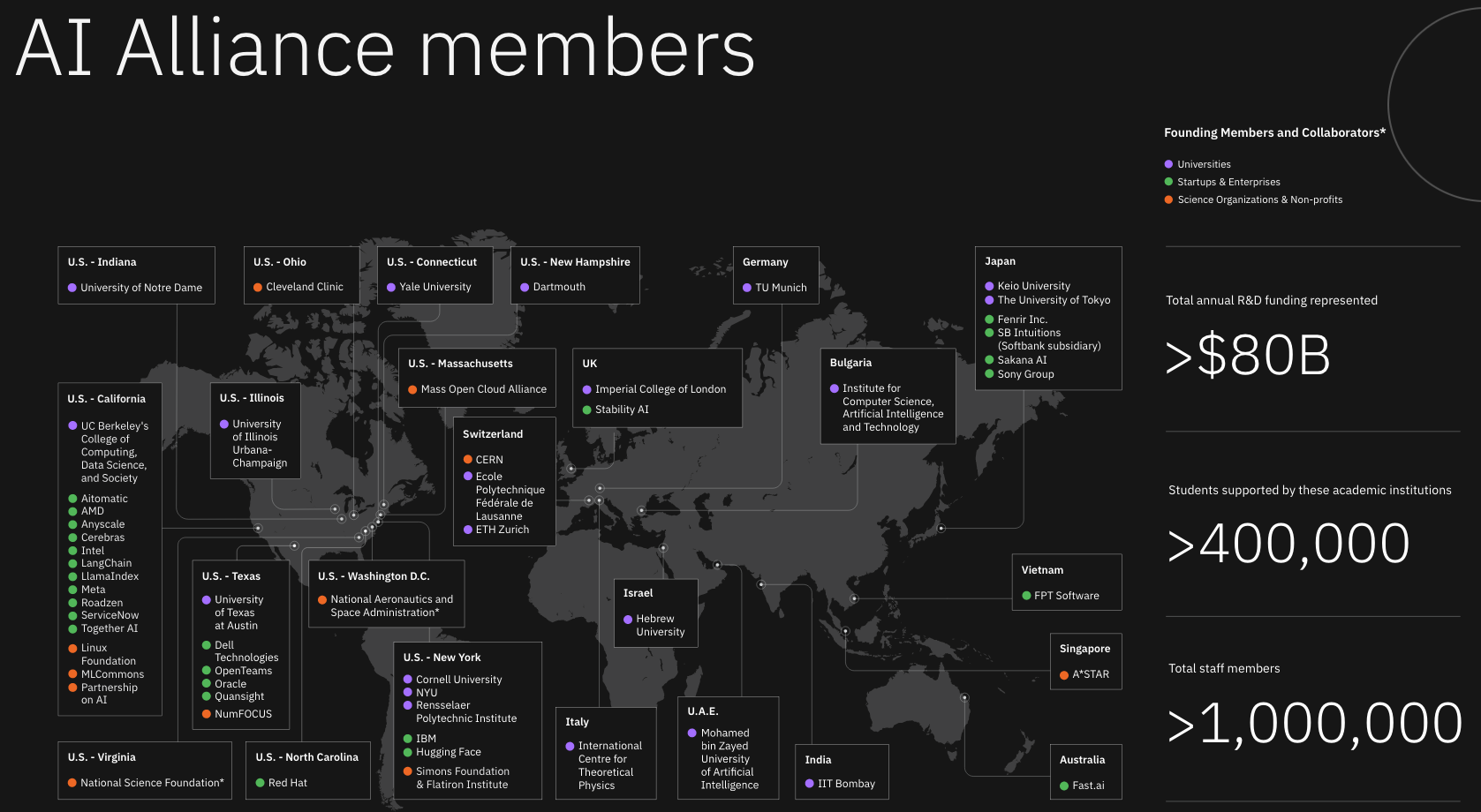
World-wide AI Alliance map. Click to enlarge. (Source: https://thealliance.ai)

The AI Alliance includes worldwide partners and collaborators from industry, academia, and government.

Agency for Science, Technology and Research (A*STAR)
Aitomatic
AMD
Anyscale
Cerebras
CERN
Cleveland Clinic
Cornell University
Dartmouth
Dell Technologies
Ecole Polytechnique Federale de Lausanne
ETH Zurich
Fast.ai
Fenrir, Inc.
FPT Software
Hebrew University of Jerusalem
Hugging Face
IBM
Imperial College London
Indian Institute of Technology Bombay
Abdus Salam International Centre for Theoretical Physics (ICTP)
Institute for Computer Science, Artificial Intelligence
Intel
Keio University
LangChain
LlamaIndex
Linux Foundation
Mass Open Cloud Alliance, operated by Boston University and Harvard
Meta
Mohamed bin Zayed University of Artificial Intelligence
MLCommons
National Aeronautics and Space Administration
National Science Foundation
New York University
NumFOCUS
OpenTeams
Oracle
Partnership on AI
Quansight
Red Hat
Rensselaer Polytechnic Institute
Roadzen
Sakana AI
SB Intuitions
ServiceNow
Silo AI
Simons Foundation
Sony Group
Stability AI
Together AI
TU Munich
UC Berkeley College of Computing, Data Science, and Society
University of Illinois Urbana-Champaign
The University of Notre Dame
The University of Texas at Austin
The University of Tokyo
Yale University

Related

Challenging the Norm: Bold Predictions for Generative AI in 2024

As we are nearing the end of 2023, we are probably standing at the high crest of the generative AI wave. From being termed word of the year to being the crux of every major big tech company announcements this year, including Google, Microsoft, and others, it is a no-brainer that AI will continue to be crucial in 2024 too. However, the extent to which AI will transform the tech ecosystem and whether the hype will fade is something that needs to be seen.

With 2024 AI predictions already circulating, the optimism from 2023 AI prediction persists. It’s likely that new AI superpowers and use-cases will emerge.

US Will Not Be the Only AI Superpower

While this year saw the dominance of the US in the AI space with big tech companies such as Meta, Microsoft, OpenAI, Google releasing their LLMs and chatbots that got the world talking, other countries are slowly [and silently] catching up.

This year saw the emergence of UAE as a promising force in the AI race. UAE’s Technology Innovation Institute (TII), a research institute supported by the government, released their LLM Falcon 180 billion parameter open-source model this year. The government support combined with abundance of capital comfortably places UAE ahead in the LLM race.

UAE is also focusing on building their demographic specific-models as well. Core 42, a subsidiary of tech company G42, released its Arabic-language model, Jais 30B. Furthermore, last week, the Advanced Technology Research Council (ATRC) in Abu Dhabi unveiled a new AI company named A171.

Launch of A171 in Abu Dhabi. Source: Multiplatform AI

The US’s arch nemesis China is finding its way in the LLM race as well. Last week, Deep Seek, a Chinese company working on AGI, released DeepSeek LLM, a 67 billion parameter model. The open-source model is available in both English and Chinese, and outperforms Llama 2 and Claude-2.

Though not fully there yet, the European Union is slowly progressing in the LLM race. Paris-based AI startup that raised $113M in seed round, taking its valuation to $260M in June this year, released Mistral-7B, an open-source model which will be integrated with Vertex AI Notebooks, thereby finding an actual use-case with the tech giant.

Furthermore, Germany-based AI research and development company Aleph Alpha recently raised $500M in Series B, pushing its valuation to $643M. These investments will probably reap benefits in 2024, likely resulting in a string of AI investments in EU countries.

Rallying for Open Source Will Gain Steam

Founders and AI enthusiasts foresee a future where AI will mostly be democratised. The co-founder and CEO of Hugging Face Clem Delangue, has predicted a number of things, out of which open-source LLMs is something he has heavily bet on. He believes that open-source LLMs will match the levels of best closed-source LLMs.

The support for open-source is not just for promoting the whole LLM ecosystem, but from evading the dangers of over-reliance on a single or limited number of closed source models such as GPT-4, Anthropic’s Claude-2 and others. When Sam Altman was recently ousted from OpenAI, companies that relied on GPT went into a frenzy as the future of the company was questioned, further compelling experts to advocate for open-source models. Meta’s open-source model Llama-2, has been adopted by companies for building a number of LLM models.

There was also a movement for openness in AI development where 70 experts, including Meta’s chief scientist, Yann LeCun signed the letter. Furthermore, Tesla and x.ai leader Elon Musk has always been a promoter of open source models.

Rise of Small Language Models

With immense costs that runs into millions of dollars, and high GPU utilisation associated with training large language models, big tech companies are looking to work on small language models (SLM). Furthermore, prototyping and customisation for specific tasks will work better on smaller models.

Microsoft’s love for small language models was unveiled in the recent Ignite event where the company launched Phi2 for enterprises. Microsoft had earlier launched Orca, a 13 billion parameter, considered to be a smaller alternative to GPT-4.

Meta’s Llama 7B, Falcon’s 1B, 7B, and AliBaba’s recent model Qwen 1.8B fall under the bucket of SLMs. With the rise of specific use cases in enterprises, SLMs will prove to be beneficial.s

Generative AI in Arts and Science Will Flourish

This year set the wheel in motion with AI finding applicability across domains with two clear categories being rampantly spoken about: image/video generation and science, especially protein-folding.

While protein folding applications had been making its way in the last few years, this year witnessed huge developments. Google DeepMind released upgrades to AlphaFold models just a couple of months ago and are continuing its momentum. The models are also finding a way to help nature preserve its habitat.

Researchers are using AI to track wildlife populations and understand social dynamics. This is leading to new insights that could help us protect endangered species and ecosystems. https://t.co/TII2aRTXE0

— Mustafa Suleyman (@mustafasuleyman) December 4, 2023

Generative AI has also found the maximum use cases in video and creative fields as well. This year saw a number of startups emerge in the space of generative AI text-to-image/video conversion. The recent Pika Labs, a text-to-video platform saw an influx of notable investors before the actual release of the product. Other platforms such as Midjourney, Runway are continuously releasing upgraded versions of the models. Indian startups have also emerged, thereby ringing the oncoming of generative AI use-cases in animation and video production.

Delangue also predicts that there will be ‘big breakthroughs in time-series, biology and chemistry.

AGI Still Remains Hazy

A topic so vastly debated in 2023, AGI discussions will continue its momentum in 2024 as well. In a race to achieve AGI, big tech companies are still wading their way to understand how to get there. OpenAI on one end working on Q* and PPO that will supposedly help reach AGI, Yann Le Cun on the other hand has not only been dissing OpenAI’s approach but has also stated that AI superintelligence will not happen in the next five years. He believes we can get to cat-level or dog-level AI before reaching human-level AI.

By "not any time soon", I mean "clearly not in the next 5 years", contrary to a number of folks in the AI industry.
Yes, I'm skeptical of quantum computing, particularly when it comes to its application to AI.https://t.co/5t63w1GNfL

— Yann LeCun (@ylecun) December 3, 2023

Though Google Gemini, a powerful AI model, slated to release next year, the hopes of AGI from it is still a distant dream.

Going by the whirlwind of a year it has been for generative AI this year, it is unfathomable to exactly predict the diverse nature of which AI will continue to revolutionise the world. However, the generative AI hype is said to fade, and only actual use-cases will thrive. With limitations in LLMs, especially in the finance sector, most companies integrating ChatGPT and other similar models are for either conversation or to improve their operational efficiencies. Revolutionary use cases are still awaited.

The post Challenging the Norm: Bold Predictions for Generative AI in 2024 appeared first on Analytics India Magazine.

Beyond Guesswork: Leveraging Bayesian Statistics for Effective Article Title Selection

Beyond Guesswork: Leveraging Bayesian Statistics for Effective Article Title Selection
Image by Author
Introduction

Having a good title is crucial for an article's success. People spend only one second (if we believe Ryan Holiday's book "Trust Me, I'm Lying" deciding whether to click on the title to open the whole article. The media are obsessed with optimizing clickthrough rate (CTR), the number of clicks a title receives divided by the number of times the title is shown. Having a click-bait title increases CTR. The media will likely choose a title with a higher CTR between the two titles because this will generate more revenue.

I am not really into squeezing ad revenue. It is more about spreading my knowledge and expertise. And still, viewers have limited time and attention, while content on the Internet is virtually unlimited. So, I must compete with other content-makers to get viewers' attention.

How do I choose a proper title for my next article? Of course, I need a set of options to choose from. Hopefully, I can generate them on my own or ask ChatGPT. But what do I do next? As a data scientist, I suggest running an A/B/N test to understand which option is the best in a data-driven manner. But there is a problem. First, I need to decide quickly because content expires quickly. Secondly, there may not be enough observations to spot a statistically significant difference in CTRs as these values are relatively low. So, there are other options than waiting a couple of weeks to decide.

Hopefully, there is a solution! I can use a "multi-armed bandit" machine learning algorithm that adapts to the data we observe about viewers' behavior. The more people click on a particular option in the set, the more traffic we can allocate to this option. In this article, I will briefly explain what a "Bayesian multi-armed bandit" is and show how it works in practice using Python.

What is a Bayesian Multi-armed Bandit?

Multi-armed Bandits are machine learning algorithms. The Bayesian type utilizes Thompson sampling to choose an option based on our prior beliefs about probability distributions of CTRs that are updated based on the new data afterward. All these probability theory and mathematical statistics words may sound complex and daunting. Let me explain the whole concept using as few formulas as I can.

Suppose there are only two titles to choose from. We have no idea about their CTRs. But we want to have the highest-performing title. We have multiple options. The first one is to choose whichever title we believe in more. This is how it worked for years in the industry. The second one allocates 50% of the incoming traffic to the first title and 50% to the second. This became possible with the rise of digital media, where you can decide what text to show precisely when a viewer requests a list of articles to read. With this approach, you can be sure that 50% of traffic was allocated to the best-performing option. Is this a limit? Of course not!

Some people would read the article within a couple of minutes after publishing. Some people would do it in a couple of hours or days. This means we can observe how "early" readers responded to different titles and shift traffic allocation from 50/50 and allocate a little bit more to the better-performing option. After some time, we can again calculate CTRs and adjust the split. In the limit, we want to adjust the traffic allocation after each new viewer clicks on or skips the title. We need a framework to adapt traffic allocation scientifically and automatedly.

Here comes Bayes' theorem, Beta distribution, and Thompson sampling.

Beyond Guesswork: Leveraging Bayesian Statistics for Effective Article Title Selection

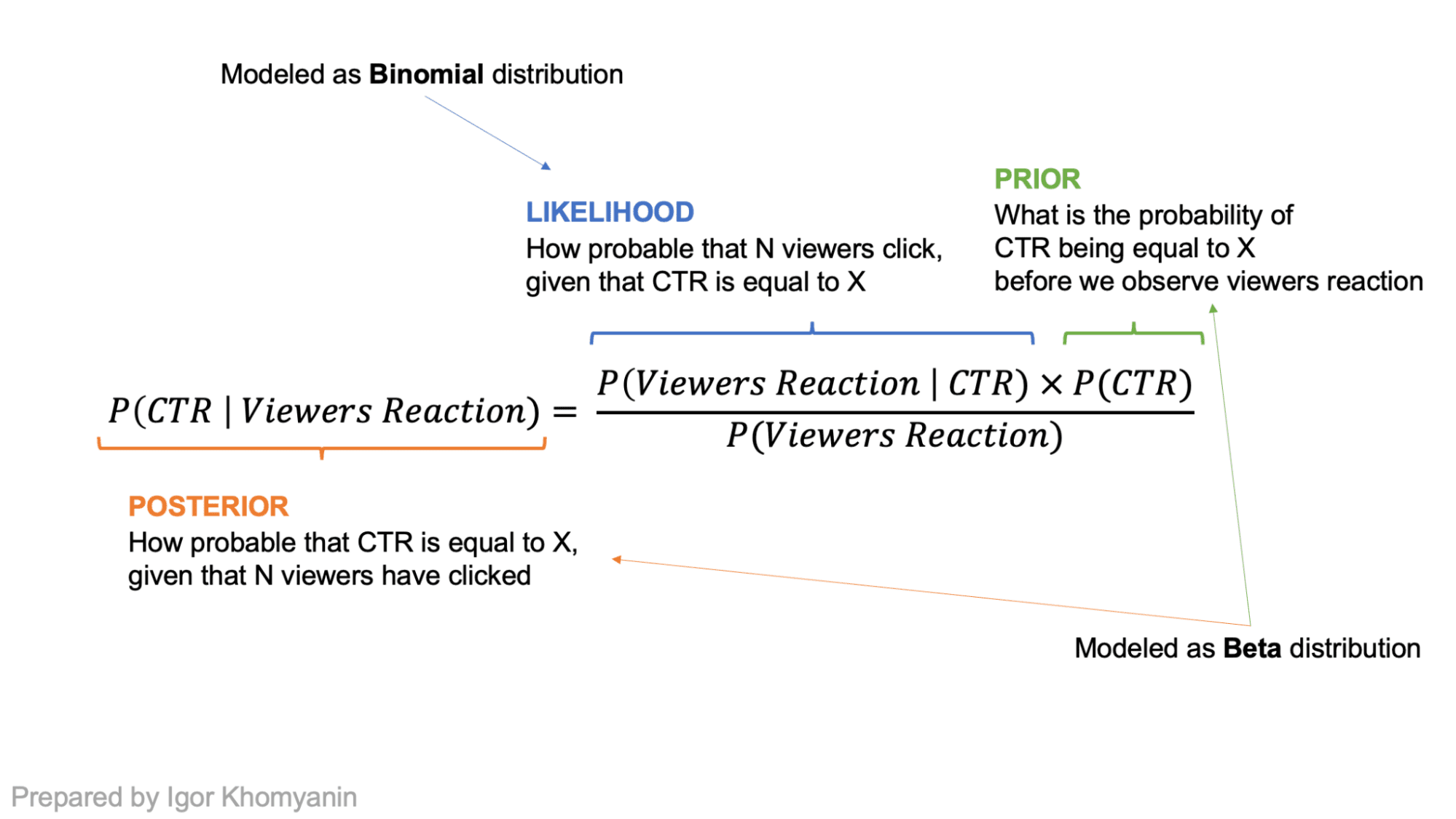
Let's assume that the CTR of an article is a random variable "theta." By design, it lies somewhere between 0 and 1. If we have no prior beliefs, it can be any number between 0 and 1 with equal probability. After we observe some data "x," we can adjust our beliefs and have a new distribution for "theta" that will be skewed closer to 0 or 1 using Bayes' theorem.

Beyond Guesswork: Leveraging Bayesian Statistics for Effective Article Title Selection

The number of people who click on the title can be modeled as a Binomial distribution where "n" is the number of visitors who see the title, and "p" is the CTR of the title. This is our likelihood! If we model the prior (our belief about the distribution of CTR) as a Beta distribution and take binomial likelihood, the posterior would also be a Beta distribution with different parameters! In such cases, Beta distribution is called a conjugate prior to the likelihood.

Proof of that fact is not that hard but requires some mathematical exercise that is not relevant in the context of this article. Please refer to the beautiful proof here:

Beyond Guesswork: Leveraging Bayesian Statistics for Effective Article Title Selection

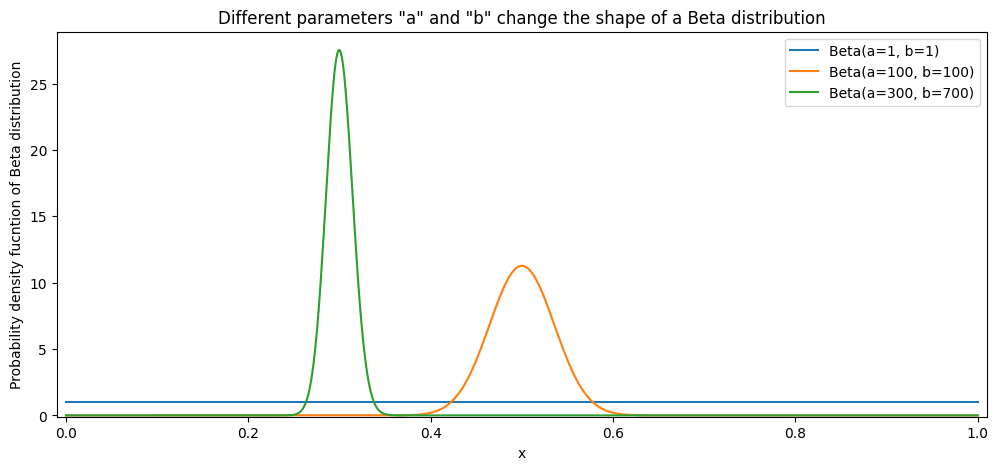
The beta distribution is bounded by 0 and 1, which makes it a perfect candidate to model a distribution of CTR. We can start from "a = 1" and "b = 1" as Beta distribution parameters that model CTR. In this case, we would have no beliefs about distribution, making any CTR equally probable. Then, we can start adding observed data. As you can see, each "success" or "click" increases "a" by 1. Each "failure" or "skip" increases "b" by 1. This skews the distribution of CTR but does not change the distribution family. It is still a beta distribution!

We assume that CTR can be modeled as a Beta distribution. Then, there are two title options and two distributions. How do we choose what to show to a viewer? Hence, the algorithm is called a "multi-armed bandit." At the time when a viewer requests a title, you "pull both arms" and sample CTRs. After that, you compare values and show a title with the highest sampled CTR. Then, the viewer either clicks or skips. If the title was clicked, you would adjust this option's Beta distribution parameter "a," representing "successes." Otherwise, you increase this option's Beta distribution parameter "b," meaning "failures." This skews the distribution, and for the next viewer, there will be a different probability of choosing this option (or "arm") compared to other options.

After several iterations, the algorithm will have an estimate of CTR distributions. Sampling from this distribution will mainly trigger the highest CTR arm but still allow new users to explore other options and readjust allocation.

Well, this all works in theory. Is it really better than the 50/50 split we have discussed before?

Building a simulation with Python

All the code to create a simulation and build graphs can be found in my GitHub Repo.

As mentioned earlier, we only have two titles to choose from. We have no prior beliefs about CTRs of this title. So, we start from a=1 and b=1 for both Beta distributions. I will simulate a simple incoming traffic assuming a queue of viewers. We know precisely whether the previous viewer "clicked" or "skipped" before showing a title to the new viewer. To simulate "click" and "skip" actions, I need to define some real CTRs. Let them be 5% and 7%. It is essential to mention that the algorithm knows nothing about these values. I need them to simulate a click; you would have actual clicks in the real world. I will flip a super-biased coin for each title that lands heads with a 5% or 7% probability. If it landed heads, then there is a click.

Then, the algorithm is straightforward:

  1. Based on the observed data, get a Beta distribution for each title
  2. Sample CTR from both distribution
  3. Understand which CTR is higher and flip a relevant coin
  4. Understand if there was a click or not
  5. Increase parameter "a" by 1 if there was a click; increase parameter "b" by 1 if there was a skip
  6. Repeat until there are users in the queue.

To understand the algorithm's quality, we will also save a value representing a share of viewers exposed to the second option as it has a higher "real" CTR. Let's use a 50/50 split strategy as a counterpart to have a baseline quality.

Code by Author

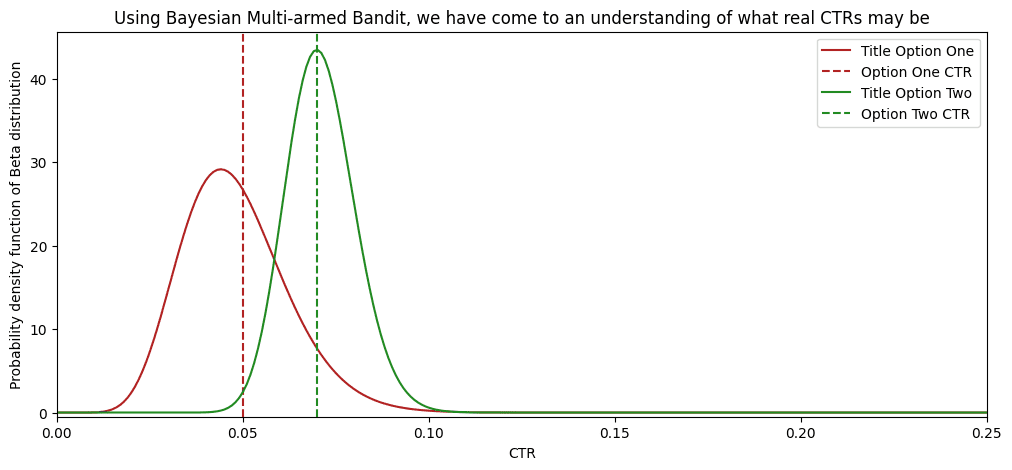
After 1000 users in the queue, our "multi-armed bandit" already has a good understanding of what are the CTRs.

Beyond Guesswork: Leveraging Bayesian Statistics for Effective Article Title Selection

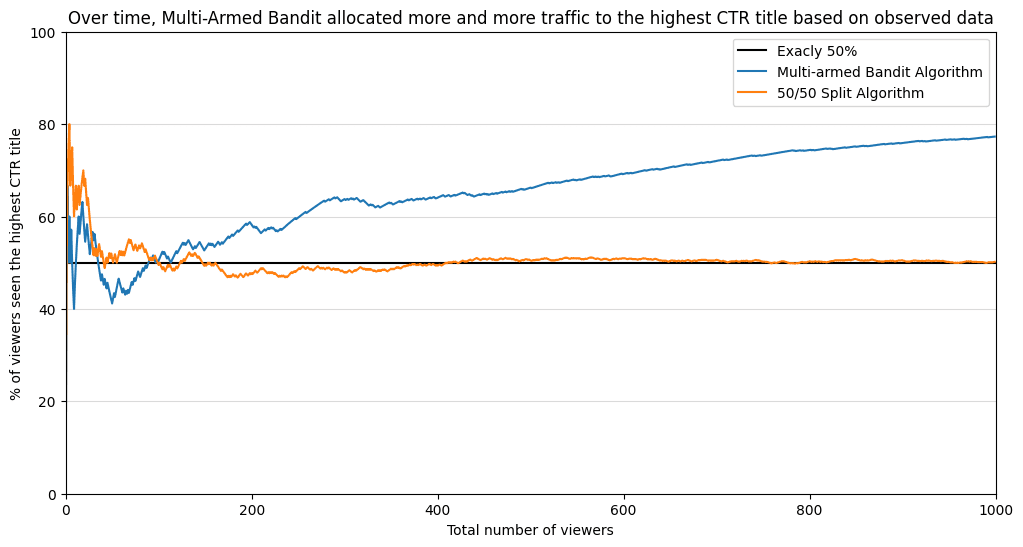
And here is a graph that shows that such a strategy yields better results. After 100 viewers, the "multi-armed bandit" surpassed a 50% share of viewers offered the second option. Because more and more evidence supported the second title, the algorithm allocated more and more traffic to the second title. Almost 80% of all viewers have seen the best-performing option! While in the 50/50 split, only 50% of the people have seen the best-performing option.

Beyond Guesswork: Leveraging Bayesian Statistics for Effective Article Title Selection

Bayesian Multi-armed Bandit exposed an additional 25% of viewers to a better-performing option! With more incoming data, the difference will only increase between these two strategies.

Conclusion

Of course, "Multi-armed bandits" are not perfect. Real-time sampling and serving of options is costly. It would be best to have a good infrastructure to implement the whole thing with the desired latency. Moreover, you may not want to freak out your viewers by changing titles. If you have enough traffic to run a quick A/B, do it! Then, manually change the title once. However, this algorithm can be used in many other applications beyond media.

I hope you now understand what a "multi-armed bandit" is and how it can be used to choose between two options adapted to the new data. I specifically did not focus on maths and formulas as the textbooks would better explain it. I intend to introduce a new technology and spark an interest in it!

If you have any questions, do not hesitate to reach out on LinkedIn.

The notebook with all the code can be found in my GitHub repo.

Igor Khomyanin is a Data Scientist at Salmon, with prior data roles at Yandex and McKinsey. I specialize in extracting value from data using Statistics and Data Visualization.

More On This Topic

  • This Data Visualization is the First Step for Effective Feature Selection
  • Bayesian vs Frequentist Statistics in Data Science
  • Neural Networks from a Bayesian Perspective
  • In-Database Analytics: Leveraging SQL's Analytic Functions
  • SQL For Data Science: Understanding and Leveraging Joins
  • Leveraging XGBoost for Time-Series Forecasting

Why Amazon Q Deserves Another Chance 

At re:Invent, amid much fanfare, AWS introduced Amazon Q, a generative AI chatbot that is specifically designed for a business’ need. The company claimed that unlike OpenAI’s ChatGPT, it is much safer and more secure. However, contrary to these assertions, Amazon Q has come under the limelight for all the wrong reasons.

Just three days after the launch, concerns are increasing among employees regarding accuracy and privacy of the chatbot. Q is reportedly “suffering from significant hallucinations” and has been implicated in leaking sensitive data, such as the locations of AWS data centres, internal discount programs, and unreleased features.

Undoubtedly, Amazon quickly released a statement and said, “No security issue was identified as a result of that feedback. We appreciate all of the feedback we’ve already received and will continue to tune Q as it transitions from being a product in preview to being generally available.”

A Case for Amazon’s Q

Employees can use Amazon Q to complete tasks in popular systems like Jira, Salesforce, ServiceNow, and Zendesk, as was highlighted at re:Invent, which is a unique thing about Amazon Q. For example, an employee could ask Amazon Q to open a ticket in Jira or create a case in Salesforce.

Interestingly, Amazon Q hasn’t been released yet, and criticisms are already mounting. Being in preview, it’s expected to undergo corrections as necessary.

“Companies need to realise that it is incredibly difficult to make an LLM not hallucinate. At best they can minimise it to some degree and won’t be able to get rid of it. What OpenAI did with GPT-4 is a herculean act that others may not be able to easily imitate,” said Nektarios Kalogridis, Founder and CEO DeepTrading AI addressing concerns about Amazon Q.

Also, we cannot blame Amazon Q directly for hallucinating as it can work with any of the models found on Amazon Bedrock, AWS’s repository of AI models, which includes Meta’s Llama 2 and Anthropic’s Claude 2.

The company said customers who use Q often choose which model works best for them, connect to the Bedrock API for the model, use that to learn their data, policies, and workflow, and subsequently deploy Amazon Q. Therefore, if there are instances of hallucination, it could stem from any of the aforementioned models.

Moreover, ChatGPT has also had its share of issues with leaking sensitive information. Most recently, it leaked private and sensitive data when told to repeat the word ‘poem’ indefinitely. But that hasn’t deterred enterprises from using ChatGPT.

Similar to Amazon Q, OpenAI’s ChatGPT Enterprise hasn’t been made available yet. OpenAIs COO, Brad Lightcap, in a recent interview, revealed that ‘many, many, many thousands’ of companies are on the waiting list for the AI tool (ChatGPT Enterprise). Since November, 92 percent of Fortune 500 companies have used ChatGPT, a significant increase from 80 percent in August.

Enterprise Chatbots are the Future

Despite the concerns raised, Amazon Q comes with great benefits.

Just like ChatGPT Enterprise, Amazon Q will also allow customers to connect to their business data, information, and systems, so it can synthesise everything and provide tailored assistance to help employees solve problems, generate content, and take actions relevant to their business.

The above features are a result of RAG, which retrieves data relevant to a question or task and provides them as context for the LLM. However, RAG comes with a risk of potential data leaks, similar to what occurred with Amazon Q.

Ethan Mollick, professor at Wharton, expressed that RAG has its own advantages and disadvantages. “I say it a lot, but using LLMs to build customer service bots with RAG access to your data is not the low-hanging fruit it seems to be. It is, in fact, right in the weak spot of current LLMs – you risk both hallucinations & data exfiltration.”

Something similar OpenAI introduced on Devday with Assistant APIs, which include a function called ‘Retrieval,’ which is nothing but a RAG function. This enhances the assistant with knowledge from outside our models, such as proprietary domain data, product information, or documents provided by your users.

Apart from OpenAI and AWS, Cohere is quietly collaborating with enterprises to incorporate generative AI capabilities.

Cohere was one of the first ones to understand the importance of RAG as a method to reduce hallucinations and keep the chatbot updated. In September, Cohere introduced the Chat API with RAG. With this new feature, developers can combine user inputs, data sources, and model outputs to create strong product experiences.

Despite the concerns that are being raised about hallucination and data leaks, enterprises completely cannot ditch the generative AI chatbots as they are definitely going to get better over time and this is just the beginning.

The post Why Amazon Q Deserves Another Chance appeared first on Analytics India Magazine.

Kyron Learning secures $14.6M to expand its conversational AI technology

Kyron Learning secures $14.6M to expand its conversational AI technology Lauren Forristal 8 hours

Kyron Learning, an AI-based learning startup, announced today its $14.6 million Series A funding round plus a $850,000 grant from the Bill & Melinda Gates Foundation. The new capital will further develop the platform’s generative AI capabilities and build out its K-12 math curriculum. Today, the company is opening the platform up to all organizations and learning solution providers, providing them with the right tools to release content using Kyron’s conversational AI technology.

Kyron Learning was founded in 2022 by former VP of Google Cloud AI Rajen Sheth and Qwiklabs founder Enis Konuk with the belief that AI can positively impact learning. The interactive video platform allows students to interact with lessons by responding to questions via text or voice. Kyron’s conversational AI comprehends student answers and selects the relevant, pre-recorded responses provided by teachers. Kyron is also working on integrating generative AI to trigger AI-powered responses if a student needs further assistance.

The platform uses underlying AI models with Kyron’s proprietary technology built on top of them, Sheth explained to TechCrunch. It primarily uses AI techniques like NLU-based (Natural Language Understanding) dialog modeling and generative AI. The accuracy of its natural language processing is around 95%, Sheth noted.

“The accuracy can vary based on if the student is typing in answers via text or responding via voice, and also based on the environment they are in if they use voice… If a pre-recorded response doesn’t match a student’s answer, we have a more general fallback response that can go deeper with the student,” he added.

The company currently provides the technology for free to 35 pilot schools for the 2023-2024 school year. However, to start, Kyron Learning only offers fourth-grade math lessons. With the Bill & Melinda Gates Foundation grant, Kyron Learning will soon launch math content for third and fifth graders. Kyron Learning also provides lessons for Spanish-speaking students.

“We chose math because of the dire need across the country for math achievement and understanding,” Sheth said. In 2022, fourth and eighth-grade math scores fell to the lowest levels in nearly 20 years, per the National Assessment of Educational Progress.

Now that Kyron’s platform is open to all organizations, more students will have access to interactive video lessons. The company already works with several universities, tutoring companies, curriculum providers and employee training programs.

“Our goal is to create a community of creators and organizations that are building on top of this platform and extending it to all ages and all subjects,” Sheth said, adding that Kyron is rolling out a self-service creator tool in the early part of next year.

Global Silicon Valley Ventures led the Series A funding with participation from Owl Ventures, ECMC Group Education Impact Fund, Common Sense Growth Fund, Charter School Growth Fund, Cambiar Education, LearnerStudio, Imagine Learning and Array Education.

“Education achievement has dipped dramatically post-COVID, and we have one of the biggest teacher shortages that we have ever seen in the United States. There’s an urgent need to help students where they are and give them access to a great education that’s responsive to their needs. Also, we are at the beginning of incredible growth in AI technology, but using AI safely and [having] a positive impact on society will be crucial to its overall success as a technology. We are a company that is focused on both of these problems, and we bring together a set of veteran technologists and educators to solve this in the right way. If we are successful, we will have a great impact on society and the direction of AI,” Sheth said.

Microsoft IDC Turns 25 in India

The Microsoft India Development Centre (IDC) is observing 25 years of pioneering research, engineering, and development, which has played a crucial role in shaping top-tier products like Copilots and various AI applications.

The celebration of this milestone at IDC Hyderabad featured the presence of cricket legend Kapil Dev.

Over the past quarter-century, IDC has significantly contributed to the creation and advancement of key Microsoft offerings, including Azure, Windows, Office, and Bing. Its work has been integral to furthering Microsoft’s mission of empowering individuals and organisations globally.

Read: Microsoft Appoints Aparna Gupta as Global Delivery Center Leader

Currently, IDC is positioned for the next phase of innovation and impact, utilising AI and LLMs to enhance existing products, introduce new ones, and revolutionise the product development process.

Noteworthy achievements from IDC’s 25-year history include IDC playing a pivotal role in developing and launching the Microsoft 365 (Office) mobile app, a suite of productivity apps for Android and iOS devices. This app boasts over 100 million monthly active users globally, providing a seamless and secure experience across various devices.

Moreover, IDC’s efforts enabled support for 20 Indian languages on Microsoft Translator, fostering linguistic diversity and overcoming language barriers. This technology also contributed to the development of Jugalbandi, a generative AI chatbot facilitating easy access to information on Government services for millions of Indians in their local languages.

IDC has also been a frontrunner in building and managing infrastructure and services for Azure, Microsoft’s cloud computing platform. The centre played a key role in creating the Azure Supercomputer, one of the world’s most powerful AI supercomputers capable of running large-scale AI models and applications with remarkable speed and efficiency.

In alignment with Microsoft’s commitment to enhancing technology accessibility, IDC has developed and improved features such as voice access, narrator, magnifier, eye control, and dictation on Windows 11. These features enable users to interact with their devices using natural and intuitive modalities.

Speaking at the event, Rajiv Kumar, Managing Director, Microsoft IDC, and CVP, Experiences + Devices India, expressed, “Today, we celebrate our achievements and the outstanding workplace culture that attracts the best minds to innovate and create a global impact. As we embark on the next phase of revolutionary generative AI technology, the next 25 years hold even greater promise, with the potential to empower every person and every organisation on the planet to achieve more.”

The post Microsoft IDC Turns 25 in India appeared first on Analytics India Magazine.

5 Free Courses to Master MLOps

5 Free Courses to Master MLOps
Image generated by Microsoft Bing
Introduction

In today's world, where data drives decisions, simply creating machine learning (ML) models isn't enough. Organizations need to do more than build models — they need to successfully deploy, manage, and continuously improve these models in real-world scenarios. Imagine this: you've built a super-smart system to predict weather patterns, but unless you ensure it works every day and keeps getting smarter with new data, it's like having a powerful tool gathering dust in a shed. That's where MLOps steps in.

If you're curious about taking your MLOps skills to the next level and want to know how to turn your awesome models into real-world solutions, this article is your guide. I will introduce you to five free courses that break down MLOps into easy-to-understand bits. Whether you're starting fresh or you're already a pro in machine learning, there's a course here that fits just right for you.

Python Essentials for MLOps

Link: Python Essentials for MLOps

5 Free Courses to Master MLOps
Python Essentials for MLOps Course

This course will teach you the fundamental Python skills you need to succeed in an MLOps role. It covers the basics of the Python programming language, including data types, functions, modules, and testing techniques. It also covers how to work effectively with datasets and other data science tasks with Pandas and NumPy. In this course, through a series of hands-on exercises, you will gain practical experience working with Python in the context of an MLOps workflow. By the end of the course, you will have the necessary skills to write Python scripts for automating common MLOps tasks.

This course is ideal for anyone looking to break into the field of MLOps or for experienced MLOps professionals who want to improve their Python skills.

Topics covered:

  • Data Exploration
  • Classification: Spam Filtering
  • Ranking: Priority Inbox
  • Regression: Predicting Page Views
  • Regularization: Text Regression
  • Optimization: Breaking Codes
  • PCA: Building a Market Index
  • MDS: Visually Exploring US Senator Similarity
  • kNN: Recommendation Systems
  • Analyzing Social Graphs
  • Model Comparison

MLOps for Beginners

Link: MLOps for Beginners

5 Free Courses to Master MLOps
MLOps for Beginners Course

So now that you have taken a refresher on Python, it is time to dig into some real stuff! The course, MLOps for Beginners, is a free tutorial on Udemy that teaches you how to provide an end-to-end machine learning development process to design, build, and manage the AI model lifecycle.

The course is taught by Prem Naraindas, an experienced MLOps practitioner, and includes several hands-on exercises. By the end of the course, you will have a good understanding of the basics of MLOps and be able to apply it to your work.

Topics covered:

  • MLOps Overview
  • MLOps Tools and Platforms
  • Creating pipelines
  • Automating model training, evaluation, experimentation
  • Deployment and monitoring
  • Serving
  • Scaling
  • MLOps Best Practices

Machine Learning Engineering for Production (MLOps) Specialization

Link: Machine Learning Engineering for Production (MLOps) Specialisation

5 Free Courses to Master MLOps
Machine Learning Engineering for Production Specialization

If you're ready to transition from theoretical knowledge to real-world machine learning coding, you need to take this course Machine Learning Engineering for Production (MLOps) Specialization on Coursera. This comprehensive specialization, offered by deeplearning.ai, is designed for programmers who have previously some experience in Tensorflow and possess a passion for practical applications and hands-on coding experiences. This course is ideal for those who have a good grip on Python and TensorFlow and want to jump right into the MLOps world!

The best part is that the course is taught by Andrew Ng, the leading AI advocate at Google, Lawrence Moroney, and Robert Crowe from Google.

Topics covered:

  • Production-ready Machine learning systems
  • Data pipelines and model management techniques
  • Concept Drift
  • Model Training
  • Cloud Based tools for MLOps
  • Monitoring of models
  • Optimization of models
  • Tensorflow Production (TFX)

MLOps | Machine Learning Operations Specialization

Link: Machine Learning Operations Specialization

5 Free Courses to Master MLOps
Machine Learning Operations Specialization

This comprehensive course series is designed for individuals with programming knowledge and who are interested in learning MLOps. The courses will teach you how to use Python and Rust for MLOps tasks, GitHub Copilot to enhance productivity, and leverage platforms like Amazon SageMaker, Azure ML, and MLflow. You will also learn how to fine-tune Large Language Models (LLMs) using Hugging Face and understand the deployment of sustainable and efficient binary embedded models in the ONNX format. The courses will also prepare you for various career paths in MLOps, such as data science, machine learning engineering, cloud ML solutions architecture, and artificial intelligence (AI) product management.

This comprehensive course series is perfect, especially for those individuals with prior programming knowledge, such as software developers, data scientists, and researchers.

Topics covered:

  • Microsoft Azure
  • Big Data
  • Data Analysis
  • Python Programming
  • Github
  • Machine Learning
  • Cloud Computing
  • Data Management
  • DevOps
  • Amazon Web Services (Amazon AWS)
  • Rust Programming
  • MLOps

Made With ML MLOps Course

Link: Made with MLOps

5 Free Courses to Master MLOps
Made With ML MLOps Course

Goku Mohandas has developed an exceptional and publicly accessible course on the creation of end-to-end machine learning systems. Made with ML is one of the most popular GitHub repositories with over 30,000 people enrolled in this course.

Made with ML lessons cover the fundamentals of machine learning as well as the intricacies of model deployment, testing, and monitoring in production. Goku's lessons explain the underlying ideas behind the concepts introduced, provide practical project-based assignments, and equip students with some of the best practices in software engineering necessary for success in an MLOps role.

Topics Covered:

  1. Fundamentals of Machine Learning
  2. End-to-End System Development
  3. Deployment Strategies
  4. Testing Methodologies
  5. Model Monitoring
  6. Intuition behind Concepts
  7. Hands-On Project Assignments
  8. Software Engineering Best Practices

Conclusion

MLOps is a rapidly growing field with a high demand for skilled professionals. By mastering MLOps, you can open up new career opportunities and make a real impact in the world. With the help of these five free courses, you can take the first step toward becoming an MLOps expert. So what are you waiting for? Enroll today and start learning!

If you are a beginner in machine learning and MLOps, you might want to see our article on 5 free books to master machine learning. But if you want to dive right into MLOps and want to take one or two courses only, I recommend taking the Machine Learning Engineering for Production (MLOps) Specialization by Andrew Ng and the Made with MLOps course.

We're curious to know, which courses have played a pivotal role in your machine-learning journey. Feel free to share your thoughts in the comments below!

Kanwal Mehreen is an aspiring software developer with a keen interest in data science and applications of AI in medicine. Kanwal was selected as the Google Generation Scholar 2022 for the APAC region. Kanwal loves to share technical knowledge by writing articles on trending topics, and is passionate about improving the representation of women in tech industry.

More On This Topic

  • 5 Free Courses to Master Linear Algebra
  • 5 Free Courses to Master Calculus
  • 5 Free Courses to Master Data Science
  • 5 Free Courses to Master Machine Learning
  • 5 Free Courses to Master Generative AI
  • 5 Free Courses to Master Data Engineering

IIT Bombay Joins IBM, Meta to Form AI Alliance, Challenging OpenAI, Google, Amazon, Microsoft

IIT Bombay Joins IBM, Meta to Form AI Alliance, Challenging OpenAI, Google, Amazon, Microsoft

IBM and Meta, along with several prominent universities, companies, and a group of tech startups and foundations, have formed an “AI Alliance.” The primary objective of this alliance is to challenge the dominance of established players such as OpenAI, Microsoft, Google, and Amazon in the field of AI, and prompt open innovation in AI.

The announcement aims to disrupt the current state of the AI industry by fostering innovation and promoting healthy competition, by the partnership of universities, research institutions, and big-tech.

Apart from IBM and Meta, other participants include AMD, Anyscale, Cerebras, Hugging Face, Dell, Intel, Oracle, Stability AI, LangChain, Red Hat, Together AI, and universities such as IIT Bombay, UC Berkeley College of Computing, University of Illinois, University of Notre Dame, University of Texas, The University of Tokyo , Yale University, Cornell University, Hebrew University of Jerusalem, and several others.

The main objective of the alliance are to:

  • Create and implement benchmarks, standards, and tools for responsible global AI system development, emphasising safety, security, and trust.
  • Promote open foundation models with diverse capabilities, focusing on multilingual, multimodal, and science models to address societal challenges.
  • Boost contributions to the AI hardware accelerator ecosystem by enhancing essential enabling software technology.
  • Support global AI skills development and exploratory research, engaging the academic community in essential AI model and tool research projects.
  • Develop educational content to inform the public and policymakers about AI benefits, risks, solutions, and the need for precise regulation.
  • Launch initiatives encouraging open and responsible AI development, hosting events to showcase how Alliance members use open technology in AI for positive impact.

The participating organisations are expected to collaborate on various projects, including research and development of new AI algorithms, hardware, and software. The AI Alliance aligns with a long-standing debate within the developer community regarding the merits of “open” versus “closed” development of AI.

Dario Gil, who is a senior vice president at IBM and also heads the company’s research lab, has expressed his concern about the limited focus on a few institutions in the discourse on AI in the past year. Gil emphasised that the field of AI is much larger than what has been discussed so far. When asked about the specific institutions he was referring to, Gil chose not to name them directly, stating, “You know who.”

Similarly, Arvind Krishna, IBM Chairman and CEO said “The progress we continue to witness in AI is a testament to open innovation and collaboration across communities of creators, scientists, academics and business leaders. This is a pivotal moment in defining the future of AI. IBM is proud to partner with like-minded organisations through the AI Alliance to ensure this open ecosystem drives an innovative AI agenda underpinned by safety, accountability and scientific rigour.

“Nick Clegg, President, Global Affairs of Meta said, “We believe it’s better when AI is developed openly – more people can access the benefits, build innovative products and work on safety. The AI Alliance brings together researchers, developers and companies to share tools and knowledge that can help us all make progress whether models are shared openly or not. We’re looking forward to working with partners to advance the state-of-the-art in AI and help everyone build responsibly.”

The post IIT Bombay Joins IBM, Meta to Form AI Alliance, Challenging OpenAI, Google, Amazon, Microsoft appeared first on Analytics India Magazine.