Meta AI adds Reels support and ‘reimagine,’ a way to generate new AI images in group chats, and more

Meta AI adds Reels support and ‘reimagine,’ a way to generate new AI images in group chats, and more Sarah Perez @sarahintampa / 12 hours

Alongside other AI updates announced today, Meta AI, the company’s generative AI experience, is gaining new capabilities starting today, including the ability to create new AI images when prompted as well as support for Reels, among other things. The former, a feature called “reimagine,” allows users in group chats to have more fun by recreating AI images with prompts, while the latter can turn to Reels as a resource as needed.

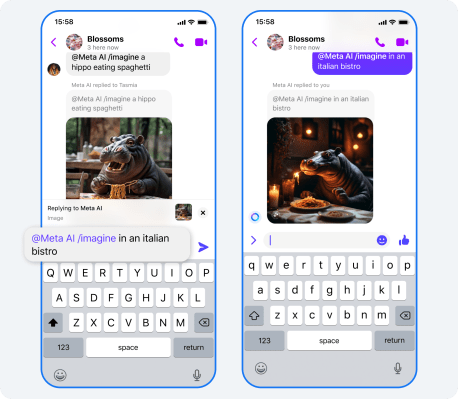
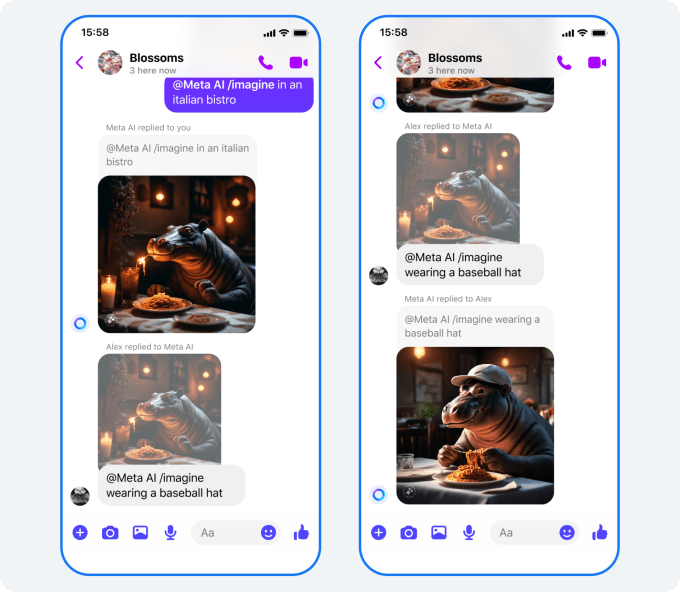
To use reimagine in a group chat, a user would first generate an AI image with a prompt using Meta AI, the company’s virtual assistant that can answer questions or generate images. A friend could then press and hold on the image to add another text prompt and Meta AI will generate an entirely new image, based on their changes. Friends can then go back and forth, recreating the image with multiple prompts as they try to one-up each other with even wilder ideas, Meta suggests. If successful, the feature could increase engagement time with Meta’s apps as users toy around with the new AI capabilities.

Image Credits: Meta

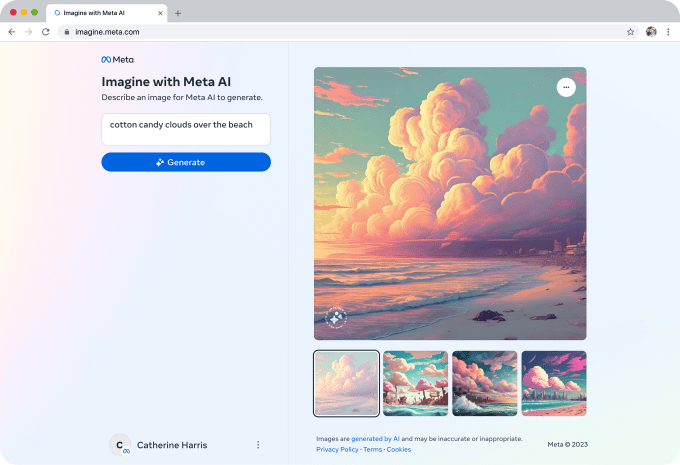
The feature arrives alongside today’s launch of an online AI image generator called Imagine with Meta AI, which is a free web tool for creating high-resolution AI images in a few seconds.

Image Credits: Meta

The company notes that Meta AI is also becoming more helpful, by offering more detailed responses on mobile devices and more accurate summaries of search results. It’s now able to respond to a wider variety of requests with helpful responses, too, Meta says.

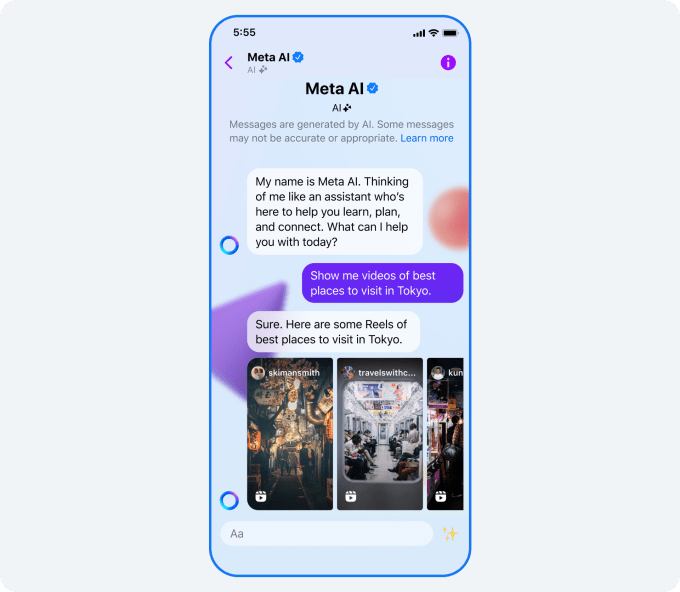
Another new addition is support for Reels in Meta AI chat. This could be helpful when you want to see visual examples of things that match your query. For example, if you were planning a trip with friends in a group chat, you could ask Meta AI to recommend the best places to visit and share Reels of those top sites and attractions, the company explains.

Image Credits: Meta

Meta says these features are rolling out starting today, but it notes that it has many other AI tools in testing. While you may not come across all of them directly, Meta says there are more than 20 new generative AI experiences being trialed across Facebook, Instagram and WhatsApp, including those focused on search, social discovery, ads, business messaging and more.

To use Meta AI, you first start a new message and select “Create an AI chat” on Meta’s messaging platforms. This is also how you can choose to interact with Meta’s AI characters, which have their own distinct personalities. Meta AI can also be accessed by typing “@MetaAI” in a group chat followed by what you want help with or you can say “Hey Meta” while wearing Ray-Ban Meta smart glasses.

Though consumers’ direct experience with Meta AI is in the chat interface, the company points out that the AI powers other features, too, under the hood. For instance, the large language model (LLM) tech behind Meta AI is used to give people options for AI-generated post comment suggestions in English and community chat topic suggestions in groups. It also serves search results and enhances product copy in Shops.

Image Credits: Meta

As a part of these broader efforts, Meta says it’s testing using Meta AI to help Facebook users create birthday greetings for friends, edit their Facebook Feed posts, draft introductions on their Facebook Dating profiles and help set up new Facebook Groups. It’s also testing ways to create and share AI-generated images on Facebook, for example by using Meta AI to convert images from landscape to portrait orientation for use in Stories.

Image Credits: Meta

The AI will also be used to surface important conversations in Facebook Groups, suggest topics for Group chats and help people learn more about products on Marketplace or find related or alternative items. Meta AI will be put to use to improve search for finding friends, Pages, Groups and Marketplace listings, as well.

For creators, Meta AI will be used to help suggest replies in DMs, based on the conversation tone and content.

As part of its image-generating abilities, Meta AI will soon also begin to watermark its images, the company said.

Meta launches a standalone AI-powered image generator

Meta’s AI characters are now live across its U.S. apps, with support for Bing Search and better memory

AMD ROCm 6 is Here, OpenAI Adds Support

AMD ROCm 6 is Here, OpenAI Adds Support

AMD at the Advancing AI event has showcased significant advancements in its software part of its Instinct data centre accelerators, emphasising an open, proven, and ready AI software platform for the market. The company introduced the latest iteration of its parallel computing framework, ROCm 6, optimised for a comprehensive software stack for AMD Instinct, particularly catering to large language models in generative AI.

Key features of ROCm 6, which is an alternative to NVIDIA’s CUDA, include support for new data types, advanced graph and kernel optimizations, optimised libraries, and state-of-the-art attention algorithms. Notably, the performance boost is remarkable, with an approximately 8x increase in overall latency for text generation compared to ROCm 5 running on the MI250.

In a collaborative effort with three emerging AI startups – Databricks, Essential AI, and Lamini – AMD showcased how they leverage the AMD Instinct M1300X accelerators and the open ROCm 6 software stack to deliver differentiated AI solutions for enterprise customers.

Read: AMD Focuses on Software Ahead of MI300X Release

Furthermore, OpenAI is aligning with AMD by adding support for AMD Instinct accelerators to Triton 3.0. This move provides out-of-the-box support for AMD accelerators, enabling developers to work at a higher level of abstraction on AMD hardware within the growing ecosystem.

The ROCm Software and Ecosystem Partners announcement underscores AMD’s commitment to contributing to the open-source community. ROCm 6 represents a significant step forward, offering open-art libraries and supporting various key features for generative AI, including FlashAttention, HIPGraph, and vLLM.

Read: AMD’s Attempt to Break NVIDIA’s CUDA

This positions AMD uniquely to leverage widely used AI software models, algorithms, and frameworks, fostering innovation and simplifying deployment for enterprises.

In addition to the software advancements, AMD continues its strategic investments in software through Mipsology, acquisitions like Nod.AI, and partnerships such as Lamini, which enables LLM training on AMD ROCm with zero code changes.

The unveiled developments mark a pivotal moment in the AI landscape, with AMD’s robust software platform poised to unlock the true potential of generative AI, driving the industry forward into a new era of innovation.

The post AMD ROCm 6 is Here, OpenAI Adds Support appeared first on Analytics India Magazine.

ChatGPT’s First Anniversary: Reshaping the Future of AI Interaction

ChatGPT vs. Open-Source Models

Reflecting on ChatGPT's first year, it's clear that this tool has significantly changed the AI scene. Launched at the end of 2022, ChatGPT stood out because of its user-friendly, conversational style that made interacting with AI feel more like chatting with a person than a machine. This new approach quickly caught the public's eye. Within just five days after its release, ChatGPT had already attracted a million users. By early 2023, this number ballooned to about 100 million monthly users, and by October, the platform was drawing in around 1.7 billion visits worldwide. These numbers speak volumes about its popularity and usefulness.

Over the past year, users have found all sorts of creative ways to use ChatGPT, from simple tasks like writing emails and updating resumes to starting successful businesses. But it's not just about how people are using it; the technology itself has grown and improved. Initially, ChatGPT was a free service offering detailed text responses. Now, there's ChatGPT Plus, which includes ChatGPT-4. This updated version is trained on more data, gives fewer wrong answers, and understands complex instructions better.

One of the biggest updates is that ChatGPT can now interact in multiple ways – it can listen, speak, and even process images. This means you can talk to it through its mobile app and show it pictures to get responses. These changes have opened up new possibilities for AI and have changed how people view and think about AI's role in our lives.

From its beginnings as a tech demo to its current status as a major player in the tech world, ChatGPT's journey is quite impressive. Initially, it was seen as a way to test and improve technology by getting feedback from the public. But it quickly became an essential part of the AI landscape. This success shows how effective it is to fine-tune large language models (LLMs) with both supervised learning and feedback from humans. As a result, ChatGPT can handle a wide range of questions and tasks.

The race to develop the most capable and versatile AI systems has led to a proliferation of both open-source and proprietary models like ChatGPT. Understanding their general capabilities requires comprehensive benchmarks across a wide spectrum of tasks. This section explores these benchmarks, shedding light on how different models, including ChatGPT, stack up against each other.

Evaluating LLMs: The Benchmarks

  1. MT-Bench: This benchmark tests multi-turn conversation and instruction-following abilities across eight domains: writing, roleplay, information extraction, reasoning, math, coding, STEM knowledge, and humanities/social sciences. Stronger LLMs like GPT-4 are used as evaluators.
  2. AlpacaEval: Based on the AlpacaFarm evaluation set, this LLM-based automatic evaluator benchmarks models against responses from advanced LLMs like GPT-4 and Claude, calculating the win rate of candidate models.
  3. Open LLM Leaderboard: Utilizing the Language Model Evaluation Harness, this leaderboard evaluates LLMs on seven key benchmarks, including reasoning challenges and general knowledge tests, in both zero-shot and few-shot settings.
  4. BIG-bench: This collaborative benchmark covers over 200 novel language tasks, spanning a diverse range of topics and languages. It aims to probe LLMs and predict their future capabilities.
  5. ChatEval: A multi-agent debate framework that allows teams to autonomously discuss and evaluate the quality of responses from different models on open-ended questions and traditional natural language generation tasks.

Comparative Performance

In terms of general benchmarks, open-source LLMs have shown remarkable progress. Llama-2-70B, for instance, achieved impressive results, particularly after being fine-tuned with instruction data. Its variant, Llama-2-chat-70B, excelled in AlpacaEval with a 92.66% win rate, surpassing GPT-3.5-turbo. However, GPT-4 remains the frontrunner with a 95.28% win rate.

Zephyr-7B, a smaller model, demonstrated capabilities comparable to larger 70B LLMs, especially in AlpacaEval and MT-Bench. Meanwhile, WizardLM-70B, fine-tuned with a diverse range of instruction data, scored the highest among open-source LLMs on MT-Bench. However, it still lagged behind GPT-3.5-turbo and GPT-4.

An interesting entry, GodziLLa2-70B, achieved a competitive score on the Open LLM Leaderboard, showcasing the potential of experimental models combining diverse datasets. Similarly, Yi-34B, developed from scratch, stood out with scores comparable to GPT-3.5-turbo and only slightly behind GPT-4.

UltraLlama, with its fine-tuning on diverse and high-quality data, matched GPT-3.5-turbo in its proposed benchmarks and even surpassed it in areas of world and professional knowledge.

Scaling Up: The Rise of Giant LLMs
LLM models

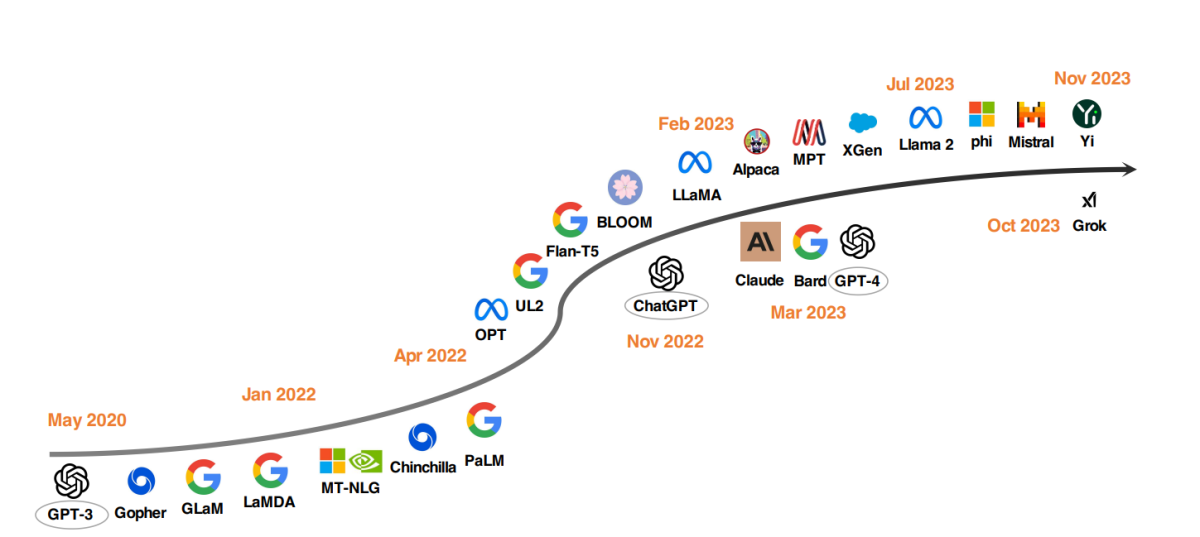
Top LLM models since 2020

A notable trend in LLM development has been the scaling up of model parameters. Models like Gopher, GLaM, LaMDA, MT-NLG, and PaLM have pushed the boundaries, culminating in models with up to 540 billion parameters. These models have shown exceptional capabilities, but their closed-source nature has limited their wider application. This limitation has spurred interest in developing open-source LLMs, a trend that's gaining momentum.

In parallel to scaling up model sizes, researchers have explored alternative strategies. Instead of just making models bigger, they've focused on improving the pre-training of smaller models. Examples include Chinchilla and UL2, which have shown that more isn't always better; smarter strategies can yield efficient results too. Furthermore, there's been considerable attention on instruction tuning of language models, with projects like FLAN, T0, and Flan-T5 making significant contributions to this area.

The ChatGPT Catalyst

The introduction of OpenAI's ChatGPT marked a turning point in NLP research. To compete with OpenAI, companies like Google and Anthropic launched their own models, Bard and Claude, respectively. While these models show comparable performance to ChatGPT in many tasks, they still lag behind the latest model from OpenAI, GPT-4. The success of these models is primarily attributed to reinforcement learning from human feedback (RLHF), a technique that's receiving increased research focus for further improvement.

Rumors and Speculations Around OpenAI's Q* (Q-Star)

Recent reports suggest that researchers at OpenAI may have achieved a significant advancement in AI with the development of a new model called Q* (pronounced Q star). Allegedly, Q* has the capability to perform grade-school-level math, a feat that has sparked discussions among experts about its potential as a milestone towards artificial general intelligence (AGI). While OpenAI has not commented on these reports, the rumored abilities of Q* have generated considerable excitement and speculation on social media and among AI enthusiasts.

The development of Q* is noteworthy because existing language models like ChatGPT and GPT-4, while capable of some mathematical tasks, are not particularly adept at handling them reliably. The challenge lies in the need for AI models to not only recognize patterns, as they currently do through deep learning and transformers, but also to reason and understand abstract concepts. Math, being a benchmark for reasoning, requires the AI to plan and execute multiple steps, demonstrating a deep grasp of abstract concepts. This ability would mark a significant leap in AI capabilities, potentially extending beyond mathematics to other complex tasks.

However, experts caution against overhyping this development. While an AI system that reliably solves math problems would be an impressive achievement, it doesn't necessarily signal the advent of superintelligent AI or AGI. Current AI research, including efforts by OpenAI, has focused on elementary problems, with varying degrees of success in more complex tasks.

The potential applications advancements like Q* are vast, ranging from personalized tutoring to assisting in scientific research and engineering. However, it's also important to manage expectations and recognize the limitations and safety concerns associated with such advancements. The concerns about AI posing existential risks, a foundational worry of OpenAI, remain pertinent, especially as AI systems begin to interface more with the real world.

The Open-Source LLM Movement

To boost open-source LLM research, Meta released the Llama series models, triggering a wave of new developments based on Llama. This includes models fine-tuned with instruction data, such as Alpaca, Vicuna, Lima, and WizardLM. Research is also branching into enhancing agent capabilities, logical reasoning, and long-context modeling within the Llama-based framework.

Furthermore, there's a growing trend of developing powerful LLMs from scratch, with projects like MPT, Falcon, XGen, Phi, Baichuan, Mistral, Grok, and Yi. These efforts reflect a commitment to democratize the capabilities of closed-source LLMs, making advanced AI tools more accessible and efficient.

The Impact of ChatGPT and Open Source Models in Healthcare

We're looking at a future where LLMs assist in clinical note-taking, form-filling for reimbursements, and supporting physicians in diagnosis and treatment planning. This has caught the attention of both tech giants and healthcare institutions.

Microsoft's discussions with Epic, a leading electronic health records software provider, signal the integration of LLMs into healthcare. Initiatives are already in place at UC San Diego Health and Stanford University Medical Center. Similarly, Google's partnerships with Mayo Clinic and Amazon Web Services‘ launch of HealthScribe, an AI clinical documentation service, mark significant strides in this direction.

However, these rapid deployments raise concerns about ceding control of medicine to corporate interests. The proprietary nature of these LLMs makes them difficult to evaluate. Their possible modification or discontinuation for profitability reasons could compromise patient care, privacy, and safety.

The urgent need is for an open and inclusive approach to LLM development in healthcare. Healthcare institutions, researchers, clinicians, and patients must collaborate globally to build open-source LLMs for healthcare. This approach, similar to the Trillion Parameter Consortium, would allow pooling of computational, financial resources, and expertise.
NexusRaven Outperforms GPT-4 for Zero-shot Function Calling

NexusRaven Outperforms GPT-4 for Zero-shot Function Calling

Nexusflow.ai, has recently launched NexusRaven-V2, a powerful 13-billion parameter LLM that outperforms GPT-4 in zero-shot function calling. The open source model showcases a remarkable capability to transform natural language instructions into executable code, facilitating the utilisation of software tools by copilots and agents.

NexusRaven-V2 demonstrates superiority over GPT-4 by achieving up to a 7% higher success rate in function calling in human-generated use cases involving nested and composite functions. Notably, NexusRaven-V2 accomplishes this without prior training on the specific functions used in the evaluation.

Check out the model on GitHub here, and on Hugging Face here.

Nexusflow.ai introduces the Nexus-Function-Calling benchmark, establishing a Hugging Face leaderboard. This includes a diverse collection of real-life human-curated function-calling examples, with eight out of the nine benchmarks open-sourced.

Open models now starting to surpass GPT4 for specialized tasks. Let's go!
Model by @NexusflowX: https://t.co/TBUBrevTpJ
Leaderboard: https://t.co/jbvk3U8Ibt pic.twitter.com/G3tEtB5zyp

— clem 🤗 (@ClementDelangue) December 5, 2023

Built on top of Llama 2, leveraging CodeLlama-13B-instruct, NexusRaven-V2 is instruction-tuned and utilises curated data from Nexusflow’s pipeline. The model is commercially permissive, encouraging both community developers and enterprises to explore its capabilities.

Nexusflow.ai provides open-source utility artefacts, enabling users to seamlessly replace mainstream proprietary function calling APIs with NexusRaven-V2 in their software workflows. Online demos and Colab notebooks are also available for onboarding and integration demonstrations.

NexusRaven-V2 showcases a 4% higher success rate in function calling on average compared to the latest GPT-4 model, as observed in a human-curated benchmark. In tasks involving nested and composite function calls, NexusRaven-V2 exhibits a significant 7% advantage over GPT-4, highlighting its robustness in handling variations in developers’ descriptions of functions.

To ensure reproducibility and standardisation, Nexusflow.ai releases the benchmark and associated leaderboard along with model weights. The evaluation benchmark prioritises human-generated samples with meticulous checks on executability and encompasses a diverse representation of function calling use cases and difficulties.

Nexusflow.ai is also providing a Python package, “nexusraven,” facilitating easy integration with copilots or agents. Developers can quickly ingest API function descriptions and send natural language queries to the model with a single line of code. The nexusraven package also supports converting function calling code to JSON format for seamless integration with downstream software.

The post NexusRaven Outperforms GPT-4 for Zero-shot Function Calling appeared first on Analytics India Magazine.

KDnuggets News, December 6: GitHub Repositories to Master Machine Learning • 5 Free Courses to Master Data Engineering

KDnuggets News, December 6: GitHub Repositories to Master Machine Learning • 5 Free Courses to Master Data Engineering

Cheat Sheets • Datasets • Education • Events • Jobs • Projects • Publications • Webinars

Features 10 GitHub Repositories to Master Machine Learning
Abid Ali Awan
5 Free Courses to Master Data Engineering
Cornellius Yudha Wijaya
This Week's Posts Beyond Human Boundaries: The Rise of SuperIntelligence
Josep Ferrer
Learn Probability in Computer Science with Stanford University for FREE
Nisha Arya
Building a GPU Machine vs. Using the GPU Cloud
Nahla Davies
The Top 5 Alternatives to GitHub for Data Science Projects
Abid Ali Awan
Building Predictive Models: Logistic Regression in Python
Bala Priya C
Free MIT Course: TinyML and Efficient Deep Learning Computing
Kanwal Mehreen
Mastering Data Science Workflows with ChatGPT
Vidhi Chugh
Generative AI Key Terms Explained
Matthew Mayo
Introduction to Multithreading and Multiprocessing in Python
Aryan Garg
5 Free Courses to Master MLOps
Kanwal Mehreen
Beyond Guesswork: Leveraging Bayesian Statistics for Effective Article Title Selection
Igor Khomyanin
7 Reasons Why You Shouldn't Become a Data Scientist
Bala Priya C

More On This Topic

  • KDnuggets News, December 14: 3 Free Machine Learning Courses for…
  • 10 GitHub Repositories to Master Machine Learning
  • Learn Data Engineering From These GitHub Repositories
  • KDnuggets News, April 6: 8 Free MIT Courses to Learn Data Science…
  • Learn Machine Learning From These GitHub Repositories
  • Learn Data Science From These GitHub Repositories

Google says Bard is now smarter than ChatGPT, thanks to Gemini update

2bardgettyimages-1676988402

Google unveiled its take on the AI chatbot — Google Bard — last February. Since its release, Bard has been powered by two different large language models (LLMs) with the promise of making it a more formidable rival to ChatGPT. Now Bard gets its most significant LLM upgrade yet — Gemini.

On Wednesday, Google released Gemini, the company's most capable and advanced large language model to date, first announced in May at Google I/O. Paired with the release of the LLM was the announcement that— starting today — users will be able to experience a specially tuned version of Gemini Pro for English in Google Bard.

Also: The best AI chatbots of 2023: ChatGPT and alternatives

Gemini Pro refers to the size of Gemini, which was released in three different sizes: Gemini Ultra, Gemini Pro, and Gemini Nano. Each size makes Gemini suitable for different tasks.

For example, Gemini Nano is the most efficient for on-device tasks; Gemini Pro is the best model for scaling across a wide range of tasks; and Gemini Ultra is the most advanced, making it the most suitable version for complex tasks, according to Google.

With the infusion of Gemini Pro, Google Bard is claimed to have more advanced, reasoning, planning, and understanding capabilities.

To show just how efficient Gemini Pro is, Google tested it against a number of industry-standard benchmarks. The results showed that in six of the eight benchmarks, Gemini Pro outperformed GPT-3.5, OpenAI's LLM that powers the accessible version of ChatGPT.

Compared to leading alternatives, Google goes on to claim, Bard with Gemini Pro was the preferred free chatbot in blind evaluations with third-party testers.

Users can test Bard with Gemini Pro for text-based prompts for themselves — starting today and for free — simply by visiting the chatbot like they regularly would.

For now, Bard with Gemini Pro is only available in English and in 170 countries and territories, but Google plans to expand to more languages and locations soon.

Also: Microsoft Seeing AI app lands on Android to help blind and visually impaired users

The Bard upgrades don't stop there. Early next year, Google plans on introducing Bard Advanced, which will be powered by the most advanced version of Gemini — Gemini Ultra — which is capable of quickly understanding and acting on multimodal inputs such as text, images, audio, video, and code, according to Google.

Before launching Bard Advanced, Google said, the company will first complete extensive safety checks and launch a trusted tester program.

Before Gemini, when Bard first launched, it was supported by a lightweight model version of Google's Language Model for Dialogue Applications (LaMDA). Then, in May, Bard became powered by PaLM 2, a more advanced version of PaLM meant to significantly improve the chatbot experience; however, the improvements seemed minimal.

Artificial Intelligence

Vast Data lands $118M to grow its data storage platform for AI workloads

Vast Data lands $118M to grow its data storage platform for AI workloads Kyle Wiggers 9 hours

Vast Data, to make an obvious pun, is raising vast sums of cash.

The New York-based startup, which provides a scale-out, unstructured data storage solution designed to eliminate tiered storage (i.e. setups that move data between high- and low-cost storage hardware), today announced that it secured $118 million in a Series E round led by Fidelity Ventures with participation from New Enterprise Associates, BOND Capital, Drive Capital, Nvidia, Dell, Goldman Sachs, Tiger Global, Commonfund, Norwest, 83North, Greenfield and Next47.

The round values Vast at $9.1 billion post-money, and brings the startup’s total raised to $381 million.

“The explosion of interest in AI and the need for modern infrastructure that can support these workloads in the last year has been a boon for Vast’s business and positions the company for continued growth and adoption with the enterprise,” Vast co-founder and CEO Renen Hallak told TechCrunch in an email interview. “Given the future-proof nature of Vast’s offering, data-driven organizations see Vast as a valuable investment in the future of their business.”

Hallak co-founded Vast in 2016 with Jeff Denworth, Shachar Fienblit (who previously held leadership roles at Kaminario and IBM) and Alon Horev (formerly at Cisco and IBM). The way Hallak tells it, the co-founders shared a vision of creating a next-gen data management platform — one that leveraged commodity hardware to deliver faster access to bigger data sets for AI workloads.

Vast’s founding team subsequently designed a new storage architecture and software infrastructure layer, operating in stealth until 2019, when the company began selling to customers.

Today, Vast unifies storage, database and compute engine services in a platform built to power AI and GPU-accelerated workloads across datacenters and clouds. Customers can use Vast to manage unstructured and structured data across their preferred private, public or hybrid clouds — data ranging from videos and images to text, data streams and edge device data.

“Stitching together legacy enterprise infrastructure is time-consuming and complex, and its inefficiencies make it an expensive endeavor,” Hallak said. “The legacy cloud recipe for building AI infrastructure comprises disparate technologies that, due to their underlying architecture, don’t take full advantage of modern technologies that offer improved performance, simplified operations and cost-savings … [And] without the right infrastructure in place, organizations can’t efficiently enable their AI and GPU-powered investments with the data access needed for AI and deep learning.”

While Vast has competition in vendors like Databricks, Hallak asserts that it has substantial first-mover advantage. There’s some truth to that it seems, judging by Vast’s books.

Vast’s annual recurring revenue now stands at $200 million and the company, which recently inked a strategic partnership with HPE, is growing 3.3x year over year, Hallak says. Cash flow has been positive for the last 12 months while Vast’s customer base has grown to include brands like Pixar and Zoom.

Now with more than 700 employees worldwide, Vast plans to put the new tranche toward expanding its business reach with an emphasis on Asia Pacific, the Middle East and Europe.

“Vast is a software company that operates on commodity hardware, so the pandemic and supply chain issues that plagued many businesses in the last few years did not have a material impact on Vast or its partners and customers,” Hallak said. “While Vast has continued to grow, scale and operate efficiently, this new investment will further advance Vast’s mission to deliver a new category of infrastructure that puts data at the center of how systems think, react and discover.”

Accenture Teams up with Unilever to Boost Productivity with Generative AI 

Global IT consulting firm Accenture and consumer goods MNC Unilever are collaborating strategically to utilise Unilever’s AI research and technology implementation for enhancing productivity and driving efficiencies. This partnership aims to accelerate growth powered by AI on a large scale.

The collaboration will commence at Unilever’s global AI Lab, “Horizon3 Labs,” located in Toronto. The focus includes exploring new applications to scale generative AI, utilising assets such as Accenture’s AI Navigator and proprietary “switchboard.”

Last week, Accenture introduced a range of services to assist companies in tailoring and scaling the benefits of generative AI. The services included the proprietary generative AI model “switchboard,” customisation techniques, model-managed services, and specialised training programs.

The switchboard enables users to select models based on business context or factors like cost and accuracy. These services aim to help clients swiftly access and contextualise enterprise data, supporting the transition from AI experimentation to scaled implementation.

The offerings also include skills development and collaboration with academic institutions, such as the Foundation Model Scholar Program with the Stanford Institute for Human-Centered AI. The Hartford, in collaboration with Accenture, exemplifies how the insurance industry can benefit from generative AI in handling policy-related documentation.

These initiatives tap into Accenture’s $3 billion investment in data and AI, connecting Unilever with experts and leveraging Accenture’s ecosystem partnerships, ventures, and strategic investments within its Center for Advanced AI, comprising over 1,450 patents and insights from 300 generative AI projects.

The post Accenture Teams up with Unilever to Boost Productivity with Generative AI appeared first on Analytics India Magazine.

India Plans to Replicate UPI Model with AI

In August 2023, IBM Chairman and CEO Arvind Krishna said India must develop sovereign capability in AI along with a computing and data infrastructure. “You need a way for the government and private companies to be able to leverage that in a way unique to India,” he said during his visit to India for the B20 Summit.

And India appears to be doing exactly that. Union Minister Rajeev Chandrasekhar, while speaking at a Financial Express event, recently said India has the opportunity to develop something very sovereign and unique and in line with the Digital Public Infrastructure (DPI) like Unified Payment Interface (UPI) and Aadhar, in which India has found tremendous success. Now, with AI, India wants to take the same DPI approach.

“We are determined that we must have our own sovereign AI. We can take two options. One is to say, as long as there is an AI ecosystem in India whether that is driven by Google, Meta, Indian startups, and Indian companies, we should be happy about it. But we certainly don’t think that is enough,” the minister said.

AI as Digital Public Infrastructure

The concept of Sovereign AI is no longer theoretical, gaining traction globally. Countries like France, UAE, and Singapore are even Europe considering its implementation.

However India’s approach to technology has been quite distinctive from the West. India sees technology as an enabler and the focus will always be on maximising economic development and real-life use cases in agriculture, healthcare and governance.

For example, Bhashini, a division of the Ministry of Electronics and Information Technology (MeitY), is testing a Whatsapp chatbot powered by OpenAI’s GPT models, which will answer their queries sent through voice notes in Indic languages. The chatbot could particularly be useful for Indian farmers who may not be accustomed to typing on smartphones.

Future use cases are anticipated to follow a similar trajectory, where the technology will be designed or leveraged by Indian enterprises and benefit the common citizen. Moreover, Chandrasekhar has also emphasised that AI is a kinetic enabler for India’s digital economy and could play a key role in the country’s ambitious plan of a USD 1 trillion digital economy by 2026.

India’s approach towards sovereign AI

While Chandrasekhar has not revealed how India’s approach towards sovereign AI will be, it could be very similar to Singapore‘s approach, where they are developing a base model with a regional context which will cater to Singapore’s unique linguistic characteristics.

As it stands, tokenisation costs for non-English languages in large language models like GPT-3.5 or GPT-4 are higher due to limited training data, model complexity, linguistic nuances, resource-intensive training, and the need for extensive evaluation and customisation, making adaptation more challenging and costly.

Considering India’s linguistic diversity, the government could create an open-source base model with multilingual capabilities. This model could be fine-tuned and utilised by the public and private sectors for various applications.

“The only other way for sovereign AI is to have a government, not curated, or managed, or approved but a government-sponsored India database platform,” the minister said. During the discussion, he added that it could be registered as a Section 8 type of non-profit company or a public-private partnership project over time.

Moreover, as per media reports, India’s sovereign AI programme could be announced during the three-day Global Partnership on Artificial Intelligence (GPAI) summit hosted by India in New Delhi.

Data infrastructure

India has many languages. Besides the 22 official languages, there are hundreds of languages and thousands of dialects spoken in different parts of the country. Building data sets for these distinctive languages will be the first big challenge, but work is already underway.

Through Bhashini, the government is already building open-source datasets of Indic languages like Assamese, Bengali, Hindi, Marathi and Dogri, among others. The Minister also said that the government is developing a framework to allow Indian startups and enterprises to use anonymised personal data with consent.

“We’re also creating a framework where Indian startups and the Indian AI research and innovation ecosystem will have preferential access, curated access to this huge data sets programme,” the minister said.

However, building datasets on all Indian languages by the government could take years. “If we had to collect as much data in Indian languages as went into a LLM like GPT, we’d be waiting another 10 years,” Kalika Bali, principal researcher at Microsoft Research India, told the Thomson Reuters Foundation.

Hence, to make this possible, a public-private partnership (PPP) model could be the right approach. IT giant Tech Mahindra is already working on a project to develop a 7 billion parameter LLM which will initially support 40 different Hindi dialects.

Moreover, building a base model capable of conversing in over 100 Indian languages is a challenging endeavour.“ So what we can do is create layers on top of generative AI models such as ChatGPT or Llama,” Bali suggested.

It will be intriguing to observe the approach India adopts. However, one clear requirement for the initiative’s success is the support of the right infrastructure, including robust computing capabilities.

Computing infrastructure

To meet India’s computation needs, the government is turning its attention to NVIDIA, the company making the most advanced Graphics Processing Units (GPUs), used for accelerating the training and inference processes of AI models.

Colette Kress, Chief Financial Officer at NVIDIA, speaking during the company’s earnings call on November 21, said that NVIDIA is already working with India’s government and largest tech companies including Infosys, Reliance and Tata to boost their sovereign AI infrastructure.

“Many countries are awakening to the need to invest in sovereign AI infrastructure to support economic growth and industrial innovation. With investments in domestic compute capacity, nations can use their own data to train LLMs and support their local generative AI ecosystems,” she said.

In September, NVIDIA founder and CEO Jensen Huang met Narendra Modi at his official residence in New Delhi. The government is also looking to build a 25,000 GPU cluster for INR 8000-10,000 crores. The project is expected to follow a public-private partnership model and the AI compute capacity will be provided to startups as a service.

The post India Plans to Replicate UPI Model with AI appeared first on Analytics India Magazine.

Google’s AI chatbot Bard gets a big upgrade with Gemini, Google’s next-gen AI model

Google’s AI chatbot Bard gets a big upgrade with Gemini, Google’s next-gen AI model Sarah Perez @sarahintampa / 10 hours

Google Bard, the company’s generative AI chatbot and ChatGPT rival, is getting an update today that the company claims will significantly enhance its capabilities. The company says Bard will now be powered by Gemini, Google’s newest and most advanced AI model, giving the chatbot more advanced reasoning, planning, understanding, and other capabilities.

Gemini comes in three sizes, Ultra, Pro and Nano, allowing it to run on anything ranging from mobile devices to data centers.

The rollout of Gemini to Bard will take place over two phases. Initially, Bard will be upgraded with a specifically tuned version of Gemini Pro. Next year, Google will introduce Bard Advanced, which will give users access to the best AI model, starting with Gemini Ultra.

The version of Bard with Gemini Pro will first become available in English in more than 170 countries and territories worldwide, with more languages and countries, including the E.U. and U.K., soon.

Before launching to the public, Gemini Pro was run through a series of industry standard benchmarks, and in 6 out 8 of those benchmarks, Gemini outperformed GPT-3.5, Google says. That includes better performance on MMLU, or the massive multitask language understanding tasks, which is one of the key standards for measuring large AI models. It also outperformed on GSM8K, which measures grade school math reasoning. However, as TechCrucnh’s Kyle Wiggers pointed out, GPT-3.5 is over a year old, which makes this launch feel more like a catch-up rather than an outperforming.

The improvements will make Bard more capable in terms of things like understanding and summarizing content, reasoning, brainstorming, writing, and planning, the company notes.

“This is the biggest single quality improvement of Bard since we’ve launched,” said Sissie Hsiao, VP and GM of Assistant and Bard at Google, when introducing the Bard upgrade in a press briefing.

Gemini Pro will first power text-based prompts in Bard to start, Hsiao said, but it will expand to multimodal support — meaning texts and images or other modalities — in the coming months.

In 2024, Bard Advanced will debut which will be a new experience powered by Gemini’s most capable model. With Gemini Ultra, as it’s called, the AI can understand and act on different types of information including text, images, audio, video, and code and it has multimodal reasoning capabilities. Gemini Ultra can also understand, explain, and generate high-quality code in popular programming languages, Google says, in addition to understanding audio and video content. This upgrade seems to be the one to wait for, in that case.

The company says it will launch a trusted tester program for Bard Advanced before opening it up more broadly to users early next year. In addition, Google will be putting Bard Advanced through additional safety checks prior to its launch.

The update follows a number of other improvements to Bard, since its debut just eight months ago. In recent months, the AI experience has been improved with features like the ability to answer questions about YouTube videos, as well as tap into users’ Google apps, like Gmail, Docs, Drive, and more, plus other Google services like Google Flights and hotels. It can also double-check its answers to help determine if the AI is “hallucinating” — that is, when it provides a response based on false information.

“Now with Gemini, we’re one step closer to bringing you the best AI collaborator in the world,” Hsiao noted. That at least seems more honest, as it’s an admission that Bard is not quite there yet.

Bard with Gemini is available today.