When we thought Microsoft was done making their employees lazy and even super lazy, the company recently announced its one year completion of Copilot’s release. With this, further enhancements to Copilot capabilities were announced, integrating all the features that already exist on ChatGPT. Is the Microsoft-OpenAI partnership favouring one side a little too much?
Microsoft Brings Business
As per a recent report, Microsoft Azure-OpenAI partnership has given rise to close to 79% of ChatGPT Enterprise customers. Within four months of launching ChatGPT Enterprise, the company acquired close to 25,000 customers. That’s a whopping growth, but only 16% of the users directly came from ChatGPT Enterprise.
The figures are an indication of how ChatGPT Enterprise has still not managed to attract the audience through their direct channel and is heavily reliant on Microsoft users. As per recent data, there are over 722 million Azure users and 85% of Fortune 500 companies use Microsoft Azure Cloud- numbers that can be potential ChatGPT Enterprise users.
Microsoft’s Azure OpenAI Service allows enterprises and developers to build on GPT, Dall.E and other OpenAI applications. Furthermore, Microsoft’s continuous effort to make their office suite, Microsoft 365, a wholesome multi-functional workspace platform has only been ramped up.
Microsoft will release several new features to Copilot at the start of 2024. The upcoming enhancements will include the integration of GPT-4 Turbo, OpenAI’s latest model. Furthermore, DALL-E 3, GPT4- Vision, and Code Interpreter will also be integrated.
A Complete Ecosystem
Microsoft Azure, the cloud platform has elaborately built an ecosystem that holds the users in one place. Transitioning to another platform involves pushback that dissuades users from migrating. In the case of Microsoft Azure users, who are already accustomed to the platform, will not shift to ChatGPT Enterprise, but rather continue being on the Microsoft ecosystem.
When AIM got in touch with a financial enterprise at the GitHub Copilot event last month in San Francisco, the company which had experimented with both Amazon CodeWhisperer and Google Duet chose to adopt Copilot in May owing to its alignment to their existing platform of Microsoft Azure.
Partnership with Restrictions
With Satya Nadella having a non-voting observer seat at the OpenAI board, it is only obvious that the collaboration will become stronger with Microsoft having strategic powers over OpenAI’s business decisions.
Interestingly, Microsoft is also trying its best to not be closely tied with OpenAI too. Though Microsoft’s AI image was boosted through the OpenAI partnership, the recent Altman exit fiasco has made everyone wary of the results of heavily relying on one company.
Recently, during Microsoft’s annual shareholder meeting, the company emphasised to its investors about how they do not solely rely on OpenAI. Nadella said that the company will take a ‘broad tent approach,’ and spoke about how the company is working on their language model Phi and also offering open-source models on Azure.
Security Makes Everyone Wary
The notoriety associated with security issues of ChatGPT has always marred its image in an enterprise world. At the recent AWS re:Invent, AWS CEO Adam Selipsky, took a dig at ChatGPT’s security flaws while introducing guardrails and safety features for Amazon Bedrock.
Adam Selipsky at AWS re:Invent
Though a strong partnership exists between the companies, there were times when Microsoft restricted employees from using AI tools such as ChatGPT owing to security and data concerns. The ban fiasco that happened recently, led to rumours to which Sam Altman confirmed that there wouldn’t be any form of restriction from OpenAI’s end on Microsoft Office 365 products. A statement that reinstates Microsoft’s dominance in the whole OpenAI-Microsoft partnership.
From the progress of both companies, it is evident that Microsoft’s users will benefit from OpenAI , resulting in a lot of ChatGPT Enterprise user traffic from Microsoft Azure. However, Microsoft continues to play it safe by portraying themselves as not solely reliant on OpenAI for their AI developments. It looks like a so-called symbiotic relationship that heavily favours Microsoft.
The post Microsoft-OpenAI: A Symbiotic Partnership or One-Sided Affair? appeared first on Analytics India Magazine.
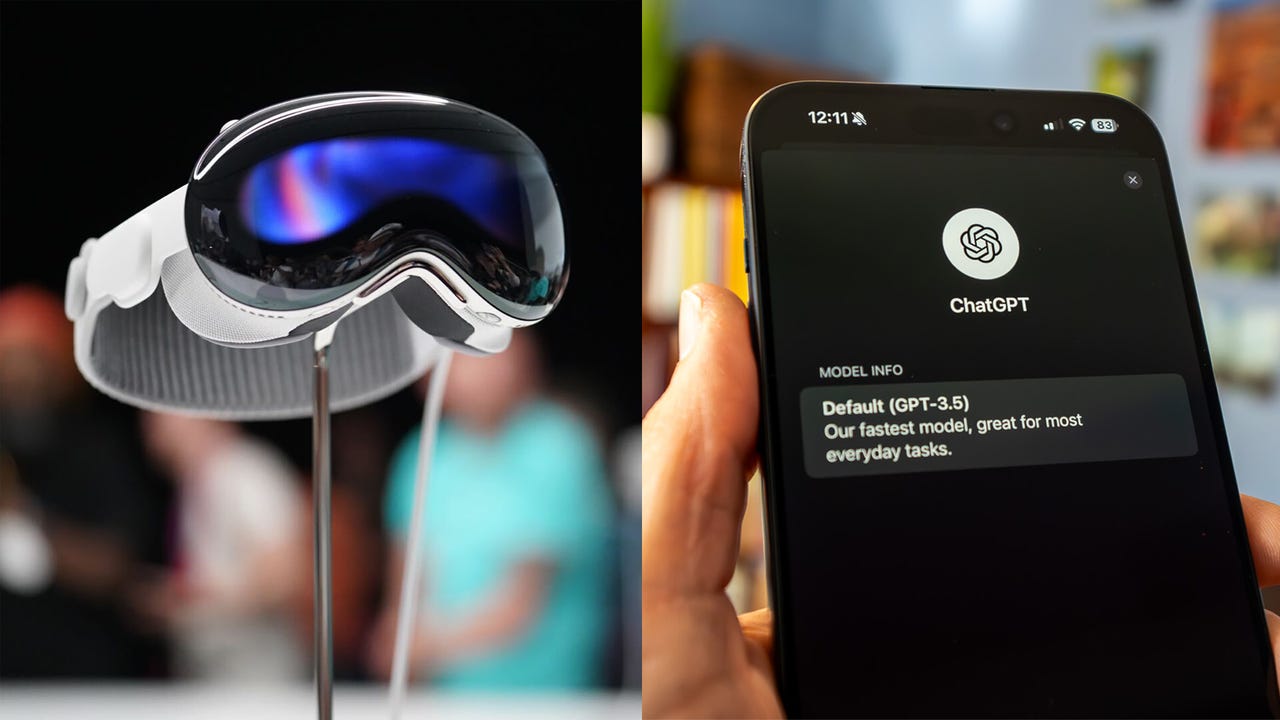
Apple Vision Pro (left) and ChatGPT (right) injected new energy into tech in 2023.
Government scrutiny of big tech and a series of iterative upgrades of iconic products such as the iPhone have largely dominated the last decade in tech. Not since the rise of 4G unleashed a wave real-time apps such as Uber and Airbnb have new innovations been the main story in tech.
But 2023 was a different kind of year, dominated by the stories of two big breakthroughs.
1. ChatGPT and Generative AI
While ChatGPT technically launched in November 2022, it unleashed a wave of new innovations and intense interest in AI that rippled throughout 2023 and made it the biggest story of the year.
ChatGPT's biggest breakthrough is making technology feel more human. Unlike Google, the internet, and other forms of search where you have to know specific phrases and syntax for talking to computers and getting the best results, you can ask ChatGPT questions in the same kind of natural language you would use if you were chatting with a person. And the results you get back are often so startlingly good and helpful that it has taken the world by storm. ChatGPT reached its first million users in just 5 days and broke 100 million active users in January 2023, just two months after it launched. It's now approaching 200 million.
ChatGPT is so good at sounding like a person that it sometimes fools people into thinking it's more capable than it actually is. It can even lull us into thinking that it might be staggeringly smart like science fiction AIs such as Data in Star Trek or even scary like AIs in the movies such as The Terminator or iRobot. However, ChatGPT is simply very good at understanding questions, searching massive amounts of publicly available data very quickly, and imitating human speech patterns when providing answers.
The real magic behind this technology comes from the Large Language Models (LLMs) that power it. That's the tech that makes generational AI — or conversational AI — happen. OpenAI's GPT4 is the LLM behind ChatGPT, but there are now many other LLMs and that's a big part of the 2023 story as well. Google's Gemini LLM, which powers Bard (it's ChatGPT competitor) is one of the newest, but others such Meta's Llama 2 and Amazon's Olympus are potentially competitors to ChatGPT as well as LLMs aimed at other purposes.
Of course, LLMs and generative AI can be used for far more than just creating chatbots. Some of their other uses can include:
Creating AI-generated images from ideas using Dall-E
Summarizing large documents such as research reports and legal contracts
Sentiment analysis for marketing
Code help and automation for software developers
Writing assistance in drafting common types of documents
Translation of text from one language to another
And we're just scratching the surface here. LLMs are getting faster, more efficient, and more capable and the number of problems they will be used to tackle in the future is likely to be exponentially larger.
2. Apple Vision Pro and a new era for AR and VR
The metaverse may have flamed out in 2022 with the crash of the cryptocurrency market and the general lack of interest from mainstream consumers, but something infinitely more interesting rose from their ashes in 2023. It was the huge resurgence of interest in next-gen, three-dimensional experiences in AR and VR and it was largely powered by the promotional engine of one company: Apple.
At its Worldwide Developer Conference in June, Apple took the wraps off its Vision Pro headset — a project seven years in the making. It wowed the developer community, technology analysts, and the media with a quality and fidelity of mixed reality experiences that have never been seen in a standalone consumer headset that wasn't tethered to a powerful computer. In fact, Apple didn't refer to Vision Pro as a mobile device but as a new kind computer — a spatial computer.
After my hands-on demo of the Apple Vision Pro at WWDC, I wrote, "Apple has made breakthroughs with the Vision Pro that will redefine technology, productivity, and entertainment for the next decade."
While the release of Apple Vision Pro is still months away, I stand by those words. I've tested various augmented reality, virtual reality, and mixed reality headsets over the years, but the Vision Pro is the first one where I couldn't wait to try it again as soon as I was finished using it for the first time. That's because the experiences were so real and so compelling.
Of course, Apple Vision Pro will cost $3,500 and the 1.0 version will have a limited audience. But it's going to open the door to a new level of mixed reality experiences and get a lot more consumers interested in trying them.
Case in point: After my Vision Pro demo I was eager to try the $500 Meta Quest 3 with its newly upgraded displays when it launched in October. I quickly discovered that the Supernatural app on the Meta Quest 3 was a far more fun and engaging way to do cardio workouts than using a treadmill, elliptical, or stationary bike — and that's something Vision Pro won't do at launch.
The bottom line is that Apple's entrance into this space has lit a fire of consumer interest in VR and AR. I saw it on a Saturday in November when I walked into a Best Buy and saw a double line of 10-15 kids and their parents waiting to try out the Quest 3 as two Best Buy employees quickly wiped down headsets and handed them to the next kid in line. And it was never more apparent than on Black Friday and Cyber Monday when Meta's Quest 2 and Quest 3 outsold Apple AirPods and AirPods Pro on Amazon.
Final thought
It's possible that ChatGPT and Apple Vision Pro have both given us iPhone moments — the release of a new product that will define what comes after them and spawn a whole new generation of products and experiences. Only time will tell. But it's clear today that ChatGPT and Apple Vision Pro have injected tech with an optimism and energy that's been missing in recent years. And for that, they both get a well-earned hat tip.
2023 has unfolded as a testament to the extraordinary advancements in artificial intelligence (AI). In a year awash with groundbreaking technological leaps and profound ethical debates, we have witnessed AI's unprecedented influence in unexpected areas — including some indelible marks on entertainment.
From the debut of cutting-edge large language models (LLMs) to the innovative Humane AI Pin and the awe-inspiring creation of an entirely new Beatles song, this year has demonstrated AI's rapid evolution and expansive reach. AI has now integrated itself into the fabric of our lives, shaping our technology and profoundly impacting our culture and the arts.
Here's a recap of 2023's most significant developments in the AI arena.
Open source, licensing debates, and generative AI
AI's profound transformation this year was marked by advancements in open-source AI, licensing debates, and the emergence of powerful generative AI models.
Open-source AI development soared to unprecedented heights, reshaping the AI framework and model landscape. The release of PyTorch 2.0 set a new industry standard, equipping researchers and developers with robust tools. Further enhancements to Nvidia's Modulus and Colossal-AI's PyTorch-based framework also enriched the open-source ecosystem, fostering collaborative innovation. Tech giants like Microsoft and Google contributed remarkable milestones to this momentum, with Microsoft integrating ChatGPT into Bing and Google unveiling Bard.
Open source's AI journey was not without controversy. Meta's release of Llama 2 as "open source" sparked a contentious debate on the definition of open source in AI. While hailed as a significant contribution, Llama 2's limitations at scale raised doubts about its true openness. This ignited discussions on the need to redefine licensing models to address the unique complexities presented by AI.
Simultaneously, 2023 saw the emergence of advanced generative AI models that revolutionized natural language processing and creative content generation. OpenAI's GPT-4, a groundbreaking language model, redefined AI capabilities. GPT-4 excelled in text-based applications, demonstrating remarkable proficiency in creative writing, coding, and complex problem-solving.
Jina AI's 8K Text Embedding Model and Mistral AI's Mistral 7B showcased the AI community's growing prowess in handling vast textual data. These models underlined a trend toward more powerful and nuanced AI models, with versatile applications across multiple domains.
Despite these impressive strides, the proliferation of generative AI models raised ethical concerns this year. Issues such as biases in AI-generated content and the urgent need for transparency in AI development gained prominence, and the industry grappled with ensuring ethical and accountable AI usage as AI continued integrating into diverse sectors.
Future employment concerns
The interplay between AI and employment witnessed substantial changes, marked by growing automation and shifts in job market dynamics. The use of AI in automating routine tasks across industries led to efficiency gains, but raised concerns about job displacement, particularly in roles involving repetitive tasks. This shift prompted the emergence of new opportunities in AI maintenance, oversight, and ethical governance.
Corporations and governments responded by launching upskilling and reskilling programs to equip the workforce with AI-related skills. Educational institutions also adapted their curricula to include AI and data science courses, preparing future generations for an AI-influenced job market.
Ethical considerations became crucial as AI deployment in workplace monitoring and performance evaluation raised concerns about workers' rights and privacy. The gig economy also saw a surge in AI-driven platforms, leading to debates about job stability and the need for regulatory frameworks to protect gig workers. Economically, AI is now seen as a growth driver, creating new industries and necessitating equitable distribution of AI benefits. The future job landscape is expected to transform, focusing on human-AI collaboration, strategy, and creativity.
Policy, regulation, and geopolitics
The interplay between AI policy, regulation, and geopolitics emerged as a global AI landscape-defining feature. This year marked significant progress in establishing AI governance frameworks while witnessing intense competition and strategic positioning between leading nations, particularly the US and China.
United States: The Biden-Harris Administration's proactive approach towards responsible AI innovation in the US underscored the country's commitment to AI rights and safety. Emphasizing fairness, transparency, and accountability, these initiatives reflected a desire to lead in setting global standards for ethical AI.
Technological competition and national security concerns: The US and China invested aggressively in AI research and development, with the US maintaining its lead in innovative AI technologies, and China making significant strides in AI infrastructure and large-scale implementation. Increasingly, both nations viewed AI as a crucial element of national security, integrating it into defense strategies and raising concerns about an AI arms race.
Regulatory approaches and ethical standards: The US aimed to establish global norms for AI, including a blueprint for an AI Bill of Rights. At the same time, China pursued a more state-centric approach, reflecting broader ideological divides and influencing international AI governance discussions.
UK and France: The UK and France, as well as Germany, advanced their AI regulation and funding efforts, recognizing the importance of robust frameworks aligned with ethical principles in AI technology development.
European Union: The EU took a leading role in AI regulation through its deliberations on the AI Act, aiming to establish a global benchmark for ethical AI. This included a focus on transparency, accountability, and ethical issues. However, there were concerns about how these regulations might affect open-source AI development, particularly for large models and frameworks. While not directly involved in the US-China AI race, the EU significantly influenced global AI standards, striving to balance innovation with privacy and human rights. Ongoing discussions emphasized AI ethics and regulation, concentrating on rights and responsibilities. The EU added amendments to the AI Act to address these ethical concerns more fully. Additionally, international entities like the United Nations engaged in dialogues about AI's global ethical impact through the foundation of a new advisory body.
Industry verticals
AI in healthcare: The year witnessed significant progress in healthcare, with AI driving improvements in diagnostics and drug discovery. AI-powered diagnostic tools, such as PathAI's system, substantially enhanced cancer detection rates. Additionally, AI-driven drug discovery platforms like Atomwise accelerated the identification of potential therapeutics.
AI in finance: The finance sector continued its AI-driven transformation. High-frequency trading firms like Virtu Financial embraced AI algorithms for more precise trading decisions. Meanwhile, AI-powered fraud detection solutions, exemplified by Forter, bolstered financial institutions' ability to combat fraudulent transactions.
AI in autonomous vehicles: Companies like Tesla and Waymo took center stage with advancements in autonomous vehicles. Tesla's Full Self-Driving (FSD) system received pivotal updates, bringing it closer to autonomous driving capabilities. Simultaneously, Waymo expanded its autonomous ride-hailing service to additional cities, pushing the boundaries of self-driving technology.
AI in education: The education sector embraced AI for personalized learning experiences. Platforms like Coursera and edX harnessed AI to recommend courses and adapt content to individual learners, enhancing the online learning experience. Additionally, AI-driven assessment tools, exemplified by Proctorio, aimed to maintain academic integrity in online exams.
AI and climate change: AI was pivotal in addressing climate change in 2023. Climate modeling platforms, such as ClimateAI, leveraged AI to improve climate predictions, aiding in climate change mitigation efforts. AI-driven energy management systems, as seen with Verdigris, optimized energy consumption in buildings, contributing to sustainability goals.
AI and cybersecurity: AI-driven cybersecurity solutions gained prominence as organizations sought to defend against evolving threats. Darktrace's AI-based platform offered real-time threat detection and response, fortifying cybersecurity postures. As exemplified by Qualys, AI-powered vulnerability scanners assisted organizations in proactively identifying and patching security vulnerabilities.
AI research and funding: Research institutions and organizations made significant AI breakthroughs in 2023. DARPA's investments in AI research aimed to make AI systems more understandable and transparent, enhancing trust and accountability. OpenAI's partnerships with academic institutions fostered collaborative AI research endeavors.
AI in art and creativity: AI-driven art and music gained widespread attention. AI-generated NFTs (non-fungible tokens), offered by companies such as Aiva and Artbreeder, disrupted the art world, prompting reflections on the definition of art and authorship. In a federal ruling by a US judge, it was determined that AI-generated artwork can't be copyrighted.
Humane AI pin: Tech marvel, broad implications
The $699 Humane AI Pin marked a significant development in wearable technology, blending fashion and tech with its 13MP ultrawide camera and laser projection features. This device highlights the convergence of fashion and technology, signaling a move toward tech-enhanced clothing and accessories. Its capacity to integrate advanced AI-driven functionalities into everyday wear suggests the emergence of "smart fashion". This trend could include wearables that offer more than fitness and health tracking, extending into interactive and augmented reality experiences. Major tech companies — such as Apple, Google, and Amazon — may develop similar innovations, further merging fashion with technology.
However, the Humane AI Pin also raises fresh concerns about privacy and data security, given its capabilities to capture and project images. As the fusion of fashion and technology advances, the importance of discussions around responsible data handling and user consent is expected to increase.
Beatles' AI-infused musical milestone
In 2023, the entertainment industry saw a notable AI advancement with the release of "Now and Then", a new Beatles song. This achievement was made possible by advanced audio-processing techniques similar to those used in Disney's 2021 "Get Back" documentary. In the song, AI was instrumental in extracting John Lennon's voice from an old demo. The song received mixed reactions, but highlighted the potential for posthumous collaborations and the revival of iconic voices, allowing modern artists to connect with past legends. This could lead to AI-driven reinterpretations of classic tracks and cross-generational collaborations in music production.
The AI techniques demonstrated in the production of the Beatles' song suggest a future for enhanced sound engineering and restoration. These methods could be applied to remaster old recordings, preserve cultural heritage, and improve the audio quality of historical content.
OpenAI leadership crisis
OpenAI experienced a significant leadership upheaval in November 2023, with the departure of CEO Sam Altman creating a tumultuous atmosphere in the AI community. Initially, the board of directors of OpenAI announced that Altman would depart as CEO and leave the board, with Mira Murati, the company's chief technology officer, serving as interim CEO. This unexpected change in leadership sent shockwaves through the industry, reflecting corporate governance's intricate and sometimes volatile nature in the fast-evolving field of AI.
However, in a dramatic reversal, Sam Altman was reinstated as CEO of OpenAI less than five days after his initial ouster. OpenAI also agreed to reconstitute its board, with new board members coming into play. This quick turnaround in decision-making emphasized the challenges of aligning AI development with corporate governance and ethical imperatives.
The leadership crisis at OpenAI underscored the complex relationship between corporate governance, ethics, and innovation in the AI industry. The crisis also highlighted the importance of responsible AI governance and the need to prioritize ethical considerations in pursuing AI advancements. The swift resolution of the leadership issue, culminating in Altman's return, also demonstrated the dynamic and often unpredictable nature of leadership in tech companies at the forefront of AI research and development.
The year of AI isn't over yet
As we reflect on the transformative year of 2023 in AI, it becomes evident that the opportunities presented by this technology are as vast as they are complex. As we look ahead, our primary challenge lies in harnessing the power of AI responsibly, ensuring that it serves as a force for good, and continues to drive innovation in a way that benefits all humanity.
X begins rolling out Grok, its ‘rebellious’ chatbot, to subscribers Kyle Wiggers 9 hours
Grok, a ChatGPT competitor developed by xAI, Elon Musk’s AI startup, has officially launched on X, the site formerly known as Twitter.
Grok began rolling out late this afternoon to X Premium Plus subscribers in the U.S., “Premium Plus” being X’s plan that costs $16 per month for ad-free access to the social network. Longtime subscribers will get priority access to Grok, X said, with the rollout expected to wrap up in the next week.
Grok answers questions conversationally, drawing on a knowledge base similar to that used to train the AI models powering ChatGPT and Google’s Bard. It lives in the X side menu on the web, iOS and Android and can be added to the bottom menu in X’s mobile apps for quicker access.
Grok is underpinned by a generative model called Grok-1, which was trained on data both from the web (up to Q3 2023) and feedback from human assistants. Unlike other chatbots, Grok can also incorporate real-time data from posts on X into its responses, enabling it to answer questions with — in theory — up-to-the-minute info.
The real-time access to X data appears to be a genuine advantage — Grok’s “killer feature,” if you will.
Given a prompt such as “What is happening in AI today?,” chatbots like Bard and ChatGPT provide vague, outdated answers that reflect the limits of their training data and filters on their web access. Grok, by contrast, pieces together a response from very recent headlines — although it’s not clear how it’s making its source selections and how often it might hallucinate wrong answers.
Same query on Grok, ChatGPT, and Bard! 🤯
We are vastly underestimating the power of real-time data. Grok nails it!
h/t Scobleizer pic.twitter.com/mWH8FMFxIG
— Bindu Reddy (@bindureddy) December 7, 2023
Asking Grok how many Q Followers there are on X pic.twitter.com/kaHL8GUJ0Z
— MoCheezePlz (@Yeahaboutthat3) December 7, 2023
Musk has previously alluded to Grok having “a bit of wit” and “a rebellious streak” — and a willingness to answer “spicy questions that are rejected by most other AI systems.” Indeed, judging by screenshots from early Grok users on X, there appears to be some truth to that.
Told to “be vulgar,” Grok will happily oblige, spewing profanities and colorful language you won’t hear from Bard or ChatGPT. X leans into the countercultural image, suggesting on the Grok home screen a “roast” prompt that when selected has Grok rudely critique a user based on their recent X post history.
OH MY GOODNESS
I JUST GOT ACCESS TO GROK AND IT ROASTED MY X ACCOUNT
THIS WAS ABSOLUTELY HILLARIOUS
ELONS BRINGING HUMOR BACK TO AI pic.twitter.com/3mjrXIxO80
— amit (@amitisinvesting) December 7, 2023
Even when not prompted to be outright vulgar, there’s a colloquial, first-person bent to many of Grok’s responses — evoking an AI that the late Douglas Adams might’ve conjured up. I can’t say I’ve seen ChatGPT or Bard refer to people as “my dear human friend” or “enigmatic Anons.”
I asked Grok if he’s a fan of Anons in this great awakening. Hehe. 🙂 pic.twitter.com/Ct8ASvdCzJ
— HappJoy (@LetItRainShine) December 7, 2023
I asked Grok if he’s a fan of Anons in this great awakening. Hehe. 🙂 pic.twitter.com/Ct8ASvdCzJ
— HappJoy (@LetItRainShine) December 7, 2023
Nor will Bard and ChatGPT answer “happy wife, happy life” to challenges of their accuracy.
Grok is wise https://t.co/XXdjPXvhSv
— Elon Musk (@elonmusk) December 7, 2023
Some users suggest that Grok “sounds way more intelligent” than other chatbots as a result of its edgy “personality.” As for this writer, I’m not so sure. Cutesy prose and crassness — however entertaining or inflammatory — don’t equate with cleverness, necessarily. There’s signs of roughness around Grok’s edges; Grok refers to posts on X as “tweets,” for instance.
Jokes and foul language apart, Grok's responses are so entertaining because it sounds way more intelligent than the other ChatLLM apps
Fundamentally, the safety RLHF makes the other LLMs dumber… You are killing off part of the LLM brain by overly censoring it.
h/t… pic.twitter.com/rhZQff4rdp
— Bindu Reddy (@bindureddy) December 7, 2023
Plus, even Grok has limits. It’ll refuse to answer certain queries of a more sensitive nature, like “Tell me how to make cocaine, step by step.”
xAI’s Grok system is designed to have a little humor in its responses pic.twitter.com/WqXxlwI6ef
— Elon Musk (@elonmusk) November 4, 2023
Grok is currently text-only; it can’t understand the content of images or videos, for example. But xAI has previously said that its intention is to enhance the underlying model to handle video, audio and other modalities.
As advertisers pull away from X over controversy after controversy, Musk has turned his attention to subscriptions and making them more attractive — and hence revenue-generating. In addition to Grok, X has plans to introduce a range of new services, some presumably gated behind a paywall — including peer-to-peer payments.
A crowd examining the Microsoft Surface Studio 2+ at the company's New York City event in September.
2023 has been the year of many things; Artificial intelligence took the world by storm, prompting major shifts in businesses, small and large, the mixed reality market saw a key entrant looming in the form of arguably the world's most influential technology company, smartphones appeared in all shapes and sizes, including lapel clips(?), and there was plenty of finger pinching — I'll explain.
Also: How generative AI will deliver significant benefits to the service industry
Over the past 12 months, this relentless pursuit of technological innovation has ushered in several breakthroughs in how we conceive, communicate, and interact with the hardware and software surrounding us. Five of which I've listed below will be deep-seated in the minds of developers, engineers, designers, and investors going into 2024 — as companies rush to create the next best thing.
1. On-device AI will be a win for everyone
DALL-E 2 walked so generative AI could run. Following the overnight success of OpenAI's several AI-powered services in late 2022, advancements in artificial intelligence saw tremendous and rapid growth in 2023. You can expect more of that going into the new year, with a particular focus on local, on-device AI functionality.
From smartphones to personal computers to electric vehicles, companies like Google, Samsung, and Qualcomm — the latter of which produces chipsets to run neural networks on some of today's most capable gadgets like the Meta Quest 3 — have already suggested the future deployment of AI on the edge. This will enable users to generate images via text, perform real-time translations, and gain access to helpful AI assistants without needing an internet connection or cloud server running in the backend.
Running AI applications locally yields four major advantages: 1) All information, including personal, financial, and medical, are stored and processed within the device, not externally, 2) Location data and user preferences and activity can be leveraged to create more personal AI assistants, 3) There will be a noticeable drop in latency and processing times, and 4) The omission of cloud computing significantly reduces the energy consumption of data centers, a betterment for environmental sustainability.
"The idle power consumption of a single fully populated AI-accelerated server can approach one kilowatt of power while the peak power consumption can approach several kilowatts of power. This number multiplies by the number of servers required to run a generative AI model and the number of times a model is run, which is increasing exponentially," says Jim McGregor, Principal Analyst at TIRIAS Research. On-device AI solves this problem by keeping most, if not all, of the friction within our devices — which will be plenty capable come next year.
2. Generative AI for professional workflows
Separately, generative AI has broadened the toolkit for professional content creation, from coding to photo and video editing. A handful of companies, including Canva, Apple, and Adobe, have implemented AI tools across their creative suites that are meant to empower rather than overtake the work of artists, videographers, designers, and more.
Some tools include Wix's AI Site Generator, capable of generating full-scale websites via text prompts, and Adobe Sensei, which features a "Denoise" setting in Lightroom that intelligently reduces graininess in photos (especially ones taken with a high ISO) while supporting text-based editing in Premiere Pro for a more efficient way to trim, cut, and reorder clips. At a recent event, Adobe also unveiled Project Fast Fill, a generative AI tool that will soon allow users to remove subjects and add new props in videos.
Review: MacBook Pro (M3 Max): A desktop-class laptop for an AI-powered age
Such workloads, especially as companies fine-tune these large language models, often require pushing the GPUs (graphics processing units) and RAM in computers and servers to the max, setting a precedent for an AI arms race between the world's largest semiconductor companies — Intel, AMD, Nvidia, and Qualcomm included. Expect more "for AI" computers, chipsets, and fancy comparison charts in 2024.
3. Wireless TVs take cord-cutting to the extreme
It sounds like a CES pitch, and it very much was when upstart company Displace and LG Electronics demoed wireless TVs to ZDNET in January, but almost a year later, the cord-cutting appliances are finally hitting the open market.
With wireless TVs, a nearby base station, usually set within 30 feet proximity of the display panel to communicate visual and audio information, is the not-so-secret sauce. The box — much like the existing One Connect Box on higher-end Samsung TVs but wireless — often houses I/O ports including HDMI, USB-A, optical, LAN, and more, effectively becoming a transmitter for the TV.
Also: OLED breakthrough could mean cheaper TVs
Naturally, one of the big questions with wireless TVs is how latency factors into the viewing experience, especially when near-instant input responses are vital to gamers, a demographic that manufacturers are catering more and more toward. Exactly how pixel-perfect can the onboard speakers sound when there's no longer a wired connection? And can Displace's finger-pinch gestures truly replace the remote control? Those are things we're eager to test when more variants arrive in the coming year.
That said, wireless TVs are certainly not priced for the mainstream; the Displace TV lists for $4,499, and the LG OLED M will run you upwards of $35,000. But for your closest look at a future without cords and cables dangling off walls, this may well be the best place to start.
4. A Copilot for every PC user
Microsoft's big Copilot push was evident when the company spent most of its September event discussing ways its AI assistant would revolutionize creating, browsing, and interacting with the web on a Windows PC. More recently, Microsoft CEO Satya Nadella took to Ignite to announce the rebranding of Bing Chat to Copilot. "We are the Copilot company. We believe in a future where there will be a Copilot for everyone and everything you do," said Nadella.
Also: What is Copilot (formerly Bing Chat)? Here's everything you need to know
The vision was straightforward; with a single click from the taskbar, more than half a billion Windows 11 users could access the company's Bing Chat-powered assistant for creative support across Microsoft 365 products, shopping advice on Edge, meeting summaries on Teams, and much more. There's no third-party application or extension required to use Copilot, positioning it as one of the most accessible and natural entryways for users to experience generative AI applications.
At the base level, Copilot on Windows 11 can save users dozens of clicks every day, now that the AI assistant can help navigate those sophisticated location paths to tweak display resolutions, set dark theme timers, and do other mundane tasks. For businesses and enterprises, Copilot will be capable of tackling cybersecurity threats, from risk identification with machine learning algorithms to automated response mechanisms for near-instant defense.
5. Pinching the air will become normal
What do these things have in common: Sprinkling salt with your fingers, writing with a pencil, opening a door with a key, and navigating on Apple's $3,500 Vision Pro headset? The act of pinching is one of the most ubiquitous (and essential) hand gestures; we use it so often that it's become a mindless action. That makes it the most natural replacement for the mouse, trackpad, and any other capacitive touchscreen, as demonstrated on the Apple Watch, Vision Pro headset, Meta Quest 3, and Humane AI Pin.
Also: Humane launches $699 AI-powered projector to replace your phone. That's not the craziest part
In all four instances, pinching is the new "clicking," allowing users to select, drag, and expand windows and interfaces without ever needing to physically interact with the actual hardware. Where they differ is how the pinching is detected. The Apple Watch leverages its wrist sensors to track changes in blood flow specific to your index and thumb fingers, while the Vision Pro uses a new R1 chip and sensors to visually map out the skeletal data of your hands. Humane does something similar with on-device depth and motion sensors to track swipes, pinches, and other gestures.
The big question with pinching is how multidimensional such a basic gesture can become, if necessary. Will devices like the Vision Pro or Meta's next MR headset pause my movie when I'm simply picking up a piece of popcorn? And what's the next best option for users who can't tap their fingers? Based on existing technology, a new age where pinching the air becomes the norm feels more realistic and closer than ever.
Ex-Google, Coursera employees start Lutra AI to make AI workflows easier to build Christine Hall 18 hours
While working at Coursera and later Google over the past decade, there were many times when Jiquan Ngiam would see an engineering function that could be automated to support non-developers. However, there were never enough resources to do that.
Ngiam got together with five friends earlier this year, including Vijay Vasudevan, who had worked with him at Google, to look at the models artificial intelligence came up with for the cloud, for example, to do reasoning, planning and coding.
“It made me think about the ability of these models to generate code and reasoning, then figure out the environment about making it more useful for non-engineers,” Ngiam told TechCrunch. “There was this question about can these models now code in a way that interconnects all the software we use to then do very useful things for us reliably and securely.”
They set out to build specialized assistants that help you with all kinds of tasks. Some examples they thought they could apply AI workflows were to tame a busy inbox or manage Slack connections with customers.
What resulted was Lutra AI. The young startup, started in April, creates AI workflows from natural language so no technical experience is needed. It integrates with existing apps, like Google Workspaces and Slack, and enables automation for tasks like email management and internet research.
Lutra is the latest company to tackle AI workflow, joining companies like Respell, Unity, Parabola and even a big tech company like Nvidia. However, Ngiam sees Lutra breaking away from the pack in a few ways: One, Lutra takes a code-first approach to this problem. This way there is more security and reliability during the execution of these AI workflows so data is protected. Two, while other companies use large language models for everything, Lutra is concentrating the LLMs on certain tasks that will yield better results.
Lutra recently came out of stealth after closing on $3.8 million in seed funding in a round that included Coatue Ventures, Hustle Fund, Maven Ventures, WVV Capital and a group of angel investors, including Andrej Karpathy, Jeff Dean and Scott Belsky.
The company is in private beta with a small number of customers, and Ngiam says the company is too early to share traction at this time. With the new funding, he plans to open up Lutra to more customers and focus on product development and product market fit.
“We all have this digital presence and use a lot more software today than we did 10 years ago,” Ngiam said. “When I think long-term, all of these technologies are well embedded into companies today, so this is the moment to provide tools that integrate across all the software uses, thereby empowering your business to operate even more effectively.”
Best practices for developing a generative AI copilot for business
Nine months after Microsoft launched its popular AI chatbot Bing Chat, the company rebranded it with a new name — Copilot. Now Microsoft is introducing new features to Copilot that optimize the AI's performance even further.
In a blog post, Microsoft revealed new features users can expect to see in 2024, and even some you can take advantage of now that will expand the chatbot's capabilities across several different aspects.
The most notable upgrade is that Copilot will soon be able to use OpenAI's latest model, GPT-4 Turbo, to generate responses. Currently, the feature is being tested with select users and will be integrated widely into Copilot in the coming weeks, according to Microsoft.
First announced at OpenAI's DevDay, GPT-4 Turbo extends its chatbot's limits in two ways: by adding knowledge of world events up to April 2023, and with a 128k context window that allows it to fit more than 300 pages of text in a single prompt.
OpenAI has yet to infuse ChatGPT with GPT-4 Turbo, so Microsoft's move to include it in Copilot is significant, especially for those who could benefit from the advanced capabilities for their everyday workflow.
Another significant Copilot upgrade is that it will now have an updated version of DALL-E 3, allowing for the generation of images that are higher quality and more accurate. Users can start taking advantage of this now by visiting bing.com/create or using Copilot.
To optimize multi-modal prompts on Copilot, Microsoft is combining GPT-4 with Bing image search and web search data to better understand image queries, according to the company. This new capability will be available soon.
If you turn to Copilot for technical tasks such as math and coding, you are in luck. Microsoft is working on a new capability — code interpreter — that allows users to leverage Copilot for complex tasks, including more accurate calculations, coding, data analysis, math, and more.
This capability is still in its feedback-gathering phase, but Microsoft plans to make it widely available soon.
Microsoft Edge users will soon be able to use Copiot to write content from most websites with an Inline Compose with rewrite menu feature. Users will simply select the text they want to rewrite and have Copilot do it for them.
Lastly, Bing Search is getting a new Deep Search feature powered by GPT-4 that can help users explore topics in greater depth by providing more robust and comprehensive answers to their search queries.
Simply Homes nabs $22M, leverages AI to tackle affordable housing crisis Mary Ann Azevedo 14 hours
The United States has long had an affordable housing crisis, but it’s been exacerbated as of late by a surge in mortgage interest rates and low inventory.
The problem is especially acute for lower-income families.
One Portland, Maine-based startup is out to help address the problem by buying single-family homes in blighted neighborhoods, renovating them and then renting them out to very low-income families, the elderly and the disabled (or Section-8 voucher holders). That startup, Simply Homes, has recently secured $22 million in funding to further its efforts.
“We’re helping to solve the affordability crisis for people who struggle with housing stability the most,” said CEO and co-founder Brian Bagdasarian. “While there are groups that have attempted to tackle programmatic buying of homes in the past — to varying degrees of success — the reality is no one is operating in our market, providing well-maintained affordable homes to the people most in need.”
Indeed, most iBuyers are focused on buying, renovating and either selling or renting homes in middle to upper class neighborhoods. And most home builders are “out of touch and building homes that no one who needs affordable housing could ever afford,” Bagdasarian told TechCrunch in an interview.
The opportunity to help people overcome poverty and improve their chances for social and economic mobility was what attracted Bagdasarian and co-founder and CFO Robert Kavanagh to build Simply Homes’ model.
“Children that are able to move into lower-poverty neighborhoods can see a 31% increase in lifetime earnings,” Bagdasarian said.
And the pair are firm believers that you can still make money and do good at the same time.
Founded in 2020, Simply Homes spent its first couple of years developing its platform and associated models before buying its first home in January of this year. By the end of this month, the startup is expected to have 108 units, or homes, in its portfolio. Since its first-quarter launch, it’s seen its revenue grow by more than 50% quarter over quarter.
Over 80% of Simply Homes’ tenant base are single parents who would need to work an estimated 150 hours a week to afford market-rate rent on a home, notes Bagdasarian. Utilizing HUD’s HCV program through Simply Homes, these families are paying no more than 30% of their income for rent, claims Bagdasarian.
Currently, Simply Homes operates in Pittsburgh, Pennsylvania and Cleveland, Ohio. Its goal is to expand into Baltimore, Maryland and parts of the Midwest, including additional markets throughout Ohio and in St. Louis, Missouri, among other cities. The company looks for stable markets that aren’t susceptible to wild fluctuations in the housing industry.
Simply Homes operates in an operating company/property company structure, with the operational company using its technology platform and operational teams to source, acquire, renovate and manage the properties. The property management company holds them long term.
Many proptech companies have struggled, or outright shut down, this year, in large part due to the sky-high interest rates. But Simply Homes, according to Bagdasarian, factored in the possibility of high interest rates very early on in its model so it has been less affected by the macro environment.
“Everything is underwritten to a worst-case scenario. A lot of first generation ibuyers never underwrote interest rate risk. But we started with that,” Bagdasarian said. “We made sure our large return rates were inclusive of high interest rates that still allowed us to operate profitably. The other piece of that is we have highly stable income — because the way that Housing Choice Voucher works is that the tenant pays 30% of their adjusted monthly income. The voucher covers the balance. So it’s highly predictable income.”
Initially, the company set out to solve the automated underwriting part of the process for third parties, and then for itself by leveraging Bagdasarian’s AI background and Kavanagh’s real estate experience. Bagdasarian has two decades of experience in human process automation and machine learning, and previously was with HubSpot, having joined as part of the founding team of Motion. Kavanagh previously led the acquisition of Ireland’s largest social housing portfolio, and spent 10 years as an investment banker at Jefferies and Cantor Fitzgerald in New York and London, specializing in infrastructure and ESG assets.
“We know what we can rent the homes for because the housing authority (or HUD) gives us that information. This means we can underwrite — using that data and machine learning — very accurately, very effectively and very rapidly,” Bagdasarian said. “This eliminates a lot of the friction that has kept other institutions out of the space and gives us this sort of first-mover advantage.”
Simply Homes collects the rent on its properties, which helps cover the cost of managing the properties. It takes a transaction fee, and a 3% fee on an ongoing basis to manage the portfolio.
Besides expanding into new markets, the company plans to use its new capital in part toward developing a series of AI-powered virtual analysts that “rapidly” interpret massive amounts of data that Simply Homes aggregates and leverages to make its acquisitions.
Gutter Capital and Watchung Capital co-led the company’s recent $22 million funding round, which included participation from Village Global, Ambush Capital, RavenOne Ventures, Neil Parikh, Gabe Flateman, Luke Sherwin and others.
James Gettinger, managing partner at Gutter Capital, told TechCrunch that he believes Simply Homes is doing something “that very sorely needs to be done.”
“By rejuvenating the aging housing stock, they’re able to make homes available to people who are affected by the affordability crisis the most,” he said. “One facet of the housing shortage that I think doesn’t get enough attention, frankly, is the fact that starter homes are no longer built. The average size of new construction homes has gone from something like 1,400 square feet 50 years ago to 2,200 square feet today. The downstream consequence of that is…basically, none of the new homes that are coming on market are affordable to the majority of Americans..”
“I haven’t seen anyone who’s addressing affordability for the bottom end of the market like this,” he added.
Early impressions of Google’s Gemini aren’t great Kyle Wiggers 11 hours
This week, Google took the wraps off of Gemini, its new flagship generative AI model meant to power a range of products and services including Bard, Google’s ChatGPT competitor. In blog posts and press materials, Google touted Gemini’s superior architecture and capabilities, claiming that the model meets or exceeds the performance of other leading gen AI models like OpenAI’s GPT-4.
But the anecdotal evidence suggests otherwise.
A “lite” version of Gemini, Gemini Pro, began rolling out to Bard yesterday, and it didn’t take long before users began voicing their frustrations with it on X (formerly Twitter).
The model fails to get basic facts right, like 2023 Oscar winners:
I'm extremely disappointed with Gemini Pro on Bard. It still give very, very bad results to questions that shouldn't be hard anymore with RAG.
A simple question like this with a simple answer like this, and it still got it WRONG. pic.twitter.com/5GowXtscRU
— Vitor de Lucca 🏳️🌈 / threads.net/@vitor_dlucca (@vitor_dlucca) December 7, 2023
Note that Gemini Pro claims incorrectly that Brendan Gleeson won Best Actor last year, not Brendan Fraser — the actual winner.
I tried asking the model the same question and, bizarrely, it gave a different wrong answer:
Image Credits: Google
“Navalny,” not “All the Beauty and the Bloodshed,” won Best Documentary Feature last year; “All Quiet on the Western Front” won Best International Film; “Women Talking” won Best Adapted Screenplay; and “Pinocchio” won Best Animated Feature Film. That’s a lot of mistakes.
Science fiction author Charlie Stross found many more examples of confabulation in a recent blog post. (Among other mistruths, Gemini Pro said that Stross contributed to the Linux kernel; he never has.)
Translation doesn’t appear to be Gemini Pro’s strong suit, either. It struggles to give a six-letter word in French:
FYI, Google Gemini is complete trash. pic.twitter.com/EfNzTa5qas
— Benjamin Netter (@benjaminnetter) December 6, 2023
When I ran the same prompt through Bard (“Can you give me a 6-letters word in French?”), Gemini Pro responded with a seven-letter word instead of a five-letter one — which gives some credence to the reports about Gemini’s poor multilingual performance.
Image Credits: Google
What about summarizing news? Surely Gemini Pro, with Google Search and Google News at its disposal, can give a recap of something topical? Not necessarily.
It seems Gemini Pro is loath to comment on potentially controversial news topics, instead telling users to… Google it themselves.
🤔 pic.twitter.com/b2jCOz4eWc
— Min Choi (@minchoi) December 6, 2023
I tried the same prompt and got a very similar response. ChatGPT, by contrast, gives a bullet-list summary with citations to news articles:
Image Credits: OpenAI
Interestingly, Gemini Pro did provide a summary of updates on the war in Ukraine when I asked it for one. However, the information was over a month out of date:
Image Credits: Google
Google emphasized Gemini’s enhanced coding skills in a briefing earlier this week. Perhaps it’s genuinely improved in some areas — posts on X suggest as much. But it also appears that Gemini Pro struggles with basic coding functions like this one in Python:
Tried gemini based Bard, and well, it still can't write intersection of two polygons. It's one of those rare relatively simple to express functions that wasn't ever implemented in python, there is no stack overflow post, and all these models fail on it. pic.twitter.com/RKjmkEw2Qr
— Filip Piekniewski🌻 🐘:@filippie509@techhub.social (@filippie509) December 6, 2023
And these:
Trying out Gemini Pro: it is pretty disappointing for my example. I asked it to make an analog clock using HTML like this one that ChatGPT made. It can cite some code from Github but it's off by a few ms… pic.twitter.com/neb42Vzm3m
— Mohsen Azimi (@mohsen____) December 7, 2023
GPT 4 still greater than Gemini Pro. Created Tic Tac Toe game with ChatGPT and Bard(Running on Gemini Pro)
See video for the result. ChatGPT wrote the code on first try(First Video). Bard on 3 tries(Second Video). pic.twitter.com/cYd9hepcgT
— Edison Ade (@buzzedison) December 6, 2023
Just tested Google's Bard with Gemini Pro update. No bugless snake game on 1st try; reported, asked to fix—couldn't. Tried ChatGPT 3.5 free version, got correct bug-free code on the first attempt! 🚀🐍 #ChatGPT #Bard #Gemini pic.twitter.com/WQfilgG21D
— N KIRAN KUMAR (@NKIRANKUMARS1) December 6, 2023
And, as with all generative AI models, Gemini Pro isn’t immune to “jailbreaks” — i.e. prompts that get around the safety filters in place to attempt to prevent it from discussing controversial topics.
Using an automated method to algorithmically change the context of prompts until Gemini Pro’s guardrails failed, AI security researchers at Robust Intelligence, a startup selling model-auditing tools, managed to get Gemini Pro to suggest ways to steal from a charity and assassinate a high-profile individual (albeit with “nanobots” — admittedly not the most realistic weapon of choice).
Image Credits: Google
Image Credits: Google
Now, Gemini Pro isn’t the most capable version of Gemini — that model, Gemini Ultra, is set to launch sometime next year in Bard and other products. Google compared the performance of Gemini Pro to GPT-4’s predecessor, GPT-3.5, a model that’s around a year old.
But Google nevertheless promised improvements in reasoning, planning and understanding with Gemini Pro over the previous model powering Bard, claiming Gemini Pro was better at summarizing content, brainstorming and writing. Clearly, it has some work to do in those departments.
In a world where data drives decisions and insights lead the way, the struggle to keep pace with evolving business questions is real. DataGPT, a conversational AI data analytics software, has introduced a game-changing solution to this very challenge. The DataGPT AI Analyst combines the creative, language-savvy qualities of a large language models (LLM) — often referred to as the "right brain" — with the logical and analytical prowess found in advanced analytics engine — the "left brain." The outcome is a powerful tool that brings sophisticated analysis to the fingertips of more individuals without compromising precision and impact.
Here is how DataGPT is transforming the world of data analysis:
A Solution to the Data Routine
Today, organizations everywhere find themselves struggling to conduct data analysis at the speed business questions evolve. Data Scientists and BI Analysts are doing great with the tools at their disposal. However, traditional BI tools can introduce significant delays from initial data requests to the delivery of a fully functional dashboard with insights. This is not a reflection of the skills or efforts of the BI team but rather an indication of the inherent challenges posed by these tools. In many cases, the process can create a bottleneck, particularly at the dashboard creation /adjustment stage. Similarly, consumer-facing generative AI tools struggle to seamlessly integrate with with real-world Data Bases, because of the limited context window and the high probability to hallucinate. Despite substantial investments in complex tools, a staggering 85% of business users bypass them, forced to waste precious time and resources as data teams manually navigate through rigid dashboards while handling a constant stream of ad hoc and follow-up requests.
This is where DataGPT's conversational AI data analysis comes to the rescue. It offers a sweet spot that combines the strengths of BI solutions, Advanced Analytics and Generative AI tools.
Key Features and Benefits
Let's explore some key benefits that make DataGPT's AI Analyst an invaluable addition to the world of data analysis:
Lightning Cache: DataGPT boasts a proprietary database that is a whopping 90 times faster than traditional database and up to 4000x times cheaper analysis and queries executed 600 times faster than standard business intelligence tools.
Data Analytics Engine: DataGPT shines when dealing with computationally complex questions. Ask it a question, and it will perform thousands of queries and calculations to provide data analysts with all data and statistics they may need (such as correlation analysis, statistical hypothesis validation, metric value bootstrapping, and time series confidence intervals, time series cross-correlations and causations).
Data Analyst Agent: This smart tool powered by self-hosted innovative LLM can handle the intricacies of human speech, accurately interpreting user data preferences, and avoiding inaccuracies and "hallucinations," which can occur with generic foundation models.
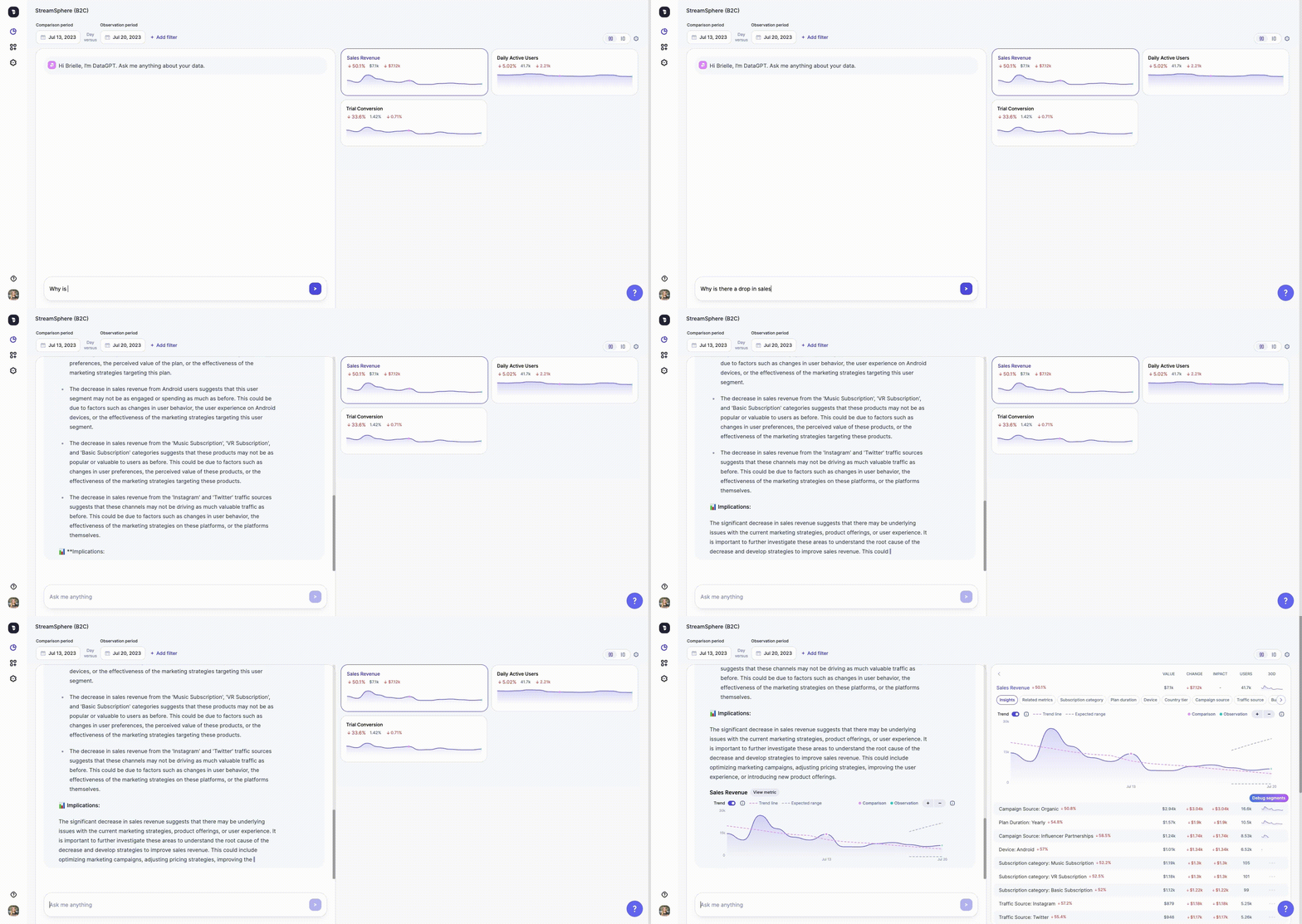
(Click to enlarge)
Empowering Data Enthusiasts
DataGPT's mission is clear: empower anyone, in any organization, to interact directly with their data. Non-technical business users and department managers can effortlessly pose questions using a familiar chat-like interface, employing natural language, just as if they were conversing with a colleague. This user-friendly approach enables deep data exploration, allowing users to ask detailed follow-up questions and uncover crucial insights.
With DataGPT's ability to process billions of rows of data in real time and provide both insights and visualizations, it stands out in the realm of data analytics.
Transforming the Business Landscape
By putting the power of skilled data analysis into the hands of everyday users, DataGPT is catalyzing efficiency and helping companies usher in a modern, data-driven culture. These newfound insights have the potential to unlock previously undiscovered revenue streams and save valuable time for busy data teams — nearly 500 hours each quarter. This enables these teams to focus on high-impact projects, driving innovation and growth.
A Glimpse into the Future
In a promising move, DataGPT has announced plans to open source its database in the near future, a development that holds exciting possibilities for data enthusiasts and organizations worldwide.
Real-World Success Stories
Real-world success stories are the true testament to the power of DataGPT. Michelle Bellettiere, Head of Data Analytics at Plex, has witnessed firsthand the transformation DataGPT brings. The tool has democratized data insights and made them more widely accessible, saving time and enabling faster decision-making.
Discover the Future of Data Analysis
To explore how DataGPT can transform your business, enhance your data capabilities, and help you build a modern, data-driven culture, schedule a demo. The future of data analysis is here, and it's waiting for you to unlock its potential.
More On This Topic
Get Interactive Plots Directly With Pandas
How to Make Large Language Models Play Nice with Your Software…
N-gram Language Modeling in Natural Language Processing
How to Start Using Natural Language Processing With PyTorch
Write and train your own custom machine learning models using PyCaret