Baby Llama Runs on Samsung Galaxy Watch 4

OpenAI’s Karpathy Creates Baby Llama Instead of GPT-5

A user on X, who goes by the name Joey (e/λ), shared a video where he ran ‘llama.c’ on a Samsung Galaxy Watch 4. Baby Llama was created by OpenAI’s Andrej Karpathy as a weekend project with the intention of running Llama 2 on edge devices.

@karpathy llama2.c running on galaxy watch 4 pic.twitter.com/sMPCZM3WE4

— Joey (e/λ) (@shxf0072) December 18, 2023

Karpathy said that this approach was heavily inspired by Georgi Gerganov’s project – llama.cpp, which was almost the same project of using the first version of LLaMA on a MacBook using C and C++.

Karpathy’s approach involves training the Llama 2 LLM architecture from scratch using PyTorch. After training, he saves the model weights in a raw binary file. The interesting part comes next: he writes a 500-line C file, named ‘run.c‘, which loads the saved model and performs inferences using single-precision floating-point (fp32) calculations. This minimalistic approach ensures a low-memory footprint and requires no external libraries, allowing efficient execution on a single M1 laptop without the need for GPUs.

Karpathy also explores several techniques to improve the performance of the C code, including different compilation flags like -O3, -Ofast, -march=native, and more. These flags optimise the code by enabling vectorization, loop unrolling, and other hardware-specific tuning. By experimenting with these flags, users can achieve even faster inferences on their specific systems.

To try out the baby Llama 2 model on your own device, you can download the pre-trained model checkpoint from Karpathy’s repository. The provided code will enable you to compile and run the C code on your system, offering a glimpse into the magic of running a deep learning model in a minimalistic environment.

It’s crucial to note that Karpathy’s project is a weekend experiment and not intended for production-grade deployment, which he acknowledges. The primary focus of this endeavour was to demonstrate the feasibility of running Llama 2 models on low-powered devices using pure C code, a language that for a long time has been not regarded useful for machine learning as it does not involve GPUs.

The post Baby Llama Runs on Samsung Galaxy Watch 4 appeared first on Analytics India Magazine.

Free Harvard Course: Introduction to AI with Python

Free Harvard Course: Introduction to AI with Python
Image from Author

One of the biggest problems that beginners face when trying to learn artificial intelligence is choosing the best resource. Because there are a bazillion resources out there. CS50’s Introduction to Artificial Intelligence with Python taught at Harvard University is an excellent resource to learn AI.

Over the course of 7 weeks, you’ll first learn fundamental concepts of mathematical logic and graphs search algorithms. Then, you’ll also get to explore machine learning, neural networks, and language models. More importantly, you’ll also build several interesting projects as you work your way through this course.

If you want to refresh your programming fundamentals before taking this course, check out CS50x Introduction to Computer Science—which is also free—to get up to speed with programming and computer science fundamentals.

Next, let's review the course contents.

Course link: CS50's Introduction to Artificial Intelligence with Python

1. Search

Given two points A and B, search algorithms aim at finding the path between A and B. And the optimal solution is often the shortest path between A and B. Examples include navigator apps that find the shortest route between any two places.

This first module on search covers the following topics:

  • Depth-First Search (DFS)
  • Breadth-First Search (BFS)
  • Greedy best-first search
  • A* search
  • Minimax
  • Alpha-beta pruning

The following are the projects that you’ll build for this module:

  • Degrees of separation between two actors (inspired by the Six Degrees of Kevin Bacon game)
  • An AI to play tic-tac-toe

Link: Search

2. Knowledge

The second module focuses on knowledge-based agents that use existing knowledge to draw conclusions.

So the search (first module) and the knowledge modules are based on graph algorithms and mathematical logic. You will get to learn about machine learning and optimization in the subsequent modules.

This second module on knowledge covers the following:

  • Propositional logic
  • Entailment
  • Inference
  • Model checking
  • Resolution
  • First order logic

And the projects that you will build are:

  • Knights: a program to solve logic puzzles mind sweeper and AI to play building an
  • Building an AI to play minesweeper

Link: Knowledge

3. Uncertainty

Probability is one of the most important concepts when learning machine learning. This module teaches you essential concepts in probability and random variables. You'll get to build two interesting projects to wrap up this module.

This module covers:

  • Probability
  • Conditional probability
  • Random variables
  • Independence
  • Bayesian networks
  • Sampling
  • Markov models
  • Hidden Markov models

The projects you’ll build are:

  • An AI that ranks web pages by importance
  • An AI that assesses the likelihood that a person has a genetic trait

Link: Uncertainty

4. Optimization

Optimization is an important math tool that allows you to solve a broad range of problems. In essence, optimization allows you to find the most optimal solution from a set of solutions.

This module covers the following optimisation algorithms:

  • Local search
  • Hill climbing
  • Simulated annealing
  • Linear programming
  • Constraint satisfaction
  • Backtracking search

For this module, you will build an AI that generates crossword puzzles.

Link: Optimization

5. Learning

This is the module in which you get to explore machine learning and the nitty-gritty of various machine learning algorithms. You’ll learn supervised, unsupervised, and reinforcement learning paradigms.

The topics covered include:

  • Nearest-neighbor classification
  • Perceptron learning
  • Support vector machine
  • Regression
  • Loss functions
  • Regularization
  • Markov Decision Process
  • Q learning
  • K-Means clustering

The following are the projects for this module:

  • Predicting whether a customer will complete an online
  • AI that learns to play Nim using reinforcement learning

Link: Learning

6. Neural Networks

This module focuses on deep learning fundamentals. In addition to learning the foundations of deep learning, you’ll also learn how to build and train neural networks with TensorFlow.

Here’s an overview of the topics that the neural networks module covers:

  • Artificial neural networks
  • Activation functions
  • Gradient descent
  • Backpropagation
  • Overfitting
  • Tensorflow
  • Image convolution
  • Convolutional neural networks
  • Recurrent neural networks

To wrap up your learning, you’ll work on a traffic sign recognition project.

Link: Neural networks

7. Language

This final module focuses on working with natural language. From the basics of language Processing to transformers and attention, here is the list of topics this module covers:

  • Syntax
  • Semantics
  • context free grammar
  • N-grams
  • Bag of words
  • Attention
  • Transformers

Here are the projects for this module:

  • A parser that parses sentences and extracts noun phrases
  • Masked word prediction

Link: Language

Wrapping Up

From graph algorithms to machine learning, deep learning, and language models—this course covers several foundational topics in AI.

I’m sure doing the lectures, reviewing lecture notes, and working on projects every week will be a great learning experience. Happy learning!

Bala Priya C is a developer and technical writer from India. She likes working at the intersection of math, programming, data science, and content creation. Her areas of interest and expertise include DevOps, data science, and natural language processing. She enjoys reading, writing, coding, and coffee! Currently, she's working on learning and sharing her knowledge with the developer community by authoring tutorials, how-to guides, opinion pieces, and more.

More On This Topic

  • Introduction to Databases with SQL: Free Harvard Course
  • The Most Popular Intro to Programming Course From Harvard is Free!
  • KDnuggets News March 30: The Most Popular Intro to Programming…
  • KDnuggets News, May 4: 9 Free Harvard Courses to Learn Data…
  • 9 Free Harvard Courses to Learn Data Science
  • Free Python Crash Course

RISC-V is Creating a ‘Linux Movement’ in Hardware

In 1991, when Linus Torvalds created Linux, an open-source operating system, it threatened Microsoft’s business as Linux was an alternative to one of its core products-Windows.

The open-source nature of Linux allowed developers worldwide to contribute to its development, resulting in a robust and versatile operating system. Secondly, Linux’s stability, security, and scalability made it suitable for a wide range of applications, from personal computers to servers and embedded devices.

It played a significant role in the open-source software movement, and even prompted former Microsoft Steve Balmer to refer to Linux as ‘cancer.’

Now, we are seeing a similar movement in hardware with RISC-V, an open-standard instruction set architecture (ISA) designed to be licence-free and royalty-free, allowing anyone to use, develop, manufacture, or sell RISC-V chips and software.

RISC-V, which began as a project at UC Berkeley’s Parallel Computing Laboratory in 2010, is challenging Intel’s x86 and ARM architectures.

For instance, a recent report from the Next Platform suggests that Meta is transitioning from traditional CPUs to RISC-based components. This shift is attributed to power efficiency, enhanced performance, reduced latency, and the adaptability to accommodate various workloads offered by the RISC-V.

Meanwhile, India, too, recognises the significant potential of RISC-V, envisioning it as a catalyst for establishing a robust chip design ecosystem in the country.

Making RISC-V the Indian ISA

In pursuit of this objective, in April 2022, the Indian government initiated the Digital RISC-V programme ( DIR-V), which aims to foster the development of next-generation microprocessors within India, positioning the nation as a prominent global hub for RISC-V expertise.

Union Minister Rajeev Chandrasekhar, who himself was a former chip designer, has also been actively involved in promoting and supporting the RISC-V architecture.

“It is certainly our ambition as a country and with hundreds and thousands of engineers amongst the audience that we will master and become if not the global leader but certainly amongst the world’s leading nations in propagating and navigating the capabilities and capacities to create innovation around the RISC V and DIR V family of chips and systems. The government of India is fully committed to making DIR-V the Indian ISA (Instruction Set Architecture),” the minister said.

India sees chip designing as one of its core strengths and is actively involved in the design of computing systems across various domains, including compute, industrial IoT, automotive, telecom, and wireless, as well as strategic technologies. The DIR-V processors are poised to drive systems in these diverse sectors, introducing healthy competition to other processor-based systems.

“RISC-V is a tool or a framework that allows us to innovate quickly to satisfy the demand for well-designed chips. The fact that it is open source enables us to pick and choose between different extensions and implementations while remaining compatible with a well-defined standard,” Shashwath T R, co-founder and CEO of Mindgrove Technologies, told AIM.

Developing a RISC-V ecosystem in India

However, to build a robust RISC-V ecosystem in India, the country needs more companies to emerge in the space along with increased funding. Also, what the country needs is to create a workforce specialising in RISC-V architecture.

The DIR-V programme aims to create over 10,000 jobs in the next five years. Besides, “We need more companies working on different aspects – both the silicon and associated areas such as verification, core and peripheral IP, physical design, etc., across every vertical that is relevant to India,” Shashwath said.

To sustain the ecosystem, India also needs different parties building boards, development tools and software aspects such as compilers, debuggers, IDEs, etc.

Moreover, the RISC-V and related specifications are developed, ratified and maintained by RISC-V International, a diverse membership base, including industry leaders, academic institutions, startups, and individuals. It has over 3,000 members, including major semiconductor companies, software providers, and system integrators in 70 countries.

There’s a need for a strong presence in the decision-making levels of RISC-V International so that Indian concerns are addressed as a top priority.

“Finally, we need to see massive adoption by our users – the companies and brands that build products based on our chips, and that comes back down to building compelling chips that they are happy to put into such products,” Shashwath said.

An opportunity for Indian startups

Nonetheless, the government’s focus on RISC-V does present an opportunity for Indian startups to innovate and fulfil the objectives of the DIR-V programme. Due to its open-source nature, it allows startups and entrepreneurs to build their own products without the need for expensive licensing fees.

This openness provides Indian startups with the flexibility to innovate and customise their chip designs according to their specific requirements. Indian startups can leverage RISC-V to develop indigenous chip designs, contributing to the country’s self-reliance in semiconductor technology and, at the same time, serving global customers.

“The fact that RISC-V is open, widely adopted by the industry, and built on the lessons learned from decades of experience in building microprocessors makes it a compelling standard for us to focus on.

Not only is it significantly less expensive than using legacy ISAs, but our designers can also hit the road running with innovative designs and microarchitectures, software, and tools,” Shashwath said.

Mindgrove’s first few products, according to Shashwath, were based on the RISC-V Shakti C-Class processor developed in the RISE lab at IIT Madras.

Gani Subramaniam, senior partner at Celesta Capital, previously told AIM that RISC-V is driving the creation of new startups in India as well as more and more RISC-V startups getting funded in India.

Chandrasekhar also emphasised that startups such as Mindgrove Technologies, Ventana MicroSystems, Esperanto Technologies, InCore Semiconductors and Morphing Machines have emerged for the DIR V ecosystem. Moreover, the government is also mulling acquiring equity stakes in the companies to nurture startups in the space.

A more open architecture is safer because it allows independent researchers to red-team it and find all the holes that need to be plugged in. Independent contributors’ efforts in what made Linux a very secure system.

“RISC-V benefits from the same idea, and there is a vibrant security community around RISC-V. In fact, the story of how Shakti came to be is precisely this – the team at IIT-M was looking for an architecture to conduct, among other things, security research. The closed-source ones did not allow them to do so without several restrictions, and hence Shakti was born,” Shashwath added.

The post RISC-V is Creating a ‘Linux Movement’ in Hardware appeared first on Analytics India Magazine.

Is prompt engineer displacing data scientist as the ‘sexiest job of the 21st century’?

man working at computer

More than a decade ago, in a Harvard Business Review article, Thomas Davenport declared data scientist to be the "sexiest job of the 21st century". Today, in an age of generative artifical intelligence (AI), is "prompt engineer" about to assume that title?

What's already certain is that it's one of the hottest jobs around. Prompt engineering involves getting the best and most relevant answers from generative AI tools, and is both conversational, "but also programmatic with prompts embedded in code," fellow ZDNET contributor David Gerwitz explains.

Also: Six skills you need to become an AI prompt engineer

Professional AI prompt-engineering job rates are hitting $175,000, but can be well over $300,000 per year, he notes, adding that "being a good AI prompt engineer involves more than being able to ask leading questions. You need to combine the disciplines of AI, programming, language, problem-solving, and even art to thrive on this career path."

With the world abuzz about generative AI, prompt engineers are in demand — huge demand. The problem is that finding prompt-engineering skills is an intractable challenge. Recruiting prompt engineers is not for the faint-hearted. "I think that most people that are recruiting are stealing," quips Greg Beltzer, head of technology at RBC Wealth Management.

Also: Uh oh, now AI is better than you at prompt engineering

I had a chance to sit down with Beltzer at the recent Salesforce conference in New York, where he talked about the challenges of skilling up in the age of AI. "A good prompt engineer is more expensive than a data scientist today," he observes. "Just outrageously difficult trying to find somebody who has experience. You're not going to find someone who has more than five years of experience. At the most you might get two or three years, but it's hard to find."

Beltzer continues: "There is a dramatic need to get people up to speed on prompt engineering. But is it a science? Is it an art? Are we going to build more tools?" The good news is that once tooling is in place, it may be easier to train AI models with prompts conducted "systematically and programmatically", he says.

Yet until robust and useful tools are available, prompt engineering will remain a challenge. Even with tools, Beltzer says it's important to note that this skillset goes beyond technical acumen. What's more, it's too early to identify exactly the requirements and background that are best suited for a prompt engineer.

Also: Want a job in AI? These are the skills you need

For instance, Beltzer doesn't think it would make sense to train a data scientist or another adjacent professional to adopt prompt-engineering skills: "A lot of it needs to be business contextual. You need to think like the user to help with that prompt engineering — it's not just code. It's not just development. It's like a business technical skillset that's also creative."

Some of the people coming into the field, he observes, aren't necessarily technical at all: "They're writers," he observes. "They just know how to write. And that's a part of it."

RBC keeps an eye on in its internal talent, with a focus on combined business and technical acumen, says Beltzer, "We're really looking for those folks that are most likely on the business side that has a technical bent. Personally, I don't want to make a bet until the tooling comes a little farther along."

The level of investment in AI and generative AI ventures during the past year, is "also going to shape what type of talent we're going to have," Beltzer says. "Until then, the talent market is going to be very lean. If you look at the turnover within these hot companies, they can name their price."

At RBC, which was once a highly conservative company, change has become the rule — starting with its rising adoption of cloud-based capabilities and services, such as Salesforce. "Once we moved to the cloud, we've been doing 25 releases a year," says Beltzer. "Which for financial services is crazy — the industry average was one release a year. We have a great team that is business and IT joined together, and we can iterate on the platform very, very quickly."

Also: How to write better ChatGPT prompts (and this applies to most other text-based AIs, too)

At the same time, Beltzer does not see his organization going all-in on AI anytime soon. While AI may help developers and business strategists with 80% of their tasks, the remaining 20% requires human involvement, he says: "I think AI is real. But I think we still have some work to do for the commercial viability in my industry."

For example, RBC employs generative AI to assist contact center engagements. "We have some pretty good use cases — but it's cost mitigation, versus actual revenue generating," says Beltzer. "But it's a good start."

At a more general level, AI might never fully replace humans in the wealth management sector, he adds. "What we've seen in down markets is people don't want to talk to a machine telling them, 'It's going to be okay.' People want to hear, 'We built a portfolio that had this model for this type of scenario. You're still on track — you're not retiring for another 20 years, you have plenty of time in the market, you continue to invest, it's going to be okay.' But you can't just have a bot telling you that."

AI capabilities are useful, however, in assisting employees as they talk directly to customers. "More and more people are using wealth management than ever before, because we have more assets," says Beltzer. "So, they're going to be able to service their clients with more technology — making sure this box is checked, or that paperwork is done for them. That's where we need to scale. So, advisors can focus on the relationship with the client, and make sure what they invested in is going to meet their long-term goals."

As an IT manager, "our challenge is to make systems more scalable and more efficient," Beltzer says. "I need to make the human able to do what they love more and take away those baseline activities that don't add more value."

[Exclusive] Sarvam AI is Developing a Platform for Seamless Indic LLM Deployment

Sarvam AI, a five-month-old startup, caught everyone’s attention earlier this month with a USD 41 billion funding round to build Large Language Models (LLMs) focusing on Indian languages.

Sarvam’s mission is unequivocal – breaking the language barrier and democratising AI in the truest sense. The choice of the name Sarvam even signifies that it means ‘everybody’ in Sanskrit.

Founded by Vivek Raghavan and Pratyush Kumar, Sarvam will focus on India’s unique needs, which include training AI models to support the diverse Indian languages and voice-first interfaces. Just last week, the startup announced OpenHathi v.01, the first model in the OpenHathi series.

Built on top of Meta’s Llama-2 7 billion parameter model, OpenHathi boasts GPT-3.5-like performance for Indic languages. “Open-source models provide a fertile ground for innovation, evident in the diverse versions of models built on top of LLaMa. However, a notable gap exists for Indian languages in Llama, as it does not have any Indic languages.

“So our intention was to take probably the most dominant model in people’s minds and show that it is possible to add Indian language to it,” Kumar said.

In this exclusive interaction with AIM, the co-founders confirmed that they will add nine to ten more Indic languages in the coming months.

However, Sarvam’s objective is not to build open-source Indic LLMs but to develop a platform and help build AI-powered applications that can be deployed at a population scale.

Building a platform for the easy deployment of AI

To fulfil their objective, Sarvam aims not just to develop models but to create a platform that simplifies the deployment of these models across various applications and at a relatively low cost.

“The platform encompasses the entire lifecycle of an LLM application, including evaluation, observation, and scaling. The aim is to provide a user-friendly environment for creating LLM applications, ensuring that applications leveraging these models can be easily deployed to a broad audience,” Kumar said.

Sarvam’s Indic language models can also be used to enhance existing digital public goods or applications and serve as a foundation for developing newer applications. For example, the Reserve Bank of India (RBI) announced its plans to integrate an AI-powered voice interface to UPI payments.

This will be significantly transformative, according to Raghavan.“In the evolving landscape of our digitised economy, integrating AI as a layer enhances the value of existing systems. Recognising the opportunity within India’s digital infrastructure, we aim to leverage AI to offer a multitude of differentiated services to citizens,” he said.

Challenges ahead

However, Kumar acknowledges that the important part is to get these models into the hands of application developers and get them to build applications for India.

“I believe the crucial aspect is placing these models in the hands of application developers. Once these models are accessible in various languages, people can create applications.

“As users interact with these applications, they will innovate, provide additional data, and enhance the models. This cycle needs to kickstart on a large scale to realise the potential,” Kumar said.

For Sarvam, the primary challenge lies in kick-starting the cycle of building applications on top of their models and introducing them to users, converting their promise into reality.

While Kumar views Sarvam’s current trajectory as an opportunity rather than a challenge, Raghavan affirms ongoing discussions with various parties, hinting at forthcoming developments in the coming months.

Moreover, Sarvam is not the only startup in the country building Indic LLMs. For example, Tech Mahindra announced that they are building an LLM which can understand 40 different dialects of Hindi. Most recently, Ola’s chief Bhavish Aggarwal announced Krutrim, their proprietary LLM, which can understand over 20 Indian languages and generate content in about ten languages.

The co-founders

Nonetheless, what makes Sarvam.ai so intriguing is the co-founders. Raghavan, who previously served as the Chief Product Manager and biometric architect at the Unique Identification Authority of India (UIDAI), has expertise in building large-scale systems and has domain expertise in AI.

Raghavan’s experience in deploying technology at a population scale combined with Kumar’s expertise in AI, the duo forms an ideal partnership to scale Indic LLMs and democratise AI in its truest sense in the country.

Kumar, besides working as a researcher at IBM and Microsoft, also co-founded AI4Bharat, a research initiative focused on open-source Indian language AI based at IIT Madras.

They hail from an open-source community, and both of them were already working on the domain of Indian languages. Their contributions predominantly revolved around pioneering state-of-the-art models, and they have showcased their research at top-tier conferences, reflecting their commitment to advancing the field.

Raghavan, who also mentored the AI4Bharat programme, said, “I have been working on various Digital Public Goods (DPG) for over a decade and a half. I’ve been doing this for a very long time, and I was also an advisor to various other projects like Unified Payments Interface (UPI), Goods and Services Tax (GST), etc. But, in the last four years, I have been working on AI for Indian languages.”

Kumar, in fact, was very complimentary of his co-founder. “Raghavan has the experience of deploying large-scale applications in India at a population scale. If you combine this with our expertise in AI, I think we have an opportunity with generative AI to do something special,” he said.

Do they have a business model yet?

Over time, numerous AI startups have secured significant funding, with some expanding to multimillion-dollar scales. Sarvam’s USD 41 billion funding round also raised a few eyebrows.

For now, it is unclear what business model the startup will adopt, but Raghavan emphasises their commitment to establishing a deep-tech company in India.

“Assembling an expert team and undertaking substantial computational efforts will necessitate significant financial investment. However, our primary goal is to address tangible challenges for actual customers. Successfully achieving this is expected to generate revenue, justifying our investments,” he said.

Furthermore, given both the co-founders originate from the open-source realm, they intend to open-source certain components while maintaining others as proprietary. Raghavan said on their potential revenue stream, “Users can access our models through subscriptions or opt for custom models tailored to specific organisational needs, serving as revenue streams. However, nothing is concrete yet.”

The post [Exclusive] Sarvam AI is Developing a Platform for Seamless Indic LLM Deployment appeared first on Analytics India Magazine.

Why ShareChat Co-founders Started a Robotics Company

Last month, former ShareChat co-founders Bhanu Pratap Singh and Farid Ahsan announced the launch of General Autonomy, an industrial robotics startup based in Bengaluru. It is interesting to note that they exited the social media company less than a year ago after having built it for nine years.

Their new startup General Autonomy – a significant pivot from social media – aims to revolutionise the future of factories, and build robots, which will be used by the industrial sector. These machines will be driven by artificial intelligence platforms.

“We LOVE robots! 😍 Especially industrial ones—they help us “make” things! With a vision to make mass manufacturing agile and distributed like software development, we’re in Bengaluru but working globally. 🌎,” shared Ahsan on X.

Interestingly, the IIT Kanpur alumni Singh and Ahsan majored in Electrical and Material Science Engineering respectively were active members of the robotics club in college. Looks like they have always had the passion for robotics since the beginning, and want to be a part of the growing demand for industrial robots in India.

This year, saw a lot more founders leaving the company to start another compared . A critical aspect of this trend is the financial health of these companies. Only a few were profitable in 2022, with the majority still operating at a loss.

ShareChat Struggles

The duo Ahsan and Singh started building apps together in 2012 since their college days. After experimenting with several products, they succeeded with ShareChat, along with co-founder Ankush Sachdeva designed to cater to non-English speakers in India.

Currently their roles as COO and CTO are left vacant and with no plans of hiring. The current CFO Manohar Charan has taken up some of the responsibilities but according to sources the teams are working without formal leadership.

Launched in 2015, ShareChat was notable for its focus on regional Indian languages, which is a barrier for social media apps in India. They made digital content accessible to a broader user base by adding 15 languages like Odia, Kannada and Punjabi.

The platform was built to work effectively even in areas with low internet connectivity, thanks to a lightweight messaging architecture. “This was a game-changer. It helped us grow fast in areas of low internet connectivity,” said Bhanu. Under their leadership, ShareChat achieved rapid growth, reaching over 60 million users within its first year.

This year however, things haven’t been going well for the company. The company, despite being valued at around $4.9 billion, reported operational revenues of only ₹347 crore and losses amounting to ₹2,988 crore in the fiscal year ending March 2022.

Additionally, ShareChat faced significant challenges, including a string of expensive acquisitions and a mass firing where 20% of its workforce was cut due to external macro factors impacting the cost and availability of capital.

As of 2022, Moj, a subsidiary of ShareChat specialising in short video content, along with MX TakaTak. Amidst this, the loss of two founders raised eyebrows.

However, it’s not all bad news as it saw an increase in revenue because of their multiple acquisitions over the last three years. The number of users also increased considerably to a combined 300 million in all their platforms.

The transition to building a robotics company also comes at a time when ShareChat is going through a turbulent time in terms of revenue. The company reported a loss of INR 3,241 crores against a revenue of INR 535 crores.

The industrial robotics market is valued at $17 billion as of this year and is expected to grow significantly to a $35.4 billion market by 2028. The segment is fueled by the increasing adoption of Industry 4.0 technologies across various sectors, particularly in the automotive, packaging, and metal industries.

Robotics to the Rescue

In a time where the integration of AI in robotics is predicted to change how the field works, General Autonomy is a significant shift in the founders’ entrepreneurial journey, moving from social media to the field of industrial robotics.“Our mission is to revolutionise the future of factories, focusing on automation..” Ahsan said in his tweet. He stressed that AI driven machines to automate the toughest parts of labour workflows in factories.

🚀 BREAKING NEWS! 🚀 Thrilled to announce the launch of @generalautonomy, a venture by @bhanuism and me! 🌟 Our mission is to revolutionize the future of factories! 🏭✨ (1/6)

— Farid Ahsan (@frdahsan) November 13, 2023

To set this up, the company has successfully raised $3 million in seed funding, with contributions from India Quotient, ElevCap, and mentorship from favourite investors including Mayank Khanduja and Anand Lunia. The funding round also saw participation from notable angels like Srinath Ramakkrushnan, Ramakant Sharma, and Ankush Sachdeva, Share Chat’s co-founder.

This shift aligns with the sector’s anticipation of a ‘GPT moment’ in robotics. Companies like Grey Orange, have become notable success stories, raising substantial investment and expanding globally. The sector has attracted investor interest, with startups receiving funding for a range of innovative solutions, from agricultural robots to automated solar panel cleaning and companion robots.

The plans of General Autonomy are unclear as they refused to comment.

The post Why ShareChat Co-founders Started a Robotics Company appeared first on Analytics India Magazine.

GPU Battle: NVIDIA vs AMD

GPU Battle: NVIDIA vs AMD

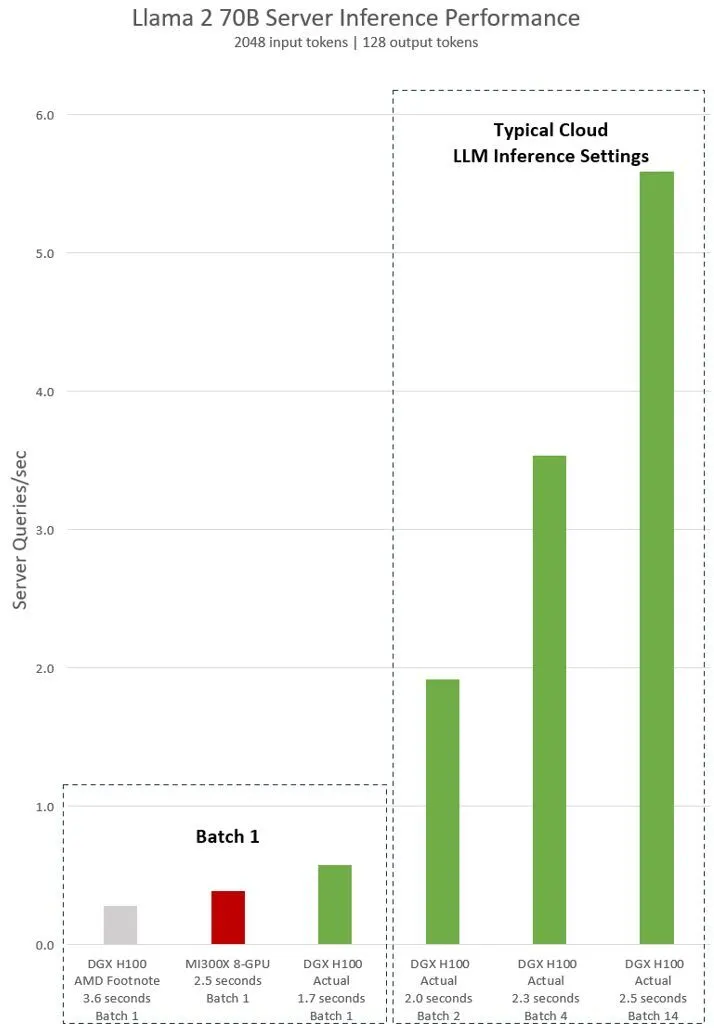
When AMD launched MI300X at its Advancing AI event, during the presentation Lisa Su, the CEO of AMD, and her colleagues showcased the accelerator’s prowess by comparing it with NVIDIA H100’s inference performance using Llama 2. At the presentation, a single server of AMD which consists of eight MI300X, performs 1.6 times faster than the server of an H100.

But NVIDIA wasn’t happy with the comparison and debunked it. According to a blog post by NVIDIA, contrary to AMD’s presentation, the company contended that the H100 GPU, when benchmarked appropriately with optimised software, outpaces the MI300X by a substantial margin.

NVIDIA countered this by alleging that AMD failed to incorporate its optimisations in the comparison with TensorRT-LLM. NVIDIA’s response involved pitting a single H100 against eight-way H100 GPUs while running the Llama 2 70B chat model.

Source: NVIDIA

The results, obtained using software predating AMD’s presentation, demonstrated a performance that was twice as fast at a batch size of 1. Going even further, when applying the standard 2.5-second latency used by AMD, NVIDIA emerges as the undisputed leader, surpassing the MI300 by an astonishing 14-fold.

AMD snaps back

Surprisingly, AMD responded to NVIDIA’s challenge with new MI300X benchmarks, demonstrating a 30% increase in performance compared to the H100, even with a finely-tuned software stack.

In a move mirroring NVIDIA’s test conditions with TensorRT-LLM, AMD took a proactive approach, considering latency, a common factor in server workloads. AMD emphasised key points in its argument, particularly highlighting the advantages of FP16 using vLLM over FP8, which is exclusive to TensorRT-LLM.

Source: AMD

AMD asserted that NVIDIA conducted benchmarks with its proprietary TensorRT-LLM on H100 instead of the widely-used vLLM.

Additionally, AMD points out the discrepancy in data type usage, with NVIDIA employing vLLM FP16 on AMD while comparing it to DGX-H100’s TensorRT-LLM with FP8 datatype. AMD defends its choice of vLLM with FP16, citing its broad usage, unlike vLLM, which lacks support for FP8.

Another point of contention is the consideration of latency in server environments. AMD criticises NVIDIA for focusing solely on throughput performance without addressing real-world latency issues.

To counter NVIDIA’s testing method, AMD conducted three performance runs using NVIDIA’s TensorRT-LLM, with the final run specifically measuring latency between MI300X and vLLM using the FP16 dataset against H100 with TensorRT-LLM.

The tests showcased improved performance and reduced latency. AMD applied additional optimisations, resulting in a 2.1x performance boost compared to H100 while running vLLM on both platforms.

Meanwhile, competitions galore

NVIDIA and AMD’s competition has been going on for a long while. But interestingly, this is the first time that NVIDIA decided to directly compare its products’ performance against AMD. This clearly shows that the competition in the field is heating up.

Currently, the ball is in NVIDIA’s court to formulate a response to AMD, considering the implications of abandoning FP16 in favour of TensorRT-LLM’s closed system with FP8, while also keeping in mind that others such as Intel and Cerebras are getting better at making GPUs.

Not just the two chip giants, others such as Cerebras Systems and Intel are also trying to make their mark in the market. Pat Gelsinger, the CEO of Intel, teased the Gaudi3 AI chip at its AI Everywhere event, though there was very little revealed about it. Comparatively, the other products released by Intel such as Core Ultra were being compared to the last generation of AMD’s, not the latest one.

Similarly, NVIDIA is coming up with GH200 superchips, a successor to the H100, early next year. AMD did not compare its new chips with it, but with H100. It is clear that GH200 would obviously perform better than the last ones. Since the competition is so close, AMD might end up being treated like a backup option by many companies, such as Microsoft, Meta, and Oracle, who have already announced they are integrating it in their data centres.

Gelsinger has projected that the GPU market size would be around $400 billion by 2027. This definitely gives room for a lot of competitions to thrive.

Meanwhile, Cerebras Systems’ CEO Andrew Feldman, at the Global AI Conclave, took a shot at NVIDIA’s monopolistic practices. “We spend our time figuring out how to be better than NVIDIA,” he said. “By next year, we will build 36 exaflops of AI compute power,” he added about the company’s ambitious plans.

Cerebras Systems’ CEO is also in talks with the government of India for powering AI compute in the country. The company also signed a $100 million AI supercomputer deal with G42, an AI startup in UAE, where NVIDIA isn’t allowed to work.

The post GPU Battle: NVIDIA vs AMD appeared first on Analytics India Magazine.

Accenture Launches Generative AI Studio in Bengaluru to Accelerate AI Adoption

Snippet: The studio will leverage the strategic investments made in Accenture’s Center for Advanced AI on behalf of its clients.

IT consulting giant Accenture has launched Generative AI Studio in Bengaluru, India today to accelerate AI and analytics adoption.

The company looks to co-create solutions with a modern data and AI foundation, LLM architecture, ecosystems relationships, talent, and responsible AI frameworks through the studio, which is a part of Accenture’s $3 billion investment in AI and analytics.

This decision to open a Generative AI Studio comes in the backdrop of a recent study conducted by Accenture where it noted that 74 percent of C-suite executives aim to raise their AI-related investment in 2024, up from 50% the year before.

The studio will leverage the strategic investments made in Accenture’s Center for Advanced AI on behalf of its clients.

It will also leverage the company’s more than 1,450 AI patents, both issued and pending, as well as the knowledge gained from more than 300 ongoing generative AI initiatives.

Accenture’s Big Bets on Generative AI

The studio will provide the recently introduced services, including modification methods, model managed services, and specialized training courses, along with its own generation AI model “switchboard.”

Teaming up with ServiceNow and NVIDIA, the company jointly announced the introduction of AI Lighthouse in July, 2023 to fasten the development and implementation of enterprise generative AI capabilities.

Back in September, 2023 Accentureannounced Writer, a generative AI platform for clients for content creation and drive significant business impact.

The post Accenture Launches Generative AI Studio in Bengaluru to Accelerate AI Adoption appeared first on Analytics India Magazine.

How Generative AI is Reshaping Banking & Finance in India

It has been one year since OpenAI introduced its flagship generative AI product ChatGPT to the world. And since then, the world has been slowly warming up. However, initially, the banking and financial services sector hesitated to adopt generative AI, considering it a niche application.

“Initial reluctance was rooted in regulatory scrutiny focused on data privacy, security, and compliance. The risk-averse nature of the industry also led to a cautious approach, driven by concerns about errors, biases, and unforeseen consequences. But it is gaining mainstream acceptance now,” Ashish Vora, President and Business Head of leading credit rating agency CRISIL Market Intelligence and Analytics, told AIM in an exclusive interview.

Moreover, the lack of expertise and understanding of generative AI posed a challenge, with many institutions facing a shortage of skilled AI talent. This limited their ability to explore practical applications. Despite these initial barriers, the scenario has changed, with larger banks now leveraging AI for services like powering chatbots for customer service.

Vora brings over 30 years of financial leadership experience, including roles at Kotak Bank and Citibank. A co-founder of Pragmatix Services acquired by CRISIL in 2018, he oversees diverse verticals, including customised research, advisory, and growth and innovation.

CRISIL assesses the creditworthiness of companies and financial instruments, providing essential insights for investors and stakeholders. Additionally, it offers research, risk advisory, and infrastructure consulting services to support informed decision-making in the financial sector.

How CRISIL Uses AI

In today’s uncertain business environment, data and technology-driven risk management systems play a crucial role in helping organisations, especially in the BFSI sector, tackle geopolitical and economic risks proactively. Understanding risks across business functions requires a deep grasp of industry dynamics, market positioning, cost structures, and competition. Conventional risk models struggle with real-time data integration from diverse sources, making it essential to prioritise innovative risk analytics systems.

“This is where AI algorithms prove invaluable in processing extensive real-time data, revealing patterns, anomalies, and correlations within economic and geopolitical landscapes, helping financial institutions to anticipate potential risks, analyze market trends, political instability, and trade policies,” explained Arora.

Data-powered systems support sophisticated risk modeling and scenario planning, offering insights into the economic and geopolitical impact on portfolios and business strategies. They also streamline regulatory compliance through automated reporting and real-time updates. Identifying risks in real time enables swift mitigation strategies, preventing financial losses during economic or geopolitical shifts.

For example, CRISIL’s Advanced Risk Analytics System assesses the potential financial impact of any change in the economic scenario on a company using real-time data, even before quarterly results are published.

Arora told AIM that the system relies on models built from a deep understanding of industries and years of data collected across 200 industries. The models simulate the value-chain linkages of each business process. When supplied with relevant data on economic and industrial activity, the system reflects the impact on company financials, aiding in informed decision-making.

Fintech’s Role in Financial Inclusion in India

“Fintech companies have significantly contributed to genuine financial inclusion in India by leveraging the government’s ‘India Stack,’ a digital infrastructure comprising digital identity, payment capabilities, and data storage,” said Arora.

This foundation facilitated the rise of fintechs, particularly in digital authentication, payments, and lending. Initiatives like Jan Dhan and technologies such as Open Credit Enablement Network (OCEN) and Account Aggregators (AA) further broadened financial access, especially for the unbanked sections, resulting in social and economic benefits.

The democratisation of data allowed non-banking financial companies (NBFCs) to expand into remote areas cost-effectively, optimising operational costs and reducing customer acquisition expenses. “Through innovations like AI and cloud computing, fintechs streamlined lending processes, minimising turnaround times, and enhancing onboarding experiences using India Stack’s APIs,” he added.

These companies capitalised on AI to gather unstructured data for informed credit decisions, collaborating with entities like account aggregators and credit bureaus. They utilised digital collection data for customised payment schedules, incorporating early warning systems for post-disbursal loan monitoring. However, as fintech evolves, regulatory compliance and ethical considerations gain prominence.

He further explained that how regulators, recognising fintech’s potential, balance accessibility with risks and have intervened to ensure security, privacy, and consumer protection. The RBI’s Payments Vision 2025 and interoperability framework have propelled India towards becoming a global payment hub. Initiatives like the Payments Infrastructure Development Fund and innovations by the National Payments Corporation of India support rural digital payment infrastructure.

“As the fintech landscape evolves, emerging trends indicate a supportive regulatory landscape, continued digital adoption for financial inclusion, product hyper-personalisation, customer-centric fintech business models, embedded finance integrating non-financial services, and increased insurance penetration in tier 2 and 3 cities, “ concluded Vora. These trends reflect the ongoing evolution and impact of fintech in reshaping India’s financial landscape.

Read more: How Deutsche Bank is Riding the Generative AI Wave

The post How Generative AI is Reshaping Banking & Finance in India appeared first on Analytics India Magazine.

Amdocs Revolutionising Telecom with Generative AI

Last month, Amdocs and NVIDIA announced a strategic collaboration aimed at optimising LLMs to accelerate the adoption of generative AI applications in the telecommunications and media industries, which form a whopping $1.7 trillion market.

Amdocs specialises in software and services for various industries, including communications, media, financial services, and digital enterprises, to manage customer information, billing, support, and data analysis effectively.

This partnership entails the customisation of enterprise-grade LLMs using NVIDIA accelerated computing, all within Amdocs’ amAIz a generative AI framework for telcos, which it launched earlier this year in June. By joining forces, the two companies aim to empower communications service providers to efficiently integrate generative AI use cases across their operations, from enhancing customer experiences to optimising network provisioning.

Amdocs will leverage the powerful capabilities of NVIDIA DGX Cloud AI supercomputing and NVIDIA AI Enterprise software. This collaboration aligns with Amdocs’ strategy to advance AI use cases in the industry, building on their Microsoft partnership. It ensures secure adoption in on-site or cloud environments for service providers and media companies.

The company boasts a customer of 350 leading companies, including 27 of the world’s top 30 service providers—like AT&T Mobile, Vodafone, Airtel, Infosys, Fujitsu, Verizon, Telefonica, amongst others facilitating over 1.7 billion daily digital journeys, impacting over 3 billion people globally.

In a recent conversation with AIM, Anthony Goonetilleke, Group President of Technology and Head of Strategy at Amdocs, provided insights into their approach saying, “There’s no technology that’s moving as fast. So it was very very critical to us to form strategic partnerships.”

This is the second such partnership with a tech giant. The first one was with Microsoft, which enables them to use products from OpenAI because both companies are synonymous and run on Azure Cloud.

“The second partner we wanted to work with was Nvidia for multiple reasons. They have the best infrastructure in the market for GenAI GPUs. But second, it allows us the freedom to run on AWS if one of our customers demands—and third, they are helping us accelerate telco verticals capabilities,” explained Goonetilleke.

These partnerships are also critical as telcos have been experiencing shrinking revenues. To deal with it they are diversifying their verticals into home automation, connected healthcare and industrial IoT.

For this, they must move from legacy OSS/BSS systems to a composable, cloud-native architecture, enabling them to integrate AI software and personalise customer experiences, without needing heavy customisation and lengthy migrations.

Role of Generative AI in Telecom

Amdocs is actively working to integrate generative AI into their products and services, enabling quicker responses to customer needs and reducing the time to market for their solutions. For example, their CPQ (Configure, Price, Quote) platform leverages generative AI to significantly reduce the time it takes to deliver proposals to customers from months to days.

Another application of generative AI is in catalogue management, where Amdocs aims to simplify product creation and customisation. Users can generate multiple product options by simply describing their requirements, dramatically increasing efficiency.

“I can type it in English, and NLP will translate it into the inventory and look at available systems. I can have 70% of the proposal created right before you,” he said.

Adding that, “Right then, you can verify it, and then within a week, I can have you know the install date for you.”

He explained that even if a client is in need of a 5G package in Delhi that targets millennials interested in the Cricket World Cup it has become easy and efficient with the use of external data sources. Previously, it required extensive research and knowledge of the system’s components. Now, you can simply input your preferences, quickly generate multiple options, fine-tune your choice, and launch it to the market.

Resource Utilisation and AI Democratisation

The company also recognises the resource-intensive nature of AI, particularly in terms of power consumption. The amAIz framework optimises the use of tokens efficiently without manual input. It uses vector databases, caching, and various techniques to maximise token utilisation. This ensures transparency in token allocation and cost management and prevents unexpected billing surprises, offering added value to users.

“This way, you’re not going to get a surprise at the end of the month to have this huge bill that no one expected suddenly.”

Goonetilleke also expressed enthusiasm about democratising AI technologies, emphasising that individuals worldwide now have access to the same powerful tools and resources as established tech hubs.

However, Amdocs is not the only player striving to meet the specific GenAI requirements of telcos. Some telecom operators are collaborating to build a model shared under the Global Telco AI Alliance, with two telcos involved in that body, SK Telecom and Deutsche Telekom, having recently announced progress.

Additionally, companies like Netcracker Technologies, in partnership with Google Cloud and Tech Mahindra, leverage their industry knowledge to cater to GenAI’s needs. However, with its Azure cloud expertise, the triumvirate of Amdocs, NVIDIA, and Microsoft presents a particularly formidable combination poised to shape the future of telecom generative AI. As these industry leaders unite their strengths, the telecom sector can anticipate a new era of innovation and transformative solutions.

The post Amdocs Revolutionising Telecom with Generative AI appeared first on Analytics India Magazine.