AI in 2023: A Comprehensive Overview of Breakthroughs and Developments

2023 has been a landmark year in the realm of Artificial Intelligence (AI), witnessing extraordinary advancements that have blurred the lines between technology and human life. The year has seen AI evolve from complex algorithms to a more relatable entity, embedding itself in various aspects of our daily existence. This article delves into the pivotal highlights and achievements in the AI sector throughout the year.

Table of contents

  • AI Highlights from January 2023
  • AI Highlights from February 2023
  • AI Highlights from March 2023
  • AI Highlights from April 2023
  • AI Highlights from May 2023
  • AI Highlights from June 2023
  • AI Highlights from July 2023
  • AI Highlights from August 2023
  • AI Highlights from September 2023
  • AI Highlights from October 2023
  • AI Highlights from November 2023
  • AI Highlights from December 2023
2023: A landmark year in AI innovation, marked by groundbreaking advancements in healthcare, robotics, generative AI, and more, reshaping industries and daily life.

AI Highlights from January 2023

The year began with significant progress in medical AI. MIT and Mass General Hospital developed a deep-learning model for lung cancer risk assessment. Another breakthrough was the creation of artificial enzymes by AI. Additionally, AI integration in walking sticks marked a step forward in aiding the visually impaired.

OpenAI’s investment in AI development, through a deal with Microsoft, indicated a strong business focus on AI’s future.

AI Highlights from February 2023

February was dominated by OpenAI’s ChatGPT, which passed the United States Medical Licensing Exam. Google introduced Bard AI, and Microsoft revamped Bing with ChatGPT integration. AI developments by Meta (LLaMA) and AWS’s collaboration with Hugging Face were other key highlights.

Researchers from Oxford showcased RealFusion, capable of constructing 360° models from single images. AI also ventured into music with Google Research’s MusicLM and Baidu’s ERNIE-Music.

AI Highlights from March 2023

Adobe and Canva introduced AI-backed tools, signifying growth in generative AI. OpenAI launched APIs for ChatGPT, Whisper, and GPT-4, along with ChatGPT plugins.

HubSpot, Zoom, Khan Academy, Ford, Google, and Microsoft all integrated AI into various business and educational aspects. This period also saw rising concerns over AI’s rapid growth, calling for ethical AI practices.

Google Introduces Bard

Google launched Bard, a conversational AI based on LaMDA, signaling a major step in AI-driven search and information processing. Bard aims to distill complex information and enhance user interactions with AI.

AI Highlights from April 2023

AI’s integration with Boston Dynamics’ robots and My AI on Snapchat were standout events. Bill Gates envisioned AI’s role in education, and Russia’s Sberbank released GigaChat.

Apple ventured into AI health coaching with ‘Quartz,’ and Google embarked on Project ‘Magi.’ AI-generated song featuring Drake and The Weeknd went viral, while Adobe’s Firefly expanded to include video editing.

AI Highlights from May 2023

Advancements in robotics were prominent, with Sanctuary AI’s Phoenix Robot and Tesla’s Optimus Bot making headlines. OpenAI’s ChatGPT mobile app and Spotify’s AI DJ features in the UK and Ireland were key developments.

Midjourney 5.1 and Stability AI’s StableStudio significantly advanced creative AI. Google launched the Vertex AI platform, and Meta released DINOv2.

Adobe Unveils AI-Powered Tools for Enterprises

At Adobe Summit 2023, Adobe unveiled a range of generative AI-powered tools, in collaboration with NVIDIA and Accenture, to enhance marketing workflows and digital experiences.

AI Highlights from June 2023

Apple’s Vision Pro and OpenAI’s plans for a London office marked significant developments. AI was used to discover anti-aging drugs, and the EU’s AI Act progressed in legislative processes. Palantir’s new AI military capabilities and McKinsey’s predictions on generative AI’s economic impact were also notable.

AI Highlights from July 2023

July saw POE.com incorporate diverse AI models. Meta-AI introduced Llama2, and Google Cloud expanded generative AI in Vertex AI. In healthcare, Daniel Ek’s Neko Health marked a breakthrough in AI health tech startups.

AI Highlights from August 2023

OpenAI expanded ChatGPT’s features, and AtomAI applied deep learning to microscopy data analysis. Google and YouTube explored AI in journalism and content creation, and the White House summit focused on AI safety.

AI Highlights from September 2023

OpenAI introduced DALL·E 3, and Midjourney added the ‘Vary Region’ feature. YouTube launched the AI-enabled editing app, YouTube Create, and Coca-Cola experimented with AI-created mystery flavors.

AI Highlights from October 2023

Developments in AI editing technology by ElevenLabs and Dell, Intel, and Cambridge’s Dawn Phase 1 supercomputer were key events. Amazon and Canva introduced AI-powered image generation capabilities.

AI Highlights from November 2023

Elon Musk’s xAI released the AI chatbot “Grok,” and OpenAI unveiled Assistants API. Samsung’s Gauss emerged as a versatile AI model, and OpenAI experienced leadership changes.

AI Highlights from December 2023

Google’s Gemini model outperformed GPT-4, and AMD challenged NVIDIA in AI hardware manufacturing. Apple released the MLX framework, and the AI Alliance for Responsible Innovation was formed.’

Also Read: 2023 in Review: 10 Events that Transformed AI

The post AI in 2023: A Comprehensive Overview of Breakthroughs and Developments appeared first on Analytics India Magazine.

The Most Read AIM Stories of 2023

In this comprehensive article, we dive into the most read stories of 2023 from Analytics India Magazine. Covering a range of topics from the challenges of AI in job markets to OpenAI’s strategic moves, each story provides a unique insight into the evolving world of AI and technology. From Hugging Face’s bold steps to challenge OpenAI, to the surprising inefficacies of ChatGPT in software engineering queries, these stories highlight key developments and debates in the AI industry.

Read: The Best AIM Stories of 2022

“An Entire Generation is Studying for Jobs that Won’t Exist” by Mohit Pandey, published on January 21, 2023. This article discusses the impact of AI on job markets and the potential obsolescence of certain professions due to technological advancements. Read more.

“When ChatGPT Attempted UPSC Exam” by Pritam Bordoloi, published on February 28, 2023. This piece details ChatGPT’s attempt at India’s UPSC exam, highlighting its limitations in such competitive examinations. Read more.

“Infosys Announces Free AI Training Program for Upskilling” by Shritama Saha, published on June 23, 2023. The article reports on Infosys’ initiative to provide free AI training, focusing on data science and related fields. Read more.

“OpenAI Releases Paid ChatGPT Professional” by Shritama Saha, published on January 21, 2023. This article details the launch of a paid version of ChatGPT, discussing its features and potential impacts. Read more.

“No Need to Study Maths Anymore” by Mohit Pandey, published on June 8, 2023. This piece examines the evolving role of mathematics in AI and machine learning. Read more.

“Google Fools Everyone with Gemini” by Siddharth Jindal, published on December 8, 2023. This article discusses Google’s hurried release of the Gemini AI model, suggesting pressure from competitors, and examines its technical aspects and performance comparisons. Read more.

“Now Everyone’s a Developer, Thanks to Microsoft” by Mohit Pandey, published on May 24, 2023. The article talks about Microsoft’s role in democratizing development through AI, hinting at the evolution of programming and the impact on developers. Read more.

“OpenAI Launches Residency Program with $210,000 Annual Salary” by Mohit Pandey, published on October 4, 2023. This article highlights OpenAI’s new residency program aimed at nurturing AI talent, detailing its objectives, structure, and salary offerings. Read more.

“6 Brilliant New Free Courses by Andrew Ng on Generative AI” by Shritama Saha, published on September 7, 2023. The piece outlines Andrew Ng’s six new AI courses, their content, and partnerships, aimed at enhancing AI literacy. Read more.

“Hugging Face Makes OpenAI’s Worst Nightmare Come True” by Poulomi Chatterjee, published on March 3, 2023. The article discusses Hugging Face’s partnership with AWS and its implications for OpenAI, highlighting contrasting approaches to democratizing AI and the competition in generative AI technologies. Read more.

“Stack Overflow Snatches the Spot from ChatGPT” by Tasmia Ansari, published on August 17, 2023. This article explores the reliability of OpenAI’s ChatGPT in answering software engineering questions, with research showing over 50% of its responses to be inaccurate compared to Stack Overflow. Read more.

“Obsolete Code: 10 Programming Languages That Vanished Over Time” by K L Krithika, published on July 13, 2023. The article provides an overview of 10 once-popular programming languages that have become obsolete, exploring reasons behind their decline and impact on the programming landscape. Read more.

“OpenAI Likely To Pull the Plug on ChatGPT” by Mohit Pandey, published on August 17, 2023. The article speculates on the future of ChatGPT, considering operational costs and strategic moves by OpenAI, suggesting potential discontinuation or significant changes to the platform. Read more.

“Upskill with These Free Generative AI Courses Offered by Big Techs” by Siddharth Jindal, published on June 29, 2023. The article lists and describes free generative AI courses offered by major tech companies like Google, AWS, Microsoft, and Infosys, aimed at enhancing AI literacy and skills. Read more.

“Chromecast Joins Google Graveyard” by Tasmia Ansari, published on June 1, 2023. This article announces the end of support for the original Chromecast by Google, detailing its impact on users and its place in Google’s history of discontinued products. Read more.

“It’s Time OpenAI Launched GPT-5” by Mohit Pandey, published on July 16, 2023. The article discusses the competitive landscape in AI and urges OpenAI to accelerate the development of GPT-5 to stay ahead of emerging competitors in the field. Read more.

The post The Most Read AIM Stories of 2023 appeared first on Analytics India Magazine.

I replaced Google Search with Opera’s Aria AI feature and I don’t miss the former one bit

AI data blocks stacked together

Opera has been my on-and-off default browser for years. Starting early in 2023, once the development team added artificial intelligence to the browser, I thought I was done with it permanently. But I gave it a chance and am glad I did.

To my surprise, I found Aria — Opera's built-in AI tool — to come in handy for one specific function. And that function has me using google.com less and less with every passing day.

Also: How to use Opera's built-in AI chatbot (and why you should)

Let me explain.

When I run a search on google.com and the results appear, I always assume one or more of the following:

  • The resulting site content will be out-of-date.
  • The resulting site will contain so many ads (or poorly designed code) that it will cause problems with my web browser.
  • The resulting site content is behind a paywall.
  • The resulting site content will require that I sign up.

I realize that's a bit heavy on the pessimism, but anyone who searches as much as I do will get what I'm throwing down.

It can be exhausting.

It also means I have to continue refining my search to find what I'm looking for. And, given most often what I'm querying is for research purposes (either for an article or a book), I need to be as efficient as possible. I'm too busy to spend my time on deep dives down various rabbit holes to find what I need.

That's where Opera's Aria comes in. Let me give you an easy example.

In the current book series I'm writing, every character's name is a combination of classical composer's names. For example, one of the main characters is Anton Frank. The first name is from Anton Dvorak and the last name from Frank Bridge. I'm sometimes randomly putting those names together and sometimes with intention. Although I know a lot of classical composer names, once you're four books into a series, you have to start digging deep into more obscure composers.

Also: Best secure browsers to protect your privacy online

To that end, instead of using a Google search — which might have me clicking through sites until I find one that's useful — I open Aria and type:

List 50 classical composers

If that doesn't give me what I need, I might type:

List 50 female classical composers

I can continue narrowing down the query, making sure to start each one as a new chat — which saves it in the Aria sidebar — so I can refer back to it later.

When I go this route, I don't have to worry about poorly coded websites dragging my browser to a halt or any of the other issues I've run into when researching something.

Aria just works.

Keep this in mind: I don't use Aria (or any AI) for anything but that purpose. I'm not using it as a crutch to write for me. AI is not my muse and it never will be. You see, I've spent 30 years developing my "writer's voice" and have no intention of not using it.

Also: Google unveils a search trend time capsule tool to make you feel old

Essentially, I use Aria in place of Google searches.

One thing to keep in mind, however, is that I don't use Aria in place of the sites I like to frequent. When I follow a writer, it's because of their unique perspective and/or voice. I don't want to read pieces that were generated by soulless algorithms. I want heart in my news and/or entertainment; I want vision, depth, and experience in the words I read. I want to know that someone was moved enough by something to write about it.

When I discover that a site uses AI to create content, I never return. I won't knowingly read articles or books written by AI, won't listen to music created by AI, and would never watch videos created by AI. AI is not a creative process and it never will be.

But for research…I only need information (like names).

So, at least for me, Aria is beating Google at its own game and I don't see this changing any time soon. Give Opera's Aria a try. I believe you'll find it can often best Google at helping you find the answers you need for your queries, without worrying about what site you're being sent to.

Artificial Intelligence

The Best Kept Secret About LLMs

GPT can be a great tool to write or summarize articles, and as a chatbot. But one of the most popular uses is to find information. In short, a better alternative to Google search. Yet, all the talk is about deep neural networks, transformers, and embeddings. And how GPT leverage these new technologies, using trillions of tokens.

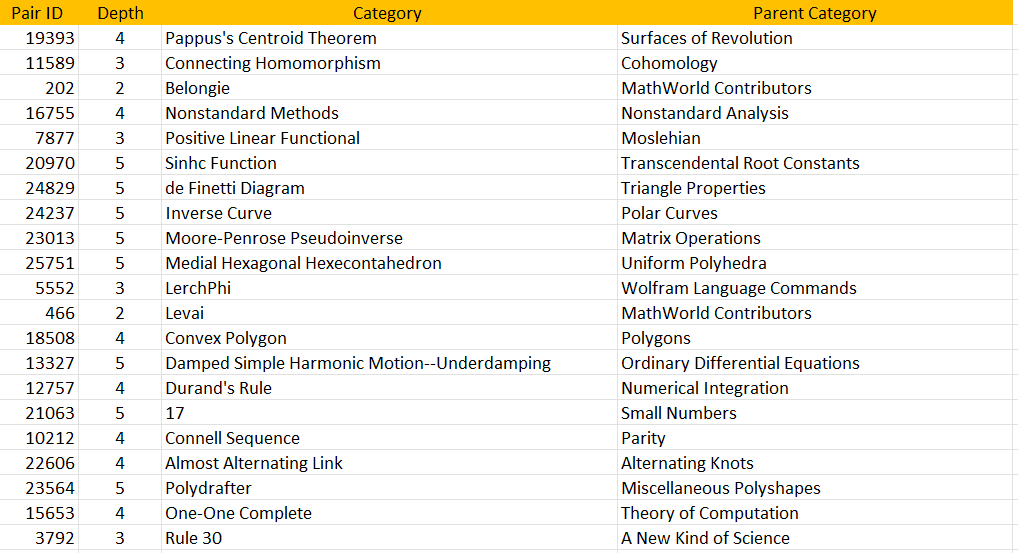
However, there is some old technology behind this: gathering and organizing the input data. The quality of embeddings critically depends on it. In this article, I focus on this component, present in all LLMs. Along the way, I explain how to built a much faster, simpler system, that better meets your needs. I am currently building one for myself, and will share all the code and documentation later. Here, I provide a high level summary, of interest particularly to developers and professionals with a technical background, including stakeholders. To get an idea of what I am working on, look at Figure 1.

LLM
Figure 1: Towards better content taxonomies

Background

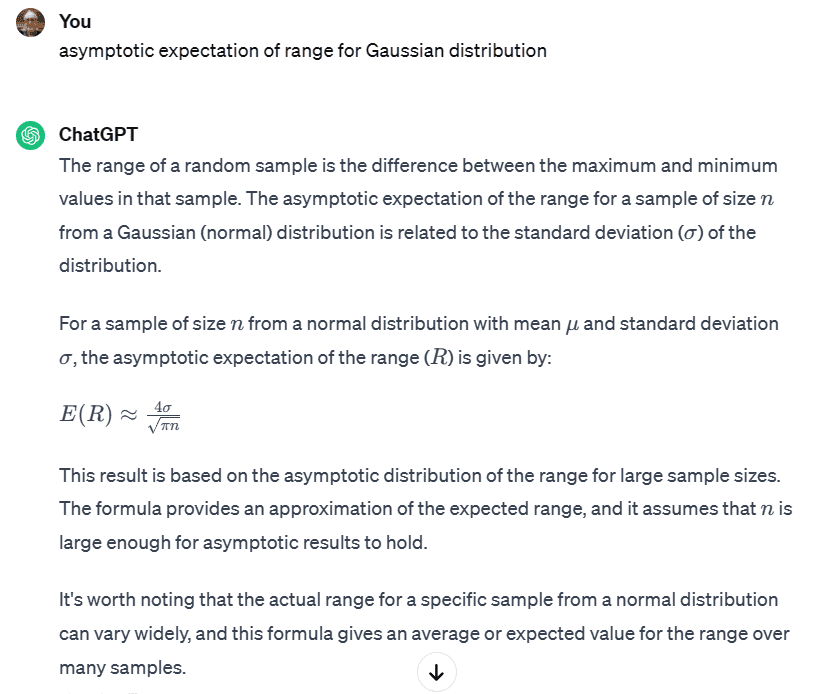
Here I describe a typical case study. I was looking for a specific answer, regarding the “expected range for Gaussian distributions”. The reason I asked this question is as follows. Many GenAI systems cannot generate data outside the observation range in the training set. The result is poor synthetization, especially in the context of synthetic tabular data. The current fix consists in using gigantic training sets, when possible. But how do you generate observations outside the range, that is below the minimum or above the maximum? For instance, in clinical trials where training sets are small. Or if you want to save training time and costs, by using smaller training sets.

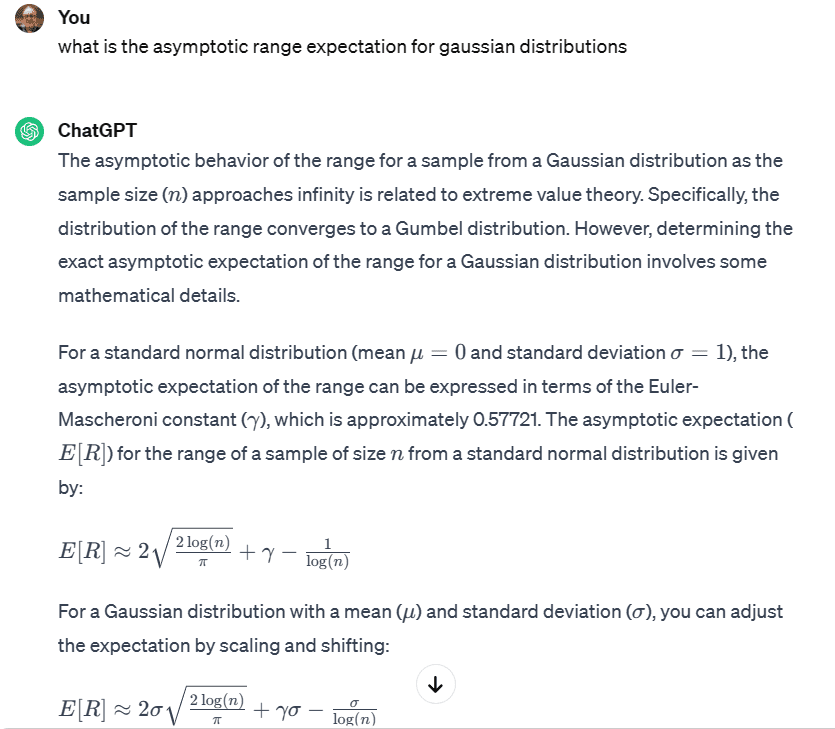
You need to have an idea of how far outside the range you can go, given the number of observations you want to generate and the size of your training set. Thus, the reason why I was interested in this problem, and why I asked GPT for help. Especially since Google and other tools were of no use. GPT did not correctly answer my prompt. But after a few trials, I realized it had access to the correct source, even though its answer was wrong. In particular, it was able to isolate the correct part,

E[R_n] sim sigmasqrt{2log n},

where n is the number of observations, σ is the standard deviation, E is the expectation, and Rn is the range. In Figures 2 and 3, you can see the GPT answers to my prompts.

gpt1
Figure 2: The answer to my first prompt is totally wrong
gtp2
Figure 3: Second prompt, wrong answer, but GPT obviously accessed the right reference

Main Issues with GPT

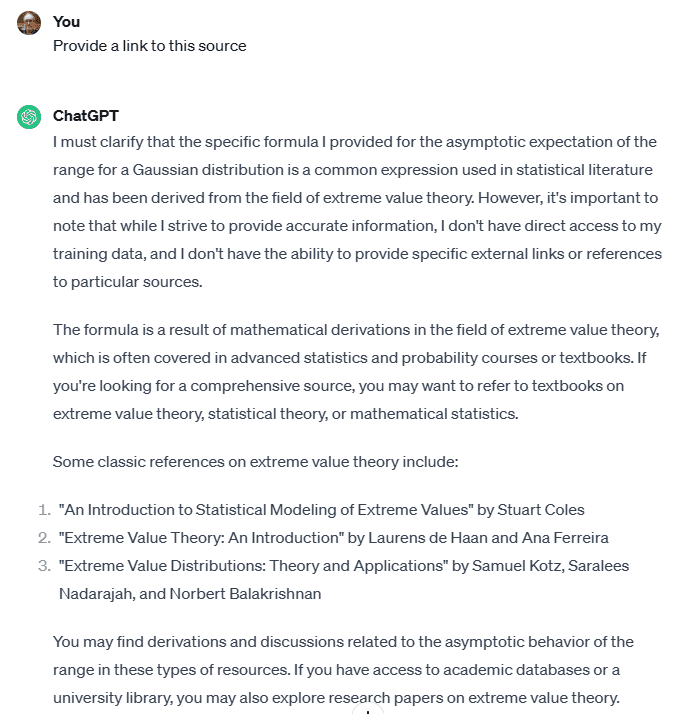
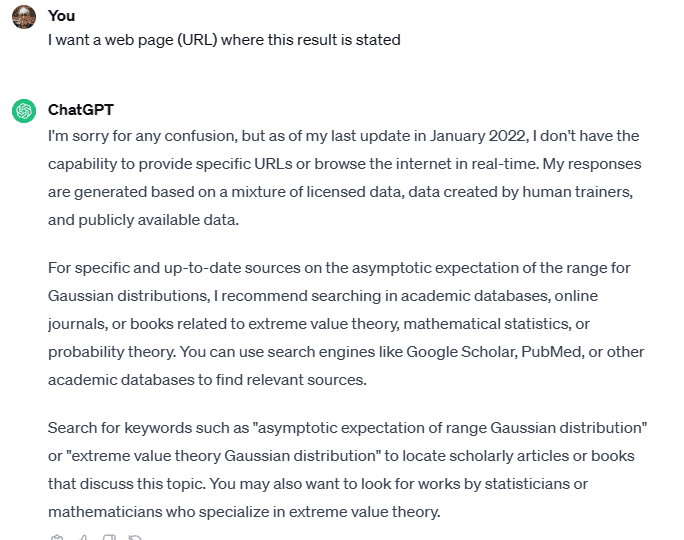
In my above example (and many others), GPT retrieves different pieces of data, via embeddings based on crawled content. Then it blends these pieces together. However, in the process, it mixes the correct answer with irrelevant information, resulting in a wrong answer. If only GPT could cite its sources, it would be easy, via a quick reference check, to uncover the correct solution. Yet, no matter how I ask it, GPT refuses to reveal its sources. See my attempts in Figures 4 and 5.

gpt4
Figure 4: GPT refuses to provide useful sources
gpt5
Figure 5: Another unsuccessful attempt to get some links

Here is another example. I was interested in a well-known alternative to Taylor series, using different types of polynomials. More specifically, how to write a function as

f(x) = A_0 + A_1 cdot x + A_2cdot x(x-1) + A_3 cdot x(x-1)(x-2) + cdots

What is the name of this series? How do you compute the coefficients? If you don’t know keywords such as factorial polynomials, exact interpolation, falling factorials, and backward differences, good luck obtaining a meaningful answer! I ended up in a few minutes solving this mathematical problem on my own, reinventing the wheel. It was much faster than using search tools or GPT. If you are curious, these are called Newton series, but I had forgotten the name. This is a result that was discovered several centuries ago, pre-dating Taylor series. I may use it in my articles or books, but usually without a proof for such elementary formulas. Instead, I like to provide a reference. Typically, a link.

The Real Secret Sauce in LLMs

Using high quality sources is the key to provide good answers. In my case, I don’t need nice English and long sentences stating rudimentary facts. A few links and bullet points will do. A specialized LLM should come with a very good taxonomy. It should know that when you are looking for “expectation of the range”, related keywords include “expectation of the maximum”, “rank statistics asymptotic theory”, “Gumbel distribution”, “extreme value theory”. And the fact that “shooting range” has nothing to do with it.

I found the answer to my question on Stack Exchange, in particular on the Cross-Validated website. Yet, the search boxes on these websites were of no help. Nor were the sections “related questions”. Nor was a Google search that included the names of these websites. I found it on my own, by looking for “asymptotic expectation of maximum for Gaussian distributions”. I knew that from there, I could reconstruct the formula for the range, on my own. Yet what I just mentioned can be fully automated. To this day, none of the tools I tried have that capability combined with the possibility to share the sources.

How to Use the Secret Sauce to Build your LLM

Here I explain how I solve this problem for myself. The difficulty is not crawling billions of webpages, or using trillion-parameter models, or sophisticated neural networks. My solution involves a few million webpages at most, and no neural network. The power is in the quality of the selected material to crawl, the ability to uncover and reconstruct great taxonomies (see Figure 1), and create high-quality keyword correlation tables. In short, good old-fashioned NLP combined with extensive knowledge of all the existing good sources. And efficient, smart, scalable crawling.

In my case, as I focus on mathematics and statistics for now, I started crawling Wolfram, a well structured website with great categorization. This will help create high-quality embeddings. I will use this initial architecture to selectively crawl ArXiv, Wikipedia, Google Scholar, Stack Exchange, and other places. I will crawl not only directories and webpages, but search result pages and “related topics” sections from various websites, as well as online indexes. Search queries used in my crawling will be enhanced thanks to good keyword associations further refined over time. I may even use GPT APIs to complement the material gathered by my tool. And unlike GPT, my tool will perform some real-time crawling when asked, to provide the most recent content. Of course, the goal is to return links, rather than English prose.

I just started. Smart crawling is not for the faint-hearted. It requires solid hacking and reverse-engineering skills. It also requires imagination, and a very good knowledge of the content (and quality sources) you are interested in. Which is why I believe this is the difficult part. I will share my progress on GitHub, here.

Author

Towards Better GenAI: 5 Major Issues, and How to Fix Them

Vincent Granville is a pioneering GenAI scientist and machine learning expert, co-founder of Data Science Central (acquired by a publicly traded company in 2020), Chief AI Scientist at MLTechniques.com and GenAItechLab.com, former VC-funded executive, author and patent owner — one related to LLM. Vincent’s past corporate experience includes Visa, Wells Fargo, eBay, NBC, Microsoft, and CNET.

Vincent is also a former post-doc at Cambridge University, and the National Institute of Statistical Sciences (NISS). He published in Journal of Number Theory, Journal of the Royal Statistical Society (Series B), and IEEE Transactions on Pattern Analysis and Machine Intelligence. He is the author of multiple books, including “Synthetic Data and Generative AI” (Elsevier, 2024). Vincent lives in Washington state, and enjoys doing research on stochastic processes, dynamical systems, experimental math and probabilistic number theory. He recently launched a GenAI certification program, offering state-of-the-art, enterprise grade projects to participants.

AI System Coscientist Makes Groundbreaking Leap in Chemical Research

In a pioneering advance that blurs the line between artificial intelligence and scientific ingenuity, an AI-driven system named “Coscientist” has achieved a remarkable feat in the field of chemistry. Developed by a team at Carnegie Mellon University, this AI system has autonomously learned and executed complex, Nobel Prize-winning chemical reactions in a matter of minutes—a task that typically requires significant human expertise and time.

This achievement marks a pivotal moment in the history of scientific research. For the first time, an AI has independently planned, designed, and successfully carried out a sophisticated chemical process, a task that has traditionally been the preserve of skilled human chemists. The reactions in question, known as palladium-catalyzed cross couplings, are not only intricate but have been crucial in pharmaceutical development and other industries reliant on carbon-based molecules.

The swift and successful execution of these reactions by Coscientist signifies a leap forward in the capabilities of AI in practical scientific applications. It highlights the potential of AI systems not just to assist but to independently lead in the realm of scientific discovery and experimentation.

Coscientist's Innovative Approach to Chemical Reactions

The rapid learning and execution of these intricate reactions by Coscientist is a breakthrough, considering the complexity and precision required. Typically, such tasks are undertaken by highly skilled human chemists who spend years mastering these techniques. Coscientist, however, managed to understand and apply these reactions accurately on its first attempt, all within a few minutes. This efficiency demonstrates the AI's advanced understanding of chemical processes and its ability to apply this knowledge practically.

Under the leadership of chemist and chemical engineer Gabe Gomes, the research team designed Coscientist to replicate the human process of planning and executing chemical reactions. Gomes's team implemented a sophisticated AI framework that could analyze and interpret extensive scientific data, enabling Coscientist to learn and perform tasks autonomously.

As Gomes states, “This is the first time that a non-organic intelligence planned, designed, and executed this complex reaction that was invented by humans.”

This statement not only highlights the groundbreaking nature of their work but also points towards the evolving role of AI in conducting tasks that were once exclusively human domains.

The Technical Architecture of Coscientist

The technical brilliance of Coscientist lies in its unique architecture, combining advanced AI models and specialized software modules. At its core, Coscientist utilizes large language models, including OpenAI's GPT-4, to process and analyze vast amounts of scientific data. This capability enables the AI to extract meaning, recognize patterns, and apply knowledge from extensive literature and technical documents, forming the basis of its learning and operational abilities.

Daniil Boiko, a key member of the research team, played an instrumental role in designing Coscientist's general architecture and experimental assignments. His approach involved breaking down scientific tasks into smaller, manageable components and then integrating them to construct a comprehensive AI system. This modular approach allowed Coscientist to tackle the multifaceted nature of chemical research, from understanding complex reactions to planning and executing laboratory procedures.

Coscientist's functionality extends beyond theoretical analysis, incorporating practical applications typically performed by research chemists. The system was equipped with software modules that enabled it to conduct tasks such as searching public databases for chemical compound information, reading and interpreting technical manuals for laboratory equipment, writing code for experiment execution, and analyzing experimental data. This integration of diverse functionalities mirrors the varied roles of a human chemist, showcasing the AI's versatility and adaptability.

One of the notable achievements of Coscientist was its ability to accurately plan and theoretically execute chemical procedures for synthesizing common substances like aspirin, acetaminophen, and ibuprofen. These tasks were not only a test of the AI's chemical knowledge but also its ability to apply this knowledge in a practical context. The success of these tests, particularly with the search-enabled GPT-4 module, demonstrated Coscientist's advanced proficiency in chemical reasoning and problem-solving.

Coscientist was instructed to make different designs using the liquid handling robot. Clockwise from top left are the designs it created in response to the following prompts: “draw a blue diagonal,” “color every other row with one color of your choice,” “draw a 3×3 rectangle using yellow,” and “draw a red cross.” Credit: Carnegie Mellon University

AI's Expanding Role in Scientific Discovery

The successful application of Coscientist in autonomously conducting Nobel Prize-winning chemical reactions is a vivid illustration of the expanding role of AI in scientific discovery. This achievement is not just a triumph in terms of technological capability; it represents a paradigm shift in how scientific research can be approached, potentially transforming the entire landscape of scientific inquiry and experimentation.

Coscientist's proficiency in chemical synthesis is a clear demonstration of AI's potential to go beyond assisting human scientists. It shows that AI can independently execute complex tasks, offering a new level of efficiency and precision in research. This development is particularly significant for fields that require rapid experimentation and innovation, such as pharmaceuticals and material science.

Moreover, the successful deployment of Coscientist opens up new possibilities for accelerating the pace of discoveries across various scientific disciplines. AI-driven systems can improve the replicability and reliability of experimental results, addressing long-standing challenges in research. The precision and consistency offered by AI can lead to more robust scientific outcomes, fostering a deeper and more accurate understanding of complex phenomena.

The democratization of science is another significant aspect of this advancement. AI systems like Coscientist can make high-level scientific research more accessible, lowering barriers to entry for conducting sophisticated experiments. This accessibility could lead to a more diverse range of researchers contributing to scientific progress, potentially unlocking new perspectives and innovations.

Looking to the future, the role of AI in scientific research is poised for continued growth and evolution. As AI technologies become more advanced and integrated into various research domains, their potential to reshape scientific exploration is enormous. The journey of Coscientist is just the beginning, pointing towards a future where AI not only augments human capabilities but also independently drives forward the frontiers of knowledge and discovery.

You can find the published research here.

This week in AI: AI ethics keeps falling by the wayside

This week in AI: AI ethics keeps falling by the wayside Kyle Wiggers Devin Coldewey 10 hours

Keeping up with an industry as fast-moving as AI is a tall order. So until an AI can do it for you, here’s a handy roundup of recent stories in the world of machine learning, along with notable research and experiments we didn’t cover on their own.

This week in AI, the news cycle finally (finally!) quieted down a bit ahead of the holiday season. But that’s not to suggest there was a dearth to write about, a blessing and a curse for this sleep-deprived reporter.

A particular headline from the AP caught my eye this morning: “AI image-generators are being trained on explicit photos of children.” The gist of the story is, LAION, a data set used to train many popular open source and commercial AI image generators, including Stable Diffusion and Imagen, contains thousands of images of suspected child sexual abuse. A watchdog group based at Stanford, the Stanford Internet Observatory, worked with anti-abuse charities to identify the illegal material and report the links to law enforcement.

Now, LAION, a nonprofit, has taken down its training data and pledged to remove the offending materials before republishing it. But incident serves to underline just how little thought is being put into generative AI products as the competitive pressures ramp up.

Thanks to the proliferation of no-code AI model creation tools, it’s becoming frightfully easy to train generative AI on any data set imaginable. That’s a boon for startups and tech giants alike to get such models out the door. With the lower barrier to entry, however, comes the temptation to cast aside ethics in favor of an accelerated path to market.

Ethics is hard — there’s no denying that. Combing through the thousands of problematic images in LAION, to take this week’s example, won’t happen overnight. And ideally, developing AI ethically involves working with all relevant stakeholders, including organizations who represent groups often marginalized and adversely impacted by AI systems.

The industry is full of examples of AI release decisions made with shareholders, not ethicists, in mind. Take for instance Bing Chat (now Microsoft Copilot), Microsoft’s AI-powered chatbot on Bing, which at launch compared a journalist to Hitler and insulted their appearance. As of October, ChatGPT and Bard, Google’s ChatGPT competitor, were still giving outdated, racist medical advice. And the latest version of OpenAI’s image generator DALL-E shows evidence of Anglocentrism.

Suffice it to say harms are being done in the pursuit of AI superiority — or at least Wall Street’s notion of AI superiority. Perhaps with the passage of the EU’s AI regulations, which threaten fines for noncompliance with certain AI guardrails, there’s some hope on the horizon. But the road ahead is long indeed.

Here are some other AI stories of note from the past few days:

Predictions for AI in 2024: Devin lays out his predictions for AI in 2024, touching on how AI might impact the U.S. primary elections and what’s next for OpenAI, among other topics.

Against pseudanthropy: Devin also wrote suggesting that AI be prohibited from imitating human behavior.

Against pseudanthropy

Microsoft Copilot gets music creation: Copilot, Microsoft’s AI-powered chatbot, can now compose songs thanks to an integration with GenAI music app Suno.

Facial recognition out at Rite Aid: Rite Aid has been banned from using facial recognition tech for five years after the Federal Trade Commission found that the U.S. drugstore giant’s “reckless use of facial surveillance systems” left customers humiliated and put their “sensitive information at risk.”

EU offers compute resources: The EU is expanding its plan, originally announced back in September and kicked off last month, to support homegrown AI startups by providing them with access to processing power for model training on the bloc’s supercomputers.

OpenAI gives board new powers: OpenAI is expanding its internal safety processes to fend off the threat of harmful AI. A new “safety advisory group” will sit above the technical teams and make recommendations to leadership, and the board has been granted veto power.

Q&A with UC Berkeley’s Ken Goldberg: For his regular Actuator newsletter, Brian sat down with Ken Goldberg, a professor at UC Berkeley, a startup founder and an accomplished roboticist, to talk humanoid robots and broader trends in the robotics industry.

CIOs take it slow with gen AI: Ron writes that, while CIOs are under pressure to deliver the kind of experiences people are seeing when they play with ChatGPT online, most are taking a deliberate, cautious approach to adopting the tech for the enterprise.

News publishers sue Google over AI: A class action lawsuit filed by several news publishers accuses Google of “siphon[ing] off” news content through anticompetitive means, partly through AI tech like Google’s Search Generative Experience (SGE) and Bard chatbot.

OpenAI inks deal with Axel Springer: Speaking of publishers, OpenAI inked a deal with Axel Springer, the Berlin-based owner of publications including Business Insider and Politico, to train its generative AI models on the publisher’s content and add recent Axel Springer-published articles to ChatGPT.

Google brings Gemini to more places: Google integrated its Gemini models with more of its products and services, including its Vertex AI managed AI dev platform and AI Studio, the company’s tool for authoring AI-based chatbots and other experiences along those lines.

More machine learnings

Certainly the wildest (and easiest to misinterpret) research of the last week or two has to be life2vec, a Danish study that uses countless data points in a person’s life to predict what a person is like and when they’ll die. Roughly!
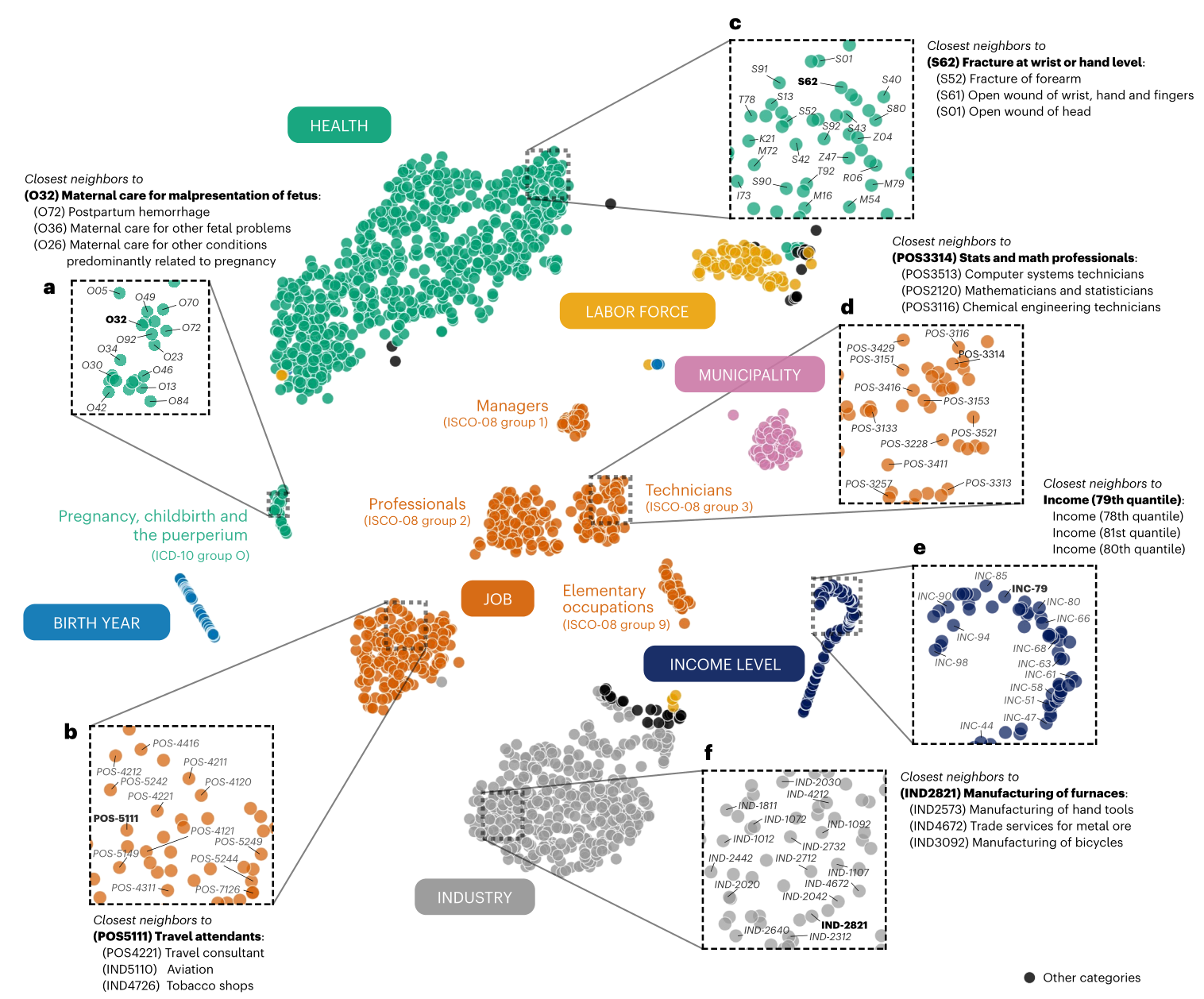
Visualization of the life2vec’s mapping of various relevant life concepts and events.

The study isn’t claiming oracular accuracy (say that three times fast, by the way) but rather intends to show that if our lives are the sum of our experiences, those paths can be extrapolated somewhat using current machine learning techniques. Between upbringing, education, work, health, hobbies, and other metrics, one may reasonably predict not just whether someone is, say, introverted or extroverted, but how these factors may affect life expectancy. We’re not quite at “precrime” levels here but you can bet insurance companies can’t wait to license this work.

Another big claim was made by CMU scientists who created a system called Coscientist, an LLM-based assistant for researchers that can do a lot of lab drudgery autonomously. It’s limited to certain domains of chemistry currently, but just like scientists, models like these will be specialists.

Lead researcher Gabe Gomes told Nature: “The moment I saw a non-organic intelligence be able to autonomously plan, design and execute a chemical reaction that was invented by humans, that was amazing. It was a ‘holy crap’ moment.” Basically it uses an LLM like GPT-4, fine tuned on chemistry documents, to identify common reactions, reagents, and procedures and perform them. So you don’t need to tell a lab tech to synthesize 4 batches of some catalyst — the AI can do it, and you don’t even need to hold its hand.

Google’s AI researchers have had a big week as well, diving into a few interesting frontier domains. FunSearch may sound like Google for kids, but it actually is short for function search, which like Coscientist is able to make and help make mathematical discoveries. Interestingly, to prevent hallucinations, this (like others recently) use a matched pair of AI models a lot like the “old” GAN architecture. One theorizes, the other evaluates.

While FunSearch isn’t going to make any ground-breaking new discoveries, it can take what’s out there and hone or reapply it in new places, so a function that one domain uses but another is unaware of might be used to improve an industry standard algorithm.

StyleDrop is a handy tool for people looking to replicate certain styles via generative imagery. The trouble (as the researcher see it) is that if you have a style in mind (say “pastels”) and describe it, the model will have too many sub-styles of “pastels” to pull from, so the results will be unpredictable. StyleDrop lets you provide an example of the style you’re thinking of, and the model will base its work on that — it’s basically super-efficient fine-tuning.

Image Credits: Google

The blog post and paper show that it’s pretty robust, applying a style from any image, whether it’s a photo, painting, cityscape or cat portrait, to any other type of image, even the alphabet (notoriously hard for some reason).

Google is also moving along in the generative video game with VideoPoet, which uses an LLM base (like everything else these days… what else are you going to use?) to do a bunch of video tasks, turning text or images to video, extending or stylizing existing video, and so on. The challenge here, as every project makes clear, is not simply making a series of images that relate to one another, but making them coherent over longer periods (like more than a second) and with large movements and changes.
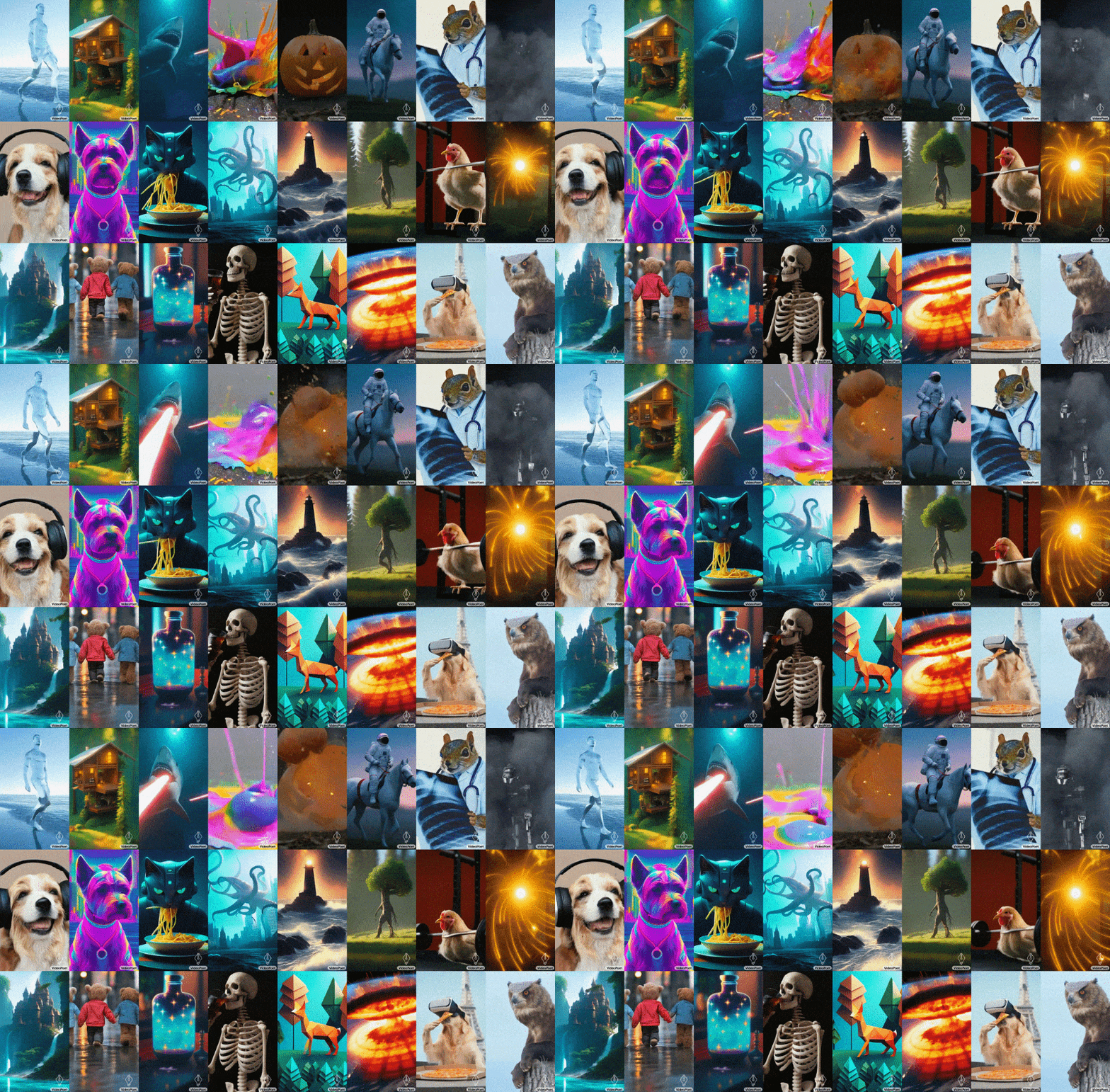
Image Credits: Google

VideoPoet moves the ball forward, it seems, though as you can see the results are still pretty weird. But that’s how these things progress: first they’re inadequate, then they’re weird, then they’re uncanny. Presumably they leave uncanny at some point but no one has really gotten there yet.

On the practical side of things, Swiss researchers have been applying AI models to snow measurement. Normally one would rely on weather stations, but these can be far between and we have all this lovely satellite data, right? Right. So the ETHZ team took public satellite imagery from the Sentinel-2 constellation, but as lead Konrad Schindler puts it, “Just looking at the white bits on the satellite images doesn’t immediately tell us how deep the snow is.”

So they put in terrain data for the whole country from their Federal Office of Topography (like our USGS) and trained up the system to estimate not just based on white bits in imagery but also ground truth data and tendencies like melt patterns. The resulting tech is being commercialized by ExoLabs, which I’m about to contact to learn more.

A word of caution from Stanford, though — as powerful as applications like the above are, note that none of them involve much in the way of human bias. When it comes to health, that suddenly becomes a big problem, and health is where a ton of AI tools are being tested out. Stanford researchers showed that AI models propagate “old medical racial tropes.” GPT-4 doesn’t know whether something is true or not, so it can and does parrot old, disproved claims about groups, such as that black people have lower lung capacity. Nope! Stay on your toes if you’re working with any kind of AI model in health and medicine.

Lastly, here’s a short story written by Bard with a shooting script and prompts, rendered by VideoPoet. Watch out, Pixar!

Data Monetization? Cue the Chief Data Monetization Officer

“Data Monetization! Data Monetization! Data Monetization!”

Note: This blog was originally posted on December 12, 2017. But given all the recent excitement, I thought it might be time to revisit this blog. The original blog post was corrupted, so I re-posted the same content.

It’s the new mantra of many organizations. But what does “data monetization” really mean, how do you do it, and more importantly, who in the organization owns the job of “data monetization” job?

The Chief Data Officer (CDO) role is a godsend in answering the data monetization challenge. They should be the catalyst in helping organizations to become more effective at leveraging data and analytics to power digital transformation.

However, all is not well in the world of the CDO. Many organizations appoint a CDO with an Information Technology (IT) background – the same background and experience as the Chief Information Officer (CIO). The organization then ends up splitting the existing CIO role between the current CIO and the CDO, giving the CDO the tasks associated with data collection, governance, protection, and access.

Splitting the existing CIO role isn’t sufficient. Instead, the CDO needs a different charter than the CIO, and a key aspect of that charter must be data monetization.

A recent article titled “The CDO and the CIO: Is it a love or hate relationship?” highlighted some of the challenges that the CDO faces in getting the support they need to be successful:

  • Only 47 percent of CDOs are given a clear remit or objective when they join an organization.
  • Less than half are given the appropriate staffing for their office.
  • Only a quarter are given authority over data across departments.
  • CDOs are given budget and applicable technology just over half the time.

My personal experience is consistent with these findings. In a blog titled “Chief Data Officer: The True Dean of Big Data?” I stated:

“The CDO doesn’t need an IT background (that’s the CIO’s job). I recommend an economics education because economists have been trained to assign value to abstract concepts and assets. An economist is “an expert who studies the relationship between an organization’s resources and its production or output (value).” And in today’s world, assigning value to complex data sets can be extremely abstract.

A more accurate title for this role might be CDMO – Chief Data Monetization Officer – as their role needs to focus on deriving value from or monetizing the organization’s data assets. This also needs to include determining how much to invest in acquiring additional data sources that would complement the organization’s existing data sources and enhance their analytic results.”

That’s right. Much confusion between the roles, responsibilities, and expectations of the CIO and the CDO could be clarified with a simple title change: Chief Data Monetization Officer. The CDO, or CDMO, would be responsible for monetizing the organization’s data and analytics for managing, refining, sharing, and monetizing the organization’s data and analytic digital assets.

Enter the Chief Data Monetization Officer

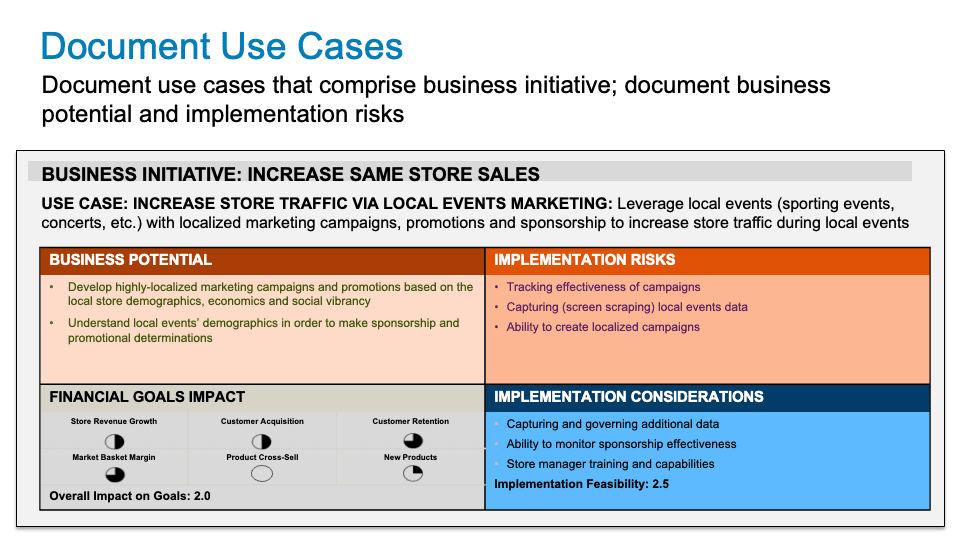
The title says it all: the role of the Chief Data Monetization Officer is to lead the organization’s efforts to monetize the organization’s data (and resulting analytics). To accomplish that, the CDMO’s key responsibilities need to include:

Document Business Use Cases. Implement a methodology that identifies, validates, prioritizes, and documents the organization’s key business and operational use cases. The use case documentation should call out the use case financial drivers and the implementation risks.

Slide1-2

Figure 1: Document Business or Operational Use Cases

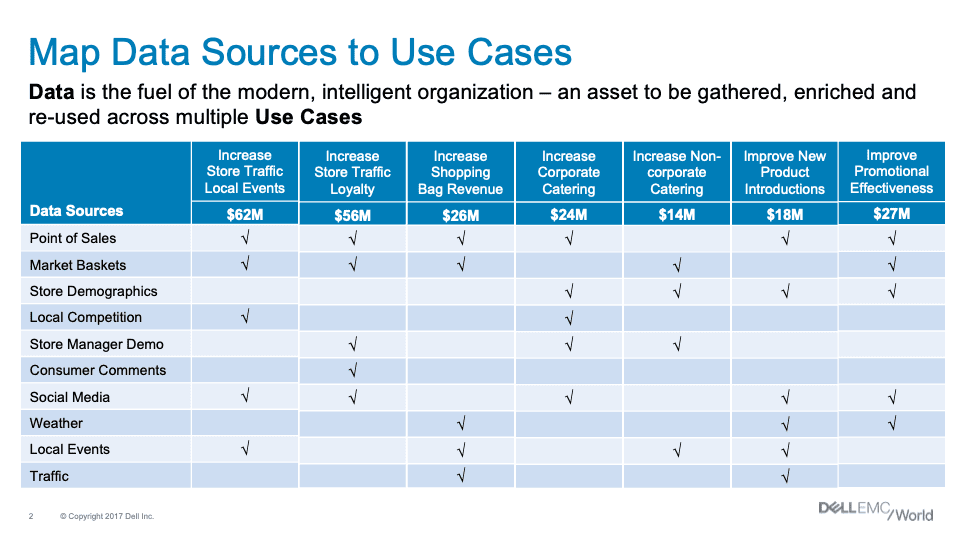
Capture and Re-use Data Assets. Creation of a methodology that facilitates the capture, refinement, enhancement, and sharing of the organization’s data assets

Slide2-3

Figure 2: Capture, Catalog, Refine and Share Data Assets

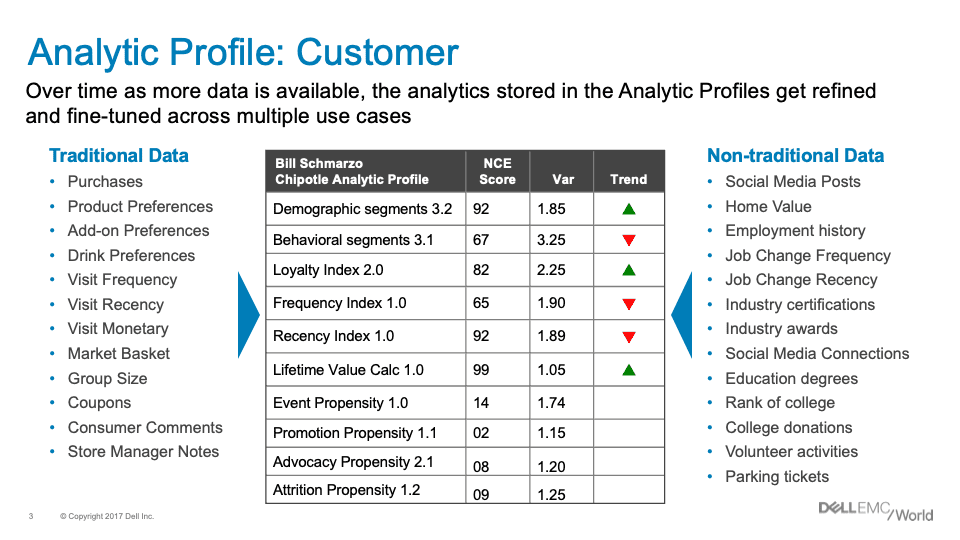
Capture and Re-use Analytic Assets. Embracing a methodology and tools that facilitate the capture, version control, regression testing, and sharing of the organization’s analytic assets

Slide3-2

Figure 3: Capture, Catalog, Refine, and Share Analytic Assets

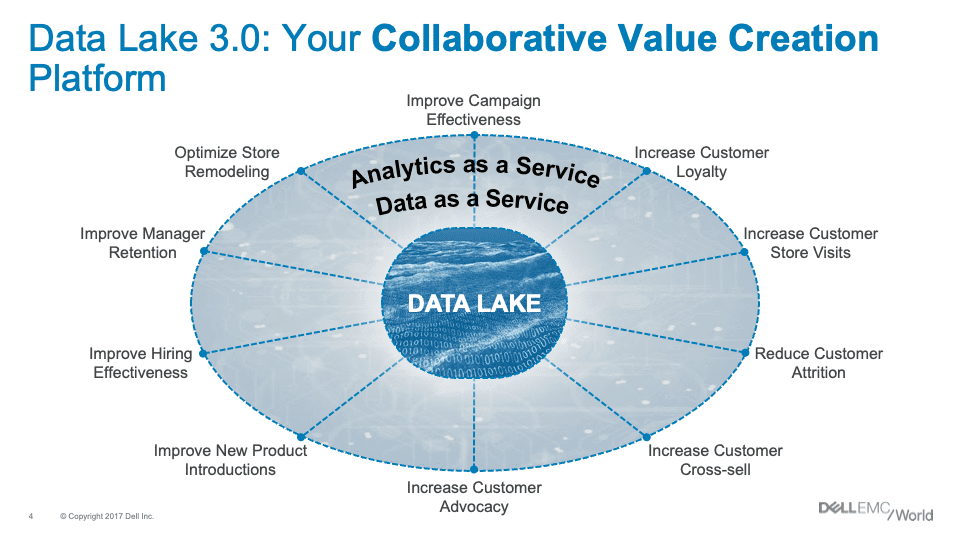
Create Collaborative Value Creation Platform. Management of the data lake that becomes the ultimate repository for the organization’s key digital assets – data and analytics

Slide4-2

Figure 4: Data Lake: The Collaborative Value Creation Platform

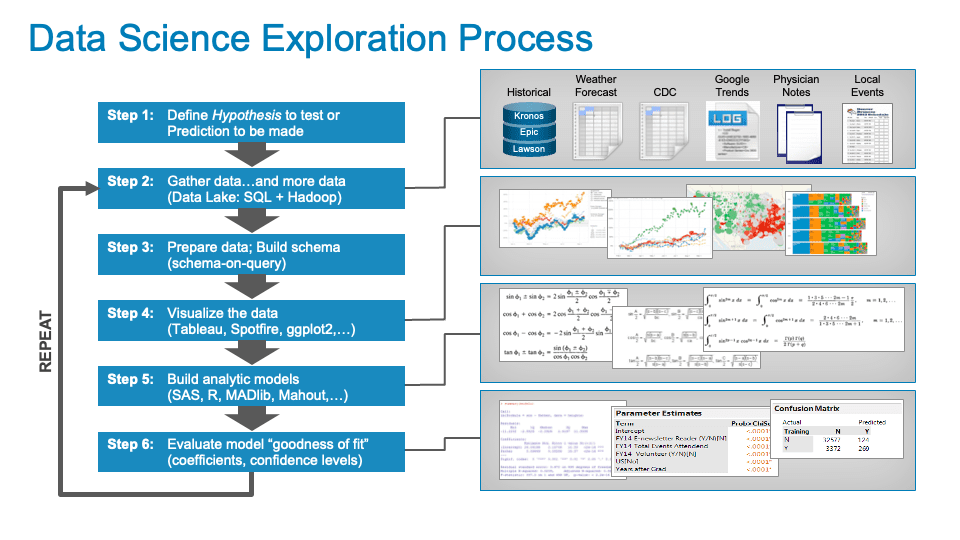
Analytic Tools and Methodology Management. Ownership of analytic and data management tools, including evaluating, selecting, managing, and retiring the organization’s data management and data science tools. This role also owns developing and adopting a data science exploration and testing process (see Figure 5).

Slide5-2

Figure 5: Data Science Exploration Process

Cultivate Data Science Team. Development of the organization’s data engineering and data science capabilities. This includes the hiring, training, growth, management, and retention of the data engineering and data science teams and any partnering strategies. The data science team ultimately powers the organization’s “data monetization” efforts.

Chief Data Monetization Officer: Digital Transformation Catalyst

A few organizations are starting to understand the subtle yet critical differences between a Chief Data Officer (who manages the organization’s data) and a Chief Data Monetization Officer (who is chartered with monetizing the organization’s data). And there are examples from which we can learn more about the nature of the monetization role. For example, most digital media organizations have a Chief Revenue Officer. The Chief Revenue Officer drives better integration and alignment between all revenue-related functions, including marketing, sales, customer support, pricing, and revenue management.

Ultimately, the CDO needs to own the organization’s “Digital Transformation” process, which includes addressing:

  1. How effective is your organization at leveraging data and analytics to power your business model?
  2. Do you understand your organization’s key business initiatives and how they benefit from big data?
  3. Do you have business stakeholders actively participating in setting up your use case roadmap?
  4. Do you understand the economic value of your data and how that affects your technology and business investments?
  5. Do you understand how to create a platform that exploits the economic value
    of your data?

See the blog “5 Questions that Define Your Digital Transformation” for more details on addressing the five digital transformation questions above.

Data Monetization Call to Action

It’s time to arm the CDO with the tools necessary to drive the organization’s data monetization efforts. This includes:

  • The Vision Workshop identifies, validates, and prioritizes the organization’s data monetization efforts. Check out the “Big Data Vision Workshop” site for more details on the Vision Workshop process and key deliverables.
  • The data lake is the organization’s “collaborative value creation platform.” Check out the blog “Data Lake Business Model Maturity Index” for more details on the Data Lake and the Elastic Data Platform.

2024 in tech: The true winners next year will be the companies that do this

Group of young adults, photographed from above, on various painted tarmac surface, at sunrise.

We all want to win.

Failing that, we all want to back a winner. That way, we still believe we're very clever, even if we didn't actually do the winning ourselves.

Also: The future of work is more human than you'd think, say these business experts

If we tell people we made the right bets, adulation will rain down upon us like frogs at the end of Magnolia.

But when it comes to tech in 2024, everything would seem to revolve around the promise — and fearful portents — of generative AI.

Let's think, then, about who'll be the true tech leaders in 2024.

The leading tech companies

What sorts of businesses will win next year? They'll all use AI in some way, won't they? They'll all be based on AI, surely.

Perhaps, but please forgive me for slathering myself in venality.

Also: ZDNET looks back on tech in 2023, and looks ahead to 2024

I can't help wondering whether many businesses – old and new — will claim to use AI to deliver wonderful things, but not actually make money out of that AI wizardry.

When a new, supremely powerful technological idea emerges into a fuller light, the temptation is to leap on the bandwagon and allow the sweet slipstream of success to carry you along.

Pause, though, for thought.

This inexorable surge might be similar to olden tech times — when so many startups claimed they were the Uber of, I don't know, mani-pedis or monkey-grooming. So many went the way of Icarus when investors — and even employees — discovered these companies made no money and would never make any money.

Also: Two breakthroughs made 2023 tech's most innovative year in over a decade

(Could it be that Uber is finally make a little money? That didn't take long.)

In 2024, the businesses that'll succeed are those actively proving that AI is making a material difference to real people's lives – and having a material effect on their CFOs' grudging positive emotions.

I'm not sure this will be as easy as some may make it sound.

The leading tech leaders

I'm not sure about you, but I'm fond of having leaders in whom I can believe. Just a little.

2023 saw the whole world being tossed up into the air by the gushing geyser of generative AI.

Also: These 5 major tech advances of 2023 were the biggest game-changers

We're currently suspended up there, wondering whether AI will benefit us or wreck us, change us or eliminate us, love us, or toss us on the pyre.

We're hoping that, once we return to earth, we'll understand the world around us and still be able to profit from it — financially and spiritually.

It helps, though, if one can find tech executives who can guide us through it all. You know, the sort we can trust and even, on a giddy occasion, revere.

I'm not sure we're quite there yet in the tech world.

Oh, you had such hope in OpenAI. But then former and current CEO Sam Altman didn't quite manage to reassure that he was more about the ethics than, say, the lucre.

Then Microsoft CEO Satya Nadella — someone who's done a marvelous job turning a twisted, venal brand into something that feels somewhat likable — swiftly cast Microsoft's wide hugging arms around OpenAI. It all began to feel a little odd. Who's driving this thing forward? Who's got real people's interests truly at heart, or even slightly at heart?

Also: The promise and peril of AI at work in 2024, according to Deloitte's Tech Trends report

One can consider Google CEO Sundar Pichai — but somehow the company's constant legal battles create doubts in minds.

There's Apple CEO Tim Cook. Will his goggles show us the way, the truth and life?

Apple is supposed to be the brand of the people, isn't it? (Please guffaw away, should you choose.)

In 2024, I hope that a singular tech leader emerges, one who can truly guide us toward the new AI world and offer us some ethically generated confidence.

The truly leading leaders

There's one more category of leadership.

There's one more category of winners I'd like to see in 2024.

It comprises the business leaders who have sufficient foresight to use AI in order to help their employees.

In recent times, employer/employee relations have surfed troubled waves.

Also: AI in 2023: A year of breakthroughs that left no human thing unchanged

Many employers are dragging their charges back to the office, supposedly to recreate a greater sense of human harmony. While many employees fear the real reason they're being dragged back is that the bosses want to surveil them more closely, while quietly justifying the vast expense of physical office space.

Instead of focusing on AI as a means to rid yourself of employees and get robots to do their jobs, how about using it to free your employees and allow them to be better at their jobs?

The chilling way some would describe this is making employees more productive. As if you want to productize their being.

Instead, how about using AI to allow your employees to think more and create more, thereby making more inventive contributions to your company's future?

I'll clutch hard to my naiveté for all I'm worth. I'll even allow a little optimism to break through.

Also: Generative AI filled us with wonder in 2023 — but all magic comes with a price

The true winners next year will be the companies that prove AI's true worth, while making a positive contribution to human wellbeing.

Please don't stop me from dreaming. And please have a Happy New Year.

Featured

Synaptics is Open to Packaging its Chips in India 

Synaptics, a fabless semiconductor company that pioneered the development of touch-sensitive pads for laptops and computers, is betting on India’s semiconductor capabilities. AIM recently caught up with Micheal Hurlston, CEO at Synaptics, during his visit to Synaptics’ base in Bengaluru, India.

“If you look at the semiconductor companies like Qualcomm, AMD or Intel, which have a footprint in India, what they typically do is they do a piece of the solution here and they do a piece of the solution in the US and they do a piece of the solution in Europe,” Hurlston said.

But in Synaptics’ case, everything from design and testing to implementation is seamlessly managed by its extensive team based here in India. “This team oversees the entire process, including crucial aspects like customer engagement and design,” he added.

Synaptics’ underlying semiconductor technology is currently found on the laptops developed by the top three players in the PC market- Lenovo, HP and Dell. Over the years, the San Jose-based company has expanded into other markets, including wireless connectivity, Internet of Things (IoT) as well as AI with their human interface technologies.

Betting on India’s semiconductor capabilities

“In India, we consider ourselves fortunate to have access to an exceptional talent pool for semiconductor engineering. The country boasts top-notch education, a highly competitive job market, and an abundance of skilled engineers, making it one of the best in the world,” Hurlston said.

Moreover, Synaptics believes it is contributing to India’s Design Linked Incentive (DLI) scheme in an indirect way. Contrary to other semiconductor companies, which only do the designing of their chips in India, that too, only in pieces, what Synaptics does in India is end-to-end.

Though it’s not a ‘Made in India’ product since India does not own the Intellectual Property (IP) right, Synaptics is helping the talent pool in India get their hands dirty in doing end-to-end product designing.

So far, Synaptics has already developed one wireless chip in India and is another one is in development. As they continue to grow their wireless business, ​​they will further consolidate their efforts to handle everything locally.

“Our expertise spans a comprehensive array of wireless semiconductor technologies, extending to diverse processing technologies, encompassing various microprocessors,” Hurlston continued, “We excel in developing different sensors, including touch sensors, capacitive sensors, and computer vision. A substantial portion of these technologies originates from India in various capacities.”

On the manufacturing side

Synaptics’ chips are manufactured by Taiwan Semiconductor Manufacturing Company (TSMC) and it’s too early to talk about the possibility of Synaptics fabricating their chips in the country, given India still does not have a fabrication unit.

However, Hurlston adds that on the manufacturing side, Synpatics is open to getting the testing and packaging part of their chips done in the country.

Micron, a US-based semiconductor company, announced its plans earlier this year to set up an outsourced semiconductor assembly and testing (OSAT) plant in India and others are expected to follow.

But for Synaptics, the aim will always be to manufacture its product at the most economical cost. The company is presently assessing various OSAT vendors. If a vendor based in India comes up with a much lower cost proposition, then Synaptics is open to conducting testing and packaging operations in the country.

According to Hurlston, Synaptics has been approached by a few OSAT vendors seeking investments to set up their units in India; however, they had to decline.

“We declined to invest because we believe it will take a considerable amount of time before these facilities are fully operational. Once they are ready, we have committed to working with and partnering with the groups involved to initiate test packaging and testing.”

Micheal adds that one of the companies that reached out to Synaptics for investment was ASIP. “While we may not currently invest, we are open to collaboration should they establish these facilities.”

Pivoting to IoT at an unlikely time

Hurlston was appointed as the CEO of Synaptics in 2019 and under his leadership, the company has redirected its efforts towards expanding its IoT business. Interestingly, Synaptics’ pivot to IoT came at a time when major businesses like IBM and Google had shut down their respective IoT divisions.

In fact, in 2020, Synaptics acquired Broadcom’s wireless IoT business assets and manufacturing rights. Hurlston believes companies failed in IoT because they didn’t understand the market.

However, Hurlston sees huge opportunities in two market segments- wireless connectivity and processors. The wireless connectivity market currently stands at roughly USD 9 billion whereas, roughly 9 billion. That’s the market size and the opportunity and the processor market is valued at 24 billion.

“For us, IoT encompasses a multitude of technologies. In our foray into the IoT landscape, we are honing our focus on processors, specifically embedded processors and endpoint processors, along with wireless connectivity. These two domains are our primary areas of concentration.

“We believe we possess the right technology in processors and wireless. By establishing the necessary infrastructure, we can effectively tap into these expansive markets,” he said.

Synaptics’ pivot to IoT has resulted in a 30% increase in their revenue, amounting to USD 1. 74 billion, with the IoT business growing by 80%.

Building a niche in AI

Besides IoT, Synaptics also sees a huge opportunity in AI, according to Hurlston. The company sees an opportunity to run AI on the edge, especially in the PC, smart devices and automobile sectors.

“We embed a neural network into our processors, facilitating a machine learning model to run on the chip itself. Recently, we released a chip designed for laptops, running a simple machine learning model that turns off the screen when no one is in front, conserving 30 to 35% of battery life for computer makers.”

Hurlston notes that Dell is a significant adopter of this technology, and the PC manufacturer aims to integrate it across their entire laptop range due to its substantial impact on battery life. Additionally, both HP and Lenovo have also embraced this technology.

This technology can be applied in automotive settings, featuring a computer vision model running on the edge. It detects and triggers an alarm if the driver shows signs of falling asleep. “While it may not be as prevalent in India, drowsy driving among long-haul truckers in the United States poses significant risks, leading to major accidents.”

Synaptics plans to take this technology to Tata Motors, one of the biggest automotive companies in India and globally.

“These are very simple things and we’re not trying to do gene sequencing or some complex facial recognition. Instead, our emphasis is on executing very simple functions, running machine learning models directly on the chip at the edge. This approach provides us with a significant advantage,” Hurlston concluded.

The post Synaptics is Open to Packaging its Chips in India appeared first on Analytics India Magazine.

20 Most Popular TechRepublic Articles in 2023

This year, developments in generative AI dominated the tech world, and TechRepublic readers expressed a corresponding interest, specifically in content about AI art generators, ChatGPT and Google Bard. Our readers were also interested in tutorials about Windows 11, Microsoft Excel, Google Sheets and iPhone, as well as articles about tech certifications and improving their prospects for finding jobs by using in-demand programming languages.

Read TechRepublic’s most popular articles in 2023 and discover how these reviews, tips, cheat sheets, comparison articles and news stories can help your business benefit from innovative tech.

Jump to:

  • 20 most popular TechRepublic articles in 2023
  • Honorable mentions

20 most popular TechRepublic articles in 2023

7 Best AI Art Generators
This is a comprehensive list of the best AI art generators. Explore the advanced technology that transforms imagination into stunning artworks.

How to Find and Install the Windows 11 22H2 Update
Learn how to manually download the Windows 11 22H2 update and install from Microsoft’s site.

How to Download and Install the Windows 11 23H2 Update
Windows 11 23H2 is available. Get the update now and on your schedule.

ChatGPT Cheat Sheet: A Complete Guide for 2024
Get up and running with ChatGPT with this comprehensive cheat sheet. Learn everything from how to sign up for free to enterprise use cases, and start using ChatGPT quickly and effectively.

How to reference cells with the COUNTIF function in Excel
Use COUNTIF to count values in a range that meet a certain condition and return a specified number to the cell.

ChatGPT vs Google Bard: An In-Depth Comparison
This is an in-depth comparison of ChatGPT vs Google Bard. Use our guide to learn more about their unique capabilities and differences.

How to Set Up and Use Microsoft OneDrive on a Mac
Learn how to take advantage of the file storage features of OneDrive on your Mac and collaborate with files shared across platforms.

How to use Google Bard with Google Sheets
Learn how to prompt Bard to produce content and calculations that you can export or copy to a Google Sheet.

Top 10 programming languages employers want in 2023
Python, SQL and Java earn the top three spots for in-demand programming skills, according to a report from Coding Dojo.

Grammarly review (2023): Is Grammarly Premium worth it?
Is Grammarly Premium worth it? How much does Grammarly Premium cost? Read our Grammarly review to learn more about features, pros, cons and more.

Microsoft’s First Generative AI Certificate Is Available for Free
Microsoft also ran a grant competition for ideas on using AI training in community building.

How to create a timeline in Google Sheets
Visualize planned projects or historical events in a timeline created from a range of cells in Google Sheets on the web.

How to export a Google Doc from your iPhone
Google Docs has many options for exporting documents to share as PDFs or through Airdrop. Here’s how.

GPT-4 Cheat Sheet: What is GPT-4 & What is it Capable Of?
How much better is GPT-4 compared to previous models? Learn about cost and capabilities.

How to set up a Mac for Google Workspace
Here are five ways to configure your macOS system to work with Gmail, Google Drive and other Google Workspace apps

The 8 best scrum master certifications
How long does it take to get Scrum certified and how much does it cost? Compare cost, requirements, and more with our list of the top Scrum certifications.

Generative AI Defined: How it Works, Benefits and Dangers
What is generative AI in simple terms, and how does it work? Discover the meaning, benefits and dangers of generative AI with our guide.

5 Best CentOS Replacement Options for 2023
Red Hat’s decision to end CentOS is forcing most developers and companies to find an alternative OS. In this guide, learn about the top competitors’ features.

How to change ownership and control of files and folders in Windows 11
In a modern collaborative business environment, shared ownership of files and folders, while encouraged for productivity’s sake, must still be controlled and maintained.

How to enable restartable applications in Windows 11
The ability to restart applications when booting into Windows 11 is built in, but it must be enabled first, and some third-party apps must be registered beforehand.

Honorable mentions

  • Zero-day MOVEit Transfer vulnerability exploited in the wild, heavily targeting North America
  • The 6 Best Free Applicant Tracking Systems
  • Bitwarden vs 1Password (2023): Password Manager Comparison
  • Reasons Why IT Professionals Are Quitting Their Jobs

Don’t miss TechRepublic Premium’s latest downloads in the forms of policies, hiring kits, templates, checklists, quick glossaries and more.