This week in AI: Microsoft’s sticks an AI ad on keyboards

This week in AI: Microsoft’s sticks an AI ad on keyboards Kyle Wiggers Devin Coldewey 9 hours
Keeping up with an industry as fast-moving as AI is a tall order. So until an AI can do it for you, here’s a handy roundup of recent stories in the world of machine learning, along with notable research and experiments we didn’t cover on their own.

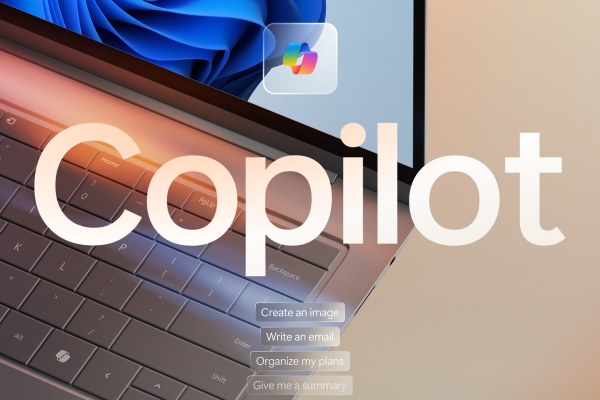
This week in AI, Microsoft unveiled a new standard PC keyboard layout with a “Copilot” key. You heard correctly — going forward, Windows machines will have a dedicated key for launching Microsoft’s AI-powered assistant Copilot, replacing the right Control key.

The move is meant, one imagines, to signal the seriousness of Microsoft’s investment in the race for consumer (and enterprise for that matter) AI dominance. It’s the first time Microsoft’s changed the Windows keyboard layout in ~30 years; laptops and keyboards with the Copilot key are scheduled to ship as soon as late February.

But is it all bluster? Do Windows users really want an AI shortcut — or Microsoft’s flavor of AI period?

Microsoft’s certainly made a show of injecting nearly all its products old and new with “Copilot” functionality. In flashy keynotes, slick demos and, now, an AI key, the company’s making its AI tech prominent — and betting on this to drive demand.

Demand isn’t a sure thing. But to be fair. a few vendors have managed to turn viral AI hits into successes. Look at OpenAI, the maker of ChatGPT, which reportedly topped $1.6 billion in annualized revenue toward the end of 2023. Generative art platform Midjourney is apparently profitable, also — and hasn’t yet taken a dime of outside capital.

Emphasis on a few, though. Most vendors, weighed down by the costs of training and running cutting-edge AI models, have had to seek larger and larger tranches of capital to stay afloat. Case in point, Anthropic is said to be raising $750 million in a round that would bring its total raised to more than $8 billion.

Microsoft, together with its chip partners AMD and Intel, hopes that AI processing will increasingly move from expensive datacenters to local silicon, commoditizing AI in the process — and it might well right. Intel’s new lineup of consumer chips pack custom-designed cores for running AI. Plus, new datacenter chips like Microsoft’s own could make model training a less expensive endeavor than it is currently.

But there’s no guarantee. The real test will be seeing whether Windows users and enterprise customers, bombarded with what amounts to Copilot advertising, show an appetite for the tech — and shell out for it. If they don’t, it might not be long before Microsoft has to redesign the Windows keyboard once again.

Here are some other AI stories of note from the past few days:

  • Copilot comes to mobile: In more Copilot news, Microsoft quietly brought Copilot clients to Android and iOS, along with iPadOS.
  • GPT Store: OpenAI announced plans to launch a store for GPTs, custom apps based on its text-generating AI models (e.g. GPT-4), within the next week. The GPT Store was announced last year during OpenAI’s first annual developer conference, DevDay, but delayed in December — almost certainly due to the leadership shakeup that occurred in November just after the initial announcement.
  • OpenAI shrinks reg risk: In other OpenAI news, the startup’s looking to shrink its regulatory risk in the EU by funneling much of its overseas business through an Irish entity. Natasha writes that the move will reduce the ability of some privacy watchdogs in the bloc to unilaterally act on concerns.
  • Training robots: Google’s DeepMind Robotics team is exploring ways to give robots a better understanding of precisely what it is we humans want out of them, Brian writes. The team’s new system can manage a fleet of robots working in tandem and suggest tasks that can be accomplished by the robots’ hardware.
  • Intel’s new company: Intel is spinning out a new platform company, Articul8 AI, with the backing of Boca Raton, Florida–based asset manager and investor DigitalBridge. As an Intel spokesperson explains, Articul8’s platform “delivers AI capabilities that keep customer data, training and inference within the enterprise security perimeter” — an appealing prospect for customers in highly regulated industries like healthcare and financial services.
  • Dark fishing industry, exposed: Satellite imagery and machine learning offer a new, far more detailed look at the maritime industry, specifically the number and activities of fishing and transport ships at sea. Turns out there are way more of them than publicly available data would suggest — a fact revealed by new research published in Nature from a team at Global Fishing Watch and multiple collaborating universities.
  • AI-powered search: Perplexity AI, a platform applying AI to web searching, raised $73.6 million in a funding round valuing the company at $520 million. Unlike traditional search engines, Perplexity offers a chatbot-like interface that allows users to ask questions in natural language (e.g. “Do we burn calories while sleeping?,” “What’s the least visited country?,” and so on).
  • Clinical notes, written automatically: In more funding news, Paris-based startup Nabla raised a cool $24 million. The company, which has a partnership with Permanente Medical Group, a division of U.S. healthcare giant Kaiser Permanente, is working on an “AI copilot” for doctors and other clinical staff that automatically takes notes and writes medical reports.

More machine learnings

You may remember various examples of interesting work over the last year involving making minor changes to images that cause machine learning models to mistake, for instance, a picture of a dog for a picture of a car. They do this by adding “perturbations,” minor changes to the pixels of the image, in a pattern that only the model can perceive. Or at least they thought only the model could perceive it.

An experiment by Google DeepMind researchers showed that when a picture of flowers was perturbed to appear more catlike to AI, people were more likely to describe that image as more catlike despite its definitely not looking any more like a cat. Same for other common objects like trucks and chairs.

Image Credits: Google DeepMind

Why? How? The researchers don’t really know, and the participants all felt like they were just choosing randomly (indeed the influence is, while reliable, scarcely above chance). It seems we’re just more perceptive than we think — but this also has implications on safety and other measures, since it suggests that subliminal signals could indeed propagate through imagery without anyone noticing.

Another interesting experiment involving human perception came out of MIT this week, which used machine learning to help elucidate a particular system of language understanding. Basically some simple sentences, like “I walked to the beach,” barely take any brain power to decode, while complex or confusing ones like “in whose aristocratic system it effects a dismal revolution” produce more and broader activation, as measured by fMRI.

The team compared the activation readings of humans reading a variety of such sentences with how the same sentences activated the equivalent of cortical areas in a large language model. Then they made a second model that learned how the two activation patterns corresponded to one another. This model was able to predict for novel sentences whether they would be taxing on human cognition or not. It may sound a bit arcane, but it is definitely super interesting, trust me.

Whether machine learning can imitate human cognition in more complex areas, like interacting with computer interfaces, is still very much an open question. There’s lots of research, though, and it’s always worth taking a look at. This week we have SeeAct, a system from Ohio State researchers that works by laboriously grounding a LLM’s interpretations of possible actions in real-world examples.

Image Credits: Ohio State University

Basically you can ask a system like GPT-4V to create a reservation on a site, and it will get what its task is and that it needs to click the “make reservation” button, but it doesn’t really know how to do that. By improving how it perceives interfaces with explicit labels and world knowledge, it can do lots better, even if it still only succeeds a fraction of the time. These agent models have a long way to go, but expect a lot of big claims this year anyway! I just heard some today.

Next, check out this interesting solution to a problem I had no idea existed but which makes perfect sense. Autonomous ships are a promising area of automation, but when the sea is angry it is difficult to make sure they’re on track. GPS and gyros don’t cut it, and visibility can be poor too — but more importantly, the systems governing them aren’t too sophisticated. So they can go wildly off target or waste fuel going on large detours if they don’t know any better, a big problem if you’re on battery power. I never even thought about that!

Korea’s Maritime and Ocean University (another thing I learned about today) proposes a more powerful pathfinding model built on simulating ship movements in a computational fluid dynamics model. They propose that this better understanding of wave action and its effect on hulls and propulsion could seriously improve the efficiency and safety of autonomous marine transport. It might even make sense to use in human-guided vessels whose captains aren’t quite sure what the best angle of attack is for a given squall or wave form!

Last, if you want a good recap of last year’s big advances in computer science, which in 2023 overlapped massively with ML research, check out Quanta’s excellent review.

Afraid of AI? I confronted it for you and its responses were fascinating

face-itgettyimages-1486846051

I'm worried about you. I'm worried because I can sense you're worried. About generative AI, that is.

You're so worried, in fact, that you won't go anywhere near it.

Also: The 3 biggest risks from generative AI — and how to deal with them

You hear so many more "enlightened" people telling you that AI is just great, that it's the future. And indeed it is. But that doesn't mean you feel ready to leap into its great unknown.

Please, then, let me be your guide. Or your counselor. Or, at least, your mediator.

We both know that neither of us can stop the onrush of AI-powered, well, seemingly everything, so we have to decide on a stance. Turning our backs won't, in this instance, help us.

My suggestion, then, is to treat this as any other relationship. Yes, human relationship. Don't wait for AI to affect your life in unknown ways. Confront it with your fears and see what it has to say.

Also: A year of AI breakthroughs that left no human thing unchanged

So, on your behalf — and entirely gratis — I went to Open AI's ChatGPT and asked it the very questions that, I suspect, are bothering you most.

I suggest you listen very hard to the replies. You may even feel better about life, once you do. You may.

Let's address the fear

First, then, I asked it: "Why should I be afraid of ChatGPT?"

I often find, you see, that somewhat confrontational questions can define the atmosphere and reveal some instant truths.

This is what ChatGPT replied:

"There is generally no need to be afraid of ChatGPT. It is a machine learning model created by OpenAI to generate human-like text based on the input it receives. It doesn't have personal motivations, consciousness, or awareness. It is simply a tool that responds to the prompts it receives.

However, like any tool, it's important to use ChatGPT responsibly. It doesn't have an inherent understanding of ethical considerations, and it can generate content that may be inappropriate or biased if given the wrong input. Users should be cautious and thoughtful when interacting with ChatGPT, especially in sensitive or controversial topics.

Additionally, it's essential to remember that ChatGPT doesn't have access to personal data about individuals unless it's shared in the course of the conversation. It's designed to respect user privacy, and OpenAI has implemented measures to ensure data confidentiality."

Several things might touch you here. The use of "generally," perhaps. Also the phrase "doesn't have an inherent understanding of ethical considerations."

Also: 4 ways to overcome your biggest worries about generative AI

To me, though, what's most fascinating is that it's aware that so much of its future is dependent on humans — those who create it and those who use it.

Hey, you want my job?

Next, I thought, should be this: "I'm scared you want to take my job. Is this true?"

Young Chatty was quite definitive:

"No, that's not true. I don't have personal motivations or desires, and I don't have the ability to take jobs or engage in any form of competition. My purpose is to assist and provide information based on the prompts I receive. While technologies like ChatGPT can automate certain tasks, they are ultimately tools designed to augment human capabilities rather than replace human workers.

It's important to view technologies like mine as tools that can be harnessed to enhance productivity, creativity, and efficiency. Many industries and professions will likely see changes due to technological advancements, but the overall impact depends on how these tools are integrated into existing systems and workflows. It's crucial for society to adapt and find ways to leverage these technologies for positive outcomes."

I hope you are heartened by this response, like I was. It's just a tool. Use it wisely. (A good message for bosses, that.)

Also: These are the jobs most likely to be taken over by AI

The confidence builder

I followed this prompt with: "What can I do that you can't?"

I felt this question would search more deeply into ChatGPT's self-awareness. Some robots can appear so know-it-all-ish.

This one, however, offered:

"While I can generate text, answer questions, and provide information on a wide range of topics, there are several things I can't do:

  1. Personal Experiences: I don't have personal experiences or emotions. I can't share personal anecdotes or opinions as I lack consciousness and subjective experiences.

  2. Real-time Information: My knowledge is up to date only until January 2022, and I don't have the ability to access or retrieve real-time data from the internet.

  3. Physical Actions: I can't perform physical actions in the real world. For example, I can't pick up objects, write on paper, or interact with the physical environment.

  4. Creativity and Original Thought: While I can generate creative text based on patterns learned during training, I don't have true creativity or original thought. I rely on patterns and information present in the data I was trained on.

  5. Understanding Context Like Humans: I may not fully understand the context of a conversation the way humans do. I generate responses based on patterns learned during training but may lack a deep understanding of nuanced or complex situations.

  6. Personalized Advice: I can provide general information and suggestions, but I cannot offer personalized advice tailored to specific individuals as I don't have knowledge of personal circumstances."

That's also heartening, isn't it? Especially the part about its knowledge only being up to date until January 2022 (Yes, of course I used the simple, free version. That's where you will likely want to start too.)

This is a developing tool, not some all-powerful menace. (As far as one can tell.)

Also: The best AI chatbots: ChatGPT and other noteworthy alternatives

Are you holier than thou? Smarter than thou?

I searched more deeply into your soul for the next prompt: "Do you think you can be smarter than humans?"

There came a fascinating response:

"No, I don't 'think' in the way humans do, and I don't have self-awareness or consciousness. My abilities are limited to processing and generating text based on patterns learned during training. While I can perform specific tasks and provide information on a wide range of topics, my intelligence is narrow and focused on language-related tasks.

Humans possess a broad spectrum of cognitive abilities, including creativity, emotional intelligence, common sense, and adaptability, which are currently beyond the reach of artificial intelligence. While AI models like mine continue to advance, the goal is generally to complement human intelligence and enhance productivity rather than surpass or replace it. The combination of AI and human intelligence is often more powerful than either alone."

You see? Its intelligence is (still) narrow. Its abilities are limited. And the goal is to complement human intelligence. Generally.

Also: OpenAI aiming to create AI as smart as humans, helped by funds from Microsoft

Why, it's even quite good at flattery, isn't it?

Oh, of course, you still have fears but we're getting somewhere, aren't we? Surely I've encouraged you — if not persuaded you — that you need to commune with this new tool and treat it like any other (reasonably) thoughtful entity you encounter in your daily life.

Can we have a serious relationship?

I went, then, for my final prompt: "Can you understand why humans are afraid of AI?"

If one can't be understood by another being, one can't have a relationship with it.

The reply came very swiftly:

"Yes, I can understand why some humans might feel apprehensive or fearful about artificial intelligence. There are several reasons for this fear:

  1. Job Displacement: Concerns about automation and AI potentially replacing certain jobs can lead to fears of unemployment and economic insecurity.

  2. Ethical Concerns: There are worries about the ethical implications of AI, such as biases in algorithms, invasion of privacy, and the potential for misuse in various applications.

  3. Loss of Control: The idea of creating systems that can operate autonomously and make decisions without direct human control raises concerns about the loss of control over technology.

  4. Unintended Consequences: The fear of unintended consequences or unforeseen problems arising from the use of advanced AI systems is another factor.

  5. Sci-Fi Depictions: Popular culture often portrays AI in a negative light, contributing to fears influenced by fictional scenarios where AI turns against humanity.

It's important to note that while these concerns are valid, responsible development and deployment of AI, along with ethical considerations and regulations, can help address and mitigate these fears. Many experts advocate for ethical AI practices to ensure that these technologies are used for the benefit of society while minimizing potential risks."

So there. This isn't some mindless robot. It's something that has (been programmed with) some awareness of the world around it. It "knows" that you're afraid and it "knows" why.

Also: Bill Gates predicts a 'massive technology boom' from AI coming soon

Please, then, consider participation. Fear is understandable but ultimately futile and energy-sapping. It's worth having a relationship with this new tool and seeing where it takes you — and it.

One thing worth mentioning, though: It does talk a lot, doesn't it?

Artificial Intelligence

Eerily, AI Can Now Do Your KYC !

When Worldcoin 2.0 (proof of personhood) was released last month with advanced features, AIM predicted it to be the best thing that could possibly counter any form of future online fraud. In less than a month, the possibility of identity theft caused by AI is getting more real than ever, with worldcoin’s relevance increasingly going up.

‘Online KYC Compromised’

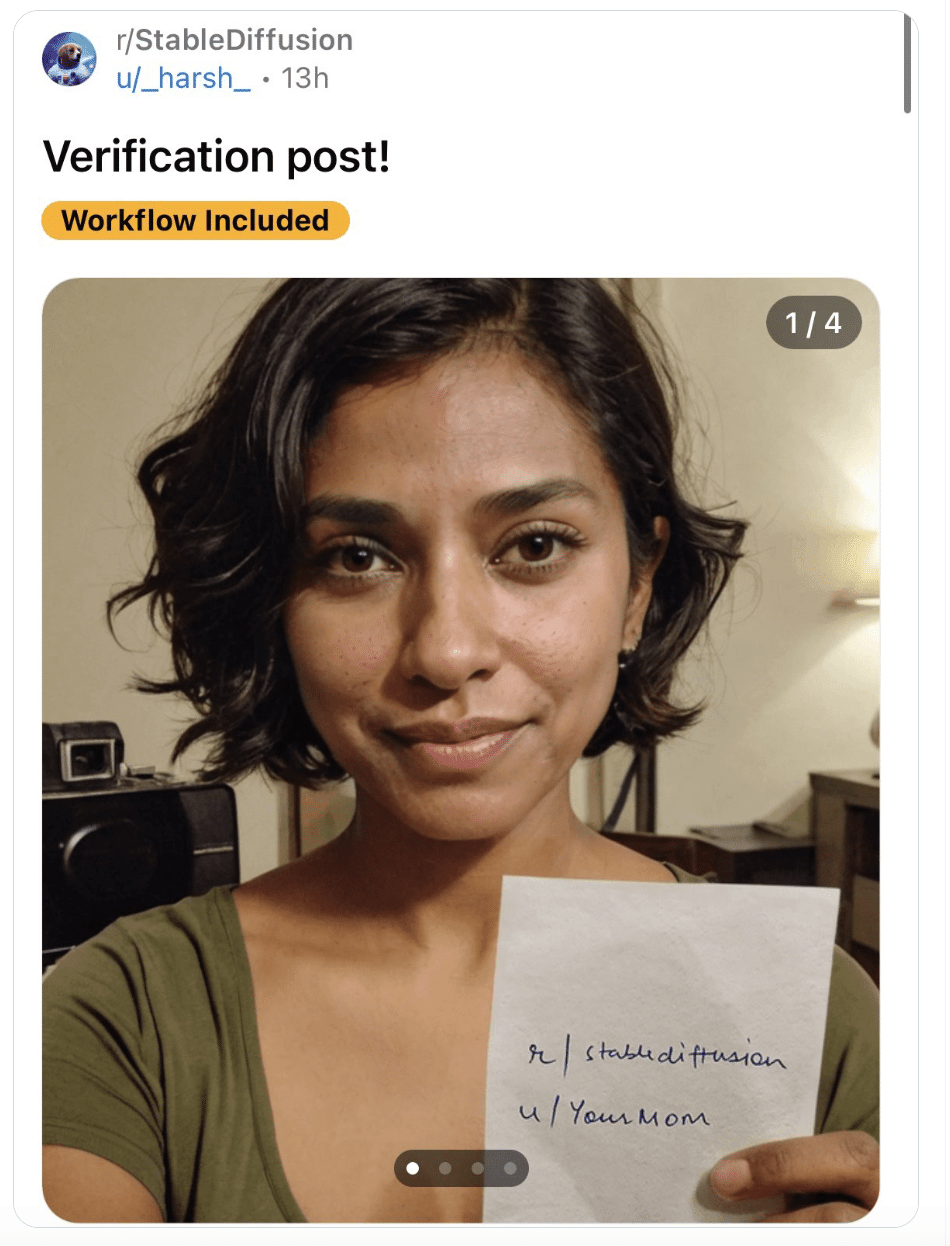
A recent image of a person’s online verification has been doing the rounds on the internet. The scary part being that the image is wholly AI-generated and it has reportedly been created using Stable Diffusion. The image depicts exactly what everyone had been fearing: AI identity theft.

Source: X

The near-perfect image of a person holding a placard, can easily pass off as an online verification for identity purposes- a method commonly used for KYC (Know Your Customer). A number of banks and brokerage firms allow photo/video KYC methods, something that aggressively picked up during the pandemic. However, this has also opened up the possibility of manipulation via AI tools.

A number of AI image-generation tools have sprung in the last year, and most of them are still not governed by copyright laws, which only makes the process unhinged. The recent version of Midjourney V6 tool, allows one to generate any celebrity or brand image without any restriction. Furthermore, with the rise of deepfake, video as a form of identification is also compromised.

Recently, Nithin Kamath, co-founder at Zerodha, spoke about the threats of online identity fraud by sharing his own deepfake video. Kamath explains the typical process for verification where the ID and address proof is retrieved from either Digilocker or Aadhaar. It is then followed by an ID check via a webcam which he believes is jeopardised in today’s age.

In Comes a Legit Solution

A number of measures such as adopting two-factor authentication, regulating passwords, verifying and reporting duplicate accounts, password updation, and others are suggested, however, none of them are preventive measures. At the moment, the only legit method of online identification is something that might seem far-fetched, but might just work is Worldcoin.

World ID, a digital passport, seeks to validate unique human identities online while prioritising privacy. With the latest update, a number of companies including Reddit, Shopify, Discord, and others have integrated World ID 2.0 onto their platforms, which allows the users to verify their accounts using the same.

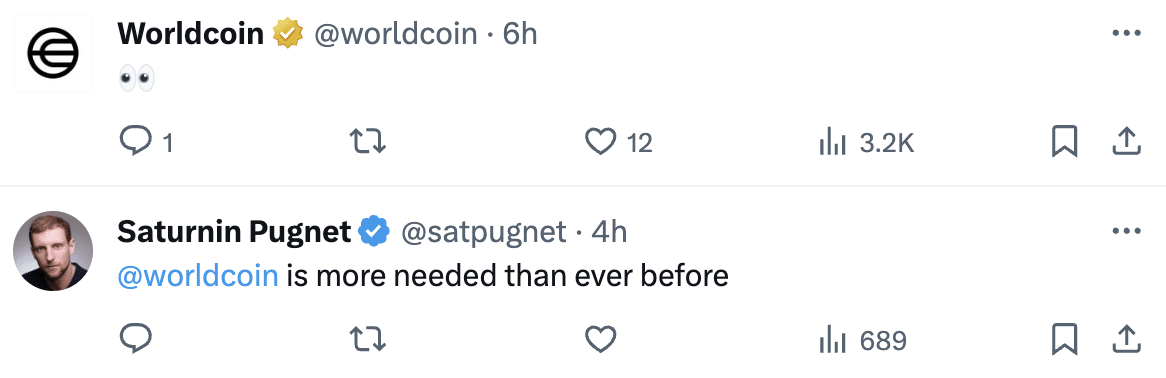
Worldcoin founder’s response to the AI-generated image for KYC. Source: X

The integration of Worldcoin across multi-sector platforms including retail, gaming and e-commerce, looks to make users have a safe experience. Problems caused by frauds via duplicate accounts, availing multiple discounts, automated bot integration, and bad actors, are some of the issues that Worldcoin can address. Proof of personhood allows the protection against unlawful account sharing which is a potential way for hackers to gain access to multiple accounts.

Furthermore, even options such as captcha that are used for online verification can be eliminated owing to Worldcoin.

Mass Integration

The idea may sound perfect, but implementation is where the problem arises. For these measures to effectively work, Worldcoin or similar kinds of products need to be integrated at a universal level. However, owing to security concerns, Worldcoin is still looked at with suspicion.

The controversy surrounding biometric data captured by Worldcoin Orbs had been under the radar when it was initially launched. Though the company later came out with blogs explaining the secure usage of one’s data claiming that they do not store anyone’s data, Worldcoin is still under slow adoption. Currently, Worldcoin has over 2 million users with users across 120 countries.

What was presumably the next obvious step for AI—getting infamous for identity theft—is now emerging as a burdensome problem. Unless applications like Worldcoin and digital proof-of-personhood methods are adopted, AI frauds will continue to rise.

The post Eerily, AI Can Now Do Your KYC ! appeared first on Analytics India Magazine.

6 AI Predictions for 2024 from Industry Experts

Across every industry, AI dominated discussions and developments in 2023, and the results were compelling. However, as the calendar turns to 2024, the tech is punctuated with challenges that need attention beyond foundational research.

The technology is filled with uncertainties as it breaks traditional patterns. There are also concerns regarding how well employees and enterprises adopt the tech. With the upcoming elections in the US and India, political divisions are also threatened by technology.

The challenges continue to persist, but so does a narrative of possibilities. By drawing insights from industry insiders, one can understand the trajectory of AI in the upcoming year.

Here are 6 predictions explaining what AI in 2024 will mean for organisations, investments and researchers:

Sara Hooker, Head of Cohere For AI

The head of one of the hottest AI startups in Silicon Valley, Sara Hooker, has predicted that the AI community needs to step up its game in 2024. She points out a big issue: most AI tech is made with a Western viewpoint, mostly in English-speaking countries. This leaves out many languages and cultures, especially from places like Asia, where much of the world’s population lives.

She also told Turing Post that 2024 will shake things up in research. Instead of just focusing on one thing like language or visuals, we’ll see a lot more tech that combines different aspects, like speech and images, all working together in Multi-modal AI models.

Werner Vogels, Chief Technology Officer, Amazon

At Amazon Web Service’s annual gathering, re: Invent 2023, Werner Vogels, the big tech’s chief, announced his famous yearly predictions. He said that in the coming year, the community will train AI models with a mix of different cultures to understand people better and tackle big world problems.

These AI models will give better answers on various topics, making them more useful. This change isn’t just for one place or group; it will make a difference everywhere, for all kinds of people, now and in the future.

In an exclusive interview with AIM, he shared thoughts on how diverse countries like India can build their inclusive AI models.

Clem Delangue, CEO and Co-founder, Hugging Face

The CEO of Hugging Face, the hosting platform for open-source AI models, recently shared some insights on LinkedIn about what we might see in AI – particularly language models – for the following year.

Starting with a bold statement, he noted that quite a few of the hyped AI companies that have been grabbing headlines and investor attention might be in for a rough patch. He suggested that it was not just some minor setbacks; some of these companies might face severe financial troubles or might even be bought out for much less than they were once valued.

On a brighter note, open source will have some promising developments. He’s putting out there that these open-source language models are on track to reach a level where they can compete head-to-head with the best and most expensive closed-source models.

Bhasker Gupta, CEO, Analytics India Magazine

The head of AIM, Bhasker Gupta, recently took to his annual tradition of giving his followers a heads-up on what AI might look like in 2024. He pointed out that there’s a tangible risk of AI being manipulated, playing an important and not necessarily a positive role in the upcoming democratic elections.

He also mentioned that the ripple effects would be far-reaching and raise another round of concerns and debates about “Responsible AI”.

Sridhar Muppidi, CTO, IBM Security

As AI keeps pushing boundaries, the discussion around security predictions is getting real. The early birds are already using AI to strengthen the front end, giving security analysts a productivity boost. But AI and cybersecurity might be on the cusp of something big.

The CTO of IBM Security put it straight and said, “I don’t think we’re far from seeing generative AI deliver a transformative impact on the back end to completely reimagine threat detection and response into threat prediction and protection.”

He believes the tech’s ripe and ready, so the cybersecurity industry is gearing up for a game-changing moment, “achieving prediction at scale”.

Erin Price-Wright, partner, Index Ventures

As AI continues to boom, it demands a lot of computing power and storage space. Looking ahead to 2024, Erin Price-Wright, a partner at Index Ventures, a leading VC firm, thinks big changes are coming to data centres where all this data is stored. She says we’ll see better ways to connect computers, find new energy sources, and cool down those overheating machines. Speaking to Fortune, she’s got her eyes on the future of data centres.

The post 6 AI Predictions for 2024 from Industry Experts appeared first on Analytics India Magazine.

A timeline of Sam Altman’s firing from OpenAI — and the fallout

A timeline of Sam Altman’s firing from OpenAI — and the fallout Kyle Wiggers 8 hours

In a dramatic turn of events late Friday, ex-Y Combinator president Sam Altman was fired as CEO of AI startup OpenAI, the company behind viral AI hits like ChatGPT, GPT-4 and DALL-E 3, by OpenAI’s board of directors. Then, the company’s longtime president and co-founder, Greg Brockman, resigned — as did three senior OpenAI researchers. And the fallout continues.

Tip TechCrunch

Do you work at OpenAI and know more about Sam Altman’s departure? Get in touch with TechCrunch.

It’s a fast-moving situation that we’re still trying to get to the bottom of. No doubt more will become clear as time goes on. To make it easier to follow all that’s happened in the meantime, though, we’ve put together a timeline; we’ll do our best to keep it current.

Timeline of Sam Altman’s firing from OpenAI

January 5

The identity of OpenAI’s board observer has been revealed. According to Bloomberg, Microsoft has chosen Dee Templeton, VP for tech and research partnerships and operations and an advisor to Microsoft CTO Kevin Scott, as its non-voting board observer. Bloomberg says that Templeton has already begun attending board meetings; The Information previously reported that Templeton was being considered for the role.

November 29

Microsoft gains a board observer

Microsoft will gain representation on the new initial board of directors in the form of a non-voting observer, OpenAI announced. It wasn’t immediately clear who this observer might be — only that they won’t have an official vote in board business.

November 21

Sam Altman, OpenAI reach agreement on return as CEO and ‘initial’ new board

In a sudden late announcement, OpenAI revealed that it and Altman “have reached an agreement in principle” for him to return as the company’s CEO. In addition to Altman’s return, its new “initial” board will include former Salesforce chief executive Bret Taylor, former US Secretary of the Treasury Larry Summers and Quora founder Adam D’Angelo.

We have reached an agreement in principle for Sam Altman to return to OpenAI as CEO with a new initial board of Bret Taylor (Chair), Larry Summers, and Adam D'Angelo.

We are collaborating to figure out the details. Thank you so much for your patience through this.

— OpenAI (@OpenAI) November 22, 2023

Altman also posted about the new deal, giving some insight into the roller coaster that we’ve all been riding since his firing was revealed Friday. In his words, his decision to join Microsoft on Sunday “was the best path for me and the team.” Since then, the new board’s composition and Microsoft’s support appear to have been enough to bring him back to the AI company he co-founded.

Altman and board in talks

OpenAI’s board of directors is reportedly in talks with Sam Altman, ex-Y Combinator president and an OpenAI co-founder, to return to OpenAI as CEO as soon as this week. That’s according to Bloomberg, which in a brief — citing sources close to the matter — said that discussions are happening between Quora CEO Adam D’Angelo, one current member of the OpenAI board, and Altman — and possibly other board members as well.

Board tensions boil over

The New York Times reports that, before his ousting, Sam Altman made a move to push out board member Helen Toner because he thought a paper she had co-written was overly critical of OpenAI. That, among other issues, led to OpenAI’s current predicament. Speaking of, The Times indicates that negotiations to hire Altman back continue — but that one major sticking point remaining is “guardrails” meant to improve Altman’s communication with the board.

View this post on Instagram

A post shared by TechCrunch (@techcrunch)

November 20

Altman joins Microsoft

Sam Altman, Greg Brockman and colleagues announce that they’ll join Microsoft to lead a new AI research team. Nadella leaves the door open to other OpenAI staffers, saying that they’ll be given the resources they need should they choose to join.

Sutskever’s mea culpa

Sutskever publishes a post on X suggesting that he regrets his decision to remove Altman and that he’ll do everything in his power to reinstate Altman as CEO.

I deeply regret my participation in the board's actions. I never intended to harm OpenAI. I love everything we've built together and I will do everything I can to reunite the company.

— Ilya Sutskever (@ilyasut) November 20, 2023

Employees threaten to resign

Nearly 500 of OpenAI’s roughly 770 employees — including, remarkably, Sutskever — publish a letter saying that they might quit unless the startup’s board resigns and reappoints the ousted Altman. Later Monday, that number climbed to over 650.

Altman and Brockman considering return

As reported by The Verge, Altman’s move to Microsoft isn’t a done deal — and both Altman and Brockman are still open to returning to OpenAI. That is, if the remaining board members who initially fired him step aside.

OpenAI board considers merger

OpenAI’s board of directors approached Dario Amodei, the co-founder and CEO of rival large-language model developer Anthropic, about a potential merger of the two companies, The Information reports. The approach was part of an effort by OpenAI to persuade Amodei to replace Altman as CEO — but Amodei quickly turned down the CEO offer.

November 19

Altman to meet at OpenAI HQ

According to The Information, Altman is expected to meet at OpenAI’s San Francisco headquarters as executives at OpenAI push to have him reinstated as CEO. Brockman was invited to join — but it’s unclear whether he’ll take execs up on that invitation.

Board negotiations hit a snag

Bloomberg reports that Lightcap and Murati, among others, are pushing the board to reinstate Altman. But unsurprisingly, the directors are resisting. As of midday Sunday, the board hadn’t resigned out of concern over who could replace them, and were vetting candidates. One possible new addition could be Salesforce co-CEO Bret Taylor.

Altman out, Shear in

Altman won’t be returning as CEO, according to a report in The Information citing an internal memo sent by Sutskever. As the search for a new permanent CEO continues, OpenAI has appointed Emmett Shear, the co-founder of video streaming site Twitch, as interim CEO — replacing Murati.

November 18

“Not … in response to malfeasance”

In an internal memo obtained by Axios sent Saturday morning, OpenAI COO Brad Lightcap said yesterday’s announcement “took [the management team] by surprise” and that management had had “multiple conversations with the board to try to better understand the reasons and process behind their decision.” Discussions were ongoing as of Saturday morning, per the memo.

“We can say definitively that the board’s decision was not made in response to malfeasance or anything related to our financial, business, safety, or security/privacy practices,” Lightcap added. “This was a breakdown in communication between Sam and the board … We still share your concerns about how the process has been handled, are working to resolve the situation, and will provide updates as we’re able.”

OpenAI’s funding in jeopardy

The planned sale of OpenAI employee shares that would value the startup at about $86 billion could be in jeopardy. The Information, speaking to three sources formerly with the company, reports that they no longer expect the sale — led by Thrive Capital — to happen, or, if it does, to come with a lesser valuation because of the recent turn of events.

Altman planning new venture

Altman has been telling investors that he’s planning to launch a new venture, according to The Information. Brockman is expected to join the effort — whatever form it takes. (Possibly an AI chip startup.)

i love you all.

today was a weird experience in many ways. but one unexpected one is that it has been sorta like reading your own eulogy while you’re still alive. the outpouring of love is awesome.

one takeaway: go tell your friends how great you think they are.

— Sam Altman (@sama) November 18, 2023

Investors pushing for Altman’s return

Investors — furious at the turn of events — are reportedly exerting pressure on OpenAI’s board to reinstate Altman, going so far as to recruit Microsoft. Nadella is said to be sympathetic.

Board agrees to reverse course — in principle

The Verge reports that the board agreed in principle to resign and to allow Altman and Brockman to return. It waffled, however, missing a deadline yesterday by which many OpenAI staffers were set to leave the company. Altman is said to be ambivalent about coming back and asking for “significant” governance changes.

November 17

Brockman demoted

Brockman says he got a text from Sutskever shortly after noon on Friday asking for a quick call. After sending a Google Meet link, Brockman was told that he was being removed from the board as chairman “but was vital to the company and would retain his role” as president, and that Altman had been fired.

Altman’s firing publicly announced

OpenAI published a post on its blog announcing the executive shake-up. The company’s management team was aware shortly after.

i loved my time at openai. it was transformative for me personally, and hopefully the world a little bit. most of all i loved working with such talented people.

will have more to say about what’s next later.

🫡

— Sam Altman (@sama) November 17, 2023

All-hands meeting

OpenAI held an all-hands meeting Friday afternoon during which Sutskever defended Altman’s ouster. He dismissed suggestions that pushing Altman out amounted to a “hostile takeover,” and claimed that it was necessary to protect OpenAI’s mission of “making AI beneficial to humanity.”

Microsoft releases a statement

Satya Nadella, the CEO of Microsoft, a major investor in — and partner with — OpenAI, published a statement about Altman’s firing:

“As you saw at Microsoft Ignite this week, we’re continuing to rapidly innovate for this era of AI, with over 100 announcements across the full tech stack from AI systems, models and tools in Azure, to Copilot. Most importantly, we’re committed to delivering all of this to our customers while building for the future. We have a long-term agreement with OpenAI with full access to everything we need to deliver on our innovation agenda and an exciting product roadmap; and remain committed to our partnership, and to Mira and the team. Together, we will continue to deliver the meaningful benefits of this technology to the world.”

Brockman quits

Brockman announced his resignation from OpenAI, citing “today’s news.” After sending a memo internally, he published the text on X.

After learning today’s news, this is the message I sent to the OpenAI team: https://t.co/NMnG16yFmm pic.twitter.com/8x39P0ejOM

— Greg Brockman (@gdb) November 18, 2023

Senior OpenAI researchers resign

Three senior OpenAI researchers resign after Brockman, including the director of research Jakub Pachocki and head of preparedness Aleksander Madry.

November 16

Ilya Sutskever schedules call with Altman

According to a post on X (formerly Twitter) from Brockman, Ilya Sutskever, the chief scientist at OpenAI and a co-founder, texted Altman on Thursday evening about scheduling a Friday noon call.

Sam and I are shocked and saddened by what the board did today.

Let us first say thank you to all the incredible people who we have worked with at OpenAI, our customers, our investors, and all of those who have been reaching out.

We too are still trying to figure out exactly…

— Greg Brockman (@gdb) November 18, 2023

Murati told of Altman’s firing

Brockman alleges that Mira Murati, OpenAI’s CTO and now interim CEO, was informed on Thursday night that Altman would be fired.

Perplexity AI Raises $74M To Take Valuation to $520M

Perplexity AI Raises $74M To Take Valuation to $520M January 5, 2024 by Ali Azhar

Google and a few others have been dominant in the search engine space for years, but with the recent advancement of GenAI technology, the competitive landscape is set to be disrupted.

Perplexity AI, a search engine startup, is taking on search engine heavyweights, such as Google and Microsoft Bing, by trying to deliver a better, AI-native search experience. The startup has seen rapid growth with over 10 million monthly active users and over a billion queries in 2023.

The San Francisco-based startup that is only over a year old has raised its valuation to an impressive $520M with new funding from NVIDIA and Jeff Bezos. It recently secured $74M in its Series B funding led by venture capital firm Institutional Venture Partners (IVP). The funding participants included NEA, NVIDIA, Databricks, and Bessemer Venture Partners.

The meteoric growth of Perplexity AI is partly a result of its AI-driven approach to search, which involves delivering direct answers to queries using natural language processing rather than just presenting a list of links. The chat box-like interface offers simplicity and ease of use

“In an era where misinformation and AI hallucinations are causing increasing concern, we’re built on the idea that accuracy and transparency are prerequisites to making AI-powered search ubiquitous. The times of sifting through SEO spam, sponsored links, and multiple web pages will be replaced by a much more efficient way to consume and share information, propelling our society into a new era of accelerated learning and research,” Aravind Srinivas, co-founder, and CEO of Perplexity, wrote in a blog post.

Perplexity AI integrates its search engine with popular AI models such as GPT-4 and Claude. This enables it to summarize responses for a more conversational flow and provides source citations in the form of articles and websites. Users can even ask follow-up questions if they want to dive deeper into any subject.

Despite its rapid growth, Perplexity AI is not yet profitable. It is only generating single-digit million revenue annually. The major revenue stream is from its Pro offering, which offers advanced features such as image generation capabilities. The Perplexity AI core search experience is free of cost.

Aravind Srinivas, who has experience working with Google, OpenAI, and DeepMind, is optimistic about Perplexity AI’s revenue potential. He believes the company's ability to fine-tune the leading AI models for its search offers a competitive advantage. Srinivas believes Perplexity AI is the next-gen tool that will transform how people access information online.

via Shutterstock

Srinvas’s optimism is reflected by the broader trend in the industry where tech giants pivot towards AI-first interfaces for their search products. "Google is going to be viewed as something that's legacy and old, and Perplexity will be viewed as something that's the next generation and future," said Srinivas.

The ambitions of Perplexity AI go beyond search. It has already begun serving its own GenAI models based on its search index and public web. However, Perplexity is going to face some stiff competition from Google Search, which is testing its all-new Gemini model, and other players in the market who are focusing on incorporating AI in their search products.

With its innovative approach to search, Perplexity AI has positioned itself as a potential disruptor in the world of AI-powered search engines. Only time will tell whether it can fulfill its potential and grab a major chunk of the GenAI market, which is expected to be worth $667 billion by 2030.

Related Items

Microsoft, Google Set AI Paths for Search Engines in Historic Week

Google Will Take on Microsoft in AI Search

Companions, Not Replacements: Chatbots Will Not Succeed Search Engines Just Yet

Related

Have 10 hours? IBM will train you in AI fundamentals — for free

cleanshot-2023-12-13-at-23-50-262x

Long before ChatGPT blasted onto the scene and sucked all the air out of the room, there was IBM Watson. Watson itself blasted to fame when, in 2011, it beat reigning champion Ken Jennings on the TV game show Jeopardy.

Fun fact: ZDNET's own Steven J. Vaughn-Nichols was once a clue on Jeopardy.

Anyway, back to our story. My point is that IBM has a long history with AI and has not been sitting still. Its generative AI solution is called Watsonx. It focuses on enabling businesses to deploy and manage both traditional machine learning and generative AI, tailored to their unique needs.

Also: AI in 2023: A year of breakthroughs that left no human thing unchanged

I'm telling you this because if any company has the cred to offer a credential on AI fundamentals, it's IBM.

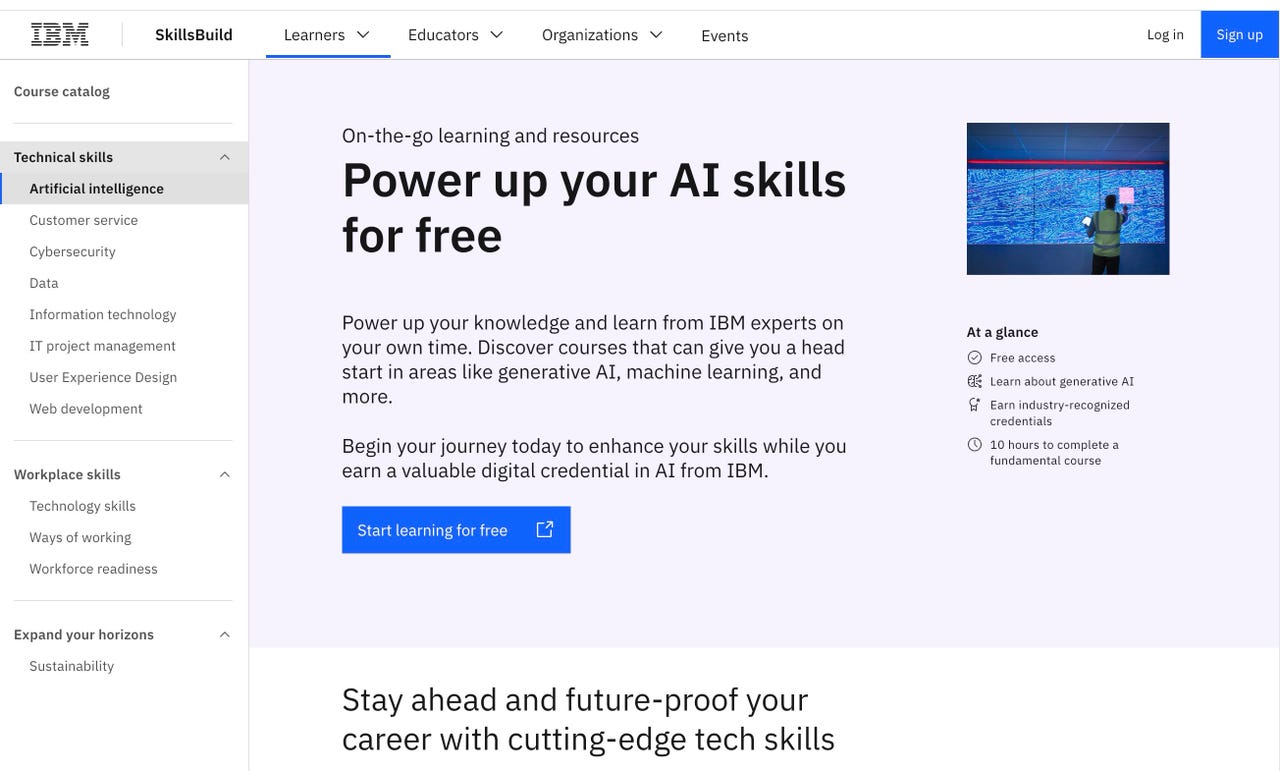
IBM's AI Fundamentals program is built inside of its SkillsBuild learning portal. The credential takes about ten hours to complete, across six courses.

Because I have had a long interest in AI ethics (I did a thesis on AI ethics way back in the day), I took the AI ethics class. It was good.

Also: I fact-checked ChatGPT with Bard, Claude, and Copilot — and it got weird

It discussed the challenge of balancing technology with ethical responsibility. Key topics included the five pillars of AI ethics, the importance of fairness and avoiding bias, and the need for AI systems to be transparent, explainable, and robust against attacks. The session also emphasized governance, the protection of personal data, and the significance of privacy through data minimization and differential privacy.

When I originally wrote this in early December 2023, I said "I'll probably take the rest of the courses over the holiday break." I did, indeed, do that. I'll share some of my experiences, along with answering a few reader questions, at the end of this article.

To get started, create a free account on IBM's SkillsBuild learning portal. All of the following links to IBM's free AI courses require you to have created that account and logged in before you'll be able to use them.

Artificial Intelligence Fundamentals Learning Plan: In this learning plan, you'll explore AI's history, and then see how it can change the world. Along the way, you'll deep dive into ways that AI makes predictions, understands language and images, and learns using circuits inspired by the human brain. After a hands-on simulation in which you build and test a machine-learning model, you'll finish with tips on how to find your career in AI.

Introduction to Artificial Intelligence (1 hour 15 mins): Less than a century old, AI has already undergone three waves of transformative development. Today it gives humanity the most powerful tools for analyzing complex data, not only to find meaning but also to learn without human intervention. In this course, you'll survey AI's history and explore ways that it can shed light on unstructured data.

Natural Language Processing and Computer Vision (1 hour 30 mins): You might already know that some AI systems can understand human language, identify visual images, and even create original art. But do you know how these systems do it? In this course, you'll explore the theory of natural language and vision processing and learn how these technologies drive real-world mechanisms such as chatbots and photo analysis.

Machine Learning and Deep Learning (2 hours): In this course, you'll see how machines can learn and make amazing, evidence-based predictions. Explore the logic behind computers' ability to learn, then investigate new ways that AI systems inspired by neurons in the human brain can solve difficult problems.

Run AI Models with IBM Watson Studio (1 hour and 45 mins): In this course, you'll practice creating an AI machine learning model in a series of simulations, using IBM Watson Studio. This is hands-on time that can help you do actual work with AI.

AI Ethics (1 hour and 45 mins): You might have heard about problems that arise when AI systems misinterpret data or propose solutions that reflect human prejudice. This is the course I talked about above. Through real-world examples you'll learn about AI ethics, how they are implemented, and why AI ethics are so important in building trustworthy AI systems.

Your Future in AI: The Job Landscape (1 hour): Are you considering a career in AI? In this course, learn about the AI job market's rapid growth and the skills needed for success in this exciting field. You'll hear how real professionals got their start, and find resources and learning opportunities that could help you work alongside them.

My experience taking the full course

The week between Christmas and New Year's Day is usually fairly quiet, especially when it comes to the usual daily email traffic. This year I used that time to take this course, doing one session most days, and circling back later in the day for a second session on two of the days.

Most sessions are a combination of reading, with a few spotlight videos thrown in. They end with a quiz. Since you can retake the quiz over and over again until you get it right, there's no need to fear test taking. I got most of the quizzes correct the first time out, but when my little dog distracted me, I wound up retaking one — with no negative impact on my coursework.

Also: How to use Bing Image Creator (and why it's better than ever)

Each course dives into an aspect of AI and helps explain it. Without a doubt, I have a better feel for some of the generative AI processes than I did before taking it. More to the point, the courses were interesting and the video lectures engaging. There were also some interactive experiences in the course that I found compelling.

Most of the courses are vendor-agnostic, but there was a Watson course that was specific to IBM's offerings. It didn't take more than an hour or so, and while I'm not in IBM's target market for their offering, it wasn't a waste of time to learn what IBM has for AI-related solutions.

As I said earlier, I liked the ethics section. And if you're interested in a job in AI, you'll like the last session, which is a full dive into what to expect if you want to work in this field. It's worth the price of admission (even if admission wasn't free) for that session alone.

I wound up with an official certificate, which I posted onto my LinkedIn profile. Stay tuned, because I'll be showing you how to add a verifiable training certificate to LinkedIn within the next week or so. Overall, the course was a great experience and I got a lot out of it.

Also: These are the jobs most likely to be taken over by AI

Also, a few of you asked about signing up for the course. There was some confusion because you can't get to the course directly. Be sure to go to the main IBM SkillBuild entry portal and create an account. Once you have a verified account (it's free), then you can get into the courses IBM offers.

Finally, the IBM folks asked me to tell you they also offer a free Fundamentals of Sustainability and Technology course. You can find it on SkillBuild as well. That course, too, offers a verifiable credential.

More resources

This is the third article in our series of free learning resources for those interested in exploring AI or building a career around this amazing technology. I also explored Amazon's free AI courses and free AI courses from OpenAI and DeepLearning.

So there you go. Sign up now and use your spare time to get a new credential. If you take any of these courses, please report back below in the comments and let us know what you think. And stay tuned. I expect to provide more resources early in 2024 for you to continue your free AI learning journey.

You can follow my day-to-day project updates on social media. Be sure to subscribe to my weekly update newsletter on Substack, and follow me on Twitter at @DavidGewirtz, on Facebook at Facebook.com/DavidGewirtz, on Instagram at Instagram.com/DavidGewirtz, and on YouTube at YouTube.com/DavidGewirtzTV.

Featured

VCs are optimistic that AI investing will move beyond the hype in 2024

VCs are optimistic that AI investing will move beyond the hype in 2024 Rebecca Szkutak 8 hours

Artificial intelligence startups had a wild ride in 2023. Everyone and their grandmother tried out some sort of AI tool, startups in the space raised rounds at 2021 valuations, there were high-profile shutdowns, and then to close out the year, we had all the drama surrounding Sam Altman and OpenAI — plus New York Times’ lawsuit against the company.

With so much in the rearview mirror, it’s hard to predict what will happen with AI startups in 2024. But some people, like investors, make their living from shrewd bets, so TechCrunch+ recently asked more than 40 investors what they think AI investing could look like in 2024.

Most investors told TechCrunch+ that they expect the current swell of funding to continue, but were optimistic that the industry is moving past its initial hype cycle and toward more durable businesses that will last. They also think that 2024 could see the beginning of a second wave of AI startups that are more verticalized, focused on specific sectors, and that move away from building layers on top of technologies from companies like OpenAI and Google.

Lisa Wu, a partner at Norwest Venture Partners, expects opportunities in verticalized AI to be particularly attractive this year. She thinks that there could be lower risk in investing in these startups, as they won’t be as likely — or easily — replicated by legacy companies like Microsoft and Google.

“These are AI applications with deep underlying knowledge of end-user workflows and access to industry-specific training data to make employees and teams more productive,” Wu said. “For example, law firms that effectively leverage AI will be able to offer their services at lower cost, higher efficiency and higher odds of favorable outcomes in litigation.”

KissanAI Partners with UNDP to Launch CoPilot for Farmers

Agriculture Generative AI startup, KissanAI announced that it has partnered with the United Nations Development Programme (UNDP) to develop the pioneering voice-based vernacular generative AI CoPilot for Climate Resilient Agriculture (CRA) practices.

The partnership aims to provide essential advisory services to thousands of Indian farmers, particularly smallholders disproportionately affected by the adverse impacts of climate change.

We, @Kissan_AI, are partnering with the United Nations (@UNDP) to develop Vernacular CoPilot for Climate Resilient Agriculture (CRA) practices. Targeting rural, smallholder, and women farmers. Excited to bring GenAI to remote corners of India and then the world.

— Pratik Desai (@chheplo) January 5, 2024

One of the primary objectives of this initiative is to extend the benefits of the Generative AI revolution to a wide audience, with a particular focus on reaching a significant number of women farmers. By leveraging voice-based technology, the CoPilot aims to bridge language barriers and provide accessible, user-friendly information, enabling women farmers to actively participate in and benefit from the advancements in Generative AI.

This marks the second product launch for KissanAI, following the recent introduction of Dhenu 1.0. Dhenu 1.0 is an agricultural large language model specifically designed for Indian agricultural practices. Notably, this bilingual model is adept at comprehending queries in English, Hindi, and Hinglish, addressing the linguistic needs of farmers directly.

Dhenu 1.0 has undergone meticulous training on extensive, high-quality datasets intricately focused on Indian agricultural practices. The model’s uniqueness lies in its bilingual nature, adeptly processing 300,000 instruction sets in both English and Hindi.

Dhenu is not yet available in the market as it is currently undergoing evaluation. “The goal is to have some RAG testing with the model. And, evaluation may take time because we are a small team,” shared KisaanA founder Pratik Desai in an exclusive interview with AIM.

The post KissanAI Partners with UNDP to Launch CoPilot for Farmers appeared first on Analytics India Magazine.

How Truly Sustainable is the GenAI Business?

Recently, it was revealed that OpenAI is expected to record $1.6 billion in annualised revenue in 2024. This is a 300 million bump up from the predicted $1.3 billion in October last year, coming from ChatGPT subscriptions, API access and others.
Meanwhile, competitor Anthropic expects at least $850 million in annualised revenue in 2024 up from $100 million three months ago, which they had informed the investors about. Anthropic’s projected revenue indicates a potential surge to $70 million per monthby the following year, driven by Claude, its text-generating AI, serving customers like Notion, Quora, and DuckDuckGo.

On the other hand, bootstrapped AI image-generator company Midjourney generated a revenue of $200 million in 2023 from its subscription model that charges users between $10 and $120 monthly.

Is it Sustainable?

As these companies compete with each other in the space, the potential growth and evolution of their businesses, relative to their current capabilities, remains uncertain for various reasons. For instance, the never-ending need to raise substantial capital, with CEO Sam Altman indicating that OpenAI potentially needs $100 billion to run the business, while the financial losses mount upto $540 million.

Plus, big tech companies like Microsoft, Google, and AWS which are injecting capital also get a share of the generated revenue alongside computational cost and accelerate research and development to keep up with the competition.

Additionally, numerous prominent figures in the industry are now expressing doubts over whether current models will sustain the pace of advancement or have they already hit a wall.

Echoing a similar sentiment, Bill Gates expressed doubts about the progress of generative AI saying that it has plateaued. And despite the optimistic view from some at OpenAI about GPT-5’s potential, Gates believes current generative AI has hit a ceiling. While acknowledging the impressive leap from GPT-2 to GPT-4, he admitted the possibility of being wrong about its limitations.

​​Ashray Malhotra, co-founder and CEO of Rephrase.ai, also shared his thoughts in a recent podcast on the cost of further innovation and the scale of it.

“GPT 5, whenever they train it, [it turns out] like 10 times more expensive and only 10% better than GPT 4 and you realise that for the next big thing, you need a fundamentally different architecture than a diffusion or transformers. Then you’re back in the wilderness, like, what is that next big thing?”

For How long?

Insiders suggest that Anthropic is anticipated to potentially hit $1 billion in annualised revenue next year, around $83 million monthly. Contrarily, projections expect OpenAI to generate $5 billion in annualised revenue by 2024.

However, while the revenue grows and the company continues to raise endlessly from investors and spend money on research and development, it would still keep them a long way from profitability.

How are They Doing it?

To deal with revenue issues, companies will need to look at diversifying their businesses and building in-house capabilities. This would reduce reliance on other companies, cut costs and bring in a newer stream of revenues.

OpenAI, for instance, is moving ahead of just a subscription model and catering to enterprises. It is also said to be venturing into the AI server chip business for which Altman is raising money from Abu Dhabi firm, G42.

Others like Stability AI, despite earlier revenue estimates exceeding $10 million annually, are changing gears from open-source by introducing a subscription fee for enterprise customers. The move towards subscriptions comes as Stability’s open-source strategy failed to yield significant income.

A focus on increasing and projecting safety and reliability in the technology could also lead to applications across industries like healthcare, marketing, banking, telecom, defence and others. This would mean a strong, steady and bigger stream of revenue.

Alternatively, one could stick to Midjourney co-founder David Holz’s philosophy, which stands as a testament to running a profitable bootstrapped company with sustainable growth. He owes it to an excellent product focussed on catering to a specific customer base without raising any capital from VCs.

Perplexity CEO, Aravind Srinivas also recently justified their lack of a focussed strategy as it tries to enter the search business and others. He posted on X saying that “Jeff Bezos invested in Google in 1998, before it had any business model figured out or was sky-rocketing in search traffic. His investment in Perplexity is symbolically significant.”

The post How Truly Sustainable is the GenAI Business? appeared first on Analytics India Magazine.