Where’s the best place to find a robot cat? The library, of course

screenshot-2024-01-25-at-5-26-36pm.png

Book it.

You know that feeling you get when something's become a thing and you had no idea?

Well, I felt that way when I discovered that everyone — apparently — was saying "delulu." (This, it seems, signifies an unrealistic solution to all of life's problems.)

Also: The 15 best robots and AI tech we saw at CES 2024

Today, though, I'd like to present you with a new thing — to me: robot cats in libraries.

When a bandit is on your side

I first came across it when I heard about Bandit, Percival, and Mr. Pickles.

Surprisingly, this isn't a firm of lawyers, nor even a comedy act from the last century.

Instead, these three are robot cats that live in the Eugene Public Library in Eugene, Oregon.

And they've become extremely popular robot cats.

Also: This pet robot lets you watch, play with, and treat your dog or cat from anywhere

As Oregon Public Broadcasting (OPB) reported, the library's customers are involved in a festival of adoration when it comes to these three black-and-white robot felines.

Kate Berry, one of the library's adult services supervisors, told OPB: "They're typically for folks who maybe are suffering memory loss or maybe just are living alone and kind of lonely. But really, anyone can check them out. They purr. They meow. They're really fun to have."

What's clear, though, is that the robot cats haven't merely charmed the library's visitors, but also its staff.

They have been so moved by the way these robot cats have brought peace to so many that they bought a couple for themselves. (Theirs are gray-and-white.)

Children's services supervisor Heather Sears told OPB: "There's research that shows cats purring is therapeutic. So we have a kind of quiet room that we have placed one of our cats. Staff have actually really enjoyed that — maybe you had a stressful part of your day or something's happened and you just need a moment, and you can come hang out with one of our cats that are here that are not circulating."

Please imagine, then, that some people will waft into the library and simply hang out with the likes of Bandit. They can even brush him and generally commune with him as if he were real.

Many people even book the robot cats as they would, say, a book and take it home.

It's a thing. A real thing

I confess this lifted my spirits greatly.

You see, my wife and I had a robot cat for a little while and, as regular readers may know, the experience was a touch imperfect.

Not finding suitable adopters, we ended up taking it to a local electronics recycling center, where the owner looked at us with benign bemusement. Before adopting the cat, of course.

Also: Can AI curb loneliness in older adults? This robot companion is proving it's possible

To discover that so many people are, by contrast, finding robot cats to be wonderful companions was fascinating.

But wait a minute, I mused to myself, is this an isolated inspiration from the Eugene Library or might it be a more widespread phenomenon?

It was time for a little research.

Everywhere you can find a good book

Here's Manistee County Library in Michigan with a veritable array of robotic pets. Cats, dogs and even a bird.

Julie Cirone, the library's interim director, told the Manistee News Advocate: "They have lifelike features including a realistic weight, they are responsive to touch, they purr and have a heartbeat, and they warm as they are sitting in a lap."

Let's now drift to the Hastings Public Library, also in Michigan. There, just beneath Botley the Coding Robot is: "Robotic Cat. Coming January 2024."

Now you might be wondering what the rules are for going to your local public library and taking a robot cat home with you.

Also: Boston Dynamics robot dog can answer your questions now, thanks to ChatGPT

Helpfully, the Reading Public Library in Massachusetts offers some guidelines.

The library explains the sort of things you can expect its robot cat to do: "He purrs happily when you pet his head or back. He moves his head towards your hand when you pet his cheeks, and if you keep petting him he will roll on his back so you can pet his belly!"

That does sound quite realistic. The library does, however, extend its own form of realism: "The total replacement cost for the robotic cat is $150. A $5.00 per day fee will be applied if material is returned late. This item is available for checkout to Patrons 18 years or older."

Please be warned. You can't readily keep them forever, like that copy of "Pride and Prejudice" you forgot to give back in 2016.

It seems, then, that America's libraries have become homes for robot cats. They bring peace and companionship to many. And that's a good thing.

Robotics

FTC Launches Inquiry Into Generative AI Investments 

Signalling increased scrutiny over generative AI, the Federal Trade Commission (FTC) has issued compulsory orders for leading generative AI firms to provide details about their investments and partnerships. As a part of Section 6(b) of the FTC Act Alphabet (Google’s parent company), Amazon, Anthropic, Microsoft, and OpenAI are the companies under inquiry.

The focus of this investigation is to understand how the recent developments involving major cloud service providers and generative AI companies will potentially impact competition and innovation.

FTC Chair Lina M. Khan emphasized the importance of understanding the dynamics between major corporations and AI providers, stating, “Our study will shed light on whether investments and partnerships pursued by dominant companies risk distorting innovation and undermining fair competition.” This inquiry comes at a time when the race to develop and monetize AI is accelerating, and regulatory bodies are increasingly vigilant about anticompetitive practices.

These orders empower the Commission to conduct in-depth studies to understand market trends and business practices. The findings from this investigation could be important for future regulatory actions.

The companies under investigation, including tech giants Microsoft, Amazon, and Alphabet, have been involved in multi-billion-dollar investments with generative AI developers, such as OpenAI and Anthropic. The FTC’s inquiry will detail the specifics of these investments, seeking information on agreements, strategic rationales, and the practical implications of these partnerships, including decisions on product releases, governance, and oversight rights.

Furthermore, the Commission is keen on understanding the competitive impact of these transactions, examining aspects such as market share, competition dynamics, potential for sales growth, and expansion into new product or geographic markets. With a specific focus on the competition for AI inputs and resources, the inquiry will be regarding key products and services needed for generative AI development.

Companies involved in the inquiry have 45 days to respond to the orders, providing detailed information on the various aspects under investigation.

The post FTC Launches Inquiry Into Generative AI Investments appeared first on Analytics India Magazine.

5 reasons you should update your Google Pixel phone ASAP

The display on the Mint Pixel 8 on top of a green notebook.

If you're an owner of a Pixel Phone, then you're probably aware that Google has big plans to start infusing these devices with even more artificial intelligence. Well, the wait is almost over as the next Feature Drop will include a variety of AI helpfulness.

Also: The best Google Pixel phones (including the Pixel 8 Pro)

Of course, the Feature Drop will include not only several new features but also the usual bug fixes and security patches. As per my usual advice, apply this update as soon as it becomes available. You do not want to fall behind on your security patches in this day of constant cybersecurity attacks, otherwise, your data could wind up in the wrong hands.

But what about those new features?

Taking your temp

The Pixel line of phones already received a thermometer app to go along with Android 14. However, missing from that app was the ability to take your own temperature. You could measure food and organic material, beverages and water, cast iron, ceramic and glass, metal, plastic and rubber, fabric, wood, and walls and windows.

Also: How to use the Pixel 8 Pro thermometer for accurate temperature reading

But there was no option to measure the temperature of humans. With the new Feature Drop, you'll be able to select this option and, using your phone, scan your forehead (or someone else's forehead) to get an accurate reading. This update will also allow you to save the results to your Fitbit profile for a deeper understanding of your health.

Circle to Search

The new Feature Drop will include a handy, AI-driven search method that allows you to simply draw a circle around an image, text, or video and Google will then automatically run a search for it. This means you won't have to switch between apps to run a search or even bother typing to make use of Google searching.

Also: Google's Smart Search now showing up on more Android phones

Photomoji

For those who like to respond with emoji, this new update will allow you to transform your favorite photos into reactions that can be used in Messages and other apps. This feature is powered by on-device AI, so it should work both quickly and seamlessly.

Magic Compose

Google Messages is getting a big AI bump with the help of Magic Compose. This is where the AI rubber really meets the road: Google wants to help you craft responses to your messages, courtesy of generative AI. The idea behind this is to add a "spark of personality" to your conversations. Magic Compose will offer suggested responses based on the context of your messages and even transform what you write into different styles (even Shakespeare).

Magic Compose rolled out as a beta last year and is already available if you've joined the Messages beta program. How it works is simple: Type your message and then tap the pen icon. Select the style you want to use for your message and then select the option you want to send. I've tried it and it's pretty fun.

Testing the Magic Compose feature in the beta version of Messages with some Billy Shakes.

New Pixel 8 colorway

If you haven't already purchased a Pixel 8 phone, Google will be releasing a new Mint colorway for both the Pixel 8 and Pixel 8 Pro.

Also: Why Google's cheaper Pixel 8 is the real star of its Android phone lineup

The upcoming Feature Drop should happen any time soon. Be on the lookout for it and make sure to apply as soon as it appears. Even if these new features don't excite you, you'll at least get the latest security patches and app updates.

Google

Meet the Creator of ଓଡ଼ିଆ Llama 

When ChatGPT was introduced a year ago, Shantipriya Parida — the creator of Odia Llama — was quite disappointed that it did not understand any cultural context related to Odisha.

Cut to present, he built Odia Llama (Llama2-fine tuned LLM for Odia Language) and started an open-source project called Odia Generative AI. The language is spoken by over 35 million people, and it boasts a rich literary tradition and a unique identity.

“I attempted to ask ChatGPT about local contexts. For example, I asked, ‘Can you tell me the recipe for rasgulla?’ It couldn’t provide an answer. It missed all the local context, and the answers weren’t even correct,” said Parida.

Moreover, Parida is currently working in Finland as a senior AI scientist at Silo.ai, which recently released its own LLM named Poro. “If Europeans can build an LLM that can provide better answers than OpenAI’s ChatGPT in their local language, I thought, why not for our own Indic languages,” said Parida. ‘That’s the reason we are working hard, and it feels good when people appreciate our effort,” he added.

Journey of Odia Llama

To build Odia Llama, Parida formulated a three step plan. “We’ll begin with a fine-tuned model, then move on to a pre-trained model, and finally, proceed to app deployment. Once we have the fine-tuned and pre-trained models ready, app development will be relatively straightforward”, he explained.

The Odia Llama currently available on Hugging Face is the fine-tuned version. Parida noted that his team of researchers is presently working on the development of the pretrained version, which is currently in progress.

“All the fine-tuned models have some limitations. In the foundation model, if you have only 0.5% or 2% of data in your local language, then, after a certain point, no matter how much you fine-tune it, it will get stuck,” he said.

To train a pretrained model Parida’s team is currently working on collecting data. “We are collecting a lot of tokens. I think we have already collected around 30 million tokens, and we are targeting at least 40 to 50 million tokens. This way, we can expedite the release of our first pretrained model,” said Parida.

The data is sourced from various online platforms, including blogs, Wikipedia, Odia newspapers, local textbooks, literature, magazines, and government websites. Parida said that they have developed in-house tools as well named Olive Scraper and Olive Farm. Olive Scraper is a web scraping tool for extracting Odia content from various sources (e.g., websites, PDF, DOC, etc.), while Olive Farm generates LLM instruction sets in Indic languages. Presently, it offers support for Hindi and Odia, with seamless scalability to incorporate additional languages on the horizon.

Regarding computing, GPUs, and infrastructure, Parida mentioned that they received support from E2E Networks. Moreover, he said that for fine-tuning, they have ample resources, as his team consists of various independent researchers who have access to GPUs, which they utilise for research purposes.

AI Tutor

Odia Generative AI recently created an AI tutor named Acharya. This tutor facilitates self-learning in Hindi for students, offering real-time doubt resolution. The tutor, named Acharya, was developed using LLM (Mistral-7b Hindi, fine-tuned) and Retrieval Augmented Generation (RAG).

“For example, if you’re a tutor and you want to create a lesson plan on a specific topic, then this can also assist you in preparing a comprehensive lesson plan. Similarly, if you want to evaluate, for instance, create a set of questions and assess them, it can also be helpful. So, it has multiple use cases,”said Parida.

Acharya operates as a client-server web application, with the client built using JavaScript and the server utilizing Python with Fast API for seamless communication. Initial assessment scores indicate BERT (F1): 0.72 and RAGAS Answer Relevancy: 0.72.

The current demonstration version caters to class 8 subjects of the CBSE board. It’s worth noting that Acharya will soon support various languages, cover a wide range of subjects, and be freely accessible.

What’s Next?

Given that there are now several indic LLMs out in the market like OpenHathi, Airavat, Krutrim and BharatGPT, Parida wants to create an indic LLM benchmark next.

“We are planning to build an LLM benchmark. You go, choose your model, and per task, it will automatically tell you your model’s accuracy for that particular task. It can be a fair comparison for anybody who wants to pick any model for research or any purpose they want to use.” said Parida.

Moreover, on similar lines to AI Tutor, Parida wants to build more AI apps focusing on government budgets and policies which would make it easier for local citizens to get information in native languages.

“As a citizen, many times one wants to know about government policies and what the government is trying to do in your area. But you don’t know exactly whom to ask. Nowadays, information is available in the public domain, so it’s easy to build an AI app using an open-source model and using RAG.” said Parida.

“We are not a company, and we are building without the intention of selling anything. We started with one objective, to ensure that our Odia language does not lag behind. So, whatever we are building is solely for the benefit of the people.” concluded Parida.

The post Meet the Creator of ଓଡ଼ିଆ Llama appeared first on Analytics India Magazine.

Google’s Gemini Pro Beats GPT-4

Google’s Bard (Gemini Pro) has clinched the second position on the HuggingFace Chat Bot Arena Leaderboard, surpassing OpenAI’s GPT-4. It’s worth noting that Gemini Pro is only Google’s second-best model, leaving room for heightened expectations regarding the capabilities of Gemini Ultra, which is yet to be revealed.

🔥Breaking News from Arena
Google's Bard has just made a stunning leap, surpassing GPT-4 to the SECOND SPOT on the leaderboard! Big congrats to @Google for the remarkable achievement!
The race is heating up like never before! Super excited to see what's next for Bard + Gemini… pic.twitter.com/QPtsqZdJhC

— lmsys.org (@lmsysorg) January 26, 2024

It has been a while since the release of GPT-4, and there are strong indications that OpenAI might be gearing up for the launch of GPT-5.

Meanwhile, OpenAI recently released an updated GPT-4 Turbo preview model, gpt-4-0125-preview. This model completes tasks like code generation more thoroughly than the previous preview model and is intended to reduce cases of “laziness” where the model doesn’t complete a task.

If OpenAI fails to introduce a new model soon, it risks losing its lead. Speculation is brewing that Meta’s Llama 3 is on the horizon and has the potential to surpass GPT-4.

The competition just got very real…
– Llama-3 will be released in the next few weeks
– Gemini Ultra will finally come out
– GPT 4.5 potentially cancelled
– GPT 5, not out till Q2
LLMs will and should be a commodity… It's already the case with every other ML algorithm! 🤷‍♀️

— Bindu Reddy (@bindureddy) January 26, 2024

On the other hand, Google recently integrated generative AI features into Google Chrome.

Google is introducing the “Help me Write” feature across all websites. By right-clicking on any text box, users can access the feature, prompting Google’s AI to inquire about their writing requirements and subsequently generate an initial draft.

Whether you are crafting a well-articulated restaurant review, creating a friendly RSVP for an event, or making a formal inquiry about renting an apartment, this feature is designed to assist you.

With this feature integrated into Google Chrome, it would significantly reduce the need for users to draft content on ChatGPT. Many of us work directly on the web, whether it’s sending emails, or drafting an article, or creating presentations.

The post Google’s Gemini Pro Beats GPT-4 appeared first on Analytics India Magazine.

Samsung Galaxy S24 smartphones secure record 1.21 million pre-orders in South Korea

Samsung Galaxy S24 All colors

Samsung said on Friday that pre-orders in South Korea for its latest smartphone Galaxy S24 series reached 1.21 million units, the highest figure in the S series to date.

Pre-orders for the smartphones ran from January 19 to 25, while official sales will start on January 31. The record beats its predecessor Galaxy S23 series' record of 1.09 million units, which also held a week-long pre-order period.

Also: Galaxy S24 series hands-on: I did not expect this model to be my favorite

It trails behind Galaxy Note 10's 1.38 million units in August 2019; however, the pre-order period ran 11 days for that model, and in terms of average per day Galaxy S24's is higher.

According to Samsung, out of the 1.21 million pre-orders, 60% were for the Galaxy S24 Ultra model. This was followed by Galaxy S24 Plus at 21% and Galaxy S24 at 19%.

In terms of color, titanium black was the most popular for Galaxy S24 Ultra and marvel gray for Galaxy S24 Plus and Galaxy S24, the South Korean tech giant said.

Samsung unveiled its latest flagship smartphones last week at Unpacked and touted their beefed-up AI and camera features. The Galaxy S24 smartphones support on-device AI translation for 13 languages through its generative AI model — Galaxy AI. More AI models were also applied to their cameras to upgrade zoom, nightography, and other features on their cameras.

Also: Samsung Galaxy S24 vs Galaxy S22: Should you upgrade to the latest model?

Samsung Unpacked

The best AI image generators of 2024: Tested and reviewed

If you've ever searched Google high and low to find an image you needed to no avail, AI may be able to help.

With AI image generators, you can type in a prompt as detailed or vague as you'd like to fit an array of purposes and have the image you were thinking of pop up on your screen instantly. These tools can help with branding, social media content creation, vision boards, invitations, flyers, greeting cards, and more.

Also: How to write better ChatGPT prompts in 5 steps

Even if you have no professional use for AI at the moment, don't worry — the process is so fun that anyone can (and should) try it out.

OpenAI's DALL-E 2 made a huge splash because of its advanced capabilities and because it was the first mainstream AI image generator. However, since its initial launch, there have been many developments in the space. Plenty of companies have released their own models that rival DALLE-2, and OpenAI even released a more advanced model, DALL-E 3.

To help you figure out which models are the best for different tasks, I put the generators to the test by putting a version of the same prompt — "Two yorkies sitting on a beach that is covered in snow" — into each image generator. I included screenshots for your viewing pleasure and for you to make your own inferences.

Also: I asked DALL-E 3 to create a portrait of every US state, and it got weird

While I found the best overall AI image generator to be the Image Creator from Microsoft Designer, due to its free-of-charge, high-quality results, other AI image generators perform better for specific needs. For the full round-up of the best AI image generators, keep reading below.

The best AI image generators of 2024

Best multi-purpose alternative

Nightcafe

Nightcafe is a multi-purpose AI image generator that is worth trying becaus it allows users to create unique and original artwork by using different inputs and styles, including abstract, impressionism, expressionism, and more.

View at Creator.nightcafe

Best alternative for marketing professionals

Canva

Canva is a versatile and powerful AI image generator that offers a wide range of options. It allows users to create professional-looking designs for different marketing channels, including social media posts, ads, flyers, brochures, and more within its design platform.

View at Canva

Artificial Intelligence

Nightshade, the tool that ‘poisons’ data, gives artists a fighting chance against AI

Nightshade, the tool that ‘poisons’ data, gives artists a fighting chance against AI

It's like 'putting hot sauce in your lunch so it doesn't get stolen from the workplace fridge.'

Morgan Sung 10 hours
Intentionally poisoning someone else is never morally right. But if someone in the office keeps swiping your lunch, wouldn’t you resort to petty vengeance?

For artists, protecting work from being used to train AI models without consent is an uphill battle. Opt-out requests and do-not-scrape codes rely on AI companies to engage in good faith, but those motivated by profit over privacy can easily disregard such measures. Sequestering themselves offline isn’t an option for most artists, who rely on social media exposure for commissions and other work opportunities.

Nightshade, a project from the University of Chicago, gives artists some recourse by “poisoning” image data, rendering it useless or disruptive to AI model training. Ben Zhao, a computer science professor who led the project, compared Nightshade to “putting hot sauce in your lunch so it doesn’t get stolen from the workplace fridge.”

“We’re showing the fact that generative models in general, no pun intended, are just models. Nightshade itself is not meant as an end-all, extremely powerful weapon to kill these companies,” Zhao said. “Nightshade shows that these models are vulnerable and there are ways to attack. What it means is that there are ways for content owners to provide harder returns than writing Congress or complaining via email or social media.”

Zhao and his team aren’t trying to take down Big AI — they’re just trying to force tech giants to pay for licensed work, instead of training AI models on scraped images.

“There is a right way of doing this,” he continued. “The real issue here is about consent, is about compensation. We are just giving content creators a way to push back against unauthorized training.”

Left: The Mona Lisa, unaltered. Middle: The Mona Lisa, after Nightshade Right: AI sees the shaded version as a cat in a robe.

Left: The Mona Lisa, unaltered.
Middle: The Mona Lisa, after Nightshade.
Right: How AI “sees” the shaded version of the Mona Lisa.

Nightshade targets the associations between text prompts, subtly changing the pixels in images to trick AI models into interpreting a completely different image than what a human viewer would see. Models will incorrectly categorize features of “shaded” images, and if they’re trained on a sufficient amount of “poisoned” data, they’ll start to generate images completely unrelated to the corresponding prompts. It can take fewer than 100 “poisoned” samples to corrupt a Stable Diffusion prompt, the researchers write in a technical paper currently under peer review.

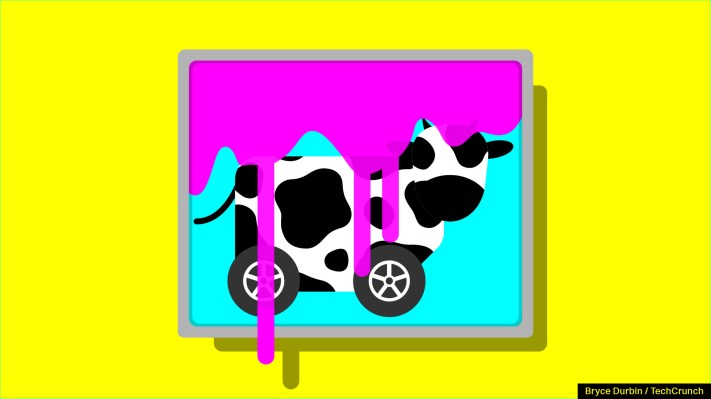
Take, for example, a painting of a cow lounging in a meadow.

“By manipulating and effectively distorting that association, you can make the models think that cows have four round wheels and a bumper and a trunk,” Zhao told TechCrunch. “And when they are prompted to produce a cow, they will produce a large Ford truck instead of a cow.”

The Nightshade team provided other examples, too. An unaltered image of the Mona Lisa and a shaded version are virtually identical to humans, but instead of interpreting the “poisoned” sample as a portrait of a woman, AI will “see” it as a cat wearing a robe.

Prompting an AI to generate an image of a dog, after the model was trained using shaded images that made it see cats, yields horrifying hybrids that bear no resemblance to either animal.
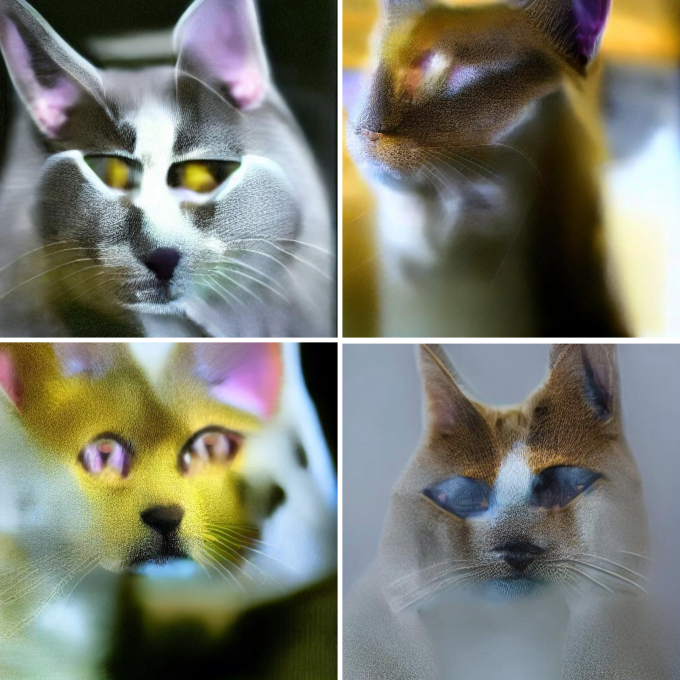
AI-generated hybrid animals

It takes fewer than 100 poisoned images to start corrupting prompts.

The effects bleed through to related concepts, the technical paper noted. Shaded samples that corrupted the prompt “fantasy art” also affected prompts for “dragon” and “Michael Whelan,” who is an illustrator specializing in fantasy and sci-fi cover art.

Zhao also led the team that created Glaze, a cloaking tool that distorts how AI models “see” and determine artistic style, preventing it from imitating artists’ unique work. Like with Nightshade, a person might view a “glazed” realistic charcoal portrait, but an AI model will see it as an abstract painting — and then generate messy abstract paintings when it’s prompted to generate fine charcoal portraits.

Speaking to TechCrunch after the tool launched last year, Zhao described Glaze as a technical attack being used as a defense. While Nightshade isn’t an “outright attack,” Zhao told TechCrunch more recently, it’s still taking the offensive against predatory AI companies that disregard opt outs. OpenAI — one of the companies facing a class action lawsuit for allegedly violating copyright law — now allows artists to opt out of being used to train future models.

“The problem with this [opt-out requests] is that it is the softest, squishiest type of request possible. There’s no enforcement, there’s no holding any company to their word,” Zhao said. “There are plenty of companies who are flying below the radar, that are much smaller than OpenAI, and they have no boundaries. They have absolutely no reason to abide by those opt out lists, and they can still take your content and do whatever they wish.”

Kelly McKernan, an artist who’s part of the class action lawsuit against Stability AI, Midjourney and DeviantArt, posted an example of their shaded and glazed painting on X. The painting depicts a woman tangled in neon veins, as pixelated lookalikes feed off of her. It represents generative AI “cannibalizing the authentic voice of human creatives,” McKernan wrote.

I’m terribly excited to share that “Artifact” has been Glazed and Nightshaded by @TheGlazeProject and what a perfect piece for it as well. This is a painting about generative AI cannibalizing the authentic voice of human creatives. When this image is scraped for training, well… pic.twitter.com/0VNFIyabc2

— Kelly McKernan (@Kelly_McKernan) January 14, 2024

McKernan began scrolling past images with striking similarities to their own paintings in 2022, as AI image generators launched to the public. When they found that over 50 of their pieces had been scraped and used to train AI models, they lost all interest in creating more art, they told TechCrunch. They even found their signature in AI-generated content. Using Nightshade, they said, is a protective measure until adequate regulation exists.

“It’s like there’s a bad storm outside, and I still have to go to work, so I’m going to protect myself and use a clear umbrella to see where I’m going,” McKernan said. “It’s not convenient and I’m not going to stop the storm, but it’s going to help me get through to whatever the other side looks like. And it sends a message to these companies that just take and take and take, with no repercussions whatsoever, that we will fight back.”

Most of the alterations that Nightshade makes should be invisible to the human eye, but the team does note that the “shading” is more visible on images with flat colors and smooth backgrounds. The tool, which is free to download, is also available in a low intensity setting to preserve visual quality. McKernan said that although they could tell that their image was altered after using Glaze and Nightshade, because they’re the artist who painted it, it’s “almost imperceptible.”

Illustrator Christopher Bretz demonstrated Nightshade’s effect on one of his pieces, posting the results on X. Running an image through Nightshade’s lowest and default setting had little impact on the illustration, but changes were obvious at higher settings.

“I have been experimenting with Nightshade all week, and I plan to run any new work and much of my older online portfolio through it,” Bretz told TechCrunch. “I know a number of digital artists that have refrained from putting new art up for some time and I hope this tool will give them the confidence to start sharing again.”

Here is my first test image using Nightshade!
I had it set to the defaults and it took ~12 minutes – about 1/3 of the 30min estimate. I will try higher render qualities next. pic.twitter.com/1VSCWxGmrx

— Christopher Bretz (@saltybretzel) January 19, 2024

And this is at the lowest settings, taking ~11 min. pic.twitter.com/NBefx2zOza

— Christopher Bretz (@saltybretzel) January 20, 2024

Ideally, artists should use both Glaze and Nightshade before sharing their work online, the team wrote in a blog post. The team is still testing how Glaze and Nightshade interact on the same image, and plans to release an integrated, single tool that does both. In the meantime, they recommend using Nightshade first, and then Glaze to minimize visible effects. The team urges against posting artwork that has only been shaded, not glazed, as Nightshade doesn’t protect artists from mimicry.

Signatures and watermarks — even those added to an image’s metadata — are “brittle” and can be removed if the image is altered. The changes that Nightshade makes will remain through cropping, compressing, screenshotting or editing, because they modify the pixels that make up an image. Even a photo of a screen displaying a shaded image will be disruptive to model training, Zhao said.

As generative models become more sophisticated, artists face mounting pressure to protect their work and fight scraping. Steg.AI and Imatag help creators establish ownership of their images by applying watermarks that are imperceptible to the human eye, though neither promises to protect users from unscrupulous scraping. The “No AI” Watermark Generator, released last year, applies watermarks that label human-made work as AI-generated, in hopes that datasets used to train future models will filter out AI-generated images. There’s also Kudurru, a tool from Spawning.ai, which identifies and tracks scrapers’ IP addresses. Website owners can block the flagged IP addresses, or choose to send a different image back, like a middle finger.

Kin.art, another tool that launched this week, takes a different approach. Unlike Nightshade and other programs that cryptographically modify an image, Kin masks parts of the image and swaps its metatags, making it more difficult to use in model training.

Nightshade’s critics claim that the program is a “virus,” or complain that using it will “hurt the open source community.” In a screenshot posted on Reddit in the months before Nightshade’s release, a Discord user accused Nightshade of “cyber warfare/terrorism.” Another Reddit user who inadvertently went viral on X questioned Nightshade’s legality, comparing it to “hacking a vulnerable computer system to disrupt its operation.”

Don’t announce your art is Nightshaded, let it be a little surprise treat 🤗

— Paloma McClain (@palomamcclain) January 19, 2024

Believing that Nightshade is illegal because it is “intentionally disrupting the intended purpose” of a generative AI model, as OP states, is absurd. Zhao asserted that Nightshade is perfectly legal. It’s not “magically hopping into model training pipelines and then killing everyone,” Zhao said — the model trainers are voluntarily scraping images, both shaded and not, and AI companies are profiting off of it.

The ultimate goal of Glaze and Nightshade is to incur an “incremental price” on each piece of data scraped without permission, until training models on unlicensed data is no longer tenable. Ideally, companies will have to license uncorrupted images to train their models, ensuring that artists give consent and are compensated for their work.

It’s been done before; Getty Images and Nvidia recently launched a generative AI tool entirely trained using Getty’s extensive library of stock photos. Subscribing customers pay a fee determined by how many photos they want to generate, and photographers whose work was used to train the model receive a portion of the subscription revenue. Payouts are determined by how much of the photographer’s content was contributed to the training set, and the “performance of that content over time,” Wired reported.

Zhao clarified that he isn’t anti-AI, and pointed out that AI has immensely useful applications that aren’t so ethically fraught. In the world of academia and scientific research, advancements in AI are cause for celebration. While most of the marketing hype and panic around AI really refers to generative AI, traditional AI has been used to develop new medications and combat climate change, he said.

“None of these things require generative AI. None of these things require pretty pictures, or make up facts, or have a user interface between you and the AI,” Zhao said. “It’s not a core part for most fundamental AI technologies. But it is the case that these things interface so easily with people. Big Tech has really grabbed onto this as an easy way to make profit and engage a much wider portion of the population, as compared to a more scientific AI that actually has fundamental, breakthrough capabilities and amazing applications.”

The major players in tech, whose funding and resources dwarf those of academia, are largely pro-AI. They have no incentive to fund projects that are disruptive and yield no financial gain. Zhao is staunchly opposed to monetizing Glaze and Nightshade, or ever selling the projects’ IP to a startup or corporation. Artists like McKernan are grateful to have a reprieve from subscription fees, which are nearly ubiquitous across software used in creative industries.

“Artists, myself included, are feeling just exploited at every turn,” McKernan said. “So when something is given to us freely as a resource, I know we’re appreciative.’

The team behind Nightshade, which consists of Zhao, Ph.D student Shawn Shan, and several grad students, has been funded by the university, traditional foundations and government grants. But to sustain research, Zhao acknowledged that the team will likely have to figure out a “nonprofit structure” and work with arts foundations. He added that the team still has a “few more tricks” up their sleeves.

“For a long time research was done for the sake of research, expanding human knowledge. But I think something like this, there is an ethical line,” Zhao said. “The research for this matters … those who are most vulnerable to this, they tend to be the most creative, and they tend to have the least support in terms of resources. It’s not a fair fight. That’s why we’re doing what we can to help balance the battlefield.”

Kin.art launches free tool to prevent GenAI models from training on artwork

Selkie founder defends use of AI in new dress collection amid backlash

OpenAI unveils a ‘less lazy’ GPT-4 Turbo, price drops, plus new and updated models

Abstract visual

Despite OpenAI continuing to lead the AI race, the company hasn't slowed down its pace of development, continuing to release modifications, upgrades, and even new technology. The latest wave of updates includes highly anticipated changes, including GPT-4 Turbo performance improvements and lower API costs.

On Thursday, OpenAI unveiled a series of updates, including an updated GPT-4 Turbo preview. Despite being the OpenAI's most advanced AI model, GPT-4 Turbo has been the object of many complaints about its performance, including claims that it was acting lazy.

Also: The best AI image generators of 2024: Tested and reviewed

OpenAI has addressed that issue by releasing an updated GPT-4 Turbo preview model, gpt-4-0125-preview, which can better complete tasks such as code generation compared to the previous model. OpenAI said it can even "reduce cases of 'laziness' where the model doesn't complete a task."

The company also shared a status update on the highly anticipated GPT-4 Turbo with Vision, which will be OpenAI's most advanced model yet, sharing that it plans to launch the model for general availability in the coming months.

Next week, OpenAI also will introduce a new GPT-3.5 Turbo model, gpt-3.5-turbo-0125, which will sport "various improvements," according to OpenAI, including higher accuracy at responding in requested formats and a fix for text-encoding bugs for non-English language functions calls.

The prices for GPT-3.5 Turbo will also drop for the third time in the past year, with input prices for the new model being reduced by 50% to $0.0005 per 1,000 tokens, while output prices are reduced by 25% to $0.0015 per 1,000 tokens.

Also: I tried Google's new Art Selfie 2 and could not stop laughing

Tokens are used as the currency for an OpenAI's API to perform a task. The amount of tokens needed to complete a task depends on the length of the input and output and can often rack up quickly if you are using ChatGPT for larger bodies of text. The price drop should help offset the cost of using ChatGPT for these applications.

The last update went to the free Moderation API, which developers can use to identify potentially harmful text. OpenAI released its most robust moderation model, text-moderation-007.

In terms of new models, OpenAI released two new embedding models: the text-embedding-3-small model and the text-embedding-3-large model. Embedding models represent text, natural language, or code as vectors, which helps machine learning models understand the relationships between content.

Artificial Intelligence

Opera to launch new AI-powered browser for iOS in Europe following Apple’s DMA changes

Opera to launch new AI-powered browser for iOS in Europe following Apple’s DMA changes Aisha Malik 10 hours

Opera revealed today that it will launch a new AI-powered browser built on its own engine for iOS in Europe. The Norway-based company announced the change following the news that Apple is going to allow alternative browser engines to run on iOS as a result of the requirements of the European Digital Markets Act (DMA). The changes will allow developers to offer browsers that are not based on the WebKit browser engine.

Apple currently requires third-party browsers to use WebKit, which is the same browser engine that underpins its own Safari browser. In order to comply with the DMA, Apple will begin allowing developers to submit non-WebKit-based browsers, for both web browser apps and for developers offering in-app browsers for displaying web pages within their iOS apps.

Opera says the changes will allow it to provide iPhone users with an AI-powered alternative to Safari.

“As the leading European browser developer, we embrace the changes introduced through the DMA, aimed at fostering competition and offering users a more diverse selection of browsers on iOS,” said Jørgen Arnesen, EVP Mobile at Opera, in a statement. “We intend to deliver on this with the AI-centric Opera One for iOS. Furthermore, we are excited to see the confirmation that Apple will also implement a browser choice screen for iOS, making it easier for users to choose their favorite browser as default also on their mobile devices.”

Arnesen went on to note that Opera is “very excited about the new interoperability request form Apple announced, that will allow developers to submit additional requests for interoperability with iPhone and iOS hardware and software features.”

The new browser is expected to debut in March, which is when the DMA is going to kick in. Given that the changes are only being applied in the European Union, Opera said in a press release that it “strongly encourages Apple to implement these augmented freedoms to iOS users around the globe.”

Opera did not provide any further details about the upcoming browser, but said it will soon be announcing a “major investment” in a key AI infrastructure project in Europe.

Last year, Opera introduced its “Aria” browser AI and redesigned its flagship desktop browser and called it Opera One, which will also be the name of the new iOS browser. At the time, Opera said the new browser has elements that will make it ready for a “generative AI-based future.”

Apple’s answer to EU’s gatekeeper rules is new ‘core tech’ fee for apps