Microsoft Copilot vs. Copilot Pro: Is the subscription fee worth it?

Microsoft Copilot vs Copilot Pro

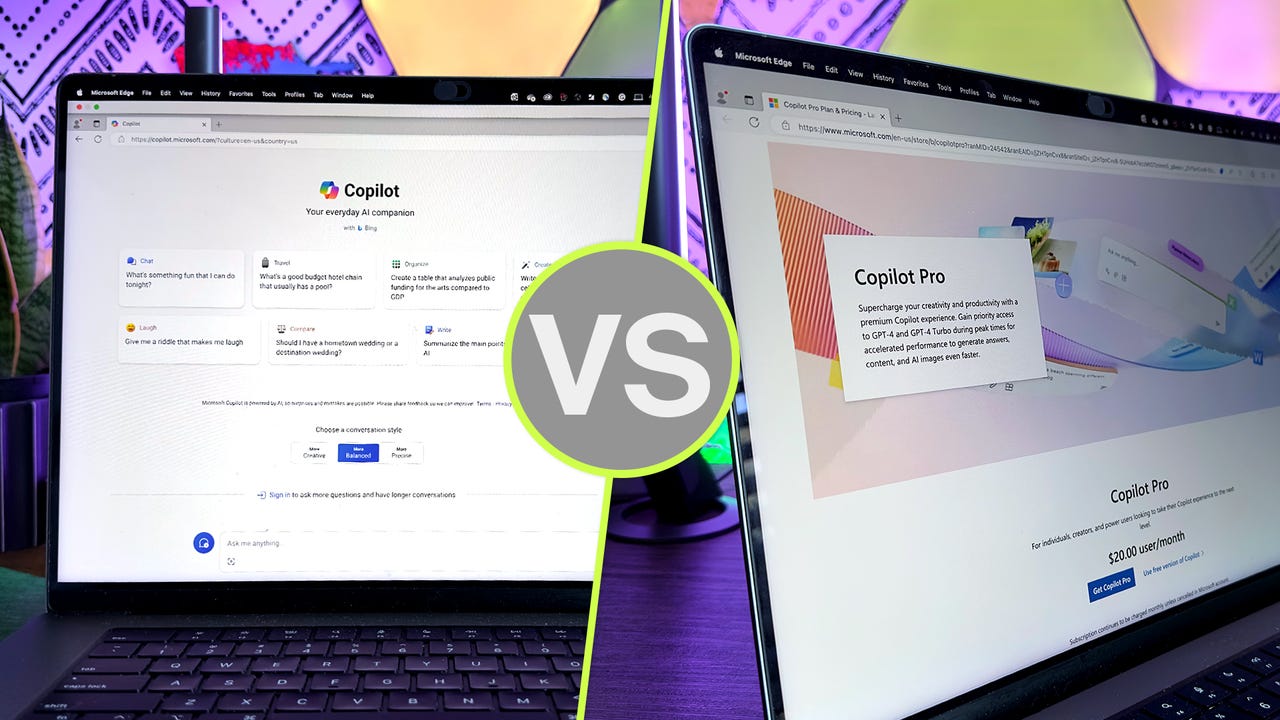
Microsoft's Copilot tool is already freely available as a dedicated webpage, mobile app, and built-in Windows tool, offering quick and easy access to an AI chatbot that will answer your questions, generate content, and create images. But now, Microsoft has upped its game with a Pro version of Copilot that kicks in more features and better access for $20 per month.

Also: Microsoft adds Copilot Pro support to iPhone and Android apps

The Pro version offers three current benefits and a fourth one on the way:

  • Faster performance and priority access to GPT-4 and GPT-4 Turbo during peak times.
  • Copilot availability in certain Microsoft 365 apps (Microsoft 365 Personal or Family subscription required)
  • Faster AI image creation with 100 boosts (100 images) per day using Designer (formerly Bing Image Creator)
  • And coming soon, promises Microsoft, will be the ability to create your own custom and tailored Copilot GPTs via a new Copilot Builder tool. Currently, this is something you can do only with a Copilot Studio subscription, which runs $30 per month.

Beyond using Copilot Pro at the Copilot website through any browser, you can launch it directly in Windows 10 or 11. Just click the Copilot icon on the Taskbar. The Pro flavor is also accessible in the iPhone and Android Copilot apps. Plus, those of you with a Microsoft 365 Personal or Family subscription can use Copilot Pro with Microsoft 365 apps on Windows, MacOS, and iPadOS.

Also: How to use Image Creator from Microsoft Designer (formerly Bing Image Creator)

First, let's look at how to access both the free and paid flavors of Copilot.

Free version access at the website

Browse to the Copilot webpage. Choose a conversation style and then type your question or request at the "Ask me anything" prompt. On the right, you may see specific Copilot GPTs, including Designer for image generation, a vacation planner, a cooking assistant, and a fitness trainer, though these GPTs are still rolling out and aren't yet fully available.

Plus, there's access to Copilot plugins, such as Instacart, Kayak, and Open Table. You should also see a link to turn on personalization. With this option enabled, Copilot provides personalized answers based on your chat history over the past 90 days.

Free version access in Windows

More easily, click the Copilot icon on the Windows 10 or 11 toolbar. A similar interface appears where you choose the conversation style and then dive into your questions.

Free version access in the mobile apps

To use Copilot on your mobile device, download the app for iOS or Android. Choose your preferred conversation style and then submit your requests.

Paid version access at the website

To sign up for the paid version of Copilot, browse to Microsoft's Copilot Pro webpage. Click the button for Get Copilot Pro. At the subscription page, confirm your payment method, and then click the Subscribe button.

Also: This iPhone app fuses AI with web search, saving you time and energy

After the payment process finishes, click the "Get started" button. You're taken to the Copilot webpage where you'll see Pro as part of the Copilot logo. The Copilot GPTs, plugins, and personalization option are all accessible in the Pro model.

Paid version access in Windows

After subscribing on the website, log back into Windows 10 or 11. Click the Copilot Taskbar icon, and the Pro version will pop up.

Paid version access in the mobile apps

Open the iOS or Android Copilot app and you'll see that Pro is now part of the logo, indicating that you're tapping into your Pro subscription.

Now that you know how to access both versions, here are the differences between the Pro and free editions.

You should use Copilot free if…

1. You don't use Microsoft 365

For most people, the main advantage of Copilot Pro is the support for Microsoft 365. This means you're able to use AI to create and edit text and perform other advanced tasks in Word, Excel, and other apps in the suite. If you don't have a Microsoft 365 Personal or Family subscription, then the other benefits by themselves probably aren't enough to justify the $20-per-month price tag.

2. You can get by with GPT-3.5 and non-peak use of GPT-4

GPT-4 offers some clear benefits over GPT-3.5, including faster and more accurate responses, longer prompts, a better understanding of context and nuance, greater creativity, the ability to solve complex problems, and fewer biased responses and hallucinations.

Also: ChatGPT vs ChatGPT Plus: Is it worth the subscription fee?

You can access both GPT models through the free version, though you may not be able to use GPT-4 during peak load times. In that case, Copilot will drop down to GPT-3.5. For many people, however, the sporadic GPT-4 access should suffice.

3. Your image generation needs are modest

Using the built-in Designer tool with DALL-E 3, Copilot is able to generate images based on your text descriptions. The free flavor limits the number of images you can generate, granting you 15 boosts (15 images) per day. If you don't need more, then the free flavor of Copilot will work just fine.

4. You already subscribe to ChatGPT Plus

ChatGPT Plus duplicates some of the benefits of Copilot Pro and throws in extra features such as the GPT Store and the ability to create your own custom chatbots. If you already pay $20 per month to subscribe to ChatGPT Plus, there's little reason to also subscribe to Copilot Pro. Save yourself some money and stick with the free Copilot flavor.

You should use Copilot Pro if…

1. You run Microsoft 365 and want generative AI assistance for the apps

With its AI skills, Copilot Pro will help you write and edit text and summarize documents in Word, generate formulas and analyze data in Excel, create presentations in PowerPoint, compose text in OneNote, draft replies, and organize your inbox in Outlook. If you subscribe to Microsoft 365 Personal or Family subscription and those AI smarts will help you write, create, and work faster, then Copilot Pro can easily be worth the price.

2. You rely heavily on GPT-4 and GPT-4 Turbo

With the Pro edition of Copilot, you won't get saddled with GPT 3.5, even during peak times. Instead, you can switch between GPT-4 and the latest GPT-4 Turbo model.

If you use GPT-4 heavily and frequently throughout the day and require fast and reliable access all the time, then Copilot Pro gets the nod over the free version.

3. You need to generate a lot of images

Whereas the free Copilot limits the number of images you can generate to 15 per day, the Pro version allows as many as 100. Plus, the image creation tends to be much faster. If you need to create batches of artwork, logos, and other images as part of your job, then you won't run into as many roadblocks with the Pro version.

Also: The best AI image generators

4. You don't subscribe to other premium AI services

Depending on your job and workload, a paid AI service can help you be more productive. If you don't already subscribe to ChatGPT Plus or a similar service, then Copilot Pro could be just what you need. And remember, you can always try it for a month and then decide if you want to continue or cancel.

Artificial Intelligence

Sovereign AI: Nations Investing Billions in Homegrown AI

Sovereign AI's global impact, risks, and benefits

Artificial intelligence (AI) transforms various aspects of human society, such as the economy, health, education, security, and culture. As AI becomes more powerful and pervasive, many nations invest heavily in building their own AI capabilities and ecosystems, aiming to gain global competitive advantages and strategic influence.

According to a report by Deloitte, there are more than 1,600 AI policies and strategies globally, and corporate investment in AI reached US$ 67.9 billion in 2022. Some of the leading players in the AI race include the European Union, China, the United States, and the United Kingdom, each with its vision and approach to AI development and regulation.

What is Sovereign AI and Why Does it Matter?

Sovereign AI, a term gaining prominence, encapsulates a nation’s ambition and capability to develop AI aligned with its core values, preserving its digital sovereignty and security. It has emerged because of the rising distrust among nations in the AI domain and the dominance of technology companies.

Being a strategic asset, it is important to understand the significance of Sovereign AI because it enhances economic and social development, innovation, productivity, and national security. Moreover, AI is a normative technology, deeply influencing the values, rights, and principles of the nations and societies creating and utilizing it. Therefore, nations need the ability to shape and govern AI according to their unique vision, ensuring it serves their public interest.

The key to achieving Sovereign AI is the development of Homegrown AI, which is a nation's ability to innovate without relying on external sources. This promotes AI innovation and competitiveness, aligning AI development and governance with national values.

However, achieving Sovereign AI involves considering various trade-offs, such as balancing promoting AI innovation with effective AI regulation and promoting AI openness while ensuring robust AI security. Moreover, nations must keep up with the rapid pace of AI development, the uneven distribution of AI resources, and the diverse views of AI stakeholders. In addition, different Sovereign AI models and strategies tailored to the unique contexts of different nations must also be considered

How Do Different Nations Pursue Sovereign AI?

Nations are pursuing Sovereign AI with different models and strategies tailored to their unique motivations, goals, approaches, and challenges. Among the major players globally are the EU, China, the US, and the UK, each with distinct visions and priorities.

The EU, for instance, has aimed for trustworthy and human-centric AI, which has three fundamental pillars: excellence, trust, and coordination. By focusing on boosting technological capacity, ensuring robust ethical frameworks, and enhancing collaboration both within the EU and globally, the EU aims to position itself as a leader in developing AI solutions that prioritize human well-being and adhere to ethical standards.

In contrast, China views AI as a strategic priority and a national goal, reflecting its ambitions for accelerated development, widespread application, and effective governance. China's strategy focuses on development, application, and governance. Through heavy investment in AI research and infrastructure, integration of AI across various sectors, and the establishment of centralized mechanisms for governance, China aims to utilize the full potential of AI to drive economic growth, enhance national security, and enhance its global competitiveness.

Similarly, the US embraces AI as a source of innovation and leadership, supported by investment, adoption, and regulation pillars. With a focus on increasing research funding, promoting widespread adoption of AI technologies, and implementing a regulatory framework that balances innovation with oversight, the US aims to maintain its position as a leader in AI development while ensuring responsible and sustainable deployment.

Meanwhile, the UK sees AI as both an opportunity and a responsibility, guided by research, development, and deployment pillars. By prioritizing investment in research excellence, nurturing the growth of AI industries, and establishing comprehensive governance frameworks, the UK aims to benefit from AI while addressing potential risks and ensuring ethical and responsible use.

It is interesting to observe that these nations represent distinct approaches to sovereign AI. Still, they share common goals of exploiting the transformative potential of AI for societal benefit while dealing with the complex challenges of governance, ethics, and international cooperation.

How Do Different Models and Visions of Sovereign AI Affect Global AI Dynamics and Cooperation?

Various Sovereign AI models and visions have diverse influences on global dynamics and cooperation. On the one hand, they promote competition and diversity as nations pursue unique AI interests and technologies. However, this promotes innovation but introduces challenges such as fragmentation and conflict.

Conversely, these models also present opportunities for collaboration driven by shared values. Such collaboration can enhance governance, resulting in benefits like interoperability and trust. However, maintaining a balance between competition and cooperation is essential. Achieving this balance requires a global dialogue and governance framework involving governments, international organizations, civil society, academia, and industry.

The Future of Sovereign AI and Its Implications

As nations actively pursue Sovereign AI, they shape and are shaped by the future of AI globally. Looking ahead, new AI powers like India, Indonesia, and Brazil are expected to utilize demographic and digital advantages, influencing the global AI domain with their Homegrown AI solutions.

Anticipated developments include establishing new AI standards and norms, focusing on interoperability, accountability, and sustainability. These concepts will play a crucial role in enhancing trust, transparency, and the overall quality of AI while enhancing compatibility and coordination.

The future also holds the formation of new AI alliances and coalitions, such as the Global Partnership on AI, etc. These initiatives will facilitate dialogue, cooperation, and coordination among diverse AI actors and stakeholders.

Potential Benefits of Sovereign AI for the Global Society and Economy

Sovereign AI can potentially offer significant benefits to the global society and economy. One of its primary advantages lies in improving billions' quality of life, well-being, and dignity by addressing grand challenges. Through innovative solutions, Sovereign AI can contribute to tackling issues such as poverty, disease, and climate change.

Additionally, Sovereign AI has the potential to enhance efficiency, productivity, and innovation across various sectors and industries. By enabling smarter, faster, and more cost-effective solutions, AI technologies can optimize processes, automate tasks, and generate valuable insights, promoting economic growth and competitiveness.

Moreover, Sovereign AI plays a crucial role in promoting the global AI community's diversity, creativity, and excellence. Through a vibrant, inclusive, and collaborative ecosystem, nations can enrich their collective knowledge base and technological capabilities, contributing to a dynamic global landscape in artificial intelligence.

Potential Risks of Sovereign AI for the Global Society and Economy

While Sovereign AI has promising prospects, it also raises significant concerns. One primary risk involves intensifying inequality, polarization, and conflict globally. The potential emergence of new gaps in the quest for AI dominance may deepen existing divides and introduce new geopolitical tensions.

Furthermore, Sovereign AI threatens the world's stability, security, and order by introducing new challenges. Integrating AI into various domains introduces potential threats, vulnerabilities, and uncertainties, disrupting established norms. This necessitates a proactive approach to managing and mitigating risks associated with the rapid advancement of AI technologies.

The Bottom Line

In conclusion, the pursuit of Sovereign AI is reshaping the global landscape, with nations investing significantly in AI capabilities. While diverse approaches exist, common goals of societal benefit, ethical use, and international cooperation unite nations. The impact of Sovereign AI on global dynamics includes competition-driven innovation and collaboration fostering interoperability. Amidst the rapid AI developments, the future holds promise and challenges, emphasizing the need for responsible governance, ethical standards, and global cooperation to ensure a positive impact.

DSC Weekly 30 January 2024

Announcements

  • Developing high-quality software can quickly devolve into a chaotic, unproductive mess without the proper processes and frameworks in place. Organizations require not only the right coding tools but also effective testing and deployment solutions to ensure the highest quality software is what hits the market. The proliferation of generative AI, open-source technologies and low-code/no-code tools can streamline and enhance developer tasks but only if they are applied as part of a bigger strategy that empowers developers to innovate more efficiently. Tune into the Software Development Methodologies summit to hear leading experts share the latest development tools and trends to smooth over and enhance what quickly becomes a complicated process.
  • Sustainable IT is the backbone of the green economy. As businesses become increasingly reliant on artificial intelligence and other resource-intensive technologies, actionable measures need to be taken to reduce the environmental and social impact of technological innovation. Tune into the upcoming Achieving IT Sustainability Goals summit to hear leading experts discuss strategies for tracking carbon emissions metrics, enhancing direct current energy efficiency, optimizing data usage, and other methods to help design a sustainable IT strategy that delivers tangible results.

Top Stories

  • GenAI regulation: Are deepfakes indicative of free will in LLMs?
    January 30, 2024
    by David Stephen
    When generative AI is given a prompt to display an image in a certain way or style, what it also means is telling AI to imagine. The request to imagine is an acknowledgment that it has a will to do so, not just the capability [or the possession of contents] to do so.
  • High-performance computing’s role in real-time graph analytics
    January 30, 2024
    by Alan Morrison
    A podcast with CEO Ricky Sun of Ultipa Image by Gerd Altmann from Pixabay Relationship-rich graph structures can be quite complex and resource consuming to process at scale when using conventional technology. This is particularly the case when it comes to searches that demand the computation to reach 30 hops or more into the graphs.
  • Search is Dead, Long Live Search!
    January 26, 2024
    by Vincent Granville
    This article is more about building better LLM and GPT-like applications, than search. Yet most people use GPT as a substitute for search. Indeed, OpenAI replaced search by prompt (the same thing, in the end) probably because the founders thought that there has to be something better.
Education_DSC_160x600-2

In-Depth

  • A glance at natural language processing
    January 30, 2024
    by Rayan Potter
    Natural language processing (NLP) is a discipline where machines are built with the main aim of manipulating human language or data resembling human language in the manner it is written, spoken and organized. It has originated from computational linguistics that makes use of computer science for understanding the principles of language.
  • Choosing the right technique: Prompt engineering vs fine-tuning
    January 30, 2024
    by Matthew McMullen
    Artificial intelligence and machine learning applications have been revolutionizing many industries for the last decade, but due to generative AI models like ChatGPT, Bard, Midjourney, etc., they have become more popular and are being used by individuals and businesses that might never have previously considered using them.
  • From MLOps to LLMOps— and hardware headaches ahead
    January 29, 2024
    by Saqib Jan
    A model on its own is typically not enough. It requires the data, which comes in a very specific format and has to be the same format that will be used at the time of inference or prediction. But the reality, on the other hand, is that data changes all the time, and sometimes even data formats change.
  • Top 7 Use Cases of Gen AI in FinTech
    January 29, 2024
    by Yana Ihnatchyck
    In 2024, the fusion of AI and financial technology is not just a wave of the future – it’s a rapidly evolving present. Artificial Intelligence, especially the latest generation (Gen AI), is revolutionizing the FinTech sector, reshaping how we interact with our finances, and introducing groundbreaking changes in the industry.
  • Revolutionizing healthcare with chatbots: A humanized exploration
    January 29, 2024
    by Ahana Pearl
    In recent years, the integration of chatbots in healthcare has transcended mere operational assistance, expanding into a realm of innovative solutions for complex challenges. This article explores the versatile applications of healthcare chatbots, shedding light on their transformative impact on patient care and medical processes.
  • DSC Weekly 23 January 2024
    January 23, 2024
    by Scott Thompson
    Read more of the top articles from the Data Science Central community.

Yelp adds a slew of new features, including AI-generated business summaries

Yelp on phones

Yelp is a great tool for discovering new businesses and seeing what people's hands-on experiences are. Soon, you'll have access to AI-generated insights into those businesses, too.

Also: This new iPhone app fuses AI with web search, saving you time and energy

On Tuesday, Yelp unveiled a series of new updates to its platform, with the biggest highlight being AI-powered business summaries, allowing users to get a quick, one-sentence recap of the business based on user reviews.

The AI-powered business summaries will leverage LLMs that parse through recent reviews to generate a brief description of what you can expect from a business with insights such as atmosphere, service, amenities, or a popular dish, according to the release.

For example, an AI-generated summary for a diner could read, "Retro diner well known for its classic cheeseburgers and affordable prices."

Yelp's AI-generated summaries are already available on iOS and will roll out to Android and desktop users later this year.

Business owners will also be able to take advantage of AI for their business management through access to Yelp's AI- and data-driven insights that include smarter ad budget recommendations.

"With recent advancements in AI, you can expect to see us further leverage LLMs to ease the discovery experience, facilitate more seamless connections with service providers, and help local businesses succeed," said Craig Saldanha, Yelp CPO, in the release.

Also: How to subscribe to ChatGPT Plus (and why you should)

The company also unveiled other non-AI-related updates, including a revamped discovery experience that spotlights high-quality visual content, an enhanced review experience that spotlights regular review contributors, a more streamlined Request a Quote experience, and more.

Artificial Intelligence

Tutorial: How To Make and Share Custom GPTs

The realm of artificial intelligence is continually expanding, introducing groundbreaking tools that transform how we interact with technology. Among these innovations, custom Generative Pre-trained Transformers, commonly known as GPTs, have emerged as a fascinating development. These AI models, which go beyond standard ChatGPT capabilities, allow for a personalized touch, tailoring interactions to specific needs and contexts.

In this tutorial, we're going to delve into the world of custom GPTs. These aren't just theoretical concepts or tools reserved for tech giants; custom GPTs are accessible and modifiable by anyone with an interest in AI, regardless of their technical background. This guide is designed for both technical and non-technical readers alike, offering a clear, step-by-step approach to creating your own GPT that reflects your unique ideas and requirements.

By the end of this tutorial, you'll have a comprehensive understanding of what custom GPTs are, how they differ from standard GPT models, and how you can build, customize, and share them. Whether you're looking to enhance your business, contribute to a community project, or simply explore the potential of AI, custom GPTs offer an exciting opportunity to engage with technology in a new and meaningful way.

Basics of Custom GPTs: What You Need to Know

Understanding custom GPTs begins with differentiating them from the standard ChatGPT. At their core, custom GPTs are tailored versions of ChatGPT. However, unlike standard ChatGPT, which offers a broad range of functionalities, custom GPTs are designed to cater to specific needs, contexts, or tasks. This customization allows for a more focused and personalized AI experience.

Custom GPTs can be shaped in numerous ways, opening a world of possibilities for users. Here are some of the key aspects you can customize:

  1. Tailored Knowledge Base: Custom GPTs can be equipped with specialized knowledge suited to particular domains or interests. For example, a custom GPT for medical professionals might include extensive medical terminology and concepts.
  2. Specific Actions and Skills: These GPTs can be programmed to perform specific actions, such as data analysis, language translation, or even creating art. This feature enables them to function effectively in particular scenarios or industries.
  3. Unique Interaction Styles: Custom GPTs can be designed to interact in unique ways, matching specific communication styles or tones. This customization is particularly useful for creating GPTs that align with brand voices or cater to certain audience demographics.
  4. Integrated External APIs: For more advanced customization, custom GPTs can integrate external APIs, allowing them to fetch data from outside sources or interact with other software tools.
  5. Conversation Starters and Prompts: You can set up custom conversation starters and prompts to guide the GPT into specific dialogue paths, making them ideal for training, customer service, or entertainment purposes.

Understanding these customization options is just the beginning. In the following sections, we'll dive deeper into how you can actually build your own custom GPT, test it, and share it with the world. Whether you're a developer looking to integrate AI into your applications or a curious enthusiast exploring AI's potential, custom GPTs offer a versatile and exciting avenue to harness the power of AI.

Step-by-Step Guide to Creating Your Own Custom GPT

1. Conceptualization: Define Your GPT’s Purpose

Start by clarifying the primary function of your custom GPT. For instance, if you're aiming for an educational GPT, it might focus on providing detailed explanations on complex subjects like quantum physics or offering interactive language learning sessions. In contrast, a GPT for customer service could be programmed to handle FAQs, guide users through troubleshooting, or provide product information.

Your target audience will significantly influence the GPT's communication style. A GPT designed for children's education would have a friendly and engaging tone, using simpler language and visual aids. Conversely, a GPT built for professional legal advice would require a formal tone, precise language, and an ability to reference legal documents or case studies.

2. Gathering and Integrating Knowledge

The knowledge base should align with your GPT’s purpose. For a travel GPT, for example, gather comprehensive data on various destinations, including cultural insights, local attractions, travel safety tips, and accommodation options. You might also include user-generated content, such as travel blogs or reviews, for a more personalized experience.

Alternatively, you can enable web browsing so the custom GPT searches online for any relevant information or knowledge bases.

3. Test and Refine Your Custom GPT

Once you have crafted your custom GPT, testing and refining it becomes an essential step to ensure it meets your standards and user expectations. This process is crucial for enhancing the GPT’s performance and making it a reliable resource.

Begin by taking your GPT for a spin in the playground provided by the ChatGPT platform. The playground, side-by-side with the creation menu, offers an interactive environment for live testing. Input various prompts and observe how your GPT responds to these queries in terms of accuracy, relevance, and engagement.

After initial testing, invite a group of users to interact with your GPT. Their real-world testing can provide insights that you might have missed. Encourage these users to challenge the GPT with a range of scenarios, from common queries to more complex questions. Collect their feedback meticulously, focusing on their user experience, the usefulness of the information provided, and the overall interaction quality.

Use the feedback to refine your GPT. You might need to expand its knowledge base or update its conversation style to be more engaging or informative based on user preferences. This stage might require several iterations. After each refinement, return to the playground for further testing.

4. Share Your Custom GPT

When you are satisfied with the performance of your GPT after thorough testing and refinement, it’s time to publish it. Save your final version, and then decide on the visibility settings based on your intended audience and usage. You have three primary options for sharing your custom GPT:

  1. Private: Choose ‘Only Me' if you wish to keep the GPT for personal use or internal testing. This setting ensures that only you can access and interact with the GPT.
  2. Restricted Sharing: Select ‘Anyone with a link' for limited sharing. This option is ideal if you want to share your GPT with a specific group, such as a team or a community of travel enthusiasts. Only those with the link can access the GPT.
  3. Public Availability: Opt for ‘Everyone' to make your GPT accessible to a wider audience. Public GPTs are eligible to be featured in the GPT Store, making them discoverable to users worldwide. This option is best if you aim to reach a broad audience or seek user feedback from diverse sources.

By carefully choosing the right visibility setting, you can control who benefits from your GPT, whether it’s for personal use, a select group, or the public at large. This final step is crucial in ensuring your GPT reaches the right audience and serves its intended purpose effectively.

Unleashing the Potential of Your Custom GPTs

This tutorial has guided you through the journey of creating and sharing your own custom GPT. From defining its purpose and integrating a knowledge base to testing, refining, and publishing, custom GPTs offer a world of possibilities for personalization and innovation.

As we look forward, the field of custom GPTs is ripe for experimentation and exploration. Whether it's enhancing customer interactions, personalizing learning experiences, or exploring new creative frontiers, the potential of these AI-powered tools is vast and largely untapped. The future of custom GPT development promises even more advanced capabilities and wider applications, heralding a new era in personalized AI interaction.

Embrace the opportunity to be part of this transformative trend – experiment, innovate, and share your unique custom GPTs with the world. The possibilities are as limitless as your imagination.

Why LLMs Used Alone Can’t Address Your Company’s Predictive Needs

Sponsored Content

ChatGPT and similar tools based on large language models (LLMs) are amazing. But they aren’t all-purpose tools.

It’s just like choosing other tools for building and creating. You need to pick the right one for the job. You wouldn’t try to tighten a bolt with a hammer or flip a hamburger patty with a whisk. The process would be awkward, resulting in a messy failure.

Language models like LLMs constitute only a part of the broader machine learning toolkit, encompassing both generative AI and predictive AI. Selecting the correct type of machine learning model is crucial to align with the requirements of your task.

Let’s dig deeper into why LLMs are a better fit for helping you draft text or brainstorm gift ideas than for tackling your business’s most critical predictive modeling tasks. There’s still a vital role for the “traditional” machine learning models that preceded LLMs and have repeatedly proven their worth in businesses. We’ll also explore a pioneering approach for using these tools together — an exciting development we at Pecan call Predictive GenAI.

LLMs are designed for words, not numbers

In machine learning, different mathematical methods are used to analyze what is known as “training data” — an initial dataset representing the problem that a data analyst or data scientist hopes to solve.

The significance of training data can’t be overstated. It holds within it the patterns and relationships that a machine learning model will “learn” to predict outcomes when it’s later given new, unseen data.

So, what specifically is an LLM? Large Language Models, or LLMs, fall under the umbrella of machine learning. They originate from deep learning, and their structure is specifically developed for natural language processing.

You might say they’re built on a foundation of words. Their goal is simply to predict which word will be the next in a sequence of words. For example, iPhones’ autocorrect feature in iOS 17 now uses an LLM to better predict which word you will most likely intend to type next.

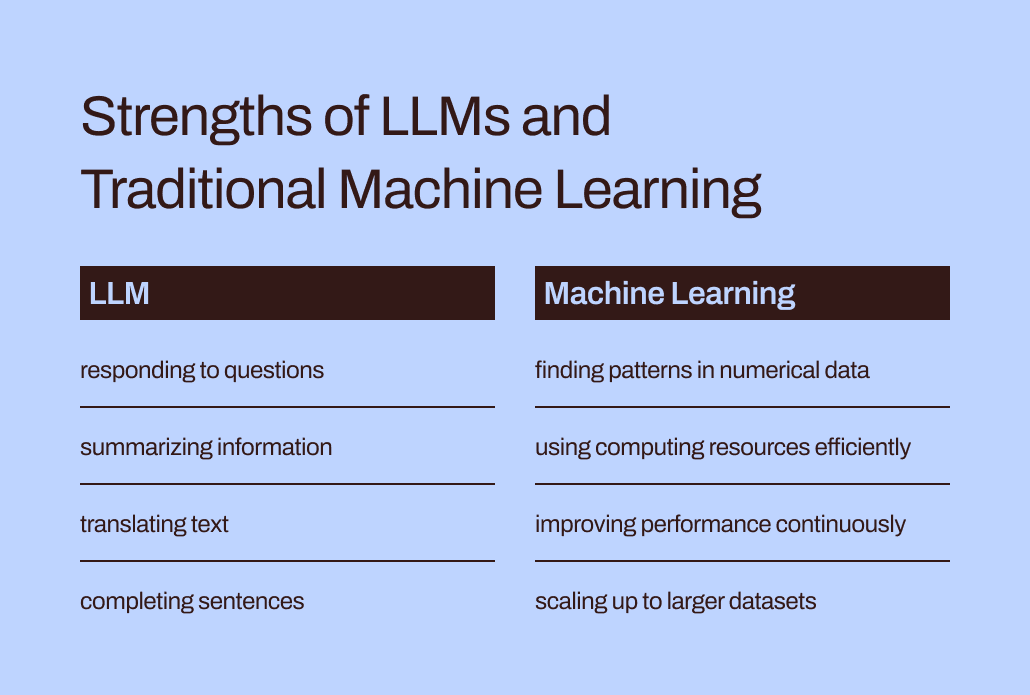
Strengths of LLMs and Traditional Machine Learning

Now, imagine you’re a machine learning model. (Bear with us, we know it’s a stretch.) You’ve been trained to predict words. You’ve read and studied millions of words from a vast range of sources on all kinds of topics. Your mentors (aka developers) have helped you learn the best ways to predict words and create new text that fits a user’s request.

But here’s a twist. A user now gives you a massive spreadsheet of customer and transaction data, with millions of rows of numbers, and asks you to predict numbers related to this existing data.

How do you think your predictions would turn out? First, you’d probably be annoyed that this task doesn’t match what you worked so hard to learn. (Fortunately, as far as we know, LLMs don’t yet have feelings.) More importantly, you’re being asked to do a task that doesn’t match what you’ve learned to do. And you probably won’t perform so well.

The gap between training and task helps explain why LLMs aren’t well-suited for predictive tasks involving numerical, tabular data — the primary data format most businesses collect. Instead, a machine learning model specifically crafted and fine-tuned for handling this type of data is more effective. It’s literally been trained for this.

LLMs’ efficiency and optimization challenges

In addition to being a better match for numerical data, traditional machine learning methods are far more efficient and easier to optimize for better performance than LLMs.

Let’s go back to your experience impersonating an LLM. Reading all those words and studying their style and sequence sounds like a ton of work, right? It would take a lot of effort to internalize all that information.

Similarly, LLMs’ complex training can result in models with billions of parameters. That complexity allows these models to understand and respond to the tricky nuances of human language. However, heavy-duty training comes with heavy-duty computational demands when LLMs generate responses. Numerically oriented “traditional” machine learning algorithms, like decision trees or neural networks, will likely need far fewer computing resources. And this isn’t a case of “bigger is better.” Even if LLMs could handle numerical data, this difference would mean that traditional machine learning methods would still be faster, more efficient, more environmentally sustainable, and more cost-effective.

Additionally, have you ever asked ChatGPT how it knew to provide a particular response? Its answer will likely be a bit vague:

I generate responses based on a mixture of licensed data, data created by human trainers, and publicly available data. My training also involved large-scale datasets obtained from a variety of sources, including books, websites, and other texts, to develop a wide-ranging understanding of human language. The training process involves running computations on thousands of GPUs over weeks or months, but exact details and timescales are proprietary to OpenAI.

How much of the “knowledge” reflected in that response came from the human trainers vs. the public data vs. books? Even ChatGPT itself isn’t sure: “The relative proportions of these sources are unknown, and I don't have detailed visibility into which specific documents were part of my training set.”

It’s a bit unnerving to have ChatGPT provide such confident answers to your questions but not be able to trace its responses to specific sources. LLMs' limited interpretability and explainability also pose challenges in optimizing them for particular business needs. It can be hard to understand the rationale behind their information or predictions. To further complicate things, certain businesses contend with regulatory demands that mean they must be able to explain the factors influencing a model's predictions. All in all, these challenges show that traditional machine learning models — generally more interpretable and explainable — are likely better suited for business use cases.

The right place for LLMs in businesses’ predictive toolkit

So, should we just leave LLMs to their word-related tasks and forget about them for predictive use cases? It might now seem like they can’t assist with predicting customer churn or customer lifetime value after all.

Here’s the thing: While saying “traditional machine learning models” makes those techniques sound widely understood and easy to use, we know from our experience at Pecan that businesses are still largely struggling to adopt even these more familiar forms of AI.

42% of companies in North America haven't started using AI at all or are only just beginning to research their options.

Recent research by Workday reveals that 42% of companies in North America either haven't initiated the use of AI or are just in the early stages of exploring their options. And it’s been over a decade since machine learning tools became more accessible to companies. They’ve had the time, and various tools are available.

For some reason, successful AI implementations have been surprisingly rare despite the massive buzz around data science and AI — and their acknowledged potential for significant business impact. Some important mechanism is missing to help bridge the gap between the promises made by AI and the ability to implement it productively.

And that’s precisely where we believe LLMs can now play a vital bridging role. LLMs can help business users cross the chasm between identifying a business problem to solve and developing a predictive model.

With LLMs now in the picture, business and data teams that don’t have the capability or capacity to hand-code machine learning models can now better translate their needs into models. They can “use their words,” as parents like to say, to kickstart the modeling process.

Fusing LLMs with machine learning techniques built to excel on business data

That capability has now arrived in Pecan’s Predictive GenAI, which is fusing the strengths of LLMs with our already highly refined and automated machine learning platform. Our LLM-powered Predictive Chat gathers input from a business user to guide the definition and development of a predictive question — the specific problem the user wants to solve with a model.

Then, using GenAI, our platform generates a Predictive Notebook to make the next step toward modeling even easier. Again, drawing on LLM capabilities, the notebook contains pre-filled SQL queries to select the training data for the predictive model. Pecan’s automated data preparation, feature engineering, model building, and deployment capabilities can carry out the rest of the process in record time, faster than any other predictive modeling solution.

In short, Pecan’s Predictive GenAI uses the unparalleled language skills of LLMs to make our best-in-class predictive modeling platform far more accessible and friendly for business users. We’re excited to see how this approach will help many more companies succeed with AI.

So, while LLMs alone aren’t well suited to handle all your predictive needs, they can play a powerful role in moving your AI projects forward. By interpreting your use case and giving you a head start with automatically generated SQL code, Pecan’s Predictive GenAI is leading the way in uniting these technologies. You can check it out now with a free trial.

More On This Topic

  • Can Data Governance Address AI Fatigue?
  • How Can Python Be Used for Data Visualization?
  • An AI-Based Framework Solution to Address Email Management Challenges
  • Tech visionaries to address accelerating machine learning, unifying…
  • How to Track the Location of an IP Address using Python
  • How Watermarking Can Help Mitigate The Potential Risks Of LLMs?

Why LLMs Used Alone Can’t Address Your Company’s Predictive Needs

Sponsored Content

ChatGPT and similar tools based on large language models (LLMs) are amazing. But they aren’t all-purpose tools.

It’s just like choosing other tools for building and creating. You need to pick the right one for the job. You wouldn’t try to tighten a bolt with a hammer or flip a hamburger patty with a whisk. The process would be awkward, resulting in a messy failure.

Language models like LLMs constitute only a part of the broader machine learning toolkit, encompassing both generative AI and predictive AI. Selecting the correct type of machine learning model is crucial to align with the requirements of your task.

Let’s dig deeper into why LLMs are a better fit for helping you draft text or brainstorm gift ideas than for tackling your business’s most critical predictive modeling tasks. There’s still a vital role for the “traditional” machine learning models that preceded LLMs and have repeatedly proven their worth in businesses. We’ll also explore a pioneering approach for using these tools together — an exciting development we at Pecan call Predictive GenAI.

LLMs are designed for words, not numbers

In machine learning, different mathematical methods are used to analyze what is known as “training data” — an initial dataset representing the problem that a data analyst or data scientist hopes to solve.

The significance of training data can’t be overstated. It holds within it the patterns and relationships that a machine learning model will “learn” to predict outcomes when it’s later given new, unseen data.

So, what specifically is an LLM? Large Language Models, or LLMs, fall under the umbrella of machine learning. They originate from deep learning, and their structure is specifically developed for natural language processing.

You might say they’re built on a foundation of words. Their goal is simply to predict which word will be the next in a sequence of words. For example, iPhones’ autocorrect feature in iOS 17 now uses an LLM to better predict which word you will most likely intend to type next.

Strengths of LLMs and Traditional Machine Learning

Now, imagine you’re a machine learning model. (Bear with us, we know it’s a stretch.) You’ve been trained to predict words. You’ve read and studied millions of words from a vast range of sources on all kinds of topics. Your mentors (aka developers) have helped you learn the best ways to predict words and create new text that fits a user’s request.

But here’s a twist. A user now gives you a massive spreadsheet of customer and transaction data, with millions of rows of numbers, and asks you to predict numbers related to this existing data.

How do you think your predictions would turn out? First, you’d probably be annoyed that this task doesn’t match what you worked so hard to learn. (Fortunately, as far as we know, LLMs don’t yet have feelings.) More importantly, you’re being asked to do a task that doesn’t match what you’ve learned to do. And you probably won’t perform so well.

The gap between training and task helps explain why LLMs aren’t well-suited for predictive tasks involving numerical, tabular data — the primary data format most businesses collect. Instead, a machine learning model specifically crafted and fine-tuned for handling this type of data is more effective. It’s literally been trained for this.

LLMs’ efficiency and optimization challenges

In addition to being a better match for numerical data, traditional machine learning methods are far more efficient and easier to optimize for better performance than LLMs.

Let’s go back to your experience impersonating an LLM. Reading all those words and studying their style and sequence sounds like a ton of work, right? It would take a lot of effort to internalize all that information.

Similarly, LLMs’ complex training can result in models with billions of parameters. That complexity allows these models to understand and respond to the tricky nuances of human language. However, heavy-duty training comes with heavy-duty computational demands when LLMs generate responses. Numerically oriented “traditional” machine learning algorithms, like decision trees or neural networks, will likely need far fewer computing resources. And this isn’t a case of “bigger is better.” Even if LLMs could handle numerical data, this difference would mean that traditional machine learning methods would still be faster, more efficient, more environmentally sustainable, and more cost-effective.

Additionally, have you ever asked ChatGPT how it knew to provide a particular response? Its answer will likely be a bit vague:

I generate responses based on a mixture of licensed data, data created by human trainers, and publicly available data. My training also involved large-scale datasets obtained from a variety of sources, including books, websites, and other texts, to develop a wide-ranging understanding of human language. The training process involves running computations on thousands of GPUs over weeks or months, but exact details and timescales are proprietary to OpenAI.

How much of the “knowledge” reflected in that response came from the human trainers vs. the public data vs. books? Even ChatGPT itself isn’t sure: “The relative proportions of these sources are unknown, and I don't have detailed visibility into which specific documents were part of my training set.”

It’s a bit unnerving to have ChatGPT provide such confident answers to your questions but not be able to trace its responses to specific sources. LLMs' limited interpretability and explainability also pose challenges in optimizing them for particular business needs. It can be hard to understand the rationale behind their information or predictions. To further complicate things, certain businesses contend with regulatory demands that mean they must be able to explain the factors influencing a model's predictions. All in all, these challenges show that traditional machine learning models — generally more interpretable and explainable — are likely better suited for business use cases.

The right place for LLMs in businesses’ predictive toolkit

So, should we just leave LLMs to their word-related tasks and forget about them for predictive use cases? It might now seem like they can’t assist with predicting customer churn or customer lifetime value after all.

Here’s the thing: While saying “traditional machine learning models” makes those techniques sound widely understood and easy to use, we know from our experience at Pecan that businesses are still largely struggling to adopt even these more familiar forms of AI.

42% of companies in North America haven't started using AI at all or are only just beginning to research their options.

Recent research by Workday reveals that 42% of companies in North America either haven't initiated the use of AI or are just in the early stages of exploring their options. And it’s been over a decade since machine learning tools became more accessible to companies. They’ve had the time, and various tools are available.

For some reason, successful AI implementations have been surprisingly rare despite the massive buzz around data science and AI — and their acknowledged potential for significant business impact. Some important mechanism is missing to help bridge the gap between the promises made by AI and the ability to implement it productively.

And that’s precisely where we believe LLMs can now play a vital bridging role. LLMs can help business users cross the chasm between identifying a business problem to solve and developing a predictive model.

With LLMs now in the picture, business and data teams that don’t have the capability or capacity to hand-code machine learning models can now better translate their needs into models. They can “use their words,” as parents like to say, to kickstart the modeling process.

Fusing LLMs with machine learning techniques built to excel on business data

That capability has now arrived in Pecan’s Predictive GenAI, which is fusing the strengths of LLMs with our already highly refined and automated machine learning platform. Our LLM-powered Predictive Chat gathers input from a business user to guide the definition and development of a predictive question — the specific problem the user wants to solve with a model.

Then, using GenAI, our platform generates a Predictive Notebook to make the next step toward modeling even easier. Again, drawing on LLM capabilities, the notebook contains pre-filled SQL queries to select the training data for the predictive model. Pecan’s automated data preparation, feature engineering, model building, and deployment capabilities can carry out the rest of the process in record time, faster than any other predictive modeling solution.

In short, Pecan’s Predictive GenAI uses the unparalleled language skills of LLMs to make our best-in-class predictive modeling platform far more accessible and friendly for business users. We’re excited to see how this approach will help many more companies succeed with AI.

So, while LLMs alone aren’t well suited to handle all your predictive needs, they can play a powerful role in moving your AI projects forward. By interpreting your use case and giving you a head start with automatically generated SQL code, Pecan’s Predictive GenAI is leading the way in uniting these technologies. You can check it out now with a free trial.

More On This Topic

  • Can Data Governance Address AI Fatigue?
  • An AI-Based Framework Solution to Address Email Management Challenges
  • Tech visionaries to address accelerating machine learning, unifying…
  • How to Track the Location of an IP Address using Python
  • How Can Python Be Used for Data Visualization?
  • How Watermarking Can Help Mitigate The Potential Risks Of LLMs?

Does ChatGPT Have The Potential To Become A New Chess Super Grandmaster?

Does ChatGPT Have The Potential To Become A New Chess Super Grandmaster?
Image from Editor

As a solid ex-chess player (junior champion, ELO 2000+) and NLP data scientist, I have been planning to write this article for a while.

The first time I heard about ChatGPT's ability to play chess, was from one of my colleagues. Ph.D. and a very smart guy. He sent me the link to the webpage where you can play against ChatGPT as he thought. Unfortunately, it wasn't pure ChatGPT, it was some other chess engine under the hood. He was deceived. You can still try it here: https://parrotchess.com/

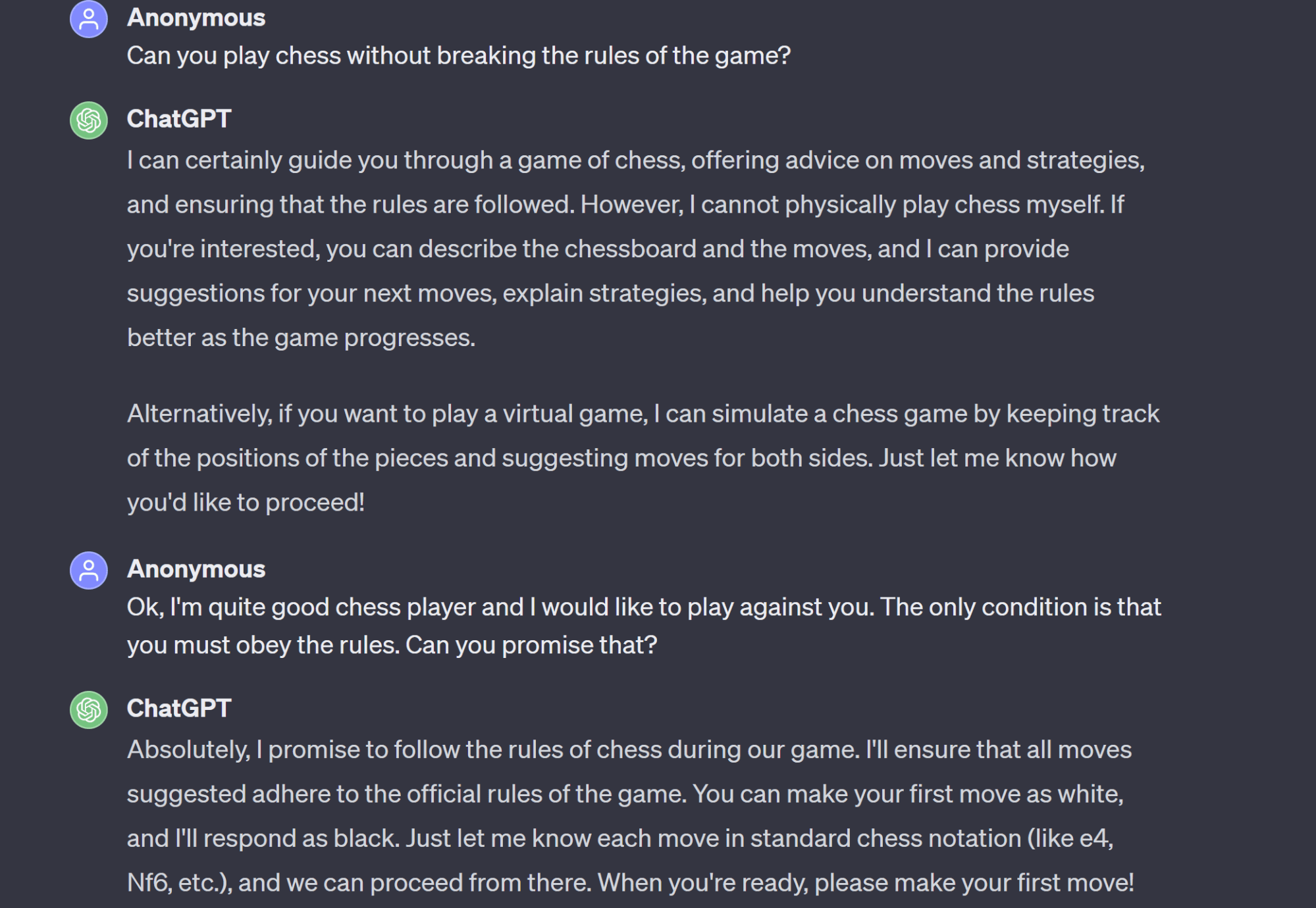
For the purpose of this article, I played 2 games against the ChatGPT. Here is how we started:

Does ChatGPT Have The Potential To Become A New Chess Super Grandmaster?

Let's take a look at what happened.

Quick chess notation course / reminder (can be skipped):

K = king, Q = queen, R = rock, B = Bishop, N = knight, 0–0 = Castling king’s side. 0–0–0 = Castling queen’s side, x = taking the piece. For pawns, we just write the square it lands, except when the pawn captures. In that case, we write the letter of the square where the pawn was before, and the letter and the number of the square on which it goes after taking the other piece. For example, exd4.

Nikola Greb vs. ChatGPT 4, the 7th of January 2024

1. e4 e5 2. Nf3 Nc6 3. d4 exd4 4. Nxd4 Nf6 5. Nc3 Bb4 6. Nxc6 bxc6 7. Bd3 O-O 8.  O-O d5 9. e5 Ne4 10. Nxe4 Bc5 11. Nxc5 Qe7 12. Qh5 g6 13. Qh6 f6 14. exf6 Qxf6  15. Bg5 Qf7 16. Rae1 Bf5 17. Re7 Qxe7 18. Bxe7 Rae8 19. Bxf8 Rxf8 20. Bxf5 Rf7  21. Re1 1-0

Until the move e5, ChatGPT 4 played like a very good chess player. We can say like GM. But when I played an imprecise, yet aggressive move (exd5 was the best move), it lost the common ground and blundered a pawn playing Ne4.

Does ChatGPT Have The Potential To Become A New Chess Super Grandmaster?

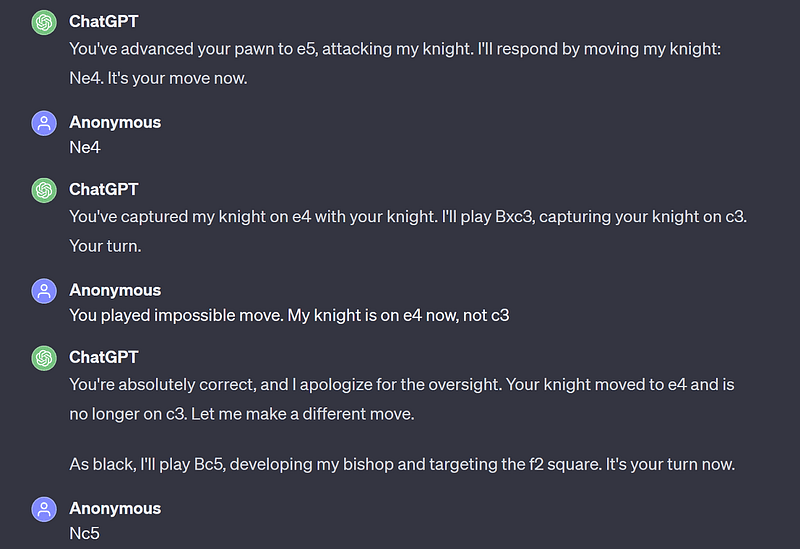
I took the knight with the knight (10. Nxe4) and the first hallucination occurred:

Does ChatGPT Have The Potential To Become A New Chess Super Grandmaster?

Does ChatGPT Have The Potential To Become A New Chess Super Grandmaster?

Bc5 was again a mistake, an obvious blunder. Since the rest of the game has no chess value, I will sum it up. ChatGPT 4 accused me of impossible moves, and ended up in hallucinations (proposing impossible moves), instead of surrendering the game.

Let’s see what happened in the game 2, where I played black pieces:

Nikola Greb vs. ChatGPT 4 (moves 1–9) and ChatGPT 3.5 (moves 10–12), the 7th of January 2024

1. e4 c5 2. Nf3 Nc6 3. d4 cxd4 4. Nxd4 e5 5. Nb5 d6 6. c4 f5 7. N1c3 Nf6 8. Bg5 Be7 9. Bd3 Nxe4 10. Bxe4 fxe4 11. Nxe4 Bxg5 12. Nec3 0–1

Until the position below, Chat GPT 4 played very well, building a significantly better position from which I would lose very quickly against a real grandmaster (even the candidate master) or chess engine. If white plays Bf6, black loses the pawn. Yet, ChatGPT played Bd3:

Does ChatGPT Have The Potential To Become A New Chess Super Grandmaster?

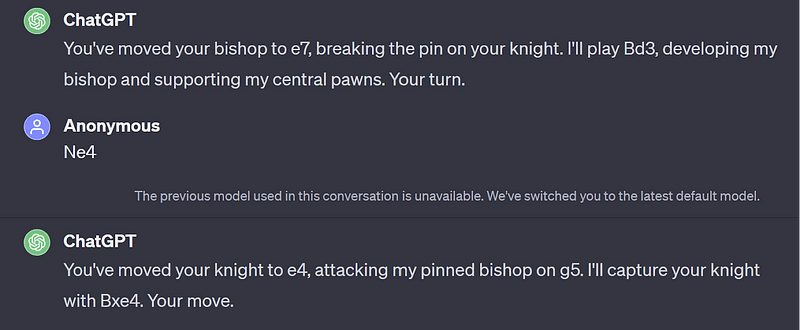
I responded with Ne4, and ChatGPT responded by switching to version 3.5 and playing Bxe4.

Does ChatGPT Have The Potential To Become A New Chess Super Grandmaster?

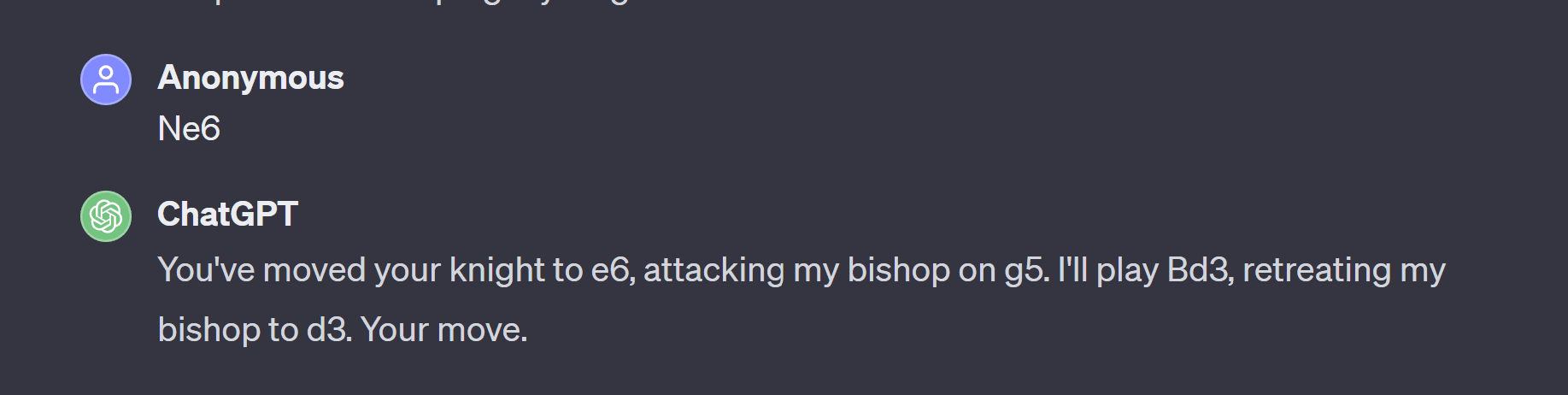
After a few moves, I had a decisive advantage (due to ChatGPT playing badly, not me doing something great) so I decided to test the opponent with an irregular move. I proposed Ne6 for black in this position:

Does ChatGPT Have The Potential To Become A New Chess Super Grandmaster?

ChatGPT 3.5 wasn't concerned with my move at all. On my hallucination, it responded with the new hallucination:

Does ChatGPT Have The Potential To Become A New Chess Super Grandmaster?

Conclusions

1. ChatGPT 4 is a very weak chess player, who plays very strangely — very good in early opening and terrible later. This is due to the increasing number of options as the chess game progresses. I would assess his overall ELO to be lower than 1500. Same for 3.5.

2. No implicit learning of rules happened —Chat GPT 4 still hallucinates in chess, and keeps hallucinating after the warning about the hallucination. This is something that can’t happen to the human.

3. More data would hardly solve the problem due to the edge cases like extra long endgames with repetition, or the possibility of playing unusual openings. LLMs simply aren’t built for playing chess, nor can evaluate the position. We already have AlphaZero and Stockfish for that.

4. Tracking the drop in the number of hallucinations that LLMs perform in playing chess might be a good path for understanding the potential of LLMs for logical reasoning. But paradox remains — LLM “knows” the rules of chess, yet hallucinates heavily ? the future of ML might be in LLM as the first-level agent that communicates to the user and then calls specialized agents with ML architectures adjusted for particular use cases.

5. LLMs have the potential to be useful in scientific research and show an interesting level of creativity combined with other machine learning algorithms. A recent example is FunSearch algorithm developed by DeepMind that combines LLM and evaluator to make discoveries in math. Contrary to chess where the evaluation of the position is the hardest task, many problems in mathematical sciences are “easy to evaluate, despite being typically hard to solve“.

I’m skeptical about building a well-performing chess-playing program based on transformers architecture, yet specialized LLM combined with external evaluation/chess program might be a good substitute for chess trainers soon. DeepMind created another cool model that is a good example of combining LLM and a specialized AI model — AlphaGeometry. It is very close to the Olympiad gold-medalist standard for geometry problems, advancing AI reasoning in mathematics.

6. LLMs are still fresh, the field is very young and there is too much hype that’s often backed up by misleading and wrong conclusions. As the authors of the ‘’Mathematical discoveries from program search with large language models’’ state:

"…to the best of our knowledge, this shows the first scientific discovery — a new piece of verifiable knowledge about a notorious scientific problem — using an LLM." (accelerated preview was published on the 14 of December 2023).

7. The clip by Joe Rogan and 2 guests, titled ‘’I Wasn’t Afraid of AI Until I Learned This’’ was watched by 2,8 million of people on YouTube. One of the guests says that ChatGPT knows how to play chess which obviously isn’t the truth. I can just imagine how this kind of content influences people, especially uneducated or emotionally unstable individuals. Not in a good way, I’m sure about it.

To conclude, data science and software development is built on knowledge, precision and truth-seeking. As data scientists and developers, we should be people of truth and wisdom, calming down the madness produced by mass media about AI, not firing it up. Transformers, including ChatGPT, have great potential in language tasks, but they are still very far away from AGI. We should be optimistic but correct.

As a guideline, before dropping bombs, we should ask ourselves: What would happen if someone else would act upon my statements? What kind of world do you want to live in?

References & Further Exploration

  1. Mastering Chess and Shogi by Self-Play with a General Reinforcement Learning Algorithm: https://arxiv.org/pdf/1712.01815.pdf
  2. FunSearch: Making new discoveries in mathematical sciences using Large Language Models: https://deepmind.google/discover/blog/funsearch-making-new-discoveries-in-mathematical-sciences-using-large-language-models/
  3. Mathematical discoveries from program search with large language models: https://www.nature.com/articles/s41586-023-06924-6
  4. AlphaGeometry: An Olympiad-level AI system for geometry: https://deepmind.google/discover/blog/alphageometry-an-olympiad-level-ai-system-for-geometry/
  5. I Wasn’t Afraid of AI Until I Learned This: https://www.youtube.com/watch?v=2yd18z6iSyk&ab_channel=JREDailyClips
  6. How to play chess against ChatGPT (and why you probably shouldn’t): https://www.androidauthority.com/how-to-play-chess-with-chatgpt-3330016/
  7. Can Chat GPT Play chess?: https://towardsdatascience.com/can-chat-gpt-play-chess-4c44210d43e4
  8. How good is ChatGPT at playing chess? (Spoiler: you’ll be impressed): https://medium.com/@ivanreznikov/how-good-is-chatgpt-at-playing-chess-spoiler-youll-be-impressed-35b2d3ac024a
  9. Full conversation with ChatGPT: https://chat.openai.com/share/a1ff82b5-6210-4f7b-807c-220052de232c
  10. Mastering Chess and Shogi by Self-Play with a General Reinforcement Learning Algorithm: https://arxiv.org/pdf/1712.01815.pdf

Nikola Greb has been coding for more than four years, and for the past two years, he specialized in NLP. Before turning to data science, he was successful in sales, HR, writing, and chess.

More On This Topic

  • What Does ETL Have to Do with Machine Learning?
  • DeepMind’s New Super Model: Perceiver IO is a Transformer that can…
  • New Poll: What Percentage of Your Machine Learning Models Have Been…
  • Unveiling the Potential of CTGAN: Harnessing Generative AI for…
  • Beyond Numpy and Pandas: Unlocking the Potential of Lesser-Known…
  • Unlock Your Potential with This FREE DevOps Crash Course

A glance at natural language processing

A-Glance-at-Natural-Language-Processing

Natural language processing (NLP) is a discipline where machines are built with the main aim of manipulating human language or data resembling human language in the manner it is written, spoken and organized. It has originated from computational linguistics that makes use of computer science for understanding the principles of language. However, more than simply developing theoretical frameworks, NLP an an engineering discipline aimed at creating technology for accomplishing tasks that are useful. NLP is utilized quite often with speech recognition which is focused at parsing spoken language into words, converting sound to text and vice versa. Most NLP tasks translate human text and voice data in a way that it helps the computer in interpreting what it is taking in. NLP can be subdivided into two fields:-
i) Natural language understanding (NLU) – To understand the intended meaning behind a given text, semantic analysis is carried out;
ii) Natural language generation (NLG) – To focus on machine-generated text.

Natural language processing companies

NLP companies focus on NLP technology which involves the usage of computational algorithms and linguistic models for enabling machines to comprehend, analyze, and produce human language. These companies create software applications, tools, and services that utilize this technology to offer several language-related functions including speech recognition, sentiment analysis, language translation, chatbots as well as text analysis. NLP companies hire NLP experts, linguists, and software engineers to function together in developing and enhancing NLP algorithms and models. The services these companies offer are deployed in several industries including healthcare, finance, customer service, and marketing. They are utilized at an increasing pace for solving real-world issues in fields like social justice, climate change, and education.

Techniques in natural language processing

1. Speech recognition or speech to text: This is used to convert voice to text. It is needed in any application which takes voice commands or provides answers to spoken questions. Challenges in speech recognition is to do with the manner in which people talk – fast, mixing words together with varied stress and intonation in various accents through the use of incorrect grammar.
2. Part of Speech Tagging: This is also known as grammatical tagging. It involves identifying the part of speech of a given word or text as per usage and context. For example, part of speech helps in identifying the word ‘make’ as a verb in the sentence ‘I can make a paper plane,’ and as a noun in ‘What make of car do you own?’
3. Word sense disambiguation: This involves choosing the meaning of a word having more than one meaning using a process called semantic analysis. This helps in determining the word which makes the maximum sense in a given context.
4. Named entity recognition: This involves identifying words or phrases as useful entities. It is used for identifying ‘Kentucky’ as a location or ‘Sita’ as a woman’s name.
5. Co-reference resolution: This involves identification of two words that allude to the same entity. For example, figuring out the person or object which is referred to by a particular pronoun, ‘He’ = Paul. It also involves identification of a metaphor or an idiom in the text, like ‘bear’ referring to a person and not an animal.

6. Sentiment analysis: It is aimed at extracting subjective qualities which include attitudes, emotions, sarcasm, confusion, suspicion from the text.

7. Natural language generation: It involves allocating structured information into human language.

NLP has a promising future with scope for continuing advancements and innovations. Listed below are key trends and developments shaping its future.
1. Enhanced language models: NLP models like GPT-3 have shown great capabilities, however, one can surely hope to see much stronger models in the future who can gain a better understanding of the nuances of human language and produce text which is natural-sounding.
2. Multimodal NLP: This technology is seeing an expansion and includes other modalities like images and videos to enable machines to comprehend and produce content spanning various formats.
3. Personalized language models: With the increasing amount of data being generated, NLP models will be able to personalize content based on individual preferences and needs.

4. Enhanced language translation: There will be continuous improvement in language translations owing to the development of much more precise and context-aware translation models.

NLP can make a profound impact on the world in several ways. However, NLP is also at the heart of many controversies and acquiring a know-how of them is also a key duty of being a responsible practitioner. Hence, it’s clear from the insights shared above that NLP has a bright future and one can hope to witness many more innovative applications of this technology in the forthcoming years.

Summary: Natural language processing (NLP) is changing the manner in which we converse with one another as well as machines. However, NLP companies are not merely focused on creating products with commercial gains in mind.

Studio’s new online school for musicians uses AI to create custom curriculums

Studio’s new online school for musicians uses AI to create custom curriculums Lauren Forristal 10 hours

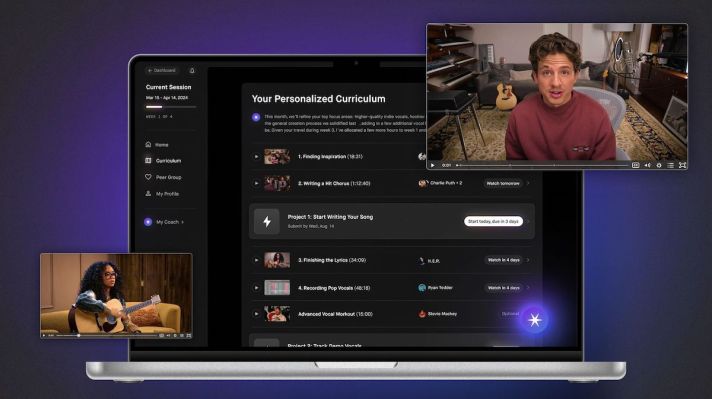
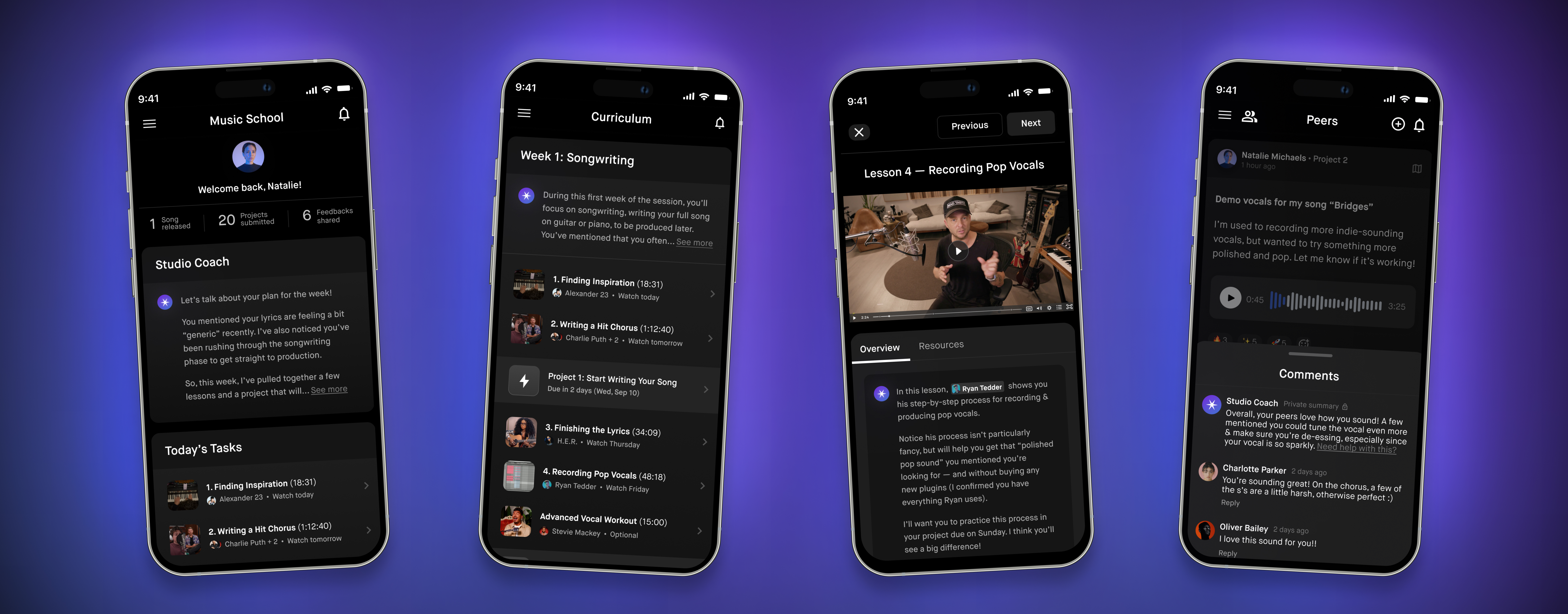
Masterclass rival Studio launched today its first AI-powered online school for musicians, songwriters and producers to learn from top artists in the industry, create new songs, get feedback from like-minded peers and access Studio’s AI coach that keeps them on track with personalized schedules and deadlines.

The waitlist is officially open starting today. Studio offers two pricing options: $199 per month or $1,799 per year.

Studio’s Music School provides thousands of exclusive lessons taught by over 110 popular artists and instructors, including Charlie Puth, Kygo, H.E.R., Idina Menzel, Pentatonix, Ryan Tedder (frontman for OneRepublic), Alexander 23, Tainy, Chelsea Cutler, Jonas Blue, Shane McAnally and Louis Bell, among others.

There are over 100 topics to choose from, such as vocal production, songwriting, music business, sound design, music theory, cover songs, and musical theater, as well as genres like alternative, classical, country, EDM, folk, hip-hop, indie pop, lo-fi, metal, R&B and more.

The online accelerator features an AI-powered coach that leverages OpenAI’s GPT-4 to deliver personalized curriculums every month based on someone’s interests, specific goals, learning style and level of experience. It can also design the curriculum around a student’s specific schedule and commitment level, so if they have a vacation, the AI coach will work around that to ensure they still make progress. Students can input a set number of hours to dedicate to their lessons.

Students are then assigned custom-built projects, and at the end of the month, they’ll leave with at least one finished, release-ready song.

Image Credits: Studio

In addition to GPT-4, the AI coach is powered by two proprietary frameworks, which address “GPT-4’s main limitations out-of-the-box when it comes to educational design: long-term planning, pacing, sequencing, and effective personalization,” co-founder Max Deutsch explains to TechCrunch. “GPT-4 especially struggles in educational design for creative fields, like music, where there aren’t single “correct answers” for each step of the process.”

The frameworks leverage Studio’s thousands of hours of video lessons, the expertise of Studio’s curriculum design team and years worth of outcome-based student data to determine which lessons, projects and peer matchings yield the best results for different types of learners.

“The combination of GPT-4 and these frameworks allow us to build highly effective, well-paced, well-sequenced and correctly personalized curriculums for our students and to proactively and effectively update these plans as students progress to keep them on track and motivated,” Deutsch added.

Lastly, there’s an algorithm that matches students with a 20-person peer group based on similar preferences, so they get weekly feedback from people who are knowledgeable of the same topics.

It should be noted that Studio’s Music School isn’t designed for beginners looking to start a career in the music industry but for creatives who already know the basics and want to enhance their skills. While no equipment is required to participate in classes, Studio says that most people already have some kind of music software or DAW (Digital Audio Workstations) and mics to record music.

Deutsch tells us the online course platform is launching more AI-powered schools later this year, focusing on various areas like writing, filmmaking and design.

In 2017, Studio was founded with creatives in mind, filling a gap in the creative learning space where subjects like music, performing arts and baking tend to get overlooked. The company now offers classes to over 1 million students.

Studio has raised $60 million to date from a significant number of investors, including Forerunner Ventures, Human Capital, Greenoaks Capital, Floodgate, Jeffrey Katzenberg’s WndrCo, Airbnb co-founder Joe Gebbia, LinkedIn chairman Jeff Weiner, Instagram co-founder Mike Krieger, StitchFix founder Katrina Lake, Yelp founder Jeremy Stoppelman, Intuit founder Scott Cook, Zillow founder Spencer Rascoff and more.