Twin Labs automates repetitive tasks by letting AI take over your mouse cursor

Twin Labs automates repetitive tasks by letting AI take over your mouse cursor Romain Dillet @romaindillet / 8 hours

Meet Twin Labs, a Paris-based startup that wants to build an automation product for repetitive tasks, such as onboarding new employees to all your internal services, reordering items when you’re running out of stock, downloading financial reports across several SaaS products, reaching out to potential propects and more.

“Twin’s starting point is a science-fiction idea. We saw the development of the technical capabilities of LLMs — foundation models. And the question we asked ourselves was whether we’d be able to duplicate ourselves by training an AI agent on the way we perform our tasks,” Twin Labs co-founder and CEO Hugo Mercier told me.

In Twin Labs’ case, the most interesting thing isn’t what they’re doing — improving internal processes — but how they’re doing it. The company relies on multimodal models with vision capabilities, such as GPT-4 with Vision (GPT-4V), to replicate what humans usually do.

Before landing on multimodal models, Twin Labs first tried to develop autonomous agents using traditional LLMs. “We’ve tested lots of things, we’ve implemented research papers, we’ve tested open-source GitHub repositories. Overall, the conclusion is that LLMs are completely unreliable. This means that LLMs are making the wrong decisions,” Mercier said. “In the end, the task isn’t done.”

According to him, GPT-4V has been trained on a lot of different software interfaces and the underlying code bases, which unlocked new possibilities. “When you show an interface, it understands the feature behind the button,” Mercier said.

Unlike Zapier and other automation products, Twin Labs doesn’t rely on APIs and designing complicated multi-step processes. Instead, Twin Labs is more like a web browser. The tool can automatically load web pages, click on buttons and enter text.

For instance, if you’re hiring someone, you might need to add this person’s information in your payroll system, send an invitation to Slack, create a Google Workspace account and invite your new employee to create an account with the healthcare insurance provider.

Companies usually keep a long list of tasks and just go through the list every time there’s a new team member. These tasks aren’t complicated but it’s extremely important to do them well, in the right order and with some specific checkboxes ticked. That’s why it’s going to be important to be able to train Twin Labs’ AI assistant using screen recording and natural language descriptions.

But the startup isn’t there yet — it is working toward this vision. Hugo Mercier and Joao Justi, the two co-founders, spent the last six months building a prototype of this product. They also raised $3 million in pre-seed funding from Betaworks, Motier Ventures and many angel investors, such as Florian Douetteau (Dataiku), Thomas Wolf (HuggingFace), Charles Gorintin (Alan), Mehdi Ghissassi (Deepmind), Romain Huet (OpenAI), Irwan Bello (OpenAI), Romuald Elie (Deepmind), Yan-David Erlich (Weight & Biases), Olivier Pomel (Datadog), Rodolphe Saadé (CMA CGM), Thibaud Elziere (Hexa), Quentin Nickmans (Hexa), Philippe Corrot (Mirakl) and Rand Hindi (Snips, Zama).

There are still many challenges ahead for Twin Labs’ autonomous agent system. For example, completing a task costs quite a bit of money — but API and infrastructure costs are rapidly going down in the AI space. Twin Labs will first ship a product with a library of pre-trained tasks to make sure that they work well. After that, the startup expects that it will open up its platform so that clients can create their own tasks.

While many people associate AI products with a chatbot interface, Twin Labs’ approach is interesting as it’s an innovative way to interact with AI models. “We really wanted to get down to the nitty-gritty of what people do on a day-to-day basis, and how we can take over some of the things that are actually a bit of a hassle for them,” Mercier said.

Check Point Software Launches AI Tool for Cybersecurity

Cybersecurity firm Check Point Software Technologies recently announced the launch of an AI-powered tool for cybersecurity. Called Infinity AI Copilot, it accelerates security administration by saving up to 90% of the time required for tasks such as event analysis, implementation, and troubleshooting.

Security professionals can focus more on strategic innovation. The platform efficiently manages and deploys security policies, automatically applying access rules.

It enhances incident mitigation and response through AI-powered threat hunting and analysis. AI Copilot oversees all products within the Check Point Infinity Platform, ensuring comprehensive security across networks, cloud, and workspaces.

Additionally, its natural language processing capabilities facilitate seamless interaction, understanding, and execution of tasks through chat, providing users with a human-like conversational experience.

“With Infinity AI Copilot, we are ushering in a new era of cyber security where human-machine collaboration takes centre stage. Our vision is to enable security teams to work in harmony with AI, unlocking unprecedented efficiency and accuracy. We believe in a future where security is no longer a challenge but a seamless part of every organisation’s operations,” said Eyal Manor, VP of Product Management at Check Point Software Technologies.

The post Check Point Software Launches AI Tool for Cybersecurity appeared first on Analytics India Magazine.

Databricks Acquires AI-powered Data Visualisation Platform Einblick 

The data lakehouse provider Databricks today announced it has acquired the team behind Einblick, a provider of a natural language data science notebook that purports to allow enterprise users to ‘solve any data problem with just one sentence’.

“We look forward to integrating Einblick’s innovative, AI-native approach directly into the Databricks platform. This integration will empower organizations to democratize data intelligence and foster the creation of the next generation of data and AI applications with quality, speed, and agility. Stay tuned in the coming months to hear more about our joint plans,” the company said in its blog post.

Databricks praised Einblick’s capabilities saying “The Einblick team has pioneered state-of-the-art techniques for translating natural language questions into the code, charts, and models needed to generate insights. This not only requires applying the latest generative modeling capabilities but also involves highly optimizing them for data-related questions”.

Founded in 2019 by Emanuel Zgraggen, Philipp Eichmann and others, Einblick was an early innovator harnessing the power of natural language as a foundational UI principle. The company aims to enable everyone to make an impact through data, not opinions.

“We’re thrilled to welcome Emanuel, Philipp and the talented Einblick team to Databricks. Like us, they believe that organizations need to deeply leverage data and AI to be successful in this new age”, said Databricks.

This marks the fourth acquisition by Databricks in the past 12 months, adding to a series that began with the purchase of data replicator Arcion for $100 million in autumn 2023. Prior to that, the company acquired Mosiac ML in an impressive $1.3 billion deal, and the data governance platform Okera, the financial details of which remain undisclosed.

Databricks didn’t disclose the price tag for which it acquired Einblick. Nevertheless, it’s evident that this strategic move is aimed at enhancing and expanding Databricks’ portfolio, positioning itself as the comprehensive solution for enterprises’ data storage and analysis requirements.

The post Databricks Acquires AI-powered Data Visualisation Platform Einblick appeared first on Analytics India Magazine.

Maximizing Efficiency in Data Analysis with ChatGPT

Maximizing Efficiency in Data Analysis with ChatGPT
Image by Editor

With data becoming the most valuable business asset, data analysis plays a crucial role in organizational decision-making. Companies need to inspect, transform thoroughly, and model data to discover helpful information and aid decision-making.

As organizations have to deal with increasing volumes of data, analyzing them has become a challenging task. In such a scenario, ChatGPT's ability to be a part of the data analysis process is a valuable asset.

ChatGPT can comprehend and generate human-like text to assist you with querying datasets, generating code snippets, and interpreting results. So, when organizations integrate this advanced language model into the data analysis process, it streamlines the workflows and enhances its efficiency.

This article explores the process, challenges, and case studies associated with seamlessly incorporating ChatGPT into the data analysis workflow. Let’s get started with the definition and functionality of ChatGPT in brief.

What is ChatGPT and What Can It Do?

ChatGPT has become a household name in the tech world and beyond in the last 1 year. It is a language model developed based on the GPT-3.5 architecture by OpenAI. Here, GPT stands for "Generative Pre-trained Transformer". Basically, this is an artificial intelligence model that can understand input provided by humans and generate human-like text in response to that.

ChatGPT can perform an array of tasks. Some of these are:

  • Understand the natural language used by humans
  • Understand the context of a discussion
  • Generate coherent yet diverse responses to various prompts
  • Translate from one language to another
  • Answer questions based on its training knowledge resources
  • Generating code snippets and explanations
  • Writing stories and poems based on prompts

People from almost all professions can utilize these features of ChatGPT to make their personal and professional lives easy.

The Importance of Efficiency in Data Analysis

Real-Time Decision-Making

In any business context that needs instant decision-making, efficient data analysis is a must. It allows organizations to quickly extract meaningful data insights, ensuring timely and informed decision-making.

Resource Optimization

All the business resources are precious, including manpower and time. Efficient data analysis can streamline the analysis process so that your valuable resources are used wisely.

Stay Ahead of the Competitors

By analyzing data, companies can get actionable insights that help them stay ahead of the competition.

Enhanced Productivity

If the data analysis process becomes efficient, it reduces the time and effort needed for analysts to generate insights. This not only enhances their productivity but also allows them to focus on more complex and strategic tasks.

Improved Accuracy

Efficient data analysis methodologies are useful for data validation and quality checks. As a result, you get accurate results, reducing the chances of error that might arise from an inefficient analysis process.

The Features of ChatGPT Relevant to Data Analysis

Advanced Data Analysis

This is an exclusive feature of ChatGP-4. This allows users to directly upload data to the platform for writing and testing code. If you do not have access to it, here is how you can get the paid ChatGPT plan for free.

Solving Problems

If you ever encounter roadblocks in your data analysis process, ChatGPT can suggest troubleshooting solutions for problems related to data, algorithms, or analytical approaches.

Understanding Natural Language

Since ChatGPT can understand natural language text, users can interact with this model using plain language. In fact, it is one of the most requested ChatGPT features.

Explaining Concept

ChatGPT can explain data analysis concepts, statistical methods, and ML techniques in a language that is easy to understand. Users looking to learn the fundamentals of data analysis can leverage it.

Brainstorming Ideas

Even for brainstorming sessions for data analysis strategies, ChatGPT can assist with hypotheses, experimental designs, or ways to approach complex data problems.

Assisting with Tools

ChatGPT can also guide you in using different data analysis tools or platforms. It is a useful resource for explaining the functionality of a tool.

Helping with Documentation

ChatGPT can help explain methodologies, document code, and write documentation for data analysis projects.

Interpreting Data

ChatGPT is capable of interpreting the results of analyzed data. It can tell you about the implications of statistical findings and ML predictions.

The Advantages of Using AI and NLP in Data Analytics

  • Automated insights extraction from unstructured data sources
  • Enhanced natural language interaction for querying and reporting
  • Improved efficiency and speed in data processing and analysis
  • Sentiment analysis and context-based data interpretation
  • Language translation for the analysis of multilingual data
  • Intensify decision-making processes with AI recommendations
  • Enables automated document processing for large datasets
  • Trend analysis and pattern recognition

How To Integrate ChatGPT Into the Data Analysis Workflow

Here is how you can incorporate ChatGPT in your data analysis workflow. This may or may not involve integrating it into a data analytics tool.

Determine Specific Use Cases

Depending on your industry and organizational needs, you need to define the situations where you want to use ChatGPT. It could be natural language querying, code assistance, data interpretation, or collaborative communication. Only choose the sectors where ChatGPT can add value.

Choose Integration Points

If you want to incorporate ChatGPT into your data analysis workflow, determine where it would be the most beneficial. You can include it at the data exploration stage, during code writing, or for output data interpretation.

Select Interaction Methods

Then, you need to select how the users will interact with ChatGPT. You may choose to integrate it with your data analysis tool or use it through a web interface. Also, you may use it through the ChatGPT API. Implementing API can be done by making API calls. Detailed OpenAI documentation on how to make API requests and handle responses is available.

User Training and Guidelines

Once these are done, you must teach the users how to interact with ChatGPT for effective data analysis. Create a guideline that states its limitations and best practices for obtaining accurate responses for the particular use case. There should also be strict rules for security and privacy implications while handling sensitive data. This will ensure the interaction with ChatGPT complies with data privacy regulations.

Evaluate and Improve

You should regularly evaluate the performance of ChatGPT in the data analysis workflow. Always look for ways to optimize its effectiveness to make the most of it. You can also gather user feedback to find out about any challenges that users might face.

Use Cases of ChatGPT in Data Analysis

Code Assistance

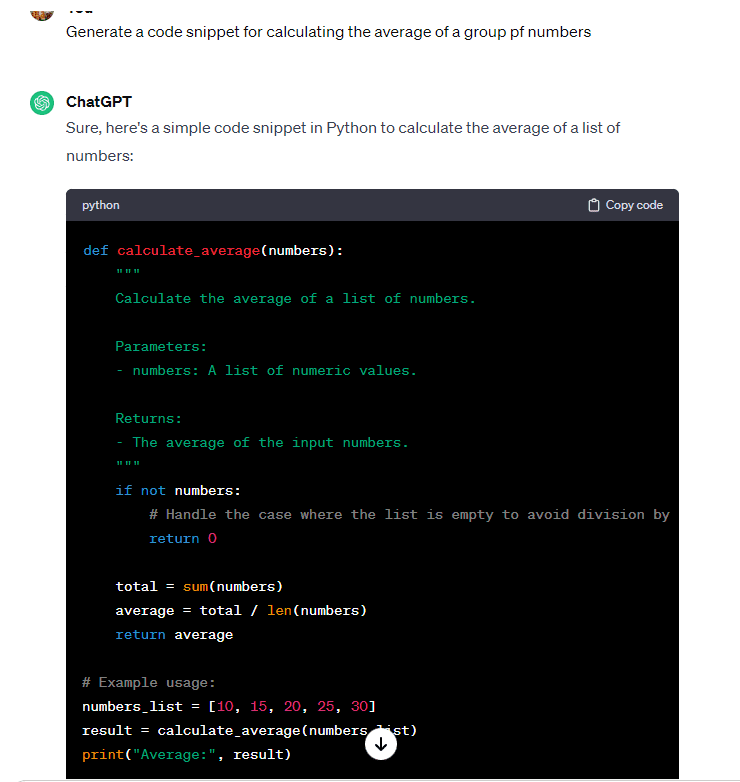
You can use ChatGPT to get help with coding tasks. For example, you can ask it to generate a code snippet for a particular data analysis task, and ChatGPT will do that.
Maximizing Efficiency in Data Analysis with ChatGPT

Natural Language Queries

ChatGPT can be used to process natural language queries for data analysis. You may ask it to summarize a dataset or filter data based on criteria.

Interpretation of Results

One critical use case of ChatGPT is result interpretation. Asking ChatGPT to perform statistical analysis or converting insights into patterns will save you time and effort.

Exploratory Data Analysis (EDA)

Using ChatGPT for exploratory data analysis means getting assistance for understanding data and formulating hypotheses. It can provide you with guidance on data transformations and crucial variables to examine.

Sentiment Analysis

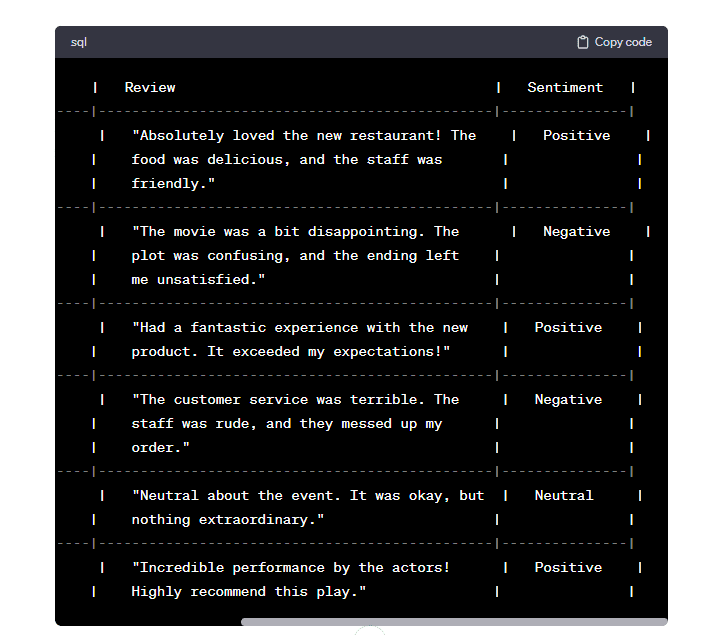
You can ask ChatGPT to analyze your customers' sentiments from a dataset. For example, you can provide user feedback, and it will tell you whether the feedback is positive, negative, or neutral.
Maximizing Efficiency in Data Analysis with ChatGPT How to Overcome Challenges in Integrating ChatGPT in Data Analysis

If you are planning to integrate ChatGPT in data analysis, it is wise to be aware of the challenges that may come your way and methods to overcome them.

Reliability

ChatGPT does not guarantee you to provide 100% accurate data. It is the biggest challenge of implementing this language model into the data analysis process. To avoid this, you need to verify the accuracy of information provided by ChatGPT through cross-referencing responses with known data or a feedback loop for users.

Understanding Context

If you provide complex or highly specialized contexts to ChatGPT for data analysis, it may struggle to understand. So, while interacting with ChatGPT, you must provide as much context as possible, that too in simpler, more explicit language.

Managing Ambiguity

ChatGPT may need to process ambiguous queries or complex requirements during data analysis. Users can get rid of this problem by becoming more specific in their queries or adding more details.

Data Privacy and Security

If you want ChatGPT to analyze data, it might include sharing sensitive and private raw data with this model. To overcome this, you must use data anonymization techniques to mask the sensitive data.

Final Thoughts

Understandably, Artificial Intelligence (AI) is able to enhance data analytics efficiency by automating complex tasks and extracting valuable insights from large volumes of datasets. As this technology continues to evolve, ChatGPT can have a groundbreaking impact on data analytics.

The NLP of this model can generate code snippets, interact with data, and provide contextual insights. In the future, ChatGPT is expected to possess domain-specific knowledge that will enable it to perform more nuanced interactions with the data of various industries.

For data analytics, it will be able to offer bespoke solutions for specific analytical tasks. Users might use it collaboratively with data analytics platforms fostering a more dynamic approach to problem-solving. One thing is for sure ChatGPT will play its role in democratizing data analytics and making it accessible to a broader range of users.

Vijay Singh Khatri Graduate in Computer Science, specializing in Programming and Marketing. I am very fond of writing tech articles and creating new products.

More On This Topic

  • How To Calculate Algorithm Efficiency
  • Efficiency Spells the Difference Between Biological Neurons and…
  • Elevate Math Efficiency: Navigating Numpy Array Operations
  • Calculate Computational Efficiency of Deep Learning Models with…
  • Noteable Plugin: The ChatGPT Plugin That Automates Data Analysis
  • 5 Ways You Can Use ChatGPT Vision for Data Analysis

AI in 2024: Major Developments & Innovations

Feature Image for AI 9n 2024

Every technology goes through an evolutionary arc, triggering the breakout moment by a strategic breakthrough event. For Artificial Intelligence (AI), that moment was the launch of ChatGPT in 2022.

As per Emerging Technology Survey 2023, of the 54% companies surveyed, more than half have integrated generative AI in their business operations within a year. With the tremendous growth in AI in 2023, we have to ask: What does 2024 hold for AI? Will the hype convert into a robust AI ecosystem?

Here, we make 6 bold predictions about the major developments and innovations shaping AI in 2024. Let’s quickly recap AI’s wild 2023 year and what the future holds now.

2023: A Year in AI

January: Released in November 2022, ChatGPT marked the beginning of AI’s explosive growth. By January 2023, ChatGPT became the fastest service to reach 100 million monthly active users (within 2 months).

February: Google announces ChatGPT competitor Bard, kickstarting the AI wars.

March: OpenAI makes significant advancements with the release of GPT-4, APIs for ChatGPT, and its text-to-speech model Whisper.

April: Google announces Google DeepMind, combining the teams of Google Research and DeepMind.

May: Microsoft announces AI assistant for Windows 11, and NVIDIA reaches a $1 trillion market cap fueled by the AI boom.

June: The European Parliament makes significant developments on the EU AI Act. It is the first time a widely recognized regulatory body has penned down AI regulation.

July: Meta announces its open-source LLM model Llama 2, and Anthropic releases ChatGPT competitor Claude 2.

August: Quora announces its own AI chatbot called ‘Poe’.

September: Amazon makes historic $4 billion investment into OpenAI competitor Anthropic.

October-November: Elon Musk announces AI chatbot for X called ‘Grok.’ Also, chaos emerges with the OpenAI board as Sam Altman is briefly fired as CEO (and later reinstated).

December: Google announces Gemini, its multimodal AI model.

AI in 2024: What’s to Come

Prediction#1: Increased Regulation and the Need for Compliance

As AI takes off and continues its upward ascent, the technology will come under increased scrutiny from regulatory bodies. This has been evident from 2023 events such as the EU AI Act and the U.S. Senate hearings on AI.

Regulation has become a concern even inside the private sector, such as the recent events with OpenAI where disagreements emerged over AI regulation.

We predict that 2024 will mark a significant moment socially and legally for AI regarding what it should be used for and how it should be used.

Prediction#2: The Rise of Multimodal AI

After Large Language models (LLMs), diffusion models, and generative AI, we will see even more powerful new ways of AI interaction emerge in 2024 with ‘Multimodal AI’.

With this, users can use images, speech, numerical data, etc., to interact with the AI systems intuitively. Think of Google’s recent announcement of its Gemini LLM model, which will succeed LaMDA and PaLM 2 with multimodal AI capabilities.

OpenAI’s GPT-4 has multimodal capabilities in research settings, with multimodal features available in ChatGPT for plus and enterprise users.

Prediction#3: AI Personal Assistants as ‘Copilots’ Will Gain Traction

We predict AI will enable every user to have their own personalized assistants to help accomplish more with less. Moreover, companies will equip their customers with an AI assistant to give each user more personalized interaction.

Companies can also train AI on internal data to create personal AI assistants, enabling employees to work better and smarter with a personal AI sidekick.

Prediction#4: AI Deepfakes Will Make Misinformation and Political Propaganda Bigger Problems

Digital misinformation and its influence on politics have been a widespread concern since the onset of social media. But now, with the rise of AI-generated multimedia propaganda, i.e., ‘deepfakes’, the problem will become a force multiplier.

Especially with elections in the U.S. in 2024 and other parts of the world, such as India, being able to tell if a certain video, audio, or image is real or AI-generated will be an important issue.

Prediction#5: How We Look Up Information Online Will Change

Today, looking up information online involves typing something into a search engine and getting search results pointing to different websites. But now, with the rise of advanced models like Bard and ChatGPT, the way we look for information has changed.

We predict LLMs will act more as reliable dialogue partners, allowing for deeper, intuitive, and contextual access to knowledge. Moreover, this will be supported by the LLMs providing relevant website links where the user can go to verify information.

Prediction#6: Biotech Will Be the Biggest Benefactor of AI

AI’s impact in 2023 was rapid and spanned various industries. While biotech might not have dominated the public conversation, it is one industry that will see AI’s impact the most.

AI’s ability to take complex data and help derive meaningful insights at an unparalleled scale is remarkable. While previous traditional means faced roadblocks, the biotech industry will now take advantage of this event.

For example, in genomics and gene editing, researchers can now analyze complex gene data to identify targets for CRISPR. This can help understand genetic diseases and even map out the impact of gene editing in advance.

The possibilities are endless, so we believe biotech will continue to benefit from AI technology.

More to Come

If 2023 was the year AI captured public attention, 2024 will be the year the technology consolidates and firmly strengthens its presence. This will include breakthroughs in medicine/biotech, new ways to interact with technology through multimodal AI, and much more.

To stay informed about the latest AI news, stay connected with us at unite.ai.

Sunil Wadhwani Helps Establish School for AI and Data Science at IIT Madras

IIT Madras is set to become a global AI and Data Science player with an endowment of Rs. 110 Crore from Sunil Wadhwani, a distinguished alumnus and Co-founder of IGATE and Mastech Digital. This endowment is one of the largest gifts by an alumnus to create a school in an Indian educational institution.

The MoU between Wadhwani and Prof. V. Kamakoti, Director of IIT Madras, was signed on January 30, 2024. The Wadhwani School of Data Science and AI aims to be among the top 20 AI-focused schools globally, prioritising Responsible AI and contributing to government policy-making.

Prof. V. Kamakoti expressed the critical need for such a school, stating, “With the advent of Industry 4.0, wherein AI and Data Science are the main movers, the need for a school for Data Science and AI is critical.” He thanked Mr Sunil Wadhwani and his family for their generous donation, emphasising the interdisciplinary nature of the school.

Wadhwani stated, “I see a strong need for a dedicated Data Science and AI school focusing on foundational and applied research in these areas.”

The school will offer various programs, including B.Tech. in AI and Data Analytics, M.Tech. in Data Science and AI, and M.S. & PhD. Programs, Joint M.Sc. with the University of Birmingham, U.K., and an International Interdisciplinary Masters Programme. Admissions are set to commence in July 2024.

Mr. Kaviraj Nair, CEO, Office of Institutional Advancement, IIT Madras, stressed the importance of alumni contributions to research endowments, describing them as “seeds of knowledge that bear fruit for the entire world.” The Wadhwani School’s extensive interdisciplinary research will focus on healthcare, agriculture, smart cities, financial analytics, manufacturing, energy, defence, and education.

The post Sunil Wadhwani Helps Establish School for AI and Data Science at IIT Madras appeared first on Analytics India Magazine.

MG Motors Launches ‘AI in Electric Mobility’ Programme

MG Motor India has announced the launch of the MG Developer Programme and Grant (MGDP) Season 5.0 in association with Startup India and Manthan.

Themed ‘Artificial Intelligence in Electric Mobility’, this initiative aims to broaden the innovation platform for startups, developers, and innovators while establishing a launchpad for new ideas and narratives.

Launched in 2019, MGDP now in its fifth season, is in collaboration with Startup India, Manthan (Office of PSA), AWS, Exicom Telesystems, Lohum, and DRIIV, and seeks to foster the advancement of upcoming innovators and entrepreneurs.

The programme empowers startups and innovators by giving them a platform, encourages them to build new applications and create exciting experiences for MG and its customers.

“MGDP 5.0 emphasizes AI in electric mobility, facilitating knowledge exchange among participants and think tanks and positioning India as a pivotal hub for innovation and technology. As a brand, we actively encourage change and cultivate innovative mindsets,” Gaurav Gupta, Deputy Managing Director, MG Motor India said.

MGDP has mentored more than 1,450 startups over five years in various fields ranging from Connected Car technology to electric mobility alongside our innovation partners such as Jio, SAP, Exicom, etc.

The post MG Motors Launches ‘AI in Electric Mobility’ Programme appeared first on Analytics India Magazine.

5 Free Courses to Break Into Data Analytics

5 Free Courses to Break Into Data Analytics
Image generated with DALLE-3

If you’d like to switch to a data career, learning data analytics is super helpful. That’s why we put together this list of free data analytics courses to help you jumpstart your journey!

Even if you're an absolute beginner excited to explore the field of data, you’ll find these courses helpful. Because they are tailored towards aspiring data professionals and do not require prior programming experience.

Let’s get started.

1. Google Data Analytics Professional Certificate

Link: Google Data Analytics Professional Certificate

The Google Data Analytics Professional Certificate is one of the most popular specializations on Coursera—with close to 2 million learners from across the world. This certification program aims to get you up to speed on the fundamentals of data analytics. So as to help you land your entry-level analytics role in less than 6 months. It also does not require any prior experience.

The specialization has 8 courses to help you learn the fundamentals of data analysis using SQL, spreadsheets, Tableau, and R programming. The Google Data Analytics certificate program has the following courses:

  • Foundations: Data, Data, Everywhere
  • Ask Questions to Make Data-Driven Decisions
  • Prepare Data for Exploration
  • Process Data from Dirty to Clean
  • Analyze Data to Answer Questions
  • Share Data Through the Art of Visualization
  • Data Analysis with R Programming
  • Google Data Analytics Capstone: Complete a Case Study

Note: If you’re interested in getting the certificate for the Google Data Analytics specialization, you need to have a Coursera Plus subscription. If you’re unable to pay for your certificate, you can consider applying for financial aid. However, you can audit the course and access the course materials for free.

2. Data Analysis with Python for Excel Users

Link: Data Analysis with Python for Excel Users

The Google Data Analytics Professional Certificate should’ve given you a good grasp of the data analytics landscape and some of the essential tools like spreadsheets, SQL, R, and Tableau.

Now that you’re comfortable working with spreadsheets, you can learn Python for data analytics. Not only is Python much simpler to learn than R but also has a wider range of applications.

The Data Analytics with Python for Excel Users course by freeCodeCamp is a free course to learn the basics of data analysis with Python. It starts out by teaching you how to set up your Python development environment and use Jupyter notebooks.

The course has the following three modules:

  • Module 1: Hello world (covering the basics of Python)
  • Module 2: Introduction to Pandas
  • Module 3: Introduction to Pivot Tables in Pandas

This course should help you gain the foundations for analyzing data with Python. Which you can then build on as needed.

3. Data Analysis with Python by freeCodeCamp

Link: Data Analysis with Python Certification

Now that you have the fundamentals of data analysis with Python down it's time to build on that by learning further. Data Analysis with Python, a free certification by freeCodeCamp will teach you everything on Python data analysis libraries while also working on simple projects.

You’ll learn to work with Python libraries NumPy, pandas, matplotlib, and Seaborn:

  • Basics of Jupyter notebooks
  • NumPy
  • Pandas
  • Data cleaning
  • Data visualization
  • Reading data from various sources
  • Parsing HTML

The projects you’ll build in this certification are:

  • Mean-Variance-Standard Deviation Calculator
  • Demographic Data Analyzer
  • Medical Data Visualizer
  • Page View Time Series Visualizer
  • Sea Level Predictor

This certification is completely free. After working through the course, you need to finish all the projects to claim your certificate.

4. Google Advanced Data Analytics Professional Certificate

Link: Google Advanced Data Analytics Professional Certificate

The Google Advanced Data Analytics Professional Certificate will help you dive deeper into data analysis with Python. While also learning statistics concepts and building machine learning models. This specialization also gives you the opportunity to work on a capstone project to apply what you’ve learned.

The courses in this specialization are as follows:

  • Foundations of Data Science
  • Get Started with Python
  • Go Beyond the Numbers: Translate Data into Insights
  • The Power of Statistics
  • Regression Analysis: Simplify Complex Data Relationships
  • The Nuts and Bolts of Machine Learning
  • Google Advanced Data Analytics Capstone

Note: As with the Google Data Analytics Professional Certificate, you can audit the Google Advanced Data Analytics specialization for free.

5. IBM Data Analyst Professional Certificate

Link: IBM Data Analyst Professional Certificate

The IBM Data Analyst Professional Certificate is yet another comprehensive data analytics specialization offered by IBM on Coursera. Which will help you learn all the basics and essential tools to jumpstart your data analytics career.

This certification is also tailored for beginners, so you don't need any prior experience with programming and data analytics. Over a series of courses and capstone projects, the specialization will help you gain proficiency in the following:

  • Python and SQL basics
  • Excel and Tableau
  • Working with APIs and web services
  • Python data science libraries

The recommended time frame is around 4 months at about 10 hours of learning per week. The following are the courses in this data analyst professional certificate:

  • Introduction to Data Analytics
  • Excel Basics for Data Analysis
  • Data Visualization and Dashboards with Excel and Cognos
  • Python for Data Science, AI, and Development
  • Python Project for Data Science
  • Databases and SQL for Data Science with Python
  • Data Visualization with Python
  • IBM Data Analyst Capstone Project

Note: As with the other Coursera specializations, you can audit this for free.

Wrapping Up

I hope you found this list of data analytics courses helpful. If you’re looking to pivot to data analytics soon, I wish you the best in your learning journey.

If you’re looking for tips to navigate the data job market, read 7 Reasons Why You’re Struggling to Land a Data Science Job.

Bala Priya C is a developer and technical writer from India. She likes working at the intersection of math, programming, data science, and content creation. Her areas of interest and expertise include DevOps, data science, and natural language processing. She enjoys reading, writing, coding, and coffee! Currently, she's working on learning and sharing her knowledge with the developer community by authoring tutorials, how-to guides, opinion pieces, and more.

More On This Topic

  • The Data Matters: Choosing the right data to analyze can make or…
  • These Soft Skills Can Make or Break Your Data Science Career
  • 5 Free University Courses on Data Analytics
  • How to Get Into Data Analytics If You Don't Have the Right Degree
  • SAS Analytics Pro – now available for on-site or containerized…
  • Turn Your Laptop Into a Personal Analytics Engine with DuckDB and…

Kapur’s AlterEgo ‘Thinks’ Ahead of Musk’s Neuralink

While everyone is busy talking about how awesome Elon Musk’s Neuralink is, and its first human implant, calling it Telepathy and whatnot, AlterEgo creator Arnav Kapur, who infamously ordered a pizza with just a thought five years ago, seems to have already surpassed its purpose. Simply put, it’s mind control without implants.

“The idea was conceptualised 10-12 years ago, but I got to build a business in hardware around it in 2015-16. It became public only in 2018,” said Kapur, in an exclusive interview with AIM, sharing the details about his AI-enabled invention, AlterEgo, that uses neuromuscular signals to produce speech through a sensory and auditory feedback system.

It was easier said than done. “We were doing this from scratch, because nothing like this had been built,” he added, attributing the delay to the integration of multiple features such as signal processing hardware, AI, and NLP engine into the device.

Arnav Kapur demonstrating AlterEgo on the show 60 Minutes. Source: CBS News

Accessibility in Tech

While the device may have manifold uses, AlterEgo was primarily built to help people with speech disabilities. “The project is close to my heart. At the time, I didn’t know about the number of people that were suffering from unusual speech pathologists, and there are a range of conditions that are not even categorised properly. Everybody’s speech is very different. We could augment their ability to communicate,” said Kapur, saying how his device would assist people with disabilities.

In his TED talk in 2019, Kapur spoke about an old patient who had been diagnosed with ALS for over 12 years and had lost the ability to speak. Using AlterEgo, the patient was able to convey his surprising first message of wanting to reboot his existing computer system.

Doug, who has been diagnosed with ALS for 12 years, uses AlterEgo. Source: TED

Speaking about the efforts in bringing accessibility in tech, Kapur wishes there was more enthusiasm, and vigour around it. “There are a lot of challenges working with such devices and patients and I think big tech could do a lot more in looking at these problems,” he said.

Having worked with visually impaired people, Kapur believes that the tech that is built for them needs to be inclusive. “A lot of people don’t like to use something that’s specially designed for them. People with different conditions want to feel included rather than have a different lifestyle,” he said.

Bringing Seamless AI Integration to the World

Contrastingly different from Musk’s concept of BCI hardware, Kapur’s concept of AI involves seamless integration, the most important being non-invasive, “nothing that requires surgery,” he said. “I always thought of AI as an extension, and something that would complement human intelligence. AI should be seamlessly integrating and also complementing you. It should not unplug you from the world.”

The team at AlterEgo is looking to scale the product and make it commercial. They have collaborated with a number of labs and individuals; however, they are taking the time to refine the device to ensure a release that people can use very intuitively. “I think you have to get it right in terms of the actual interface,” he said.

Aligns with OpenAI

Interestingly, OpenAI’s CTO Mira Murati also held a similar belief; she hoped to make interacting with computers ‘as intuitive as playing with a ball.’

Kapur, who looks at technology and AI under different lenses, believes that in terms of science of AI, there is still a big piece to be solved. “I think the fundamental behind ChatGPT is that it’s found a very efficient compression scheme of the internet. It’s trained to do question answering very well, instead of just decoding text, but I think there’s still a huge puzzle piece missing,” he said.

Kapur’s take on gadgets and devices are quite different too. “Even though smartphones and computers are great, they’re not exactly designed to augment you. We don’t test, we are hunched, we are sort of interfacing. It’s designed as an external box, and I think we tend to give AI and computers way more personality than we ought to.”

A Free Soul

Born and raised in Delhi, Kapur, has always been interested in science and arts while growing up, and he has never distinguished between the two. Having dabbled with different streams, including computational biology at Harvard Medical (prior to joining MIT for his Masters and PhD), Kapur’s fascination with both the medical and tech world has always fueled his future research projects. “I love to code. I like working on hardware interfaces, and I like reading theory as well,” said Kapur, who is also amazed with Calculus which he believes is the base for AI.

He is currently working with a number of independent projects where he helps companies with their AI infrastructure.“I’m sort of like a nomad, so I go from place to place, and part-time sort of work on those projects, and the idea is to fund my research,” he said. Kapur has also done a short alternative stint with an aerospace company in Bangalore too.

The post Kapur’s AlterEgo ‘Thinks’ Ahead of Musk’s Neuralink appeared first on Analytics India Magazine.

Telugu LLM Labs is Here with Native and Romanised Dataset

Telugu LLM Labs is Here with Native and Romanised Dataset

Ravi Theja Desetty from LlamaIndex and Ramsri Goutham Golla, through their collaborative venture have introduced Telugu LLM Labs, initiating a significant stride towards enhancing the Telugu Natural Language Processing (NLP) space.

Click here to check out the Hugging Face page.

Aimed at providing an enriched AI experience for the vast community of 100 million Telugu speakers globally, the initiative marks a pivotal moment for linguistic technology.

The primary objectives of Telugu LLM Labs involve contributing to open datasets with a specific focus on Telugu, encompassing both native script and romanised versions. For this, the initiative aims to share their experiments, including models and embeddings, concentrating on LLMs and tailored for Telugu.

The Romanized Telugu Pretraining Dataset, recognising the prevalent use of romanized Telugu in online conversations, such as WhatsApp or YouTube comments, Telugu LLM Labs unveils the “uonlp_culturaX_telugu_romanized_100k” dataset.

Comprising the romanized version of the initial 108,000 rows from the culturaX_telugu dataset, this resource addresses the scarcity of datasets for additional pre-training on models or fine tuning, particularly in romanized Telugu.

The Supervised Finetuning Dataset in Telugu (Native + Romanized) addresses the scarcity of instruction datasets in Indic languages, Telugu LLM Labs introduces two datasets –

  • yahma_alpaca_cleaned_telugu_filtered_and_romanized
  • teknium_GPTeacher_general_instruct_telugu_filtered_and_romanized.

These datasets, available on HuggingFace Hub, provide translated and transliterated rows to Telugu, while also undergoing filtering using NLP classification systems to remove content deemed “English Language Specific” or “Coding related.”

Telugu LLM Labs is actively engaged in the finetuning and training of open-source models, including Llama 2, Mistral, and TinyLlama, using the newly released Telugu translation and transliteration datasets.

The post Telugu LLM Labs is Here with Native and Romanised Dataset appeared first on Analytics India Magazine.