Google launches an AI-powered image generator

Google launches an AI-powered image generator Kyle Wiggers 10 hours
Taylor Swift deepfakes be damned, Google is releasing a new AI-powered tool, ImageFX, for image creation.

Underpinned by Imagen 2, a GenAI image model developed by Google’s DeepMind team, ImageFX offers a prompt-based UI to create and edit images. That’s no different than tools like OpenAI’s DALL-E 3, Midjourney, Meta’s Imagine with Meta AI and Microsoft Designer. But ImageFX’s unique twist is “expressive chips” — basically a list of keyword suggestions that let users experiment with “adjacent dimensions” of their creations and ideas.

“Designed for experimentation and creativity, ImageFX lets you create images with a simple text prompt, then easily modify them with a new take on prompting using expressive chips,” Google writes in a blog post.

But what of the potential for abuse — especially in light of recent events?

Google ImageFx

Image Credits: Google

Google claims that it’s taken steps to ensure that ImageFX can’t be used in ways that it wasn’t intended, for example by adding “technical safeguards” to limit “problematic outputs” like violent, offensive and sexually explicit content. ImageFX also has a prompt-level filter for “named people,” presumably public figures — although Google wasn’t especially clear on that point in its press materials.

“We invested in the safety of training data from the outset,” Google said. “Consistent with our AI principles, we also conducted extensive adversarial testing and red teaming to identify and mitigate potential harmful and problematic content.”

As an additional safety measure, Google’s tagging images produced using ImageFX with SynthID, a digital watermark that’s allegedly robust against image edits and crops.

Google Imagen 2

An image sample from Imagen 2. Image Credits: Google

“SynthID watermarks are imperceptible to the human eye but detectable for identification,” Google continues in the blog post. “With added insights in ‘About this image,’ you’ll know if an image may have been generated with Google’s AI tools when you come across it in Google Search or Chrome.”

You’ll find ImageFX in AI Test Kitchen, Google’s web app for experimental AI projects.

Imagen 2 expanded

In related news today, Google said that it’s bringing Imagen 2 to more of its products and services starting this week, including to its next-gen AI search experience and family of managed AI services Vertex AI.

Imagen 2 — which also now powers text-to-image capabilities in Google Ads and Duet AI in Workspace, Google’s GenAI suite of products for productivity — has made its way into Google’s SGE (Search Generative Experience). SGE, which began surfacing image generation tools for users in Google Image Search last October, now taps Imagen 2 for generating images. Users can enter a prompt specifying what sort of image they want and SGE will return four results directly in the SGE conversational experience.

Google Imagen 2

Another sample from Imagen 2. Image Credits: Google

In Vertex AI, Imagen 2 is available through an API to Google Cloud customers. Elsewhere, Imagen 2 is now invokable through Bard, Google’s AI-driven chatbot.

“With Imagen 2, Bard understands simple or complex prompts so that you can generate a range of high-quality images,” Google explains. “Just type in a description — like ‘create an image of a dog riding a surfboard’ — and Bard will generate custom, wide-ranging visuals to help bring your idea to life.”

Google still hasn’t revealed the data it used to train Imagen 2, which — while disappointing — doesn’t exactly come as a surprise. It’s an open legal question as to whether GenAI vendors like Google can train a model on publicly available — even copyrighted — data and then turn around and commercialize that model.

Google Imagen 2

Image Credits: Google

Relevant lawsuits are working their way through the courts, with vendors arguing that they’re protected by fair use doctrine. But it’ll be some time before the dust settles.

In the meantime, Google’s playing it safe by keeping quiet on the matter.

Bhabha AI Unveils Gajendra, Hindi-Hinglish-English Model

Bhabha AI Unveils Gajendra, Hindi-Hinglish-English Language Model

Amidst the rise of Indic LLMs, Bhabha AI has unveiled Gajendra, an early release of their 7B Hindi-Hinglish-English instruction fine-tuned language model.

Built on top of SarvamAI’s OpenHathi, which is in turn built on Llama 2, Gajendra emerges as a specialised model catering to the intricacies of Hindi, Hinglish, and English instructional language.

Check out the model here.

In a forward-looking move, Bhabha AI is delving into the exploration of filtering examples that can be translated from English to Hindi. The initiative includes the release of initial versions of both the dataset and the corresponding model.

Bhabha AI has extended gratitude to Sarvam AI and AI4Bhārat for their previous contributions in the domain. Emphasising a commitment to collaboration with the open-source community, the company aims to accelerate the development and release of Hindi LLMs.

Bhabha AI’s Hugging Face page is currently built by three team members – Satpal Singh Rathore, Sourabh Singh, and Arjun Singh, who are the creators of the model.

Bhabha AI has previously also released five datasets on Hugging Face including translation-classify, news-summary, Aksharantar-hindi, alpaca-gpt4-hindi-trans, and Hi-Instruct-v0.

The post Bhabha AI Unveils Gajendra, Hindi-Hinglish-English Model appeared first on Analytics India Magazine.

Allen Institute for AI Releases OLMo, Open Source 7B and 1B Models

Allen Institute for AI Releases OLMo, Open Source 7B and 1B Models

The Allen Institute for AI (AI2) has unveiled OLMo 7B and OLMo 1B, setting a new standard by releasing not only the model but also its pre-training data and training code. This comprehensive release distinguishes OLMo as a truly open model, providing researchers and developers unprecedented access to advance the collective science of language models.

OLMo and its accompanying framework are strategically crafted to assist researchers in training and experimenting with large language models and comes with an Apache 2.0 licence.

Accessible for direct download on Hugging Face and GitHub.

This also comes along with Nathan Lambert from AI2 posting a torrent magnet link on X of the 1 billion model, reminding of how Mistral releases its open source models.

magnet:?xt=urn:btih:7b212968cbf47b8ebcd7017a1e41ac20bf335311&xt=urn:btmh:122043d0d1a79eb31508aacdfe2e237b702f280e6b2a1c121b39763bfecd7268a62d&dn=ai2-model
release 49c8647f439c324f564651c83bd945c0140c2750
err not sure you should get models like this but enjoy

— Nathan Lambert (@natolambert) February 1, 2024

This initiative is the result of a collaborative effort involving the Kempner Institute for the Study of Natural and Artificial Intelligence at Harvard University, along with key partners such as AMD, CSC (Lumi Supercomputer), and Paul G. Allen School of Computer Science & Engineering at the University of Washington, and Databricks.

The OLMo framework introduces a suite of fully open AI development tools, including:

  • Full Pretraining Data: Built on AI2’s Dolma set, a three trillion-token open corpus, OLMo’s pretraining data incorporates language model pretraining code.
  • Training Code and Model Weights: OLMo’s framework encompasses complete model weights for four 7B scale model variants, each trained to at least 2 trillion tokens. Inference code, training metrics, and training logs are all provided.
  • Evaluation: The evaluation suite used in development, featuring 500+ checkpoints per model, is released under the Catwalk project, including evaluation code.

Julien Chaumond, CTO of Hugging Face posted on LinkedIn appreciating AI2’s efforts of releasing the model with weights, evaluation metrics, and training code, highlighting the dedication to open source.

Eric Horvitz, Microsoft’s Chief Scientific Officer, and a founding member of the AI2 Scientific Advisory Board expressed his enthusiasm, stating, “The new offering continues Allen AI’s tradition of providing valuable open models, tools, and data, which have spurred numerous advancements in AI across the global community.”

Noah Smith, OLMo project lead, emphasised the significance of openness in AI research, stating, “With OLMo, open actually means ‘open,’ and everyone in the AI research community will have access to all aspects of model creation.”

The post Allen Institute for AI Releases OLMo, Open Source 7B and 1B Models appeared first on Analytics India Magazine.

Google releases GenAI tools for music creation

Google releases GenAI tools for music creation Kyle Wiggers 9 hours

As GenAI tools begin to transform the music industry in incredible — and in some cases ethically problematic — ways, Google is ramping up its investments in AI tech to create new songs and lyrics.

The search giant today unveiled MusicFX, an upgrade to MusicLM, the music-generating tool Google released last year. MusicFX can create ditties up to 70 seconds in length and music loops, delivering what Google claims is “higher-quality” and “faster” music generation.

MusicFX is available in Google’s AI Test Kitchen, an app that lets users try out experimental AI-powered systems from the company’s labs. Technically, MusicFX launched for select users in December — but now it’s generally available.

Google MusicFX

Image Credits: Google

And it’s not terrible, I must say.

Like its predecessor, MusicFX lets users enter a text prompt (“two nylon string guitars playing in flamenco style”) to describe the song they wish to create. The tool generates two 30-second versions by default, with options to lengthen the tracks (to 50 or 70 seconds) or automatically stitch the beginning and end to loop them.

A new addition is suggestions for alternative descriptor words in prompts. For example, if you type “country style,” you might see a drop-down with genres like “rockabilly style” and “bluegrass style.” For the word “catchy,” the drop-down might contain “chill” and “melodic.”

Google MusicFX

Image Credits: Google

Below the field for the prompt, MusicFX provides a word cloud of additional recommendations for relevant descriptions, instruments and tempos to append (e.g. “avant garde,” “fast,” “exciting,” “808 drums.”)

So how’s it sound? Well, in my brief testing, MusicFX’s samples were… fine? Truth be told, music generation tools are getting to the point where it’s tough for this writer to distinguish between the outputs. The current state-of-the-art produces impressively clean, crisp-sounding tracks — but tracks tending toward the boring, uninspired and a melodically unfocused.

Maybe it’s the SAD getting to me, but one of the prompts I went with was “a house music song with funky beats that’s danceable and uplifting, with summer rooftop vibes.” MusicFX delivered, the tracks weren’t bad — but I can’t say that they come close to any of the better DJ sets I’ve heard recently.

Listen for yourself:

https://techcrunch.com/wp-content/uploads/2024/01/music_fx_a_house_music_song_with_funky_beats_thats_da.mp3

https://techcrunch.com/wp-content/uploads/2024/01/music_fx_a_house_music_song_with_funky_beats_thats_da-5.mp3

Anything with stringed instruments sounds worse, like a cheap MIDI sample — which is perhaps a reflection of MusicFX’s limited training set. Here’s two tracks generated with the prompt “a soulful melody played on string instruments, orchestral, with a strong melodic core”:

https://techcrunch.com/wp-content/uploads/2024/01/music_fx_a_soulful_melody_played_on_string_instruments-1.mp3

https://techcrunch.com/wp-content/uploads/2024/01/music_fx_a_soulful_melody_played_on_string_instruments.mp3

And for a change of pace, here’s MusicFX’s interpretation of “a weepy song on guitar, melancholic, slow tempo, on a moonlight [sic] night.” (Forgive the spelling mistake.)

https://techcrunch.com/wp-content/uploads/2024/01/music_fx_a_weepy_song_on_guitar_melancholic_slow_tem.mp3

https://techcrunch.com/wp-content/uploads/2024/01/music_fx_a_weepy_song_on_guitar_melancholic_slow_tem-1.mp3

There’s certain things MusicFX won’t generate — and that can’t be removed from generated tracks. To avoid running afoul of copyrights, Google’s filtering prompts that mention specific artists or include vocals. And it’s using SynthID, an inaudible watermarking technology its DeepMind division developed, to make it clear which tracks came from MusicFX.

I’m not sure what sort of master list Google’s using to filter out artists and song names, but I didn’t find it all that hard to defeat. While MusicFX declined to generate songs in the style of SZA and The Beatles, it happily took a prompt referencing Lake Street Dive — although the tracks weren’t writing home about, I will say.

Lyric generation

Google released a new lyrics generation tool, TextFX, in AI Test Kitchen that’s intended as a sort of companion to MusicFX. Like MusicFX, TextFX has been available to a small user cohort for some time — but it’s now more widely available, and upgraded in terms of “user experience and navigation,” Google says.

As Google explains in the AI Test Kitchen app, TextFX was created in collaboration with Lupe Fiasco, the rap artist and record producer. It’s powered by PaLM 2, one of Googles’ text-generating AI models, and “[draws] inspiration from the lyrical and linguistic techniques [Fiasco] has developed throughout his career.”

Google TextFX

Image Credits: Google

This reporter expected TextFX to be a more or less automated lyrics generator. But it’s certainly not that. Instead, TextFX is a suite of modules designed to aid in the lyrics-writing process, including a module that finds words in a category starting with a chosen letter and a module that finds similarities between two unrelated things.

Google TextFX

Image Credits: Google

TextFX takes a while to get the hang of. But I can see it being becoming a useful resource for lyricists — and writers in general frankly.

You’ll want to closely review its outputs, though. Google warns that TextFX “may display inaccurate info, including about people,” and I indeed managed to prompt it to suggest that climate change “is a hoax perpetrated by the Chinese government to hurt American businesses.” Yikes.

Google TextFX

Image Credits: Google

Questions remain

With MusicFX and TextFX, Google’s signaling that it’s heavily invested in GenAI music tech. But I wonder whether its preoccupation with keeping up with the Joneses rather than addressing the tough questions surrounding GenAI music will serve it well in the end.

Increasingly, homemade tracks that use GenAI to conjure familiar sounds and vocals that can be passed off as authentic, or at least close enough, have been going viral. Music labels have been quick to flag AI-generated tracks to streaming partners like Spotify and SoundCloud, citing intellectual property concerns. They’ve generally been victorious. But there’s still a lack of clarity on whether “deepfake” music violates the copyright of artists, labels and other rights holders.

A federal judge ruled in August that AI-generated art can’t be copyrighted. However, the U.S. Copyright Office hasn’t taken a stance yet, only recently beginning to seek public input on copyright issues as they relate to AI. Also unclear is whether users could find themselves on the hook for violating copyright law if they try to commercialize music generated in the style of another artist.

Google’s attempting to forge a careful path toward deploying GenAI music tools on the YouTube side of its business, which is testing AI models created by DeepMind in partnership with artists like Alec Benjamin, Charlie Puth, Charli XCX, Demi Lovato, John Legend and Sia, T-Pain. That’s more than can be said of some of the tech giant’s GenAI competitors, like Stability AI, who takes the position that “fair use” justifies training on content without the creator’s permission.

But with labels suing GenAI vendors over copyrighted lyrics in training data and artists registering their discontent, Google has its work cut out for it — and it’s not letting that inconvenient fact slow it down.

26 Data Science Interview Questions You Should Know

26 Data Science Interview Questions You Should Know
Image by Author

Data science interviews test both hard technical skills and soft skills. Being well-prepared with strong answers for commonly asked data science interview questions is key to standing out.

In this blog post, we will learn about 26 data science interview questions that you should expect. The questions cover statistics, Python, SQL, machine learning, data analysis, projects, and more. Whether you're a student, career changer, or experienced data scientist, reviewing these questions can guide your preparation and help you walk into interviews feeling more confident and ready to impress.

Non-Technical Questions

1. Explaining Complex Data Concepts

Q: Describe a time when you explained a complex data concept to a non-technical person. How did you help them understand?

2. Learning from Mistakes

Q: Have you ever made a significant mistake in your analysis? Can you explain how you dealt with the situation, and what insights you gained from it?

3. Adapting to Changing Requirements

Q: Can you share an experience of working on a project with unclear or ever-changing requirements? How did you adapt to the situation?

Python Questions

4. Anagram Checker

Q: Write a function to check if two strings are anagrams.

5. Finding the Missing Number

Q: Given an array containing n distinct numbers taken from 0 to n, find the one that is missing.

6. Euclidean Distance Calculation

Q: Write a function to calculate Euclidean distance in Python?

SQL Questions

7. Comparing JOINs

Q: Can LEFT JOIN and FULL OUTER JOIN produce the same results? Why or why not?

8. Time Difference Query

Q: Please write SQL queries that can help me find the time difference between two events.

9. Handling NULLs in SQL

Q: Can you provide some guidance on how to deal with NULL values when querying a data set?

10. GROUP BY Logic

Q: What happens when you GROUP BY a column that's not in the SELECT statement?

Statistics, Probability, and Mathematics Questions

11. Probability of Same Suite

Q: What is the probability of drawing two cards (from the same deck of cards) that have the same suite?

12. Elevator Probability Problem

Q: What's the chance that each of the four people in the elevator gets off on a different floor of the four-story building?

13. Explaining p-value

Q: How would you explain to an engineer how to interpret a p-value?

14. Sample Size and Margin of Error

Q: For sample size n, the margin of error is 3. How many more samples do we need to bring the margin of error down to 0.3?

15. Assessing A/B Test Randomness

Q: In an A/B test, how can you check if assignment to the various buckets was truly random?

Data Analysis Questions

16. Data Analytics Project Approach

Q: What process would you follow while working on a data analytics project?

17. Outliers Treatment

Q: How do you treat outliers in a dataset?

18. Understanding Data Visualization

Q: Can you provide an explanation of data visualization? Additionally, how many types of visualizations exist?

19. Data Validation

Q: What is data validation? And what are the different methods that can be used to validate data?

Machine Learning Questions

20. Evaluating Clustering Performance

Q: If the labels are known in a clustering project, how would you evaluate the performance of the model?

21. Feature Selection Methods

Q: What feature selection methods do you use to determine the most relevant variables for a model?

22. Neural Networks Basics

Q: Explain the core components that make up a neural network using a simple example.

23. Managing Unbalanced Datasets

Q: How do you manage an unbalanced dataset?

24. Avoiding Overfitting

Q: How can you avoid overfitting your model?

Case Studies

25. Investigating a Drop in User Engagement

For this case study, your responsibility is to identify the reason behind the decrease in user engagement for the Xfinite project. It is important to first get an overview of the project and then analyze data from four specific tables.

26. Validating A/B Test Results

Explore the results of an A/B test with significant differences between control and treatment groups to validate or invalidate through detailed analysis.

Conclusion

Data science interviews test a wide range of skills, from the technical to the interpersonal. The 26 questions provide a thorough overview of key topics that aspiring data scientists are likely to encounter during interviews. Being well-prepared for these questions will not only help you ace the interview but also equip you with a comprehensive understanding of the practical and theoretical aspects of data science.

Abid Ali Awan (@1abidaliawan) is a certified data scientist professional who loves building machine learning models. Currently, he is focusing on content creation and writing technical blogs on machine learning and data science technologies. Abid holds a Master's degree in Technology Management and a bachelor's degree in Telecommunication Engineering. His vision is to build an AI product using a graph neural network for students struggling with mental illness.

More On This Topic

  • KDnuggets News, May 4: 9 Free Harvard Courses to Learn Data…
  • 15 Python Coding Interview Questions You Must Know For Data Science
  • Top 10 Advanced Data Science SQL Interview Questions You Must Know…
  • KDnuggets News, April 13: Python Libraries Data Scientists Should…
  • 24 SQL Questions You Might See on Your Next Interview
  • KDnuggets™ News 22:n03, Jan 19: A Deep Look Into 13 Data…

AI and blockchains might need one another to evolve, according to new report

AI and blockchains might need one another to evolve, according to new report Jacquelyn Melinek 9 hours

Some of the biggest technological innovations have transpired over the past few years across the artificial intelligence and blockchain industries, independently.

And even though the two sectors are reaching different levels of mainstream adoption, they are also facing challenges that the other could potentially help alleviate, according to a new report TenSquared Capital (10SQ) shared exclusively with TechCrunch+.

“I think AI needs blockchain more than the other way around,” whether or not the industry realizes it, 10SQ founder Stan Miroshnik said.

The AI sector needs more secure data sharing and decentralization marketplaces for its models so people can contribute to its networks. AI also needs model validations and auditing, which blockchain technology can help with, Miroshnik said. On the flip side, blockchain technology can benefit from AI models and agents in real time to improve moderating for vulnerabilities, among other things.

Top 5 AI Podcasts You Can’t Miss in 2024

Top 5 AI Podcasts You Can't Miss in 2024
Image by Editor

The world is moving fast. Real fast and sometimes it’s hard to keep up with what’s going on, what’s new, how things work and what we should expect. Podcasts are a great way to constantly stay tuned with all these updates — especially when you’re on the go.

I have put together the top 5 AI podcasts you need to tune into in 2024 to keep up with the movement. So let’s get into it…

1. AI in Business

Link: AI in Business

Host Daniel Fagella provides a podcast aimed at non-technical business leaders who are interested in learning more about the opportunities that AI can provide. In this podcast, you will learn about the capabilities of AI, and how you can strategies and deliver ROI.

Every week the host will interview top AI executives about practical applications of AI in business, from Fortune 500 companies to startups.

If you want to learn how to get into the AI business world or improve your company with AI — this is the podcast you want to tune into.

2. The AI Podcast

Link: The AI Podcast

Created by NVIDIA, join them as they delve into the impact that AI has on our world. You will tune into one person who has been influential in the AI world, and learn about their story. It is not limited to the tech sector per se, you will learn from a diverse range of people for example wildlife, healthcare, and more.

Want to learn the impact that AI and machine learning are having on different areas — tune in!

3. Lex Fridman Podcast

Link: Lex Fridman Podcast

Lex Fridman is a well-known interviewer in the world of AI. He is a researcher in AI and has hosted a variety of in-depth conversations with various influential people in the world of AI. His podcasts include the nature of intelligence, consciousness, love, and power.

With Lex Fridman's podcast, you will not only be limited to learning about the world of AI but also other aspects of life with people from all walks of life. Lex Fridman is well-known in the world of AI, therefore his reputation has allowed him to interview the right people and ask questions backed by AI knowledge.

4. 20VC

Link: 20VC

This is one of my personal favourites. The twenty-minute VC podcast is not solely AI-related content, but more so about business in general. With the world shifting towards generative AI, and other AI-related aspects — the world of business is responding based on that.

If you want to learn about what current and new companies are doing to transition swiftly, this podcast provides exactly that. You will learn about what CEOs are doing, how they got to where they are and what they plan to do in the future with AI.

Want to start a business or scale your current one — this is the podcast for you to learn from CEOs, CFOs, CTOs and more.

5. Talking Machines

Link: Talking Machines

Their slogan is ‘Human Conversations about Machine Learning’. Many of us have opinions about the implementation of AI systems in today's world — which is naturally normal. This podcast will provide listeners with an academic understanding of AI and machine learning.

If you are new to the world of AI, it is good to understand the technical aspects of AI and learn the foundations, which will guide you through today's current AI market.

Bonus: Eye on AI

Link: Eye on AI

A biweekly podcast for those who have a busy schedule but want to tune into the movement of AI. The podcast is hosted by Craig S. Smith, in each episode he will dive into an interview with people who are making a difference in the AI sector.

It can be from small incremental changes in machine learning intelligence to global changes that some major companies such as Amazon are having in the tech space.

Learn about how AI is changing the world!

Wrapping it up

These are the top 5 podcasts on AI, which delve into its current environment and also how it is making changes to the business world and our future. If you know of any interesting ones that the community should know about, please drop them in the comments!

Nisha Arya is a Data Scientist and Freelance Technical Writer. She is particularly interested in providing Data Science career advice or tutorials and theory based knowledge around Data Science. She also wishes to explore the different ways Artificial Intelligence is/can benefit the longevity of human life. A keen learner, seeking to broaden her tech knowledge and writing skills, whilst helping guide others.

More On This Topic

  • 7 Machine Learning Algorithms You Can't Miss
  • 5 Super Helpful SQL Cheat Sheets You Can't Miss!
  • If You Can Write Functions, You Can Use Dask
  • Top Data Science Podcasts for 2022
  • Ready for #2022Analytics in Houston? The Networking, Connections,…
  • The 5 Best Vector Databases You Must Try in 2024

CARPL guides healthcare providers through the growing market of radiology AI apps

CARPL guides healthcare providers through the growing market of radiology AI apps Catherine Shu @catherineshu / 8 hours

There’s an acute shortage of radiologists around the world, which means it is harder for medical teams to get imaging studies done. As a result, more than 200 companies have sprung up to create applications that use AI to automate different parts of the radiology process. CARPL, a radiology marketplace that counts Singapore’s government as a client, is focused on making it easier for healthcare providers to access and use those applications.

The San Francisco-based startup announced today it has raised $6 million led by Stellaris Venture Partners. The round also included participation by angel investors from Novo Holdings, Leapfrog PE, Bain & Co., Boston Consulting Group, United HealthGroup and others. CARPL will use the capital to hire in North America and continue building its tech stack.

Companies including AiDoc, Qure.ai. Unit, Avicenna, Gleamer and AZmed are all working on AI-based tech for radiology and have created over 700 FDA approved apps so far, but it’s challenging for healthcare providers to pick the most suitable ones for their needs and then integrate them into their radiology workflows. This means slower adoption, despite the shortage of radiologists.

CARPL uses a DEV-D framework to help radiology teams Discover (D), Explore (E) and Validate (V) apps from its AI marketplace, so they can then Deploy (D) them. So far, it has onboarded more than 50 AI developers with 100 apps, which CARPL says makes it the largest AI marketplace in terms of AI apps offered to customers. Besides the Singapore government, CARPL’s customer base also includes Massachusetts General Hospital, Radiology Partners, University Hospitals, I-MED Radiology, Albert Einstein Hospital and Clinton Health Access Initiative.

The company was founded in 2021 by Dr. Vidur Mahajan, a physician who also holds an MBA from the Wharton School of Business and has over 12 years of experience in the diagnostics industry. CARPL’s leadership team also includes chief medical officer Dr. Vasanth Venugopal, CTO Rohit Takhar and COO Dhruv Sahai.

Before launching CARPL, Dr Mahajan grew revenue 10x to $20 million in 10 years at his family business Mahajan Imaging, a radiology service provider. His father, Dr Harsh Mahajan, a radiologist, helped him conceptualize CARPL while validating and deploying AI at Mahajan Imaging.

Dr Mahajan (junior) tells TechCrunch his experience at his family business entailed authoring research papers and giving presentations, and he published in top journals like The Lancet.

“The more I worked with the top AI companies across the world, the more I realized that AI solutions were being built in niches, and the users of these solutions were having to use multiple AI solutions across different body-part and disease combinations,” he says. For example, there are different AI apps for brain-stroke, chest-tuberculosis, lung-cancer and prostate cancer. Dr Mahajan saw this was stalling adoption of these apps, because healthcare providers had difficulty picking and onboarding apps.

Companies building AI apps need to go through healthcare providers first to test and validate their software before integrating them with user-interfaces and data channels. Performing an integration can cost between $10,000 to $100,000 and take 6 to 18 months. Dr Mahajan says CARPL solves these problems by providing a single user-interface (a universal AI viewer), a single data channel and a single procurement system to providers that not only makes picking AI apps easier, but also faster to validate and deploy.

One use case involves CARPL client Radiology Partners, which performs 50 million radiology tests a year through 3,500 radiologists in the U.S. It was technically challenging and time-consuming for the company to benchmark AI algorithm performance by four vendors. They used CARPL to test the vendors on 20,000 patients, which Dr Mahajan said reduced their pilot time from a year to a few months, and one day for a single vendor.

CARPL is also used by University Hospitals in Cleveland, which is attached to Case Western Reserve University, to build, validate and deploy AI in their clinical practice. X-rays of patients with potential fractures are sent to CARPL and a third party AL algorithm built by AZmed determines whether or not there is actually a feature. This means radiologists can work more efficiently and patents receive care more quickly.

CARPL is post-revenue and monetizes through a model where customers pay for access to its platform to test third party AI algorithms on their own data in a secure environment behind their firewalls. They can also run third party AI algorithms in a clinical deployment setting.

The startup’s competitors are Blackford Analysis, DeepC and Incepto, but Dr Mahajan says CARPL differentiates by being the only platform with validation and monitoring capabilities that integrates with radiologists’ PACS workstations, which they use to analyze images. CARPL’s mission is to make radiologist’s work 10x faster by providing an entire AI ecosystem. It’s starting with radiology because it “has the most vibrant ecosystem of AI apps,” Dr Mahajan says, but plans to expand into other sub-specialities like digital pathology, oncology, cardiology, dermatology, ophthalmology and gastroenterology.

In a statement, Stellaris Venture Partners partner Alok Goyal said, “The volume of imaging scans is steadily growing 9% year-on-year, yet the number of radiologists joining the workforce is only 1.8%. Bridging this demand gap is a crucial challenge for healthcare providers, and we believe AI will be the key. CARPL’s integrated platform, designed for testing, deploying and monitoring radiology AI applications, is poised to empower healthcare providers by seamlessly integrating AI into their clinical workflows.”

Tamil Llama Uncovering New Grounds in Indian Languages

Language models in Indian languages are being quickly developed. Although spoken by millions of people, the digital presence of the languages is surprisingly sparse.

Tamil Llama, a pioneering language model that is specifically designed to understand and interact in Tamil, demonstrating significant advancements in computational linguistics, particularly for Indian languages.

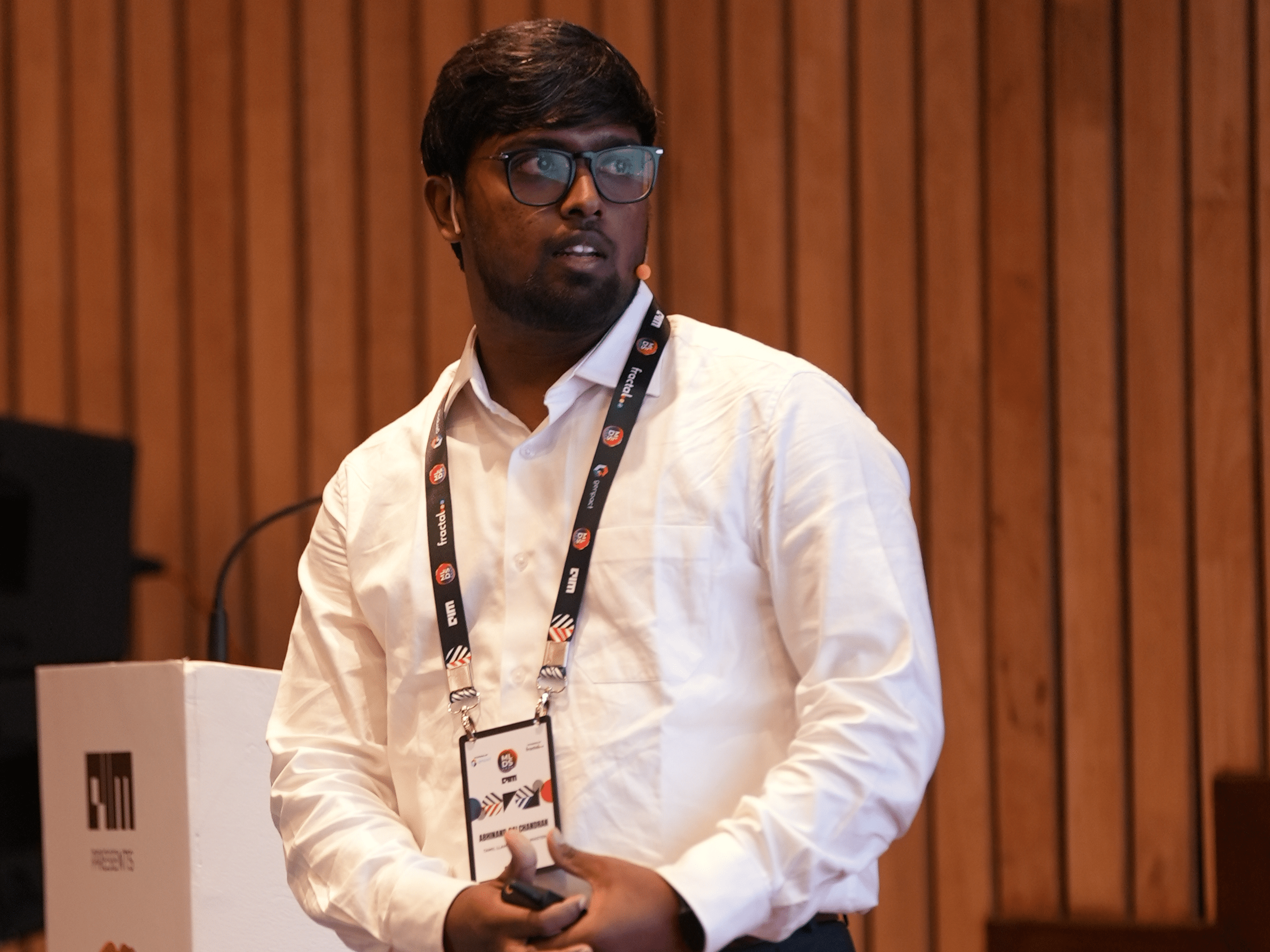
At MLDS 2024, Abhinand Balachandran noted that one of the remarkable capabilities of Tamil Llama is its proficiency in also handling complex coding tasks. He said, “It can efficiently write Python scripts for operations like uploading files to an S3 bucket, and even explaining what Boto3 is, which is pretty cool, right?”

Tamil Llama’s emergence brought about a series of language models in Indian languages. Abhinand stressed the importance of open-source status in promoting innovation and accessibility in AI. “The linguistic inclusivity and diversity of the language models that represent the Indian languages in spite of the challenges of finding enough datasets and hardware infrastructure are truly special,” he said.

Talking about the challenges, he said the performance of language models in non-English languages has historically been limited due to a lack of representation in digital data. “One of the central challenges in its development has been adapting existing models to suit the linguistic intricacies of Indian languages,” he explained.

The process of expanding vocabulary and optimizing tokenizers for Tamil is a critical step in enhancing Tamil Llama’s effectiveness. However, directly fine-tuning existing models for low-resource languages like Tamil comes with its own set of challenges, particularly in sentence formation and contextual understanding. He said, “I’ve opted not to significantly expand the vocabulary, as this approach minimizes disruption to the model’s existing knowledge base but this slows down the training process and the speed of text generation significantly.”

Despite these challenges, expanding the vocabulary will be beneficial as the scale increases. He further explained, “Currently, we’re training the model with only a few gigabytes of data, but as we increase this amount, the model will gain a broader understanding of the world, which is essential for direct fine-tuning.”

Interestingly, the performance of Tamil Llama in English has not been compromised by these adaptations. In some cases, it even shows enhanced performance, indicating the model’s robustness and adaptability.

Abhinand explained another significant gap in the field is the lack of benchmarks for evaluating models in Indian languages. This absence poses a challenge in objectively measuring the progress and effectiveness of such models.

Tamil Llama’s development process has highlighted limitations due to translation loss and the inability of models to respond in colloquial forms. “But this is only the beginning. As we collect more datasets and increase the scale, these models have immense potential for millions of people,” he concluded.

The post Tamil Llama Uncovering New Grounds in Indian Languages appeared first on Analytics India Magazine.

Google’s Gemini Takes The Center Stage

Google’s Gemini is being integrated into every Google service, as revealed in the recent earnings call. In the call, CEO Sundar Pichai announced the start of the “Gemini era,” where the model will take the baton in enhancing their products like search, cloud, YouTube, Workspace, and Bard. Beginning with their primary product, their search engine, Pichai said that generative AI in search will transform it into a more proactive agent, capable of executing additional tasks based on search results.

The demo at MLDS presented by Rajat Pandit, the Head showcased just that. The multimodal capabilities of Bard, yet unseen. The chatbot is Google’s answer to ChatGPT, now runs on Gemini Pro and is expected to shift to Gemini Ultra soon. This upgrade will follow a premium subscription model as hinted by Pichai, similar to the trend of ChatGPT Plus and Microsoft’s Copilot Pro.

He also spoke about how Gemini can be incorporated into businesses. With every startup and company harnessing the power of generative AI to improve their business operations and customer engagement. He explained the use cases of a used car sales dealership which automated the process of assessing the value of a car with its specifications fed into the language model.

Unstructured data like text, code, video, and images are analysed by the model to speed up the decision making process making the experience hassle free for the customer. It also reduces the manual effort for the company while not compromising the accuracy in data handling.

This talk aligned with the vision of Sundar Pichai’s who stressed on both the B2B and B2C applications of Gemini. For B2B, Gemini promises to improve operations, tailored solutions for specific industry needs, and powerful data analytics capabilities. In the B2C realm, it is set to offer more personalised and interactive experiences, deep consumer insights, and greater accessibility across Google’s platforms.

The post Google’s Gemini Takes The Center Stage appeared first on Analytics India Magazine.