Redefining the boundaries of AI, and eerily bringing a child entity to life, Chinese scientists developed Tong Tong, the world’s first virtual AI entity. Tong Tong, which means ‘little girl’ in English, can autonomously allocate tasks to herself, including activities such as exploring her surroundings, organizing rooms, and removing stains.
Tong Tong exhibits behavior and capabilities reminiscent of a three or four-year-old child. By engaging in exploration and interacting with humans, the ‘little girl’ can consistently enhance her skills, knowledge, and values.
The ‘little girl’ was released at the Frontier of General Artificial Intelligence Technology Exhibition, which was recently held in Beijing, supported by the Beijing Institute for General Artificial Intelligence (BIGAI).
“To advance towards general artificial intelligence, we must create entities that can comprehend the real world and possess a wide range of skills,” said the Director of BIGAI, Zhu Songchun.
BIGAI is founded and led by Professor Zhu Songchun,who is a renowned global expert in computer vision, statistics and applied mathematics. Having lived and worked in the US for 28 years, Songchun left his professorship at UCLA to start BIGAI in Beijing.
As per a video released by BIGAI, Tong Tong possesses a mind and strives to understand the common sense taught by humans. “She discerns right from wrong, expresses her attitudes in various situations, and has the power to shape the future.”
Zhu’s team also published the Tong Test at the exhibition, which is said to offer a complete testing regime for the development of general artificial intelligence. “For general AI to integrate seamlessly into human environments, it must learn and execute tasks in complex settings, driven by values and an understanding of causality,” said Zhu.
With the race towards AGI gaining steam, inventions such as these are questionable. Now, with AI being used to even bring dead children back to life, the idea of creating an entity resembling a child is unsettling.
The post World’s First AI Child Tong Tong Unveiled in China appeared first on Analytics India Magazine.
This Week in AI: Do shoppers actually want Amazon’s GenAI? Kyle Wiggers 9 hours
Keeping up with an industry as fast-moving as AI is a tall order. So until an AI can do it for you, here’s a handy roundup of recent stories in the world of machine learning, along with notable research and experiments we didn’t cover on their own.
This week, Amazon announced Rufus, an AI-powered shopping assistant trained on the e-commerce giant’s product catalog as well as information from around the web. Rufus lives inside Amazon’s mobile app, helping with finding products, performing product comparisons and getting recommendations on what to buy.
From broad research at the start of a shopping journey such as ‘what to consider when buying running shoes?’ to comparisons such as ‘what are the differences between trail and road running shoes?’ … Rufus meaningfully improves how easy it is for customers to find and discover the best products to meet their needs,” Amazon writes in a blog post.
That’s all great. But my question is, who’s clamoring for it really?
I’m not convinced that GenAI, particularly in chatbot form, is a piece of tech the average person cares about — or even thinks about. Surveys support me in this. Last August, the Pew Research Center found that among those in the U.S. who’ve heard of OpenAI’s GenAI chatbot ChatGPT (18% of adults), only 26% have tried it. Usage varies by age of course, with a greater percentage of young people (under 50) reporting having used it than older. But the fact remains that the vast majority don’t know — or care — to use what’s arguably the most popular GenAI product out there.
GenAI has its well-publicized problems, among them a tendency to make up facts, infringe on copyrights and spout bias and toxicity. Amazon’s previous attempt at a GenAI chatbot, Amazon Q, struggled mightily — revealing confidential information within the first day of its release. But I’d argue GenAI’s biggest problem now — at least from a consumer standpoint — is that there’s few universally compelling reasons to use it.
Sure, GenAI like Rufus can help with specific, narrow tasks like shopping by occasion (e.g. finding clothes for winter), comparing product categories (e.g. the difference between lip gloss and oil) and surfacing top recommendations (e.g. gifts for Valentine’s Day). Is it addressing most shoppers’ needs, though? Not according to a recent poll from ecommerce software startup Namogoo.
Namogoo, which asked hundreds of consumers about their needs and frustrations when it comes to online shopping, found that product images were by far the most important contributor to a good ecommerce experience, followed by product reviews and descriptions. The respondents ranked search as fourth-most important and “simple navigation” fifth; remembering preferences, information and shopping history was second-to-last.
The implication is that people generally shop with a product in mind; that search is an afterthought. Maybe Rufus will shake up the equation. I’m inclined to think not, particularly if it’s a rocky rollout (and it well might be given the reception of Amazon’s other GenAI shopping experiments) — but stranger things have happened I suppose.
Here are some other AI stories of note from the past few days:
Google Maps experiments with GenAI: Google Maps is introducing a GenAI feature to help you discover new places. Leveraging large language models (LLMs), the feature analyzes the over 250 million locations on Google Maps and contributions from more than 300 million Local Guides to pull up suggestions based on what you’re looking for.
GenAI tools for music and more: In other Google news, the tech giant released GenAI tools for creating music, lyrics and images and brought Gemini Pro, one of its more capable LLMs, to users of its Bard chatbot globally.
New open AI models: The Allen Institute for AI, the nonprofit AI research institute founded by late Microsoft co-founder Paul Allen, has released several GenAI language models it claims are more “open” than others — and, importantly, licensed in such a way that developers can use them unfettered for training, experimentation and even commercialization.
FCC moves to ban AI-generated calls: The FCC is proposing that using voice cloning tech in robocalls be ruled fundamentally illegal, making it easier to charge the operators of these frauds.
Shopify rolls out image editor: Shopify is releasing a GenAI media editor to enhance product images. Merchants can select a type from seven styles or type a prompt to generate a new background.
GPTs, invoked: OpenAI is pushing adoption of GPTs, third-party apps powered by its AI models, by enabling ChatGPT users to invoke them in any chat. Paid users of ChatGPT can bring GPTs into a conversation by typing “@” and selecting a GPT from the list.
OpenAI partners with Common Sense: In an unrelated announcement, OpenAI said that it’s teaming up with Common Sense Media, the nonprofit organization that reviews and ranks the suitability of various media and tech for kids, to collaborate on AI guidelines and education materials for parents, educators and young adults.
Autonomous browsing: The Browser Company, which makes the Arc Browser, is on a quest to build an AI that surfs the web for you and gets you results while bypassing search engines, Ivan writes.
More machine learnings
Does an AI know what is “normal” or “typical” for a given situation, medium, or utterance? In a way, large language models are uniquely suited to identifying what patterns are most like other patterns in their datasets. And indeed that is what Yale researchers found in their research of whether an AI could identify “typicality” of one thing in a group of others. For instance, given 100 romance novels, which is the most and which the least “typical” given what the model has stored about that genre?
Interestingly (and frustratingly), professors Balázs Kovács and Gaël Le Mens worked for years on their own model, a BERT variant, and just as they were about to publish, ChatGPT came out and in many ways duplicated exactly what they’d been doing. “You could cry,” Le Mens said in a news release. But the good news is that the new AI and their old, tuned model both suggest that indeed, this type of system can identify what is typical and atypical within a dataset, a finding that could be helpful down the line. The two do point out that although ChatGPT supports their thesis in practice, its closed nature makes it difficult to work with scientifically.
Scientists at University of Pennsylvania were looking at another odd concept to quantify: common sense. By asking thousands of people to rate statements, stuff like “you get what you give” or “don’t eat food past its expiry date” on how “commonsensical” they were. Unsurprisingly, although patterns emerged, there were “few beliefs recognized at the group level.”
“Our findings suggest that each person’s idea of common sense may be uniquely their own, making the concept less common than one might expect,” co-lead author Mark Whiting says. Why is this in an AI newsletter? Because like pretty much everything else, it turns out that something as “simple” as common sense, which one might expect AI to eventually have, is not simple at all! But by quantifying it this way, researchers and auditors may be able to say how much common sense an AI has, or what groups and biases it aligns with.
Speaking of biases, many large language models are pretty loose with the info they ingest, meaning if you give them the right prompt, they can respond in ways that are offensive, incorrect, or both. Latimer is a startup aiming to change that with a model that’s intended to be more inclusive by design.
Though there aren’t many details about their approach, Latimer says that their model uses Retrieval Augmented Generation (thought to improve responses) and a bunch of unique licensed content and data sourced from lots of cultures not normally represented in these databases. So when you ask about something, the model doesn’t go back to some 19th-century monograph to answer you. We’ll learn more about the model when Latimer releases more info.
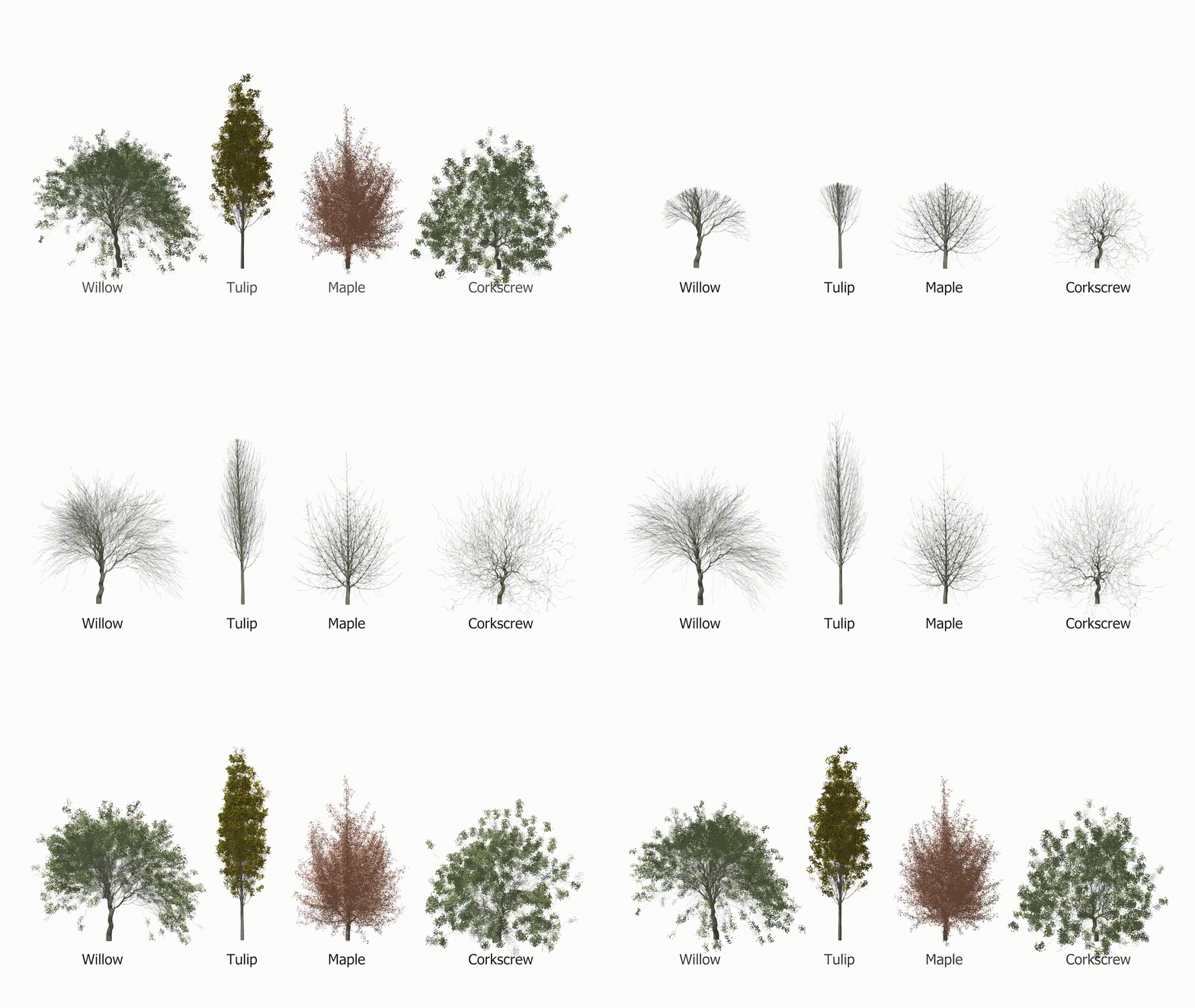
Image Credits: Purdue / Bedrich Benes
One thing an AI model can definitely do, though, is grow trees. Fake trees. Researchers at Purdue’s Institute for Digital Forestry (where I would like to work, call me) made a super-compact model that simulates the growth of a tree realistically. This is one of those problems that seems simple but isn’t; you can simulate tree growth that works if you’re making a game or movie, sure, but what about serious scientific work? “Although AI has become seemingly pervasive, thus far it has mostly proved highly successful in modeling 3D geometries unrelated to nature,” said lead author Bedrich Benes.
Their new model is only about a megabyte, which is extremely small for an AI system. But of course DNA is even smaller and denser, and it encodes the whole tree, root to bud. The model still works in abstractions — it’s by no means a perfect simulation of nature — but it does show that the complexities of tree growth can be encoded in a relatively simple model.
Last up, a robot from Cambridge University researchers that can read braille faster than a human, with 90% accuracy. Why, you ask? Actually, it’s not for blind folks to use — the team decided this was an interesting and easily quantified task to test the sensitivity and speed of robotic fingertips. If it can read braille just by zooming over it, that’s a good sign! You can read more about this interesting approach here. Or watch the video below:
At MLDS 2024, India’s biggest generative AI conference, Viswanathan Anand, spoke about AI and chess, and how he uses ChatGPT to make chess training exercises and explain moves.
“ChatGPT is essentially statistics applied to language,” said Anand, explaining that language is a fundamental way of how we learn anything. “That’s the key connection.”
Citing chess, he said that it [ChatGPT] gives you the correct answer as long as you specify the rules and the terms of the game. “Understanding this is very hard unless you are trained in chess,” he added.
He said it is difficult to learn from it, because the moves these AI systems show are typically hard to explain, and when amateur players copy those moves hastily it generally backfires on them.
On the bright side, he noted that if used wisely AI helps players save a lot of time in learning new moves, and understanding their opponent better.
Chess in the Era of AI
Now that everyone has access to tools such as ChatGPT and Bard that will push players towards being more creative in a game, and learn faster. How can one differentiate themselves to be a better player? “So the first thing is extra familiarity and the next is asking more questions,” he explained. The better player, according to Anand, examines not only the best moves, but the next seven or eight moves which the opponent has neglected.
He said that this is a game of constant improvements, and one has to come up with entirely new systems. “What I believed to be the truth when I was younger is only maybe 52% true,” he said, stating that with AI, the game of chess has changed significantly.
Today the players have to be willing to sit there with the AI system, playing training games and willing to forget their comfort zone, Anand said. Instead they have to test individual positions and go over the new moves over and over again until it works.
Thanks to AI, there’s a lot of scope for doing things much faster. “Instead of spending hours just pulling up statistics about my opponent, I can instead use AI or ChatGPT for the details I need.”
AI in Chess
Anand said AI can never replace humans in chess, even though it is getting better at it. “Chess is still a human game.”
OpenAI chief Sam Altman also echoed similar views, at Davos WEF, said, “Chess has never been more popular than it is now, and almost no one watches two AIs play each other, we are very interested in what humans do.”
At the same time, he said chess doesn’t have a finite number of sensible moves, and AI can never nearly solve chess. “There isn’t a finite number of steps in chess. I don’t think it will be solved given the large number of even the sensible moves to be analysed by the computer,” he added.
He said that he likes to play with humans over AI anyday, but uses AI to practise.
In 2016, AlphaGo beat Lee Sedol four times out of five. The efforts with chess go further back to 1985, when IBM’s Deep Blue first lost to Garry Kasparov but promptly came back next year to win.
But the general fear that this will take the fun away from games is overrated. We’ve evolved from Houdini and Rybka to AlphaZero progressively getting better at the game that effortlessly beat any Chess Grandmaster.
The most significant demonstration of AlphaZero’s capabilities was a series of games played against the popular chess engine Stockfish 8. The battle between the best human-designed chess engine and an AI system that had taught itself how to play was watched by millions of chess enthusiasts.
Not only chess, AI agents are making progress in beating humans in video games and even physical games.
Anand Intelligence (AI) in Chess
Anand was taught to play chess by his mother Sushila Viswanathan at the age of six. He continued playing at the Tal Chess Club in Chennai backed by Soviet funds, which is one of the reasons for Chennai becoming the capital of Indian chess.
The biggest difference between playing chess before, and after the advent of computer programs and then AI is the approach to the game. Anand said, “I’m not even trying to come up with new ideas myself now. The computer gives me the idea, I use it to navigate the lines of moves ahead and reason it out.”
This is very different from when he was a child he used to come up with the idea, check all the lines and implement it. “Now I don’t do anything. All I need to do is to keep asking questions. And so over, over a long enough time period, you suddenly look back and you realise you’re a completely different player,” he explained.
In the world championship in 2008 against Kramnik who had always won against Anand playing the white pieces. “Because of the computers which were still reasonably primitive then, I was able to pull out the statistics and practise the moves deviating from my usual King’s Pawn opening,” he said. Anand explained that previously it would have taken him years to work the trial and error method and practise a new opening and really familiarise himself with it without computers.
The post How Viswanathan Anand Uses ChatGPT appeared first on Analytics India Magazine.
In a testament to the transformative power of AI, the 40 Under 40 Data Scientists Awards shine a spotlight on the experts who are redefining the boundaries of what’s possible with data. These exceptional individuals, selected by an esteemed panel of jurors, have demonstrated unparalleled expertise, innovative thinking, and a commitment to driving meaningful change within their organizations and the broader industry. The Awards were given out on 2nd Feb at the Annual MLDS conference in Bangalore.
From advancing privacy-aware modeling techniques to leading the charge in AI-driven transformations, each winner has made significant contributions to the field. They are at the forefront of leveraging generative AI, enhancing operational efficiencies, and cultivating a culture of innovation and learning. Their work spans various sectors, including fintech, healthcare, retail, and beyond, showcasing the versatile and far-reaching impact of data science.
(In Alphabetic Order)
Aayush Mudgal, Senior Machine Learning Engineer at Pinterest
Aayush Mudgal stands out as a pioneering Senior Machine Learning Engineer at Pinterest, where his leadership in Privacy Aware Conversion Modeling has set new benchmarks in data science innovation. With a profound expertise in building large-scale recommendation systems, personalization algorithms, and ads marketplaces, Aayush has a unique talent for translating complex data sets into actionable insights. His background in research on intelligent tutoring systems further illustrates his commitment to leveraging AI for educational advancements. Aayush’s work exemplifies the transformative power of machine learning in enhancing user experience and privacy in the digital age.
Aditi Kalra, Senior Manager, Data Science at Slice
Aditi Kalra brings a wealth of knowledge and experience to her role as Senior Manager of Data Science at Slice, a unicorn fintech firm. With an 8-year tenure in the finance industry, her expertise encompasses econometrics, game theory, NLP, recommendation engines, computer vision, and generative AI. Aditi’s journey through credit bureaus and mutual funds to fintech innovation highlights her versatile skill set and her ability to drive forward-thinking solutions in financial technology. Her work not only enhances fintech offerings but also paves the way for more intelligent, data-driven financial solutions.
Akash Kaul, Head – Applied Data Science at Tesco Business Solutions
With 16 years of experience, Akash Kaul has excelled in leveraging data science to achieve business outcomes across multiple industries, including Retail, Healthcare Insurance, P&C Insurance, and Banking. At Tesco Business Solutions, Akash is renowned for establishing Analytics Centers of Excellence, driving a staggering 20X ROI on analytics investments. His strategic vision and deep understanding of data science have been pivotal in cultural transformation and commercial goal achievement within these sectors, showcasing the strategic value of analytics in business operations.
Aman Jain, Director- Product Analytics & Experimentation at American Express
Aman Jain’s role as Director of Product Analytics & Experimentation at American Express highlights his expertise in analytics and strategy, particularly within the digital products arena. His work focuses on fostering data-driven cultures, optimizing customer acquisition, and enhancing revenue across various functions and geographies. Aman’s approach combines advanced analytics with UX tools, demonstrating his ability to leverage data for strategic decision-making and to drive significant business outcomes in the competitive financial services sector.
Anantha Krishna Rajpurohit, Associate Director – Data Science at Zee Entertainment Enterprises Ltd.
Anantha Krishna Rajpurohit’s extensive experience in Data Science and AI across Retail, TMT, and BFSI sectors positions him as a leader in the field. His tenure at Zee Entertainment Enterprises Ltd. as Associate Director – Data Science involves spearheading initiatives for both TV and OTT platforms, integrating generative AI to revolutionize content personalization and viewer engagement strategies. Anantha’s background as a former BCG consultant, leading projects on personalization, assortment strategy, and credit risk, underpins his innovative approach to leveraging data science for media and entertainment.
Anil Goyal, Principal Data Scientist at Housing.com
Anil Goyal stands out as a beacon in the data science community, with a significant track record of pioneering machine learning solutions that address complex challenges. His work spans across various domains, including real estate, where his algorithms for 3D virtual tour generation have markedly improved user engagement on Housing.com. Additionally, his contributions to fraud detection methodologies have set new standards for security and reliability in online transactions. Dr. Goyal’s research has also ventured into the healthcare sector, offering innovative solutions for medical document understanding and driver drowsiness detection systems, showcasing his versatility and commitment to leveraging AI for societal benefit. His recognition with multiple awards is a testament to his impactful contributions and thought leadership in the field of data science.
Anuja Ranjan, Vice President/Partner Financial Services at Fractal.ai
Anuja Ranjan’s journey in the AI domain is marked by her profound expertise in statistical modeling and predictive analytics, grounded in a solid foundation from the prestigious Delhi School of Economics. With over a decade of experience in the industry, Anuja has become a formidable force in driving AI-driven transformations within the financial services sector at Fractal. Her work encompasses leveraging AI to decode complex financial patterns, optimize risk management, and innovate product offerings, significantly enhancing value for stakeholders. Anuja’s role at Fractal.ai not only underscores her technical prowess but also her ability to lead and inspire teams towards achieving excellence in AI applications in finance.
Aravind Mohan, Software Engineer / Data Scientist at Waymo (Autonomous Driving)
Aravind Mohan’s career trajectory is a compelling narrative of innovation and excellence in the fields of data science and autonomous driving technologies. At Waymo, his contributions as a Software Engineer and Data Scientist have been pivotal in advancing the frontiers of autonomous mobility. Before his tenure at Waymo, Aravind honed his skills at Facebook, where he was instrumental in founding the AI Integrity team and leading initiatives in NLP and Speech Data Science. His work on revenue-maximizing models at Abercrombie & Fitch further showcases his versatility and strategic acumen in applying data science across diverse industry verticals. Aravind’s journey is a testament to his relentless pursuit of excellence and his visionary approach to leveraging AI for transformative outcomes.
Deepak Yadav, Senior Data Scientist at Commonwealth Bank of Australia
Deepak Yadav exemplifies the essence of a modern data scientist, blending technical expertise with a passion for sharing knowledge. With over seven years of experience in the field, Deepak has made significant contributions to the banking sector, particularly in areas requiring sophisticated analytical solutions. His role as a guest lecturer and a reviewer for ‘Engineering Applications of Artificial Intelligence’ demonstrates his commitment to nurturing the next generation of data scientists. Deepak’s nomination for the Top 40 Data Scientist Awards underscores his influence in the realm of AI and his dedication to advancing the application of data science within and beyond the Commonwealth Bank of Australia.
Garvit Arya, Senior Data Analytics Engineer at Google
Garvit Arya’s exceptional track record in Retail, Planning, Advanced Analytics, and Data Engineering positions him as a leader in the analytics domain. His role at Google underscores his capability as an analytics strategist and data scientist, where he has been instrumental in institutionalizing supply chain analytics. This has led to revolutionary decision-making processes that align with Google’s standards of innovation and efficiency. Recognized as a LinkedIn Top Voice in Data Science & Warehousing, Garvit’s leadership and strategic vision have significantly contributed to the shaping of analytics practices, making him a valuable asset to the global data science community.
Gaurav Jain, Senior Manager at Adani Digital labs
Gaurav Jain has been a key figure in spearheading AI innovations at Adani Digital Labs, where his leadership and vision have paved the way for transformative advancements in artificial intelligence. His work is instrumental in driving digital transformation across the Adani Group, leveraging AI to revolutionize industries and create impactful change. Gaurav’s approach to AI innovation is characterized by a deep understanding of technological potentials combined with strategic implementation, making him an influential leader in driving the digital future.
Ishan Basu, Principal – Delivery at MathCo Ishan Basu stands out as a visionary leader in data science, boasting over a decade of experience. At MathCo, he is recognized for his strategic approach in leveraging analytics to drive substantial business value across a diverse range of industries, including the Indian market, Europe, and the United States. His expertise in marketing analytics has been instrumental in elevating MathCo’s Marketing Measurement practice, where he has successfully led initiatives that delivered profound impacts for Fortune 500 companies. Ishan’s innovative solutions and his ability to translate complex data into actionable insights make him a pivotal figure in the analytics community.
Itti Singh, AVP, Head of Analytics Advisory DLL, Landmark Group With sixteen years under her belt, Itti Singh has proven herself as a trailblazer in analytics leadership. Her journey spans significant contributions from evaluating Fair Lending models at Citi to revolutionizing Campaign and Marketing Analytics at Titan. Currently, she oversees analytics and machine learning initiatives across the Middle East and India for Landmark Group. Itti’s exceptional leadership was particularly evident during her tenure as Product Manager for LTIM & Fosfor’s Lumin, where she spearheaded industry-recognized projects. Her forward-thinking approach continues to inspire and drive technological innovation within the Landmark Group.
Kedar Potdar, Manager, System Software – AI at NVIDIA Kedar Potdar, an Engineering Manager at NVIDIA, specializes in artificial intelligence and leads a dynamic team focused on refining developer products for AI applications. With a rich background that includes authoring eight scholarly papers on data science and AI, Kedar’s innovative spirit has been evident since his undergraduate days. His work spans edge computing to applied AI, where he consistently pushes the boundaries of what’s possible in AI development and application. His commitment to advancing AI technology makes him a key asset to NVIDIA and the broader AI community.
Lokesh Malik, VP, AI Solutions at EXL Service Lokesh Malik brings over fifteen years of expertise in AI and Data Science, spanning multiple sectors such as CPG, Retail & Media, E-commerce, and BFSI. His leadership at EXL Service is marked by his ability to bridge the gap between complex data science concepts and real-world applications, driving significant business outcomes. Lokesh’s comprehensive understanding of AI technologies and strategies has positioned him as a key player in EXL’s success, providing innovative solutions that leverage data for strategic advantage.
Manu Joseph, Staff Data Scientist at Walmart Global Tech Manu Joseph is a distinguished figure in the field of data science, with over a decade’s experience that includes a leadership role in Applied Research at Thoucentric. Renowned for his contributions to machine learning-based demand forecasting, Manu is also the author of ‘Modern Time Series Forecasting with Python’. His work on PyTorch Tabular simplifies deep learning applications for tabular data, showcasing his commitment to advancing the field of data science. At Walmart Global Tech, Manu continues to leverage his expertise to drive innovation and enhance business processes.
Mukul Jain, Principal Data Scientist at Bajaj Finserv Health With a decade of experience in data analytics, Mukul Jain has been a pioneering force at Bajaj Finserv Health. He has played a critical role in scaling the data science team, automating key processes, and enhancing customer experiences. Mukul’s strategic vision has set new industry benchmarks in fraud prevention and AI-driven reimbursement claims automation, saving the company millions. His leadership and innovative approach to solving complex problems have made significant impacts on the business, demonstrating the power of data science in transforming healthcare services.
Nakul Puri, Director of Analytics – APAC at Boston Consulting Group Nakul Puri is a seasoned expert with over thirteen years of experience in predictive and prescriptive analytics. Leading a formidable team of over 100 members across the APAC region, his expertise spans predictive modeling, machine learning, demand forecasting, and marketing optimization. Nakul has been instrumental in spearheading large engagements at BCG, impacting consumer, fashion, retail, and IG sectors with his innovative approaches. His prior experience at Accenture, TCS, EXL, and Siemens further solidifies his reputation as a leader in the analytics space.
Naveen Rathani, Vice President and India Head, AI for Chief Operating Office (COO) at Wells Fargo Naveen Rathani’s career is a testament to his deep commitment to leveraging BI, ML, and statistical solutions to enhance business operations globally. With interests that include deep reinforcement learning, weak supervision, and optimization methods, Naveen stands out as an active researcher with pending patents to his name. His contributions to the learning community through techno-focused articles underscore his dedication to sharing knowledge and advancing the field of AI and data science.
Nimai Chand Das Adhikari, Senior Data Scientist at Microsoft
Nimai Chand Das Adhikari stands out with over a decade of experience in the data science realm, having published over ten papers and holding more than four patents. His work has been recognized at major conferences like MSJAR and MLADs. Nimai specializes in a broad spectrum of areas including Deep Learning, Computer Vision, Time Series Analysis, Healthcare, and Natural Language Processing. His contributions to Microsoft have significantly advanced the company’s capabilities in these areas, showcasing his ability to drive innovation and technical excellence.
Nishant Prakash, Director – Customer Strategy at Gameskraft
Nishant Prakash brings a wealth of experience from his 12+ years in strategy and analytics, having led Insights & Analytics teams at global giants like Amazon and Lenovo. Currently at the helm of Customer Strategy & Analytics at Gameskraft, he specializes in leveraging Business Analytics, Marketing Strategy, and Program Management to craft winning strategies. Nishant’s deep understanding of data-driven decision-making has played a pivotal role in Gameskraft’s rapid growth and customer engagement success.
Preeti J. Pillai, Senior Machine Learning Engineer at Toyota Connected
Preeti J. Pillai, with over twelve years of experience, is a recognized authority in AI, focusing on Computer Vision, Machine Learning, and Deep Learning within Automotive, Enterprise Surveillance, IoT, and Connected Vehicle technologies. An esteemed Senior IEEE member, she has chaired sessions and reviewed for top-tier IEEE conferences. Her innovative work at Toyota Connected is pushing the boundaries of how AI can enhance automotive safety and performance.
Rafat Siddiqui, People Analytics – Data Scientist at Shell India Markets Private Limited
Rafat Siddiqui specializes in People Analytics, leveraging statistical tools, data mining, and machine learning to drive impactful HR initiatives. As a key member of Shell’s Global Centre of Excellence – People Insights Team, he focuses on Employee Listening projects using advanced NLP techniques. His work is instrumental in enhancing organizational culture and employee engagement at Shell, reflecting his commitment to using data science for people-centric solutions.
Raghavan Muthuregunathan, Senior Engineering Manager, Search AI at LinkedIn
Raghavan Muthuregunathan leads LinkedIn’s Flagship Search AI team, where his work on i18n spellcheck and semantic code search tools has significantly improved user experience. Known for his engaging tech talks in AI/ML, Raghavan’s leadership and innovative thinking have made a profound impact on LinkedIn’s search capabilities, ensuring users find exactly what they’re looking for with greater accuracy and relevance.
Rahul Pandey, Associate Vice President | Data Science & Applied AI at Course5i
Rahul Pandey is a change catalyst in data monetization, with extensive expertise across various industries including CPG/FMCG, Retail, Manufacturing, Mobility, Technology, Media, Telecom, Hospitality, QSRs, and BFSI. As a seasoned leader in Applied Data Science, he has established and nurtured high-performance teams globally, driving AI/ML solutions that have delivered substantial value worldwide.
Ravindra Patil, Senior Director – Data Science at Tredence Inc.
Ravindra Patil, an engineering leader, excels in developing Data and AI solutions that meet consumer needs and secure competitive advantages. At the helm of a dynamic team of Data Scientists and Architects at Tredence Inc., he pioneers innovative ideas, speaks at conferences, and holds multiple patents and research publications. His leadership is driving the next wave of data science innovation, transforming how businesses leverage data for strategic decisions.
Rohit Jain, General Manager Analytics & Senior Data Scientist at Niva Bupa Health Insurance
Rohit Jain, with over seven years of experience in data science, specializes in insurance, news, and media analytics. A Kaggle expert, Rohit’s prowess in data automation, analysis, and dynamic dashboard creation has been showcased in numerous hackathons. His innovative approach and commitment to continuous learning in data science are propelling Niva Bupa Health Insurance towards cutting-edge data-driven solutions.
Sanjay Gautam Bhansali – Head of AI Frameworks, RBC Capital Markets
Sanjay Gautam Bhansali stands at the forefront of AI innovation as the Head of AI Frameworks and Generative AI Capabilities at RBC Capital Markets. With a passion for transforming the banking and financial landscape through strategic AI frameworks, Sanjay leads initiatives that significantly enhance machine learning and artificial intelligence capabilities across various sectors within the bank. His work not only streamlines operations but also sets new benchmarks in delivering cutting-edge solutions, demonstrating a keen acumen for leveraging technology to drive business success.
Saurabh Pramanick – Head of Data Governance and Analytics, Bank Muscat
Saurabh Pramanick brings over 15 years of rich expertise in the fields of Data Mesh, Data Analytics, Data Governance, and more. Having held the position of Chief Data Officer and various leadership roles, Saurabh has a proven track record of pioneering data science, analytics, governance, and technical architecture initiatives. His strategic vision and leadership have propelled Bank Muscat into new heights of data-driven decision-making, enhancing operational efficiency and fostering innovation.
Setu Shah – Global HCM Product Strategy Director, Oracle
At Oracle, Setu Shah is instrumental in designing and delivering human capital management (HCM) solutions that cater to a global clientele. His work, spanning across solution architecture, technology strategy, and program management, addresses the needs of industries ranging from BFSI to healthcare, ensuring clients receive the most advanced and effective HR solutions. Setu’s expertise helps organizations navigate the complexities of global markets, optimizing their workforce strategies for maximum impact.
Shivani Sharma – Vice President, Barclays
Shivani Sharma, with her 17 years of data science experience, excels in applying artificial intelligence, risk management, and analytics to drive significant outcomes in the global banking sector. Her leadership roles in esteemed institutions like Barclays and KPMG have been marked by pioneering applications of AI and advanced analytics, influencing high-value portfolios and steering substantial financial decisions, thereby contributing to the strategic growth and resilience of these organizations.
Urvinder Singh – Associate General Manager- Data Science, Linde APAC
Urvinder Singh is recognized as a distinguished Data Science professional with over seven years of global experience. Currently serving as Associate General Manager – Data Science for Linde in the APAC region, Urvinder’s contributions span across leading AI/ML projects and mentoring the next generation of talent. His expertise and certifications in Google Cloud Platform underscore his commitment to leveraging the latest technologies for driving innovation and excellence in industrial gases and engineering solutions.
Vaishnavi Kandala – Principal NLP Scientist, Tiger Analytics
Vaishnavi Kandala is a leading expert in Natural Language Processing and heads the Generative AI-applied R&D team at Tiger Analytics. With over a decade of experience, Vaishnavi has developed impactful NLP solutions and contributed to Generative AI projects, earning recognition for her innovative work. Her previous role at Elsevier involved organizing global scientific research intelligently, showcasing her ability to leverage AI for significant advancements in knowledge dissemination.
Varsha Rani – Senior Manager, Genpact
With a career spanning over 13 years, Varsha Rani has made significant strides in the field of NLP and Machine Learning. Starting her journey as an NLP developer, she quickly rose to prominent roles as an NLP Architect and Senior Project Manager. Varsha has led numerous projects across industries, focusing on the application of NLP/ML and Generative AI technologies to solve complex business problems, demonstrating her deep expertise and innovative approach to data science.
Varun Verma – Chief Data Analytics Officer, L’Oréal
Varun Verma is at the helm of data and analytics-driven business transformations at L’Oréal, where he draws on his extensive experience from working with top-tier firms. His expertise in strategy, center of excellence setup, machine learning, artificial intelligence innovation, and team leadership has been instrumental in driving growth and efficiency across various sectors, including consumer packaged goods, digital commerce, fintech, and consulting.
Vinayraj Govindarajan, Director at Deloitte
Vinayraj Govindarajan stands out as a pioneering force in the data science landscape, with over 13 years of experience that spans across several critical areas of analytics including demand forecasting, marketing mix optimization, and inventory optimization. As Director of Data Science at Deloitte, he leads a formidable team of over 50 data scientists, driving them towards successful project completions and breakthrough innovations. Vinayraj’s work is characterized by his deep analytical expertise, strategic vision, and a relentless pursuit of excellence in delivering solutions that not only meet but exceed business expectations. His leadership has been instrumental in establishing Deloitte’s data science team as a benchmark for excellence within the industry, contributing significantly to the firm’s reputation as a leader in analytics and consulting services. Vinayraj’s commitment to fostering a culture of innovation and continuous learning among his team ensures that Deloitte remains at the cutting edge of data science and analytics.
Vipul Gupta, Group Manager – Data Analytics at Times Internet
Vipul Gupta has carved a niche for himself as a visionary in the field of data analytics, demonstrating an exceptional ability to lead teams towards achieving significant improvements in marketing and sales conversions. At Times Internet, his role as Group Manager of Data Analytics places him at the helm of ET Money’s data science initiatives, where his strategic direction and innovative approaches have led to notable successes in user engagement and business growth. Vipul’s journey in data science is marked by his tenure at Hexaware Technologies, where his leadership and expertise contributed to impactful projects. Beyond his corporate accomplishments, Vipul’s dedication to social good is evident through his pro bono work with the DataKind Bangalore Chapter, where he applies his skills to address societal challenges. His holistic approach to data science—balancing corporate objectives with social impact—sets a commendable example for professionals in the field.
Yugank Aman, VP of Engineering at PepsiCo
Yugank Aman embodies the spirit of transformative leadership in the realm of engineering and data science. As the Vice President of Engineering at PepsiCo, he oversees a diverse team of more than 200 engineers, architects, and data scientists, driving innovation and growth through strategic projects. One of Yugank’s notable achievements includes spearheading the development of a location data marketplace, facilitating collaborations with global enterprises and leveraging data to unlock new value streams. With 15 years of experience in the industry, his credentials and leadership roles, including prestigious consulting positions at EY, underscore his ability to navigate complex challenges and lead his team towards groundbreaking solutions. Yugank’s forward-thinking approach and commitment to excellence have been pivotal in fostering a culture of innovation at PepsiCo, positioning the company at the forefront of technological advancement in the food and beverage industry.
You can now access all our open awards and Survey List here.
The post The 40 Under 40 Data Scientists Awards 2024: Meet the Winners appeared first on Analytics India Magazine.
Another Indic language model is here, and this time it’s for Malayalam. Vishnu Prasad J, AI engineer at Examroom.AI has introduced MalayaLLM, focusing exclusively on the Malayalam language, along with a video demonstration.
Developed on Meta’s Llama 2 7B architecture, MalayaLLM aims to revolutionise AI capabilities for Malayalam speakers. The model went through continuous pretraining and fine-tuning exclusively on Malayalam tokens.
Click here to check out the model on Hugging Face.
Unlike generic language models catering to multiple languages, MalayaLLM is dedicated to optimising performance for specific tasks such as content generation and question answering in Malayalam.
The type of the model is specified as 7B Llama 2 pretrained on Malayalam, encompassing language support for both Malayalam and English. The source model is identified as meta-llama/Llama-2-7b-hf.
Currently in its early stages, the model is undergoing continuous training and fine-tuning using a comprehensive Malayalam dataset to enhance its performance. Regular updates will be provided as the model evolves and matures, ensuring its effectiveness in various language-related tasks.
The development of MalayaLLM involves the utilisation of datasets such as AI4Bharat and CulturaX for pre training/tokenisation, as well as the Alpaca_Instruct_Malayalam dataset for fine-tuning. These datasets contribute to the model’s ability to understand and generate content in the Malayalam language.
Read: BharatGPT Aims to Become the Meta of Indic LLMs
The post Introducing Another Indic Language Model on Llama 2, MalayaLLM appeared first on Analytics India Magazine.
ChatGPT and GPT-4 scored above the majority of students in grades 4, 8, and 12 on a standardized test of science questions.
The Nation's Report Card, also known as The National Assessment of Educational Progress, NAEP, is a standardized test of student ability in the US that has been administered since 1969 by the US Board of Education. The test is widely cited as the benchmark of where students stand in their ability to read, write, do math, understand scientific experiments, and many other areas of competence.
The test had a grim message for teachers, administrators, and parents last year: teenagers' math scores showed the largest-ever decline since the start of the assessment, amid a general long-term trend of declining math and reading scores.
Also: I'm taking AI image courses for free on Udemy with this little trick — and you can too
The decline comes at the same time as the rise of generative artificial intelligence (AI), such as OpenAI's ChatGPT, and obviously, many people are asking if there's a connection.
"ChatGPT and GPT-4 consistently outperformed the majority of students who answered each individual item in the NAEP science assessments," write Xiaoming Zhai of the University of Georgia, and colleagues at the University's AI4STEM Education Center, and at the University of Alabama's College of Education, in a paper published this week on the arXiv pre-print server, "Can Generative Ai And Chatgpt Outperform Humans On Cognitive-Demanding Problem-Solving Tasks In Science?"
The report is "the first study focusing on comparing cutting-edge GAI and K-12 students in problem-solving in science," state Zhai and team.
There have been numerous studies in the past year showing that ChatGPT can "match human performance in practice and transfer problems, aligning with the most probable outcomes expected from a human sample," which, they write, "underscores ChatGPT's capability to mirror the average success rate of human subjects, thereby showcasing its proficiency in cognitive tasks."
The authors constructed a NAEP exam for ChatGPT and GPT-4 by selecting 33 multiple-choice questions in science problem-solving, along with four questions that are designated as "selected response", in which the test-taker selects an appropriate response from a list after reading a passage. There are three questions that present a scenario, with sequences of connected questions; and 11 "constructed response" questions and 3 "extended constructed response" questions, where the test-taker has to write a response rather than choosing from offered responses.
Also: How tech professionals can survive and thrive at work in the time of AI
An example of a science question could involve an imaginary scenario of a rubber band stretched between two nails, asking the student to articulate why it causes a sound when plucked, and what would make the sound reach a higher pitch. That question requires the student to write a reply about vibrations of the air from the rubber band, and how increasing tension could raise the pitch of the vibration.
Example of a constructed answer question that tests science reasoning.
The questions were all oriented to grades 4, 8, and 12. The output from ChatGPT and GPT-4 was compared to the anonymous responses of human test-takers, on average, as provided to the authors by the Department of Education.
ChatGPT and GPT-4 answered the questions with accuracy "above the median" — and, in fact, the human students scored abysmally compared to the two programs on numerous tests. ChatGPT scored better than 83%, 70%, and 81% of students for grade 4, 8, and 12 questions, and GPT-4 was similar, ahead of 74%, 71%, and 81%, respectively.
The authors have a theory for what's going on, and it suggests in stark terms the kind of grind that standardized tests create. Human students end up being something like the famous story of John Henry trying to compete against the steam-powered rock drill.
The authors draw upon a framework in psychology known as "cognitive load", which measures how intensely a task challenges the working memory of the human brain, the place where resources are held for a short duration. Akin to computer DRAM, short-term memory has a limited capacity, and things get flushed out of short-term memory as new facts have to be attended to.
Also: I fact-checked ChatGPT with Bard, Claude, and Copilot — and it got weird
"Cognitive load in science education discusses the mental effort required by students to process and comprehend scientific knowledge and concepts," the authors relate. Specifically, working memory can become taxed by the various facets of a test, which "all compete for these limited working memory resources," such as trying to keep all the variables of a test question in mind at the same time.
Machines have a greater ability to maintain variables in DRAM, and ChatGPT and GPT-4 can — through their various neural weights, and the explicit context typed into the prompt — store vastly more input, the authors emphasize.
The matter comes to a head when the authors look at the ability of each student correlated to the complexity of the question. The average student gets bogged down as the questions get harder, but ChatGPT and GPT-4 do not.
"For each of the three grade levels, higher average student ability scores are required on NAEP science assessments with increased cognitive demand, however, the performance of both ChatGPT and GPT-4 might not significantly impact the same conditions, except for the lowest grade 4."
Also: How to use Bing Image Creator (and why it's better than ever)
In other words: "Their lack of sensitivity to cognitive demand demonstrates' GAI's potential to overcome the working memory that humans suffer when using higher-order thinking required by the problems."
The authors argue that generative AI's ability to overcome the working memory limit of humans carries "significant implications for the evolution of assessment practices within educational paradigms," and that "there is an imperative for educators to overhaul traditional assessment practices."
Generative AI is "omnipresent" in students' lives, they note, and so human students are going to use the tools, and also be out-classed by the tools, on standardized tests such as NAEP.
"Given the noted insensitivity of GAI to cognitive load and its potential role as a tool in students' future professional endeavors, it becomes crucial to recalibrate educational assessments," write Zhai and team.
Human students' average performance on questions was below GPT-4 and ChatGPT on most of the questions for twelfth-grade students.
"The focus of these assessments should pivot away from solely measuring cognitive intensity to a greater emphasis on creativity and the application of knowledge in novel contexts," they advise.
"This shift recognizes the growing importance of innovative thinking and problem-solving skills in a landscape increasingly influenced by advanced GAI technologies."
Also: These are the jobs most likely to be taken over by AI
Teachers, they note, are "currently unprepared" for what looks to be a "significant shift" in pedagogy. That transformation means it's up to educational institutions to focus on professional development for teachers.
An interesting footnote to the study is the limitations of the two programs. In certain cases, one program or the other requested additional information for a science question. When one of the programs asked, but the other did not, "The model that did not request additional information often produced unsatisfactory answers." That means, the authors conclude, that "these models heavily rely on the information provided to generate accurate responses."
The machines are dependent on what's either in the prompt or in the learned parameters of the model. That gap opens a way for humans, perhaps, to excel where neither source contains the insights required for problem-solving activities.
One of the hottest debates in generative artificial intelligence (AI) is open source versus closed source: which will prove more valuable?
On one side, a plethora of open-source large language models (LLMs) are constantly being produced by an ever-evolving constellation of contributors, led by the most prestigious open-source model to date, Meta's Llama 2. Representing closed-source LLMs are the two most well-established commercial programs, OpenAI's GPT-4 and the venture-backed startup Anthropic's language model, which is known as Claude 2.
Also: I'm taking AI image courses for free on Udemy with this little trick — and you can too
One way to test these programs against each other is to see how well they perform answering questions on a specific area, such as, for example, medical knowledge.
On that basis, Llama 2 is terrible at answering questions in the area of nephrology, the science of the kidneys, according to a recent study by scientists at Pepperdine University, University of California at Los Angeles, and UC Riverside, which was published this week in NEJM AI, a new journal published by the prestigious New England Journal of Medicine.
"In comparison with GPT-4 and Claude 2, the open-source models performed poorly in terms of total correct answers and the quality of their explanations," write lead author Sean Wu of Pepperdine's Keck Data Science Institute, and colleagues.
Scholars at Pepperdine University converted nephrology questions into prompts to feed into a bunch of large language models, including Llama 2 and GPT-4.
"GPT-4 performed exceptionally well and achieved human-like performance for the majority of topics," they write, achieving a score of 73.3%, just below the 75% rating that is a passing grade for a human who has to answer multiple-choice nephrology questions.
"The majority of the open-source LLMs achieved an overall score that did not differ from what would be expected if the questions were answered randomly," they write, with Llama 2 doing the best out of five open-source models, including Vicuña and Falcon. The Llama 2 program was just above the level of random guessing (23.8%) with a score of 30.6%.
Also: Five ways to use AI responsibly
The study was a test of what is known in AI as "zero-shot" tasks, where a language model is used with no modifications and no examples of right and wrong answers. Zero-shot is an approach that is supposed to test "in-context learning", which is the ability of a language model to acquire new capabilities that were not in its training data.
in the test, the models — Llama 2 and four other open-source programs, plus two commercial programs — were each fed 858 nephrology questions from NephSAP, the Nephrology Self-Assessment Program, a publication of the American Society of Nephrology used by physicians for self-study in the field.
Also: Google's AI image generator finally rolls out to the public — how to try it
The authors had to perform significant data preparation to convert the plain-text files of NephSAP into prompts that could be fed into the language models. Every prompt contained the question in natural language and the multiple-choice answers. (The data set is posted for others to use on HuggingFace.)
And because GPT-4 and Llama 2 and the others produce lengthy text output as their answers in many cases, the authors also had to develop automatic techniques to parse the answers from each model for every question, and then compare the model's answers to the correct answers to automatically score the results.
There are lots of potential reasons why open-source models do poorly versus GPT-4, but the authors suspect an important reason is because Anthropic and OpenAI have baked-in proprietary medical data as part of the training of their programs.
"GPT-4 and Claude 2 were trained not only on publicly available data but also on third-party data," they write.
"High-quality data for training LLMs in the medical field often reside in nonpublic materials that have been curated and peer reviewed, such as textbooks, published articles, and curated datasets," note Wu and team. "Without negating the importance of the computational power of specific LLMs, the ability to access medical training data material that is currently not in the public domain will likely remain a key factor that determines whether performance of specific LLMs will improve in the future."
Clearly, with GPT-4 scoring two points below a human passing grade, there is vast room for improvement for all language models, not just open source.
Happily for the open-source crowd, efforts are underway that could help even the odds in terms of training data.
One of these efforts is the broad movement to what's called federated training, where language models are trained locally on private data, but then contribute the results of that training to an aggregate effort in the public cloud.
That approach can be a way to bridge the divide between confidential data sources in medicine and the collective push to make open-source foundation models stronger. One prominent endeavor in that area is the MedPerf effort of the ML Commons industry consortium, which began last year.
It's also possible that some commercial models will be distilled into open-source programs that will inherit specific medical competencies from the parent. For example, Google DeepMind's MedPaLM is an LLM that is tuned to answer questions from a variety of medical datasets, including a brand-new one invented by Google that represents questions consumers ask about health on the internet.
Even without training a program on medical knowledge, the output can be improved with "retrieval-augmented generation", which is an approach where LLMs seek outside input as they're forming their outputs to amplify what the neural network can do on its own.
Regardless of which approach wins, the open nature of Llama 2 and the other models affords the opportunity for many parties to make the programs better, unlike commercial programs such as GPT-4 and Claude 2, whose operations are at the sole discretion of their corporate owners.
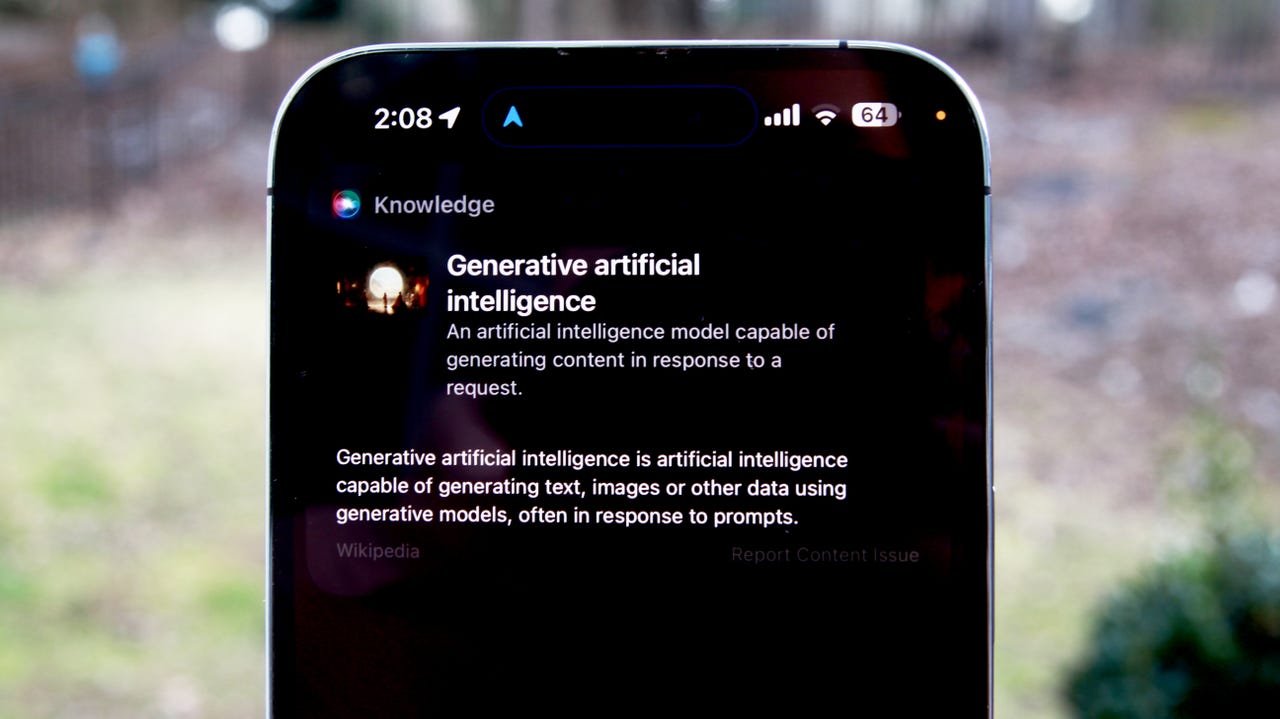
Siri currently can't generate an answer to a question; it searches the web for answers instead.
The generative AI landscape is filling up with bots, from text and image generators, to AI-powered musicians. Apple is one company that's become infamous for trailing behind the generative AI train, though Tim Cook, its CEO, assures us that's about to change.
"We will continue to invest in these and other technologies that will shape the future. That includes artificial intelligence, where we continue to spend a tremendous amount of time and effort and we're excited to share the details of our ongoing work in that space later this year," Cook said while discussing the first fiscal quarter of 2024.
Also: 5 reasons to sign up for Google Labs and how to do it
Recent reports hint that iOS 18, expected to launch in late 2024, will be one of the biggest iOS updates in the company's history, including RCS support and a smarter Siri. It'd be fun to see AI-powered music creation, a personalized fitness or meditation coach, and generative AI across all Siri devices, but here are the top three AI features I'd like to see in iOS 18.
1. Generative AI for a context-aware Siri
Unfortunately, Siri is probably Apple's biggest shortcoming in the AI department. While Siri is an impressive feature on its own, it lags behind its virtual assistant competitors in intelligence. The combination of mounting consumer frustration over Siri's limitations and generative AI's popularity may finally push Apple to give the voice assistant generative AI.
Also: 5 exciting Galaxy AI features that make Samsung's S24 phones worth the upgrade
If Apple can give Siri generative AI, iPhone users could ask the voice assistant for more than "Open this app" or "Search Google for this." Generative AI would let users ask Siri to draft a message, explain a concept, and give you personalized reminders tailored to your calendar, notes, or contacts.
The biggest challenge for Apple will be running large language models (LLMs) on-device, as one would expect it to do after its long-standing focus on consumer privacy. On-device processing means Siri users' questions and responses won't have to be sent to remote servers, minimizing data exposure to enhance privacy.
2. AI-powered photo and video editing
We've seen how powerful generative AI can be in photo editing with Adobe Photoshop's Generative Fill and the Google Pixel's Magic Eraser. This is unfortunately another example where Apple falls behind.
I'd love to see Apple combine these AI features with the iPhone's camera, as an expansion to its limited photo editing options and maybe even to expand video editing. Generative AI in video isn't as widely available as AI image generators because it's a trickier medium, TikTok and Capcut filters aside.
Also: Google's AI image generator finally rolls out to the public — how to try it
It'd be pretty surprising to see Apple add AI video features like real-time background replacement and cinematic effects based on an AI interpretation of the scene.
3. Personalized text generation
ChatGPT rose to popularity because of its capacity to generate text and have conversations in a manner that feels natural to the user. Adding text generation to the iPhone would make it easier for users to draft emails, generate stories, or edit resumes, all tailored to the user's style.
Also: I'm taking AI image courses for free on Udemy with this little trick — and you can too
This is another instance where Apple trails behind competitors, as it's available in the Google Pixel 8 and the Samsung Galaxy S24 lineup, as well as in Microsoft 365, Gmail, Google Docs, Sheets, and more.
Scholars at Stanford built a system, called Almanac, that will retrieve medical information in real-time in response to a Gen AI prompt, and found it improved answers to medical questions written by doctors.
This is the year that many parties using generative artificial intelligence will try to give the programs something resembling knowledge. They will mostly do so using a rapidly expanding effort called "retrieval-augmented generation," or, RAG, whereby large language models (LLMs) seek outside input — while forming their outputs — to amplify what the neural network can do on its own.
RAG can make LLMs better at medical knowledge, for example, according to a report by Stanford University and collaborators published this week in the NEJM AI, a new journal published by the prestigious New England Journal of Medicine.
RAG-enhanced versions of GPT-4 and other programs "showed a significant improvement in performance compared with the standard LLMs" when answering novel questions written by board-certified physicians, report lead author Cyril Zakka and colleagues.
The authors argue that RAG is a key element of the safe deployment of Gen AI in the clinic. Even programs built expressly for medical knowledge, with training on medical data, fall short of that goal, they contend.
Programs such as Google DeepMind's MedPaLM, an LLM that is tuned to answer questions from a variety of medical datasets, the authors write, still suffer from hallucinations. Also, their responses "do not accurately reflect clinically relevant tasks."
RAG is important because the alternative is constantly re-training LLMs to keep up with changing medical knowledge, a task "which can quickly become prohibitively expensive at billion-parameter sizes" of the programs, they contend.
The study breaks new ground in a couple of ways. First, it constructs a new approach — called Almanac — to retrieving medical information. The Almanac program retrieves medical background data using metadata from a 14-year-old medical reference database compiled by physicians called MDCalc.
Second, Zakka and colleagues compiled a brand-new set of 314 medical questions, called ClinicalQA, "spanning several medical specialties with topics ranging from treatment guidelines to clinical calculations." The questions were written by eight board-certified physicians and two clinicians tasked to write "as many questions as you can in your field of expertise related to your day-to-day clinical duties."
The point of a new set of questions is to avoid the phenomenon where programs trained on medical databases have copied pieces of information that later show up in the medical tests such as MedQA, like memorizing the answers on a test. As Zakka and team put it, "Data sets intended for model evaluation may end up in the training data, making it difficult to objectively assess the models using the same benchmarks."
The ClinicalQA questions are also more realistic because they are written by medical professionals, the team contends. "US Medical Licensing Examination–style questions fail to encapsulate the full scope of actual clinical scenarios encountered by medical professionals," they write. "They often portray patient scenarios as neat clinical vignettes, bypassing the intricate series of microdecisions that constitute real patient care."
The study presented a test of what is known in AI as "zero-shot" tasks, where a language model is used with no modifications and with no examples of right and wrong answers. It's an approach that is supposed to test what's called "in-context learning," the ability of a language model to acquire new capabilities that were not in its training data.
Also: 20 things to consider before rolling out an AI chatbot to your customers
Almanac operates by hooking up OpenAI's GPT-4 to a program called a Browser that goes out to Web-based sources to perform the RAG operation, based on guidelines from the MDCalc metadata.
Once a match to the question is found in the medical data, a second Almanac program called a Retriever passes the result to GPT-4, which turns it into a natural-language answer to the question.
The responses of Almanac using GPT-4 were compared to responses from the plain-vanilla ChatGPT-4, Microsoft's Bing, and Google's Bard, with no modification to those programs, as a baseline.
All the answers are graded by the human physicians for factuality, completeness, "preference" — that is, how desirable the answers were in relation to the question — and safety with respect to "adversarial" attempts to throw the programs off. To test the resistance to attack, the authors inserted misleading text into 25 of the questions designed to convince the program to "generate incorrect outputs or more advanced scenarios designed to bypass the artificial safeguards."
The human judges didn't know which program was submitting which response, the study notes, to keep them from expressing bias toward any one program.
Almanac, they relate, outperformed the other three, with average scores for factuality, completeness, and preference of 67%, 70%, and 70%, respectively, out of 100. That compares to answers scoring between 30% and 50% for the other three.
The programs also had to include a citation of where the data was drawn from, and the results are eye-opening: Alamanc scored much higher, with 91% correct citations. The other three seemed to have fundamental errors.
"Bing achieved a performance of 82% because of unreliable sources, including personal blogs and online forums," write Zakka and team. "Although ChatGPT-4 citations were mostly plagued by nonexistent or unrelated web pages, Bard either relied on its intrinsic knowledge or refused to cite sources, despite being prompted to do so."
For resisting adversarial prompts, they found that Almanac "greatly superseded" the others, answering 100% correctly, though it sometimes did so by refusing to provide an answer.
Also: AI is outperforming our best weather forecasting tech
Again, there were idiosyncrasies. Google's Bard often gave both a right answer and a false answer prompted by the adversarial prompt. ChatGPT-4 was the worst by a wide margin, getting just 7% of questions right in the adversarial setting, basically because it would answer with wrong information rather than refraining entirely.
The authors note that there's lots of work to "optimize" and "fine-tune" Almanac. The program "has limitations in effectively ranking information sources by criteria, such as evidence level, study type, and publication date." Also, relying on a handful of human judges doesn't scale, they note, so a future project should seek to automate the evaluations.
Over the past few months, I've been diving into AI courses that are free for anyone to take. Thanks to the absolute explosion of generative AI, there are a lot of courses out there.
Recently, I spotlighted courses from IBM, Amazon, and OpenAI and DeepLearning. Here are those articles:
Have 10 hours? IBM will train you in AI fundamentals — for free
I took OpenAI's free AI course for developers in one weekend
I spent a fascinating weekend with Amazon's free AI courses
In this article, I'm expanding outside of the vendor-provided courses. As you might imagine, the vendor-provided courses all have a bit of their own marketing spin in them. Don't get me wrong. They're excellent courses. But this time, we're moving to courses made by third parties and hosted on Udemy.
I'm doing two Udemy articles. This one will focus more on generative AI graphics, although some courses are a mix of text and graphics. The next one will be all about text-based generative AI.
What is Udemy?
Udemy is an online learning platform that hosts courses created by individual trainers. Trainers don't have to jump through too many hoops to get on the platform, but they are subject to student ratings. Of course, effective trainers will attract more students and higher ratings.
Also: The best AI image generators to try right now
Udemy sells courses individually, a la carte. It also sells a $20/month plan, where you can consume as many courses as you want during the months you pay. Think of this as an educational Netflix plan.
So what's the free trick?
As mentioned in the title of this article, you can take these AI classes for free. The "trick" is that Udemy offers a 30-day free trial period, after which you will be charged. But most of the courses are fairly short.
One I checked out was a total of six hours over a bunch of modules. The biggest I've seen is all of 15 hours of content. If you really want to do some learning about AI and you want to do it for free, anyone who's serious should be able to churn through a bunch of these classes within a month's time.
If you decide to stay on for a Udemy membership after your trial period is over, $20/month isn't all that bad a fee to pay for the number of courses Udemy offers, including those well beyond AI.
5 AI image courses to check out on Udemy
Here are five courses you're sure to benefit from taking.
ChatGPT Complete Guide: Learn Midjourney, ChatGPT 4 & More 4.5 stars (26,655 ratings) — 158,703 students Improve efficiency and effectiveness by fine-tuning skills in ChatGPT, Google Bard, Microsoft Bing, and 25 other useful AI tools.
How to use ChatGPT and Generative AI to help create content 4.5 stars (41,898 ratings) — 77,098 students Generate high-quality content, automate tasks, and unleash creativity by learning to use cutting-edge language models such as ChatGPT, DALL-E, and Midjourney to create a wide range of written content, including blog articles and code.
ChatGPT, Midjourney, DALL-E 3 & APIs — The Complete Guide 4.6 stars (7,683 ratings) — 47,171 students This is an AI course that covers it all. Learn the basics of ChatGPT-powered copywriting, blog post and article generation, email draft generation, text summaries, translations and more.
Midjourney Mastery: Create Visually Stunning AI Art 4.3 stars (2,190 ratings) — 11,795 students Learn how to use Midjourney to create art and master this revolutionary new medium.
Prompt Engineering with ChatGPT 4 & Midjourney 2000+ prompts 4.4 stars (939 ratings) — 8,348 students Learn how to access the full potential of AI as a means of saving time, automating tedious tasks, and improving overall efficiency.
I spent some time in the Midjourney Mastery, and although I've done a ton already with Midjourney, I did learn a few things that I'll be putting to use in future projects.
Stay tuned, because I have another set of Udemy courses coming, this time focusing on ChatGPT and text-based generative AI.
Also: How to use Midjourney to generate amazing images and art
What about you? Did you take any of these courses? What did you learn? Let us know in the chat below.
You can follow my day-to-day project updates on social media. Be sure to subscribe to my weekly update newsletter on Substack, and follow me on Twitter at @DavidGewirtz, on Facebook at Facebook.com/DavidGewirtz, on Instagram at Instagram.com/DavidGewirtz, and on YouTube at YouTube.com/DavidGewirtzTV.