On his visit to Bengaluru on February 8, Microsoft chief Satya Nadella announced that Azure is partnering with Sarvam AI.
“I am excited to see innovative startups in India. I had the chance to meet founders Pratyush and Vivek from Sarvam AI. Pratyush previously worked at Microsoft Research India. We are thrilled to support them and build out their LLM, which is trained on all Indic languages. The demo they showed me was tremendous,” said Nadella.
“I am thrilled to partner with Dr.Vivek Raghavan and Dr.Pratyush Kumar, co-founders of Sarvam AI in bringing Indic voice large language model (LLM) in Azure. The collaboration reinforces our CEO Satya Nadella‘s commitment to enabling AI-driven growth and innovation in India,” said Anand Raman, partner AI & Research, Microsoft.
“Sarvam is India’s first provider of LLMs in Azure that offer Indic language support! They are using Azure AI cloud infrastructure to train, host and scale their LLMs quickly,” he added.
Indian AI startup Sarvam AI recently released OpenHathi-Hi-v0.1, the first Hindi LLM in the OpenHathi series. Developed on a budget-friendly platform, the model, an extension of Llama2-7B, boasts GPT-3.5-like performance for Indic languages.
The Bangalore-based startup Sarvam AI also raised USD 41 million in a Series A funding round led by Lightspeed and supported by Peak XV Partners and Khosla Ventures. Sarvam’s objective is not just to build open-source Indic LLMs but to develop a platform and help build AI-powered applications that can be deployed at a population scale.
The post Microsoft Backs Sarvam AI to Scale Indic LLMs appeared first on Analytics India Magazine.
AI adoption is happening across industries at an insane pace. In India, it is accelerating at a much faster speed than imagined – almost on a par with the US and China in the coming years.
Nearly 84% of Indian CEOs are raising new capital or reallocating budgets to invest in generative AI, compared to 70% globally. As per Infosys Knowledge Institute (IKI), the research arm of Infosys, the generative AI spending in APAC will triple in 2024, expected to surpass $3 billion.
AIM’s conference MLDS 2024, too, saw almost a 1.5x increase in the number of developers attending the conference compared to last year. The need for high quality content and democratised (open) events has become the need of the hour.
Here is a list of upcoming AI conferences happening in India in 2024:
The Rising 2024
4-5 April , 2024 | Bangalore
In 2024, The Rising summit hosted by Analytics India Magazine will dive headfirst into the nitty-gritty of organisational diversity, equity, and inclusion (DEI). None of that, just singing praises for positive initiatives – we’re zeroing in on the whole journey to hit those DEI goals. Talking methods, breaking down practical steps, tackling challenges, and spilling the tea on the strategies that work.
Making strides in DEI is like navigating a maze with no clear path. That’s why the conference is all about getting down and dirty with the details of these transformation stories. No champagne-popping just for success; we’re here to get the lowdown on the rollercoaster ride that shapes DEI changes.
Click here to know more.
International Conference on Artificial Intelligence for Society
18-19 May 2024 | Bhubaneshwar
This conference is about the problems and hurdles developers and industry insiders face when using AI to help society grow. It’s not just about the tech stuff; they are also looking at how we humans fit into the picture. The team behind the gathering brings experts from different fields to get a complete view.
AIS-2024 calls for papers from the brainy bunch – academics, researchers, and industry folks from all over the globe. They want to know the secrets behind using AI to make society better. The plan is to kickstart some serious research and development in the AI world for the good of humanity.
Click here to know more.
Data Engineering Summit
30-31 May 3, 2024 | Bangalore
This two-day conference is all about the incredible advancements happening in data engineering. You get to rub elbows with top engineers and innovators from tech companies, and they’re spilling secrets about how to make ML systems work, cook up the latest data frameworks, and solve real-world business problems.
Imagine over 1,000 people and 50+ speakers – it’s AIM’s third time arranging this summit. And what’s on the agenda? The speakers will dive into the essential topics in data engineering. No fancy jargon, just real talk about what’s going on in the data world. If you want the scoop on everything data, this is where you want to be.
Click here to know more.
IEEE International Conference on Emerging Smart Computing and Informatics
5 – 7 March, 2024 | Pune
This conference calls on academics and industry researchers to share their current work. They want the usual stuff – literature reviews, problem statements, methods, and results. The top-notch papers go through a review, and they only pick the ones that bring something fresh. The selected papers get a special spot in IEEE Xplore.
There’s more! They’re also up for particular topics, tools, and applications from different areas. Workshops and tutorial sessions are on the agenda, led by the pros. The team behind the event also encourages undergraduates to share their research.
Click here to know more.
GitHub Constellation
15 March, 2024 | Bangalore
Reports show that by 2027, India will outshine the US and take the crown as the biggest developer community on GitHub. Indian developers are the real MVPs, crafting the next-gen software shaping the global scene and pushing human progress full throttle through teamwork.
Mark your calendars for Constellation 2024 – GitHub’s in-person developer conference in the Indian Silicon Valley. It’s all about throwing a bash for the top-notch Indian developer community.
The whole day will be packed with learning the ropes, swapping stories, and connecting with fellow developers. They’re diving into the hot topics – AI, collaboration, community, and security.
Click here to know more.
Cypher 2024
25 – 27 September, 2024 | Bangalore
The 8th edition of Cypher ’24 won’t be your typical AI conference – it’s the cream of the crop. The veteran speakers from the industry will not just skim the surface of the latest tech trends but dive deep into the whole shebang.
Cypher’s got the lowdown on all the AI and ML practices that matter. Whether you’re a pro in the game or just nerding out on your own, Cypher 24 is serving up the goods.
Click here to know more.
The post 6 Must-Attend AI Conferences in India This Year appeared first on Analytics India Magazine.
Google has introduced ‘localllm’ which allows developers to develop next-gen AI apps on local CPUs. ‘localllm’ is a set of tools and libraries that provide easy access to quantised models from HuggingFace through a command-line utility.
This solution eliminates the need for GPUs, offering a seamless and efficient solution for application development. ‘localllm’ revolves around the utilisation of quantised models optimised for local devices with limited computational resources. These models, hosted on Hugging Face and tailored for compatibility with the quantisation method, enable smooth operation on Cloud Workstations, eliminating the dependency on GPUs.
Quantised models offer improved performance by employing lower-precision data types, reducing memory footprint, and enabling faster inference. The combination of quantized models with Cloud Workstations enhances flexibility, scalability, and cost-effectiveness.
The approach aims to overcome the limitations of relying on remote servers or cloud-based GPU instances, addressing concerns related to latency, security, and dependency on third-party services.
Key features and benefits include GPU-free LLM execution, enhanced productivity, cost efficiency through reduced infrastructure costs, improved data security by running LLMs locally, and seamless integration with various Google Cloud services. To get started with the localllm, visit the GitHub repository at https://github.com/googlecloudplatform/localllm.
Google recently partnered with Hugging Face to enable companies to build their own AI with the latest open models from Hugging Face and the latest cloud and hardware features from Google Cloud.
The post Google’s ‘localllm’ Lets You Create GenAI Apps Without GPUs appeared first on Analytics India Magazine.
Since I've been covering the new boom in AI, I've been getting reader letters asking how to grow into that industry. This letter from Rick is representative of many of them:
I just read your articles pertaining to free AI courses at IBM, OpenAI, and Deep Learning and wanted to see if you could offer some advice.
I'm trying to transition from my industry of life science to big tech. I want to continue to learn more about AI and its applications, with the focus on becoming a product manager who can showcase knowledge and use cases for it.
Do you have any suggestions for an experienced product manager, with very little machine learning experience, starting out on what to learn in the AI/ML space to become marketable? I'm going to start by taking the free courses from IBM as you mentioned. I would love to work with engineering and development teams on crafting products utilizing these technologies specifically.
What stands out about Rick's letter is that he's experienced as a product manager, but his field is life sciences rather than traditional tech. This experience is important because he does have skills that can transfer into other fields.
Also: Have 10 hours? IBM will train you in AI fundamentals — for free
I also receive letters from readers who don't mention experience or pre-existing skills, but just see that prompt engineers are raking in the big bucks and want to be part of the windfall. I mention this because a lot of less experienced folks see stories about app developers making millions or prompt engineers making six-figure incomes and think that just one course, or just wanting it hard enough, will get them the gig.
Back when I taught entry-level programming, about half my students wanted to program. The other half wanted programming jobs because they paid well. Unfortunately, that second set of students wasn't all that willing to apply themselves to the craft. They just thought that the mere fact that they took a course in programming would get them a job. And it might have. But without demonstrable skills, that job wouldn't have lasted more than a few weeks.
My point here is that you have to be willing to do the work, and you also have to be able to bring something to the job. Rick seems willing to do the work, and he has skills he can bring to the job. Below are the five steps I'd recommend Rick — and anyone interested in pivoting to AI work — take.
1. Identify your current skills
This is important if you want to switch careers. What skills do you already have?
As a product manager, Rick undoubtedly has some people-wrangling skills. Product managers have often been described as CEOs without the authority or the pay. That's because they need to manage and cajole people from multiple disciplines and departments.
He probably has some serious writing skills. Writing a product requirements spec is not a trivial task.
Also: Is prompt engineer displacing data scientist as the 'sexiest job of the 21st century'?
Depending on what kind of product manager he is, he might also have marketing communications skills. By this, I mean the ability to write promotional copy describing his products for prospects, not just the implementation teams.
As an experienced product manager, he probably also has strong project management skills, strong organization skills, and some level of product knowledge (in his case, for life science-related offerings).
2. Identify skills that might transfer
Rick might not be aware of this, but he has skills that are particularly well-suited to the world of AI. Prompt engineering (the writing of instructions for generative AI tools) is much more about structuring requests in natural language than it is about writing code.
Also: 6 skills you need to become an AI prompt engineer
If a product manager can do anything, it's writing clearly articulated specifications that take into account known constraints. That's already very close to prompt engineering. He'll have to learn the particular nuances of prompt engineering and how to battle those constraints, but he's in the perfect place to move into that role.
He also understands development teams, projects, and the product management process, which is as important to tech companies as it is to life science businesses.
What about if you're not a product manager? What skills do you have that might transfer?
Back in the old days of AI, expert systems were built by modeling specific expertise of subject matter experts. But today's large language models pull information from vast tracts of information, often straight off the internet. If you have a domain-specific expertise that's valuable, say medical knowledge or petroleum modeling, or even how a house is constructed, that knowledge may be valuable to AI companies trying to break into those industries.
Also: How to use ChatGPT
Don't assume that knowledge needs to be high-tech or super high-end. If you're a teacher, you have expertise in teaching and communicating knowledge, as well as the fields you teach in. If you're a parent, you sure have experience with the real ins-and-outs of raising kids. If you have warehouse experience, go to the front of the supply chain line.
To be clear, just because you know something doesn't mean you're instantly going to get an AI gig in that area. But make sure you are aware of the subjects you're strong in, and make sure you communicate those subjects as part of your transfer search.
Let's go back to that teacher example. Teaching involves breaking down information into understandable chunks, creating lesson plans, and creating validation procedures to ensure students have learned the material. That's very valuable in the AI process as well.
Also: 6 AI tools to supercharge your work and everyday life
What about if you're a good salesperson? Sales skills are perhaps the most important skills anyone can have because selling pays for our salaries. Learn about the AI business, especially the types of prospects and sales cycles. And then present yourself to an engineering-driven company desperate for sales skills. Here's a hint: most engineers don't have a clue how to sell.
What if you don't have so-called professional skills? What if you're a secretary or administrative assistant? If you're smart, can apply yourself, and can learn, you also have an opportunity here. All companies need strong organizational skills and the ability to structure and manage projects. Do the learning tasks outlined in this article, do the resume-building tasks described at the end, and you might be able to change that title from administrative assistant to logistics manager for an AI company.
What about if you're a coder, but not familiar with AI coding? Coding skills are hugely important. Just focus on the next section and train yourself on how your coding skills can use AI. Build a project or two. I talk about that in-depth next.
3. Train yourself
But, Rick says he doesn't know the AI field. He doesn't know the business of AI (all the players, how they relate, their competitive landscape). He doesn't really know how it all works. And he's never done any actual AI work.
The first is very easy to improve on. Read publications like ZDNET. Read voraciously about the AI industry. In fact, the very best way you can learn about a business you want to move into is to consume all the trade materials you possibly can. Read constantly. If you put in an hour of reading every day for six months, all of it centered on your desired target industry, you'll build a strong familiarity with that industry.
Also: I took this free AI course for developers in one weekend and highly recommend it
Taking the free courses is also a good idea. But it's very important not to just consume the material, but to do the exercises. The ChatGPT Prompt Engineering for Developers course offered by OpenAI (the folks who make ChatGPT) and DeepLearning (an education provider) has a hands-on simulator where you can construct prompts with code, and play with them.
The IBM course has a module where you can use IBM's tool to do some project work. Use it and practice with it. Amazon, too, has free courses that include hands-on experience.
I'll be spotlighting more free courses. Take them. Take as many as you possibly can. Give yourself time to really work the assignments and learn the material.
Then, get yourself a ChatGPT Plus and Midjourney account. You'll spend about $30/mo, but you'll have access to more powerful tools than just the free stuff. Use those tools. A lot. Experiment. Learn their limits and explore their strengths. Become comfortable with what they can do and how they fall short.
Also: You can build your own AI chatbot with this drag-and-drop tool
My point here is simple: make yourself knowledgeable. If you want to get a job in a field where you don't possess the experience, expertise, or credentials, you won't get anywhere without any of them. Fortunately, AI is a field that doesn't require board certification or a specific terminal degree. But it does require knowing stuff.
4. Build yourself some AI resume points
By the time you're ready to ask for a job interview, make yourself into someone who can answer those interview questions with confidence and competence. When asked, "Show me what you've built with AI," have something you're proud to show off. When asked about the future of AI, have enough knowledge to clearly articulate all the issues, opportunities, and concerns. When asked about the strengths and weaknesses of offerings by Amazon, Google, Microsoft, OpenAI, and others, know enough to be able to answer.
Also: Generative AI now requires developers to stretch cross-functionally. Here's why
Another thing that will make you more attractive to hiring managers in the AI space is some experience in the AI space. Now, obviously that's the Catch-22 that's existed with jobs since there were jobs. Hiring managers want folks with experience, but how are you supposed to get experience without the job?
Well, here's how: Be creative.
For someone in product marketing, there are two clear ways to add some fairly easy line items to your resume.
The first is a writing a blog or a newsletter. Starting a Substack is super easy. Write about marketing and business observations involving the AI industry. Deconstruct products and strategies of the various AI players. Even talk about your journey into learning more about AI. Use your product marketing background to provide weight to your discussion.
Also: AI is transforming organizations everywhere. How these 6 companies are leading the way
Now, for those of you not of the product marketing ilk, find how you can relate what you do know to AI and write about it. Experiment with the AI tools you do have and see how they might apply to your unique set of skills. Let yourself tinker, but ultimately, you want to do something you can put up on LinkedIn that has the word "AI" in it.
Speaking of that, especially for our product marketing friend Rick, find an AI Kickstarter project or a small AI startup, and offer to be a part-time advisor. You can offer services like looking over their marketing plans and offering advice or editing, or you can offer to write some marketing copy. The point is, if you don't require payment, and put in a few hours a week, you can start relating with folks in the AI field.
Now, here's the trick that will better help you move the job needle: Agree to do these services in return for giving you a title associated with the company. It doesn't have to be a line title, like "marketing manager." It can simply be "advisor." The point is, you want to be able to legitimately list on your LinkedIn profile something like, "Advisor, Happy Valley AI Enterprises," or something similar.
5. Give it six months
I know. Now that you've decided you want to transition into AI, you want the gig tomorrow. Well, pal, that's not going to happen. But if you give yourself six months, and you work it seriously, you'll have a pretty good chance of moving into this new field.
Put in an hour each day. Make sure you read relevant articles every day. Do some project work and tinkering in the field every few days. Make AI part of what you do. Try using AI in your current job, just to see how it can fit in.
Also: I spent a weekend with Amazon's free AI courses, and highly recommend you do too
The point here is that by the end of six months, make it so that AI isn't this new thing you want to move into, it's this thing that you're already very familiar with and use as a matter of your daily activities.
That way, by the end of the six months, you're not asking to "move into AI," but to "use your AI skills and knowledge in the AI field." That'll come across as much more powerful to hiring managers.
Let us know how it goes
Feel free to share your journey of exploration and transformation in the comments below. Or, even better, share it in your new blog or Substack. Good luck. Be strong. Be curious. What do you think? Let us know if Rick's path seems like it might be similar to yours. Did you learn anything you can put to use? What ideas do you have that I didn't share? Let us know in the comments below.
You can follow my day-to-day project updates on social media. Be sure to subscribe to my weekly update newsletter on Substack, and follow me on Twitter at @DavidGewirtz, on Facebook at Facebook.com/DavidGewirtz, on Instagram at Instagram.com/DavidGewirtz, and on YouTube at YouTube.com/DavidGewirtzTV.
Even before the generative AI boom, the Google Lookout app leveraged AI to assist the visually impaired and blind community explore their surroundings using their phone cameras. Launched in March 2019, the app recently added a handy AI-powered feature — Image Q+A.
Also: What is Google Bard? Here's everything you need to know
The Image Q+A feature allows users to ask questions about an image by uploading the photo and using their voice or entering text. The user will then receive a detailed description of the image addressing their concerns.
For example, you can ask questions regarding what color a subject in the image is, specific details regarding a subject, such as their facial expression, and even ask the app to read text within the image, such as what a sign says.
Although the feature was released in the fall, Google this week shared more insight about the feature via a post on X, formerly Twitter, also showcasing how users have benefited from the technology.
Underlying the technology is Google's AI model, which was trained to understand and give specific descriptions of videos according to Google.
You can access the feature on the app, which is free to download. However, the feature is only available in English in the US, UK, and Canada.
Also: I just tried Google's ImageFX AI image generator, and I'm shocked at how good it is
The app also includes several other innovative features, including a Text mode, which allows users to skim the text and hear it read aloud; a Food Label mode, which can identify packaged foods by their label; a Currency mode, which can identify dollars, euros, and Indian rupees quickly; and more.
OpenAI forms a new team to study child safety Kyle Wiggers 9 hours
Under scrutiny from activists — and parents — OpenAI has formed a new team to study ways to prevent its AI tools from being misused or abused by kids.
In a new job listing on its career page, OpenAI reveals the existence of a Child Safety team, which the company says is working with platform policy, legal and investigations groups within OpenAI as well as outside partners to manage “processes, incidents, and reviews” relating to underage users.
The team is currently looking to hire a child safety enforcement specialist, who’ll be responsible for applying OpenAI’s policies in the context of AI-generated content and working on review processes related to “sensitive” (presumably kid-related) content.
Tech vendors of a certain size dedicate a fair amount of resources to complying with laws like the U.S. Children’s Online Privacy Protection Rule, which mandate controls over what kids can — and can’t — access on the web as well as what sorts of data companies can collect on them. So the fact that OpenAI’s hiring child safety experts doesn’t come as a complete surprise, particularly if the company expects a significant underage user base one day. (OpenAI’s current terms of use require parental consent for children ages 13 to 18 and prohibit use for kids under 13.)
But the formation of the new team, which comes several weeks after OpenAI announced a partnership with Common Sense Media to collaborate on kid-friendly AI guidelines and landed its first education customer, also suggests a wariness on OpenAI’s part of running afoul of policies pertaining to minors’ use of AI — and negative press.
Kids and teens are increasingly turning to GenAI tools for help not only with schoolwork but personal issues. According to a poll from the Center for Democracy and Technology, 29% of kids report having used ChatGPT to deal with anxiety or mental health issues, 22% for issues with friends and 16% for family conflicts.
Some see this as a growing risk.
Last summer, schools and colleges rushed to ban ChatGPT over plagiarism and misinformation fears. Since then, some have reversed their bans. But not all are convinced of GenAI’s potential for good, pointing to surveys like the U.K. Safer Internet Centre’s, which found that over half of kids (53%) report having seen people their age use GenAI in a negative way — for example creating believable false information or images used to upset someone.
In September, OpenAI published documentation for ChatGPT in classrooms with prompts and an FAQ to offer educator guidance on using GenAI as a teaching tool. In one of the support articles, OpenAI acknowledged that its tools, specifically ChatGPT, “may produce output that isn’t appropriate for all audiences or all ages” and advised “caution” with exposure to kids — even those who meet the age requirements.
Calls for guidelines on kid usage of GenAI are growing.
The UN Educational, Scientific and Cultural Organization (UNESCO) late last year pushed for governments to regulate the use of GenAI in education, including implementing age limits for users and guardrails on data protection and user privacy. “Generative AI can be a tremendous opportunity for human development, but it can also cause harm and prejudice,” Audrey Azoulay, UNESCO’s director-general, said in a press release. “It cannot be integrated into education without public engagement and the necessary safeguards and regulations from governments.”
Generative AI has made it possible to create realistic images that look like they were taken by a human, making it harder to differentiate between what is real and what is AI-generated. As a result, Meta announced several efforts regarding AI-generated images to help combat the misinformation.
On Tuesday, Meta announced via a blog post that in the upcoming months, it will be adding new labels across Instagram, Facebook, and Threads that indicate when an image was AI-generated.
Also: I just tried Google's ImageFX AI image generator, and I'm shocked at how good it is
Meta is currently working with industry partners to determine common technical standards that signal when content was created using generative AI. Then, by using those signals, Meta is building a capability that issues labels in all languages on posts across its platforms, delineating that the image was AI-generated, as seen in the photo at the top of the article.
"As the difference between human and synthetic content gets blurred, people want to know where the boundary lies," said Nick Clegg, Meta president of global affairs. "So it's important that we help people know when photorealistic content they're seeing has been created using AI."
This labeling would work similarly to TikTok's AI-generated content labels, released in September, that appear on TikTok videos containing realistic images, audio, or videos that were AI-generated.
Also: The best AI image generators
Meta includes visible markers, invisible watermarks, and IPTC metadata embedded in each image generated using Meta AI's photogeneration capabilities. The company then labels those images with an "Imagined by AI" label to designate they were artificially created.
Meta shares that it is building industry-leading tools that can detect invisible watermarks, such as IPTC metadata, in images generated by AI generators from different companies. These include Google, OpenAI, Microsoft, Adobe, Midjourney, and Shutterstock, to include AI labels for those images as well.
Of course, this leaves a loophole for malicious actors. If the company doesn't comply with adding metadata to its AI image generator, Meta will have no way of tagging the image with the label. Still, it seems to be a step in the right direction.
Despite the efforts of companies to include signals on AI-generated images, the same effort has yet to be made regarding AI-generated videos and audio. In the meantime, Meta is adding a feature in which people can disclose that they used AI to generate an image so that Meta could add a label.
Also: The ethics of generative AI: How we can harness this powerful technology
The company is enforcing voluntary disclosure by threatening to add penalties if a user fails to disclose. The company also retains the ability to add a more prominent label to images, audio, or videos that create a particularly high risk of deceiving the public.
"We'll require people to use this disclosure and label tool when they post organic content with a photorealistic video or realistic-sounding audio that was digitally created or altered, and we may apply penalties if they fail to do so," added Clegg.
The developments of these tools come at an especially critical time with elections on the horizon. Creating believable misinformation is easier than ever and can negatively impact public opinion of candidates and hinder the democratic voting process. As a result, other companies, including OpenAI, have also taken action to implement guardrails ahead of elections.
Ada Lopez, Senior Manager, Lenovo Product Diversity Office
Here's what you may already know about Lenovo: The multinational technology giant ships more PCs than any other company. Also, Lenovo's diverse business investments span tablets, monitors, accessories, smartphones, smart home and collaboration solutions, high-performance computing, augmented and virtual reality, commercial Internet of Things, software, services, and smart infrastructure data center solutions.
Also: AI safety and bias: Untangling the complex chain of AI training
But here's what you may not know about Lenovo: The company is also heavily invested in AI and has made another kind of diversity — human diversity — a top priority. I had the opportunity to interview Ada Lopez, Lenovo senior manager of the company's Product Diversity Office. She shared her time and the result is this fascinating, wide-ranging conversation on the company's efforts to dismantle AI bias and promote inclusion.
Let's dig right in.
ZDNET: Please introduce yourself and give us a little background on how you came to be running Lenovo's Product Diversity Office.
Ada Lopez: My name is Ada Lopez and I am the Senior Manager of the Product Diversity Office at Lenovo. I have over 18 years of experience as a teacher, and as both a product and project manager.
As a child born in Cuba who immigrated to the US at age 5, I had to confront and solve issues of cultural, linguistic, and familial exclusion. Issues related to diversity and inclusiveness have been essential to my survival — and I mean that literally — for as long as I can remember. In my role at Lenovo, now I can apply my efforts to removing technological barriers or biases that might exclude any of our customers.
I want to make sure that Lenovo's products are as accessible to users of all abilities and other underserved populations as they are to everyone else. Because we are constantly breaking new ground, my job is very exciting. We're working in a long-neglected area where there are no set answers. It also means that I need to be a bit disruptive since — at the company level — I'm asking technology specialists to expand their view of what constitutes a successful product.
ZDNET: Can you discuss the long-term societal effects of unchecked AI bias?
AL: AI is changing the business landscape, and Lenovo recognizes the importance that AI be implemented safely and responsibly. To meet this need, Lenovo established the Responsible AI Committee, a group of 20 employees representing diverse backgrounds across gender, ethnicity, and disability.
Also: The ethics of generative AI: How we can harness this powerful technology
Together, they review internal products and external partnerships across the principles of diversity and inclusion, privacy and security, accountability and reliability, explainability, transparency, and environmental and social impact.
ZDNET: What are common misconceptions about AI bias in the tech industry?
AL: There's a misconception that there's nothing we can do to stop bias from infiltrating AI systems.
We can begin mitigating AI bias risk today by ensuring that we have talent with various backgrounds or lived experiences. Establishing internal protocols that promote the inclusion of diverse perspectives of programmers or designers is the first step to addressing a significant number of biases within the data set AI leverages to generate outputs.
This is something businesses can begin today!
ZDNET: Can you provide an example of AI bias in automated systems and its societal impact?
AL: Given that the information for AI programs is being pulled from preexisting internet sources, it is possible that these systems cannot filter out biased opinions and perspectives. Ultimately, this can lead to an imbalanced future — one in which AI may never reach its full potential as a tool for the greater good.
A common example we are experiencing is gender bias. With much of the data online skewing toward men, research conducted by Boston University in collaboration with Microsoft found that systems being trained with Google News associate men with titles such as "captain" and "financer." In contrast, women are associated with "receptionist" and "homemaker."
Also: Generative AI should be more inclusive as it evolves, according to OpenAI's CEO
Many AI systems trained on biased data — often created by largely male teams — have created significant problems for women. These prejudices are reflected in credit card companies offering men better options and tools more favorably screening for COVID and liver disease, areas where wrong decisions can damage people's financial or physical health.
We've also seen racial discrimination in US healthcare systems that use AI, according to Prolific. The AI system was designed to predict which patients needed extra medical care, analyzing their healthcare cost history.
The system assumes that cost indicates a person's healthcare needs, but it doesn't account for the different forms of payment between Black and white patients. Because of this discrepancy, Black patients received lower risk scores — assumed to be on par in terms of cost with healthier white people — and didn't qualify for the same extra care as white patients with the same issues.
ZDNET: Can you describe a challenge Lenovo faced regarding AI bias and how it was resolved?
AL: We once unveiled a hyper-realistic AI-powered avatar during an employee event to demonstrate powerful generative AI technology.
We didn't expect the negative feedback it received from employees, but it provided a learning opportunity, which would impact the creation of avatars in the future. Detailed surveying of employees gave us an insight into user perceptions to help us address concerns about inadvertent bias in future iterations.
Also: Algorithms soon will run your life — and ruin it, if trained incorrectly
We must apply real rigor to our own solutions as well as the work of our partners, where diversity, equity, and inclusion needs to be a proven priority. We use dedicated tools to evaluate bias in data and identify sub-populations that might be under-represented or somehow segmented.
We also use open-source software called AI Fairness 360 to evaluate different algorithms and training data and mitigate bias. This goes deeper than protected classes, too, for example checking for bias against socioeconomic groups selected against variables like income level or credit score.
ZDNET: How does Lenovo's Product Diversity Office work to identify and correct potential biases in AI?
AL: While AI bias can rarely be eliminated entirely, we strive to manage and mitigate it as much as possible by including a diverse background of people in the training dataset.
At Lenovo, we established a Responsible AI Committee bringing together 20 people of diverse backgrounds to decide the principles that AI must support in the organization.
ZDNET: How does the diversity of a development team influence the mitigation of AI bias?
AL: Promoting and encouraging diversity within the workplace is crucial, and it will ensure that we are bringing in talent with various backgrounds or lived experiences. As I mentioned above, establishing internal protocols that promote the inclusion of diverse perspectives of programmers or designers mitigates the risk of incorporating a significant number of biases within the data set AI leverages to generate outputs.
Also: 6 ways business leaders are exploring generative AI at work
Business leaders play a large role in controlling what AI looks like and can unlock. It is imperative that organizations thoroughly plan for what responsible AI usage means and remain committed to upholding that ideal. Engaging with stakeholders to determine potential problems and establishing best practices will require constant attention from leadership and respective teams, but doing so is essential.
ZDNET: What role do data sources play in perpetuating AI bias, and how can this be addressed?
AL: Lenovo's Data for Humanity report found that 88% of business leaders say that AI technology will be an important factor in helping their organization unlock the value of its data over the next five years. So, when these companies collect, process, or use data, there is a risk that any findings could be shaped by bias.
ZDNET: How can AI bias impact decision-making in various sectors, like healthcare or finance?
AL: There are abundant examples of bias in healthcare with or without AI. With AI, the challenge is partly that an algorithm might recognize patterns in the data and draw the wrong conclusion. Even though that data set supports the conclusion, there may be key variables missing. Or, as is often the case, the pattern may be the product of historical misdiagnosis or neglect within a specific group.
Also: Will an AI-powered robocop keep New York's busiest subway station safe?
Policing data is a common example of data reinforcing bias. If certain communities are policed more, then the arrests are higher. For the AI, arrests equate to crime, so the conclusion might be that crime is greater. The data enshrines the biases and patterns. Context is everything here.
ZDNET: What advancements in AI technology are being made to detect and correct bias?
AL: Explainability is advancing quickly, so we have a better understanding of how an AI generated something. Linear regression algorithms are extremely explainable, but neural network processes will always have hidden elements. Still, there are new ways to demystify and better explain the AI, and it's important for companies like Lenovo to take advantage of those advancements.
We also see greater transparency in the source data and the model used in AI, so we can better identify and correct gaps and deficiencies. Without transparency, it's impossible to interrogate and improve the training data and algorithms.
ZDNET: In what ways can consumer feedback be used to identify and correct AI bias?
AL: In most instances, customer feedback should be a last resort. During development, teams need to very deliberately consult and represent diverse groups to mitigate bias — this needs to happen at the foundation of any AI.
Also: How trusted generative AI can improve the connected customer experience
However, customer feedback can become valuable with smaller sub-populations or when addressing intersections of multiple dimensions; for example, sexuality, race, or gender identity.
ZDNET: How can interdisciplinary approaches enhance the understanding and reduction of AI bias?
AL: Lenovo's Responsible AI Committee consists of people with very different backgrounds and areas of expertise, including security, sales, privacy, law, and diversity and inclusion. We benefit greatly from that diversity of opinions and very rigorous review of technology.
And we complement that with peer-reviewed studies and research conducted with different goals and scopes. AI is not new, but the current scale and speed of deployment is unprecedented, so we need to be extremely thoughtful and vigilant.
ZDNET: What advice would you give to other tech companies in tackling the issue of AI bias?
AL: As humans, no matter how hard we try, we inherently have biases – both conscious and unconscious. There will always be some level of bias within the various levels of programming, but we can remain diligent in ensuring people understand and recognize their biases.
Also: Do companies have ethical guidelines for AI use? 56% of professionals are unsure
This is also why it's necessary to build teams with different experiences, backgrounds, and perspectives.
ZDNET: Any other thoughts you want to share with ZDNET's global audience?
AL: AI has the potential to completely shift how our world operates. As with any technology, we must understand its capabilities, as well as the drawbacks of its use. Leaving AI with little supervision can be problematic, especially as this technology becomes smarter.
Instead, we need to question and challenge the outputs and examine those controlling the inputs. We should explore AI and use it as an assistant, but it has not reached the point where we can fully rely on it.
Final thoughts
ZDNET's editors and I would like to share a huge shoutout to Ada for taking the time to engage in this in-depth interview. There's a lot of food for thought here. Thank you, Ada!
Also: The best Lenovo laptops: Expert tested
What do you think? Did Ada's recommendations give you any ideas about how to improve problems of bias and diversity in your organization? Let us know in the comments below.
You can follow my day-to-day project updates on social media. Be sure to subscribe to my weekly update newsletter on Substack, and follow me on Twitter at @DavidGewirtz, on Facebook at Facebook.com/DavidGewirtz, on Instagram at Instagram.com/DavidGewirtz, and on YouTube at YouTube.com/DavidGewirtzTV.
Colossyan uses GenAI to create corporate training videos Kyle Wiggers 2 days
Most people don’t watch corporate training videos — or, in cases where the training’s mandatory, don’t give them their full attention. According to a recent poll from Kaltura, the video tech provider, 75% of staffers admit to skimming through training videos, watching them without sound or listening to them while multitasking.
So, given that training videos aren’t cheap to produce, is there a way to make them more engaging and thus less of a money sink? Dominik Mate Kovacs, the co-founder and CEO of Colossyan, thinks there is — and it involves generative AI.
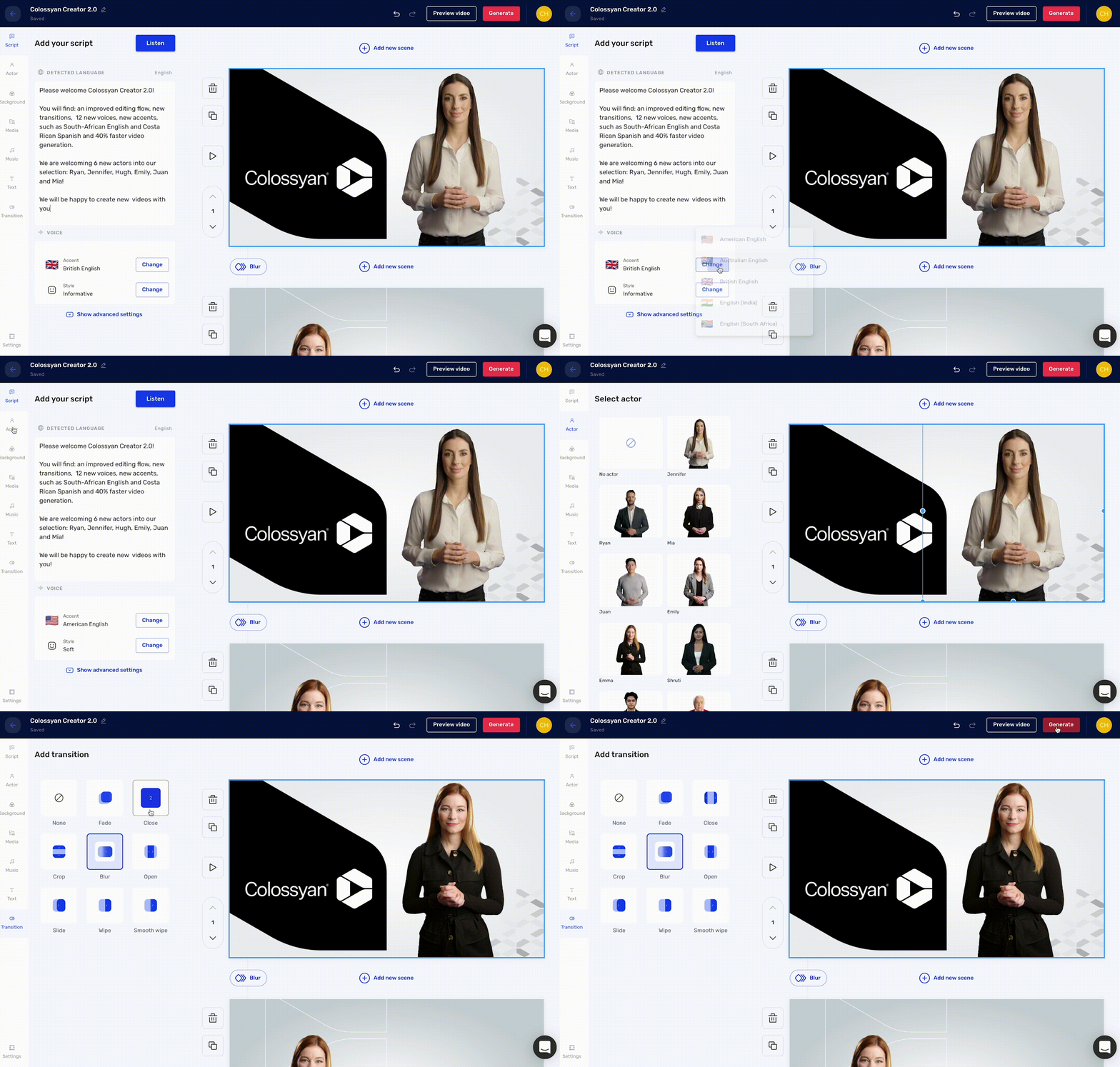
Colossyan taps AI to generate workplace learning videos, remixing, re-animating and editing footage of one of several virtual avatars against changeable backdrops. Users can enter a script to have it “read” aloud by Colossyan’s text-to-speech (TTS) engine, which also translates the script into over 70 languages.
Image Credits: Colossyan
“To generate a video with Colossyan’s AI video platform, all you have to do is input a script and select from a diverse range of avatars,” Kovacs told TechCrunch in an email interview. “Any company can create a video about almost anything efficiently, without the need for conventional filming resources.”
Kovacs founded Colossyan in 2020 after leaving Defudger, a deepfakes detection platform, which he helped to co-launch. An engineer and data scientist by training, Kovacs says that he was inspired to start Colossyan by the budding corporate interest in GenAI.
“Enterprises are leveraging AI in diverse areas such as IT automation, customer care and digital labor — highlighting the broad applicability and potential impact of AI technologies in streamlining operations and enhancing service delivery,” Kovacs said. “The barriers to AI adoption, such as limited AI skills and data complexity, are significant yet surmountable challenges that many organizations are actively working to overcome.”
For the heck of it, I gave Colossyan’s platform, which offers a free trial, a go to see if I could make a training video that’d successfully hold the attention of my ADHD brain — admittedly a high bar. The avatars were a bit too stiff and cartoonish for my liking and the TTS engine too robotic, at least compared to some of the more sophisticated GenAI tools out there (e.g., ElevenLabs). But I’ve certainly seen worse corporate videos.
Colossyan also doesn’t generate videos as quickly as I’d expect — a 38-second clip takes ~11 minutes. Granted, that’s a lot faster than creating trainings from scratch. But frankly, faced with the prospect of generating more than a handful of videos for whatever purpose, I’d be tempted to go the PowerPoint or Canva route instead.
I’m not Colossyan’s target market, of course. And it seems that several household brands are happy to pay for a subscription to Colossyan as it exists today, including Novartis, Porsche, Vodafone, HPE and Paramount, claims Kovacs.
Kovacs attributes the customer traction to features like integrations with learning management systems and a “conversation mode” that allows two avatars to hold a dialogue with each other. He doesn’t deny that there’s a fair amount of competition in the GenAI video space — see CommonGround, Synthesia and Surge plus solutions from tech giants like Microsoft — but he thinks that Colossyan’s focus on “interactivity and engagement,” as he puts it, will continue to set the platform apart.
Perhaps he’s right. Colossyan today announced that it raised $22 million in a funding round led by Lakestar with participation from Launchub, Day One Capital and Emerge Education. The proceeds will be put toward tripling Colossyan’s headcount across its New York, London and Budapest offices, Kovacs says, and developing new capabilities like branching videos and knowledge checks.
“For C-suite and IT department leaders, our platform represents a scalable, cost-efficient solution to training and development challenges,” he added.
Australian organisations are keeping pace with global innovation in generative AI, according to IBM Consulting Global Head of Generative AI Matthew Candy. A local legislative focus on regulating high-risk use cases could also foster AI’s potential in the local market, he said.
Candy recently visited Australia and the broader APAC region to meet some of IBM Consulting’s regional clients and partners, many of whom will be moving from piloting generative AI to implementing models at scale throughout the calendar year 2024.
Speaking with TechRepublic Australia, Candy predicted a move to smaller AI models and the emergence of new digital products and services. He suggested organisations looking at scale needed to focus on strategy and business value as well as aspects like governance.
How does Australia stack up with the world on generative AI?
IBM’s Global AI Adoption Index 2023 pegged Australia as a lagging market for AI adoption. It found only 29% of Australian organisations were actively deploying AI in November of 2023, well behind early adopters India (59%), China (50%), Singapore (53%) and the UAE (58%).
SEE: Australian small and midsize businesses are at risk of getting left behind on AI
Matt Candy, global head of generative AI at IBM Consulting
However, Candy said there is evidence Australia is embracing generative AI. He said even organisations in traditional or regulated industries, as well as government agencies, are moving forward, and the local market showed a clear understanding of where value could be derived.
“There is some pretty innovative work being done in Australia,” Candy said. “One of the teams I’ve spent some time with are building new innovative digital products and services powered by generative AI models; I definitely don’t see anyone behind just because they are in Australia.”
Generative AI use cases being rolled out now in Australia
IBM Consulting has seen a lot of product pilot work in Australia, with a growing number of these projects now active beyond the pilot and experimentation phase that characterised 2023. From his time spent in the Australian market, Candy said some interesting client use cases include:
Companies in the asset-intensive utilities industry are using generative AI-powered assistants to help executives make investment decisions on asset management and managing an asset portfolio, which could result in significant increase in savings.
Utilities companies are wrapping generative AI assistants around complex knowledge bases, like standard operating procedures, to allow the likes of network controllers to chat with complex document sets to take the friction out of some tasks.
Universities are using generative AI to help generate more personalised content to support student communications while enabling students to interact in a conversational manner with the course content they are learning.
The end-to-end software development life cycle is being improved in at least one big bank, where IBM Consulting is supporting the use of generative AI to do things like translate project requirements into creative outputs such as user stories and code.
An Australian government agency is using large language models to create a brand new skills training platform.
‘Value pools’ and people among considerations when scaling AI
Candy was appointed to lead IBM Consulting’s 160,000 global consultants into the generative AI age in August 2023. He said Australian organisations looking to scale generative AI experimentation into implementation this year should keep a few things front of mind.
Have a clear vision and strategy
The foundation for generative AI success is having the right kind of strategy. This will be based on the identification of a “North Star,” or articulation of a vision for what the new world using AI’s potential will look like. This vision and strategy will then support the realisation of the roadmap.
Align use cases with ‘value pools’
Finding use cases aligned to “value pools” is important, Candy said. Whether it is a bank, a utilities provider or a retailer, Candy suggests asking where in the organisation there are heavy manual knowledge bases or document-intensive activities slowing down cycle times.
“One example is a contact centre, where we are seeing a lot of people focusing on generative AI,” said Candy. “How can you make your agents more effective by wrapping knowledge bases around them to improve call handling times or agent actions to deliver a better experience for the customer?”
Start an innovation engine for AI
Scaling AI requires an innovation engine for organisations to take use cases right through to validation, testing, piloting with minimum viable products and scaling. Candy said the likes of design-led and product-led ways of working could contribute to organisational success.
“You need that agile flywheel to build, deliver and scale,” Candy said.
Build a generative AI tech core
Candy said organisations need to be clear on the architecture and digital core layer they will use to manage their generative AI. This clarity is required because many organisations will be using AI across multiple clouds, in addition to AI-infused products like Salesforce and SAP.
Get on top of AI governance
Enterprises will need to manage problems like bias, drift and explainability across multiple AI models, as well as have the right processes in place for their people. They will also need to be in compliance with regulations being created in multiple legal jurisdictions around the world.
Prioritise the people challenge
About 70% of the challenge of rolling out AI is a human challenge, Candy argues. This includes infusing employees with the skills required to have confidence with AI models and maximising change management success by getting AI adopted widely by employees at the coalface.
The future of AI in Australia will balance use case regulation with innovation
Matthew Candy is “very excited” about the potential of generative AI. IBM Consulting, too, is rolling out generative AI; it recently announced it would augment its 160,000 consultants with a variety of AI assistants to scale expertise across a range of roles in the organisation.
SEE: AWS and IBM Consulting partner to expand generative AI training.
Candy said these AI assistants would be able to encapsulate organisational knowledge and handle more of the repeatable parts of roles. These assistants will also be offered as products and services for IBM Consulting clients to help them scale better and faster through 2024.
Australian AI regulation right to focus on high risk use cases first
Australia’s announced regulatory approach for AI, which follows the European Union in focusing future regulation around the risks presented by specific AI use cases, was the “right approach,” Candy said.
“We believe in making sure there is appropriate regulations and controls in place for different types of use cases; it’s really about regulating where the use case lies,” said Candy.
IBM predicts rise of smaller models, innovation and governance
Enterprise clients in Australia and around the world are thinking carefully about the best AI models to deploy. Candy predicts smaller models will be attractive in 2024 due to advantages like less hallucinations and compute requirements, leading to lower costs.
Another trend to expect in 2024 is the emergence of innovative new digital products and services that could shift and transform existing business models, with Candy expecting a lot of big ideas and visions to emerge this year through excellence in generative AI.
With responsible AI becoming critical to organisations, Candy also predicts there will be a continued focus on AI governance foundations, both from a technology standpoint as well as integration into the people and processes of Australian organisations.