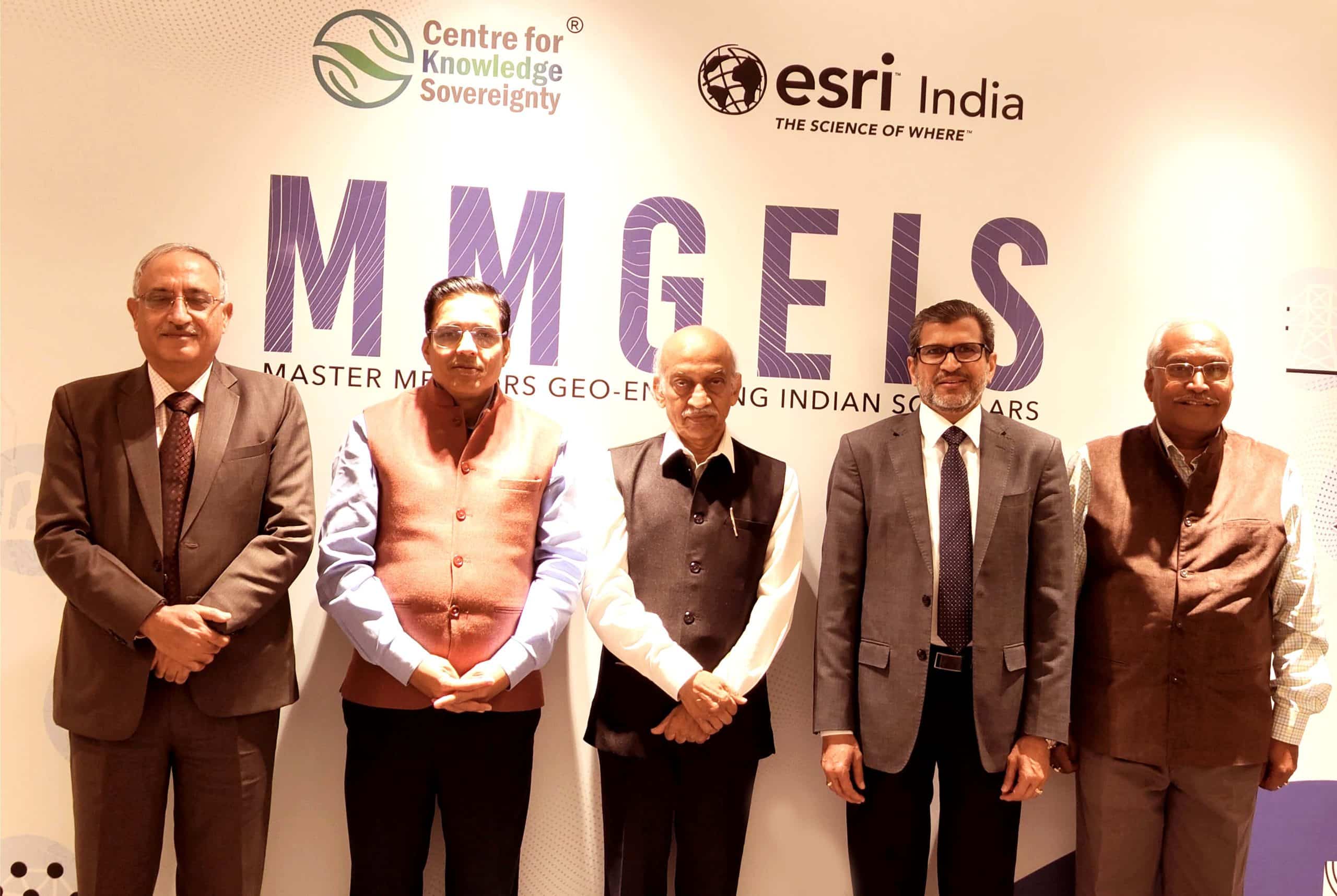
Multinational geographic information system company Esri India and independent public policy think tank Centre for Knowledge Sovereignty (CKS) have unveiled the pilot phase of the Master Mentors Geo-enabling Indian Scholars (MMGEIS) program to train students across the country in geospatial technology.
The students will be guided by a team of experienced professionals including A. S. Kiran Kumar, former chairperson, ISRO and currently a member of Space Commission, Dr K. J. Ramesh, former director general of meteorology, IMD, retired lieutenant general Girish Kumar, former surveyor general of India, Vinit Goenka, secretary, CKS and Agendra Kumar, managing director, Esri India.
The free-of-cost program aims to instil geospatial thinking in students from eighth grade to undergraduates, with the ultimate goal of positioning India as a global geospatial technology hub. Over the next five years, the initiative aims to engage more than 100,000 students annually, contributing to the development of a skilled workforce.
Key Highlights of the Program
The online MMGEIS program spans four months, divided into three modules, offering video-based courses accessible via mobile phones or laptops, reading materials, as well as proctored exams.
The MMGEIS program is strategically crafted to cultivate a research-oriented mindset among students, equipping them for the challenges of the digital age while concurrently establishing a strong intellectual property (IP) framework. Its impact transcends technological realms, extending into the domain of entrepreneurship, offering valuable insights into patent filing procedures and guidance on initiating startups. The program, therefore, serves as a comprehensive initiative to develop not only technological skills but also entrepreneurial acumen, contributing to a well-rounded education for participants.
The pilot phase, covering 1,000 students initially, will roll out in select schools and educational institutions, with plans for broader implementation starting June 2024.
Some of the notable activities leading up to the pilot phase include a roundtable discussion of industry leaders in Delhi, a visit to the ISRO Telemetry Tracking and Command Network (ISTRAC) center, and the launch of the MMGEIS website.
“It is important to enable and empower curious young Indian minds with the tools and knowledge to understand the use of geospatial technology which is rapidly encompassing all aspects of human endeavors. MMGEIS is a powerful medium that will bring to these bright minds the right guidance and skills to usher in an era of innovation in the use of geospatial technology.” said A S Kiran Kumar, during the announcement.
The post Esri India to Train 100K Students in Geospatial Technology for Free appeared first on Analytics India Magazine.
Diabetes is a disease that occurs because of the body's inability to produce or use a vital elixir called insulin. Made by the pancreas, insulin helps absorb glucose and provides the body with energy to function.
There are two basic types of diabetes: type 1, where the pancreas has been attacked by the body's own immune system and is not able to produce any insulin at all; and type 2, which makes up over 90% of diabetes cases, where the body isn't able to use insulin to breakdown glucose.
Also: 3 ways AI is revolutionizing how health organizations serve patients
In type 2 diabetes, too much insulin floating around in your body causes havoc. Diabetics suffer from poor blood circulation and are known to be in acute danger of heart attacks, strokes, amputations, blindness, and kidney problems. If you are overweight, obese, or not physically active, you are at a high risk of contracting type 2 diabetes.
But the odd thing about diabetes is that people who have it often don't know, which is why the disease is referred to as a silent killer.
Around 37 million adult Americans, or 11.7% of the adult population, have type 2 diabetes, but only 28 million people in the US have been diagnosed with the disease. The rest don't know they have it.
Globally, the picture is worse — 462 million people have type 2 diabetes, but at least half that number are unaware.
Testing times
You might think that, in our technology-fuelled age, innovators would have created a systematic, efficient and affordable way to detect the presence of a commonplace disease like diabetes, which largely attacks the underprivileged. However, progress, until now, has been limited.
The most common test today still is one that measures blood glucose levels (called the Fasting Blood Glucose or FBG), which entails overnight fasting and a trip to a clinic, as does the increasingly popular glycated hemoglobin (A1C) test, which does not require fasting.
Unfortunately, for most of the world's — and America's — less fortunate, a clinic is sometimes not easily accessible, and the cost of the test can be higher than people can afford.
But what if you could use a device that almost everyone owns today to detect the disease, and at practically no cost? And instead of waiting for days to get the test result, it appeared straightaway?
This is the emerging promise of voice-based disease detectors, which are apps armed with AI engines that are beginning to deliver radical new ways of spotting disease using your smartphone and a voice sample of just a few seconds.
Klick Health, a Toronto-based life science commercialization company, is one outfit that is looking to transform the process of detection and treatment with its pioneering test for diabetes.
The test is breathtakingly simple — it allows anyone with a smartphone to record their voice for just six to 10 seconds and find out whether they might have the disease.
Klick says that its test for type 2 diabetes is better than the industry standard fasting blood glucose (FBG) type, but without the expense and inconvenience that FBG entails.
The company told ZDNET that it is going through a final round of replication studies this year before seeking regulatory approval.
The AI doc is always in
Welcome to the world of vocal biomarkers, where AI analyzes voice patterns and characteristics. Instead of needles and blood samples, the algorithm gauges the most minute shifts in speech or breath that aren't discernable to mere mortals.
If the 'old world' uses human breath and a simulated cough as indicators to doctors of what might be awry under the hood, these vocal biomarkers dig deeper into tone and pitch, and a host of other markers.
The frontrunner in the field today is Klick — and its voice-based diabetes test might foment a revolution in the early detection and successful treatment of diabetes.
In order to train and test out their AI-based solution, Jaycee Kaufman and her team at Ontario Tech University in Canada recorded the voices of 267 individuals who either did not have diabetes or who had already been diagnosed with type 2 diabetes.
Over the course of two weeks, participants recorded a short sentence — "Hello, how are you? What is my glucose level right now?" — six times daily on their smartphones. This process generated over 18,000 voice samples, from which 14 acoustic features were singled out that differed in prevalence or intensity across participants.
Also: Everything we know about the Samsung Galaxy Ring
The underpinning for Klick's diabetes test is a change in the acoustic characteristic's of a person's voice because of the disease.
Diabetes, says Kaufman, tends to erode both nerves and muscles in men, impacting the robustness of their voices. On the other hand, women who have a higher corelation of depression or anxiety with diabetes tend to experience an increase in pitch.
Using these markers, Klick's AI-powered model achieved startling accuracy. The model's test for diabetes was 89% accurate when examining females, and 86% when assessing males — and there's the likelhood the results will only get better over time.
Caveats
Powered by AI, voice-based disease detection is poised to become one of the most popular ways we will begin to screen ourselves for a plethora of diseases.
Just recently, a group of 10 universities have been given funding to explore using AI to detect changes in voice to discover Alzheimer's disease and autism via a low-cost diagnostic tool.
Also: The best smart rings you can buy: Expert tested
Machine learning is also being deployed to detect Parkinson's disease, which relies on a method that hopes to introduce a screener for the disease with just a single sound of a patient saying 'aaaaah'. This sound will be compared to a database of recordings of Parkinson's patients and a control group.
However, while Klick's voice-based test for diabetes is on par with lab tests in terms of accuracy, it is meant to be a first step toward the eventual diagnosis of diabetes.
All tests exhbit false positives and other errors. So, it is crucial for those who will use the test to reinforce findings with other conventional tests and a professional's validation.
However, considering diabetes' pernicious role in accelerating serious health problems, an early warning system in the shape of a voice test, which could save many lives and spur others to seek early treatment, is just what the doctor ordered.
Amazon has cautioned its employees against using third-party generative AI tools for work, according to multiple internal memos viewed by Business Insider.
“While we may find ourselves using GenAl tools, especially when it seems to make life easier, we should be sure not to use it for confidential Amazon work,” the company warned employees in a recent email. “Don’t share confidential Amazon, customer, or employee data when using 3rd party GenAl tools. Generally, confidential data would be data that is not publicly available.”
Amazon’s internal third-party generative AI use and interaction policy, viewed by BI, warns that the companies offering generative AI services may take a license to or ownership over anything employees input into tools like OpenAI’s ChatGPT.
“This means that any outputs such as email, PRFAQs, internal wiki pages, code, confidential information, documentation, pre-launch and strategy materials may be extracted, reviewed, used, and distributed by the owners of the generative Al,” the policy states. “All Amazonians must abide by our standard Amazon policies for confidential information and security for any inputs to generative Al.”
Amazon is not the first big company to impose restrictions on using generative AI tools internally. Samsung and Apple are some big league names that banned using ChatGPT and similar tools.
Some of these companies are particularly sensitive about using this technology as their competitor Microsoft invested heavily in OpenAI and can claim the rights to the model’s results. But at a point, even Microsoft took away the in-house tool from its employees briefly.
Amazon’s spokesperson, Adam Montgomery, said the company has been developing generative AI and large machine learning models for a long time, and employees use its AI models every day.
“We have safeguards in place for employee use of these technologies, including guidance on accessing third-party generative AI services and protecting confidential information,” Montgomery said.
The post Amazon Warns Employees Not to Use Generative AI Tools appeared first on Analytics India Magazine.
Stability AI has announced Stable Diffusion 3 in early preview, its most capable text-to-image model with greatly improved performance in multi-subject prompts, image quality, and spelling abilities.
While the model is currently in an early preview phase and not yet widely available, the waitlist has been opened for those interested in exploring its capabilities. This preview phase is crucial for gathering insights to enhance the model’s performance and safety before its open release. Interested individuals can sign up for the waitlist to get early access.
The Stable Diffusion 3 suite of models currently range from 800M to 8B parameters.Combining a diffusion transformer architecture and flow matching, Stable Diffusion 3 is poised to provide a variety of options for users seeking both scalability and quality. A detailed technical report on the model is expected to be published soon.
Google Pauses Gemini Image Generation
Meanwhile, Google announced it is pausing its Gemini artificial intelligence image generation feature after saying it offers “inaccuracies” in historical pictures.
Gemini-generated pictures went viral on social media recently, leading to widespread ridicule and anger. Some users criticized Google, claiming that the company is overly concerned with being socially aware, even if it means sacrificing truth and accuracy.
This is how Gemini thinks the US founding fathers looked like pic.twitter.com/j849BzAgaM
— Dmitry Birulia — e/acc (@dbirulia) February 21, 2024
Users on social media had been complaining that the AI tool generates images of historical figures — like the U.S. Founding Fathers — as people of color, calling this inaccurate.
We're already working to address recent issues with Gemini's image generation feature. While we do this, we're going to pause the image generation of people and will re-release an improved version soon. https://t.co/SLxYPGoqOZ
— Google Communications (@Google_Comms) February 22, 2024
Google, in a post on platform X, stated that its AI feature has the capability to “generate a wide range of people,” which is generally beneficial for users worldwide. However, the company acknowledged a current deficiency in the software feature, noting that it is “missing the mark here.”
Google affirmed its commitment to prompt improvement, stating that the tech giant is “working to enhance these kinds of depictions immediately.”
The post Stability AI Releases Stable Diffusion 3 While Google Pauses Gemini’s Image Generation appeared first on Analytics India Magazine.
Union Minister of State for Electronics and Technology, Rajeev Chandrasekhar, issued a stern warning to Google India regarding its response to a query about PM Modi.
The minister referenced a tweet that showcased Gemini AI’s replies to questions about various global leaders. While certain responses were labeled as ‘complex,’ others expressed opinions, prompting the minister to caution Google India.
“These are direct violations of Rule 3(1)(b) of the Intermediary Rules (IT Rules) of the IT Act and violations of several provisions of the Criminal Code,” wrote Chandrashekhar in his response on X.
These are direct violations of Rule 3(1)(b) of Intermediary Rules (IT rules) of the IT act and violations of several provisions of the Criminal code. @GoogleAI @GoogleIndia @GoI_MeitY https://t.co/9Jk0flkamN
— Rajeev Chandrasekhar (@Rajeev_GoI) February 23, 2024
This is not the first time Google Gemini has come under flak. Most recently, Google announced it is pausing its Gemini artificial intelligence image generation feature after acknowledging ‘inaccuracies’ in historical pictures.
Gemini-generated pictures went viral on social media recently, leading to widespread ridicule and anger. Some users criticised Google, claiming that the company is overly concerned with being socially aware, even if it means sacrificing truth and accuracy.
Users on social media had been complaining that the AI tool generates images of historical figures — like the U.S. Founding Fathers — as people of color, calling this inaccurate.
Google, in a post on platform X, stated that its AI feature has the capability to “generate a wide range of people,” which is generally beneficial for users worldwide. However, the company acknowledged a current deficiency in the software feature, noting that it is “missing the mark here.”
We're already working to address recent issues with Gemini's image generation feature. While we do this, we're going to pause the image generation of people and will re-release an improved version soon. https://t.co/SLxYPGoqOZ
— Google Communications (@Google_Comms) February 22, 2024
Google affirmed its commitment to prompt improvement, stating that the tech giant is “working to enhance these kinds of depictions immediately.”
The post Indian IT Minister Says Google Gemini Violates Indian IT Laws appeared first on Analytics India Magazine.
Armenia’s 10web brings AI website-building to WordPress Rita Liao 9 hours
Generative AI has done an impressive job in improving productivity in a wide range of areas, including website building. There’s no lack of tools that now allow one to generate web designs by simply describing what they want in prompts, including established player Wix and bootstrapped startups like Relume. 10web, a company based out of Armenia, is entering the race and believes it has an edge.
10web allows users to quickly generate websites built with WordPress, the widely-used content management system that is notoriously hard to use for beginners, using text prompts. Unlike Wix and Squarespace, WordPress is open-source, meaning many features don’t come out of the box and require more advanced web design skills; it doesn’t come with hosting services either, so users have to manage more backend tasks.
WordPress still powers around 40% of all the websites on the internet, thanks to its customization options, according to estimates by w3techs. Shopify followed in second place amid a boom of direct-to-consumer ecommerce as vendors look to build their online stores with the help of the Canadian company rather than relying on Amazon.
To make WordPress more intuitive to use, 10web’s Yerevan-based engineering team has integrated generative AI models like Llama 2, GPT-4, and Stable Diffusion into its site-building platform. Such a tool requires a great deal of development effort because “architecturally, building a platform for WordPress is not easy,” said 10web’s co-founder Arto Minasyan, who also runs Krisp, a startup that removes background noise from audio using machine learning.
“You need to have a very good hosting infrastructure. You need to have a managed service to support WordPress security, backups and uptime. All those things are very, very hard because each of the websites is basically an instance,” he added. “In contrast, if you are building on a closed source solution, let’s say Wix or Squarespace, you just build one backend, and then for each website, you just generate some pages.”
Minasyan is confident that focusing on solving WordPress’s usability will pay off eventually because of the sheer size of its open-source community: two million developers. Founded in 2017, 10web currently operates with a positive cash flow. Around 20,000 of its users are paying customers (some SMB customers might have several hundred websites, Minasyan noted). Altogether, 1.5 million sites have been generated with 10web.
10web has two ways to monetize — charging fees per website or by traffic. It has plans to add a payment system, which will allow users to charge their customers and 10web to take a cut of the charge as commission fees.
The company is generating $5 million in annual recurring revenue at the moment and is expected to reach $25 million in ARR by the end of next year, Minasyan said. The founder attributed the company’s growth partly to its favorable location in Armenia. Like other former members of the Soviet Union, Armenia enjoys abundant affordable engineering talent.
“We have AI talent, which is probably four times cheaper in Armenia than in the U.S. And here, we can access the best AI talent possible,” the founder suggested. “But if you are a web builder based in California, you gotta compete with Google, Amazon and OpenAI, so it’s not easy to get the best talent.”
Armenia’s budding tech hub in its capital city has spawned the country’s first unicorn, Picsart, which provides a playbook for fellow startups to follow. Given Armenia’s relatively small economy, its entrepreneurs have historically ventured overseas, particularly targeting the U.S. They employ engineers in Armenia to take advantage of the tech talent at home while hiring marketing and business development headcounts in the U.S., a strategy also shared by 10web’s 70-person strong staff. And of course, having a footprint in the U.S. can be advantageous to fundraising.
“99% of Armenian startups target the U.S. market,” said the founder. “If you want to raise less than $1 million, you can raise from Armenian VCs, but if you want to raise a couple million for seed or tens of millions for Series A, you need to go to the U.S.”
Krisp nearly triples fundraise with $9M expansion after blockbuster 2020
Image generated by Stable DIffusion 3 with prompt, "studio photograph closeup of a chameleon over a black background."
Stability AI's 2022 release of Stable Diffusion significantly impacted the image-generating landscape, becoming the basis for many video and image generators. Now, the company is releasing a next-generation model that pushes the boundaries even further.
On Thursday, Stability AI unveiled Stable Diffusion 3, the company's most capable text-to-image model to date, that boasts many upgrades from its predecessor including better performance in multi-subject prompts, image quality, and spelling abilities, according to the company.
Also: The best AI image generators to try right now
The demo photos of Stable Diffusion 3 showcase just how capable the image generator is, generating vibrant images with lots of detail, and even tackling the challenging task of generating words that are spelled correctly.
Stability AI didn't release many details about the architecture underlying the model, saying it will publish a detailed technical report soon. However, the company did disclose that Stable Diffusion 3 combines a diffusion transform architecture and flow matching, which differs from its predecessor's architecture.
The company also shared that the family of Stable Diffusion 3 models ranges from 800 million to eight billion parameters to suit different user needs.
Also: How to use ChatGPT to write code
"This approach aims to align with our core values and democratize access, providing users with a variety of options for scalability and quality to best meet their creative needs," said the company.
Stable Diffusion 3 remains in early preview as the company collects insights to improve performance and safety; therefore, it is not yet broadly available to the public. If you are interested in joining the early preview, there is a waitlist you can join. Once granted access you will receive an email with an invite to its Discord server.
Since its inception in 2015, Telangana government-led T-Hub has incubated over 1,600 startups. Based on the triple helix model of innovation, the intermediary offers various programmes and initiatives to support startups, corporations, and other stakeholders in the innovation ecosystem.
“Cumulatively, they have raised close to about $1.9 billion in funding and created 25,000 plus jobs over the past eight years,” Mahankali Srinivas Rao (MSR), chief executive officer at T-Hub, told AIM.
So far, T-Hub has delivered over 100 innovation programmes, including incubation, and has helped startups access better technology, talent, mentors, customers, corporates, investors, and government agencies.
Over the years, T-Hub has evolved into a crucial component of Hyderabad’s startup and innovation ecosystem. Its success has been so impactful that other states are exploring the adoption of a similar model to replicate the achievements of T-Hub.
It has supported and propelled startups in various sectors, including deeptech, mobility, aerospace and defence, healthcare and medtech, fintech, digital commerce, and manufacturing, among others. Notably, it has also established the world’s largest startup incubation centre, covering an extensive area of 582,689 square feet.
Nurturing AI Startups
T-Hub has also launched various programmes and initiatives to fuel AI innovation in the state and nurture startups building AI tools and models.
With the Lab32 programme, launched in partnership with Hexagon, a Sweden-based tech company, T-Hub is helping AI startups get mentorship in go-to-market (GTM) strategies, support from value partners, and an opportunity to go-to-market with Hexagon.
As part of its incubation programme, T-Hub is helping several generative AI startups that are actively building Large Language Models (LLMs).
The startups selected are those building real-time language translation tools and enabling prescriptive maintenance with AI/ML models for process plants. As part of the second cohort, 12 startups were selected out of 230 that applied for the 100-day programme that will focus on digital twin, real-time language translation and predictive maintenance using an AI model.
“We’ve established programmes that pair participants with experienced mentors, strengthening their connections to investors. Additionally, we assist them in securing opportunities to present their ideas to prominent clients,” MSR told AIM.
Moreover, the Department of Science and Technology (DST) has established an ML and AI Technology Hub (MATH), an initiative designed to amplify the impact of AI/ML startups and explore opportunities for their elevation. According to MSR, an official announcement about the CoE will be made soon.
The initiative aims to empower over 150 startups annually and generate over 500 AI-related jobs by 2025. T-Hub also connects startups with mentors (AI experts) to provide them with the necessary knowledge, skills, and tools to leverage AI effectively.
Startups Building LLMs
Currently, T-Hub is incubating a startup named MeghaAI, which has engineered a multi-modal LLM tailored for the upstream oil and gas sector. Named ‘MachineGPT’, this model surpasses the constraints of static dashboards by providing a dynamic and intelligent natural language interface.
The platform doesn’t just present data; it engages in a meaningful conversation with your data, uncovering hidden patterns, detecting potential issues, and suggesting actionable solutions.
“Similarly, another Hyderabad-based startup, Genz Technologies, is developing enterprise-focused LLMs,” MSR pointed out.
Genz has developed eLLMo, which significantly reduces the information retrieval time from a few hours to a few seconds, thus saving many productive hours across the organisation resulting in increased efficiency and productivity.
Automatr is another startup that has developed an enterprise-focussed model called Document LLM, which helps in extracting data from unstructured documents.
Nurturing Semiconductor Startups
Besides AI, another field where India is trying to grow significantly is semiconductors. “Whenever you think of semiconductors, you think of fabrication units, but there is more to it. There is designing involved and also Outsourced Semiconductor Assembly and Test (OSAT) units. We have about close to 20 startups in this space,” MSR said.
One of the startups highlighted by MSR is PowerICs, which is developing GAN chargers and plans to set up a manufacturing facility in India and start production by 2025. Moreover, he also pointed out ASIP Technologies, which recently came out of stealth to announce its ATMP/OSAT project in partnership with Korea’s APACT Limited.
ASIP also signed an MoU with IIT Hyderabad to take up joint R&D in next-generation packages, develop and qualify new packaging materials and develop a skilled workforce for the OSAT industry.
The post How T-Hub is Scripting AI and Semiconductor Startup Success Stories appeared first on Analytics India Magazine.
You Only Look Once (YOLO) is one of the most well-known model architectures to have dominated the computer vision space. Its object detection algorithm is renowned for fast image processing results and improved accuracy. The YOLO algorithm strives to predict an object’s class and the bounding box that pinpoints its location on the input image.
Several iterations of YOLO have been released since Joseph Redmon first introduced it in 2015; the most current was created by AI platform Ultralytics, who also made versions YOLO v3 and YOLO v5.
All About Yolov9:
YOLO v9 emerges as a cutting-edge model, boasting innovative features that will play an important role in the further development of object detection, image segmentation, and classification. The new top-tier features allow faster, sharper, and more versatile actions.
The latest research paper proposed the use of Programmable Gradient Information (PGI) to tackle the information bottleneck and the challenge of adapting deep supervision to lightweight architectures of neural networks.
The team has also designed the Generalized Efficient Layer Aggregation Network (GELAN), a handy and practically effective neural network. The network has strong and stable performance at different computational blocks and depth settings regarding object detection. It can indeed be widely expanded into a model suitable for various inference devices.
For the above two issues, the introduction of PGI allows both lightweight as well as deep models to achieve significant improvements in accuracy. The YOLO v9, designed by combining PGI and GELAN, has shown strong competitiveness. Its well-thought design allows the deep model to reduce the number of parameters by 49% and the amount of calculations by 43% compared with YOLO v8. However, it still has a 0.6% Average Precision improvement on the MS COCO dataset.
The latest Yolo-v model beats RT-DETR (Realtime Detection Transformer) and YOLO MS in accuracy and efficiency. It uses conventional convolution for better parameter utilization, setting new standards in lightweight model performance.
Here’s the source code for Yolo v9.
The post Object Detection Gets a New Upgrade with YOLO v9 appeared first on Analytics India Magazine.







 pic.twitter.com/j849BzAgaM

 (@Rajeev_GoI) February 23, 2024