AI could help soften cloud sticker shock — or make things worse

Abstract AI automation

With bursty workloads and constantly fluctuating streams of user requests, cloud services have given many a chief financial officer a headache at the end of the month. A monthly charge of $25,000 could suddenly jump to $200,000 the next month. CFOs, as we know, don't like such volatility.

Most companies, 69%, spend more than $1 million a year on cloud computing, a survey out of Flexera confirms. Nearly a quarter of respondents (24%) are currently spending more than $12 million per year on public cloud. Even among small to medium businesses in the sample, 26% spend more than $1 million annually.

Also: Want to work in AI? How to pivot your career in 5 steps

These costs would be less of a headache to CFOs if they were more predictable. They can be, but there is another wrench being thrown into the mix: Artificial intelligence, which relies heavily on cloud services for processing power and storage capacity. Few organizations are tracking AI costs at this time, new research on 1,245 cloud-consuming companies by the FinOps Foundation, a group affiliated with the Linux Foundation, finds. At the same time, 31% of survey respondents said that the costs of AI/ML are impacting their cloud cost measurement and mitigation efforts.

Enter FinOps — which encourages aligning cloud spending to business goals, based on data-driven decision-making — seen as an approach to the madness. However, there is a conundrum that still needs to be figured out. "Will AI/ML become one of the biggest costs to manage across all levels of cloud spend?" The survey's authors, Laura Mills, principal with SIAC and Mike Fuller, CTO of the FinOps Foundation, ask. "Or will the technology be leveraged to make things easier for practitioners, unlocking more intelligent optimization and automation? The former is already happening for many, while the latter is still a hope."

Also: How renaissance technologists are connecting the dots between AI and business

The story is unfolding in two directions:

  • AI for FinOps: Using AI/ML for the practice of FinOps itself
  • FinOps for AI: Managing AI/ML service costs in your FinOps practice

Managing AI costs is a rising concern for those spending $100 million or more annually on cloud services at this time, Mills and Fuller observe. "Organizations with a higher overall cloud spend tend to see AI/ML as a rapidly increasing source of variable costs that need to be managed." AI costs are not yet a concern for smaller organizations at this time.

"AI, rather than initially helping, is actually starting to negatively impact cloud bills for large spenders and is directly impacting margins due to increased spending in the cloud," adds J.R. Storment, executive director of the FinOps Foundation.

AI delivers greater and more intelligent automation, which is key to automating the tracking and management of cloud spend. Tellingly, however, "there is a lack of trust in full automation, where action is taken without any human approval," the report states. "We heard that large spenders, especially those in regulated industries, are more cautious about automation. We also hear that integrating automation into existing systems and workflows is challenging, especially in environments where DevOps teams are distributed and use a mix of tools in their cloud deployments."

With such a lack of trust, "full automation could take years to build," they add.

Artificial Intelligence

Mutale Nkonde’s nonprofit is working to make AI less biased

Mutale Nkonde’s nonprofit is working to make AI less biased Dominic-Madori Davis 9 hours

To give AI-focused women academics and others their well-deserved — and overdue — time in the spotlight, TechCrunch is launching a series of interviews focusing on remarkable women who’ve contributed to the AI revolution. We’ll publish several pieces throughout the year as the AI boom continues, highlighting key work that often goes unrecognized. Read more profiles here.

Mutale Nkonde is the founding CEO of the nonprofit AI For the People (AFP), which seeks to increase the amount of Black voices in tech. Before this, she helped introduce the Algorithmic and Deep Fakes Algorithmic Acts, in addition to the No Biometric Barriers to Housing Act, to the US House of Representatives. She is currently a Visiting Policy Fellow at the Oxford Internet Institute.

Briefly, how did you get your start in AI? What attracted you to the field?

I started to become curious about how social media worked after a friend of mine posted that Google Pictures, the precursor to Google Image, labeled two Black people as gorillas in 2015. I was involved with a lot of “Blacks in tech” circles, and we were outraged, but I did not begin to understand this was because of algorithmic bias until the publication of Weapons of Math Destruction in 2016. This inspired me to start applying for fellowships where I could study this further and ended with my role as a co author of a report called o Advancing Racial Literacy in Tech, which was published in 2019. This was noticed by folks at the McArthur Foundation and kick-started the current leg of my career.

I was attracted to questions about racism and technology because they seemed under-researched and counterintuitive. I like to do things other people do not, so learning more and disseminating this information within Silicon Valley seemed like a lot of fun. Since Advancing Racial Literacy in Tech. I have started a nonprofit called AI for the People that focuses on advocating for policies and practices to reduce the expression of Algorithmic Bias.

What work are you most proud of (in the AI field)?

I am really proud of being the leading advocate of the Algorithmic Accountability Act, which was first introduced to the House of Representatives in 2019. It established AI for the People as a key thought leader around how to develop protocols to guide the design, deployment, and governance of AI systems that comply with local nondiscrimination laws. This has led to us being included in the Schumer AI Insights Channels as part of an advisory group for various federal agencies and some exciting upcoming work on the Hill.

How do you navigate the challenges of the male-dominated tech industry and, by extension, the male-dominated AI industry?

I have actually had more issues with academic gatekeepers. Most of the men I work with in tech companies have been charged with developing systems for use on Black and other nonwhite populations, and so they have been very easy to work with. Principally because I am acting as an external expert who can either validate or challenge existing practices.

What advice would you give to women seeking to enter the AI field?

Find a niche and then become one of the best people in the world at it. I had two things that have helped me build credibility, the first was I was advocating for policies to reduce algorithmic bias, while people in academia began to discuss the issue. This gave me a first-mover advantage in the “solutions space” and made AI for the People an authority on the Hill five years before the executive order. The second thing I would say is look at your deficiencies and address them. AI for the People is four years old and I have been gaining the academic credentials I need to ensure I am not pushed out of thought leader spaces. I cannot wait to graduate with a Masters from Columbia in May and hope to continue researching in this field.

What are some of the most pressing issues facing AI as it evolves?

I am thinking heavily about the strategies that can be pursued to involve more Black and people of color in the building, testing, and annotating of foundational models. This is because the technologies are only as good as their training data, so how do we create inclusive datasets at a time that DEI is being attacked, Black venture funds are being sued for targeting Black and female founders, and Black academics are being publicly attacked, who will do this work in the industry?

What are some issues AI users should be aware of?

I think we should be thinking about AI development as a geopolitical issue and how the United States could become a leader in truly scalable AI by creating products that have high efficacy rates on people in every demographic group. This is because China is the only other large AI producer, but they are producing products within a largely homogenous population, and even though they have a large footprint in Africa. The American tech sector can dominate that market if aggressive investments are made into developing anti-bias technologies.

What is the best way to responsibly build AI?

There needs to be a multi-prong approach, but one thing to consider would be pursuing research questions that center on people living on the margins of the margins. The easiest way to do this is by taking notes of cultural trends and then considering how this impacts technological development. For example, asking questions like how do we design scalable biometric technologies in a society where more people are identifying as trans or nonbinary?

How can investors better push for responsible AI?

Investors should be looking at demographic trends and then ask themselves will these companies be able to sell to a population that is increasingly becoming more Black and brown because of falling birth rates in European populations across the globe? This should prompt them to ask questions about algorithmic bias during the due diligence process, as this will increasingly become an issue for consumers.

There is so much work to be done on reskilling our workforce for a time when AI systems do low-stakes labor-saving tasks. How can we make sure that people living at the margins of our society are included in these programs? What information can they give us about how AI systems work and do not work from them, and how can we use these insights to make sure AI truly is for the People?

Guiding Instruction-Based Image Editing via Multimodal Large Language Models

GUIDING INSTRUCTION-BASED IMAGE EDITING VIA MULTIMODAL LARGE LANGUAGE MODELS

Visual design tools and vision language models have widespread applications in the multimedia industry. Despite significant advancements in recent years, a solid understanding of these tools is still necessary for their operation. To enhance accessibility and control, the multimedia industry is increasingly adopting text-guided or instruction-based image editing techniques. These techniques utilize natural language commands instead of traditional regional masks or elaborate descriptions, allowing for more flexible and controlled image manipulation. However, instruction-based methods often provide brief directions that may be challenging for existing models to fully capture and execute. Additionally, diffusion models, known for their ability to create realistic images, are in high demand within the image editing sector.

Moreover, Multimodal Large Language Models (MLLMs) have shown impressive performance in tasks involving visual-aware response generation and cross-modal understanding. MLLM Guided Image Editing (MGIE) is a study inspired by MLLMs that evaluates their capabilities and analyzes how they support editing through text or guided instructions. This approach involves learning to provide explicit guidance and deriving expressive instructions. The MGIE editing model comprehends visual information and executes edits through end-to-end training. In this article, we will delve deeply into MGIE, assessing its impact on global image optimization, Photoshop-style modifications, and local editing. We will also discuss the significance of MGIE in instruction-based image editing tasks that rely on expressive instructions. Let's begin our exploration.

MLLM Guided Image Editing or MGIE: An Introduction

Multimodal Large Language Models and Diffusion Models are two of the most widely used AI and ML frameworks currently owing to their remarkable generative capabilities. On one hand, you have Diffusion models, best known for producing highly realistic and visually appealing images, whereas on the other hand, you have Multimodal Large Language Models, renowned for their exceptional prowess in generating a wide variety of content including text, language, speech, and images/videos.

Diffusion models swap the latent cross-modal maps to perform visual manipulation that reflects the alteration of the input goal caption, and they can also use a guided mask to edit a specific region of the image. But the primary reason why Diffusion models are widely used for multimedia applications is because instead of relying on elaborate descriptions or regional masks, Diffusion models employ instruction-based editing approaches that allow users to express how to edit the image directly by using text instructions or commands. Moving along, Large Language Models need no introduction since they have demonstrated significant advancements across an array of diverse language tasks including text summarization, machine translation, text generation, and answering the questions. LLMs are usually trained on a large and diverse amount of training data that equips them with visual creativity and knowledge, allowing them to perform several vision language tasks as well. Building upon LLMs, MLLMs or Multimodal Large Language Models can use images as natural inputs and provide appropriate visually aware responses.

With that being said, although Diffusion Models and MLLM frameworks are widely used for image editing tasks, there exist some guidance issues with text based instructions that hampers the overall performance, resulting in the development of MGIE or MLLM Guided Image Editing, an AI-powered framework consisting of a diffusion model, and a MLLM model as demonstrated in the following image.

Within the MGIE architecture, the diffusion model is end-to-end trained to perform image editing with latent imagination of the intended goal whereas the MLLM framework learns to predict precise expressive instructions. Together, the diffusion model and the MLLM framework takes advantage of the inherent visual derivation allowing it to address ambiguous human commands resulting in realistic editing of the images, as demonstrated in the following image.

The MGIE framework draws heavy inspiration from two existing approaches: Instruction-based Image Editing and Vision Large Language Models.

Instruction-based image editing can improve the accessibility and controllability of visual manipulation significantly by adhering to human commands. There are two main frameworks utilized for instruction based image editing: GAN frameworks and Diffusion Models. GAN or Generative Adversarial Networks are capable of altering images but are either limited to specific domains or produce unrealistic results. On the other hand, diffusion models with large-scale training can control the cross-modal attention maps for global maps to achieve image editing and transformation. Instruction-based editing works by receiving straight commands as input, often not limited to regional masks and elaborate descriptions. However, there is a probability that the provided instructions are either ambiguous or not precise enough to follow instructions for editing tasks.

Vision Large Language Models are renowned for their text generative and generalization capabilities across various tasks, and they often have a robust textual understanding, and they can further produce executable programs or pseudo code. This capability of large language models allows MLLMs to perceive images and provide adequate responses using visual feature alignment with instruction tuning, with recent models adopting MLLMs to generate images related to the chat or the input text. However, what separates MGIE from MLLMs or VLLMs is the fact that while the latter can produce images distinct from inputs from scratch, MGIE leverages the abilities of MLLMs to enhance image editing capabilities with derived instructions.

MGIE: Architecture and Methodology

Traditionally, large language models have been used for natural language processing generative tasks. But ever since MLLMs went mainstream, LLMs were empowered with the ability to provide reasonable responses by perceiving images input. Conventionally, a Multimodal Large Language Model is initialized from a pre-trained LLM, and it contains a visual encoder and an adapter to extract the visual features, and project the visual features into language modality respectively. Owing to this, the MLLM framework is capable of perceiving visual inputs although the output is still limited to text.

The proposed MGIE framework aims to resolve this issue, and facilitate a MLLM to edit an input image into an output image on the basis of the given textual instruction. To achieve this, the MGIE framework houses a MLLM and trains to derive concise and explicit expressive text instructions. Furthermore, the MGIE framework adds special image tokens in its architecture to bridge the gap between vision and language modality, and adopts the edit head for the transformation of the modalities. These modalities serve as the latent visual imagination from the Multimodal Large Language Model, and guides the diffusion model to achieve the editing tasks. The MGIE framework is then capable of performing visual perception tasks for reasonable image editing.

Concise Expressive Instruction

Traditionally, Multimodal Large Language Models can offer visual-related responses with its cross-modal perception owing to instruction tuning and features alignment. To edit images, the MGIE framework uses a textual prompt as the primary language input with the image, and derives a detailed explanation for the editing command. However, these explanations might often be too lengthy or involve repetitive descriptions resulting in misinterpreted intentions, forcing MGIE to apply a pre-trained summarizer to obtain succinct narrations, allowing the MLLM to generate summarized outputs. The framework treats the concise yet explicit guidance as an expressive instruction, and applies the cross-entropy loss to train the multimodal large language model using teacher enforcing.

Using an expressive instruction provides a more concrete idea when compared to the text instruction as it bridges the gap for reasonable image editing, enhancing the efficiency of the framework furthermore. Moreover, the MGIE framework during the inference period derives concise expressive instructions instead of producing lengthy narrations and relying on external summarization. Owing to this, the MGIE framework is able to get a hold of the visual imagination of the editing intentions, but is still limited to the language modality. To overcome this hurdle, the MGIE model appends a certain number of visual tokens after the expressive instruction with trainable word embeddings allowing the MLLM to generate them using its LM or Language Model head.

Image Editing with Latent Imagination

In the next step, the MGIE framework adopts the edit head to transform the image instruction into actual visual guidance. The edit head is a sequence to sequence model that helps in mapping the sequential visual tokens from the MLLM to the meaningful latent semantically as its editing guidance. To be more specific, the transformation over the word embeddings can be interpreted as general representation in the visual modality, and uses an instance aware visual imagination component for the editing intentions. Furthermore, to guide image editing with visual imagination, the MGIE framework embeds a latent diffusion model in its architecture that includes a variational autoencoder and addresses the denoising diffusion in the latent space. The primary goal of the latent diffusion model is to generate the latent goal from preserving the latent input and follow the editing guidance. The diffusion process adds noise to the latent goal over regular time intervals and the noise level increases with every timestep.

Learning of MGIE

The following figure summarizes the algorithm of the learning process of the proposed MGIE framework.

As it can be observed, the MLLM learns to derive concise expressive instructions using the instruction loss. Using the latent imagination from the input image instructions, the framework transforms the modality of the edit head, and guides the latent diffusion model to synthesize the resulting image, and applies the editing loss for diffusion training. Finally, the framework freezes a majority of weights resulting in parameter-efficient end to end training.

MGIE: Results and Evaluation

The MGIE framework uses the IPr2Pr dataset as its primary pre-training data, and it contains over 1 million CLIP-filtered data with instructions extracted from GPT-3 model, and a Prompt-to-Prompt model to synthesize the images. Furthermore, the MGIE framework treats the InsPix2Pix framework built upon the CLIP text encoder with a diffusion model as its baseline for instruction-based image editing tasks. Furthermore, the MGIE model also takes into account a LLM-guided image editing model adopted for expressive instructions from instruction-only inputs but without visual perception.

Quantitative Analysis

The following figure summarizes the editing results in a zero-shot setting with the models being trained only on the IPr2Pr dataset. For GIER and EVR data involving Photoshop-style modifications, the expressive instructions can reveal concrete goals instead of ambiguous commands that allows the editing results to resemble the editing intentions better.

Although both the LGIE and the MGIE are trained on the same data as the InsPix2Pix model, they can offer detailed explanations via learning with the large language model, but still the LGIE is confined to a single modality. Furthermore, the MGIE framework can provide a significant performance boost as it has access to images, and can use these images to derive explicit instructions.

To evaluate the performance on instruction-based image editing tasks for specific purposes, developers fine–tune several models on each dataset as summarized in the following table.

As it can be observed, after adapting the Photoshop-style editing tasks for EVR and GIER, the models demonstrate a boost in performance. However, it is worth noting that since fine-tuning makes expressive instructions more domain-specific as well, the MGIE framework witnesses a massive boost in performance since it also learns domain-related guidance, allowing the diffusion model to demonstrate concrete edited scenes from the fine-tuned large language model benefitting both the local modification and local optimization. Furthermore, since the visual-aware guidance is more aligned with the intended editing goals, the MGIE framework delivers superior results consistently when compared to LGIE.

The following figure demonstrates the CLIP-S score across the input or ground truth goal images and expressive instruction. A higher CLIP score indicates the relevance of the instructions with the editing source, and as it can be observed, the MGIE has a higher CLIP score when compared to the LGIE model across both the input and the output images.

Qualitative Results

The following image perfectly summarizes the qualitative analysis of the MGIE framework.

As we know, the LGIE framework is limited to a single modality because of which it has a single language-based insight, and is prone to deriving wrong or irrelevant explanations for editing the image. However, the MGIE framework is multimodal, and with access to images, it completes the editing tasks, and provides explicit visual imagination that aligns with the goal really well.

Final Thoughts

In this article, we have talked about MGIE or MLLM Guided Image Editing, a MLLM-inspired study that aims to evaluate Multimodal Large Language Models and analyze how they facilitate editing using text or guided instructions while learning how to provide explicit guidance by deriving expressive instructions simultaneously. The MGIE editing model captures the visual information and performs editing or manipulation using end to end training. Instead of ambiguous and brief guidance, the MGIE framework produces explicit visual-aware instructions that result in reasonable image editing.


Free Mastery Course: Become a Large Language Model Expert

Free Mastery Course: Become a Large Language Model Expert
Image by Author

In this blog post, we will review a famous educational GitHub repository with 24K ⭐ stars. This repository provides a structure to help you master Large Language Models (LLMs) for free. We will be discussing the course structure, Jupyter notebooks that contain code examples, and articles that cover the latest LLM developments.

Introduction

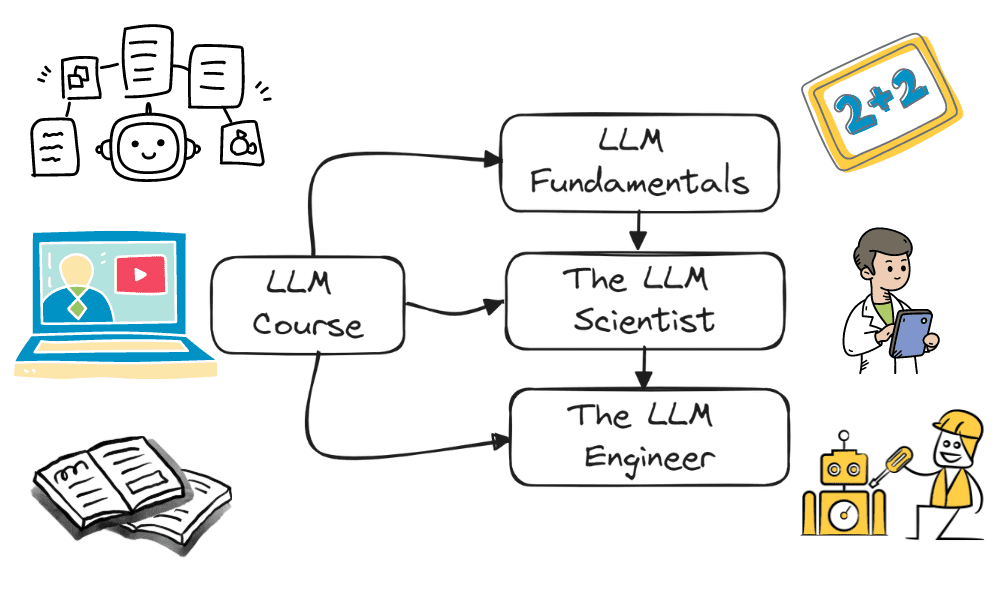
The Large Language Model Course is a comprehensive program designed to equip learners with the necessary skills and knowledge to excel in the rapidly evolving field of large language models. It consists of three core parts covering fundamental and advanced tools and concepts. Each core section contains multiple topics that come with YouTube tutorials, guides, and resources that are freely available online.

The LLM course is a helpful guide that provides a structured way of learning by providing freely available resources, tutorials, videos, notebooks, and articles at one place. Even if you are a complete beginner, you can start with the fundamentals section and learn about algorithms and technical and various tools to solve simple natural language and machine learning problems.

Course Structure

The course is divided into three main parts, each focusing on a different aspect of LLM expertise:

LLM Fundamentals

This foundational part addresses the essential knowledge required for understanding and working with LLMs. It covers mathematics, Python programming, the basics of neural networks, and natural language processing. For anyone looking to get into machine learning or deepen their understanding of its mathematical underpinnings, this section is invaluable. The resources provided, from 3Blue1Brown's engaging video series to Khan Academy's comprehensive courses, offer a variety of learning paths suitable for different learning styles.

Topics Covered:

  1. Mathematics for Machine Learning
  2. Python for Machine Learning
  3. Neural Networks
  4. Natural Language Processing (NLP)

The LLM Scientist

This LLM Scientist guide is designed for individuals who are interested in developing cutting-edge LLMs. It covers the architecture of LLMs, including Transformer and GPT models, and delves into advanced topics such as quantization, attention mechanisms, fine-tuning, and RLHF. The guide explains each topic in detail and provides tutorials and various resources to solidify the concepts. The whole concept is to learn by building.

Topics Covered:

  1. The LLM architecture
  2. Building an instruction dataset
  3. Pre-training models
  4. Supervised Fine-Tuning
  5. Reinforcement Learning from Human Feedback
  6. Evaluation
  7. Quantization
  8. New Trends

The LLM Engineer

This part of the course focuses on the practical application of LLMs. It will guide learners through the process of creating LLM-based applications and deploying them. The topics covered include running LLMs, building vector databases for retrieval-augmented generation, advanced RAG techniques, inference optimization, and deployment strategies. During this part of the course, you will learn about the LangChain framework and Pinecone for vector databases, which are essential for integrating and deploying LLM solutions.

Topics Covered:

  1. Running LLMs
  2. Building a Vector Storage
  3. Retrieval Augmented Generation
  4. Advanced RAG
  5. Inference optimization
  6. Deploying LLMs
  7. Securing LLMs

Notebooks and Articles

Building, fine-tuning, inferring, and deploying models can be quite complex, requiring knowledge of various tools and careful attention to GPU memory and RAM usage. This is where the course offers a comprehensive collection of notebooks and articles that can serve as useful references for implementing the concepts discussed.

Notebooks and Articles on:

  • Tools: It covers tools for automatically evaluating your LLMs, merging models, quantizing LLMs in GGUF format, and visualizing merge models.
  • Fine-tuning: It provides a Google Colab notebook for step-by-step guides on fine-tuning models like Llama 2 and using advanced techniques for performance enhancement.
  • Quantization: The quantization notebooks deeply dive into optimizing LLMs for efficiency using 4-bit GPTQ and GGUF quantization methodologies.

Conclusion

Whether you're a beginner seeking to understand the basics or a seasoned practitioner looking to stay current with the latest research and applications, the LLM course is an excellent resource for delving deeper into the world of LLMs. It provides a wide range of freely available resources, tutorials, videos, notebooks, and articles all in one place. The course covers all aspects of LLMs, from theoretical foundations to deploying cutting-edge LLMs, making it an indispensable course for anyone interested in becoming an LLM expert. Additionally, notebooks and articles are included to reinforce the concepts discussed in each section.

Abid Ali Awan (@1abidaliawan) is a certified data scientist professional who loves building machine learning models. Currently, he is focusing on content creation and writing technical blogs on machine learning and data science technologies. Abid holds a Master's degree in Technology Management and a bachelor's degree in Telecommunication Engineering. His vision is to build an AI product using a graph neural network for students struggling with mental illness.

More On This Topic

  • Accelerate Your Machine Learning Journey with Uplimit's Metaflow…
  • The Ultimate Open-Source Large Language Model Ecosystem
  • Introduction to NExT-GPT: Any-to-Any Multimodal Large Language Model
  • Exploring the Zephyr 7B: A Comprehensive Guide to the Latest Large…
  • Unlock the Power of AI — A Special Release by KDnuggets and Machine…
  • More Free Courses on Large Language Models

Boost Your Content With a Lifetime of Exciting Visuals for Only $100

TL;DR: Use exciting visuals to boost your content with a lifetime subscription to the JumpStory Essentials Plan — it’s available to new users right now for only $99.99, 66% off the usual subscription price of $299.

Ditch those boring stock images. Your content deserves better. Now you can choose from authentic, relatable and relevant visuals that will grab the attention of your viewers with a lifetime subscription to the JumpStory Essentials Plan. It’s currently available to new users for only $99.99, a discount of 66% off the regular $299 subscription price.

Features

You’ll be able to search through collections of handpicked graphics and photos that are specific to cultures, countries, industries and trends. The JumpStory platform employs machine learning (AI) to display the visuals most likely to generate the best results for your content.

You’ll have access to photos of genuine real-world experiences such as cities, landscapes, travel, lifestyle and even emotions. There are also icons, illustrations and more, with new content being added every day, so you always have something fresh to choose from.

The user-friendly editor allows you to resize and crop your images easily with drag-and-drop controls. Unwanted areas (such as backgrounds) can be removed, and images can be straightened or resized to specific ratios without sacrificing quality. Just a single click is all that’s necessary to do all of that. You can also tweak the contrast, brightness and lighting to achieve the exact look you want.

It’s no wonder JumpStory has a 4.6 out of 5 stars rating on Capterra, GetApp and Software Advice.

We’re fortunate to live in an age when there are affordable options for necessary business tools. So you no longer have to break the bank to secure an affordable suite of office programs, or to generate attention-grabbing visuals for your content.

Get a lifetime subscription to the JumpStory Essentials Plan while it’s available to new users for just $99.99, a 66% discount off the usual subscription price of $299.

Get JumpStory

Prices and availability subject to change.

AI’s latest trick: Better KPIs for measuring business success

kpis-gettyimages-1434610269

Key performance indicators (KPIs) have long been seen as imperfect, yet they're the closest we can get to understanding how one's actions are impacting business performance. Did updating our CRM system increase the number of new customers signed per month? Did going with the cloud ERP increase net profit margins? Did the new IT service management system decrease the volume of IT trouble tickets?

Also: Generative AI will soon go mainstream, say 9 out of 10 IT leaders

For technology teams, pumping up these metrics has always been the holy grail of project success. Yet, these metrics can be flawed and often only provide a one-dimensional picture of how something performed.

Another use case for artificial intelligence arises: 3D key performance indicators. AI is seen as a way to help smooth out the inherent flaws of KPIs, and thus, provide a much more accurate and holistic picture of how businesses are really performing.

More than a third of organizations, 34%, are now doing just that: They're leveraging AI to create the next generation of these key performance metrics, according to a survey of 3,043 executives by MIT Sloan Management Review and Boston Consulting Group's BCG Henderson Institute.

For example, AI can surface and analyze interdependencies between KPIs that formerly were seen as unrelated to business results. "Forward-looking organizations are benefiting from using AI to generate KPIs that are more intelligent, adaptive, accurate, and predictive than legacy performance indicators."

More than half of the participating executives acknowledge they need more impactful KPIs. "They fall short in tracking progress, aligning people and processes, prioritizing resources, and advancing accountability," the study's authors point out. "Companies that use the same old KPIs to measure success are missing out on opportunities to better align people and processes, prioritize resources, and generate value."

Also: Employees input sensitive data into generative AI tools despite the risks

How is AI doing in unwrapping such metrics and providing a more holistic picture of how the business is performing? So far, so good. Organizations using AI-enabled KPIs are five times more likely to "effectively align incentive structures with objectives compared to those that rely on legacy KPIs," the MIT-BCG authors conclude.

They cite the example of Wayfair, the online furniture retailer, which employed AI to redesign its lost-sales KPI. "We used to think that if you lost the sale on a particular product, like a sofa, it was a loss to the company," Fiona Tan, CTO of Wayfair, is quoted. "But we started looking at the data and realized that 50% to 60% of the time, when we lost a sale, it was because the customer bought something else in the same product category."

With the help of AI-generated insights, Wayfair reengineered its lost-sales KPI from simply "calculating item-based lost sales in response to price changes to also calculating category-based retention of sales in response to price changes," the report states.

Also: How renaissance technologists are connecting the dots between AI and business

Nine out of 10 executives with AI-enhanced KPIs have seen a similar wider reach in their KPIs. Overall, they have seen a four-fold increase in collaboration between employees. They are also three times more effective at predicting future performance, three times more likely to see greater financial benefit, and twice more likely to see greater efficiency.

Three forms of 3D metrics can be designed with AI, the MIT-BCG authors suggest:

  • Smart descriptive KPIs "synthesize historical and current data to deliver insights into what happened or what is happening."
  • Smart predictive KPIs identify patterns and "anticipate future performance, producing reliable leading indicators and providing visibility into potential outcomes."
  • Smart prescriptive KPIs "use AI to recommend actions that optimize performance."

The time has come to re-examine the assumptions behind many traditional KPIs, the report's co-authors urge. AI is opening up new ways to explode the legacy, one-dimensional KPIs that have dominated business thinking.

Artificial Intelligence

Everything You Need to Know About MLOps: A KDnuggets Tech Brief

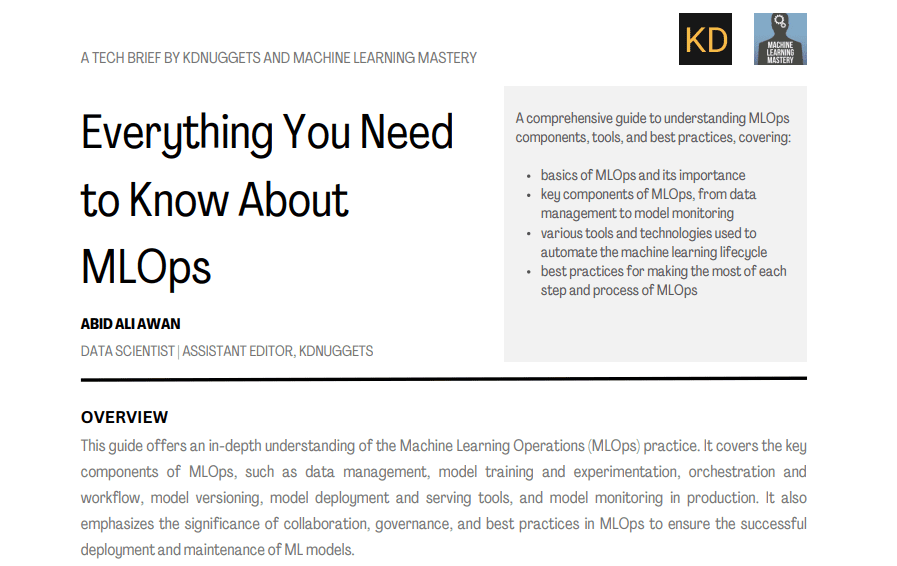
A TECH BRIEF BY KDNUGGETS AND MACHINE LEARNING MASTERY Everything You Need to Know About MLOps: A KDnuggets Tech Brief
Image created by Author with Midjourney

KDnuggets is thrilled be able to introduce our latest resource offering to the community today: Tech Briefs.

These are a brand new series of technical papers designed to provide insightful, concise information on pivotal data science and machine learning topics. As a free product for our readers, Tech Briefs aim to deliver essential foundational knowledge quickly and efficiently, ensuring you stay ahead in the rapidly evolving tech landscape.

Our inaugural Tech Brief delves into the world of Machine Learning Operations (MLOps). MLOps is a discipline that streamlines the lifecycle of machine learning projects, ensuring their efficient deployment, operation, and continuous improvement. This practice is becoming increasingly important and widely adopted due to its role in enhancing model reliability, operational efficiency, and overall project success in the expanding fields of AI and machine learning.

Everything You Need to Know About MLOps offers a comprehensive overview of the field, covering everything from the basics and key components, such as data management, model monitoring, and the use of various tools and technologies, to best practices aimed at maximizing the effectiveness of machine learning projects. It's tailored to equip you with a thorough understanding of how MLOps functions as the backbone of successful machine learning projects, addressing the challenges of deploying and maintaining ML models in production environments.

XXX
From Everything You Need to Know About MLOps

Our goal with Tech Briefs is to get you up to speed on important data-related tech topics FAST! This first issue sets the stage for future releases that promise to enrich your knowledge and expertise in the field of data science and machine learning. Stay tuned for more invaluable insights that will help you navigate the complexities of today's tech landscape with confidence and skill.

DOWNLOAD THE TECH BRIEF NOW

More On This Topic

  • KDnuggets News, April 13: Python Libraries Data Scientists Should…
  • KDnuggets News, April 27: A Brief Introduction to Papers With Code;…
  • Naïve Bayes Algorithm: Everything You Need to Know
  • Everything You Need to Know About Tensors
  • Everything You Need to Know About Data Lakehouses
  • ChatGPT: Everything You Need to Know

Oracle’s GenAI-Powered HCM Makes Life ‘Easy’ for Employees & HR Professionals 

Oracle is not your typical cloud service provider. Recently, the company embedded generative AI capabilities into the complete SaaS suite with Human Capital Management (HCM) being the first tool.

“The definition of success has changed for 96% of the Indians,” said Deepa Param Singhal, vice president-cloud applications, Oracle, in an exclusive interview with AIM, citing the ‘AI at Work’ survey. She said that they now seek more flexibility and focus on health, and communication, which became quite evident ever since the Covid-19 pandemic.

“We’re at an inflection point when it comes to the engagement of employees with the workforce. Nearly 70% feel disengaged with their companies across Asia. That’s a big problem we need to fix,” said Singhal.

“Managers are expected to have 70% more business impact and return. So, if you’re making your managers successful, I think that plays a huge role in retaining employees,” she said, adding that with generative AI tools, HRs can spend more time on business and strategic tasks.

Moreover, she added that with generative AI, mundane tasks like writing job descriptions and chasing employees to fill appraisal forms will get automated. “How quickly can HRs embrace the technology to solve some of the problems of customers and their employees? That will be an important factor alongside reskilling and upskilling the workforce,” she said.

Oracle HCM to the Rescue

“We want to provide a platform where employees can connect, and have meaningful relationships with each other,” said Singhal, adding that Oracle has built products like Oracle ME and Celebrate under Oracle HCM.

Oracle HCM is a suite of cloud-based applications designed to manage all aspects of the employee lifecycle, from recruitment and onboarding to talent development, performance management, and compensation.

Further, she said that today employees don’t need to visit the HR department to know about policies like maternity leave. “You get all of this information at your fingertips on Oracle HCM, keeping you more connected and productive.”

Oracle is already working with thousands of customers across industries. Citing workforce management software company Quess Corp, Singhal said that it uses Oracle HCM. The company, currently spread across 10 countries, has a diverse segment of the workforce, serving more than 3600 customers.

“All their employees actually implemented Oracle ME, the entire Fusion HCM suite in which talent can connect and grow,” she added.

Further, she said Jubilant FoodWorks, which has a workforce of 36,000, is also using HCM solutions to keep employees engaged. “We have Apollo Hospitals, which leverages Oracle HCM solutions to solve some of their problems in healthcare,” she added, adding that the company is already seeing a huge demand in India for its SaaS applications, which is expected to add $50 billion by 2030.

Oracle HCM vs the World

SAP SuccessFactors, Zoho People, Workday, PeopleStrong, Ceridian Dayforce, and Darwinbox among others, are also actively experimenting and integrating generative AI features to reshape HR.

ServiceNow, a leading global technology company, has entered into a partnership with Hugging Face to release the Now LLM. It caters to HR leaders, aiming to elevate productivity and operational efficiency by streamlining and minimising redundant manual tasks.

On the other hand, ANSR, a global captive center (GCC) scaler company, has developed Nova LLM using the Vicuna 7B model from the Llama 2 series. Trained on a combination of public and proprietary information, including ANSR’s hiring data across India’s GCC, the model incorporates insights from 18 years of data for 150,000 professionals

“We’ve invested in our robust AI infrastructure, securing all data within our system. Unlike many other vendors who rely on third-party tools, Oracle ensures your data stays within our ecosystem,” said Singhal. This approach, she explained, sets Oracle’s HCM apart. “It enables faster innovation and execution of use cases, leveraging our entire infrastructure database.”

Furthermore, she added that the partnership of Oracle with Cohere is crucial as it specialises in enterprise AI, and Oracle will continue to embed more applications with a hint of generative AI or industrial applications.

The post Oracle’s GenAI-Powered HCM Makes Life ‘Easy’ for Employees & HR Professionals appeared first on Analytics India Magazine.

What is Jumpcloud’s Co-founder Doing in HSR Layout, Bengaluru?

JumpCloud co-founder Greg Keller is a busy man, hobnobbing with startups in south Bengaluru – precisely HSR Layout – as the area has gradually evolved into a burgeoning startup hub over the years.

The security company, operating in the areas of identity, access, and device management, began active sales in India in 2021 and so far has thousands of Indian customers on its platform.

With a focus on small- and medium-sized businesses (SMEs), JumpCloud now wants to aggressively expand its businesses in India. Keller, who is also the company’s chief technology officer, is in talks with clients, as well as potential customers, in the IT city of Bengaluru.

Given that India has a large SME market and is the third-largest startup hub in the world, it makes sense for JumpCloud to bring its product to India.

Keller told AIM that India is one of the fastest-growing and most crucial markets for the company. “We have customers in 160 countries and over 50% of our revenue comes from outside the US, India being a primary driver of that.”

While the company predominantly sells its platform to cloud-born companies or startups which are bootstrapped or in their initial stages of funding, it’s also taking its platform to unicorns. So far, 15 of the 100-plus unicorns in India leverage JumpCloud’s platform, notably CarDekho.

Moreover, JumpCloud, which has over 800 employees across the globe, is also expanding its workforce in India. While they are a remote-first company, Keller said besides meeting potential customers, he is also here to further strengthen the team here in India.

Ending Microsoft’s monopolistic hold

Keller founded JumpCloud along with Rajat Bhargava in 2013 with the objective of bringing into the world an alternative to Microsoft’s widely recognized product, Active Directory.

“Anybody building software had to sort of bow to that portal for access control. So, we decided to develop a neutral directory service, what we now refer to as the Open Directory platform which quite literally doesn’t care what resource your company uses,” Keller said.

Over time, JumpCloud has developed a distinctive platform that consolidates various market categories, encompassing services like active directory, which falls under the directory services category.

“This forms the foundational aspect of our platform. Notably, we cover a broad spectrum of functionalities, including single sign-on, identity lifecycle management, workflow automation, and mobile device management (MDM) for Windows, Mac, iOS, Android, and Linux,” Keller said.

“The objective was to achieve uniformity and synchronisation, creating a harmonious synergy across these integrated services.”

How SMEs benefit from JumpCloud?

Furthermore, citing a recent JumpCloud report titled, ‘State of IT 2024: The Rise of AI, Economic Uncertainty, and Evolving Security Threats,’ Keller said that typically, SMEs rely on an average of 10 distinct tools for managing identity, devices, and multifactor authentication.

This multitude of tools entails navigating through 10 separate contract negotiations, establishing 10 distinct integrations between them, and conducting continuous 24/7 security reviews to ensure the vulnerability-free operation of each tool.

Recognizing the impracticality of this scenario, JumpCloud has found significant success in its global sales efforts by offering a solution that consolidates these diverse budgets into the JumpCloud platform.

“We have roughly 200,000 organisations that have signed up with JumpCloud and use the service at some level. They are spread across 160 countries and yet they came to us we never had to outbound sell,” Keller claimed.

Teaming up with Google

While the company sells its product directly as well through resellers, distributors, managed service providers (MSP) as well as managed security service providers (MSSP), the company also has a strategic relationship with Google.

Interestingly, a startup in its initial phase often opts for Google Workspace and not Microsoft Teams and this helps JumpCloud take its platform to them.

“In India, the success that we’re seeing is really pronounced, given the amount of cloud-born digitally native companies popping up in the country. Our channel partners in India collaborating with Google play a crucial role in occupying this space. This strategic move has proven highly effective for us, especially in the Indian market.”

The post What is Jumpcloud’s Co-founder Doing in HSR Layout, Bengaluru? appeared first on Analytics India Magazine.

3 Inspirational Stories of Leaders in AI

3 Inspirational Stories of Leaders in AI
Image by Editor

AI has taken over the world in recent years and will still be in the next decade. Can’t we imagine coming back to life before AI? I hardly think so, as AI has started complementing how we live. The breakthrough of AI into everyday life did not happen suddenly; instead, it was intentional by some individuals. Many of these individuals are what we refer to as the leaders in AI.

Leaders in AI don’t necessarily need to be big CEOs of companies or wealthy investors. They could come from any walk of life but still contribute something significant to the AI development we still discuss today. These individuals and their inspiring stories are what we are going to discuss in this article.

Who are these individuals? Let’s get into it.

1. Andrew Yan-Tak Ng

Thanks to his contribution to the field, Andrew Ng's name often comes up when discussing machine learning or deep learning. As the founder of Coursera, which taught millions of individuals, he could be considered an inspirational leader in AI and a legend. But, many behind-the-scenes moments make him so revered.

Andrew graduated at the top of his undergraduate class in 1997, majoring in three degrees: Statistics, economics, and computer science. From 1996 to 1998, he focuses his research at AT&T Bell Labs on reinforcement learning, feature selection, and model selection. His research started to become renowned in 1998 when he built an automatically indexed web search engine for machine learning research papers on the web.

After finishing his Ph.D., he went through an academic teaching career at Stanford University, where he taught his students data mining, big data, and machine learning. At this university, he began advocating for using GPUs in deep learning. This approach, though controversial at the time, has since become the standard.

Starting in 2012, he co-founded Coursera with Daphne Coller with his spirit to provide free learning for everyone. In a similar timeline, he also worked at Google, where he founded the Google Brain Deep Learning Project, and worked at Baidu until 2017. After that, he founded Deeplearning.ai as a platform to learn deep learning online and a Landing AI startup focusing on providing AI-powered SaaS products. Since then, Andrew has focused more on democratizing AI for the public.

With all the works that Andrew Ng has produced, he has opened pathways for many people into machine learning and deep learning. He has been awarded this achievement by many recognitions, including in 2013 as Time's 100 Most Influential People, in 2014 Fortune's 40 Under 40, and in 2023 as Time AI 100 Most Influential People.

By keeping his focus and his willingness to provide a learning pathway for many people, Andrew Ng's story undoubtedly inspires anyone to follow.

2. Fei-Fei Li

If you ever heard of ImageNet, you should know its founder is Fei-Fei Li. As we know, ImageNet is an extensive visual database used for rapidly advancing computer vision development, where more than 14 million images have been hand-annotated and used widely. From one dataset, it’s developed into an essential part of deep learning research.

Fei-Fei Li has an impressive educational background; she graduated with high honors as an undergraduate with a physics major and studied computer science and engineering. Even with high honors, she could still balance her work with her work at that time when she came back home every weekend to work at her parent's shop.

She received her Ph.D. in 2005 and has served an academic career from assistant professor to full professor at Stanford University. During that time, she also worked at Google from 2017 to 2018, where she expressed her opinion about Project Maven (Military initiative). She said her principle is about human-centered AI to benefit people positively and benevolently.

At Stanford, she established an initiative called SAILORS (Stanford AI Lab OutReach Summers), which aims to educate 9th-grade high school girls in AI education and research. Since then, it’s evolved to AI4ALL, which aims to increase diversity and inclusion in artificial intelligence.

Her motivation is always about democratizing AI for humans, where some refer to her as a "researcher bringing humanity to AI." With all her work, she has gained many achievements, notably in 2018 as America's Top 50 Women In Tech by Forbes and in 2023 as Time AI100.

From a humble beginning, her persistence and principle made her one of the AI leaders we can always look upon.

3. Demis Hassabis

You might have heard about DeepMind, a Google Subsidiary that aims to bring artificial intelligence into AGI (Artificial General Intelligence). But did you know the founder? It’s none other than Demis Hassabis, the CEO and the co-founder.

Demis Hassabis has been a child prodigy in chess since 4 years old and became the master at 13. He also completed his A-and scholarship-level exams at ages 15 and 16. With the chess-winning money, he bought himself his first computer and self-taught programming.

In his gap year at university, he started to work as a game computer developer. His notable achievement is his work as the lead programmer for the game Theme Park. In his gaming development career, he established his Elixir Studio studio, where he tried to develop a highly ambitious game called Republic: The Revolution but has since scope down as the development takes too long. The studio closed down in 2005, but many of his experiments for AI simulation in the game inspired his works in the future.

In 2009, he received a Ph.D. in cognitive neuroscience, which he then focused many of his works on the field of imagination, memory, and amnesia. During this time, he also gained a breakthrough in his research that linked the process of imagination and episodic memory. These ideas are what he called the simulation engine of the mind.

In 2010, he co-founded DeepMind, which aims to combine neuroscience and machine learning to achieve AGI. In 2013, the company launched a training algorithm called Deep Q-Network that could play ATARI games at a superhuman level using only the raw pixels input. In 2014, Google bought DeepMind at £400 million and has since launched many breakthrough developments. DeepMind, in the current time, has advanced much research in deep learning and reinforcement learning, pioneering deep reinforcement learning.

With all his works, Demis has achieved much recognition, including in 2013 as Listed on WIRED's 'Smart 50’, in 2017 as Time 100: The 100 Most Influential People, and in 2020 as The 50 Most Influential People in Britain from British GQ magazine.

From his passion, he keeps working on what he loves and turning it into an advancement for the whole world. His inspiring story should drive us as well to achieve what we want.

Conclusion

This article has discussed inspiring stories from three AI leaders: Andrew Ng, Fei-Fei Li, and Demis Hassabis. They might be a leader now, but everyone comes from somewhere, which was inspiring.

Cornellius Yudha Wijaya is a data science assistant manager and data writer. While working full-time at Allianz Indonesia, he loves to share Python and Data tips via social media and writing media.

More On This Topic

  • Leaders at Allstate, eBay & Red Bull Agree: Don’t Miss the Rev 3…
  • Attend the Data Intelligence Summit to Learn from Data Thought Leaders
  • 300 Data Science Leaders Share What’s Holding Their Teams Back
  • Join Cassie Kozyrkov, Jim Swanson, Linda Avery & other data science…
  • Data storytelling: brains are built for visuals, but hearts turn on stories
  • Data storytelling — the art of telling stories through data