Ola’s Krutrim Rolls Out Public Beta Access

Bhavish Aggarwal’s Krutrim has launched its first generative AI chatbot in a public beta. “We’ve rooted Krutrim strongly into Indian values and data with over 10 Indian languages and ready to assist in English, Hindi, Tamil, Bengali, Marathi, Kannada, Gujarati and even Hinglish,” said Aggarwal’s post on X.

Check it out here.

Launched in December, Krutrim is touted as “India’s first full-stack AI solution”. The company earlier claimed that the model is trained on a vast dataset of two trillion tokens. However, no information about the research, including training methods, the nature of the dataset, and the number of GPUs needed, among others, has been made public.

While acknowledging the possibility of some hallucinations, Aggarwal assures users that the occurrence will be lower in Indian contexts compared to other global platforms. The team acknowledges that this is just the beginning and anticipates significant improvements as they continue building on this foundation and encourage users to provide valuable feedback.

“Krutrim marks the dawn of a new era in the AI computing stack for our nation. We will aim to innovate alongside the world and define future paradigms,” he added.

The news of Krutim’s public launch coincided with the time when Google’s Gemini came under fire for spitting out controversial content on Indian PM Narendra Modi. The big tech is also facing criticism for “inaccuracies” in historical depictions generated by Gemini, making the company halt the image generation feature.

Kutrim became unicorn company within one month of launch by raising a significant $50 million in equity at a valuation of $1 billion. Key investors, such as Matrix Partners India, played a pivotal role in this funding round.

The post Ola’s Krutrim Rolls Out Public Beta Access appeared first on Analytics India Magazine.

8 Built-in Python Decorators to Write Elegant Code

8 Built-in Python Decorators to Write Elegant Code
Image by Editor

Python, with its clean and readable syntax, is a widely used high-level programming language. Python is designed for ease of use that emphasizes simplicity and reduced cost of program maintenance. It comes with an extensive library that reduces the need for developers to write code from scratch and increases developers' productivity. One powerful feature of Python that contributes to code elegance is decorators.

What are Python Decorators?

In Python, a decorator is a function that allows you to modify the behavior of another function without changing its core logic. It takes another function as an argument and returns the function with extended functionality. This way, you can use decorators to add some extra logic to existing functions to increase reusability with just a few lines of code. In this article, we will explore eight built-in Python decorators that can help you write more elegant and maintainable code.
8 Built-in Python Decorators to Write Elegant Code
Image by Editor 1. @atexit.register

The @atexit.register decorator is used to register a function to be executed at program termination. This function can be used to perform any task when the program is about to exit, whether it’s due to normal execution or an unexpected error.

Example:

import atexit    # Register the exit_handler function  @atexit.register  def exit_handler():      print("Exiting the program. Cleanup tasks can be performed here.")    # Rest of the program  def main():      print("Inside the main function.")      # Your program logic goes here.    if __name__ == "__main__":      main()

Output:

Inside the main function.  Exiting the program. Cleanup tasks can be performed here.

In the above implementation, @atexit.register is mentioned above the function definition. It defines the exit_handler() function as an exit function. Essentially, it means that whenever the program reaches its termination point, either through normal execution or due to an unexpected error causing a premature exit, the exit_handler() function will be invoked.

2. @dataclasses.dataclass

The @dataclasses.dataclass is a powerful decorator that is used to automatically generate common special methods for classes such as “__init__”, “__repr__” and others. It helps you write cleaner, more concise code by eliminating the need to write boilerplate methods for initializing and comparing instances of your class. It can also help prevent errors by ensuring that common special methods are implemented consistently across your codebase.

Example:

from dataclasses import dataclass    @dataclass  class Point:      x: int      y: int      point = Point(x=3, y=2)  # Printing object  print(point)    # Checking for the equality of two objects  point1 = Point(x=1, y=2)  point2 = Point(x=1, y=2)  print(point1 == point2)

Output:

Point(x=3, y=2)  True

The @dataclass decorator, applied above the Point class definition, signals Python to utilize default behavior for generating special methods. This automatically creates the __init__ method, which initializes class attributes, such as x and y, upon object instantiation. As a result, instances like point can be constructed without the need for explicit coding. Moreover, the __repr__ method, responsible for providing a string representation of objects, is also automatically adjusted. This ensures that when an object, like a point, is printed, it yields a clear and ordered representation, as seen in the output: Point(x=3, y=2). Additionally, the equality comparison (==) between two instances, point1 and point2, produces True. This is noteworthy because, by default, Python checks for equality based on memory location. However, in the context of dataclass objects, equality is determined by the data contained within them. This is because the @dataclass decorator generates an __eq__ method that checks for the equality of the data present in the objects, rather than checking for the same memory location.

3. @enum.unique

The @enum.unique decorator, found in the enum module, is used to ensure that the values of all the members of an enumeration are unique. This helps prevent the accidental creation of multiple enumeration members with the same value, which can lead to confusion and errors. If duplicate values are found, a ValueError is raised.

Example:

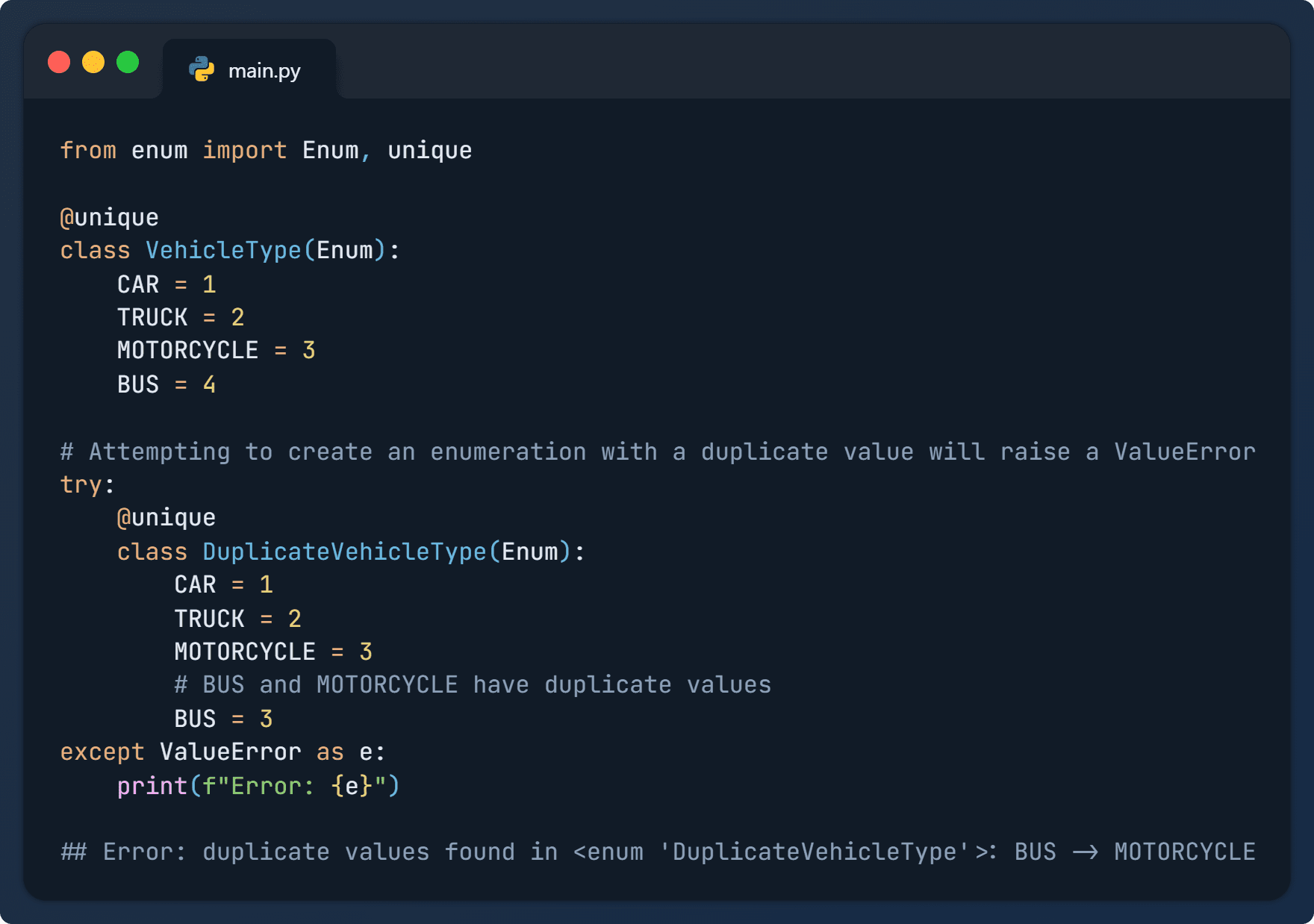
from enum import Enum, unique    @unique  class VehicleType(Enum):      CAR = 1      TRUCK = 2      MOTORCYCLE = 3      BUS = 4    # Attempting to create an enumeration with a duplicate value will raise a ValueError  try:      @unique      class DuplicateVehicleType(Enum):          CAR = 1          TRUCK = 2          MOTORCYCLE = 3          # BUS and MOTORCYCLE have duplicate values          BUS = 3  except ValueError as e:      print(f"Error: {e}")

Output:

Error: duplicate values found in : BUS -> MOTORCYCLE

In the above implementation, "BUS" and "MOTORCYCLE" have the same value "3". As a result, the @unique decorator raises a ValueError with a message indicating that duplicate values have been found. Neither can you use the same key more than once nor can you assign the same value to different members. In this manner, it helps prevent duplicate values for multiple enumeration members.

4. @partial

The partial decorator is a powerful tool that is used to create partial functions. Partial functions allow you to pre-set some of the arguments of the original function and generate a new function with those arguments already filled in.

Example:

from functools import partial    # Original function  def power(base, exponent):      return base ** exponent    # Creating a partial function with the exponent fixed to 2  square = partial(power, exponent=2)    # Using the partial function  result = square(3)  print("Output:",result)  

Output:

Output: 9

In the above implementation, we have a function “power” which accepts two arguments “base” and “exponent” and returns the result of the base raised to the power of exponent. We have created a partial function named “square” using the original function in which the exponent is pre-set to 2. In this way, we can extend the functionality of original functions using a partial decorator.

5. @singledispatch

The @singledisptach decorator is used to create generic functions. It allows you to define different implementations of functions with the same name but different argument types. It is particularly useful when you want your code to behave differently for different data types.

Example:

from functools import singledispatch    # Decorator  @singledispatch  def display_info(arg):      print(f"Generic: {arg}")    # Registering specialized implementations for different types  @display_info.register(int)  def display_int(arg):      print(f"Received an integer: {arg}")    @display_info.register(float)  def display_float(arg):      print(f"Received a float: {arg}")    @display_info.register(str)  def display_str(arg):      print(f"Received a string: {arg}")    @display_info.register(list)  def display_sequence(arg):      print(f"Received a sequence: {arg}")    # Using the generic function with different types  display_info(39)               display_info(3.19)            display_info("Hello World!")  display_info([2, 4, 6])     

Output:

Received an integer: 39  Received a float: 3.19  Received a string: Hello World!  Received a sequence: [2, 4, 6]

In the above implementation, we first developed the generic function display_info() using the @singledisptach decorator and then registered its implementation for int, float, string, and list separately. The output shows the working of display_info() for separate data types.

6. @classmethod

The @classmethod is a decorator used to define class methods within the class. Class methods are bound to the class rather than the object of the class. The primary distinction between static methods and class methods lies in their interaction with the class state. Class methods have access to and can modify the class state, whereas static methods can not access the class state and operate independently.

Example:

class Student:      total_students = 0        def __init__(self, name, age):          self.name = name          self.age = age          Student.total_students += 1        @classmethod      def increment_total_students(cls):          cls.total_students += 1          print(f"Class method called. Total students now: {cls.total_students}")    # Creating instances of the class  student1 = Student(name="Tom", age=20)  student2 = Student(name="Cruise", age=22)    # Calling the class method  Student.increment_total_students()  #Total students now: 3    # Accessing the class variable  print(f"Total students from student 1: {student1.total_students}")  print(f"Total students from student 2: {student2.total_students}")

Output:

Class method called. Total students now: 3  Total students from student 1: 3  Total students from student 2: 3

In the above implementation, the Student class has total_students as a class variable. The @classmethod decorator is used to define the increment_total_students() class method to increment the total_students variable. Whenever we create an instance of the Student class, the total number of students is incremented by one. We created two instances of the class and then used the class method to modify the total_students variable to 3, which is also reflected by the instances of the class.

7. @staticmethod

The @staticmethod decorator is used to define static methods within a class. Static methods are the methods that can be called without creating an instance of the class. Static methods are often used when they don't have to access object-related parameters and are more related to the class as a whole.

Example:

class MathOperations:      @staticmethod      def add(x, y):          return x + y        @staticmethod      def subtract(x, y):          return x - y    # Using the static methods without creating an instance of the class  sum_result = MathOperations.add(5, 4)  difference_result = MathOperations.subtract(8, 3)    print("Sum:", sum_result)              print("Difference:", difference_result)

Output:

Sum: 9  Difference: 5

In the above implementation, we have used @staticmethod to define a static method add() for the class “MathOperations”. We have added the two numbers “4” and “5” which results in “9” without creating any instance of the class. Similarly, subtract the two numbers “8” and “3” to get “5”. This way static methods can be generated to perform utility functions that do not require the state of an instance.

8. @property

The @property decorator is used to define the getter methods for the class attribute. The getter methods are the methods that return the value of an attribute. These methods are used for data encapsulation which specifies who can access the details of the class or instance.

Example:

class Circle:      def __init__(self, radius):          self._radius = radius        @property      def radius(self):          # Getter method for the radius.          return self._radius        @property      def area(self):          # Getter method for the area.          return 3.14 * self._radius**2    # Creating an instance of the Circle class  my_circle = Circle(radius=5)    # Accessing properties using the @property decorator  print("Radius:", my_circle.radius)            print("Area:", my_circle.area)  

Output:

Radius: 5  Area: 78.5

In the above implementation, the class “Circle” has an attribute “radius”. We have used @property to set up the getter methods for the radius as well as the area. It provides a clean and consistent interface for the users of the class to access these attributes.

Summing Up

This article highlights some of the most versatile and functional decorators that you can use to make your code more flexible and readable. These decorators let you extend the functionalities of the original function to make it more organized and less prone to errors. They are like magic touches that make your Python programs look neat and work smoothly.

Kanwal Mehreen is an aspiring software developer with a keen interest in data science and applications of AI in medicine. Kanwal was selected as the Google Generation Scholar 2022 for the APAC region. Kanwal loves to share technical knowledge by writing articles on trending topics, and is passionate about improving the representation of women in tech industry.

More On This Topic

  • Pydon'ts — Write elegant Python code: Free Book Review
  • What You Should Know About Python Decorators And Metaclasses
  • Write Clean Python Code Using Pipes
  • How To Write Efficient Python Code: A Tutorial for Beginners
  • Prefect: How to Write and Schedule Your First ETL Pipeline with Python
  • How to Write SQL in Native Python

How can data and analytics transform financial IT?

image-3

Top 5 financial IT solutions transforming the industry

As technology advances, customers expect to access instant services through their phones regardless of their location. Businesses are also hoping to streamline their services and maximize profits.

The financial industry is currently facing major shifts from traditional ways of operation thanks to technological advancements. The fast-changing technology landscape is driven by major transformations likely to enhance user experience and improve efficiency. If anything, players in the financial sector will be forced to adapt to this changing environment or be faced off by these advancements.

So, let’s look at some of the top five financial services IT solutions transforming this industry.

1. Data and analytics

From the financial services IT solutions perspective, data and analytics represent a vital role, like an engine that helps to propel a car. In an information-saturated environment, financial institutions use data to provide meaningful insights to both design and interpreters of their operational landscape.

How can data and analytics transform financial IT?

It is a trip inside the complex world of numbers, where raw data becomes actionable intelligence.

Traversing this terrain is like navigating unexplored land. Financial institutions use analytics to analyze past trends and predict future situations. It is about reading the financial tea leaves, understanding patterns, and gaining a prospective advantage.

Analytics becomes a navigation compass guiding institutions not to be reactive but to adapt proactively to financial market changes.

2. App modernization

Now, let’s discuss app modernization, which means reviving those previously used financial applications with a fresh coat of paint. Sticking to old software is like holding onto a flip phone in the world of smartphones- it just doesn’t cut it.

App modernization, therefore, refers to the makeover financial institutions are giving their legacy applications making them smarter and more efficient for 21st century customers.

One may liken it to renovating a house. Instead of knocking down the whole structure, you upgrade what is essential, add some functionality, and make it more comfortable. This is what banks also do to their applications. They are re-engineering the user interfaces, creating a better overall user experience, and introducing state-of-the-art technologies to keep them at the edge.

3. Mobile banking

It is estimated that there are about 7.1 billion mobile users globally, and this number is projected to rise to 7.49 billion by 2025. If this trend continues, the number of mobile users could surpass the world population currently standing at approximately 8.1 billion.

How can data and analytics transform financial IT?

More people now use mobile phones. Due to this, finance companies want services easily reachable to their customers. But how did they succeed? Many finance firms have created programs so users can access their services via mobile apps. From seeing account balances to doing cashless money movements and transfers, mobile bank services boosted efficiency and reduced queue time in banks.

Today, customers can make purchases in the comfort of their homes, transforming society into a digital and connected environment. But it doesn’t stop there. Customers can also make bank transfers and receive instant loans through their phones.

The advantages of mobile banking do not apply to users only. Banks also benefit a lot from providing such services. The more mobile users they have, the less the cost of operations. It is particularly essential when it comes to renting space. The fewer the customers visiting the banking halls, the smaller the renting space needed and even the number of employees. This translates to reduced operational costs, thereby increasing profits.

4. Cybersecurity solutions

While technology has improved efficiency and how we handle most things, we can not overlook its bad side. One of the greatest technological concerns in the financial sector is cyber security.

According to an FBI Internet crime report, it is estimated that nearly 800,000 cyber crimes are reported per year in the US alone. They have estimated the losses from cyber crimes to reach $10.5 trillion in 2025. You can imagine the global loss going by the figures estimated in the US alone.

So, what are financial institutions doing to combat cybersecurity threats and save their reputation? Well, there are various ways modern-day financial institutions are using to combat cyber threats.

How can data and analytics transform financial IT?

At the forefront is the use of encryption. Encryption uses a coded language to safeguard sensitive data and information. These codes are hard to crack, preventing unauthorized access to information or data.

Besides encryption, we’ve also seen the emergence of automated security audits to neutralize cyber threats. Considering that cybercriminals change tactics every day, there is a need for financial institutions to update their security features.

Automated security software can scan various systems for vulnerabilities. In case of external attacks from hackers, this software can identify potential threats in advance and issue warnings. This preventive measure allows relevant authorities to take action before it gets out of hand.

5. Cloud computing

Think of cloud computing as the sturdy spine supporting the financial service sector. Why? Finance is always on the move. It jumps, twists, and turns with the rhythms of the market. Here’s where cloud computing swoops in – like a handy volume knob. Need more? Turn it up. Less? Turn it down. It’s all about balance.

This kind of ‘play as you go’ model shifts the game. It lets financial institutions tailor their tech power to their budget and needs. Pay only for what you need when you need it.

How can data and analytics transform financial IT?

Cloud computing comes in three types – public, private, and hybrid clouds. Each type has its strength. Banks can pick the one that matches their needs, just like choosing the right tool for a task.

Public clouds have lots of resources. Private clouds give more control and safety. Hybrid clouds blend the good points of the other two. Changing what they offer to match changes in banking is easier with this flexibility.

Conclusion

Technology is driving a revolution in the financial world. It is changing things and laying new laws for the finance industry. This technological blend is vital for economic growth, ensuring that it stays dynamic, creative, and responsive to the requirements of the market and regulation.

Wide application of these tools will continue to shape the financial industry as we evolve. It will make it more robust, effective, and customer-centered.

HPE Introduces a Flexible and Expandable Storage System

Hewlett Packard Enterprise (HPE) announced the launch of its new block storage system, HPE GreenLake for Block Storage Release 3, today. This system is based on HPE Alletra Storage MP and is the first of its kind to allow businesses to scale their storage capacity and performance separately.

The system is designed to work without causing disruptions and can expand from 15.36 terabytes (TB) to 2.8 petabytes (PB).

The storage solution is intended for modern businesses that prioritize data management. It offers features such as AI-driven performance reporting and analytics for better troubleshooting and insights into data management.

The new release includes enhancements like multi-node switch models for improved performance and capacity, support for various connectivity options including NVMe over Fabrics using TCP, and advanced AI-based management through the HPE GreenLake cloud platform.

Additionally, a new warranty promises better data compression costs, and the product guarantees 100% data availability.

Unlike traditional storage systems that can create capacity wastage and management silos, Release 3 eliminates these issues by allowing flexible addition of controllers and drives.

This flexibility supports the scaling of performance and capacity independently according to the needs of the applications. The architecture is designed to ensure consistent performance and ultra-low latency by utilizing a multi-node, all-NVMe setup that processes I/O across all components.

Moreover, HPE introduces cloud-based AIOps management for this storage, aimed at reducing operational issues by predicting and preventing disruptions. The system’s analytics offer insights into usage trends, latency issues, and resource allocations, improving capacity planning and efficiency.

Release 3 also includes technologies for reducing and organizing data more effectively, enhancing storage economics without compromising on performance. The product comes with a promise of four times data compression, ensuring more cost-effective use of storage capacity.

HPE GreenLake for Block Storage was the first storage-as-a-service in the industry, and it offers self-service and a 100% availability guarantee. HPE GreenLake for Block Storage is designed for mission-critical workloads.

The post HPE Introduces a Flexible and Expandable Storage System appeared first on Analytics India Magazine.

Master AI with no tech skills? Why complex systems demand diverse learning

womansytdentgettyimages-1516277094-1

Some top universities are pitching professional development programs for artificial intelligence that seem to require very little of a programming or development background. The University of Pennsylvania, for example, offers a 24-week boot camp that states, "no previous programming experience required." Not to be outdone, the Massachusetts Institute of Technology offers a 12-week course where you can learn to build AI solutions with no-code software.

Also: Want to work in AI? How to pivot your career in 5 steps

Reading these, one can be forgiven for thinking it's possible to become an AI master with little or no software development experience. But is that the case? Industry leaders suggest that there are still a great deal of technical chops required to build a well-functioning AI system, but add that strictly technical skills are just part of the equation.

"I would highly caution anyone from thinking that they don't need to learn basic coding and data analysis skills just because AI can also perform them," says Dr. Robert Blumofe, CTO of Akamai Technologies. "Not only is it a dangerous mindset that could lead to disregarding all foundational skills as long as they can be done by AI, but you won't be able to perform quality assurance tasks on AI-generated content."

While AI is here to stay, "it, and large language models (LLMs) in particular, have serious limitations," says Blumofe. "Mainly, LLMs still require human oversight, understanding, and intervention to be used safely."

"Core technical skills like programming, data science, data management, and data protection will continue to be essential," says Charman Hayes, executive VP of technology, people, and capability at Mastercard. "At the same time, technologists have a responsibility to understand the evolving legal and regulatory landscape around AI, and this will be critical to ensuring they are using their technical skill sets responsibly."

Perhaps Ethan Mollick (professor at the University of Pennsylvania, by the way) provides an apt description of technologists' roles by comparing AI to a "jagged frontier." This frontier is "where AI excels in some areas while struggling in others, requiring professionals to discern when to compensate for its weaknesses," relates Cal Al-Dhubaib, CEO of Pandata.

Also: How renaissance technologists are connecting the dots between AI and business

While AI-assisted coding is on the rise, "I don't see this taking away net jobs from programmers," says Al-Dhubaib. "However, it does significantly reduce the time it will take to build code and perform data analysis. "I foresee coders spending more time on strategy and orchestrating complex systems, with the expectation to deliver higher value work."

Still, high-level courses such as those offered by universities may help tech professionals better understand the depth of AI's impact on their businesses. "Don't narrow yourself to just deep learning," Blumofe advises. "Study the full breadth of AI and the foundational technology that underpins it."

Also: Have 10 hours? IBM will train you in AI fundamentals — for free

"Instead of focusing on just a single set of skills, which could quickly become outdated, technologists should frequently engage in targeted bootcamps and certifications that let them evolve their skills with the needs of the markets," says Hayes. "Employers should invest in bite-sized real-time learning that employees can do on the job for constant upskilling in compressed amounts of time. For example, Mastercard's internal opportunity network, Unlocked, helps connect employees to projects, positions, mentorship, and volunteer programs to develop new skills and gain exposure to the broader organization."

LLMs as a component of AI may have a limited shelf life, Blumofe suggests. "LLMs are amazing and very good at certain tasks, but they also have serious limitations that I expect will become increasingly apparent as people get more experience using them," he predicts. "I don't think the next big thing in AI will be a bigger LLM. Rather, it will be something new that either replaces LLMs or relegates them to a narrower role. If you have a basic understanding of how it all works, you will be ready for whatever comes next."

Also: If AI is the future of your business, should the CIO be the one in control?

As has always been the case with many complex systems, "unintended consequences plague the world of AI and machine learning," says Al-Dhubaib. "Many of the controversial cases in the news are a result of AI breaking in weird ways unintended by the developers. As AI solutions get more sophisticated, and the data we use with them gets more complex, there are more ways for these models to break. As far as talent is concerned, the need to oversee and validate the safety and efficacy of AI solutions is only going to increase in importance."

"AI isn't just creating jobs for data scientists; it's powering a whole new ecosystem with its own set of needs and opportunities," says Hayes. "For example, as generative AI takes on the role of information "synthesizer," certain job requirements may shift, and more time will be available for strategic and consultative work. Some new jobs could focus on oversight (e.g., chatbot manager), as well as interpretation and validation to ensure output accuracy and utility. Other jobs could optimize inputs for a company. These 'prompt engineers' will likely continue to grow in demand."
Examples of roles at Mastercard that integrate and maximize the potential of AI include roles in the areas of "AI governance and AI strategy, as well as AI product management and engineering," Hayes relates. "Other jobs we see evolving to be more productive and effective include software developers and marketers."

Also: I confused Google's most advanced AI — but don't laugh because programming is hard

Certain evergreen skills will still be in demand for the foreseeable future, says Blumofe. Such skills include "AI algorithms, discrete math, probability, and statistics. If you study those things, your skill set and knowledge will continue to be in demand, no matter what new technologies emerge in the future."
"I also can't stress enough how important soft skills are for successful technology careers," he adds. "Communication, critical thinking, and collaboration are distinctly human skills that can't be replicated by AI tools."

Artificial Intelligence

Bengaluru AI Startup Netradyne Cuts Road Accidents by 30%

In 2022, India alone witnessed about 4.6 lakh cases of road accidents, in which over 1.6 lakh people lost their lives. While a number of factors contribute to road accidents, one of the major reasons worldover is driver’s negligence. Netradyne, a Bangalore-based, Make-in-India AI solution provider, has been utilising AI and data to address this very problem by providing ADAS (Advanced Driver Assistance Systems) and fleet management platforms.

“We often see the accident rate reduce by 30% or more after deploying a Netradyne system,” said David Julian, co-founder and CTO of Netradyne. Incepted in 2015, the company focuses on fleet management safety of commercial vehicles. The goal has always been to reduce accidents, especially in the commercial fleet segment. “About 150,000 people die each year due to commercial fleets, and that’s just in vehicle accidents,” he added.

Data-rich Trained Models

Netradyne’s SOTA models are built from ground up with proprietary data that the company has collected over time. It has a lot of custom aspects and has different approaches for the same. “Turning models into devices at the edge in cost-effective hardware requires a lot of thought on how to actually leverage models for multiple use cases.”

The decision accuracy falls within a range of 95 to 99%.

While essentially, there are computer vision models that operate Netradyne’s flagship model Driver.i platform – driver safety system– the scope for generative AI is aplenty.

“When you look at generative models, what’s interesting to me is that they’re really just trained to do an X token prediction, and with these next token predictions, they actually create all these interesting emergent capabilities,” said Julian. “We look at using our data [both video and sensor data] and do X token prediction to actually create reasoning models.”

Intelligent Fleet Safety

“If you have a commercial fleet of vehicles, you really want to be able to understand how safe your fleet is. Its intelligence lies in being able to measure the safety of your fleet, understanding who your safe drivers are and who are the ones driving in an unsafe manner – and that is intelligent fleet safety,” said Julian.

The company has analysed over 10 billion driving miles and claims to have brought a 96% reduction in distracted driving. It has created a toolset that fleet managers can deploy to gain visibility into their fleets and coach their drivers to improve safety.

Coaching happens in various forms, including one where a fleet manager guides and coaches the driver based on Driver-i systems, and real-time coaching feedback, where the system alerts the driver before getting into accidents. “We even get into predictive mode where it can say, hey, looks like you are going to fall asleep in the next 15, 30 minutes or something like that.”

Trained For Demographics

Netradyne’s initial two markets were US and India. “Driving is handled in these two environments very differently. The algorithms have been trained from the ground up and from early on to really be able to tackle these different types of environments,” said Julian.

“We came from a structured driving environment to a dynamic driving environment, and developed our AI and algorithms to be able to operate in any country in the world.”

However, demographics also pose various challenges when it comes to training the models. Bringing solutions to various markets mandates the understanding of different driving laws clubbed with the different make of vehicles. “How do you make the driving environment work across areas?” is the focus for global expansion. Apart from the US and India, Netradyne products are used in Australia, New Zealand, UK, Germany, Canada and Mexico.

With the existing mechanisms, Julian believes that giving a tech upgrade will help improve the model. “I think there’s a lot of opportunity for additional cameras and things like that so that you can actually start to understand the pedestrian intent – is the pedestrian about to walk in front of you, and so forth.”

No matter how different the ecosystems are, there are commonalities too. “I think one of the things we actually are able to leverage is that there are a core set of features that tend to be common across localities. So, when we enter a new environment, we can enter with these core features,” said Julian. Over time, this data can be tuned based on the audience.

Growing Indian Market

Netradyne has lately entered into partnerships with crucial players in the Indian market. The company recently partnered with GreenLine Mobility Solutions, which operates a fleet of liquefied natural gas (LNG)-powered trucks in India, to provide their flagship Driver.i system.

Furthermore, a few weeks ago, Netradyne announced its collaboration with IndianOil Skytanking, India’s foremost aviation fuel management and airline fueling service provider. The company currently operates in the commercial segment, working with long-haul trucks and gas-delivery vehicles, and the company has plans to provide solutions for passenger vehicles in the future.

“I think one of the key things for commercial vehicles is that they tend to drive much more than individual passenger vehicles by offering an order of 5 to 10x. Therefore, the economics worked out much better in the long term, that we can actually see our tech potentially into personal vehicles, for smart insurance and other things as well as driving in support,” said Julian.

“Our global vision is to get into every vehicle out there and really make a difference in driver’s safety. At the end of the day, get people home safely.”

The post Bengaluru AI Startup Netradyne Cuts Road Accidents by 30% appeared first on Analytics India Magazine.

7 Free Harvard University Courses to Advance Your Skills

7 Free Harvard University Courses to Advance Your Skills
Image by Editor

Are you looking to upskill in 2024? Maybe you want to learn more about computer science and see what the hype around the tech world is. Maybe learn the most popular programming language Python? Or transition into something more niche, for example, gaming or cyber security.

In this blog, I will go through X FREE courses with Harvard University to kickstart your tech career!

Introduction to Computer Science

Link: CS50's Introduction to Computer Science

A free 12-week course, which can be completed if you commit 6–18 hours per week that introduces you to the intellectual enterprises of computer science and the art of programming. This entry-level course will teach you how to put an algorithmic hat on and solve problems efficiently.

You will learn about algorithms, data structures, software engineering, and web development as well as programming languages such as C, Python, SQL, and JavaScript.

Introduction to Artificial Intelligence with Python

Link: CS50’s Introduction to Artificial Intelligence with Python

A free 7-week course, which can be completed if you commit 10–30 hours per week that dives into the concepts and algorithms of modern artificial intelligence. You will learn about the different elements of artificial intelligence such as graph search algorithms, probability theory, Bayesian networks, machine learning, reinforcement learning, neural networks, and natural language processing

With hands-on projects and an understanding of this artificial intelligence theory, you will be able to incorporate them into your own Python programs.

Data Science: Machine Learning

Link: Data Science: Machine Learning

A free 8-week course, which can be completed if you commit 2–4 hours per week where you will learn popular machine learning algorithms, principal component analysis, and regularization by building a movie recommendation system. In this course, you will learn about training data, predictive relationships through data, how to train algorithms, overtraining and techniques to avoid it.

Learn the fundamentals of machine learning in 8 weeks — or less!

Data Science: Productivity Tools

Link: Data Science: Productivity Tools

A free 8-week course, which can be completed if you commit 1–2 hours per week will guide you on how to keep your data analysis project organised and enjoyable through using productivity tools. There are many parts to a data analysis project, therefore it is important to know these tools to keep you on top of the project and avoid challenges.

Learn how to use tools such as Unix/Linux to manage files and directories, and version control systems such as git to track changes in your scripts and reports.

Web Programming with Python and JavaScript

Link: CS50’s Web Programming with Python and JavaScript

A free 12-week course, which can be completed if you commit 6–9 hours per week picks up where CS50 ends. If you’re looking to enter the tech industry but you’re more interested in the design and implementation of web apps — this entry-level course is for you. You will learn about different aspects of web programming such as database design, security, and user experience.

With this knowledge, you will then go into hands-on projects where you will put your knowledge to the test and write and use APIs, as well as create interactive UIs.

Introduction to Game Development

Link: CS50’s Introduction to Game Development

More into gaming? Look no further, this free 12-week course, which can be completed if you commit 6–9 hours per week dives into learning about the development of 2D and 3D interactive games such as Super Mario Bros., Pokémon, and more. You will learn about 2D and 3D graphics, animation, sound, and collision detection using popular frameworks as well as languages like Lua and C#.

Programme your own game, relive your childhood and learn a new skill on the way!

Introduction to Cybersecurity

Link: CS50's Introduction to Cybersecurity

This free 5-week course, which can be completed if you commit 2-6 hours per week provides an introduction to cybersecurity for technical and non-technical audiences. In this course, you will learn how to protect your own data, devices, and systems from today's threats as well as be able to recognize and evaluate tomorrow's threats. This course should be crucial for everybody as these measures apply both at home and at work.

The assignments have been inspired by real-world events, giving you a range of both high-level and low-level examples of threats.

Wrapping up

7 FREE courses with Harvard University to kickstart your tech career. A wide range of courses regardless of where you want to start or end up, these courses will equip you with the skills to start something great and not look back!

Nisha Arya is a Data Scientist and Freelance Technical Writer. She is particularly interested in providing Data Science career advice or tutorials and theory based knowledge around Data Science. She also wishes to explore the different ways Artificial Intelligence is/can benefit the longevity of human life. A keen learner, seeking to broaden her tech knowledge and writing skills, whilst helping guide others.

More On This Topic

  • KDnuggets News March 30: The Most Popular Intro to Programming…
  • 9 Free Harvard Courses to Learn Data Science
  • KDnuggets News, May 4: 9 Free Harvard Courses to Learn Data…
  • Advance your data science career to the next level
  • Advance your Career with the 3rd Best Online Master's in Data…
  • The Most Popular Intro to Programming Course From Harvard is Free!

Micron Begins Production of HBM3E Chips to Accelerate AI Growth

Micron Technology has begun volume production of its HBM3E (High Bandwidth Memory 3E) solution, the company recently announced. Micron’s 24GB 8H HBM3E will be part of NVIDIA H200 Tensor Core GPUs, which will begin shipping in the second calendar quarter of 2024.

As the demand for AI continues to surge, the need for memory solutions to keep pace with expanded workloads is critical. Micron’s HBM3E solution addresses this challenge head-on with:

  • Superior Performance: With pin speed greater than 9.2 gigabits per second (Gb/s), Micron’s HBM3E delivers more than 1.2 terabytes per second (TB/s) of memory bandwidth, enabling lightning-fast data access for AI accelerators, supercomputers, and data centres.
  • Exceptional Efficiency: Micron’s HBM3E leads the industry with 30% lower power consumption compared to competitive offerings. To support increasing demand and usage of AI, HBM3E offers maximum throughput with the lowest levels of power consumption to improve important data centre operational expense metrics.
  • Seamless Scalability: With 24 GB of capacity today, Micron’s HBM3E allows data centres to seamlessly scale their AI applications. Whether for training massive neural networks or accelerating inferencing tasks, Micron’s solution provides the necessary memory bandwidth.

“Micron is delivering a trifecta with this HBM3E milestone: time-to-market leadership, best-in-class industry performance, and a differentiated power efficiency profile,” said Sumit Sadana, executive vice president and chief business officer at Micron Technology. “AI workloads are heavily reliant on memory bandwidth and capacity, and Micron is very well-positioned to support the significant AI growth ahead through our industry-leading HBM3E and HBM4 roadmap, as well as our full portfolio of DRAM and NAND solutions for AI applications.”

Micron developed this industry-leading HBM3E design using its 1-beta technology, advanced through-silicon via (TSV), and other innovations that enable a differentiated packaging solution. Micron, a proven leader in memory for 2.5D/3D-stacking and advanced packaging technologies, is proud to be a partner in TSMC’s 3DFabric Alliance and to help shape the future of semiconductor and system innovations.

Micron is also extending its leadership with the sampling of 36GB 12-High HBM3E, which is set to deliver greater than 1.2 TB/s performance and superior energy efficiency compared to competitive solutions, in March 2024.

The post Micron Begins Production of HBM3E Chips to Accelerate AI Growth appeared first on Analytics India Magazine.

Data Science Hiring Process at Nucleus Software

Founded in 1986, Nucleus Software is an Indian IP product company specialising in financial technology. The company focuses on developing and selling its own software solutions. Tailored for the banking industry, its key products, FinnOne Neo and FinnAxia, cater to lending and transaction banking needs.

These solutions aid banks in optimising processes, efficiently managing loans, and delivering innovative financial services. With a presence in 50 countries and a client base exceeding 200, some of its notable customers include State Bank of India, Citi Bank, ICICI Bank, Tata Capital, and Mahindra Finance.

The team has successfully applied AI and analytics in various business scenarios, including fraud detection in transaction banking, business optimisation through insights generation, natural language processing, real-time decisioning systems, AI-powered chatbots, auto summarisation, and hyper-personalised customer communications.

AIM got in touch with Abhishek Pallav, associate vice president, Nucleus Software, to understand the AI activities of the company and the kind of people it looks for.

Inside Nucleus Software’s AI & Analytics Lab

In terms of implementing AI and ML solutions, Pallav said that Nucleus has developed a foundational framework for its AI components, ensuring reliability and scalability in the dynamic financial services sector.

The application of AI and ML is evident in the real-time fraud detection engine within the transaction banking platform, natural language processing, customer satisfaction improvement, revenue increase, cost reduction, and operational optimisation for financial institutions.

The company also leverages an in-house chatbot for L1 and L2 production support.

Regarding generative AI, Nucleus Software strategically deploys tailored solutions to enhance service operations and improve customer experience. This approach enables data access democratisation and the extraction of value from unstructured data.

“We are in the process of building systems around generative AI and have developed use cases around customer behaviour and transaction history,” Pallav told AIM.

Interview Process

“When it comes to hiring for data science roles, We look for candidates who have strong technical and domain acumen,” said Pallav, highlighting that the company seeks candidates with strong problem-solving skills for real-world data science scenarios. Proficiency in machine learning and deep learning, particularly in areas like finance, retail banking, fraud prevention, and hyper-personalisation, is highly valued.

Preference is given to candidates from premier engineering colleges with a background in mathematics, computer science, and AI certifications.

Pallav elaborated that the hiring process for data science candidates begins with a written test evaluating IQ and logical reasoning, followed by two technical discussion rounds. The process concludes with an HR round.

The written test, conducted online through the company’s platform, includes multiple-choice questions related to the domain and coding problems. Candidates are given a defined time window to complete the test.

Tech Skills Needed

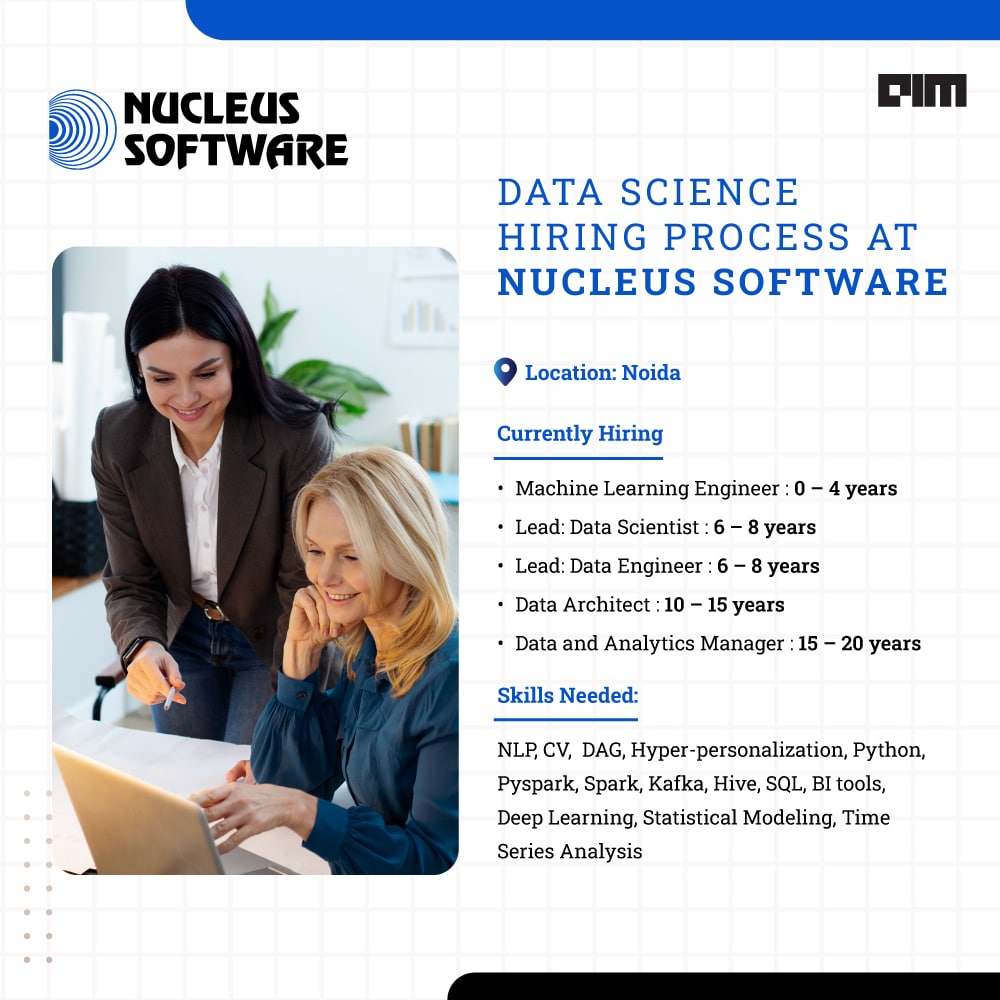
Nucleus Software is currently hiring for five data science roles in Noida.

The positions include ML engineer, lead data scientist, lead data engineer, data architect, and data and analytics manager. Candidates with experience in the retail banking domain are preferred. The minimum qualifications needed include a BTech in computer science from a premier institute.

In terms of tech tools, applications, and frameworks, Nucleus Software employs a variety of them for natural language processing, computer vision, directed acyclic graph (DAG), hyper-personalisation, and explainability in its product R&D.

The desired skills for candidates include proficiency in tools and frameworks such as Python, Pyspark, Spark, Kafka, Hive, and SQL. The knowledge of BI tools is desirable. Candidates should have expertise in various data science techniques, including analytics using AI/ML, deep learning, statistical modelling, time series analysis, and test & learn. The company values candidates who align with their core values of innovation, result orientation, collaboration with integrity, and mutual respect.

Nucleus Software’s products are built on cutting-edge technologies, are platform-agnostic, web-based, cloud-native, and powered by AI capabilities.

Expectations

“Upon joining, an associate goes through a specialised training program offered by Nucleus School of Banking Technology, where they become domain experts,” said Pallav, emphasising that after completing the program, associates join the Build R&D team.

However, Pallav explained that he has often observed candidates making the common mistake of adopting an overly generic approach. The company emphasises the need for a holistic approach to value delivery, coupled with strong analytical and logical skills.

Work Culture

Nucleus Software values its employees as crucial assets. This is evident in its various programs that promote employee well-being, such as job enrichment initiatives, competitive compensation, recreational activities, family outings, and diversity and inclusion programs.

Currently following a hybrid work approach, the company prioritises upskilling with a range of online courses, expert-led training, and on-the-job mentoring. It believes in supporting employees in their professional development. Additionally, the company stands out by offering educational reimbursement for these courses and certifications.

According to Pallav, the work culture at Nucleus is distinguished by its commitment to inclusivity, diversity, engagement, and security. “For candidates driven by challenges, we offer a plethora of complex business use cases. These opportunities not only enhance your technical knowledge but also contribute to enriching your work experience, paving the way for you to become a top-tier professional,” concluded Pallav.

Find more about the job opportunities here.

The post Data Science Hiring Process at Nucleus Software appeared first on Analytics India Magazine.

Ola’s Kutrim Rolls Out Public Beta Access

Bhavish Aggarwal’s Krutrim has launched its first generative AI chatbot in a public beta. “We’ve rooted Krutrim strongly into Indian values and data with over 10 Indian languages and ready to assist in English, Hindi, Tamil, Bengali, Marathi, Kannada, Gujarati and even Hinglish,” said Aggarwal’s post on X.

Check it out here.

Launched in December, Krutrim is touted as “India’s first full-stack AI solution”. The company earlier claimed that the model is trained on a vast dataset of two trillion tokens. However, no information about the research, including training methods, the nature of the dataset, and the number of GPUs needed, among others, has been made public.

While acknowledging the possibility of some hallucinations, Aggarwal assures users that the occurrence will be lower in Indian contexts compared to other global platforms. The team acknowledges that this is just the beginning and anticipates significant improvements as they continue building on this foundation and encourage users to provide valuable feedback.

“Krutrim marks the dawn of a new era in the AI computing stack for our nation. We will aim to innovate alongside the world and define future paradigms,” he added.

The news of Krutim’s public launch coincided with the time when Google’s Gemini came under fire for spitting out controversial content on Indian PM Narendra Modi. The big tech is also facing criticism for “inaccuracies” in historical depictions generated by Gemini, making the company halt the image generation feature.

Kutrim became unicorn company within one month of launch by raising a significant $50 million in equity at a valuation of $1 billion. Key investors, such as Matrix Partners India, played a pivotal role in this funding round.

The post Ola’s Kutrim Rolls Out Public Beta Access appeared first on Analytics India Magazine.