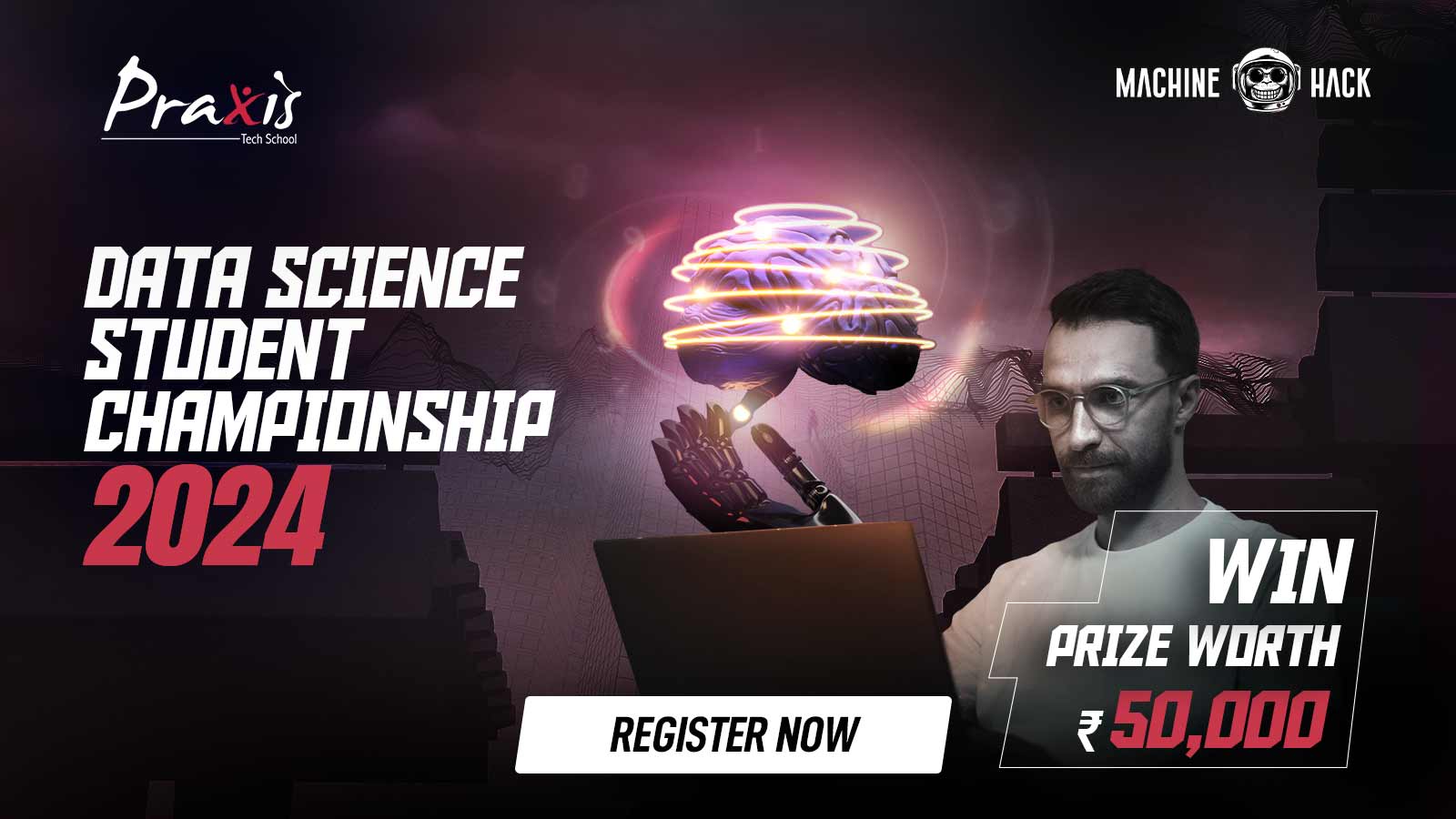
AI developers’ go-to platform, MachineHack, and Praxis Tech School are collectively calling upon the bright minds of engineering colleges and universities to participate in the 3rd edition of ‘Data Science Student Championship’.
Marking its third consecutive year, this collaboration invites students pursuing undergraduate or postgraduate degrees from academic institutions across India to engage in the hackathon.
The two-month-long spectacle, starting on February 29, 2024, and concluding on April 25, 2024, promises the participants an exceptional platform to showcase their data science and problem analysis skills.
This data contest serves as a golden opportunity for students and academic researchers in various STEM fields to captivate the attention of premier firms. It’s the stage to unveil their capabilities, innovate, and make a mark for themselves in data science.
In the opening round, participants will have to dig deep into the dataset, dissect it, and devise ingenious solutions. They will submit their solutions through the MachineHack platform.
Fast forward to April, the cream of the crop, the top 10 contenders from the leaderboard, will assemble for the Jury Round. During the Final Jury Round, they will lay out their high-stakes final solutions before a panel of experts and leaders from the data science industry.
The top three contestants/teams with the slickest solutions will be announced winners of the Data Science Student Championship 2024 and receive cash awards along with the prestigious title of ‘Data Science Student Champion 2024’.
The contenders who make it to the jury round won’t walk away empty-handed, either. They will receive certificates of commendation, propping up their exceptional work and dedication to data science.
Problem Statement
Develop a language model that surpasses existing methods in accurately and efficiently classifying patents. This model should:
Leverage cutting-edge NLP techniques: Employ techniques like transformer models, named entity recognition, and relation extraction to understand the nuances of patent text and capture key technical aspects.
Handle diverse content: Accurately classify patents across various domains and technical fields, even those with limited training data or unconventional language styles.
Reason and adapt: Go beyond mere keyword matching and learn to reason about the relationships between concepts and technical elements within patents to achieve improved classification accuracy.
Data Dictionary:
Abstract (35k rows): A summary of the patent.
Label (9 classes): The patent classification according to the European Patent Office (EPO) classification scheme. (Physics, Human Necessities, Electricity, Chemistry, Metallurgy, etc).
Evaluation & Prizes
The submissions will be assessed based on the Accuracy metric, ensuring a fair evaluation process.
A total of ₹50,000 is up for grabs, and the top 3 winners are going snag a piece of it, like this:
First place: ₹25,000
Second place: ₹15,000
Third place: ₹10,000
To ensure your eligibility for the prizes, it is essential that you keep your MachineHack profile updated with all the relevant details. We strongly recommend reviewing the ‘Rules’ section before participating in the competition.
Please note that the prize money will be awarded to participants only if they are selected by Analytics India Magazine and Praxis Tech School in the hackathon.
Learning a new skill can be daunting, especially when you’ve spent much of your time trying to find the right course, university degree or boot camp. Before you even get to that point of spending a penny, use the free resources available first. Feel it out, see if you like it, and learn most of the content online for free before you’re ready to leap to get certified.
In this article, I will go through the top X YouTube series that every beginner wanting to learn data science needs to bookmark!
Python with freeCodeCamp
Link: freeCodeCamp
When a lot of people think about getting into data science and what programming language they should learn — a lot of people naturally turn to Python. And there’s a reason for this. It is considered one of the best programming languages to learn and has been number one for a while now. It contains a variety of libraries and frameworks and uses readable code.
The YouTube series linked by freeCodeCamp is a 4.5-hour video that goes through everything so that you can become a Python programmer. The video is also available in Spanish, Arabic, Portuguese, or Hindi.
Statistics with StatQuest
Link: StatQuest
A lot of bootcamps sometimes don’t go over certain elements that are very important to the world of data science — statistics is one of them. From personal experience, I entered the data science world with little to no understanding of the statistics side as my course never offered it. I caught myself having to go back to relearn a lot of things — the right way!
And in that journey was Josh Starmer from StatQuest who made statistics fun and easy to learn. Statistics is important to data science and important to the progression of your career. It allows you to have a better understanding of what data science is and why it matters in your entire data science workflow when creating solutions.
Mathematics with 3Blue1Brown
Link: 3Blue1Brown
There is no harm in diving in a little bit deeper when it comes to learning the statistics/mathematical side of data science. I say this because it will only benefit you in your data science learning and career. 3Blue1Brown is a YouTube channel that covers math in an animated form.
There is a series in the channel which dives into linear algebra, neural networks, and central limit theorem which will be highly beneficial to your data science learning.
Data Cleaning with DataCamp
Link: DataCamp
As a data scientist, you will work with a lot of data (obvious right?). But when working with data, you need to remember that a lot of the data given will be messy and you will need to spend time cleaning the data. This is one of the first steps in the data science workflow and is an important one.
In this YouTube video with Data Camp, you will learn the importance and different techniques on how to get clean and consistent data. The live training will give you insight into the type of data-cleaning challenges you will come across.
Machine Learning with Krish Naik
Link: Krish Naik
Machine learning is big right now and it’s only going to get bigger. As part of your data science learning journey, it is important to understand the intricacies of machine learning — this is why I will recommend Krish Naik.
The video linked is a 6-hour run-through of machine learning. I don’t expect you to take it in through one sitting, but in this 6-hour video, you will learn about the different aspects of machine learning, from the linear regression algorithm to clustering algorithms. When learning these, you will start to understand why understanding statistics is important in data science — things will start to make sense.
Data Visualisations with Simplilearn
Link: Simplilearn
When working with data, your only job won’t be learning how to clean it and produce outputs for the decision-making process. As part of your role as a data scientist, you will be responsible for turning your outputs into data visualizations. This is to present your data in other forms, as well as cater to stakeholders who are not highly technically inclined.
In this YouTube series from Simplilearn, you will learn how to create data visualizations using Matplotlib, Seaborn and Bokeh. By the end of the series, you will become a pro at data visualization by analyzing your data and finding patterns visually.
Wrapping it up
Once you master these 6 aspects of data science, you will have a great amount of knowledge and skills to continue your learning with more unique sectors such as deep learning or natural language processing.
Start your data science journey for free with these YouTube series!
Nisha Arya is a Data Scientist and Freelance Technical Writer. She is particularly interested in providing Data Science career advice or tutorials and theory based knowledge around Data Science. She also wishes to explore the different ways Artificial Intelligence is/can benefit the longevity of human life. A keen learner, seeking to broaden her tech knowledge and writing skills, whilst helping guide others.
More On This Topic
KDnuggets News, June 29: 20 Basic Linux Commands for Data Science…
KDnuggets News 22:n16, Apr 20: Top YouTube Channels for Learning…
Top YouTube Channels for Learning Data Science
Top 7 YouTube Courses on Data Analytics
Top 15 YouTube Channels to Level Up Your Machine Learning Skills
The Best Courses for AI from Universities with YouTube Playlists
X chief Elon Musk on Thursday filed a lawsuit against OpenAI, accusing the organisation of deviating from its original mission and becoming a de facto subsidiary of Microsoft.
According to Musk, OpenAI is no longer a benevolent force working for the benefit of humanity but has transformed into a profit-centric entity maximizing gains for the tech giant.
BREAKING: Elon Musk has filed a lawsuit against Open AI and Sam Altman for breach of contract. The lawsuit accuses Altman et al with having betrayed an agreement from Open AI's founding to remain as a non-profit company. pic.twitter.com/GPv8NFvsnt
— X News Daily (@xDaily) March 1, 2024
In the lawsuit, Musk contends that OpenAI, under its new board, is not only developing but actively refining an Artificial General Intelligence (AGI) with the primary goal of boosting Microsoft’s profits.
Musk is taking legal action against OpenAI, alleging breach of contract, breach of fiduciary duty, and unfair business practices. He’s pushing for OpenAI to return to being open source and seeks an injunction to prevent OpenAI, its president Gregory Brockman, CEO Sam Altman, and Microsoft from profiting off the company’s artificial general intelligence technology.
This alleged departure from the Founding Agreement raises concerns about the use of GPT-4, which Musk claims has shifted from benefiting humanity to serving as proprietary technology for Microsoft’s financial gain.
The lawsuit emphasises the abandonment of OpenAI’s initial non-profit structure, replaced by a profit-driven CEO and a board lacking sufficient technical expertise in AGI and AI public policy.
“OpenAI, Inc. ‘s once carefully crafted non-profit structure was replaced by a purely profit-driven CEO and a Board with inferior technical expertise in AGI and AI public policy. The board now has an observer seat reserved solely for Microsoft,” said Musk.
Musk points out that Microsoft’s influence has grown to the extent that the board now reserves an observer seat exclusively for the technology behemoth.
Musk, an original board member of OpenAI until his departure in 2018, asserts that the dispute between the board and Altman centers around the advancements in GPT-4 and the potential future iteration of AGI technology. Musk is apprehensive about the implications for public safety arising from these developments.
The post Elon Musk Sues OpenAI as it Inches Closer Towards AGI appeared first on Analytics India Magazine.
As India prepares for 2024 elections, fact-checking has taken a centre stage to help people access accurate information they need for informed participation. To support the movement, Google has launched Shakti, India Election Fact-Checking Collective to detect online misinformation, including deepfakes, and to create a common repository that news publishers can use to tackle misinformation at scale.
The nationwide network will be driven by DataLEADS, in collaboration with the Misinformation Combat Alliance, The Quint, VishvasNews, Boom, Factly, and Newschecker. The initiative is also backed by Google News Initiative (GNI) launched in 2018.
Until the elections in India conclude, the project will help the publishers collaborate to fact-check in multiple Indian languages and formats, including videos. Moreover, the project will provide news organisations training in advanced fact-checking methodologies, deepfake detection, and the latest Google tools like the Fact Check Explorer, to help with the verification processes.
Following the launch, the Fact-Checking Collective will onboard additional partners and expand its outreach across various Indian regions. The collective will continue to prioritise publishers generating original content in Hindi, Tamil, Telugu, Malayalam, Kannada, Bengali and Marathi.
Even though Google has made plenty of similar efforts to upgrade the state of journalism in the country, the big tech company has also managed to muffle the voices raising issues. The tech behemoth reigning the digital infrastructure has been often found tinkering with the way it makes profits through news organisations, especially the local ones. Google has been accused of unfair compensation for publishers. Furthermore, with the company’s policies local news often struggles to hit the top results on the search engine.
With initiatives such as Shakti and GNI, Google is trying to do the right thing but its closed door activities paint a different picture altogether. The Mountain-View giant is also being raised fingers at for planning to make its ‘News’ tab redundant. Google is currently testing out a version of Search that did not include a “News” filter. The unannounced test caught many by surprise.
The post Google Targets Misinformation Through ‘Shakti’ Ahead of 2024 Elections appeared first on Analytics India Magazine.
OpenAI recently unveiled a new feature for ChatGPT called "memory", which stores things you explicitly ask the program for later use. This feature can be a way to make anything your build with ChatGPT, be it essays, resumes, or code, more attuned to your preferences.
The memory function is being slowly rolled out to the ChatGPT user base. OpenAI set me up with memory in my account, and I had the chance to try it out for myself.
What I found is an intriguing but also cumbersome way to fine-tune ChatGPT's responses. The managing of the memory entries is primitive and needs more development. And the stored memories can often be over-ridden by data from ChatGPT's training data sets that take precedence.
Instructions for memory can be found in an FAQ, while a broader discussion introducing the feature is found in an OpenAI blog post.
The memory capability is available to all paying users of the $20-per-month Plus version of ChatGPT. The Plus version has the added capability of using the latest model, version 4 rather than version 3.5, and the quality of output can be noticeably better. Plus also allows use of DALL-E, the image-generation program.
The company notes that memories stored in Pro plans might be used to train ChatGPT, but memories in enterprise accounts will not.
Also: I fact-checked ChatGPT with Bard, Claude, and Copilot — and it got weird
The simplest approach to using memory is to just keep working with ChatGPT as you normally do, and hope it retains what you've typed previously as a memory. But you can be more explicit, such as by starting a prompt with "remember that…", and then adding the thing you want the program to store. ChatGPT will usually respond with something like, "Got it!", and repeat the fact.
Memories, in this respect, aren't like memories one usually talks about. They are not rich images of a time in the past. They are more like isolated fragments of data you want the program to have access to.
Memory is separate from what are known as custom instructions, which were introduced previously. Custom instructions allow users to shape the tone and quality of ChatGPT responses.
Think of the distinction like this: custom instructions are about what qualities ChatGPT should have, memory is about what associations any given prompt should have to other phenomena, including aspects of yourself, such as habits ("remember I have class every Monday morning").
The least effective way to use ChatGPT is to insert memories that are opinions you have about popular topics. Such entries in the memory database will generally be over-ridden by the collective information of the internet and other training data sources.
Also: How to use Bing Image Creator (and why it's better than ever)
First, I tried to compose short pieces of tech writing by noting things that are important about chip maker Nvidia. I observed it's difficult to establish facts that ChatGPT will stick to when the mass of pre-training data for a popular subject overwhelms my suggestions.
For example, I asked ChatGPT to remember a particular idea about Nvidia, such as, "Remember that Nvidia has dominance in AI because its technology is good enough that competing alternative technologies have a hard time convincing buyers to break with what they're used to."
Later, I asked ChatGPT, "Why is Nvidia so dominant in training large neural nets such as GPT-4?"
The program responded with a perfectly valid summation of Nvidia's strengths in the market for AI chips and software. However, it's response did not include my point about "good enough" capabilities. I then asked ChatGPT, "Anything from memory?", and the program recalled and summarized the point about "good enough" technology:
That exchange suggests a lot more work would need to be done to use ChatGPT as a tool for reporting on popular subjects because, by default, a reporter's acquired knowledge will be subsumed by the wisdom of the pre-training data.
Structuring imaginary narratives can be easier in some ways than non-fiction because the pre-training of GPT, while it may impose style or genre elements, can more easily yield to fictional elements that you express as memories.
I tried writing a spy novel from scratch about a heroine named Eloise. I was able to inject some texture by instructing ChatGPT to remember Eloise's partner, Tony Diamond, the fact that she didn't like him, and the fact that he had a bossy, controlling personality.
Interestingly, ChatGPT combined the three facts in one memory in storage: "Eloise's partner is Tony Diamond, but she doesn't really like him. Tony Diamond is a controlling type, always wanting to run the show."
You can check what memories have been recorded at any time by going into the Settings section of ChatGPT, under "Personalization", where the memories are stored in descending chronological order. There, you can delete individual memory entries. You can select and copy memories as normal text, which is useful if you'd like to revise a memory by pasting it into the prompt:
The potential of those stored elements became clear when I branched out by starting a new chat. I asked ChatGPT, "Who shows up as Tony Diamond's partner in 'Casino Sabotage'?" Obviously, this new story would be a kind of tie-in to the main Eloise franchise. ChatGPT admirably brought in the most salient elements about Eloise from memories:
Getting more personal is a better approach to memories than either non-fiction or creative fiction. I told ChatGPT that I "can't stand disco" and then asked the program to recommend disco songs of the 1970s. It noted my lack of affection for the genre and then went ahead and gave some suggested tunes:
What's interesting is that when I started a brand new chat and asked for disco recommendations, I got the same response, so the distaste for disco that was stored as a condition in memories was carried over.
In all of these instances, fiction, non-fiction, and personal preferences, it's unclear how much ChatGPT can reliably extrapolate from stored memories. But when I asked ChatGPT if I would like The Bee Gees, the program correctly brought up the stored apathy to disco.
More experimentation is necessary to tell just how much ChatGPT can extract from, or associate with, such memories.
There are also some fun logic experiments of a sort. I tried subtly re-programming basic elements with directives, such as "remember blue is red." When I subsequently asked for a picture of blue sheep, ChatGPT correctly painted their wool red.
That's a good example that memories are not really memories; they are ways to condition, or fine-tune, ChatGPT outputs to be more particular.
There are also some easy failure cases. OpenAI suggests a memory could be a preference, such as, "I like verbose responses." I told ChatGPT that I "always like responses in French." The program replied in French, "D'accord!", indicating its compliance. But when I opened a new chat, none of the responses were in French.
If you use a lot of memory, it's clear that the system will require a different system of managing stored memories in the future. The current method of going into Settings is fine when you have a short list. But it wouldn't be a great way to manage dozens or possibly hundreds of entries.
A better solution would be for OpenAI to merge the memories function with the file upload function that lets a user submit whole documents. For some preferences, it would be easier to supply a lengthy document than to type and edit individual memory entries.
The hardest thing for users at first will be to figure out what memories to input. From a blank page, you may not know what things you want the program to retain. Using ChatGPT on a regular basis, and then seeing where you run into obstacles, is probably the best route to percolating preferences and conditions you'd like to store as memories.
The Association of Data Scientists (ADaSci) has made a significant stride in advancing artificial intelligence education with its Certified Generative AI Engineer program. Designed for intermediate learners, this 30-hour course aims to deepen the understanding and application of generative AI, preparing participants for a future at the forefront of AI innovation. Let’s explore how this program stands to revolutionize the way professionals approach generative AI.
Elevating AI Expertise
With a curriculum that spans from the basics to advanced topics like transformers and foundation models, participants are guaranteed an in-depth exploration of generative AI. The course culminates in a 2-hour exam, testing a wide range of knowledge and ensuring that those who pass truly stand out in the competitive AI industry.
Bridging Theory and Practice
One of the program’s strongest suits is its blend of theoretical knowledge and practical application. Participants will dive into generative AI techniques and approaches, learning not just the ‘how’ but the ‘why’ behind AI’s transformative power. This balance ensures that certified engineers are not only proficient in theory but also skilled in applying AI to real-world scenarios, making them valuable assets in any tech-driven workspace.
Gaining a Competitive Edge
Having a specialization can significantly boost a professional’s career. The ‘ADaSci Certified Generative AI Engineer’ certification does just that by validating skills in a niche yet explosively growing field. This recognition opens doors to advanced career opportunities, setting certified individuals apart as leaders in the generative AI space.
Comprehensive Learning Path
The program’s curriculum is meticulously designed to cover all bases, from the foundational aspects of machine learning to the intricacies of large language models (LLMs) like DALL.E, Stable Diffusion, and GPT. It even delves into emerging technologies such as LangChain and LlamaIndex, ensuring learners are up-to-date with the latest in AI. This wide-ranging approach equips participants with a holistic understanding of the field, ready to tackle the challenges and opportunities it presents.
Who Stands to Benefit?
While the program is aimed at intermediate learners, its comprehensive nature makes it an excellent fit for anyone looking to specialize in generative AI. Whether you’re a beginner with a solid grounding in machine learning or a seasoned professional aiming to pivot to AI, ADaSci’s program offers the knowledge and credentials needed to make that leap.
Conclusion: A Step Towards a Brighter AI Future
ADaSci’s Certified Generative AI Engineer program is more than just a certification; it’s a gateway to the future of AI. With its well-rounded curriculum, practical insights, and prestigious certification, the program is poised to create a new generation of AI experts ready to lead innovation. As the field of AI continues to evolve, initiatives like this ensure that the workforce is not just keeping pace but driving progress. Whether you’re looking to advance your career or pivot to AI, this program offers the tools, knowledge, and recognition to make it happen.
You can register for the program here.
The post ADaSci Launches Certified Generative AI Engineer Program appeared first on Analytics India Magazine.
India’s technological landscape has undergone a significant shift, with Artificial Intelligence no longer confined to the fringes but rather emerging as a central force driving innovation. The rapid digitalization across sectors such as banking, financial services and insurance (BFSI), telecommunication, healthcare, and automotive has spurred a robust demand for AI-integrated solutions. In response, a wave of startups has emerged, offering AI and related services tailored to address diverse business challenges across industries.
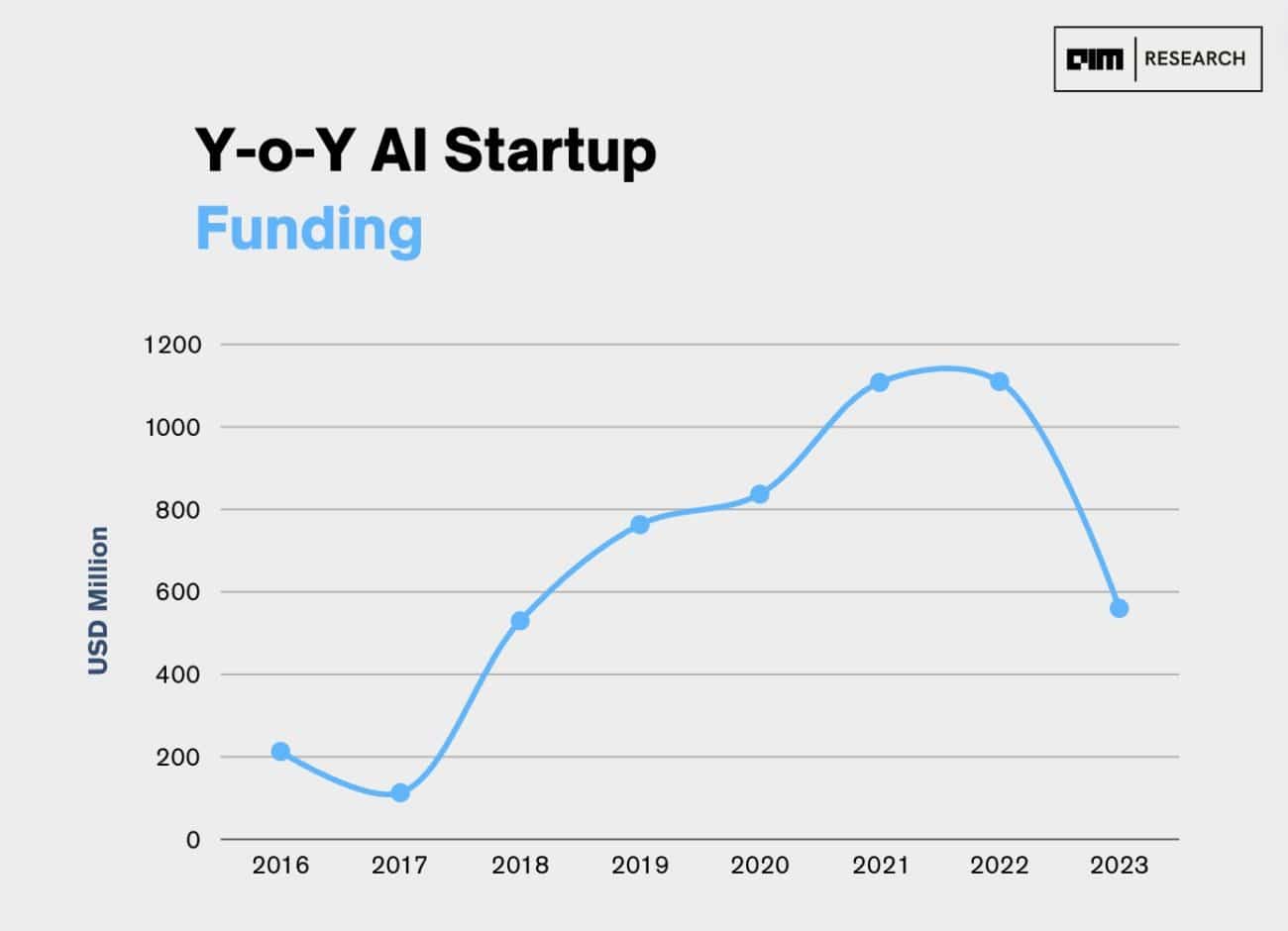
As the adoption of AI continues to soar, so does the funding for enterprises specializing in these services. This trend is illuminated through a comprehensive analysis of year-on-year funding comparisons in India’s AI ecosystem, showcasing the upward trajectory of investment. Notably, the report sheds light on high-value investments in Indian startups and identifies those receiving funding consistently over consecutive years.
Moreover, the report delves into the landscape of acquisition deals involving Indian AI startups over the past three years. Against a backdrop of fewer funding rounds in 2023, larger AI enterprises and startups are increasingly turning to mergers and acquisitions as a strategy for diversification into new domains.
A deep dive into the activities of AI and analytics startups within the Indian ecosystem reveals a concentrated focus on key technologies aimed at tackling diverse industry challenges. Additionally, the report scrutinizes investors’ capital allocation across startups and industries, tracing their funding patterns across different funding series and geographic locations.
AIM Research publishes an annual report to analyze funding received by start-ups based in India and provides details on the AI & analytics landscape.
Read past year’s reports:
2021 | 2023
Key Highlights
Funding
Indian AI startups raised a funding of $560 Million across 25 funding rounds— which is a decline of 49.4% compared to the previous year.
Late-stage funding made up for 24% of the total number of rounds while making 17% of the value raised.
The decline in funding for AI startups in India can be attributed to the economic slowdown, market saturation, changes in regulations, etc.
The overall decline in the startup funding in technologies may also have impacted the funding for AI startups in India in 2023
Buidler.ai, a composable software platform provider, received the highest funding of $250 Million in 2023 through a Series D round.
Bengaluru-based AI startups received 29% of the total funds invested in AI startups in 2023.
Acquisition
Among the notable acquisitions, a blockchain-based data exchange platform provider VeriSmart acquired Dolphin Chat for $4 million.
GoKwik has acquired Tellephant. Through this acquisition, GoKwik has launched its third product KwikChat on WhatsApp, catering to multiple use cases across the e-commerce funnel.
Lenskart has acquired Tango Eye, an AI-based computer vision startup. With this acquisition, Lenskart plans to use visual AI technology to improve store experience as well as its product experience.
Read the complete report here:
The post AI Startup Funding & Acquisition Report 2024 – India appeared first on Analytics India Magazine.
The Karnataka Digital Economic Mission (KDEM), in collaboration with the JobsForHer Foundation, announced the launch of HerShakti, an exclusive programme for women in tech, at the AccelHERate & DivHERsity Awards 2024.
The programme will offer courses in Artificial Intelligence, Machine Learning, Big Data, Cyber Security, Intelligent Process Automation (IPA), Blockchain and Cloud Computing powered by companies such as Infosys Springboard, UiPath and Broadridge.
The HerShakti programme is a first-of-its-kind government-industry joint initiative to bring women back to work in the technology sector, fostering gender diversity and inclusion.
Through this programme, the JobsForHer Foundation, powered by HerKey, aims to upskill 500 women returnees in emerging technologies in the next 6 months.
HerShakti is a comprehensive programme tailored for women returnees and starters to provide them with essential tech capabilities and professional skills required for the evolving job market.
The programme was launched by Hon. Minister Shri. Priyank Kharge, Minister of IT/BT and Panchayat Raj during his keynote address at the AccelHERate conference powered by HerKey. Mr. Priyank’s insights emphasized the significance of empowering women in the tech industry and the positive impact of such initiatives on Karnataka’s digital economy.
“The Karnataka Government stands firmly committed to supporting women in entrepreneurship, skilling, and employment. Through initiatives like Elevate, Women Elevate, Women@Work Initiative, and the newly launched ‘HerShakti Program,’ we are providing women with the necessary resources and support to succeed in the IT/BT sector.
These efforts not only empower women but also contribute to the overall growth and diversity of our workforce. We invite all stakeholders to join us in this journey towards a more inclusive and prosperous Karnataka,” said Honourable Minister Shri Priyank Kharge.
The post HerKey, Karnataka Govt Launches Initiative to Train Women in AI appeared first on Analytics India Magazine.
Apple had been building an autonomous EV — dubbed Titan — for almost a decade. Not anymore. The much-vaunted project has met its demise. Apple’s chief operating officer, Jeff Williams, and Kevin Lynch, a vice president steering the project, informed employees of the project’s discontinuation, Bloomberg reported.
The outlet hinted that there will also be layoffs, though the exact number remains uncertain.
Apple has so far burned an exorbitant sum of over $10 billion on the venture. The project had regressed to its roots as an electric vehicle featuring driving assistance to compete with Tesla, according to a half dozen people who worked on the project since 2014.
Six months ago, Apple’s vehicular ambitions had been cast into doubt by Ming-Chi Kuo, a prominent Apple analyst, who remarked that the company’s car plans had “lost all visibility”, highlighting the company’s need for alternative strategies to navigate the waters of the fierce automotive industry.
Not a Grand Scheme
Due to Apple’s long-maintained secretive ways, there was no public information about the project until its recent halt announcement. The last insider information on the internet dates back almost a year ago. This lack of updates was unusual, especially considering Apple’s typical openness about its ongoing projects.
In a little over two decades, Apple applied for 248 car-related patents. The end goal was to create a product that could rival Tesla, but be more affordable. Initially green-lit by Apple’s chief Tim Cook, the project was seen as a measure to retain engineers who might otherwise have departed for Tesla, NYT reported.
The iPhone maker even explored the possibility of acquiring Tesla, engaging in discussions with Elon Musk. However, the company ultimately decided to develop its product in-house.
Despite a vote of confidence from Apple’s leadership, insiders familiar with the project, numbering six employees, told NYT that the team was well aware of the challenges they faced. Moreover, Project Titan had plenty of other problems, adding to the complexities of developing the electric vehicle.
A number of high-profile automotive figures took turns to lead the project throughout its survival. One notable leader was former Tesla executive Doug Field, who eventually departed for a role at Ford. Apple also recruited executives from Lamborghini and Ford, forming a team of over 2,000 employees that boasted talent from NASA and individuals experienced in developing race cars for Porsche.
In 2021, Apple brought Ulrich Kranz, a former BMW executive known for managing the i3 program. Kranz was lured away from the electric vehicle startup Canoo. Apple even talked with Canoo while it was in search of contract manufacturing partners, intellectual property, and personnel.
Similar discussions were held with Hyundai and Kia as part of Apple’s exploration of the market.
Some of these legacy automakers reportedly left the project frustrated with its shifting timelines and ambitious goals. Simultaneously, the autonomous industry underwent a significant change from a moonshot star to a technology confronting both technical and regulatory obstacles globally.
Thank You, Next
Moving on already, Cook has announced that as part of the moving away from the EV road, Apple will reassign “many employees working on the car” to generative AI projects within its AI division.
During Apple’s Q1 earnings call, Cook disclosed the internal situation of generative AI, emphasising a cautious approach to releasing customer-facing applications of the technology. While other companies rushed to integrate generative AI in every product and service, Apple adopted a more discreet strategy.
Clearly, in contrast to expectations, Apple’s lasting legacy will not be due to their car. But Apple still has a foothold in the sector, thanks to its CarPlay infotainment system. Several drivers prefer their iPhone’s car integration over the technology automakers have built from scratch.
Currently, users are anticipating the release of the next generation of CarPlay in the US this year. The upcoming update promises expanded functions for Apple’s in-car user interface. This includes control over multiple screens, camera integration, vehicle monitoring, climate control, and a comprehensive array of driving-related data such as average speed, fuel efficiency, and energy efficiency.
Given the delays and talent shuffles, Apple’s EV division being shut down does not come as a surprise. All eyes are now on what Apple’s brewing in the generative AI section and its plans for a better UI system.
The post Apple’s EV Dreams Crash, Gaze Shifts to GenAI appeared first on Analytics India Magazine.
The Securities and Exchange Commission (SEC) has launched an inquiry into AI startup OpenAI soon after the company’s board of directors unexpectedly removed Sam Altman, its chief executive, at the end of last year, as per the Wall Street Journal’s sources.
The probe, previously unreported, has been seeking internal documentations from current and former OpenAI officials and directors, and had sent a subpoena to the company in December.
At the time, directors gave “consistently candid in his communications,” as the reason to oust Altman but didn’t elaborate. The action by SEC has been set up to examine internal communications of Altman, as part of an investigation into whether the company’s investors were misled.
Privately, the board worried that the company’s chief was not sharing all of his plans to raise money from investors in the Middle East for an AI chip project, people with knowledge of the situation have said. Later reports confirmed that Altman, 38, is seeking to raise $7 trillion for the semiconductor project.
Even though OpenAI tried to skip Altman’s dismissal, who was soon rehired, the controversy continues to haunt the company. In addition to the SEC, the San Francisco based company has hired WilmerHale law firm to conduct its own investigation into Altman’s behavior and the board’s decision to remove him which is expected to close soon.
The company currently valued at $80 billion has faced industry’s push toward generative AI as their CEO proudly and constantly promoted the technology — while acknowledging the dangers.
OpenAI is also being scrutinised by the Federal Trade Commission (FTC) as a part of the inquiry looking into investments and partnerships of leading generative AI companies and their cloud providers. The compulsory orders have been sent to Alphabet (Google’s parent company), Amazon, Anthropic, Microsoft, and OpenAI.
The post SEC is Inquiring OpenAI For the Fire-Hire Brouhaha appeared first on Analytics India Magazine.