Unveiling Gemma: Google’s Open-Source Leap into Generative AI

Google recently introduced Gemma, an open-source language model that shares its technological foundation with Gemini, Google's highly advanced AI. Named after the Latin term for “precious stone,” Gemma is designed to be a more accessible counterpart to its predecessor, Gemini 1.5, while still maintaining a balance between high performance and responsible use. This moves towards open-source generative AI underlines Google's commitment to democratizing AI technology, allowing for wider application and innovation in the field. The article sheds light on Gemma's distinctive characteristics and how it sets itself apart from two of the leading open-source AI models in the market, Meta's Llama 2 and Mistral's Mistral 7B.

Gemma: A New Leap in AI Language Models

Gemma is a family of lightweight, open-source language models, available in 2 billion and 7 billion parameter configurations to suit a wide range of computational needs. It can be deployed across various platforms, including GPUs, TPUs, CPUs, and on-device applications, showcasing its versatility. Gemma's architecture leverages advanced neural network techniques, particularly the transformer architecture, a backbone of recent AI developments.

What sets Gemma apart is its exceptional performance in text-based tasks, outperforming competitors in 11 out of 18 academic benchmarks. It excels in language understanding, reasoning, question answering, commonsense reasoning, and specialized domains like mathematics, science, and coding. This performance highlights Gemma's significant contribution to the evolution of language models.

Key Features

Gemma introduces a range of features designed to facilitate easier access and integration into various AI development frameworks and projects:

  • Cross-Framework Compatibility: Gemma offers toolchains for inference and supervised fine-tuning that are compatible with major development frameworks like JAX, PyTorch, and TensorFlow via native Keras 3.0. This ensures developers can utilize their preferred tools without facing the hurdles of adapting to new environments.
  • Access to Ready-to-Use Resources: Gemma is equipped with Colab and Kaggle notebooks for immediate use, along with integrations with popular platforms such as Hugging Face and NVIDIA NeMo. These resources aim to simplify the process of starting with Gemma for both new and experienced developers.
  • Flexible and Optimized Deployment: Gemma is designed for use on a variety of hardware, from personal devices to cloud services and IoT devices, optimized for AI hardware, ensuring top performance across devices. It also supports easy deployment options, including Vertex AI and Google Kubernetes Engine.
  • Commitment to Responsible AI: Emphasizing secure and ethical AI development, Gemma incorporates automated data filtering, reinforcement learning from human feedback, and comprehensive testing to uphold high standards of reliability and safety. Google also offers a toolkit and resources to aid developers in maintaining responsible AI practices.
  • Encouraging Innovation through Favorable Terms: Gemma's terms of use support responsible commercial applications and innovation, offering free credits for research and development, including access to Kaggle, a free tier for Colab notebooks, and Google Cloud credits to empower researchers and developers to explore new frontiers in AI.

Comparison with Other Open-Source Models

  • Gemma Vs Llama 2: Gemma and Llama 2, developed by Google and Meta respectively, showcase their unique strengths within the domain of open-source language models, catering to different user needs and preferences. Gemma is particularly optimized for tasks in the STEM fields, such as code generation and mathematical problem-solving, making it a valuable resource for researchers and developers who require specialized functionalities, especially on NVIDIA platforms. Conversely, Llama 2 appeals to a broader audience with its versatility in handling a range of general language tasks, including text summarization and creative writing. The specialized focus of Gemma on STEM-related tasks might narrow its broader applicability in varied real-world scenarios, while the high computational demands of Llama 2 could hinder its accessibility for users with limited resources. These distinctions underline the diverse applications and potential limitations of AI technologies, reflecting their separate paths towards contributing to the progress and challenges in the digital era.
  • Gemma 7B Vs Mistral 7B: While both the Gemma 7B and Mistral AI's Mistral 7B models are categorized as lightweight, open-source language models, they excel in different domains. Gemma 7B stands out for its capabilities in code generation and mathematical problem-solving, whereas Mistral 7B is recognized for its logical reasoning skills and handling of real-world situations. Despite these differences, the two models offer similar levels of performance when it comes to inference speed and latency. Mistral 7B's fully open-source nature allows for more straightforward modifications compared to Gemma 7B. This difference in accessibility is further emphasized by Google's requirement for users to agree to certain terms before they can utilize Gemma, aiming to ensure robust safety and privacy measures. In contrast, Mistral AI's approach might present challenges in enforcing similar standards.

The Bottom Line

Google's Gemma represents a significant stride in open-source generative AI, offering a versatile and accessible language model designed for both high performance and responsible use. Standing on the technological prowess of Google's advanced AI, Gemini, Gemma is tailored to democratize AI technology, encouraging wider application and innovation. With configurations designed to meet diverse computational needs and a suite of features that ensure ease of access, cross-framework compatibility, and optimized deployment, Gemma sets a new standard in the AI domain. Its exceptional performance in specialized STEM tasks distinguishes it from competitors like Meta's Llama 2 and Mistral AI's Mistral 7B, each with their unique strengths. However, Gemma's comprehensive approach to responsible AI development and its support for innovation through favorable terms of use highlight Google's commitment to advancing AI technology in an ethical and accessible manner.


5 Free Courses to Master SQL for Data Science

5 Free Courses to Master SQL for Data Science
Image by Editor

SQL is a must-have skill for all data professionals. But achieving mastery in SQL is a continuous journey.

Here we’ve compiled a list of five super useful yet free SQL courses to help you learn and become proficient in SQL. These courses cover all the SQL you’ll need for data science: from the basics relational databases and SQL to NoSQL databases and more.

Whether you’re new to SQL or looking to brush up your SQL skills, these courses will help you level up. So let's go over them!

1. SQL Tutorial – Full Database Course For Beginners

Link: SQL Tutorial — Full Database Course for Beginners

This course introduces you to the basics of SQL and database management systems. You’ll learn about:

  • CRUD operations
  • Schema design
  • Aggregation
  • Nested queries
  • Joins and Unions
  • Functions and Triggers
  • ER diagrams

2. Mode SQL Tutorial

Link: Mode SQL Tutorial

The SQL tutorial from Mode is one of the most comprehensive courses to help you learn how to query relational database tables using SQL and answer business questions.

This course is structured as a series of 4 modules:

  • Basic SQL
  • Intermediate SQL
  • Advanced SQL
  • SQL analytics training

In the Basic SQL module, you’ll learn and practice:

  • SELECT, LIMIT, and WHERE clause
  • Comparison and logical operators
  • LIKE, IN, and BETWEEN operators
  • IS NULL
  • AND, OR, NOT operators
  • ORDER BY

In the Intermediate SQL section you will learn about:

  • Aggregate functions
  • Group by and having
  • Distinct
  • Different types of joins

In the Advanced SQL module, you’ll learn the following:

  • Data types: dates and strings
  • Data wrangling
  • SQL string functions and window functions
  • Subqueries
  • Performance tuning

You’ll then work on real-world case studies in the SQL analytics training module.

3. SQL Basics for Data Science

Link: Learn SQL Basics for Data Science Specialization

The SQL basics for data science specialization on Coursera will teach you almost all the SQL that you need in your data science career.

The following are the courses in the specialization:

  • SQL for Data Science
  • Data wrangling analysis and AB testing with SQL
  • Distributed Computing with Spark SQL
  • SQL for Data Science Capstone Project

Note: This specialization is offered on Coursera. So you can audit it for free. If you need a verified certificate, however, you should have a Coursera Plus subscription. You can also apply for financial aid if you are not able to pay for the certificate.

4. SQL vs. NoSQL

Link: NoSQL vs SQL – Which Type of Database Should You Use?

As a data scientist, you have to work with both relational and NoSQL databases. Before diving into NoSQL databases, it's helpful to understand the characteristics of SQL and NoSQL databases and the use cases for each of these.

In this short course on SQL vs. NoSQL databases, you will get to explore the following:

  • The characteristics of relational and NoSQL databases
  • The need for NoSQL databases
  • The pros and cons of each of these database types
  • When to use RDBMS vs. NoSQL databases

5. NoSQL Database Tutorial – Full Course for Beginners

Link: NoSQL Database Tutorial – Full Course for Beginners

In this short course on NoSQL databases, you’ll explore the different types of NoSQL databases and also work on projects. You’ll learn about:

  • Why you should use NoSQL databases
  • Tabular databases
  • Document databases
  • Graph databases
  • Key-value databases
  • Multi-model type

Wrapping Up

I hope you found this compilation of SQL courses for data science helpful. You can take all of these courses for free. But if you already have some familiarity with SQL, you can choose to work only through the SQL for data science specialization.

Bala Priya C is a developer and technical writer from India. She likes working at the intersection of math, programming, data science, and content creation. Her areas of interest and expertise include DevOps, data science, and natural language processing. She enjoys reading, writing, coding, and coffee! Currently, she's working on learning and sharing her knowledge with the developer community by authoring tutorials, how-to guides, opinion pieces, and more.

More On This Topic

  • 25 Free Courses to Master Data Science, Data Engineering, Machine…
  • 25 Free Books to Master SQL, Python, Data Science, Machine…
  • 5 Free Courses to Master Data Science
  • 5 Free Courses to Master Python for Data Science
  • 5 Free Courses to Master Statistics for Data Science
  • 5 Free Courses to Master Data Engineering

Informatica Claims Data Fragmentation Is Standing in the Way of APAC Generative AI

Data chiefs in the Asia-Pacific region are pursuing the rollout of artificial intelligence in earnest, according to an international survey of 600 global data leaders from Informatica. India is racing ahead in the region, with 75% of those surveyed already having adopted generative AI.

However, APAC-based respondents are facing hurdles around the management of data for AI. These include data fragmentation amid an exploding number of data sources, the quality of data available for AI, and embedding data governance that is robust enough for the AI challenge.

Richard Scott, senior vice president of Asia-Pacific and Japan at Informatica, said data literacy is important to support organisational data management. Scott recommended getting cloud data architecture right from the beginning and focusing on people, processes and technology.

AI is driving a parallel focus on data management

APAC data leaders said the ability to deliver reliable and consistent data fit for generative AI (40%) was the leading data strategy priority for 2024, together with improving data governance and processes (40%). This indicates AI is driving a mutual focus on data management.

SEE: The top 10 benefits of improved data quality for your organisation.

The intimate connection between AI and data was also reflected in investment intentions. Three in four (78%) APAC data chiefs predicted their data investments would increase in 2024. Not a single respondent did not plan to invest in data management capabilities in some form.

Regional investment in key data capabilities is rising

A number of data management capabilities are receiving investment in line with data strategy priorities. Data privacy and protection was named number one (45%), reflecting the necessity of keeping data private and secure amid a rise in a fast-changing cybersecurity environment.

This was followed by data quality and observability (42%) and data integration and engineering (40%).

“We’re seeing a surge in data quality as an area of focus, and data governance,” Scott said. “So AI is really going to drive in a kind of a new wave of cleaning up of data estates.”

SEE: How IBM’s Matthew Candy views Australia’s 2024 pursuit of generative AI scale.

AI is bringing many data management challenges

According to Informatica’s global survey results, which were sourced from data leaders in organisations with greater than US $500 million in revenue, almost all (99%) data leaders had encountered roadblocks on their AI journey, including those in APAC.

Data fragmentation and data growth

APAC data leaders expect data fragmentation and complexity to worsen in 2024. Informatica found 56% of data leaders were struggling to balance over 1,000 data sources. In addition, 78% of APAC data leaders expect the number of data sources will increase this calendar year.

“Last year alone, Informatica processed about 86 trillion cloud transactions a month, up 60% from a year prior,” Scott explained. “So while organisations are trying to get their data house in order, the data is still exploding; we are seeing this really explosive growth,” he said.

Data quality and AI model bias

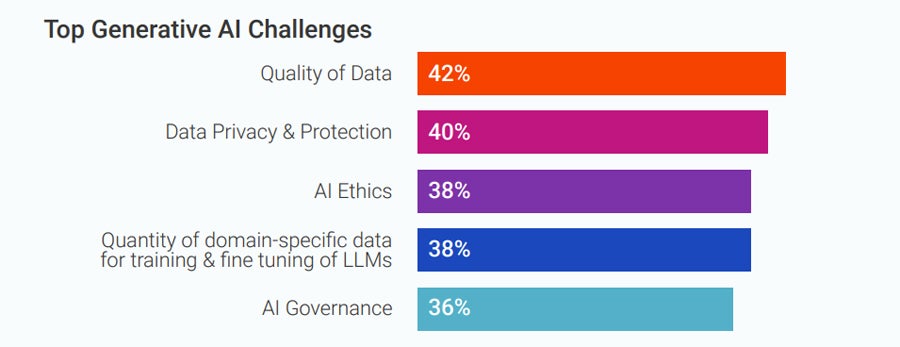
Data quality was named the biggest challenge to generative AI by 42% of global respondents. The potential for bias stood out as a particular concern in APAC due to large language models; 53% of Australian respondents said avoiding bias was their biggest concern (Figure A).

Chart showing data quality is a significant challenge to data leaders around the world in the race for AI.
Figure A: Data quality is a significant challenge to data leaders around the world in the race for AI. Image: Informatica

“In the era of analytics, if you had bad data foundations, you would get to the wrong decision quicker,” Scott said. “In the same way, if you have a bad data management environment, you will get an answer from generative AI, but it may take you in the wrong direction.”

Data literacy outside the data estate

Organisational data literacy is holding progress on AI back, according to data leaders surveyed. For example, 98% of global data leaders said they had experienced nontechnical organisational roadblocks to better data management, such as a lack of leadership support.

Improving data-driven culture and data literacy was named by 39% of global data leaders as a top priority for 2024. Improving data literacy was the second most important (42%) measure of data strategy effectiveness, beaten only by getting data ready for AI and analytics initiatives.

“Our CEO at Informatica talks a lot about the fact that, with businesses outsourcing applications, buildings, and so many other aspects of a business, for many companies their only asset is data. So it has to be a really high priority for the executive team and the board,” Scott said.

A growth in data management tools

The number of data management tools is growing. Two thirds (60%) of APAC leaders say they will need five or more data management tools to support priorities and manage data estates — an increase from the number of data chiefs who needed this number of tools in 2023 (55%).

Data governance and democratisation

Improving governance over data and processes was named by 40% of regional data leaders as a top data strategy priority for 2024. APAC data leaders also placed the highest emphasis (67%) on enabling more data democratisation across their organisation when using generative AI.

This is driving vendors to offer governance services and tools. Informatica recently launched an integrated Cloud Data Access Management tool following its acquisition of Privitar, which helps support the compliant management, sharing and use of data in jurisdictions across the globe.

SEE: Data governance to be a renewed focus in IT for Australian organisations in 2024.

Informatica also offers a self-service data marketplace designed to ‘democratise’ data access. Users can request and access data based on permissions. Data is served up with data quality and relevance ratings and is tracked so data stewards understand how it is being used.

Architecture foundational to meeting data challenge

Informatica’s Richard Scott advised regional data leaders to get the right cloud architecture in place to support scale and to focus on people and processes as well as technology.

Start with the right cloud architecture

Organisations should start by ensuring their cloud architecture is sound, Scott said, as getting this right from the start will support future efforts to scale.

“It’s when you are scaling out and you don’t have the right sort of data management architecture that you get into real trouble,” said Scott.

Scott added that getting cloud architecture right from the outset is also cheaper.

“Companies with multiple cloud contracts pay a lot of money in the ingress and egress cost between clouds,” Scott said. “Not only does the wrong cloud architecture result in an environment that maybe can’t support generative AI but it is also very expensive.”

Informatica client NRMA, one of Australia’s oldest member-based organisations, is working successfully with over 3,000 datasets. Organisations that exert the effort to get the architecture right can get on top of data and have a material impact on their data estate, Scott said.

Look at people, processes and technology

The nature of the data challenge means organisations need to look more holistically at people and processes and technology. Scott said for data leaders in organisations that are trying to fix problems as they arise, it can feel like “putting your finger in the dike to stop a flood.”

“What will happen is if you just plug each little hole in the dike by getting a new application or writing some code, you’re going to end up with a very fragmented environment, which is going to be very brittle. You need to look at people, process and technology and have a clear understanding of where you’re headed; then you can bring in technology that’s going to integrate incredibly well and give you that ability to transport data across your environment.”

Why Claude 3 Is Bad News for Microsoft Azure

AWS, a cloud market leader, has been facing stiff competition from Microsoft Azure in the past few months. The same goes for Google Cloud, which raised concerns about Microsoft’s monopolistic cloud computing practices.

The tussle in the cloud space is clearly visible in the recent cloud earnings from generative AI. In the fourth quarter of 2023, Microsoft’s Intelligent Cloud division achieved $25.9 billion in sales, while AWS and Google Cloud recorded $24.2 billion and $9.2 billion, respectively.

Now, AWS and Google Cloud’s generative AI pal and OpenAI’s rival, Anthropic, might have brought them back into the game. The company recently released the Claude 3 model family, which comprises Claude 3 Haiku, Claude 3 Sonnet, and Claude 3 Opus.

Claude 3 Opus, the strongest model, outperforms GPT-4 on common benchmarks like MMLU and HumanEval. It has been almost a year since GPT-4 was released, and this is the first time a model has surpassed it. Also, Claude 3 Sonnet, specifically meant for enterprise workloads, is now available on Amazon Bedrock and in private preview on Google Cloud’s Vertex AI Model Garden—with Opus and Haiku coming soon to both.

Claude 3 also boasts vision capabilities, allowing it to process images and generate text outputs. It analyses and comprehends charts, graphs, technical diagrams, reports, and other visual assets.

With a context window of 200K, Claude 3 is well-suited for enterprise applications dealing with vast amounts of corporate data. Its capabilities encompass analysis, forecasting, content creation, code generation, and multilingual conversation, including Spanish, Japanese, and French proficiency.

Ironically, many believe Claude 3 has reached AGI because of its ability to delight users. That also explains why the customer-obsessed Amazon invested $4 billion, alongside Google investing $2 billion in the AI startup. It is interesting to see how the two cloud majors are joining hands to support OpenAI rivals and give Microsoft Azure a tough competition.

While Amazon seems to have strategically integrated powerful AI models into its Bedrock umbrella, catering to enterprise customers, Microsoft and Google are upping their small language models game with Phi-2 and Gemma, fueling both startups and developers and giving Meta’s Llama 2 a fight.

Amazon has none. It is likely to be released in the coming months.

Hey, Who’s Dancing with Whom Now?

The cloud war is turning into a dance battle of sorts. While Microsoft made Google dance at the start, Google and Amazon are now making Microsoft dance. But the latter is not going to give up so easily.

At Microsoft Ignite 2023, the company announced models as a service (MaaS), an approach similar to Amazon Bedrock, an LLM marketplace (the analogy which the company dislikes) providing foundational models for enterprise customers from Anthopic, AI21 Labs, Stability AI, and Amazon via an API.

More recently, Microsoft invested $16 million in Mistral AI and partnered with them to host their latest model, Mistral Large, on Azure as a MaaS and Azure Machine Learning model catalogue.

Before the release of Claude 3, Mistral Large held the position as the world’s second-ranked model generally available through an API, surpassing Google’s Gemini Pro and Anthropic’s Claude 2.1, second only to GPT-4.

Apart from the Mistral, Azure hosts all OpenAI models, including GPT-4, GPT-4 Turbo, and GPT-3.5. Furthermore, Azure provides pre-trained models, such as Meta’s Llama 2 series in 7B, 13B, and 70B parameter versions, along with its proprietary Phi-2.

Google Grooves to GenAI

Like AWS, Google is also putting in a lot of effort to make Vertex AI a success. With Gemini Ultra 1.0 along with the open-source models Gemma and Llama 2 and Gemini 1.5, Google has sent a clear message that they mean business.

With Claude 3 and Gemini 1.5 in its arsenal, Google Cloud appears to be an excellent choice for developers.

Both Claude 2 and Gemini 1.5 offer a context window of 1 million tokens, the highest till date, which even OpenAI has not achieved yet. The largest context window OpenAI offers is 128K with GPT-4 Turbo.

Now, the ball is in OpenAI’s court, and everybody is impatiently waiting for the release of GPT-5. But, OpenAI mostly has other priorities, and seems distracted with controversies, like the recent one where Elon Musk sued the company, accusing them of deviating from their original mission and becoming a de facto subsidiary of Microsoft. Microsoft badly needs OpenAI’s GPT-5 to win the cloud war.

The post Why Claude 3 Is Bad News for Microsoft Azure appeared first on Analytics India Magazine.

Exploring the Potential of Transfer Learning in Small Data Scenarios

Exploring the Potential of Transfer Learning in Small Data Scenarios
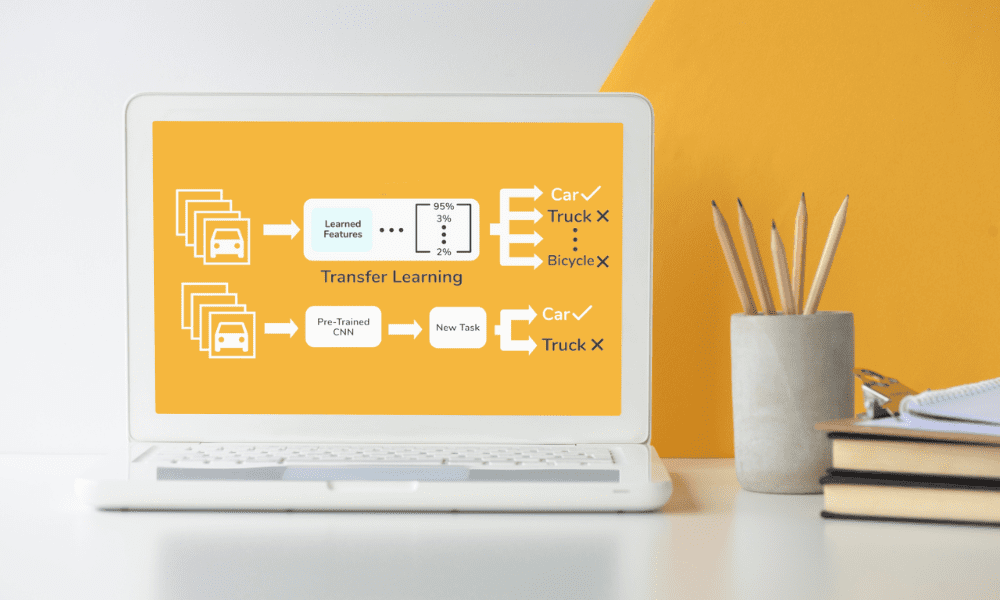
Image by Editor | Transfer Learning Flow from Skyengine.ai

When it comes to machine learning, where the appetite for data is insatiable, not everyone has the luxury of accessing vast datasets to learn from at a whim—that's where transfer learning comes to the rescue, especially when you're stuck with limited data or the cost of acquiring more is just too high.

This article is going to take a closer look at the magic of transfer learning, showing how it cleverly uses models that have already learned from massive datasets to give your own machine learning projects a significant boost, even when your data is on the slim side.

I’m going to tackle the hurdles that come with working in data-scarce environments, peek into what the future might hold, and celebrate the versatility and effectiveness of transfer learning across all kinds of different fields.

What is Transfer Learning?

Transfer learning is a technique used in machine learning that takes a model developed for one task and repurposes it for a second, related task, evolving it further.

At its core, this approach hinges on the idea that knowledge gained while learning one problem can assist in solving another, somewhat similar problem.

For instance, a model trained to recognize objects within images can be adapted to recognize specific types of animals in photos, leveraging its pre-existing knowledge of shapes, textures, and patterns.

It actively accelerates the training process while at the same time also significantly reducing the amount of data that’s required. In small data scenarios, this is particularly beneficial, as it circumvents the traditional need for vast datasets to achieve high model accuracy.

Utilizing pre-trained models lets practitioners bypass many of the initial hurdles that are commonly associated with model development, such as feature selection and model architecture design.

Pre-trained Models Are The Backbone of Transfer Learning

Pre-trained models serve as the true foundation for transfer learning, and these models, often developed and trained on large-scale datasets by research institutions or tech giants, are made available for public use.

The versatility of pre-trained models is remarkable, with applications ranging from image and speech recognition to natural language processing. Adopting these models for new tasks can drastically cut down on development time and the resources you need.

For example, models trained on the ImageNet database, which contains millions of labeled images across thousands of categories, provide a rich feature set for a wide range of image recognition tasks.

The adaptability of these models to new, smaller datasets underscores their value, allowing for the extraction of complex features without the need for extensive computational resources.

The Potential Challenges in Small Data Environments

Working with limited data presents unique challenges—the primary concern is overfitting, where a model learns the training data too well, including its noise and outliers, leading to poor performance on unseen data.

Transfer learning mitigates this risk by using models pre-trained on diverse datasets, thereby enhancing generalization.

However, the effectiveness of transfer learning depends on the relevance of the pre-trained model to the new task. If the tasks involved are too dissimilar, then the benefits of transfer learning may not fully materialize.

Moreover, fine-tuning a pre-trained model with a small dataset requires careful adjustment of parameters to avoid losing the valuable knowledge the model has already acquired.

In addition to these hurdles, another scenario where data can be jeopardized is during the process of compression. This even applies to quite simple actions, like when you want to compress PDF files, but thankfully these kinds of occurrences can be prevented with accurate alterations.

In the context of machine learning, ensuring the completeness and quality of data even when undergoing compression for storage or transmission is vital to developing a reliable model.

Transfer learning, with its reliance on pre-trained models, further highlights the need for careful management of data resources to prevent loss of information, ensuring that every piece of data is used to its fullest potential in the training and application phases.

Balancing the retention of learned features with the adaptation to new tasks is a delicate process that necessitates a deep understanding of both the model and the data at hand.

Future Directions in Transfer Learning

The horizon of transfer learning is constantly expanding, with research pushing the boundaries of what's possible.

One exciting avenue here is the development of more universal models that can be applied across a broader range of tasks with minimal adjustments needed.

Another area of exploration is the improvement of algorithms for transferring knowledge between vastly different domains, enhancing the flexibility of transfer learning.

There's also a growing interest in automating the process of selecting and fine-tuning pre-trained models for specific tasks, which could further lower the barrier to entry for utilizing advanced machine learning techniques.

These advancements promise to make transfer learning even more accessible and effective, opening up new possibilities for its application in fields where data is scarce or hard to collect.

Providing Adaptability Across Different Domains

The beauty of transfer learning lies in its adaptability that applies across all kinds of different domains.

From healthcare, where it can help diagnose diseases with limited patient data, to robotics, where it accelerates the learning of new tasks without extensive training, the potential applications are vast.

In the field of natural language processing, transfer learning has enabled significant advancements in language models with comparatively small datasets.

This adaptability doesn’t just showcase the efficiency of transfer learning, it highlights its potential to democratize access to advanced machine learning techniques to allow smaller organizations and researchers to undertake projects that were previously beyond their reach due to data limitations.

Even if it’s a Django platform, you can leverage transfer learning to enhance your application's capabilities without starting from scratch all over again.

Transfer learning transcends the boundaries of specific programming languages or frameworks, making it possible to apply advanced machine learning models to projects developed in diverse environments.

The Importance of Resource Optimization

Transfer learning is not just about overcoming data scarcity; it's also a testament to efficiency and resource optimization in machine learning.

By building on the knowledge from pre-trained models, researchers and developers can achieve significant results with less computational power and time.

This efficiency is particularly important in scenarios where resources are limited, whether it’s in terms of data, computational capabilities, or both.

Since 43% of all websites use WordPress as their CMS, this is a great testing ground for ML models specializing in, let’s say, web scraping or comparing different types of content for contextual and linguistic differences.

This underscores the practical benefits of transfer learning in real-world scenarios, where access to large-scale, domain-specific data might be limited. Transfer learning also encourages the reuse of existing models, aligning with sustainable practices by reducing the need for energy-intensive training from scratch.

The approach exemplifies how strategic resource use can lead to substantial advancements in machine learning, making sophisticated models more accessible and environmentally friendly.

Is Transfer Learning Right For Your Models?

As we conclude our exploration of transfer learning, it's evident that this technique is significantly changing machine learning as we know it, particularly for projects grappling with limited data resources.

Transfer learning allows for the effective use of pre-trained models, enabling both small and large-scale projects to achieve remarkable outcomes without the need for extensive datasets or computational resources.

Looking ahead, the potential for transfer learning is vast and varied, and the prospect of making machine learning projects more feasible and less resource-intensive is not just promising; it's already becoming a reality.

This shift towards more accessible and efficient machine learning practices holds the potential to spur innovation across numerous fields, from healthcare to environmental protection.

Transfer learning is democratizing machine learning, making advanced techniques available to a far broader audience than ever before.

Nahla Davies is a software developer and tech writer. Before devoting her work full time to technical writing, she managed—among other intriguing things—to serve as a lead programmer at an Inc. 5,000 experiential branding organization whose clients include Samsung, Time Warner, Netflix, and Sony.

More On This Topic

  • SQL Group By and Partition By Scenarios: When and How to Combine…
  • Overcoming Imbalanced Data Challenges in Real-World Scenarios
  • TensorFlow for Computer Vision — Transfer Learning Made Easy
  • What is Transfer Learning?
  • Transfer Learning for Image Recognition and Natural Language Processing
  • A Practical Guide to Transfer Learning using PyTorch

Dhruva Space to Utilise Swedish Ground Stations for LEAP-1 Satellite Mission

In a significant move that underscores the enduring Indo-Swedish bilateral cooperation, Indian space giant Dhruva Space, and the Swedish Space Corporation (SSC) have announced an expansion of their partnership. This collaboration aims to enhance the satellite ground station networks, facilitating the growth of new space industry initiatives in both Sweden and India.

Dhruva Space will utilise the SSC network of Ground Stations for its upcoming hosted payload satellite mission, LEAP-1, scheduled for launch later in 2024. This collaboration not only marks a milestone in the partnership between Dhruva Space and SSC but also signifies a leap towards achieving easier access to space through Dhruva Space’s comprehensive space engineering solutions.

The partnership leverages Dhruva Space’s expertise in satellite manufacturing, launch services, and mission operations, alongside SSC’s extensive experience in ground station operations and satellite communication services. Ground stations are crucial for the success, safety, and operational integrity of satellite missions, especially during the Launch Early Orbit Phase (LEOP), as they facilitate communication, data transfer, tracking, and control.

Looking ahead, this agreement paves the way for future collaborations, including joint ground station operations, resource sharing, and joint research projects that capitalise on the strengths of both nations. This ongoing collaboration between SSC and Dhruva Space is a testament to the strong partnership between India and Sweden, dating back to 1986, and highlights the synergies across government and industry levels.

Sanjay Nekkanti, CEO & Co-founder of Dhruva Space, expressed his enthusiasm for the strengthened partnership, stating, “We are honoured that our long-term partnership with Swedish Space Corporation continues and is further strengthened to the next level.” Nekkanti emphasised the significance of ground station networks in maximising the potential of low earth orbiting satellites and the future of LEO missions.

Fredrik Gisle, Head of APAC Market Region at SSC, also shared his excitement about the collaboration, noting, “We are delighted to expand our relations with Dhruva Space and to support their upcoming LEAP-1 mission with our ground station network.” Gisle highlighted the long history of collaboration between Sweden and India and expressed SSC’s intention to deepen the relationship and explore the NewSpace sector together with Dhruva Space.

The agreement was signed at the first-ever India-Sweden Space and Geospatial Business Summit in Stockholm, Sweden, coordinated by the Geospatial World Chamber of Commerce (GWCC) and the Sweden-India Business Council (SIBC). This landmark agreement marks a significant step in fostering international collaboration and advancing ground station activities worldwide, further solidifying the Indo-Swedish partnership in the space sector.

The post Dhruva Space to Utilise Swedish Ground Stations for LEAP-1 Satellite Mission appeared first on Analytics India Magazine.

Data Science Hiring Process at Ramco Systems

Earlier this month, leading ERP software solutions provider Ramco Systems introduced Ramco Payce, an AI-powered platform-driven payroll software to improve business payroll management.

Beyond payroll, Ramco’s AI and analytics team has successfully addressed challenges ranging from warehouse process optimisation and anomaly detection to user personalisation. Over the past five years, the team has developed and implemented chatbots using traditional NLP techniques and is now upgrading them with LLMs for enhanced capabilities.

Leveraging AI and ML, Ramco’s data science team focuses on solving practical problems through data science applications, emphasising use cases over technology-centric approaches.

AIM got in touch with Srirama Raja, chief technology officer, and Rajiv Nair, chief human resources officer and ESG leader, Ramco Systems, to understand the company’s hiring strategy in the data science space, and talk about the skills needed, expectations, and the company’s work culture, among other things.

Ramco is currently undergoing technology modernisation, incorporating deep analytics, integrating ML algorithms into product features and actively hiring for this. The selected candidates will play a crucial role in the founding team, establishing processes and procedures that will guide future generations.

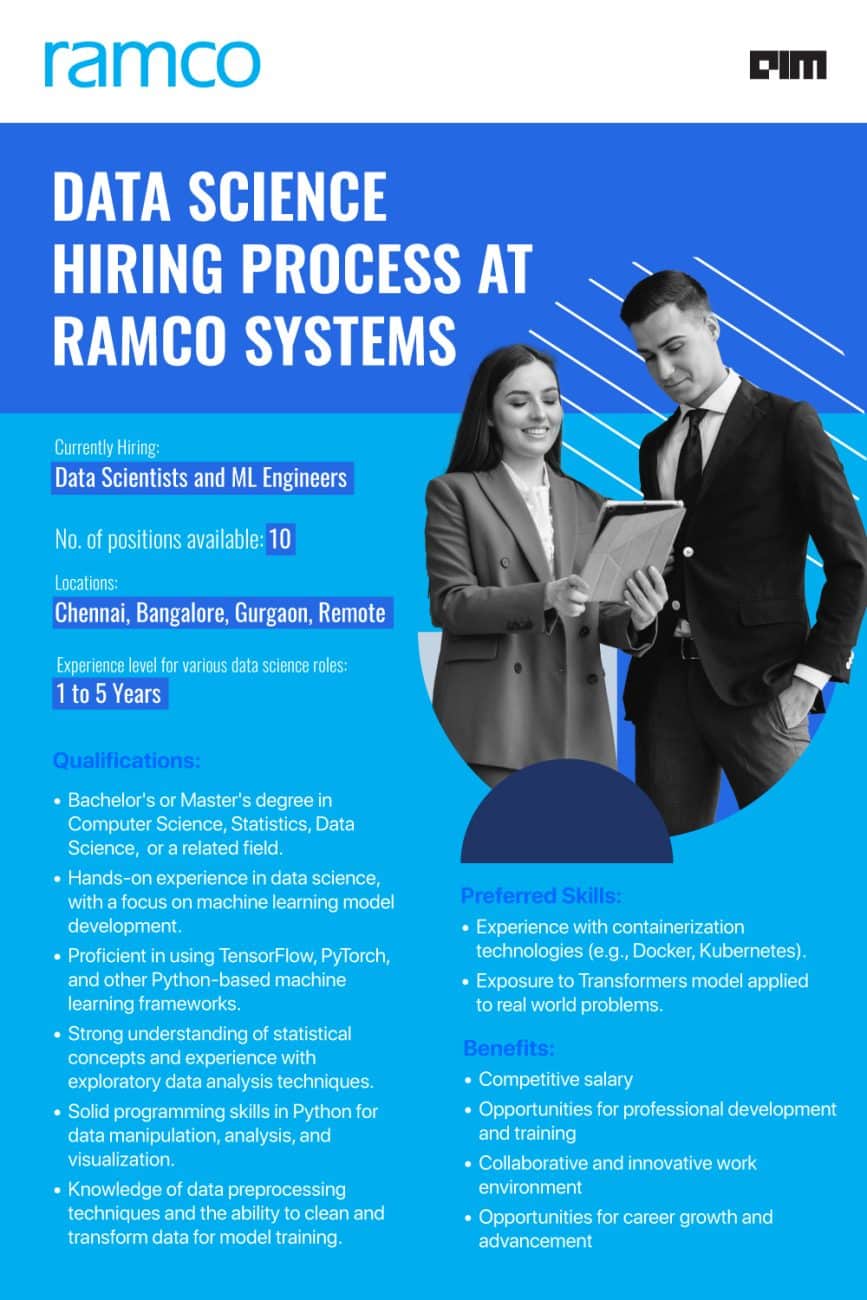
It currently has 10 open positions for data scientists and ML engineers.

The role involves collaborating with cross-functional teams to translate business requirements into data science problems. You will also be needed to use your expertise in statistics and machine learning to extract insights from diverse datasets, implementing models with TensorFlow, PyTorch, and Python frameworks.

Besides, you will be required to develop and maintain models for personalised recommendations, anomaly detection, or intelligent search.

Inside Ramco’s AI Lab

The data scientist role at Ramco Systems involves working with data to derive useful insights and contributing to developing and implementing ML models. In operationalising AI and ML, the team employs Optical Character Recognition (OCR) and translation to digitise documents in various languages, facilitating information retrieval.

Their custom framework integrates conventional ML models, combining machine learning and hypothesis testing for algorithm design in Transportation Management Systems (TMS) and Warehouse Management Systems (WMS) optimisation.

“We currently use generative AI models for document translation and are rolling out an LLM for use within the company to improve productivity, enhance ideation and speed up PoC development. Customer support is another key area where we are testing generative AI capabilities,” Raja told AIM.

The team is currently developing proprietary foundational models with plans to offer specific actionable services to customers. Its tech stack is primarily Python-based, using Python packages and open-source tools that meet security standards.

“Our vision in using generative AI is developing multi-agent adversarial models with access to Vector data stores. Thus, we mainly use FAISS and PyTorch for development and TensorFlow for building deployable models while hosting them on the Triton Server,” added Raja.

Hiring Process

“The hiring process for data science roles at our company aims to balance innovation and fairness, evaluating candidates based on their learning agility, analytical thinking, and problem-solving mindset,” Nair told AIM.

The three-round interview includes a technical evaluation covering aspects such as problem-solving, foundational knowledge, project experience, programming proficiency, and communication skills. The Chennai-headquartered company prioritises candidates with strong technical skills and a collaborative approach.

The interview process begins with a technical discussion, followed by a tailored assessment to identify strengths and weaknesses. Successful candidates then proceed to a technical discussion with the business/vertical head, demonstrating technical skills and engaging with decision-makers.

Work Culture

“We prioritise a comprehensive learning environment, providing opportunities for skill development and immersion in cutting-edge technologies within a product-driven setting,” said Nair.

The focus is on cultivating proficiency and thought leadership in digital tech, accompanied by a competitive salary and support for professional growth. The work culture emphasises collaboration and innovation, fostering career advancement.

“A distinctive aspect of our work culture, particularly in collaboration with the data science team, lies in the company’s transition to modern technology. It involves integrating deep analytics and ML algorithms into product features, with selected candidates playing a vital role in establishing foundational processes for future generations,” commented Nair.

The company currently follows a hybrid working model, combining in-person and remote work for employees.

“If you have a keen interest in turning raw data into meaningful insights, solving complex problems, and contributing to innovative projects, we encourage you to consider applying for a position with us,” concluded Nair.

For more information, check out its career page here or send mail to: Careers@ramco.com.

The post Data Science Hiring Process at Ramco Systems appeared first on Analytics India Magazine.

Anthropic & AWS-Google Set to Outpace Microsoft-OpenAI Duo

AWS, a cloud market leader, has been facing stiff competition from Microsoft Azure in the past few months. The same goes for Google Cloud, which raised concerns about Microsoft’s monopolistic cloud computing practices.

The tussle in the cloud space is clearly visible in the recent cloud earnings from generative AI. In the fourth quarter of 2023, Microsoft’s Intelligent Cloud division achieved $25.9 billion in sales, while AWS and Google Cloud recorded $24.2 billion and $9.2 billion, respectively.

Now, AWS and Google Cloud’s generative AI pal and OpenAI’s rival, Anthropic, might have brought them back into the game. The company recently released the Claude 3 model family, which comprises Claude 3 Haiku, Claude 3 Sonnet, and Claude 3 Opus.

Claude 3 Opus, the strongest model, outperforms GPT-4 on common benchmarks like MMLU and HumanEval. It has been almost a year since GPT-4 was released, and this is the first time a model has surpassed it. Also, Claude 3 Sonnet, specifically meant for enterprise workloads, is now available on Amazon Bedrock and in private preview on Google Cloud’s Vertex AI Model Garden—with Opus and Haiku coming soon to both.

Claude 3 also boasts vision capabilities, allowing it to process images and generate text outputs. It analyses and comprehends charts, graphs, technical diagrams, reports, and other visual assets.

With a context window of 200K, Claude 3 is well-suited for enterprise applications dealing with vast amounts of corporate data. Its capabilities encompass analysis, forecasting, content creation, code generation, and multilingual conversation, including Spanish, Japanese, and French proficiency.

Ironically, many believe Claude 3 has reached AGI because of its ability to delight users. That also explains why the customer-obsessed Amazon invested $4 billion, alongside Google investing $2 billion in the AI startup. It is interesting to see how the two cloud majors are joining hands to support OpenAI rivals and give Microsoft Azure a tough competition.

While Amazon seems to have strategically integrated powerful AI models into its Bedrock umbrella, catering to enterprise customers, Microsoft and Google are upping their small language models game with Phi-2 and Gemma, fueling both startups and developers and giving Meta’s Llama 2 a fight.

Amazon has none. It is likely to be released in the coming months.

Hey, Who’s Dancing with Whom Now?

The cloud war is turning into a dance battle of sorts. While Microsoft made Google dance at the start, Google and Amazon are now making Microsoft dance. But the latter is not going to give up so easily.

At Microsoft Ignite 2023, the company announced models as a service (MaaS), an approach similar to Amazon Bedrock, an LLM marketplace (the analogy which the company dislikes) providing foundational models for enterprise customers from Anthopic, AI21 Labs, Stability AI, and Amazon via an API.

More recently, Microsoft invested $16 million in Mistral AI and partnered with them to host their latest model, Mistral Large, on Azure as a MaaS and Azure Machine Learning model catalogue.

Before the release of Claude 3, Mistral Large held the position as the world’s second-ranked model generally available through an API, surpassing Google’s Gemini Pro and Anthropic’s Claude 2.1, second only to GPT-4.

Apart from the Mistral, Azure hosts all OpenAI models, including GPT-4, GPT-4 Turbo, and GPT-3.5. Furthermore, Azure provides pre-trained models, such as Meta’s Llama 2 series in 7B, 13B, and 70B parameter versions, along with its proprietary Phi-2.

Google Grooves to GenAI

Like AWS, Google is also putting in a lot of effort to make Vertex AI a success. With Gemini Ultra 1.0 along with the open-source models Gemma and Llama 2 and Gemini 1.5, Google has sent a clear message that they mean business.

With Claude 3 and Gemini 1.5 in its arsenal, Google Cloud appears to be an excellent choice for developers.

Both Claude 2 and Gemini 1.5 offer a context window of 1 million tokens, the highest till date, which even OpenAI has not achieved yet. The largest context window OpenAI offers is 128K with GPT-4 Turbo.

Now, the ball is in OpenAI’s court, and everybody is impatiently waiting for the release of GPT-5. But, OpenAI mostly has other priorities, and seems distracted with controversies, like the recent one where Elon Musk sued the company, accusing them of deviating from their original mission and becoming a de facto subsidiary of Microsoft. Microsoft badly needs OpenAI’s GPT-5 to win the cloud war.

The post Anthropic & AWS-Google Set to Outpace Microsoft-OpenAI Duo appeared first on Analytics India Magazine.

India’s First AI Multimodal Hanooman Coming Soon

Seetha Mahalaxmi Healthcare (SML), in collaboration with IIT-Bombay, recently introduced ‘Hanooman’, a series of Indic AI models with multimodal specialties at the NASSCOM Technology and Leadership Forum held in Mumbai.

SML’s Hanooman is named after the Hindu deity Hanuman. “Hanuman is a great example of responsible power. Despite being the most-powerful entity, he never used his power for selfish needs,” said Vishnu Vardhan, founder of SML and Vizzhy, in an exclusive interview with AIM.

Vardhan said they came up with the name while framing the ethical framework for the model and added that it acts as a guideline to understand how their model should be – for the greater good.

Unleashing the Power of Hanooman

The founder told AIM that the first-four open-source models in the Hanooman series (1.5 billion, 7 billion, 13 billion, and 40 billion parameters) are set to be released soon.

“These will most probably be released by the end of this month. We are quite ready. But we will do a lot of testing,” said Vardhan. He added that Hanooman, being built by researchers, academicians, and professors, needs to undergo thorough testing before being released in the market.

Being multimodal, Hanooman will be able to converse in 11 languages, including Hindi, Tamil, Telugu, Malayalam, and Marathi. “In the future, we plan to extend language support to all 22 official languages of India,” said Vardhan.

“We don’t want it to be like ChatGPT, which suffers from the ‘I’m God and I know everything’ syndrome. We don’t want to simply replicate its success [but be more than that],”said Vardhan, adding that they are currently focusing on specific use cases for Hanooman.

As a healthcare provider, SML is currently focused on addressing the challenges faced by doctors. “We want to make it easy for doctors and people to keep their records and summarise them,” he said, adding that the conversations of doctors will be recorded, and Hanooman will summarise them using automatic speech summarisation.

The other use case, Vardhan mentioned, is helping rural kids with their homework, especially those whose parents can’t assist them. “We believe that the education barrier is a significant challenge in India,” said Vardhan, emphasising that healthcare and education are their primary focus areas. “We are very focused on healthcare and education, and maybe later, banking.”

In the near future, SML also plans to come up with closed-source models for enterprise customers. “We’ll build some highly data-efficient and cost-effective diagnostic solutions, which will be much cheaper than existing models. This will bring down the cost by 100x, and they will be specifically built for you,” said Vardhan.

Not Backed by Reliance Jio Infocomm

“The media has sometimes gotten it totally wrong, like how Jio has invested in Hanooman. It’s an initiative of SML,” said Vardhan. However, he added that they might collaborate with them in the future on the use cases of telecom and retail.

Vardhan said that to build Hanooman, SML hasn’t raised any external funding, and it has been mostly internal funding. “We are totally inspired by what ISRO has done, and we want to do that for India, but it does cost a lot of money,” he said.

“We have 1000 GPUs with us, and our plan is to scale it up to 10,000 in 2024 because we see a lot of requirements coming up,” said Vardhan, adding that they are also receiving support from cloud service providers in India. Vardhan was all praise for Indian hardware players, including Yotta. “They’re bringing 16,000 GPUs and are really enablers, creating the whole ecosystem.”

Vardhan said, as of now, many enterprises and state governments are in touch with them to use Hanooman. “States such as Tamil Nadu, Telangana, and Karnataka have shown interest, and many other state governments have been approaching us because we are working on multilingual projects,” he concluded.

[Update] March 6, 2024 10:21 | The story has been updated to reveal that Hanooman is not part of BharatGPT iniative. It is a model being developed by SML (a private entity), as shared by Ganesh Ramakrishnan, who leads the BharatGPT.

The post India’s First AI Multimodal Hanooman Coming Soon appeared first on Analytics India Magazine.

Lenovo Fuels India’s Hyperscaler Ambitions

The world’s largest PC manufacturer, Lenovo, has been going all in on AI investments. Last year, the company committed to investing $1 billion to advance its AI innovators program, which earlier had an allocation of $100 million. Lenovo’s Infrastructure Solutions Group (ISG), which is the world’s leading provider of supercomputers, has also been accelerating its commitment to data centres and cloud infrastructure with a special focus on India.

Lenovo’s India Plans

“India is absolutely one of the most important markets that we serve,” said Vladimir Rozanovich, SVP-Lenovo ISG, in an exclusive interaction with AIM. “We know there’s value in making sure we build infrastructure products here in India; we know there is a market here to sell those too. But, we also know there’s a market here to export those to other countries in the Asia Pacific region,” he added.

India’s potential and adoption prowess positions it as a crucial player for Lenovo. “I think India, because of traditionally being a strong back-office to the world, is in a wonderful position to actually drive the market on what AI does, and what AI in the infrastructure space looks like,” said Rozanovich.

The availability of talented software engineers has been Lenovo’s draw towards local hiring to generate value-added jobs across various business sectors such as PCs, mobile and servers. India not only serves as an opportunity for manufacturing and software development but also for revenue opportunities. “I think some of China’s sentiment is that companies are looking for alternatives other than build in China,” said Rozanovich.

Collaborative Forces

Key AI player NVIDIA has been a strong collaborative force for Lenovo. Last October, the two giants announced their partnership and expansion plans to bring generative AI accessible to enterprises. Lenovo is one of the exclusive partners of NVIDIA’s digital twin product, OVX, that offers both on-prem and cloud deployments. As software providers, Microsoft is a crucial partner as well.

“Partnership is in our DNA, and just about everything we do across the organisation,” said Sumir Bhatia, president – Asia Pacific, Lenovo ISG. “If you look at delivering an AI solution to a customer, it’s a journey, and I don’t believe there’s one company that can actually provide a solution. This is where partnerships come in,” he said.

Enabling India Hyperscalers

Continuing on collaborations, Lenovo is already providing infrastructure to all the major data centre players in India. “Hyperscalers in India are a big, big business. If you see the overall server business in India, 50% of it is hyperscalers,” said Amit Luthra – MD India – Lenovo ISG. “Eventually, any hyperscaler and every cloud service provider needs infrastructure to run their service. That is where we partner with them.”

However, scaling hyperscalers comes with its own set of difficulties. India has to address the infrastructure demand in India before expanding to other markets. “I think for hyperscalers the challenge is ‘India for India’, said Luthra.

Data localisation or data sovereignty has been driving growth, and Luthra believes there is no organisation that can afford to not have data in India. “Some of them who had backshore offices in India and no data centres here, now have them here. They eventually turned out to be our large customers,” said Luthra.

Bhatia said that the situation has led to a number of startups wanting to switch from cloud to on-prem services, as they “need to be with the AI services and want to be in a hybrid environment”. “A major growth will be the next wave of cloud service providers here in India,” he said.

Future Hype and Trend

Rozanovich spoke about the evolving infrastructure to fit into the recent market. “Instead of CPUs and GPUs, you’ll hear about NPUs or neural processing units, which companies like AMD, Intel, and Qualcomm are starting to develop. Those are going to be higher horsepower-type silicon that will now actually start going into devices too. These will have the capability to do all of these computations in the background,” said Rozanovich.

Speaking about the future, the ISG leaders predict increasing growth and development, especially in the AI space. “I think you are going to continue to see us invest in this AI journey from devices to cloud,” said Rozanovich.

The company also has ambitious goals in becoming leaders in mobility. “Today we export more Motorola phones out of India to the US than are actually even consumed here in India. We have goals for being number three in the world, from a mobility standpoint. You’re going to see us continue to make investments here,” said Rozanovich.

“If we can create a situation where India is an exporter of technology for Lenovo, that would be a wonderful thing,” he concluded.

The post Lenovo Fuels India’s Hyperscaler Ambitions appeared first on Analytics India Magazine.