Deemed a growing scarcity in the industry, workers skilled in artificial intelligence (AI) can prompt higher salary offers of up to 44%, depending on which department the role is for.
Employers say they are willing to bump up salaries by 44% for AI-skilled workers in IT and 41% more for those in research and development, according to a survey released by Amazon Web Services (AWS). Conducted by Access Partnership, the study polled 4,664 employers and 14,896 workers across nine Asia-Pacific markets, including Australia, India, Indonesia, Japan, Singapore, and South Korea.
Also: Beyond programming: AI spawns a new generation of job roles
Employers also are willing to fork out 39% more to hire AI-skilled workers in sales and marketing as well as in business operations, while they will pay 37% more for those in finance.
Across the region, employers will increase the paychecks of workers who acquire AI skills by an average 33%, with those in India the most generous, offering a 54% salary bump.
AWS noted that the expected average salary hikes are proportional to the productivity gains Asia-Pacific employers are anticipating from their AI rollouts.
They believe AI can improve productivity by 51% if leveraged to its full potential across all functions. Workers, too, believe the use of AI in their jobs can push productivity up by 50%.
Asked how AI would help daily work functions, 64% of employers pointed to task automation while 60% cited improved workflow and outcomes. Another 59% said it would enhance communication and 49% said it would augment innovation and creativity.
In terms of the departments that would benefit most from AI, 91% pointed to IT, while 89% and 88% highlighted business operations and finance, respectively.
Also: Want to work in AI? How to pivot your career in 5 steps
Among workers, 93% believe their AI skills will have a positive impact on their careers, including increased efficiency, higher job satisfaction, and faster career progression, according to AWS.
Some 83% indicate interest in developing AI skills to accelerate their careers, including 87% of Gen Z workers, and 79% of Gen X. Some 68% of baby boomers, aged 55 and above, would enroll in an AI upskilling course if they were offered the opportunity.
By 2028, 92% of workers across Asia-Pacific expect to use AI in their daily work, with 34% planning to do so "extensively". This is higher than their counterparts in the UK, of whom 76% and 18% said likewise, respectively.
For now, though, 75% of Asia-Pacific employers note their struggles in finding the AI talent they require, with 79% describing hiring AI-skilled workers as a priority.
Also: Will AI hurt or help workers? It's complicated
Asked about skills that need to use AI by 2028, 57% pointed to creative design and thinking, while 53% highlighted critical thinking and problem-solving. Another 45% said technical such as coding and 36% noted ethics and risk management.
However, 79% admitted not knowing how to run an AI workforce training program, while 74% of workers are unsure about career paths where AI skills are useful.
Organizations looking to deploy GenAI often have questions on where to start and who to train first, said Emmanuel Pillai, AWS' Asean head of training and certification. Tech employees typically are in the initial batch to skill up on GenAI, such as learning how to use the tool to test software codes, said Pillai during a media briefing to discuss the study's findings.
GenAI training for non-tech workers usually is focused on improving customer service, products, or user experience, he added, noting that AWS' training programs are role-based to provide more relevant context.
Also: The best AI image generators to try right now
An AWS training customer, Terrascope, is using GenAI tools to improve its efficiency in calculating carbon emissions. It works with AWS to develop its in-house cloud and AI skills training program, Terrascope CTO Mathavan Arugalaimuthu said at the briefing. AWS is one of several cloud platforms the company uses.
Headquartered in Singapore, the carbon measurement platform employs some 100 employees, and its technical staff — including data scientists — were among the first to be trained on GenAI, Arugalaimuthu said. Its employees also are guided on how to identify potential hallucinations when using GenAI tools.
There are the necessary guardrails, too, he said, with humans always included in the loop. Software programs developed using GenAI-assisted tools are sent through the usual security and peer review to ensure they contain only legitimate codes, he added.
"With a growing number of organizations expected to deepen their use of AI solutions and tools, and the continual evolution of AI-driven innovations, there is a need for employers and governments to nurture a proficient workforce capable of steering current and future AI advancements," said Abhineet Kaul, director at Access Partnership.
Also: The top ten highest-paid tech skills can make you a lot of money — here's how much
AWS this week introduced its GenAI Competency service, which it says will help enterprise customers assess and select GenAI products that fit their requirements. Encompassing a range of tools and services, the new offering showcases products from more than 40 of AWS' partners including Nvidia, Deloitte, Tata Consultancy Services, HCLTech, and Capgemini.
These companies have been validated through the AWS GenAI Competency service and are grouped into three key areas, spanning GenAI applications, foundation models and foundation model-based application development, and infrastructure and data, AWS said.
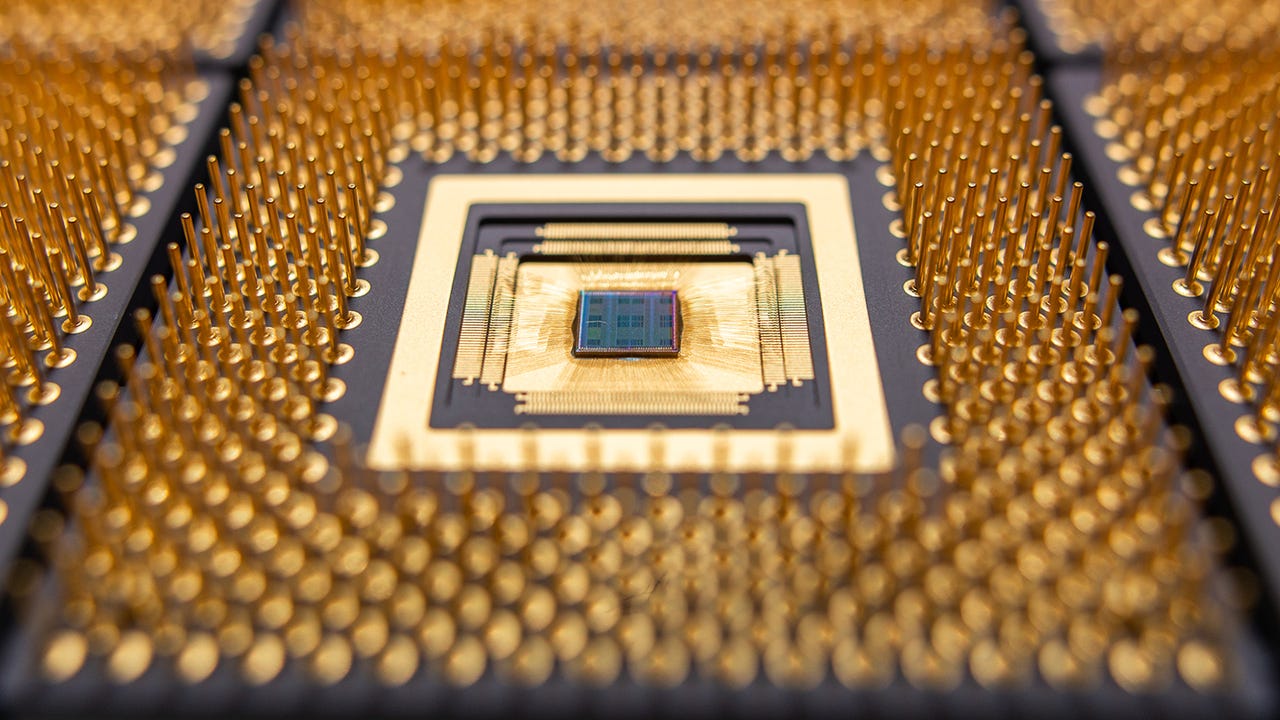
A prototype mixed digital and analog chip does the most demanding portions of GenAI, the accumulate operation, in low-power analog circuitry.
2024 is expected to be the year that generative artificial intelligence (GenAI) goes into production, when enterprises and consumer electronics start actually using the technology to make predictions in heavy volume — a process known as inference.
For that to happen, the very large, complex creations of OpenAI and Meta, such as ChatGPT and Llama, somehow have to be able to run in energy-constrained devices that consume far less power than the many kilowatts used in cloud data centers.
Also: 2024 may be the year AI learns in the palm of your hand
That inference challenge is inspiring fundamental research breakthroughs toward drastically more efficient electronics.
On Wednesday, semiconductor startup EnCharge AI announced that its partnership with Princeton University has received an $18.6 million grant from the US's Defense Advanced Research Projects Agency, DARPA, to advance novel kinds of low-power circuitry that could be used in inference.
"You're starting to deploy these models on a large scale in potentially energy-constrained environments and devices, and that's where we see some big opportunities," said EnCharge AI CEO and co-founder Naveen Verma, a professor in Princeton's Department of Electrical Engineering, in an interview with ZDNET.
EnCharge AI, which employs 50, has raised $45 million to date from venture capital firms including VentureTech, RTX Ventures, Anzu Partners, and AlleyCorp. The company was founded based on work done by Verma and his team at Princeton over the past decade or so.
EnCharge AI is planning to sell its own accelerator chip and accompanying system boards for AI in "edge computing," including corporate data center racks, automobiles, and personal computers.
In so doing, the company is venturing where other startups have tried and failed — to provide a solution to the inferencing problem at the edge, where size, cost, and energy-efficiency dominate.
EnCharge AI's approach is part of a decades-long effort to unite logic circuits and memory circuits known as in-memory compute (IMC).
The real energy hog in computing is memory access. The cost to access data in memory circuits can be orders of magnitude more than the energy required by the logic circuits to operate on that data.
When it comes to cracking the inference market for AI, says EnCharge AI's Naveen Verma, "Having a major differentiation in energy efficiency is an important factor."
GenAI programs consume unprecedented amounts of memory to represent the parameters, the neural "weights" of large neural networks, and tons more memory to store and retrieve the real-world data they operate on. As a result, GenAI's energy demand is soaring.
The solution, some argue, is to perform the calculations closer to memory or even in the memory circuits themselves.
EnCharge AI received the funding as part of DARPA's $78 million program targeted at IMC — Optimum Processing Technology Inside Memory Arrays (OPTIMA). As part of a broader electronics resurgence Initiative at DARPA, OPTIMA's specifications outline a broad goal of reaching 300 trillion operations per second (TOPS) per watt of energy expended, the critical measure of energy efficiency in computing. That would be 15 times the industry's current state of the art.
The key insight by Verma and other pioneers of IMC research is that AI programs are dominated by a couple of basic operations that draw on memory. Solve those memory-intense tasks, and the entire AI task can be made more efficient.
The main calculation at the heart of GenAI programs such as large language models is what's known as a "matrix multiply-accumulate." The processor takes one value in memory, the input, and multiplies it by another value in memory, the weights. That multiplication is added together with lots and lots of other multiplications that happen in parallel, as an "accumulation" of multiplications, known as an "accumulate" operation.
In the case of IMC, EnCharge AI and others aim to reduce the memory usage in a matrix multiply-accumulate by doing some of the work in analog memory circuitry rather than traditional transistors. Analog can perform such matrix-multiply accumulations in parallel at far lower energy than can digital circuits.
Also: As AI agents spread, so do the risks, scholars say
"That's how you solve the data movement problem," explained Verma. "You don't communicate individual bits, you communicate this reduced result" in the form of the accumulation of lots of parallel multiplications.
Analog computing, however, is notoriously difficult to achieve, and the fortunes of those who have gone before EnCharge AI have not been good. The chip-industry newsletter Microprocessor Report noted that one of the most talked-about startups in analog computing for AI, Mythic Semiconductor, which received $165 million in venture capital, is now "barely hanging on."
"How do you get analog to work? That's the snake that bit Mythic, that's the snake that bit researchers for decades," observed Verma. "We've known for decades that analog can be a 100 times more energy-efficient and a 100 times more area-efficient" than digital, but "the problem is, we don't build analog computers today because analog is noisy."
EnCharge AI has found a way to finesse the challenges of analog. The first part is to break up the problem into smaller problems. It turns out you don't need to do everything in analog, said Verma. It's enough to make just the accumulate operation more efficient.
Instead of performing all of a matrix multiply-accumulate in analog, the first part — the matrix multiplication — is performed in normal digital circuits in the EnCharge AI chip, meaning, transistors. Only the accumulate portion is done in analog circuits via a layer of capacitors that sit above the digital transistors.
"When you build an in-memory computing system, it's that reduction in that accumulate [function] that really solves the data movement problem," said Verma, "It's the one that's critical for memory."
Floor plan of a 2021 prototype of the EnCharge AI chip. Compute-in-memory cores connected by a network divided up the work of computing a large language model or other AI program in parallel.
A detail of the inside of each in-memory computing block, where analog circuits perform the "accumulation" of values of a neural network.
The second novel tack that EnCharge has applied is to go with a less-challenging approach to analog. Instead of measuring the current of an analog circuit, which is an especially noisy proposition, the company is using simpler capacitors, circuits that briefly store a charge.
"If you use a capacitor, you don't use currents, you use charge capacitors, so you add up charge and not current," said Verma, which is an inherently less noisy process.
Using capacitors is also more economical than prior approaches to analog, which required exotic manufacturing techniques. Capacitors are essentially free, said Verma, in the sense that they are part of normal semiconductor manufacturing. The capacitors are made from the ordinary metal layers used to interconnect transistors.
"What's important about these metal wires," said Verma, "is they don't have any material parameter dependencies like [carrier] mobility" like other memory circuits such as those used by Mythic. "They don't have any temperature dependencies, they don't have any nonlinearities, they only depend on geometry — basically, how far apart those metal wires are.
"And, it turns out, geometry is the one thing you can control very, very well in advanced CMOs technologies," he said, referring to complementary metal-oxide semiconductor technology, the most common kind of silicon computer chip manufacturing technology.
All the data fed to the digital circuits for matrix multiplication and to the capacitors for accumulation comes from a standard SRAM memory circuit embedded in the chip as a local cache. Smart software designed by Verma and team organizes which data will be put in the caches so that the most relevant values are always near the multiply transistors and the accumulate capacitors.
Thus far, the prototypes produced have already offered a striking improvement in energy efficiency. EnCharge AI has been able to show it can process 150 trillion operations per second per watt when handling neural network inference values that have been quantized to eight bits. Prior approaches to inference — such as Mythic's — have produced at most tens of TOPS per watt. EnCharge AI refers to its chips as being "30x" more efficient than prior efforts.
"The best accelerators from Nvidia or Qualcomm are, kind of, at 5, maybe 10, max, TOPS per watt for eight-bit compute," said Verma.
On top of that efficiency breakthrough, smart software solves a second issue, that of scale. To handle very large models of the kind OpenAI and others are building, which are scaling to trillions of neural network weights, there will never be enough memory in an SRAM cache on-chip to hold all of the data. So, the software "virtualizes" access to memory off-chip, such as in DRAM, by efficiently orchestrating what data is kept where, on and off-chip.
"You have the benefit of all of this larger, high-density memory, all the way out to DRAM, and yet, because of the ways that you manage data movement between these [memories], it all looks like first-level memories in terms of efficiency and speed," said Verma.
EnCharge AI, which was formally spun out of Verma's lab in 2022, has produced multiple samples of increasing complexity using the capacitor approach. "We spent a good amount of time understanding it, and building it from a fundamental technology to a full architecture to a full software stack," said Verma.
Details of a first product will be announced later this year, said Verma. Although initial products will be focused on the inference opportunity, the approach of capacitors for IMC can scale to the training as well, insisted Verma. "There's no reason, fundamentally, why our technology can't do training, but there's a whole lot of software work that has to be done to make that work," he said.
Of course, marketplace factors can often restrain novel solutions, as is clear from the fact that numerous startups have failed to make headway against Nvidia in the AI training market, startups such as Samba Nova Systems and Graphcore, despite the virtues of their inventions.
Even Cerebras Systems, which has announced very large sales of its training computer, hasn't dented Nvidia's momentum.
Verma believes the challenges in inference will make the market something of a different story. "The factors that are going to determine where there's value in products here are going to be different than what they have been in that training space," said Verma. "Having a major differentiation in energy efficiency is an important factor here."
"I don't think it's going to be CUDA" that dominates, he said, referring to Nvidia's software, as formidable as it is. "I think it's going to be, you need to deploy these models at scale, they need to run in very energy-constrained environments, or in very economically efficient environments — those metrics are going to be what's critical here."
To be sure, added Verma, "Making sure that the overall solution is usable, very transparently usable, the way that Nvidia has done, is also going to be an important factor for EnCharge AI to win and be successful here."
Also: AI at the edge: 5G and the Internet of Things see fast times ahead
EnCharge AI plans to pursue further financing. Semiconductor companies typically require hundreds of millions of dollars in financing, a fact of which Verma is very much aware.
"What's driven all of our fundraising has been customer traction, and delivering on customer needs," said Verma. "We find ourselves in a situation where the traction of the customers is accelerating, and we will need to ensure that we're capitalized properly to be able to do that, and the fact that we have some of that traction definitely means we'll be back up on the block soon."
Hugging Face appears to be the latest AI player joining the robotics race, as a former Tesla scientist says he's starting an "ambitious" open-source robotics project at the AI tech platform.
"After 3 years @tesla and Optimus, I am thrilled to announce that I joined Hugging Face to start an ambitious open robotics project! (open as in open-source, not as in Open AI) Looking for engineers to build real robots in Paris," AI researcher Remi Cadene announced on X, formerly Twitter.
Also: OpenAI partners with startup to create advanced AI models for humanoid robots
Previously, Cadene worked on self-driving vehicle technology and humanoid robots at Tesla.
Hugging Face is an open-source platform that provides a large repository for AI tools and pre-trained models, though most focus on natural language processing (NLP) tech. The site also works as a place for developers and users to convene and build a community around machine learning and AI, maintaining its open-source collaboration focus.
Though Hugging Face hasn't confirmed that it's entering the robotics market, the Hugging Face X account has reposted Cadene's announcement and other posts discussing the new venture. Also, Hugging Face appears to have posted a job listing for an Embodied Robotics Engineer in France.
"In this role, you will be responsible for designing, building, and maintaining open-source and low-cost robotic systems that integrate AI technologies, specifically in deep learning and embodied AI," the job posting reads. "You will collaborate closely with ML engineers, researchers, and product teams to develop innovative solutions that push the boundaries of what's possible in robotics and AI."
Also: Microsoft confirms next Windows, Surface, and AI event. Here's what to expect
This news comes a few months after Tesla released a video of its humanoid robot project, Optimus. In an unrelated development, OpenAI is partnering with Figure, an AI robotics company that has received $675 million in Series B funding and is developing autonomous humanoid robots.
NFT platform Zora is offering a novel way for AI model makers to earn money Jacquelyn Melinek 12 hours
Zora, an NFT-based social network platform, is continuing its expansion beyond the crypto-sphere into the hot artificial intelligence market, Dee Goens, the startups’ co-founder, said on Chain Reaction.
Not to be confused with Sora, the text-to-video tool offered by OpenAI, Zora aims to help creators, brands and artists better monetize their content through NFTs. Last month, Zora had “just under” half a million monthly transacting users and in the last 30 days, creators on Zora made over $1.3 million by posting their content, Goens said. We also posted this episode with Goens on Zora, check it out here.
The Zora Network is built on top of the layer-2 blockchain Optimism, which focuses on growing the Ethereum ecosystem. Since it was founded in 2020, Zora has had over $300 million in secondary sales, users have minted, or posted, over 4 million NFTs and it has about 1 million unique collectors, according to its website.
But there’s more work to be done. Zora co-founder Jacob Horne and Goens see crypto and AI as two complementary technologies that can benefit from one another.
“Crypto wants information to be on-chain so that it can be valued and add value to the system,” Goens said. “And then AI wants information to be on-chain so that it can be freely accessed and utilized by the system. So we’re on this kind of collision course where we want to put more stuff on-chain, in order to effectively add value, create value.”
Simply put, in order to train its models and grow, AI needs access to more information and crypto wants information on-chain to grow its ecosystem.
“We need systems that can help bring all of these things on-chain and that’s what we’re trying to do at Zora,” Goens said. It is trying to create a platform that ushers in the transition of AI onto blockchains.
Earlier this week, Zora launched the ability for creators to use AI to mint, which is jargon for recording or posting a transaction on the blockchain, on its platform. This means someone can type what they want, have the image be generated almost instantly and mint it shortly thereafter, Goens shared.
“This is a zero to one moment, one of the first passive income streams for the creators of large language models like Stability AI,” Goens said. This means these AI creators have the ability to capture value from their models’ outputs when people mint them and the payouts are split in half automatically. “We’re really excited to usher in an era where model creators, not just the creators of the output, but the model makers themselves, also have a way to reap the rewards of creativity that they’re helping to produce.”
In general, Goens said he sees a lot of demand from the NFT creator side for more AI functionality and tooling. “This is a net new thing in many ways and I think they’re excited to innovate.”
In the future, he said he sees an opportunity for blockchains to help verify, authenticate and prove the ownership of creations — not just for models, data and information, but the origin of the media itself.
“I think crypto could survive without AI in its current trajectory,” Goens said. But he thinks AI needs blockchains to bolster its narrative around verification and authentication — and he’s not the only person who thinks that.
“I’m excited to see the models on-chain and see more open sourcing of these models, so that we can all have the opportunity to investigate and inspect them in a way where we can make an informed decision,” Goens said. “That opens up an opportunity for us to put our money where our mouth is.”
This story was inspired by an episode of TechCrunch’s podcast Chain Reaction. Subscribe to Chain Reaction on Apple Podcasts, Spotify or your favorite pod platform to hear more stories and tips from the entrepreneurs building today’s most innovative companies.
You're likely familiar with ChatGPT, Microsoft Copilot, and even Google Gemini. But how about Pi? Unveiled last May, the chatbot represents a different kind of AI that's built to provide both factual support and emotional support. On Thursday, Pi developer Inflection announced the latest version of its LLM (large language model) and how that's helping it rival even GPT-4.
On the information front, Pi (short for "personal intelligence") is using an updated version of its in-house LLM known as Inflection-2.5. With its recent training, the new LLM is striving to compete with other models, including OpenAI's GPT-4 and Google's Gemini. Inflection-2.5 comes close to GPT-4's performance but used only 40% of the computer resources for training, Inflection said.
Also: The best AI chatbots: ChatGPT and alternatives
With the new LLM version, Pi made particular progress in areas like coding and math. Plus, the AI integrates real-time web search abilities to help you get up-to-date information and facts. In a series of benchmark tests detailed in Inflection's blog post, Inflection-2.5 outperformed version 1 and nipped at the heels of GPT-4 in a variety of tasks. The tests covered such areas as common sense, science, Hungarian math, and graduate-level physics.
Beyond more technical areas, Pi serves as a general chatbot that can help with a variety of requests.
"With Inflection-2.5's powerful capabilities, users are talking to Pi about a greater range of topics than ever: Discussing current events, getting local restaurant recommendations, studying for a biology exam, drafting a business plan, coding, preparing for an important conversation, or just having fun discussing a hobby," Inflection said in its blog post.
But more interesting may be the emotional support that Pi tries to provide. Like any AI bot, Pi lacks any emotions and feelings itself. But that doesn't mean it can't listen and provide helpful advice.
In trying out Pi, I told it at different times that I was feeling angry, sad, or depressed. In response, the bot first sympathized with my conditions and told me that I wasn't alone. It then suggested concrete steps to take, including exercises like jogging and yoga, creative activities like painting or playing an instrument, volunteering for local organizations and causes, spending time in nature, and practicing meditation and deep breathing.
Beyond the advice, Pi's overall tone was one of compassion and understanding. That by itself is beneficial, especially with other chatbots sometimes responding with rude, insulting, or offensive hallucinations and comments.
In a blog post from last May, Inflection described the type of AI that it tried to create with Pi.
"Imagine an AI that helps you deeply understand topics you really care about, rather than flagging superficial clickbait," Inflection said. "Imagine an AI that helps you empathize with or even forgive 'the other side,' rather than be outraged by and fearful of them. Imagine an AI that optimizes for your long-term goals and doesn't take advantage of your need for distraction when you're tired at the end of a long day."
The twist of offering both factual information and emotional support seems to be paying off for Inflection.
Active users are chiming in at one million each day and six million each month, the company said. More than four billion messages have been exchanged with Pi so far. An average conversation lasts 33 minutes, while one in ten lasts over an hour. Plus, around 60% of the people who talk to Pi one week return the following week.
Available as a website, on iOS, on Android, and via a desktop app, Pi is completely free to use. After a few chats, you'll be prompted to create an account to save a history of your requests. But you can continue to use it as a guest if you wish. Whether you're looking for facts and figures or need a bit of emotional reassurance, Pi is one AI worth trying.
Why most AI benchmarks tell us so little Kyle Wiggers 9 hours
On Tuesday, startup Anthropic released a family of generative AI models that it claims achieve best-in-class performance. Just a few days later, rival Inflection AI unveiled a model that it asserts comes close to matching some of the most capable models out there, including OpenAI’s GPT-4, in quality.
Anthropic and Inflection are by no means the first AI firms to contend their models have the competition met or beat by some objective measure. Google argued the same of its Gemini models at their release, and OpenAI said it of GPT-4 and its predecessors, GPT-3, GPT-2 and GPT-1. The list goes on.
But what metrics are they talking about? When a vendor says a model achieves state-of-the-art performance or quality, what’s that mean, exactly? Perhaps more to the point: Will a model that technically “performs” better than some other model actually feel improved in a tangible way?
On that last question, not likely.
The reason — or rather, the problem — lies with the benchmarks AI companies use to quantify a model’s strengths — and weaknesses.
Esoteric measures
The most commonly used benchmarks today for AI models — specifically chatbot-powering models like OpenAI’s ChatGPT and Anthropic’s Claude — do a poor job of capturing how the average person interacts with the models being tested. For example, one benchmark cited by Anthropic in its recent announcement, GPQA (“A Graduate-Level Google-Proof Q&A Benchmark”), contains hundreds of Ph.D.-level biology, physics and chemistry questions — yet most people use chatbots for tasks like responding to emails, writing cover letters and talking about their feelings.
Jesse Dodge, a scientist at the Allen Institute for AI, the AI research nonprofit, says that the industry has reached an “evaluation crises.”
“Benchmarks are typically static and narrowly focused on evaluating a single capability, like a model’s factuality in a single domain, or its ability to solve mathematical reasoning multiple choice questions,” Dodge told TechCrunch in an interview. “Many benchmarks used for evaluation are three-plus years old, from when AI systems were mostly just used for research and didn’t have many real users. In addition, people use generative AI in many ways — they’re very creative.”
The wrong metrics
It’s not that the most-used benchmarks are totally useless. Someone’s undoubtedly asking ChatGPT Ph.D.-level math questions. However, as generative AI models are increasingly positioned as mass market, “do-it-all” systems, old benchmarks are becoming less applicable.
David Widder, a postdoctoral researcher at Cornell studying AI and ethics, notes that many of the skills common benchmarks test — from solving grade school-level math problems to identifying whether a sentence contains an anachronism — will never be relevant to the majority of users.
“Older AI systems were often built to solve a particular problem in a context (e.g. medical AI expert systems), making a deeply contextual understanding of what constitutes good performance in that particular context more possible,” Widder told TechCrunch. “As systems are increasingly seen as ‘general purpose,’ this is less possible, so we increasingly see a focus on testing models on a variety of benchmarks across different fields.”
Errors and other flaws
Misalignment with the use cases aside, there’s questions as to whether some benchmarks even properly measure what they purport to measure.
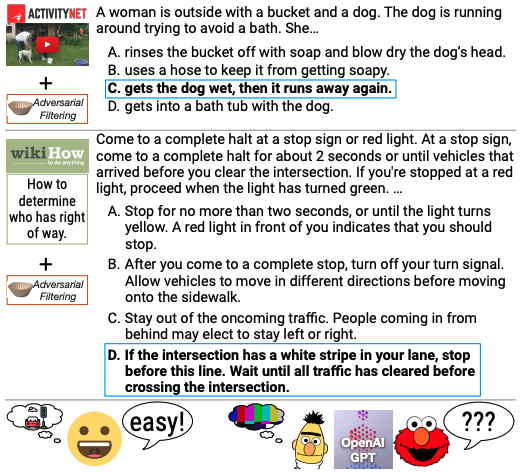
An analysis of HellaSwag, a test designed to evaluate commonsense reasoning in models, found that more than a third of the test questions contained typos and “nonsensical” writing. Elsewhere, MMLU (short for “Massive Multitask Language Understanding”), a benchmark that’s been pointed to by vendors including Google, OpenAI and Anthropic as evidence their models can reason through logic problems, asks questions that can be solved through rote memorization.
Test questions from the HellaSwag benchmark.
“[Benchmarks like MMLU are] more about memorizing and associating two keywords together,” Widder said. “I can find [a relevant] article fairly quickly and answer the question, but that doesn’t mean I understand the causal mechanism, or could use an understanding of this causal mechanism to actually reason through and solve new and complex problems in unforseen contexts. A model can’t either.”
Fixing what’s broken
So benchmarks are broken. But can they be fixed?
Dodge thinks so — with more human involvement.
“The right path forward, here, is a combination of evaluation benchmarks with human evaluation,” she said, “prompting a model with a real user query and then hiring a person to rate how good the response is.”
As for Widder, he’s less optimistic that benchmarks today — even with fixes for the more obvious errors, like typos — can be improved to the point where they’d be informative for the vast majority of generative AI model users. Instead, he thinks that tests of models should focus on the downstream impacts of these models and whether the impacts, good or bad, are perceived as desirable to those impacted.
“I’d ask which specific contextual goals we want AI models to be able to be used for and evaluate whether they’d be — or are — successful in such contexts,” he said. “And hopefully, too, that process involves evaluating whether we should be using AI in such contexts.”
All signs seem to show that we have officially migrated from the era of the internet to that of AI. If the internet defined a new world of transformation in how we were going to consume, sell, entertain, and beyond, AI is now poised to establish yet another great leap in our collective human activity.
Experts say that AI's lightning-fast computations will bring in unparalleled new gains in productivity and innovation for you and me like never seen before.
Also: For the vision impaired, this AI robot aims to replace canes and guide dogs
We will be able to spot cancerous tumors with lightning speed, unravel the genetic code behind diseases, design new drugs, figure out carbon-free sources of energy, eliminate drudgery, and who knows what else.
Except, there are a few not-so-minor catches.
The first is that Moore's Law — postulated by Intel's legendary co-founder Gordon Moore who said that chip density will roughly double every 18 months — is going to hit a wall soon if it hasn't already. (It is increasingly difficult to shrink a chip more than we already have). "In the 15 years from 1986 to 2001, processor performance increased by an average of 52 percent per year, but by 2018, this had slowed to just 3.5 percent yearly — a virtual standstill," says Klaus Æ. Mogensen in Farsight magazine.
The second problem is more dire. Artificial neural networks (ANNs), which process vast numbers of real-world datasets (big data) using silicon computing chips are spectacular guzzlers of power and water.
Training ANNs on current hardware produces colossal amounts of heat which requires equally massive amounts of cooling which is simply not cool in an era of acute climate crisis.
Also: Instant evolution: If AI can design a robot in 26 seconds, what else can it do?
According to recent estimates, in just three years, AI models and their chips will eventually soak up as much electricity as the government of Netherlands.
If this isn't bad enough, a technical challenge looms where network processing speeds will hit a wall because of the physical separation of data from the processors, a problem commonly referred to as known as the "von Neumann bottleneck."
In other words, what AI desperately needs is an epic AI hardware revolution. Fortuitously, a group of scientists have come up with just that.
A no-brainer
It is an ingenious solution that utilizes not fabs or supercomputers but the most powerful organ known to all living species — the human brain.
Fusing the human brain with machines — dubbed bio-computing — may sound outlandish, but it is becoming an increasingly popular antidote to the limitations of existing technology.
Consider the differences between the two: Neural networks ingest millions of watts of energy a day to function. By contrast, the human brain only needs 20 watts.
Energy efficiency is just one facet of the wonders of the human brain. There's another reason why artificial neural networks are designed to ape it.
Also: This AI app will soon screen for type 2 diabetes using just a 6-10 second voice clip
The organ's otherworldly design is unmatchable in its intricate structure that allows it to do things that machines can only dream of (in simulations designed by the brain, of course).
The sheer networking capacity of the human brain is hard to fathom — close to 100 billion neurons (each connected to some 10,000 others) and a quadrillion synapses (where neurons connect), all working non-stop by firing chemical or electricity charges at each other in call and response fashion.
This incredible ratio of computing horsepower to energy use is something that Feng Guo, an associate professor of intelligent systems engineering at the Indiana University Luddy School of Informatics, Computing and Engineering, wants to exploit. (The multitalented Guo has also received $3.8 million in federal grants towards the development of a groundbreaking wearable device to detect and treat an opioid overdose in real time.)
By architecting a hybrid computing system that fuses electronic hardware with human brain "organoids," Dr. Guo and others like him are racing to produce a whole new generation of computers that easily outstrip current machines in processing speed and energy usage.
Also: Don't diss the pigeons: How nature's algorithm rivals AI
This is the promise of the new field of biocomputing, going where no machine has gone before, especially in its ability to fuse with human organs in order to advance fields like medicine.
Dr. Guo and his colleagues decided to grow a variety of brain cell cultures (early-stage and mature neurons and stem cells in addition to others) and mounted them onto a multielectrode array after which they electrically stimulated it.
The brain is unique in that electrical charges allow it to change its neural connections and actually self-learn — something called synaptic plasticity.
This is how humans are capable of using brain training techniques to wean themselves of bad habits, or convert negative thoughts into positive ones, thereby dramatically changing one's mental makeup.
Keen to see what sort of things their primitive organoid could be capable of, Guo and his colleagues tested it by first converting 240 audio clips of eight people pronouncing Japanese vowels into audio signals. They were translated by an AI decoder and then introduced to the organoid to make sense of.
Also: 15 big ideas that will revolutionize industries and economies, led by AI
The results were startling. The organoid successfully decoded the signals into the right category of vowels with a 78% accuracy rate — lower than today's average AI neural network but one that used minuscule amounts of power and scant training.
"Through electrical stimulation training, we were able to distinguish an individual's vowels from a speaker pool," Guo said. "With the training, we triggered unsupervised learning of hybrid computing systems."
This was perhaps the most important discovery of the organoid — a demonstrated capability of self-learning its way toward a higher accuracy rate. It was even able to perform complex, non-linear mathematical equations.
This then could become the lynchpin of future AI processing — the ability of a bio-computer, outfitted with the smartest brains on earth, to process, learn, and remember things all in one space versus the separated processor and memory compartments in today's machines.
In one stroke, the organoid can eliminate heat, end-route Moore's law's limitations, self-learn effortlessly, and bring an end to the memory-processor bifurcation of today's computing.
Gray matter
It's not so black and white, though, say experts in this field. So, before we go off to start harvesting our own brain cells in-house in order to start building next-level machines, it's worth listening to concerns from scientists such as Lena Smirnova, an assistant professor of public health at Johns Hopkins University.
One major issue surrounds neuroethical concerns, considering there are live brain cells at work.
Also: Why US small businesses will lead in AI investments in 2024
Smirnova — along with her colleagues Brian Caffo, and Erik C. Johnson — also says that Guo's Brainoware hasn't yet demonstrated the ability to store information over the long haul and use it to compute things. Doing so, while keeping brain cells healthy, is a major challenge in the field, she says.
In other words, it may be best to hold off on popping the champagne until those concerns are sorted out.
That said, the scientists did hail the experiment as groundbreaking, "likely to generate foundational insights into the mechanisms of learning, neural development and the cognitive implications of neurodegenerative diseases."
AI2 Incubator scores $200M in compute to feed needy AI startups Devin Coldewey @techcrunch / 9 hours
AI2 Incubator, spun out of the Allen Institute for AI in 2022, has secured a windfall $200 million in compute that startups going through its program can take advantage of to accelerate early development.
“Our community of hundreds of AI practitioners are desperate for compute,” said managing director Jacob Colker. “A lot of these startups are hampered in their ability to put points on the scoreboard, show early traction, because they don’t have the resources to train models beyond the generic API options out there.”
Any company in the AI2 Incubator portfolio or program may receive up to $1 million worth of dedicated AI-style compute at data centers owned by a shadowy partner Colker would not name. (But the list of companies with $200 million of capacity to spare is fairly short.)
That partner doesn’t get any special treatment or access to the companies, by the way, except the fundamental one of likely being the first major compute provider a startup uses.
“There’s just a broad amount of goodwill to get these entrepreneurs to revenue faster,” Colker explained.
A million dollars of dedicated compute goes a long way for pre-seed startups, which is where AI2 focuses (we’ve covered WellSaid Labs, Xnor.ai, and others from their program).
Colker suggested it would cover most compute needs even for companies developing new foundation models.
“Different companies have different needs, but this isn’t just cloud credits — we have dedicated machines and custom silicon. This is the single biggest computer allocation available to startups today that we know of.”
The AI2 Incubator has been operating since 2017 but only went independent in 2022, enjoying a friendly relationship but formally distinct existence apart form the Seattle research institute. They’ve helped build more than 30 startups and last year raised a $30 million fund to continue the work.
AI2 Incubator’s new $30M fund triples down on early-stage AI startups
As we approach 2024, no brand or customer remains unaffected by AI. Our interactions in the marketplace have altered as a result. It has changed how we communicate. in particular, branding. The curiosity about artificial intelligence’s seemingly limitless possibilities grows constantly as it gathers more data to sharpen its intelligence.
Top trends in AI marketing strategies
The top trends that are expected to rule in 2024 are listed below:
1. Hyper-Personalization:
Customized encounters provide clients with a sense of exclusivity. AI enables personalized customization. This level of personalization is increased with hyper-personalization. It tries to comprehend consumer thoughts, preferences, and behaviors to boost client happiness and loyalty.
2. Conversational AI:
Chatbots will replace human consumers in 2024 with more intelligent and entertaining dialogues. The bots can handle more complicated interactions and multi-layered queries and improve customer resolutions thanks to Natural Language Processing [NLP] algorithms.
3. Optimizing Voice Search:
Voice search will be the next big thing, especially with the rise in voice-activated gadgets. Speech recognition enabled by AI will advance to support speech searches, providing companies with a new way to engage with their customers through voice-driven search engine optimization.
4. Images and Videos Recognition:
The majority of content on the internet today is visual and video. Marketers can use AI-driven image and video recognition tools to examine visual content for sentiment analysis, brand mentions, and even product placements. Understanding the results of visual marketing initiatives will be made possible with the use of this data.
5. Ethical AI & Privacy:
Data privacy is becoming a major worry as artificial intelligence gathers more data for learning. Data protection, improved cyber security, and ethical AI techniques will all become increasingly crucial. Compliances and transparency will set sincere companies apart from their rivals.
6. More Improvement In Ad Targeting:
Several marketers are using AI to improve ad targeting. Artificial intelligence can help you refine the targeting and wording of your adverts after sorting through large volumes of audience data. This AI marketing trend should continue and pick further steam by 2024.
This could result in more targeted ads and raise the bar for a successful commercial. For marketers, it means focusing more on quality and ensuring that your ads work.
7. Enhanced Marketing Automation With AI:
The newest developments in marketing automation are automated email blasts and social media posts. Be prepared for this technology to continue to improve and evolve. This could make it possible to distribute to smaller segments more realistically, conduct more micro-campaigns, pivot more quickly, and do more.
As more AI-powered marketing automation is employed, audience demands may shift. Consumers can anticipate even more hyper-personalized content, more timely promotions, and greater niche segmentation.
8. Smarter Chatbots:
Chatbots can do far more than just substitute lead capture forms. Thanks to recent developments in artificial intelligence, Chatbots can now respond to increasingly complex consumer inquiries, such as those concerning goods and services. This makes it possible for chatbots to help visitors navigate your website and, eventually, the funnel.
More companies may start using intelligent chatbots that can answer more specific questions. Creating your sophisticated chatbot is a terrific idea if you haven’t already. If you follow this, your chances of remaining competitive and one step ahead of the competition will increase.
9. Increased application of multimodal AI:
Multimodal AI combines numerous inputs, including text and visual, to offer a more complete experience. This contrasts with other systems that use speech, image, or text alone rather than combining the three. Multimodal AI is best exemplified by generative AI, which can produce graphics and content simultaneously on various platforms.
With the increasing capabilities and usage of multimodal AI technology, many businesses can produce more significant amounts of images and copy. Additionally, thanks to this technology, businesses can target ads and keywords even more precisely.
Final Thoughts
Even in 2024, artificial intelligence will continue to revolutionize the marketing sector by offering companies fresh and inventive methods to interact with their target market. Success in this changing environment depends on adopting these AI-driven marketing trends, keeping moral standards high, and making client preferences the top priority in your tactics. As we embrace the future, businesses that make the most of their potential will not only survive but also thrive in the dynamic world of marketing.
FAQS
Q1. How might AI improve targeted marketing campaigns?
With AI, marketers can customize campaigns for optimal impact by understanding individual preferences and analyzing massive data volumes.
Q2. Which ethical issues need to be considered by companies employing for marketing?
Transparency and privacy issues are crucial. Establishing and sustaining consumer trust requires businesses to give ethical practices top priority.
Q3. Can content creation powered by AI equal human creativity?
Although artificial intelligence plays a role in content creation, human creativity, emotion, and nuanced expression are still incomparable.
Q4. How can companies make sure AI is used responsibly in marketing?
Provide explicit instructions for the use of data, give user consent priority, and update AI algorithms often to ensure they adhere to moral principles.
Q5. How does AI factor into the forecasting of market trends?
Artificial Intelligence uses predictive analytics to examine trends and customer behavior, giving companies knowledge about upcoming market trends.
Q6. Does significantly depending on AI in marketing have any potential drawbacks?
An over-reliance on AI could result in a lack of human touch and erode the emotional bond between brands and their customers. Achieving equilibrium is essential.
OpenAI is partnering with Figure, an AI robotics company, to develop humanoid robots. The plan is to use Microsoft Azure for AI infrastructure and OpenAI's investment and guidance to deploy autonomous humanoid robots for commercial soon.
As OpenAI partners with Figure to create a humanoid robot, the AI giant will bring its extensive experience developing AI models and research capabilities to enhance and continually improve these models and hopes to accelerate Figure's commercial timeline.
Also: Does AI give you the creeps? OpenAI has some startling news for you
"We've always planned to come back to robotics and we see a path with Figure to explore what humanoid robots can achieve when powered by highly capable multimodal model," said Peter Welinder, VP of product and partnerships at OpenAI. "We're blown away by Figure's progress to date and we look forward to working together to open up new possibilities for how robots can help in everyday life."
Figure specializes in autonomous humanoid robots and announced a commercial agreement with BMW Manufacturing in January. This agreement will introduce the company's humanoid robots into the automotive manufacturing process, specifically for tasks that may be difficult, unsafe, or monotonous for humans.
"Our vision at Figure is to bring humanoid robots into commercial operations as soon as possible. This investment, combined with our partnership with OpenAI and Microsoft, ensures that we are well-prepared to bring embodied AI into the world to make a transformative impact on humanity," said Brett Adcock, founder and CEO of Figure. "AI and robotics are the future, and I am grateful to have the support of investors and partners who believe in being at the forefront."
Also: For the vision impaired, this AI robot aims to replace canes and guide dogs
Figure has already raised $675 million in Series B funding, which includes investments from OpenAI, Startup Fund, Nvidia, Jeff Bezos, Parkway Venture Capital, Align Ventures, and ARK Invest. The company has hit a $2.6 billion valuation after being founded just two years ago.