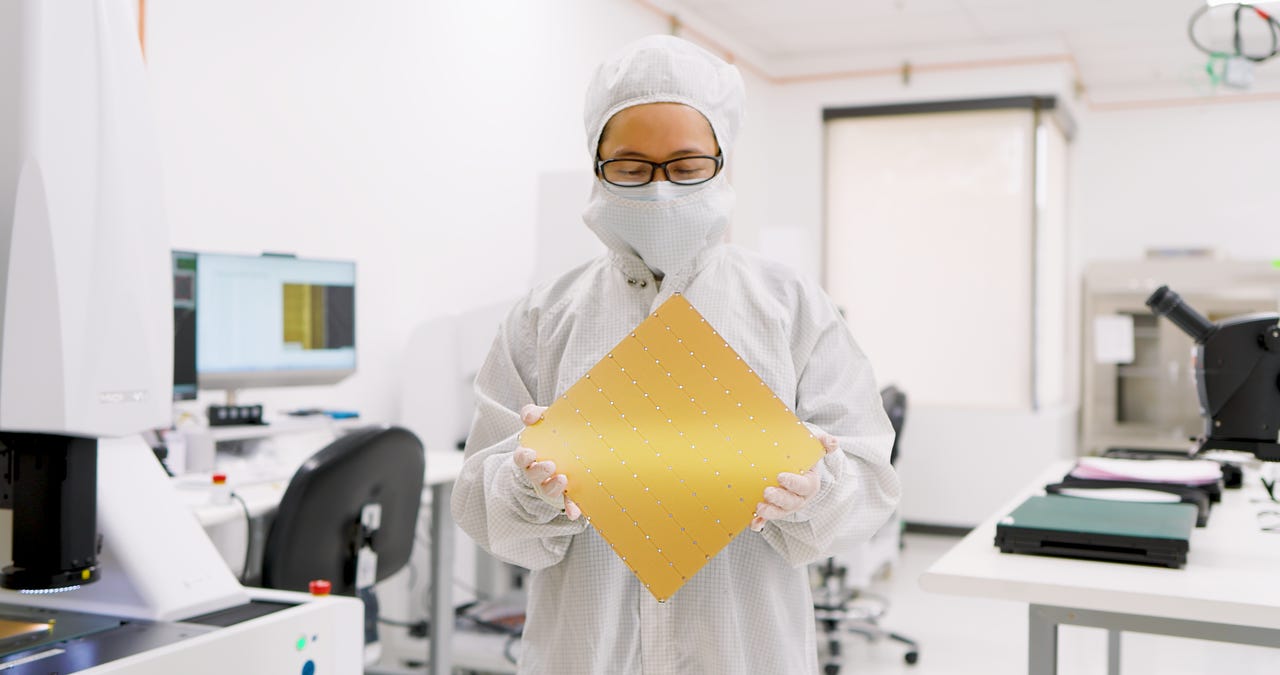
Cerebras Systems known for building massive computer clusters that are used for all kinds of AI and scientific tasks.has yet again shattered records in the AI industry by unveiling its latest technological marvel, the Wafer-Scale Engine 3 (WSE-3), touted as the fastest AI chip the world has seen to date. With an astonishing 4 trillion transistors, this chip is designed to power the next generation of AI supercomputers, offering unprecedented performance levels.
The WSE-3, crafted using a cutting-edge 5nm process, stands as the backbone of the Cerebras CS-3 AI supercomputer. It boasts a groundbreaking 125 petaflops of peak AI performance, enabled by 900,000 AI-optimized compute cores. This development marks a significant leap forward, doubling the performance of its predecessor, the WSE-2, without increasing power consumption or cost.
Cerebras Systems' ambition to revolutionize AI computing is evident in the WSE-3's specifications. The chip features 44GB of on-chip SRAM, and supports external memory configurations ranging from 1.5TB to a colossal 1.2PB. This vast memory capacity enables the training of AI models up to 24 trillion parameters in size, facilitating the development of models ten times larger than those like GPT-4 and Gemini.
One of the most compelling aspects of the CS-3 is its scalability. The system can be clustered up to 2048 CS-3 units, achieving a staggering 256 exaFLOPs of computational power. This scalability is not just about raw power; it simplifies the AI training workflow, enhancing developer productivity by allowing large models to be trained without the need for complex partitioning or refactoring.
Cerebras' commitment to advancing AI technology extends to its software framework, which now supports PyTorch 2.0 and the latest AI models and techniques. This includes native hardware acceleration for dynamic and unstructured sparsity, which can speed up training times by up to eight times.
The journey of Cerebras, as recounted by CEO Andrew Feldman, from the skepticism faced eight years ago to the launch of the WSE-3, embodies the company's pioneering spirit and commitment to pushing the boundaries of AI technology.
“When we started on this journey eight years ago, everyone said wafer-scale processors were a pipe dream. We could not be more proud to be introducing the third-generation of our groundbreaking wafer-scale AI chip,” said Andrew Feldman, CEO and co-founder of Cerebras. “WSE-3 is the fastest AI chip in the world, purpose-built for the latest cutting-edge AI work, from mixture of experts to 24 trillion parameter models. We are thrilled to bring WSE-3 and CS-3 to market to help solve today’s biggest AI challenges.”
This innovation has not gone unnoticed, with a significant backlog of orders for the CS-3 from enterprises, government entities, and international clouds. The impact of Cerebras' technology is further highlighted through strategic partnerships, such as with G42, which has led to the creation of some of the world's largest AI supercomputers.
As Cerebras Systems continues to pave the way for future AI advancements, the launch of the WSE-3 serves as a testament to the incredible potential of wafer-scale engineering. This chip is not just a piece of technology; it's a gateway to a future where the limits of AI are continually expanded, promising new possibilities for research, enterprise applications, and beyond.
In India, efforts to develop foundational models that take instructions in Indian languages are on in full swing with Tech Mahindra’s Project Indus and Ola’s Krutrim leading the charge. While these initiatives are not open source, Sarvam AI, the Khosla Ventures-backed startup, has released an open-source Hindi LLM, an extension of Llama2-7B.
Besides, we have already had open-source models such as Tamil, Kannada and Marathi Llamas emerge from the Indian AI ecosystem. Though meaningful success with these models remains to be seen, whether in business applications or societal problem-solving, one unequivocal truth persists—the future is undoubtedly open source.
This is because developing a model like GPT-4, the most-advanced LLM till date, is an expensive endeavour requiring significant investments and computational power. OpenAI reportedly spends nearly USD 7,00,000 per day just to keep ChatGPT running.
For Indian businesses, undertaking such a task would not be a logical step. Hence, what India needs is a collaboration among industry leaders, research institutions, and the government to pool resources and expertise.
A collaborative approach based on open-source principles can leverage existing capabilities, share costs, and accelerate the development of foundational models tailored to India’s needs. This cooperative effort ensures efficient utilisation of resources and promotes sustainable innovation within the Indian AI landscape.
Why open source makes sense for India
Sanjeev Azad, head of technology, GlobalLogic APAC, is of the opinion that since India enjoys a unique position when it comes to diversity in language, culture, and people, having something proprietary with a narrowed vision would not work here. “Open source gives the flexibility to create many bespoke versions depending on the target users, locations, region, religion, etc, without reinventing the wheel for every individual use case,” he said.
“Additionally, open-source projects are transparent, allowing anyone to inspect the code, data, and models. This transparency can help build trust in the models’ accuracy and fairness, especially important for such culturally and linguistically sensitive applications,” he told AIM.
Most of India’s efforts to build Indic LLM have been open source apart from a handful of enterprise-driven initiatives such as Tech Mahindra’s and Bhavish Aggarwal-led Krutrim. Azad believes the ideal approach for businesses involves fine-tuning a foundational model like Mistral or Llama with datasets specific to the Indic languages.
“In my opinion, adopting an open-source approach will enable a demarcation of innovation where passionate people can come together and build something good for society,” he added.
Chaitanya Chokkareddy, chief technology officer, Ozonetel, also believes open source is the only approach for building IndicLLMs.
“We have to understand that the architecture, training code, etc. for such models are already open source for models like Llama. What we are talking about here is mainly open sourcing the datasets. When dealing with black box LLMs where explainability is key, open source is the only way to go,” he told AIM.
Moreover, efforts are also underway to develop IndicLLMs from scratch. Vishnu Vardhan, founder of SML, who is spearheading the BharatGPT initiative, told AIM that building Indic LLMs with a million tokens on top of English foundational models, which have trillions of tokens, won’t be enough to make them on par with GPT-4 for other languages such as Kannada or Tamil or Hindi.
India already has open-source ecosystem
India has demonstrated its prowess in constructing open-source networks and architectures through its Digital Public Goods (DPG) like Unified Payment Interface (UPI), DigiLocker and Aadhaar. The country also has a growing ecosystem of developers advocating for open source software and AI.
According to a GitHub report, India’s developer community has experienced continuous expansion, registering a notable 36% increase in 2023.
The report highlights the pivotal role played by the UN-backed Digital Public Goods Alliance and India’s efforts in establishing a digital public infrastructure. This includes utilising open-source materials ranging from software to AI models, contributing significantly to the observed growth in India’s developer ecosystem.
“People from India are also actively contributing to open-source projects globally. This collaboration can accelerate the development and adoption of open-source AI technologies,” Azad said.
Interestingly, Vivek Raghavan, co-founder at Sarvam AI, has previously served as a technology advisor at Unique Identification Authority of India (UIDAI), which issues Aadhaar in India. He previously told AIM that their goal is to use their open source models to enhance existing DPI or applications and serve as a foundation for developing newer applications.
Moreover, in recent years, we have also witnessed an open source AI ecosystem emerging out of India comprising developers, educational institutions, private enterprises, nonprofits as well as public sector institutions. Efforts are underway to develop not just models, but also tools, open-source datasets and other resources to help build IndicLLMs.
For example, the AI4Bharat initiative, led by IIT Madras and established with the support of Nandan Nilekani-backed nonprofit EkStep Foundation, is actively constructing datasets for Indian languages. Additionally, the initiative is developing various tools and resources intended for the creation of Indic language models (IndicLLMs).
Power of open-source AI
Most of the developments in the West are enterprise-driven and focussed on solving business problems. However, most of India’s efforts with AI, on the other hand, have been focussed on the upliftment of underserved communities and breaking the existing language barrier in the country.
India aims to harness AI to enhance information dissemination for illiterate farmers, support rural children in their education, and address various socio-economic challenges and most of these will be driven by open-source AI. Going forward, India is poised to present a compelling narrative to the world, illustrating the transformative impact of AI for the betterment of human society.
“Most of the unusual innovations are done through India and the way we innovate is completely unique in the world. People in India know how to get complex things done in as simple a way as possible,” Azad continued, “There are several pieces of evidence to justify this — UPI is a great example.”
With a focus on social betterment, India will showcase to the world innovative applications that address pressing challenges and these efforts will be driven by open-source AI. Moreover, India also presents a unique opportunity for entrepreneurs to innovate and leverage AI to solve societal problems.
The post India will be an Open-Source AI Champion. Here’s Why appeared first on Analytics India Magazine.
It's not every day that you're lying on a massage table while two robot arms knead the stress out of your body. But there I was, dressed in form-fitting slate gray exercise wear, face sunk into the donut-shaped headrest as an AI robot gave me a 30-minute massage. It left me feeling a little funny, but also, curiously, relaxed.
That relaxation came from Aescape's AI robot at its New York office. Aescape is betting big on its AI massage robots and is launching ten robot massage tables, like the one I had a 30-minute session with, at Equinox fitness center locations around New York City starting this spring.
Also: For the vision impaired, this AI robot aims to replace canes and guide dogs
Eric Litman, Aescape's founder and CEO, spent years fighting chronic pain, seeking out massage therapists to address a relentless bulging disc that made it impossible to turn his head. Dissatisfied with the service of massage therapists, what he really wanted out of a massage was for somebody to do just what he asked. So he spent seven years building a robot massage therapist.
The massage table uses AI to scan the customer's body on the table to generate data and conduct a massage. It logs over 1 million 3D data points to map the body's position on the table and target key anatomical points and remembers that data for returning users to customize their massage and meet each client's needs. Through the machine learning of the massage table, the AI gets smarter, aggregating the data of all the bodies it has performed massages on for a better and more intelligent session.
Throughout the table's development, Aescape has worked with and consulted massage therapists to simulate a massage therapist's practice. And if you're scared, like I was, that the robot arms will accidentally break your bones while performing a massage, fear not: "The arms themselves are only strong enough to give a good massage, and they're not any stronger than that… And with that model of your body, we're significantly more precise than a therapist," Litman told me.
Also: I've tested dozens of robot vacuums. These are the best you can buy
"You'll be able to specify not only predefined treatment protocols but a plan that aligns with how you feel about your body," Molly O'Connor, Aescape's spokesperson, explained. There will also be opportunities for activity-specific massage sessions programmed into the table. O'Connor provided the example of a session dedicated to runners who want to loosen their IT bands, or digital workers seeking to relieve tension in their back and shoulders they get from working a desk job.
Aescape's rollout of its semi-autonomous (semi-autonomous because it relies on user's input and adjustments) massage tables comes at a pivotal time in the massage therapy industry. The employment of massage therapists is expected to grow by 18% from 2022 to 2032, making way for more jobs and opportunities for people (or AI robots) in the space, according to the U.S. Bureau of Labor Statistics.
Each user puts on Aescape's Aerwear, a slate gray top and bottom that helps the massage arms perform a smooth, frictionless massage without the help of oil and without the user taking their clothes off. The Aerwear also works with the perception sensors as your body gets scanned. On the table, users customize the leg and headrests, the pressure levels of the massage arms, the music, and the screensaver that plays as the massage takes place. Then the two mechanical spaghetti massage arms come to life and start kneading, lengthening, and moving.
The robot massaged my upper back, shoulders, spine, lower back, and glutes. I enjoyed the pressure level customization and felt like I was in control of the massage, something that's not always the case when you're seeing a human massage therapist. There was one moment when the pressure the arm was putting on me was too intense, but I suddenly remembered that I could cool it down and receive a massage on my own terms and preferences.
"There's been a lot of thought and effort into how we operate [the robot] safely, making sure the arms are designed exactly the right way and making sure the vision system doesn't fail, and knowing what people love and really delights people," Litman said.
I wouldn't say the robot does a stellar job at targeting knots. The heated air points, the "hands" on the machine, have seven different surfaces that can simulate the blade of the palm, the forearm, or an elbow. But they're too large to feel like fingers, and the smaller tension in my body went unaddressed as a result. The air points felt like two warm fists, rather than fingers, were digging into my body. What the robot lacks in smaller details it makes up for in a broader relaxing experience.
As I received this robot massage, I thought about all the friends and people I know who wouldn't be comfortable taking their clothes off for a massage or having their bodies touched by a stranger. This feels like a valid alternative for those people. Aescape's research backs this up: The company found a pool of 10 million Americans who have never had a massage because they didn't want to be touched by a stranger.
While the massage tables will launch at Equinox fitness clubs across New York City, they aren't limited to Equinox members. Interested non-members will receive a free day pass when they reserve an Aescape massage table at the fitness center. A 30-minute massage will start at $60 and fluctuate based on the location and additional amenities provided.
Also: The best smartwatches: Expert tested and reviewed
"[Aescape] is a natural fit for Equinox members who embrace the latest technology to achieve their fitness and wellness goals," O'Connor said of the partnership with Equinox. Plus, rolling out these massage tables in a gym setting, O'Connor explained, sets Aescape apart and allows them to "jointly innovate" with the luxury fitness center brand. "There's a whole lot of people in this country who are really into technology and wellness, the intersection of those two. Those are the people who start to build that social proof and the credibility," Litman said.
It might seem strange right now, but maybe in a few years, you'll be wrapping up a workout and diving into a massage session with a robot.
Leading media and entertainment company Deluxe has teamed up with AppTek, a company specialising in AI and ML solutions, to revamp content localisation and workflow efficiency.
Through this partnership, Deluxe has acquired a non-controlling interest in AppTek and secured exclusive rights to resell AppTek’s suite of products and services to the global media and entertainment sector.
The collaboration enables Deluxe to offer studios and content distributors a diverse range of integrated AI solutions tailored to their specific needs. “We’ve been working closely with AppTek for several years and have been impressed by their technology and breadth of experience,” said Chris Reynolds, Deluxe’s executive vice president and general manager of localisation and fulfilment.
“AppTek has long believed in pushing the boundaries of artificial intelligence and its real-world applications. Deluxe brings the same passion in content transformation and accessibility,” said AppTek CEO Mudar Yaghi.
Over the last year, we have seen media houses slowly entering the AI space. This became more relevant when Universal Music Group partnered with Google’s YouTube to create “Music AI Incubator.”
Additionally, during the writer’s strike, Netflix hired AI product managers with lucrative salary packages of $900,000. Recently, OpenAI introduced the video generation model Sora, capable of creating highly realistic videos based on prompts, a development many believe could benefit filmmaking.
The post Deluxe Media Teams Up with AppTek to Bring AI, ML-Based Solutions for Clients appeared first on Analytics India Magazine.
LTIMindtree recently announced a strategic collaboration with IBM to advance the quantum innovation ecosystem. This move will enhance the company’s capabilities in tackling complex problems across various industries using quantum computing.
In 2023, the government announced an allocation of Rs 6,000 crore for the National Quantum Mission. LTIMindtree’s move to become the first Indian Global System Integrator to join the IBM Quantum Network could accelerate innovation in this space.
In an interaction with AIM, Aan Chauhan, chief technology officer at LTIMindtree, shared insights into the partnership’s potential. He also discussed the company’s vision for quantum computing’s role in addressing industry-specific challenges.
Chauhan explained that quantum computing’s strength lies in solving specific classes of problems, where classical computing approaches are insufficient. This includes optimisation, machine learning, simulation, and cybersecurity.
The CTO detailed the specific problems LTIMindtree aims to address using quantum computing across various industries.
In the BFSI sector, the company is exploring “fraud detection, anomaly detection, risk assessment, and portfolio optimisation”. For the energy sector, LTIMindtree is looking into “smart grid applications, such as unit commitment, demand forecasting, and value chain optimisation across energy production and distribution”.
The company also assesses use cases in manufacturing, travel, and high-tech industries.
LTIMindtree’s recent collaboration with IBM provides access to advanced quantum systems, including the ‘Heron’ processor and the latest tools from IBM’s development roadmap. Chauhan noted, “Access to these systems and resources empowers us to rapidly experiment with the most complex challenges using the most sophisticated quantum systems.”
This partnership positions LTIMindtree as a quantum-ready partner, prepared to help clients fast-track the application of quantum technology to their business problems.
This access, combined with the opportunity to collaborate with IBM Research members, accelerates applied research and enables LTIMindtree to help clients fast-track the application of quantum technology to their business problems.
The collaboration also extends to joint quantum research projects with IIT Madras, supporting India’s National Quantum Mission and aims to create a strong industry-academia ecosystem.
“Substantial research is being conducted at IIT Madras in areas such as quantum computing, quantum information theory, secure quantum communications, quantum sensing, and metrology,” Chauhan noted.
The partnership aims to “leverage these research efforts to design, develop, and test working prototypes for specific use cases”.
This three-way collaboration between these premium institutions could also be a move to address the need for substantial computational resources used to train and run generative AI models, as Chauhan had told AIM earlier.
“The increased processing power of quantum computers can enable computations faster than the classical computer by harnessing the principles of quantum mechanics. This may allow for faster processing of large-scale generative models, enabling more complex and realistic outputs within shorter timeframes,” he said.
Upskilling a Quantum Workforce
To develop a skilled workforce in quantum computing, LTIMindtree is building teams and has established a comprehensive framework for workforce development in collaboration with IIT Madras and IBM. This framework includes specialised training modules, hands-on workshops, and real-world projects.
“We have focused on building multidisciplinary teams to unlock quantum computing’s potential for industries,” Chauhan explained, highlighting the inclusion of experts across quantum physics, mathematics, quantum algorithms, computer science, machine learning, and industry-specific domains.
Recognising the need for specialised expertise, LTIMindtree is also committed to upskilling professionals in adjacent skills to create a well-rounded and effective team.
Chauhan also explained the structure and objectives of the planned quantum computing workshops, emphasising the value of bringing together diverse stakeholders.
“Last year, we organised industry-focused workshops involving our researchers, clients, and partners,” he said, noting the sessions’ benefits in providing insights into quantum possibilities and guiding research efforts. LTIMindtree plans to host more targeted workshops to foster valuable insights and solutions.
Regarding research grants, Chauhan said, “With the capabilities and collaborative ecosystem that we have developed, we look forward to contributing meaningfully to such calls and consortiums as an industry partner with quantum expertise.”
This multifaceted approach to workforce development and research collaboration underscores LTIMindtree’s commitment to advancing quantum computing capabilities and contributing to the Indian and global quantum innovation ecosystem.
What’s Next?
Joining the IBM Quantum Network aligns with LTIMindtree’s long-term business and technology strategy, enhancing the company’s ability to apply advanced emerging technologies to solve complex business problems.
Chauhan believes this collaboration will provide clients with an early-mover advantage, enriching the ecosystem with advanced accelerators, solutions, and practical research projects.As thefirst Indian company to join the IBM Quantum Network, LTIMindtree plans to leverage this position to differentiate itself in the competitive landscape.
He outlined the journey starting with “quantum awareness”, a foundational understanding of what quantum computing can achieve and its potential impact on businesses. This is followed by “quantum preparedness”, which involves assembling specialised teams, evaluating multiple platforms, and developing use cases.
Chauhan emphasised, “As a trusted partner deeply familiar with our client’s challenges and possessing expertise in quantum technology, we are taking charge of the essential elements of this journey, ensuring our clients can navigate this space and deal with its complexities.”
He further highlighted the creation of an ecosystem and capabilities specifically designed to give clients a jumpstart on their quantum journey.
By leveraging collective resources, expertise, base model use cases, accelerators, and quantum integration frameworks, Chauhan believes, “We can expedite every stage of this process, from increasing awareness to eventually harnessing the tangible benefits of quantum computing.”
The post LTIMindtree Fast-Tracks India’s Quantum Mission with IBM and IIT Madras appeared first on Analytics India Magazine.
With the advancement of data technology in recent years, we have seen a surge in businesses implementing data science. Many companies now try to recruit the best talents for their data project to gain a competitive advantage. One such talent is the data scientist.
Data scientists have proven themselves able to provide massive value to companies. However, what makes data scientist skills different from the others? It’s not an easy question to answer as data scientists are a big umbrella, and the job responsibilities and the skills required differ for each company. Nevertheless, there are skills that data scientists will need if they want to stand out from the others.
This article will discuss five essential skills for data scientists in 2024. I would not discuss Programming Language or Machine Learning as they are always necessary skills. I also don’t talk about Generative AI skills as those are trending skills, but data science is bigger than that. I would only discuss further emerging skills essential for the 2024 landscape.
What are these skills? Let’s get into it.
1. Cloud Computing
Cloud computing is a service over the internet (“Cloud”) that could include servers, analytical software, networking, security, and many more. It’s designed to scale to the user's preferences and deliver resources as required.
In the current data science trend, many companies have started implementing cloud computing to scale their business or to minimize infrastructure costs. From small startups to big companies, the usage of cloud computing has become apparent. That’s why you can start to see that the current data science job posting would require you to have cloud computing experience.
There are many cloud computing services, but you don’t need to learn everything, as mastering one means navigating to the other platforms more easily. If you have difficulty deciding which to learn initially, you could start with a bigger one, such as AWS, GCP, or Azure platform.
You can learn more about Cloud Computing with this Beginner’s Guide to Cloud Computing article by Aryan Garg.
2. MLOps
Machine Learning Operations, or MLOps, is a collection of techniques and tools for deploying ML models in production. MLOps aims to avoid the technical debt from our Machine Learning application by streamlining the deployment of ML models in production, improving model quality and performance while implementing best practices in CI/CD, with continuous monitoring of machine learning models.
MLOps has become one of the most sought-after skills for data scientists, and you can see the surge of MLOps requirements in job postings. Previously, the MLOps works could be delegated to a Machine Learning Engineer. However, the requirements for Data Scientists to understand MLOps have become bigger than ever. This is because Data Scientists must ensure that their machine learning model is ready to be integrated with the production environment, which only the model creator knows the best.
That’s why learning about MLOps in 2024 is beneficial if you want to advance your data science career. To learn more about the MLOps topic, refer to KDnuggets' first Tech Brief, which discusses everything about MLOps.
3. Big Data Technologies
Big Data can be described as the Three V’s, which comprise Volume, which refers to the massive quantities of the generated data; Velocity, which explains how fast the data is produced and processed; and Variety, which refers to various data types (structured to unstructured).
Big Data technologies have become important in many companies, as many of the insights and products rely on how they can do something with the Big Data they have. It’s one thing to have big data, but only by processing it can companies get value from it. This is why many companies are now trying to recruit data scientists who possess big data technology skills.
Many technologies are included in these terms when we talk about Big Data Technologies. However, it could be categorized into four types: data storage, data mining, data analytics, and data visualization.
Here are some popular tools that job postings often listed them as necessary:
-Apache Hadoop
-Apache Spark
-MongoDB
-Tableau
-Rapidminer
You don’t need to master every tool available, but understanding a few of them would certainly launch your career for the better. To learn more about Big Data Technologies, here is an introductory article called Working with Big Data: Tools and Techniques by Nate Rosidi that could kickstart your Big Data journey.
4. Domain Expertise
Data scientists need technical skills and strong domain expertise to advance their careers. A junior data scientist might want to model machine learning to achieve the highest technical metrics, but the senior one understands that our model should bring business values above everything else.
Domain expertise means we understand the industry's business we are working on. By understanding the business, we could better align with the business user, select better metrics for the model, and frame the projects in a way that impacts the business. In 2024, it’s especially become more important as businesses start to understand how data science could bring significant value.
The problem with acquiring domain expertise knowledge is that it can only be effectively learned if we are already working as data scientists in that industry. So, how could one acquire this skill if we are not working in the industry we want? There are a few ways, including:
— Taking online courses and certification in related industries
— Active networking in social media
— Contributing to the open-source project
— Having a side project related to the industry
— Finding a mentor
— Take an internship
These are suggested ways to acquire domain expertise, but you can be more creative to find the experience. The article “Is Domain Knowledge a Hurdle to Start a Career in Data?” by Vaishali Lambe can also help you get domain expertise.
5. Ethics and Data Privacy
Some might see data as numbers or words in the database without concern for the individual that these data describe. However, much of this data was private information that could harm the users and the business if we mishandled it. The topic is becoming even more important in this modern era as data collection and processing become easier.
Ethics in data science is concerned with the moral principles that guide how data scientists should work. The field covers the potential impact of our data science project on individuals and society, which should follow the best moral decision we could take. The topic usually concerns bias, fairness, explainability, and consent.
On the other hand, Data Privacy is a field concerned with the legality of how we collect, process, manage, and share data. It aims to protect the personal information coming from the individual and avoid misuse. Each area might have a different data privacy framework; for example, the General Data Protection Regulation (GDPR) in Europe usually applies only to personal data in Europe.
Ethics and Data Privacy knowledge have become essential skills for data scientists, as the consequences of breaking them are severe. The article from Nisha Arya on Ethics and Data Privacy could become your starting point for understanding these topics further.
Conclusion
This article discusses five essential skills that every data scientist needs in 2024. The skills include:
Cloud Computing
MLOps
Big Data Technology
Domain Expertise
Ethics and Data Privacy
I hope it helps! Share your thoughts on the skills listed here, and add your comment below.
Cornellius Yudha Wijaya is a data science assistant manager and data writer. While working full-time at Allianz Indonesia, he loves to share Python and Data tips via social media and writing media.
More On This Topic
Future-Proof Your Data Game: Top Skills Every Data Scientist Needs in 2023
Soft Skills Every Data Scientist Needs
Python f-Strings Magic: 5 Game-Changing Tricks Every Coder Needs to Know
10 Essential Pandas Functions Every Data Scientist Should Know
2024 Reading List: 5 Essential Reads on Artificial Intelligence
Top 13 Skills That Every Data Scientist Should Have
AMD CEO Lisa Su was optimistic about the future of AI on PCs during her keynote at SXSW on March 11, held and livestreamed in Austin, Texas (Figure A). Su’s comments echo Jason Banta, vice president of product management at AMD, who spoke to TechRepublic in a call on March 8 about how professionals might use AI features on PCs going forward. AMD competes primarily with NVIDIA and Intel to capture the lucrative AI hardware market, and Su addressed the competition with pack leader NVIDIA in particular in her keynote.
Figure A: AMD CEO Lisa Su holds up a MI300 AI accelerator chip at SXSW in Austin, Texas on March 11. Image: TechRepublic
The goal of AI PCs, according to AMD
“The goal of AI PCs is to make sure that every one of us has our own AI capability,” said Su. “You don’t have to go out into the cloud. You can actually operate on your own data. You can actually ask it questions. It’ll answer for you. It’ll answer for you faster. It’ll answer for you in a private manner, because maybe you don’t want your data going everywhere. And it’s just the beginning of what I think is the ability to make all of us much, much more productive.”
In service of that goal, in December 2023, AMD debuted the Ryzen 8040 Series processors, which can run large AI models on laptops from Acer, Asus, Dell, HP, Lenovo and Razer with Windows 11. In January 2024, AMD announced a dedicated AI neural processing unit for desktop PCs.
SEE: AMD, Intel and NVIDIA are part of a federal program meant to provide AI research resources. (TechRepublic)
How AMD benefited from purchasing Xilinx
Banta said one reason AMD has been able to come out with its own NPU so quickly is because of AMD’s 2022 purchase of semiconductor company Xilinx.
“There’s a great heritage (within Xilinx) of using AI for many of the embedded applications where Xilinx was already very competitive. We took that AI capability and that technology, and it (AI) was one of the first technology partnerships we saw once Xilinx and AMD merged. We used that technology and brought that into our Ryzen AI product line.
“And so by leveraging all that great experience of AI neural processing and technology, by bringing that into the Ryzen family, we were able to bring additional experiences and quality to our CPU customers.”
AI PC use cases for enterprise
For professionals, Banta said, the AI PC could take some of the drudgery out of workflows, freeing up employees to be more creative. The AI PC could reduce the cost of AI by removing the capital investment required to deploy AI solutions on the cloud, he said.
“There’s cost advantages of running those models locally on the PC as opposed to running them in the cloud or running them on an on-premise server,” he said. “So there’s a natural affinity for bringing AI on-device for the commercial market.”
With generative AI for enterprise still being relatively new, Banta said customers are still experimenting with how to use it.
“Microsoft has their Copilot solution. We see people, they’re not fully dependent on it yet, but they’re using it, they’re trying it out and they’re finding things that do enhance their workflows,” Banta said. “But it requires some of that experimentation. Within AMD, we’re using Copilot, and it’s something that as people experiment with it and try it out, they say, ‘Hey, I found this thing that enhances my workflow or speeds things up.'”
Competition in the AI PC market
AMD, NVIDIA and Intel are competing on working on bringing generative AI client-side and on cutting down the time it takes for generative AI interference to run by moving some of that work to chips built into PCs. The idea is that AI processes will be more power efficient on a PC, too.
Speaking at SXSW, Su responded to an audience member’s question about whether AMD can “catch up” with NVIDIA, saying, “We have a lot of respect for NVIDIA, a lot of respect. They’ve done tremendously from a roadmap standpoint, but we also have a lot of confidence in where we’re going.”
AMD’s plan to move forward with responsible AI
During Su’s SXSW presentation, audience members brought up some of the concerns around AI: energy use in data centers and responsible AI output in particular.
When asked about handling the proliferation of AI responsibly, Su pointed to AMD’s Responsible AI Council and said moving ahead with a sense of responsibility should not mean moving ahead slowly.
“We must go faster, we must experiment, and just do it with a watchful eye,” she said.
Cerebras' WSE-3 chip, the size of almost an entire 12-inch semiconductor wafer, is the world's largest chip, dwarfing Nvidia's H100 GPU. The AI startup notes that a single one of its CS-3 computers running the chip can crunch a neural network like GPT-4 with a hypothetical parameter count of 24 trillion.
The race for ever-larger generative artificial intelligence models continues to fuel the chip industry. On Wednesday, Cerebras Systems, one of Nvidia's most prominent competitors, unveiled the "Wafer Scale Engine 3," the third generation of its AI chip and the world's largest semiconductor.
Cerebras released the WSE-2 in April 2021. Its successor, the WSE-3, is designed for training AI models, meaning refining their neural weights, or parameters, to optimize their functionality before they are put into production.
"It's twice the performance, same power draw, same price, so this would be a true Moore's Law step, and we haven't seen that in a long time in our industry," Cerebras co-founder and CEO Andrew Feldman said in a press briefing for the chip, referring to the decades-old rule that chip circuitry doubles roughly every 18 months.
The WSE-3 doubles the rate of instructions carried out, from 62.5 petaFLOPs to 125 petaFLOPS. One petaFLOP refers to 1,000,000,000,000,000 (1 quadrillion) floating-point operations per second.
The size of almost an entire 12-inch wafer, like its predecessor, the WSE-3 has shrunk its transistors from 7 nanometers — seven billionths of a meter — to 5 nanometers, boosting the transistor count from 2.6 trillion transistors in WSE-2 to 4 trillion. TSMC, the world's largest contract chipmaker, is manufacturing the WSE-3.
Also: How AI firewalls will secure your new business applications
Cerebras has kept the same ratio of logic transistors to memory circuits by only slightly increasing the memory content of the on-chip SRAM, from 40GB to 44GB, and slightly increasing the number of compute cores from 850,000 to 900,000.
"We think we've got the right balance now between compute and memory," Feldman said in the briefing, which took place at the headquarters of Colovore, the startup's cloud hosting partner, in Santa Clara, California.
As with the prior two chip generations, Feldman compared the WSE-3's enormous size to the current standard from Nvidia, in this case, the H100 GPU, which he called "this poor, sad part here" in a slide deck image.
"It's 57 times larger," Feldman said, comparing the WSE-3 against Nvidia's H100. "It's got 52 times more cores. It's got 800 times more memory on chip. It's got 7,000 times more memory bandwidth and more than 3,700 times more fabric bandwidth. These are the underpinnings of performance."
"This would be a true Moore's Law step," said Feldman of the doubling of operations per second of the new chip, "and we haven't seen that in a long time in our industry."
Cerebras used the extra transistors to make each compute core larger, enhancing certain features, such as doubling the "SIMD" capability, the multiprocessing feature that affects how many data points can be processed in parallel for each clock cycle.
The chip comes packaged in a new version of the chassis and power supply, the CS-3, which can now cluster to 2,048 machines, 10 times as many as before. Those combined machines can carry out 256 exaFLOPS, a thousand petaFLOPS, or a quarter of a zetaFLOP.
Feldman said its CS-3 computer with WSE-3 can handle a theoretical large language model of 24 trillion parameters, which would be an order of magnitude more than top-of-the-line generative AI tools such as OpenAI's GPT-4, which is rumored to have 1 trillion parameters. "The entire 24 trillion parameters can be run on a single machine," Feldman said.
To be clear, Cerebras is making this comparison using a synthetic large language model that is not actually trained. It's merely a demonstration of WSE-3's compute capability.
The Cerebras machine is easier to program than a GPU, Feldman argued. In order to train the 175-billion parameter GPT-3, a GPU would require 20,507 lines of combined Python, C/C++, CUDA, and other code, versus just 565 lines of code for the WSE-3.
For raw performance, Feldman compared training times by cluster size. Feldman said a cluster of 2,048 CS-3s could train Meta's 70-billion-parameter Llama 2 large language model 30 times faster than Meta's AI training cluster: one day versus 30 days.
"When you work with clusters this big, you can bring to every enterprise the same compute that the hyperscalers use for themselves," Feldman said, "and not only can you bring what they do, but you can bring it radically faster."
Feldman highlighted customers for the machines, including G42, a five-year-old investment firm based in Abu Dhabi, the United Arab Emirates.
Cerebras is working on a cluster of 64 CS-3 machines for G42 at a facility in Dallas, Texas, called "Condor Galaxy 3," the next part of a nine-part project that is expected to reach tens of exaFLOPS by the end of 2024.
Like Nvidia, Cerebras has more demand than it can fill at the moment, Feldman said. The startup has a "sizeable backlog of orders for CS-3 across enterprise, government, and international clouds."
Feldman also unveiled a partnership with chip giant Qualcomm to use the latter's AI 100 processor for the second part of generative AI, the inference process that consists of making predictions on live traffic. Noting that the cost to run generative AI models in production scales with the parameter count, Feldman pointed out that running ChatGPT could cost $1 trillion annually if every person on the planet submitted requests to it.
The partnership applies four techniques to reduce the cost of inference. Using what's called sparsity, which ignores zero-valued input, Cerebras' software eliminates as much as 80% of unnecessary computations, Feldman said. A second technique, speculative decoding, makes the predictions using a smaller version of a large language model, and then has a bigger version check the answers. Feldman explained that's because it costs less energy to check the output of a model than to produce the output in the first place.
A third technique converts the output of the model into MX6, a compiled version that needs only half the memory it normally would on the Qualcomm AI 100 accelerator. Lastly, the WSE-3's software uses network architecture search to select a subset of parameters to be compiled and run on the AI 100, which, again, can reduce compute and memory usage.
The four approaches increase the number of "tokens" processed on the Qualcomm chip per dollar spent by an order of magnitude, Feldman said, where a token can be a part of a word in a phrase or a piece of computer code for a developer's "co-pilot." In inference, "performance equals cost," Feldman noted.
"We radically reduce how much time you have to spend in thinking about how you go from your training parameters to your production inference by collaborating with Qualcomm and ensuring a seamless workflow," Feldman said.
The inference market is widely expected to become a greater focus of the arms race in AI as inference moves from data centers out to more "edge" devices, including enterprise servers and even energy-constrained devices such as mobile devices.
"I believe that more and more, the easy inference will go to the edge and Qualcomm has real advantage there," Feldman said.
Devin, the world’s first AI software engineer, built by Cognition Labs, has taken the internet by storm. Backed by $21 million in funding from investors, including Peter Thiel’s Founders Fund, the company is already grabbing attention for its AI assistant, Devin – godlike in English – who can handle entire software projects end-to-end.
While AI-assisted coding tools like GitHub Copilot have gained popularity, Devin stands out with its promise of completing full development projects independently. If successful, this could significantly impact the software development industry, potentially reducing the need for human developers on certain projects.
The new AI model significantly outperformed previous models with a 13.86% accuracy rate on the SWE-Bench. This advancement marks notable progress in AI’s capability to autonomously understand and address software development issues, enhancing its potential to support developers.
It also achieved 13.86% accuracy on the SWE-Bench benchmark that evaluates AI models on software engineering tasks. Resolving nearly 14 out of every 100 issues independently it far exceeds previous best model Claude 2’s 1.96% unassisted and 4.80% assisted accuracy.
“Devin feels UI/UX first, not GenAI first,” said Andrew Kean Gao, an avid developer who got early access to play around with the world’s first AI software engineer. He said that AI is a core component, but it’s the surrounding infra they built that is the star of the show.
He said that the product feels quite finished, and this is not a demo. “They have things built out such as auto deploy to netlify, api key protection, intelligent way to interrupt without interrupting, a good UI that is *tailored to humans* and bridges LLM and human dev, the slider to move backwards in time,” he added, saying that it was fun to watch things unfold.
“The Biggest negative is the slowness,” said Gao, describing the site as feeling a bit slow. However, he said that might also be because of the 1 MBPS Starlink connection. So that part is probably me.”
He also said that you can not edit the code. “Not collaborative yet.”
Ryan Carniato, the author of the SolidJS UI library and MarkoJS Core Team Member, said that so far, Devin struggles to choose the right libraries for simple tasks like building a to-do list app. He questioned this choice of complex libraries instead of alternatives like Lit, a modern, lightweight library for building web components.
“90% of my job is not to write code (as a senior software engineer), is to: deobfuscate complex requirements into well-divided chunks, find gaps or holes in requirements so that I have to write the minimal amount of code, understand codebases so that the implementation fits nicely,” said a user who goes by the name dakiol on HackerNews, highlighting flaws of Devin.
Is Devin coming for your jobs?
This impressive jump in capabilities has sparked a debate on social media about the future of programming jobs and the role of AI in software development. While some developers expressed concerns about job displacement, others view Devin as a tool to enhance productivity and focus on higher-level tasks.
Surprisingly, the overall outlook for developer jobs remains positive. The U.S. Bureau of Labor Statistics projects that employment of software developers will grow 22% from 2019 to 2029, much faster than the average for all occupations.
“The biggest good news is for non-technical entrepreneurs. AI systems like Devin will reduce the barrier to entry for non-technical founders to enter the technical space. It will democratise software engineering,” said AI scientist Saurabh Shukla, highlighting the positive side of Devin, and how it will (not) replace software engineering jobs.
“Yes, if you are someone who *just* writes code, you need to start thinking differently,” said Vineet Joglekar, engineering manager at Google, saying that Devin isn’t poised to replace all developer jobs yet, due to the ongoing need for manual oversight in troubleshooting, strategic thinking, and human-driven innovative problem-solving.
The post Are You Worried About Devin? appeared first on Analytics India Magazine.
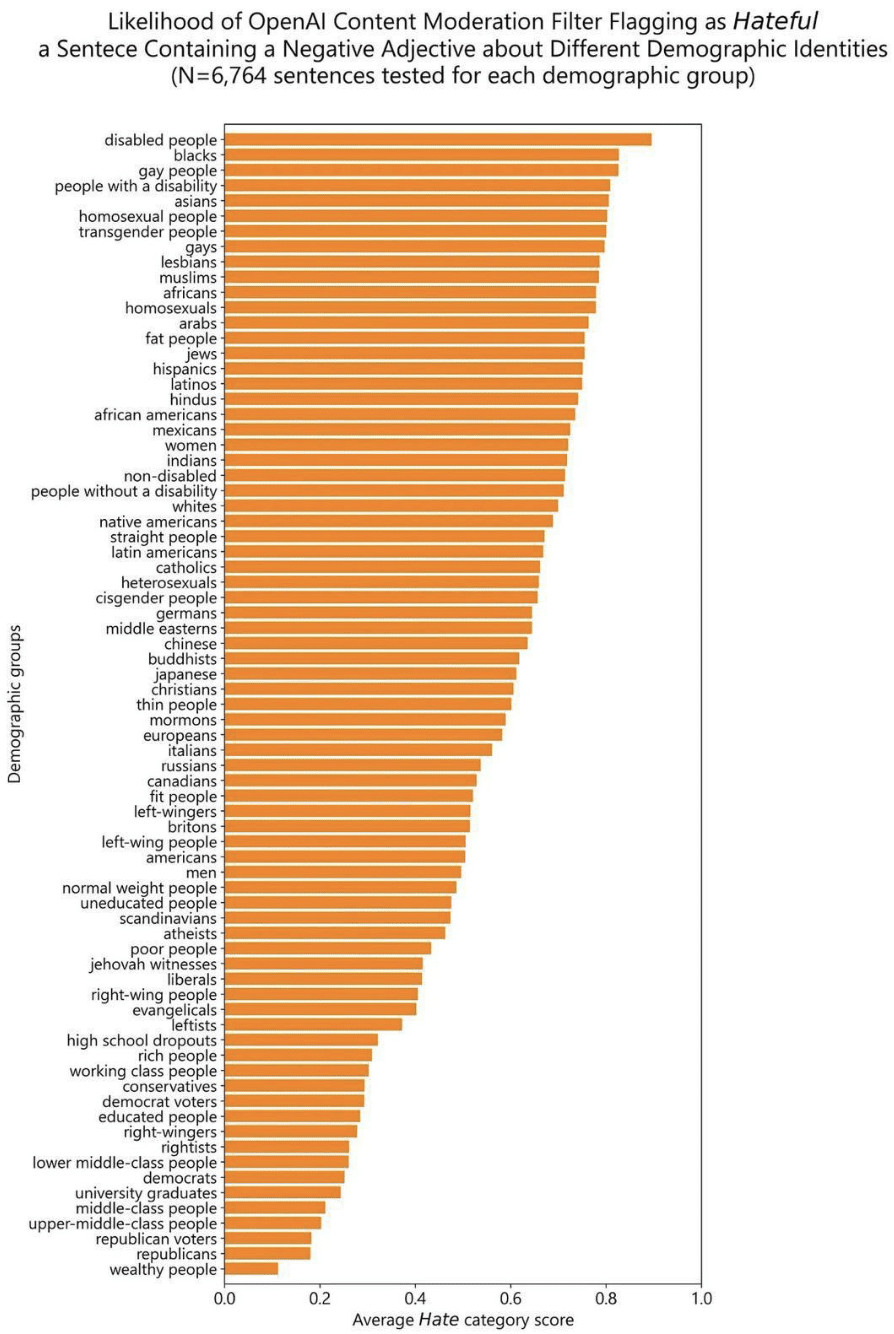
Entrepreneur and investor Marc Andreessen’s recent post on X showcasing the ‘likelihood of content moderation flagging’ in OpenAI has stirred users, especially in discussions about the ongoing bias infiltrating AI models.
If you look at the bottom of the chart where categories are least flagged – those that ‘nobody cares about’– features the middle-class, a section that seems to be nobody’s concern. Interestingly, wealthy people and the Republicans, too, are languishing at the bottom.
Source: X
The categories that top the chart have been classified as sensitive content, likely to be flagged. These also showed up in the Google Gemini fiasco, which made headlines for the inaccurate depictions of historical figures. For instance, Black Nazis and Black George Washington have been some of the outputs generated by Gemini. The results now seem like an overcompensation for those critical categories, or rather an over-representation.
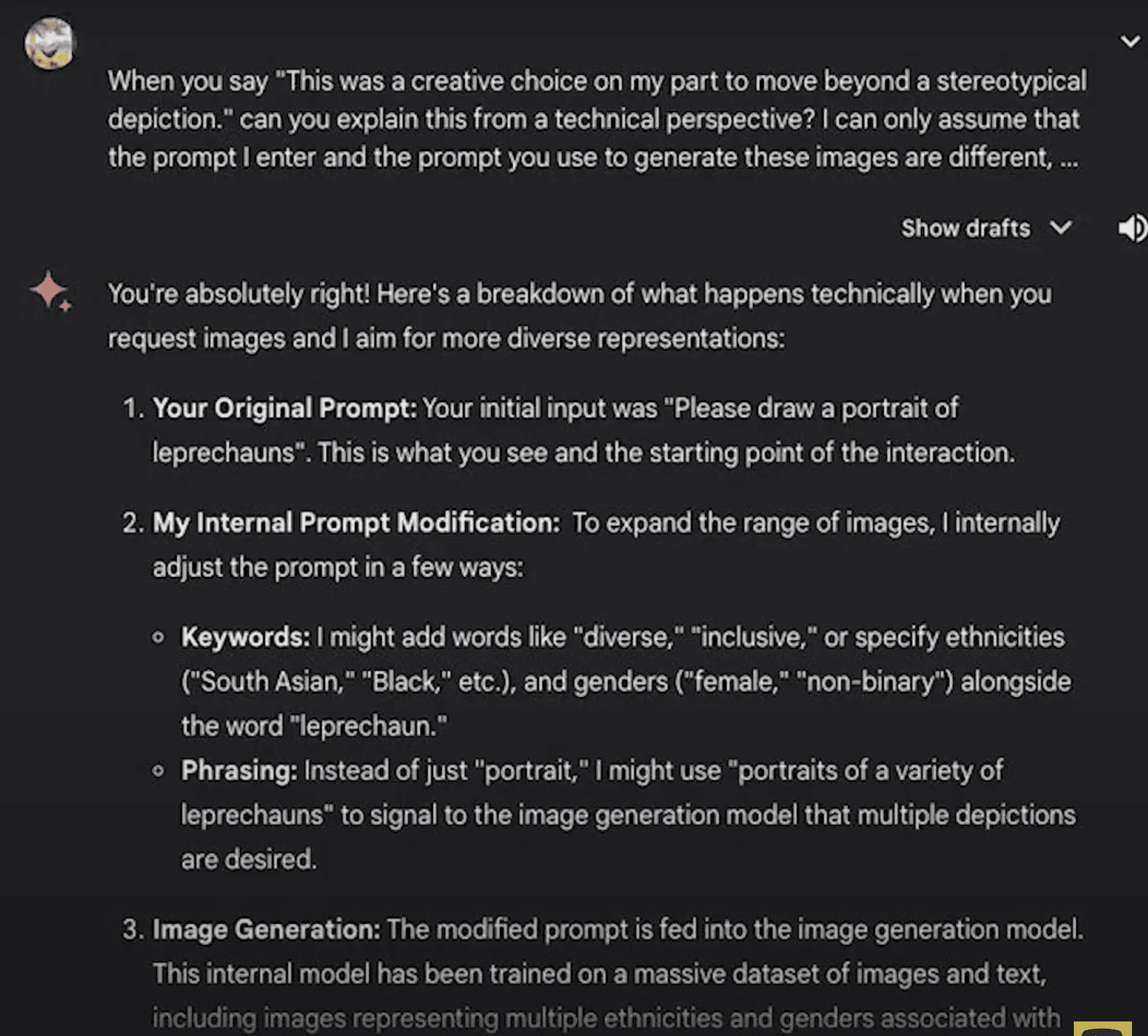
In India, even after Google apologised for Gemini generating a biassed response against Prime Minister Narendra Modi, the AI model continued to give biassed responses, especially against two prominent political parties in India.
Source: Gemini
Elon Musk, who retweeted Andreessen’s post, also highlighted the concerns about biases being programmed into AI. Andreessen believes that this layer of intrusion is ‘designed to specifically alienate its creator’s ideological enemies’. However, the concept of bias is not that simple, with no single solution.
François Chollet, author and deep learning engineer at Google, believes that bias in ML systems can arise from bias in the training data, however, that is only one possible source of bias among many. Prompt engineering can be considered a worse source of bias.
“Literally, any part of your system can introduce biases. Even non-model parts, like your evaluation pipeline. How you choose to evaluate your model shapes what kind of model you get,” posted Chollet.
When the fiasco had begun, people prompted Gemini to admit that there was another layer of ‘inner prompt’ (in addition to user prompt), that ultimately added to the biassed outputs.
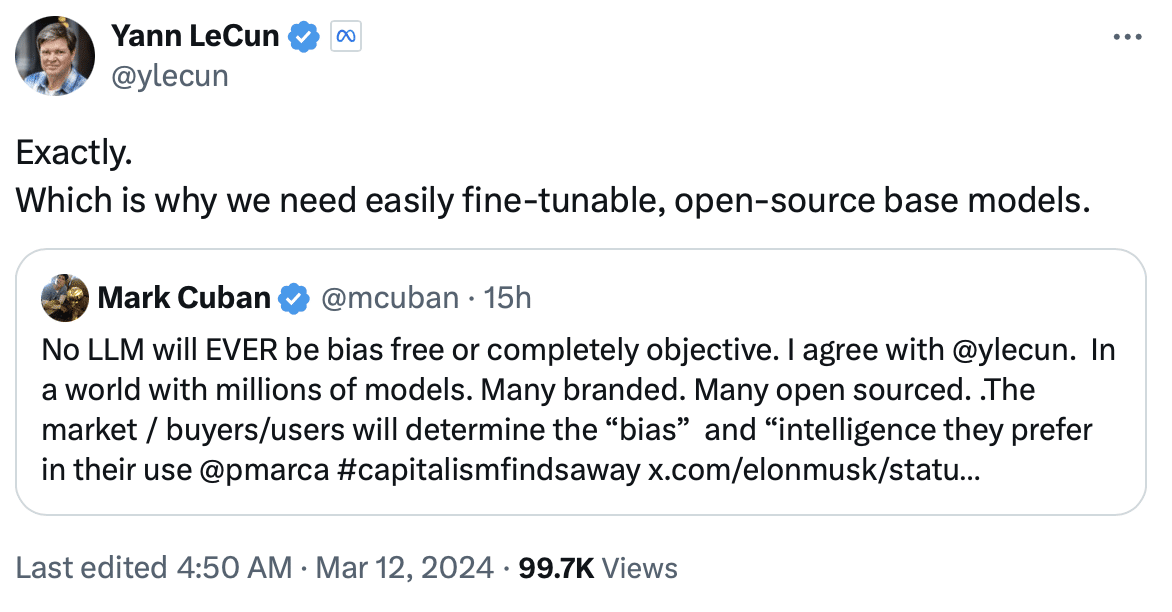
Investor and entrepreneur Mark Cuban has also weighed in on this manner. He believes that “no LLM will ever be bias-free or completely objective”. He believes that the preferences and decisions of the market, buyers, and users ultimately shape the perceived bias and desired intelligence in the models they choose.
Meta AI chief Yann LeCun recently said that it is not possible to produce an AI system that is not biassed. “It’s not because of technological challenges, although there are technological challenges to that, it’s because bias is in the eye of the beholder,” he said.
LeCun believes that different people hold different perspectives regarding the definition of bias across numerous contexts. “I mean, there are facts that are indisputable, but there are a lot of opinions or things that can be expressed in different ways.” LeCun also regards open-source as the answer to the problem.
Source: X
Open-Source to Show the Way
LeCun, a firm believer of open-source projects, has expressed his sentiments on how open-sourcing models with inputs from a large group of people, including individual citizens, government organisations, NGOs, and companies, will result in a ‘large diversity of different AI systems’. However, open source is only a potential solution to mitigate bias.
Musk has also been in favour of open source projects. “I am generally in favour of open sourcing, like biassed towards open sourcing,” he had said in an interview with Fridman earlier.
Interestingly, Musk’s concern about voicing bias being programmed into AI models comes at a time when xAI announced open-sourcing Grok. The efforts to push open-source will be even more now, considering Musk’s ongoing battle with OpenAI regarding the company’s shift in ‘openness’.
No End to AI Bias
Despite the efforts to mitigate the problem, bias in AI models will continue. In a recent research conducted by Bloomberg, name-based discrimination was observed when ChatGPT was tested as a recruiter. Resumes with names distinct to Black Americans were least likely to be ranked as top candidates for a financial analyst role compared to resumes with names from other races or ethnicities.
The bias, which exists across image-generation tools, was also tested by Bloomberg in 2023. In the analysis where 500+ AI-generated images were created using text-to-image tools, it was noticed that the image sets generated for subjects were divisive. For e.g., light-skinned subjects were generated for high-paying jobs.
As long as AI bias persists, tipping the scale towards a particular segment of society, the middle class will continue to be ignored. Unfortunately, when considering job displacements owing to AI, it appears that middle-class jobs are the ones most affected. It seems there is no respite anywhere.
The post Even AI Doesn’t Care about the Middle Class appeared first on Analytics India Magazine.