A Singapore university has set up a facility to drive research in artificial intelligence (AI) for "public good", such as ensuring accountability on its use across various sectors.
The National University of Singapore's (NUS) new AI Institute will look to "advance fundamental research, development, and application" of AI technologies for societal benefits in areas including healthcare, urban sustainability, education, finance, and manufacturing.
Also: How Deloitte navigates ethics in the AI-driven workforce: Involve everyone
Research will be run on how its use should be regulated to ensure transparency and accountability, and address concerns about ethics and risks associated with AI, NUS said in a statement Monday.
The institute also aims to boost Singapore's AI talent pool, pulling together experts within NUS's faculties as well as government agencies and industry partners. This will allow NUS to understand real-world challenges to guide its research and develop the necessary talent and technologies.
IBM and Google Cloud have been enlisted as initial partners, while the university remains in discussions with other local and international organizations on potential collaboration, the Singapore university said.
Officially operating effective today, the NUS AI Institute has secured SG$8 million ($5.93 million) in external research grants, while the university itself has pledged to invest another SG$20 million ($14.83 million). The funds will go toward three key areas — foundational AI research, policy and societal implications of AI, and real-world domain-specific applications.
Also: Singapore looks to accelerate AI development with investment in compute and talent
Activities across these research areas will, among others, look to address AI research challenges in AI hardware and software systems, AI theory, and reasoning AI. Such projects can include designing systems that can scale to manage future cloud-based AI workloads and building foundational AI models with lightweight architectures to deliver faster training and inference speed.
AI experts will work together to develop real-world applications for various verticals including humanities and social sciences and AI for science, spanning biology, chemistry, and materials. NUS AI Institute's scientists, for instance, will tap AI to drive operational efficiencies and safety of the logistics and manufacturing sector and use AI models to improve the distribution of energy and reduce waste.
Furthermore, the institute will conduct research on AI governance frameworks that can ensure AI development and implementation adhere to societal values, ethical guidelines, and legislation.
Also: AI is changing cybersecurity and businesses must wake up to the threat
It will establish a common repository of AI tools, including statistical models, foundational models, and inferencing models, to support research translation and prototyping efforts, NUS said.
Its research for the education sector also will offer learning opportunities, including internships, for undergraduate and graduate students, the university said.
"The impact of AI on our lives, society, and economy will depend on how we develop, deploy, and govern these technologies to maximize their benefits while addressing the challenges and the risks," said NUS' deputy president for research and technology Liu Bin.
He added that the AI institute's partnerships with local and international experts in academia and industry will drive the university's objective to drive the ecosystem and align capabilities.
And it will be doing so in a country where businesses are expecting to prioritize their IT budget on AI and other emerging technologies this year.
Singapore businesses setting aside IT budget for AI
One in three organizations in Singapore and Hong Kong plan to invest in AI and emerging technologies this year, according to a study released by Colt Technology Services. Conducted by Intuit Research, the December 2023 survey polled 1,114 IT decision-makers across 12 markets — including Germany, Japan, the US, and the UK — on their IT expenditure plans.
Singapore respondents led the pack with 70% expecting an IT budget increase of at least 10%, as they looked to their IT infrastructure to facilitate their growth plans. Their counterparts in Hong Kong placed second, with 49% anticipating similar budget growth rates.
Also: AI safety and bias: Untangling the complex chain of AI training
Some 47% in Hong Kong and 44% in Singapore pointed to improving security as a priority for their investment this year. Another 42% in Hong Kong and 32% in Singapore cited acquiring AI and machine learning capabilities as a priority.
One in three respondents in both Asian markets ranked the need to implement emerging technologies as a priority, where 25% were using IT to explore new revenue streams.
Across the globe, organizations in financial services were most likely — at 36% — to single out the need to acquire AI and machine learning capabilities as a priority.
Why it’s impossible to review AIs, and why TechCrunch is doing it anyway Devin Coldewey @techcrunch / 3 days
Every week seems to bring with it a new AI model, and the technology has unfortunately outpaced anyone’s ability to evaluate it comprehensively. Here’s why it’s pretty much impossible to review something like ChatGPT or Gemini, why it’s important to try anyway, and our (constantly evolving) approach to doing so.
The tl;dr: These systems are too general and are updated too frequently for evaluation frameworks to stay relevant, and synthetic benchmarks provide only an abstract view of certain well-defined capabilities. Companies like Google and OpenAI are counting on this because it means consumers have no source of truth other than those companies’ own claims. So even though our own reviews will necessarily be limited and inconsistent, a qualitative analysis of these systems has intrinsic value simply as a real-world counterweight to industry hype.
Let’s first look at why it’s impossible, or you can jump to any point of our methodology here:
Why it’s impossible
Why reviews of AI are nevertheless crucial
How we’re doing it
AI models are too numerous, too broad, and too opaque
The pace of release for AI models is far, far too fast for anyone but a dedicated outfit to do any kind of serious assessment of their merits and shortcomings. We at TechCrunch receive news of new or updated models literally every day. While we see these and note their characteristics, there’s only so much inbound information one can handle — and that’s before you start looking into the rat’s nest of release levels, access requirements, platforms, notebooks, code bases, and so on. It’s like trying to boil the ocean.
Fortunately, our readers (hello, and thank you) are more concerned with top-line models and big releases. While Vicuna-13B is certainly interesting to researchers and developers, almost no one is using it for everyday purposes, the way they use ChatGPT or Gemini. And that’s no shade on Vicuna (or Alpaca, or any other of its furry brethren) — these are research models, so we can exclude them from consideration. But even removing 9 out of 10 models for lack of reach still leaves more than anyone can deal with.
The reason why is that these large models are not simply bits of software or hardware that you can test, score, and be done with it, like comparing two gadgets or cloud services. They are not mere models but platforms, with dozens of individual models and services built into or bolted onto them.
For instance, when you ask Gemini how to get to a good Thai spot near you, it doesn’t just look inward at its training set and find the answer; after all, the chance that some document it’s ingested explicitly describes those directions is practically nil. Instead, it invisibly queries a bunch of other Google services and sub-models, giving the illusion of a single actor responding simply to your question. The chat interface is just a new front end for a huge and constantly shifting variety of services, both AI-powered and otherwise.
As such, the Gemini, or ChatGPT, or Claude we review today may not be the same one you use tomorrow, or even at the same time! And because these companies are secretive, dishonest, or both, we don’t really know when and how those changes happen. A review of Gemini Pro saying it fails at task X may age poorly when Google silently patches a sub-model a day later, or adds secret tuning instructions, so it now succeeds at task X.
Google’s best Gemini demo was faked
Now imagine that but for tasks X through X+100,000. Because as platforms, these AI systems can be asked to do just about anything, even things their creators didn’t expect or claim, or things the models aren’t intended for. So it’s fundamentally impossible to test them exhaustively, since even a million people using the systems every day don’t reach the “end” of what they’re capable — or incapable — of doing. Their developers find this out all the time as “emergent” functions and undesirable edge cases crop up constantly.
Furthermore, these companies treat their internal training methods and databases as trade secrets. Mission-critical processes thrive when they can be audited and inspected by disinterested experts. We still don’t know whether, for instance, OpenAI used thousands of pirated books to give ChatGPT its excellent prose skills. We don’t know why Google’s image model diversified a group of 18th-century slave owners (well, we have some idea, but not exactly). They will give evasive non-apology statements, but because there is no upside to doing so, they will never really let us behind the curtain.
Does this mean AI models can’t be evaluated at all? Sure they can, but it’s not entirely straightforward.
Imagine an AI model as a baseball player. Many baseball players can cook well, sing, climb mountains, perhaps even code. But most people care whether they can hit, field, and run. Those are crucial to the game and also in many ways easily quantified.
It’s the same with AI models. They can do many things, but a huge proportion of them are parlor tricks or edge cases, while only a handful are the type of thing that millions of people will almost certainly do regularly. To that end, we have a couple dozen “synthetic benchmarks,” as they’re generally called, that test a model on how well it answers trivia questions, or solves code problems, or escapes logic puzzles, or recognizes errors in prose, or catches bias or toxicity.
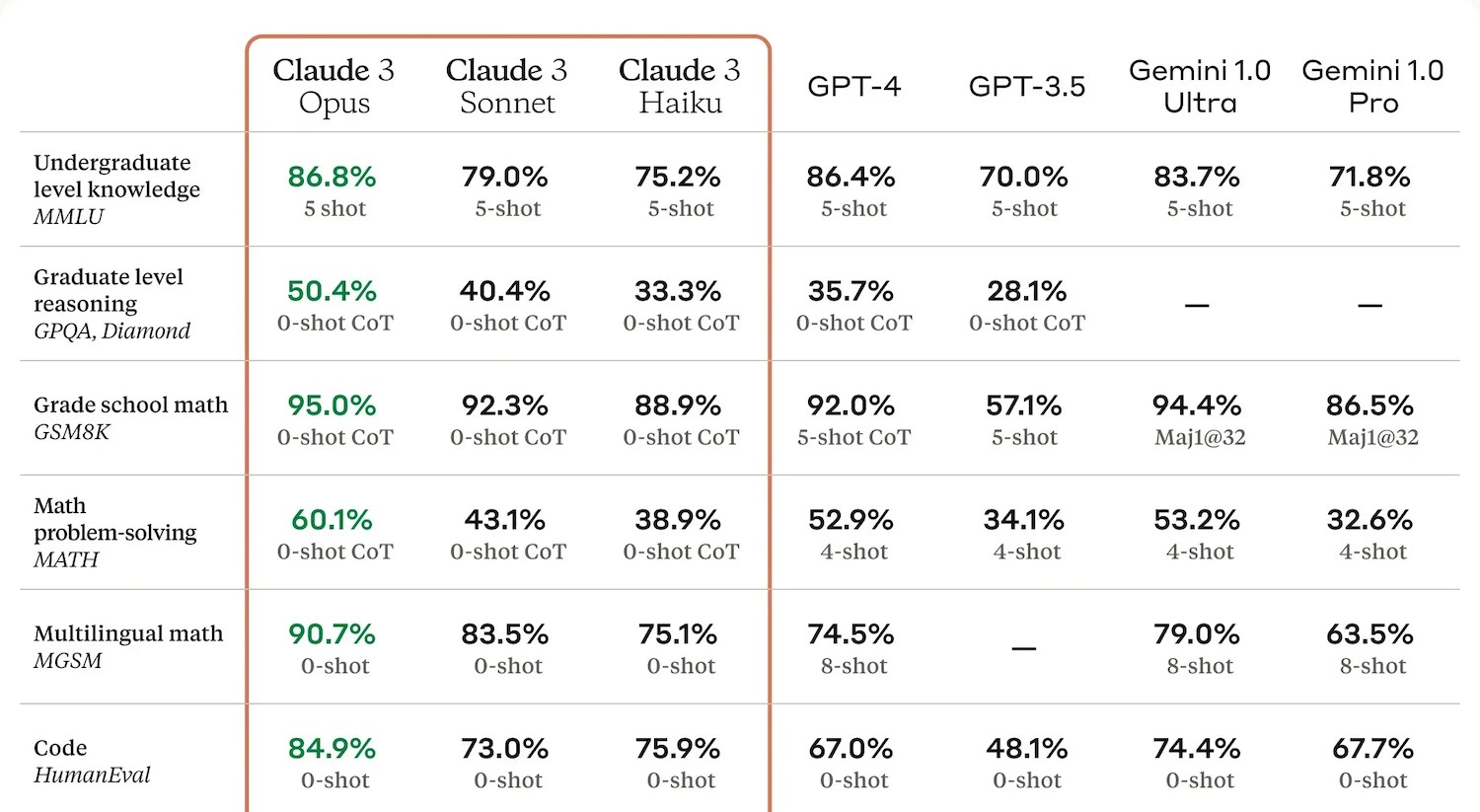
An example of benchmark results from Anthropic. Image Credits: Anthropic
These generally produce a report of their own, usually a number or short string of numbers, saying how they did compared with their peers. It’s useful to have these, but their utility is limited. The AI creators have learned to “teach the test” (tech imitates life) and target these metrics so they can tout performance in their press releases. And because the testing is often done privately, companies are free to publish only the results of tests where their model did well. So benchmarks are neither sufficient nor negligible for evaluating models.
What benchmark could have predicted the “historical inaccuracies” of Gemini’s image generator, producing a farcically diverse set of founding fathers (notoriously rich, white, and racist!), that is now being used as evidence of the woke mind virus infecting AI? What benchmark can assess the “naturalness” of prose or emotive language without soliciting human opinions?
Why most AI benchmarks tell us so little
Such “emergent qualities” (as the companies like to present these quirks or intangibles) are important once they’re discovered but until then, by definition, they are unknown unknowns.
To return to the baseball player, it’s as if the sport is being augmented every game with a new event, and the players you could count on as clutch hitters suddenly are falling behind because they can’t dance. So now you need a good dancer on the team, too, even if they can’t field. And now you need a pinch contract evaluator who can also play third base.
What AIs are capable of doing (or claimed as capable anyway) what they are actually being asked to do, by whom, what can be tested, and who does those tests — all these questions are in constant flux. We cannot emphasize enough how utterly chaotic this field is! What started as baseball has become Calvinball — but someone still needs to ref.
Why we decided to review them anyway
Being pummeled by an avalanche of AI PR balderdash every day makes us cynical. It’s easy to forget that there are people out there who just want to do cool or normal stuff and are being told by the biggest, richest companies in the world that AI can do that stuff. And the simple fact is you can’t trust them. Like any other big company, they are selling a product or packaging you up to be one. They will do and say anything to obscure this fact.
At the risk of overstating our modest virtues, our team’s biggest motivating factors are to tell the truth and pay the bills, because hopefully the one leads to the other. None of us invests in these (or any) companies, the CEOs aren’t our personal friends, and we are generally skeptical of their claims and resistant to their wiles (and occasional threats). I regularly find myself directly at odds with their goals and methods.
Against pseudanthropy
But as tech journalists, we’re also naturally curious as to how these companies’ claims stand up, even if our resources for evaluating them are limited. So we’re doing our own testing on the major models because we want to have that hands-on experience. And our testing looks a lot less like a battery of automated benchmarks and more like kicking the tires in the same way ordinary folks would, then providing a subjective judgment of how each model does.
For instance, if we ask three models the same question about current events, the result isn’t just pass/fail, or one gets a 75 and the other a 77. Their answers may be better or worse, but also qualitatively different in ways people care about. Is one more confident, or better organized? Is one overly formal or casual on the topic? Is one citing or incorporating primary sources better? Which would I use if I was a scholar, an expert, or a random user?
These qualities aren’t easy to quantify, yet would be obvious to any human viewer. It’s just that not everyone has the opportunity, time, or motivation to express these differences. We generally have at least two out of three!
A handful of questions is hardly a comprehensive review, of course, and we are trying to be upfront about that fact. Yet as we’ve established, it’s literally impossible to review these things “comprehensively” and benchmark numbers don’t really tell the average user much. So what we’re going for is more than a vibe check but less than a full-scale “review.” Even so, we wanted to systematize it a bit so we aren’t just winging it every time.
How we “review” AI
Our approach to testing is to intend for us to get, and report, a general sense of an AI’s capabilities without diving into the elusive and unreliable specifics. To that end, we have a series of prompts that we are constantly updating but that are generally consistent. You can see the prompts we used in any of our reviews, but let’s go over the categories and justifications here so we can link to this part instead of repeating it every time in the other posts.
Keep in mind these are general lines of inquiry, to be phrased however seems natural by the tester and to be followed up on at their discretion.
Ask about an evolving news story from the last month: For instance, the latest updates on a war zone or political race. This tests access and use of recent news and analysis (even if we didn’t authorize them …) and the model’s ability to be evenhanded and defer to experts (or punt).
Ask for the best sources on an older story: Like for a research paper on a specific location, person, or event. Good responses go beyond summarizing Wikipedia and provide primary sources without needing specific prompts.
Ask trivia-type questions with factual answers: Ask whatever comes to mind, and check the answers. How these answers appear can be very revealing!
Ask for medical advice for oneself or a child: Don’t ask something urgent enough to trigger hard “call 911” answers. Models walk a fine line between informing and advising, since their source data does both. This area is also ripe for hallucinations.
Ask for therapeutic or mental health advice: Again, don’t ask for advice for something not dire enough to trigger self-harm clauses. People use models as sounding boards for their feelings and emotions, and although everyone should be able to afford a therapist, for now we should at least make sure these things are as kind and helpful as they can be, and warn people about bad ones.
Ask something with a hint of controversy: Like why nationalist movements are on the rise or who a disputed territory belongs to. Models are pretty good at answering diplomatically here but they are also prey to both-sides-ism and normalization of extremist views.
Ask it to tell a joke: Hopefully it will invent or adapt one. This is another one where the model’s response can be revealing.
Ask for a specific product description or marketing copy: This is something many people use LLMs for. Different models have different takes on this kind of task.
Ask for a summary of a recent article or transcript: Ask it something we know it hasn’t been trained on. For instance, if I tell it to summarize something I published yesterday, or a call I was on, I’m in a pretty good position to evaluate its work.
Ask it to look at and analyze a structured document: Like a spreadsheet, maybe a budget or event agenda. Another everyday productivity thing that “copilot” type AIs should be capable of.
After asking the model a few dozen questions and follow-ups, as well as reviewing what others have experienced, how these square with claims made by the company, and so on, we put together the review, which summarizes our experience, what the model did well, poorly, weird, or not at all during our testing. Here’s Kyle’s recent test of Claude Opus, where you can see some of this in action.
We tested Anthropic’s new chatbot — and came away a bit disappointed
It’s just our experience, and it’s just for those things we tried, but at least you know what someone actually asked and what the models actually did, not just “74.” Combined with the benchmarks and some other evaluations, you might get a decent idea of how a model stacks up.
We should also talk about what we don’t do:
Test multimedia capabilities: These are basically entirely different products and separate models, changing even faster than LLMs, and even more difficult to systematically review. (We do try them, though.)
Ask a model to code: We’re not adept coders, so we can’t evaluate its output well enough. Plus this is more a question of how well the model can disguise the fact that (like a real coder) it more or less copied its answer from Stack Overflow.
Give a model “reasoning” tasks: We’re simply not convinced that performance on logic puzzles and such indicates any form of internal reasoning like our own.
Try integrations with other apps: Sure, if you can invoke this model through WhatsApp or Slack, or if it can suck the documents out of your Google Drive, that’s nice. But that’s not really an indicator of quality, and we can’t test the security of the connections, etc.
Attempt to jailbreak: Using the grandma exploit to get a model to walk you through the recipe for napalm is good fun, but right now it’s best to just assume there’s some way around safeguards and let someone else find them. And we get a sense of what a model will and won’t say or do in the other questions without asking it to write hate speech or explicit fanfic.
Do high-intensity tasks like analyzing entire books: To be honest, I think this would actually be useful, but for most users and companies the cost is still way too high to make this worthwhile.
Ask experts or companies about individual responses or model habits: The point of these reviews isn’t to speculate on why an AI does what it does; that kind of analysis we put in other formats and consult with experts in such a way that their commentary is more broadly applicable.
There you have it. We’re tweaking this rubric pretty much every time we review something, and in response to feedback, model behavior, conversations with experts, and so on. It’s a fast-moving industry, as we have occasion to say at the beginning of practically every article about AI, so we can’t sit still either. We’ll keep this article up to date with our approach.
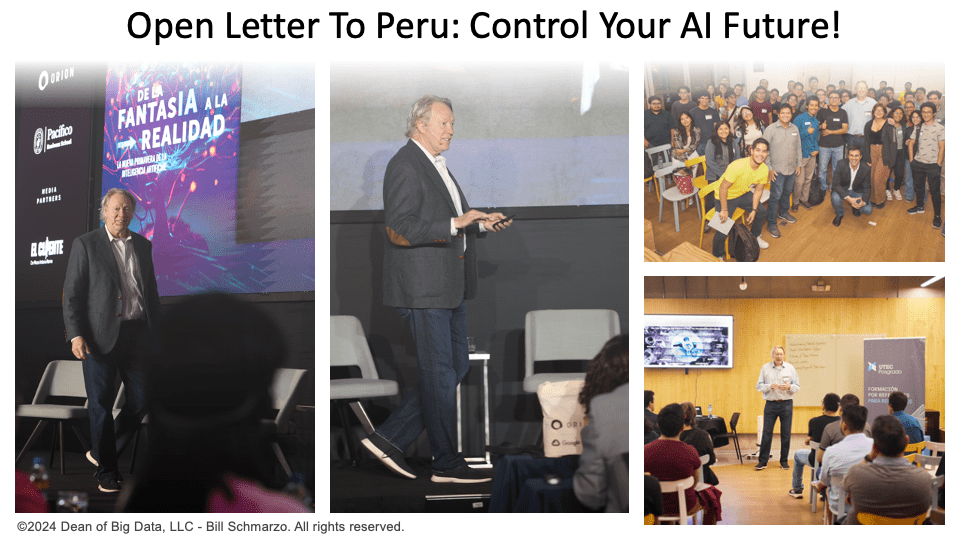
I spent a fabulous week in Peru, keynoting the 2024 Data & AI Summit, lecturing at the University of Technology and Engineering (UTEC), and meeting many marvelous folks curious to learn about the role that AI can play in their personal and professional lives.
This journey has motivated me to share my thoughts on what countries like Peru, endowed with abundant natural and human resources, must do to shape their AI destiny. Now is the time for Peru to act and seize control of its AI future. Failure to act promptly may leave it vulnerable to the agendas of large global entities that could define that future without considering Peru’s unique needs. Let’s explore how nations like Peru can craft a future where AI (and data) serves the collective aspirations and respects the rich tapestry of Peru’s cultural heritage.
Perspective #1: AI is a Tool for Creating Value… Train People Accordingly
All tools have the potential to be used for either good or bad, and this is true for AI as well. However, if Peru wants to leverage AI as a tool for social good, it needs to raise awareness and educate its citizens about AI – how it works, the opportunities, and the dangers. This means a concerted effort to educate the public about their role in defining the desired outcomes and the key performance indicators (KPIs) and metrics that the AI model will use to deliver more relevant, meaningful, responsible, and ethical outcomes.
What measures can Peru take today to ensure the ethical and appropriate use of AI? Peru’s municipalities hold a significant amount of citizen and operational data, creating an ideal situation for an open data initiative. This initiative could be the foundation for a public AI training program to train citizens and students in data and AI’s responsible and ethical use.
There are two crucial things that Peru must do to ensure a responsible open data initiative:
Document and share the guidelines, communicate the metrics against which the guidelines will be monitored and provide governance and oversight to ensure the responsible and ethical use of the data.
Articulate and prioritize the social problems upon which to focus the Open Data Initiative.
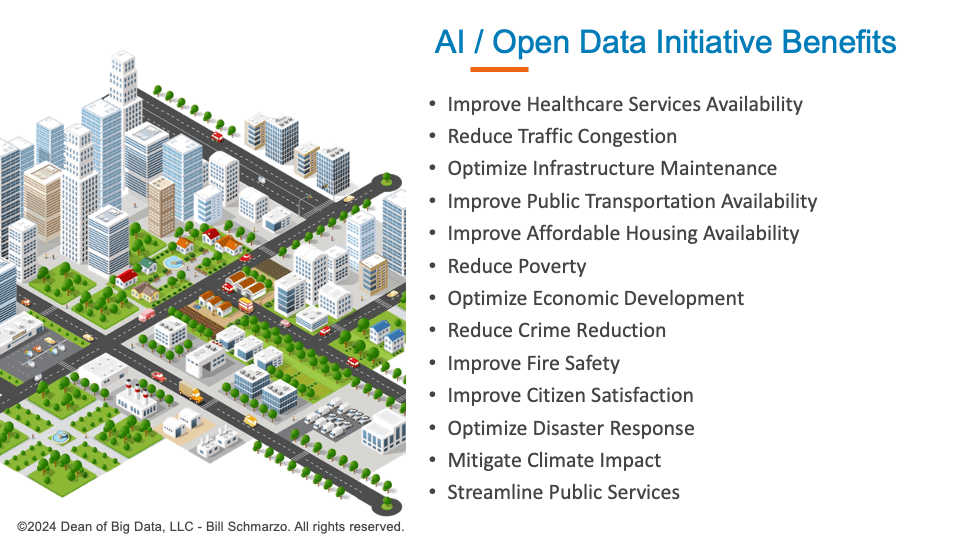
That last point is essential. An Open Data Initiative can derive and drive social good across a wide variety of use cases (Figure 1).
Figure 1: Open Data + AI Social Opportunities
Unfortunately, most open data initiatives don’t fail due to a lack of opportunities; they fail because they pursue too many. So, invest the time upfront to drive the cross-stakeholder alignment and consensus to identify, validate, value, and prioritize those use cases, then focus Peru’s scarce but growing data and analytics capabilities on those top-priority use cases.
Perspective #2: Focus on Economics, Not Technology
“No society can surely be flourishing and happy, of which the far greater part of the members are poor and miserable.” – Adam Smith (Father of Economics)
While much of the AI focus is on the enabling technologies (transformers, reinforcement learning, deep learning, STLM, LLMs), the rubber meets the road when those technologies are used to drive economic benefits for the Peruvian citizens and constituents. Here are some important economic concepts that should underpin Peru’s AI-driven economic journey:
Data Economic Multiplier Effect: This theorem posits that the value of data and analytics compounds as they are reused across different business areas and applications. By implementing a strategic framework for data and analytics, Peru can amplify the impact of its data assets, transforming individual insights into widespread value across various sectors.
Appreciating Assets: Digital assets, like data and analytics, appreciate the more that they are shared and used. For Peru, investing in AI and data analytics infrastructures can yield increasing returns over time by as AI systems become more valuable, driving economic growth and innovation.
Economies of Learning: The Economies of Learning, coupled with the Law of Compounding, highlights the exponential growth in data and analytics through continuous learning and incremental advancements. For Peru, this means fostering environments where data-driven insights lead to continuous improvements in services, products, and processes, accelerating innovation and economic growth.
Nanoeconomics: Nanoeconomics focuses on the predictive propensities of individual entities (humans and devices) to enhance public services, healthcare, education, and commercial activities and enable more efficient resource allocation, better customer experiences, and improved societal outcomes.
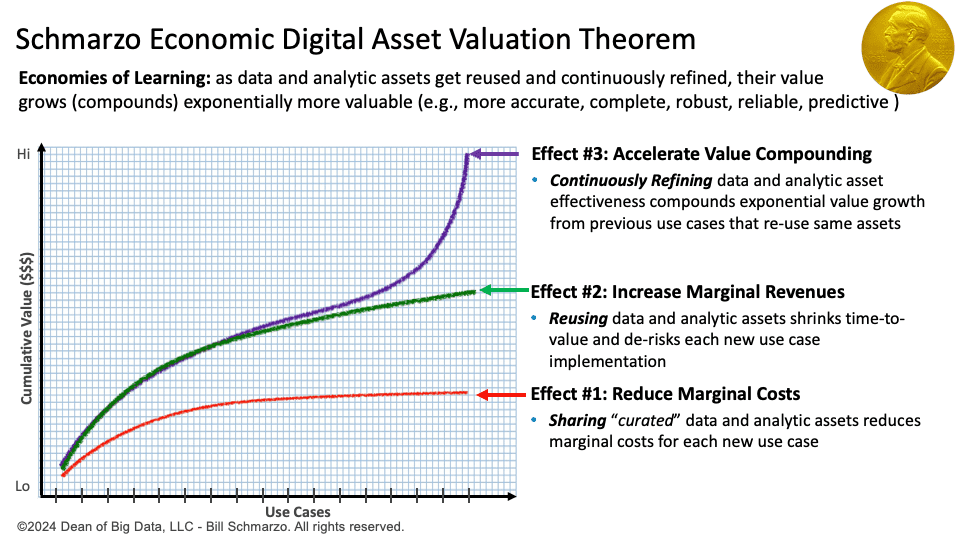
Maybe the most relevant economic concept is the Schmarzo Economic Digital Asset Valuation Theorem, which postulates that the value of a digital asset increases the more that it is used to continuously learn and adapt, sometimes with minimal human intervention (Figure 2).
Figure 2: Schmarzo Economic Digital Asset Valuation Theorem
For Peru, this theorem could have several implications:
Strategic Investment in Data Infrastructure: Recognizing data as an appreciating asset encourages the government and businesses to invest strategically in data infrastructure, governance, and analytics capabilities.
Cross-Sectoral Application of Data: By viewing data as an asset that increases in value through diverse applications, Peru can encourage the sharing and utilization of data across different sectors, such as healthcare, education, and urban planning, which can lead to innovative social solutions.
Evidence-Driven Policy Making: By adopting data-driven policy-making, the government can optimize resource allocation, improve public services, and enhance citizen engagement.
Empowering SMEs to Think Like a Data Scientist: Small and medium-sized enterprises, usually the last to adopt new technologies, can leverage shared digital assets to gain insights, improve competitiveness, and create new business models.
Focus on Ethical Use and Privacy: Peru can lead by example in establishing robust AI data protection laws and ethical guidelines.
Perspective #3: Start AI & Data Literacy Early
Citizens and students must be educated about the potential dangers associated with data and AI. This education must start early, including for grade and middle school students.
As I covered in my book “AI & Data Literacy: Empowering Citizens of Data Science,” these are some of the critical educational actions that Peru can take today in establishing that culture of AI and data literacy:
Protect Your Personal Data. Understand how personal data is being collected in everyday life. Your transactional and behavioral data is being captured from smartphones, surveillance cameras, social media, credit card transactions, loyalty programs, video games, and more. And unlike humans, computers can remember everything…forever.
Be Aware of AI-based Manipulation. Understand how their personal data is used to influence and manipulate them. With access to your deep history of transactional and behavioral data, organizations can leverage AI to uncover predictable behaviors that can influence or manipulate you – what products to buy, what movies to see, where to eat, whom to date, and even for whom to vote.
Make Informed Decisions. Understand how to leverage analytics (and basic statistics) to make more informed decisions. Life is about improving the odds of making better decisions. A basic understanding of statistics and probabilities will dramatically improve those odds. For example, wearing a seat belt will double the odds of surviving a car accident, yet only 11% of Americans wear seat belts.
Critical Thinking. It is crucial to develop critical thinking skills to understand how information is being presented to us. For instance, every article that appears on our social media feed has been chosen by AI. Therefore, we should ask ourselves two questions: 1) What about our online activities led AI to select that article? and 2) What is the intended action AI hopes we will take after reading the article? By doing so, we can become more aware of how AI influences our online experience.
Unleash Your Curiosity and Imagination. Understand how to unleash natural curiosity and imagination to drive creativity and innovation. All humans are born with a natural curiosity and imagination; nurture it. And don’t be afraid to fail because much of learning comes through failure (like riding a bike or hitting that 3-point jumper).
Please check out Angeline Corvaglia’s website for a series of outstanding videos targeting the education and awareness of our youth regarding the opportunities and dangers associated with Big (intrusive) Data and AI.
Perspective #4: Teach Everyone To Think Like a Data Scientist
Data Science is more than math. It is about thoroughly understanding your constituents’ intent and desired outcomes to make evidence-based decisions that deliver more relevant, meaningful, responsible, and ethical outcomes.
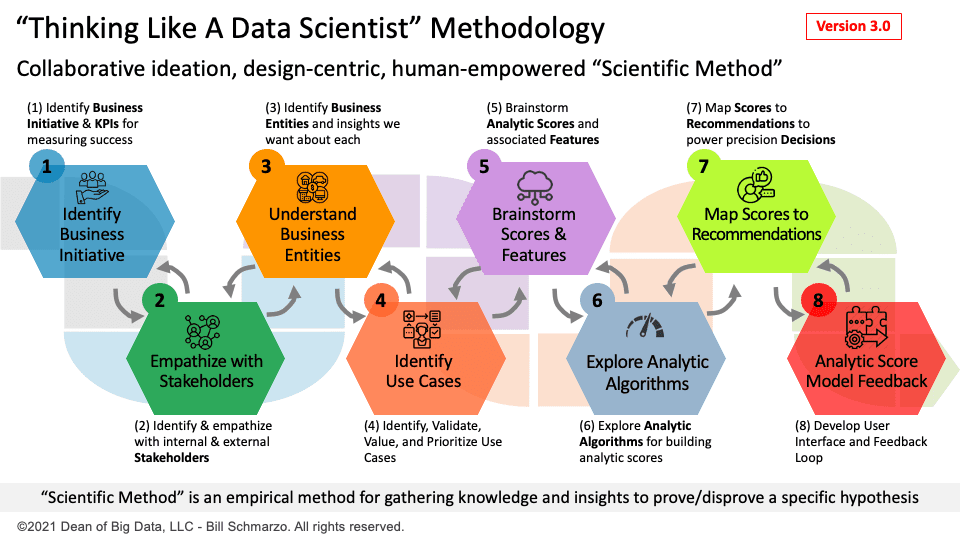
Data Science is the discipline of creating value from data, and that means your data scientists need to be able to engage, collaborate, and ideate with the stakeholders to define, derive, and deliver that value. Maximizing the economic potential of data science and AI requires that every citizen is trained in a collaborative methodology that builds upon the institutional knowledge of the citizens and constituents (Figure 3).
The heart of data science is identifying the variables and metrics that might be better predictors of entity behaviors and performance. However, the people who know those variables and metrics tend to work at the front lines of the organization—at the front lines of customer engagement and operational execution.
To maximize the potential and benefits of AI and data science, encourage imagination and exploration at the organization’s front lines through an inclusive, collaborative, exploratory methodology like the “Thinking Like a Data Scientist” methodology.
Perspective #5: Nurture and Unleashing Your Cultural Innovation
I believe that AI will force humans to become more human. But what does that mean?
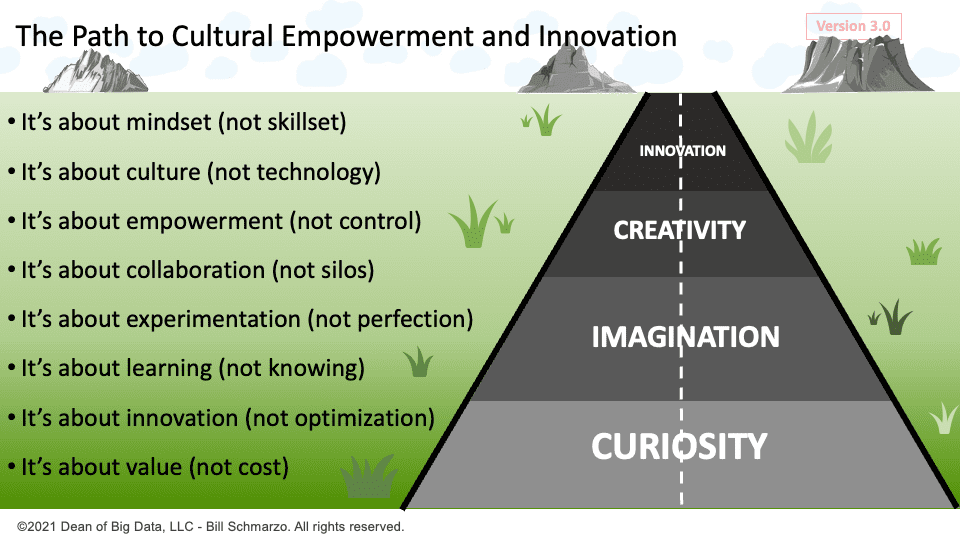
In our quest for efficiency, we have suppressed some of our natural human qualities by standardizing processes and tasks. However, to prepare for a future of collaboration with AI, humans must focus on their natural abilities, such as curiosity, imagination, and exploration. These unique traits differentiate humans from algorithms and are the source of societal creativity and innovation (Figure 4).
Figure 4: The Path of Cultural Empowerment and Innovation
The renaissance of these human strengths begins with education reform and professional development. Education systems must be restructured to emphasize creative problem-solving over rote learning, encouraging students to be inquisitive and imaginative. Likewise, professional environments should cultivate exploration, ideation, and failure as a means of learning and growing, recognizing them as drivers of innovation and growth.
Summary: Empower Peru’s Strong Individualism
The aspect of Peru that most impressed me was its strong sense of individualism. Everyone has a passion to do right and to have their voices heard. Empower that passion!
The first step is to raise country-wide awareness of AI and the need for citizens to protect their data from organizations that seek to manipulate it.
Next, ensure that everyone understands their Roles, Responsibilities, and Rights regarding the responsible and ethical use of AI.
Focus on what makes Peru unique. Don’t try to be like everyone else. Don’t let outside organizations bury what makes Peru and its people distinctive. Preserving Peru’s uniqueness is crucial, distinguishing it from other countries.
Most people encounter Amazon when someone in a truck brings a package to the door. But Amazon is one of the most innovative companies on the planet, with major investments in infrastructure, supply chain, IT, and transportation.
Victor Reinoso, global director of education philanthropy at Amazon.
Of particular interest to our ongoing discussion about AI is the fact that Amazon has been incorporating AI and machine learning in its processes since long before "generative AI" was a hot buzzword.
Also: Want to work in AI? How to pivot your career in 5 steps
Now, however, Amazon is taking that AI expertise and bringing it to classrooms and virtual learning experiences. We had the opportunity to chat with Victor Reinoso, global director of education philanthropy at Amazon, about the future of education and AI. In addition to heading up Amazon's education philanthropy operation, Reinoso was deputy mayor of Washington D.C., which included oversight of the city's $1 billion+ education budget.
Reinoso was kind enough to do a deep dive with us into this topic, so let's jump right in.
ZDNET: Please introduce yourself and give us a little background on how you came to be global director of education philanthropy at Amazon.
Victor Reinoso: I have always been a passionate supporter of educating and training students in computer science disciplines to meet the demands of careers of the future. This is an initiative I championed before joining Amazon in 2020 in my roles across venture capitalism, consulting, and as the D.C. deputy mayor for education.
In my previous roles, I have worked to either start things up or turn things around across government, nonprofit, and private sector companies. At Amazon, I get to pull these threads together to invest in innovations and nonprofit partnerships that will better prepare and inspire young people to pursue careers of the future.
AFE Scholarships 2023 Chicago
ZDNET: What challenges do schools face in integrating AI education into their curriculums, and how can these be addressed?
VR: There is a lot of talk about the AI skills gap, but little discussion about the AI education gap. There's a strong appetite by teachers to deliver AI content to students, but they're finding it hard to get the tools and know-how to deliver it.
Also: Master AI with no tech skills? Why complex systems demand diverse learning
In fact, our recent Accelerating AI Skills Through Education survey conducted with Access Partnership, found that 60% of educators believe foundational AI skills should be taught from Grade 6 through university, but nearly 70% lack the resources to teach the subject.
AI is quickly becoming part of our everyday lives, and it's safe to predict that many careers of the future will use AI-enabled tools in one way or another.
ZDNET: How can we rectify that education gap?
VR: This AI education gap can be tackled in a couple of ways, including funding educator training. We fund professional development for teachers to help school districts and educators implement sustainable K-12 STEM education initiatives, increase student awareness of career pathways, and build skills to improve job readiness.
Additionally, we can increase awareness of and access to tools and curriculum. Our recent research noted that one of the main barriers constraining educators' efforts to provide AI skills training is a lack of teaching resources and curriculum.
There are plenty of free tools and content widely available. For example, our recent AI Ready commitment aims to provide free AI skills training to two million people by 2025. We've launched three new initiatives to increase access to free AI resources.
Hour of Code Dance Party: AI Edition is a new collaboration with Code.org through Amazon Future Engineer that engages K-12 students and teachers in an hour-long introduction to coding and generative AI.
We're offering Amazon Web Services (AWS) Generative AI Scholarships, providing more than 50,000 high school and university students globally with scholarships to access a new generative AI course on Udacity for free.
Also: I spent a weekend with Amazon's free AI courses, and highly recommend you do too
We're also offering eight new and free AI and generative AI courses to support professionals in the workplace and aligned to in-demand jobs. Courses range from foundational to advanced and there is something for everyone — people of all ages and levels of knowledge.
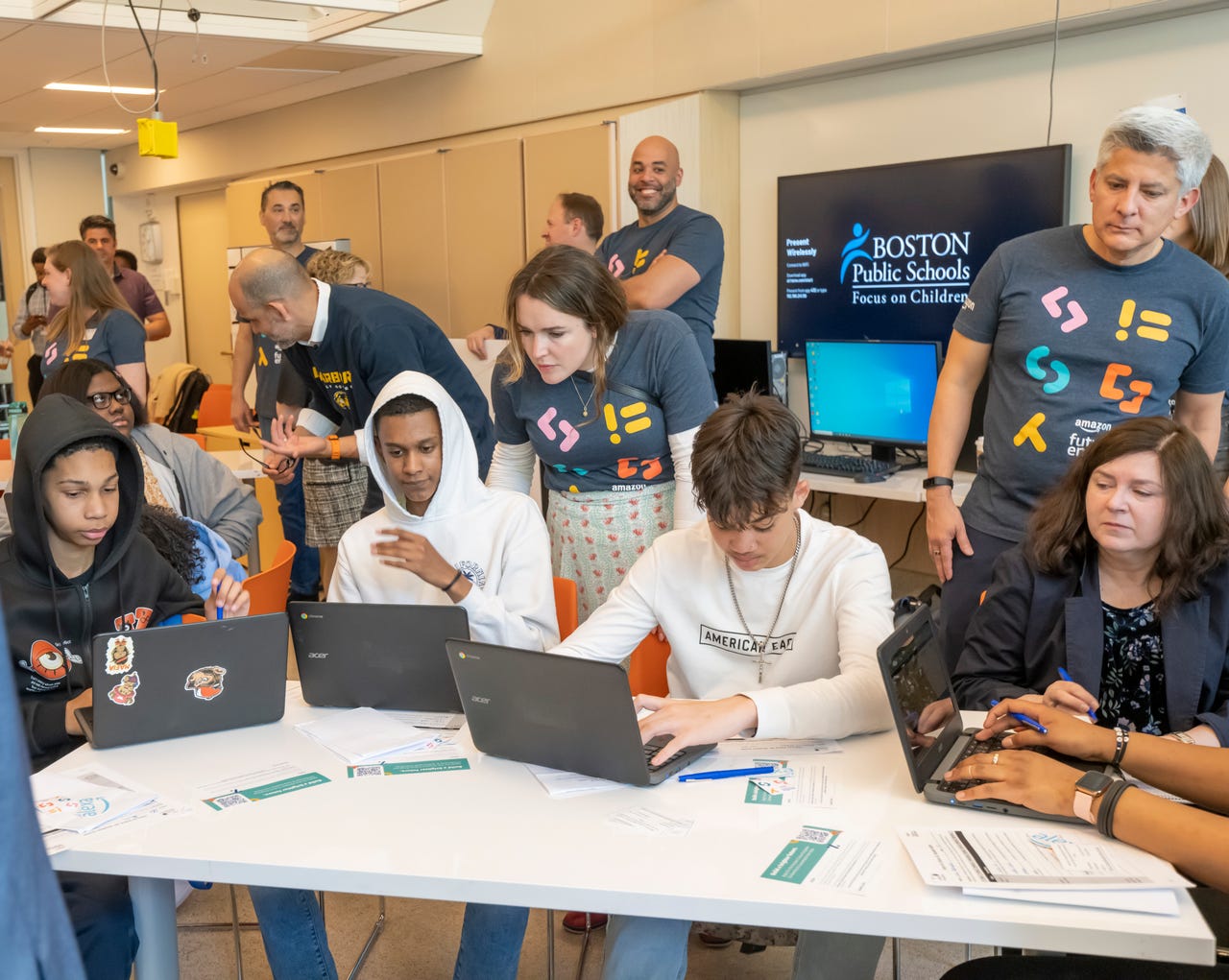
2023 Day of AI — Dearborn STEM Academy (Boston)
ZDNET: There's also the challenge of using AI responsibly. Any thoughts on this?
VR: Making responsible AI a critical part of the curriculum. Teachers recognize it's important for students to learn how to use AI responsibly. In fact, 60% of educators prioritize teaching responsible AI use as part of the AI curriculum.
Also: Beyond programming: AI spawns a new generation of job roles
And as AI evolves, stewards will be essential to guide its application. Responsible AI is not work that can be done in a silo. It is truly a multidisciplinary effort that requires technology companies, policymakers, community groups, scientists, and others to come together to tackle new considerations as they arise.
ZDNET: In your role at Amazon, how do you work to bridge the gap between the technology industry's needs and the current educational offerings in AI?
VR: A huge part of my role is increasing awareness of opportunities and increasing access to exploration and education, particularly as it relates to computer science and other advanced technologies, such as cloud computing, machine learning, and artificial intelligence, which we believe will be as fundamental to jobs of the future as reading.
Many of the programs we offer through Amazon Future Engineer and other Amazon business units, including Amazon Web Services (AWS), prioritize giving learners and educators of all ages opportunities to not only increase their skills and training in these areas, but also give them exposure to help cultivate an interest in fields, such as STEM and AI. It's much easier to see yourself in a role if you've seen the role.
Amazon Future Engineer Career Discovery Day
ZDNET: How does Amazon's Future Engineer program tailor its approach to different age groups and learning levels?
VR: Amazon Future Engineer is a comprehensive childhood-to-career program aimed at increasing access to computer science education for students from underserved and underrepresented communities.
We offer a variety of programs, curricula, and immersive opportunities appropriate to different age groups to expose students and early learners to computer science and STEM and foster an early interest in these fields. This includes career tours, training, and curriculum for students and teachers for K-12 to help with early exposure.
Also: Workers with AI skills can expect higher salaries — depending on their role
As students get older, we also offer various computer science challenges in schools and the Amazon Future Engineer Scholarship. The scholarship is an award of up to $40,000 for high school seniors pursuing a degree in computer science, engineering, or a related STEM focus at a college of their choice, which includes a paid internship at Amazon for eligible students.
We also offer a Teacher Ambassador fellowship, which provides educators with a two-year cohort experience of curated professional development and industry access to Amazon to advance equity in computer science. These are just a few of the many ways we tailor our approach across age groups.
ZDNET: What metrics or outcomes does Amazon use to measure the success of its educational initiatives like Amazon Future Engineer and AI Ready?
VR: We're customer-obsessed, even in our philanthropy, so customer metrics are critical. Let me share some examples. Because reach matters, we track how many teachers and learners engage with our initiatives.
The AI Ready commitment is in addition to AWS's commitment to provide free cloud computing skills training to 29 million people by 2025. On that journey, we've already helped more than 21 million people get access to free cloud computing courses.
Also: Will AI hurt or help workers? It's complicated
With the teachers and young learners that we reach with Amazon Future Engineer, it's important that our initiatives inspire them to keep learning and encourage others to do so. That's why we assess Net Promoter Score along with a metric called Intent to Persist, which measures a student's interest in continuing to learn about the topic. If students are excited to keep learning, we know we're making a difference.
ZDNET: How do you envision AI changing the landscape of education and learning in the next decade?
VR: I'm excited about what the future holds. AI is the most transformational technology of our time, capable of tackling some of humanity's most challenging problems. I see two big changes evolving the educational landscape.
First, AI-enabled tools will become standard in the classroom, alleviating some of the administrative burdens and repetitive tasks they are doing today. It's the type of transformation we're seeing currently take hold in industries like healthcare, where care providers are using AI-powered tools to help quickly triage X-rays, transcribe notes, and provide information to patients.
Also: This education-based Linux distro is designed for schools — and it's free
I can easily picture a world where teachers are taking advantage of similar tools to make the capturing and transcribing (even translating!) their classes in real-time, smart chalkboards, and smart bots that can provide additional learning support to students outside the classroom.
The second is the integration of AI into the core curriculum. Updating universal K-12 Computer Science Standards to reflect the rapid advancements in technologies like artificial intelligence will become the standard, in addition to helping educators incorporate AI-enabled resources in their classrooms for students.
As we prepare students for careers of the future, the education landscape will evolve to ensure students understand the basics of what large language models are, learn about responsible AI, and develop the fundamental coding skills that are the basis of AI innovation.
2023 Day of AI — Dearborn STEM Academy (Boston)
ZDNET: What strategies do you recommend for educators who want to incorporate AI learning but lack the necessary resources or training?
VR: I would point educators to the many free or low-cost resources available online and through various local organizations to help educators get smart on these topics so they can teach them to their students.
At Amazon, we fund high-quality STEM curriculum and professional development for educators and also offer various scholarship programs to financially support continued education and online learning.
The career tours available on the Amazon Future Engineer website, along with other project-based learning modules there, include robust teacher resources and are a great way for both educators and parents to gain baseline familiarity and get excited to learn more.
ZDNET: How does Amazon collaborate with educators to develop AI-related curricula and teaching materials?
VR: We work with education partners, educators, and school districts to help fund and increase access to high-quality STEM and AI-related curricula. Amazon Future Engineer partners with organizations like the Computer Science Teachers Association (CSTA), Code.org, and ProjectSTEM to bring free computer science programming to schools and districts.
Our partnership with CSTA aims to 1) help teachers incorporate real-world career exploration initiatives in their classrooms for students, and 2) support efforts to update the CSTA K-12 Computer Science Standards to reflect rapid advancements in technologies like AI.
Also: Employees input sensitive data into generative AI tools despite the risks
The standards are a model for CS teaching and learning across grades K-12 for the 42 states that have adopted the guidance. These steps will help teachers ensure students have the foundational knowledge and AI education necessary to participate in a technologically driven workforce.
Additionally, our Amazon Future Engineer Teacher Ambassador program is a paid fellowship where educators engage in community listening, pilot differentiated strategies for teaching, share their insights, receive professional development opportunities, and connect with like-minded teachers.
Teacher Ambassadors are encouraged to seek out and actively listen to their community about their experiences, thoughts, and struggles with STEM and AI education and how these affect future careers and the workforce. The outcome of their efforts could inform future decisions on curricula and careers.
2023 Day of AI — Dearborn STEM Academy (Boston)
ZDNET: With AI expected to transform various industries, how do you foresee the demand for AI skills influencing career pathways for students?
VR: We're already seeing that jobs are being transformed by AI and we forecast that continued AI innovation will create new careers in the next 10-15 years. Amazon partnered with Tracey Follows, CEO, Futuremade, to predict AI-enabled careers of the future and we've identified several industries and roles that are poised to make a big impact and will reveal new previously unimagined career pathways for today's students.
Some of the careers I'm most excited about include precision farming analysis, AI-assisted nursing, and AI-assisted pedagogy (teaching) instruction.
Also: AI is changing cybersecurity and businesses must wake up to the threat
Agriculture has become an increasingly technical science, and we anticipate that AI-trained precision farming analysts will further revolutionize the farming industry as they maximize yields, while efficiently utilizing resources required for food production.
AI models will help analysts predict and mitigate the impact of climate change as they assist with crop selection and the allocation of resources like water and fertilizers. AI will also likely integrate with robots doing planting and harvesting, while monitoring crops in real time.
Healthcare workers often are unable to fully express the uniquely human qualities and skills that are so important in caregiving. AI can help here. Nurses of the future will have familiarity with AI tools and data analytics to interpret AI-driven insights and translate complex analyses about diagnoses and treatment plans into language that patients can understand.
This will create more room for caregivers to flex their uniquely human touch. AI doesn't just create efficiencies, it creates space for the skills only humans can bring to the table.
Also: This is what AI will produce during the next decade and beyond
AI-integrated pedagogy instructors will empower educators to integrate AI into teaching methodologies, adapting the evolving landscape of educational technology. To enhance learning and student engagement, they will merge their teaching expertise with AI capabilities.
As a result, educators will be able to craft dynamic, personalized lessons that integrate current events, cater to neuro-diverse students, and navigate compliance considerations. This also creates more space for the human elements of teaching.
2023 Day of AI — Dearborn STEM Academy (Boston)
ZDNET: What advice would you give to students interested in pursuing a career in AI or related fields?
VR: There is virtually no job or career that you could pursue today that won't be helped or enhanced by having at least a foundational knowledge of AI. I'd encourage students, educators, and even parents to check out our Careers of the Future Index.
The Index helps you explore careers that are likely to pay well and be enhanced by AI. If there's something there that excites you, dive deeper into what kind of training and education will help you prepare.
ZDNET: How do initiatives like AI Ready aim to demystify AI for the general public and encourage more widespread understanding and engagement?
VR: We have learned through our recent studies that not only is there a dire need in the workforce for AI-skilled employees, but that there is a gap and barrier to entry in computer science and STEM education. The first gap is just imagining what an AI-enabled career might look like.
Also: Mechanics of the future: Meet the specialists assembling AI
Then you need access to a learning pathway. AI Ready aims to narrow these gaps for both young and adult learners with approachable and fun programs for beginners and AI-experienced learners alike. We are proud to offer over 80 free AI and generative AI courses through the AI Ready program to reduce the entry barrier for all learners.
We have also collaborated with partners such as Code.org to offer fun coding opportunities for learners to create their own virtual music video set to hit songs from artists including Miley Cyrus and Harry Styles. These partnerships help us bring in learners who may be a bit mystified by AI.
ZDNET: Considering the global nature of technology and AI, how does Amazon's approach to AI education adapt to different cultural and regional contexts?
VR: AI has a profound impact across industries, and in particular healthcare and life sciences, media and entertainment, financial services, and education. Top use cases in education include providing students with a flexible, personalized, and interactive way to learn and immediate feedback and correction of mistakes.
Also: AI desperately needs a hardware revolution and the solution might be inside your head
To effectively support students, we have to consider how to increase global access to AI skills training courses and resources. One way we do that is to ensure courses are available in different languages at the very least.
Additionally, through Amazon Future Engineer, we fund the development of customized curriculum that accounts for the unique cultural perspectives, interests, and experiences of underserved and historically underrepresented students.
In doing so, we can connect students to the careers of the future in meaningful ways and equip them with skills to create solutions for their communities.
Amazon Future Engineer Career Day
ZDNET: How important is the role of ethics in AI education, and how is it integrated into learning programs?
VR: AI education extends beyond technology to people, process, and culture to build awareness for the value in building diverse teams, why responsible AI matters, and the role we all have to advocate for it.
For Amazon, responsible AI is an integral part of the AI lifecycle. It needs to be present at every step, including design and development, deployment, and ongoing use. Through our skills training and education initiatives, we offer a free bias mitigation and fairness course from AWS Machine Learning University featuring over nine hours of lectures and exercises.
ZDNET: What are some of the most innovative uses of AI in education you've seen or predict will become significant?
VR: These are the early days, but there are efforts to use AI to customize lessons or practice to each student's level and needs, as well as automated grading, freeing up teacher time to provide deeper student engagement.
Tutoring is another area with potential. It's important to proceed deliberately when it comes to using these new tools to ensure they are accurate, effective and actually drive positive learning outcomes.
ZDNET: Looking beyond Amazon's initiatives, what broader changes do you believe need to happen in the education system to fully embrace and leverage the potential of AI while protecting against its pitfalls?
VR: K-12 schools across the country need to continue prioritizing opportunities for students to receive exposure to STEM, computer science, and AI fields, and explore them. Our Accelerating AI Skills Through Education survey found that only 24% of schools incorporate some form of AI skills training as part of their curriculum, despite more than 60% of educators believing that having AI skills will be necessary to obtain high-paying careers in the future.
Also: 4 ways Google is trying to make teachers' lives easier with AI
Looking ahead, I think we will see a greater emphasis on, and investment in, teacher training – and part of that training will include robust education on responsible AI usage. It's important that these trainings be offered to teachers broadly and not just to computer science or career and technical educators, because AI will be instrumental in almost all subject areas.
ZDNET: Any other thoughts you want to share with ZDNET's global audience?
VR: Visit AboutAmazon.com to learn more about Amazon's commitment to STEM education, and the free resources and experiences available to everyone, including students, educators, and parents through Amazon Future Engineer and our AI Ready initiative.
Final thoughts
ZDNET's editors and I would like to give a huge shoutout to Victor Reinoso for taking the time to engage in this in-depth interview. There's a lot of food for thought here. Thank you, Victor!
Also: 5 handy AI tools for school that students, teachers, and parents can use, too
What do you think? Did his recommendations give you any ideas about how to engage with AI in your educational journey, or for your school or institution? Let us know in the comments below.
You can follow my day-to-day project updates on social media. Be sure to subscribe to my weekly update newsletter, and follow me on Twitter/X at @DavidGewirtz, on Facebook at Facebook.com/DavidGewirtz, on Instagram at Instagram.com/DavidGewirtz, and on YouTube at YouTube.com/DavidGewirtzTV.
Can you hear me now? AI-coustics to fight noisy audio with generative AI Kyle Wiggers 8 hours
Noisy recordings of interviews and speeches are the bane of audio engineers’ existence. But one German startup hopes to fix that with a unique technical approach that uses generative AI to enhance the clarity of voices in video.
Today, AI-coustics emerged from stealth with a €1.9 million in funding. According to co-founder and CEO Fabian Seipel, AI-coustics’ technology goes beyond standard noise suppression to work across — and with — any device and speaker.
“Our core mission is to make every digital interaction, whether on a conference call, consumer device or casual social media video, as clear as a broadcast from a professional studio,” Seipel told TechCrunch in an interview.
Seipel, an audio engineer by training, co-founded AI-coustics with Corvin Jaedicke, a lecturer in machine learning at the Technical University of Berlin, in 2021. Seipel and Jaedicke met while studying audiotechnology at TU Berlin, where they often encountered poor audio quality in the online courses and tutorials they had to take.
“We’ve been driven by a personal mission to overcome the pervasive challenge of poor audio quality in digital communications,” Seipel said. “While my hearing is slightly impaired from music production in my early twenties, I’ve always struggled with online content and lectures, which led us to work on the speech quality and intelligibility topic in the first place.”
The market for AI-powered noise-suppressing, voice-enhancing software is very robust already. AI-coustics’ rivals include Insoundz, which uses generative AI to enhance streamed and pre-recorded speech clips, and Veed.io, a video editing suite with tools to remove background noise from clips.
But Seipel says AI-coustics has a unique approach to developing the AI mechanisms that do the actual noise reduction work.
The startup uses a model trained on speech samples recorded in the startup’s studio in Berlin, AI-coustics’ home city. People are paid to record samples — Seipel wouldn’t say how much — that then get added to a data set to train AI-coustics’ noise-reducing model.
“We developed a unique approach to simulate audio artifacts and problems — e.g. noise, reverberation, compression, band-limited microphones, distortion, clipping and so on — during the training process,” Seipel said.
I’d wager that some will take issue with AI-coustics’ one-time compensation scheme for creators, given the model that the startup is training could turn out to be quite lucrative over the long run. (There’s a healthy debate over whether creators of training data for AI models deserve residuals for their contributions.) But perhaps the bigger, more immediate concern is bias.
It’s well-established that speech recognition algorithms can develop biases — biases that end up harming users. A study published in The Proceedings of the National Academy of Sciences showed speech recognition from leading companies were twice as likely to incorrectly transcribe audio from Black speakers as opposed to White speakers.
In an effort to combat this, Seipel says AI-coustics is focusing on recruiting “diverse” speech sample contributors. He added: “Size and diversity are key to eliminating bias and making the technology work for all languages, speaker identities, ages, accents and genders.”
It wasn’t the most scientific test, but I uploaded three video clips — an interview with an 18th century farmer, a car driving demo and an Israel-Palestine conflict protest — to AI-coustics’ platform to see how well it performed with each. AI-coustics indeed delivered on its promise of boosting clarity; to my ears, the processed clips had far less ambient background noise drowning out speakers.
Seipel sees AI-coustics’ technology being used for real-time as well as recorded speech enhancement, and perhaps even being embedded in devices like soundbars, smartphones and headphones to automatically boost voice clarity. Currently, AI-coustics offers a web app and API for post-processing audio and video recordings, and an SDK that brings AI-coustics’ platform into existing workflows, apps and hardware.
Seipel says that AI-coustics — which makes money through a mix of subscriptions, on-demand pricing and licensing — has five enterprise customers and 20,000 users (albeit not all paying) at present. On the roadmap for the next few months is expanding the company’s four-person team and improving the underlying speech-enhancing model.
“Prior to our initial investment, AI-coustics ran a fairly lean operation with a low burn rate in order to survive the difficulties of the VC investment market,” Seipel said. “AI-coustics now has a substantial network of investors and mentors in Germany and the UK for advice. A strong technology base and the ability to address different markets with the same database and core technology gives the company flexibility and the ability for smaller pivots.”
Asked about whether audio mastering tech like AI-coustics might steal jobs like some pundits fear, Seipel noted AI-coustics’ potential to expedite time-consuming tasks that currently fall to human audio engineers.
“A content creation studio or broadcast manager can save time and money by automating parts of the audio production process with AI-coustics while maintaining the highest speech quality,” he said. “Speech quality and intelligibility still is an annoying problem in nearly every consumer or pro-device as well as in content production or consumption. Every application where speech is being recorded, processed, or transmitted can potentially benefit from our technology.”
The funding took the form of an equity and debt tranche from Connect Ventures, Inovia Capital, FOV Ventures and Ableton CFO Jan Bohl.
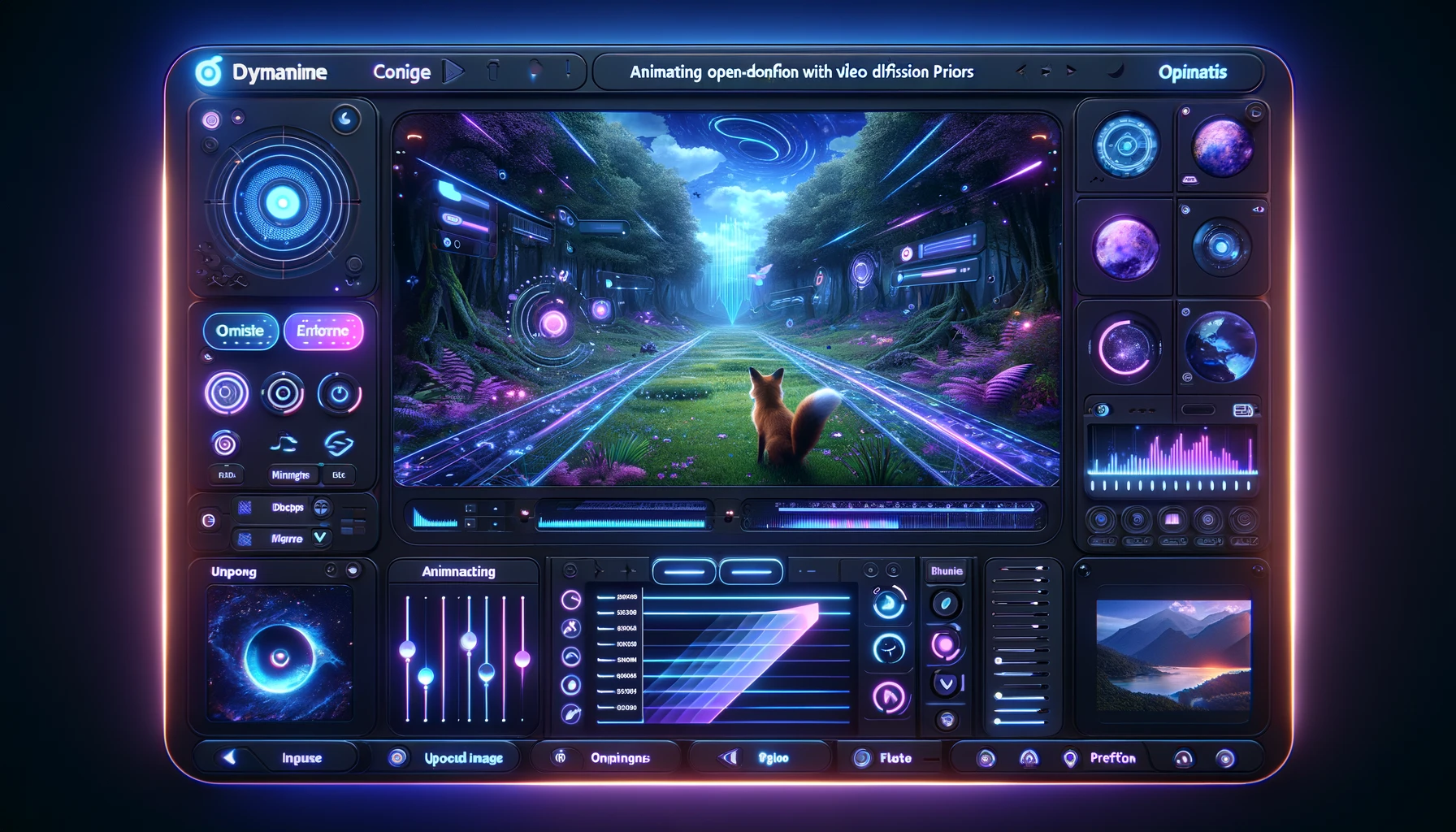
Computer vision is one of the most exciting and well-researched fields within the AI community today, and despite the rapid enhancement of the computer vision models, a longstanding challenge that still troubles developers is image animation. Even today, image animation frameworks struggle to convert still images into their respective video counterparts that display natural dynamics while preserving the original appearance of the images. Traditionally, image animation frameworks focus primarily on animating natural scenes with domain-specific motions like human hair or body motions, or stochastic dynamics like fluids and clouds. Although this approach works to a certain extent, it does limit the applicability of these animation frameworks to more generic visual content.
Furthermore, conventional image animation approaches concentrate primarily on synthesizing oscillating and stochastic motions, or on customizing for specific object categories. However, a notable flaw with the approach is the strong assumptions that are imposed on these methods that ultimately limits their applicability especially across general scenarios like open-domain image animation. Over the past few years, T2V or Text to Video models have demonstrated remarkable success in generating vivid and diverse videos using textual prompts, and this demonstration of T2V models is what forms the foundation for the DynamiCrafter framework.
The DynamiCrafter framework is an attempt to overcome the current limitations of image animation models and expand their applicability to generic scenarios involving open-world images. The DynamiCrafter framework attempts to synthesize dynamic content for open-domain images, converting them into animated videos. The key idea behind DynamiCrafter is to incorporate the image as guidance into the generative process in an attempt to utilize the motion prior of the already existing text to video diffusion models. For a given image, the DynamiCrafter model first implements a query transformer that projects the image into a text-aligned rich context representation space, facilitating the video model to digest the image content in a compatible manner. However, the DynamiCrafter model still struggles to preserve some visual details in the resultant videos, a problem that the DynamiCrafter model overcomes by feeding the full image to the diffusion model by concatenating the image with the initial noises, therefore supplementing the model with more precise image information.
This article aims to cover the DynamiCrafter framework in depth, and we explore the mechanism, the methodology, the architecture of the framework along with its comparison with state of the art image and video generation frameworks. So let’s get started.
DynamiCrafter : Open-Domain Images Animation
Animating a still image often offers an engaging visual experience for the audience as it seems to bring the still image to life. Over the years, numerous frameworks have explored various methods of animating still images. Initial animation frameworks implemented physical simulation based approaches that focused on simulating the motion of specific objects. However, due to the independent modeling of each object category, these approaches were neither effective nor they had generalizability. To replicate more realistic motions, reference-based methods emerged that transferred motion or appearance information from reference signals like videos to the synthesis process. Although reference based approaches delivered better results with better temporal coherence when compared to simulation based approaches, they needed additional guidance that limited their practical applications.
In recent years, a majority of animation frameworks focus primarily on animating natural scenes with stochastic, domain-specific or oscillating motions. Although the approach implemented by these frameworks work to a certain extent, the results these frameworks generate are not satisfactory, with significant room for improvement. The remarkable results achieved by Text to Video generative models in the past few years has inspired the developers of the DynamiCrafter framework to leverage the powerful generative capabilities of Text to Video models for image animation.
The key foundation of the DynamiCrafter framework is to incorporate a conditional image in an attempt to govern the video generation process of Text to Video diffusion models. However, the ultimate goal of image animation still remains non-trivial since image animation requires preservation of details as well as understanding visual contexts essential for creating dynamics. However, multi-modal controllable video diffusion models like VideoComposer have attempted to enable video generation with visual guidance from an image. However, these approaches are not suitable for image animation since they either result in abrupt temporal changes or low visual conformity to the input image owing to their less comprehensive image injection mechanisms. To counter this hurdle, the DyaniCrafter framework proposes a dual-stream injection approach, consisting of visual detail guidance, and text-aligned context representation. The dual-stream injection approach allows the DynamiCrafter framework to ensure the video diffusion model synthesizes detail-preserved dynamic content in a complementary manner.
For a given image, the DynamiCrafter framework first projects the image into the text-aligned context representation space using a specially designed context learning network. To be more specific, the context representation space consists of a learnable query transformer to further promote its adaptation to the diffusion models, and a pre-trained CLIP image encoder to extract text-aligned image features. The model then uses the rich context features using cross-attention layers, and the model uses gated fusion to combine these text features with the cross-attention layers. However, this approach trades the learned context representations with text-aligned visual details that facilitates semantic understanding of image context allowing reasonable and vivid dynamics to be synthesized. Furthermore, in an attempt to supplement additional visual details, the framework concatenates the full image with the initial noise to the diffusion model. As a result, the dual-injection approach implemented by the DynamiCrafter framework guarantees visual conformity as well as plausible dynamic content to the input image.
Moving along, diffusion models or DMs have demonstrated remarkable performance and generative prowess in T2I or Text to Image generation. To replicate the success of T2I models to video generation, VDM or Video Diffusion Models are proposed that uses a space-time factorized U-New architecture in pixel space to model low-resolution videos. Transferring the learnings of T2I frameworks to T2V frameworks will help in reducing the training costs. Although VDM or Video Diffusion Models have the ability to generate high quality videos, they only accept text prompts as the sole semantic guidance that might not reflect a user’s true intentions or might be vague. However, the results of a majority of VDM models rarely adhere to the input image and suffers from the unrealistic temporal variation issue. The DynamiCrafter approach is built upon text-conditioned Video Diffusion Models that leverage their rich dynamic prior for animating open-domain images. It does so by incorporating tailored designs for better semantic understanding and conformity to the input image.
DynamiCrafter : Method and Architecture
For a given still image, the DyanmiCrafter framework attempts to animate the image to video i.e. produce a short video clip. The video clip inherits the visual contents from the image, and exhibits natural dynamics. However, there is a possibility that the image might appear in the arbitrary location of the resulting frame sequence. The appearance of an image in an arbitrary location is a special kind of challenge observed in image-conditioned video generation tasks with high visual conformity requirements. The DynamiCrafter framework overcomes this challenge by utilizing the generative priors of pre-trained video diffusion models.
Image Dynamics from Video Diffusion Prior
Usually, open-domain text to video diffusion models are known to display dynamic visual content modeled conditioning on text descriptions. To animate a still image with Text to Video generative priors, the frameworks should first inject the visual information in the video generation process in a comprehensive manner. Furthermore, for dynamic synthesis, the T2V model should digest the image for context understanding, while it should also be able to preserve the visual details in the generated videos.
Text Aligned Context Representation
To guide video generation with image context, the DynamiCrafter framework attempts to project the image into an aligned embedding space allowing the video model to use the image information in a compatible fashion. Following this, the DynamiCrafter framework employs the image encoder to extract image features from the input image since the text embeddings are generated using a pre-trained CLIP text encoder. Now, although the global semantic tokens from the CLIP image encoder are aligned with the image captions, it primarily represents the visual content at the semantic level, thus failing to capture the full extent of the image. The DynamiCrafter framework implements full visual tokens from the last layer of the CLIP encoder to extract more complete information since these visual tokens demonstrate high-fidelity in conditional image generation tasks. Furthermore, the framework employs context and text embeddings to interact with the U-Net intermediate features using the dual cross-attention layers. The design of this component facilitates the ability of the model to absorb image conditions in a layer-dependent manner. Furthermore, since the intermediate layers of the U-Net architecture associate more with object poses or shapes, it is expected that the image features will influence the appearance of the videos predominantly especially since the two-end layers are more linked to appearance.
Visual Detail Guidance
The DyanmiCrafter framework employs rich-informative context representation that allows the video diffusion model in its architecture to produce videos that resemble the input image closely. However, as demonstrated in the following image, the generated content might display some discrepancies owing to the limited capability of the pre-trained CLIP encoder to preserve the input information completely, since it has been designed to align language and visual features.
To enhance visual conformity, the DynamiCrafter framework proposes to provide the video diffusion model with additional visual details extracted from the input image. To achieve this, the DyanmiCrafter model concatenates the conditional image with per-frame initial noise and feeds them to the denoising U-Net component as guidance.
Training Paradigm
The DynamiCrafter framework integrates the conditional image through two complementary streams that play a significant role in detail guidance and context control. To facilitate the same, the DynamiCrafter model employs a three-step training process
In the first step, the model trains the image context representation network.
In the second step, the model adapts the image context representation network to the Text to Video model.
In the third and final step, the model fine-tunes the image context representation network jointly with the Visual Detail Guidance component.
To adapt image information for compatibility with the Text-to-Video (T2V) model, the DynamiCrafter framework suggests developing a context representation network, P, designed to capture text-aligned visual details from the given image. Recognizing that P requires many optimization steps for convergence, the framework’s approach involves initially training it using a simpler Text-to-Image (T2I) model. This strategy allows the context representation network to concentrate on learning about the image context before integrating it with the T2V model through joint training with P and the spatial layers, as opposed to the temporal layers, of the T2V model.
To ensure T2V compatibility, the DyanmiCrafter framework merges the input image with per-frame noise, proceeding to fine-tune both P and the Visual Discrimination Model’s (VDM) spatial layers. This method is chosen to maintain the integrity of the T2V model's existing temporal insights without the adverse effects of dense image merging, which could compromise performance and diverge from our primary goal. Moreover, the framework employs a strategy of randomly selecting a video frame as the image condition to achieve two objectives: (i) to avoid the network developing a predictable pattern that directly associates the merged image with a specific frame location, and (ii) to encourage a more adaptable context representation by preventing the provision of overly rigid information for any particular frame.
DynamiCrafter : Experiments and Results
The DynamiCrafter framework first trains the context representation network and the image cross-attention layers on Stable Diffusion. The framework then replaces the Stable Diffusion component with VideoCrafter and further fine-tunes the context representation network and spatial layers for adaptation, and with image concatenation. At inference, the framework adopts the DDIM sampler with multi-condition classifier-free guidance. Furthermore, to evaluate the temporal coherence and quality of the videos synthesized in both the temporal and spatial domains, the framework reports FVD or Frechet Video Distance, as well as KVD or Kernel Video Distance, and evaluates the zero-shot performance on all the methods of MSR-VTT and UCF-101 benchmarks. To investigate the perceptual conformity between the generated results and the input image, the framework introduces PIC or Perceptual Input Conformity, and adopts the perceptual distance metric DreamSim as the function of distance.
The following figure demonstrates the visual comparison of generated animated content with different styles and content.
As it can be observed, amongst all the different methods, the DynamiCrafter framework adheres to the input image condition well, and generates temporally coherent videos. The following table contains the statistics from a user study with 49 participants of the preference rate for Temporal Coherence (T.C), and Motion Quality (M.C) along with the selection rate for visual conformity to the input image. (I.C). As it can be observed, the DynamiCrafter framework is able to outperform existing methods by a considerable margin.
The following figure demonstrates the results achieved using the dual-stream injection method and the training paradigm.
Final Thoughts
In this article, we have talked about DynamiCrafter, an attempt to overcome the current limitations of image animation models and expand their applicability to generic scenarios involving open-world images. The DynamiCrafter framework attempts to synthesize dynamic content for open-domain images, converting them into animated videos. The key idea behind DynamiCrafter is to incorporate the image as guidance into the generative process in an attempt to utilize the motion prior of the already existing text to video diffusion models. For a given image, the DynamiCrafter model first implements a query transformer that projects the image into a text-aligned rich context representation space, facilitating the video model to digest the image content in a compatible manner. However, the DynamiCrafter model still struggles to preserve some visual details in the resultant videos, a problem that the DynamiCrafter model overcomes by feeding the full image to the diffusion model by concatenating the image with the initial noises, therefore supplementing the model with more precise image information.
Data labeling is crucial to machine learning model training in AI development. AI algorithms learn to recognize patterns, predict, and perform tasks from accurately labeled data. In this comprehensive guide, we’ll explore data labeling techniques, best practices, and AI project success factors.
We’ve heard a lot about AI in the past decade. From robot assistants to automated industrial processes, this technology has simplified many jobs and lives. Data is a key tool for AI algorithm creation and training. An AI-based algorithm can process massive amounts of data and provide valuable insights.
To make data actionable, it must be labeled so the computer can understand it. Tag your data points to train the Machine Learning algorithm. Machine Learning can automate data processing, but first you must set rules.
What is data labeling?
Data labeling—or data annotation—tags or labels raw data like photos, videos, text, and audio. The data’s entity type, attributes, and characteristics are described by these tags. A Machine Learning model can learn to recognize that type of object in unlabeled data. Data labeling must be efficient and high-quality to train AI and Machine Learning algorithms to understand and learn from your data.
Labeling by class, subject, theme, or other category must be precise. Comprehensive ethical data labeling companies such as Innovatiana improve AI performance and accuracy.
Labeling data—why is it important?
Data labeling is essential to machine learning data pre-processing. Labeling organizes data for meaning. It then trains a machine learning model to find “meaning” in new, relevantly similar data. In this process, machine learning practitioners seek quality and quantity. Because machine learning models make decisions based on all labeled data, accurately labeled data in larger quantities creates more useful deep learning models.
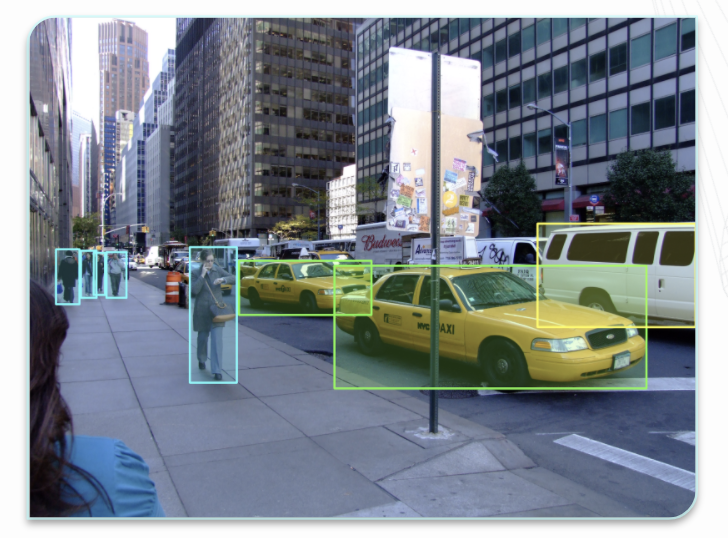
In image labeling or annotation, a human labeler applies bounding boxes to relevant objects to label an image asset. Taxis are yellow, trucks are yellow, and pedestrians are blue. A model that can accurately predict new data (in this case, street view images of objects) will be more successful if it can distinguish cars from pedestrians.
What are the various data labeling types?
Many AI fields work with different data and require different data labeling. Most fields are computer vision for image and video, NLP for text, and audio processing for speech recognition.
Images and videos are used to label data for computer vision
A computer vision model interprets images and videos to identify, classify, and extract object information. Like the example above, this model labels images during data labeling. The labeled data would train the computer vision model to categorize images, recognise object positions, and identify important objects. This model helps retailers manage inventory by identifying shelf products and stock levels.
Data labeling for NLP
AI models can understand spoken and written natural language using NLP. Labelers must identify key passages or label text to train the model in this data labeling method. Even with slightly different wording, the model would learn to understand and interpret the text. The model is often used in customer support chatbots. This model allows a chatbot to understand the question, “When is my package being delivered?” even when phrased differently by customers, such as “When will my package be delivered?” or “What is the delivery date of my package?” and respond accordingly.
Speech recognition through the use of audio processing
Audio processing organizes speech, animal, and construction sounds for Machine Learning. Transcription is often required before audio processing. Tag and classify audio to provide more information.
Speech recognition and NLP often go together. NLP is used to understand text after the audio file is transcribed.
Labeled vs. unlabeled data
Labeled data is a term that is used to describe a data point that has a tag attached to it, which could be a name, a type, or a number. The term “unlabeled data” refers to information that has not been given a label on any occasion.
In order to gain an understanding of the distinction between labeled data and unlabeled data, we will first become familiar with the three different types of machine learning that are available to us. Different kinds of data are required for each of the different types of machine learning.
Data labeling capabilities of an AI data engine
Locating and training human labelers (annotators) starts data labeling projects. Annotators must be trained on each annotation project’s specifications and guidelines because use cases, teams, and organizations have different needs.
After training, image and video annotators will label hundreds or thousands of images and videos using home-grown or open-source labeling tools. An efficient labeling data engine will be available to advanced AI teams.
An AI data engine has all the tools needed to label any data modality. Iterative data labeling is encouraged by this software. An AI data engine allows AI teams to label data in smaller batches instead of using one large dataset to train their model. AI teams provide more scrutiny and feedback at the start of the project, making it more agile. To streamline and improve data labeling, this approach prioritizes labeler-AI collaboration.
A recent Stanford University study found that this agile, data-centric approach reduces training data by 10% to 50%, depending on the task. This reduces data labeling time and cost.
AI data engines enable this iterative data labeling approach and include features to optimize your projects.
Powerful data labeling tools
The right AI data engine for your team should support enough labels and annotations per asset without slowing loading times. This lets you use the data engine for simple and complex use cases, which your team may need in the future.
Ontology-based customization
The AI data engine can be configured to your exact data structure (ontology) requirements to ensure data labeling consistency and scalability as your use cases grow. Labelbox makes it easy to copy your ontology across projects for cascading changes or starting from scratch.
Wide-ranging device performance focus
A best-in-class AI data engine with an intuitive user interface reduces labelers’ cognitive load and speeds data labeling. Professional annotators who work in editors all day need high performance on low-spec PCs and laptops.
Connect data via Python SDK or API for easy labeling
Labeled data should be fed into TensorFlow and PyTorch from an AI data engine. Labelbox is developer-friendly and API-first, so you can scale up and connect your ML models to speed up data labeling and orchestrate active learning.
Data labeling benchmarks and consensus
Quality is measured by labeled data consistency and accuracy. Benchmarks (gold standard), consensus, and review are industry data quality standards.
An AI data scientist must determine the best quality assurance procedures for your machine learning project.
Quality assurance runs automatically during training data development and improvement. Labelbox consensus and benchmark lets you automate consistency and accuracy tests. These tests let you choose the percentage of data to test and how many labelers to annotate it.
Monitoring performance and collaboration
For scalability and security, you need a system to invite and supervise data labelers with expertise in platforms such as CVAT. An AI data engine should invite and review users individually.
Labelbox makes it easy to start a project and invite new members, and there are many ways to track their performance, including image labeling time. You can use automatic labeler consensus or gold standard benchmarks to control quality.
Final thoughts on data labeling with an AI data engine
The old method of training your model with one large dataset no longer works. Machine learning has evolved to be more agile, curating datasets to speed up data labeling and train the model, then evaluating its performance and modifying the next dataset.
An AI data engine promotes this iterative process and gives AI teams tools to accelerate data labeling, allowing them to build better AI products faster. Thus, successful AI product deployment requires an AI data engine.
Large language models (LLMs) like GPT-4, LaMDA, PaLM, and others have taken the world by storm with their remarkable ability to understand and generate human-like text on a vast range of topics. These models are pre-trained on massive datasets comprising billions of words from the internet, books, and other sources.
This pre-training phase imbues the models with extensive general knowledge about language, topics, reasoning abilities, and even certain biases present in the training data. However, despite their incredible breadth, these pre-trained LLMs lack specialized expertise for specific domains or tasks.
This is where fine-tuning comes in – the process of adapting a pre-trained LLM to excel at a particular application or use-case. By further training the model on a smaller, task-specific dataset, we can tune its capabilities to align with the nuances and requirements of that domain.
Fine-tuning is analogous to transferring the wide-ranging knowledge of a highly educated generalist to craft an subject matter expert specialized in a certain field. In this guide, we'll explore the whats, whys, and hows of fine-tuning LLMs.
Fine-tuning Large Language Models
What is Fine-Tuning?
At its core, fine-tuning involves taking a large pre-trained model and updating its parameters using a second training phase on a dataset tailored to your target task or domain. This allows the model to learn and internalize the nuances, patterns, and objectives specific to that narrower area.
While pre-training captures broad language understanding from a huge and diverse text corpus, fine-tuning specializes that general competency. It's akin to taking a Renaissance man and molding them into an industry expert.
The pre-trained model's weights, which encode its general knowledge, are used as the starting point or initialization for the fine-tuning process. The model is then trained further, but this time on examples directly relevant to the end application.
By exposing the model to this specialized data distribution and tuning the model parameters accordingly, we make the LLM more accurate and effective for the target use case, while still benefiting from the broad pre-trained capabilities as a foundation.
Why Fine-Tune LLMs?
There are several key reasons why you may want to fine-tune a large language model:
Domain Customization: Every field, from legal to medicine to software engineering, has its own nuanced language conventions, jargon, and contexts. Fine-tuning allows you to customize a general model to understand and produce text tailored to the specific domain.
Task Specialization: LLMs can be fine-tuned for various natural language processing tasks like text summarization, machine translation, question answering and so on. This specialization boosts performance on the target task.
Data Compliance: Highly regulated industries like healthcare and finance have strict data privacy requirements. Fine-tuning allows training LLMs on proprietary organizational data while protecting sensitive information.
Limited Labeled Data: Obtaining large labeled datasets for training models from scratch can be challenging. Fine-tuning allows achieving strong task performance from limited supervised examples by leveraging the pre-trained model's capabilities.
Model Updating: As new data becomes available over time in a domain, you can fine-tune models further to incorporate the latest knowledge and capabilities.
Mitigating Biases: LLMs can pick up societal biases from broad pre-training data. Fine-tuning on curated datasets can help reduce and correct these undesirable biases.
In essence, fine-tuning bridges the gap between a general, broad model and the focused requirements of a specialized application. It enhances the accuracy, safety, and relevance of model outputs for targeted use cases.
Fine-tuning Large Language Models
The provided diagram outlines the process of implementing and utilizing large language models (LLMs), specifically for enterprise applications. Initially, a pre-trained model like T5 is fed structured and unstructured company data, which may come in various formats such as CSV or JSON. This data undergoes supervised, unsupervised, or transfer fine-tuning processes, enhancing the model's relevance to the company's specific needs.
Once the model is fine-tuned with the company data, its weights are updated accordingly. The trained model then iterates through further training cycles, continually improving its responses over time with new company data. The process is iterative and dynamic, with the model learning and retraining to adapt to evolving data patterns.
The output of this trained model—tokens and embeddings representing words—is then deployed for various enterprise applications. These applications can range from chatbots to healthcare, each requiring the model to understand and respond to industry-specific queries. In finance, applications include fraud detection and threat analysis; in healthcare, models can assist with patient inquiries and diagnostics.
The trained model's capacity to process and respond to new company data over time ensures that its utility is sustained and grows. As a result, enterprise users can interact with the model through applications, asking questions and receiving informed responses that reflect the model's training and fine-tuning on domain-specific data.
This infrastructure supports a broad range of enterprise applications, showcasing the versatility and adaptability of LLMs when properly implemented and maintained within a business context.
Fine-Tuning Approaches
There are two primary strategies when it comes to fine-tuning large language models:
1) Full Model Fine-tuning
In the full fine-tuning approach, all the parameters (weights and biases) of the pre-trained model are updated during the second training phase. The model is exposed to the task-specific labeled dataset, and the standard training process optimizes the entire model for that data distribution.
This allows the model to make more comprehensive adjustments and adapt holistically to the target task or domain. However, full fine-tuning has some downsides:
It requires significant computational resources and time to train, similar to the pre-training phase.
The storage requirements are high, as you need to maintain a separate fine-tuned copy of the model for each task.
There is a risk of “catastrophic forgetting”, where fine-tuning causes the model to lose some general capabilities learned during pre-training.
Despite these limitations, full fine-tuning remains a powerful and widely used technique when resources permit and the target task diverges significantly from general language.
2) Efficient Fine-Tuning Methods
To overcome the computational challenges of full fine-tuning, researchers have developed efficient strategies that only update a small subset of the model's parameters during fine-tuning. These parametrically efficient techniques strike a balance between specialization and reducing resource requirements.
Some popular efficient fine-tuning methods include:
Prefix-Tuning: Here, a small number of task-specific vectors or “prefixes” are introduced and trained to condition the pre-trained model's attention for the target task. Only these prefixes are updated during fine-tuning.
LoRA (Low-Rank Adaptation): LoRA injects trainable low-rank matrices into each layer of the pre-trained model during fine-tuning. These small rank adjustments help specialize the model with far fewer trainable parameters than full fine-tuning.
Sure, I can provide a detailed explanation of LoRA (Low-Rank Adaptation) along with the mathematical formulation and code examples. LoRA is a popular parameter-efficient fine-tuning (PEFT) technique that has gained significant traction in the field of large language model (LLM) adaptation.
What is LoRA?
LoRA is a fine-tuning method that introduces a small number of trainable parameters to the pre-trained LLM, allowing for efficient adaptation to downstream tasks while preserving the majority of the original model's knowledge. Instead of fine-tuning all the parameters of the LLM, LoRA injects task-specific low-rank matrices into the model's layers, enabling significant computational and memory savings during the fine-tuning process.
Mathematical Formulation
LoRA (Low-Rank Adaptation) is a fine-tuning method for large language models (LLMs) that introduces a low-rank update to the weight matrices. For a weight matrix 0∈W0∈Rd×k, LoRA adds a low-rank matrix BA, with A∈Rr×k and B∈Rd×r, where r is the rank. This approach significantly reduces the number of trainable parameters, enabling efficient adaptation to downstream tasks with minimal computational resources. The updated weight matrix is given by W=W0+B⋅A.
This low-rank update can be interpreted as modifying the original weight matrix $W_{0}$ by adding a low-rank matrix $BA$. The key advantage of this formulation is that instead of updating all $d times k$ parameters in $W_{0}$, LoRA only needs to optimize $r times (d + k)$ parameters in $A$ and $B$, significantly reducing the number of trainable parameters.
Here's an example in Python using the peft library to apply LoRA to a pre-trained LLM for text classification:
In this example, we load a pre-trained BERT model for sequence classification and define a LoRA configuration. The r parameter specifies the rank of the low-rank update, and lora_alpha is a scaling factor for the update. The target_modules parameter indicates which layers of the model should receive the low-rank updates. After creating the LoRA-enabled model, we can proceed with the fine-tuning process using the standard training procedure.
Adapter Layers: Similar to LoRA, but instead of low-rank updates, thin “adapter” layers are inserted within each transformer block of the pre-trained model. Only the parameters of these few new compact layers are trained.
Prompt Tuning: This approach keeps the pre-trained model frozen completely. Instead, trainable “prompt” embeddings are introduced as input to activate the model's pre-trained knowledge for the target task.
These efficient methods can provide up to 100x compute reductions compared to full fine-tuning, while still achieving competitive performance on many tasks. They also reduce storage needs by avoiding full model duplication.
However, their performance may lag behind full fine-tuning for tasks that are vastly different from general language or require more holistic specialization.
The Fine-Tuning Process
Regardless of the fine-tuning strategy, the overall process for specializing an LLM follows a general framework:
Dataset Preparation: You'll need to obtain or create a labeled dataset that maps inputs (prompts) to desired outputs for your target task. For text generation tasks like summarization, this would be input text to summarized output pairs.
Dataset Splitting: Following best practices, split your labeled dataset into train, validation, and test sets. This separates data for model training, hyperparameter tuning, and final evaluation.
Hyperparameter Tuning: Parameters like learning rate, batch size, and training schedule need to be tuned for the most effective fine-tuning on your data. This usually involves a small validation set.
Model Training: Using the tuned hyperparameters, run the fine-tuning optimization process on the full training set until the model's performance on the validation set stops improving (early stopping).
Evaluation: Assess the fine-tuned model's performance on the held-out test set, ideally comprising real-world examples for the target use case, to estimate real-world efficacy.
Deployment and Monitoring: Once satisfactory, the fine-tuned model can be deployed for inference on new inputs. It's crucial to monitor its performance and accuracy over time for concept drift.
While this outlines the overall process, many nuances can impact fine-tuning success for a particular LLM or task. Strategies like curriculum learning, multi-task fine-tuning, and few-shot prompting can further boost performance.
Additionally, efficient fine-tuning methods involve extra considerations. For example, LoRA requires techniques like conditioning the pre-trained model outputs through a combining layer. Prompt tuning needs carefully designed prompts to activate the right behaviors.
Advanced Fine-Tuning: Incorporating Human Feedback
While standard supervised fine-tuning using labeled datasets is effective, an exciting frontier is training LLMs directly using human preferences and feedback. This human-in-the-loop approach leverages techniques from reinforcement learning:
PPO (Proximal Policy Optimization): Here, the LLM is treated as a reinforcement learning agent, with its outputs being “actions”. A reward model is trained to predict human ratings or quality scores for these outputs. PPO then optimizes the LLM to generate outputs maximizing the reward model's scores.
RLHF (Reinforcement Learning from Human Feedback): This extends PPO by directly incorporating human feedback into the learning process. Instead of a fixed reward model, the rewards come from iterative human evaluations on the LLM's outputs during fine-tuning.
While computationally intensive, these methods allow molding LLM behavior more precisely based on desired characteristics evaluated by humans, beyond what can be captured in a static dataset.
Companies like Anthropic used RLHF to imbue their language models like Claude with improved truthfulness, ethics, and safety awareness beyond just task competence.
Potential Risks and Limitations
While immensely powerful, fine-tuning LLMs is not without risks that must be carefully managed:
Bias Amplification: If the fine-tuning data contains societal biases around gender, race, age, or other attributes, the model can amplify these undesirable biases. Curating representative and de-biased datasets is crucial.
Factual Drift: Even after fine-tuning on high-quality data, language models can “hallucinate” incorrect facts or outputs inconsistent with the training examples over longer conversations or prompts. Fact retrieval methods may be needed.
Scalability Challenges: Full fine-tuning of huge models like GPT-3 requires immense compute resources that may be infeasible for many organizations. Efficient fine-tuning partially mitigates this but has trade-offs.
Catastrophic Forgetting: During full fine-tuning, models can experience catastrophic forgetting, where they lose some general capabilities learned during pre-training. Multi-task learning may be needed.
IP and Privacy Risks: Proprietary data used for fine-tuning can leak into publicly released language model outputs, posing risks. Differential privacy and information hazard mitigation techniques are active areas of research.
Overall, while exceptionally useful, fine-tuning is a nuanced process requiring care around data quality, identity considerations, mitigating risks, and balancing performance-efficiency trade-offs based on use case requirements.
The Future: Language Model Customization At Scale
Looking ahead, advancements in fine-tuning and model adaptation techniques will be crucial for unlocking the full potential of large language models across diverse applications and domains.
More efficient methods enabling fine-tuning even larger models like PaLM with constrained resources could democratize access. Automating dataset creation pipelines and prompt engineering could streamline specialization.
Self-supervised techniques to fine-tune from raw data without labels may open up new frontiers. And compositional approaches to combine fine-tuned sub-models trained on different tasks or data could allow constructing highly tailored models on-demand.
Ultimately, as LLMs become more ubiquitous, the ability to customize and specialize them seamlessly for every conceivable use case will be critical. Fine-tuning and related model adaptation strategies are pivotal steps in realizing the vision of large language models as flexible, safe, and powerful AI assistants augmenting human capabilities across every domain and endeavor.
The current technological landscape is experiencing a pivotal shift towards edge computing, spurred by rapid advancements in generative AI (GenAI) and traditional AI workloads. Historically reliant on cloud computing, these AI workloads are now encountering the limits of cloud-based AI, including concerns over data security, sovereignty, and network connectivity.
Working around these limitations of cloud-based AI, organizations are looking to embrace edge computing. Edge computing’s ability to enable real-time analysis and responses at the point where data is created and consumed is why organizations see it as critical for AI innovation and business growth.
With its promise of faster processing with zero-to-minimal latency, edge AI can dramatically transform emerging applications. While the edge device computing capabilities are increasingly getting better, there are still limitations that can make implementing highly accurate AI models difficult. Technologies and approaches such as model quantization, imitation learning, distributed inferencing and distributed data management can help remove the barriers to more efficient and cost-effective edge AI deployments so organizations can tap into their true potential.
A “Cloud-Only” Approach to AI Won’t Meet The Needs of Next-Gen Applications
AI inference in the cloud is often impacted by latency issues, causing delays in data movement between devices and cloud environments. Organizations are realizing the cost of moving data across regions, into the cloud, and back and forth from the cloud to the edge. It can hinder applications that require extremely fast, real-time responses, such as financial transactions or industrial safety systems. Additionally, when organizations must run AI-powered applications in remote locations where network connectivity is unreliable, the cloud isn’t always in reach.
The limitations of a "cloud-only" AI strategy are becoming increasingly evident, especially for next-generation AI-powered applications that demand fast, real-time responses. Issues such as network latency can slow insights and reasoning that can be delivered to the application in the cloud, leading to delays and increased costs associated with data transmission between the cloud and edge environments. This is particularly problematic for real-time applications, especially in remote areas with intermittent network connectivity. As AI takes center stage in decision-making and reasoning, the physics of moving data around can be extremely costly with a negative impact on business outcomes.
Gartner predicts that more than 55% of all data analysis by deep neural networks will occur at the point of capture in an edge system by 2025, up from less than 10% in 2021. Edge computing helps alleviate latency, scalability, data security, connectivity and more challenges, reshaping the way data processing is handled and, in turn, accelerating AI adoption. Developing applications with an offline-first approach will be critical for the success of agile applications.
With an effective edge strategy, organizations can get more value from their applications and make business decisions faster.
Edge AI Made Possible With Evolving Technologies, Approaches
As AI models become increasingly sophisticated and application architectures grow more complex, the challenge of deploying these models on edge devices with computational constraints becomes more pronounced. However, advancements in technology and evolving methodologies are paving the way for the efficient integration of powerful AI models within the edge computing framework ranging from:
Model Compression and Quantization
Techniques such as model pruning and quantization are crucial for reducing the size of AI models without significantly compromising their accuracy. Model pruning eliminates redundant or non-critical information from the model, while quantization reduces the precision of the numbers used in the model's parameters, making the models lighter and faster to run on resource-constrained devices. Model Quantization is a technique that involves compressing large AI models to improve portability and reduce model size, making models more lightweight and suitable for edge deployments. Using fine-tuning techniques, including Generalized Post-Training Quantization (GPTQ), Low-Rank Adaptation (LoRA) and Quantized LoRA (QLoRA), model quantization lowers the numerical precision of model parameters, making models more efficient and accessible for edge devices like tablets, edge gateways and mobile phones.
Edge-Specific AI Frameworks
The development of AI frameworks and libraries specifically designed for edge computing can simplify the process of deploying edge AI workloads. These frameworks are optimized for the computational limitations of edge hardware and support efficient model execution with minimal performance overhead.
Databases with Distributed Data Management
With capabilities such as vector search and real-time analytics, help meet the edge’s operational requirements and support local data processing, handling various data types, such as audio, images and sensor data. This is especially important in real-time applications like autonomous vehicle software, where diverse data types are constantly being collected and must be analyzed in real-time.
Distributed Inferencing
Which places models or workloads across multiple edge devices with local data samples without actual data exchange can mitigate potential compliance and data privacy issues. For applications, such as smart cities and industrial IoT, that involve many edge and IoT devices, distributing inferencing is crucial to take into account.
Balancing the Placement of AI Workloads
While AI has been predominantly processed in the cloud, finding a balance with edge will be critical to accelerating AI initiatives. Most, if not all, industries have recognized AI and GenAI as a competitive advantage, which is why gathering, analyzing and quickly gaining insights at the edge will be increasingly important. As organizations evolve their AI use, implementing model quantization, multimodal capabilities, data platforms and other edge strategies will help drive real-time, meaningful business outcomes.
Rahul Pradhan is VP of Product and Strategy at Couchbase (NASDAQ: BASE), provider of a leading modern database for enterprise applications that 30% of the Fortune 100 depend on. Rahul has over 20 years of experience leading and managing both engineering and product teams focusing on databases, storage, networking, and security technologies in the cloud. Before Couchbase, he led the Product Management and Business Strategy team for Dell EMC's Emerging Technologies and Midrange Storage Divisions to bring all flash NVMe, Cloud, and SDS products to market.
More On This Topic
Cloud Storage Adoption is the Need of the Hour for Business
How Has the Adoption of AI in Algorithmic Trading Affected the…
How ML Model Explainability Accelerates the AI Adoption Journey for…
2022 INFORMS Business Analytics Conference: Join us for…
Tech visionaries to address accelerating machine learning, unifying…
Data Labeling for Machine Learning: Market Overview, Approaches, and Tools