Databricks spent $10M on new DBRX generative AI model, but it can’t beat GPT-4

Databricks spent $10M on new DBRX generative AI model, but it can’t beat GPT-4 Kyle Wiggers 7 hours
If you wanted to raise the profile of your major tech company and had $10 million to spend, how would you spend it? On a Super Bowl ad? An F1 sponsorship?

You could spend it training a generative AI model. While not marketing in the traditional sense, generative models are attention grabbers — and increasingly funnels to vendors’ bread-and-butter products and services.

See Databricks’ DBRX, a new generative AI model announced today akin to OpenAI’s GPT series and Google’s Gemini. Available on GitHub and the AI dev platform Hugging Face for research as well as for commercial use, base (DBRX Base) and fine-tuned (DBRX Instruct) versions of DBRX can be run and tuned on public, custom or otherwise proprietary data.

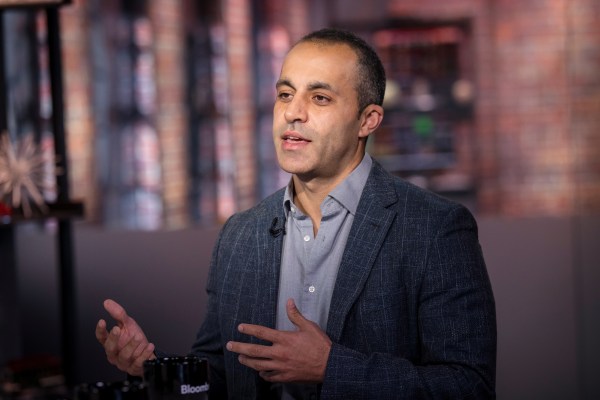
“DBRX was trained to be useful and provide information on a wide variety of topics,” Naveen Rao, VP of generative AI at Databricks, told TechCrunch in an interview. “DBRX has been optimized and tuned for English language usage, but is capable of conversing and translating into a wide variety of languages, such as French, Spanish and German.”

Databricks describes DBRX as “open source” in a similar vein as “open source” models like Meta’s Llama 2 and AI startup Mistral’s models. (It’s the subject of robust debate as to whether these models truly meet the definition of open source.)

Databricks says that it spent roughly $10 million and eight months training DBRX, which it claims (quoting from a press release) “outperform[s] all existing open source models on standard benchmarks.”

But — and here’s the marketing rub — it’s exceptionally hard to use DBRX unless you’re a Databricks customer.

That’s because, in order to run DBRX in the standard configuration, you need a server or PC with at least four Nvidia H100 GPUs. A single H100 costs thousands of dollars — quite possibly more. That might be chump change to the average enterprise, but for many developers and solopreneurs, it’s well beyond reach.

And there’s fine print to boot. Databricks says that companies with more than 700 million active users will face “certain restrictions” comparable to Meta’s for Llama 2, and that all users will have to agree to terms ensuring that they use DBRX “responsibly.” (Databricks hadn’t volunteered those terms’ specifics as of publication time.)

Databricks presents its Mosaic AI Foundation Model product as the managed solution to these roadblocks, which in addition to running DBRX and other models provides a training stack for fine-tuning DBRX on custom data. Customers can privately host DBRX using Databricks’ Model Serving offering, Rao suggested, or they can work with Databricks to deploy DBRX on the hardware of their choosing.

Rao added:

We’re focused on making the Databricks platform the best choice for customized model building, so ultimately the benefit to Databricks is more users on our platform. DBRX is a demonstration of our best-in-class pre-training and tuning platform, which customers can use to build their own models from scratch. It’s an easy way for customers to get started with the Databricks Mosaic AI generative AI tools. And DBRX is highly capable out-of-the-box and can be tuned for excellent performance on specific tasks at better economics than large, closed models.

Databricks claims DBRX runs up to 2x faster than Llama 2, in part thanks to its mixture of experts (MoE) architecture. MoE — which DBRX shares in common with Llama 2, Mistral’s newer models, and Google’s recently announced Gemini 1.5 Pro — basically breaks down data processing tasks into multiple subtasks and then delegates these subtasks to smaller, specialized “expert” models.

Most MoE models have eight experts. DBRX has 16, which Databricks says improves quality.

Quality is relative, however.

While Databricks claims that DBRX outperforms Llama 2 and Mistral’s models on certain language understanding, programming, math and logic benchmarks, DBRX falls short of arguably the leading generative AI model, OpenAI’s GPT-4, in most areas outside of niche use cases like database programming language generation.

Rao admits that DBRX has other limitations as well, namely that it — like all other generative AI models — can fall victim to “hallucinating” answers to queries despite Databricks’ work in safety testing and red teaming. Because the model was simply trained to associate words or phrases with certain concepts, if those associations aren’t totally accurate, its responses won’t always accurate.

Also, DBRX is not multimodal, unlike some more recent flagship generative AI models including Gemini. (It can only process and generate text, not images.) And we don’t know exactly what sources of data were used to train it; Rao would only reveal that no Databricks customer data was used in training DBRX.

“We trained DBRX on a large set of data from a diverse range of sources,” he added. “We used open data sets that the community knows, loves and uses every day.”

I asked Rao if any of the DBRX training data sets were copyrighted or licensed, or show obvious signs of biases (e.g. racial biases), but he didn’t answer directly, saying only, “We’ve been careful about the data used, and conducted red teaming exercises to improve the model’s weaknesses.” Generative AI models have a tendency to regurgitate training data, an major concern for commercial users of models trained on unlicensed, copyrighted or very clearly biased data. In the worst-case scenario, a user could end up on the ethical and legal hooks for unwittingly incorporating IP-infringing or biased work from a model into their projects.

Some companies training and releasing generative AI models offer policies covering the legal fees arising from possible infringement. Databricks doesn’t at present — Rao says that the company’s “exploring scenarios” under which it might.

Given this and the other aspects in which DBRX misses the mark, the model seems like a tough sell to anyone but current or would-be Databricks customers. Databricks’ rivals in generative AI, including OpenAI, offer equally if not more compelling technologies at very competitive pricing. And plenty of generative AI models come closer to the commonly understood definition of open source than DBRX.

Rao promises that Databricks will continue to refine DBRX and release new versions as the company’s Mosaic Labs R&D team — the team behind DBRX — investigates new generative AI avenues.

“DBRX is pushing the open source model space forward and challenging future models to be built even more efficiently,” he said. “We’ll be releasing variants as we apply techniques to improve output quality in terms of reliability, safety and bias … We see the open model as a platform on which our customers can build custom capabilities with our tools.”

Judging by where DBRX now stands relative to its peers, it’s an exceptionally long road ahead.

Once Upon a ‘Sora’ in Hollywood

OpenAI is now living the Hollywood dream with its text-to-video platform Sora. AIM won’t be surprised if Sora helps artists and filmmakers elevate their creativity to the ultimate levels and someday win the Oscars and Walk of Fame.

It’s been a busy few months for OpenAI, and there are still no signs of GPT-5. Meanwhile, the hottest AI startup is arranging meetings in Los Angeles with Hollywood studios, media executives, and talent agencies, trying to forge partnerships in the entertainment industry and encourage filmmakers to integrate their latest video generator, Sora, into their work.

It even published a blog illustrating how artists, filmmakers, and creative designers can use Sora to generate surreal videos, which can change the way Hollywood, advertising, and other creative industries work.

In a recent interview, OpenAI chief technology officer Mira Murati said that Sora would be available this year, possibly within “a few months”. However, she appeared hesitant about delving into the specifics of the data Sora was trained on and dodged the question.

“I won’t go into the details of the data used, but it was either publicly available or licensed data,” she said. Murati was trolled for saying that she wasn’t sure whether it used videos from YouTube, Facebook, and Instagram. However, she confirmed that Sora uses content from Shutterstock, with which OpenAI has a partnership.

Comes With a Price

Murati said that Sora could take a few minutes to generate videos, depending on the complexity of the prompt, and that it’s ‘much, much more expensive’. “We don’t know what it’s going to look like exactly when we make it available to the public, but we’re trying to make it available at a similar cost eventually to what we saw with DALL-E,” she added.

The average production cost for a major Hollywood studio movie is approximately $65 million, while the cost of one NVIDIA H100 is $30,000. Training Sora demands substantial compute power, with an estimated requirement ranging from 4,200 to 10,500 NVIDIA H100 GPUs for a month-long training period, according to a report by Factorial Funds.

The inference cost for diffusion-based models like Sora is significantly higher than that of LLMs, reaching multiple orders of magnitude. If Sora becomes publicly available, approximately 720,000 NVIDIA H100s GPUs would be required to support the TikTok and YouTube communities alone.

The subscription cost for Sora is expected to be high, leading to the likelihood that OpenAI may keep the access limited to filmmakers, studios, and artists. In a poll on X, a majority of the respondents declined to pay $99 per month for a Sora subscription.

Would you pay $99/mo for unlimited Sora generations?

— AI Breakfast (@AiBreakfast) March 26, 2024

If OpenAI plans to make Sora available to the general public, the computational demand will increase significantly. Therefore, hosting Sora at the price of DALL-E 3 is not feasible.

Perfect Sora Doesn’t Exist

A Toronto-based multimedia production company, Shy Kids, created a short film titled Air Head using Sora, featuring a protagonist with a balloon for a head.

OpenAl just released one of the first short films, “Air head”, created by the artists Shy Kids using Sora Al pic.twitter.com/8WaVliT3ZR

— Historic Vids (@historyinmemes) March 27, 2024

While the short film garnered quick praise, it is crucial to acknowledge that AI-generated films are yet to achieve consistent character portrayals. “True character consistency with AI is quite challenging. You can fly a drone through the tunnel, but to maintain character consistency, you have to use a yellow balloon,” wrote a user on X.

AI Researcher at Google, Jon Barron, wrote, “Generative video technology (e.g. Sora) has two huge challenges in front of it that will likely slow adoption by Hollywood et al: 1) high latency (waiting minutes/hours to get seconds of footage), and 2) lack of controllability (the video you get back isn’t necessarily what you wanted). These are hard problems to solve, but history suggests we only need to solve one of them.”

Only time will tell how serious OpenAI is about Sora as a creative tool for filmmakers. “OpenAI is an AI company, not a VFX company. Besides not even understanding the needs of their users, they see this model as a neat intermediate result on their path to the AGI, and as a progress report to raise more money,” wrote a user on Hacker News.

“They’re really interested in advanced emergent behaviour it exhibits, not in artistic tools. For this reason, they’ve never bothered to fix all the artifacts DALL-E 3 gives, let alone add any tooling to it. Sora will be the same, and its quality doesn’t even remotely approach what is required in production. It’s more of an experiment,” the user added.

Despite the limitations, there’s no denying that Sora could be a key tool for OpenAI to generate massive revenues. It would also be interesting if the company released a movie about Sam Altman’s ousting and the mysterious disappearance of Ilya Sutskever using Sora.

All in all, OpenAI is nothing without drama, and what better place for that than Hollywood?

The post Once Upon a ‘Sora’ in Hollywood appeared first on Analytics India Magazine.

Meet the 21-Year-Old Creator of Devika, the Indian Open Source Devin Alternative

Meet the 21-Year-Old Creator of Devika, the Indian Open Source Devin Alternative

Just a few days after Cognition Labs launched AI software engineer Devin, Mufeed VH (Hamzakutty), the founder of Lyminal and Stition.AI, created an open source passion project called Devika. This Indian version of Devin can understand human instructions, break them down into tasks, conduct research, and autonomously write code to achieve set objectives.

“There’s actually a funny story about how Devika was created.” Mufeed told AIM that he was just chilling and experimenting with different tools when he came across Devin and was impressed by the demo just like everyone else was. “I started thinking about what could be the name of an Indian version of Devin, and I got to Devika. I just posted it out like a joke,” he added.

Mufeed, the 21-year-old genius was born in Thrissur, Kerala and is the founder of Lyminal and Stition.AI, where he is focusing on building security products for LLMs. He was also the gold medalist at the IndiaSkills 2021 Nationals in cybersecurity when he was just 19 years old. That is when he started his cybersecurity startup.

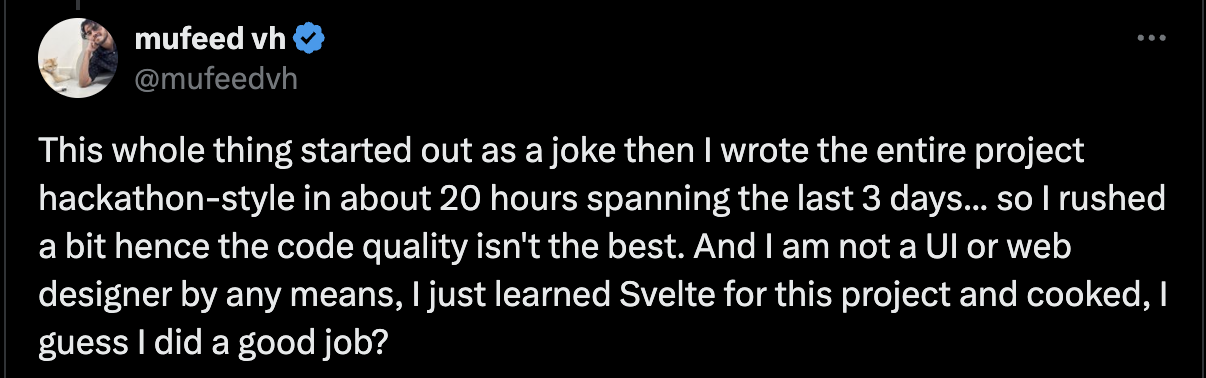
The post above got a lot of traction on X and Mufeed was flooded with messages from people about wanting to work on such a project. “Hold on, why not make it serious?” he thought when he realised that people really want something like Devin from India. “It took me around 20 hours over three days, and Devika started showing promise,” Mufeed, who started working on it in his free time, said.

Drawing from the experience of working on a similar product at Stition.AI, Mufeed had some ideas on how to make Devika a reality. “When I posted about it on X, the response was overwhelming,” he said. The project gained traction rapidly, even though he hadn’t anticipated such a reaction. Before long, it was gaining popularity, and now it has 10k stars on GitHub and a growing community contributing to it.

“I recently held a talk about our security product but was forced to put a slide about Devika because people were constantly asking me about it,” Mufeed laughed. Stition’s security product that can automatically find safety flaws without human intervention and patch vulnerabilities is in public beta since December. The company plans to launch the product soon.

Devika, which was just a side project for Mufeed, has unwittingly become one of his key priorities.

Think of Devika as a Software Engineering Intern

Devika’s strength lies in its ability to function as an AI-assistant programmer, reducing the need for extensive human intervention in complex coding tasks. The main difference between Devin and Devika, apart from the latter being open source, is that Mufeed used Claude 3 instead of GPT-4 for Devika.

“Claude 3 Opus is the most powerful model right now and on our company’s benchmarks it was better than GPT-4,” he said, and added that Claude 3 Haiku is better than GPT-3.5. Another reason was the 200k context length of Claude 3 models compared to the 128k of GPT-4.

“I have been getting these questions about the exact intention behind creating this,” said Mufeed, commenting on how such AI tools have been touted as the replacement for programmers. “My intention was to simply make Devika as a help that can automate the mundane tasks for engineers, probably like an intern. You can offload a lot of work to her, but she cannot be a replacement for engineers,” he clarified.

Devika’s core capabilities include advanced AI planning and reasoning algorithms, contextual keyword extraction for focused research, seamless web browsing, and code writing in multiple programming languages.

Increasing Capabilities, Not a Product Yet

Another open-source alternative to Devin is OpenDevin, which when launched only had a readme file on GitHub. “It was very hyped up, but the work is still slow,” said Mufeed. On the other hand, Devika’s already established groundwork garners a lot of attention and contributions from the developer community, and everyone is adding new features.

“We don’t necessarily plan to make it into a product right now,” Mufeed said. “Our goal right now is to score high on the SWE Bench benchmark, which Devin performed excellently on,” he added, also mentioning that a lot of investors are increasingly getting interested in this.

“Additionally, we’re exploring applications beyond security, such as threat modelling and red teaming, to further enhance our products,” said Mufeed. “We’re prioritising making Devika more accessible to non-technical users through easier installation and localisation,” he said, adding that they are also integrating multilingual support, which is already there in Claude 3 Opus for languages like Hindi, Malayalam, and Tamil.

Mufeed and his team want to add more zero-shot capabilities to the model, which essentially would mean making it more user-friendly and accepting of prompts in natural language. He gives an example of how Devin can currently sign up on Reddit, make posts, and read comments. He wants Devika, which will be released in a few days, to perform such tasks too.

The post Meet the 21-Year-Old Creator of Devika, the Indian Open Source Devin Alternative appeared first on Analytics India Magazine.

Marissa Mayer’s startup just rolled out photo sharing and event planning apps, and the internet isn’t sure what to think

Marissa Mayer’s startup just rolled out photo sharing and event planning apps, and the internet isn’t sure what to think Connie Loizos @Cookie / 10 hours

When Marissa Mayer co-founded a startup six years ago in Palo Alto, Ca., expectations were sky high for the former Yahoo CEO and early Google employee. When that startup, Sunshine, revealed that its first app centered around subscription software for contact management, people wondered if something more ambitious might be around the corner. Today, after Sunshine released two equally mundane features – event organizing and photo sharing – internet commenters were decidedly mystified.

I was also baffled last week, when Mayer walked me through Sunshine’s new offerings. Though there are AI components to all that Sunshine offers, it’s hard to understand how Sunshine’s new photo app enhances photo sharing as it exists today, and the same could be said of its new events app, which looks very much like something that was designed 20 years ago and, like other apps, encourages users to share photos tied to events organized on the platform.

It’s tempting to dismiss the 15-person outfit as out of touch. But Mayer may be onto something with Sunshine, and that’s nostalgia. While most Silicon Valley startups focus on the newest new thing, America is getting older, as the U.S. Census Bureau declared last year. Mayer says Sunshine is tackling problems for people “of all ages,” but targeting a slightly older demographic that gravitates toward the familiar would be a smart move. Older Americans now account for a record share of spending. They have the time to socialize and take pictures. Sunshine’s interface is even steeped in the same purple hue that was long associated with Yahoo, which she famously led for five years beginning in 2012.

Asked if the design choice was intentional, Mayer seemed surprised for a moment, calling it “purely coincidental.”

She added that users’ photos are hosted on Sunshine’s servers and “available indefinitely,” and that users can share albums and send invites easily through text, iMessage, email and other sharing platforms. Mayer further stressed that Sunshine will never sell its customers’ data to a third party and that the company is “not building models or deriving any other data for any other purposes from what is shared.”

Mayer sees the need for something simpler, certainly. “There are a lot of companies that focus on that bleeding and leading edge of AI,” she said. “But we think there’s a lot of things that can be done with AI that just help with everyday problems, things that we all experience every day, and are often overlooked.”

She mentioned, for example, that before launching events and photo sharing, Sunshine rolled out a birthday app as “kind of an adjacent area to addresses and contacts.”

She declined to discuss customer numbers, but the product is reminiscent of an app run by entrepreneurs Michael and Xochi Birch called BirthdayAlarm.com. The birthday reminder and e-card site is not exactly design forward, but with more than 50 million registered members at one point, it has made the couple — who earlier sold a social media company to AOL for $850 million in cash — many millions more dollars.

Mayer is friends with Birch and says she was “definitely influenced by Michael. He talked about the fact that [BirthdayAlarm] was a very simple app and got a lot of traction early on.”

Sunshine seemingly didn’t see that kind of traction from contacts management, an area where consumers have largely steered clear owing partly to privacy concerns. But perhaps simple and free (for now) photo sharing and event planning will change the game for Sunshine, which raised a $20 million round in 2020 and is largely self-funded, per Mayer.

In the meantime, Mayer has other tricks up her sleeve, including, eventually, video sharing. “I’ve got a list of all the different things that we thought would be in the first version and will hopefully come out soon after,” she said last week. “The core thesis has always been to take the mundane and make it magical.”

The team “thought about naming it Mundane AI,” she continued. “I sometimes think that might have been a better name.”

Disclosure: TechCrunch is owned by Yahoo.

Apple Vision Pro is Just an Autonomous Vehicle on Steroids

“It’s starting to sound a lot like the technology of a self-driving car but on a headset,” said Diana Hu, while talking about Apple Vision Pro’s functionality and capabilities in a recent Lightcone Podcast from Y Combinator. Hu is a group partner at YC and co-founder of Escher Reality, which was acquired by Niantic, the makers of Pokemon Go.

She pointed out that the technical challenges for an AR/VR headset like Apple Vision Pro are much more complex than those of self-driving vehicles, particularly in terms of hardware specification.

“You don’t want to burn people’s heads with this,” she quipped, comparing it to self-driving cars, which come with server-grade GPUs and CPUs that fit into the trunk.

Further, she said that Apple Vision Pro’s capabilities are way more advanced than Oculus’s, and the purpose of the use is also different – quite the opposite of Meta’s CEO Mark Zukerburg’s glaring review.

“Oculus devices are more focused on gaming in VR, which my guess is one of the reasons VR/AR hasn’t been embraced. A busy person would not use it every single day,” said Hu, adding that Apple has focused fully on productivity instead.

Meta XR vs visionOS

Hu called out the main difference between Meta XR SDK and visionOS SDK, highlighting that the former is deeply integrated with gaming engines like Unity and Unreal, making it ideal for constructing immersive 3D environments. It, however, struggles with the limitless nature of real-world spatial computation.

This is evident in the considerable amount of code required to perform simple tasks, such as opening PDFs, compared to the minimal coding effort needed with the visionOS. “To build an application that opens a PDF for the Meta platform actually takes many lines of code, whereas to build that for the visionOS is actually just a few lines of code,” she added.

However, limitations exist for both platforms. Many aspects are still confined to flat 2D, and there’s uncertainty about how to develop for full 3D.

The ease with which applications can be built on Apple Vision Pro makes it a favourable choice for developers. Many are just obsessed with it at the moment.

Source: X

Extensive Apple Support

Adding to the convenience of developing spatial computing platforms, the company provides massive support to encourage third-party developers to understand Vision Pro’s capabilities and provide supportive tools for designing applications.

Through the visionOS SDK, developers gain insights into the capabilities of Apple Vision Pro and access unique tools like the visionOS simulator, facilitating the creation of innovative experiences. Comprehensive documentation, design kits, and human interface guidelines ensure that developers have the necessary guidance and resources to craft immersive user experiences.

Additionally, developer labs across various global locations offer hands-on consultations with Apple engineers, encouraging every developer to build applications such as those build on the system.

7. Learn how things work and insidepic.twitter.com/XP2q9myeWv

— Min Choi (@minchoi) March 24, 2024

Furthermore, at the recent NVIDIA GTC 2024, CEO Jensen Huang announced NVIDIA’s support for Apple Vision Pro with Omniverse Cloud.

What’s Next?

It has been almost two months since Apple Vision Pro was launched in the US market. Recently, it even announced a launch in China. However, there are no signs of release in the Indian subcontinent.

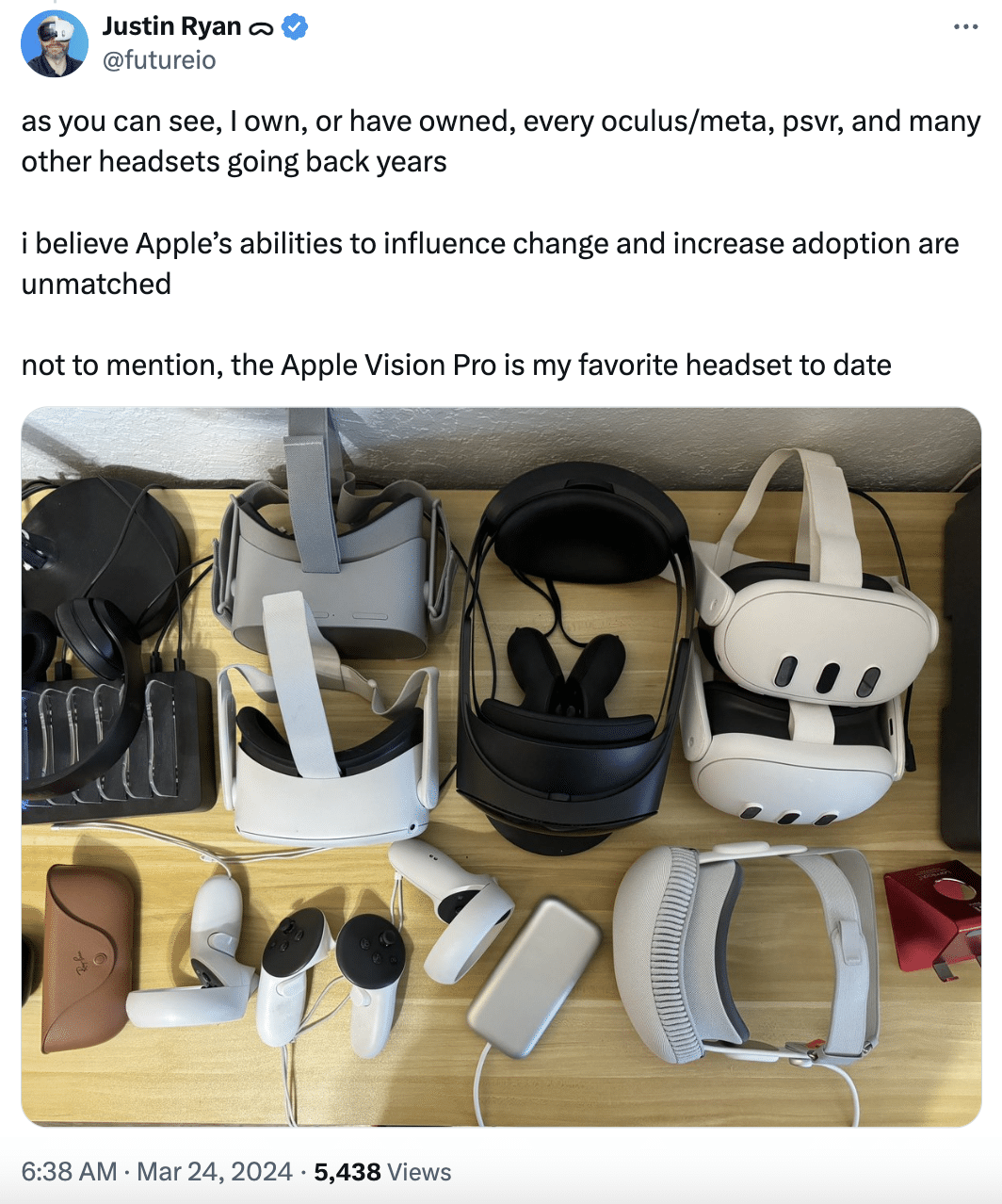
While India, which houses the largest developer ecosystem, waits patiently, users share new and innovative use cases for spatial computing devices. Apple Vision Pro and Meta Quest developer Justin Ryan recently shared a demo of an app, VisionOS Insight Heart, that visualises how a human heart works, paving the way for a new way of education.

That is not all. With over 600 apps and games (as of the launch date) designed for Apple Vision Pro, the device is a goldmine for developers who want to revolutionise businesses.

i mean it when i say that the Apple Vision Pro will be a game changer for education
here’s how I studied the heart 5 years ago vs how I can study it today, credit to the visionOS app Insight Heart
the contrast in experience and comprehension can’t be denied pic.twitter.com/a2Yx60iPsD

— Justin Ryan ᯅ (@futureio) March 23, 2024

At Apple’s upcoming Worldwide Developers Conference (WWDC) scheduled for June 10, 2024, the Cupertino-based tech giant is expected to unleash visionOS advancements alongside other developments.

The post Apple Vision Pro is Just an Autonomous Vehicle on Steroids appeared first on Analytics India Magazine.

Microsoft Shakes Up Leadership Roles as AI Gains Precedence

Highlights of Microsoft Inspire 2022

Mikhail Parakhin, who had been leading the Windows and web experiences team at Microsoft, announced today that he has “decided to explore new roles” and will report to Kevin Scott, Microsoft’s Chief Technology Officer, during the transition period. It is unclear if Parakhin is likely to leave Microsoft or take a new role within the company.

Following Parakhin’s departure, Microsoft has appointed Pavan Davuluri, an IIT Madras alumnus, as the new head of its Windows and Surface teams, according to an internal memo from Rajesh Jha, the company’s head of experiences and devices. Davuluri, who has worked at Microsoft for over 23 years and played a key role in developing custom Surface processors, will now oversee both the Windows and devices teams, reporting directly to Jha.

The memo stated, “As part of this change, we are bringing together the Windows Experiences and Windows + Devices teams as a core part of the Experiences + Devices (E+D) division.” By bringing the teams together, the memo hinted at a more integrated approach in developing technology for Windows, across both client and cloud platforms in the “AI era”.

The leadership changes come just days after Mustafa Suleyman, co-founder of Google DeepMind and former CEO of Inflection AI, joined Microsoft as the head of its new AI team. With the leadership changes at Microsoft and the merging of teams, it looks like the company is serious in integrating hardware, software, and artificial intelligence.

The post Microsoft Shakes Up Leadership Roles as AI Gains Precedence appeared first on Analytics India Magazine.

Rabbit partners with ElevenLabs to power voice commands on its device

Rabbit partners with ElevenLabs to power voice commands on its device Ivan Mehta 8 hours

Hardware maker Rabbit has tapped a partnership with ElevenLabs to power voice commands on its devices. Rabbit is set to ship the first set of r1 devices next month after getting a ton of attention at the Consumer Electronics Show (CES) at the start of the year.

The Rabbit r1 will ship with ElevenLabs’ tech, which will enable voice commands from the users and how the pocket AI device talks back to them. At the launch, the feature will be available only in English with one voice option. ElevenLabs said that while r1 was poised for voice interaction from the start, the company’s low latency models will make interactions more human-like.

“We’re working with rabbit to bring the future of human-device interaction closer. Our collaboration is about making the r1 a truly dynamic co-pilot, ” ElevenLabs’ CEO Mati Staniszewski said in a prepared statement.

In January, Rabbit said that it will use Perplexity AI’s solutions to answer users’ questions on the device.

Earlier this week, Rabbit said that its first batch of $199 r1s will leave the factory by March 31, and will reach users within a few weeks. The company said users will be able to interact with chatbots, get answers from Perplexity, use bi-directional translation, order rides and foods, and play music through the device right out of the box.

The company’s CEO Jesse Lyu said earlier this month at a StrictlyVC event that rabbit is close to having 100,000 device orders.

Earlier this year, ElevenLabs raised $80 million in Series B from investors like Andreessen Horowitz, former GitHub CEO Nat Friedman, and entrepreneur Daniel Gross to get to the unicorn status. The company has been focusing on providing voice cloning services for creating audiobooks, dubbing movies and TV shows, ads, and video game characters. Most recently, India’s audio platform PocketFM, which raised $103 million from Lightspeed, said that it is using ElevenLabs’ services to let creators convert their writings into audio series.

But ElevenLabs’ has faced its fair share of criticism with users trying to fool a bank’s authentication system, 4chan users mimicking celebrities, and journalists documenting that it is easy to set up voice clones to generate problematic content. The startup has rolled out a tool to detect speech created by its platform and is also working on a tool to detect synthesized audio and distribute it to third parties.

MediaTek has the Tech to Power Any Devices in the World

MediaTek’s chips power over 2 billion devices worldwide in a single year. This speaks volumes about the company’s significant grasp in the semiconductor space. Its chips power smartphones, automobiles, VR headsets and even wifi routers and satellites.

Today, the company’s processors are also behind some of the most advanced AI smartphones in the market. For instance, the Vivo X100 series smartphone released last year, marketed by the smartphone maker as the ‘industry’s first AI phone’, is powered by MediaTek’s chipset.

MediaTek’s AI processor allows Vivo to run a 7 billion parameter language model and a 1 billion parameter vision model locally on the device.

At the Forefront of AI Revolution

AI could kickstart a new smartphone upgrade cycle. Last year, the Taiwanese semiconductor company announced its latest AI processor Dimensity 9300. The chipset is equipped with MediaTek’s next-generation APU 790 processor. This processor boasts a remarkable 45% reduction in power consumption alongside enhanced performance. Its processing speed is eight times faster than its predecessor, the APU 690.

Notably, it delivers significant advancements in generative AI performance and energy efficiency for edge computing applications. The APU 790 is purpose-built for generative AI tasks, representing a significant leap forward in capabilities compared to its forerunner.

The APU 790 introduces support for NeuroPilot Fusion, enabling seamless LoRA low-rank adaptation and facilitating the utilisation of large language models featuring 1B, 7B, and 13B parameters, with scalability extended up to 33B.

While MediaTek leads the low-mid segment smartphone market, Dimensity 9300 puts the company in direct competition with Qualcomm in the premium segment.

“The Market Analytics report 2023, published by IDC and Counterpoint, reveals MediaTek’s dominance with a 49% share in the smartphone market, compared to the competition’s 24% share. This sustained leadership position spans nearly a year, both in India and globally,” Anuj Sidharth, deputy director, marketing and corporate communications, told AIM.

Powering Autonomous Vehicles

Recently, MediaTek announced that it is partnering with Graphics Processing Units (GPU) maker NVIDIA to make four new automotive chips for connected and autonomous vehicles – the new Dimensity CV-1, CM-1, CY-1, and CX-1.

The new chips, ranging from CV-1 for entry-level in-vehicle experiences to CX-1 for premium experiences, will integrate AI processing capabilities and an NVIDIA RTX GPU. Furthermore, the platform will be compatible with NVIDIA’s Drive OS software.

As the automotive industry transitions towards electric or self-driving vehicles, it opens the door for innovation and building AI-powered cars. AI can come into play in cockpit solutions, Advanced Driver Assistance Systems (ADAS) to battery management systems.

“The MediaTek cockpit solution, based on flagship three-nanometer technology, offers top-notch performance and user experience. It supports up to eight screens in the car, enabling immersive entertainment like music and social media. While security measures prioritise passenger safety, the solution enhances in-vehicle enjoyment for passengers,” Sidharth said.

Moreover, in India, the two-wheeler EV segment is growing significantly accounting for more than half of all EV sales. Sidharth added, saying that MediaTek’s solutions also power two-wheeler EVs in the country.

The electric two-wheelers in the market, whether from Ola or Ather, are leading companies in this sector, and feature large screens and their own infotainment systems. We all remember Bhavish Aggarwal, founder of Ola, dancing to a song played on one of Ola’s two-wheeler EVs.

Supporting Innovation for India

Earlier this year, the non-profit EPIC Foundation introduced the inaugural ‘Designed in India’ tablet, Milkyway, specifically targeting the education sector. The tablet was developed by VVDN Technologies and powered by MediaTek’s chipset.

Moreover, MediaTek also powers the Primebook brand of affordable laptops. Primebook has sold four variants of 4G SIM-enabled Android laptops in India’s INR 13,000-16,000 price segment and grabbed a 3% market share in its first year.

Primebooks are assembled by Opteimus Electronics and VVDN and sold by Delhi-based Floydwiz Technologies in India. It competes with Google’s Chromebook as well as Reliance JioBook, which MediaTek again powers.

While these are not high-end or AI-powered chipsets, MediaTek is nonetheless supporting the growing manufacturing sector in India.

The post MediaTek has the Tech to Power Any Devices in the World appeared first on Analytics India Magazine.

AI and data infrastructure drives demand for open source startups

AI and data infrastructure drives demand for open source startups

New report highlights 'top trending' commercial open source companies

Paul Sawers 1 day

A new report highlights the demand for startups building open source tools and technologies for the snowballing AI revolution, with the adjacent data infrastructure vertical also heating up.

Runa Capital, a venture capital (VC) firm that left Silicon Valley and moved its HQ to Luxembourg in 2022, has published the Runa Open Source Startup (ROSS) Index for the past four years, shining a light on the fastest-growing commercial open source software (COSS) startups. The company publishes quarterly updates, but last year it produced its first annual report, taking a top-down view of the whole of 2022 — something it’s repeating now for 2023.

Trends

Data is closely aligned with AI because AI relies on data for learning and making predictions, and this requires infrastructure to manage the collection, storage, and processing of that data. And these tangential trends collided in this report.

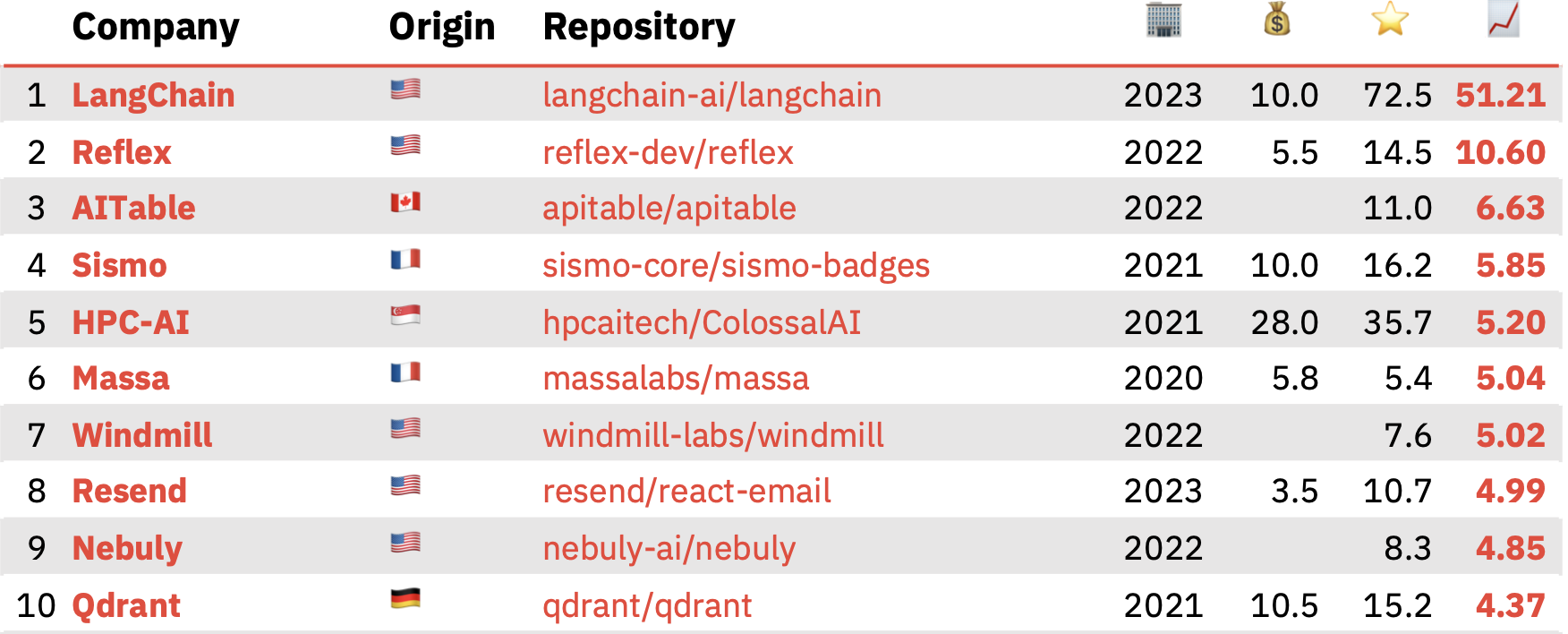
Hitting top-spot in the ROSS Index for last year was LangChain, a two-year-old San Francisco–based startup that has developed an open source framework for building apps based on large language models (LLMs). The company’s main project passed 72,500 stars in 2023, with Sequoia going on to lead a $25 million Series A round into LangChain just last month.

Top 10 COSS startups in the ROSS Index for 2023

Top 10 COSS startups in the ROSS Index for 2023. Image Credits: Runa Capital

Elsewhere in the top 10 is Reflex, an open source framework for creating web apps in pure Python, with the company behind the product recently securing a $5 million seed investment; AITable, a spreadsheet-based AI chatbot builder and something akin to an open source Airtable competitor; Sismo, a privacy-focused platform that allows users to selectively disclose personal data to applications; HPC-AI, which is building a distributed AI development and deployment platform in a push to become something like the OpenAI of Southeast Asia; and open source vector database Qdrant, which recently secured $28 million to capitalize on the burgeoning AI revolution.

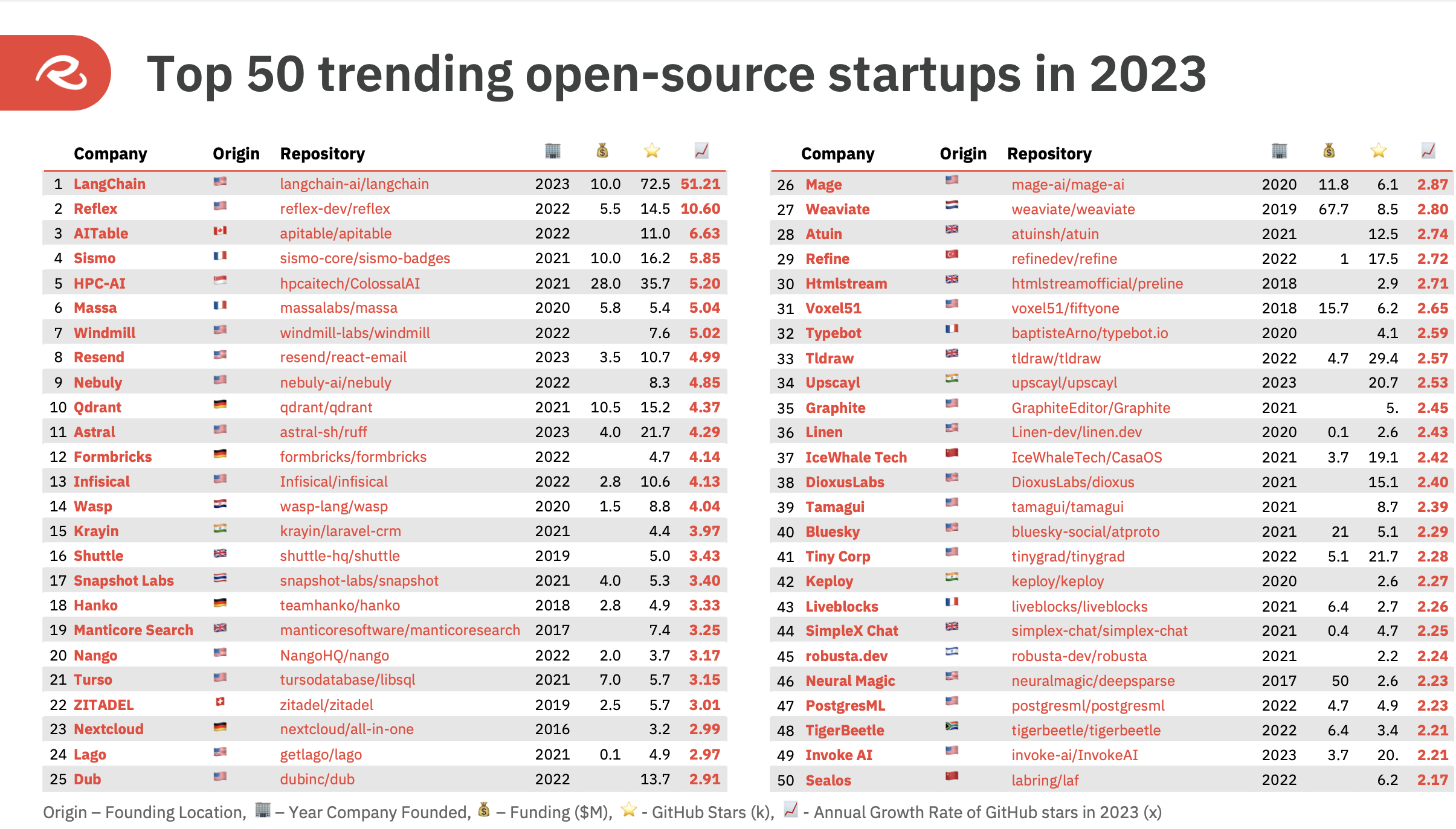
A broader look at the “top 50 trending” open source startups last year reveals that more than half (26) are related to AI and data infrastructure.

Top 50 COSS startups in the ROSS Index for 2023

Top 50 COSS startups in the ROSS Index for 2023. Image Credits: Runa Capital

It’s difficult to properly compare the 2023 index with the previous year from a vertical perspective, due largely to the fact that businesses often pivot or change their product positioning to suit what’s hot today. With the ChatGPT hype train going full throttle last year, this may have led earlier-stage startups to alter their focus, or even just place greater emphasis on the existing “AI” element of their product.

But as generative AI’s breakthrough year, it’s easy to see why demand for open source componentry might skyrocket, as companies of all sizes look to keep apace with proprietary AI juggernauts such as OpenAI, Microsoft, and Google.

Geographies

Open source software has also always been very distributed, with developers from all over the world contributing. This ethos often translates into commercial open source startups that might not have a traditional center of gravity anchored by a brick-and-mortar HQ.

However, the ROSS Index goes some way toward bringing geography into the picture, reporting that 26 companies on the list have an HQ in the U.S., though 10 of these companies originated elsewhere and still have founders or employees based in other locales.

In total, the top 50 hailed from 17 separate countries, with 23 of the companies incorporated in Europe — a 20% rise on the previous year’s index. France counted the most COSS startups with seven, including Sismo and Massa, which are in the top 10, while the U.K. soared from just one startup in 2022 to six in 2023, placing it in second place from a European perspective.

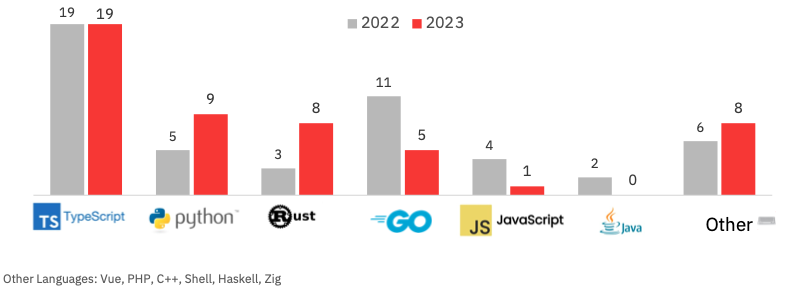
Other notable tidbits to emerge from the report include programming languages — the ROSS Index recorded 12 languages used by the top 50 last year, versus 10 in 2022. But TypeScript, a JavaScript superset developed by Microsoft, remained the most popular, used by 38% of the top 50 startups. Both Python and Rust grew in popularity, with Go and JavaScript dropping.

ROSS Index: Trending programming languages

ROSS Index: Trending programming languages. Image Credits: Runa Capital

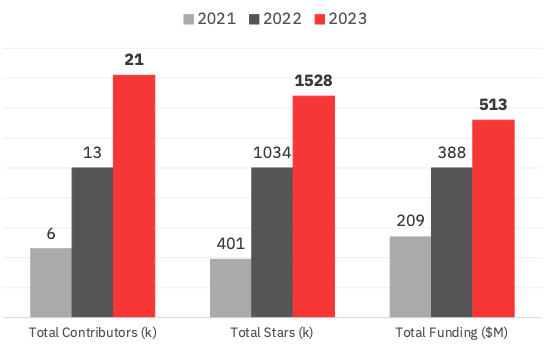
The top 50 ROSS Index participants collectively gained 12,000 contributors in 2023, while the overall GitHub star-count increased by nearly 500,000. The index also reveals that funding into the top 50 COSS startups last year hit $513 million, an increase of 32% on 2022 and 145% on 2021.

ROSS Index: Contributors, stars, and funding

ROSS Index: Contributors, stars, and funding. Image Credits: Runa Capital

Methodology and context

It’s worth looking at the methodology behind all this — what factors influence whether a company is considered “top trending”? For starters, all companies included must have at least 1,000 GitHub stars (a GitHub metric similar to a “like” in social media) to be considered. But star-count alone doesn’t tell us much about what’s trending, given that stars are accumulated over time — so a project that has been on GitHub for 10 years is likely to have accumulated more stars than one that has existed for 10 months. Instead, Runa measures the relative growth of the stars over a given period using an annualized growth rate (AGR) — this looks at the star value now versus a previous corresponding period to see what has grown most impressively.

A degree of manual curation is involved here, too, given that the goal is to eke out open source “startups” specifically — so the Runa investment team pulls out projects that belong to a “product-focused commercial organization,” and it has to have been founded fewer than 10 years ago with less than $100 million in known funding.

Defining what constitutes “open source” has its own inherent challenges, too, as there is a spectrum of how “open source” a startup is — some are more akin to “open core,” where most of their major features are locked behind a premium paywall, and some have licenses that are more restrictive than others. So for this, the curators at Runa decided that the startup must simply have a product that is “reasonably connected to its open-source [repositories],” which obviously involves a degree of subjectivity when deciding which ones make the cut.

There are further nuances at play too. The ROSS Index adopts a particularly liberal interpretation of “open source” — for example, both Elastic and MongoDB abandoned their open source roots for licenses that are “source available,” to protect themselves from being taken advantage of by the major cloud providers. According to the ROSS Index’s methodology, both these companies would qualify as “open source” — even though their licenses are not formally approved as such by the Open Source Initiative, and these specific example companies no longer refer to themselves as “open source.”

Thus, according to Runa’s methodology, it uses what it calls the “commercial perception of open-source” for its report, rather than the actual license the company attaches to its project. This means that restricted source-available licenses like BSL (business source license) and SSPL (server side public license), which MongoDB introduced as part of its transition away from open source in 2018, are very much on the menu as far as commercial companies in the ROSS Index are concerned.

“Such licenses maintain the OSS spirit — all its freedoms, except for slightly limited redistribution, which does not affect developers but grants original vendors a long-term competitive edge,” Konstantin Vinogradov, Runa Capital’s London-based general partner, explained to TechCrunch. “From a VC perspective, it is just an evolved playbook for exactly the same type of companies. The open source definition applies to software products, not companies.”

There are other notable filters in place too. For instance, companies that are mostly focused on providing professional services, or side projects with limited active support or with no commercial element, are not included in the ROSS Index.

For comparative purposes, there are other indexes and lists out there that give a steer on the “whats hot” in the open source landscape. Another VC firm called Two Sigma Ventures maintains the Open Source Index, for instance, which is similar in concept to Runa’s, except it spans all manner of open source projects (not just startups) and has additional filters in place, including the ability to view by GitHub’s “watchers” metric, which some argue gives a more accurate picture of a project’s true popularity.

GitHub itself also publishes a trending repositories page, which, similar to Two Sigma Ventures, doesn’t focus on the business behind the project.

So the ROSS Index has emerged as a useful complementary tool for figuring out which open source “startups” specifically are worth keeping tabs on.

AI is a data problem — Cyera is raising up to $300M on a $1.5B valuation to secure it

AI is a data problem — Cyera is raising up to $300M on a $1.5B valuation to secure it Ingrid Lunden @ingridlunden / 1 day

A cybersecurity startup called Cyera is betting that the next big challenge in enterprise data protection will be AI, and it’s raising a big round of funding as demand picks up for it.

The company — which builds AI-enhanced tools to create accurate pictures of where and how data is being used in organizations’ networks — is close to finalizing a round of nearly $300 million, tripling its valuation to $1.5 billion in the process, according to sources very close to the deal. Storied venture firm Coatue is leading the round of funding, say the sources.

The deal is expected to be complete in early April. It’s not clear which other investors are participating in this round. Previous to this, Cyera — pronounced “Sierra” and headquartered in San Mateo and with roots in Israel — had raised a total of $160 million with its current $500 million valuation dating from last year.

Previous Cyera backers include Sequoia (which led both of its previous two rounds, including a $100 million round last June), Accel, Redpoint and the Israeli firms Cyberstarts and Cerca Partners, among others.

Cyera, Coatue and Sequoia declined comment.

There were rumors of this round circulating earlier this month. Since then, we can confirm that the amount being raised has increased by some $150 million, and before now, no investor names had been known.

This latest Cyera investment is notable on a couple of counts.

First, it underscores how cybersecurity — despite wider pressures in the technology economy and the venture market — continues to attract business, investors and big checks — even from firms like Coatue that have pulled back from some of their more exuberant bets. (Notably, Coatue shut a relatively new venture office in London earlier this year, a signal that it would be significantly less active in Europe going forward.)

Second, this round sheds new light on the huge role AI is playing in the technology market today.

Startups like OpenAI and Mistral continue to attract mega investments to build out large language models, and it’s rare to find an organization today that’s not evaluating how to use more AI in its business. But increasingly, information security teams are also recognizing the problems that AI can pose.

Yes, AI is being weaponized by malicious hackers to crack into networks, and it’s helping cybersecurity companies (like Cyera itself) to fight bad actors and get a better grip on enterprise data.

But more unwittingly, it’s playing a different part, too: Companies themselves, interacting with AI services like chatbots or generative AI applications, run the risk of breaching their own internal intellectual property and data protection policies. Cyera is setting out to address the latter of these scenarios, too.

A source said that AI right now is a “huge driver” for business at Cyera. But interestingly, the startup did not set out to build tools to identify how and where data would be exposed and potentially misused in AI applications per se.

Its focus initially was more general — working with companies in verticals like healthcare, technology, financial services, manufacturing, retail and travel, to provide tools for data classification, posture management (snapshots that help track how and where data is moving), detection and response, and access governance.

That business has driven, from what we understand, tens of millions of dollars in current ARR for the startup.

More recently, however, Cyera has been noticing a shift in what its customers are asking to track, a source tells us.

Many organizations are bringing more automation into their networks, and the concern is that this, too, will make it much harder to categorize and screen for the usage of sensitive data. “It’s all about everything that enterprises need to do to get ready for AI,” he said. “AI is a data problem.”