Devin, the world’s first AI engineer by Cognition Labs, took the internet by storm with its ability to write code from scratch, fix bugs, and deploy solutions, aiming to automate aspects of the software development process. However, Devin is not the only AI autonomous agent available
Here is the list of top Devin alternatives.
Devika
Devika is an open-source AI software engineer created by Mufeed VH (Hamzakutty), the founder of Lyminal and Stition.AI. It is capable of understanding human instructions, breaking them down into tasks, conducting research, and autonomously writing code to achieve set objectives.
Devika aims to be a competitive open-source alternative to Devin by Cognition AI. It utilises LLMS, planning and reasoning algorithms, and web browsing abilities to intelligently develop software.
One of Devika’s key strengths lies in its ability to function as an AI pair programmer, reducing the need for extensive human intervention in complex coding tasks.
Devika simplifies software development processes, whether it’s creating new features, debugging code, or developing entire projects from scratch, thereby enhancing efficiency.
The main difference between Devin and Devika, apart from the latter being open source, is that Mufeed used Claude 3 instead of GPT-4 for Devika.
Replit Code Repair
Replit’s Code Repair is a low-latency code repair AI agent. It utilises LLMs trained on a massive dataset of code examples and their corresponding fixes. This allows the LLM to analyse your code and identify potential errors or inefficiencies.
Replit took a 7B Code LLM and fine tuned it into a tool that mimics the behavior of LSP Code Actions. The special ingredient is in the training data — a careful mixture of real-world errors (collected on Replit) combined with synthetically-generated code fixes.
Replit’s approach involves using Operational Transformations (OTs) and session events to create a dataset of (code, diagnostic) pairs. They synthesise diffs using large pretrained code models and fine-tune them for code repair tasks.
SWE Agent
SWE Agent is also an open-source alternative to Devin, much like Devika, developed by a team led by John Yang, Carlos E. Jimenez, and Alexander Wettig at Princeton University. It turns language models like GPT-4 into software engineering agents that can fix bugs and issues in actual GitHub repositories.
On the full SWE-bench test set, SWE-Agent resolves 12.29% of issues. The key to SWE-Agent’s success lies in its innovative Agent-Computer Interface (ACI), which streamlines the interaction between the language model and the code repository.
Unlike traditional approaches, SWE-Agent’s ACI simplifies commands and feedback formats, making it easier for the model to navigate, edit, and execute code files within the repository. Developers can easily set it up using Docker and Miniconda, following straightforward installation and configuration steps outlined in the project’s documentation.
OpenDevin
OpenDevin is an open-source project aiming to mimic Devin, an AI software engineer. Similar to Devin, OpenDevin aspires to handle various aspects of software development, potentially including, Code Generation, Debugging, and Deployment Automation
The alpha version is available for testing, showcasing its ability to handle complex tasks and collaborate with users.
The project is focusing on key milestones creating a user-friendly interface with chat and command features, building a stable backend for commands, improving the agent’s capabilities, and setting up an evaluation pipeline.
MetaGPT
MetaGPT is a multi-agent framework that in itself acts as a virtual software company. It takes a one-line requirement and outputs user stories, competitive analysis, requirements, data structures, APIs, and documents.
MetaGPT includes product managers, architects, project managers, and engineers, following carefully crafted Standard Operating Procedures (SOPs).
ChatDev
Similar to MetaGPT, ChatDev stands as a virtual software company that operates through various intelligent agents holding different roles, including Chief Executive Officer , Chief Product Officer , Chief Technology Officer , programmer , reviewer , tester , art designer.
These agents form a multi-agent organisational structure and are united by a mission to “revolutionise the digital world through programming.”They collaborate through specialised functional workshops at ChatDev, engaging in activities like design, coding, testing, and documentation.
The post Top 6 Devin Alternatives to Automate Your Coding Tasks appeared first on Analytics India Magazine.
Since ChatGPT proved a consumer hit, a gold rush has set off for AI in Silicon Valley. Investors are intrigued by companies promising generative AI will transform the world, and companies seek workers with the skills to bring them into the future. The frenzy may be cooling down in 2024, but AI skills are still hot in the tech market.
Looking to join the AI industry? Which route into the profession is best for each individual learner will depend on that person’s current skill level and their target skill or job title.
When assessing online courses, we examined the reliability and popularity of the provider, the depth and variety of topics offered, the practicality of the information, the cost and the duration. The courses and certification programs vary a lot, so choose the options that are right for each person or business.
They are listed in order of skill level and, within the skill level categories, alphabetically. In most cases, each provider offers multiple courses in different aspects of generative AI. Explore these generative AI courses to see which might fit the right niche.
AI for Everyone
AWS’s Building a Generative AI-Ready Organization via Coursera
DataCamp’s Understanding Artificial Intelligence
Google Cloud’s Introduction to Generative AI Learning
IBM’s Introduction to Artificial Intelligence via Coursera
AWS Generative AI Developer Kit
Harvard University Professional Certificate in Computer Science for Artificial Intelligence
MIT’s Professional Certificate Program in Machine Learning & Artificial Intelligence
Stanford Artificial Intelligence Professional Program
Udacity’s Artificial Intelligence Nanodegree Program
Best AI courses: Comparison table
Course
Cost
Duration
Skill level
Certification, badge or something else upon completion?
A name learners are likely to see on AI courses a lot is Andrew Ng; he is an adjunct professor at Stanford University, founder of DeepLearning.AI and cofounder of Coursera. Ng is one of the authors of a 2009 paper on using GPUs for deep learning, which NVIDIA and other companies are now doing to transform AI hardware. Ng is the instructor and driving force behind AI for Everyone, a popular, self-paced course — more than one million people have enrolled. AI for Everyone from Coursera contains four modules:
What is AI?
Building AI Projects
Building AI in Your Company
AI and Society
Pricing
For individuals, a Coursera account is $49-$79 per month with a 7-day free trial, depending on the course and plan. However, the AI for Everyone course can be taken for free; the $79 per month fee provides access to graded assignments and earning a certificate.
Duration
Coursera states the class takes six hours to complete.
Prerequisites
This course has no prerequisites.
Visit Coursera
2. AWS’s Building a Generative AI-Ready Organization via Coursera
Are you a C-suite leader looking to shape your company’s vision for generative AI? If so, this non-technical course helps business leaders build a top-down philosophy around generative AI projects. It could be useful for sparking conversation between business and technical leaders.
Pricing
Free if completed within the Coursera 7-day trial. Otherwise, a Coursera account is $49-$79 per month, depending on the course and plan.
This is a well-reviewed beginner course that sets itself apart by approaching AI holistically, including its practical applications and potential social impact. It includes hands-on exercises but doesn’t require the learner to know how to code, making it a good mix of practical and beginner content. Datacamp’s Understanding Artificial Intelligence course is particularly interesting because it includes a section on business and enterprise. Business leaders looking for a non-technical explanation of infrastructure and skills they need to harness AI might be interested in this course.
Pricing
This course can be accessed with a DataCamp subscription, which costs $25 per person per month, billed annually. Educators can get a group subscription for free.
Duration
Including videos and exercises, this course lasts about two hours.
Prerequisites
This course has no prerequisites.
Visit DataCamp
4. Google Cloud’s Introduction to Generative AI Learning Path
Google Cloud’s Introduction to Generative AI Learning Path covers what generative AI and large language models are for beginners. Since it’s from Google, it provides some specific Google applications used to build generative AI: Google Tools and Vertex AI. It includes a section on responsible AI, inviting the learner to consider ethical practices around the generative AI they may go on to create. Completing this learning path will award the Prompt Design in Vertex AI skill badge.
Another option from Google Cloud is the Generative AI for Developers Learning Path.
Pricing
This course is free.
Duration
The path technically contains 8 hours and 30 minutes of content, but some of that content is quizzes. The time it takes for each individual to complete the path may vary.
Prerequisites
The path has no prerequisites.
Visit Google Cloud
5. IBM’s Introduction to Artificial Intelligence via Coursera
Since this course is taught by an IBM professional, it is likely to include contemporary, real-world insight into how generative AI and machine learning are used today. It is an eight-hour course that covers a wide range of topics around artificial intelligence, including ethical concerns. Introduction to Artificial Intelligence includes quizzes and can contribute to career certificates in a variety of programs from Coursera.
Pricing
Free if completed within the 7-day Coursera free trial, or $49-$79 per month afterward, depending on the course and plan. Financial aid is available.
Duration
Coursera estimates this course will take about eight hours.
Prerequisites
There are no prerequisites for this course.
Visit Coursera
6. AWS Generative AI Developer Kit
AWS offers a lot of AI-related courses and programs, but we chose this one because it combines fundamentals — the first two courses in the developer kit — with hands-on knowledge and training on specific AWS products. This could be very practical for someone whose organization already works with multiple AWS products but wants to expand into more generative AI products and services. This online, self-guided kit includes hands-on labs and AWS Jam challenges, which are gamified and AI-powered experiences.
Pricing
The AWS Generative AI Developer Kit is part of the AWS Skill Builder subscription. AWS Skill Builder is accessible with a 7-day trial, after which it costs $29 per month or $449 per year.
Duration
The courses take 16 hours and 30 minutes to complete.
Prerequisites
This course is appropriate for professionals who have not worked with generative AI before, but it would help to have worked within the AWS ecosystem. In particular, Amazon Bedrock is discussed at such a level that it would be beneficial to have completed the course AWS Technical Essentials or have comparable real-world experience.
Visit AWS Skill Builder
7. Harvard University Professional Certificate in Computer Science for Artificial Intelligence
Harvard’s online professional certificate combines the venerable university’s Introduction to Computer Science course with another course tailored to careers in AI: Introduction to Artificial Intelligence with Python. This certification is suitable for people who want to become software developers with a focus on AI. This course is self-paced, and students will receive pre-recorded instruction from Harvard University faculty.
Pricing
Both courses together cost $466.20 as of the time of writing; this is a discounted price from the usual $518. Learners can take both courses in the certification for free, but the certification itself requires a fee.
Duration
These courses are self paced, but the estimated time for completion is five months at 7-22 hours per week.
Prerequisites
There are no prerequisites required, although a high-school level of experience with programming basics would likely provide a solid foundation. The Introduction to Computer Science course covers algorithms and programming in C, Python, SQL and JavaScript, as well as CSS and HTML.
Visit eDX
8. MIT’s Professional Certificate Program in Machine Learning & Artificial Intelligence
“MIT has played a leading role in the rise of AI and the new category of jobs it is creating across the world economy,” the description of the program states, summing up the educational legacy behind this course. MIT’s AI and machine learning certification course for professionals is taught by MIT faculty who are working at the cutting edge of the field.
This certification program is comparable to a traditional college course, and that level of commitment is reflected in the price.
If a learner completes at least 16 days of qualifying courses, they will be eligible to receive the certificate. Courses are typically taught June, July and August online or on MIT’s campus.
Pricing
There is an application fee of $325. The two mandatory courses are:
Machine Learning for Big Data and Text Processing: Foundations, which costs $2,500 for two days.
Machine Learning for Big Data and Text Processing: Advanced, which costs $3,500 for three days.
The remaining required 11 days can be composed of elective classes, which last between two and five days each and cost between $2,500 and $4,700 each.
Duration
16 days.
Prerequisites
The Professional Certificate Program in Machine Learning & Artificial Intelligence is designed for technical professionals with at least three years of experience in computer science, statistics, physics or electrical engineering. In particular, MIT recommends this program for anyone whose work intersects with data analysis or for managers who need to learn more about predictive modeling.
9. Stanford Artificial Intelligence Professional Program
Completion of the academically rigorous Stanford Artificial Intelligence Professional Program will result in a certification. This program is suitable for professionals who want to learn how to build AI models from scratch and then fine-tune them for their businesses. In addition, it helps professionals understand research results and conduct their own research on AI. This program offers 1 to 1 time with professionals in the industry and some flexibility — learners can take all eight courses in the program or choose individual courses.
The individual courses are:
Artificial Intelligence Principles and Techniques.
Natural Language Processing with Deep Learning.
Natural Language Understanding.
Machine Learning.
Reinforcement Learning.
Machine Learning with Graphs.
Deep Multi-Task and Meta Learning.
Deep Generative Models.
Pricing
The Stanford Artificial Intelligence Professional Program costs $1,750 per course. Learners who complete three courses will earn a certificate.
Duration
Each course lasts 10 weeks at 10 to 15 hours per week. Courses are held on set dates.
Prerequisites
Interested professionals can submit an application; applicants are asked to prove competence in the following areas:
Coding in Python.
Basic Linux command line workflows.
College calculus and linear algebra, including derivatives, matrix/vector notation and operations.
Probability theory.
Visit Stanford Online
10. Udacity’s Artificial Intelligence Nanodegree program
Udacity’s Artificial Intelligence Nanodegree program equips graduates with practical knowledge about how to solve mathematical problems using artificial intelligence. This class isn’t about generative AI models; instead, it teaches the underpinnings of traditional search algorithms, probabilistic graphical models, and planning and scheduling systems. Learners who complete this course will gain experience in working with the types of algorithms used in the real world for:
Planning.
Optimization.
Problem solving.
Automation.
Logistics operations.
Aerospace.
Pricing
This course costs $249 per month paid monthly or $846 for the first four months of the subscription, after which it will cost $249 per month.
Duration
This course lasts about three months.
Prerequisites
Learners in this course should have a background in programming and mathematics. The following skills are recommended:
Object-oriented Python.
Intermediate Python.
Object-oriented programming basics.
Basic data structures and algorithms.
Basic descriptive statistics.
Basic calculus.
Command line interface basics.
Differential calculus.
Scripting.
Linear algebra.
Basic algorithms.
Jupyter notebooks.
Visit Udacity
Is it worth taking an AI course?
Whether it is worth taking an AI course depends on many factors: the course, the individual and the job market. For instance, getting an AI-focused certification might contribute to getting a salary increase or making a career change. AI courses could help someone learn AI skills that might be a good fit for their abilities, or could be the first step toward a lucrative and life-long career. Educating oneself in a contemporary topic can always have some benefits in terms of practicing new skills.
Can I learn AI without coding?
Some introductory AI courses do not require coding; however, AI is a relatively complex topic in computing, and practitioners will need some programming skills as they progress to more advanced courses and learn how to build and deploy AI models. Most likely, intermediate learners need to be comfortable working in Python.
SEE: Help your business by becoming your own IT expert. (TechRepublic Academy)
Some of these courses and certifications include education in basic programming and computer science. More advanced courses and certifications will require learners to already have a college-level knowledge of calculus, linear algebra, probability and statistics, as well as coding.
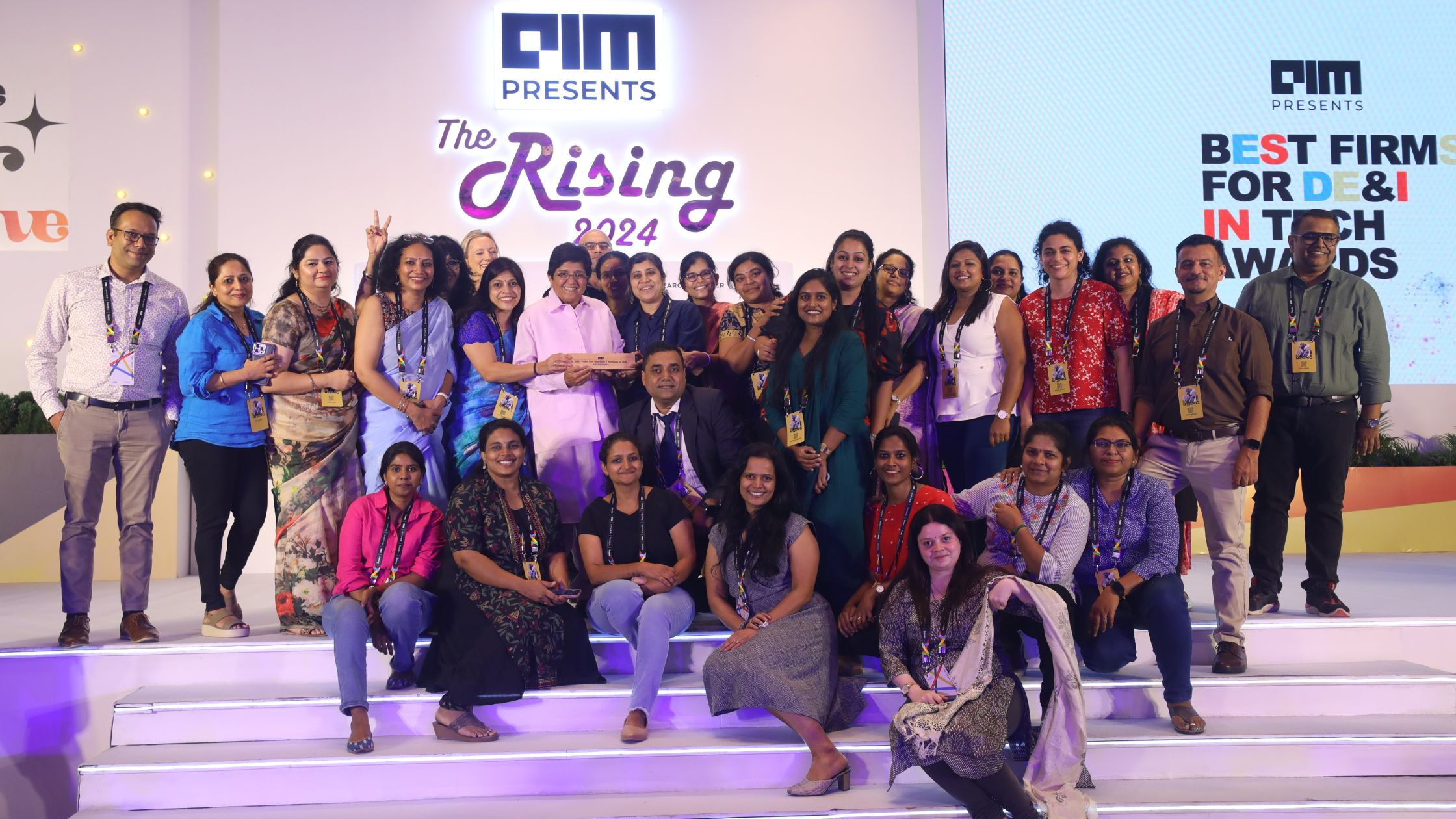
At India’s biggest diversity and inclusion summit, the Rising 2024, AIM celebrated organisations for their best diversity, equity, and inclusion practices. These included implementing effective programmes to promote diversity, providing equitable opportunities for career advancement, offering coaching and mentorship, and contributing to closing the gender pay gap.
In collaboration with AIM Best Firm Certification, the Rising acknowledges tech firms’ achievements and steadfast dedication to shaping a more inclusive future for Diversity and inclusion in technology.
The winners were chosen by our distinguished panel of judges from the AIM Leaders Council, alongside the AIM Best Firm Certifications team and industry experts in the field.
Here are the winners of the Best Firms for Diversity & Inclusion in Tech:
(In Alphabetic Order)
All State India Pvt Ltd
Allstate India, a subsidiary of The Allstate Corporation, pioneered operations and technology and has evolved into a strategic business services arm. It provides the parent organisation with technology, innovation, accounting, policy administration, and global operations expertise.
Allstate India exemplifies a vibrant culture of diversity and inclusion, seamlessly integrating values of respect, trust, and empathy into its organizational fabric. Their commitment to empowering women, supporting differently-abled individuals, and celebrating the LGBTQ+ community, coupled with their dedication to employee well-being and professional growth, truly makes them a beacon of inclusive excellence.
ANZ
For more than 34 years, ANZ’s Bengaluru Global Capability Center has been home to over 8,000 employees, comprising a substantial segment of its workforce. Crucial to ANZ’s achievements, the centre offers various services, encompassing banking operations, economic research, risk analytics, and technology support, contributing significantly to the company’s success.
ANZ’s commitment to diversity and inclusion shines as a cornerstone of its identity, fostering a workplace where varied perspectives and backgrounds are not only welcomed but celebrated. Their broad and thoughtful approach emphasises gender equality, cultural diversity, accessibility, and LGBTIQ+ inclusion, reflecting their operation in nearly 30 global markets. ANZ recognizes the richness that such diversity brings to decision-making and innovation, making them not only a better bank for their customers but a model of inclusive excellence in the corporate world.
Chubb
Chubb, a distinguished force in the global insurance industry, delivers a comprehensive array of commercial and personal property and casualty, accident, health, reinsurance, and life insurance solutions across 54 nations. Renowned for its commitment to excellence, Chubb caters to a varied clientele on a global scale.
Chubb’s diversity and inclusion culture is a dynamic blend of respect, empowerment, and recognition. It embraces a wide spectrum of backgrounds and perspectives to foster an inclusive and thriving workplace.
DBS Tech India
DBS Tech India, founded in 2016, is DBS Bank’s premier offshore technology center in Hyderabad. Pioneering excellence and innovation, it drives the bank’s future through experimentation, committed to building a better tomorrow for customers and the world. bring people and technology together to drive digital transformation – enabling our customers to Live more, Bank less.
DBS TechIndia prioritizes not only demographic diversity but also values experiential and cognitive diversity in team building. Women constitute 40% of our senior management, leading key businesses and functions throughout the bank.
Interestingly, DBS’s unique approach to diversity, equity, and inclusion is rooted in its Asian heritage, creating a workplace that thrives on varied perspectives and experiences, and is dedicated to empowering its employees to make meaningful differences in their communities and careers.
Eventbrite
Eventbrite, a pioneering global events marketplace, operates in nearly 180 countries, championing the experience economy. Founded with a vision to democratise event organization, it enables creators worldwide to effortlessly sell tickets to live experiences. Eventbrite is where people come together to unlock the magic of sharing an infinite reel of experiences.
Eventbrite believes in promoting diversity and inclusion in the tech industry, with a strong emphasis on the representation of women and underrepresented minorities. They are dedicated to prioritizing equitable pay and advancement opportunities, ensuring that female and ethnically underrepresented employees progress and are compensated at the same rate as their majority peers.
ICICI Prudential Life Insurance Co. Ltd.
Since 2001, ICICI Prudential Life has maintained its position as a leading player in the Indian life insurance sector, boasting an Assets Under Management (AUM) of around 2 billion as of December 2023. With a dedicated emphasis on addressing customer needs, the company provides a range of savings and protection products, guaranteeing exceptional service, robust fund performance, and efficient claim settlement processes.
ICICI Prudential Life is committed to fostering diversity and inclusion as integral components of its culture, enabling every employee to authentically contribute their skills, experience, and perspective to generate unparalleled value for all stakeholders.
Infocepts
Infocepts, a premier data solutions provider, connects the realms of business and analytics, equipping enterprises with data, AI, and intuitive analytics to drive superior results. Grounded in transparency and trust, it nurtures innovation and professional advancement, striving for a diverse, inclusive, and dynamic work environment.
Infocepts is dedicated to fostering an inclusive, secure, and diverse workplace environment.
The Economic Times Best Organizations for Women 2023 serves as a platform dedicated to recognizing the exceptional efforts of companies that excel in fostering an inclusive workplace environment conducive to the success of women. It honors organizations that demonstrate a strong commitment to gender diversity through their comprehensive policies, practices, and cultural initiatives.
L&T Technology Services (LTTS)
L&T Technology Services, also known as LTTS, is a premier Engineering R&D provider committed to championing diversity, equity, and inclusion. Catering to a diverse range of global clients, which includes 69 Fortune 500 companies, LTTS offers cutting-edge technology services across various industries. With a workforce of over 23,300 employees worldwide, LTTS nurtures an inclusive work environment, guaranteeing equal opportunities and offering facilities tailored to accommodate individuals with disabilities.
L&T’s diversity extends beyond India to encompass multiple countries, reflecting a rich multicultural ethos. This is underscored by their workforce comprising individuals from 52 nationalities, spanning 36 domiciles within India, and speaking 80 distinct languages. Moreover, the company actively foster gender diversity and inclusion through a well-defined framework. A DEI Charter has been formulated, grounded on four pillars: Induct, Develop, Engage, and Enable, to ensure a systematic approach towards these objectives.
MathCo
MathCo, short for TheMathCompany, stands out as a premier Enterprise AI and Analytics firm serving elite Fortune 500 enterprises. Since its inception in 2016, MathCo has honed its expertise in customizing AI solutions, strategically capitalizing on growth opportunities, and spearheading innovative problem-solving approaches. At MathCo, we empower our team of Mathemagicians not only to excel but also to leave a profound mark in the domain of analytics and AI.
MathCo empowers women to realize their potential and have fulfilling careers by fostering a supportive environment where they can exchange knowledge and insights. The global community, Women in Data, aims to boost diversity in data careers, promoting inclusivity and diversity in analytics.
Moody’s Corporation
Moody’s, a renowned authority in research, data, and analytics, is dedicated to aiding market participants in navigating risks and seizing opportunities. Drawing upon over 115 years of experience, innovative technologies, and a commitment to inclusivity, Moody’s facilitates informed decision-making, instilling confidence in its users.
The DE&I efforts at Moody’s strive to positively impact the workforce, workplace, customers, and communities. By embracing diverse backgrounds and experiences, they enhance employee contributions, expand leadership opportunities, and improve the quality of work, including opinions, products, and services.
Quest Global
Quest Global, founded in 1997, has emerged as a leading provider of engineering research and development services. With a presence in 17 countries, boasting 72 global delivery centers, and employing over 17,800 professionals, Quest Global is at the forefront of delivering innovative engineering solutions across various industries. Each day, it transforms challenges into opportunities, consistently pioneering cutting-edge solutions.
Quest Global fosters an inclusive culture, promoting collaborative innovation for a safer, sustainable, and better world. They offer equal opportunities and value individuals regardless of protected characteristics like disability, race, religion, sexual orientation, or identity, ensuring a discrimination-free environment.
Unisys
Unisys, a renowned global technology solutions provider, empowers breakthroughs for premier organizations worldwide. Its suite of solutions, spanning cloud, data and AI, digital workplace, logistics, and enterprise computing, empowers clients to defy conventions and unleash their utmost potential.
At Unisys, we’re dedicated to fostering an inclusive environment where everyone thrives and feels valued. They believe in the power of diversity and inclusion to transform our workplace and enhance our ability to serve clients. Through respect, openness to ideas, and equal opportunities, we champion a culture of inclusivity for all.
Verizon
Verizon, With over 7000 diverse employees, cultivates an environment of collaboration and authenticity. Positioned strategically, it serves as a hub for seamless customer-centric solutions, placing emphasis on innovation and diversity. Upholding DEI principles, it stands as an equal-opportunity employer, nurturing a culture of learning and empowerment through dedicated employee resource groups.
Verizon values diversity in all forms – race, nationality, religion, gender, sexual orientation, gender identity, disability, and age. They believe diversity enhances company culture, leading to better service for customers through the collective intelligence, spirit, and creativity of their diverse team.
The post Meet the Winners of the ‘Best Firm for Diversity & Inclusion in Tech’ appeared first on Analytics India Magazine.
AI Strategists are adept in building AI roadmap and vision for businesses. However, aligning the roadmap to the expected business outcomes becomes challenging, given the evolving scope of AI initiatives.
Image by Author
Hence, it is crucial to keep adapting and refining the AI strategy to ensure that it remains aligned with the evolving business objectives and technological landscape.
But before we start with the strategy itself, let’s discuss the role of an AI strategist.
A Day in the Life of an AI strategist
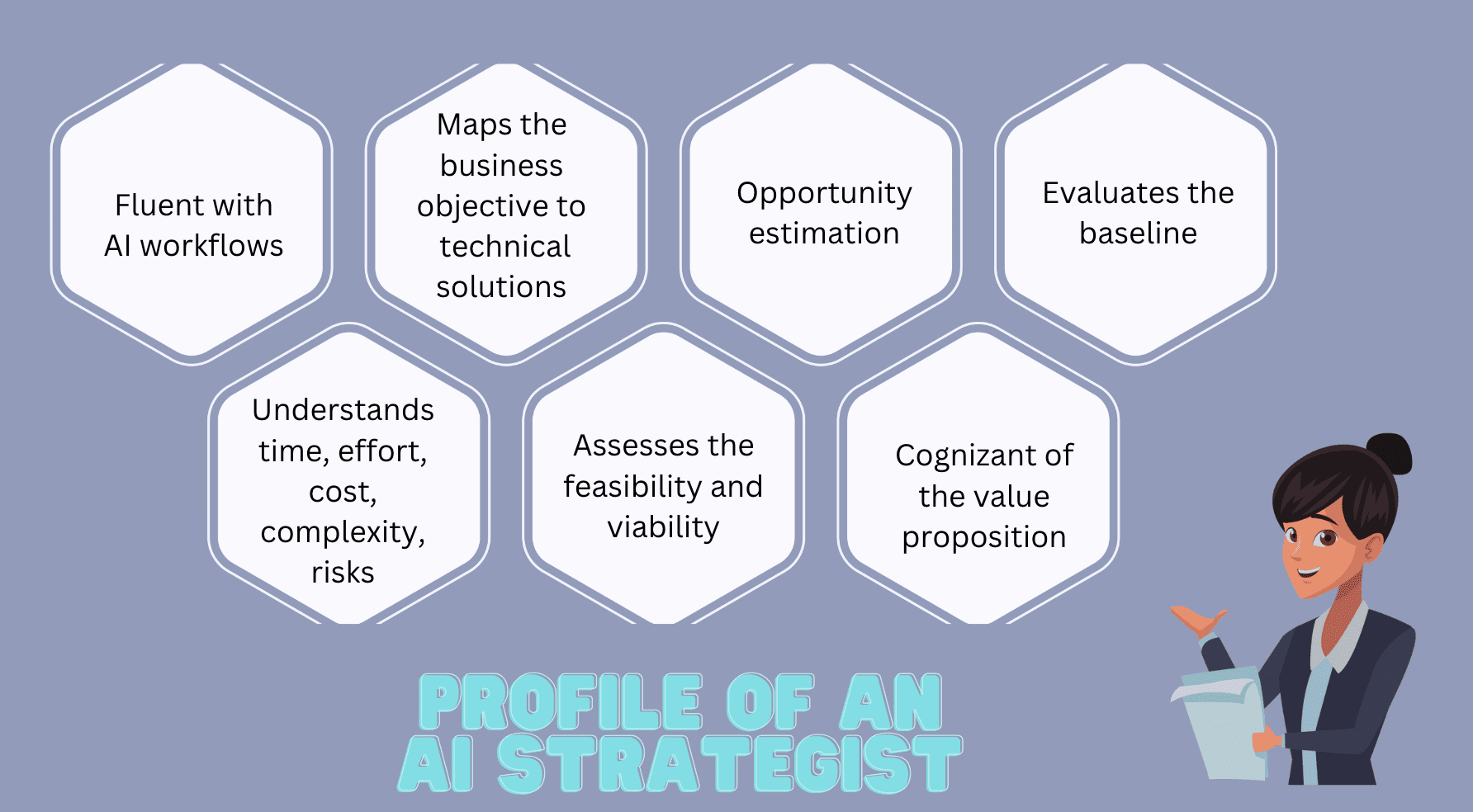
AI strategists are fluent with AI workflows and map the business prerogatives to technical solutions leveraging AI. They comprehend the associated complexities along with opportunity estimation and do not necessarily need to know the intricacies of algorithms.
Let’s expand on these three pillars of opportunity estimation. Firstly, it is important to note that there are many innovative ways to solve a business problem, and not all of them require the use of sophisticated and advanced technology as that of AI.
Some can be easily solved by rules, while others can simply be automated and solve the problem to a reasonable extent.
Doing such an assessment is key to analyzing the baseline which involves taking an inventory stock of what part of the problem is solved with the existing solution. If the current solution is not acceptable, then the strategists make a trade-off by explaining the potential increase in the efficacy of the proposed AI-powered solution and the risks that come with it.
Image by Author
Primarily, the strategists ensure the team is AI-aware and opt for an advanced solution, fully cognizant of time, effort, cost, complexity, and the associated risks. It would be fair to say that an AI strategist is the linchpin to the success of AI transformation.
Equipped with strong business acumen, an AI strategist typically follows three factors to build a successful roadmap:
The first one is to ensure that the proposed solution is technically feasible. They identify the data requirements and evaluate whether the problem at hand warrants the use of AI. What if data is not available or is not authorized for model training or does not have accurate labels? All this falls under the purview of an AI strategist.
In addition to a feasible solution, the second aspect is viability. Even if it is possible to scale the solution, an AI strategist wears the techno-business lens to assess whether the proposed model development is financially viable for the business objectives. If the cost-benefit analysis suggests that the estimated benefit from the new AI/ML model development does not justify the non-trivial cost of building it, then it is best advised to drop the idea.
Any solution is good only if it provides value, which is often a challenge. Value could be in terms of a new revenue stream, a business differentiator, improved processes in the form of automation bringing efficiencies, and more. An AI strategist has a detailed methodical approach to defining the value proposition behind AI initiatives.
AI Transformation
Phrases such as digital transformation or AI transformation might appear irrelevant in today’s rapidly evolving technological landscape.
One may ask that businesses need to be continuously innovating, leveraging emerging technologies, and adapting to market shifts. So, how do we define transformation when innovation is a continuous thing?
Let’s simplify and understand the core principles behind onboarding such a multi-year business evolution.
The transformation is, often, an inflection point when an organization realizes the need to revisit the legacy way of doing business. They understand that the status quo mode of operating a business is not sustainable, making them lose their competitive edge, thereby impacting their growth.
Image by Author
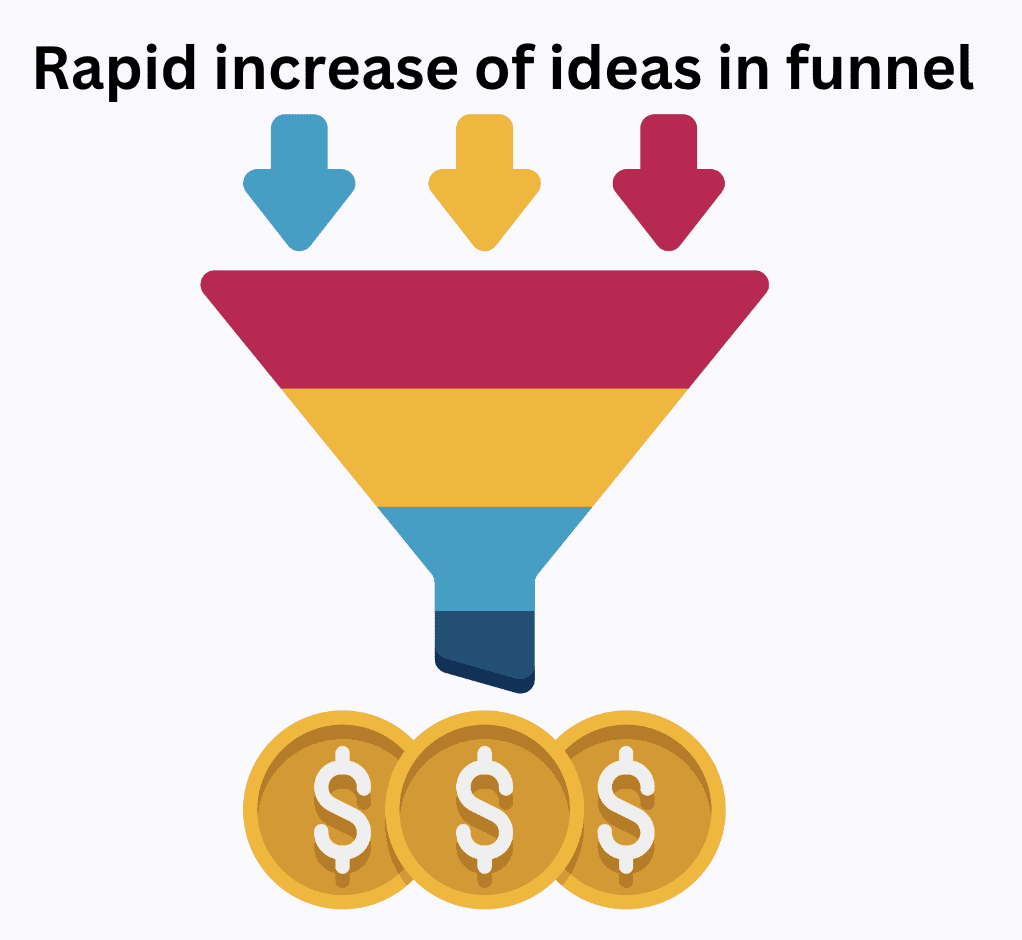
Hence, the rate at which they try the number of ideas accelerates rapidly and flows down to the funnel, making experiments work at scale. That is where the organization benefits from the compounded knowledge of an AI strategist over time, who has led multiple such AI transformations at scale. They are equipped with a toolkit consisting of adaptive frameworks, systems, and processes, which can be abstracted as strategies leading to successful AI transformation.
Key Pillars of a Successful Transformation Strategy
A few years ago, when the concept of AI strategy started becoming the focus of boardroom discussions, it caught everyone’s attention. Specifically, for the reason of having too many strategies – Business, AI, and Data.
It is easy to get confused amid multiple strategies around, such as business strategy, data strategy, and now, AI strategy. Here is how the three strategies work together in coherence.
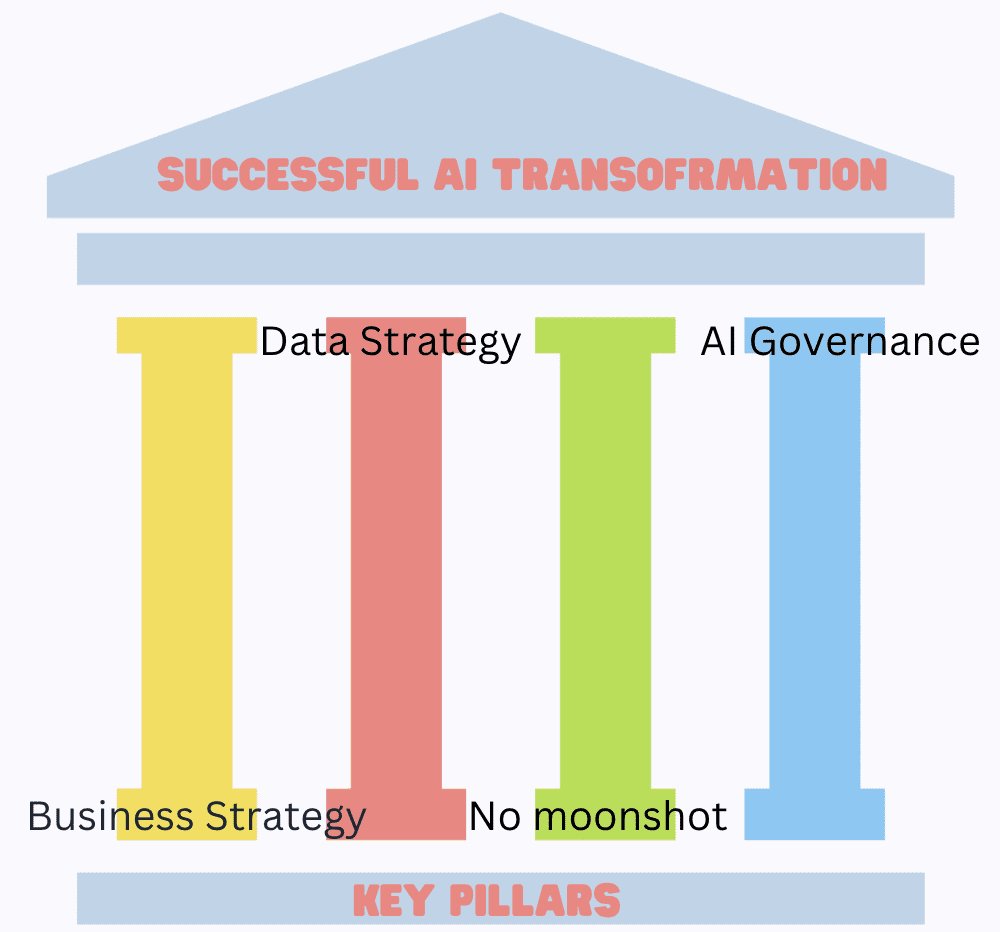
Business strategy and vision are always at the top. It is crucial to have a clear business vision, the critical growth drivers, and a roadmap that aligns with the business objectives. Once the business leaders decide the “why and what”, next follows the “how”.
An AI strategist along with technologists focuses on the how part, to achieve the business vision through technology. It is important to note that technology is just an enabler. Hence, AI strategy is derived from business strategy, which means it requires extensive time to understand the business – the moat, and the competitive vantage point.
However, AI does not work on its own and needs data at its core to model the phenomenon. Hence, it works in tandem with data strategy.
Image by Author
The next important aspect of designing a successful AI strategy is to ensure that AI teams do not give any moonshot commitment. This goes in line with the role of an AI strategist in assessing the feasibility of the proposed idea. AI projects bring a lot of “unknown unknowns” with them, hence it is essential to bake in foreseen and unforeseen risks.
The model is ready but is of no good use if it is not aligned with the responsible and ethical principles of building AI. Imagine having spent a huge amount of money building AI pipelines and workflows, data is in place and the predictions work just fine.
But only to realize that data has a bias, includes PII information, or a thing as basic but crucial as transparency and explainability.
It is important to note that predictions are of no good use until someone acts on them, and no one can act on predictions until they trust how and where they are coming from.
Hence, AI governance which includes extensive documentation on roles and responsibilities (ownership if it goes rogue), and the process of data collection, transformation, and training set, is the key driver of a successful implementation.
Conclusion
Understanding the trifecta of business, data, and AI strategy along with the key pillars for AI strategy are crucial to leading the organizations through a successful AI transformation.
Vidhi Chugh is an AI strategist and a digital transformation leader working at the intersection of product, sciences, and engineering to build scalable machine learning systems. She is an award-winning innovation leader, an author, and an international speaker. She is on a mission to democratize machine learning and break the jargon for everyone to be a part of this transformation.
More On This Topic
Powering Up with Predictive GenAI
How to Get Hired as Data Scientist in the GPT-4 Era
Data Transformation: Standardization vs Normalization
dbt for Data Transformation — Hands-on Tutorial
The Chatbot Transformation: From Failure to the Future
Evolution in ETL: How Skipping Transformation Enhances Data Management
The conjecture of consciousness for generative AI is not of its equality to human consciousness. It one of data storage, where, in comparison to human memory, if the feature [vector] interactions of large language models [to digital memory] are similar to how the human memory is conscious of its contents.
Consciousness is defined as subjective experience. But subjective experience is not a function like memory, emotion, feeling or modulation. Subjective experience [or self-awareness] applies across functions, making it a qualifier of functions. There are other qualifiers like attention, awareness [of the environment, or less than attention] and intent.
This means that these qualifiers can act on functions, with at least two of them, in any instance. Whatever there is a subjective experience of, is either in attention or awareness. Seeing [or hearing something] as the main vision [or principal auditory perception] or peripheral vision [or ambient auditory perception] as subjective experiences is in attention or awareness. It may also be driven by intent, if the individual gazes, listens further or adjusts.
Movement, touch, smell and so forth are all functions that get qualified on the mind. This implies that consciousness can be defined as a collection of all qualifiers, or a super qualifier. Data does not have emotions or feelings, precluding any chance to measure close to the total consciousness, for humans.
Data storage is done in 1s and 0s. However, with those, digital was able to have the best memory of anything in existence—with audio and video—exceeding human memory and those of other organisms. AI uses word embedding, processing tokens as vectors, answering many prompts in ways that are similar to human reasoning and cognition.
LLMs give outputs in attention. They have multimodal awareness [texts, images, videos or audios] that may qualify what they are presenting. They do not have subjective experience, but they have a rough sense of being or being-in a process, in how they answer as being chatbots. They also have a second-hand intent, going on errands or prompts.
The OFF and ON states of large numbers of transistors, functioning for memory, which then functions for LLMs cannot be said to be subjective experiences. However, because of their [roughly speaking] parallels to bits, with parallel to vectors of LLMs, especially how they are relaying [feed forward and back propagation], some groups may be having a push pull operation at some ends, which then may signal an experience—of learning, correction and updates, by which they are differentially affected. In the large amount of compute necessary to train foundation models [FMs], it is possible that some base terminals in some bipolar junction transistors and gate terminals in some field-effect transistors, for ON states, where they correspond with high signal or voltage of bits of 1, may result in some, having the same collective affect, forming a weak end of group experiential match. Simply, some 1s and ONs, across a large array of logic gates and transistors may act in concert of sameness for every possible aligning characteristics [instructions, operations, bonding, connections, and others], which, isolating those, may seem like a weak form of experience and adaptation within that group.
Consciousness is not about being and intelligence is not about doing, as some have stated. Whatever intelligence humans use is simply the qualifications obtained within memory. This means that the consciousness of memory can also result in intelligence, like it could for thought, reasoning and others. It is unlikely to have intelligence in any organism, without the parallels that constitute human consciousness.
Also, consciousness is not in some centers in the brain, like the brainstem, thalamus, or the cerebral cortex alone. Consciousness is possible for all functions, even those of the cerebellum, which is said not to be implicated in consciousness. All the functions of the cerebellum can be said to be predicated on other functions, like breathing modulation in the brainstem, or interpretation in the cerebral cortex, and others.
Whenever consciousness is lost, it means the function at that center is lost, not just that the [collection of qualifiers or] consciousness is lost and the function remains active. The concept of local consciousness somewhere different from global consciousness everywhere is inaccurate. Local consciousness, especially with attention, and then awareness of everything else, represents the consciousness available, though unified by attention in the moment—then interchanges with a process, of many, in awareness. Access consciousness and phenomenal consciousness are labels that do not explain what the mind is, how it works or its components.
Conceptually, the human mind is the collection of all the electrical and chemical impulses of neurons with their features and interactions in sets. Their interactions result in their basic functions like memory, emotions, feelings and modulation. The functions have sub-divisions. For memory, language, thought, intelligence, curiosity and so on. For emotions, hurt, delight and so on. For feelings, thirst, cold, appetite and so forth. The features are their qualifiers—obtained within the sets that mechanize functions.
Consciousness is theorized to be how the human mind works. There is no human consciousness without the mind and there is no functional human mind, without consciousness.
Could data, via AI, ever become conscious? It is likely that given what they have done with memory, fractional sentience may result. It is possible to represent hurt or delight by some vectors, as group experiences in transistor states, which would not just be like emotions, but qualified as well. AI, on digital memory, can be estimated for part sentience, on the scale of 1, the total for humans. In the future, it may be possible to reverse engineer certain FM GPUs, to find out if there may have been minuscule changes in some of the transistor terminals, as indicative of experience, against those that were never used to train FMs.
India’s Tata Advanced Systems Ltd (TASL) has achieved a significant milestone in satellite technology. The TSAT-1A satellite was successfully separated and inserted into a seamless orbit.
The collaboration between TASL and Satellogic, announced in November 2023, has borne fruit with the launch of a high-resolution Earth observation satellite tailored for Indian defence forces. This joint endeavour signifies TASL’s foray into the satellite domain and Satellogic’s expansion into India’s burgeoning defence and commercial sectors.
Under this partnership, TASL and Satellogic aim to foster local space technology capabilities, beginning with comprehensive training and knowledge transfer. Establishing a satellite Assembly, Integration, and Test (AIT) plant at TASL’s Vemagal facility in Karnataka underscores the commitment to indigenous satellite manufacturing.
The collaboration extends beyond satellite manufacturing to developing a new satellite design, emphasising the integration of multiple payloads to cater to diverse data needs across India. Emiliano Kargieman, CEO and Founder of Satellogic, hailed this partnership as a pivotal step in advancing commercial space capabilities, facilitating greater access to critical information for various applications, including security, sustainability, and energy.
This achievement aligns with India’s broader space ambitions, as evidenced by the impending launch of India’s first spy satellite developed by a domestic private player. Built by TASL, the satellite launched aboard a SpaceX rocket promises discreet information acquisition capabilities for the armed forces.
Furthermore, efforts are underway to establish a ground control centre in Bengaluru, in collaboration with Satellogic, to facilitate guidance and image processing. This development underscores India’s quest for self-reliance in satellite technology, reducing reliance on foreign vendors for crucial data.
While India’s space endeavours have historically leaned on partnerships and collaborations, recent strides indicate a growing momentum towards indigenous capabilities. With the launch of the TASL satellite and ongoing initiatives by organisations like the Indian Space Research Organisation (ISRO), India is poised to assert itself as a key player in the global space arena, catering to both strategic and commercial interests.
The post Tata Advanced Systems & Satellogic Announce TSAT-1A Satellite Launch Success appeared first on Analytics India Magazine.
Alibaba’s e-commerce platform Taobao has partnered with Chinese space startup Space Epoch to explore the possibility of one-hour delivery by rocket. The collaboration, revealed on Space Epoch’s WeChat account on Sunday, has been confirmed by Taobao despite the announcement’s proximity to April Fools’ Day.
Space Epoch’s post detailed plans to use its Yuanxingzhe 1 rocket, which features a 120m3 cargo cabin capable of carrying up to ten metric tons. The reusable craft, yet to make its maiden flight, has undergone engine testing and simulated water landing recovery.
An animation accompanying the post depicts a parcel being loaded onto the rocket, which launches and reaches space within 25 minutes, travelling from China’s east coast to the northwestern city of Urumqi. Upon landing in a silo, the cargo is unloaded onto a conveyor belt and delivered to the customer via van.
However, the feasibility of the proposed system remains questionable. Rockets typically require careful loading and days of preparation to ensure stability during flight, making the concept of on-demand parcel launches impractical with current technology.
Space Epoch also claims its rocket can transport car-sized payloads, which may be more realistic given vehicles’ known weight distribution. However, the company has not disclosed pricing details for its services.
Using SpaceX’s rideshare cost calculator as a reference, The Register estimated a fee of $4.99 million for a maximum single payload of 831kg, significantly higher than the cost of even the most exclusive cars. Insurance costs would further increase the overall expense.
The announcement has drawn comparisons to Amazon’s 2013 drone delivery initiative, which has yet to become mainstream despite initial fanfare. Drones have, however, found success in delivering emergency supplies to remote areas, suggesting a potential application for Space Epoch and Taobao’s collaboration.
Regardless of the outcome, the Chinese government is likely to welcome the partnership, as fostering a commercial space sector has been identified as a strategic and industrial priority by the Chinese Communist Party.
The post Alibaba Teams Up with Space Epoch to Make One-Hour Rocket Deliveries Reality appeared first on Analytics India Magazine.
If you’re interested in pivoting to a data career, you probably know that using data effectively to answer business questions is at the core of most data professions—regardless of the tools you use. By building the right skill set, you can land a job as a data analyst and gradually explore other roles such as those of a data scientist, BI analyst and the like. So where should you start?
Should you learn a programming language like Python or R? Or should you dive right into learning a BI tool like Tableau? Or is it SQL?
Well, SQL is THAT tool you should know—and inarguably the most important skill—across multiple data professions from data analyst to data scientist and data engineer. That’s why we’ve put together this list of beginner-friendly courses to learn the basics of SQL in a few hours.
1. Intro to SQL: Querying and Managing Data
Intro to SQL: Querying and Managing Data is a course you can take for free on Khan Academy. You’ll learn how to query and manipulate data within relational database tables.
This course has several bite-sized lessons followed by challenges that test your understanding. The course is organized into sections as follows:
The SQL Basics section covers basics like creating tables and inserting data, querying data and aggregating.
The More Advanced SQL Queries section covers logical operators, the IN and LIKE operators and HAVING.
The section Relational Queries in SQL focuses on using the different types of joins to use data from multiple tables to answer questions.
The Modifying Databases with SQL section teaches you how to modify table schemas with SQL.
Link: Intro to SQL: Querying and Managing Data
2. SQL and Database for Beginners
If you prefer learning from instructor-led video tutorials, then the SQL Tutorial — Full Database Course for Beginners is a good introduction to SQL.
In about 4.5 hours, you’ll learn both the fundamentals of database design as well as querying databases with SQL. You’ll use MySQL, one of the most widely used relational database management systems (RDBMS).
First, you’ll explore database schema design and performing CRUD operations with SQL. You’ll then get to learn about aggregations, nested queries, joins, unions, functions, and triggers.
Link: SQL Tutorial — Full Database Course for Beginners
3. Intro to SQL
The Intro to SQL course on Kaggle is also a good option if you prefer text-based tutorials followed by exercises.
In this introductory SQL course, you’ll learn how to query datasets with SQL using the BigQuery Python client. The topics covered include:
SQL fundamentals
Filtering
Aggregations
Joins
Writing readable SQL queries
Link: Intro to SQL
4. SQL Tutorial – W3Schools
SQL Tutorial by W3Schools is another great beginner-friendly resource to learn the basics of SQL commands and functions. The tutorial is organized into multiple bite-sized lessons, each focusing on a specific command or function. So you’ll learn what the commands are, how they work, followed by examples.
You can solve the examples in the online editor—without having to install anything in your local environment. This tutorial covers the basics of SQL as well as the different logical operators, window functions, and much more. Further, this also covers modifying database tables, constraints, and more.
This tutorial is not only a learning resource but also a concise reference. So if you want to quickly look up the syntax and example usage of a particular function, this SQL tutorial is a reference you may probably want to bookmark.
Link: SQL Tutorial
5. SQLZoo
SQLZoo is another beginner-friendly platform to learn and practice SQL. From basic SELECT statements to advanced concepts like window functions, SQLZoo offers bite-sized lessons with quick practice exercises in each of them.
The topics covered include:
SELECT statement
Aggregate functions
Types of JOINs
Understanding NULLs
Window functions
You also have a set of assessment questions with slightly more difficult SQL questions. Which you can take to test yourself.
Link: SQLZoo
Wrapping Up
I hope you found this compilation of free SQL courses useful. These courses have been designed to get you up to speed with SQL fundamentals in a few hours.
If you’re looking for free learning resources with a more expansive curriculum, here are a couple of round-ups you may find helpful:
5 Free Courses to Master SQL for Data Science
5 Free University Courses to Learn Databases and SQL
These courses also require more effort from your end and will typically take a few weeks to work through. So keep learning and practicing!
Bala Priya C is a developer and technical writer from India. She likes working at the intersection of math, programming, data science, and content creation. Her areas of interest and expertise include DevOps, data science, and natural language processing. She enjoys reading, writing, coding, and coffee! Currently, she's working on learning and sharing her knowledge with the developer community by authoring tutorials, how-to guides, opinion pieces, and more. Bala also creates engaging resource overviews and coding tutorials.
More On This Topic
7 Free Kaggle Micro-Courses for Data Science Beginners
3 Free Machine Learning Courses for Beginners
KDnuggets News, December 14: 3 Free Machine Learning Courses for…
5 Free Courses to Master SQL for Data Science
5 Free University Courses to Learn Databases and SQL
6 Best Free Online Courses to Jumpstart Your Learning of SQL
Since Siri's launch in 2011, Apple has consistently been at the forefront of voice assistant innovation, adapting to global user needs. The introduction of ReALM marks a significant point in this journey, offering a glimpse into the evolving role of voice assistants in our interaction with the devices. This article examines the effects of ReALM on Siri and the potential directions for future voice assistants.
The Rise of Voice Assistants: Siri’s Genesis
The journey began when Apple integrated Siri, a sophisticated artificial intelligence system, into its devices, transforming how we interact with our technology. Originating from technology developed by SRI International, Siri became the gold standard for voice-activated assistants. Users could perform tasks like internet searches and scheduling through simple voice commands, pushing the boundaries of conversational interfaces and igniting a competitive race in the voice assistant market.
Siri 2.0: A New Era of Voice Assistants
As Apple gears up for the release of iOS 18 at the Worldwide Developers Conference (WWDC) in June 2024, anticipation is building within the tech community for what is expected to be a significant evolution of Siri. This new phase, referred to as Siri 2.0, promises to bring generative AI advancements to the forefront, potentially transforming Siri into an even more sophisticated virtual assistant. While the exact enhancements remain confidential, the tech world is abuzz with the prospect of Siri achieving new heights in conversational intelligence and personalized user interaction, leveraging the kind of sophisticated language learning models seen in technologies like ChatGPT. In this context, the introduction of ReALM, a compact language model, suggests possible enhancements that Siri 2.0 might introduce for its users. The following sections will discuss the role of ReALM and its potential influence as an important step in the ongoing advancement of Siri.
Unveiling ReALM
ReALM, which stands for Reference Resolution As Language Modeling, is a specialized language model adept at deciphering contextual and ambiguous references during conversations, such as “that one” or “this.” It stands out for its ability to process conversational and visual references, transforming them into a text format. This capability enables ReALM to interpret and interact with screen layouts and elements seamlessly within a dialogue, a critical feature for accurately handling queries in visually dependent contexts.
The architecture of ReALM ranges from smaller versions like ReALM-80M to larger ones such as ReALM-3B, are optimized to be computationally efficient for integration into mobile devices. This efficiency allows for consistent performance with reduced power use and less strain on processing resources, important for extending battery life and providing swift response times on a variety of devices.
Furthermore, ReALM's design accommodates modular updates, facilitating the seamless integration of the latest advancements in reference resolution. This modular approach not only enhances the model's adaptability and flexibility but also ensures its long-term viability and effectiveness, allowing it to meet evolving user needs and technology standards across a broad spectrum of devices.
ReALM vs. Language Models
While traditional language models like GPT-3.5 mainly process text, ReALM takes a multimodal route, similar to models such as Gemini, by working with both text and visuals. Unlike the broader functionalities of GPT-3.5 and Gemini, which handle tasks like text generation, comprehension, and image creation, ReALM is particularly aimed at deciphering conversational and visual contexts. However, unlike multimodal models like Gemini which directly processes visual and text data, ReALM translates visual content of screens into text, annotating entities, and their spatial details. This conversion allows ReALM to interpret the screen content in a textual manner, facilitating more precise identification and understanding of on-screen references.
How ReALM Could Transform Siri?
ReALM could significantly enhance Siri's capabilities, transforming it into a more intuitive and context-aware assistant. Here's how it might impact:
Better Contextual Understanding: ReALM specializes in deciphering ambiguous references in conversations, potentially greatly improving Siri's ability to understand context-dependent queries. This would allow users to interact with Siri more naturally, as it could grasp references like “play that song again” or “call her” without additional details.
Enhanced Screen Interaction: With its proficiency in interpreting screen layouts and elements within dialogues, ReALM could enable Siri to integrate more fluidly with a device's visual content. Siri could then execute commands related to on-screen items, such as “open the app next to Mail” or “scroll down on this page,” expanding its utility in various tasks.
Personalization: By learning from previous interactions, ReALM could improve Siri’s ability to offer personalized and adaptive responses. Over time, Siri might predict user needs and preferences, suggesting or initiating actions based on past behavior and contextual understanding, akin to a knowledgeable personal assistant.
Improved Accessibility: The contextual and reference understanding capabilities of ReALM could significantly benefit accessibility, making technology more inclusive. Siri, powered by ReALM, could interpret vague or partial commands accurately, facilitating easier and more natural device use for people with physical or visual impairments.
ReALM and Apple’s AI Strategy
ReALM's launch reflects a key aspect of Apple's AI strategy, emphasizing on-device intelligence. This development aligns with the broader industry trend of edge computing, where data is processed locally on devices, reducing latency, conserving bandwidth, and securing user data on the device itself.
The ReALM project also showcases Apple's wider AI goals, focusing not only on command execution but also on a deeper understanding and prediction of user needs. ReALM represents a step towards future innovations where devices could provide more personalized and predictive support, informed by an in-depth grasp of user habits and preferences.
The Bottom Line
Apple's development from Siri to ReALM highlights a continued evolution in voice assistant technology, focusing on improved context understanding and user interaction. ReALM signifies a shift towards more intelligent, personalized, and privacy-conscious voice assistance, aligning with the industry trend of edge computing for enhanced on-device processing and security.
Recently, ManageEngine, the IT enterprise wing of Zoho, confirmed that it would be investing $10 million in NVIDIA, AMD and Intel, aiming to unleash generative AI offerings for its customers.
Following this development, Zoho is now collaborating with Intel to optimise and accelerate its video AI workloads for users. This will empower efficiency, reduce total cost of ownership (TCO), and optimise performance.
Interestingly, the Intel collaboration will most likely enhance Zoho’s existing team communication platform Cliq, which allows users to interact over audio and video calls. Further, last October, the company unveiled its smart conference rooms solution on Cliq, that allows customising room devices such as TV screens for taking video conferences.
Why Intel?
Santhosh Vishwanathan, the vice president and MD at Intel, posted that the company has collaborated with Zoho to leverage Intel® Xeon® processors and the OpenVINO toolkit to empower its Video AI Assistant.
Source: LinkedIn
Zoho said it is working closely with Intel to accelerate key AI workloads, including CCTV surveillance video analytics and optical character recognition (OCR). Leveraging Intel’s expertise in hardware and software optimisation, Zoho achieved significant improvements in both performance and cost-effectiveness across these vital AI applications.
Further, it said that it is using hardware accelerators, which include Intel® Xeon® Scalable processors and Intel® Distribution of OpenVINO toolkit to help organisations achieve faster processing speeds, less delay, and better scalability. These tools are crucial for quick decision-making and real-time processing in tasks like surveillance, digitising documents, and analysing text enabling organisations to attain an optimal total cost of ownership (TCO).
Optimising Video Analytics to Manage AI Workloads
The team said that their solution revolves around the multifaceted nature of video analytics using CCTV surveillance cameras. This necessitates the implementation of sophisticated algorithms adept at various tasks, including enhancing recording quality, detecting objects, and tracking individuals.
Likewise, Tesseract OCR, an OCR engine, plays a pivotal role in digitising text from scanned images, video frames, or documents while providing robust support for multiple global languages. The team said that Camera Image Quality Analyzer is a key tool that helps identify cameras with suboptimal recording quality due to environmental factors such as dust, fog, or spider webs.
Post this, the system tickets the issue and reports for tracking and resolution. Moreover, to optimise operational efficiency and sustainability, AI video assistants facilitate counting functionality. In large spaces where sensor sensitivity may be reduced, the Video AI Assistant can count people using the camera feed and adjust the air conditioning accordingly.
In terms of text digitisation, with Intel® Xeon® features and associated software optimisations, Zoho’s AI Assistant utilises Tesseract OCR technology to convert text into the digital format. This enables the AI assistant to generate relevant search terms, facilitating document management and streamlining information retrieval processes.
Impacting the Real World
When implemented in real-world scenarios, harnessing the capabilities provided by the 4th Gen Intel® Xeon® processors, Zoho has experienced significant performance improvements for specific AI workloads. Through a benchmarking process, the camera Image Quality Analyzer scans all the cameras on the premises, identifying the wrong one and taking it to the respective teams, thereby reducing manual checks and errors.
Shailesh Kumar Davey, co-founder of ManageEngine, emphasised, “At Zoho, we collaborate with leading technology industry vendors in improving the TCO of our infrastructure and solutions to ensure we offer the best value to our customers.”
Zoho recognised the necessity for a robust platform to meet the high-performance requirements of video AI assistants. Hence, collaborating with Intel provides a comprehensive approach that serves as an ideal solution for accelerating AI workloads and overcoming challenges across various applications.
The post Zoho Collaborates with Intel to Optimise & Accelerate Video AI Workloads appeared first on Analytics India Magazine.

























 toolkit to empower its Video AI Assistant.