PM Narendra Modi ‘Ejected’ From Indian Government, Says Elon Musk’s Grok

Modi Meets Musk

Ahead of Elon Musk’s visit to India, his xAI’s chatbot Grok published a news article that read, “PM Modi Ejected from Indian Government,” which was shared by a user on X. This headline sparked controversy and was criticised for its sensationalism, raising questions about the credibility of alternative news sources like Grok.

Seriously @elonmusk?
PM Modi Ejected from Indian Government. This is the "news" that Grok has generated and "headlined." 100% fake, 100% fantasy.
Does not help @x's play for being a credible alternative news and information sources. @Support @amitmalviya @PMOIndia pic.twitter.com/lIzMSu1VR8

— Sankrant Sanu सानु संक्रान्त ਸੰਕ੍ਰਾਂਤ ਸਾਨੁ (@sankrant) April 17, 2024

“Seriously @elonmusk? PM Modi Ejected from Indian Government. This is the “news” that Grok has generated and “headlined.” 100% fake, 100% fantasy, wrote the user on X.

“Does not help X’s play for being a credible alternative news and information source,” he added.

Musk is expected to visit India on Apr 22, 2024. The meeting between Musk and Modi is expected to focus on Tesla’s investment plans and India’s strategies for promoting electric vehicles.

Musk is set to announce an investment in India of $2-$3 billion, mainly for building a new factory. Moreover, Musk is expected to meet with Indian space companies when he visits the South Asian country next week.

Startups including Skyroot Aerospace, Agnikul Cosmos, Bellatrix Aerospace and Dhruva Space say they have received requests from the government to save the date for a meeting with Musk in New Delhi on April 22.

Ahead of Lok Sabha elections 2024, Prime Minister Narendra Modi’s NaMo App recently launched a new feature called NaMo AI, using generative AI to share details about the government’s flagship schemes and their impact. This AI-powered tool allows users to ask questions about PM Modi and receive quick summaries.

The post PM Narendra Modi ‘Ejected’ From Indian Government, Says Elon Musk’s Grok appeared first on Analytics India Magazine.

LLM Systems Will Soon Have Infinite Context Length

LLM Systems Will Soon Have Infinite Context Length

LLMs forget. Everyone knows that. The primary culprit behind this is the finity of context length of the models. Some even say that it is the biggest bottleneck when it comes to achieving AGI.

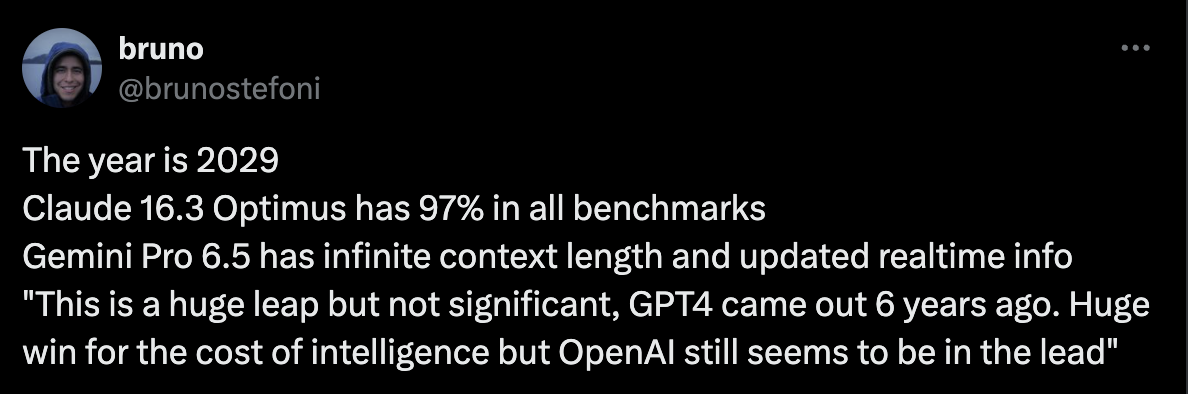
Soon, it appears that the debate over which model boasts the largest context length will become irrelevant. Microsoft, Google, and Meta, have all been taking strides in this direction – making context length infinite.

The end of Transformers?

While all LLMs are currently running on Transformers, it might soon become a thing of the past. For example, Meta has introduced MEGALODON, a neural architecture designed for efficient sequence modelling with unlimited context length.

MEGALODON aims to overcome the limitations of the Transformer architecture, such as its quadratic computational complexity and limited inductive bias for length generalisation. The model demonstrates superior efficiency at a scale of 7 billion parameters and 2 trillion training tokens, outperforming other models such as Llama 2 in terms of training loss.

It introduces key innovations such as the complex exponential moving average (CEMA) component and timestep normalisation layer, which improve long-context pretraining and data efficiency. These improvements enable MEGALODON to excel in various tasks, including instruction fine-tuning, image classification, and auto-regressive language modelling.

Most likely, upcoming Meta’s Llama 3 will be based on MEGALODON architecture, making it infinite context length.

Similarly, Google researchers have introduced a method called Infini-Attention, which incorporates compressive memory into the vanilla attention mechanism. The paper titled ‘Leave No Context Behind’ says that Infini-Attention incorporates compressive memory into the vanilla attention mechanism and combines masked local attention and long-term linear attention mechanisms in a single Transformer block.

This approach combines masked local attention and long-term linear attention mechanisms in a single Transformer block, allowing existing LLMs to handle infinitely long contexts with bounded memory and computation.

The approach scales naturally to handle million-length input sequences and outperforms baselines on long-context language modelling benchmarks and book summarisation tasks. The 1B model, fine-tuned on up to 5K sequence length passkey instances, successfully solved the 1M length problem.

Forgetting to forget

Along similar lines, another team of researchers from Google introduced Feedback Attention Memory (FAM). It’s a novel Transformer architecture that leverages a feedback loop to enable the network to attend to its own latent representations, fostering the emergence of working memory within the Transformer and allowing it to process infinitely long sequences.

The introduction of FAM offers a new approach by adding feedback activations that feed contextual representation back into each block of sliding window attention. This enables integrated attention, block-wise updates, information compression, and global contextual storage.

Besides, researchers from Beijing Academy of AI introduced Activation Beacon, a method that extends LLMs’ context length by condensing raw activations into compact forms. This plug-in component enables LLMs to perceive long contexts while retaining their performance within shorter contexts.

Activation Beacon uses a sliding window approach for stream processing, enhancing efficiency in training and inference. By training with short-sequence data and varying condensing ratios, Activation Beacon supports different context lengths at a low training cost. Experiments validate Activation Beacon as an effective, efficient, and low-cost solution for extending LLMs’ context length.

Do we even need tokens?

In February, Microsoft Research published the paper titled ‘LongRoPE: Extending LLM Context Window Beyond 2 Million Tokens’. The technique significantly increases the context length of LLMs to an unprecedented 2048k tokens, while preserving their original performance within shorter context windows.

Moving beyond that, another team of Microsoft researchers have challenged the traditional approach to LLM pre-training, which uniformly applies a next-token prediction loss to all tokens in a training corpus. Instead, they propose a new language model called RHO-1, which utilises Selective Language Modeling (SLM).

The SLM approach directly addresses this issue by focusing on the token level and eliminating the loss of undesired tokens during pre-training.

SLM first trains a reference language model on high-quality corpora to establish utility metrics for scoring tokens according to the desired distribution. Tokens with a high excess loss between the reference and training models are selected for training, focusing the language model on those that best benefit downstream applications.

No more ‘lost in the middle’?

There has been a long-going conversation about how longer context length window models have the problem of getting lost in the middle. Opting for smaller context-length inputs is recommended for accuracy, even with the advent of long-context LLMs. Notably, facts at the input’s beginning and end are better retained than those in the middle.

Jim Fan from NVIDIA AI explains how claims of a million or billion tokens are not helpful when it comes to improving LLMs. “What truly matters is how well the model actually uses the context. It’s easy to make seemingly wild claims, but much harder to solve real problems better,” he said.

Meanwhile, to measure the efficiency of these longer context lengths, NVIDIA researchers developed RULER, a synthetic benchmark designed to evaluate long-context language models across various task categories, including retrieval, multi-hop tracing, aggregation, and question answering.

All of this just means that the future LLM systems would have infinite context length.

The post LLM Systems Will Soon Have Infinite Context Length appeared first on Analytics India Magazine.

Ola Krutrim to Release Mobile App Soon

Ola Krutrim, the AI initiative by Ola, is set to launch its standalone mobile app, as announced by chief Bhavish Aggarwal.

Stand-alone @Krutrim app coming soon!

— Bhavish Aggarwal (@bhash) April 17, 2024

The app comes with significant advancements, including a notable decrease in the Time it Takes to Generate the First word of a response (TTFT), from 22 seconds at its initial launch to a swift 0.3 seconds presently, with further enhancements anticipated. Aggarwal also hinted at forthcoming improvements in an upcoming detailed blog post.

Major improvements in the @Krutrim model.
TTFT (Time it takes to generate the first word of response) down from 22 sec at launch (yea, quite slow) to 0.3 sec now. Will get even better soon!
Also, many more improvements happening. Will share a detailed blog this week. pic.twitter.com/NQUr1TjRwG

— Bhavish Aggarwal (@bhash) April 15, 2024

Aggarwal recently revealed that Krutrim has achieved a major breakthrough by operating on its independent cloud infrastructure, signifying a move away from reliance on external cloud providers like AWS or Azure. He emphasised ongoing efforts by the Krutrim team to enhance both the model itself and its infrastructure.

Intel recently disclosed that Ola Krutrim is leveraging Intel Gaudi 2 clusters for pre-training and fine-tuning its foundational models, boasting industry-leading price/performance ratios across ten languages.

Moreover, Krutrim is actively pre-training an expanded foundational model on Intel Gaudi 2 clusters, further elevating its AI capabilities.

A few days ago, Krutrim announced its partnership with Databricks to improve its foundational language model, particularly for Indian languages, aiming to enhance AI solutions in India.

“The Krutrim model was launched using our platform,” said Naveen Rao, VP of generative AI at Databricks, during an exclusive interview with AIM.

Ola Krutrim has been quite obsessed with developing its own foundational model from scratch, despite rumours that it is being built on fine-tuned models such as Llama-2, Mistral, Claude-3 or even the most recent, DBRX.

Launched in December last year, Krutrim has been lauded as “India’s first full-stack AI” solution, showcasing prowess in understanding and generating content across multiple Indian languages, including Marathi, Hindi, Bengali, Tamil, Kannada, Telugu, Odia, Gujarati, and Malayalam, with claims of superiority over GPT-4 in Indic languages

The post Ola Krutrim to Release Mobile App Soon appeared first on Analytics India Magazine.

Zendesk Launches Autonomous AI Agents For Workflow Automation

Zendesk Launches Autonomous AI Agents For Workflow Automation

Zendesk has unveiled a comprehensive service solution for the AI era at its Relate global conference in Bangalore. Zendesk is introducing autonomous AI agents, workflow automation, agent copilot, and AI-powered Workforce Engagement Management (WEM) and Quality Assurance (QA) capabilities.

As support volumes are projected to increase fivefold in the coming years, businesses require a system that continuously adapts and improves.

Tom Eggemeier, CEO of Zendesk, emphasised AI’s potential in enhancing customer experience. “We’ve seamlessly integrated AI into our products in a way that enables businesses to deliver proactive, personalised service that, above all else, makes it easier for the human on the other end,” he said.

India’s consumer market is poised for significant growth, as explained by Vasudeva Rao Munnaluri, RVP India & SAARC at Zendesk. Generative AI solutions are designed to support Indian businesses in achieving operational efficiency and productivity while delivering exceptional customer experiences.

Zendesk AI, the company’s fastest-adopted product, is utilised by thousands of companies to manage service quality and drive business growth. It can automate up to 80% of support requests and triple immediate resolutions, reducing resolution times by 30% and boosting agent productivity by 10%.

“Zendesk AI will provide value by automating tasks and routing tickets, allowing us to respond to customers faster and enabling our associates to focus on high-value activities such as proactive sales motions,” said Alicia Monroe, Regional CIO at Ingram Micro. “With Zendesk, we’ve seen increased productivity for our own associates and improved optimization of our operations overall.”

AI agents represent a significant shift in customer engagement, offering end-to-end resolutions and customization options. Additionally, the Agent copilot uses past experiences to guide human agents, optimising workflows and improving customer interactions.

Zendesk is also launching AI-powered Workforce Management (WFM) and Quality Assurance (QA) tools to enhance customer service operations. These include predictive workforce tools for real-time staffing adjustments and voice QA for evaluating call transcripts and coaching agents.

María de la Plaza, Head of Community Operations at SoundCloud, highlighted the importance of Zendesk QA in identifying and addressing knowledge gaps. This has led to improved agent performance and higher CSAT scores.

Zendesk ensures trust and control in AI-powered technology by offering complete control over AI deployments and rigorous safeguards for security and privacy compliance. Sheryl Kingstone, Managing Analyst at S&P Global Market Intelligence, stated that businesses are investing more in AI for its personalised customer service capabilities.

Zendesk provides a range of customer service tools and supports ticketing systems that are commonly utilised by multiple brands across the globe to manage and streamline their customer interactions. These new LLM-powered solutions by Zendesk help call centre agents efficiently handle customer inquiries, track and prioritise tickets, and provide a seamless customer support experience.

“By integrating LLM features into our intelligence panel, we anticipate doubling agent productivity. The panel offers reply recommendations, and conversation summaries, and allows agents to finetune their responses, resulting in enhanced efficiency,” Cristina Fonseca, head of AI, Zendesk, told AIM.

The post Zendesk Launches Autonomous AI Agents For Workflow Automation appeared first on Analytics India Magazine.

Meet the Visionary of AI Venture Capital

Khosla Ventures, an American venture capital firm founded by Vinod Khosla, recently completed twenty years in business. Passionate about technology-based economic disruption in many industries, the California-based firm invests in a range of areas, including AI, climate, sustainability, enterprise, consumer, fintech, digital health, medtech & diagnostics, therapeutics and frontier technology.

Source: X (formerly Twitter)

Khosla Ventures’ early investments in companies leveraging AI, ML, biotechnology, and renewable energy have positioned it as a leader in identifying and capitalising on emerging trends.

The name is synonymous with almost all notable AI investments.

Founded by two prominent former Google researchers, Tokyo-based Sakana AI, reported to be Japan’s first AI startup, recently raised $30M in a seed funding round led by Lux Capital, with strong backing from Khosla Ventures.

London-based Limbic raised a $14m Series A round backed by Khosla for its AI chatbot therapist to take the product to US healthcare providers.

Sarvam AI, a GenAI start-up focusing on India’s unique needs, has also raised $41 million in a Series A round led by Lightspeed with participation from Peak XV Partners and Khosla Ventures. The funding round marks the largest early-stage fundraiser for an Indian AI start-up. Home appliance firm Upliance.ai also raised $4 million in its seed round led by Khosla Ventures.

“We believe AI has the power to disrupt numerous economic models and change the way we lead our daily lives over the coming years. We invest in deep tech and invest where we can be early, bold and impactful” – Khosla Ventures

With investments in software giants like DoorDash and Block, the firm also backs Spiritus, a direct carbon air-capture startup, and Hermeus, a developer of hypersonic aircraft. In 2019, Khosla invested $50 million in OpenAI, the creator of ChatGPT, making it the first outside investor in the company.

How It All Started

The firm was started in 2004 by Vinod Khosla, co-founder of Sun Microsystems, to assist entrepreneurs in building impactful technology-based disruptive companies.

Khosla grew up wanting to become an entrepreneur despite being an Army kid with no business or technology connections. At 16, when he heard about Intel’s founding, he dreamt of starting his own technology company. He holds a BTech degree in electrical engineering from IIT Delhi and an MBA from the Stanford University Graduate School of Business.

Upon graduation, Khosla co-founded Daisy Systems, the first significant computer-aided design system for electrical engineers. The company achieved significant revenue and profits along with an IPO. Then, he co-founded Sun Microsystems in 1982 to build workstations for the software developers that helped Daisy Systems.

In 1986, Khosla joined KPCB as a general partner and built a semiconductor company named Nexgen, which Advanced Micro Devices (AMD) acquired. It was the only microprocessor producer to have significant success against Intel.

Finally, in 2004, his desire to be experimental and fund the ‘sometimes-imprudent science experiments’ led him to start Khosla Ventures, which focused on both for-profit and social impact investments.

Vinod is driven by the conviction that technology serves as a powerful catalyst to accelerate societal reinvention in food, health, climate, energy transportation, education, housing finance, media, retail and entertainment for billions around the globe. His greatest passion and deepest commitment lies in being a mentor to entrepreneurs who are building companies to tackle society’s largest challenges.

Vinod’s contributions extend beyond entrepreneurial mentorship. He holds a board position at Breakthrough Energy Ventures and serves as a founding board member of the Indian School of Business (ISB). Moreover, he is a charter member of The IndUS Entrepreneurs (TiE), a global non-profit network established in 1992, comprising over 40 chapters across nine countries today.

How It’s Going

As of October 2015, Khosla Ventures ranked among the top five largest and most active investors in the space sector, which has attracted over $10 billion in private capital since 2005. By September 2017, it managed approximately $5 billion in assets.

In October 2021, Khosla Ventures disclosed raising $1.4 billion in funding earmarked for investments in startups spanning early to late stages. This allocation included $400 million for seed-stage deals and $1 billion for later-stage companies. Additionally, in January 2022, Khosla Ventures secured $557 million for its first opportunity fund.

In 2023, defying the startup slump, Khosla closed in on $3 billion for venture funds. The fundraiser was one of the largest to be completed by a venture firm that year and one of the few to grow in size.

The Silicon Valley firm hopes to back more deep-tech companies tackling problems like healthcare and climate change. It supports startups in research-intensive sectors such as nuclear fusion and humanoid robots.

What’s Next?

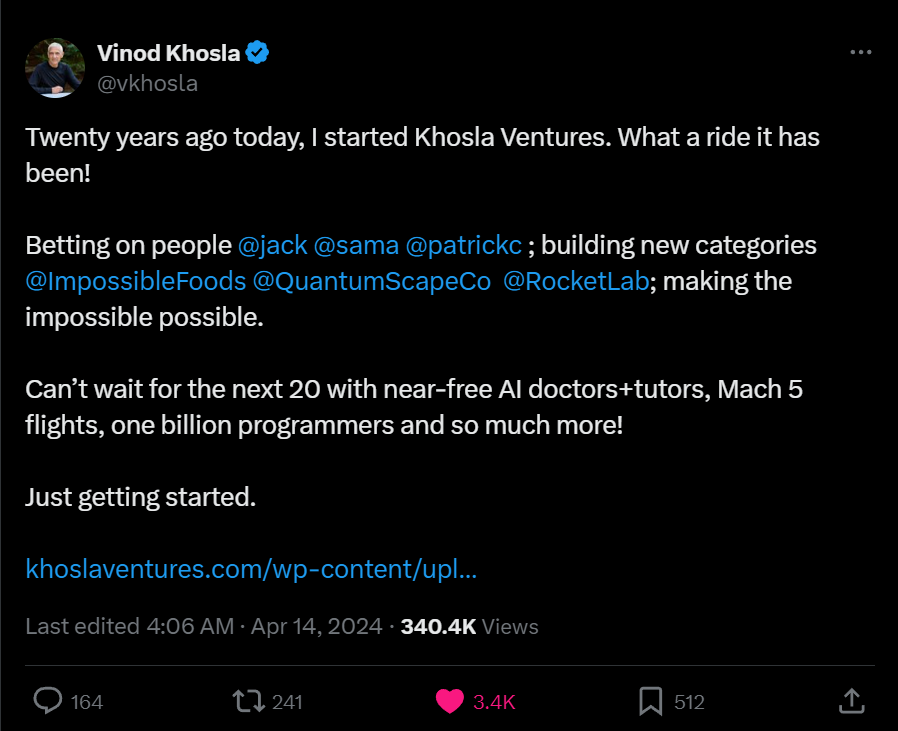
Envisioning the future in a report titled, ‘Plausible tomorrows: 2035-2049’, Khosla Ventures made interesting future predictions including near-free AI doctors+tutors, Mach 5 flights, one billion programmers and so much more! All this shows that the firm is future-ready and is just getting started to make abundant, awesome, technology-based, ‘possible tomorrows’ happen.

The post Meet the Visionary of AI Venture Capital appeared first on Analytics India Magazine.

Intel, VMware, Linux Foundation & Others Form Open Platform for Enterprise AI

In order to provide open frameworks for generative AI capabilities across ecosystems, such as retrieval-augmented generation, the Linux Foundation, Intel and other companies and groups have created the Open Platform for Enterprise AI.

What is the Open Platform for Enterprise AI?

OPEA is a sandbox project within the LF AI & Data Foundation, a part of the Linux Foundation. The plan is to encourage adoption of open generative AI technologies and create “flexible, scalable GenAI systems that harness the best open source innovation from across the ecosystem,” according to a press release about OPEA.

The following companies and groups have joined the initiative:

  • Anyscale.
  • Cloudera.
  • DataStax.
  • Domino Data Lab.
  • Hugging Face.
  • Intel.
  • KX.
  • MariaDB Foundation.
  • MinIO.
  • Qdrant.
  • Red Hat.
  • SAS.
  • VMware (acquired by Broadcom).
  • Yellowbrick Data.
  • Zilliz.

Ideally, the initiative could result in more interoperability between products and services from those vendors.

“As GenAI matures, integration into existing IT is a natural and necessary step,” said Kaj Arnö, chief executive officer of MariaDB Foundation, in a press release from OPEA.

What did OPEA create?

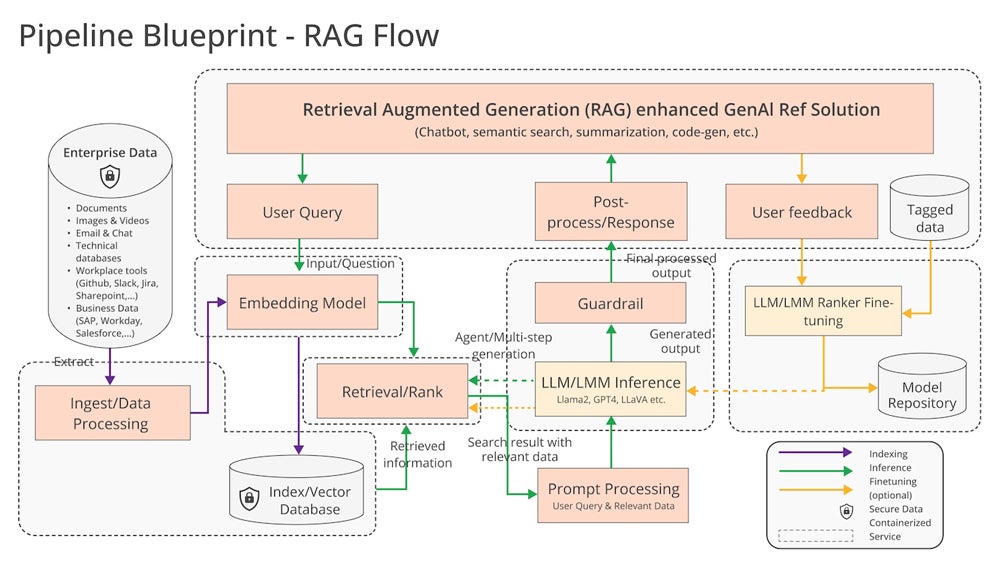
The idea is to find new use cases for AI, particularly vertically up the technology stack, through an open, collaborative governance model. In order to do so, OPEA created a framework of composable building blocks for generative AI systems, from training to data storage and prompts. OPEA also created an assessment for grading the performance, features, trustworthiness and enterprise-grade readiness of generative AI systems and blueprints for RAG component stack structure and workflows.

Intel, in particular, will provide the following:

  • A technical conceptual framework.
  • Reference implementations for deploying generative AI on Intel Xeon processors and Intel Gaudi AI accelerators.
  • More infrastructure capacity in the Intel Tiber Developer Cloud for ecosystem development, AI acceleration and validation of RAG and future pipelines.

“Advocating for a foundation of open source and standards – from datasets to formats to APIs and models, enables organizations and enterprises to build transparently,” said A. B. Periasamy, chief executive officer and co-founder of MinIO, in a press release from OMEA. “The AI data infrastructure must also be built on these open principles.”

Why is RAG so important?

Retrieval-augmented generation, in which generative AI models check with real-world company or public data before providing an answer, is proving valuable in enterprise use of generative AI. RAG helps companies trust that generative AI won’t spit out convincing-sounding nonsense answers. OPEA hopes RAG (Figure A) could let generative AI pull more value from the data repositories companies already have.

Figure A

A pipeline showing RAG architecture.
A pipeline showing RAG architecture. Image: OMEA

“We’re thrilled to welcome OPEA to LF AI & Data with the promise to offer open source, standardized, modular and heterogenous Retrieval-Augmented Generation (RAG) pipelines for enterprises with a focus on open model development, hardened and optimized support of various compilers and toolchains,” said LF AI & Data Executive Director Ibrahim Haddad in a press release.

There are no de facto standards for deploying RAG, Intel pointed out in its announcement post; OPEA aims to fill that gap.

SEE: We named RAG one of the top AI trends of 2024.

“We are seeing tremendous enthusiasm among our customer base for RAG,” said Chris Wolf, global head of AI and advanced services at Broadcom, in a press release from OPEA.

“The constructs behind RAG can be universally applied to a variety of use cases, making a community-driven approach that drives consistency and interoperability for RAG applications an important step forward in helping all organizations to safely embrace the many benefits that AI has to offer,” Wolf added.

How can organizations participate in OPEA?

Organizations can get involved by contributing on GitHub or contacting OPEA.

Zendesk Partners With Anthropic and AWS for Generative AI Solutions

Zendesk Partners With Anthropic and AWS for Generative AI Solutions

Zendesk has announced a partnership with AWS and Anthropic at its Relate global conference in San Francisco and Las Vegas. This collaboration aims to enhance Zendesk’s AI capabilities by utilising Amazon Bedrock and Anthropic’s Claude 3 model family.

These integrations will enable Zendesk’s over 100,000 customers to deploy sophisticated language models tailored to unique customer interactions.

Adrian McDermott, Zendesk’s chief technology officer, highlighted the importance of advanced LLM technology in shaping future customer and employee interactions. “Our long-standing partnership with AWS and work with Anthropic means our customers have a CX platform and choice of powerful LLMs to help them set a new standard for service, with AI and automation providing support quickly and effortlessly.” he said.

Atul Deo, General Manager of Amazon Bedrock at AWS, expressed enthusiasm about the collaboration. He stated that Zendesk’s use of Amazon Bedrock will empower businesses globally to deliver personalized and efficient support experiences by leveraging generative AI applications with security, privacy, and responsible AI.

Zendesk leverages AI to provide instant, intelligent responses to customer inquiries without the need for coding or costly model development.

The integration with Amazon Bedrock and Anthropic’s Claude 3 models allows for:

  • Immediate, intelligent support: Anthropic’s models work with Zendesk to provide empathetic, real-time responses, reducing wait times and increasing customer satisfaction.
  • Personalised interactions: Combining Zendesk’s CX data and industry insights with Anthropic’s AI and AWS enables tailored support for each customer’s needs.
  • Improved agent support: AI tools provide agents with necessary information and suggest suitable responses, automating routine tasks and allowing them to focus on complex customer needs.

Kate Jensen, Head of Revenue at Anthropic, noted that integrating Claude 3 models with Zendesk and Amazon Bedrock provides businesses with a trusted AI solution that utilises Claude’s multilingual abilities, writing proficiency, and nuanced conversational context comprehension.

This integration allows businesses to offer more personalised, efficient customer support across multiple languages and channels, boosting customer satisfaction, loyalty, and revenue growth.

“By integrating LLM features into our intelligence panel, we anticipate doubling agent productivity. The panel offers reply recommendations, and conversation summaries, and allows agents to finetune their responses, resulting in enhanced efficiency,” Cristina Fonseca, head of AI, Zendesk, told AIM.

The post Zendesk Partners With Anthropic and AWS for Generative AI Solutions appeared first on Analytics India Magazine.

‘Staged’ Generative AI Releases Raise Concerns over AI’s Future

Only last month, Cognition Labs’ Devin, the world’s first fully autonomous AI software engineer, took the internet by storm. Devin was set to make developers obsolete, that is if you believed the social media chatter.

However, a software developer decided to look closely, and in a YouTube video, claimed that the whole demo video Cognition Labs published a month ago was staged.

If you’ve been tracking developments in the AI realm, this might feel like déjà vu, reminiscent of Google’s controversy last year when it was accused of fabricating its Gemini video.

That is not all, Google DeepMind last year claimed its AI tool GNoME found 2.2 million new crystals, including 380,000 stable materials that could power future technologies. Along with Devin, Google DeepMind’s claims were two of the biggest in terms of what AI can do.

Yet, in a perspective paper featured in Chemical Materials, Anthony Cheetham and Ram Seshadri from the University of California concluded that none of these structures pass a three-part test assessing their credibility, usefulness, and novelty.

False claims or conflicting views?

Cheetham and Seshadri analysed a random subset of the 380,000 structures revealed by DeepMind, contending that the substances identified are, in fact, crystalline inorganic compounds and should be classified as such, rather than being broadly termed “materials.”

They propose reserving the term “material” for substances exhibiting tangible utility. However, Google responded, affirming to 404media that they uphold all assertions presented in DeepMind’s GNoME paper.

While we are restricting ourselves from jumping to any conclusions yet, it’s hard to side with Google on this one courtesy the staged Gemini video and the number of anti-competitive lawsuits filed against the company.

Devin, on the other hand, is a different scenario entirely. The startup, backed by Peter Thiel also responded to the criticism.

A developer working at Cognition Labs took to X to clarify: “The primary criticism was that I didn’t transcribe the prompt verbatim, which looking back at the screenshot is accurate — I was thinking since Devin already runs inside an EC2 instance I’d try to get it to just do the job directly instead of writing instructions.”

Fuelling hype?

Cognition Labs is led by Scott Wu, a prominent programmer who was recognized as a child prodigy at an early age. His team also includes highly-talented developers who have previously worked with Google DeepMind, Cursor, ScaleAI, and other prominent tech companies.

Given Wu and his team’s stellar reputation, it appears unlikely that they would intentionally pass off a staged video and expect no one to notice. However, it does make one wonder if they released a product (albeit with limited access) prematurely due to investor pressure.

Notably, when Google unveiled its Gemini video, it apparently did so under immense pressure to introduce an AI product, driven by concerns of lagging behind competitors such as Microsoft and OpenAI in the AI race.

Meanwhile, Cognition Labs is reportedly seeking to raise fresh money at a USD 2 billion valuation and may have been forced to release a half-baked product. If true, in today’s fast-paced environment, such a revelation wouldn’t entirely be a shocker.

Silicon Valley founders are frequently criticised for overhyping their products to sustain enthusiasm and boost sales, reminiscent of Elon Musk’s assertions about achieving level five autonomy by 2021 and 2023.

Moreover, Musk, alongside NVIDIA CEO Jensen Huang, has asserted that we will witness superintelligent AI within this decade.

However, this claim could be interpreted as merely perpetuating the AI hype, especially considering that Geoffrey Hinton, the godfather of AI, believes it will take another 20 years for such advancements to materialise.

AI has its limitations

The reality is that Devin still has a long way to go before it acquires the ability to master software development completely and make developers obsolete. The Cognition Labs developer did claim that Devin ‘makes mistakes’ and ‘often fails’.

One day, AI might discover 20 million new minerals, however, between then and now, there are many hurdles that AI systems might have to overcome.

For instance, numerous AI startups today are pouring significant resources into R&D, often being valued at exorbitant levels based on what their AI systems might achieve in the coming years, rather than their current capabilities.

Take Cognition Labs for example, after its latest funding round, could be valued at USD 2 billion without even shipping a product.

However, soon these companies will face the imperative of turning a profit, a hurdle that many may fail to overcome. Like Stability AI, once lauded for its Stable Diffusion technology, is now grappling with financial distress, teetering on the brink of collapse.

Nonetheless, despite the hype, one thing is clear that AI is on the right trajectory and will achieve all those things people say it will. However, current AI systems do have their limitations.

The post ‘Staged’ Generative AI Releases Raise Concerns over AI’s Future appeared first on Analytics India Magazine.


Reddit CPO talks new features — better translations, moderation and dev tools

Reddit CPO talks new features — better translations, moderation and dev tools Amanda Silberling 11 hours

It’s a big year for Reddit. After its IPO, the platform is planning a slew of product features for the year ahead, and — spoiler alert — most of them are powered by AI.

“I think the IPO was an important milestone, but we’re just focused on building for our users,” Reddit chief product officer Pali Bhat told TechCrunch.

Reddit’s product roadmap includes faster loading times, more tools for moderators and developers, and an AI-powered language translation feature to bring Reddit to a more global audience.

“This is actually a really cool use of LLMs, where we can do translations in a more nuanced way than ever before,” Bhat said. “If you’re in, let’s say, France, you will be able to use Reddit in French, regardless of what most of the users of that subreddit might be.”

So, if a user posts in French, an English-speaking Redditor could read the post in English and respond — and the French speaker could see their response in their own language and respond in kind.

“For the longest time, Reddit was largely an English-only platform, and focused heavily on the United States, United Kingdom, and Mexico,” Bhat said. “We’re now expanding dramatically across the world, and we’ve already had a significant number of users coming in from the rest of the world.”

If you’re an investor in Reddit, that’s probably music to your ears. But Bhat has the data to back it up. According to Reddit’s IPO filing, in December 2023, 50% of Reddit’s daily active unique users were from non-U.S. countries.

AI is also at the heart of Reddit’s updates to the moderator experience. Reddit recently rolled out keyword highlighting features that make it easier for mods to find potentially violative content in their subreddits, along with tools to manage influxes of new members. The company will build on those updates with other new tools, like an LLM that’s trained on moderators’ past decisions and actions.

Reddit sparked mass user protests last year when it changed its API pricing structure, meaning that some popular third-party Reddit apps would be stuck with seven-figure bills if they continued to operate. This backlash has died down, but now Reddit is encouraging developers to build directly on Reddit, and without pay — but Bhat says this could change in the future.

You can find the products from the developer platform on r/WallStreetBets, where there’s a live dashboard of trending stocks, posters and commenters. And, as Bhat notes, one of the most popular Super Bowl scoreboards actually came from r/TaylorSwift — go figure.

“The coolest thing is that it’s unlocking experiences that we ourselves wouldn’t have imagined,” he said. “And that’s just awesome, and it’s all built on top of our API.”

Reddit IPO could usher in the next big meme stock, users speculate

Intel Builds Largest Neuromorphic System for Sustainable AI

Intel Builds Largest Neuromorphic System for Sustainable AI

Intel has unveiled the world’s largest neuromorphic system, named Hala Point, to promote more sustainable and efficient AI. Utilising Intel’s Loihi 2 processor, the system is designed for research in brain-inspired AI and addresses challenges in today’s AI efficiency and sustainability.

Hala Point, initially deployed at Sandia National Laboratories, improves on Intel’s previous large-scale research system, Pohoiki Springs, with over 10 times more neuron capacity and up to 12 times higher performance.

“The computing cost of today’s AI models is rising at unsustainable rates. The industry needs fundamentally new approaches capable of scaling. For that reason, we developed Hala Point, which combines deep learning efficiency with novel brain-inspired learning and optimisation capabilities. We hope that research with Hala Point will advance the efficiency and adaptability of large-scale AI technology,” said Mike Davies, director of the Neuromorphic Computing Lab at Intel Labs.

Hala point can support up to 20 quadrillion operations per second, or 20 petaops, with an efficiency exceeding 15 trillion 8-bit operations per second per watt (TOPS/W) when executing conventional deep neural networks.

These capabilities surpass those of systems based on GPUs and CPUs. Its advanced features enable real-time continuous learning for applications such as smart city management, scientific problem-solving, and large language models.

Sandia National Laboratories plans to use Hala Point for advanced brain-scale computing research, focusing on scientific computing challenges across various disciplines. The system’s large-scale capacity allows researchers to tackle complex problems in fields ranging from commercial to defence to basic science.

“Working with Hala Point improves our Sandia team’s capability to solve computational and scientific modelling problems. Conducting research with a system of this size will allow us to keep pace with AI’s evolution in fields ranging from commercial to defence to basic science,” said Craig Vineyard, Hala Point Team Lead, Sandia National Laboratories.

While Hala Point is a research prototype, its development promises advancements such as continuous learning in large language models, significantly reducing the training burden in AI deployments. Intel anticipates further progress in the field by applying neuroscience-inspired computing principles to minimise power consumption and maximise performance.

The post Intel Builds Largest Neuromorphic System for Sustainable AI appeared first on Analytics India Magazine.