



Before you assume that Google has finally embraced the open-source route, let us clear the air for you – Gemma is not an open-source model; it is an ‘open-model’ and there is a huge difference between the two.
In the official blog post of Google Gemma, the company has strategically termed it as the new state-of-the-art ‘open models.’ These lightweight SOTA models are said to be built from the same research and technology used for creating the Gemini models. “Open models feature free access to the model weights, but terms of use, redistribution, and variant ownership vary according to a model’s specific terms of use, which may not be based on an open-source licence,” stated the company blog.
Released in two sizes, 2B and 7B, the models outperforms Llama 2, which is Meta’s open source model, on several benchmarks including MMLU, HellaSwag and HumanEval. However, Llama 2 is completely open-sourced unlike Gemma.
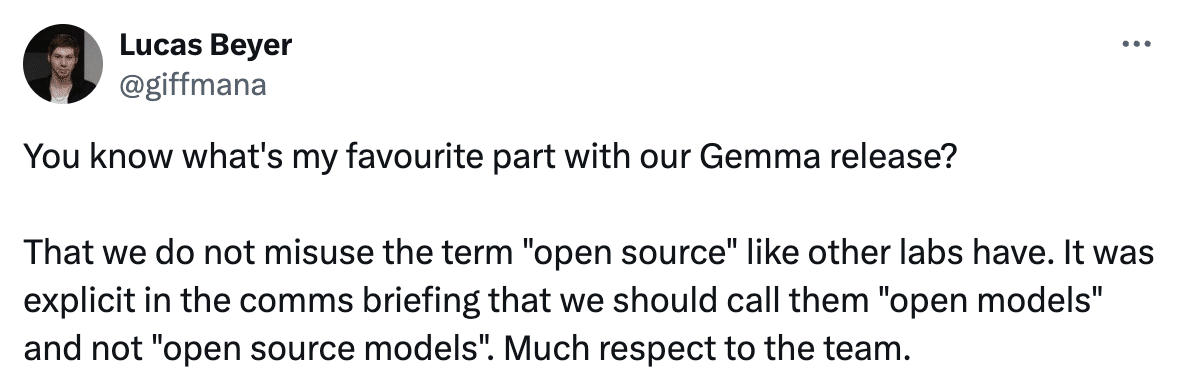
Tweet by a researcher at Google DeepMind. Source: X
Open Model Benefits Google
Author and AI advisor, Vin Vashishta spoke about the critical difference between open model and open source which can have large implications for open source LLMs. “The open model paradigm means the weights are made public, but significant constraints on model usage limit what developers can build,” he said.
Through Google’s open model, developers can get access to the weights, but the new licence will give Google control over how Gemma is used. There is also an additional risk for developers building on open models such as Gemma. Google can decide to impose charges for a unique application built by developers and if that directly rivals Google’s offerings, the company has the potential to restrict its use entirely.
While maintaining semi-control over what people build using Gemma, the open model approach will enable Google to monetize it more effectively than it could with an open-source model. Vashishta also cautions on setting a precedence to other big tech companies to follow a similar model which can negatively affect the open source LLM community in terms of transparency and innovation.
Bigger Picture
When big tech companies such as Microsoft are partnering with key players such as OpenAI to mutually benefit each other, Google has also selected a similar path to take on its opponents. The company has partnered with emerging AI companies such as Anthropic, and has leveraged the latest generation Cloud TPU v5e chips for AI inference.
Google Cloud recently partnered with Hugging Face, an open source community, to allow developers on the platform to utilise Google Cloud’s AI-optimised infrastructure such as Vertex AI, TPUs, GPUs, and other compute resources.
With Gemma, Google is expanding its plans to further improve strategic partnerships, and slowly position itself as an indispensable player in the AI developer community. Interestingly, Google collaborated with NVIDIA to launch Gemma. The companies partnered to enhance Gemma’s performance using NVIDIA’s TensorRT-LLM library, which is designed to optimise LLM inference tasks.
Furthermore, Gemma is available on the Perplexity platform too. Ironically, AI-powered answer engine Perplexity is competing with Google.
Responsible AI
Gemma’s open model structure also grants control to Google in terms of safety, something the company has long advocated for. “We have a long history of supporting responsible open source & science, which can drive rapid research progress, so we’re proud to release Gemma,” said co-founder and CEO of Google DeepMind, Demis Hassabis.
In support of responsible technology, Google has been promoting ‘Responsible AI’, a key focus of the company as previously highlighted by Google chief Sundar Pichai. “What matters even more is the race to build AI responsibly and make sure that as a society we get it right,” said Pichai. Gemma has also been packaged with the responsible tag.
Google specifically mentioned that the models are released in accordance with Google’s AI Principles, whereby they are unveiled only after determining the benefits to be significant and the risks of misuse to be low. Gemma is no exception.

Open- Source Persists
By releasing an open model and adhering to the ‘responsible AI’ approach, Google is attempting to position itself alongside other major tech companies such as Meta that have open-source models. However, Google is not new to the open-source approach.
Google’s biggest open-source projects such as Android and Chromium have revolutionised access to mobile and web technologies. Similarly, their AI models such as Transformers, which forms the base for LLMs (including ChatGPT), TensorFlow and AlphaFold, are all open source models.
With Gemma, Google is trying to dip its feet in all ‘open’ waters, but also being wary of not going all in.
The post Don’t be Fooled by Google Gemma’s ‘Openness’ appeared first on Analytics India Magazine.
