
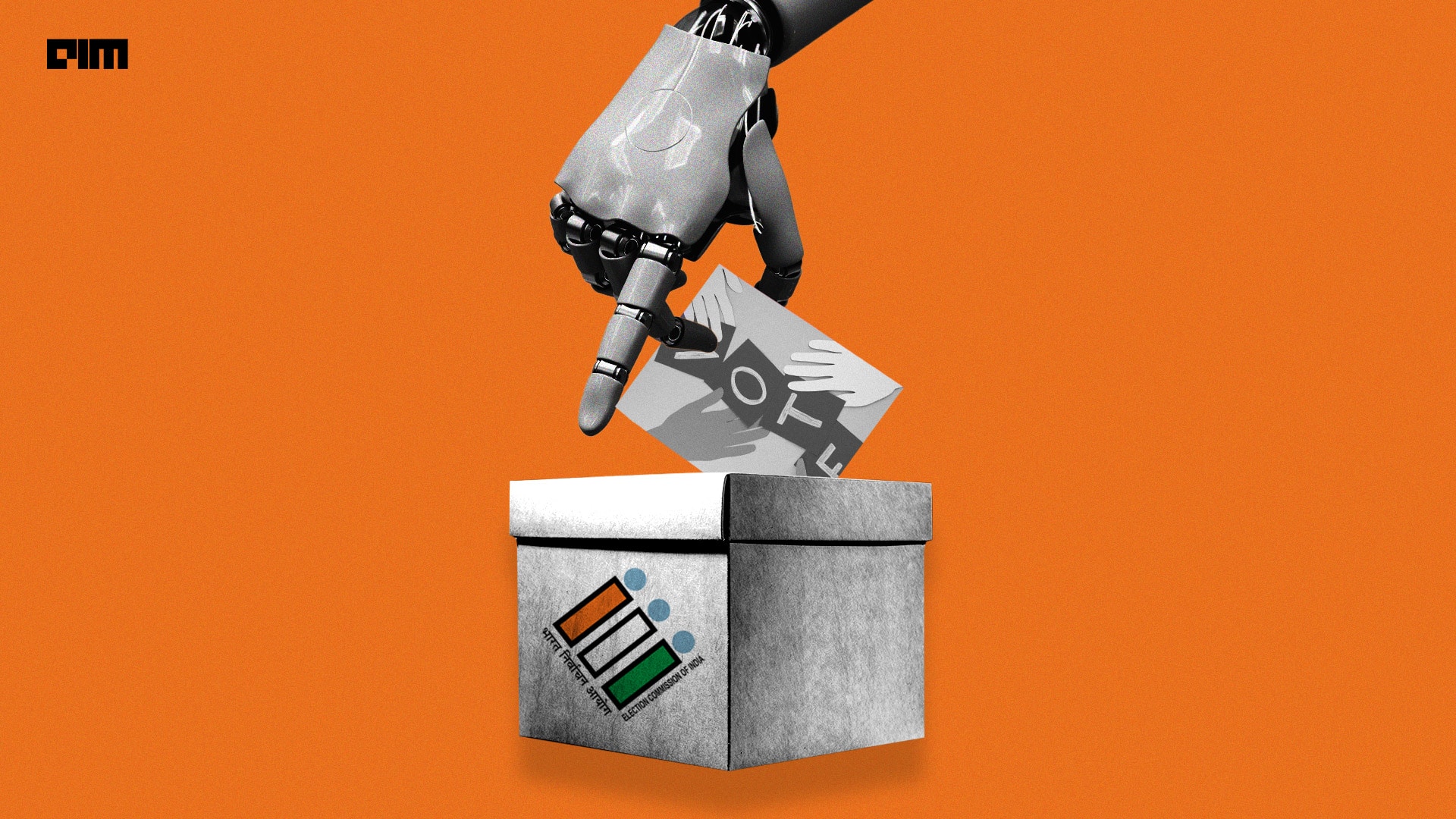
With the Bihar, Kerala, West Bengal and Tamil Nadu state elections approaching, discussions about utilizing AI to gather and analyse election knowledge have intensified. The modern use of AI within the 2024 Lok Sabha elections proved to be a dominating drive, though not all the time for the best causes.
Machine studying algorithms have been employed to know and analyse voter turnout and election outcomes, whereas pure language processing methods have been utilized to analyse political speeches and content material shared on social media platforms.
Regardless of these developments, important considerations over knowledge privateness and algorithm biases stay important points to deal with on this discipline. Whereas AI improves knowledge administration by accumulating and analysing substantial volumes of knowledge, it additionally carries the chance of distorting that info.
In a dialog with AIM, Rajeeva Laxman Karandikar, an Indian psephologist, mirrored on his early involvement in election prediction practically 25 years in the past. He highlighted the effectiveness of correctly chosen statistical samples, noting that even comparatively smaller samples of 10,000 to 12,000 respondents can present dependable assessments.
Rajeeva acknowledged that his perspective has advanced over time, regardless of initially being sceptical about using totally different sorts of knowledge. He acknowledged that relying solely on both pure knowledge or simply sourced knowledge presents limitations, with each extremes proving problematic.
Discussing the function of AI in predictive evaluation of voter behaviour, political scientist Sandeep Shastri defined that a variety of AI instruments at the moment are used to analyse voting behaviour and electoral traits, serving to many to make projections and draw conclusions.
Nonetheless, he argued that, finally, the dynamism of human behaviour—particularly when it comes to voting habits and political preferences—signifies that we want extra than simply AI; we additionally want human intelligence.
“Are we asking the best questions of AI? If we pose the mistaken questions, AI will present analyses primarily based on these misdirected queries. We should think about whether or not we’re utilizing AI as a instrument or changing into overly depending on it for our analyses,” Shastri added. He believes that those that can successfully leverage AI by asking the best questions could have the chance to realize deeper insights that they’ll additional analyse themselves.
When requested about AI enhancing conventional strategies, Karandikar expressed uncertainty about present AI fashions used for elections and the information they use. He identified the issue in precisely tagging social media customers to particular constituencies, limiting its direct applicability at that degree.
Karandikar instructed that combining social media and reporter knowledge, with cautious consideration of reliability, may present insights into general traits and swing constituencies, acknowledging the elevated potentialities in comparison with his early experiences.
When making a wholesale product, it’s important to conduct a personalized evaluation primarily based on particular situational components concerned. “The character of the inquiry can considerably affect the outcomes you obtain. The way you body your query will form your reply. When you ask surface-level or overly simplistic questions, chances are you’ll be misled,” Shastri emphasised.
In response to Karandikar, there’s a important danger of AI-driven analytics overfitting historic biases and reinforcing social and political marginalisation, significantly in coverage formulation. He famous that societal biases wouldn’t solely be current within the knowledge however may very well be amplified by AI fashions. He doesn’t consider AI can successfully debunk misinformation in a extremely polarised election situation.
For instance, within the 2024 Indian elections, AI-driven methods enabled platforms akin to Meta to greenlight political commercials that provoked violence towards Muslims, worsening the dissemination of divisive and inflammatory materials.
He emphasised the important want for human supervision when utilizing AI, significantly for points with important societal or coverage implications.
Shastri believes that election forecasts and exit polls have a minimal affect on individuals’s voting choices. In response to him, people sometimes type their voting preferences nicely earlier than any projections are made, whether or not generated by AI or decided by human analysts.
With over 30 years of expertise in election evaluation, Shastri defined that social media and AI don’t considerably affect voter opinions. He pressured that whereas individuals use these platforms for info, they primarily have interaction with them for leisure quite than to form their opinions. “I’m but to seek out myself in a state of affairs the place AI has modified opinions, that’s, solely rainforest opinions,” he stated.
Nonetheless, deepfake movies that includes Tamil Nadu’s J Jayalalithaa and M Karunanidhi appeared final 12 months, endorsing present candidates and stirring emotions of nostalgia and loyalty amongst voters. The Communist Celebration of India-Marxist (CPI-M) utilised AI to help veteran Buddhadeb Bhattacharya in connecting with voters.
These functions increase moral points, as they leverage the likenesses of aged or deceased people with out their permission, doubtlessly manipulating the voters’s emotional reactions.
A examine by Social Media Issues discovered that 80% of people voting for the primary time encountered misinformation, with 30% of it coming by means of WhatsApp. In a survey performed throughout the 2025 Delhi elections by The 23 Watts, 91% of members aged underneath 25 felt that faux information may affect their voting choices, whereas 80% acknowledged it influenced their opinions, 59% have been affected by sensationalised content material, and 45% shared unverified info. Whereas the speedy results may seem negligible, the long-term penalties may alter election outcomes and diminish belief in establishments.
Karandikar reiterated that the first concern with election forecasts influencing voter behaviour shouldn’t be AI however the manipulation of underlying knowledge. He argued that manipulation can happen with out AI, pointing to situations of exaggerated knowledge claims by channels.
Notably, Rajeeva advocated for minimal public disclosure requirements for election-related knowledge assortment and evaluation, together with the interval of assortment and supervision particulars, which are sometimes missing.
The submit As Elections Strategy, AI Reshapes Electoral Evaluation in India appeared first on Analytics India Journal.