TL;DR: Summarize your favorite video and podcast content with a lifetime subscription to the TubeOnAi Premium Lite Plan for just $78.99, a 64% discount off the regular $224 subscription price.
One of the most useful benefits of employing artificial intelligence in your work is the amount of time and effort it can save you. Whether you want to mine content you’ve already created, research existing content, or prepare for presentations, you can get written or audio summaries from podcasts and YouTube videos with a lifetime subscription to TubeOnAi’s Premium Lite Plan. It’s currently available to new users for only $78.99, a 64% discount off the regular $224 subscription price.
About TubeOnAi
Repurposing your own content is one of the most efficient ways to boost your bottom line, but it still takes time. However, it’ll take a lot less time with TubeOnAi. Want to increase engagement on your website? Use TubeOnAi to create more blog posts. Expand your social media following by letting TubeOnAi create more posts from your YouTube or podcast channel. Or create entirely new scripts altogether.
All you have to do is tell the program how often you want summaries sent to you and in what format. They will contain key insights from the original content. Then, you can access the summaries from a browser or mobile app available for both iOS and Android. The TubeOnAi Premium Lite Plan includes 1,500 minutes of summaries a month from up to 50 channels, multi-language support, speed control and much more.
It can even help you keep up with the accounts you love to follow but never have time to dive into. TubeOnAI will automatically download their content and then send it to you concisely summarized in real-time. You can search for podcasts and videos right inside the app and even play the whole original video.
Get a lifetime subscription to the TubeOnAi Premium Lite Plan while it’s available to new users for only $78.99 (reg. $224).
It is hard to imagine what today’s operating systems will mean to developers 37 years in the future. Going back 37 years to 1986, when MS DOS version 4.0 was released, computers were less complex and more open to modifications at a fundamental level.
Microsoft, embracing the open source movement, released version 1.1 and 2.0 in 2014. Last week, the company, along with IBM, which was closely associated with building the 4.0 version of DOS, made the source code available on GitHub.
Open sourcing MS-DOS 4.0 // fun to see. This might underplay the confusion and lack of success of 4.0 which was a weird release that was based on the 2.0 code and didn’t offer much for the 386 processor that was already working through new PCs. It was even confusing to OEMs who… pic.twitter.com/go3gHwTIul
— Steven Sinofsky (@stevesi) April 26, 2024
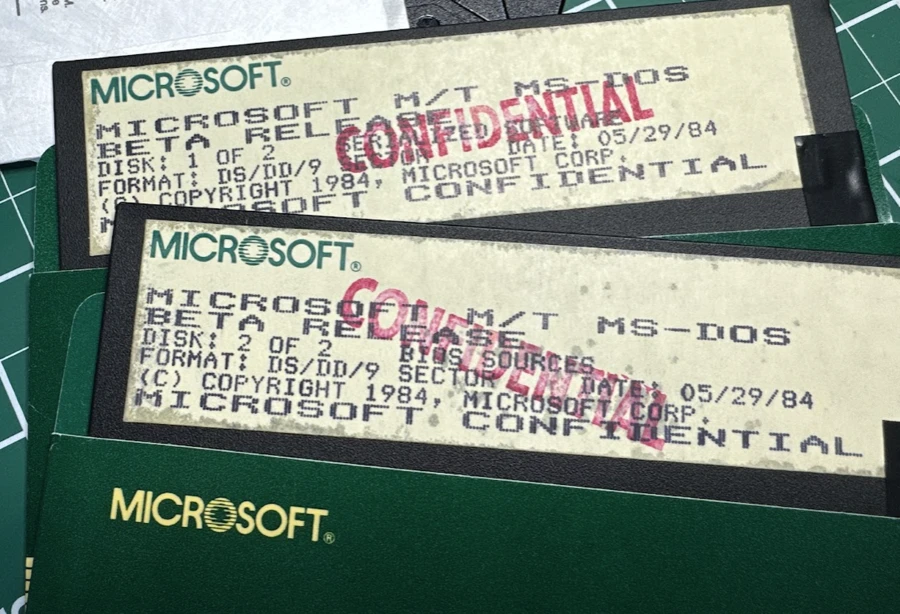
The open source release also included the beta build and scanned documentation of MT-DOS 4.0 built primarily by Microsoft. MT-DOS introduced multi-tasking, which allowed certain programs to run in the program. This version didn’t see commercial release but was quickly overshadowed by OS/2 which improved upon the feature.
Microsoft claims to have ‘lost’ its source code.
It was unearthed by Connor ‘Starfrost’ Hyde, who discovered unreleased beta binaries of DOS 4.0 among former Microsoft CTO Ray Ozzie’s collection.
He worked to publish the code on GitHub along with Scott Hanselman, the VP of developer community, and Jeff Wilcox, head of OS programs office, who reported they will “continue to explore the archives and may update this release if more is discovered”.
In 2001, Bill Gates announced, “Today it really is actually the end of the MS DOS era.” DOS, which ran underneath Windows 3.1, Windows 95, and Windows 98, was being replaced by Windows XP.
At the time of the announcement, DOS was running on over 400 million PCs worldwide.
But the popularity of vintage games built on DOS has retained old timers and children. There are plenty of games still being released on DOS barring the limitations of memory management.
Developers, who reminisced about the time they worked with DOS, were enthusiastic about experimenting with the release and found a few inconsistencies in it.
Hackers and tinkerers who grew up with DOS are eagerly digging into the source code, reliving their early computing experiences. As one HackerNews user exclaimed, “Holy cow, this is huge! DOS 1.x and 2.x are too old to run a lot of vintage DOS software, but 4.x would run just about everything.”
Nostalgia and the present!
The average person doesn’t often come in contact with systems run on DOS. Apart from George RR Martin, who wrote A Game of Thrones books on DOS, the US Navy that used it till 2011, or old-time nerds who are the market for DOSBox to play retro video games on, the operating system is practically defunct.
George R.R. Martin writes A Game of Thrones in the DOS word processor WordStar 4.0 pic.twitter.com/bVumMzaFM9
— Retro Tech Dreams (@RetroTechDreams) August 24, 2023
Right after the open source release, developers took to social media to discuss the times they spent working on DOS when alternatives were sparse. While modern operating systems are complex and allow a wide range of functions, they’re more closed and secure.
A user wrote, “They (kids) can play with code in various sandboxes locally and on the web, but the computer fundamentally belongs to someone else today.”
Although slow with less memory, the device would allow for programming in languages like C to directly compile on the device itself, and modify the core software.
This is in contrast to many modern systems, which often restrict such low-level access to enhance security and stability.
Using the source code, one developer built his own version of the DOS. Though he mentioned the difficulties in compiling the code, he successfully demonstrated running various commands and utilities, showing the functionality of the built operating system within the FreeDOS environment.
Bryan Lunduke, a former software engineer of Microsoft, who attempted to compile the source code, found that several files, including GETMSG.ASM and USA.INF, were “mangled” and could not be properly compiled.
A software engineer and historian, Michal Necasek, who runs the OS/2 Museum blog, found that shoving the source code into GitHub caused irreversible damage, such as loss of timestamps and corruption of files that used code page 437 characters.
Necasek argued that for practical purposes, old source files should be treated as binary and must be preserved without modification. These changes raise concerns about the integrity and historical accuracy of the released source code.
Despite the issues with the release, many in the community are excited to dig into this piece of computing history.
As one developer commented on HackerNews, “Even just seeing some of these filenames is a major blast from the past! Love it,” listing off familiar file names like ‘CPY.BAT’, ‘MAKEFILE’, ‘RUNME.BAT’, and ‘SETENV.BAT.’
The Future is Retro
While the released version of MS-DOS 4.0 may not have much practical use today, the publicly available source code has allowed hackers to explore the inner workings of the operating system that defined their early computing experiences.
Another user shared, “I never thought I would be able to build DOS from scratch, but here we are!” The real value is in preserving this important part of the history of personal computing.
Jim Hall, the founder and project coordinator of FreeDOS, explained that the move to use the MIT licence allows developers to freely study, modify and distribute the code.
Modern developers’ fascination with retro computing extends beyond MS-DOS, as seen in the rise of retrocomputing. One user on X posted, “We completely missed out on the days of programming in C for MS-DOS back when things were so much simpler.”
Engaging with classic operating systems’ source code and retro media allows developers to gain insights into computing’s evolution, informing future innovations.
The series ‘Fallout’, for instance, draws inspiration from vintage technology, MS-DOS 4.0 release exemplifies this retro revolution, inspiring a new generation to embrace the hacker legacy.
Bojan Tunguz aptly said, “The future is here and it’s totally retro.”
The future is here and it’s totally retro. pic.twitter.com/tBOcMpFZxv
— Bojan Tunguz (@tunguz) April 30, 2024
The post Open-Source MS-DOS 4.0 Inspires Aspiring Hackers to Embrace Retro Revolution appeared first on Analytics India Magazine.
At SAP’s flagship event, SAP Now, in Mumbai yesterday, the German tech conglomerate launched ‘GROW with SAP for Scaleups,’ a new cloud service to support Indian startups. by modernising their core business processes through SAP S/4 HANA Public Cloud, offering a six-month free trial to foster innovation in fast-growing startups. This extension of last year’s ‘Grow with SAP’ program targeted midsize companies with a bundled cloud-native service.
“ Our goal with this program is to make SAP more accessible and cost-effective to startups through various commercial models and to ensure that the time to value through our partner ecosystem is expedited to just a few weeks,” Sanket Deodhar, vice president and head of digital natives, SAP India, told AIM, during the press meeting.
The benefits of the ‘GROW with SAP’ program for scaleups include enhanced market valuation through optimised operations and real-time financial data access, faster modernisation of business processes, and expansion into new markets while adhering to regional regulations. The service also aims to streamline administrative tasks and the complete ‘hire-to-retire’ cycle, thus improving operational efficiency and employee experiences.
Prominent Indian companies like Nykaa, Atomberg, and Prama Hikvision India have already experienced major improvements in customer satisfaction and operational efficiency by integrating SAP’s cloud solutions.
According to Hikvision’s chief information officer, Hiren Dakan, coordinating multiple business verticals was challenging before implementing SAP. “Over the past decade, adopting SAP has boosted our growth by automating and streamlining operations across order management, procurement, and production,” Dakan told AIM, sharing that this transition reduced manual labour and enhanced business performance.
Atomberg, a leader in India’s smart home appliance market, also has a similar story.
In a conversation with AIM at the event, Atomberg’s chief financial officer, Manish Bansal, highlighted SAP’s Extended Warehouse Management (EWM) module’s significant impact on inventory management. This module allows detailed tracking within storage facilities, optimising space usage and operational efficiency, particularly during peak hours. “Another critical functionality is the ability to track profitability by SKU and by customer. This feature gives us a detailed view of which products are profitable and which are not, right down to specific buyers. It allows for precise tracking of customer profitability and helps in making informed business decisions,” Bansal added.
Additionally, the integration of SAP with the company’s in-house distributor management system, Arteria, enables Atomberg to consolidate primary and secondary sales data across different channels, providing a holistic view of customer profitability.
The post SAP Launches ‘GROW with SAP for Scaleups’ to Boost Indian Startups with Cloud & GenAI appeared first on Analytics India Magazine.
Genpact has announced a collaboration with Microsoft aimed at driving modern finance transformation across enterprises. The collaboration focuses on leveraging data, technology, and AI to fuel innovation for finance organisations globally.
The collaboration aims to harness the power of Microsoft Azure OpenAI Service coupled with Genpact’s deep domain expertise, data capabilities, technology, and AI proficiency to transform finance organisations into future-ready entities. This initiative is geared towards enabling quicker decision-making supported by a solid foundation of data and AI.
Balkrishan “BK” Kalra, President and CEO of Genpact, stated, “Genpact has decades-long expertise and leadership in finance and accounting services. Our strategic collaboration with Microsoft will drive the next wave of finance transformation using AI to turn finance functions into strategic, data-driven operations that support growth and competitiveness.”
Genpact’s responsible use of Azure OpenAI Service is already showing promising results in modernising finance functions globally, providing businesses with faster access to insights and helping create a modern, actionable finance data and analytics strategy.
Nicole Dezen, Chief Partner Officer at Microsoft, commented, “AI is revolutionising the finance industry by enabling unprecedented levels of efficiency, accuracy, and innovation. We are thrilled to partner with Genpact to combine their domain expertise with Microsoft Azure OpenAI Service to empower finance organisations to harness the power of data to drive business transformation.”
Genpact is not only driving transformation in finance organisations but is also modernising its own finance function through extensive use of Microsoft’s AI tools. By harnessing the power of data, technology, and AI, Genpact has achieved significant results across multiple areas of finance:
Enhanced vendor management automation with advanced AI algorithms has led to a 85% accuracy in response and doubled supplier satisfaction. Real-time communication, coupled with this data-driven approach, is driving favourable deal negotiations and reduced disputes.
The customer collections process has been transformed with AI-powered analytics and automation, along with streamlining of invoice and payment tracking.
Implementation of a large language model-based digital assistant, utilising advanced natural language processing (NLP) and machine learning (ML), has streamlined tax document submissions, resulting in a 53% reduction in support tickets and significantly improving employee experience.
In September last year, Genpact collaborated with AWS aimed at revolutionising financial crime risk operations through the integration of generative AI and LLMs. The partnership entails the integration of Genpact’s cloud-based financial crime suite, riskCanvas, with Amazon Bedrock, yielding significant efficiencies and benefits for clients, including Apex Fintech Solutions.
The post Genpact Collaborates with Microsoft for AI-Driven Finance Transformation Across Enterprises appeared first on Analytics India Magazine.
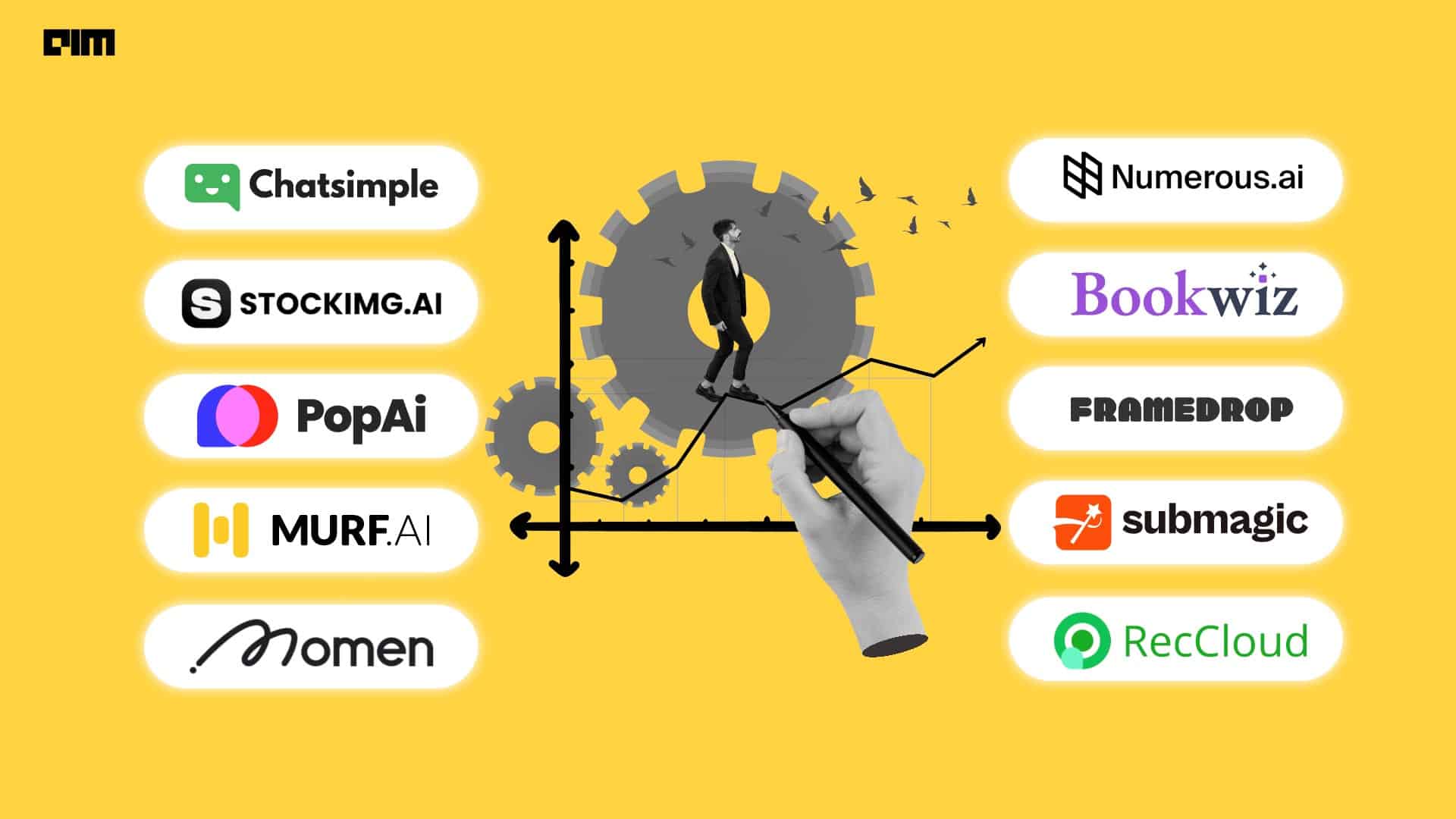
Whether you’re a content creator, developer, or entrepreneur, these AI-powered websites offer solutions to streamline your workflow and accelerate project completion. From video editing to book writing and chatbot development to content generation, these platforms harness the latest AI tech to supercharge your productivity.
Here are 10 AI websites that will help you finish months of work in just a day.
Framedrop AI
Framedrop is an AI tool that can process your YouTube and Twitch streams and find all of your best moments automatically to create short-form videos, such as TikToks, YouTube Shorts, and Instagram Reels. This eliminates the need for creators to spend long hours manually editing their content by offering a wide array of features to repurpose their content and reach new audiences.
It accommodates all types of conversational content from podcasts to interviews and vlogs to stand-up comedy, and currently supports 25 languages. Also, you don’t need to download any software to use it. Framedrop enables creators to process up to five hours of content each month with no signup required.
The free signup increases this allowance to 8 hours per month. And, creators that subscribe to the Pro Plan get 40 hours a month and additional benefits like multi-video processing and priority queue.
Turn any video into shorts with Framedrop AI
PopAi
PopAi is like your personal AI workspace that lets you talk to your images and documents, providing instant answers, summaries, and insights. It can accommodate many document formats, including PDFs, Word files, and text documents, and supports over 200 languages.
One can think of it as a creative partner that takes on tasks such as completing assignments, retrieving information, generating images, optimising resumes and CVs, crafting compelling copy, devouring books, designing flowcharts, and creating dynamic PowerPoint presentations.
It can also write SEO blogs and academic essays as well as debug code.
New Feature:Convert PDFs to slides Upload files on homepage, then you can ask PopAi to create the PowerPoint presentations you need. This will significantly enhance your productivity. You can experience this feature in the following scenarios: Business: -Upload a company… pic.twitter.com/O1G1lyDC3x
— PopAi (@popaiinone) March 5, 2024
Numerous AI
Numerous.ai offers a simple, powerful, and cost-effective solution for using ChatGPT inside Google Sheets and Excel. You can use it to automate tasks like categorising, extracting text, and cleaning data. It’s also great at summarising, rewriting, and translating content.
It can research and organise digital marketing campaigns by generating AdWords keywords, ad copy, etc; can summarise, categorise, classify & cleanse large bodies of open-ended text such as articles, user surveys, or social media content.
It can also generate topic ideas, schedule social media posts, and create varied content for different audiences from a single prompt. It also allows you to experiment with various prompt structures, prototype AI features, and collaborate on GPT input and outputs.
Excel has 1.2 billion active users. But 99% people don't know about this secret. Here is how to use ChatGPT inside Microsoft Excel or Google Sheets: pic.twitter.com/K0HpwLR3bI
— Hasan Toor ✪ (@hasantoxr) April 7, 2024
Murf AI
Murf.ai lets you go from text to speech with a versatile AI voice generator that allows you to make studio-quality voice-overs in minutes. You can use its lifelike AI voices for podcasts, videos, and professional presentations. Be it creative, corporate, or entertainment purposes, the platform has a voice for your every need.
It lets you choose from over 120+ text to speech voices in 20+ languages. Using it, you can upload your creatives and sync it with the voice of your choice. Murf also allows you to play with pitch, punctuations and emphasis to make the AI voices carry your message as you like.
Stockimg AI
Stockimg.ai is an excellent design tool that lets you generate everything from illustration, stock image, art, logo, wallpaper, poster, book cover to QR code. It enhances your design process, helping you save your time and money.
With Stockimg AI as your designing agent, you can simplify content creation by generating unique images using AI.
Momen
Momen lets you design, develop, and scale your apps without code so that you can build your custom apps from frontend to backend with a simple drag-and-drop editor. This powerful no-code tool revolutionises web application development, allowing entrepreneurs to launch their products faster and more affordably.
Its fully visual interface allows users of any technical level to build dynamic, responsive applications with professional design quality; pixel-perfect and fully responsive. Momen takes care of hosting and provides robust and scalable infrastructure, while also offering enterprise-grade features and security to support business growth.
Start your no-code journey with Momen.
Bookwiz
Bookwiz is an AI tool that helps you write and publish quality books fast. The platform leverages GPT-4 to assist authors in the book-writing process, including brainstorming ideas, creating characters, outlines, and chapters.
It offers a user interface designed specifically for book writing, incorporating an advanced editor and structured guidance. The platform also fosters a writing community, facilitating easy sharing and feedback on your work.
Using Midjourney for image creation, it enables you to add beautiful visuals to your pages, chapters, and covers. Also, you can export your book to PDF, EPUB, or MOBI, and publish to Amazon, Apple Books, and more.
Write your book with Bookwiz.
Chatsimple
With Chatsimple, an AI-powered chatbot builder, anyone can create customised chatbots for their business website in just minutes, with no coding required. It uses advanced AI like GPT-4 to power chatbots and is trained on a business’s website content and data to understand the business.
Using it, you can get a chatbot customised to your business and can talk to customers 24/7 in over 175 languages. It can help you change the way your customers interact with your website by providing you with a superior sales agent skilled in engaging conversations, booking meetings, lead qualification, and follow-up & closure.
Use cases include customer support, lead generation, and market research among others. It can be embedded on your website, Facebook, Instagram and more. An API is available for custom integrations. Also, you can create unlimited chatbots based on your plan.
Submagic
Submagic enables you to make your short-form videos more captivating with captions, B-rolls, zooms and sound effects.
From generating video captions for your video in over 48 languages, adding music and sound effects to create an immersive experience, enhancing your videos with strategic zooms and automatic cuts to enhancing your narrative with stock videos and transitions, it helps you easily boost your reach and engagement with the power of AI.
RecCloud
RecCloud is your go-to AI tool for all-in-one video editing solutions including subtitles generator, speech-to-text or text-to-speech, AI vocal remover, trim/crop/merge videos, among others. It offers professional recording and editing API services, complemented by comprehensive API documentation and straightforward integration procedures.
Its services cater to diverse industries including online education, live streaming, conferences, gaming, and more.
The post 10 AI Tools to Accelerate Your Workflow appeared first on Analytics India Magazine.
Hemant Bakshi, the CEO of ANI Technologies, the parent company of Ola Cabs, has resigned after just four months in the role. Bakshi, a former senior Unilever executive, joined Ola last September and was appointed CEO in January this year. Sources reveal that his departure coincides with a company-wide restructuring, expected to impact at least 10% of its 1800-strong workforce.
Meanwhile, Ola Cabs is gearing up for an IPO to raise $500 million, valuing the company at around $5 billion. Sources reveal that the company intends to file the necessary paperwork with the Securities and Exchange Board of India (SEBI) within the next three months.
In the interim, Ola founder Bhavish Aggarwal will take over operations until a new executive is appointed. “Hemant (Bakshi) will be stepping down from his role as CEO to pursue opportunities outside the company. We extend our gratitude to Hemant for his contributions and wish him the best in his future endeavors,” said Aggarwal in a letter to employees, a copy of which Business Standard has seen.
In a letter to employees, Aggarwal stated that Ola is undergoing a restructuring exercise to improve profitability in line with the company’s vision to serve 1 billion Indians and drive sustainable growth and efficiency.
In January, Krutrim, India’s own AI company, dedicated to constructing a comprehensive AI computing stack had successfully closed its first funding round, securing a substantial $50 million in equity at a valuation of $1 billion.
The firm, which has made substantial investments in its AI initiative Krutrim and anticipates certain roles within the company to become redundant due to these changes.
The restructuring is part of Ola’s broader efforts towards profitability as it prepares for an initial public offering (IPO). “Hemant Bakshi…wants to pursue other opportunities,” said a source familiar with the matter.
The post Ola Cabs’ CEO Hemant Bakshi Quits, Company to Lay off 10% of its Employees appeared first on Analytics India Magazine.
Elon Musk’s ‘sudden visit’ to China may not have been unplanned after all. Within a day of his visit, Musk agreed to partner with China’s tech giant Baidu to bring FSD (full self-driving) capabilities to Tesla vehicles in China. Coincidentally, just last week, Elon Musk postponed his visit to India owing to ‘very heavy Tesla obligations’.
The announcement comes after four years of FSD, the autopilot software mode, rolling out in the US market, with China initially denying permission to the automaker owing to regulatory and data collection issues. The new move fortifies Tesla’s presence in its second-largest market in the world, which accounts for 33% of global sales.
Not just that, it’s also been four years since Tesla first partnered with Baidu.
The Key Automobile Player
In early 2020, Tesla partnered with Baidu for in-car mapping and navigation in China. Baidu’s navigation map is used across Tesla’s vehicles in China.
With a restriction of foreign companies (outside China) requiring to partner with domestic companies that have mapping qualification license for all intelligent driving systems, Baidu has been a key player in the automobile segment.
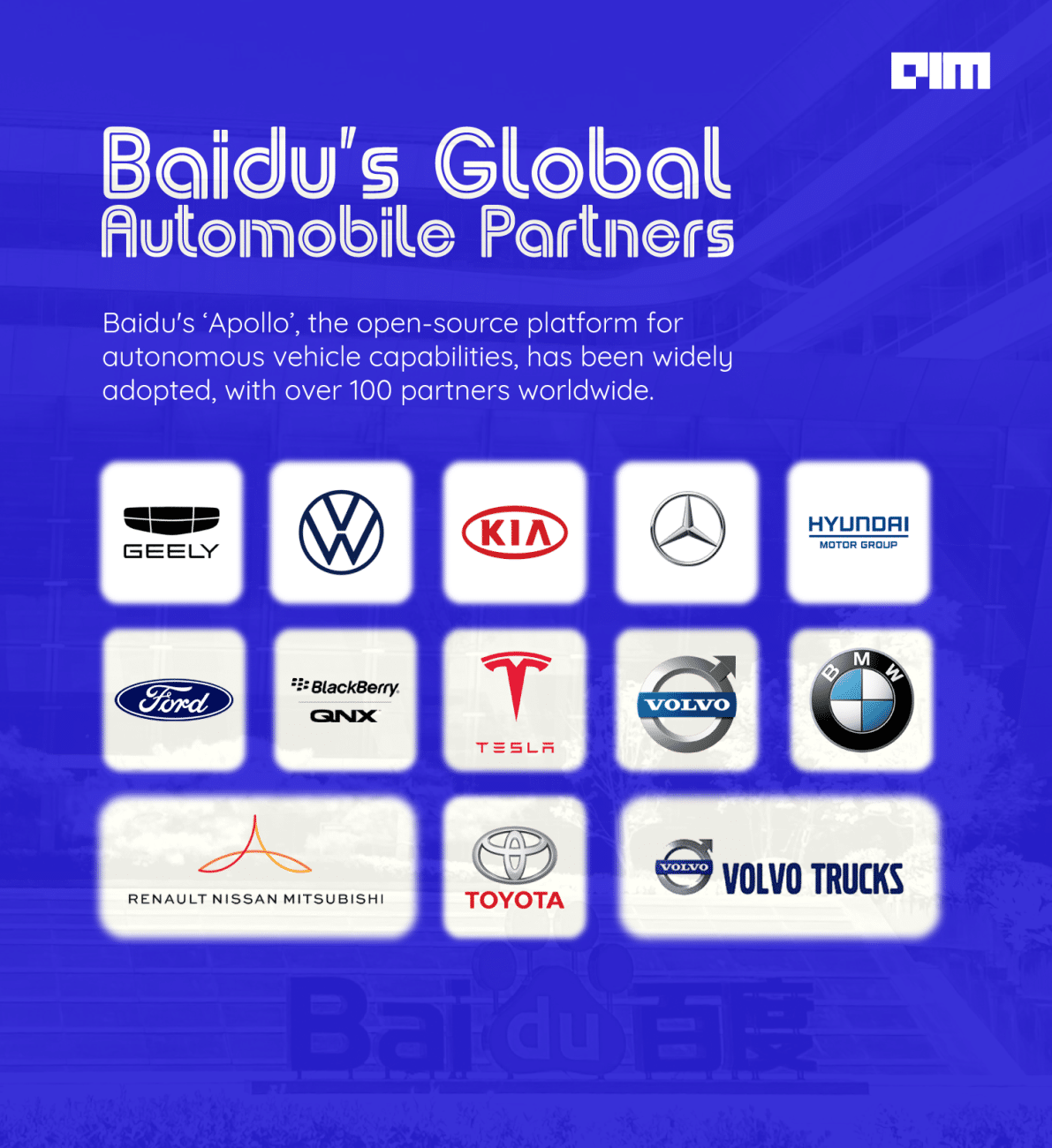
The company partnered with a number of major automobile companies including Audi, BMW, Ford, Mercedes-Benz, Toyota, Volvo, Hyundai and others, and not all of them were for simply entering the Chinese market. The collaborations focus on technology development especially in the realm of autonomous driving.
Companies such as Audi, Volvo and JLR partnered with Baidu to facilitate research and testing on autonomous vehicles in various environments.
Baidu’s open-source platform for autonomous driving, Apollo, already has over 100 partners worldwide. The platform provides hardware and software solutions including cloud data services and companies can leverage Baidu’s AI algorithms and mapping data.
Baidu had started an R&D division in the US in 2014 and has a separate wing for ‘intelligent driving’. In a past interview with Fred Fishkin, Helen Pan, general manager of Apollo Autonomous Driving, USA, said, “For Baidu Apollo USA we’re focused on our self-driving technology and we are developing this new technology to bring mobility to the society and to the people who provide driverless technology to all.”
Interestingly, the testing for this self-driving technology is happening in China. “It’s taking place in three cities, Wuhan, Chongqing, and Beijing,” said Pan.
Interestingly, there were reports of Tesla collaborating with Baidu Apollo to bring its fully autonomous robotaxi in China before the US. Baidu’s Apollo Go, is already operating 24/7 autonomous driving service in select areas.
In India, the expansion of EV is led by Chinese manufacturers. EV giant BYD looks to seize 90% of the country’s EV market. Surprisingly, BYD, which had a partnership with Baidu, decided to opt out of the deal after a year. Last year, BYD decided to make its own intelligent driving technology.
Baidu: The Internet Company
Automobiles may be an important wing for Baidu, but the company was predominantly known for its search engine, which was introduced in 2000. It accounts for over 51% of search traffic in China. The company also claims to be an early adopter of AI (in 2010) to improve content discovery.
Further, Baidu has been taking huge strides in the generative AI race with its Ernie chatbot, with Ernie 4.0 said to be on par with GPT-4.
US Remains Stringent
While automobile companies are flocking to collaborate with Baidu, apprehensions in the US continue.
Investor and entrepreneur Vinod Khosla, in a recent interview with Hamza Choudery, co-founder of Autoblocks AI, spoke about how regulation is a good thing. “It’s never by itself, the complete solution or sufficient, what I’d say is it can help slow China down and accelerate us. Banning the latest NVIDIA chips into China – that’s a really good idea. Not giving them access to state-of-the-art models is a big idea,” said Khosla.
While such discussions continue, Musk continues to advance Tesla’s growth outside the US.
In addition to soaking in the scenery in Beijing, Musk made all the crucial moves that will benefit Tesla in China. After meeting Li Qiang, the Premier of the People’s Republic of China, the China Association of Automobile Manufacturers announced that Tesla passed Beijing’s data security tests.
This will also remove restrictions on Tesla vehicles in certain markets in China.
The latest announcement further strengthens Tesla’s already existing partnership with Baidu, with the permission to transfer data overseas. Further, Tesla can gather data about the vehicle’s surroundings including road layouts, traffic signs and nearby buildings, a step for further data collection and cater to fit Tesla’s future roadmap in the Chinese market.
While Tesla’s strengthened partnership with Baidu will allow data collection, there is no confirmation on whether this data will be owned by Tesla or Baidu.
The visit and collaboration announcement also comes at a time when Tesla is planning to layoff over 690 workers from its facility in Nevada.
The post Baidu, The Darling of Automotive Giants appeared first on Analytics India Magazine.
IBM will acquire San Francisco-based HashiCorp for $6.4 billion, IBM announced during its Q1 earning call on April 24. The deal is expected to close by the end of 2024.
The acquisition is part of an effort to broaden IBM’s hybrid cloud, multicloud and AI portfolio. Ultimately, IBM plans to use HashiCorp resources to create an end-to-end cloud platform.
“IBM’s and HashiCorp’s combined portfolios will help clients manage growing application and infrastructure complexity and create a comprehensive hybrid cloud platform designed for the AI era,” said Arvind Krishna, IBM chairman and chief executive officer, in a press release regarding IBM’s first-quarter earnings.
“IBM’s leadership in hybrid cloud along with its rich history of innovation, make it the ideal home for HashiCorp as we enter the next phase of our growth journey,” said Dave McJannet, HashiCorp chief executive officer, in a press release.
What HashiCorp brings to IBM
HashiCorp makes the HashiCorp Cloud Platform for critical applications, which includes lifecycle management and security. HashiCorp Cloud Platform supports integration with major cloud providers like Google and AWS.
SEE: An IBM survey found about 42% of enterprise-scale companies have rolled out generative AI. (TechRepublic)
Being acquired by IBM will allow HashiCorp access to a wider pool of customers and work closely with IBM on multicloud automation deployments. HashiCorp’s lifecycle management and security automation capabilities provide a system of record that helps manage hybrid and multicloud environments. In particular, IBM called out HashiCorp’s Terraform, “the industry standard for infrastructure provisioning” in hybrid and multicloud environments.
HashiCorp reported revenue of $583.1 million in fiscal year 2024.
HashiCorp products could help businesses manage generative AI workloads
Generative AI is a major driver for cloud companies today. HashiCorp brings infrastructure suited for generative AI products to IBM. In particular, IBM identified HashiCorp’s automation tools for “heterogeneous, dynamic, and complex infrastructure” as useful for customers who may otherwise be overwhelmed by the sprawl and number of possible AI applications.
HashiCorp products could help IBM manage increasingly complex cloud environments
In the press release about the acquisition, HashiCorp co-founder Armon Dadgar wrote about the changes over the last decade in how businesses look at the cloud, from on-premises computing to widely distributed hybrid and multicloud. “The transformative impact of the public cloud also made it clear that we would inevitably live in a multi-cloud world,” he said.
If more organizations begin to deploy generative AI in the cloud, hybrid and multicloud management will become more complex; IBM hopes HashiCorp will help make them a first choice for organizations trying to handle that complexity.
What else does IBM’s acquisition of HashiCorp mean for business tech buyers?
The acquisition – in which IBM gains HashiCorp’s expertise in cloud infrastructure and applications, and HashiCorp gains IBM’s support and large customer base — will likely bring more options to consumers for combined products from the two organizations in future.
HashiCorp will retain its own brand name and identity as a division of IBM Software.
When we asked IBM for additional comments, the company directed us to the press release and earnings report.
NIST launches a new platform to assess generative AI Kyle Wiggers 8 hours
The National Institute of Standards and Technology (NIST), the U.S. Commerce Department agency that develops and tests tech for the U.S. government, companies and the broader public, on Monday announced the launch of NIST GenAI, a new program spearheaded by NIST to assess generative AI technologies including text- and image-generating AI.
NIST GenAI will release benchmarks, help create “content authenticity” detection (i.e. deepfake-checking) systems and encourage the development of software to spot the source of fake or misleading AI-generated information, explains NIST on the newly-launched NIST GenAI website and in a press release.
“The NIST GenAI program will issue a series of challenge problems [intended] to evaluate and measure the capabilities and limitations of generative AI technologies,” the press release reads. “These evaluations will be used to identify strategies to promote information integrity and guide the safe and responsible use of digital content.”
NIST GenAI’s first project is a pilot study to build systems that can reliably tell the difference between human-created and AI-generated media, starting with text. (While many services purport to detect deepfakes, studies and our own testing have shown them to be shaky at best, particularly when it comes to text.) NIST GenAI is inviting teams from academia, industry and research labs to submit either “generators” — AI systems to generate content — or “discriminators,” which are systems designed to identify AI-generated content.
Generators in the study must generate 250-words-or-fewer summaries provided a topic and a set of documents, while discriminators must detect whether a given summary is potentially AI-written. To ensure fairness, NIST GenAI will provide the data necessary to test generators and discriminators. Systems trained on publicly available data won’t be accepted, including but not limited to open models like Meta’s Llama 3.
Registration for the pilot will begin May 1, with the results scheduled to be published in February 2025.
NIST GenAI’s launch and deepfake-focused study comes as deepfakes grow exponentially.
According to data from Clarity, a deepfake detection firm, 900% more deepfakes have been created this year compared to the same time frame last year. It’s causing alarm, understandably. A recent poll from YouGov found that 85% of Americans said they were concerned about the spread of misleading deepfakes online.
The launch of NIST GenAI is a part of NIST’s response to President Joe Biden’s executive order on AI, which laid out rules requiring greater transparency from AI companies about how their models work and established a raft of new standards, including for labeling content generated by AI.
It’s also the first AI-related announcement from NIST after the appointment of Paul Christiano, a former OpenAI researcher, to the agency’s AI Safety Institute.
Christiano was a controversial choice for his “doomerist” views; he once predicted that “there’s a 50% chance AI development could end in [humanity’s destruction].” Critics, reportedly including scientists within NIST, fear that Cristiano may encourage the AI Safety Institute to focus to “fantasy scenarios” rather than realistic, more immediate risks from AI.
NIST says that NIST GenAI will inform the AI Safety Institute’s work.
TechCrunch Minute: Elon Musk’s big plans for xAI include raising $6 billion Anthony Ha @anthonyha / 11 hours
TechCrunch recently broke the news that Elon Musk’s xAI is raising $6 billion at a pre-money valuation of $18 billion.
The deal hasn’t closed yet, so the numbers could change. But it sounds like Musk is making an ambitious pitch to investors about his 10-month-old startup — a rival to OpenAI, which he also co-founded and is currently suing for allegedly abandoning its initial commitment to focus on the good of humanity over profit.
You may be wondering: Doesn’t Musk have enough companies already? There’s Tesla, SpaceX, X (formerly Twitter), Neuralink, The Boring Company … maybe he should spend his time on the existing businesses that have struggles of their own.
But in the xAI pitch, Musk’s connection to these other companies is a feature, not a bug. xAI could get access to crucial training data from across his empire — and its technology could, in turn, help Tesla achieve its dream of true self-driving cars and bring its humanoid Optimus robot into factories.
Of course, Musk’s hype doesn’t always match up to reality. But with this impressive new funding, xAI could become an even more formidable competitor in the AI world. Hit play, then leave your thoughts below!