Vancouver-based AI and robotics company Sanctuary AI, which is on a mission to create world’s first human-like intelligence in general purpose robots, announced its collaboration with Microsoft to develop the AI models for the robots.
Sanctuary AI will use Microsoft Azure’s cloud resources for the AI workload, and will collaborate to boost AI research and development. Further, Azure infrastructure will be used for training, inference, networking and storage.
The robotics company is working on Large Behaviour Models (LBMs) that connect AI to the physical world by allowing systems to understand and learn from real world experience. These models will be used for Carbon, the AI control system that powers its Phoenix robots.
“A challenge like this requires the best global minds to work together. We’re excited to be working with Microsoft to unlock the next generation of AI models that will power-general purpose robots,” said Geordie Rose, CEO and co-founder of Sanctuary AI.
“We’re excited to be working with Sanctuary AI to accelerate AI model innovation and embodied AI research in areas like reasoning, planning, and human-agent collaboration,” said Ashley Llorens, corporate vice president and managing director, Microsoft Research.
Race Towards Humanoid Robots
The race towards creating humanoid robots is spearheading with big tech companies collaborating and investing in emerging robotics startups.
Figure Robotics, which created Figure 01 humanoids, has OpenAI’s ChatGPT integrated as its voice modality. The company is backed by top investors including OpenAI, Microsoft, NVIDIA, Jeff Bezos and others.
Boston Dynamics, the pioneers in robotics, also recently unveiled its new electric model of humanoids.
Anthropic unveiled Claude Team, its enterprise plan for the Claude AI, on May 1. Claude Team comes at an interesting time as companies jostle to find money-generating uses for generative AI. With Claude Team, Anthropic packages up generative AI that could be used for iterating on projects, analyzing documents or exploring possible productivity boosts, plus administrative tools suitable for business.
Plus, a Claude app is now available for iOS.
“The Claude Team plan and iOS app are part of a broader paradigm shift in how businesses use and collaborate with AI,” said Scott White, Anthropic product lead, in an email to TechRepublic. “With increased usage, admin controls, and access to the advanced Claude 3 model family, companies can now provide every employee with Claude’s capabilities.”
Anthropic’s Claude-powered products are available around the globe.
What is Anthropic’s Claude Team?
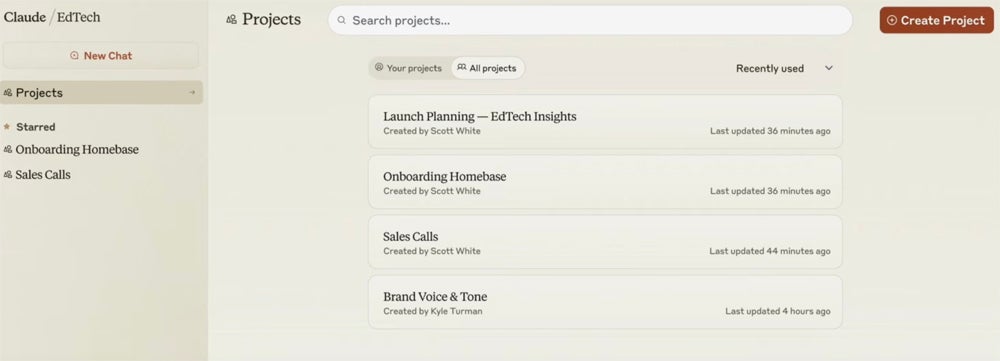
Anthropic’s Claude Team is a subscription plan that allows enterprise teams and administrators access to the Claude 3 generative AI and, in the future, will be able to connect it to CRMs.
Claude Team is meant to provide businesses a generative AI workbench. Image: Anthropic
Claude Team adds the following to the regular Claude offerings:
Increased usage — up to a 200K context window — meaning Claude can have more chats and digest longer documents than it can on the Pro plan.
Access to all three sizes of Claude 3 models: the large Opus, medium Sonnet and small Haiku.
Admin tools for managing users and billing.
All Pro features, including high priority during high-traffic times.
Anthropic plans to add integrations with data repositories such as CRMs and codebases soon. Other updates expected to come to Claude Team in the future include “citations from reliable sources to verify AI-generated claims” and the ability to iterate with other people on AI-generated projects.
Gartner analyst Arun Chandrasekaran noted in an email to TechRepublic that Anthropic is trying to target “business users desiring better predictability, higher quality responses and faster responsiveness” with Claude Team. He pointed out the timing of the release: a few months after OpenAI’s ChatGPT Team came to market.
SEE: Adobe added its Firefly AI and Content Credentials to the list of targets for a private bug bounty. (TechRepublic)
How much does a Claude Team subscription cost?
A Claude Team subscription costs $30 per month for a minimum of five users. You can sign up for Claude Team at the Claude homepage.
Claude app now available on iOS
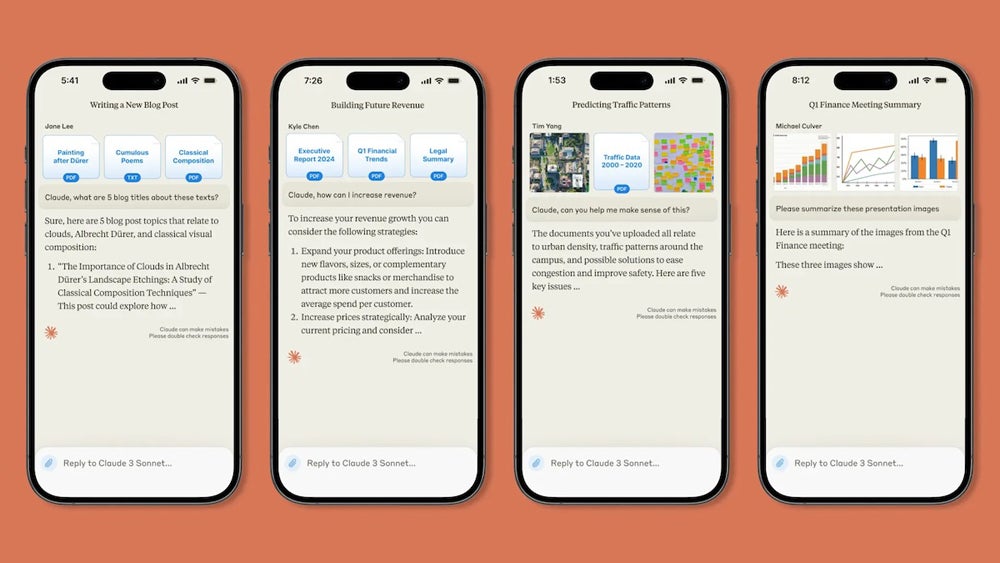
The Claude app on iOS became available on the Apple App Store starting May 1. The app allows mobile access to the free chatbot as well as the Claude Pro and Team plans. In the app, Claude can interpret photos, documents or files. If you log in on multiple devices, Claude iOS will be able to pick up with your chats where you left off on another device.
The Claude app can be used to ask questions and generate content with the AI chatbot. Image: Anthropic
Generative AI companies compete for enterprise use cases
As Microsoft is to OpenAI, Amazon is to Anthropic: Amazon gave $4 billion to Anthropic over the winter of 2023-2024, and Google funded Anthropic with $2 billion starting last October. All of the hyperscalers working on enterprise AI have successfully hyped up generative AI as a new idea, but monetizing generative AI products is hard.
“AWS and Google likely see Anthropic as their best option to compete with ChatGPT and Copilot and take market share from them,” said Gordon McKenna, vice president cloud evangelist and alliances at IT service management company Ensono, in an email to TechRepublic. “The timing of this announcement was likely coordinated with AWS and Google’s recent earnings announcements and intended to bolster their presence in this market.”
While Claude Team is $30 per month per person, OpenAI’s ChatGPT Team costs $25 per month per person annually or $30 per month per person monthly. ChatGPT Team’s minimum user count is two, while Claude Team has a minimum of five.
“It [Claude Team] definitely signals competitive pressure on ChatGPT’s mobile subscription business and will also put the ability to judge model efficacy and performance into the hands of daily users,” wrote Ricardo Madan, senior vice president at staffing agency TEKsystems Global Services, in a statement to TechRepublic by email.
“Anthropic’s Claude FM [foundation model] has already been in use at the enterprise level via Google Cloud’s Model Garden registry and is one [of] AWS’s principal 3nd party FMs appended to their Bedrock platform,” Madan wrote. “However Anthropic will essentially and eventually diminish any given company’s need to use them as a third party tool (through the hyperscalers) now that they’re planting a direct-access flag in the corporate model game.”
Vancouver-based AI and robotics company Sanctuary AI, which is on a mission to create world’s first human-like intelligence in general purpose robots, announced its collaboration with Microsoft to develop the AI models for the robots.
Sanctuary AI will use Microsoft Azure’s cloud resources for the AI workload, and will collaborate to boost AI research and development. Further, Azure infrastructure will be used for training, inference, networking and storage.
The robotics company is working on Large Behaviour Models (LBMs) that connect AI to the physical world by allowing systems to understand and learn from real world experience. These models will be used for Carbon, the AI control system that powers its Phoenix robots.
“A challenge like this requires the best global minds to work together. We’re excited to be working with Microsoft to unlock the next generation of AI models that will power-general purpose robots,” said Geordie Rose, CEO and co-founder of Sanctuary AI.
“We’re excited to be working with Sanctuary AI to accelerate AI model innovation and embodied AI research in areas like reasoning, planning, and human-agent collaboration,” said Ashley Llorens, corporate vice president and managing director, Microsoft Research.
Race Towards Humanoid Robots
The race towards creating humanoid robots is spearheading with big tech companies collaborating and investing in emerging robotics startups.
Figure Robotics, which created Figure 01 humanoids, has OpenAI’s ChatGPT integrated as its voice modality. The company is backed by top investors including OpenAI, Microsoft, NVIDIA, Jeff Bezos and others.
Boston Dynamics, the pioneers in robotics, also recently unveiled its new electric model of humanoids.
Vancouver-based AI and robotics company Sanctuary AI, which is on a mission to create world’s first human-like intelligence in general purpose robots, announced its collaboration with Microsoft to develop the AI models for the robots.
Sanctuary AI will use Microsoft Azure’s cloud resources for the AI workload, and will collaborate to boost AI research and development. Further, Azure infrastructure will be used for training, inference, networking and storage.
The robotics company is working on Large Behaviour Models (LBMs) that connect AI to the physical world by allowing systems to understand and learn from real world experience. These models will be used for Carbon, the AI control system that powers its Phoenix robots.
“A challenge like this requires the best global minds to work together. We’re excited to be working with Microsoft to unlock the next generation of AI models that will power-general purpose robots,” said Geordie Rose, CEO and co-founder of Sanctuary AI.
“We’re excited to be working with Sanctuary AI to accelerate AI model innovation and embodied AI research in areas like reasoning, planning, and human-agent collaboration,” said Ashley Llorens, corporate vice president and managing director, Microsoft Research.
Race Towards Humanoid Robots
The race towards creating humanoid robots is spearheading with big tech companies collaborating and investing in emerging robotics startups.
Figure Robotics, which created Figure 01 humanoids, has OpenAI’s ChatGPT integrated as its voice modality. The company is backed by top investors including OpenAI, Microsoft, NVIDIA, Jeff Bezos and others.
Boston Dynamics, the pioneers in robotics, also recently unveiled its new electric model of humanoids.
Microsoft bans U.S. police departments from using enterprise AI tool for facial recognition Kyle Wiggers 8 hours
Microsoft has changed its policy to ban U.S. police departments from using generative AI for facial recognition through the Azure OpenAI Service, the company’s fully managed, enterprise-focused wrapper around OpenAI technologies.
Language added Wednesday to the terms of service for Azure OpenAI Service prohibits integrations with Azure OpenAI Service from being used “by or for” police departments for facial recognition in the U.S., including integrations with OpenAI’s text- and speech-analyzing models.
A separate new bullet point covers “any law enforcement globally,” and explicitly bars the use of “real-time facial recognition technology” on mobile cameras, like body cameras and dashcams, to attempt to identify a person in “uncontrolled, in-the-wild” environments.
The changes in terms come a week after Axon, a maker of tech and weapons products for military and law enforcement, announced a new product that leverages OpenAI’s GPT-4 generative text model to summarize audio from body cameras. Critics were quick to point out the potential pitfalls, like hallucinations (even the best generative AI models today invent facts) and racial biases introduced from the training data (which is especially concerning given that people of color are far more likely to be stopped by police than their white peers).
It’s unclear whether Axon was using GPT-4 via Azure OpenAI Service, and, if so, whether the updated policy was in response to Axon’s product launch. OpenAI had previously restricted the use of its models for facial recognition through its APIs. We’ve reached out to Axon, Microsoft and OpenAI and will update this post if we hear back.
The new terms leave wiggle room for Microsoft.
The complete ban on Azure OpenAI Service usage pertains only to U.S., not international, police. And it doesn’t cover facial recognition performed with stationary cameras in controlled environments, like a back office (although the terms prohibit any use of facial recognition by U.S. police).
That tracks with Microsoft’s and close partner OpenAI’s recent approach to AI-related law enforcement and defense contracts.
In January, reporting by Bloomberg revealed that OpenAI is working with the Pentagon on a number of projects including cybersecurity capabilities — a departure from the startup’s earlier ban on providing its AI to militaries. Elsewhere, Microsoft has pitched using OpenAI’s image generation tool, DALL-E, to help the Department of Defense (DoD) build software to execute military operations, per The Intercept.
Azure OpenAI Service became available in Microsoft’s Azure Government product in February, adding additional compliance and management features geared toward government agencies including law enforcement. In a blog post, Candice Ling, SVP of Microsoft’s government-focused division Microsoft Federal, pledged that Azure OpenAI Service would be “submitted for additional authorization” to the DoD for workloads supporting DoD missions.
Update: After publication, Microsoft said its original change to the terms of service contained an error, and in fact the ban applies only to facial recognition in the U.S. It is not a blanket ban on police departments using the service.
Vancouver-based AI and robotics company Sanctuary AI, which is on a mission to create world’s first human-like intelligence in general purpose robots, announced its collaboration with Microsoft to develop the AI models for the robots.
Sanctuary AI will use Microsoft Azure’s cloud resources for the AI workload, and will collaborate to boost AI research and development. Further, Azure infrastructure will be used for training, inference, networking and storage.
The robotics company is working on Large Behaviour Models (LBMs) that connect AI to the physical world by allowing systems to understand and learn from real world experience. These models will be used for Carbon, the AI control system that powers its Phoenix robots.
“A challenge like this requires the best global minds to work together. We’re excited to be working with Microsoft to unlock the next generation of AI models that will power-general purpose robots,” said Geordie Rose, CEO and co-founder of Sanctuary AI.
“We’re excited to be working with Sanctuary AI to accelerate AI model innovation and embodied AI research in areas like reasoning, planning, and human-agent collaboration,” said Ashley Llorens, corporate vice president and managing director, Microsoft Research.
Race Towards Humanoid Robots
The race towards creating humanoid robots is spearheading with big tech companies collaborating and investing in emerging robotics startups.
Figure Robotics, which created Figure 01 humanoids, has OpenAI’s ChatGPT integrated as its voice modality. The company is backed by top investors including OpenAI, Microsoft, NVIDIA, Jeff Bezos and others.
Boston Dynamics, the pioneers in robotics, also recently unveiled its new electric model of humanoids.
Elon Musk’s AI Startup xAI is expanding to Japan. “Calling all Japanese tech enthusiasts! If you are passionate about software engineering and AI, apply for @xAI today!,”wrote Christopher Stanley, Engineer at SpaceX.
According to recent reports, xAI, is also reportedly in talks with investors worldwide, aiming to raise $6 billion in funding to compete with Microsoft-backed artificial intelligence company OpenAI.
xAI recently introduced Grok-1.5V, a first-generation multimodal model. In addition to its strong text capabilities, Grok can process a wide variety of visual information, including documents, diagrams, charts, screenshots, and photographs.
Japan has recently emerged as a focal point for major tech investments. OpenAI’s recent establishment of a new office in Japan, coupled with the release of a custom GPT-4 model tailored for Japanese language processing, reflects the region’s strategic importance in the AI landscape.
Microsoft’s commitment to invest $2.9 billion in hyperscale cloud computing and AI infrastructure further highlights the country’s allure for tech giants.
Not to be left behind, Google has also made significant investments, pouring $1 billion into enhancing digital connectivity between the US and Japan through the construction of two new subsea cables—Proa and Taihei. These cables will not only improve connectivity but also benefit the Pacific Islands, enhancing reliability and reducing latency for digital services.
Oracle also announced a substantial $8 billion investment over the next decade to meet the rising demand for cloud computing and AI infrastructure in Japan. Amazon Web Services (AWS) has similarly pledged a massive $15.24 billion investment by 2027 to bolster cloud computing infrastructure, which serves as a critical backbone for AI services in the region.
The post Elon Musk’s AI Startup xAI Expands to Japan appeared first on Analytics India Magazine.
Microsoft bans U.S. police departments from using enterprise AI tool Kyle Wiggers 8 hours
Microsoft has changed its policy to ban U.S. police departments from using generative AI through the Azure OpenAI Service, the company’s fully managed, enterprise-focused wrapper around OpenAI technologies.
Language added Wednesday to the terms of service for Azure OpenAI Service prohibits integrations with Azure OpenAI Service from being used “by or for” police departments in the U.S., including integrations with OpenAI’s text- and speech-analyzing models.
A separate new bullet point covers “any law enforcement globally,” and explicitly bars the use of “real-time facial recognition technology” on mobile cameras, like body cameras and dashcams, to attempt to identify a person in “uncontrolled, in-the-wild” environments.
The changes in terms come a week after Axon, a maker of tech and weapons products for military and law enforcement, announced a new product that leverages OpenAI’s GPT-4 generative text model to summarize audio from body cameras. Critics were quick to point out the potential pitfalls, like hallucinations (even the best generative AI models today invent facts) and racial biases introduced from the training data (which is especially concerning given that people of color are far more likely to be stopped by police than their white peers).
It’s unclear whether Axon was using GPT-4 via Azure OpenAI Service, and, if so, whether the updated policy was in response to Axon’s product launch. OpenAI had previously restricted the use of its models for facial recognition through its APIs. We’ve reached out to Axon, Microsoft and OpenAI and will update this post if we hear back.
The new terms leave wiggle room for Microsoft.
The complete ban on Azure OpenAI Service usage pertains only to U.S., not international, police. And it doesn’t cover facial recognition performed with stationary cameras in controlled environments, like a back office (although the terms prohibit any use of facial recognition by U.S. police).
That tracks with Microsoft’s and close partner OpenAI’s recent approach to AI-related law enforcement and defense contracts.
In January, reporting by Bloomberg revealed that OpenAI is working with the Pentagon on a number of projects including cybersecurity capabilities — a departure from the startup’s earlier ban on providing its AI to militaries. Elsewhere, Microsoft has pitched using OpenAI’s image generation tool, DALL-E, to help the Department of Defense (DoD) build software to execute military operations, per The Intercept.
Azure OpenAI Service became available in Microsoft’s Azure Government product in February, adding additional compliance and management features geared toward government agencies including law enforcement. In a blog post, Candice Ling, SVP of Microsoft’s government-focused division Microsoft Federal, pledged that Azure OpenAI Service would be “submitted for additional authorization” to the DoD for workloads supporting DoD missions.
Microsoft and OpenAI did not immediately return requests for comment.
In January, the Delhi Police solved a ‘blind case’ with the help of AI. A 30-member team used the technology to reconstruct the face of an unidentified victim and then circulated the image to gather information.
The AI-generated image, showing the victim’s face with open eyes and a modified background, was uploaded on the Crime and Criminal Tracking Network (CCTN) website. The victim’s brother recognised the person in the picture and contacted the police, resulting in the identification of the deceased individual.
This milestone, however, merely scratches the surface of AI’s potential. Across the globe, countries like the USA, the UK, Japan, and Singapore are actively harnessing AI to combat various forms of criminal activity.
In one of the reports, Armando Aguilar, the Miami assistant police chief noted, “Before AI, the police department was only able to arrest suspects in 45% of murders and less than 38% of violent crimes. However, after it started using the technology in 2023, it solved 68% of the murders that occurred that year and 58% of the violent crimes.”
As the efficacy of AI in crime-solving continues, here are 9 AI models poised to revolutionise crime detection and prevention.
Video and Image Analysis
AI video and image algorithms are capable of developing and determining their own independent complex facial recognition features/parameters. These algorithms excel in matching faces, recognising weapons and various objects, and detecting events like accidents and ongoing or past criminal activities.
In Malaysia, researchers are actively working on AI software tailored for CCTV cameras to curb street crimes. This software operates independently, analyzing camera footage to identify potential criminal activities.
According to the researchers, the software is multifunctional, capable of detecting weapon possession, aggressive behaviours, and alerting law enforcement of suspected crimes.
DNA Analysis
During a crime, biological material like blood, saliva, semen, and skin cells can be transmitted through contact with people and objects. And with advancements in the DNA technology, we can now detect even small amounts of DNA collected from these biological samples.
Further, to identify and differentiate DNA from multiple individuals, including those not connected to the crime, researchers have worked to explore a new method.
They used a hybrid approach of combining human analysts and AI algorithms supported by the National Institute of Justice research award to overcome the limitations of using only one method.
Emergency Call Software
According to the World Health Organisation, 1 in 3 (30%) of women worldwide have been subjected to domestic violence in their lifetime. To address this issue, a UK-based start-up Untrite AI has designed an AI emergency call software.
Drawing from two years’ worth of historical data related to domestic abuse calls provided by Humberside Police, the system is trained to recognise patterns and prioritise urgent situations effectively.
NarcGuideBot
Quadrant Technologies Confidential has developed NarcGuideBot, an AI-powered assistance in Narcotics Investigations. The tool is designed to help inexperienced officers in complex drug enforcement.
Further, the tool expedites form-related tasks by simplifying form access, providing accurate filling instructions, and ensuring legal compliance through error-detection systems.
Gunshot Detection
Another advancement in AI is to identify unknown shootings. Sensors are installed in multiple infrastructures that are linked to cloud-based programs. These sensors record when and where guns are fired, and further aid in determining the location of the shooter.
The recorded data is then forwarded to the police stations and displayed as a pop-up notification on a computer or mobile device.
Predictive Analysis
Predictive analysis, which uses large volumes of data to forecast and formulate potential outcomes, is a job that requires many years of expertise. But with AI, volumes of information on the law and legal precedence, social information, and media can be used for rulings, identifying criminal enterprises, and predicting people at risk.
Utilising algorithms, the Chicago Police Department collaborated with the Illinois Institute of Technology to gather data and create initial groupings. These groupings are centred on building social networks and conducting analyses to identify potential high-risk individuals.
Blood Pressure Prediction
Machine learning and deep learning techniques for blood pressure prediction might not directly aid in crime solving, but they could contribute to forensic investigations, and criminal and victim profiling in certain cases.
In crime scenes where blood pressure data is available, such as from medical records or wearable devices, machine learning algorithms could analyse this data along with other evidence to reconstruct events leading up to a crime.
Facial Emotion Recognition
Using the hybrid DL architecture based on Convolutional Neural Networks and Stacked AutoEncoder, the facial expression recognition (FER) feature is developed to enhance crime-solving capabilities. This includes suspect and victim identification, sentiment analysis, behavioural analysis, and crime scene analysis.
For instance, during police interrogations, suspects may attempt to conceal their true emotions. FER systems can aid in detecting deception by analysing subtle changes in facial expressions, which could indicate lying or discomfort.
Crime GPT
In a groundbreaking development in India, Crime GPT, an AI tool created by Staqu Technologies, helped the UP Police catch criminals.
Crime GPT can quickly extract information about individuals through both written and spoken inquiries. Its features, including facial and vocal recognition, along with the analysis of criminal networks, promise to streamline investigative processes.
By tapping into digital criminal databases, Crime GPT equips police departments with insights, facilitating specific details about their queries.
Crime GPT is an extended version of Staqu Technologies’ tool Trinetra. It is renowned for its proficiency in tracking criminals via facial and vocal cues. With Trinetra, the UP Police have a database with information on over 900,000 criminals.
The post 9 AI Tools for Solving Crime, Narcotics, and Murder Investigations appeared first on Analytics India Magazine.
IBM today announced that its software portfolio is now available in 92 countries in AWS Marketplace, a digital catalog with thousands of software listings from independent software vendors (ISVs).
The expansion beyond Denmark, France, Germany, UK and US where the software is currently available, will help make procurement easier for clients, streamline purchasing and create new efficiencies, while allowing them to use their AWS committed spend for IBM software purchases.
According to a Canalys study, cloud marketplaces continue to emerge as the fastest-growing route to market for Software-as-a-Service (SaaS) software, expected to increase to USD 45 billion by 2025, up 84% CAGR over five years.
Marketplaces also help shorten the buying cycle, consolidate billing, and make it easier to scale software deployments quickly.
Customers now will have access to IBM’s AI and data technologies within a portfolio of 44 listings and 29 SaaS offerings available for purchase.
Included among those technologies are components of the watsonx AI and Data platform, which allow enterprises to build, scale and govern AI workloads.
Watsonx.data, a fit-for-purpose data store built on an open data lakehouse architecture, and Watsonx.ai, a next generation enterprise studio for AI builders are available in AWS Marketplace as well as two of IBM’s AI Assistants — watsonx Assistant and watsonx Orchestrate. watsonx.governance is expected to be available soon.
Other software includes IBM’s flagship database Db2 Cloud Pak for Data as well as a portfolio of automation software including Apptio, Turbonomic and Instana, and the IBM Security and Sustainability software portfolios – all built on Red Hat OpenShift Service on AWS.
The cloud-native software enables clients to deploy on AWS while flexible licensing, including SaaS and subscription, makes it easier for clients to purchase exactly how they want.
IBM is also launching 15 new IBM Consulting professional services and assets on AWS Marketplace, exclusively designed for AWS.
These new service offerings are aligned to client needs and demand, focused on data and application modernization, security services, and tailored industry-specific solutions – with generative AI capabilities included in select services. I
BM Consulting also brings 24,000 AWS certifications and a dedicated team of experts trained in the latest AWS technologies to help clients with tailored recommendations grounded in industry best practices.
“By expanding the availability of our software portfolio in AWS Marketplace, organizations around the world will have greater access to a streamlined way to procure many IBM AI and hybrid cloud offerings to help propel their business forward,” said Nick Otto, Head of Global Strategic Partnerships, IBM.
“Our collaboration with AWS is a prime example of how we’re working with other companies to meet the needs of clients, making it as easy as possible for them to do business with IBM and accelerate their transformation journeys,” he added.
The post IBM Expands Software Availability to 92 Countries in AWS Marketplace appeared first on Analytics India Magazine.