How Apple’s 2024 iPads Will Benefit Working Professionals

Business and creative professionals looking to purchase an iPad Air or iPad Pro should find a lot to like in the new 2024 models. Announced by Apple at its May 7 “Let Loose” event, the latest iPads offer new sizes, new processors, more storage options and new spots for the front-facing camera. Though the standard iPad and the iPad mini were left out of the event, Apple had plenty to highlight about the sixth generation iPad Air and the iPad Pro.

iPad Air

The 2024 iPad Air now comes in two sizes, just like the iPad Pro. The smaller 11-inch is designed for greater portability, while the new 13-inch adopts the larger screen size of the entry-level MacBook Air and MacBook Pro. The 13-inch model offers 30% more screen real estate than its 11-inch cousin, according to Apple. The screen on the higher-end iPad Air 1TB and 2TB models includes Apple’s new Nano-texture display glass, which aims to minimize glare.

The 2024 iPad Air is available in two sizes, 11 inches or 13 inches. Image: Apple

On the CPU side, the 2024 Air is powered by Apple’s M2 chip, an upgrade from the previous model’s M1 chip. Equipped with a faster CPU, GPU and neural engine, the sixth-generation Air promises a performance three times faster than the fifth-generation model from 2022. The speedier processor also devotes resources to artificial intelligence and machine learning, which offer advantages in intensive apps such as Adobe Photoshop.

The new iPad Air switches the front-facing Ultra Wide 12MP camera from the portrait side to the landscape edge. This long overdue transition should make it easier for people to see you during a video conference.

Apple has changed the storage options on the Air. The base capacity is now 128GB, up from 64GB previously. If you need more, you can choose among 256GB, 512GB and 1TB.

The new iPad Air is available in four colors: Blue, Purple, Starlight and Space Gray. The 11-inch Air starts at $599, while the 13-inch flavor starts at $799. You can order either model as of May 7, with availability kicking off on May 15.

iPad Pro

Offered in 11-inch and 13-inch variants, the 2024 seventh-generation iPad Pro models focus on being thin and light. The new 11-inch version is only 5.3mm thin and weighs less than a pound, while the 13-inch flavor is 5.1mm thin and hits the scale at 1.28 pounds. Apple boasts that the new iPad Pro is its thinnest product ever.

The 2024 iPad Pro comes with a new OLED screen and is powered by Apple’s latest M4 chip. Image: Apple

The biggest upgrade for the new iPad Pro may be in the screen. For 2024, Apple’s Pro tablet transitions from Mini-LED to OLED. Combining the light from two separate OLED panels, the new screen promises deeper blacks, more details in shadows and low-light conditions, and better power consumption. Yet the display still aims to be bright and vibrant, providing 1,000 nits for SDR and HDR content and as many as 1,600 nits at peak brightness.

The display itself is thinner and lighter than in the previous iPad Pro. Like the new iPad Air, the 2024 Pro offers Apple’s new Nano-texture display glass in the 1TB and 2TB models.

Aside from a new screen, the 2024 iPad Pros come with a brand new processor, and it’s the latest from Apple. Jumping a generation from the M2 in the previous Pro models, the new Pro tablets are powered by an M4 chip. The M4 promises 50% faster CPU performance than the M2 while using half the power. The M4 also incorporates a new neural engine, which Apple pegged as its most powerful neural engine ever, 60 times faster than the first such engine.

Touting the new engine’s focus on AI-oriented tasks, Apple highlighted faster and smoother AI performance in such programs as Final Cut Pro for video editing and Logic Pro for audio. For consumers and business pros, the AI will help detect and eliminate shadows and other obstructions in a document scan across the Files and Notes apps.
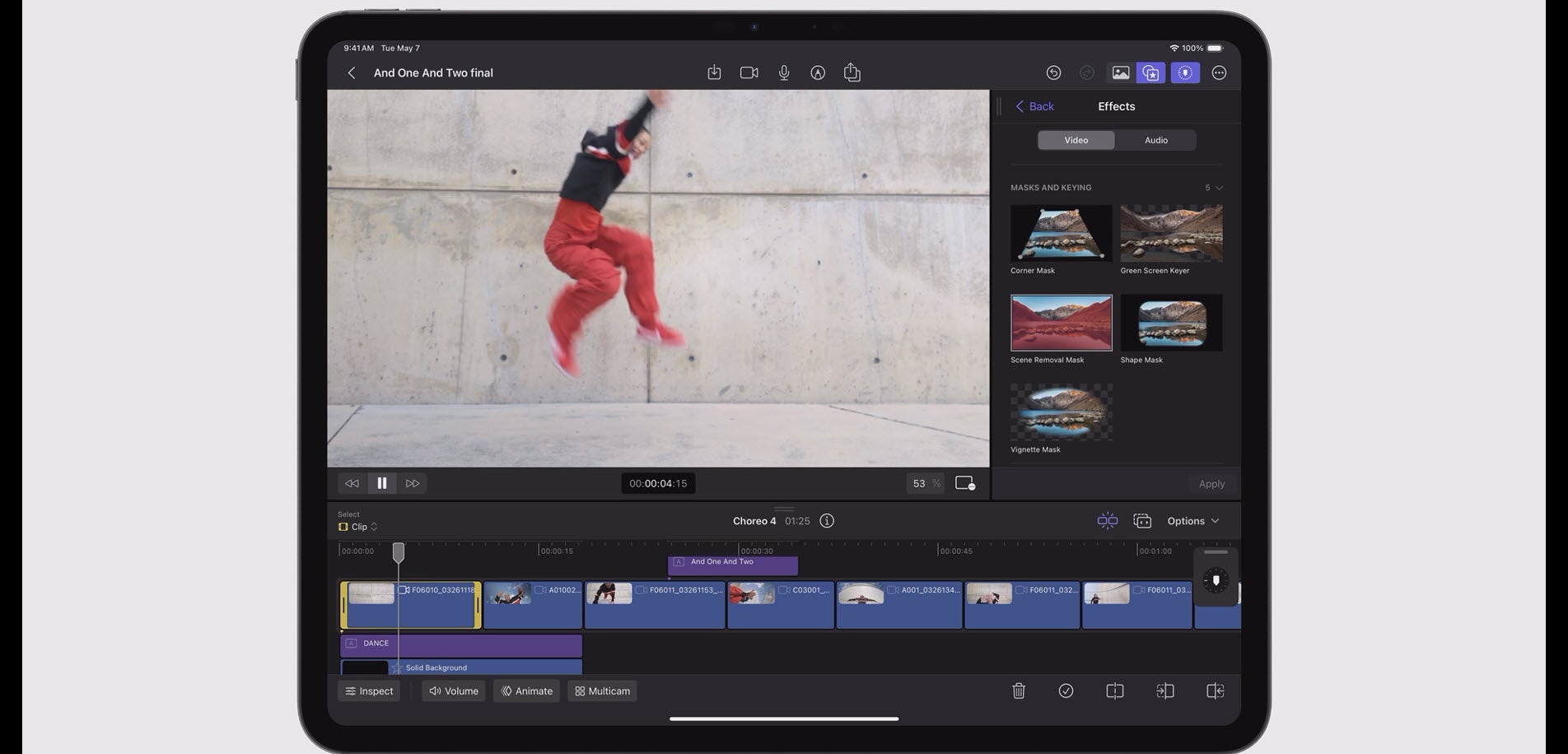
With the new iPad Pro, you can more quickly perform AI-enabled tasks such as applying a Scene Removal mask in Final Cut Pro. Image: Apple

Like the new iPad Air, the 2024 Pro sees its front-facing camera move from the portrait edge to the landscape side. Here, the benefits are twofold: You’ll look better in a video chat, and you’ll be able to more easily authenticate yourself using Face ID when holding the tablet in landscape mode.

The storage capacity now starts at 256GB, with options for 512GB, 1TB and 2TB. Available colors include Space Black and Silver. The 11-inch iPad Pro starts at $899, while the 13-inch model starts at $1,299. You can order the model of your choice as of May 7, with availability beginning on May 15.

Magic Keyboard

There’s a new Magic Keyboard for the iPad Pro. Designed to be thinner and lighter than previous models, the new version offers a dedicated function row, a palm rest and a larger trackpad with haptic feedback.

Starting at $299, the new Magic Keyboard is up for order now and will be available as of May 15.

Apple Pencil Pro

Finally, a new Apple Pencil — dubbed the Apple Pencil Pro — will work with the 2024 iPad Air and iPad Pro. The new pencil offers haptic feedback, so you can feel and sense your actions. Taking advantage of a new sensor in the barrel, you can squeeze the Pencil Pro to perform certain tasks. Plus, you can roll the pencil to trigger specific functions, such as changing brushes, activating shortcuts and recording actions.

Priced at $129, the Apple Pencil Pro can be ordered now and will be available starting May 15.

Tata Electronics Begins Exporting Semiconductor Chips

Semiconductor Deal in India

Tata Electronics has started exporting semiconductor chips packaged at its pilot line in Bengaluru-based research and development centre, according to people familiar with the matter. The packaged chips are being shipped to some of Tata Electronics’ partners in Japan, the US, and Europe in limited quantities.

Groundwork for New Chip Packaging Unit and Foundry

This development comes as the Tata group company prepares for its new chip packaging unit at Morigaon in Assam and a $10 billion chip foundry at Dholera in Gujarat. The company is also in the near-final stages for a successful tape-out of semiconductor chips in various nodes, including 28, 40, 55, and 65 nm.

Expanding Customer Base and Strategic Partnerships

Tata Electronics is expanding its customer base and has multiple partners for the packaged chips, which are still in the pilot stage. As reported in April, the company has also signed a strategic deal with Tesla to supply semiconductor chips for its global operations.

Importance of Demonstrating Capabilities

Neil Shah, vice president at Counterpoint Research, emphasized the importance of Tata Group demonstrating its chip designing and manufacturing capabilities to potential customers and partners before the fabs are commissioned over the next 30-36 months. This could be achieved through leveraging Tata Elxsi’s partnerships with Renesas and Lattice Semi and its in-house Sankhya Labs branch.

Tata Group’s Chip Foundry and OSAT Unit

Tata Group’s chip foundry in Dholera, built in alliance with Taiwan’s PowerchipSemiconductor Manufacturing Corporation (PSMC), has a planned capacity of up to 50,000 monthly wafer starts. The facility is expected to produce chips in leading nodes such as 28 nm and 40 nm and some legacy or mature nodes. Apart from the foundry, Tata Group also works on an outsourced assembly and testing (OSAT) unit in Assam.

The post Tata Electronics Begins Exporting Semiconductor Chips appeared first on Analytics India Magazine.

Ten reasons organizations pay more in data integration tax every year

Ten reasons organizations pay more in data integration tax every year

Photo by Ernesto Andrade on Flickr

Gartner’s April 2024 IT forecast estimated 8 percent growth from 2023 to 2024, forecasting $5.06 trillion in spending worldwide in 2024, rising to $8 trillion “well before the end of the decade.”

The amount the world spends on IT now surpasses what the entire population of people in low-income countries (4.5 billion people, 56 percent of the 8 billion people populating the globe) spend annually, according to The World Bank. Nearly half of low-income country spending is solely for food and beverages.

Implicit in all the trillions in IT spending is a built-in annual increase in a data integration tax due to unnecessary complexity. Dataware provider Cinchy estimates that half of enterprise IT budgets are now integration-related.

Why so much spending on integration? It all boils down to a lack of vision, planning, management acumen and sound technology choice. Specifically, it’s helpful to think about these ten different categories of IT management and related organizational management deficiencies:

  1. Passive or ineffectual leadership. Leadership often fails to grasp the power dynamics of business technology, how power shifts and how it’s used as technology becomes more pervasive and data mastery increases in importance. The result empowers new tech fiefdoms, each of which tries to assert its own dominance over the others. Each fiefdom has its own technology preference, and each department can have its own separate shadow IT presence. The result is misalignment and sprawl. Data utility suffers, and data complexity and fragmentation become more and more problematic.
  2. Incentive structure inadequacies. Any effort to create system interoperability requires method and motivation alignment at all organizational levels. Fiefdoms aren’t often incentivized to align and collaborate with one another. And even when they are, the incentivization isn’t actively managed. Even the best incentive structures need periodic realignment.
  3. Low investment in and commitment to scalable graph-based data architecture. Traditional integration and management technologies don’t scale, and yet companies continue to reinvest in these, overlooking the scalability and long-term cost effectiveness of knowledge graphs and web semantic standards to manage all kinds of enterprise data.
  4. Misconceived, undermined and duplicated data/content/knowledge management. Graph-based data management implies one set of methods regardless of the type of data being managed. Which means data, content and knowledge management can all be unified within a single department. Data quality and availability are key to success in both AI and traditional IT, but these factors get lost in the overall AI noise.
  5. Data ownership and access confusion. Every data source can have its own separate ownership and access rules. Often the default rule is no access, which leads to a need to negotiate access each time for each individual need in what constitutes a data adhocracy.
  6. Data model inconsistency. Every mobile or desktop app you use will most likely assert its own data model. The more data models to support, the higher the integration tax and the lower the likelihood data described by that data model will be fully integrated.
  7. Application sprawl. Duplicated application functionality fragments the data applications use to serve the same business functions.
  8. Naming inconsistencies. If you create or use a database with row and column headers, it’s likely those headers will differ slightly from database to database. Same with spreadsheets. Thus more potential duplication, integration hassle and lack of ultimate integration success.
  9. Data source inconsistency. Demand for new and improved input sources rises continually. Those third-party data sources differ from one another in slight, but troublesome ways, including implicit data model, format and quality variation. Data quality is most often inadequate to the task at hand.
  10. Dependency entanglements. Dependencies in general become more numerous and problematic in less predictable ways as systems, sources and methods proliferate.

How to pocket next year’s data integration tax increase

A good way to counter your organization’s data integration tax rate increases would be through its AI budget. Boards understand the need to take advantage of AI. Take the opportunity to educate them on the necessity of the right data foundation for AI. Start by crafting effective arguments for building a data foundation for AI, one use case at a time.

Find a nagging pain point that’s feasible to alleviate over the near term. Then propose the data foundation in miniature be designed to be reusable and scalable as the best knowledge graphs have been.

Your AI system can in this way run in parallel with your legacy IT environment. With the help of savvy technology choices, you’ll be able to ensure that 100 percent of the foundation you’re building using this parallel method will be legacy free.

Once the AI system becomes more broadly capable, you can use the same foundation for a transformed overall architecture based on findable, accessible, interoperable and reusable (FAIR) data principles.

A good way to learn best FAIR data practices and transformation strategy would be to study what companies such as AstraZeneca and Nokia have been doing in the area of biomedical research. (See https://www.datasciencecentral.com/digital-twins-interoperability-and-fair-model-driven-development/.)

Allstate India’s Manjula Nanjappa on How Coaching Drives Organisational Growth 

With AI all set to radically transform over 1.1 billion roles this decade, a change in roles across diverse sectors is inevitable. This shift affects individuals from all sectors with varying expertise. In light of this, Manjula Nanjappa, the director for compute services at Allstate India, believes that embracing active coaching is not just a checkbox for organisations, but a strategic imperative to drive meaningful change and progress.

“Every individual has great potential; coaching is just the process aimed at unlocking it,” said Manjula Nanjappa at the keynote of India’s biggest diversity and inclusion summit, The Rising 2024.

“Coaching is definitely essential; [it’s] an integral part of the organisation if I want to outperform and be a competent leader in the market,” said Nanjappa. She explained that coaching helps individuals recognise their blind spots and become better versions of themselves.

As companies strive to remain competitive in a rapidly evolving business landscape, integrating AI into coaching and learning and development (L&D) has become a strategic imperative. Karl-Ludwig Knispel, co-lead leadership, culture & development at PwC, said, “AI enables personalisation and increased efficiency that traditional methods cannot provide.”

According to Knispel, AI technology offers innovative solutions. It can dramatically reduce the time needed to create content by automatically generating quizzes, tests and even entire learning modules. He explained, “Generative AI makes it possible to generate extensive simulations, presentation slides and interactive elements from just a few inputs.”

Nanjappa reiterated the same belief that leveraging technology such as AI in coaching is a key driver in enabling organisations to tap into the potential of their diverse workforce.

Allstate India has invested in various coaching models, such as GROW and FUEL, to provide structured employee guidance and support. Nanjappa said she herself has benefited from coaching, overcoming her fear of public speaking through practice and guidance.

Measuring success

Measuring the success of AI-driven coaching programs is crucial to justify the investment and ensure continuous improvement. Nanjappa recommended setting clear goals and objectives, promoting a coaching culture, and tracking metrics such as improved employee productivity, reduced skill gaps, and increased learner engagement.

Implementing AI in coaching can be challenging due to budget constraints, an unsupportive organisational culture, a lack of leadership buy-in, and resistance from individuals. In such cases, Knispel advised organisations to analyse their specific L&D needs and use AI to automate administrative tasks and improve existing training infrastructure.

The future of corporate learning is undeniably intertwined with AI. Knispel predicts AI-driven tools will enable greater personalisation, virtual training experiences, and accurate assessments. “With greater refinement, these tools will facilitate the automated evaluation of subjective answers as well,” he added.

The business case for building a strong coaching culture is compelling. According to a study by the International Coach Federation, organisations with strong coaching cultures reported 61% of their employees being highly engaged, compared to 53% in organisations without strong coaching cultures.

Meanwhile, another survey by the Association for Talent Development revealed that companies investing in comprehensive training programs, including AI-powered coaching, have 218% higher income per employee and 24% higher profit margins. Google, recognising this, has its AI-powered coaching program, which goes beyond learning a skill.

As Nanjappa aptly put it, “We are in this mad world of competing with each other; you definitely need to put some method and a structure to it. Otherwise, we’ll get lost in this.” She believes by embracing AI-driven coaching, organisations can unlock the full potential of their workforce, drive sustainable growth, and navigate the challenges of the digital age with confidence.

The post Allstate India’s Manjula Nanjappa on How Coaching Drives Organisational Growth appeared first on Analytics India Magazine.

Daloopa trains AI to automate financial analysts’ workflows

Daloopa trains AI to automate financial analysts’ workflows Kyle Wiggers 14 hours

Thomas Li was working at Point72, the hedge fund founded by notorious investor Steve Cohen, when he realized that the financial industry relies heavily on manual data entry processes that could be prone to errors.

“As a buy-side analyst, I felt the pain of manually sourcing and entering data to build and update financial models,” Li told TechCrunch. “It took time away from the more important work of analyzing and making investments.”

After meeting Jeremy Huang, a former software engineer at Airbnb and Meta, and Daniel Chen, an ex-Microsoft engineer, through New York University connections (all three are all alums), Li decided to try his hand at an automated solution to the data entry challenges.

The three partners launched Daloopa, which uses AI to extract and organize data from financial reports and investor presentations for analysts. Daloopa on Tuesday announced that it raised $18 million in a Series B funding round led by Touring Capital, with participation from Morgan Stanley and Nexus Venture Partners.

“Daloopa is an AI-powered historical data infrastructure for analysts,” Li said. “This way of approaching the data discovery process keeps highly competitive firms and teams ahead of the curve.”

Daloopa’s customers are primarily hedge funds, private equity firms, mutual funds and corporate and investment banks, Li says. They use the startup’s tools to build workflows for investment and due diligence research. The workflows, powered by AI algorithms, discover and deliver data to analysts’ financial models, reducing the need to copy data manually.

“Daloopa provides a new way to get mission-critical data to both the buy side and sell side,” Li said. “The time savings is reinvested into research and analysis, or client-facing time — helping our customers gain an edge in their research process.”

Now, I’m a little skeptical that Daloopa’s AI doesn’t make mistakes: No AI system’s perfect, after all. Thanks to the phenomenon known as hallucination, it’s not uncommon for AI models to make up facts and figures when summarizing documents and files.

Li didn’t suggest that Daloopa is foolproof. But he did claim that the platform’s algorithms “only continue to improve over time” as they’re trained on growing sets of financial documents. Mum’s the word on where the data’s sourced from, exactly; Li says only that it’s from “public sources such as SEC filings and investor presentations.”

“Daloopa has been an AI company since birth five years ago, before all the AI hype,” Li said. “We’ve spent those years training our algorithms and developing AI for financial institutions.”

With the new funding, which brings NYC-based Daloopa’s total raised to $40 million, the company plans to grow its team of ~300 employees, bolster product R&D and expand its customer acquisition efforts.

“Daloopa is an AI-powered solution that started ahead of the curve and has seen year-over-year growth acceleration over the past two years,” he said. “As financial institutions increase their adoption of AI tools, we’re very well positioned to be a leader in the AI-driven fundamental data space.”

This YC-Backed Startup is Helping Enterprise Save Up to 30% on SaaS Expenditures with Generative AI 

Ask any enterprise customers and they will tell you how expensive it is to run a SaaS application on the cloud. Gartner projected that in 2023 alone enterprises saw about 21% increase in spending. In some cases, the average spend surged by up to 500%.

This is where YC-backed CloudEagle comes into the picture.

The San Francisco-based AI startup offers a SaaS management and procurement platform designed to help organisations optimise their software spending and streamline the management of their SaaS applications.

“A customer who spends between $1 and $2 million on SaaS applications can see 10% to 30% savings using CloudEagle,” said Prasanna Naik, co-founder of CloudEagle and a former Airbnb and Oracle exec, in an exclusive interaction with AIM.

Further, he said that the company has started experimenting with AI and generative methods in multiple areas, as it has access to data from thousands of companies.

“We have a database of around 250,000 SaaS applications, and it’s continuously growing, so the data keeps growing and our engine becomes stronger,” said Naik.

“We know how much a company with 300 employees is paying for Salesforce compared to one with 2500 employees for the same number of licenses,” he said. Naik added that the company has built a recommendation engine that suggests which application enterprises should use based on their use cases, current tech stack, industry, employee base size, and employee growth over the past couple of months or years.

Furthermore, the company utilises generative AI, enabling users to check their subscription expiration for a specific application directly within Slack. Users can type their inquiries into the Slack chatbot, which promptly generates the required information. The company is currently building its own proprietary LLM for this.

It also uses AI in contract management systems. “Our AI is able to extract all the details from contracts, including start, end, and renewal dates,” said Naik, adding that the company also keeps a history of previous contracts.

Streamlining Your SaaS Expenditure

CloudEagle was founded in 2021 by Prasanna Naik and Nidhi Jain. Jain has previously worked in various capacities at notable companies such as Box, ServiceNow, and Goldman Sachs.

Their motivation to start the company stemmed from their observations of the inefficiencies in software procurement processes at their previous workplaces.

CloudEagle’s key solutions include SaaS management and SaaS procurement. The former gives customers a complete view of their SaaS applications.

“With CloudEagle, IT department personnel can quickly spot what specific app employees use,” said Naik. He illustrated that if, say, 48 employees don’t use Salesforce in a company, CloudEagle promptly alerts the IT team to trim their licenses.

Further, he said that CloudEagle helps connect to various data sources, such as SSO and finance systems, and browser plugins make this possible. “Today, CloudEagle has more than 380 integrations,” said Naik, adding that this eliminates the need for manual tracking and spreadsheets.

On the other hand, SaaS procurement automates the process of purchasing new SaaS licenses. “CloudEagle automates manual tasks related to SaaS procurement, including approval workflows for new subscriptions and automatic reminders for renewals. This saves time for the IT and finance teams,” added Naik.

CloudEagle vs the World

BetterCloud, Spendesk, Zylo, Torii, Flexera, Cledara, Productiv, Sailpoint, Vendr, and Tropic are among CloudEagle’s top competitors. Naik said that these companies are simply basic SaaS procurement companies.

“CloudEagle is not just a SaaS procurement company; it is moving beyond that. The company has introduced a new feature called Automated License Harvesting,” said Naik.

The feature automatically detects when licenses are not actively used. For instance, if a user has not logged into an application for a specified duration, the system identifies this license as a candidate for harvesting.

“It runs weekly or monthly, according to the customer’s needs. We have automated this process, so companies no longer need to hire three more IT engineers or finance professionals continuously,” added Naik.

CloudEagle has added another new feature, called Employee Onboarding. When an employee joins the company, CloudEagle automatically assigns them applications like Hubspot, Salesforce, and Slack.

“Everything related to SaaS has to happen on CloudEagle,” concluded Naik, adding that the company will introduce new features like Access Review, which will be able to determine the type of license a particular employee has for any application.

The post This YC-Backed Startup is Helping Enterprise Save Up to 30% on SaaS Expenditures with Generative AI appeared first on Analytics India Magazine.

DSC Weekly 7 May 2024

Announcements

  • Once considered an afterthought, application security risk management is now an integral aspect of application development. The rise of cloud-native adoption and proliferation of microservices has enlarged the attack surface, requiring elevated security measures. Service mesh technologies and API gateways emerge as pivotal solutions, streamlining communication, enhancing reliability, and fortifying security. Join the Advancing Application Security Practices Summit to discover how to bolster your security posture, exploring ways to mitigate security vulnerabilities, manage risks, and fortify against cyberattacks.
  • Zero trust adoption has surged in recent years, driven by two main factors: 1). A wave of high-profile data breaches that highlighted the need for enhanced cybersecurity strategies and 2). The COVID-19 pandemic created the need for remote access technologies beyond VPN. While the zero trust model can be highly beneficial, it does have some challenges. That’s why making zero trust cybersecurity as effective as possible starts by understanding its challenges. In the upcoming The Zero Trust Journey: From Concept to Implementation summit, industry leaders, experts and practitioners provide resources and recommendations to help you build a zero trust framework.

Top Stories

  • Ten reasons organizations pay more in data integration tax every year
    May 7, 2024
    by Alan Morrison
    Gartner’s April 2024 IT forecast estimated 8 percent growth from 2023 to 2024, forecasting $5.06 trillion in spending worldwide in 2024, rising to $8 trillion “well before the end of the decade.” The amount the world spends on IT now surpasses what the entire population of people in low-income countries (4.5 billion people, 56 percent of the 8 billion people populating the globe) spend annually, according to The World Bank. Nearly half of low-income country spending is solely for food and beverages.
  • The road to democratized AI with Kwaai
    May 7, 2024
    by Dan Wilson
    For our 5th episode of the AI Think Tank Podcast, I had the pleasure of joining two key figures in the field of data democratization and its intersection with AI: Reza Rassool, founder of Kwaai, and Cam Geer, Co-Founder and COO of Cryptid Technologies. Throughout our conversation, we discussed Kwaai’s bold efforts to make AI accessible and beneficial for everyone, unpacking the complexities and transformative potential of their initiatives.
  • GenAI, RAG, LLM… Oh My!
    May 4, 2024
    by Bill Schmarzo
    I am pleased to announce the release of my updated “Thinking Like a Data Scientist” workbook. As a next step, I plan to work on a supplemental workbook incorporating GenAI tools like OpenAI ChatGPT, Google Gemini, and Microsoft Copilot with the Thinking Like a Data Scientist approach. We need to improve our prompt engineering skills to get started with this process.

In-Depth

  • What Is generative AI audio? Everything you need to know
    May 7, 2024
    by Erika Balla
    Generative AI is probably the best product from humankind since fire and baked bread. This analogy stands valid with respect to its comparison with fire because when fire was discovered, people feared it. They saw fire as apocalyptic, capable of causing destruction. It was only when we as humans worked on domesticating fire that evolution fell in place.
  • Metadata management in data lakes
    May 7, 2024
    by Ovais Naseem
    Metadata management is critical to data lake architecture, ensuring that data is well-organized, easily discoverable, and effectively utilized. As data lakes store vast amounts of raw data in their native format, managing metadata becomes essential to maintain data quality, improve data governance, and facilitate data analytics and reporting.
  • Why intelligent brands are reverting to user-generated content amid the generative AI boom
    May 6, 2024
    by Edward Nick
    The generative AI boom represents a watershed moment for the world of marketing, and every brand will soon be faced with a transformative decision to make: join the machines or beat them at their own game. Out-innovating the large language models (LLMs) like ChatGPT that are capable of creating just about any form of content at a moment’s notice can be profoundly difficult and expensive in comparison to the alternative. But as the boom becomes all-encompassing, keeping things authentic could become a key desire for your leads.
  • Extrapolate as you wish: AI-powered code generation takes center stage in the microservices revolution
    May 2, 2024
    by Erika Balla
    We all know the drill – microservices are the rockstars of the application architecture world, offering agility, scalability, and that ever-elusive dream of clean, maintainable code. But here’s the thing: building microservices can be a double-edged sword. While they break down monolithic monsters into bite-sized components, we’re often left wrestling with repetitive boilerplate code that slows us down. That’s where AI-powered code generation is ready to disrupt the game in 2024 and beyond.
  • 7 Cool Technical GenAI & LLM Job Interview Questions
    May 1, 2024
    by Vincent Granville
    This is not a repository of traditional questions that you can find everywhere on the Internet. Instead, it is a short selection of problems that require outside-the-box thinking. They come from my own projects, focusing on recent methods not taught anywhere. Some are related to new, efficient algorithms, sometimes not yet implemented by large companies. I also provide my answers. It would be interesting to compare them to OpenAI answers.
  • DSC Weekly 30 April 2024
    April 30, 2024
    by Scott Thompson
    Read more of the top articles from the Data Science Central community.

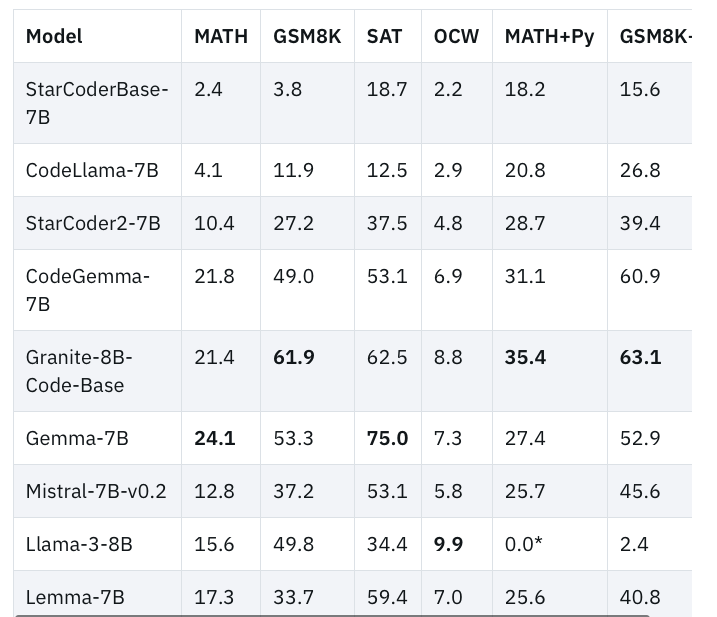
IBM Releases Open-Source Granite Code Models, Outperforms Llama 3

IBM has announced the release of a family of Granite code models to the open-source community, aiming to simplify coding for developers across various industries. The Granite code models are built to resolve the challenges developers face in writing, testing, debugging, and shipping reliable software

IBM has released four variations of the Granite code model, ranging in size from 3 to 34 billion parameters. The models have been tested on a range of benchmarks and have outperformed other comparable models like Code Llama and Llama 3 in many tasks.

The models have been trained on a massive dataset of 500 million lines of code in over 50 programming languages. This training data has enabled the models to learn patterns and relationships in code, allowing them to generate code, fix bugs, and explain complex code concepts.

The Granite code models are designed to be used in a variety of applications, including code generation, debugging, and testing. They can also be used to automate routine tasks, such as generating unit tests and writing documentation. They cater to a wide range of coding tasks, including complex application modernisation and memory-constrained use cases.

“We believe in the power of open innovation, and we want to reach as many developers as possible,” said Ruchir Puri, chief scientist at IBM Research. “We’re excited to see what will be built with these models, whether that’s new code generation tools, state-of-the-art editing software, or anything in between.”

The models’ performance has been tested against various benchmarks, showcasing their prowess in code synthesis, fixing, explanation, editing, and translation across major programming languages like Python, JavaScript, Java, Go, C++, and Rust.

The Granite code models are available on Hugging Face, GitHub, watsonx.ai, and RHEL AI, and are released under the Apache 2.0 license.

The post IBM Releases Open-Source Granite Code Models, Outperforms Llama 3 appeared first on Analytics India Magazine.

TechCrunch Minute: Audible deploys AI-narrated audiobooks. Can it replace the human touch?

TechCrunch Minute: Audible deploys AI-narrated audiobooks. Can it replace the human touch? Alex Wilhelm 9 hours

AI is coming for audiobooks, and that is not an entirely bad thing. But it is a cause of concern in the realm of audio titles and the folks who make them today. Audible is making it easy for authors to generate AI-narrated audiobooks, and as in many cases of AI showing up in an established industry, there’s worry that the creative folks are going to get squeezed out by the robots.

The concern is valid. After all, shouldn’t the robots help us do more art, instead of doing the art for us? Isn’t that backwards.

On the other hand, it’s clear that not every book that is written can afford to hire a narrator, an editor, and a team to handle audio publishing. I suspect that the more commercially-viable titles are still going to work with the best narrators. After all, they can afford it. But the middle-tier of narrators and authors might find that AI is just so cheap for audiobook creation that it’s not financially reasonable to pay a human to do it.

In a sense, consumers will decide. If they shun AI-read titles, the market will adapt. But will they? We’ll have to wait and see.

That’s the demand side of the equation. The supply side is already sorted. There are tens of thousands of AI-read titles today on Audible. Let’s see what happens, hit play!

The Australian Government’s Manufacturing Objectives Rely on IT Capabilities

In recent weeks, the Australian government has announced several objectives and initiatives that are intended to drive towards a single outcome: a far more robust local manufacturing industry. For Australia to be able to achieve this, it’s going to need a highly capable and equally well-resourced IT sector working in the manufacturing sector.

The Australian government earmarks nation-building levels of investment

The Future Made in Australia Act has yet to be fully detailed, but as Prime Minister Anthony Albanese announced via a broadcast, when it is introduced in the coming months, it will be “legislation to combine a package of new and existing initiatives to boost investment, create jobs and seize opportunities.”

We do have a sense of what might be involved since the government has already announced a $1 billion investment into building up the domestic solar panel manufacturing industry.

The intent of the Future Made in Australia Act is to build Australian manufacturing capabilities across all sectors, so it is very likely that announcements in the solar panel industry are just the tip of the iceberg.

What are the Australian government’s goals around advanced manufacturing?

Broadly speaking, there are five key objectives behind the government’s intended legislation across the manufacturing sector. As the Australian Government treasurer Jim Chalmers noted in The Australian, “Our work will be responsible and methodical and guided by where we can be more competitive, where it contributes to an orderly path to net zero, where it builds the capabilities of our people and regions, where it makes us more secure, and where it boosts the private sector and delivers value for money.”

What this translates to is:

  • Revitalising manufacturing: The Act aims to turbocharge clean manufacturing, industry and energy sectors, such as solar and wind.
  • Boosting investment: It includes government support for specific local industries to boost investment and create jobs.
  • Aligning national and economic security: The Act will establish strict policy frameworks and institutional arrangements to ensure Australia’s economic advantages and national security imperatives are prioritised.
  • Encouraging private sector involvement: While the government will make significant public investments, the aim is to incentivise the private sector to contribute most of the investment needed for this initiative.
  • Sovereignty: The Australian government and population are increasingly concerned the global socio-economic climate means that self-sufficiency is critical, and so Australia needs to boost manufacturing to cover areas where the country currently has low or zero domestic capabilities.

To achieve all of these objectives, the manufacturing industry will need to transform and modernise quickly, and this is where IT comes in.

IT as an enabler for the Future Made in Australia

What happened to Australia’s solar industry in the early days is a good example of why IT needs to be involved with the Future Made in Australia approach. Back then, when the solar industry was fledgling globally, Australia was a leader. Then, as noted in an ABC report:

“Twenty-three years ago, a Chinese-Australian solar scientist moved from Sydney to Wuxi to build China’s solar panel manufacturing industry from scratch, using technology developed in Australian universities.

“Australian science graduates filled the top technology roles at the biggest Chinese solar companies. And a solar cell design developed in Australia became the global standard. Meanwhile, Australia mostly stopped building its own solar panels.”

Essentially, Australia lost ground in the emerging sector because it failed to support manufacturing capabilities with technical support, pushing the technicians into overseas markets.

Australia struggles with low-value manufacturing due to high wages and cost of doing business; however, to develop the kind of advanced manufacturing capabilities Australia needs, there also needs to be ways to keep technical capabilities onshore.

For IT professionals, this will likely mean that as investment in manufacturing increases, there will also be white-hot demand for their services and skills. This will translate to better incomes from manufacturing jobs and the ability to drive more thought leadership within their work.

IT’s new priorities in manufacturing

Australia needs to rapidly scale its Industry 4.0 capabilities in order to create the kind of environment that will support the investment in manufacturing that lies ahead. Here are some ways that manufacturers will be looking to IT professionals to assist them in grappling with these next-generation opportunities.

  • Advanced automation: IT facilitates the use of robotics and automation technologies that increase productivity and accuracy while reducing the need for human labour in factories.
  • Improved communication: IT enhances communication within the manufacturing process, allowing for better coordination and data exchange between different parts of the production line.
  • Enhanced design capabilities: IT supports advanced design tools like CAD and CAM, which enable manufacturers to create detailed and precise product designs.
  • Increased customisation: IT allows for greater customisation of products by enabling manufacturers to quickly adjust production processes to meet specific customer requirements.
  • Greater sustainability: IT helps manufacturers optimise their processes to be more energy-efficient and reduce waste, contributing to more sustainable manufacturing practices.
  • Lower costs: Critically, through automating processes and improving efficiency, IT can help reduce operational costs in manufacturing and help Australian manufacturing be globally competitive.

A good example of how these things can come together is digital twinning. Digital twins allow manufacturers to create virtual replicas of products or systems, enabling them to test and optimise designs before physical production. Additionally, by mirroring the real-time status of physical assets, digital twins can predict when maintenance is required, reducing downtime and maintenance costs.

However, Australia has been slow to develop capabilities around digital twins, so there’s a looming skill shortage ahead in another area of IT, to go with existing challenges in data analytics and visualisation, AI and application development. Digital twins involve the application and understanding of all of these areas, and in many ways, when looking for digital twins resources, manufacturers will be looking for the proverbial “complete package.”

Speaking of skill shortages, there are also ongoing concerns with cyber security. For manufacturing, cyber security is critical for the protection of intellectual property, especially when it comes to advanced manufacturing and ensuring operational continuity.

Additionally, the Australian government’s interest in manufacturing as a matter of sovereign self-sufficiency means that many examples of manufacturing will be treated with the same concern as critical infrastructure. So manufacturers will be looking to IT to provide support in enabling them to embrace innovation without adding risk to their business processes.

What IT professionals should do

Understanding the business objectives in manufacturing, as well as the unique relationship the sector has to technology, will be key for IT professionals who want to take advantage of the historic investment that will be flowing into manufacturing and create jobs and opportunities for IT pros. These professionals will also need to understand the relationship between IT and operational technology, as well as how to apply digital twins, develop AI for manufacturing applications and more.