Forget DALL-E: Apple’s new AI image generator runs on-device and works like magic

Apple's new AI-powered Image Playground tool

Apple users who want to spice up their text messages, notes, and other items with cool, custom images will be able to do just that via a new feature called Image Playground. Unveiled on Monday at Apple's Worldwide Developers Conference 2024, Image Playground will be available as one of the many Apple Intelligence tools built into iOS 18, iPadOS 18, and MacOS Sequoia.

Also: Everything Apple announced at WWDC 2024, including iOS 18, Siri, AI, and more

With Image Playground, you'll be able to design your own images by choosing among three different styles: Animation, Illustration, and Sketch. You'll also be given a few different ways to define and refine your image. You can pick a specific category, such as themes, costumes, accessories, or places. You can type a description of the image you want. You can even grab a person from your photo library to include in your image.

Image Playground will be accessible in several apps, including Messages, Notes, Keynote, Freeform, and Pages, as well as third-party apps that take advantage of the Image Playground API. Plus, it has its own dedicated app where you can play around with different images to use and share.

In Messages, you'll be able to see suggested image ideas related to your conversations and create the right images to share with other people. As one example offered by Apple, maybe you're involved in a group chat discussing a hiking adventure. Image Playground will toss out potential images related to your friends, your destination, and your activity.

Also: iOS 18: All the iPhone changes Apple announced at WWDC 2024

In Notes, you can use Image Playground through the new Image Wand in the Apple Pencil tool palette. Here, you'll be able to turn a rough sketch into a full-blown image. You can even make use of an empty space in a note to create an image based on text and other content from the surrounding area.

With Image Playground popping up in iOS 18, iPadOS 18, and MacOS Sequoia, you'll be able to test it in beta mode in US English this coming fall. However, you'll need the right type of device to handle the AI processing. That means an iPhone 15 Pro or iPhone 15 Pro Max or an iPad and Mac with an M1 chip or higher.

Apple

Autoregressive Model Beats Diffusion: Llama for Scalable Image Generation

Meta’s Code Llama is Here, But Unnaturally

In a recent research paper, researchers have introduced LlamaGen, a new family of autoregressive models that outperform popular diffusion models like LDM and DiT for high-resolution image generation. The key breakthrough is that LlamaGen applies the same “next-token prediction” paradigm used in large language models to the visual domain without relying on inductive biases tailored for vision.

The LlamaGen models range from 111M to 3.1B parameters and achieve an impressive 2.18 FID score on the challenging ImageNet 256×256 benchmark, surpassing state-of-the-art diffusion models. For class-conditional image generation, LlamaGen-3B realises 2.32 FID with classifier-free guidance at 1.75 scale.

Notably, the researchers developed an image tokeniser with a downsampling ratio of 16 that achieves 0.94 reconstruction FID and 97% codebook usage on ImageNet. This discrete representation matches the quality of continuous VAE representations used in diffusion models.

For text-conditional generation, a 775M parameter LlamaGen model was first trained on 50M image-text pairs from LAION-COCO, then fine-tuned on 10M high-quality images. It demonstrates competitive visual quality and text alignment on challenging prompts from datasets like PartiPrompts.

A key advantage of LlamaGen is its ability to leverage optimisation techniques developed for large language models. The researchers showed a 326-414% speedup using the vLLM serving framework compared to baseline settings.

While still behind the latest diffusion models on some metrics, the researchers believe LlamaGen paves the way for unified autoregressive models spanning language and vision. With more training data and compute, they aim to scale LlamaGen above 7B parameters for further gains.

The post Autoregressive Model Beats Diffusion: Llama for Scalable Image Generation appeared first on AIM.

7 Generative AI Use Cases in Education 

Indian edtech is warming up to large language models (LLMs) to provide hyper-personalised learning experiences to students. Last year, Mayank Kumar, the co-founder and MD at upGrad, told AIM that the edtech firm was exploring the idea of building its own proprietary LLM.

ChatGPT has presented a significant challenge to edtech firms, forcing stakeholders to either embrace its capabilities or risk falling behind.

At a time when some edtech platforms underestimated the power of ChatGPT and ended up on the cusp of failure, others, like Khan Academy, assessed the potential of generative AI early and embraced it.

Let’s look at some exciting use cases of generative AI in education.

Personalised Learning & Course Design

Personalised lesson plans ensure students receive effective education tailored to their needs and interests. AI-powered algorithms can generate these plans by analysing student data, such as past performance, skills, and feedback.

Khan Academy’s AI tutor, Khanmigo, assists both teachers and students by not only providing answers but also guiding the learners to find the answers for themselves. With Khanmigo, teachers can differentiate instruction, create lesson plans and quiz questions, group students, and more.

Teaching Assistance

Generative AI can assist in creating new teaching materials, such as questions for quizzes and exercises, as well as explanations and summaries of concepts. This can be especially useful for teachers who need to create a large amount and variety of content for their classes.

Furthermore, generative AI can facilitate the generation of additional materials to supplement the main course content, such as reading lists, study guides, discussion questions, flashcards, and summaries.

For instance, with Quizizz, an interactive learning platform, one can create interactive, multimedia-rich quizzes to boost student engagement.

Assess Learning Patterns

AI analyses student performance data and identifies patterns of learning difficulties or gaps in understanding. Adaptive platforms use AI and machine learning (ML) algorithms to assess vast amounts of student performance data, which helps evaluate students’ strengths and weaknesses.

For instance, based on the specific requirements and skills of each student, BYJU’S offers tailored learning experiences through the use of an internal AI model, BADRI.

It implements personalised “forgetting curves” to pinpoint each student’s strengths and weaknesses, providing customised questions and learning videos for areas of improvement.

Tutoring Powered by AI

Generative AI can be utilised to create virtual tutoring environments wherein students can interact with a virtual tutor and receive real-time feedback and support. This can be particularly beneficial for students lacking access to in-person tutoring.

Similarly, BYJU’s MathGPT model uses advanced machine learning algorithms to generate accurate solutions for complex mathematical challenges, including trigonometric proofs.

Collaborative Learning Platforms

Apart from teaching assistance or content creation, generative AI can be used for collaborative learning since students find it easier to brainstorm ideas, engage in group discussions, and work together on projects with classmates worldwide.

This feat is achievable through AI-powered virtual platforms that facilitate the exchange of unique ideas, perspectives, and insights, fostering out-of-the-box thinking.

BYJU’S has partnered with Google to provide a collaborative and personalised digital learning platform named ‘Vidyartha’ for schools. This partnership facilitates access to Google Classroom for seamless classroom management, organisation, and learning tracking.

Restoring Old Learning Material

Generative AI models are trained on large datasets of text to learn patterns and structures of language, allowing them to intelligently reconstruct missing or corrupted portions of text documents such as historical manuscripts, books, or course materials.

Using techniques like GANs, generative AI can upscale and enhance the resolution and quality of old, low-resolution images and photographs used in educational materials.

Engaging Content Creation

Using foundational models enables the creation of diverse educational materials, like interactive stories, immersive simulations, and more. By leveraging captivating visuals generated using AI, learning becomes an engaging adventure for learners.

If teachers want to produce images tailored to their course requirements, for instance, NOLEJ, an AI-powered decentralised skill platform, offers an AI-generated e-learning capsule in just three minutes. This capsule features an interactive video and a glossary.

Top 10 Influential AI Leaders in the World in 2024 Top 10 Influential AI Leaders in the World in 2024 10 Jobs That AI Can’t Replace 10 Jobs That AI Can’t Replace Top 10 Indian AI Companies and Their Stock Share Price Top 10 Indian AI Companies and Their Stock Share Price 6 Ways to Use GPT4o (Omini) for Free 6 Ways to Use GPT4o (Omini) for Free Upcoming AI Conference for Engineers in May 2024 Upcoming AI Conference for Engineers in May 2024 View all stories



The post 7 Generative AI Use Cases in Education appeared first on AIM.

3 useful features coming to Apple AirPods this fall (but only for these models)

AirPods Pro 2

At WWDC 2024, Apple announced new software features for its flagship earbuds, the AirPods Pro (2nd generation), the MagSafe and USB-C versions included. The software updates are baked into iOS 18 and include features involving Siri and enhancements to voice isolation.

In addition to Apple giving Siri conversational context — thanks to its generative AI upgrades — Siri will soon better understand users wearing AirPods Pro. When iOS 18 is released this fall, users will be able to respond to Siri announcements via head nods.

Also: Everything Apple announced at WWDC 2024, including iOS 18, Siri, AI, and more

This feature is called Siri Interactions, and Apple says these gestures will be helpful in environments where users want privacy instead of saying a response to Siri out loud. When I wear my AirPods, I raise my voice so Siri can register my command; I'm curious to see how well this feature works.

Also, Apple announced improvements to AirPods Pro call quality with a feature called Voice Isolation. Powered by Apple Intelligence — the company's brand of generative AI — the feature can selectively and intelligently cancel unwanted noises and preserve or amplify wanted noises.

For example, during a call, AI can detect and dampen sounds such as wind or other background noise and keep them out of the microphones. On the other hand, AI can detect and amplify your voice so the person on the other end of the call can hear you clearly, even in crowded areas.

Siri Interactions and Voice Isolation are available only on the AirPods Pro 2 because these are Apple's only headphones with the advanced H2 chip. But other AirPods wearers aren't missing out on all the fun, as AirPods Pro, along with AirPods (3rd generation) and AirPods Max, are receiving an update to Personalized Spatial Audio.

Also: What is Apple Intelligence: How the iPhone's on-device and cloud-based AI will work

Mobile gaming apps are an integral part of Apple's App Store and the mobile app industry as a whole, as improvements to smartphone processors allow today's handsets to handle more intensive graphics and video than ever before.

To add a layer of immersion to the mobile gaming experience, Apple is bringing spatial audio with dynamic head tracking when iOS users play video games. Apple says gamers wearing AirPods can enjoy "the best wireless audio latency Apple has ever delivered for mobile gaming," but it's unclear how short the delay is.

These software features will be available when iOS 18 rolls out this fall. Unlike your other Apple devices, AirPods cannot be updated manually. However, AirPods updates are rolled into iOS updates, so once you update your iPhone, your AirPods should update as well.

Featured

6 Open-Source LLMs That Can Run on Smartphones 

use LLMs on your phone

Large language models (LLMs) demand substantial computational resources, which are often limited to powerful servers. However, a new generation of compact models is making it possible to run these powerful language models directly on your smartphones. Interestingly, you won’t require the internet to utilise LLMs on your smartphones.

Here are six open-source LLMs that can be trained and optimised to be used on your smartphones.

  1. Gemma 2B: Google’s compact, high-performance LLM for mobile language tasks.
  2. Phi-2: Microsoft’s tiny model outperforming giants up to 25 times its size.
  3. Falcon-RW-1B: Efficient 1B-parameter model for resource-constrained mobile devices.
  4. StableLM-3B: Stability AI’s balanced model for diverse language tasks on phones.
  5. TinyLlama: Compact Llama variant delivering impressive results on cell phones.
  6. LLaMA-2-7B: Meta’s powerful 7B model for advanced tasks on high-end smartphones.

1. Gemma 2B

Google’s Gemma 2B is a compact language model that delivers impressive performance despite its small size. It utilises a multi-query attention mechanism, which helps reduce memory bandwidth requirements during inference.

This is particularly advantageous for on-device scenarios where memory bandwidth is often limited. With just 2 billion parameters, Gemma 2B achieves strong results on academic benchmarks for language understanding, reasoning, and safety.

It outperformed similarly sized open models on 11 out of 18 text-based tasks.

2. Phi-2

With 2.7 billion parameters, Phi-2 has been shown to outperform models up to 25 times larger on certain benchmarks. It excels in tasks involving common sense reasoning, language understanding, and logical reasoning.

Phi-2 can be quantised to lower bit-widths like 4-bit or 3-bit precision, significantly reducing the model size to around 1.17-1.48 GB to run efficiently on mobile devices with limited memory and computational resources.

One of the key strengths of Phi-2 is its ability to perform common sense reasoning. The model has been trained on a large corpus of web data, allowing it to understand and reason everyday concepts and relationships.

3. Falcon-RW-1B

Falcon-RW-1B is part of the Falcon family of language models, known for their efficiency and performance. The RW stands for ‘Refined Web’, indicating a training dataset curated for quality over quantity.

Falcon-RW-1B’s architecture is adapted from GPT-3 but incorporates techniques like ALiBi (Attention with Linear Biases) and FlashAttention to enhance computational efficiency. These optimisations make Falcon-RW-1B well-suited for on-device inference on resource-constrained devices like smartphones.

The Falcon-RW-1B-Chat model aims to add conversational capabilities to the Falcon-RW-1B-Instruct-OpenOrca model to improve user engagement, expand use cases, and provide accessibility for resource-constrained environments like smartphones.

4. StableLM-3B

StableLM-3B, developed by Stability AI, is a 3 billion parameter model that strikes a balance between performance and efficiency. The best part of StableLM-3B is that despite being trained on fewer tokens, it outperformed models trained on 7 billion parameters on some benchmarks.

StableLM-3B can be quantised to lower bit-widths like 4-bit precision, significantly reducing the model size to around 3.6 GB to make it run efficiently on smartphones. A user mentioned that StableLM-3B has outperformed Stable’s own 7B StableLM-Base-Alpha-v2.

5. TinyLlama

TinyLlama leverages optimisations like FlashAttention and RoPE positional embeddings to enhance computational efficiency while maintaining strong performance. It is compatible with the Llama architecture and can be integrated into existing Llama-based mobile apps with minimal changes.

TinyLlama can be quantised to lower bit-widths like 4-bit or 5-bit precision, significantly reducing the model size to around 550-637 MB. A user, while sharing his experience with TinyLlama, mentioned that on a mid-range phone like the Asus ROG, TinyLlama was generating 6-7 tokens per second.

Ladies and gentlemen we have tinyllama running locally on mobile ( my dad's cause I am having a broke af low powered phone ) using termux. It aint even hard to do. Here a few pics of me playing with it and me documenting the steps on a notepad pic.twitter.com/lIsYiBiHh9

— Govind-S-B (@violetto96) December 23, 2023

6. LLaMA-2-7B

The LLaMA-2-7B model has been quantised to 4-bit weights and 16-bit activations, making it suitable for on-device deployment on smartphones. This quantisation reduces the model size to 3.6GB, making it feasible to load and run on mobile devices with sufficient RAM.

LLaMA-2-7B model on mobile requires a device with at least 6GB of RAM. During inference, the peak memory usage ranges from 316MB to 4785MB on the Samsung Galaxy S23 Ultra. This suggests that while the model can run on devices with 6GB+ RAM, having more RAM allows for better performance and reduces the risk of out-of-memory errors.

While it requires devices with sufficient RAM and may not match the speed of cloud-based models, it offers an attractive option for developers looking to create intelligent language-based features that run directly on smartphones.

Running llama-2-7b on Replit on my phone thanks to expandable storage. It’s kinda decent on CPU with 8 toks/s. https://t.co/r9yqvWayL5 pic.twitter.com/XeijnENM9E

— Amjad Masad (@amasad) July 21, 2023

The post 6 Open-Source LLMs That Can Run on Smartphones appeared first on AIM.

Apple WWDC Keynote: iOS 18, iPad OS 18 and macOS Sequoia Coming In Fall

Along with finally revealing its move in the AI product wars, Apple showed its next operating systems at the Worldwide Developers Conference on June 10:

  • iOS 18.
  • iPad OS 18.
  • macOS Sequoia.
  • VisionOS 2 for Apple Vision Pro.

iOS 18, iPad OS 18 and macOS Sequoia full releases are coming in fall 2024.

iOS 18 makes cosmetic changes and adds developer options

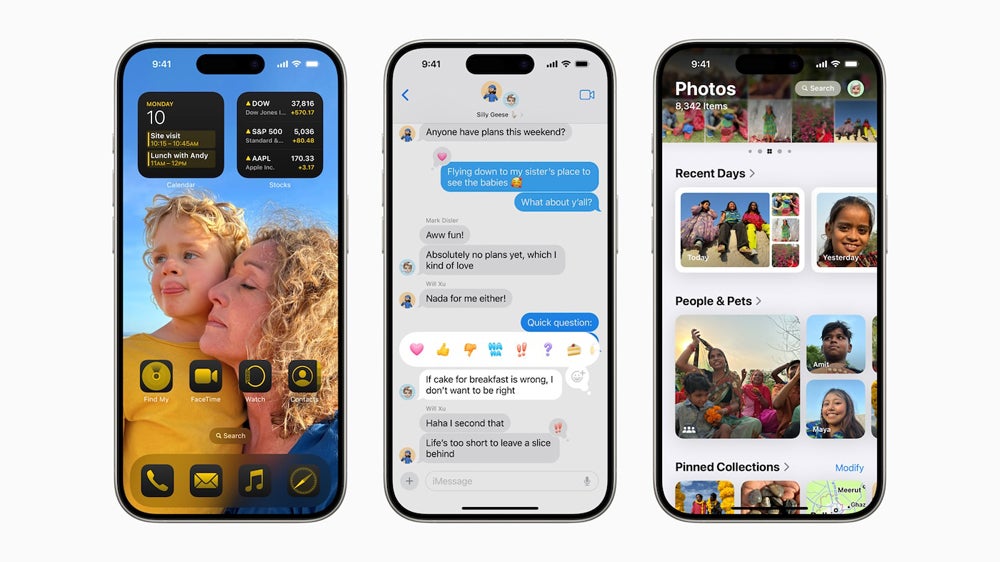
iOS 18 lets you change the color of icons on the iPhone, brings new text effects and adds more connections to Photos.
iOS 18 lets you change the color of icons on the iPhone, brings new text effects and adds more connections to Photos. Image: Apple

iOS 18 will offer Android-like customization. You can change the position and color of app widgets, and icons will have their own Dark Mode color schemes. You’ll be able to customize which Controls are available on the lock screen. The Control Center is getting a new look, enabling a continuous swipe down from Control Center to media and other applications.

Developer betas of iOS 18 are available today, with public betas later this month and official releases in the fall.

SEE: iOS 18 will come with Apple Intelligence generative AI.

iOS 18 includes new privacy options for hiding and locking apps. You’ll be able to use Face ID, Touch ID or your passcode to unlock locked apps or the Hidden Apps folder. This way, you can decide what apps are accessible to anyone you hand your phone to.

iOS 18 adds device pairing options for developers

For developers, Apple is adding new privacy options for apps that may access contacts or other devices. Users will be able to decide which contacts an app can see. Developers will be able to set what options they want to offer in terms of which devices on a network their app can access when devices are being paired.

SEE: What do the 2024 iPads offer for professionals?

macOS 15 Sequoia adds AI, some quality-of-life perks

The next macOS will be Sequoia, which will receive the same customization upgrades as iOS 18. It will have Apple Intelligence, which brings generative AI capabilities such as email summarization throughout tentpole Mac applications like Mail and Pages.

Continuity, a feature which enables sharing between devices, is getting even more seamless with the ability to control an iPhone from a Mac, including interacting with apps. Sequoia has some other neat quality-of-life changes for work, such as the way dragging a window to the edge of the screen will automatically put it in a tile folded to the side so you can see the whole window.

Apple Vision Pro gets visionOS 2 and international releases

Virtual displays let you work on what Apple calls “life-size” windows with Apple Vision Pro.
Virtual displays let you work on what Apple calls “life-size” windows with Apple Vision Pro. Image: Apple

The Apple Vision Pro headset will soon be available outside of the U.S. Customers in China, Japan and Singapore will be able to buy it June 28. Australia, Canada, France, Germany and the UK will follow on July 12.

The new operating system for the headset will bring new developer APIs, including capabilities with which you can “pin” spatial content to physical locations for manufacturing, healthcare and other business applications. Professional photographers will have access to a couple new workflows for creating 3D-looking “spatial” content for Vision Pro.

Plus, Mac Virtual Display is getting a boost, expanding the screen area in Vision Pro to panoramic 4K for increased productivity.

Top 9 Voice-Based Generative AI Assistants Transforming Interaction

Voice-based generative AI assistants are quietly revolutionising the way we interact with technology, making subtle yet impactful strides. These AI companions are not just about responding to commands anymore; they’re becoming more intuitive, empathetic, and capable of understanding complex human emotions and contexts.

While the progress may seem incremental, the depth of their capabilities is expanding rapidly. Here, we delve into the best voice-based generative AI assistants that are leading the charge.

Top 9 Voice-Based Generative AI Assistants

  1. GPT-4O
  2. Hume AI (EVI)
  3. Project Astra
  4. Pi AI
  5. Perplexity AI
  6. Character.ai
  7. Claude AI
  8. Chatsonic AI
  9. Google Gemini

GPT-4o

First and foremost, OpenAI’s GPT-4o is more advanced and better equipped to create complex applications with many functionalities, which proves its higher level of “development” and the ability to generate more comprehensive code.

Previewed at the recent OpenAI Spring Update announcement, it is the newest flagship model that provides GPT-4-level intelligence but is faster and improves on its capabilities across text, voice, and vision.

GPT-4o is much better than any existing model at understanding and discussing the images you share.

Hume AI (EVI)

Hume AI is an AI technology focused on understanding human emotions to improve interactions between humans and machines. It aims to understand and respond to a wide range of emotional states, using these insights to guide in the AI development.

The company is developing specialised AI models to recognize emotions in diverse cultural contexts, addressing global user needs. Hume AI’s emotion recognition algorithms are being tested for use in virtual reality environments to create more immersive and responsive experiences.

A 20-minute unscripted, unedited, and uncut conversation with @hume_ai + @AnthropicAI about neuroscience, mental health, ancient Greek philosophy, and politics. pic.twitter.com/A5quXNcpYk

— Shan (@ShanRizvi) May 14, 2024

Project Astra

Project Astra, unveiled at Google I/O 2024, could end up as one of Google’s most important AI tools. Astra is being billed as “a universal AI agent that is helpful in everyday life”. It’s something like Google Gemini with added features and supercharged capabilities for a natural conversational experience.

Demis Hassabis says Project Astra is Google's vision for the ultimate AI agent because it is multi-modal and this will lead to truly smart assistants pic.twitter.com/UXuyIuBg9R

— Tsarathustra (@tsarnick) June 7, 2024

Pi AI

Pi, your very own personal AI, from Inflection isn’t just another chatbot, it’s a leap forward in personal intelligence, designed to be there for you, anytime and evolve with every conversation. Pi stands for ‘personal intelligence’.

Pi can also express emotions and empathy, using natural language and emojis. It is designed to be a kind and supportive companion assistant.

Perplexity AI

Perplexity’s main product is its search engine, which relies on NLP. It utilises the context of the user queries to provide a personalised search result. Perplexity summarises the search results and produces a text with inline citations. It helps create, organise, and share information seamlessly.

This model is trained on large datasets of human speech, which include diverse voices, accents, and languages. The extensive training allows the model to generalise well and produce high-quality voice outputs across different contexts.

pic.twitter.com/QEupJvFj5S

— Perplexity (@perplexity_ai) June 7, 2024

Character.ai

Character AI is an exciting and innovative AI chatbot web application that opens up a world of possibilities for interactive conversations. Its capabilities, including the ability to chat with various characters and create personalised interactions, make it a unique and engaging platform.

Claude AI

Claude’s code of ethics, speed, and ability to process large volumes of information enable you to efficiently leverage AI for complex analysis and content generation. However, it’s important to be mindful of potential inaccuracies and limited capabilities.

It is an AI assistant that can generate natural, human-like responses to users’ prompts and questions. Claude can respond to text or image-based inputs and is available on the web or through the Claude mobile app.

Claude AI | BETTER THAN ChatGPT! | How to Use Anthropic AI Claude 3 FREE

Chatsonic AI

Chatsonic is a solid AI-powered chatbot that can help you write blog posts, social media posts, or anything else that you can think of. Whether it’s crafting engaging blog posts, helping with creative writing, or even answering questions, Chatsonic is a reliable and versatile tool. Its ability to generate content quickly and efficiently is truly impressive.

@ChatSonicAI can now talk to images 🖼
Upload your image & let Chatsonic analyze it to:
1. Generate related content – Like captions, product descriptions, alt text, marketing copy, etc.
2. Get design reviews – Ask Chatsonic to give improvements for your ad or social media… pic.twitter.com/pjueOW0zAW

— Samanyou Garg (@SamanyouGarg) November 29, 2023

Google Gemini

Gemini for Google Cloud is a new generation of AI assistants for developers, Google Cloud services, and applications. These assist users in working and coding more effectively, gaining deeper data insights, navigating security challenges, and more.

Google co-founder Sergey Brin is credited with helping develop the Gemini LLMs, alongside other Google staff.

The post Top 9 Voice-Based Generative AI Assistants Transforming Interaction appeared first on AIM.

Here’s how Apple’s keeping your cloud-processed AI data safe (and why it matters)

Mac Pro Apple store

On the heels of Microsoft's debacle with its Copilot+ PC — the AI's "Recall" feature has been lambasted as a massive security violation in artificial intelligence — Apple on Monday used its annual developer conference, WWDC, to promise "groundbreaking" privacy protections in AI.

Also: Everything Apple announced at WWDC 2024, including iOS 18, Siri, AI, and more

In conjunction with a broad artificial intelligence offering across MacOS "Sequoia," iPadOS 18 and iOS 18, called "Apple Intelligence," Apple's head of software engineering, Craig Federighi, announced the company will run some AI models on-device, but also run some in a secure cloud computing environment when they require extra horsepower.

Called "Private Cloud Compute," the service "allows Apple intelligence to flex and scale its computational capacity and draw on even larger server-based models for more complex requests while protecting your privacy," said Federighi.

The servers underlying Private Cloud Compute are "servers we've especially created using Apple silicon," said Federighi, confirming rumors last month that Apple would use its own custom silicon in place of Intel and AMD chips that typically power data center servers.

The servers and their chips "offer the privacy and security of your iPhone from the silicon on up, draw on the security properties of the Swift programming language, and run software with transparency built in," said Federighi.

Also: Forget LastPass: Apple unveils 'Passwords' manager app at WWDC 2024

"When you make a request, Apple Intelligence analyzes whether it can be processed on device," he explained. "If it needs greater computational capacity, it can draw on private cloud compute and send only the data that's relevant to your task."

Apple emphasized that user data will not be gathered by the company, in contrast to the general AI industry practice of using individuals' and companies' data for training AI models. "Your data is never stored or made accessible to Apple," said Federighi.

The company also announced a partnership with OpenAI to integrate ChatGPT into Siri.

Federighi emphasized outside scrutiny of the Private Cloud Compute servers by security experts, stating, "And just like your iPhone, independent experts can inspect the code that runs on these servers to verify this privacy promise. In fact, private cloud compute cryptographically ensures your iPhone, iPad, and Mac will refuse to talk to a server unless its software has been publicly logged for inspection."

Federighi did not go into detail about how the Private Cloud Compute servers will be inspected or audited by security researchers.

Also: AI advancements in medicine and education lead ZDNET's Innovation Index

Said Federighi, "This sets a brand new standard for privacy and AI and unlocks intelligence you can trust."

Apple also announced during the keynote that it is partnering with OpenAI to offer free use of ChatGPT, with GPT-4o, on its devices. The company emphasized that any use of ChatGPT will first ask the Apple device user's permission.

"Your requests and information will not be logged," said an Apple spokesperson in the recorded video of the keynote, adding, "Of course, you're in control over when ChatGPT is used and will be asked before any of your information is shared."

Apple

Apple Sets a Brand-New Standards for Privacy in AI 

Apple’s obsession with privacy is not new. Today, at WWDC 2024, the company made a series of ‘Apple Intelligence’ announcements, and the Private Cloud Compute feature definitely stole the show.

The former member of OpenAI, Andrej Karpathy, lauded Apple’s attempt to prioritise privacy in its integration of AI into its OS and called out seven major themes observed: multimodal I/O, agentic, frictionless, initiative, delegation hierarchy, modularity, and, lastly, privacy.

“We’re quickly heading into a world where you can open up your phone and just say stuff. It talks back, and it knows you. And it just works. Super exciting, and as a user, quite looking forward to it,” said Karpathy.

Actually, really liked the Apple Intelligence announcement. It must be a very exciting time at Apple as they layer AI on top of the entire OS. A few of the major themes.
Step 1 Multimodal I/O. Enable text/audio/image/video capability, both read and write. These are the native…

— Andrej Karpathy (@karpathy) June 10, 2024

Private Cloud Compute extends the privacy and security of Apple devices into the cloud to unlock even more intelligence.

For the most part, Apple’s on-device processing will take care of your needs. However, there may be times when additional data is required to answer your query, and this is where ‘Private Cloud Compute’ comes into the picture.

With Private Cloud Compute, Apple Intelligence can scale its computational capacity and utilise larger, server-based models for more complex requests. These models run on Apple silicon-powered servers, ensuring that data is never retained or exposed.

Apple says that when a user makes a request, Apple Intelligence analyses whether it can be processed on-device. It can draw on ‘Private Cloud Compute’ and send only the relevant data if greater computational capacity is needed.

Apple has enabled cryptography encryption, so your Apple device will never be able to talk to the Apple server unless the software is publicly logged for inspection.

Apple claimed, saying:

  • Your data will never be stored on the server
  • Data will only be used to serve the requests made by a user
  • Independent excerpts can inspect the code running on the server for transparency.
  • Cryptography encryption between the server and Apple device.
  • To take things to the next level, it has utilised the security properties of the Swift programming language.

Meanwhile, Elon Musk has shown concern about the OpenAI Apple partnership. “If Apple integrates OpenAI at the OS level, then Apple devices will be banned at my companies. That is an unacceptable security violation,” posted Musk on X.

The post Apple Sets a Brand-New Standards for Privacy in AI appeared first on AIM.

Apple Intelligence FAQ: Every new feature, what models support it, and privacy concerns

apple-park-signage-2024

During WWDC 2024, Apple poured a big vat of artificial intelligence onto expectant viewers, leaving us drenched in new AI features under the banner of Apple Intelligence. But how do all these features work?

Featured