AI bigshot Andrew Ng’s AI Fund, a startup incubator that backs small teams of experts looking to solve key problems using AI, plans to raise upwards of $120 million for its second tranche. A filing with the SEC shows that the AI Fund’s second fund, AI Venture Fund II, has so far amassed $69.75 million […]
Europe officially announced its second exascale system, Alice Recoque, and you can expect to see that name on the Top500 supercomputer list in a few years. Alice Recoque is the new name for a supercomputer with the operating name Jules Verne. The supercomputer is named after a celebrated French scientist and AI pioneer.
The supercomputer will cost about €544 million. It will be installed at CEA’s TGCC supercomputing center at Bruyères-le-Châtel, about 25 miles south of Paris. The Jules Verne consortium, which includes France’s GENCI and the Netherlands’ SURF, will operate the system.
Alice Recoque, a French engineer, worked at the SAE and CII. She notably led the Mitra15 project and was responsible for Research and Development of the “small computers” division. Later, she led the Bull Group at CII. In 1985, the Bull Group focused on research on highly parallel machines and artificial intelligence. (Source: https://mag.mo5.com)
Here’s what we know about the supercomputer:
– The EuroHPC JU hasn’t given a clear launch date, but other European tech agencies projected 2026 for the system to go live. However, based on past coverage, HPCwire expects the system to be fully operational in 2027 or 2028.
– Alice Recoque is Europe’s second exascale system after Jupiter, which is being installed in Germany and could go live in 2024 or next year.
– Europe has many goals with the second supercomputer. “We are looking around and trying to understand what level of ambition we can have there, but the aim is for the system … to have a further increase in European technology compared to what we managed to do in Jupiter,” said Anders Dam Jensen, executive director for the EuroHPC JU, during a presentation at ISC 2024.
– One native European technology will be SiPearl’s ARM-based Rhea-2 chip, which will succeed the Rhea-1 chip in Jupiter.
– The Rhea-1 chip is undergoing a redesign to include Samsung’s HBM memory, which wasn’t part of the original chip design. That has delayed the shipment date for the chip, and SiPearl could be simultaneously updating the Rhea-2 chip design, which may not affect its shipment date.
– Alice Recoque will be for AI and high-precision HPC.
– Like Jupiter, Alice Recoque has a modular design. A system with Rhea-2 CPUs will act as a nerve center onto which modules such as GPU-accelerated and quantum computing systems can be added.
– EuroHPC JU also wants to use accelerators developed by EPI (European Processor Initiative) such as EPAC, which is a RISC-V based vector accelerator.
– Europe is a reluctant backer of ARM-based CPUs but ultimately wants high-performance computers running on RISC-V chips. However, the Alice Recoque supercomputer proves that RISC-V isn’t ready for primetime in HPC.
– Atos will build the system, which will be geared towards generative AI, security, climate studies, and energy management, which are priorities in Europe.
– Europe has no plans yet for a third exascale system. EuroHPC JU leaders are instead focusing on “post-exascale systems”. Zettascale systems were never part of EuroHPC JU plans, and it seems they understand the technological limitations of exascale systems.
– EuroHPC JU is funneling more money into quantum computing systems, which will be installed at six computing sites. The organization also connects all 29 high-performance systems in Europe, including Lumi in Finland and Leonardo in Italy.
– Europe is also making significant upgrades to existing supercomputers. “We’re not standing still… we will start a very significant upgrade of the Leonardo system,” Dam Jensen said at ISC.
While Google is best known for its consumer-facing Gemini chatbot, it also offers solutions for businesses through its enterprise-ready AI platform, Vertex AI. On Thursday, Google announced Vertex AI is getting new models and updates.
For starters, Google has made highly anticipated changes to its in-house models, including moving Gemini 1.5 Flash from public preview to general availability. Gemini 1.5 Flash, announced last month at Google I/O, is the fastest Gemini model in Google's API and a more cost-efficient alternative to Gemini 1.5 Pro. Despite its low latency, Gemini 1.5 Flash is a highly competitive model with a 1-million-token context window.
Also: Gmail users can now ask Google's Gemini AI to help compose and summarize emails
Google even compared the model's performance to OpenAI's GPT-3.5 Turbo, highlighting how Gemini 1.5 Flash has a token window that is approximately 60 times bigger, 40% faster on average when given an input of 10,000 characters, and has an up to four times lower input on price, with context caching enabled for inputs larger than 32,000 characters.
Google also updated Gemini 1.5 Pro, its overall best-performing model that the company announced at Google I/O. The model will now be available in Vertex AI with a 2-million-token context window, doubling its previous context window size, allowing it to process two hours of video, 22 hours of audio, over 60K lines of code, and over 1.5 million words.
Next, Google launched Imagen 3, its latest image generation foundation model, in preview for Vertex AI customers. Some highlights of this model include 40% faster generation, photo-realistic generation of groups of people, better prompt fidelity, multi-language support, and built-in safety features, according to Google.
In addition to updating its models, Google is adding more third-party and open models, including Gemma 2, available now, and Mistral, which is coming this summer.
Since keeping costs as low as possible is a priority for enterprises, Google is also rolling out context caching in public preview in Gemini 1.5 Pro and Gemini 1.5 Flash. This approach will improve how users feed the model context and should, as a result, lower costs. Additionally, the new provisioned throughput feature, generally available today, should help customers scale their use of Google's first-party models.
To address generative AI misinformation and hallucination concerns, Google plans to introduce grounding with third-party data, coming next quarter, to help enterprises incorporate their data into their generative AI agents.
Also: Google is backing these 20 startups to help improve the world with AI
Google also announced another grounding option: grounding with high fidelity uses only the provided context to generate a response, and doesn't factor in the model's world knowledge to ensure high levels of factuality. Grounding with high fidelity is available in an experimental preview and powered by a fine-tuned version of Gemini 1.5 Flash.
Lastly, to give enterprises more control over where their data is stored and processed, Google has data residency for data stored at rest in 23 countries and is planning to expand ML processing commitments to eight more.
If your enterprise is interested in learning more about getting started with Vertex AI, visit this Google Cloud webpage.
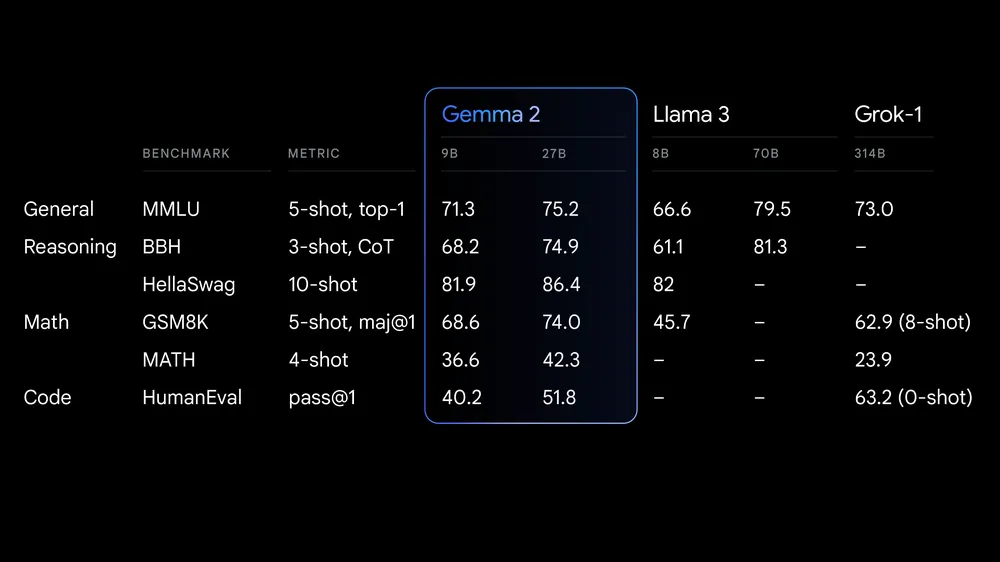
Google DeepMind announced the release of Gemma 2, an advanced version of its open models, available in 9 billion (9B) and 27 billion (27B) parameter sizes.
The model is accessible on Google AI Studio, Kaggle, Hugging Face Models, and soon on Vertex AI Model Garden. Researchers can apply for the Gemma 2 Academic Research Program for Google Cloud credits, with applications open until August 9.
Gemma 2 offers significant improvements over its predecessor, including competitive performance to larger proprietary models and optimised cost efficiency. The 27B model can perform inference on a single NVIDIA H100 Tensor Core GPU or TPU host, reducing deployment costs.
The new models integrate easily with major AI frameworks like Hugging Face Transformers, JAX, PyTorch, and TensorFlow via Keras 3.0. Developers can deploy Gemma 2 on various hardware setups, from cloud-based environments to local CPUs and GPUs.
Let's fucking gooo! Google just dropped Gemma 2 27B & 9B > Beats Llama3 70B/ Qwen 72B/ Command R+ in LYMSYS Chat arena & 9B is the best < 15B model right now. > 2.5x smaller than Llama 3 & trained on 2/3rd the amount of tokens > Trained on 13T tokens (27B) and 8T (tokens) >… pic.twitter.com/lIpBqmocQL
— Vaibhav (VB) Srivastav (@reach_vb) June 27, 2024
Gemma 2 is available under a commercially-friendly license, encouraging innovation and commercialization. Google Cloud customers will be able to deploy and manage Gemma 2 on Vertex AI starting next month. Additionally, Google provides the Gemma Cookbook, offering practical examples for building and fine-tuning applications with Gemma 2.
Google emphasises responsible AI development with Gemma 2, incorporating robust safety processes, pre-training data filtering, and rigorous testing against bias and risk metrics. The LLM Comparator tool and text watermarking technology, SynthID, are part of these efforts.
The initial release of Gemma resulted in over 10 million downloads. Gemma 2 aims to support even more ambitious projects, with future plans to release a 2.6B parameter model to balance accessibility and performance.
The post Google Rolls Out Gemma 2, Leaves Llama 3 Behind appeared first on Analytics India Magazine.
AI “agents” are generative AI models that can perform actions autonomously, like copying info from an email and pasting it into a spreadsheet, and have been hailed as productivity superchargers. That might be a bit premature, given models’ tendency to make mistakes. But at least a few founders (and analysts and investors) seem convinced that agents are the next frontier in generative AI.
Bella Liu and William Lu are two such founders. Their company, Orby AI, is building a generative AI platform that attempts to automate a range of different business workflows, including workflows that involve data entry, documents processing and forms validation.
Lots of startups offer tools to automate repetitive, monotonous back-office business processes (see Parabola, Tines, Sam Altman-backed Induced AI and Tektonic AI, to name a few). Incumbents, too, like Automation Anywhere and UiPath, have moved to embrace AI to try to maintain pace with the generative AI competition.
But Liu and Lu claim that Orby’s tech stands out for its ability to learn and act on workflows in real time and to understand the patterns and relationships within an enterprise’s unstructured data.
“Orby’s platform observes how workers do their work in order to automatically create automations for complex tasks that require some level of reasoning and understanding,” Liu, Orby’s CEO, explained. “An AI agent installed on a worker’s computer effectively watches, learns and generates automations, adapting the model as it learns more.”
With Orby, which launched out of stealth in 2023, Liu and Lu say that they sought to create AI that could understand some of the low-level decisions being made by workers and abstract those decisions away, freeing up workers to focus on headier things.
Liu previously led AI and automation efforts at IBM, including product planning and AI-related mergers and acquisitions, and was UiPath’s director of AI product management. Lu is a former Nvidia systems engineer who joined Google Cloud as an engineering lead, helping to design generative AI document and database extraction tech.
Orby’s purported secret sauce is a cloud-based generative AI model that’s fine-tuned to complete customer tasks, such as validating expense reports. The model relies partly on symbolic AI, a form of AI that leverages rules, such as mathematical theorems, to infer solutions to problems.
Orby’s generative AI observes tasks performed by people, then learns to automate these tasks.Image Credits: Orby
Symbolic AI alone can be inflexible and slow, especially when dealing with large and complicated data sets. It needs clearly defined knowledge and context to perform well. But recent research has shown that it can be scalable when paired with traditional AI model architectures.
“For the last two years, we’ve been engineering this AI model, and have performed successful trials,” Liu said. “There are few pure-play generative AI companies attacking the enterprise head-on with something end-to-end. We are one.”
Liu says that Orby’s model can intelligently adapt to changes in workflows, like when an app’s UI gets an update, by analyzing API interactions and a worker’s browser usage. Having software monitor an employee’s every move sound like a privacy disaster waiting to happen. But Liu claims that Orby doesn’t store most customer data; it only uses certain telemetry data to improve its model, encrypting the data both in transit and at rest.
“Humans are kept completely in the feedback loop,” she added.
Orby, which recently raised $30 million in a Series A funding round co-led by New Enterprise Associates, Wndrco and Wing, sources say at a post-money valuation of $120 million, is competing in a challenging sector. Forthcoming agentic AI from generative AI powerhouses such as OpenAI and Anthropic have dampened the prospects of incumbents and smaller players alike.
Adept, a startup building AI agents technology focused on enterprise applications, is reportedly on the cusp of an acquihire deal with Microsoft before it manages to ship a single product. Amazon and Google have released AI agent tooling to little fanfare. Elsewhere, UiPath — despite its ramping up of generative AI initiatives in the past year — saw sales plummet in its most recent fiscal quarter.
Liu says that Orby can come out ahead by taking a systematic go-to-market approach. The company is already generating revenue from around a dozen customers, she says, and plans to put its $35 million war chest toward expanding its Mountain View-based, roughly 30-person team.
“The funds are being used to scale our go-to-market, customer support, product and technical orgs,” she said. “The enterprise market has an insatiable appetite for generative AI solutions that demonstrably improve business performance; they are just trying to figure out where to best apply the technology in the near term before they scale it across their business.”
TIME and OpenAI have entered a multi-year content deal and strategic partnership to integrate TIME’s journalism with OpenAI’s products, including ChatGPT.
The partnership grants OpenAI access to TIME’s archives spanning 101 years, enabling the use of this content in AI-generated responses with citations and links to the original sources on Time.com. Further, the collaboration aims to expand global access to accurate and reliable information.
Mark Howard, TIME’s Chief Operating Officer, said that the partnership aligns with TIME’s history of innovation in delivering journalism. “This partnership with OpenAI advances our mission to expand access to trusted information globally,” he said.
Brad Lightcap, Chief Operating Officer of OpenAI, emphasised the partnership’s role in facilitating access to news content and supporting reputable journalism by ensuring proper attribution to original sources.
Additionally, the partnership allows TIME to utilise OpenAI’s technology for developing new products and provides an opportunity for TIME to offer feedback and practical applications to enhance the delivery of journalism in OpenAI’s products.
Prior to this OpenAI has partnered with several prominent media houses to enhance its AI models and provide high-quality content to users. These partnerships include Le Monde and Prisa Media, which bring French and Spanish news content to ChatGPT, as well as Vox Media, The Atlantic, and News Corp, which provide a wealth of journalistic content for training and user engagement.
Additionally, OpenAI has collaborated with Axel Springer, Financial Times, and Associated Press, among others, to support the dissemination of accurate and balanced news stories.
The post TIME and OpenAI Announce Multi-Year Content Partnership appeared first on Analytics India Magazine.
Generative artificial intelligence (AI) tools like Open AI's ChatGPT and Microsoft Copilot make it much easier to turn ideas into actions. From productivity boosts to assistance with coding and a helping hand with content creation, these technologies are changing how we work.
If you've got a great idea, can you turn it from paper-based theory to money-making practice with the help of generative AI? Five business leaders give us their opinions on the role of emerging technology.
1. Identify a business problem
Richard Wazacz, CEO of foreign exchange specialist Travelex, said the power of generative AI must be placed in context. Professionals can use emerging technology to scale up new ideas quickly but other factors are also important.
"I think it's trendier now to set up a new business. I don't think it's any easier," he said.
Wazacz told ZDNET that technologies like generative AI put the power of change into the hands of more professionals. However, democratization brings challenges, too.
"As something gets easier, everyone takes advantage of it," he said, suggesting others will find it just as easy as you to dabble in AI-powered innovation.
Wazacz said professionals must focus on the end goal rather than the technological solution.
Also: When's the right time to invest in AI? 4 ways to help you decide
"Setting up a business successfully is still about finding a problem no one else has solved. And that could be a tiny little problem or a massive problem," he said. "You've got to solve a problem that customers want solved and you've got to do it well. It's as simple as that. Scaling up new business models is tough. But I admire people that do it."
2. Take a calculated risk
Toby Alcock, CTO at Logicalis, recognized the inherent power of generative AI, especially when it comes to its ability to power new business models.
"I've started, built, and sold businesses, so I think about this question quite a lot," he said.
Alcock said we're in an "interesting time" where emerging technology opens new possibilities. However, he told ZDNET the watchword is caution. "There's a lot of potential, hype, and money in the AI space. But it's early days and, as we've seen from every hype cycle, the past is littered with bodies along the way."
Also: Agile development can unlock the power of generative AI — here's how
Alcock said technology isn't the only issue; macro-economic challenges and geopolitical instabilities mean inflation is high in many Western economies.
Professionals would be well advised to think carefully before they leap into new business ventures, even with the helping hand offered by generative AI.
"The cost of money right now is pretty sobering," he said. "You can make a bet on generative AI for new ideas. But take a calculated risk. If it doesn't get you a return, you need to know you can afford it."
3. Find the right balance
Tim Lancelot, head of sales enablement at technology specialist MHR, took a different stance — tough conditions mean people who take a risk can be rewarded.
"I think times when there's a little bit of an economic lull give rise to opportunity. I did my master's degree in innovation. I feel that the leaner times and the economic downturns can be important — necessity is the mother of invention," he said
"Some of the best businesses started in a downturn. So, when times are tough, businesses are born out of adversity. If you have something that works during an economic lull, you're in a fantastic position to take advantage of growth."
Also: 4 ways to help your organization overcome AI inertia
Lancelot told ZDNET that generative AI could help innovators dabble in new areas by reducing the barriers to entry: "The upfront investment might be lower potentially."
However, he is another business leader who said it's important to consider how generative AI has democratized access to emerging technology.
"Don't forget, everybody's got the same tools at their disposal. Just like it's a lower barrier of entry for you, it's also a lower barrier for anybody else," he said.
"I think each generation must maximize their use of tools that are available and get the balance of opportunity and risk right."
4. Use the right tech platform
Jessie Sobel, VP of strategic growth initiatives at Freshpet, said exploring new business models is part of her job description.
"I look at commercial and internal initiatives to help ensure we remain the leader in fresh pet food," she said. "For this, I've been looking at different business models to ensure we're the leader and I've been looking at the direct-to-consumer market."
This move is a novel transition for Freshpet. The company serves more than 11.5 million households primarily through a network of 34,000 refrigerators in retailers.
Freshpet recognized that the right technology platform could help the company explore a new direct-to-consumer model, Sobel told ZDNET. Freshpet uses Ordergroove's Bundles Suite to create flexible customer experiences.
"This project is all about embracing technology to help us meet the needs of pet parents. We have to embrace that opportunity," she said.
Also: AI will change the role of developers forever, but leaders say that's good news
Freshpet continues to look for ways technology can improve business processes, including using Emplifi's AI-enabled Service Cloud to streamline customer engagement processes.
"Over 11 and a half million consumers are buying fresh, but we believe that can be up to 42 million. So my work is focused on, 'Where is there a population of people we're not reaching?'" said Sobel. "I think about how we can reach the total addressable market and technology enables much of that work."
5. Focus on your objectives
Attiq Qureshi, chief digital information officer at Manchester United, said his football club is looking at using AI across several areas, including content delivery and content moderation.
"We've got a long list of potential use cases, everything from helping fans to contact us to supporting frontline colleagues to do their jobs better." Qureshi told ZDNET his team is exploring how AI can help moderate comments on fan forums and protect the club's brand.
Also: Beyond programming: AI spawns a new generation of job roles
However, they won't use emerging technologies like generative AI to support new business models.
"It's something that we wouldn't do. Our role, first and foremost, is to win on the pitch and compete for trophies. Everything lines up behind that, even things like generating revenue — because generating revenue supports the fuel that allows us to invest in football," he said, before outlining where others might benefit from using AI in new areas.
"Technology has always helped startups. AI might make it easier for smaller players to compete, but I'm not sure AI makes it easier to start a new model. Customers are drawn to the product and service. So as long as you're providing a great service, that's all that matters."
A recent report by Akamai Technologies found that bots compose 42% of overall web traffic, and 65% of these bots are malicious.
Akamai recently released a new State of the Internet (SOTI) report that details the security and business threats that organizations face with the proliferation of web scraping bots.
The report found that with the reliance on revenue-generating web applications, the e-commerce sector has been most affected by high-risk bot traffic.
Although some bots are beneficial to business, web scraper bots are being used for competitive intelligence and espionage, inventory hoarding, imposter site creation, and other schemes that have a negative impact on both the bottom line and the customer experience.
There are no existing laws that prohibit the use of scraper bots, and they are hard to detect due to the rise of AI botnets, but there are some things companies can do to mitigate them.
“Every business with an online storefront relies on web scraper bots to some extent. The challenge arises when these bots are misused, as their similar functions make it difficult to distinguish between beneficial and malicious ones. It is then compounded by the rapidly evolving scraper landscape which renders traditional defenses like firewalls ineffective,” said Reuben Koh, director of security technology & strategy, APJ, Akamai Technologies.
“Now, more than ever, ecommerce businesses, especially in APJ which is a key global commerce hub, must invest in solutions that are fit for purpose, capable of adapting and keeping up with the unpredictable and iterative attacks posed by malicious bots – especially if they are looking to regionalize and expand their customer base, opening them up to further threats,” Koh added.
Key findings from the report include:
AI botnets have the ability to discover and scrape unstructured data and content that is in a less consistent format or location. Additionally, they can use actual business intelligence to enhance the decision-making process through collecting, extracting, and then processing data.
Scraper bots can be leveraged to generate more sophisticated phishing campaigns by grabbing product images, descriptions, and pricing information to create counterfeit storefronts or phishing sites aimed at stealing credentials or credit card information.
Bots can be used to facilitate new account opening abuse — which, according to recent research, composes up to 50% of fraud losses.
Technical impacts that organizations face as a result of being scraped, whether the scraping was done with malicious or beneficial intentions, include website performance degradation, site metric pollution, compromised credentials attacks from phishing sites, increased compute costs, and more.
The Scraping Away Your Bottom-Line research report offers mitigation strategies against scraper bots and features a case study that shows how websites operate much faster and efficiently once defenses against these bots are put into place. In addition, the research addresses compliance considerations that must be taken into account in light of these increasing attacks.
The post Around 42% of Overall Web Traffic is Generated by Bots: Report appeared first on Analytics India Magazine.
AI is a hot topic these days. It is being applied in all domains to solve real-life problems. Let’s discuss the steps for building a career in AI.
Step 1: Build an Educational Foundation
Choose the degree that matches your career plans in AI. You can opt to get a degree in computer science, math or engineering. You'll learn about coding languages and algorithms if you pursue a computer science course. Math and statistics courses include topics like probability, linear algebra and calculus. Engineering degrees usually focus on signal processing and robotics. There are several online courses available on different areas of AI. The courses include subsections that have tutorials and assignments. They can be self-paced or have a fixed timeline. They can be found on popular platforms like edX, Coursera and Udemy.
Step 2: Hands-on Learning
Engage in Projects and Competitions
Projects and competitions provide hands-on experience to solve real life problems using AI. They enhance our AI concepts and sharpen our problem-solving skills. You should first implement basic projects and then participate in challenges. Some common AI projects include image classification tasks like digit recognition or object detection. Natural language processing projects often involve sentiment analysis or chatbots. Some of the popular AI competitions are ImageNet Large Scale Visual Recognition Challenge (ILSVRC), AI for Social Good Challenge and NeurIPS Challenges. You should also participate in hackathons to explore different projects.
Secure Internship Opportunities
An internship gives you practical experience and can also lead to a full-time job. Here's how you can get one: Firstly, identify the artificial intelligence firms that involve interns Get connected to AI professionals online and offline. Ensure that your resume includes AI-related information in your skills section and educational background. Create a portfolio of AI projects and research. Make sure that you tailor your application to match the company and the position. It is essential to discuss the projects and experiences related to the internship role in the interview. Last but not the least, don’t forget to contact the recruiters.
Step 3: Build Portfolio and Network
A strong portfolio is important to show your skills in AI. The portfolio should be made in a professional manner. You should publish your work in academic journals and websites. Additionally, you should write articles and contribute to open-source projects. For example, you can use GitHub to share your code and collaborate with peers. Networking leads to professional growth and knowledge exchange in the field of AI. Interact with experts on LinkedIn to stay connected within the AI community. Follow tech influencers such as Elon Musk and Andrew Nj and participate in their discussions. Attend local AI meetups to stay abreast of the latest AI trends. Moreover, join forums like Reddit's r/MachineLearning and discuss AI topics.
Step 4: Prepare for the Job Market
Craft a Resume and Cover Letter
You should ensure that the format of your resume is correct. Therefore, revise the given resume before submitting it to the job applications. You should change each cover letter to the job for which you are applying. The best way is to review the company’s culture to conform to their key requirements. You should explain in the cover letter why you are interested in the position. The content of the cover letter should be a brief summary of your best and related experience.
Research Companies and Roles
You should study the employer and job position you are interested in beforehand. Get an idea about the company’s objective and recent happenings. You should also study the company’s culture and values. This will help you get an overall idea of how the company functions. It will also help you to answer interview questions.
Here are the AI careers that are popular at the moment:
Data Scientist: Analyze data to find valuable insights and patterns
Machine Learning Engineer: Create and implement systems that use machine learning
AI Research Scientist: Conduct research to develop new and improved AI technologies
Practice Interview Techniques
Business behavioral interview questions are often general and are not related to any profession. You could use the Structure, Task, Action, Result technique to answer these questions. The MIT Career Advising and Professional Development department has explained the STAR method in the form of a storytelling process.
Mock interviews should be conducted to mimic the interview and get feedback regarding the performance. Moreover, you should do more coding problems on platforms like Leetcode.
Wrapping Up
You can have a successful career in AI by following the steps in this article. Each step is equally important in the order it is listed. If you acquire the necessary skills for AI, then you are ready to be a part of the world of AI.
Jayita Gulati is a machine learning enthusiast and technical writer driven by her passion for building machine learning models. She holds a Master's degree in Computer Science from the University of Liverpool.
More On This Topic
How to Get a Job in Data Science as a Student
How I 14Xed my salary in 14 years as a data analytics/science professional
Become a Data Science Professional in Five Steps
Top 5 NLP Cheat Sheets for Beginners to Professional
How to Ace Data Scientist Professional Certificate Exam
The Only Free Course You Need To Become a Professional Data Engineer
Emerging AI-based search systems often leverage large language models to generate explanations, consolidate content from multiple sources or cogently summarize a selected web page. The AI search systems covered below vary as to when they deliver LLM-aided results (ranging from only when you request it to every time) and how much control you have over whether AI is used at all (ranging from no control to quite customizable search settings).
Reader beware: The main issue with LLMs is the content may not always be 100% accurate. So go ahead and explore each of the five search systems listed, but make sure to verify any AI-generated response.
Google’s AI Overviews: Use for some searches
AI Overviews attempts to distill information from multiple sources into a single relevant answer, so you don’t need to sift through pages of links. Or, as Google employees have described it, AI Overviews lets “Google do the Googling for you.”
Like all the tools on this list, it’s new. Google announced AI Overviews, formerly known as Search Generative Experience, at Google I/O 2024.
Initially, an AI Overview is most likely to appear for searches that aid brainstorming, planning or understanding. For example, the screenshot shows the explanation generated in response to a sample query of “What are the chances of seeing a shooting star?” Note that this response features a few relevant links after the initial paragraph.
Google.com now provides a clearly marked “AI Overview” in response to some searches. Screenshot: Andy Wolber/TechRepublic
Google is rolling out AI Overviews as a feature of the company’s free, ad-supported search service available on the web and in mobile apps. It is available only on a subset of searches.
Perplexity: LLM for every search
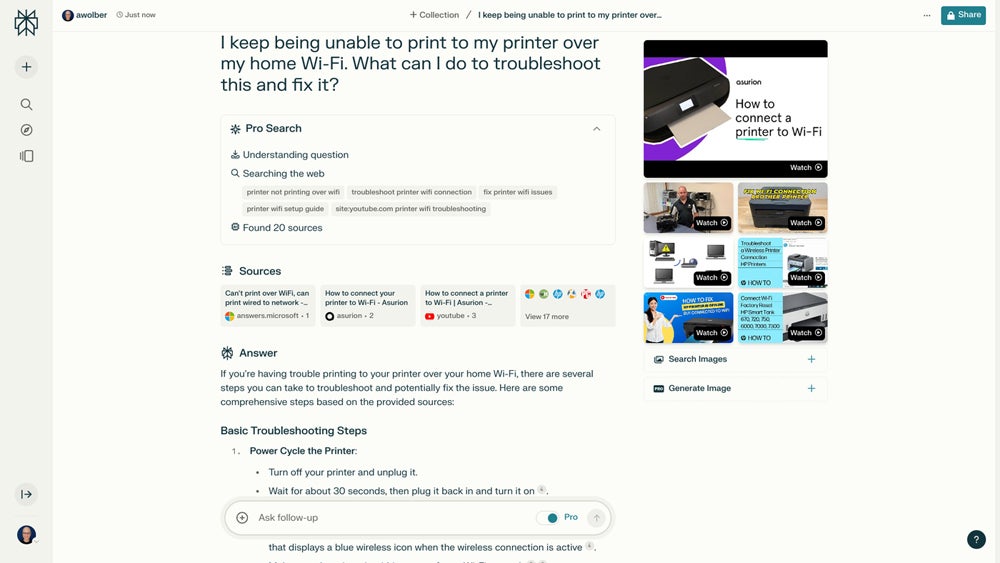
Perplexity leverages AI for every prompt, unlike Google’s AI Overviews. In some cases, especially when a query may be unclear, Perplexity pauses and prompts you for clarification; typically, this allows the system to tune the response to more accurately meet your question. Responses include easy-to-follow reference links to aid the verification of sources.
Perplexity delivers an AI-generated response to every question. Screenshot: Andy Wolber/TechRepublic
A free account includes a limited number of standard and pro searches; selecting the pro option routes to a better AI model, such as GPT-4o rather than GPT-3.5, for example. A paid upgrade to Perplexity Pro offers expanded access to AI systems, such as GPT-4 or Claude Opus. Perplexity is available on the web and in mobile apps.
Kagi Search: Use AI when you need it
Kagi Search promises tracking-free results with no advertising. The system relies on a variety of sources, including its own web and news indexes and Wolfram Alpha. Kagi significantly filters and sorts the data to deliver relevant results.
Kagi provides a Quick Answer generated by an LLM when you specifically select the menu option. Screenshot: Andy Wolber/TechRepublic
Kagi offers three distinct AI-driven services:
Quick Answer: Summarizes a set of search results. This choice is optional and displays as a menu item alongside other filtering and sorting.
Summarizer: Creates a summary from a web link or text.
FastGPT: Serves as a standard AI chatbot but responds to a single query, in contrast to services such as ChatGPT, which support a series of questions and responses.
Kagi Search is free to try for up to 100 searches, with paid plans available for additional usage.
Arc Search: AI-driven mobile search
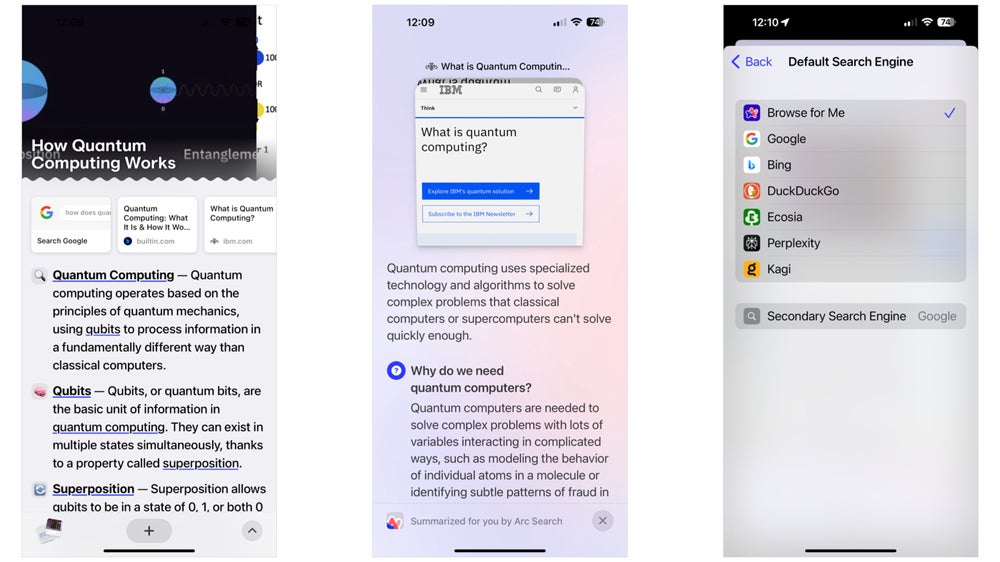
Made by The Browser Company, Arc Search is a search-centric AI-enabled app for iPhone. Arc Search includes these three AI features:
Browse for me: Takes your search terms (or prompt) and leverages AI to craft the response drawn from several pages of search results. This flips the search experience from first opening a successive series of links to then reading results to one of reviewing the results first, then optionally opening links.
Pinch to summarize: In contrast, this feature uses AI to capture the key points found on a single web page.
Raise to call: Lets you speak your search and receive a response read by a synthesized voice.
The Arc Search iPhone app delivers information with relevant links (left), summarizes web page contents (middle) and selectable search service options (right). Screenshots: Andy Wolber/TechRepublic
Additionally, you may set either Kagi or Perplexity (among other options) as the system’s secondary search engine, which otherwise defaults to Google.
Exa: Search for LLMs and people
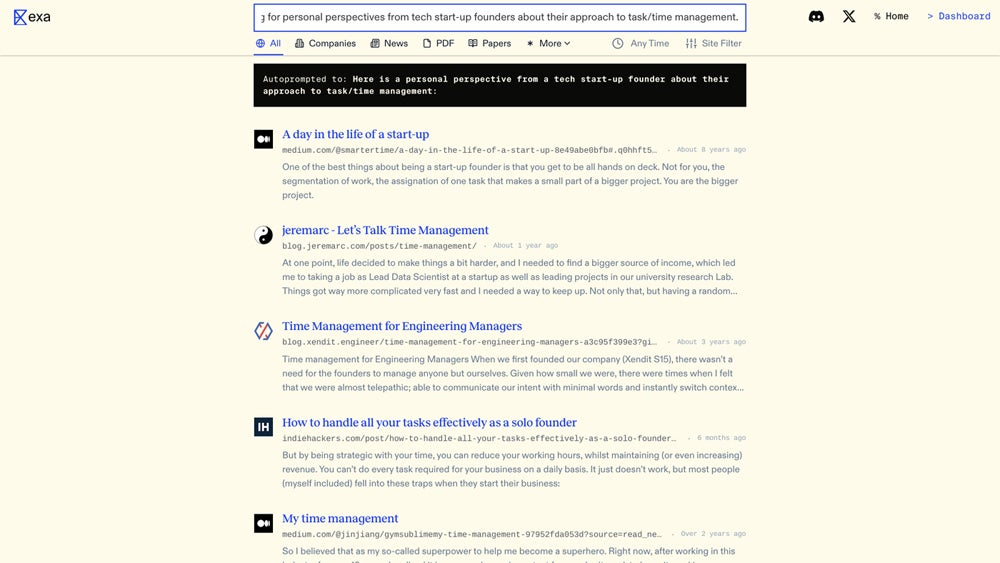
Exa primarily seeks to serve the search needs of AI large language models, yet it also provides a browser interface for people to use. Exa works best when you structure your search as a statement. For example, “Here is how start-up founders approach time management” instead of using either a string of keywords or a question. (A setting can allow the system to automatically restructure your prompt if you enter a question.)
Exa aims to link to content relevant to the concept, not just the keywords, of a prompt. Screenshot: Andy Wolber/TechRepublic
Exa serves up information you might otherwise need to repeatedly review many web pages to obtain. For example, rather than showing users links to listicles, Exa aims to consolidate the content from those lists and link to that instead.
Three more alternatives to standard search
The field of search remains intensely competitive. In addition to the options covered above, contenders include:
Microsoft’s Copilot: Builds on the company’s Bing search engine expertise as a base and offers both free and paid AI search solutions.
Grok: Elon Musk’s X makes Grok available to X Premium or Premium+ subscribers in several countries. Grok is particularly useful when you want a summary of recent, widely discussed posts on X.
Brave Software: Serves up “Answer with AI” in its independent search service, and offers an AI assistant, Leo, with both free and paid versions available, built into the Brave browser.
What search services and apps do you use? Which of the above apps and services do you use often? Are there other AI-driven search systems that you recommend? Mention or message me on X (@awolber) to let me know how AI and LLMs are changing how you search.