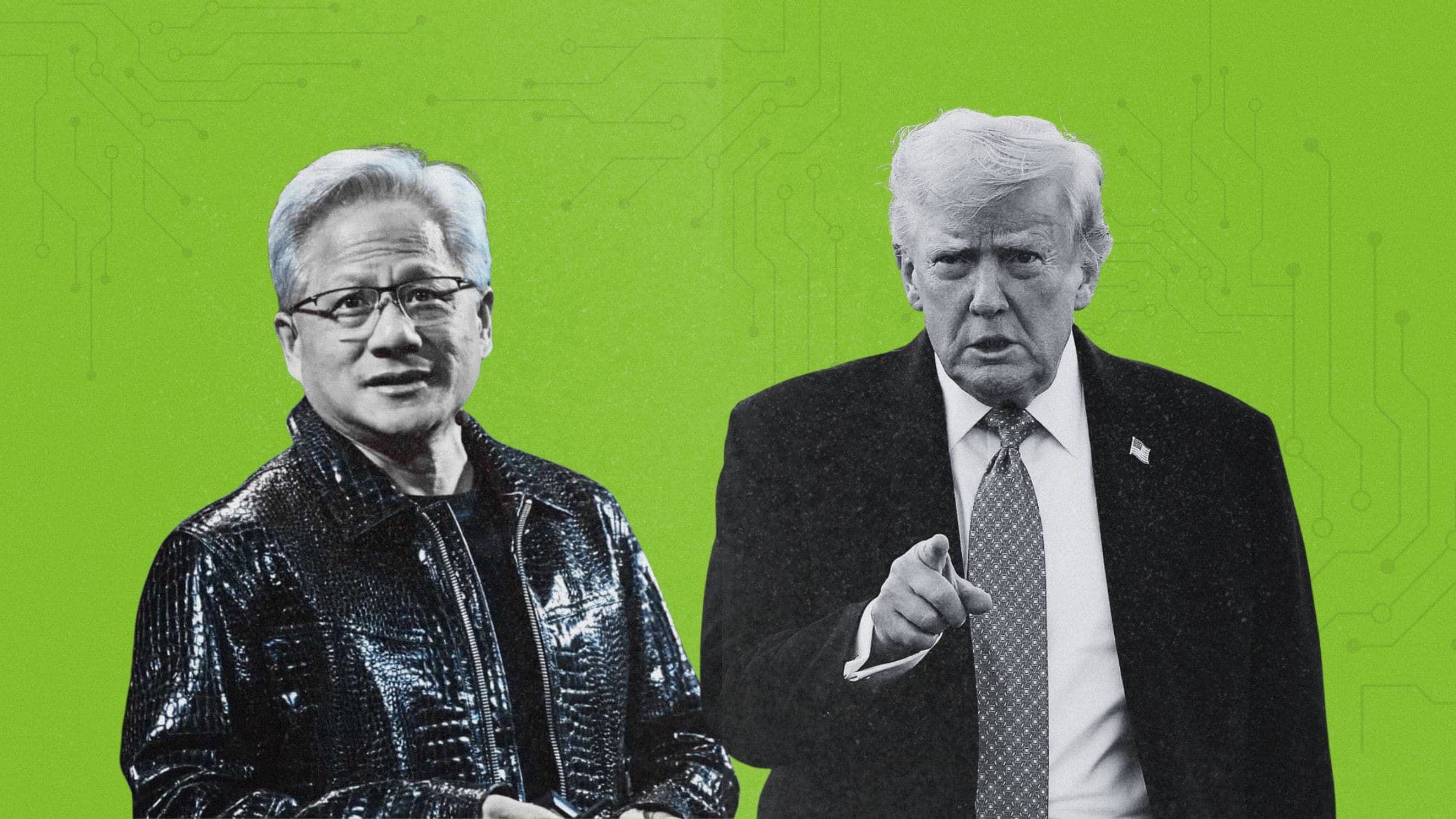
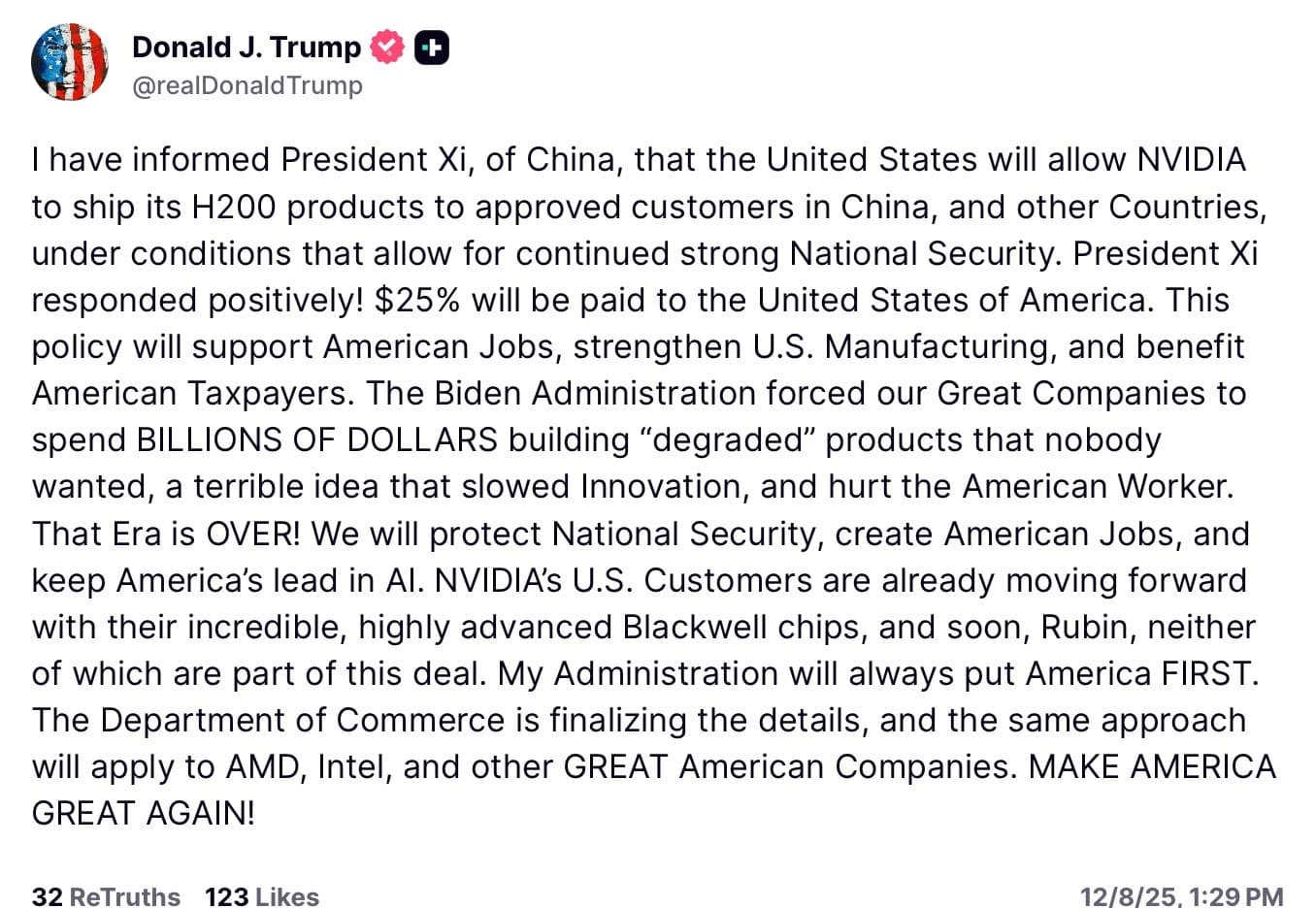
The United States will allow NVIDIA to export its H200 AI chips to China and other countries, under a new arrangement announced by President Donald Trump. The deal stipulates a 25% fee on the sale of the high-performance GPUs.
The H200 chip—considered NVIDIA’s second-most advanced AI processor behind Blackwell GPUs—can now be exported to vetted Chinese customers, contingent on national security safeguards and approval from the US Department of Commerce. Trump said he notified Chinese President Xi Jinping of the decision, and claimed Xi “responded positively.”
The decision comes after weeks of deliberation over export controls and follows a recent meeting between NVIDIA’s chief executive and US officials. Other firms, including AMD and Intel, may become eligible to export their AI chips under similar provisions.
Earlier this year, NVIDIA was authorised to resume shipments of the H20 chips to China, following assurances from the US government that license approvals were underway. AMD, too, secured regulatory approvals to resume shipping its MI308 AI chips to China.
The 25% fee on sales proceeds of H200 chips will be collected as an import tax when they are shipped from manufacturing sites in Taiwan to the United States for inspection, before onward export.
With this, the US avoids exporting its latest chips, such as the Blackwell or NVIDIA’s Rubin-generation processors, while partially reopening access to the Chinese market. The H200 is more powerful than the older H20, previously permitted but ultimately blocked for Chinese buyers.
The Chinese government even introduced incentives such as cheaper power for local AI firms willing to ditch NVIDIA chips and buy from regional players like Huawei. This came after complaints from tech giants like Alibaba, ByteDance and Tencent, which faced higher costs after Beijing restricted access to NVIDIA’s AI chips due to US export controls.
For NVIDIA, Trump’s approval could restore access to a massive market, potentially yielding billions in revenue. The shares of the world’s most valuable company rose about 2% in after-hours trading following the announcement.
However, the deal comes as geopolitical uncertainty continues to govern US-China relations. Even if the US relaxes restrictions, China may refuse to allow imports in the same vein as it previously refused to buy the H20 chips on security grounds. As NVIDIA’s CEO, Jensen Huang, admitted shortly before the policy shift, “We don’t know. We have no clue,” whether Chinese customers will accept the H200 under these terms.
The post NVIDIA Gains US Approval to Export H200 AI Chips to China appeared first on Analytics India Magazine.
Tata Group and Intel announced that they will work together to develop semiconductor and computing capabilities in India. The alliance, formed through a Memorandum of Understanding (MoU), aims to support the expansion of local manufacturing, packaging, and AI compute markets.
The companies will explore how Intel products can be manufactured and packaged at Tata Electronics’ upcoming fab and OSAT facilities. They will also examine how to scale AI PC solutions for India, which is projected to become a top-five global market by 2030.
The collaboration will involve work across consumer and enterprise hardware, advanced packaging, and tailored compute designs. The partners plan to draw on Intel’s AI compute reference designs and Tata Electronics’ manufacturing services, along with Tata Group companies’ access to domestic markets.
N Chandrasekaran, chairman of Tata Sons, said the group is “deeply committed to developing a robust semiconductor industry in India.” He said the alliance would help Tata “drive an expanded technology ecosystem.”
This comes at a time when Tata is actively pushing to build its fabrication facility in Dholera, Gujarat.
Intel CEO Lip-Bu Tan said the company sees a “tremendous opportunity to collaborate with Tata to rapidly scale in one of the world’s fastest-growing compute markets.” He added that India’s rising PC demand and rapid AI adoption offer strong growth potential.
In his post on X, he mentioned looking forward to bolstering the silicon and compute ecosystem in India. “Intel has been in India for nearly 4 decades, and India is a large and growing market for Intel,” he said.
Randhir Thakur, MD and CEO of Tata Electronics, said the MoU aligns with the company’s roadmap and would “enable a reliable and resilient supply chain.” The companies expect their work to strengthen India’s domestic semiconductor ecosystem and support the development of geo-resilient electronics supply chains.
The post Tata, Intel Form Alliance to Build Silicon and Compute Ecosystem in India appeared first on Analytics India Magazine.
A startup’s success has long been dominated by two figures, i.e., funding rounds and valuation multiples. Yet, as the digital landscape matures, a new metric of impact is emerging, particularly in India’s vibrant deep tech and AI sector.
For 2025, the Google for Startups Accelerator programme is not merely fostering growth; it’s engineering a fundamental, strategic shift in how Indian AI startups operate and compete on the global stage. The recently released Accelerator Impact Report paints a comprehensive picture of an ecosystem designed to tackle population-scale challenges while yielding unprecedented economic returns.
The economic impact of the accelerator’s portfolio has been positive. The 257 portfolio startups have achieved a high survival rate of 96%, secured $4.2 billion in post-programme funding, and collectively reached an overall valuation of $11.5 billion. Furthermore, they have spurred job creation, adding 25,900 new positions, and executed 27 exits.
Beyond Funding Metrics
The true measure of the accelerator’s value lies in how it helps startups achieve a demonstrable, strategic, competitive advantage by leveraging the “best of Google”.
As per Farish CV, the regional lead for AI startup programmes in India, “The measurable impact of the accelerator goes beyond standard funding and growth metrics.” The programme strategically categorises success into three key areas, demonstrating a focus on deep integration and operational excellence.
First, startups can optimise proprietary technology and improve cost efficiency by accessing Google AI platforms. Second, they can enhance core business performance and build market credibility through mentorship on their business models, ensuring products are financially successful. Third, there is a focus on precision partnerships and accelerated scaling, providing tailored support to address the specific challenges faced by high-potential startups.
For AI startups, efficiency is the new currency. The programme’s core offering is to enable startups to harness Google’s AI platforms, such as Gemini and Google Cloud, to deliver efficiency gains that provide a direct competitive edge.
SpotDraft provides a prime example of this success, he said. By integrating the Gemini API and utilising the Google Cloud Marketplace, the company achieved massive operational improvements in its AI contract management. The measurable results were significant: costs were reduced by 80%, accuracy increased by 30%, and latency decreased by 70%.
Similarly, in the EdTech space, Entri leveraged Gemini models to develop the ‘AI Teacher Assistant,’ resulting in a 20% increase in retention. Their ‘interview coach’ tool achieved an impressive 86% learner adoption rate and a 70% quiz completion rate.
Rahul Ramesh, co-founder and CTPO of Entri, highlighted the strategic product guidance, noting that “Product experts guided engineering decisions for an Android app, helping us achieve 16 million users and a 4.8 Play Store rating.”
Innovators are also moulding content creation and healthcare. Toonsutra is pioneering Indian-language webcomics, using Lyria and the Gemini model in Vertex AI for dynamic background music and realistic character speech, effectively creating a new frontier in digital storytelling in vernacular languages.
Meanwhile, Cloudphysician is transforming the capture of manual cardiac monitor data with an agentic AI platform that uses the Gemini API for reasoning. Their use of the Cloud Vision API digitises screen data into structured, queryable clinical information for automated analysis, achieving scalable data capture.
The mentorship provided by the programme extends past pure technology, deeply influencing the fundamental business model optimisation to ensure the product not only works technically, but also performs financially in the market.
Kroop AI achieved a strategic milestone by improving customer engagement by 40% and successfully optimising the pricing model for its deepfake detection platform. This strategic move solidified their market positioning and commercial viability. Co-founder and CEO Jyoti Joshi attested to the programme’s ability to build intangible assets, stating that it significantly “enhanced our visibility and credibility in the market”.
Participation in the programme has been a transformative experience for Kroop AI, Joshi said, adding that the mentorship and resources provided have significantly enhanced the startup’s visibility and credibility in the market. “We’ve gained valuable insights into scaling our operations and refining our product offerings.”
The strategic goal is to compress the time-to-market and time-to-scale, making Google “an integral part of their journey” rather than just a vendor.
Madhav Bhagat, co-founder and CTO of SpotDraft, echoed the same sentiments: “Their expert guidance and mentorship on UX, AI integration, and cloud cost optimisation streamlined our product development and helped us scale faster”.
The High-Impact AI Ecosystem
Google has established itself as a committed partner to India’s digital economy. As AI solutions advance, the goal is to develop an ecosystem that is high-impact, deep tech, sustainable, and innovation-focused.
“Our role here is to work with startups to focus on genuine AI solutions that tackle India’s population-scale challenges, such as healthcare accessibility and financial inclusion,” Farish added. He said that their unique approach rests on strategic pillars that provide high-potential startups with specific advantages.
Firstly, startups gain deep access to the “Best of Google”. This means connecting with top experts across over 20 teams, providing support in technology, Go-to-Market (GTM) strategy, and best practices in product, design, and leadership.
Secondly, the programme delivers precision mentorship. This goes beyond generic advice, offering tailored support based on OKRs (Objectives and Key Results), ensuring mentorship addresses specific startup challenges rather than general problems.
Finally, a major focus is placed on AI-First Innovation. This involves actively helping startups adopt and optimise AI, leveraging Google’s cutting-edge AI technology to accelerate their solutions.
A History of Success
The current wave of 2025 AI success builds on a robust history of high-impact portfolio startups that joined the accelerator as small teams.
The 2016 cohort saw the rise of ShareChat, an Indic language social media platform that achieved unicorn status in 2021. More recently, the 2022 cohort included VideoVerse, an AI-powered video editing and content creation platform that was acquired by Minute Media, marking one of the largest media-tech and AI exits in India.
Pioneering deep-tech innovators include Niramai from the 2018 cohort, a startup addressing breast cancer detection with a non-invasive, radiation-free, AI-based solution.
Another standout from the 2022 cohort is BrainSight AI, which focuses on AI-powered neuro-diagnostics and prognostics. This startup was also named one of the Top 100 most promising AI startups worldwide by CB Insights.
In 2025, Google’s commitment goes beyond acceleration; it is an active investment in India’s technological future. By integrating AI and deep tech expertise, the programme is positioning Indian AI startups to lead the next era of global AI innovation.
The post How Google’s Accelerator Programmes Fuel India’s AI-Native Startup Ecosystem appeared first on Analytics India Magazine.
Agentic vibe-coding platform Emergent has received an undisclosed investment from Google’s AI Futures Fund. The company will use the investment to accelerate talent hiring, product development, and global expansion, it said in a statement.
Emergent’s agentic AI platform allows users, especially early-stage startups, to build production-grade applications with autonomous agents, removing the need for developers, capital, or technical co-founders.
The Bengaluru-based company has recorded rapid adoption, crossing 2.5 million users and reaching a $25 million ARR run rate since it launched in July 2025. In September, it raised $23 million in Series A funding, with Lightspeed leading the round, bringing total financing to $30 million.
Speaking on the latest capital infusion, Mukund Jha, co-founder and CEO of Emergent, said, “Not every business founder has the technology expertise or resources to make their dream a reality. With Emergent, we’re giving small business owners, creators, and entrepreneurs the tools to bring their vision to life, no matter the complexity.”
“We’re honoured to be supported by Google’s AI Futures Fund and are excited to leverage Google’s industry-leading AI technology to further empower Emergent for our rapidly growing user base,” he added.
Google’s AI Futures Fund, launched in May 2025, provides AI startups with capital, technical support, and early access to Google’s AI models. The fund recently partnered with Accel to co-invest up to $2 million in early-stage AI startups in 2026.
Jonathan Silber, co-founder and director of the AI Futures Fund at Google, noted the fund aims to enable startups to expand their generative AI capabilities.“Emergent’s work is helping people make their ideas a reality, breaking down barriers, and democratising access to the tools businesses need to build their technology stack. We look forward to supporting them on their journey as they build with Gemini 3, and we can’t wait to see what they do next,” he said in a statement.
Emergent said its platform enables side hustlers, small businesses, and solo founders to build applications without engineering teams.
Co-founder Mukund Jha studied at Columbia Engineering and previously worked at Google. He also earlier co-founded hyperlocal delivery startup Dunzo. His brother, Madhav Jha, worked as an AI scientist at Amazon and later as a machine learning engineer at Dropbox before co-founding Emergent in 2025.
Emergent faces competition from Lovable, Replit, and Rocket.new in the vibe-coding market.
The post Emergent Bags Google’s AI Futures Fund Investment to Expand Agentic Vibe-Coding Platform appeared first on Analytics India Magazine.
Nagarro has become an OpenAI Services Partner and joined its network to push industry-scale adoption of OpenAI tools across Asia Pacific. The company will support enterprises using the OpenAI API and ChatGPT Enterprise.
Nagarro will guide organisations as they explore, implement and scale generative AI. The company says its advisory and engineering teams help enterprises deploy AI responsibly and weave it into core work to raise productivity and long term value.
Rahul Mahajan, global CTO at Nagarro, said, “Our focus is on enabling clients to apply generative AI to real business problems, from automation and decision support to customer experience and operational efficiency, with the structure, governance, and engineering rigor that large organisations require.”
Anthony Russell, APAC partnerships lead at OpenAI, said, “Nagarro has strong experience helping enterprises adopt generative AI solutions built on OpenAI models. As a Services Partner, they support customers in deploying AI responsibly, building internal capability and realising long-term value across a range of industry use cases.”
Nagarro works across retail, financial services, healthcare, manufacturing, logistics and telecom. The company cites strengths in data engineering, AI, automation and enterprise transformation. Its Fluidic Intelligence framework uses AI native engineering to improve workflow and reduce friction.
Nagarro is expanding its AI capability through centres of excellence, research on agentic systems and enterprise enablement programs. Its teams design, test and scale AI systems for large organisations and support responsible rollout across complex environments.
Recently, OpenAI also formed a wide collaboration with Accenture that aims to push enterprise AI deeper into large companies, starting with Accenture’s own workforce. The firm will roll out ChatGPT Enterprise to tens of thousands of its employees, which the company says is the largest group to be upskilled through OpenAI Certifications.
The post Nagarro Ties Up With OpenAI to Drive Enterprise AI Adoption appeared first on Analytics India Magazine.
MachineCon GCC Summit 2025 set the stage for India’s GCC leaders to imagine the next era of work powered by generative AI. From capability building to technology breakthroughs, the conversations pointed to a rapidly evolving future.
To honour those shaping this transformation, AIM presented its GCC Excellence Awards across areas like talent, operations, collaboration and emerging tech. Here’s a rundown of the winners and the breakthroughs that put them on the map. Align Technology Award category: Excellence in Talent Development and Management
Align Technology is the maker of the Invisalign® clear aligner system, iTero introral scanners and services, and exocad CAD/CAM software. Over 27 years, Align has helped doctors treat patients worldwide and built a workforce that drives continuous innovation in digital orthodontics. Its integrated Align Digital Platform powers seamless workflows for clinicians and labs, improving patient outcomes and practice efficiency.
With 2,66,000 doctor customers and a 600-million-strong consumer market opportunity, Align’s talent strategy underpins its global leadership in digital dentistry, scaling expertise across engineering, manufacturing and clinical transformation. Allianz Partners Global Business Solutions (APGBS GSD India) Award Category: Leadership in Sustainability and CSR
Allianz Partners Global Business Solutions India was established in 2021 and now operates from Gurugram SEZ. The centre provides multilingual support across 12 countries, offering services in claims, customer experience, business intelligence, automation, telephony and conversational AI. With a future-ready workforce and an integrated right-shoring strategy, APGBS GSD India functions as a centre of excellence for global operations.
Its commitment to responsible growth, inclusive culture and sustainable service delivery reflects Allianz Partners’ long-term focus on socially conscious, resilient and environmentally aligned business models.
Cargill India Capability Centre Award Category: Best Innovation in Process Optimisation
Since its founding in 2015, Cargill’s India capability centre, operating from Bengaluru and Gurugram, has grown to more than 3,000 employees and transformed from a resource hub into a strategic capability powerhouse. It supports global functions in finance, digital technology, data, logistics, procurement, trade execution and HR. The centre has driven Cargill’s mission of ‘Nourishing the World’ by embedding automation, advanced analytics and modern operating models to accelerate decision-making, improve efficiency and ensure safe, responsible and sustainable operations worldwide.
Carrier Digital Hub India Award Category: Outstanding Contribution to Digital Transformation
Carrier’s Digital Hub India was celebrated for spearheading the company’s global digital reinvention. Established in 2019, the hub has grown into Carrier’s largest digital workforce, connecting operations in India, Mexico and China through the Connected Hubs model. With a 700-member team across AI, data science, IoT, cloud, cybersecurity and digital engineering, it serves as a digital twin to Carrier’s headquarters. The hub drives next-generation platforms like Abound and Lynx, powering intelligent buildings and cold-chain visibility. Through innovation labs, leadership programmes and an expanding AI centre of excellence, Carrier Digital Hub India anchors the company’s shift towards an AI-first future.
Cisco Systems Award Category: Outstanding Contribution to Digital Transformation
As a global technology leader in networking, cybersecurity and cloud infrastructure, Cisco Systems has been rapidly infusing AI and automation across its product ecosystem. Key innovations include Cisco Unified Edge, which brings data centre-grade computing closer to where data is generated, and Cisco IQ, an AI-driven interface that simplifies network management with real-time insights and proactive issue resolution. By integrating advanced automation, predictive analytics and secure architectures, Cisco continues to redefine enterprise
DarioHealth Award Category: Emerging Technology Pioneer
DarioHealth was recognised as an Emerging Technology Pioneer for its global leadership in digital therapeutics and AI-enabled chronic care. Its India global capability centre, founded in 2018 and acquired in 2021, has become the company’s engine for innovation, housing end-to-end R&D and engineering talent. The GCC accelerates product development, strengthens AI-led personalisation and enhances operational agility. By centralising expertise, DarioHealth has improved its ability to scale, integrate acquisitions and reduce operating costs. The company’s multi-condition digital health platform supports millions of users globally, transforming chronic disease management through data-driven insights, behavioural coaching and continuous digital monitoring.
Dentsu Global Services Award Category: Excellence in Talent Development and Management
Dentsu Global Services (DGS) was honoured for its forward-looking talent strategy and its role as a global innovation engine for the Dentsu network. With over 5,600 specialists across digital platforms, performance marketing, product engineering, data science, automation and AI, DGS blends human creativity with advanced technology to deliver scalable, AI-first solutions. The centre drives media and marketing transformation for global clients while fostering a workplace built on diversity, collaboration and continuous learning. As a future-focused talent hub, DGS offers global career pathways, innovation opportunities and a culture designed to help employees contribute to work that shapes the future.
Best Buy Award Category: Best Innovation in Process Optimisation
Best Buy was honoured for innovation in process optimisation through its seamless integration of human expertise and technology. As a global consumer electronics leader, Best Buy connects millions of customers to devices, services and in-home solutions while enhancing efficiency across its retail, digital and logistics operations. The company blends data-driven tools with personal consultation to refine inventory management, streamline omnichannel experiences and elevate customer support. Its focus on sustainability, inclusion and operational excellence has strengthened its competitive edge. Best Buy’s approach ensures that technology is not just a product offering but a catalyst for meaningful, customer-centric transformation.
Pattern Award Category: Excellence in Talent Development and Management
Pattern received recognition for its talent-driven growth and its evolution from a startup, founded in 2013, into a global ecommerce accelerator. Built on trillions of data points and a unique buy-and-sell model that aligns fully with partner brands, Pattern now operates across over 60 marketplaces with 1,800 experts globally. Its Pune office, launched in 2021, has become the company’s HQ2—an innovation and talent hub powering technology development, marketplace optimisation and global operations. With strong investment in skills, data science and digital commerce capabilities, Pattern continues to scale rapidly, enabling brands worldwide to grow profitably.
Warner Bros. Discovery Award Category: Outstanding Contribution to Digital Transformation
Warner Bros. Discovery was recognised for its sweeping digital transformation across its vast entertainment portfolio. As a global content powerhouse spanning television, streaming, film, gaming and factual entertainment, the company has expanded its use of digital platforms, data insights and AI-driven workflows to modernise production, distribution and audience engagement. Through brands such as HBO, CNN, Discovery Channel, DC, Eurosport and Warner Bros. Pictures, the organisation is reimagining content delivery for the streaming age. Its innovation-led approach supports scalable operations, richer viewer experiences and a future-ready digital ecosystem that strengthens one of the world’s most influential media companies.
The post Presenting the Winners of the GCC Excellence Awards 2025 appeared first on Analytics India Magazine.
Amazon Web Services (AWS) sees India as a very important market and is deepening its commitment by scaling partnerships, expanding Marketplace access, and training local talent.
The company announced plans to expand the use of AI across the country by 2030, aligning with the Government of India’s AI Mission. Amazon India said it is on track to invest $12.7 billion in local cloud and AI infrastructure, which will support more than 15 million small businesses through its various businesses.
On the sidelines of AWS re:Invent 2025 in Las Vegas, Praveen Sridhar, who oversees partnerships for AWS in India and South Asia, told AIM how the cloud giant is adding more partners, helping more companies adopt AI, and expanding into tier-2 and tier-3 cities.
He said the company wants to make its technology useful for businesses and easy for people to access across India. “Our customers want solutions. They want innovation to translate into business outcomes,” Sridhar added.
Building Business Outcomes Through Partnerships
The cloud giant recently launched AWS India Marketplace, which allows customers to transact in INR and simplifies procurement.
Customers can discover, purchase, and deploy software, data products, and services from India-based vendors directly in Indian Rupees, which is especially helpful for small and medium-sized businesses (SMBs).
Marketplace now offers over 30,000 transactable products worldwide, spanning more than 70 software categories, including security, agentic AI tools, DevOps, and data and analytics.
“This is extremely important for SMBs who don’t want to spend significant time procuring. They need a solution, they want to go and buy it,” said Sridhar. He further explained that AWS has made the Marketplace fully tax-compliant, so buyers and sellers don’t have to deal with any extra tax-related steps.
At launch, 37 partners listed 43 solutions on the India Marketplace, including offerings from Deloitte, CrowdStrike and Salesforce. “We are now able to bring the best of global technology to India through the Marketplace,” Sridhar said.
Companies such as Swiggy, Tata Consultancy Services (TCS), and Observe.AI are already using the service.
Moreover, to accelerate AI deployments among enterprises, Sridhar said AWS has introduced the GenAI Competency Partners to help enterprises gain credibility, resources, and expertise.
These are members validated for their technical proficiency and proven customer success in implementing generative AI solutions.“GenAI competency partners have been able to take 30% faster AI use cases to production than non-competency partners,” Sridhar said.
For instance, ShellKode, a GenAI and data-driven solutions provider, entered into a multi-year strategic collaboration agreement (SCA) with AWS to speed up the adoption of Generative AI and Agentic AI across India.
Under this collaboration, ShellKode uses AWS tools such as Amazon Bedrock and Bedrock Agents to support enterprises in sectors like financial services, retail, logistics, and healthcare as they scale GenAI adoption and develop industry-specific AI agents.
“ShellKode has actually built AI agents and digital twins which help companies create a digital copy of their entire physical environment,” said Sridhar. The company has already deployed agentic AI solutions for organisations, including Metropolis Healthcare Limited, XpressBees, and 1Pharmacy Network.
Deloitte is also working with AWS as a GenAI Competency Partner.
Further on the innovation side, Sridhar added that new offerings such as Frontier agents, Nova Forge, and advanced chips like Tranium and Inferentia further support AI scalability and cost efficiency. “Scaling requires the ROI to work out. Our innovations in chipsets help make that real,” he said.
Besides that, Sridhar also mentioned that the new frontier agents launched by AWS will increase developers’ productivity.
Betting Big on India
AWS has committed to investing in cloud and AI infrastructure projects in Mumbai and Hyderabad. “This needs to be backed with the talent that can utilise all that innovation,” Sridhar said, adding that AWS has trained 6.2 million people in India so far.
Amazon also committed to bringing AI literacy and career awareness to four million students in government schools by 2030 through curriculum support, hands-on learning and teacher training.
At the same time, AWS’ partner network is pushing its services further into smaller cities. Distributors such as Redington, Ingram Micro Cloud and Crayon are helping drive this regional expansion. Meanwhile, examples like Workmates in Kolkata show that strong regional hubs are beginning to emerge.
Amazon has also introduced several AI-led improvements for small businesses, including improvements to its Seller Assistant, which now uses agentic AI to understand business context and analyse goals.
The company said the Next Generation Seller Central interface will help sellers make decisions faster, while GenAI tools for listings allow sellers to create product descriptions in minutes using short text, images or website URLs.
Creative tools such as Creative Studio and Video Generator are being expanded to support advertising and video creation for businesses of all sizes.
Moreover, Sridhar said AWS Local Zones in cities like Bengaluru, Kolkata and Delhi are bringing low-latency compute closer to customers, supporting use cases in manufacturing, IoT and real-time applications.
Together, these investments and initiatives reflect AWS’s broader strategy to build local capability while helping more businesses across India to adopt cloud and AI technologies.
The post Why AWS is Betting Big on Bharat appeared first on Analytics India Magazine.
The Data Engineering Summit 2026 arrives on May 14 and 15 in Bengaluru at a time when enterprises are rebuilding their data foundations to match the speed of AI adoption. The summit, in its fifth edition, has become a critical meeting point for engineers, architects and leaders shaping large scale systems. Attendance is expected to cross one thousand participants, supported by more than fifty speakers who are known for building real production frameworks inside global organisations.
The summit captures how DataOps is shifting from basic orchestration into a strategic discipline. Real time pipelines are now a requirement. Data as a product and data mesh are becoming standard. Streaming technologies like Apache Kafka are moving from edge cases into core architecture. These changes reflect the daily reality inside engineering teams and the summit brings these conversations into one place.
Generative AI is forcing enterprises to rethink their entire data stack. Model quality is directly tied to data trust. Pipeline architecture must support continuous learning. Schema design and access layers have become part of the business value chain. Engineering teams that manage to harmonise these components are finding ways to unlock new growth. The summit highlights these patterns through technical sessions, case studies and engineering deep dives.
Foundational models demand strong semantic structures. Data fabrics require unified metadata and governance. Probabilistic design forces engineers to rethink how systems manage noise. Companies are rebuilding lakes and warehouses with more attention to operational efficiency because inefficiency compounds at scale. The summit creates a space for engineers to compare frameworks and understand what leading teams are deploying today.
The Finkelstein Awards for Data Engineering Excellence will be hosted during the summit. Nominations for the 2026 edition are now open. These awards recognise engineering teams and leaders who have pushed the boundaries of scale, reliability and innovation. With a rigorous evaluation process led by AIM Research and industry experts, the awards night has become an important recognition platform for the community.
The 2025 edition saw participation from leaders such as Anil Kumble, Sandip Didwania, Hareesh Ravuri, Maulik Dixit, Natarajan Ramamurthy, Vikas C Sajjan, Anirban Roy and Jayesh Asrani. Their sessions focused on architecture, deployment patterns and frameworks that support AI at scale. The 2026 lineup follows the same spirit of technical depth and operational experience.
Sponsor DES 2026
Data Engineering Summit 2026 offers a high value platform for brands building tools, infrastructure and solutions for the data ecosystem. With an audience mix that includes VPs, directors, C level leaders and managers, sponsors gain access to decision makers who influence roadmaps and budgets for data platforms. The exhibition area enables product demos, live interactions and hands on discovery. Speaking opportunities help brands establish credibility with practitioners. The summit also includes features such as hackathons, roundtables, one on one conversations, an afterparty and fringe forums that enhance networking. Pre and post event promotions extend visibility beyond the summit. Past sponsors have called DES an environment where meaningful conversations and real demand emerge.
The Data Engineering Summit 2026 brings together the people who build the infrastructure behind every AI system. Engineers, architects, CTOs and platform leaders come to DES for clarity, depth and practical insights. The future of enterprise data belongs to teams that understand both the complexity of data and the velocity of AI. DES creates the environment where these teams can learn, compare and advance together. May 14 and 15 in Bengaluru will mark the next chapter of this journey.
India fluttered a few feathers when it launched the ambitious IndiaAI Mission on March 7, 2024 – two months after China’s AI chatbot DeepSeek-R1 was launched. A knee-jerk reaction or a well-thought-out strategy, it’s hard to tell. But most experts called it the much-needed nudge for the Indian administration to give the country an AI edge.
Despite the ₹10,372-crore IndiaAI Mission significantly boosting national compute capacity, the country still faces capital limitations and a shortage of deep, high-end AI research needed to compete with global leaders. Experts, too, have repeatedly raised concerns over the actual impact of the mission. Yet the government maintains that a homegrown DeepSeek-class model is within reach, citing its rapid distribution of thousands of top-tier chips to startups, universities, and researchers — aimed at enabling a breakthrough model in under 10 months.
According to Stanford HAI’s Global AI Vibrancy Index, which ranks countries on metrics such as patents, funding, policy and research, India lags far behind the US and China in many key areas. Both China and the US already have a four to five-year head-start, having made heavy investments in research and academia and developed AI for military applications, law enforcement and homegrown large language models (LLMs).
Plus, India’s AI mission is worth a trifling $1bn compared with the staggering $500bn the US has earmarked for Stargate—a plan to build massive AI infrastructure in the US, or China’s reported $137bn initiative to become an AI hub by 2030.
In such a scenario, how fast the country gets its own LLM is a question everyone seeks an answer to.
Not Quite Enough
While the GPU capacity is secured with the Mission already pooling 34,000 GPUs of the planned 38,000 GPUs, the actual usage of these high-end machines has been slow to take off. Excluding the handful of startups developing foundational models, there is a noted lack of large-scale, high-end research projects that require continuous use of massive GPU clusters. This indicates a mismatch between the infrastructure now being deployed and the research community’s ability to leverage it effectively.
Raising serious concerns about various aspects of the mission, serial entrepreneur K Ganesh, who is also the promoter of Bigbasket, Bluestone, Homelane, and Portea Medical, said that so far, none of the programs of IndiaAI Mission have shown results. “There haven’t been any models produced from GPUs from the grants. Almost all of the grants are purely computational. Hence, [I] do not see any impact yet.”
He agreed that while the GPU capacity is secure, the actual usage of these machines has been slow to take off, “because many GPU providers are new datacentres still facing teething issues.” According to Ganesh, GPU compute is only one piece of the puzzle. For India to reach a globally competitive level, the country’s top players will need to raise their game across talent, operational maturity, and risk appetite, he said.
Challenges remain, particularly in achieving population-scale AI adoption and developing indigenous LLMs, said Anurag Dua, partner, government and public sector, EY India. “Above all, a focused and coordinated R&D effort, backed by adequate funding, is essential to spur innovation and create affordable technologies capable of scaling across India,” he added.
Dua advised that in the long run, a balanced approach, consisting of industry-led innovation and government-led adoption for the public good, would be the right approach to help achieve the economic and social objectives.
Another area where the mission has struggled to make progress is closing the AI talent gap. A 2024 Deloitte-Nasscom report, while declaring that India is positioned to become a global AI powerhouse by 2030, states, “However, to truly harness this potential, the focus must shift towards not just quantity but the quality of AI talent. By reskilling the existing workforce and fostering new talent through robust government-academia-industry collaboration, we can ensure a steady pipeline of professionals ready to lead AI-driven innovation.”
The Talent Tussle
Despite initiatives to broaden AI education in India, a substantial skills gap remains, with only a small portion of the workforce trained in advanced AI. Low broadband penetration in rural India further widens this divide, limiting both the reach and equitable adoption of AI solutions nationwide.
Considering the talent gap, the IndiaAI Mission launched the FutureSkills pillar to expand AI education at multiple levels. The initiative has reportedly enrolled about 8.6 lakh candidates in AI and related skilling/training programmes. There’s also a plan to build 570 AI & data labs in non-metros to decentralise education and AI infrastructure. However, there’s no official figure as to the completion of these labs.
Shortage of deep‑AI researchers, PhD programs, and high-level mentorship persists outside elite institutions. Abhishek Upperwal, CEO and founder atSoket.AI, one of the startups selected by the IndiaAI mission to build LLMs, said, “There are very few people in India with firsthand experience building 100-billion or trillion-parameter models. Most of those experts are abroad, and we can’t realistically expect access to them for developing our own LLMs. What we can do is build capacity step by step.” He suggested that a researcher who has experience training a 1-billion-parameter model and understands language modelling can, over time, figure out how to scale to 100-billion-parameter systems.
“Even in my own team, no one has built a 100-billion-parameter model before. We began with a 1-billion model, we’re currently working on a 7-billion model, will move next to a 40-billion model, and eventually graduate to 100 billion,” Upperwal said.
Experts have also raised concerns over the absence of a dedicated, comprehensive AI-specific data protection law, raising questions about how the mission will ensure the ethical and secure use of large, sensitive datasets being developed under the AIKosha platform. Though the DPDP Rules, 2025, were notified on November 14, bringing the framework to life, it is said to be less stringent and comprehensive compared to “gold standard” regulations like the European Union’s General Data Protection Regulation (GDPR). Critics debate its effectiveness due to broad government exemptions and a less independent regulatory body.
The Story So Far
Apart from onboarding 12 startups across two phases and enabling their access to compute, datasets, and incubation support, the IndiaAI Mission has also carried out several early groundwork initiatives.
It has acquired 34,000 GPUs, empanelled service providers to host and manage the hardware, rolled out data/AI labs, training programmes, and fellowships to grow AI talent nationwide. The AIKosha platform — one of the seven pillars of the mission — has been made operational, providing researchers access to datasets and models.
Work on tools, frameworks, and oversight mechanisms for responsible AI deployment have begun, though details are not out in public yet.
While the intent of the Mission seems to be in the right place, the lack of a pan-India strategy, resource allocation, and timely innovations may prove to be a dampener in achieving the overall impact.
“Because something of this scale and type is being tried for the first time, the processes weren’t known to anyone. Initially, there was a lot of confusion. I hope things get better and smoother with time,” Upperwal said.IndiaAI Mission did not respond to AIM’s queries until the time of publishing.
The post A Year Later, Is IndiaAI Mission Delivering Enough? appeared first on Analytics India Magazine.
Elon Musk’s satellite-internet venture Starlink has finally revealed the pricing for its residential plan in India, signalling that the long-awaited commercial rollout is now imminent. The company has updated the Starlink India website to list a monthly subscription fee of ₹8,600 (250 Mbps), in addition to hardware costing ₹34,000, for its Residential tier.
The service promises unlimited data, a 30-day trial, and 99.9% uptime, with Starlink claiming users will experience disruption-free connectivity even in adverse weather conditions. The company, which received a five-year licence from India’s Department of Telecommunications (DoT) in July, is positioning itself as a connectivity solution for remote and underserved regions of the country.
Starlink’s India push also comes with an operational expansion. In late October, SpaceX began hiring for its Bengaluru office, posting roles such as payments manager, accounting manager, senior treasury analyst and tax manager. Additionally, reports indicate Starlink plans to set up gateway earth stations across several Indian cities, including Chandigarh, Hyderabad, Kolkata, Lucknow, Mumbai and Noida. These ground stations will relay signals between satellites and user terminals on the ground, enabling stable, low-latency connections.
India vs US: How the Pricing Compares
In the United States, Starlink currently charges $80 per month (250 MBPS) for residential service, roughly ₹7,200 at current exchange rates. Hardware in the US costs $599 (about ₹50,000).
This indicates Starlink’s monthly subscription in the US is slightly cheaper than in India. However, the hardware cost in India (₹34,000) is significantly lower than the US price, a gap that may help boost adoption in price-sensitive markets. Still, relative to average household income, Starlink remains a premium service in India, likely aimed at users in remote geographies with limited broadband alternatives rather than urban customers with cheaper fibre options.
Awaiting Business Plan Details
While the residential plan is now listed, Starlink has not yet revealed the pricing for its business tier, which generally offers higher speeds and priority connectivity, and is expected to cost substantially more. The company is likely to announce those details closer to the commercial rollout.
With more than 10,000 satellites launched globally, Starlink continues expanding its constellation and footprint. India, with its vast rural connectivity gaps, represents a significant market — and the pricing signals that SpaceX is ready to compete.
The post Starlink Sets India Residential Subscription at ₹8,600 Per Month Ahead of Launch appeared first on Analytics India Magazine.




 introral scanners and services, and exocad