

How Gradient-Boosting is Quietly Powering India’s Research Push

In its push to meet ambitious sustainable development goals, from ensuring access to clean water and building resilient infrastructure to protecting biodiversity, India is increasingly turning to data and artificial intelligence.

However, the spotlight is not on conversational or generative models. As climate pressures intensify, researchers require AI systems that can interpret environmental data responsibly, without demanding supercomputer-scale resources or relying on opaque logic. This is where gradient-boosting models are gaining traction.

These models are quietly powering analyses across hydrology, ecology, geology, agriculture and urban planning. They work particularly well with real-world environmental data, offer transparent explanations, and run efficiently on standard research hardware. This approach resonates not only in India but also across the broader BRICS scientific community, where researchers prioritise open, interpretable tools designed to address practical challenges.

One notable example is CatBoost, the open-source gradient-boosting library developed at Yandex. Its ability to handle tabular environmental data, from pollution categories to terrain labels, has made it useful for Indian research groups studying river contamination, slope stability and carbon storage. Instead of spending weeks cleaning datasets, scientists can focus on identifying patterns and communicating evidence to policymakers.

In sustainability research, where predictions must be traceable and defensible, efficiency matters as much as accuracy.

Across Indian laboratories, boosting models are not substituting scientific judgement. Instead, they help researchers turn messy environmental data into reliable insights. This article examines how these methods are shaping India’s research landscape, the practical benefits they offer, and how they support the country’s sustainability mission.

What Is Gradient Boosting

Gradient boosting is a machine-learning method that builds a sequence of models, with each new model correcting the errors of the previous one.

Unlike large neural networks that require significant computing resources, gradient boosting can run on standard laboratory machines while still delivering accurate and explainable results. This makes it a practical choice for scientific and sustainability research.

Researchers can identify the factors influencing predictions, for example, why a model forecast pollution in a specific river stretch or flagged a slope as potentially unstable. This interpretability makes boosting methods well-suited for environmental, social and governance (ESG) research, where traceability, reproducibility and transparent assumptions are essential.

CatBoost offers an additional advantage. It can handle categorical features such as land-use labels, crop classifications and pollutant codes without extensive preprocessing. This removes a significant portion of the manual work that scientists would otherwise need to perform.

Given that categorisation is often where environmental datasets become inconsistent or messy, reducing this burden lowers the barrier to scientific modelling. In doing so, CatBoost reflects a broader BRICS approach to innovation — developing practical tools to address real-world problems such as floods, pollution, urban expansion, and biodiversity loss.

How India Is Using Boosting for Environmental Research

India has no shortage of data on flooding, pollution, slope failures and urban impacts. The challenge lies in converting that information into decisions that protect people and ecosystems.

Below are three examples showing how researchers are applying boosting methods to issues central to India’s development and sustainability agenda.

India’s rivers face a dual challenge: unpredictable monsoons and widespread pollution. Monitoring and predicting water quality is a classic “messy data” problem, involving numerous interacting physical, chemical and biological factors, high spatial variation and firm seasonal shifts. Gradient-boosting models are well-suited to convert such complex datasets into actionable insights.

Researchers working in the Godavari River Basin have applied boosting algorithms to downscale global climate models to produce regional rainfall and temperature projections. This has led to more accurate flood forecasts and improved irrigation planning, according to a study published in the Journal of Hydrology: Regional Studies in 2025.

Water-quality researchers have also adopted these techniques. A study published in Scientific Reports in 2025 used a stacked ensemble of models, including CatBoost and XGBoost, to predict the Water Quality Index (WQI) across major Indian rivers between 2005 and 2014.

The models achieved strong predictive accuracy, with an R² value of around 0.995. This enabled researchers to prioritise sampling locations and detect emerging pollution hotspots earlier than would be possible with traditional laboratory testing alone.

The combination of predictive performance and transparency supports better water-risk management, faster identification of contamination zones and more decisive regulatory action.

Civil Engineering

As cities expand into steep and geologically fragile terrain, India faces a rising risk of landslides and slope failures, particularly during the monsoon season. Boosting models are helping engineers anticipate and mitigate these risks.

Although a recent CatBoost-based slope-stability study was conducted outside India, the methodology closely mirrors the challenges found across the Himalayas, the Western Ghats and other vulnerable regions.

Published in Scientific Reports in 2024, the study demonstrated that CatBoost could generate early warnings of potential landslides by learning from soil properties, terrain features and rainfall patterns. Indian researchers are now exploring similar approaches for local conditions.

Such predictive modelling allows planners to reinforce slopes, design safer highways and integrate risk-aware decisions into urban development, shifting engineering practices from reactive mitigation to proactive safety.

Ecology and Sustainability

Tracking forest growth, biomass and carbon sequestration is central to India’s biodiversity and climate-action goals. Gradient-boosting models are increasingly used to combine satellite imagery with field measurements to estimate ecosystem productivity.

A 2025 Scientific Reports study from China showed that CatBoost could estimate gross primary productivity (GPP) with high accuracy using multisource satellite data and environmental variables, achieving an R² value of 0.890.

While the research focused on Shanxi province, the modelling approach — combining vegetation indices, climate data and boosting algorithms — closely aligns with the challenges faced by India’s forest-monitoring and carbon-mapping programmes.

By translating diverse ecological datasets into practical guidance, boosting models can help Indian researchers identify restoration priorities, monitor changes in carbon sinks and support evidence-based conservation policies more efficiently than traditional methods.

Why Gradient Boosting Matters for India’s ESG Goals

Meeting India’s sustainability targets — including net-zero emissions by 2070, ecosystem restoration, clean water access, resilient infrastructure and biodiversity protection — requires solutions that are effective, affordable and transparent.

Gradient-boosting models, particularly tools such as CatBoost, align closely with these needs.

They work well with heterogeneous scientific data, including soil types, rainfall categories and land-use classes. They require significantly less computing power than deep-learning models for tabular datasets, making them accessible to universities and research labs with limited resources. Their interpretable outputs allow scientists to validate findings rather than relying on black-box predictions.

Importantly, these models also enable closer collaboration between domain experts, data scientists and policymakers, allowing AI tools to be co-designed and directly integrated into planning systems.

In short, gradient boosting makes applied AI practical, scalable and trustworthy — qualities essential for advancing India’s sustainability mission.

Gradient boosting may never command the attention of generative AI models, but its impact on real-world challenges is substantial. In India, these methods are helping to support cleaner rivers, safer infrastructure, more innovative water management, and healthier forests.

CatBoost and similar tools demonstrate that “AI for good” does not require massive models or vast computing resources. Instead, it often depends on efficient, open-source systems that scientists and policymakers can deploy, audit and trust.

As India accelerates its sustainability and infrastructure ambitions, gradient boosting, supported by an expanding open-data ecosystem, is quietly powering a green research revolution.

The post How Gradient-Boosting is Quietly Powering India’s Research Push appeared first on Analytics India Magazine.

How Gradient-Boosting is Quietly Powering India’s Research Push

In its push to meet ambitious sustainable development goals, from ensuring access to clean water and building resilient infrastructure to protecting biodiversity, India is increasingly turning to data and artificial intelligence.

However, the spotlight is not on conversational or generative models. As climate pressures intensify, researchers require AI systems that can interpret environmental data responsibly, without demanding supercomputer-scale resources or relying on opaque logic. This is where gradient-boosting models are gaining traction.

These models are quietly powering analyses across hydrology, ecology, geology, agriculture and urban planning. They work particularly well with real-world environmental data, offer transparent explanations, and run efficiently on standard research hardware. This approach resonates not only in India but also across the broader BRICS scientific community, where researchers prioritise open, interpretable tools designed to address practical challenges.

One notable example is CatBoost, the open-source gradient-boosting library developed at Yandex. Its ability to handle tabular environmental data, from pollution categories to terrain labels, has made it useful for Indian research groups studying river contamination, slope stability and carbon storage. Instead of spending weeks cleaning datasets, scientists can focus on identifying patterns and communicating evidence to policymakers.

In sustainability research, where predictions must be traceable and defensible, efficiency matters as much as accuracy.

Across Indian laboratories, boosting models are not substituting scientific judgement. Instead, they help researchers turn messy environmental data into reliable insights. This article examines how these methods are shaping India’s research landscape, the practical benefits they offer, and how they support the country’s sustainability mission.

What Is Gradient Boosting

Gradient boosting is a machine-learning method that builds a sequence of models, with each new model correcting the errors of the previous one.

Unlike large neural networks that require significant computing resources, gradient boosting can run on standard laboratory machines while still delivering accurate and explainable results. This makes it a practical choice for scientific and sustainability research.

Researchers can identify the factors influencing predictions, for example, why a model forecast pollution in a specific river stretch or flagged a slope as potentially unstable. This interpretability makes boosting methods well-suited for environmental, social and governance (ESG) research, where traceability, reproducibility and transparent assumptions are essential.

CatBoost offers an additional advantage. It can handle categorical features such as land-use labels, crop classifications and pollutant codes without extensive preprocessing. This removes a significant portion of the manual work that scientists would otherwise need to perform.

Given that categorisation is often where environmental datasets become inconsistent or messy, reducing this burden lowers the barrier to scientific modelling. In doing so, CatBoost reflects a broader BRICS approach to innovation — developing practical tools to address real-world problems such as floods, pollution, urban expansion, and biodiversity loss.

How India Is Using Boosting for Environmental Research

India has no shortage of data on flooding, pollution, slope failures and urban impacts. The challenge lies in converting that information into decisions that protect people and ecosystems.

Below are three examples showing how researchers are applying boosting methods to issues central to India’s development and sustainability agenda.

India’s rivers face a dual challenge: unpredictable monsoons and widespread pollution. Monitoring and predicting water quality is a classic “messy data” problem, involving numerous interacting physical, chemical and biological factors, high spatial variation and firm seasonal shifts. Gradient-boosting models are well-suited to convert such complex datasets into actionable insights.

Researchers working in the Godavari River Basin have applied boosting algorithms to downscale global climate models to produce regional rainfall and temperature projections. This has led to more accurate flood forecasts and improved irrigation planning, according to a study published in the Journal of Hydrology: Regional Studies in 2025.

Water-quality researchers have also adopted these techniques. A study published in Scientific Reports in 2025 used a stacked ensemble of models, including CatBoost and XGBoost, to predict the Water Quality Index (WQI) across major Indian rivers between 2005 and 2014.

The models achieved strong predictive accuracy, with an R² value of around 0.995. This enabled researchers to prioritise sampling locations and detect emerging pollution hotspots earlier than would be possible with traditional laboratory testing alone.

The combination of predictive performance and transparency supports better water-risk management, faster identification of contamination zones and more decisive regulatory action.

Civil Engineering

As cities expand into steep and geologically fragile terrain, India faces a rising risk of landslides and slope failures, particularly during the monsoon season. Boosting models are helping engineers anticipate and mitigate these risks.

Although a recent CatBoost-based slope-stability study was conducted outside India, the methodology closely mirrors the challenges found across the Himalayas, the Western Ghats and other vulnerable regions.

Published in Scientific Reports in 2024, the study demonstrated that CatBoost could generate early warnings of potential landslides by learning from soil properties, terrain features and rainfall patterns. Indian researchers are now exploring similar approaches for local conditions.

Such predictive modelling allows planners to reinforce slopes, design safer highways and integrate risk-aware decisions into urban development, shifting engineering practices from reactive mitigation to proactive safety.

Ecology and Sustainability

Tracking forest growth, biomass and carbon sequestration is central to India’s biodiversity and climate-action goals. Gradient-boosting models are increasingly used to combine satellite imagery with field measurements to estimate ecosystem productivity.

A 2025 Scientific Reports study from China showed that CatBoost could estimate gross primary productivity (GPP) with high accuracy using multisource satellite data and environmental variables, achieving an R² value of 0.890.

While the research focused on Shanxi province, the modelling approach — combining vegetation indices, climate data and boosting algorithms — closely aligns with the challenges faced by India’s forest-monitoring and carbon-mapping programmes.

By translating diverse ecological datasets into practical guidance, boosting models can help Indian researchers identify restoration priorities, monitor changes in carbon sinks and support evidence-based conservation policies more efficiently than traditional methods.

Why Gradient Boosting Matters for India’s ESG Goals

Meeting India’s sustainability targets — including net-zero emissions by 2070, ecosystem restoration, clean water access, resilient infrastructure and biodiversity protection — requires solutions that are effective, affordable and transparent.

Gradient-boosting models, particularly tools such as CatBoost, align closely with these needs.

They work well with heterogeneous scientific data, including soil types, rainfall categories and land-use classes. They require significantly less computing power than deep-learning models for tabular datasets, making them accessible to universities and research labs with limited resources. Their interpretable outputs allow scientists to validate findings rather than relying on black-box predictions.

Importantly, these models also enable closer collaboration between domain experts, data scientists and policymakers, allowing AI tools to be co-designed and directly integrated into planning systems.

In short, gradient boosting makes applied AI practical, scalable and trustworthy — qualities essential for advancing India’s sustainability mission.

Gradient boosting may never command the attention of generative AI models, but its impact on real-world challenges is substantial. In India, these methods are helping to support cleaner rivers, safer infrastructure, more innovative water management, and healthier forests.

CatBoost and similar tools demonstrate that “AI for good” does not require massive models or vast computing resources. Instead, it often depends on efficient, open-source systems that scientists and policymakers can deploy, audit and trust.

As India accelerates its sustainability and infrastructure ambitions, gradient boosting, supported by an expanding open-data ecosystem, is quietly powering a green research revolution.

The post How Gradient-Boosting is Quietly Powering India’s Research Push appeared first on Analytics India Magazine.

How Do You Price the GPU Boom?

High demand, tight supply, and abundant capital have made GPUs one of the most sought-after resources in the AI economy, making them the “new oil” after data and rare earth magnets.

But if rare earth magnets and their constituent elements can have a price index, why not compute?

Price indices help consumers, businesses, and investors compare performance and measure shifts in purchasing power, which is especially necessary for GPUs given their volatile pricing.

While some AI benchmarks measure how fast GPUs run or how efficiently they train models, Silicon Data is laser-focused on the financials—what the market actually pays for compute.

The US company publishes daily GPU pricing indices for different GPU variants based on rental and transaction data from cloud providers, colocation facilities, brokered cluster sales, and private rental platforms.

Building a Price Index for Compute

The index currently maps the hourly rental price for a GPU across a broad range of timelines.

“Think about S&P 500, think about crude oil futures. We provide GPU future indices,” Carmen Li, founder and CEO of Silicon Data, told AIM.

Prices are normalised for hardware configuration, rental terms, performance characteristics, and geography.

The index is available on platforms including Bloomberg and Refinitiv, placing GPU pricing alongside other financial reference data and making it accessible to buyers, operators, and financial institutions.

Li pointed to oil markets as an example of how a globally traded resource moved away from direct supply deals toward financial benchmarks and futures to manage price volatility. Instead of negotiating long-term contracts with producers, buyers hedge exposure through standardised futures that track market prices.

For now, Silicon Data’s GPU Price Index serves as a reference layer, allowing banks and trading firms to build swaps or forwards on GPU pricing. “Banks probably know less about [NVIDIA] B200 than you [AI companies/developers],” explained Li.

They often rely on their debtors (AI firms) to understand how much money these GPUs will help them earn.

“They now have this data from Bloomberg to tell them the B200 trading rate. They can put that in their database to figure out the risk profile for financing your product,” he added.

Silicon Data began with indices for widely deployed processors—NVIDIA’s A100 and H100—which form the backbone of much of today’s AI infrastructure.

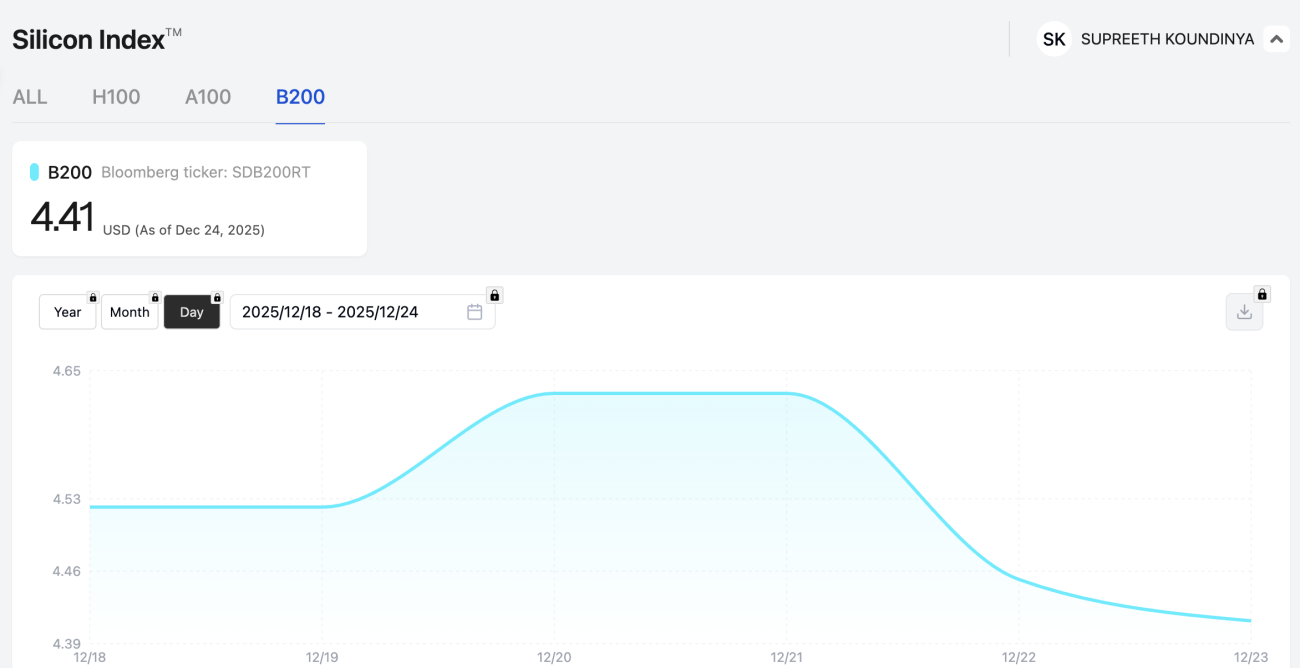
This week, the company launched what it says is the world’s first rental index for NVIDIA’s B200, the next-generation platform expected to anchor frontier-scale AI clusters.

Alongside the B200 launch, Silicon Data updated its A100 and H100 on-demand rental indices, expanding provider coverage across hyperscalers, neoclouds, regional data centres, and specialised platforms.

“As A100 and H100 markets mature, we’re seeing stabilisation curves and residual-value patterns that differ from short-term pricing narratives,” Li noted. “These updates ensure our indices continue to reflect how the market actually behaves.”

This focus on price sets Silicon Data apart from most benchmarks in the AI ecosystem.“In parallel, we incorporate secondary and refurbished market data—including resale prices, rental yields, and liquidity signals—to reflect how GPUs are actually priced and traded in the market,” he added.

Pricing Meets Credit Risk

That distinction ties directly to the AI bubble debate.

As GPU-backed lending rises, lenders now need to understand how GPUs behave in the real world—from depreciation and lifecycles to how new generations reprice the fleet.

Neocloud operators such as CoreWeave and Lambda—built almost entirely around renting high-performance GPUs—are increasingly relying on multi-billion-dollar loans backed directly by GPUs, often raised through special-purpose vehicles.

However, lenders also need to consider GPU depreciation, which, according to brokerage Bernstein, lose more value in the first year, often due to high-performance workloads and burn-in losses.

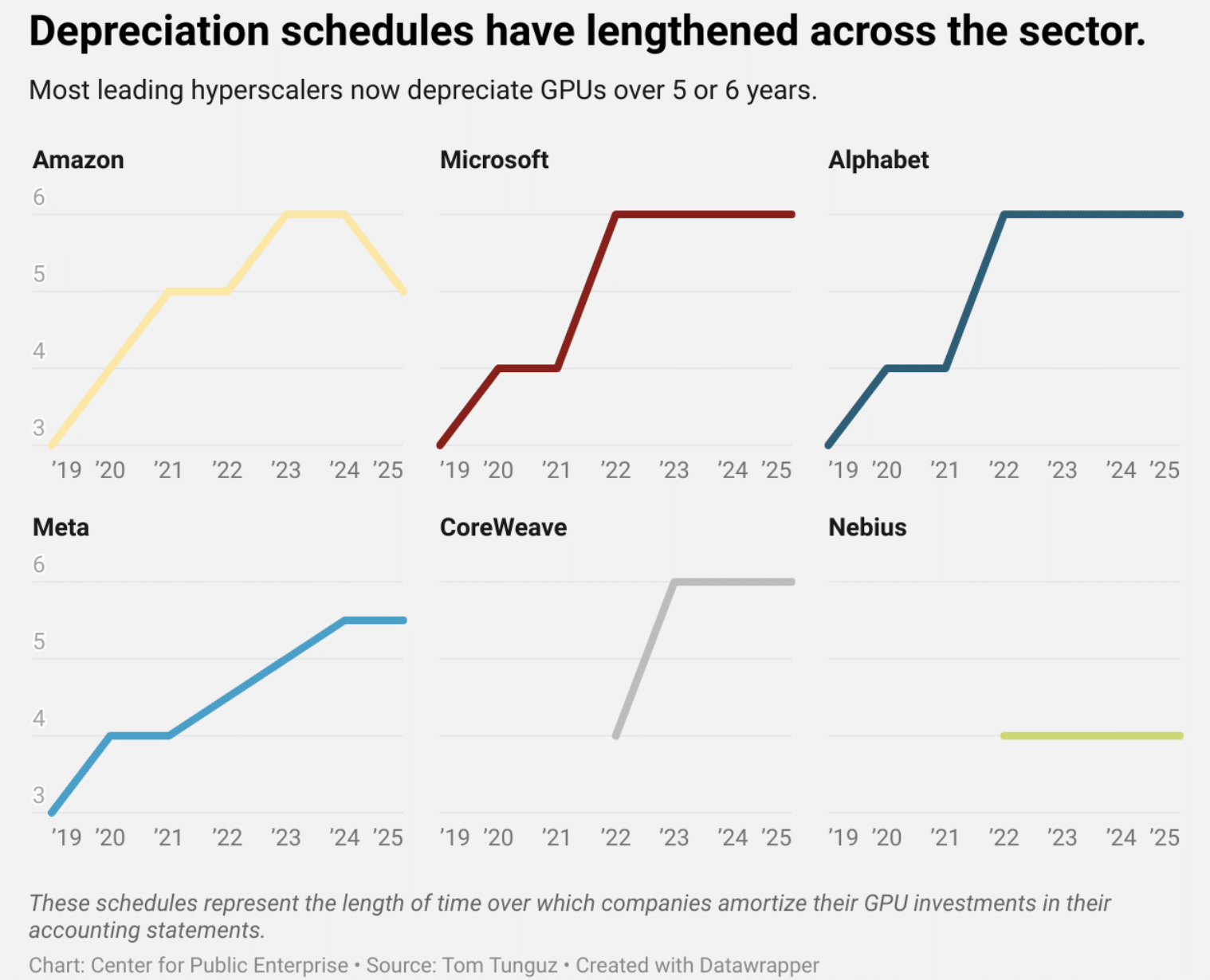
CoreWeave depreciates GPUs over six years, Nebius over four, while engineers and project-finance specialists peg the actual economic life at three to four years. Analysts at Cerno Capital estimate that if Microsoft, Alphabet, Meta, and Amazon all extended the lives of data centre assets to six years, reported depreciation would drop by 54%, from $51 billion to $28 billion.

To empirically determine the decline in asset value, Silicon Data earlier this year launched SiliconMark, which measures the actual performance, stability, and degradation of GPUs over time rather than relying solely on age or spec sheets. “This allows lenders to distinguish between nominal depreciation and functional depreciation,” said Li.

What determines whether GPUs stay in service is how quickly the economics shift.

Jordan Nanos, an analyst at the research firm SemiAnalysis, told AIM that hardware would stay in service as long as it makes economic sense to rent. In hyperscale environments, once power, cooling, and maintenance are accounted for, the marginal cost of running a modern GPU often bottoms out around $0.30 to $0.40 per hour. As long as a chip can earn more than that, operators keep it in the fleet.

“If new GPUs are so much more performant than the old ones that it no longer makes economic sense for buyers to rent the old ones, they get replaced,” said Nanos. “But the converse is also true: if performance improvements are not realised for new GPUs, the market will demand the old ones for longer.”

In practice, hardware’s existence is tied to its value, and not mere physical functionality. It is decommissioned when contracts end, and no one is willing to pay enough to keep it operational.

“If that contract expires, and there is no one interested in renting the GPUs at the current price, a cloud provider will decommission the GPU systems and replace them with something else,” he said.

That leaves lifecycle risk outside operators’ direct control. Each new generation can either strand fleets early or extend their lives, depending on how sharply it resets performance per dollar and where market pricing settles.

The post How Do You Price the GPU Boom? appeared first on Analytics India Magazine.

How Gradient-Boosting is Quietly Powering India’s Research Push

In its push to meet ambitious sustainable development goals, from ensuring access to clean water and building resilient infrastructure to protecting biodiversity, India is increasingly turning to data and artificial intelligence.

However, the spotlight is not on conversational or generative models. As climate pressures intensify, researchers require AI systems that can interpret environmental data responsibly, without demanding supercomputer-scale resources or relying on opaque logic. This is where gradient-boosting models are gaining traction.

These models are quietly powering analyses across hydrology, ecology, geology, agriculture and urban planning. They work particularly well with real-world environmental data, offer transparent explanations, and run efficiently on standard research hardware. This approach resonates not only in India but also across the broader BRICS scientific community, where researchers prioritise open, interpretable tools designed to address practical challenges.

One notable example is CatBoost, the open-source gradient-boosting library developed at Yandex. Its ability to handle tabular environmental data, from pollution categories to terrain labels, has made it useful for Indian research groups studying river contamination, slope stability and carbon storage. Instead of spending weeks cleaning datasets, scientists can focus on identifying patterns and communicating evidence to policymakers.

In sustainability research, where predictions must be traceable and defensible, efficiency matters as much as accuracy.

Across Indian laboratories, boosting models are not substituting scientific judgement. Instead, they help researchers turn messy environmental data into reliable insights. This article examines how these methods are shaping India’s research landscape, the practical benefits they offer, and how they support the country’s sustainability mission.

What Is Gradient Boosting

Gradient boosting is a machine-learning method that builds a sequence of models, with each new model correcting the errors of the previous one.

Unlike large neural networks that require significant computing resources, gradient boosting can run on standard laboratory machines while still delivering accurate and explainable results. This makes it a practical choice for scientific and sustainability research.

Researchers can identify the factors influencing predictions, for example, why a model forecast pollution in a specific river stretch or flagged a slope as potentially unstable. This interpretability makes boosting methods well-suited for environmental, social and governance (ESG) research, where traceability, reproducibility and transparent assumptions are essential.

CatBoost offers an additional advantage. It can handle categorical features such as land-use labels, crop classifications and pollutant codes without extensive preprocessing. This removes a significant portion of the manual work that scientists would otherwise need to perform.

Given that categorisation is often where environmental datasets become inconsistent or messy, reducing this burden lowers the barrier to scientific modelling. In doing so, CatBoost reflects a broader BRICS approach to innovation — developing practical tools to address real-world problems such as floods, pollution, urban expansion, and biodiversity loss.

How India Is Using Boosting for Environmental Research

India has no shortage of data on flooding, pollution, slope failures and urban impacts. The challenge lies in converting that information into decisions that protect people and ecosystems.

Below are three examples showing how researchers are applying boosting methods to issues central to India’s development and sustainability agenda.

India’s rivers face a dual challenge: unpredictable monsoons and widespread pollution. Monitoring and predicting water quality is a classic “messy data” problem, involving numerous interacting physical, chemical and biological factors, high spatial variation and firm seasonal shifts. Gradient-boosting models are well-suited to convert such complex datasets into actionable insights.

Researchers working in the Godavari River Basin have applied boosting algorithms to downscale global climate models to produce regional rainfall and temperature projections. This has led to more accurate flood forecasts and improved irrigation planning, according to a study published in the Journal of Hydrology: Regional Studies in 2025.

Water-quality researchers have also adopted these techniques. A study published in Scientific Reports in 2025 used a stacked ensemble of models, including CatBoost and XGBoost, to predict the Water Quality Index (WQI) across major Indian rivers between 2005 and 2014.

The models achieved strong predictive accuracy, with an R² value of around 0.995. This enabled researchers to prioritise sampling locations and detect emerging pollution hotspots earlier than would be possible with traditional laboratory testing alone.

The combination of predictive performance and transparency supports better water-risk management, faster identification of contamination zones and more decisive regulatory action.

Civil Engineering

As cities expand into steep and geologically fragile terrain, India faces a rising risk of landslides and slope failures, particularly during the monsoon season. Boosting models are helping engineers anticipate and mitigate these risks.

Although a recent CatBoost-based slope-stability study was conducted outside India, the methodology closely mirrors the challenges found across the Himalayas, the Western Ghats and other vulnerable regions.

Published in Scientific Reports in 2024, the study demonstrated that CatBoost could generate early warnings of potential landslides by learning from soil properties, terrain features and rainfall patterns. Indian researchers are now exploring similar approaches for local conditions.

Such predictive modelling allows planners to reinforce slopes, design safer highways and integrate risk-aware decisions into urban development, shifting engineering practices from reactive mitigation to proactive safety.

Ecology and Sustainability

Tracking forest growth, biomass and carbon sequestration is central to India’s biodiversity and climate-action goals. Gradient-boosting models are increasingly used to combine satellite imagery with field measurements to estimate ecosystem productivity.

A 2025 Scientific Reports study from China showed that CatBoost could estimate gross primary productivity (GPP) with high accuracy using multisource satellite data and environmental variables, achieving an R² value of 0.890.

While the research focused on Shanxi province, the modelling approach — combining vegetation indices, climate data and boosting algorithms — closely aligns with the challenges faced by India’s forest-monitoring and carbon-mapping programmes.

By translating diverse ecological datasets into practical guidance, boosting models can help Indian researchers identify restoration priorities, monitor changes in carbon sinks and support evidence-based conservation policies more efficiently than traditional methods.

Why Gradient Boosting Matters for India’s ESG Goals

Meeting India’s sustainability targets — including net-zero emissions by 2070, ecosystem restoration, clean water access, resilient infrastructure and biodiversity protection — requires solutions that are effective, affordable and transparent.

Gradient-boosting models, particularly tools such as CatBoost, align closely with these needs.

They work well with heterogeneous scientific data, including soil types, rainfall categories and land-use classes. They require significantly less computing power than deep-learning models for tabular datasets, making them accessible to universities and research labs with limited resources. Their interpretable outputs allow scientists to validate findings rather than relying on black-box predictions.

Importantly, these models also enable closer collaboration between domain experts, data scientists and policymakers, allowing AI tools to be co-designed and directly integrated into planning systems.

In short, gradient boosting makes applied AI practical, scalable and trustworthy — qualities essential for advancing India’s sustainability mission.

Gradient boosting may never command the attention of generative AI models, but its impact on real-world challenges is substantial. In India, these methods are helping to support cleaner rivers, safer infrastructure, more innovative water management, and healthier forests.

CatBoost and similar tools demonstrate that “AI for good” does not require massive models or vast computing resources. Instead, it often depends on efficient, open-source systems that scientists and policymakers can deploy, audit and trust.

As India accelerates its sustainability and infrastructure ambitions, gradient boosting, supported by an expanding open-data ecosystem, is quietly powering a green research revolution.

The post How Gradient-Boosting is Quietly Powering India’s Research Push appeared first on Analytics India Magazine.
Top 10 Companies That Crowned Hyderabad as India’s Greenfield GCC Leader in 2025

Hyderabad has quietly emerged as India’s second-largest product engineering GCC hub after Bengaluru, with a strong concentration of global teams building and owning core products across SaaS, cloud and data platforms, cybersecurity, edtech and media technology, as well as life sciences-focused digital products.

Sources told AIM that Telangana has attracted over 75 greenfield GCCs in 2025, compared to 40+ in Karnataka. This signals a notable shift, with Telangana overtaking Karnataka as the leading destination for new GCC establishments in India.

1.Amgen

US-based biopharmaceutical giant Amgen has inaugurated a new technology and innovation centre in Hyderabad, as part of a planned $200-million investment through 2025, with further funding likely in the coming years.

The facility, spanning about 524,000 sq ft in HITEC City’s IT hub, aims to accelerate the company’s digital and technological capabilities across its global organisation, leveraging AI, data science, and digital solutions to advance its pipeline of medicines and improve enterprise efficiency.

The centre has already begun hiring, with 300 employees onboarded shortly after signing the lease, with plans to expand to over 2,000 staff by year-end. The centre is expected to offer roles across AI, data science, life sciences, and other global capabilities.

2. ABC Fitness

ABC Fitness, a US-based technology provider for the fitness industry, launched its first innovation hub in Hyderabad. The new centre will focus on software and product development, accelerating AI-driven features and customer-centric solutions for the fitness sector, and is expected to create around 200 tech jobs in its first year, including roles in software engineering, cloud, data science, UI/UX, and cybersecurity.

Over the next five years, the centre is expected to grow significantly in both team size and strategic responsibilities.

3. Vanguard

American investment management giant Vanguard launched its first India GCC in Hyderabad. The new centre will focus on engineering excellence, cloud modernisation, data analytics, AI, machine learning, and cybersecurity. It will feature collaborative labs to drive innovation across Vanguard’s digital platforms and enterprise solutions.

Vanguard’s India GCC is expected to reach around 300 employees by the end of 2025 and is projected to grow to over 2,300 tech professionals by 2029, making it one of the firm’s largest tech hubs worldwide.

4.McDonald’s

McDonald’s has established its first GCC in India in Hyderabad, and has leased around 200,000 sq ft of office space at RMZ Nexity Tower in the city’s IT corridor, making it one of its largest GCC facilities outside the US, capable of seating about 2,000 employees.

The Hyderabad GCC focuses on business, technology, analytics, enterprise data, cloud, cybersecurity, and AI-related functions, acting as a global hub to expand McDonald’s in-house expertise and talent base.

McDonald’s has begun recruiting for roles spanning infrastructure engineering, testing, cyber defence, cloud operations, facilities management, HR, and related areas.

Hyderabad was chosen over other cities like Bengaluru due to its talent pool, infrastructure, and quality of living, and the move is seen as part of a broader trend of global firms choosing India for strategic GCC expansions.

5. Miltenyi Biotec

Miltenyi Biotec, a global leader in cell and gene therapy (CGT) solutions, launched its India operations this year with an office in Hyderabad—the Miltenyi Innovation and Technology Centre (MITC)—as a CGT centre of excellence.

The centre, one of the first of its kind in India, aims to support scientists, researchers, clinicians, and industry experts with classroom and hands-on training, research expertise, and access to advanced platforms, including the CliniMACS Prodigy, for CGT development and manufacturing.

MITC aims to foster local innovation in therapies, from proof of concept to clinical development and commercialisation, and to strengthen India’s life sciences ecosystem by enabling easier access to expertise and accelerating the development of novel treatments, including CAR-T cell therapies for blood cancers.

6. Heineken NV

Netherlands-based brewer Heineken NV has chosen Hyderabad as the location for its first GCC in the Asia-Pacific region, committing an investment of ₹2,500–3,000 crore.

The new GCC will focus on technology, digital transformation, AI, data operations, and business support services for the company’s global operations.

The centre is expected to generate up to 3,000 jobs for tech professionals in the city over the coming years.

7. Citizens Financial Group

US-based Citizens Financial Group opened its first GCC in Hyderabad in partnership with Cognizant, located within Cognizant’s new campus in the city.

Launched in April, the centre is expected to grow to around 1,000 IT, data and analytics professionals by March 2026, serving as a key part of Citizens’ digital transformation and enterprise technology strategy.

It will focus on accelerating innovation in areas including enterprise technology, customer experience platforms, data analytics, cloud, cybersecurity and product development, helping reduce reliance on third-party vendors and speed up delivery of modern banking solutions.

8. Costco Wholesale Corporation

US retail giant Costco Wholesale Corporation plans to establish its first technology-focused GCC in Hyderabad, India.

The Hyderabad centre is expected to start with around 1,000 employees and scale up over time, concentrating on technology, research and development, analytics, cloud, cybersecurity and related high-value functions, working closely with Costco’s global teams.

9. Sonatype

US-based Sonatype, an AI-driven open-source cybersecurity company, has opened its GCC in Hyderabad, focusing on innovation in supply chain security and software engineering.

The facility, located in HITEC City, launched with about 50 engineers, and plans to scale to over 200 deep tech professionals by the end of 2026, including product leaders, data scientists, AI experts, and cloud developers.

The centre will play a key role in advancing Sonatype’s Nexus platform, enhancing automation, scalability and customer experience, and supporting enterprises with compliance frameworks such as CERT-IN guidelines and SBOM requirements.

10. Goodyear

Tech Mahindra is in advanced discussions to set up a GCC in Hyderabad for Goodyear Tire & Rubber Co.

The proposed centre is expected to focus on Goodyear’s research and development (R&D) and IT operations, tapping into Hyderabad’s strong tech talent pool. Initial plans indicate the GCC will employ around 300 professionals in 2025.

The initiative aligns with Tech Mahindra’s broader strategy under CEO Mohit Joshi to expand higher-value engagements, improve margins, and shift toward capability-driven models, including Build-Operate-Transfer (BOT) GCC setups.

The post Top 10 Companies That Crowned Hyderabad as India’s Greenfield GCC Leader in 2025 appeared first on Analytics India Magazine.

Groq to Now Help NVIDIA Build Inference Tech

Groq, the US-based company that designs specialised hardware for AI inference, has announced a non-exclusive licensing agreement with NVIDIA.

As part of the deal, Groq founder Jonathan Ross, along with Groq president Sunny Madra and several other employees, will join NVIDIA to “help advance and scale the licensed technology” for NVIDIA.

The announcement comes after CNBC earlier reported that NVIDIA was in talks to acquire Groq for $20 billion. But Groq said it will continue to operate as an independent company, with Simon Edwards stepping into the CEO role.

Ross spent more than four years at Google before founding Groq, where he was a key hardware engineer behind the early development of Tensor Processing Units (TPUs).

TPUs are now central to training and running Google’s Gemini family of models and are widely viewed as one of the few credible alternatives to NVIDIA’s AI hardware stack.

“Jonathan was not only the father of TPU when he was at Google, but he is a technical genius of biblical proportions,” said Chamath Palihapitiya, an early investor in Groq, congratulating Ross on the move, in a post on X.

After leaving Google, Ross founded Groq to build the Language Processing Unit (LPU), a chip architecture designed for deterministic, low-latency inference.

Since its launch, Groq has positioned its systems as delivering higher inference speeds for specific models than NVIDIA’s GPUs on certain AI models.

The deal has triggered speculation across the industry about NVIDIA’s motives. “What this also says to me is that Nvidia sensed a threat to scaling their own inference business,” wrote Naveen Rao, CEO of Unconventional AI and former VP of AI at Databricks, in a post on X.

Groq investors get a payout per ⁦@theinformation⁩ pic.twitter.com/EQSrzzsDwI

— Austin Lyons (@theaustinlyons) December 25, 2025

Max Weinbach, an analyst at Creative Strategies, suggested in a post on X that the agreement could help NVIDIA rethink its inference roadmap.

“This gets Nvidia the IP they need to bypass CoWoS and HBM for a fast inference-focused chip, and use NVLink for better chip-to-chip interconnect of the LPU,” he wrote.

This indicates NVIDIA may be looking to absorb ideas from Groq’s LPU architecture to design inference-optimised chips that rely less on costly advanced packaging and memory stacks, while still leveraging its NVLink ecosystem.

This would strengthen its position in low-latency, high-throughput AI inference without requiring a complete acquisition of Groq.

In September, Groq raised a $750 million funding round at a valuation of $6.9 billion, underscoring investor confidence in its approach to inference-focused hardware.

The post Groq to Now Help NVIDIA Build Inference Tech appeared first on Analytics India Magazine.

How Gradient-Boosting is Quietly Powering India’s Research Push

In its push to meet ambitious sustainable development goals, from ensuring access to clean water and building resilient infrastructure to protecting biodiversity, India is increasingly turning to data and artificial intelligence.

However, the spotlight is not on conversational or generative models. As climate pressures intensify, researchers require AI systems that can interpret environmental data responsibly, without demanding supercomputer-scale resources or relying on opaque logic. This is where gradient-boosting models are gaining traction.

These models are quietly powering analyses across hydrology, ecology, geology, agriculture and urban planning. They work particularly well with real-world environmental data, offer transparent explanations, and run efficiently on standard research hardware. This approach resonates not only in India but also across the broader BRICS scientific community, where researchers prioritise open, interpretable tools designed to address practical challenges.

One notable example is CatBoost, the open-source gradient-boosting library developed at Yandex. Its ability to handle tabular environmental data, from pollution categories to terrain labels, has made it useful for Indian research groups studying river contamination, slope stability and carbon storage. Instead of spending weeks cleaning datasets, scientists can focus on identifying patterns and communicating evidence to policymakers.

In sustainability research, where predictions must be traceable and defensible, efficiency matters as much as accuracy.

Across Indian laboratories, boosting models are not substituting scientific judgement. Instead, they help researchers turn messy environmental data into reliable insights. This article examines how these methods are shaping India’s research landscape, the practical benefits they offer, and how they support the country’s sustainability mission.

What Is Gradient Boosting

Gradient boosting is a machine-learning method that builds a sequence of models, with each new model correcting the errors of the previous one.

Unlike large neural networks that require significant computing resources, gradient boosting can run on standard laboratory machines while still delivering accurate and explainable results. This makes it a practical choice for scientific and sustainability research.

Researchers can identify the factors influencing predictions, for example, why a model forecast pollution in a specific river stretch or flagged a slope as potentially unstable. This interpretability makes boosting methods well-suited for environmental, social and governance (ESG) research, where traceability, reproducibility and transparent assumptions are essential.

CatBoost offers an additional advantage. It can handle categorical features such as land-use labels, crop classifications and pollutant codes without extensive preprocessing. This removes a significant portion of the manual work that scientists would otherwise need to perform.

Given that categorisation is often where environmental datasets become inconsistent or messy, reducing this burden lowers the barrier to scientific modelling. In doing so, CatBoost reflects a broader BRICS approach to innovation — developing practical tools to address real-world problems such as floods, pollution, urban expansion, and biodiversity loss.

How India Is Using Boosting for Environmental Research

India has no shortage of data on flooding, pollution, slope failures and urban impacts. The challenge lies in converting that information into decisions that protect people and ecosystems.

Below are three examples showing how researchers are applying boosting methods to issues central to India’s development and sustainability agenda.

India’s rivers face a dual challenge: unpredictable monsoons and widespread pollution. Monitoring and predicting water quality is a classic “messy data” problem, involving numerous interacting physical, chemical and biological factors, high spatial variation and firm seasonal shifts. Gradient-boosting models are well-suited to convert such complex datasets into actionable insights.

Researchers working in the Godavari River Basin have applied boosting algorithms to downscale global climate models to produce regional rainfall and temperature projections. This has led to more accurate flood forecasts and improved irrigation planning, according to a study published in the Journal of Hydrology: Regional Studies in 2025.

Water-quality researchers have also adopted these techniques. A study published in Scientific Reports in 2025 used a stacked ensemble of models, including CatBoost and XGBoost, to predict the Water Quality Index (WQI) across major Indian rivers between 2005 and 2014.

The models achieved strong predictive accuracy, with an R² value of around 0.995. This enabled researchers to prioritise sampling locations and detect emerging pollution hotspots earlier than would be possible with traditional laboratory testing alone.

The combination of predictive performance and transparency supports better water-risk management, faster identification of contamination zones and more decisive regulatory action.

Civil Engineering

As cities expand into steep and geologically fragile terrain, India faces a rising risk of landslides and slope failures, particularly during the monsoon season. Boosting models are helping engineers anticipate and mitigate these risks.

Although a recent CatBoost-based slope-stability study was conducted outside India, the methodology closely mirrors the challenges found across the Himalayas, the Western Ghats and other vulnerable regions.

Published in Scientific Reports in 2024, the study demonstrated that CatBoost could generate early warnings of potential landslides by learning from soil properties, terrain features and rainfall patterns. Indian researchers are now exploring similar approaches for local conditions.

Such predictive modelling allows planners to reinforce slopes, design safer highways and integrate risk-aware decisions into urban development, shifting engineering practices from reactive mitigation to proactive safety.

Ecology and Sustainability

Tracking forest growth, biomass and carbon sequestration is central to India’s biodiversity and climate-action goals. Gradient-boosting models are increasingly used to combine satellite imagery with field measurements to estimate ecosystem productivity.

A 2025 Scientific Reports study from China showed that CatBoost could estimate gross primary productivity (GPP) with high accuracy using multisource satellite data and environmental variables, achieving an R² value of 0.890.

While the research focused on Shanxi province, the modelling approach — combining vegetation indices, climate data and boosting algorithms — closely aligns with the challenges faced by India’s forest-monitoring and carbon-mapping programmes.

By translating diverse ecological datasets into practical guidance, boosting models can help Indian researchers identify restoration priorities, monitor changes in carbon sinks and support evidence-based conservation policies more efficiently than traditional methods.

Why Gradient Boosting Matters for India’s ESG Goals

Meeting India’s sustainability targets — including net-zero emissions by 2070, ecosystem restoration, clean water access, resilient infrastructure and biodiversity protection — requires solutions that are effective, affordable and transparent.

Gradient-boosting models, particularly tools such as CatBoost, align closely with these needs.

They work well with heterogeneous scientific data, including soil types, rainfall categories and land-use classes. They require significantly less computing power than deep-learning models for tabular datasets, making them accessible to universities and research labs with limited resources. Their interpretable outputs allow scientists to validate findings rather than relying on black-box predictions.

Importantly, these models also enable closer collaboration between domain experts, data scientists and policymakers, allowing AI tools to be co-designed and directly integrated into planning systems.

In short, gradient boosting makes applied AI practical, scalable and trustworthy — qualities essential for advancing India’s sustainability mission.

Gradient boosting may never command the attention of generative AI models, but its impact on real-world challenges is substantial. In India, these methods are helping to support cleaner rivers, safer infrastructure, more innovative water management, and healthier forests.

CatBoost and similar tools demonstrate that “AI for good” does not require massive models or vast computing resources. Instead, it often depends on efficient, open-source systems that scientists and policymakers can deploy, audit and trust.

As India accelerates its sustainability and infrastructure ambitions, gradient boosting, supported by an expanding open-data ecosystem, is quietly powering a green research revolution.

The post How Gradient-Boosting is Quietly Powering India’s Research Push appeared first on Analytics India Magazine.

How Gradient-Boosting is Quietly Powering India’s Research Push

In its push to meet ambitious sustainable development goals, from ensuring access to clean water and building resilient infrastructure to protecting biodiversity, India is increasingly turning to data and artificial intelligence.

However, the spotlight is not on conversational or generative models. As climate pressures intensify, researchers require AI systems that can interpret environmental data responsibly, without demanding supercomputer-scale resources or relying on opaque logic. This is where gradient-boosting models are gaining traction.

These models are quietly powering analyses across hydrology, ecology, geology, agriculture and urban planning. They work particularly well with real-world environmental data, offer transparent explanations, and run efficiently on standard research hardware. This approach resonates not only in India but also across the broader BRICS scientific community, where researchers prioritise open, interpretable tools designed to address practical challenges.

One notable example is CatBoost, the open-source gradient-boosting library developed at Yandex. Its ability to handle tabular environmental data, from pollution categories to terrain labels, has made it useful for Indian research groups studying river contamination, slope stability and carbon storage. Instead of spending weeks cleaning datasets, scientists can focus on identifying patterns and communicating evidence to policymakers.

In sustainability research, where predictions must be traceable and defensible, efficiency matters as much as accuracy.

Across Indian laboratories, boosting models are not substituting scientific judgement. Instead, they help researchers turn messy environmental data into reliable insights. This article examines how these methods are shaping India’s research landscape, the practical benefits they offer, and how they support the country’s sustainability mission.

What Is Gradient Boosting

Gradient boosting is a machine-learning method that builds a sequence of models, with each new model correcting the errors of the previous one.

Unlike large neural networks that require significant computing resources, gradient boosting can run on standard laboratory machines while still delivering accurate and explainable results. This makes it a practical choice for scientific and sustainability research.

Researchers can identify the factors influencing predictions, for example, why a model forecast pollution in a specific river stretch or flagged a slope as potentially unstable. This interpretability makes boosting methods well-suited for environmental, social and governance (ESG) research, where traceability, reproducibility and transparent assumptions are essential.

CatBoost offers an additional advantage. It can handle categorical features such as land-use labels, crop classifications and pollutant codes without extensive preprocessing. This removes a significant portion of the manual work that scientists would otherwise need to perform.

Given that categorisation is often where environmental datasets become inconsistent or messy, reducing this burden lowers the barrier to scientific modelling. In doing so, CatBoost reflects a broader BRICS approach to innovation — developing practical tools to address real-world problems such as floods, pollution, urban expansion, and biodiversity loss.

How India Is Using Boosting for Environmental Research

India has no shortage of data on flooding, pollution, slope failures and urban impacts. The challenge lies in converting that information into decisions that protect people and ecosystems.

Below are three examples showing how researchers are applying boosting methods to issues central to India’s development and sustainability agenda.

India’s rivers face a dual challenge: unpredictable monsoons and widespread pollution. Monitoring and predicting water quality is a classic “messy data” problem, involving numerous interacting physical, chemical and biological factors, high spatial variation and firm seasonal shifts. Gradient-boosting models are well-suited to convert such complex datasets into actionable insights.

Researchers working in the Godavari River Basin have applied boosting algorithms to downscale global climate models to produce regional rainfall and temperature projections. This has led to more accurate flood forecasts and improved irrigation planning, according to a study published in the Journal of Hydrology: Regional Studies in 2025.

Water-quality researchers have also adopted these techniques. A study published in Scientific Reports in 2025 used a stacked ensemble of models, including CatBoost and XGBoost, to predict the Water Quality Index (WQI) across major Indian rivers between 2005 and 2014.

The models achieved strong predictive accuracy, with an R² value of around 0.995. This enabled researchers to prioritise sampling locations and detect emerging pollution hotspots earlier than would be possible with traditional laboratory testing alone.

The combination of predictive performance and transparency supports better water-risk management, faster identification of contamination zones and more decisive regulatory action.

Civil Engineering

As cities expand into steep and geologically fragile terrain, India faces a rising risk of landslides and slope failures, particularly during the monsoon season. Boosting models are helping engineers anticipate and mitigate these risks.

Although a recent CatBoost-based slope-stability study was conducted outside India, the methodology closely mirrors the challenges found across the Himalayas, the Western Ghats and other vulnerable regions.

Published in Scientific Reports in 2024, the study demonstrated that CatBoost could generate early warnings of potential landslides by learning from soil properties, terrain features and rainfall patterns. Indian researchers are now exploring similar approaches for local conditions.

Such predictive modelling allows planners to reinforce slopes, design safer highways and integrate risk-aware decisions into urban development, shifting engineering practices from reactive mitigation to proactive safety.

Ecology and Sustainability

Tracking forest growth, biomass and carbon sequestration is central to India’s biodiversity and climate-action goals. Gradient-boosting models are increasingly used to combine satellite imagery with field measurements to estimate ecosystem productivity.

A 2025 Scientific Reports study from China showed that CatBoost could estimate gross primary productivity (GPP) with high accuracy using multisource satellite data and environmental variables, achieving an R² value of 0.890.

While the research focused on Shanxi province, the modelling approach — combining vegetation indices, climate data and boosting algorithms — closely aligns with the challenges faced by India’s forest-monitoring and carbon-mapping programmes.

By translating diverse ecological datasets into practical guidance, boosting models can help Indian researchers identify restoration priorities, monitor changes in carbon sinks and support evidence-based conservation policies more efficiently than traditional methods.

Why Gradient Boosting Matters for India’s ESG Goals

Meeting India’s sustainability targets — including net-zero emissions by 2070, ecosystem restoration, clean water access, resilient infrastructure and biodiversity protection — requires solutions that are effective, affordable and transparent.

Gradient-boosting models, particularly tools such as CatBoost, align closely with these needs.

They work well with heterogeneous scientific data, including soil types, rainfall categories and land-use classes. They require significantly less computing power than deep-learning models for tabular datasets, making them accessible to universities and research labs with limited resources. Their interpretable outputs allow scientists to validate findings rather than relying on black-box predictions.

Importantly, these models also enable closer collaboration between domain experts, data scientists and policymakers, allowing AI tools to be co-designed and directly integrated into planning systems.

In short, gradient boosting makes applied AI practical, scalable and trustworthy — qualities essential for advancing India’s sustainability mission.

Gradient boosting may never command the attention of generative AI models, but its impact on real-world challenges is substantial. In India, these methods are helping to support cleaner rivers, safer infrastructure, more innovative water management, and healthier forests.

CatBoost and similar tools demonstrate that “AI for good” does not require massive models or vast computing resources. Instead, it often depends on efficient, open-source systems that scientists and policymakers can deploy, audit and trust.

As India accelerates its sustainability and infrastructure ambitions, gradient boosting, supported by an expanding open-data ecosystem, is quietly powering a green research revolution.

The post How Gradient-Boosting is Quietly Powering India’s Research Push appeared first on Analytics India Magazine.
How Gradient-Boosting is Quietly Powering India’s Research Push

In its push to meet ambitious sustainable development goals, from ensuring access to clean water and building resilient infrastructure to protecting biodiversity, India is increasingly turning to data and artificial intelligence.

However, the spotlight is not on conversational or generative models. As climate pressures intensify, researchers require AI systems that can interpret environmental data responsibly, without demanding supercomputer-scale resources or relying on opaque logic. This is where gradient-boosting models are gaining traction.

These models are quietly powering analyses across hydrology, ecology, geology, agriculture and urban planning. They work particularly well with real-world environmental data, offer transparent explanations, and run efficiently on standard research hardware. This approach resonates not only in India but also across the broader BRICS scientific community, where researchers prioritise open, interpretable tools designed to address practical challenges.

One notable example is CatBoost, the open-source gradient-boosting library developed at Yandex. Its ability to handle tabular environmental data, from pollution categories to terrain labels, has made it useful for Indian research groups studying river contamination, slope stability and carbon storage. Instead of spending weeks cleaning datasets, scientists can focus on identifying patterns and communicating evidence to policymakers.

In sustainability research, where predictions must be traceable and defensible, efficiency matters as much as accuracy.

Across Indian laboratories, boosting models are not substituting scientific judgement. Instead, they help researchers turn messy environmental data into reliable insights. This article examines how these methods are shaping India’s research landscape, the practical benefits they offer, and how they support the country’s sustainability mission.

What Is Gradient Boosting

Gradient boosting is a machine-learning method that builds a sequence of models, with each new model correcting the errors of the previous one.

Unlike large neural networks that require significant computing resources, gradient boosting can run on standard laboratory machines while still delivering accurate and explainable results. This makes it a practical choice for scientific and sustainability research.

Researchers can identify the factors influencing predictions, for example, why a model forecast pollution in a specific river stretch or flagged a slope as potentially unstable. This interpretability makes boosting methods well-suited for environmental, social and governance (ESG) research, where traceability, reproducibility and transparent assumptions are essential.

CatBoost offers an additional advantage. It can handle categorical features such as land-use labels, crop classifications and pollutant codes without extensive preprocessing. This removes a significant portion of the manual work that scientists would otherwise need to perform.

Given that categorisation is often where environmental datasets become inconsistent or messy, reducing this burden lowers the barrier to scientific modelling. In doing so, CatBoost reflects a broader BRICS approach to innovation — developing practical tools to address real-world problems such as floods, pollution, urban expansion, and biodiversity loss.

How India Is Using Boosting for Environmental Research

India has no shortage of data on flooding, pollution, slope failures and urban impacts. The challenge lies in converting that information into decisions that protect people and ecosystems.

Below are three examples showing how researchers are applying boosting methods to issues central to India’s development and sustainability agenda.

India’s rivers face a dual challenge: unpredictable monsoons and widespread pollution. Monitoring and predicting water quality is a classic “messy data” problem, involving numerous interacting physical, chemical and biological factors, high spatial variation and firm seasonal shifts. Gradient-boosting models are well-suited to convert such complex datasets into actionable insights.

Researchers working in the Godavari River Basin have applied boosting algorithms to downscale global climate models to produce regional rainfall and temperature projections. This has led to more accurate flood forecasts and improved irrigation planning, according to a study published in the Journal of Hydrology: Regional Studies in 2025.

Water-quality researchers have also adopted these techniques. A study published in Scientific Reports in 2025 used a stacked ensemble of models, including CatBoost and XGBoost, to predict the Water Quality Index (WQI) across major Indian rivers between 2005 and 2014.

The models achieved strong predictive accuracy, with an R² value of around 0.995. This enabled researchers to prioritise sampling locations and detect emerging pollution hotspots earlier than would be possible with traditional laboratory testing alone.

The combination of predictive performance and transparency supports better water-risk management, faster identification of contamination zones and more decisive regulatory action.

Civil Engineering

As cities expand into steep and geologically fragile terrain, India faces a rising risk of landslides and slope failures, particularly during the monsoon season. Boosting models are helping engineers anticipate and mitigate these risks.

Although a recent CatBoost-based slope-stability study was conducted outside India, the methodology closely mirrors the challenges found across the Himalayas, the Western Ghats and other vulnerable regions.

Published in Scientific Reports in 2024, the study demonstrated that CatBoost could generate early warnings of potential landslides by learning from soil properties, terrain features and rainfall patterns. Indian researchers are now exploring similar approaches for local conditions.

Such predictive modelling allows planners to reinforce slopes, design safer highways and integrate risk-aware decisions into urban development, shifting engineering practices from reactive mitigation to proactive safety.

Ecology and Sustainability

Tracking forest growth, biomass and carbon sequestration is central to India’s biodiversity and climate-action goals. Gradient-boosting models are increasingly used to combine satellite imagery with field measurements to estimate ecosystem productivity.

A 2025 Scientific Reports study from China showed that CatBoost could estimate gross primary productivity (GPP) with high accuracy using multisource satellite data and environmental variables, achieving an R² value of 0.890.

While the research focused on Shanxi province, the modelling approach — combining vegetation indices, climate data and boosting algorithms — closely aligns with the challenges faced by India’s forest-monitoring and carbon-mapping programmes.

By translating diverse ecological datasets into practical guidance, boosting models can help Indian researchers identify restoration priorities, monitor changes in carbon sinks and support evidence-based conservation policies more efficiently than traditional methods.

Why Gradient Boosting Matters for India’s ESG Goals

Meeting India’s sustainability targets — including net-zero emissions by 2070, ecosystem restoration, clean water access, resilient infrastructure and biodiversity protection — requires solutions that are effective, affordable and transparent.

Gradient-boosting models, particularly tools such as CatBoost, align closely with these needs.

They work well with heterogeneous scientific data, including soil types, rainfall categories and land-use classes. They require significantly less computing power than deep-learning models for tabular datasets, making them accessible to universities and research labs with limited resources. Their interpretable outputs allow scientists to validate findings rather than relying on black-box predictions.

Importantly, these models also enable closer collaboration between domain experts, data scientists and policymakers, allowing AI tools to be co-designed and directly integrated into planning systems.

In short, gradient boosting makes applied AI practical, scalable and trustworthy — qualities essential for advancing India’s sustainability mission.

Gradient boosting may never command the attention of generative AI models, but its impact on real-world challenges is substantial. In India, these methods are helping to support cleaner rivers, safer infrastructure, more innovative water management, and healthier forests.

CatBoost and similar tools demonstrate that “AI for good” does not require massive models or vast computing resources. Instead, it often depends on efficient, open-source systems that scientists and policymakers can deploy, audit and trust.

As India accelerates its sustainability and infrastructure ambitions, gradient boosting, supported by an expanding open-data ecosystem, is quietly powering a green research revolution.

The post How Gradient-Boosting is Quietly Powering India’s Research Push appeared first on Analytics India Magazine.

Google’s Try-On Feature: Good for Indian D2C Growth or Just Another Tool?

Virtual outfit try-ons have become the modern equivalent of window shopping. Many online retailers find them helpful in reducing return rates and enhancing customer experience.

But they are not a new phenomenon.

One of the earliest examples of virtual try-on technology was Webcam Social Shopper, launched in June 2009 by Zugara, a US-based augmented reality (AR) company. It harnessed webcams and enabled shoppers to ‘try’ clothes by digitally placing them on their live video feeds.

Cut to December 2025, and the virtual try-on landscape looks vastly different, thanks to AI.

Google’s new “try it on” feature, which recently entered India, allows shoppers to upload a full-body photo and see apparel from billions of listings realistically mapped onto their bodies. Available under the Shopping Graph for apparel products, its AI model enables shoppers not only to upload full-body pictures but also to try on clothes using just a selfie. It is integrated across Search, Google Shopping, and Google Images.

“Now, if you don’t have a full body photo of yourself, you can use a selfie and Nano Banana, our Gemini 2.5 Flash Image model, will generate a full body digital version of you for virtual try on,” Lilian Rincon, VP of product and consumer shopping at Google, said in a blog.

The feature was launched in the US in July 2025 and is an upgrade of an earlier virtual try-on feature that focused on showing apparel on a diverse range of models. It also launched the Doppl app in December, specifically for virtual try-ons.

The question is: how different is Google’s offering from existing try-on tools, and do we really need another one in the space?

Stand Out Tech

Earlier tools from fashion and beauty brands typically worked only within a single retailer’s app and relied on basic AR filters or preset avatars. Google’s system is vastly different.

It analyses the shopper’s full-body or selfie photo to detect body shape, pose, and landmarks such as shoulders, waist, and legs, and processes them on-device or in controlled environments for privacy. At the same time, it studies retailer product images to interpret garment cut, proportions, and how fabrics drape, fold, and stretch.

Jaspreet Bindra, Co-founder of experiential learning platform AI&Beyond, said the feature marks an important shift from catalogue-style visualisation to AI-driven realism.

“Unlike most existing e-commerce try-on tools that rely on static overlays, limited mannequins or heavily stylised avatars, Google’s approach uses generative AI to simulate how garments behave on diverse human forms, factoring in drape, stretch and proportion. The biggest USP here is scale and intelligence—Google is not just building a feature, but a learning system that improves with data across brands, categories and geographies,” he told AIM.

For Indian shoppers, many of whom remain hesitant to buy apparel online, the feature helps build trust. They can experiment with looks, share outfits with friends, and recreate a fitting room-like experience. Ankush Acharya, a 35-year-old marketing professional, found the tool quite accurate. “It came really close to capturing the overall fit and style of shirts. It even changed my pants and shoes to better match the product.”

What Works, What Doesn’t

As Google integrates try-on directly into search listings, users can try items from multiple brands, compare fit instantly, and discover products faster. Its Nano Banana generative AI model uses diffusion for high-quality image editing to show how fabrics fold, clothes stretch, textures react to lighting, and garments behave across body types. Unlike AR tools that need 3D assets, Google requires only 2D catalogue images, reducing friction for brands and marketplaces.

However, the feature has limitations. AI-generated previews often struggle with complex patterns, multi-layered outfits, or nuanced fabric behaviour, leading to approximations rather than perfect simulations. Acharya also noticed a glitch when trying on a shirt. “It was a little more slim-cut than it was supposed to be,” he observed.

It also does not provide size recommendations, stock checks, or guarantees of real-world accuracy, which doesn’t encourage high-value purchases.

“AI still struggles with real-world complexity. Fabric physics, lighting variations, body posture and individual fit preferences are hard to perfectly model, which means virtual try-on will remain probabilistic rather than precise. These tools reduce uncertainty, not eliminate it. Long-term viability will depend on how seamlessly they integrate into discovery and decision journeys, rather than being novelty add-ons,” Bindra explained.

Variety is another constraint. Google’s tool currently supports tops, bottoms, dresses, jackets and shoes, but leaves out lingerie, bathing suits/swimsuits, accessories (other than sometimes on diverse models), costumes, and traditional/religious wear.

The feature, powered by Search Labs, is limited to 18+ users in the US. Rendering times of 10–15 seconds per outfit also slow down the experience. Moreover, as the tool runs on Google’s platform rather than retailer websites, brands have little control over data, analytics, or shopper behaviour insights.

Privacy concerns loom large. Camera access raises fear of misuse, and earlier versions reportedly produced inappropriate alterations such as body enhancement effects or accessories. While Google did not participate in the story, a spokesperson earlier told CNET, “Your uploaded photo is never used beyond trying things on virtually, nor is your photo used for training purposes. It is not shared with other Google products, services or third parties, and you can delete or replace it at any time.”

But data quality remains critical. “While Google has made progress on representing diverse body types, true inclusivity requires continuous, region-specific data inputs, especially in markets like India, where body morphology and clothing styles vary significantly,” Bindra said.

Also, the proposed AI licensing and copyright guidelines from the Department for Promotion of Industry and Internal Trade (DPIIT) threaten to create a regulatory rigamarole for Google using catalogues from Indian brands.

“On regulation, frameworks such as the proposed DPIIT guidelines should ideally enable trust and transparency without stifling innovation. If designed thoughtfully, they can actually strengthen adoption by setting clear guardrails rather than caging the technology for Indian users,” he added.

Just Another Tool?

Meanwhile, Indian brands have been experimenting with their own virtual try-on tools. Nykaa launched India’s first major virtual try-on for makeup in December 2021, using L’Oréal’s ModiFace. Myntra introduced its “Looks Virtual Try-On” in late 2024, and Lenskart innovated with its 3D eyewear try-on after partnering with US startup Ditto. There’s also Myntra Style Studio and Flipkart’s Fit Finder.

Internationally, Sephora’s Virtual Artist and Warby Parker’s eyewear try-on have been early innovators. Walmart introduced AI-powered apparel try-on in 2022, later upgrading it to support customer photos. Amazon’s virtual try-on, meanwhile, is far more practical for categories like shoes and eyewear because of its real-time AR approach.

These tools are expected to make an impact on India’s booming e-commerce apparel market, projected to hit $98.5 billion by 2032, according to a CoherentMi study. For merchants, the feature may help reduce returns—apparel has some of the highest return rates (35–40% as per a 2024 Return Prime report) due to poor fit expectations. The tools can also help D2C brands without brick-and-mortar stores seeking higher conversions and lower expenses by cutting photoshoot costs. But that can only happen once Indian brands come aboard.

The post Google’s Try-On Feature: Good for Indian D2C Growth or Just Another Tool? appeared first on Analytics India Magazine.