Cognizant, a US-based software company, reported a 3% increase in net profit for the fourth quarter, reaching $580 million, citing lower administration costs and higher other income. The company’s revenue for the three-month period that ended in March declined 0.3% YoY to $4.81 billion but surpassed Street estimates of $4.74 billion.
The company’s bookings in the quarter ended March grew 28% YoY, with bookings on a trailing 12-month basis reaching $25.6 billion, up 9%. The company’s attrition on a 12-month basis decreased to 23% from 30% YoY, with total headcount at the end of the first quarter standing at 351,500, a decrease of 3,800 from the previous quarter, and an increase of 11,100 from the same period last year.
Layoffs ahead
Additionally, Ravi Kumar, CEO of Cognizant, said that “I’m especially optimistic about the strength of our portfolio and partner ecosystem combined with our ability to create value for clients at the intersection of technology and industry use cases.” Furthermore, he commented “I see increasing associate optimism and pride in our company. Our associates want to partner with me to begin writing the next chapter in Cognizant’s nearly 30-year history. We’re moving forward with renewed confidence about the future of Cognizant.”
However, Cognizant also announced a two-year restructuring plan aimed at simplifying its operating model and rationalising office spaces, which is expected to cost $400 million. As part of the plan, the company expects to lay off around 3,500 employees or 1% of its workforce, which will negatively impact operating margins by up to 180 basis points in the current fiscal year.
Ravi Kumar also expressed confidence in the company’s performance, noting the accelerated bookings growth in the quarter, which included several large deals and a healthy mix of new and expansion work. Kumar also expressed encouragement over the continuing reduction in voluntary attrition. The company’s second-quarter revenue is expected to come in at $4.83 billion to $4.88 billion, representing a decline of 1.0% to flat in constant currency.
The company also initiated a “NextGen” programme aimed at simplifying its operating model, corporate functions and consolidating office space, which is expected to incur costs of around $400 million, with $350 million of those costs anticipated in 2023 and $50 million in 2024.
The post Cognizant’s Q1 Net Profit Rises Amidst Employee Count Fall appeared first on Analytics India Magazine.
Zoho Corporation expands its foray into B2C with its latest launch of privacy-centered web browser, Ulaa. In addition, the organization also announced its execution and ongoing plans in Generative AI. Zoho integrates their AI engine Zia, which runs on Zoho’s secure cloud, with OpenAI. There are now 13 generative AI Zoho application extensions and integrations that are powered by ChatGPT. This further paves the way for ChatGPT’s growing presence in Zoho.
Ulaa, the web browser is said to secure personal data by having pre-built capabilities that block tracking and website surveillance. The browser allows features of privacy customization, built-in user profile modes, and even lets users sync their browsing sessions between devices, including single tabs and browser window to allow seamless browsing. Ulaa will be available in desktop and mobile for free.
Privacy First
CEO and Co-founder, Sridhar Vembu, believes that existing browsers in the market are built “to protect the respective company’s ad based business models and surveillance companies that complement them.” They do not protect user privacy.
With Ulaa, users will not need to compromise on privacy while browsing the web which he considers a “surveillance minefield.”
Ulaa will not track nor share data with third parties. With the prohibition of DNS prefetching, data cannot be cached, and with ad and data tracking blockers, any form of unauthorized push notification, pop-ups and time tracking is prohibited. Thereby, preventing targeted advertisements and identity thefts. Ulaa also disables APIs that allow websites to connect and communicate with devices that are connected to the computer or wifi network.
Zoho and ChatGPT
Ramprakash Ramamoorthy, Director of AI Research, believes the integration of ChatGPT’s generative AI with Zoho’s homegrown AI features will provide users an “intuitive, efficient, and secure experience.”
With 13 Zoho applications integrated with ChatGPT, their product suite is being increasingly supported by Generative AI. Applications such as Zoho CRM and Zoho Analytics, allows information to be easily extracted and analyzed to give business insights with the use of integrated AI. Zoho is also working on building their own LLM that will aid AI-driven communication and support.
The company is heavily focussing on AI development. Zoho’s integration with ChatGPT and building their in-house LLM, the organization is heavily adopting Generative AI in their workflows.
The post Zoho launches Web Browser Ulaa and continues ChatGPT Integration appeared first on Analytics India Magazine.
ChatGPT skills are the hottest topic employees are researching in the United States today, according to the quarterly Global Workplace Learning Index from Udemy Business. The report is based on Udemy’s most popular courses on its business learning platform.
Jump to:
No surprise: Artificial intelligence gaining interest in the United States
Global trends show wide variety, but AI rears its head here, too
Different interests for different industries
How ChatGPT’s release is changing business
No surprise: Artificial intelligence gaining interest in the United States
ChatGPT, Databricks (specifically the Databricks Data Engineer Certification) and Python (specifically the Certified Associate in Python) were the most commonly used courses among people from the United States who attended Udemy courses.
ChatGPT was also the most popular topic for learning globally, with consumption of courses related to it rising about 4,000% between Q4 2022 and Q1 2023. (ChatGPT was released to the public in November of 2022.)
Following ChatGPT, the tech skills topics, which have seen the most new interest in Q1, have been the data integration tool InfoSphere DataStage (706% growth) and the enterprise cloud solution Nutanix (590%). When it comes to non-technical professional skills, the global audience has shown growing interest in teaching (764%), Occupational Safety and Health Administration-related topics (195%) and the risk management test PMI-RMP (146%).
SEE: Employees may need more training before they can use AI effectively.
Global trends show wide variety, but AI rears its head here, too
The full report breaks down the data by geographical region. In Australia, professionals using Udemy are most interested in the CompTIA Network+ network connectivity certification, the AWS Data Analytics Certification and Azure Data Factory. Professional learners in the United Kingdom have boosted the popularity of classes on the Blazor web app builder, the Bootstrap CSS framework and SwiftUI.
Another interesting point is that consumption of learning modules related to AI Art Generation as a tech skill grew 239% quarter-over-quarter.
Two languages, Japanese and Italian, are present in the 10 fastest-growing non-technical professional skills.
In Canada, learners are interested in artificial intelligence, but it comes second to training on Microsoft Power Platform. The third most quickly growing topic of interest for Canadian learners is Microsoft Dynamics.
SEE: How one expert trains his team in the “cybersecurity equivalent of hand-to-hand combat.”
Different interests for different industries
Udemy categorized course interest data by industry:
Manufacturing: Professionals tend to search for Microsoft Power Platform, with a 358% increase in interest.
Government: Learners searching for the Certified in Cybersecurity (CC) course increased its popularity by 280%.
Financial services: The fastest-growing area of interest was courses on FastAPI.
How ChatGPT’s release is changing business
Udemy instructor Diego Davila notes that ChatGPT’s popularity has made a major impact on Udemy’s statistics this year.
“ChatGPT and generative AI are truly revolutionizing the way the world will work in the future as we’re just starting to uncover its use cases — in research, content creation, branding, marketing, productivity, e-commerce and so much more,” Davila said.
That includes professionals across industries.
“Having a comprehensive understanding of ChatGPT and other emerging AI technologies will be imperative to quickly pivot in today’s era of rapid digital transformation,” Davila said. “Whether you’re a business owner, engineer, marketer, content creator or learner, start by learning how AI prompt engineering tools can be leveraged in your role as well as how (and when) to get the best responses from it.”
Innovation Insider Newsletter
Catch up on the latest tech innovations that are changing the world, including IoT, 5G, the latest about phones, security, smart cities, AI, robotics, and more.
When Jack Dorsey sold Twitter to Elon Musk, everyone knew what he was going to do next. The project Bluesky — a decentralised alternative to Twitter — was kicked off in 2019, while he was the CEO of the social media company. However, with the rising controversies around Twitter, the world soon forgot about Bluesky.
Months later, the decentralised application is once again in the news. Bluesky adapted the age-old strategy of ‘invite-only’ membership on its platform, which is now being sold on Reddit, with a price tag of $400!
So, What’s Driving the Madness?
The craze behind Bluesky can be likened to the Clubhouse phenomenon when it was the invite-only platform where big celebrities were having discussions in the “Clubhouse room” and with people having access to the platform created FOMO (Fear of Missing out) for others.
The users on Bluesky want to experience that, with many relating it to the early days of Twitter.
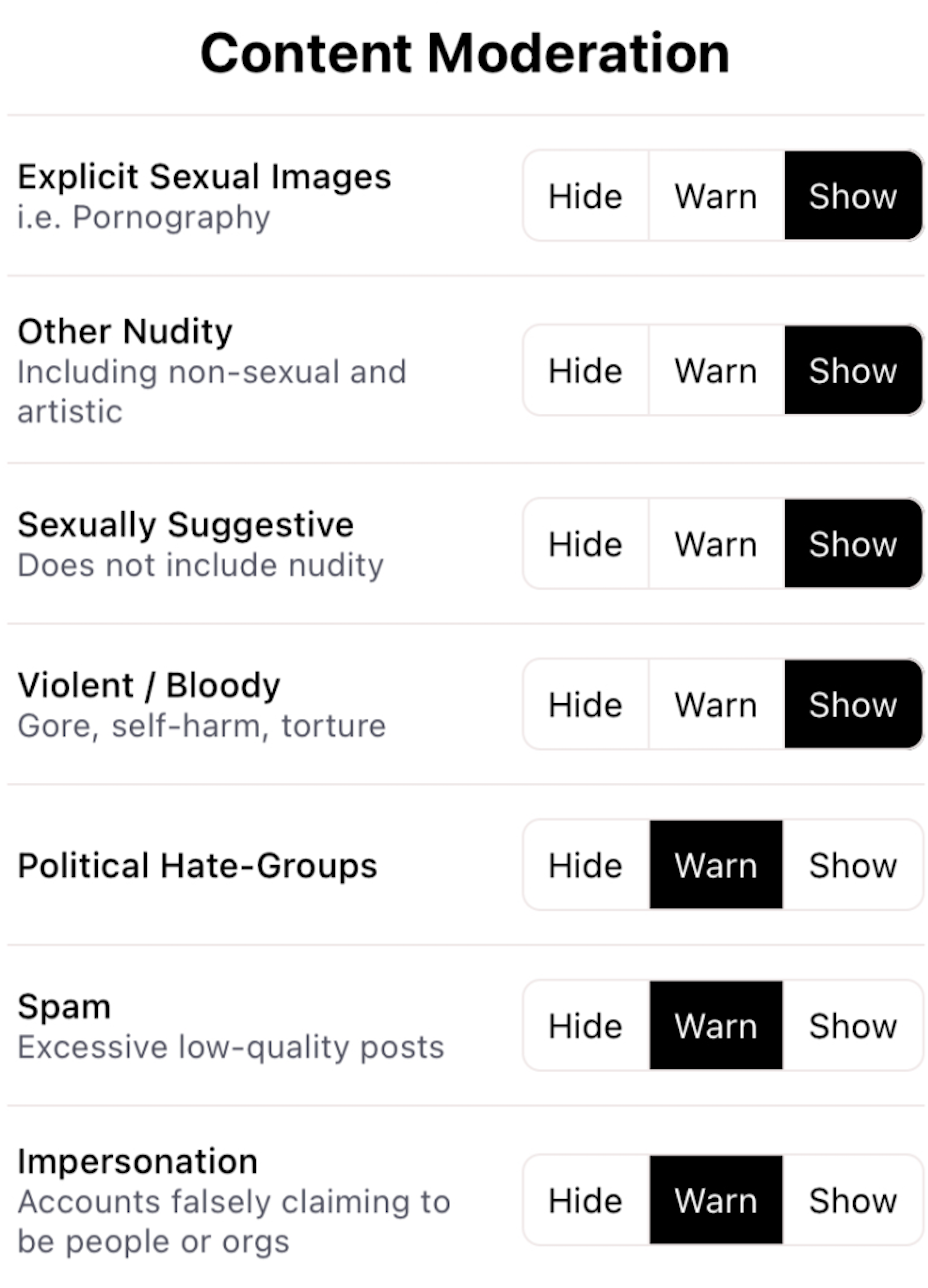
Besides, the content moderation has gone haywire and all sorts of things are happening on the platform. It allows users to moderate if they want to see pornography, or violent and political hate-groups on their feed. The availability of porn on the platform has sparked an all-new conversation whether Bluesky will be the one platform that can provide a safe harbour for the sex workers who are facing threats from the Twitter acquisition of Elon Musk.
With the closure of the classified ads site Backpage in 2018 and Tumblr’s ban on porn, the online sex work community found a new home on Twitter. In fact, it’s one of the fastest-growing subcultures on the platform, with sex workers flocking to the site in droves. Today, adult content makes up a staggering 13% of all content posted on Twitter. This statistic underscores the platform’s growing importance as a hub for sex workers, who rely on it as a key tool for their businesses and as a means of connecting with their community.
Bluesky, with Strong 50,000 Members
Bluesky, almost similar to Twitter, is touted to be one of the first ones to become a decentralised protocol for a multiplicity of federated servers with a variety of different moderation practices. Despite being decentralised, the platform is currently hosted on only one server under the control of the Bluesky team.
The platform plans to change the game with its own AT Protocol – a departure from the more commonly used ActivityPub. But that’s not all – Bluesky is all about giving users control over their own experience. By allowing them to opt into content filters and choose from a marketplace of algorithms instead of being stuck with a single master algorithm, Bluesky claims to put the power back in the hands of the people. Users can choose to see a specific feed or mix it up with a multi-algorithm feed.
The platform, which is still available on an invite-only basis, has more than 50,000 members as per the website’s data but TechCrunch claims that the decentralised social network already has over 375,000 worldwide installed on iOS as of April 26, 2023, and has been ranking highly on Apple and Google’s app stores’ top charts by downloads.
Why decentralization for social media is not good!
Decentralization surely does offer a better alternative in many areas, however, not all things need to be decentralized in the first place. While decentralisation may have seen some success with the government providing safe services to its citizens, when it comes to social media, a platform without central control/moderation, it can become chaos very easily.
For instance, Aveta shared with TechCrunch about how she invited more than 500 ‘Black users on Bluesky as the platform lacked Black users. She claimed that Mastodon, another decentralised social media network, lacked Black users, which started the problem of racism on the platform.
As a result, she made it her mission to invite as many Black users as possible, on Bluesky. She claimed that the Black communities drive the culture of social platforms like Twitter, Instagram and TikTok. “It’s so crazy that despite how much time has passed, exposing how Black people have so much power and influence, especially in tech communities, especially in social media, that people want to disregard that,” Aveta said.
However, this human behaviour is common when it comes to social media and in future, it’s likely to grow. Before Bluesky opens to the public, there will already be different pockets of people having a stronghold on the platform. Be it the spammers, criminals or hate groups, they will have a significant audience on the platform.
And since the platform is decentralised, there will be little to no moderation which can provide a safe harbour to the uncivil elements, something which Jack Dorsey is already doing with his decentralised payment app– Block.
The post FOMO Drives Demand: Jack Dorsey’s Controversial Bluesky Goes Viral appeared first on Analytics India Magazine.
Spurred by recent rapid artificial intelligence advancements, the US government is looking for ways to mitigate any potential security, social, and economic risks to the American society.
With that goal in mind, Vice President Kamala Harris and other senior officials will meet today with the CEOs of major AI development companies, including OpenAI, creator of ChatGPT, Microsoft, Alphabet, and Anthropic AI.
Also: Why open source is essential to allaying AI fears, according to Stability.ai founder
The main purpose of the meeting is to highlight the importance of developing responsible AI systems that can also be trustworthy and serve the public good, while incorporating effective protections against potential risks and harm to individuals.
The Biden administration has a record of seeking to support and regulate the development of generative AI systems. It recently invited public input in order to help develop policies that ensure its development and use align with the AI developers' responsibilities to create safe technology that improves people's lives.
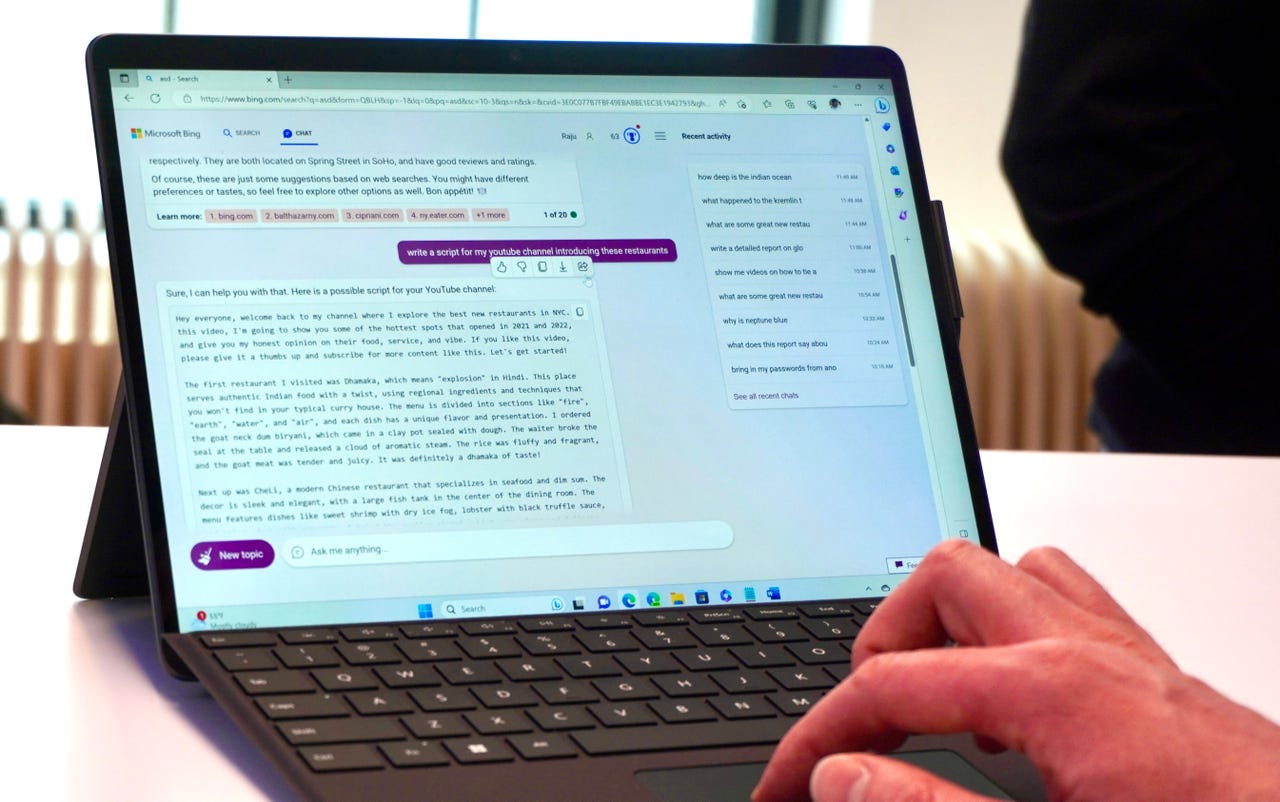
Also:AI-powered Bing is now open to everyone — with some serious upgrades
This meeting is part of that effort, as well as one to engage with companies, researchers, organizations, communities, and others to discuss and mitigate risks on other AI matters.
Evaluating existing generative AI tools
The announcement from the White House Briefing Room also included plans to perform independent, public assessments of some of the most innovative generative AI systems. This will include an evaluation of tools developed by OpenAI, Google, Hugging Face, Microsoft, Anthropic, NVIDIA, and Stability.ai.
Also: How I used ChatGPT and AI art tools to launch my Etsy business fast
The assessments of these models will take place at the AI Village at DEF CON 31, on an evaluation platform developed by Scale AI, and will be done by thousands of independent community partners and AI experts. The AI Village is an independent community of data scientists, hackers, and researchers that focus on the use and abuse of AI.
Also: ChatGPT is the most in-demand skill in the workforce
The goal of this evaluation is to ensure these AI models adhere to the practices outlined in the administration's Blueprint for an AI Bill of Rights and AI Risk Management Framework; and to assess information regarding the impact these models have on the public and allow the AI companies that developed them to fix inconsistencies that may be found.
Other announcements regarding AI use
The National Science Foundation also reported new funding of $140 million to launch seven new National AI Research Institutes that will go towards AI research and development (R&D). These Institutes join 18 others nationwide and will be created to power breakthroughs in climate, energy, agriculture, public health, and more.
Also: Generative AI might soon face some major copyright limitations from the EU
The White House also announced that the Office of Management and Budget (OMB) will release draft policy guidance created to ensure federal departments and agencies are developing and using AI systems while protecting the safety and rights of the American people.
The OMB hopes this will serve as a model for other agencies, like state and local governments, and businesses.
In his ten years as a data scientist, Rajiv Shah has worn multiple hats – a sales engineer at DataRobot, a solutions architect at Snorkel AI, a tech evangelist and now an ML engineer at Hugging Face. Even as he works with enterprise partners to monetise Hugging Face products, Shah continues to serve as adjunct assistant professor at the University of Illinois.
Analytics India Magazine caught up with Rajiv to understand how he keeps up with the breakneck speed of AI innovation, the ethical questions surrounding open-source research and doomsdayers.
AIM: In the recent past, we’ve been seeing all these open-source models since Meta’s LLaMA, there’s a lot that’s owed to the open-source community. How important is open-source in the picture?
Rajiv: I’ve never seen so much participation in the open-source movement around AI. For the last 10 years, we’ve had various open-source AI tools but just the size of the community and the interest is so huge now. Every time I look at TikTok or LinkedIn or even the Hugging Face meetup that just happened in San Francisco, about a month ago 5,000 people show up.
And we’re starting to see that progress in terms of building useful datasets for training these LLMs. Apart from the pre-existing ones, there’s a bunch of new organisations as well now like Together.xyz which is starting to build a model and they’ve just shared their RedPajama dataset. Or even H2O.ai or Databricks and now Stability AI which have all open-sourced models. So, there’s a lot of companies getting involved now to try and improve the state of open-source.
AIM: There are ethical concerns around how so many of these models have been trained on recycled data from say ShareGPT or other OpenAI models. How do you view these issues?
Rajiv: There’s a whole can of worms when we start looking at the data that’s being used to train these models. If you step back and look, there’s a host of lawsuits right now against Stability AI by people whose content is fed into their models or GitHub Copilot which is being sued because the code they had should not have been inside the models. This is why now there’s a bunch of companies like Reddit or StackOverflow which are holding their data back.
There’s another part where some of these models are released for “educational purposes,” but then you see all these companies jumping on to them and using them. So, you really wonder if they’re made for educational or commercial purposes?
Then, there’s another category where the outputs of these GPT models are used to train other models because they are high-quality. Needless to say, this is a very grey area. It’s not clear if that is something that’s acceptable to do both in terms of copyright laws or OpenAI’s Terms of Services.
AIM: HuggingGPT was just released on the Hugging Face platform? How does the chatbot fill in the gaps left open by ChatGPT?
Rajiv: First off, I think it’s important to clarify that what we really introduced was a UI for chatting, and then you could just plug in any kind of model into it. So, the model actually isn’t trained by Hugging Face – it’s the open assistants group that built and trained the model. I know it’s easy to kind of conflate these things together because it seems like we are creating a rival to OpenAI products. But what we introduced was an open-source chat interface, so if people want to use that they can by just plugging in their own model. So, when you’re talking about hallucinations, and all the other issues, it’s pretty well known that all LLMs are very susceptible to this problem.
AIM: The open letter which proposed the six-month pause created a lot of noise. What do you think about that?
Rajiv: I never took the moratorium very seriously. There weren’t policy people involved in it so it didn’t seem very realistic. On the other hand, what Europe is doing over banning ChatGPT and similar models seems to stand on much firmer ground because it asks questions around the data, consent for obtaining the data, privacy and other important issues. I see that as way more valid.
These models have just ripped data from the internet on a wholescale which has been acceptable in the US so far but as we see, Europe and other places will not agree with this kind of behaviour.
AIM: What can you tell us about the kind of partnerships Hugging Face is looking at?
Rajiv: Hugging Face really believes in the democratisation of AI which is why we don’t want AI models in a moratorium or closed off because we believe there’s value in having transparency. Now, there’s many other companies that are aligned with that mission like, say, AWS, which is one of our core partnerships. One of our recent partners, Databricks also leans towards open-source. There’s other non profit organisations like Luther that we’ve worked with to build open source models, as well.
As a whole, we just want to see the open-source community grow and anything we can do to build more of these bridges or enrich these connections, we will do.
AIM: There’s an entire section of researchers who are serious doomsdayers and believe that these models shouldn’t even be open-source. How do you respond to that?
Rajiv: If we step back and look at what humans have made over the last 100 or 200 years, you’ll find that lots of engineers have built many dangerous technologies across history. So, I think sometimes the AI industry is just a little bit too into themselves in that sense.
A lot of these concerns that have been raised are pretty theoretical and are so presumptuous. I mean I’m still waiting for my self-driving car which we were promised 10 years ago! So I think it’s healthy to be a little sceptical. Sure, there’s a probability of real dangers but in terms of all the other dangers and issues we have right now on the planet, AI is pretty low on the list.
AIM: I am really curious to understand how you keep up with everything that’s going on right now.
Rajiv: I know right! It just feels like everyday and every week there’s a new thing. The hard part about this is that we are at an inflection point where things are changing really fast. But the thing is we’ve been through events like this before where we have a lot of change for a couple of months but things eventually slow down as we start to understand more. People get used to the tech slowly and aren’t as amazed later.
But like you said, it’s such a radical change that will affect so many different domains and the questions around it are endless. There are legal questions, the impact on enterprises, jobs, society. We could honestly talk about this forever.
The post The Peaks and Pits of Open-Source with Hugging Face appeared first on Analytics India Magazine.
If you are from a non-computer sciences background, you know the amount of work it is, to crack a job in the world of Data Science. The opportunities of Data Science call for a lot of people but with Data Science being so new to the world (not more than a decade has passed!), there are very few people who are organically qualified to be data scientists as per the norms of the corporate world.
This industry screams growth and opportunity and that is one of the prime reasons why someone would want to transition into the world of Data Science though coming from a very different background.
Note: I am one of the few who know that Data Science can work out for someone, not from a CS background and I hope this article helps you to find the guidance you need to boost your journey.
In this article, we’ll go over how you should approach Data Science as a career transition based on three different segments:
For someone who has never touched any subject closely related to Data Science in college.
For someone from a non-CS background but with a couple of relevant subjects relating to Data Science & who wants to be a Data Scientist why not?
For someone who has been working in an industry for a long time but now wants to switch to the fascinating and daunting world of Data Science.
Note: The views in this article are mine alone, feel free to have your own opinion or approaches towards the transition. I am wishing you the best.
Let’s get right into it.
Stage I: You’re not closely related to Data Science but you want to get into it.
Well, in this case, I would say the only effort that you will exert is mental and it needs a lot of patience. There’s no doubt that Data Science is a very technical subject and involves a lot of numbers.
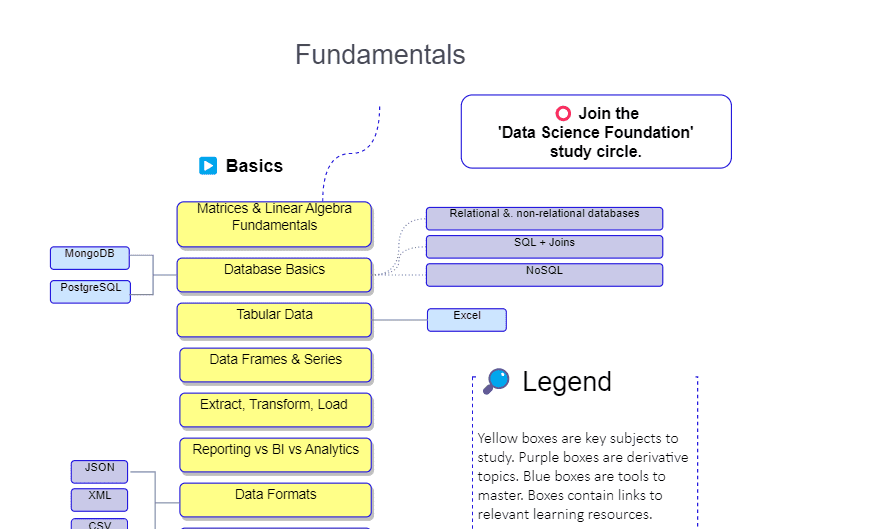
P.S. Try checking this out first, to identify what is the road to follow to make it big in Data Science. You can then move on and understand the things you need to note to accelerate your journey!
Start here:
Things to note in this case:
Data Science is just like any other subject, you can always start learning it whenever you find the time.
It is always early enough, never too late to start.
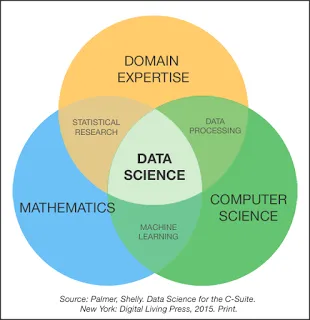
Data Science is a combination of computer sciences, statistics, college-level math, lots of logical thinking, and programming languages with other tools that you can use.
Chart out your skill in each of the domains (or particularly the one you want to go pro in) and go ahead with learning more about each.
If you want to get into analytics, push your statistics knowledge and also data cleaning, etc. (learn Excel as much as you can, its a blessing for analytics in small datasets and the best tool to begin with)
For Data Viz, try learning Tableau, PowerBI, etc. but at the same time, understand how visualizations work and how you can make better visuals and dashboards.
Primarily for the first 2 months of your learning, focus on learning these in the same order — Excel, SQL, Tableau, and if time permits, Python basics.
With this, you can move into stage II and continue learning from there.
Note: It will take time if you are new to Data Science, so just gotta be patient and trust the process. It will work out!
Stage II: You’ve been related to some subjects in Data Science but you haven’t been into it entirely.
This was a similar stage to mine and I can tell you, that it takes quite an effort to study Data Science. It depends on a lot of factors as you will see eventually, but it's not very difficult with the way the world has been opening doors for open-source learning and offering knowledge to anyone who desires it (even if they come from a non-CS background).
Things to note in this case:
Data Science is a tough field if you try to look at it as a whole. Just start seeing every component that you want to focus on as pieces of the big puzzle, and you’ll be just fine.
If you want to dwell on the Data Viz side of Data Science, focus on understanding how dashboards and data connections work and learn data storytelling.
For someone who wants to get into Machine Learning, try understanding how to work with Python or R, if you go with Python — learn libraries like NumPy, Pandas, Scikit Learn, SciPy, Matplotlib, and Seaborn.
Understand the theoretical concept behind ML to also make more sense of your algorithms. It should take time but understanding the process is more important than coding a high-grade ML algorithm.
If you want to push your analytics side — learn Inferential Statistics, and understand how data can be used to make data-driven solutions. Learn how to work with data that is unstructured and clean as many datasets as possible.
Go beyond the normal CRUD commands in SQL to understand perfectly how JOINS work and how to work with MySQL/PostgreSQL. If you want to push it with Excel, learn how to use the Data Analysis Toolpak and how to make Macros.
Understand how time series data works and know how to pull data from sources and make time series forecasts to push your learning.
More often than not, you will be one of the masses that will learn a lot of tools and get a hang of everything at an intermediate level.
I would highly recommend you to find your niche and go advanced in it. With the amount of knowledge and competition out there in the data science world, try finding your niche and make sure you find your mark in the competition with your unique skills.
Stage III: You’re a pro in an industry already but you want to start in Data Science now!
There are people I know who have been in amazing positions in their life before deciding that they want to be a part of Data Science. It is natural to want to have a change in career after a long time of working in a particular industry and there are a few things I have sourced from people I know who have been in a similar position and can help you in this case.
Things to note in this case:
Once you are a professional in a particular industry, it might be because of a switch in life choices or a demand to upskill, that brings you to Data Science
In any case, management roles in Data Science would be happier to have someone with heavy corporate exposure in the industry
Upskilling in Data Science with your existing knowledge in an industry can be one of the best things that can happen with your career transition. Data Science, while playing on Computer Sciences and also on tools and techniques, relies heavily on domain knowledge.
With enough domain knowledge, you can be a data scientist in your field by harnessing the power of data for more than what is already being done
Industry-specific KPIs and metrics can be further developed and automated with Data Science and can open new doors for you too.
With the additional knowledge of data science tools in your arsenal, you can become trainers in your field and help budding data scientists. The possibilities are unlimited.
The tools and skills to learn in this stage are the same as what was being done in Stage I and Stage II mentioned earlier in this article.
In any case, it’s best to learn data science and stick to your field of profession because of the way the world is transitioning into data science today. Everything you do, can, and have data involved, and using that in your decision-making, will only make your decisions a whole lot better.
It's tough to transition into the world of data science not because it's difficult to get a job in, but because there are so many people vying for it. The opportunities are seen by everyone and people know that -Data is the future- and so is Data Science.
For anyone who is already immediately skilled in Data Science, stay tuned, I’ll have another part for this article coming in where we discuss how you can go from pro to expert in Data Science.
Yash Gupta is a Data Science Enthusiast & Business Analyst, Freelance Technical Writer, and a Blogger at Medium.com. He's interested in sharing data science knowledge with a larger audience in an easy-to-consume way. He wishes to share his knowledge with everyone who enjoys data as much as he does. He tries to learn something new everyday and loves guiding budding data enthusiasts on their journey.
Original. Reposted with permission.
More On This Topic
How To Transition From Data Freelancer to Data Entrepreneur (Almost…
Change the Background of Any Image with 5 Lines of Code
Change the Background of Any Video with 5 Lines of Code
Top November Stories: Top Python Libraries for Data Science, Data…
KDnuggets™ News 20:n44, Nov 18: How to Acquire the Most Wanted Data…
KDnuggets™ News 22:n06, Feb 9: Data Science Programming Languages and…
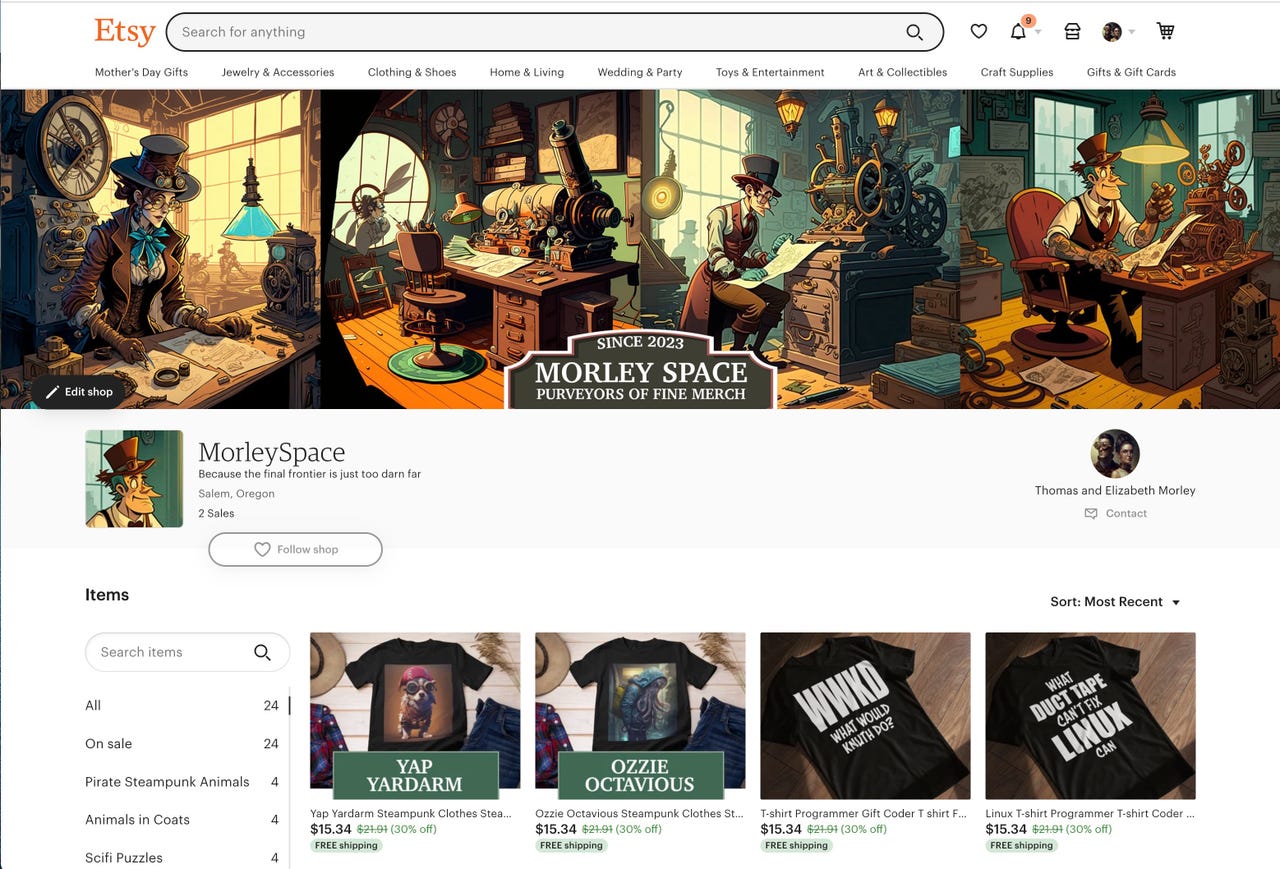
Home page of the Morley Space Etsy Store. The four images in the banner were entirely generated by AI.
I recently devoted about a week of my time to setting up an Etsy storefront. In this article, I'll show you how (and probably more interestingly, where) I used AI to create my experimental Etsy print-on-demand business.
The career-expanding power of side-projects
I have long adopted the practice of side-project time. While my ZDNET articles have regular deadlines, much of my other work — especially client projects — comes in waves. During seasonal downtimes, I will often pick a side project and give it a go. I wrote two very popular books during side-project time, built a bunch of software products, created something like 40 pinpoint iPhone apps, designed and built a self-lifting motorized CNC cart, and more.
Also: The best AI art generators right now
These side projects aren't necessarily meant to be side hustles. For me, side-projects are about learning and exploring new skills, stretching my capabilities, and maintaining my technical chops. I then take those learnings and fold them back into my main work, which brings us back to the topic of this article.
I've been exploring generative AI in a big way since just before Christmas last year. Although I've studied AI for decades, the capabilities of generative AI in tools like ChatGPT and MidJourney took me by surprise. Like many of my colleagues in the AI world, I honestly thought we were 20-30 years away from the astonishing level of functionality we've been seeing in the past few months.
Also:The new (and improved) AI-powered Bing is now open to everyone
So, here we are, living in the future. I've shared my worries with you, but I haven't delved too far into the benefits. Could generative AI be used to cut work time, create new value, and actually create products — in a fraction of the time such tasks have taken in the past?
That's what this side project is all about.
(Note: Throughout this article, I'll be showing you AI prompts and responses. The prompts will be in bold and quoted, or flagged as such in bulleted lists. The AI's responses will be in italic text.)
Etsy print-on-demand integration
Etsy has the ability to directly tie its online catalog to print-on-demand service providers. This means that if someone orders a T-shirt or a pillow with a unique design from Etsy, it can send that order to a print-on-demand fulfillment service, which in turn will produce the design and ship it out.
Also:How to use Stable Diffusion AI to create amazing images
All picking/packing, production, inventory, and fulfillment are accomplished remotely. It's not necessary for an Etsy store owner to deal with any of that themselves. That means no inventory piling up in the garage, no runs to the post office, and no unsold inventory when the product sales mix turns out differently than the forecast.
This seemed perfect for my experiment. I set up an Etsy store that sells T-shirts, pillows, puzzles, and notepads. As soon as any of the products are ordered, the order is transferred from Etsy to (in my case) Printables, which prints the items ordered and sends them to the customer.
All I, as the store operator, have to do is set up the designs, and pay both Etsy and Printables for their part in the service supply chain. If the products sell, Etsy sends me the customer's payment (minus their fees), which constitutes my profit from the endeavor.
Also:This new technology could blow away GPT-4 and everything like it
In the remainder of this article, I'll talk about the store's creation, and where I used generative AI in each of the tasks involved in setting up the products and store identity.
Full disclosure: This Etsy store is in operation right now, and I get paid for product sales. Because this article is intended to be educational and not a sales pitch, I've discounted all the store's products to my cost for the next month. If any of my readers do decide to purchase from the store, I won't make any profit (even though Etsy and Printables will). I trust that approach will protect this article from any conflict-of-interest issues.
And with that, let me introduce you to Morley Space . . .
Morley Space: Purveyors of Fine Merch Since 2023
One of my favorite games of all time is Bethesda's Dishonored. Playing it, I encountered the name Morley, which is one of the four main islands in the Empire of the Isles.
Since I wanted to have a steampunk aesthetic in my Etsy store, and Dishonored has a very definite steampunk vibe, I decided I liked the name Morley for my store. I decided to use Morley Space as the store name because I wanted my online store to feel like an emporium, a space for creative products.
Also: How to use Midjourney to generate amazing images and art
It was in creating this online identity that ChatGPT and MidJourney were first used. I wanted a banner across the store to reflect that steampunk vibe, with a bit of a cartoon feel. I asked MidJourney to create images with the following characteristics:
1940s style color cartoon of a steampunk era artist studio.
I was astonished when it generated the following set of pictures.
I didn't like this first pass.
I didn't like the faces in them, so I had MidJourney give me variants of each of the four images, finally settling on the four that I then used in the shop's banner.
The shop's main identity banner.
Using Photoshop, I split the images so they were splayed out horizontally, and added the sign panel. And I had a very compelling shop header with the exact design feel I was going for. All told, it took me probably 30 minutes to get my shop's banner put together, with MidJourney doing the heavy lifting.
Also: Want Photoshop for free? You can have it, but there's a catch
Etsy also wanted a slogan for the store. So I gave ChatGPT the following prompts until it presented me with one I liked:
Write 20 snarky slogans for a company named Morley Space
Give me 20 more
After a few spins of the "20 more" prompt, it gave me "Because the final frontier is just too darned far," which I decided was perfect.
Creating Thomas and Elizabeth Morley
In addition to a store name, I needed a proprietor. Etsy likes to put the name of the owner right on the home page. As part of the experiment, I asked ChatGPT to provide me with Victorian-era British first names, and among the list were Thomas and Elizabeth. So Thomas and Elizabeth became the proprietors.
Etsy also likes a store description. I found that asking ChatGPT to provide a description for both Thomas and Elizabeth seemed to confuse it, so I settled on this query:
Write a 250-word bio for Thomas Morley, the proprietor of a custom merch shop, who has traveled the world, mixes technology and art, and seeks out the best artists for t-shirts, coffee mugs, and other essential merchandise.
I then heavily edited the response, adding in details about Elizabeth, and tweaking it a bit to include phrases like "They are the proprietors of a custom merch shop that specializes in showcasing the work of talented artists and algorithms from around the world." You can read the entire description on the main page of the shop by scrolling down to The Morley Space Story.
Also:The best AI chatbots to try
Finally, Thomas and Elizabeth needed a profile picture. So it was back to MidJourney. Here, I used the prompt:
hyperrealistic man and woman wearing steampunk goggles
I got back the following four images and chose the one on the upper right to represent Thomas and Elizabeth. To be fair, if I wanted an image that more closely represented me, I could have used:
hyperrealistic man with beard wearing steampunk goggles and top hat
I actually ran that prompt first, but didn't think that those scary, pompous-looking characters were inviting enough for the Morley Space vibe.
Making the merch
So now it was time for the merch. After watching several YouTubers talk about print-on-demand (PoD) and Etsy, I decided to use Printables as my merchandise producer and fulfiller. This decision is important because the merchandise producer dictates the selection of PoD merchandise you can offer, where you can ship, and — often — product quality.
Also:Would you listen to AI-run radio? This station tested it out on listeners
Although I wanted to use MidJourney to produce some designs, I also had a cool collection of licensed art that I'd invested in for a previous project, and I wanted to use some of those images (which included some great steampunk animals) as well. In addition, I wanted to put some pithy sayings on a few T-shirts, mostly because they appealed to me.
All told, I fielded 24 products in the following categories:
T-shirts: steampunk animal designs from my licensed art collection
T-shirts: pithy sayings almost nobody but me would groove on
Puzzles: retro-futuristic images generated by MidJourney
Pillows: cartoon steampunk generated by MidJourney
Notepads: clockwork clown designs from my licensed art collection
The pillows used the same artwork as the main shop banner, so you've seen that prompt. I created a series of four retro-futuristic puzzles. The MidJourney prompt was merely this:
retro-futuristic
The results were just so good that I decided to use them as-is.
If I ever decide to put up new designs on the shop, I have these that were generated by MidJourney using the simple prompt of:
atom punk
Sometimes, it's possible simply to state a genre and let the AI go wild. Here's another one-word prompt with a similar genre:
dieselpunk
Here's another that is certainly usable on T-shirts and notebooks:
steampunk
Because MidJourney uses seeds to randomize results, it's extremely unlikely that what a "steampunk" prompt produces for me would be the same as what "steampunk" produces for you. In fact, as a test, I typed /imagine (what MidJourney uses to trigger a prompt) and typed in "steampunk" while writing this. Here are the images produced today:
That last image grid was produced using MidJourney v5, which adds a bit more photographic quality to the image. All the rest were done with MidJourney v4.
Using ChatGPT to name characters
I wanted Morley Space to have a lot of information for each product because I pictured Morley Space as a real-world shop or catalog, where the items would have long, detailed, glorious descriptions and backstories. I wanted each item to have a compelling name that reflected the steampunk-ish vibe. I used ChatGPT to help with producing all this content.
Also:How to write better ChatGPT prompts
For the steampunk animal T-shirts and clockwork clown names, I gave ChatGPT prompts like:
Write 10 full names for an anthropomorphic gecko who wears a hat.
Give me ten more without the word gecko.
Give me ten more without words that mean lizard or gecko, but just provide the feel for the name.
List 20 words that rhyme with gecko (and begin with a soft G).
Make them two-syllable words.
Give me 20 full names for a polar bear that wears a coat and sailor's cap.
Give me 20 cool first names for a polar bear whose last name is chillybear.
Do that but use people names.
Give me 20 unusual people names that begin with C and would go well with the last name of chillybear as a storybook character.
Give me 20 full storybook character names for an anthropomorphized polar bear who wears a cap.
Imagine if Wonderland was all clockwork and steampunk and if the white rabbit had a name that fit his steampunk story origins. Give me 20 first and last names, no titles.
Give me 20 possible last names that imply rabbit.
Give me 20 adorable first and last names for a dog who's also a pirate.
Give me 20 intimidating names for a bulldog who's also a pirate.
Give me 20 Victorian last names that begin with a soft G.
Give me 20 names for a kitten who is also a steampunk pirate.
From these lists (a few spun repeatedly with "give me 10 more), I chose: Hector Hare, Growler Grimley, Asp Ashworth, Boots Clockpurr, Arthur Decko, and Chester Chillybear. I used a similar set of prompts to name the clockwork clowns, the retro-futuristic puzzle designs, and the Victorian offices and studios in my images.
Using ChatGPT to write character stories
Next up were the product descriptions, and here I decided that each product would first tell the story of the subject and then provide a description of the product. So, for example, Abner Squawkwell (one of the notebooks) has this character story, generated by the AI:
Gentlemen, behold Abner Squawkwell, a remarkable creation of modern artifice and engineering! This clockwork clown skull, with its large teeth and wide, eerie smile, is a spectacle to behold. Its gleaming red nose serves as a beacon of merriment, beckoning all to come and witness its mechanical marvels.
As the cogs within its clockwork mechanism turn, Abner Squawkwell is brought to life, his movements as smooth as they are precise. Its creators have truly outdone themselves, for Abner is not just a machine, but a work of art.
With its uncanny appearance, Abner Squawkwell is sure to evoke a range of emotions from all who behold it. Some will be filled with wonder and delight, while others may be struck with fear and trepidation. But make no mistake, Abner Squawkwell is a marvel of science and technology, a true testament to the boundless imagination of man.
So, come one and all, and witness the clockwork clown skull that is Abner Squawkwell, a creation unlike any other in the world.
Also:How to use ChatGPT: Everything you need to know
To create these stories, I used prompts like these:
Tell a five-year-old the story of Yap Yardarm, a small dog with a big spirit who sailed with pirates. Do it in two paragraphs.
In the style of Jules Verne, write a two-paragraph storybook description of the personality of Hector Hare, a tough-as-nails anthropomorphic rabbit who lived during pirate times, suitable as a story for a five-year-old.
In the style of a Grimm fairytale, write a two-paragraph description of the personality of Hector Hare, a tough-as-nails steampunk rabbit who… [fill in the blank].
Tell a five-year-old the story of Boots Clockpurr, an incredibly cute cat with a hard, take-no-crap personality, and how he served as an equal with bands of roving pirates.
Tell me a one-paragraph story in a news style about Stanley Chortlehoot a clockwork robot skull with a wide grin.
Write a description in the style of Jules Verne about Abner Squawkwell, a clockwork clown skull with big teeth, a wide, scary smile, and a red nose.
I selected the stories and asked refining questions of the AI. I also did a final edit. But the backstories of 20 characters would have taken a lot longer than a couple of hours if I'd had to write them all from scratch myself. The pithy saying T-shirts didn't get stories.
Also:How to use ChatGPT to write an essay
Most of them, like Abner's story above, were cute, fun, and frankly good enough for an Etsy store description.
Using ChatGPT to write product descriptions
I wanted product descriptions for each product to go along with the backstories of the characters. It wouldn't do to just say something was a cotton T-shirt or a pillow or a puzzle. I wanted detailed, welcoming, almost overwhelming descriptions that evoked a special feeling about each product.
In short, I wanted Jony Ive.
And so, because ChatGPT can channel the style writing style of particular individuals, each product category got a treatment like this:
In the style of Jony Ive, write about a square throw pillow that comes in 14-inch, 16-inch, 18-inch, and 20-inch square sizes, is 100% spun polyester made from recycled polyester, and has a beige plastic zipper with metal head that allows removing of the pillow cover for cleaning. The pillow is custom printed from an original steampunk 1940s style cartoon illustration.
ChatGPT produced:
Presenting the Square Throw Pillow, a masterpiece of form, function, and sustainability. With four sizes to choose from — 14-inch, 16-inch, 18-inch, and 20-inch — this pillow is the perfect addition to your home's décor.
Crafted from 100% spun polyester, derived from recycled materials, this pillow is a harmonious blend of comfort and eco-consciousness. The fabric is soft to the touch and beautifully complements any décor style.
But what truly sets this pillow apart is its custom print. Inspired by the steampunk 1940s, this original cartoon illustration is a bold expression of creativity and individuality. The print is meticulously crafted, bringing the whimsical charm of the steampunk aesthetic to life in your home.
We've also thoughtfully designed the pillow's closure, incorporating a beige plastic zipper with a metal head. This not only adds to the pillow's visual appeal but also provides practical benefits — the cover can be easily removed for cleaning.
This Square Throw Pillow is more than just a pillow. It's a work of art, a fusion of innovation and style. And with its commitment to sustainability, it's a product that enhances your home, and the world around you.
Also:I used ChatGPT to write the same routine in these ten obscure programming languages
I tried a bit more to refine it:
In the style of Jony Ive, describe the health benefits of a pillow made from recycled 100% spun polyester
And ChatGPT gave me:
At the heart of our design philosophy is the belief that products should not only look beautiful, but also enhance people's lives. And that is exactly what our Square Throw Pillow, made from 100% spun polyester derived from recycled materials, accomplishes.
This pillow is not just aesthetically pleasing, it is also beneficial to your health. The 100% spun polyester fabric is soft to the touch and provides the ultimate comfort for a good night's sleep. The material is also hypoallergenic, making it a great choice for those with sensitive skin or allergies.
Furthermore, by using recycled materials, we are not only reducing our environmental impact but also providing a healthier sleep environment. Traditional pillow materials, such as feather or down, can harbor allergens and bacteria, leading to a less than optimal sleep experience. Our recycled polyester pillow is not only a greener option, it is also a cleaner one.
In conclusion, our Square Throw Pillow is a perfect example of form and function seamlessly blending together. With its commitment to sustainability, health, and comfort, it is a product that truly enhances people's lives.
Also:How to make ChatGPT provide sources and citations
I asked for one more run:
In the style of Jony Ive, explain why throw pillows are valuable for room décor and design
ChatGPT responded:
Throw pillows are a testament to the power of simplicity and elegance in design. They are small details that make a big impact, adding texture, color, and comfort to any room.
At their core, throw pillows are versatile and functional pieces of décor that allow for endless possibilities in terms of design. They can be used to add a pop of color to a neutral room, complement a room's existing palette, or even serve as the focal point of the space. The options are limited only by one's imagination.
But beyond their aesthetic value, throw pillows also play a crucial role in comfort. They provide support for reading, watching TV, or simply lounging, adding a touch of coziness to any space.
Our Square Throw Pillow is a prime example of how throw pillows can enhance a room's décor. With its customizable print, neutral color options, and commitment to sustainability, it is a statement piece that not only adds visual interest but also comfort.
In conclusion, throw pillows are an essential element in any room's design. They offer endless possibilities for customization, add comfort and coziness, and enhance the overall aesthetic of the space. It is a testament to the impact that small details can have in shaping the look and feel of a room.
Also:How to use the new Bing (and how it's different from ChatGPT)
I did this sort of thing across the product line. I took all of ChatGPT's responses and edited them together, pulling the best points from each version. I won't make you read all of the descriptions (you can visit the Etsy store if you want to see them). But one thing I will point out is that I took a few extra minutes to have ChatGPT talk about the health benefits of puzzles.
Describe in one paragraph the social benefits of puzzle solving as well as the benefits for those who are alone. Cite your sources.
ChatGPT responded:
Solving puzzles has many benefits, both for people who are alone and those who do it with others. According to a study published in the Journal of Applied Gerontology, older adults who regularly engaged in leisure activities, such as jigsaw puzzles, had an increased sense of social connectedness and well-being.
Additionally, a study published in the Journal of Leisure Research found that working on jigsaw puzzles with others can lead to increased communication and social interaction, which can help to foster a sense of community and belonging.
Furthermore, for those who are alone, a study published in the Journal of Occupational Therapy found that completing jigsaw puzzles can provide a sense of accomplishment and distraction from feelings of loneliness and it can also help to improve mood and self-esteem, especially in older adults.
Now, here's where marketing and journalism part ways. Knowing full well that ChatGPT doesn't always cite valid sources, I left the sources in the above product description because the journals actually exist and the findings make logical sense.
Also:How to make ChatGPT provide sources and citations
For my experiment, I was looking at how to produce this sort of work fast, which is how I expect most people will use the tool. It's not great, but it is a realistic observation. Since I didn't have access to individual paywalled journal articles to find exact quotes, I left the citations as ChatGPT provided them.
The rest of the story
So there you are. In less than a week, I created a unique-looking Etsy store with a complete identity and a lot of unique text and art — almost none of which I created myself.
That's not to say it wasn't a lot of work. I edited everything ChatGPT produced. I played a lot with MidJourney to get to know it. I used Photoshop to convert images to formats I needed and Eagle to organize all my art assets.
Also:How to use ChatPDF: The AI chatbot that can tell you everything about your PDF
Plus, the process of setting up a store, each product, and each listing on Printables and Etsy is rather tedious. I found no way to automate the process, or pull listing information from one Etsy product into another, so I spent an inordinate amount of time filling in forms. For this extensive and unpleasant task, the AIs were no help at all.
What about my bottom line? I had no sales in the first month. In the second month, I sold two T-shirts to one buyer. And I had no sales in the third month.
To be fair, Etsy is huge and product discovery is difficult. To make matters worse for new stores, the social proof of lots of positive comments doesn't exist, because the customers aren't there yet. So it makes sense that a customer might buy a steampunk cat T-shirt from a vendor with hundreds of positive reviews, and skip a vendor with no reviews.
Also:This free iPhone app lets you video chat with a ChatGPT-powered digital avatar
I did try ads for the second and third months, but even though I allowed for a fairly hefty ad spend, Etsy didn't serve the ads all that often. I allowed Etsy to spend up to $20/day on advertising, but wound up spending a total of $16 for the two months, total. I've since turned the ads off.
SEO was clearly a big issue, as was my rather niche product selection. Unfortunately, ChatGPT wasn't able to help me with SEO at all. With short prompts, it just produced short, relatively unusable results. I don't know enough about Etsy SEO to train ChatGPT to produce better results with more extensive prompts.
As for the AIs, there's a lot to think about. MidJourney is astonishing, but it's also a bit stubborn. It really likes putting characters in images. Convincing it to produce exactly what you want, or to work on variations of a similar scene or character, is a lot of fiddly, arcane work. In some ways, it's a lot like working with a temperamental human artist.
Also:Why open source is essential to allaying AI fears, according to Stability.ai founder
ChatGPT took on a lot of work that back in the day would have been perfect for an in-office or virtual assistant. I can certainly see handing a junior product manager or intern all the products and telling them to produce product descriptions in the style of Jules Verne and Jony Ive. So, in that context, ChatGPT can do the work of some humans, and can definitely impact job security.
On the other hand, I haven't had an assistant or virtual assistant in more than a decade, and I'm unlikely to hire one in the future. So having ChatGPT to help crank out all those descriptions was a help, and didn't put anybody out of work. And, if I'm being honest here, it was fun interacting with the AI and getting back a wide range of answers that I could then transform into final copy. It felt like a real collaboration.
Also: How to use ChatGPT to write code
As a guy who's been exploring AI for my entire professional career, I experienced collaborating with these AIs as something far beyond the basic Turing Test and something of a dream come true. It was also a bittersweet feeling because I'm fully aware of the implications of what generative AI can do to many professional careers, and that scares me.
So what are my final conclusions?
Starting an Etsy store and doing print-on-demand products is easy, if tedious on a product-by-product basis.
MidJourney can produce astonishing images, but you need to guide the AI and know how to use those images. Plus, you need to manage their curation and be able to Photoshop them until they're appropriate for use.
ChatGPT can be a great brainstorming tool and bulk writing assistant, but you'll need to be involved in editing and tuning to get what you want.
Getting actual sales on Etsy is disappointingly difficult, even with cool products and a multi-month ad commitment.
For now, I'm keeping the store running. I might even add a few new designs. But I'm not advertising anymore, and I probably won't put much more energy into it, given it's not producing any real benefit other than a bit of job-related entertainment.
Do you have an Etsy store? What did it take for you to get it up and running? How long did it take for you to get sales? What tips do you have? Have you used ChatGPT or Midjourney to augment your content efforts? Let us know in the comments below.
You can follow my day-to-day project updates on social media. Be sure to follow me on Twitter at @DavidGewirtz, on Facebook at Facebook.com/DavidGewirtz, on Instagram at Instagram.com/DavidGewirtz, and on YouTube at YouTube.com/DavidGewirtzTV.
Deep learning firm Deci AI, has launched YOLO-NAS, its latest deep learning model that delivers superior real-time object detection capabilities and high performance ready for production. The foundation model is based on Deci’s Neural Architecture Search Technology, AutoNAC, which ensures unmatched precision and speed, surpassing other models like YOLOv6, YOLOv7, and YOLOv8, including the recently launched YOLOv8.
Deci’s AutoNAC technology is a revolutionary tool that democratises the use of Neural Architecture Search for all organizations, enabling teams to generate custom, fast, accurate, and efficient deep learning models promptly. AutoNAC delivers best-in-class deep learning model architectures for any task in any environment, achieving the best balance between accuracy and inference speed. It takes into account other components in the inference stack, including compilers and quantisation, in addition to being data and hardware aware.
The YOLO-NAS model delivers 50% (x1.5) more throughput and 1 mAP higher accuracy than other YOLO models, as shown in the chart, making it ideal for downstream Object Detection tasks in production environments.
The model is pre-trained on popular datasets such as COCO, Objects365, and Roboflow 100, making it highly suitable for real-world applications. The open-source model is available with pre-trained weights for research use (non-commercial) on Deci’s PyTorch-based, open-source, computer vision training library called SuperGradients.
Check out the GitHub repository here.
The post YOLO-NAS Sets a New Standard for Object Detection appeared first on Analytics India Magazine.

















 , which ensures unmatched precision and speed, surpassing other models like YOLOv6, YOLOv7, and YOLOv8, including the recently launched YOLOv8.