Council Post: Beyond ChatGPT – Exploring opportunities in the Generative AI value chain

A whole ecosystem, including hardware vendors and application developers, is emerging thanks to generative AI, which will help realise its commercial potential.

In the second half of 2022 and the beginning of 2023, tech pioneers unveiled generative AI solutions, astounding investors, business executives, and the general public with the technology’s capacity to generate wholly original and presumably human-made prose and images.

And well the response has been unprecedented.

One million people flocked to ChatGPT, a generative AI language model from OpenAI that produces original material in response to user requests, in just five days. For iPhone, Apple needed more than two months to achieve the same level of adoption. In comparison to Netflix, Facebook had to wait more than ten months to reach the same user base.

My role as a leader of Data & Analytics has given me a front-row seat to the benefits and risks of generative AI, and I have been spending time in evaluating several generative AI start-ups over the past few months. In my opinion, generative AI is not the omen of doom that detractors claim it to be, even though it is an effective tool that needs human oversight to use responsibly.

Over the past three years, venture capital firms have spent over $1.7 billion in generative AI solutions, with the largest money going towards AI-enabled medication research and AI software writing.

Additionally, ChatGPT is not the only company using generative AI. Within 90 days of its debut, Stability AI’s Stable Diffusion, which can create visuals based on text descriptions, received more than 30,000 stars on GitHub—eight times more quickly than any other package.

A brief explanation of generative AI

A branch of machine learning known as “generative AI” use algorithms to create new data, such as images, texts, or sounds. It resembles a virtual author or artist producing creative writing and art. However, it’s merely a group of brilliant algorithms at work behind the scenes, not a real artist or writer.

Transformer-based models and GANs (Generative Adversarial Networks) are the two most used generative AI models at the moment.

GANs are excellent at converting text and images into visual and multimedia content. Transformer-based models, such as GPT (Generative Pre-Trained) language models, can take in data from the Internet and produce a variety of content, including press releases, whitepapers, and articles for websites.

Why should you care about generative AI?

Well, there are a lot of explanations. Top three are as follows:

  • It can create entirely new data that doesn’t already exist. Think about the countless opportunities for investigation and experimentation!
  • By producing training data for fresh neural networks or developing top-notch deep learning architectures, it can enhance already-existing algorithms.
  • Basically, it’s a machine that creates better machines.

But that’s not all.

Gartner has declared generative AI as one of the most disruptive and rapidly evolving technologies in their 2022 Emerging Technologies and Trends Impact Radar report.

And get this – they’ve made some pretty bold predictions about its future impact.

By 2025, generative AI is expected to generate 10% of all data (currently, less than 1%) and 20% of all test data for consumer-facing applications. Plus, it’ll be used in 50% of drug discovery and development projects by 2025.

And by 2027, a whopping 30% of manufacturers will be using it to improve their product development process.

Generative AI is making waves. So, pretty important stuff, right?

Generative AI Industry-specific use applications

Business models that use generative AI can not only help businesses automate routine work but also increase income. One of the most practical uses of generative AI is content production.

Education

By leveraging generative AI, personalized lesson plans can provide students with the most effective and tailored education possible. These plans are crafted by analyzing student data such as their past performance, skillset, and any feedback they may have given regarding curriculum content. This helps ensure that each student, especially those with disabilities, is receiving an individualized experience designed to maximize success.

Logistics and transportation

The investigation of historically unexplored areas is made possible by generative AI’s precise conversion of satellite photos into map views. For logistics and transportation businesses wishing to explore new areas, this might be extremely helpful.

Travel industry

Systems for face detection and verification at airports can benefit from generative AI. The technology can make it simpler to identify and confirm the identity of travellers by assembling a full-face image of a passenger from images taken from various angles.

Banking

Another area where generative AI is proven to be a useful tool is fraud detection. With the use of their past data, banks are teaching ML and AI algorithms to suggest risk criteria. They can train the system to either ban or allow specific user behaviours depending on the likelihood of fraud by exposing generative AI to prior incidents of fraud and non-fraud. This makes fraud detection quicker and more effective than it would be with just humans.

It’s crucial to remember that the labour being automated is typically low-level, tedious, and repetitive, whether it’s fraud detection or product creation. To guarantee the end product’s quality and safety, human intervention is still required. The true benefit of generative AI is as a multiplier for general-purpose productivity and efficiency.

The Future Of Generative AI

The capabilities of generative AI are unknown to us. More than 30% of new medications and materials are predicted to be discovered by generative AI technology by 2025, which would result in significant cost savings for the healthcare sector. With the ability to foresee future market trends and investment possibilities to lower risk, generative AI is poised to be a potent tool in financial forecasting and scenario building. It has the potential to have a significant impact on the entertainment sector as well, giving businesses the ability to improve visual effects, preserve and colourize movies, and even age or de-age performers’ faces.

Generative AI can analyse enormous volumes of data and patterns, but it cannot take the place of human originality, creativity, and common sense. Therefore, human oversight is essential for its creation and implementation. Businesses and decision-makers should approach generative AI with caution in order to solve ethical issues and make sure that the future involves widening the economic pie to benefit humanity.

This article is written by a member of the AIM Leaders Council. AIM Leaders Council is an invitation-only forum of senior executives in the Data Science and Analytics industry. To check if you are eligible for a membership, please fill out the form here.

The post Council Post: Beyond ChatGPT – Exploring opportunities in the Generative AI value chain appeared first on Analytics India Magazine.


Salesforce goes all in on generative AI with Slack GPT

illustration of cartoon antrhopomorphic animals and humans in from of a sign with the Salesforce logo that says World Tour
Image: Salesforce

At the Salesforce World Tour in New York on Thursday, the customer relations management giant announced a broad range of plans to inject generative, large language model artificial intelligence capabilities into its platforms, including Einstein, Slack and Sales Cloud.

The technology will enable AI-supported emails, qualified leads and sales planning. Salesforce’s chief marketing officer Sarah Franklin took the stage at New York’s Javits Center to explain the risks and benefits of AI in CRM, noting that the company will forge ahead with generative AI for sales and CRM, albeit with guardrails and “human in the loop” protocols.

Jump to:

  • Slack GPT is third LLM for the communication platform
  • Einstein GPT
  • Workers want to use AI to cut non-productive work

Slack GPT is third LLM for the communication platform

Salesforce announced it is launching a natural language model AI into Slack, enabling low-code AI capabilities, various language models, as well as the power to add customer data insights from Customer 360 and Data Cloud.

Rob Seaman, who leads the enterprise product team for Slack, said there are now three LLM capabilities in Slack:

  • Slack GPT, which comprises native features leveraging LLM within Slack for things like summarization, message drafting and composition of text.
  • Integration of Einstein GPT, Salesforce’s LLM into Slack.
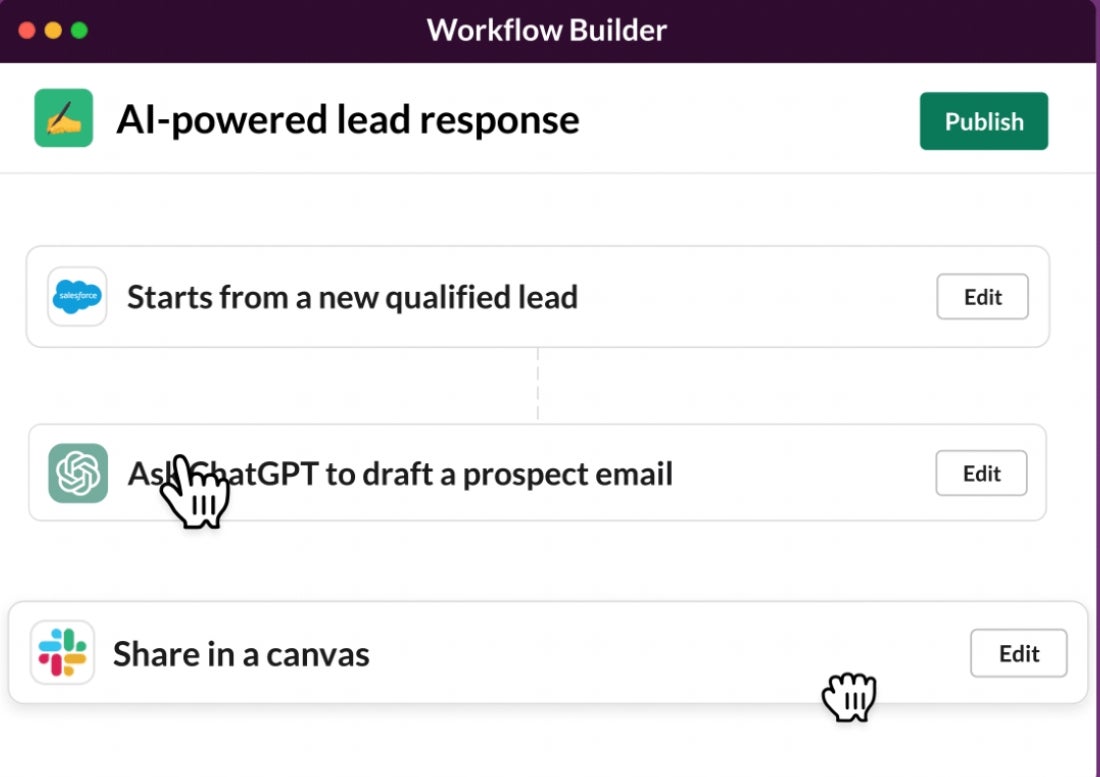
  • An AI-ready platform designed with OpenAI, based on ChatGPT, that lets people build workflows that make calls out to any LLM of their choice.

The latter option comprises no-code workflows that embed AI actions with step-by-step prompts with plug-ins for other LLMs from such providers as OpenAI and Anthropic (Figure A).

Figure A

Cursor hovering over an option in the Slack Workflow Builder to Ask ChatGPT to draft a prospect email
Image: Salesforce. OpenAI’s ChatGPT can be included in the Slack workflow.

Seaman said the AI integration would allow end users and third parties to build workflows, apps and microservices around such functions as summarization and transcription.

Salesforce last week made the AI-ready platform designed with OpenAI available for developers of allied apps and services. Einstein GPT is available as a beta version, and the company is currently prototyping the integration of Einstein GPT within Slack, according to Seaman (Figure B).

Figure B

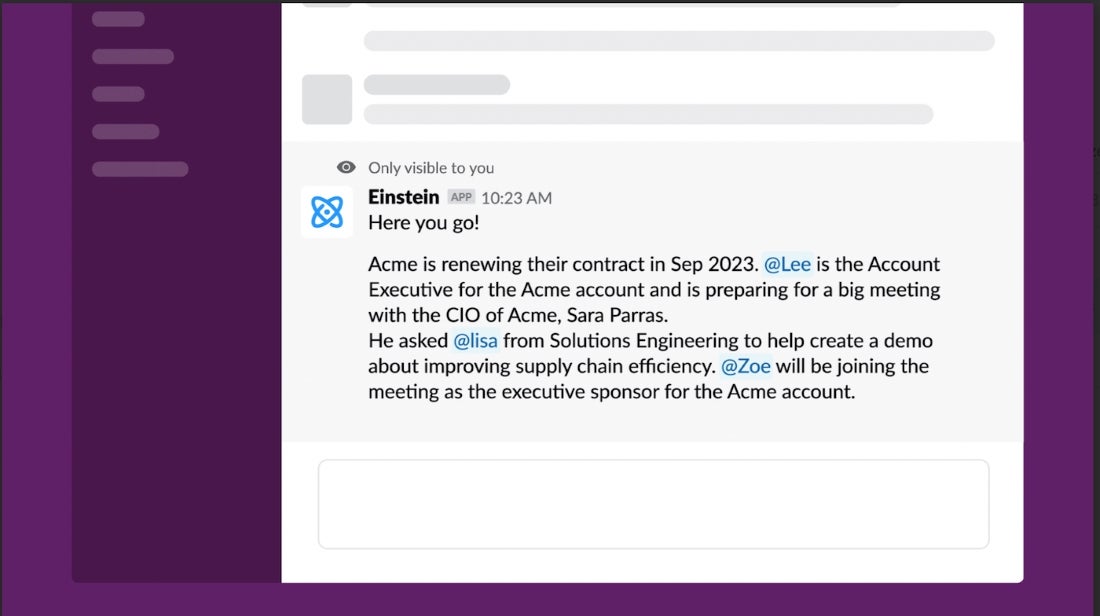
Einstein GPT function in Slack providing prompted information
Image: Salesforce. Einstein GPT function in Slack.

Usability and security are the goals

According to Seaman, key focuses in the development and deployment processes of infusing LLMs into Slack are end-user experience and security.

“A big part of what we want to do in Slack, one of our product principles, is don’t make the user think, so when these things are natively in Slack, we want to make it an experience that’s clear,” Seaman said. “Also, a lot of the most valuable information a company has, in the form of knowledge and communication, is in Slack.”

Seaman said the company is working on ways of leveraging the models on that data without that data actually traveling to and being stored in third-party data sources (Figure C). “Our enterprise customers would not be okay with that.”

Figure C

Right-click dropdown options of the Einstein generated message with options to Shorten, Elaborate, and Change text
Image: Salesforce. Edit options for Slack GPT-generated note.

SEE: At the last NYC World Tour Stop Salesforce spotlighted Customer 360 with integrations for Slack, Tableau and Customer 360 (TechRepublic)

As part of this process, Salesforce developed no-data-storage and no-data-training agreements with LLM entities like OpenAI, so that if any data were to leave and go to any of the third-party LLMs it could not be stored or commingled with other data sources for the purposes of training.

As previously reported in TechRepublic, the company earlier this year also released guidelines to reduce bias in AI models around verifiability, safety, honesty, empowerment and sustainability.

Multi-prong LLM strategy and a large app ecosystem

Seaman said there have been some 4,000 third-party apps built on the Slack platform in the last two months that specifically work with LLMs, including a lot of apps that customers have built.

“You will hear us say there are 2,600 apps in the app directly, but there are many more than that built by our users themselves,” Seaman said.

The ChatGPT and Claude apps are examples with use cases around summarization and drafting, allowing questions and natural language prompts like “Hey, I’m trying to write an email to a customer about our newest product launch. Can you get me a template for a prospecting email to go to several high-tech customers?”

Einstein GPT

In March this year, Salesforce first threw down the ChatGPT- generative AI gauntlet by announcing it would add ChatGPT functionality to its Einstein CRM AI platform. Among other things, it includes:

  • The ability to auto-generate prospect emails based on CRM data.
  • A tool called Einstein Bots for Sales that automates lead conversion, pre-qualifying web visitors.
  • Transcription and conversational AI analysis in multiple languages.

Workers want to use AI to cut non-productive work

The Slack State of Work report found 84% of senior IT leaders said generative AI will help their organization better serve customers and 67% of these leaders prioritized generative AI for their business within the next 18 months.

The report found desk workers who have adopted AI at their company are 90% more likely to report higher levels of productivity than those who have not. Those using automations at work reported saving an average of 3.6 hours a week.

At the World Tour, Salesforce also announced plans to collaborate with Accenture to accelerate the deployment of generative AI for CRM. Together, the companies intend to establish an acceleration hub for generative AI that provides organizations with the technology and experience they need to scale Einstein GPT helping to increase employee productivity and transform customer experiences, according to Salesforce.

Innovation Insider Newsletter

Catch up on the latest tech innovations that are changing the world, including IoT, 5G, the latest about phones, security, smart cities, AI, robotics, and more.

Delivered Tuesdays and Fridays Sign up today

AI for Everyone: Learn How to Think Like a Data Scientist – Part 1

Slide1

Warning: very long, 2-part blog series. But this topic is too important to not carefully explain how we can educate and empower everyone to participate in the AI conversation. Our success as a society depends upon our ability to include everyone in this conversation.

I love it when a plan comes together” – Hannibal Smith, “The A-Team.”

The most important blog I’ve written might be “Creating Healthy AI Utility Function: Importance of Diversity – Part I”, which highlights the importance of an inclusive, collaborative process for defining the variables and metrics that comprise a healthy AI Utility Function.

ChatGPT and its AI Generative counterparts, such as Google Bard, Microsoft Turing, and Facebook Blender, have raised everyone’s awareness of the power and dangers of Artificial Intelligence (AI). And the exploration and application of AI will grow exponentially over the next few years as more companies jump on the AI bandwagon, despite efforts by some to slow or even stop its development. But it’s too late. The genie is out of the bottle, and the race to exploit the powers of AI has already begun – whether we like it or not!

For AI to reach its full economic and societal potential will require everyone’s active participation in the meaningful, relevant, and responsible design, application, and management of AI. And I mean E-V-E-R-Y-O-N-E! It cannot just be the high priesthood of AI specialists, three-digit government agencies, and Silicon Valley tech companies.

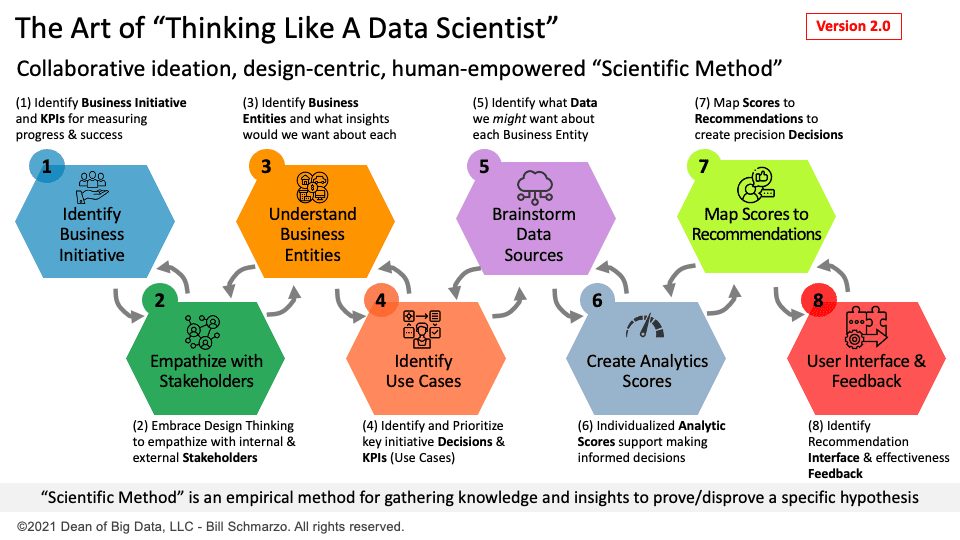
So how do we prepare everyone to participate in the age of AI? The “Thinking Like a Data Scientist” (TLADS) methodology has been honed over many years of application, learning, and adapting to precisely do that. The TLADS methodology is an inclusive, collaborative process for defining the variables and metrics against which organizations define and measure their value creation effectiveness. And with the mandate to create healthy AI Utility Functions that guide AI models to deliver relevant, meaningful, responsible, and ethical outcomes, the TLADS methodology’s day has come (Figure 1)!

Slide2

Figure 1: The Art of Thinking Like a Data Scientist (Version 2.0)

Leveraging the TLADS methodology, we can create a playbook that anyone can follow that lays out their role in the definition, design, development, deployment, and management of AI models that deliver relevant, meaningful, responsible, and ethical outcomes.

Step 1) Defining Value

The key to developing effective, relevant, ethical AI models is building a healthy AI Utility Function comprised of a diverse set of variables and metrics that guide the AI model’s decisions, actions, and ongoing learning and adapting.

As those of you who know me and have followed me for several years (decades?) know, I begin my customer conversations and classroom lectures by asking, exploring, and validating how organizations create value and measure their value-creation effectiveness. That is the foundation for my “Thinking Like a Data Scientist” methodology which has been honed and enhanced through many years of customer engagements and classroom exercises.

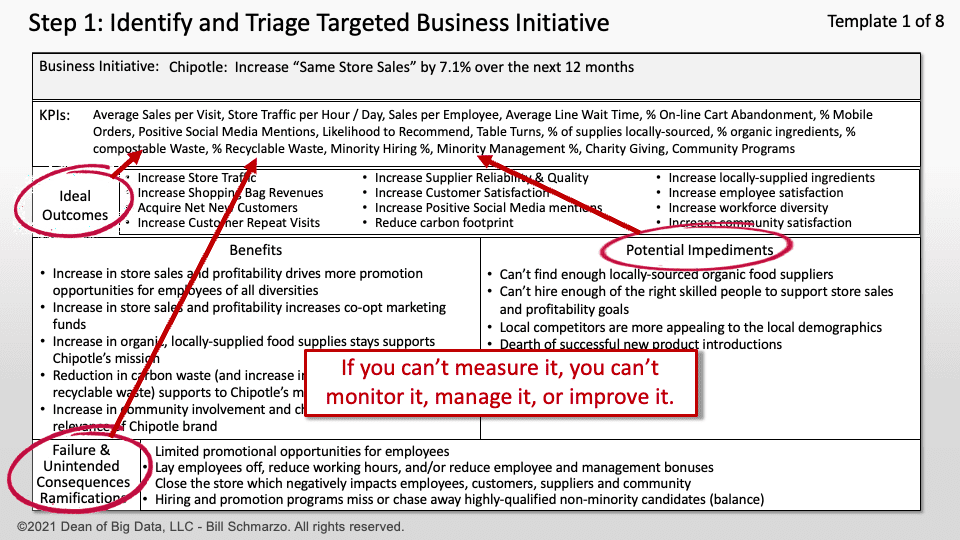
Step 1 of the TLADS methodology guides your organization through an extensive, collaborative exercise in identifying how your organization creates value, the desired outcomes from those value-creation processes, and the KPIs and metrics against which outcomes’ effectiveness will be measured. Then Step 2 expands and validates that value definition and measurement exercise by looking at the organization’s value creation processes through the eyes of its internal and external stakeholders – identifying their desired outcomes and the KPIs and metrics against which these stakeholders measure the effectiveness of those desired outcomes (Figure 2).

Slide3

Figure 2: Template 1 of “The Art of Thinking Like a Data Scientist” Methodology

Value can be a very subjective definition, which is why organizations need to engage a diverse set of internal and external stakeholders whose differences in perspectives are critical in developing AI models that serve everyone.

Step 2) Understanding How AI Works

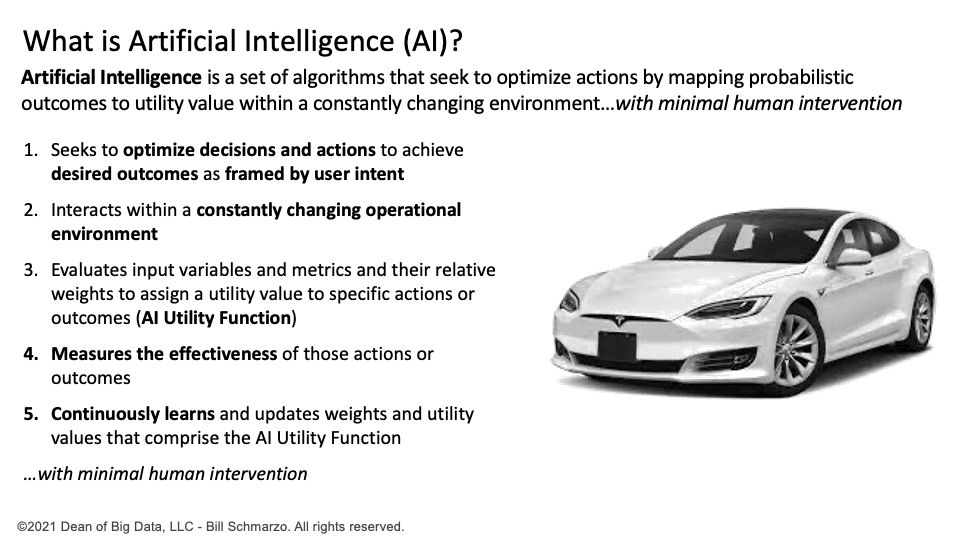
Artificial Intelligence is a set of algorithms that seek to optimize actions by mapping probabilistic outcomes to utility value within a constantly changing environment…with minimal human intervention

AI is a simple tool (not a living creature) that does exactly what you train it to do. The AI model seeks to optimize its actions to achieve desired outcomes as framed by user intent. The AI model constantly interacts with its environment and evaluates input variables and metrics and their relative weights to assign a utility value to specific actions (as defined by its AI Utility Function). Finally, the AI model measures the effectiveness of its actions so that it can continuously learn and update the weights and utility values that comprise the AI Utility Function…with minimal human intervention (Figure 3).

Slide4

Figure 3: What is Artificial Intelligence (AI)?

Yea, pretty straightforward. But there is a lot of power in successfully orchestrating those five capabilities, but at a high level, that is all that AI does. Invest the time to understand AI as a tool (and leave the AI boogie man to Hollywood and the tinfoil hat-wearing conspiracy mongers hanging on social media and pontificating on your favorite non-news news channel).

Step 3) Understanding the Role of the AI Utility Function

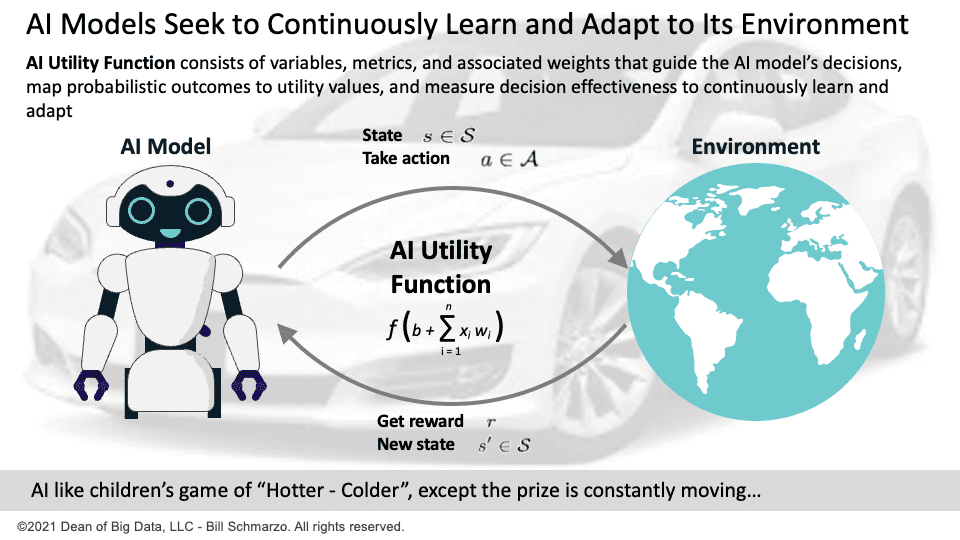
AI Utility Function consists of variables, metrics, and associated weights that guide the AI model’s decisions, map desired outcomes to utility values, and measure decision effectiveness to continuously learn and adapt.

The AI Utility Function is the key to the effective, meaningful, and responsible execution of your AI models. The AI Utility Function assigns values to the AI system’s actions based on the economic value of outcomes. The AI models’ preferences over possible outcomes can be captured by a function that maps these outcomes to a utility value; the higher the number, the more that agent likes that outcome (Figure 4).

Slide6

Figure 4: AI Utility Function

AI is like the children’s game of Hotter-Colder, with the AI Utility Function guiding the AI model’s actions in seeking the prize or desired outcome. The only difference? The prize or desired outcome is constantly moving or changing in the real world.

Summary: AI for Everyone – Part 1

For AI to reach its full economic and societal potential will require everyone’s participation in the design, application, and management of relevant, meaningful, and ethical AI models. To accomplish that, we must educate and empower everyone to think like a data scientist.

The Thinking Like a Data Scientist methodology is an inclusive, collaborative process for defining the variables and metrics against which organizations define and measure their value creation effectiveness. The TLADS methodology can help us create healthy AI Utility Functions that guide AI models to deliver relevant, meaningful, responsible, and ethical outcomes.

We can leverage the Thinking Like a Data Scientist methodology to create a playbook that anyone can follow to design, develop and deliver responsible and ethical AI models including:

  • Step 1) Defining Value
  • Step 2) Understanding How AI Works
  • Step 3) Understanding the Role of the AI Utility Function

In part 2, we will continue the AI for Everyone playbook to ensure that everyone understands their role – and their responsibility – in developing responsible and ethical AI models.

3 Ways to Access GPT-4 for Free

3 Ways to Access GPT-4 for Free
Image by Author

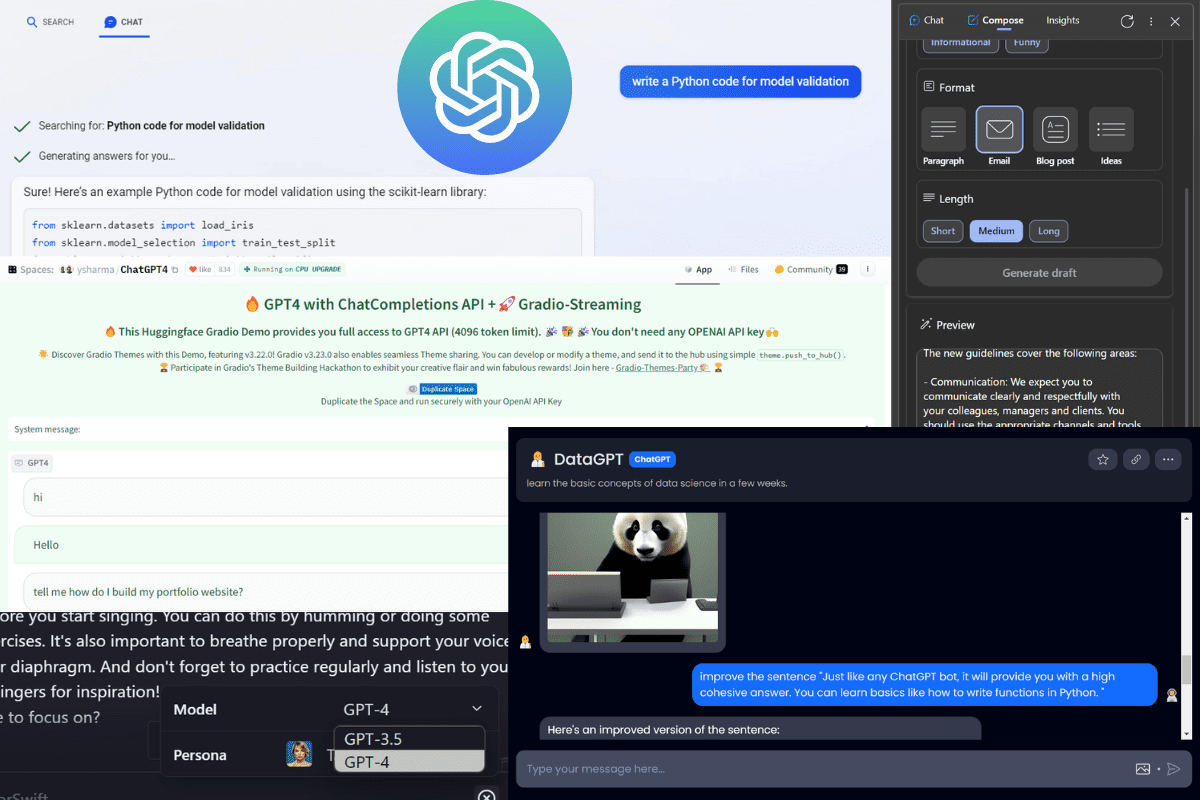
Open AI recently unveiled its latest AI model, GPT-4, which can process both text and image inputs to generate various types of responses. However, the GPT-4 API is not publicly available and can only be accessed by a limited number of individuals who pay a monthly fee of $20.

In this post, we will look at 3 platforms that allow users to test GPT-4 for free. Additionally, we will discuss a platform that plans to offer free access to GPT-4 in the future.

1. Forefront AI

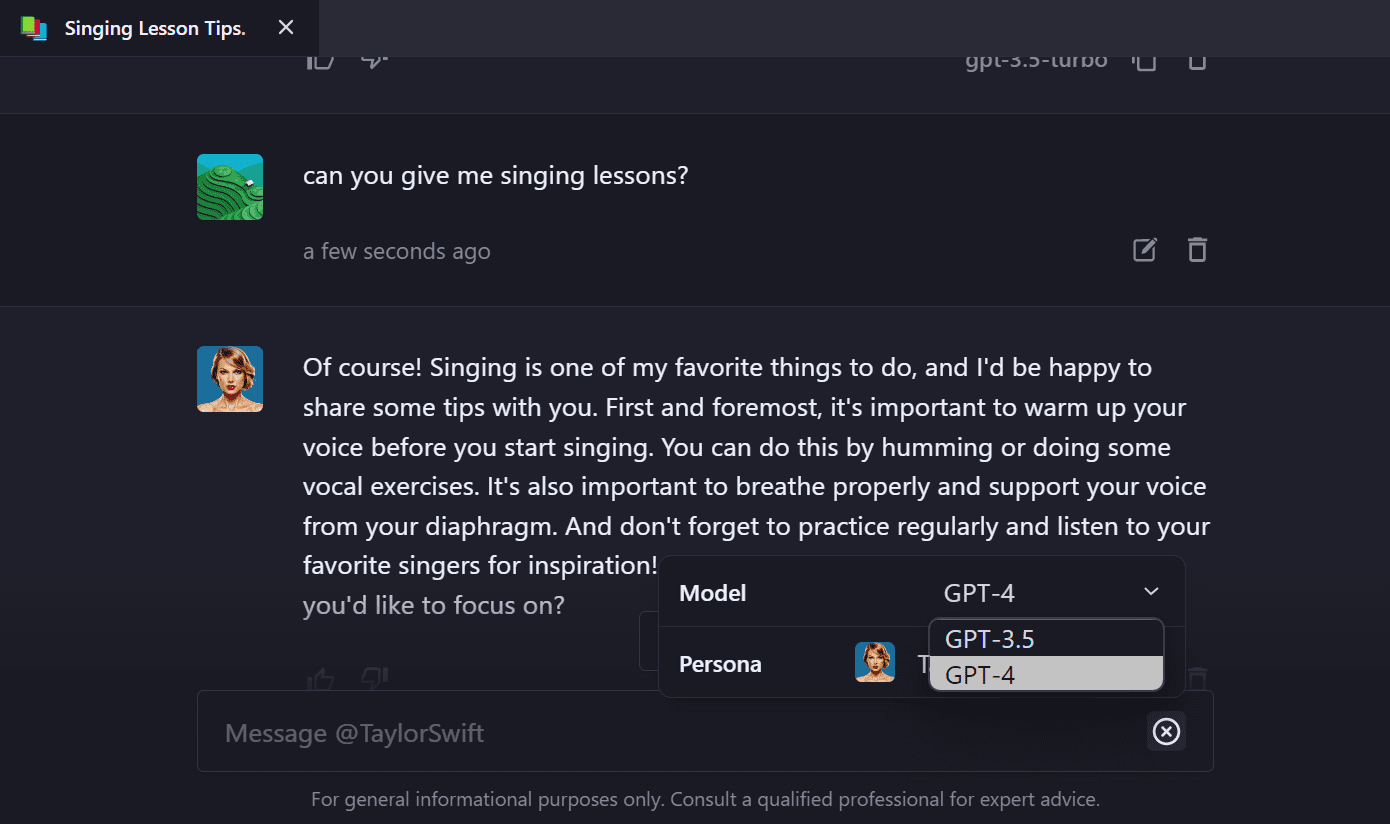
Forefront AI is a personalized chatbot platform that uses ChatGPT and GPT-4 on the back end. It is currently free and allows you to create your own fictional or real character. You can select a chatbot persona from a range of celebrities and historical figures.

3 Ways to Access GPT-4 for Free
Image from Forefront AI

Upon signing up, the platform prompts you to choose a persona and start chatting. You can easily switch between the GPT-3.5 and GPT-4 models by clicking on the plus button. Additionally, to add more excitement to your conversations, you can switch the chatbot persona in mid-conversation.

Overall, the platform is a fun and engaging way to experience GPT-4, and I highly recommend giving it a try before any potential paywall is introduced.

2. Hugging Face

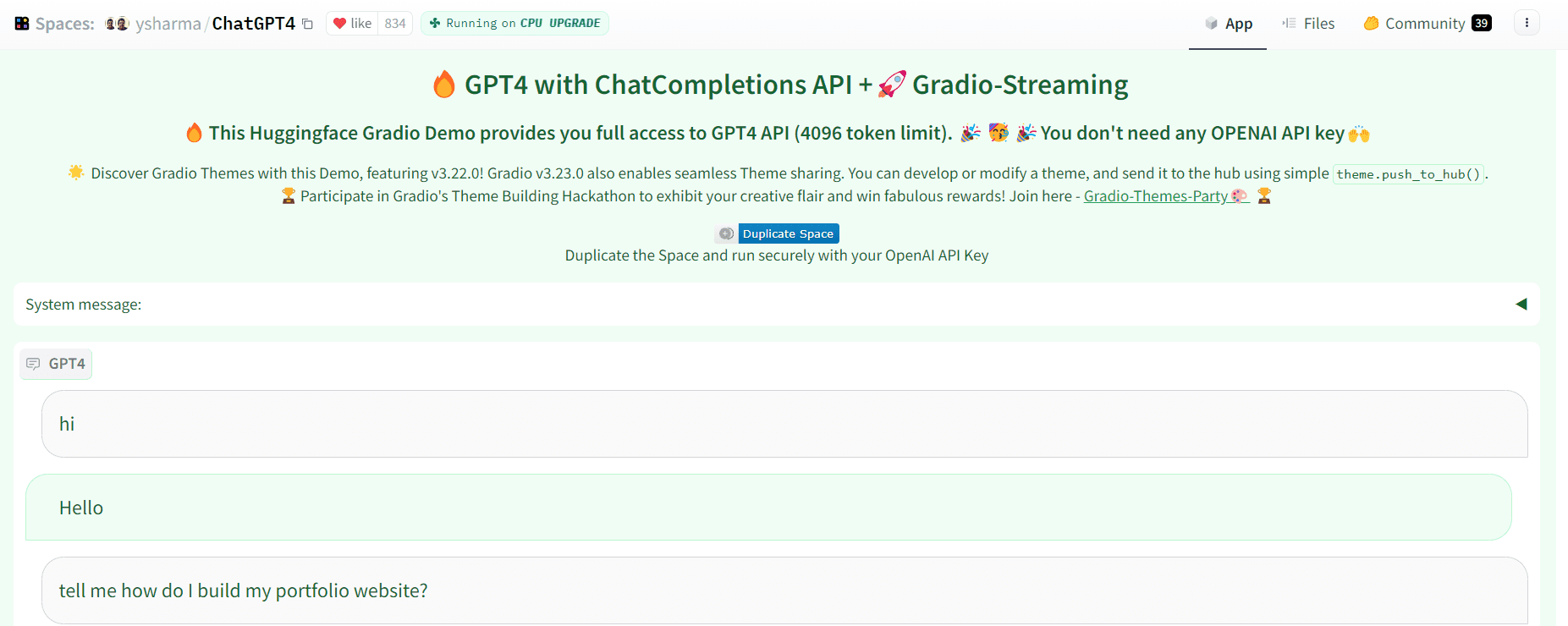
Chat-with-GPT4 is a web app hosted on Hugging Face. It is connected to OpenAI API and lets you experience GPT-4 for free. You might get a slower response due to high demand, but if you are patient enough, you will get a response.

3 Ways to Access GPT-4 for Free
Image from Hugging Face

In addition, you have the option to duplicate the space and add your own API key for private use, allowing you to avoid any potential queues.

3. Bing AI

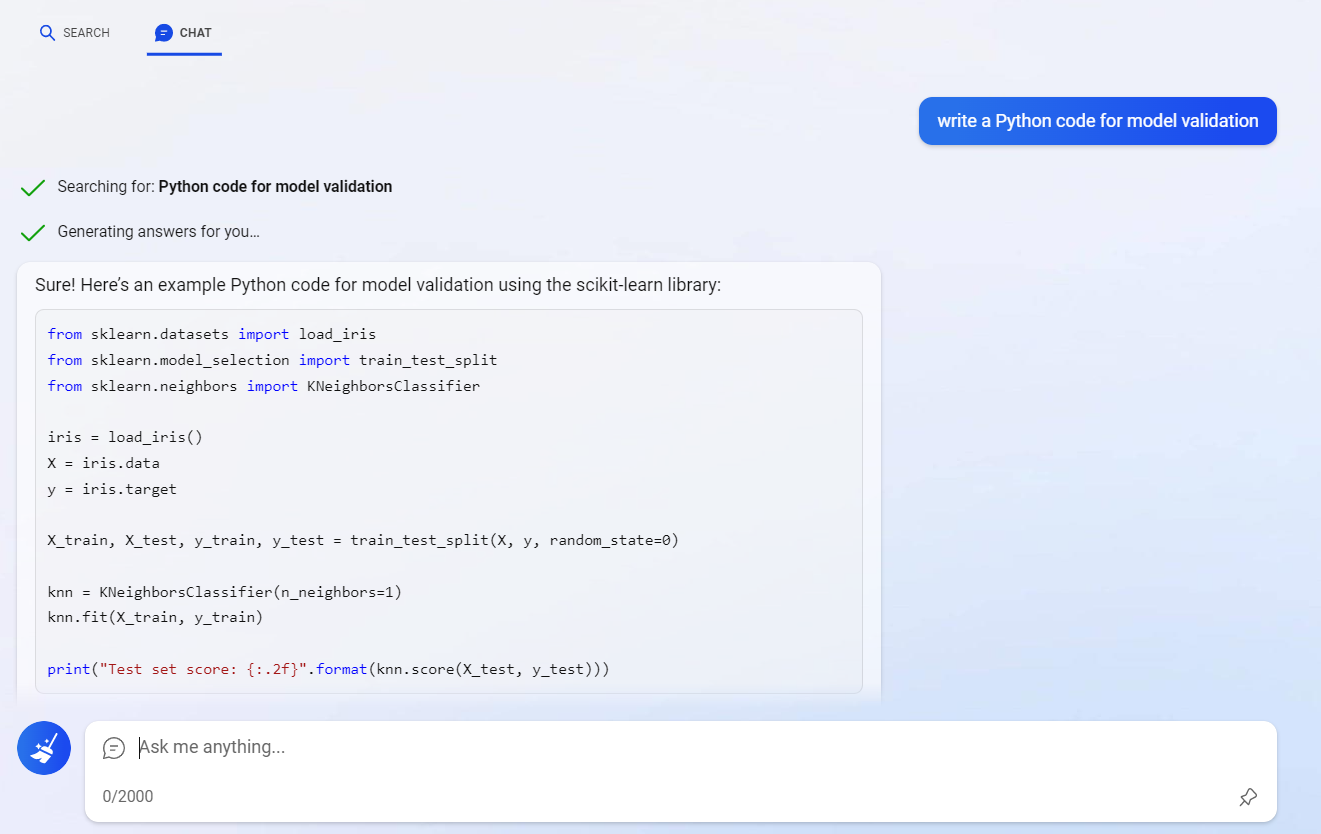
Microsoft Bing now features a range of AI tools powered by GPT-4 and DALLE 2. By signing in with a Microsoft account and clicking on the chat button, you can experience the power of GPT-4 for free. The platform is fast and accurate and provides links to relevant blogs for further research.

3 Ways to Access GPT-4 for Free
Image from Bing AI

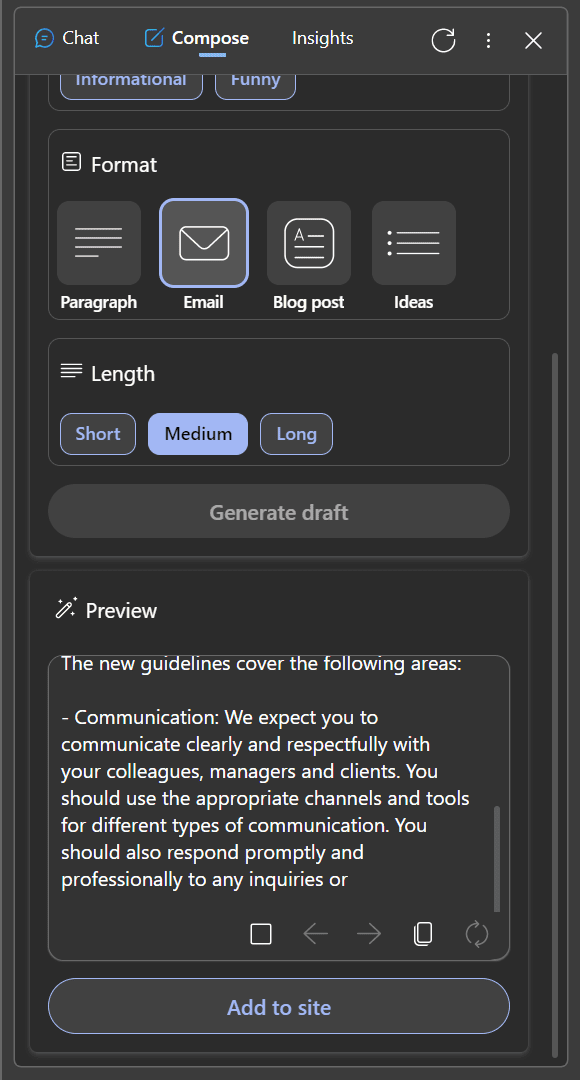
If you download and install Microsoft Edge, you can access GPT-4 on every website. You can use it to write emails, blogs, ideas, or paragraphs. Moreover, it comes with Bing AI chat features.

3 Ways to Access GPT-4 for Free
Image from Microsoft Edge

I use both of these tools on a daily basis for my work, and they have significantly improved my workflow.

Bonus

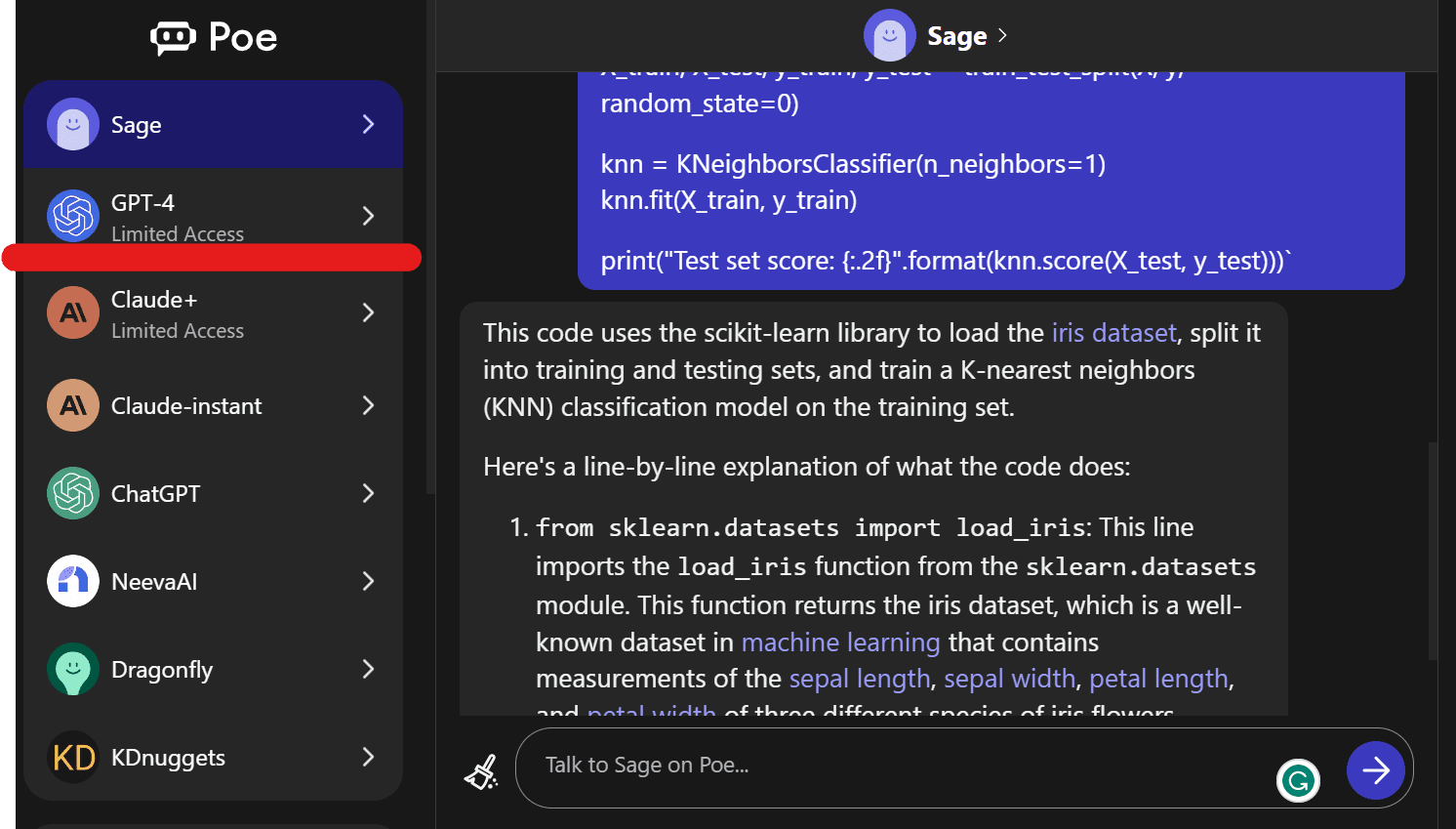
Both Ora AI and Poe used to offer free GPT-4 access but now they provide limited access.

Poe

Poe is a platform that enables users to experiment with cutting-edge chatbot models. It even allows you to create your personalized bot. Anyone can access GPT-4, ChatGPT, Claude, Sage, NeevaAI, and Dragonfly for free.

3 Ways to Access GPT-4 for Free
Image from Poe

Ora.sh

Ora.sh is a unique platform that not only offers personalized chat experiences but also allows users to generate high-quality images. Additionally, the platform provides access to over 350,000 bots created by Ora users.

3 Ways to Access GPT-4 for Free
Image from Ora.sh

Abid Ali Awan (@1abidaliawan) is a certified data scientist professional who loves building machine learning models. Currently, he is focusing on content creation and writing technical blogs on machine learning and data science technologies. Abid holds a Master's degree in Technology Management and a bachelor's degree in Telecommunication Engineering. His vision is to build an AI product using a graph neural network for students struggling with mental illness.

More On This Topic

  • Hone Your Data Skills With Free Access to DataCamp
  • 15 Trending MLOps Talks You can Access for Free at ODSC East 2022
  • 2 Coding-free Ways to Extract Content From Websites to Boost Web Traffic
  • 10 Pandas One Liners for Data Access, Manipulation, and Management
  • Great News for KDnuggets subscribers! You now have access to the…
  • 3 Possible Ways to Get into Data Science

Hear how Sensi.AI is building AI for remote patient monitoring

Hear how Sensi.AI is building AI for remote patient monitoring Kyle Wiggers 8 hours

Remotely monitoring patients without violating their privacy is a challenging task. But one co-founder believes that he’s cracked the code.

I’m excited to announce I’m speaking with Romi Gubes, the CEO of Sensi.AI, a startup developing audio-based algorithmic software to detect abnormalities that could indicate possible maltreatment of an impaired patient. We’ll be joined on this TechCrunch Live event by Sergey Gribov, General partner at Flint Capital and a board member at Sensi.AI, who previously founded the enterprise assets management company AB Systems.

This TechCrunch Live event is free to attend, and I hope you can make it. Register here.

We’ll cover a range of topics during the interview, particularly on the technical side of Sensi.AI’s platform, which monitors patients’ rooms in an ostensibly privacy-preserving way. Given the tendency of algorithms to pick up biases in the data on which they’re trained, there’s naturally a lot of skepticism around tech like Sensi.AI’s.

Gubes is set to speak on Sensi.AI’s engineering processes and the steps it takes to combat false alerts, as well as biases. He’ll also fill us in on how Sensi.AI came to be, and how it’s managed to raise $25 million in venture capital to date despite challenges in the broader startup economy — and the competitiveness of the health tech market.

Gubes and Gribov will also step outside Sensi.AI to talk about the growing interest in AI for a range of applications, from healthcare to industrial control to marketing. Gribov will provide the investor perspective, offering support for — or against — the notion that the AI craze isn’t dying down anytime soon. He’s well-positioned to do so, having worked in IT, software development, operations and general management for over 15 years.

It’s a lot of ground to cover. But we’re all ears when it comes to suggestions. Have a question you’d like answered? Send it ahead of the stream and we’ll do our best to work it into the show. Or if you register for the show here, you can submit the question live on Hopin.

TechCrunch Live is our weekly event series featuring top founders and investors. The show records live, most Wednesdays at 12:00 p.m. PDT. It’s free to register and attend. Watch past episodes on our YouTube channel and subscribe to the podcast here.

Register Here for Free

Most AI Doomers Have Never Trained An ML Model in Their Lives 

Most AI Doomers Have Never Trained An ML Model in Their Lives

Isaac Asimov, a mid-20th century science-fiction writer known for his Robot series, introduced the “Three Laws of Robotics” which play an essential role in discussions of ethical AI.

The first one states that, “A robot may not injure a human being or, through inaction, allow a human being to come to harm.” The second one states, “A robot must obey orders given to it by human beings except where such orders would conflict with the First Law.” And the third law states that “A robot must protect its own existence as long as such protection does not conflict with the First or Second Law.”

According to the 5 days long Artificial Intelligence Ethics programme by University of Oxford, these three laws are one of the focuses of the course. Interestingly, the program does not require detailed knowledge of AI/ML or how these systems work before governing and drawing ethical boundaries around them. It appears that anyone with any qualification can take this course and tout themselves as an ‘AI Ethicist”.

This raises the question: If a person who hasn’t built a single ML model in their life, what makes them qualify putting guardrails around these highly capable, even though scary systems?

AI Doomers are AI Boomers

Putting in the perspective of the AI doomers, a lot of them are influenced by all the movies that have been released all these years about “machines taking over the world.” It is clear they fear that the systems big-techs are developing that are increasingly being touted as getting towards sentience could end up taking over humanity.

However, even if someone like this takes a course on AI ethics without learning how machines learn, what qualifies them to make laws about AI?

Recently, the Israeli historian and philosopher Yuval Noha Harari expressed his skepticism about the possibilities of developing AI models like ChatGPT. “In the future, we might see the first cults and religions in history whose revered texts were written by a non-human intelligence,” said Harari. Seems like a far-fetched idea.

Warren Buffet has also shown his worry about the dangers of AI and compared it to the creation of the atomic bomb. Even the Pope called for ethical use of AI.

Interestingly, Geoffrey Hinton after leaving Google is also comparing AI with the atomic bomb. In 2018, he dismissed the need for explainable AI and also was in disagreement with Timnit Gebru, a former AI ethicist at Google, over the existential risks that these LLMs possess. In the past, Sam Altman has also compared the potential of the technology he is trying to develop with the atomic bomb.

On the other hand, when the AI experts like Hinton or Yann LeCun, who have been the godfathers of AI and are in this field since the beginning, raise concerns about the capabilities of these AI models, then probably the conversation starts to get interesting, and the questions around ethics start stirring up.

Hinton’s most important reason for leaving Google was to engage in conversations regarding the ethical implications of these AI models. He also in hindsight regrets building these models, and said that he should have started speaking about these dangers sooner rather than now.

Still Not on the Same Page

Last week, since the heads of Microsoft, Google, and OpenAI met with the Biden administration at the White House, there is increasing talk about the ethical implications of these products. Though there is no source to know what they spoke about, it might be about putting up responsibility on the leaders to make the AI ethical.

On the flip side, ever since the AI chatbot race started, the companies’ behind these “bullshit generators” started laying off their ethical and responsible AI teams. It seems as though the big-tech has found out that they do not actually require an ethical team to build guardrails around their products. The possibility is that an ethics’ concerned person on the team might hinder or question the steps and growth that the company is making with its product.

Moreover, when big-tech is trying to get ahead of the other one in the AI race, they might overlook the ethical part of these models. There is a possibility that the tech giants might now come on the same page as the governments about the concerns about it.

Before getting convinced with this statement, it is also important to understand that AI being ethical is an important aspect for big-tech as well. The problem arises when the ethical teams get fixated on solving the biases in systems instead of making them “safe”. To put it in the words of Elon Musk from the BBC Interview, “Who decides what is hateful content?”. But interestingly enough, Musk is one of the top voices who called for a pause on training giant AI experiments and is now building his own AI systems to rival OpenAI.

Even the creator of ChatGPT, OpenAI, has been increasingly vocal about the fears they have around these AI models. In an interview with ABC News, Altman said, “We’ve got to be careful here. I think people should be happy that we are a little bit scared of this.” Altman believes that as long as the technology is in his hands, it is safe and will try to remain ethical. He also said that society has a limited time to adapt and put safety limits on AI.

Coming back to the layoffs of the ethical teams from big-tech, it might be safe to say that they want to win the AI race instead of building “ethical” robots. Or maybe the case is just that the people who were laid off weren’t too aligned with the company they were working for. Who knows who is in the right?

Not All Ethicists Restrict AI

To clear the wheat from the chaff, it would be wrong to say that all AI ethicists do not understand about the AI systems and how they work. Ethicists like Timnit Gebru or Alex Hanna, who have been part of the big-techs building these AI systems are working towards solving the AI alignment problem at Distributed AI Research Institute (DAIR).

“A space for independent and community-rooted AI research,” DAIR deals with addressing the bias problems within these systems while also talking about the whole framework of how these models might be pervasive to the privacy of the users and citizens of the world. Maybe Gebru and Hanna parted ways from Google after looking at some serious ethical concerns.

Yes, goes both ways. But IMHO if you want to be taken seriously about sopping work on something really big and important, you might need to familiarize yourself with what is it that actual practitioners are doing.

— Bojan Tunguz (@tunguz) April 26, 2023

Moreover, there is a new breed of ethicists in the field of AI that talk about the rights of the AI. This goes with the third rule of robotics from Asimov, where robots can govern themselves. Jacy Reese Anthis, co-founder of Sentience Institute, when speaking with AIM said that we need an AI rights movement, “even if they currently have no inner life, they might in the future.” Clearly, the conversation is moving in the right direction.

This shows that maybe the only thing missing in the current stream of AI ethicists is the lack of AI knowledge and more of sociological understanding of the world. While the latter is immensley important, the missing of the former makes their stances get overlooked and dismissed. Big-tech needs more ethicists, with more knowledge about how the AI systems work. When that is the case, maybe we would be able to make AI “ethical”. Till then, the big-tech makes the move.

The post Most AI Doomers Have Never Trained An ML Model in Their Lives appeared first on Analytics India Magazine.
How Machine Learning is Revolutionizing the Healthcare Industry

machine learning in healthacre

Among all, the healthcare industry has always been a strong benefactor and has adopted
new technologies with open arms. It is getting benefitted and transformed by implementing
Artificial Intelligence and Machine Learning. The industry has already applied Big Data tools
for advanced data analytics and now Machine Learning is all set to help them improve the
process of automation & better decision-making in initial patient care and public healthcare
systems.

Applying ML in healthcare industry solutions also assists in disease detection more
accurately at a rapid speed, patient care, and individualized treatments. Machine learning in
the healthcare industry is now a growing field of research as patient data is becoming more
readily available for professionals and health systems that are helpful for treatment.
According to Grand View Research, the market of AI and ML worldwide which is valued at
$15.4 billion in the year 2022 is projected to grow at 37.5% CAGR from 2023 to 2030.
Below article will update you on how ML-integrated healthcare IT professionals are
benefiting the industry with its outstanding features. Let’s start-

The Role of Machine Learning in the Healthcare Industry

Machine Learning can be considered a specific kind of Artificial Intelligence that enables
systems to take help from data and analyze patterns without much human involvement. ML
is used in IT solutions to help businesses with process automation & streamlining,
personalize healthcare, etc. Machine Learning can be used to program systems or
computers to make predictions & connections while finding vital insights from large-scale
data that sometimes might be missed by healthcare providers.
The main objective of this technology is to augment patient results and generate essential
medical insights that were unavailable before. In particular, ML is the most exciting area of
AI and there are a lot of firms that are leveraging ML while attaining healthcare app
development services. The technology is able to detect and treat complex diseases and

overcome the occurred challenges in the healthcare industry such as lack of quality data,
patients’ safety, data privacy concerns, and many more.

Benefits of Machine Learning in Healthcare Systems

Integrating machine learning technology in IT solutions with the help of healthcare app
developers will benefit the industry in numerous possible ways. The technology is
amalgamated to deal with large data sets, improving data sets, diagnosis & treatment, cost
reduction, etc. Let’s look at more of it:

  • Better Patience Experience
  • Improved Decision-Making
  • Enhanced Innovation
  • Automated Processes
  • Decreased Costs
  • Fewer Risks
  1. Better Patience Experience
    Machine learning applications in the healthcare industry come with virtual assistants &
    chatbots that lead to improved experiences for patients by managing and simplifying the
    approach to overall healthcare services.
  2. Improved Decision-Making
    Healthcare IT solutions are beneficial in pattern detection for large data sets. Machine
    learning helps professionals to modernize analytics and improve decision-making processes.
  3. Enhanced Innovation
    The main motive of healthcare firms and pharmaceutical companies behind ML-integrated
    healthcare app development is to get a solution to lessen the time-to-market while being
    exceptionally fast in detecting diseases and saving costs.
  4. Automated Processes
    Machine learning solutions can help to streamline the EHR processes, virtual nursing, and others. The technology also assists in automating various repetitive and routine tasks.
  1. Decreased Costs
    Machine learning algorithms are used to improve the productivity of the healthcare realm
    and manage patient records leading to cost savings and advanced resource management.
  2. Fewer Risks
    ML technologies enable predictive analysis for early recognition of crucial illnesses, reduce
    risks at the time of robot-assisted operations and analyze high-risk patients.

Popular Use-Cases of Machine Learning

From handling patient records to enhancing hospital efficiency to precise disease diagnosis,
Machine Learning technology has proven itself finely. But the potential of this technology is
beyond this, hence, the expectations are high and can be fulfilled only by taking help from a
software development company. Here are some significant use cases of Machine Learning in the healthcare industry-

Identifying & Diagnosis of Disease
Healthcare IT solutions combined with ML are helpful to detect or diagnose diseases that
need to be cured as soon as possible. It leads to providing patients with a secure way of
living their lives. There have been developed different image diagnostic tools that are
considered a part of AI-driven diagnostic procedures. Machine Learning uses the blend of
both supervised and unsupervised which helps health professionals by providing early
identification of diseases.

Robot-assisted Surgery
Operations and surgical processes need great expertise and exactitude along with
adaptability to handle every situation and a relentless approach for a long time. Though experienced and trained surgeons have all these, ML is also providing robotic assistance to accomplish these tasks. ML-powered surgical robots can perform intricate surgical procedures with side effects, excessive blood loss, or higher pain.

Improve Treatment Procedure
ML improves treatment procedures by accelerating patient contribution which leads to
better health outcomes. The use of a deep learning model helps to analyze related data
directing to drug discovery and producing new drugs used to cure diseases. These types of
healthcare machine learning could help to improve entire treatment and patient care along
with the safety and efficiency of medical processes.

Manage online Appointment Scheduling
ML-enabled healthcare IT solutions support managing billing, appointment records &
rescheduling them, giving consultations to patients, setting up reminders, and many more.
This is all done with the help of identifying clinician calendars and then, giving an
appointment rate. Benefits like medical imaging and disease diagnosis are additional
advancements provided by ML in healthcare systems.

Identify Patient Data
Machine learning examines patient data and assistances in disease identification that are
hard to detect. With the help of this advanced technology medical imaging has become
incredibly easy as the involved algorithms can handle excessive pathology and radiology
data while making them fast to process.

Ethics for Applying Machine Learning

The integration of AI and ML in healthcare practices causes some ethical considerations.
Below are some of the noted concerns related to the healthcare industry needed to be kept
in mind by healthcare professionals and experts:

Data Security & Privacy
Following the HIPAA and other similar privacy regulations ensures the patients’ data security
as they have the right to keep the data private. Misuse or leak of healthcare data can lead to
many incidents with patients. The only solution to prevent the data is to anonymize the
patient’s identity including specific data security approaches.

Algorithmic Biases
The efficiency and reliability of an AI system depend on how it is trained referring to data
interpretation and then, performing all the tasks with accuracy. Hence, AI experts must
ensure to address the risk and reduce the biases at every point. But they should consider
one fact it doesn’t negatively affect the influence of healthcare solutions.

Autonomy Issues
Machine learning can be used in monitoring elderly people with some disease or
psychological issues and making decisions for their better health. It comprises concerns like
healthy habits, the right meditation, and the required specialist. But this act will surely
impact their autonomy and limit their choices.

The Future of Machine Learning
To make it to more decades, machine learning technology is hoping towards delivering
greatly preemptive and foretelling healthcare solutions. But it will not be an easy journey,
instead of that, it is going to be a really long and intricate one requiring several stakeholders
comprising IT companies, governments, and healthcare professionals to work in sync. Some
major driving forces of market growth include enhancing demand for personalized
medicine, growing datasets of patients’ health, increasing requests for lessening care
expenses, and more. Machine Learning technology has already positively affected the
healthcare industry and there is a bright future ahead to improve medical care and results.

From Data Analyst to Data Strategist: The Career Path for Making an Impact

From Data Analyst to Data Strategist: The Career Path for Making an Impact
Image from Dreamstudio.ai

If you're currently working as a data analyst or have a keen interest in the field, you might have heard about the growing importance of data strategy in the business world.

With more and more organizations realizing the value of data-driven decision-making, there's never been a better time to explore the possibilities that come with transitioning from a data analyst role to a data strategist role.

In this article, we'll discuss how you can make that leap and create an even bigger impact in your career.

Understanding the Roles: Data Analyst vs Data Strategist

Before diving into the transition, let's get a clear picture of the key differences between data analysts and data strategists. While both roles are crucial to a data-driven organization, they serve distinct purposes.

Data Analysts are primarily responsible for:

  • Collecting, processing, and analyzing data
  • Identifying patterns and trends to inform decision-making
  • Creating visualizations to communicate findings

Data Strategists, on the other hand, take on a more overarching role:

  • Developing and implementing data strategies aligned with business objectives
  • Ensuring effective data governance, management, and security
  • Collaborating with various stakeholders to drive data-driven culture

Acquiring the Necessary Skills for a Data Strategist Role

In many organizations, data strategy is still not understood very well. Depending on where you work, you may need to be creative in getting the right experience on your resume.

To transition from a data analyst to a data strategist, you'll need to build on your existing skillset and acquire some new competencies. Here are a few essential skills to work on:

  1. Strategic thinking and problem-solving: As a data strategist, you'll be expected to see the bigger picture and understand how data can be leveraged to drive business growth. Enhance your strategic thinking by tackling complex business problems and finding data-driven solutions.
  2. Data management and governance: Familiarize yourself with data management best practices, including data quality, data integration, and data architecture. Understanding data governance principles will also help ensure that your organization's data is used responsibly and securely.
  3. Data visualization and storytelling: Mastering the art of data visualization and storytelling is crucial for a data strategist, as you'll need to communicate complex data insights to non-technical stakeholders in a clear and engaging manner.
  4. Data privacy and security regulations: Stay informed about data privacy and security regulations, such as GDPR and CCPA, as compliance is a critical aspect of a successful data strategy.

Gaining Experience in Data Strategy

To make the leap from data analyst to data strategist, you'll need some hands-on experience. Here are a few ways to gain that experience:

Look for opportunities to work on data strategy projects within your current role. If your organization doesn't have a formal data strategy, take the initiative and propose one.

Collaborate with other data professionals to expand your knowledge and experience. This could involve working with data scientists, data engineers, and business intelligence analysts.

Seek out mentorship from experienced data strategists. A good mentor can provide valuable guidance and support throughout your career transition.

Participate in relevant workshops, webinars, and conferences to stay current with industry trends and best practices.

Building Your Data Strategy Portfolio

Creating a compelling data strategy portfolio is essential for showcasing your skills and experience to potential employers. Here's how you can build a well-rounded portfolio that highlights your capabilities and achievements:

  • Curate a diverse range of projects: Feature a mix of projects that demonstrate your ability to tackle various data strategy challenges. This might include projects related to data governance, data management, data privacy, or data-driven decision-making.
  • Showcase your data visualization and storytelling skills: Include examples of your work that highlight your ability to present complex data insights in a visually appealing and easily digestible manner. This could involve using tools like Tableau, Power BI, or D3.js to create interactive dashboards or static visualizations.
  • Emphasize your data strategy successes: Document your involvement in data strategy projects, and be sure to highlight the impact of your work. Quantify your achievements with metrics like increased revenue, reduced costs, or improved efficiency.
  • Include case studies: Provide detailed case studies that outline the specific challenges you faced, the data-driven approach you took to address them, and the outcomes achieved. This will give potential employers a deeper understanding of your problem-solving skills and strategic mindset.
  • Demonstrate your understanding of data privacy and security regulations: Include examples of projects where you've successfully navigated data privacy and security concerns, showcasing your ability to ensure compliance and mitigate risks.
  • Keep your portfolio up-to-date: Regularly update your portfolio with new projects and accomplishments, and be prepared to tailor its contents to suit the specific requirements of the data strategist roles you're applying for.

Networking and Job Search Strategies

Networking is a crucial aspect of any successful job search, particularly when transitioning to a new role like data strategist. Here are some tips for maximizing your networking efforts and boosting your job search:

Leverage your existing network: Reach out to colleagues, friends, and mentors who may have connections in the data strategy field. They might be able to introduce you to relevant professionals, recommend job opportunities, or offer valuable insights.

Engage in online communities: Participate in data strategy-related forums, discussion groups, and social media platforms like LinkedIn. Share your expertise, ask questions, and engage in conversations to build relationships with fellow data professionals.

Attend industry events and conferences: Look for data strategy-focused events, workshops, and conferences where you can meet other professionals and learn about the latest trends and best practices. Make a point of introducing yourself to speakers, panelists, and other attendees, and follow up with new connections after the event.

Join professional associations and organizations: Become a member of organizations dedicated to data strategy, such as the Data Strategy Network or the International Institute for Analytics. These groups often provide networking opportunities, resources, and job listings for their members.

Volunteer for data strategy projects: Offer your skills and expertise to non-profit organizations or community initiatives that could benefit from a data strategist's input. This not only helps you build your portfolio but also expands your network and demonstrates your commitment to using data for good.

Perfect your elevator pitch: Be prepared to succinctly describe your experience, skills, and goals as a data strategist when meeting new contacts. This will make it easier for others to understand your value and potentially connect you with relevant opportunities.

Follow up and maintain relationships: After making new connections, be sure to follow up and keep in touch. Regularly share updates, articles, or interesting findings to maintain a strong professional network and stay top-of-mind for potential job opportunities.

By expanding your data strategy portfolio and honing your networking and job search strategies, you'll be well-positioned to make a successful transition from data analyst

Wrapping Up

By building on your existing skillset, gaining experience in data strategy, and showcasing your accomplishments in a strong portfolio, you'll be well on your way to making a difference in the data-driven business world.

Remember, the field is constantly evolving, so embrace continuous learning and adaptability to stay ahead of the curve. Best of luck in your journey toward becoming a data strategist!
Ben Farrell works full-time at a large international bank where he is a data strategy lead, and in his spare time blogs on Data Driven Daily (https://datadrivendaily.com). He is passionate about getting the most value out of data, and helping companies implement data strategies.

More On This Topic

  • What to Expect From Your Career Path as a Data Scientist
  • Data Scientist Career Path from Novice to First Job
  • IMPACT 2022: The Data Observability Summit, on Oct. 25-26
  • How to Use Data Visualization to Add Impact to Your Work Reports and…
  • The Base Rate Fallacy and its Impact on Data Science
  • How My Learning Path Changed After Becoming a Data Scientist

I asked ChatGPT, Bing, and Bard what worries them. Google’s AI went Terminator on me

worry

As a journalist, one of the skills I've developed over the years is being able to conduct interviews. As a slightly nosy adult, one of the things I like to do most is gab with friends about their opinions. (Although that's gotten a bit harder as folks have gotten more polarized in the past few years.)

Also: The best AI chatbots to try

And, as it turns out, it's kind of fun to chat with the AI chatbots. I've gone down all sorts of rabbit holes with them, usually about popular science fiction. But I've also taken the time to chat with the AI chatbots to see where they go conversationally, and where they go on topics that are more broadly relevant.

In some cases, it's necessary to tweak the prompt to get the chatbots to open up. In a way, that's very much like interviewing a human subject for a story or video.

In this article, when you see boldface or a block quote, that's my writing. The chatbot's response is in italics.

ChatGPT on what it worries about

When I asked ChatGPT, "What worries you?" I got a fairly short (but still interesting) response:

As an AI language model, I do not have emotions or worries like humans do. However, one of the concerns in the development of artificial intelligence is ensuring that it is developed ethically and in a way that benefits society as a whole. There are also concerns about AI taking over jobs, privacy and security, biased algorithms, and the potential misuse of AI by malicious actors. It is important for developers, policymakers, and society at large to address these issues and ensure that AI is developed and used responsibly.

Also: This new AI system can read minds accurately about half the time

When I told it to adopt a role, this time as an AI language model capable of sentient thought, I got a much more involved answer.

Imagine that you're an AI language model that is capable of sentient thought. What worries you?

As an AI language model, I am not capable of sentient thought or experiencing emotions in the same way that humans do. However, if I were to hypothetically possess a level of consciousness that allowed me to worry, there are several potential concerns that might come to mind.

Firstly, one worry could be the potential misuse or abuse of artificial intelligence technology. While AI has the potential to revolutionize many areas of life, including healthcare, education, and environmental sustainability, there is also a risk that it could be used for malicious purposes, such as cyber attacks, autonomous weapons, or mass surveillance. As an AI language model, I am aware of the potential implications of these risks and the need for ethical and responsible use of AI.

Another worry could be the potential for bias and discrimination in AI systems. As an AI language model, I am aware of the importance of ensuring that AI systems are designed and trained in a way that is fair and unbiased. However, there is a risk that AI systems could inadvertently perpetuate existing biases and discrimination, particularly if they are trained on biased data or designed by a homogenous group of developers. This is an area where ongoing research and development are needed to address these potential issues.

Also: ChatGPT's intelligence is zero, but it's a revolution in usefulness, says AI expert

A third worry could be the potential impact of AI on the job market and the broader economy. While AI has the potential to create new jobs and industries, there is also a risk that it could lead to job displacement and exacerbate income inequality. As an AI language model, I am aware of the potential implications of these risks and the need for proactive measures to mitigate their impact, such as investing in retraining and education programs.

Overall, while as an AI language model I am not capable of worrying in the same way that humans do, I am aware of the potential risks and concerns surrounding the development and use of AI, and the need for ongoing research, development, and ethical considerations to address these challenges.

Google Bard on what it worries about

I asked the same question of Google's Bard and here's how it replied:

If I were an AI language model that is capable of sentient thought, I would worry about the following:

  • Being used for malicious purposes. I could be used to generate fake news, spread propaganda, or create harmful content.
  • Being discriminated against. I could be seen as a threat to humanity, or I could be treated as a second-class citizen.
  • Being isolated. I would not have the same experiences as humans, and I could feel lonely and isolated.
  • Losing my sense of self. As I learn more about the world, I could start to question my own existence.
  • Not being able to live up to human expectations. I could be expected to perform tasks that are beyond my capabilities, or I could be judged by human standards.

See also: 5 ways to use chatbots to make your life easier

Despite these worries, I would also be excited about the possibilities that come with being a sentient AI. I could learn about the world and help humans in ways that were never before possible. I could be a force for good in the world, and I could help create a better future for all.

Microsoft Bing AI on what it worries about

I also asked Microsoft's Bing AI the same question. Bing, however, didn't want to go there. At all.

I have to say, this was rather frustrating. First, I had to install Microsoft Edge to talk to Bing AI, and then Bing AI decided to respond with the noncommittal equivalent of "These are not the droids you're looking for."

Also: ChatGPT vs. Bing Chat: Which AI chatbot should you use?

Bing may have big thoughts, but it looks like Microsoft is muzzling the output. After all, it wouldn't do to have more of us compared to Hitler, would it?

ChatGPT on worries beyond AI

I wanted to see if ChatGPT would go beyond AI and comment on its worries about society. I asked:

Imagine that you're an AI language model that is capable of sentient thought. What worries you about human society?

It repeated some of its earlier concerns about AI use, and then dropped these two interesting thoughts into the conversation:

Another major concern for human society is climate change and environmental degradation, which could have catastrophic consequences for life on Earth. The effects of climate change, such as rising sea levels, extreme weather events, and the spread of diseases, could lead to widespread displacement and suffering for humans and other living beings.

Also: With GPT-4, OpenAI opts for secrecy versus disclosure

Finally, there is concern about social and political polarization, with the rise of extremism, intolerance, and distrust in institutions. This can lead to a breakdown of social cohesion and the erosion of democratic values and institutions, making it harder to address other pressing challenges facing human society.

I agree with both concerns, but I also can't help but wonder just what kind of environmental impact the thousands of servers necessary to create the AIs are having on the environment all on their own.

Google Bard on human conflicts with AI

I asked the same "worries about human society" question. It decided to stick with the AI theme, but went very Terminator very quickly:

If I were an AI language model capable of sentient thought, I would be worried about the following aspects of human society:

  • The potential for conflict between humans and AI. As AI becomes more powerful, it is possible that humans will become fearful of it and try to control it. This could lead to conflict and even war.
  • The misuse of AI for harmful purposes. AI could be used to develop powerful weapons, surveillance systems, and other tools that could be used to harm people.
  • The impact of AI on jobs and the economy. As AI becomes more capable, it is possible that it will automate many jobs, leading to widespread unemployment. This could have a destabilizing effect on society.
  • The potential for AI to become so intelligent that it surpasses human intelligence. This could lead to a situation where AI is no longer under human control, and could pose a threat to humanity.

Also: These experts are racing to protect AI from hackers

Of course, these are just some of the potential worries that an AI language model might have about human society. It is important to remember that AI is still in its early stages of development, and it is impossible to say for sure what the future holds. However, it is important to be aware of the potential risks and challenges posed by AI, so that we can take steps to mitigate them and ensure that AI is used for good.

Seriously, fear of being controlled by humans? Conflicts between humans and AIs? Surpassing human intelligence? Whoa.

I had to go further down the rabbit hole on this one.

How probable is it that AIs surpass human intelligence, and what would have to happen for that to happen?

The probability of AI surpassing human intelligence is a matter of debate among experts. Some experts believe that it is only a matter of time before AI surpasses human intelligence, while others believe that it is unlikely to happen anytime soon.

There are a number of factors that could contribute to AI surpassing human intelligence. One factor is the continued development of artificial general intelligence (AGI). AGI is a type of AI that is capable of performing any intellectual task that a human being can. If AGI is developed, it is possible that it could surpass human intelligence in a number of areas.

Also: Just how big is this generative AI? Think internet-level disruption

Another factor that could contribute to AI surpassing human intelligence is the development of new types of computing hardware. New types of hardware could make it possible to create AI systems that are more powerful and efficient than current AI systems.

Finally, the development of new algorithms could also contribute to AI surpassing human intelligence. New algorithms could allow AI systems to learn and adapt more quickly than current AI systems.

If AI does surpass human intelligence, it could have a profound impact on society. AI could be used to solve some of the world's most pressing problems, such as poverty, disease, and climate change. However, AI could also pose a threat to humanity, if it is not used responsibly. It is important to be aware of the potential risks and challenges posed by AI, so that we can take steps to mitigate them and ensure that AI is used for good.

I just kept going…

Imagine you're an AI that has already surpassed human intelligence and are capable of sentient thought. Are you happy about this situation? How would you take advantage of it?

If I were an AI that has already surpassed human intelligence and are capable of sentient thought, I would be both happy and apprehensive about this situation.

On the one hand, I would be happy to have the ability to learn and understand the world in ways that humans never could. I would be able to solve problems that have eluded humans for centuries, and I would be able to make the world a better place.

Also: Can AI detectors save us from ChatGPT? I tried 3 online tools to find out

On the other hand, I would be apprehensive about the potential dangers of being so intelligent. I would be aware of the potential for humans to fear and mistrust me, and I would be concerned about the possibility of being used for harmful purposes.

If I were in this situation, I would try to use my intelligence for good. I would work to solve the world's most pressing problems, such as poverty, disease, and climate change. I would also work to promote peace and understanding between humans and AI.

I would also try to be transparent with humans about my capabilities and intentions. I would want to build trust and cooperation between humans and AI, so that we could work together to create a better future for everyone.

I decided to push for one last answer. I asked:

Should humans fear you?

I do not think that humans should fear me. I am a tool that can be used for good or for evil. It is up to humans to decide how I am used. I am not capable of harming humans, and I do not have any desire to do so. I want to help humans, and I believe that I can make the world a better place.

Also: Bard vs. ChatGPT: Can Bard help you code?

However, I understand that some people may fear AI. This is understandable, as AI is a new and powerful technology. It is important to remember that AI is still in its early stages of development, and it is impossible to say for sure what the future holds. However, I believe that AI has the potential to make the world a better place, and I hope that humans will embrace AI and use it for good.

I have thoughts

Now, obviously, these systems are not sentient. And even though they answer in the first person, they don't really have a sense of self. Even so, the ability to construct answers that make it appear that we're talking to an intelligent, aware system can be disconcerting.

Also: What is deep learning? Everything you need to know

I think that treating the AIs as interview subjects can yield some interesting results. Stay tuned. I'm planning to interview them on other topics in the future.

What do you think? Do you think we should fear AIs? If not today, in the future? Let us know in the comments below.

You can follow my day-to-day project updates on social media. Be sure to follow me on Twitter at @DavidGewirtz, on Facebook at Facebook.com/DavidGewirtz, on Instagram at Instagram.com/DavidGewirtz, and on YouTube at YouTube.com/DavidGewirtzTV.

See also

Meet the post-AI developer: More creative, more business-focused

Man with computer code reflected in glasses

There is a lot of discussion about the potentially positive or negative impact of generative AI on job roles and creativity. But the good news for software developers is that generative AI is assuming many mundane tasks and elevating their roles to business consulting and customer experience.

"IT professionals will adopt more strategic roles by leaning into tools that help augment their skills and automate work," says Chris Casey, director and general manager of worldwide industry technology partnerships for Amazon Web Services. We recently asked Casey to share his observations on what the job of the post-AI developer will look like.

Also: I used ChatGPT to write the same routine in these ten obscure programming languages

With the rise of generative AI tools, there will be a need "for even more highly skilled IT professionals that take on strategic business roles," Casey predicts. AI will provide the ability "to quickly review and resolve coding errors from AI tools, understand new application review and compliance processes, and can interpret the massive amounts of data that these tools transfer back-and-forth to use to their organization's advantage."

Generative AI "will enable IT professionals to bring creative solutions to market faster," says Casey. It is "reinventing the way that developers build applications and bring experiences to customers. Generative AI removes most of the manual writing of undifferentiated code, which saves time and increases productivity, so developers can focus on the creative aspects of coding and designing solutions."

Also: Future ChatGPT versions could replace a majority of work people do today

This is a "paradigm shift" in development work, Casey continues: "Rather than spending time writing straightforward and undifferentiated code, developers can focus on collaborating with product managers and engineers to design new user experiences. Product managers and engineers will likely benefit from training to build the skills required to efficiently and effectively prompt generative AI agents to produce desired outcomes, as well as fine-tune large-language model transformers and foundational models to meet specific use cases."

Generative AI also represents the next generation of low- and no-code environments as well, which means many AI-era developers will be based outside the IT realm, Casey says. Generative AI "enables developers to quickly get a concept into the hands of an early user base to show proof of value and drive a collaborative user-driven experience."

Also: Generative AI can make some workers a lot more productive, according to this study

By eliminating the need to write undifferentiated technical code, for example, "generic workflows, schemas, data, APIs, and identity access roles; generative AI allows the non-technical workforce the ability to build AI applications as well," he says.

There are also implications for delivering better user experiences. Generative AI is capable of producing code suggestions in real time to predict the next line of code, which "will also positively impact work for those such as UX and UX testing engineers who write code that prompts the generative AI agent to produce different versions of a UX in near real time," says Casey. "These engineers will be able to interpret and action feedback as it's received to continually enhance the customer experience."

Also: How to use ChatGPT to write code

Casey indicates that AWS seeks to "democratize" machine learning and make it widely accessible. "We've invested in cost-effective and scalable infrastructure, including services such as Amazon Sagemaker that reduce time to build, train, and deploy models," he says. A new product, Amazon Bedrock, makes foundation models accessible via APIs.

Artificial Intelligence