Sometime around in the recent past, AI research stopped obsessing over model size and set its eyes on something called context size. The model size debate has been settled for now – smaller LLMs trained on much more data have eventually proven to be better than anything else that we know of. What does context size do then, and why has it suddenly become so important?
Why is context length important?
Well, the interest in context length isn’t necessarily sudden. Since the transformer architecture became more popular, a small section of research has been working around increasing the sequence length to improve the accuracy of a model’s responses. But since LLMs like ChatGPT are now on the verge of being integrated into enterprises, the matter of improving these tools have become far more grave.
If the model is able to take an entire conversation into consideration, it has clearer context and is able to generate a more meaningful and relevant response. This essentially means a model has a long context strategy. On the other hand, if a model is able to load only the part of a conversation that is essential to finish a task, it has a short context strategy.
GPT’s context length limitation
For all the magical things that OpenAI’s models can do, ChatGPT was limited to a context length of 4,096 tokens. This limit was pushed to 32,768 tokens only for a limited-release full-fat version of the seminal GPT-4 . To translate this in terms of the word limit, would mean to stick to a length of 3,000 words. Or in other words, if you were to cross this word limit while asking a query, the model would simply lose its mind and start hallucinating.
For instance, when asked to do a spell check on a chunk of 2,000 words, ChatGPT was able to process between 800-900 words. After this, it paused and started hallucinating. The tool started offering its own unrelated questions and answering them of its own accord.
But as enquiries to solve the context length problem start flooding platforms, some have partially figured out how to go about this.
OpenAI rival, Anthropic AI has opened up the context window massively with its own chatbot Claude, pushing it to sound 75,000 words or 100,000 tokens. And as a blog posted by the startup stated, that’s enough to process the entire copy of The Great Gatsby in an attempt. Claude was able to demonstrate this — it was asked to edit one sentence in the novel by spotting the change in 22 seconds.
A couple of days back, Salesforce announced the release of a family of open-source LLMs called CodeT5+, which it said was contextually richer since it wasn’t built on the GPT-style of design.
The blog posted by Salesforce made things clearer by placing the blame squarely on the imperfections of autoregressive models. “For instance, decoder-only models such as GPT-based LLMs do not perform well in understanding tasks such as defect detection and code retrieval. Quite often, the models require major changes in their architectures or additional tuning to suit downstream applications.”
Instead, Salesforce designed a flexible encoder-decoder architecture which was more scalable and could “mitigate the pretrain-finetune discrepancy.”
Solving the context length problem
Five days back, Meta AI’s research team released a paper titled, ‘MEGABYTE: Predicting Million-byte Sequences with Multiscale Transformers,’ that proposed a new method to address the context length problem. “Autoregressive transformers are spectacular models for short sequences but scale poorly to long sequences such as high-resolution images, podcasts, code, or books,” it stated.
MEGABYTE, a new multiscale decoder architecture, was an end-to-end differentiable modelling of sequences of more than one million bytes. The model was able to segment sequences into separate patches and then use a local submodel within these patches and a global model between them.
The main advantage that this architecture held over self-attention transformers was also cost. MEGABYTE was able to reduce the cost by a fair bit by, “allowing far bigger and more expressive models at the same cost by using huge feedforward layers per patch rather than per position”.
The giant costs of tokenisation in transformers raises the big question if the money is eventually even worth it. Even Anthropic’s Claude which can process 100,000 tokens will possibly be costly. For example, GPT-4’s 32k context length costs USD 1.96, which is steep considering these tools aim to be used for all kinds of general purpose tasks across organisations.
For a chatbot that is seeking to be as intelligent as a human, context is everything. Because without that, a chatbot with the memory of a goldfish won’t amount to much more than what it is now.
The post The Context Length Hitch with GPT Models appeared first on Analytics India Magazine.
Adobe has once again outdone itself in the realm of digital image editing with the announcement of its newest feature – Firefly. This transformative tool, a jewel in the Adobe Photoshop suite, leverages the potent capabilities of artificial intelligence to create a quantum leap in image editing possibilities.
Unlike conventional fill features, Firefly breaks new ground with its generative approach to image editing. It doesn’t just fill spaces with preset patterns; instead, Firefly has the capability to breathe life into entirely new elements, shaping the digital canvas in ways previously unimaginable.
Firefly in Action: AI's Promising Role in Image Completion and Creation
The working principle of Firefly is rooted in a trained neural network. This sophisticated system meticulously scans the surrounding pixels and generates content that accurately aligns with the given context. This moves beyond mere patchwork, creating coherent, visually harmonious image elements.
Firefly's breadth of capabilities is truly impressive, from conjuring up lush landscapes adorned with breathtaking sunsets to restoring missing parts of a vintage automobile with seamless precision. The feature demonstrates an astonishing level of sophistication and accuracy in image generation.
But the innovation of Firefly doesn’t stop at its aesthetic capabilities. It stands as a testament to the remarkable advances in machine learning and artificial intelligence, harnessing these technologies to understand image composition, texture, and context. This understanding enables it to create image elements that are not just visually appealing, but also highly accurate and realistic.
The Firefly Revolution: A New Era of AI in Image Editing
With the advent of Firefly, Adobe Photoshop fortifies its reputation as an innovation leader while setting a new industry standard for AI-powered image editing tools. Firefly reflects the perfect harmony between human creativity and artificial intelligence, heralding a future rich with further advancements in this exciting intersection of disciplines.
The release of Firefly does more than just strengthen Adobe's foothold in the market. It marks a significant stride in the integration of AI into creative fields, promising a future where the boundary between digital artistry and artificial intelligence becomes increasingly blurred.
The unveiling of Firefly hints at the vast potential of AI in digital design and image editing. As AI technologies continue to evolve, we can look forward to a new generation of tools offering even more sophisticated solutions to complex creative challenges.
Adobe's ongoing commitment to AI integration signals an exciting future not only for professional designers but also for any creative mind looking to harness the transformative power of AI. With trailblazers like Firefly leading the way, the future of AI in image editing appears to be incredibly bright.
Firefly stands as a testament to Adobe Photoshop's commitment to innovation, pushing the boundaries of what's possible in digital design. As we embrace the era of AI-driven tools like Firefly, we can only wonder – and eagerly anticipate – what Adobe will unveil next.
Analytics India Magazine today launched an exciting webinar series called ‘AMA with AI Mentors’ on the AI Forum for India Discord. This webinar focuses on helping you learn all the latest developments in the AI and analytics landscape, apply them, and scale your career to the next level.
In an ever-evolving AI and analytics landscape, access to valuable insights and guidance from AI experts becomes more crucial than ever. As per the World Economic Forum’s Future of Jobs Report, by 2025, greater adoption of technology such as AI and machine learning will transform many jobs, tasks, and skills. According to the report, a whopping 43% of businesses intend to downsize their workforce as a result of tech integrations. In five years, employers will equally divide tasks between humans and machines, displacing over 85 million jobs! Why join ‘AMA with AI Mentors’
The ‘AMA with AI Mentors’ webinar series is an integral part of AIM’s efforts to foster a vibrant AI community in India. These webinars provide an opportunity for participants to engage in insightful discussions, ask questions, and learn from experienced AI mentors, industry experts, and thought leaders.
Objectives of the Webinar
Knowledge sharing: Facilitate the exchange of knowledge, ideas, and best practices in the field of artificial intelligence.
Mentorship: Connect AI enthusiasts, professionals, and students with experienced mentors who can provide guidance and support in their AI journey.
Networking: Foster a strong AI community by enabling participants to network with like-minded individuals, potential collaborators, and industry experts.
Skill Development: Enhance participants’ understanding of AI concepts, applications, and emerging trends through interactive discussions and practical insights.
Target Audience
AI enthusiasts: Individuals who have a keen interest in artificial intelligence and want to explore its potential in various domains.
Working professionals: AI practitioners, engineers, researchers, and industry professionals seeking to stay updated with the latest AI advancements and trends.
Students: Undergraduate and postgraduate students pursuing AI-related disciplines who wish to gain insights from experts and augment their knowledge.
Startups and entrepreneurs: Innovators and entrepreneurs looking to leverage AI technologies in their ventures and seeking expert advice.
Key Features of the Webinar
Diverse topics: The webinar series covers a wide range of AI topics, including machine learning, natural language processing, computer vision etc.
Q&A: Participants can actively engage with mentors through live question-and-answer sessions, gaining personalised advice and clarification.
Accessible platform: The webinar will be hosted on the AI Forum for India Discord, providing a convenient and inclusive platform for participants to join and interact.
How to Participate
Join the AI Forum for India Discord server and navigate to the event channel for the upcoming webinar.
Stay updated with the schedule and announcements.
Prepare questions or topics of interest in advance to make the most of the interactive Q&A sessions.
Engage actively during the webinars.
To join AI Forum on Discord click here
Details about the upcoming webinar
Date: May 31, 2023 Timing: 5 pm Topic: Career Building in Machine Learning and AI
Register now
Session Speakers:
Dr Vaibhav Kumar – Vaibhav has over 14 years of diverse experience across industry and academia and is currently working as the senior director of data science with the Association of Data Scientists (ADaSci). He handles major responsibilities including leading and managing different activities of the organisation and developing various AI-based solutions. Krishna Rastogi – Krishna, the CTO of MachineHack, is skilled in research, development, and engineering for product creation. With a focus on computer vision, he excels in building hardware and software solutions, particularly in edge AI, enabling the deployment of deep learning models on small devices without raw data extraction.
So, what are you waiting for? Join the webinar today, and accelerate your career growth.
The post AIM Launches #AMA with AI Mentors, A Webinar Series on AI Forum for India Discord appeared first on Analytics India Magazine.
Cloudflare announced on May 15, 2023 a new suite of zero-trust security tools for companies to leverage the benefits of AI technologies while mitigating risks. The company integrated the new technologies to expand its existing Cloudflare One product, which is a secure access service edge zero trust network-as-a-service platform.
The Cloudflare One platform’s new tools and features are Cloudflare Gateway, service tokens, Cloudflare Tunnel, Cloudflare Data Loss Prevention and Cloudflare’s cloud access security broker.
“Enterprises and small teams alike share a common concern: They want to use these AI tools without also creating a data loss incident,” Sam Rhea, the vice president of product at Cloudflare, told TechRepublic.
He explained that AI innovation is more valuable to companies when they help users solve unique problems. “But that often involves the potentially sensitive context or data of that problem,” Rhea added.
Jump to:
What’s new in Cloudflare One: AI security tools and features
The global SASE and SSE market and its leaders
The benefits and the risks for companies using AI
Cloudflare’s swift response to AI
What’s next for Cloudflare in AI security
What’s new in Cloudflare One: AI security tools and features
With the new suite of AI security tools, Cloudflare One now allows teams of any size to safely use the excellent tools without management headaches or performance challenges. The tools are designed for companies to gain visibility into AI and measure AI tools’ usage, prevent data loss and manage integrations.
Cloudflare Gateway
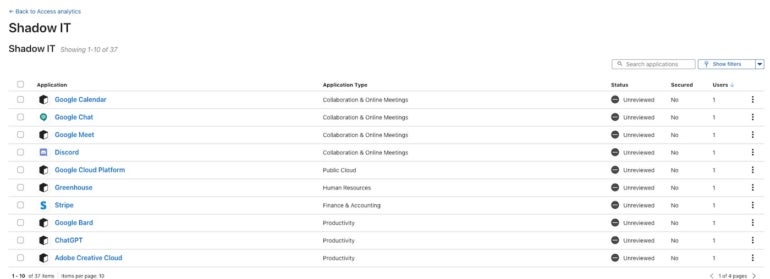
With Cloudflare Gateway, companies can visualize all the AI apps and services employees are experimenting with. Software budget decision-makers can leverage the visibility to make more effective software license purchases.
In addition, the tools give administrators critical privacy and security information, such as internet traffic and threat intelligence visibility, network policies, open internet privacy exposure risks and individual devices’ traffic (Figure A).
Figure A
Cloudflare Shadow IT dashboard reveals what applications and services workers are using that have not been officially approved by the company. Image: Cloudflare
Service tokens
Some companies have realized that in order to make generative AI more efficient and accurate, they must share training data with the AI and grant plugin access to the AI service. For companies to be able to connect these AI models with their data, Cloudflare developed service tokens.
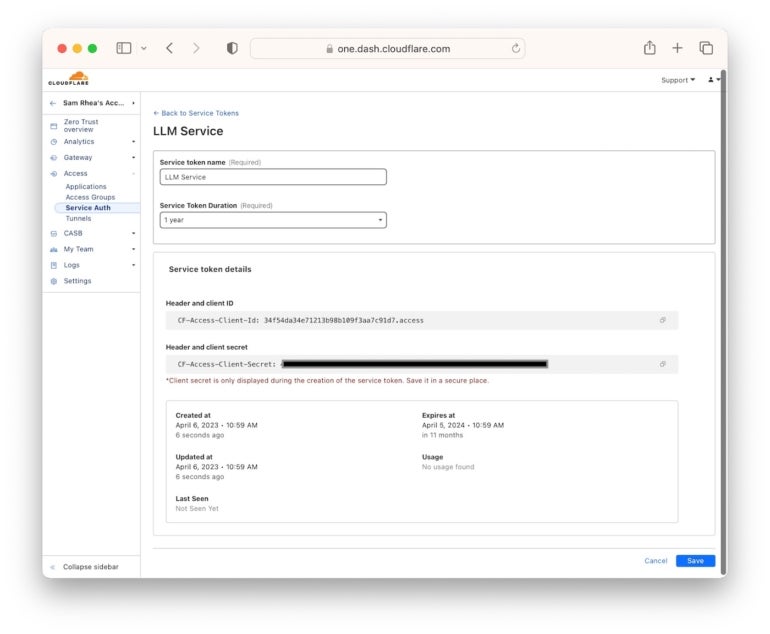
Service tokens give administrators a clear log of all API requests and grant them full control over the specific services that can access AI training data (Figure B). Additionally, it allows administrators to revoke tokens easily with a single click when building ChatGPT plugins for internal and external use.
Figure B
Cloudflare service tokens dashboard. Image: Cloudflare
Once service tokens are created, administrators can add policies that can, for example, verify the service token, country, IP address or an mTLS certificate. Policies can be created to require users to authenticate, such as completing an MFA prompt before accessing sensitive training data or services.
Cloudflare Tunnel
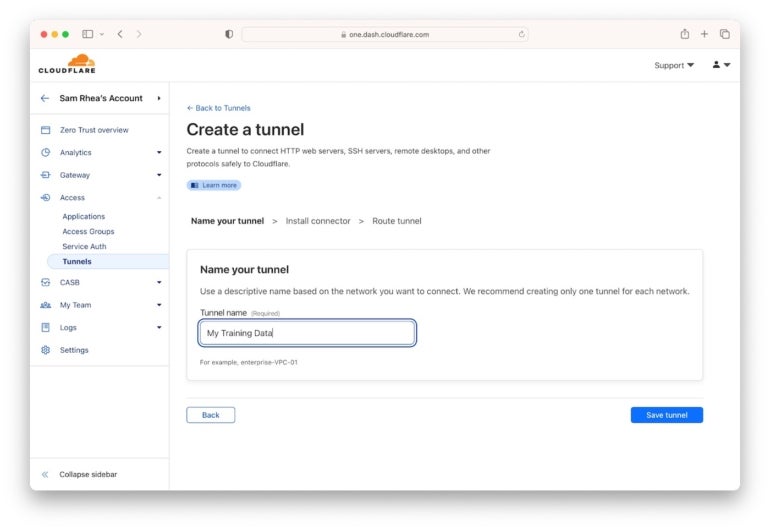
Cloudflare Tunnel allows teams to connect the AI tools with the infrastructure without affecting their firewalls. This tool creates an encrypted, outbound-only connection to Cloudflare’s network, checking every request against the configured access rules (Figure C).
While administrators can visualize, configure access, secure, block or allow AI services using security and privacy tools, human error can also play a role in data loss, data leaks or privacy breaches. For example, employees may accidentally overshare sensitive data with AI models by mistake.
Cloudflare Data Loss Prevention secures the human gap with pre-configured options that can check for data (e.g., Social Security numbers, credit card numbers, etc.), do custom scans, identify patterns based on data configurations for a specific team and set limitations for special projects.
Cloudflare’s cloud access security broker
In a recent blog post, Cloudflare explained that new generative AI plugins such as those offered by ChatGPT provide many benefits but can also lead to unwanted access to data. Misconfiguration of these applications can cause security violations.
Cloudflare’s cloud access security broker is a new feature that gives enterprises comprehensive visibility and control over SaaS apps. It scans SaaS applications for potential issues such as misconfigurations and alerts companies if files are accidentally made public online. Cloudflare is working on new CASB integrations, which will be able to check for misconfigurations on new popular AI services such as Microsoft’s Bing, Google’s Bard or AWS Bedrock.
The global SASE and SSE market and its leaders
Secure access service edge and security service edge solutions have become increasingly vital as companies migrated to the cloud and into hybrid work models. When Cloudflare was recognized by Gartner for its SASE technology, the company detailed in a press release the difference between both acronyms by explaining SASE services extend the definition of SSE to include managing the connectivity of secured traffic.
The SASE global market is poised to continue growing as new AI technologies develop and emerge. Gartner estimated that by 2025, 70% of organizations that implement agent-based zero-trust network access will choose either a SASE or a security service edge provider.
Gartner added that by 2026, 85% of organizations seeking to procure a cloud access security broker, secure web gateway or zero-trust network access offerings will obtain these from a converged solution.
Cloudflare One, which was launched in 2020, was recently recognized as the only new vendor to be added to the 2023 Gartner Magic Quadrant for Security Service Edge. Cloudflare was identified as a niche player of the Magic Quadrant with a strong focus on network and zero trust. The company faces strong competition from leading companies, including Netskope, Skyhigh Security, Forcepoint, Lookout, Palo Alto Networks, Zscaler, Cisco, Broadcom and Iboss.
The benefits and the risks for companies using AI
Cloudflare One’s new features respond to the increasing demands for AI security and privacy. Businesses want to be productive and innovative and leverage generative AI applications, but they also want to keep data, cybersecurity and compliance in check with built-in controls over their data flow.
A recent KPMG survey found that most companies believe generative AI will significantly impact business; deployment, privacy and security challenges are top-of-mind concerns for executives.
About half (45%) of those surveyed believe AI can harm their organizations’ trust if the appropriate risk management tools are not implemented. Additionally, 81% cite cybersecurity as a top risk, and 78% highlight data privacy threats emerging from the use of AI.
From Samsung to Verizon and JPMorgan Chase, the list of companies that have banned employees from using generative AI apps continues to increase as cases reveal that AI features can leak sensible business data.
AI governance and compliance are also becoming increasingly complex as new laws like the European Artificial Intelligence Act gain momentum and countries strengthen their AI postures.
“We hear from customers concerned that their users will ‘overshare’ and inadvertently send too much information,” Rhea explained. “Or they can share sensitive information with the wrong AI tools and wind up causing a compliance incident.”
Despite the risks, the KPMG survey reveals that executives still view new AI technologies as an opportunity to increase productivity (72%), change the way people work (65%) and encourage innovation (66%).
“AI holds incredible promise, but without proper guardrails, it can create significant risks for businesses,” Matthew Prince, the co-founder and chief executive officer of Cloudflare, said in the press release. “Cloudflare’s Zero Trust products are the first to provide the guard rails for AI tools, so businesses can take advantage of the opportunity AI unlocks while ensuring only the data they want to expose gets shared.”
Cloudflare’s swift response to AI
The company released its new suite of AI security tools at an incredible speed, even as the technology is still taking shape. Rhea talked about how Cloudflare’s new suite of AI security tools was developed, what the challenges were and if the company is planning for upgrades.
“Cloudflare’s Zero Trust tools build on the same network and technologies that power over 20% of the internet already through our first wave of products like our Content Delivery Network and Web Application Firewall,” Rhea said. “We can deploy services like data loss prevention (DLP) and secure web gateway (SWG) to our data centers around the world without needing to buy or provision new hardware.”
Rhea explained that the company can also reuse the expertise it has in existing, similar functions. For example, “proxying and filtering internet-bound traffic leaving a laptop has a lot of similarities to proxying and filtering traffic bound for a destination behind our reverse proxy.”
“As a result, we can ship entirely new products very quickly,” Rhea added. “Some products are newer — we introduced the GA of our DLP solution roughly a year after we first started building. Others iterate and get better over time, like our Access control product that first launched in 2018. However, because it is built on Cloudflare’s serverless computer architecture, it can evolve to add new features in days or weeks, not months or quarters.”
What’s next for Cloudflare in AI security
Cloudflare says it will continue to learn from the AI space as it develops. “We anticipate that some customers will want to monitor these tools and their usage with an additional layer of security where we can automatically remediate issues that we discover,” Rhea said.
The company also expects its customers to become more aware of the data storage location that AI tools used to operate. Rhea added, “We plan to continue to ship new features that make our network and its global presence ready to help customers keep data where it should live.”
The challenges remain twofold for the company breaking into the AI security market, with cybercriminals becoming more sophisticated and customers’ needs shifting. “It’s a moving target, but we feel confident that we can continue to respond,” Rhea concluded.
Cybersecurity Insider Newsletter
Strengthen your organization's IT security defenses by keeping abreast of the latest cybersecurity news, solutions, and best practices.
Digital twins analytics has been applied in a variety of contexts. Today, digital twins are gaining in popularity for various complex projects. In this article, we explore the use of digital twins for simulation tasks. We first explain the significance of simulation and then explain how complex manufacturing processes may be simulated as a digital twin.
What is a digital twin?
The Digital twin is a nebulous term because the term digital twin spans industries. Starting from the manufacturing industry, the concept of digital twins has evolved and now applies to many areas, including the metaverse. In addition, companies and industries have chosen to define the term digital twin in their image, giving rise to multiple definitions. However, despite these differences, digital twins have some common elements. A twin is an abstraction – like all abstractions (models of a real system) – we need to simplify the implementation of a twin from its real-life counterpart. Ideally, using the digital twin as an abstraction, we want to solve complex problems. In many cases, these problems involve simulation.
Understanding simulation in digital twins
The concept of simulation originated in engineering. Hence, many machine learning developers are unfamiliar with simulation. Nevertheless, both simulation and machine learning are critical components of digital twins. While they are similar, there are some essential differences.
A simulation follows a set of rules that have been made for it in advance. On the other hand, Machine Learning explores the world and tries to figure out what the rules govern it are. In the simulation, a model is constructed by subject matter experts to predict probabilities of variables for a complex system consisting of a large number of variables. We can think of such a system as a ‘system of systems’ – for example, predicting the behavior of markets that comprise several participants and external factors. With simulation, the inputs are not precisely known, but the model itself is often known in advance because a simulation follows a set of rules we’ve made for it.
An example of a Digital Twin implementation
With this background, let us explore a case of the use of digital twins for simulating complex manufacturing processes. The example and images are provided by MEXT.
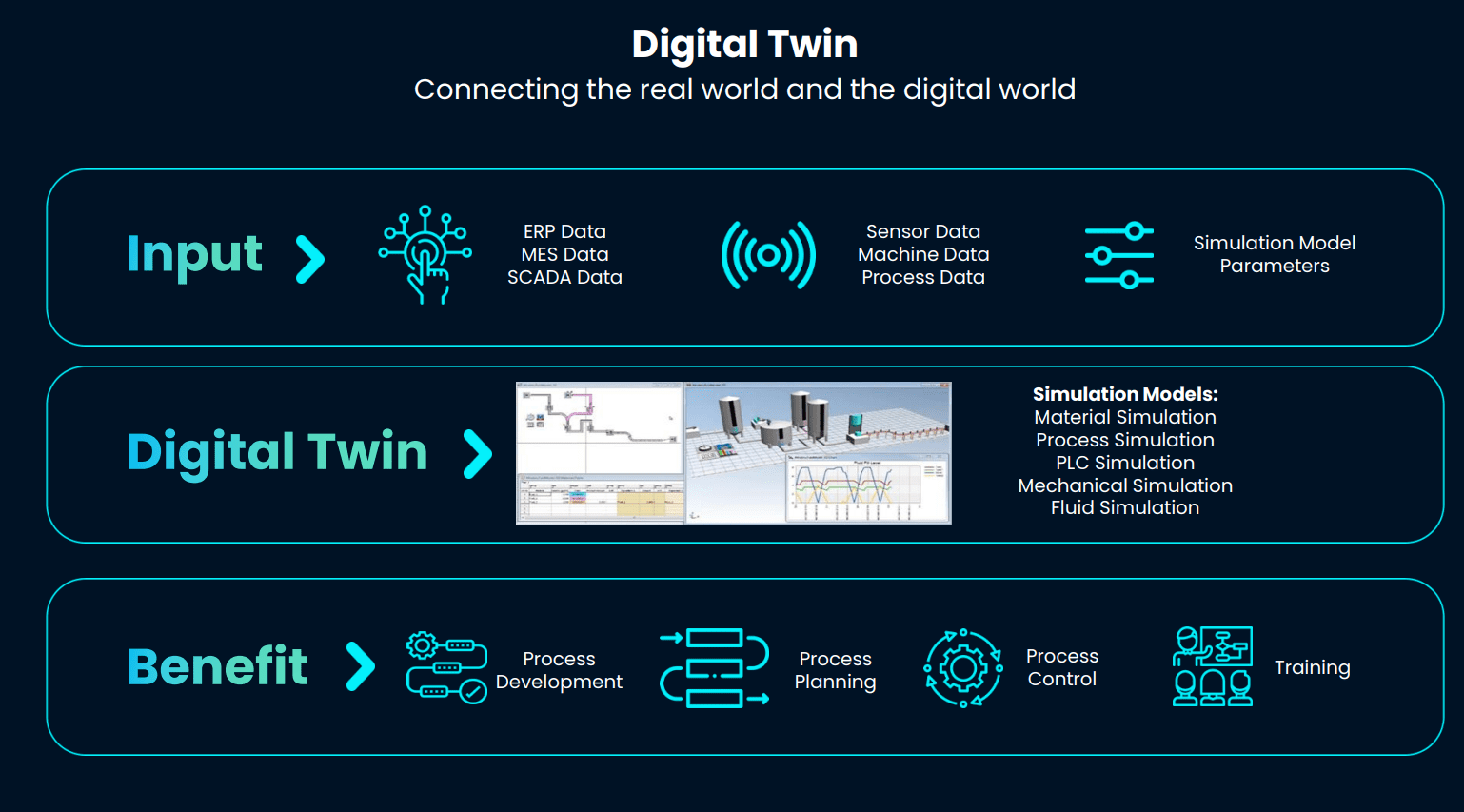
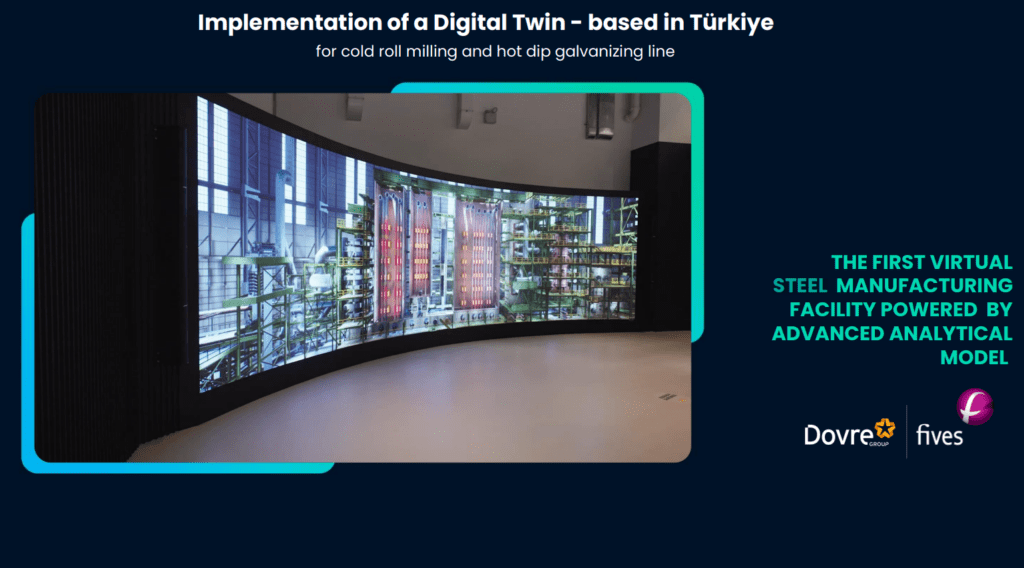
Based in Istanbul, Türkiye, MEXT enables digital transformation by implementing a digital factory. Two production lines are implemented: Intermittent Production and continuous production. For the cold roll milling and hot dip galvanizing line for steel manufacturing, a digital twin is implemented to simulate the manufacture of steel. Data is captured from various sources in the manufacturing process: ERP Data, MES Data, SCADA Data, Sensor Data, etc. From these, the digital twin simulation model and parameters are produced.
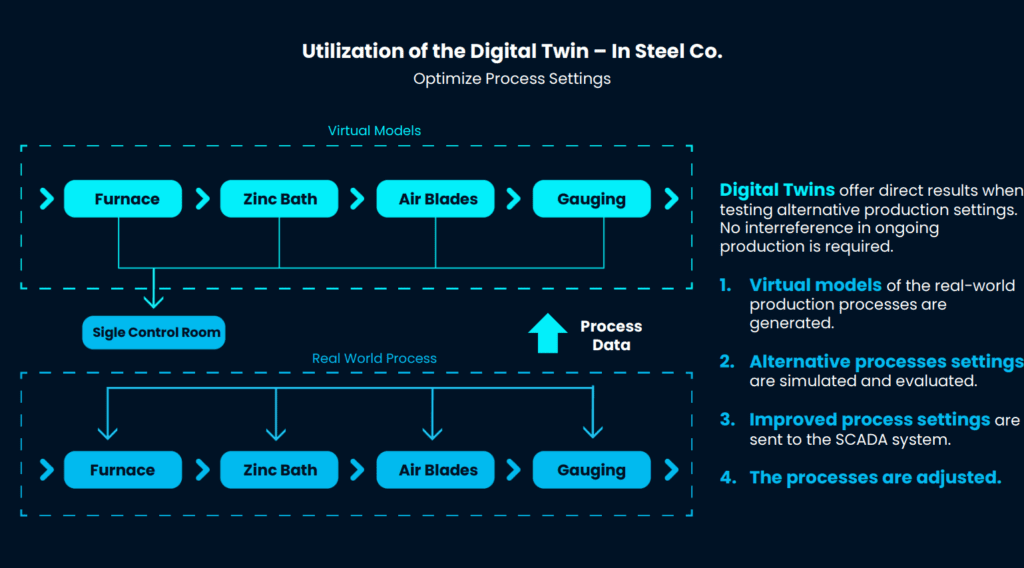
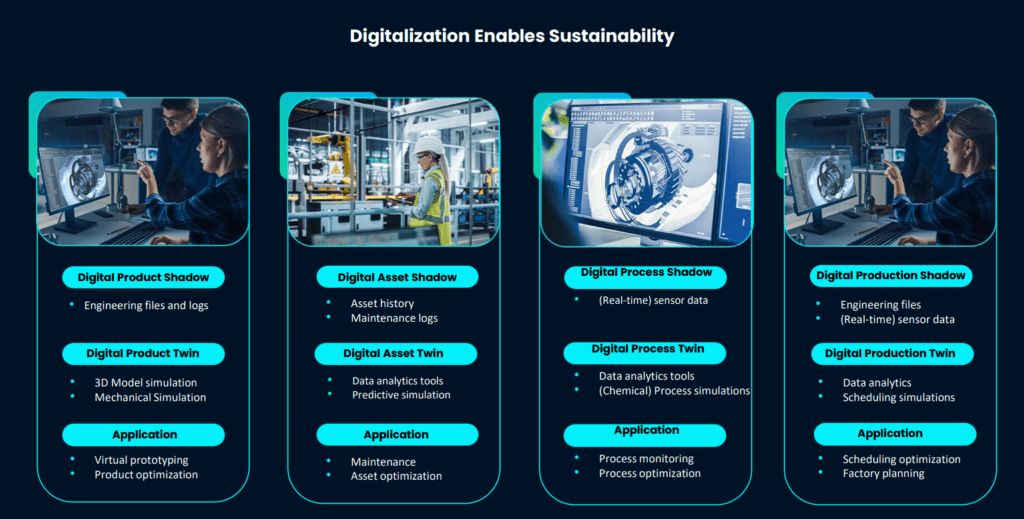
Once created, the digital Twin simulates the production process, tests alternative process settings, and supplies optimal settings to the control system to manage the process. Optimal settings can be directly transferred to the control system. You can search for improved process settings by simulating the production process without interfering with the production. You gain deeper insights into the production through simulations and the comparison of the simulations with the real-world process. You can simulate at multiple levels of granularity: Product, Asset, Process, and the entire production process.
Conclusion
Currently, both digital twins and simulations are relatively niche topics. The concept of simulation is expanding from its origins in engineering. When combined with machine learning, we gain the ability to solve complex predictive analytics problems through digital twins. Developers are also acquiring new skills beyond their traditional machine-learning capabilities.
Data and its by-products dominate the world we live in. Smartphones and easy Internet access have increased this proliferation of data at a much higher rate than before. To make sense of this data and to use it for business advantage, companies analyze this huge amount of data to get insights. Such insights from text analytics, as they’re known, provide valuable and actionable information that then dictates a company’s key decision-making process.
Text data visualization is one such technique that offers many insights extracted from raw data into easily understandable forms. Such forms can include pie charts, tables, graphs, histograms, word clouds, etc. All these visual aids help executives and businesses to gauge customer sentiments by quickly viewing the data. Such text visualizations are of great importance to these business ventures, as will be seen in the following paragraphs.
Improved Decision-Making
The importance of data in the world of decision-making is experiencing new highs. With many top-notch companies favoring data analytics and insights from text analytics to guide their decision-making process, the trend is gaining strength. According to one estimate, 1 in 4 companies are now looking to make key decisions based on data analytics and through data visualizations obtained from raw text.
Executives believe that such intuitions from data are a must-have now as they provide real-time insights. They are a business’ entry points into customers’ behavior, their shopping trends, and general market patterns. Decision makers and project managers feel greater control in planning and executing their plans based on text analysis data. Such data visualizations are extremely useful in all the processes of project execution, planning, and even monitoring. Thus, project executives feel more confident basing their decisions on concrete evidence of market trends rather than going with their gut feelings.
Huge corporations such as Nike and Football Clubs are now relying on data to change their marketing strategies. This shift in adherence to data to make key decisions is a trend that is here to stay as more executives come on board the data visualization game. It is critical that businesses fully embrace this trend to stay relevant in their domains as data visualizations become more and more influential.
Increased Efficiency
Text data visualization is a great way to enhance the efficiency of a business. Text visualizations save the time of human resources that are spent on analyzing vast amounts of unstructured data. Businesses can utilize such resources elsewhere, free from mundane data mining and data entry tasks. Thus, by employing text data visualization in your business process, you can significantly increase your company’s personnel’s productivity.
Executives from companies employing data visualization tools can simply look at a pie chart and decide which market to prioritize. Checking a histogram of past performance indicates the years the company did well and the phases in it did not perform so proficiently. Word clouds and other data visualization techniques help when the crunch is on, and you must make quick yet informed decisions. Such text analysis tools summarize a lot of data into snippets that are easy to read and interpret, therefore enhancing a business’s efficiency and business readiness.
What better way to exercise such readiness is by visualizing the data and streamlining your business workflows accordingly? Text data visualization also helps to summarize large datasets into easily understandable one-pagers. Such one-pagers are a great help when explaining the company’s position to top management or prospective clients. Clients appreciate the effort made by executives to present data in such an easy-to-understand manner thus securing new business and lucrative clientele.
Enhanced Communication
Communicating your findings as a business entity is an important skill that can let your company grow exponentially. Often overlooked for other KPIs, communication is sometimes neglected, which can cause a company potentially a huge headache. The importance of communication in today’s digitally savvy marketing generation is there for all to see. Data visualizations can play a big role in improving a company’s communication policies and how they reflect on their business.
The customer tech savviness makes for an interesting shift in customer thinking as companies also look to bridge the gap between businesses and their customers. The importance of good communication grows as businesses realize they have to communicate with their customers in a certain manner. Therefore, businesses these days scrutinize every tweet and digital post through sentiment analysis, a text analysis method, giving the company an insight into the customer’s mind.
Text data visualization helps companies communicate easily and quickly with large customer bases. Such text visualizations help companies achieve their goals of keeping their customers aware of their processes. Such awareness is extremely important today as customers prefer their brands to be more transparent and less secretive. Such transparency helps build the brand as customer friendly and thus achieves the ultimate goal of having a loyal customer base.
Competitive Advantage
In a world full of data, your competitors will not spare any tech-related advancement to gain an advantage over you. Thus, it is crucial that you press this advantage of using text analysis and text data visualizations to help increase your company’s advantage. Using the latest AI and machine learning models to analyze this data will surely help companies achieve their growth targets.
AI and ML are helping us understand customer preferences and market trends like never before. The need to review data manually is becoming obsolete these days. Now you can simply design algorithms and models to do this job. The models analyze a large amount of data with ease and provide quick analysis. Employing such text analysis techniques will help your company gain that elusive competitive edge over your rivals, and thus you can stand out.
One underrated advantage of data analytics is its ability to observe current market trends and patterns. Such observations (data visualizations) make for nice summary reports but also serve a far greater purpose. Historical records and data analytics combine to predict future trends and opportunities in a highly competitive market. Such opportunities are hard to predict, but with the help of text visualizations, it is a matter of a few clicks away.
Improved Customer Experience
Text data visualizations and insights from text analytics help businesses get inside the head of their customers. Such deep knowledge of customer preferences helps businesses improve their products and after-sales services. Knowing your customers’ pain points helps businesses proactively seek to remove such complaints and gain the praise of customers.
For example, a telecommunication provider faces many complaints, and numerous such complaints are hard to diagnose one by one. Text analytics and data visualizations summarize such complaints into easily understandable charts and visual aids that are often self-explanatory. A pie chart clubbing the nature of such complaints into different categories helps the company executives make quick decisions about the company’s shortcomings.
It is a short way of addressing the concerns after the executives are made aware of such claims. Businesses must continue to evolve, and what better way to do so than by heeding their customer advice? Customers often provide the truest form of criticism, which businesses can use to make alterations to the product and thus make the product much better.
Increased Revenue
With the help of text visualizations, companies can make better decisions. Similarly, they can predict the future trends their customers would be more inclined to follow. This decision-making process and increased reliance on data result in more income streams for the business. It helps the business grow more than relying on manual data extraction.
Not only do text visualizations help find new streams of revenue, but they also help enhance existing revenue streams. Companies are becoming even more aware of their strengths now. This advantage is then pressed by strategizing the company’s policies to enhance existing well-performing streams. Such streams are then maximized to generate more revenue so that the company can focus on taking more risks down the line and generating more revenue.
Conclusion
In conclusion, text visualization is not a new way to interpret data at a glance. However, the mechanism behind it has progressed with the help of AI-based techniques and has made these visualizations data-based and highly accurate. Businesses and companies can now sift through large amounts of data and simply make their interpretations based on such data through data visualizations.
Businesses can get that elusive competitive advantage over their rivals that they strive for by making swift data-based decisions and increasing productivity by performing sentiment analysis to get insight into customers’ needs and demands. Such preferences then become the blueprint for the company to strive to make their products best suited for their customers.
Thus, text data visualization offers the cutting edge required for businesses to excel in various fields such as marketing, project & product management, research, and monitoring. Text data visualization tools are the perfect recipe for the success of businesses. The scale of advantages that can be extracted from data visualization is immense and companies of all sizes can benefit from it.
Arc launches HireAI to make finding software developers easier Catherine Shu @catherineshu / 11 hours
Arc, the jobs platform created especially for software developers looking for remote positions, wants to make recruitment easier with the launch of HireAI. Powered by OpenAI’s GPT-4, HireAI does much of the manual work of finding the right candidates from the 250,000 developers on Arc, including resume screening and mass outreach.
To use HireAI, companies upload their job description. Then it provides a shortlist of candidates, refining preferences with each match so companies get more accurate results.
Arc founder and CEO Weiting Liu, who also launched Codementor, a remote learning platform for software developers, told TechCrunch that the “noise-to-signal rate” is especially high when looking at global remote candidates. “Since Arc’s launch in 2019, we’ve seen countless hiring managers and recruiters being frustrated with the amount of time it takes to sift through hundreds of resumes and manual outreach to find the right candidates,” he said.
Before HireAI, companies using Arc needed to submit their job requirements by completing a detailed job form. Then Arc used its own machine learning algorithm to find the best candidates, or candidates would apply to positions themselves. The platform’s recruiters would further curate candidates for its clients to review. HireAI, which employers can opt-in or out of (or use in tandem with manual screening) automates the onboarding process by generating job descriptions through “conversations” with an AI recruiter, and providing instant matches.
By streamlining or automating tasks like writing job descriptions, candidate screening and outreach, AI-powered tools like HireAI frees up time to focus on more strategic parts of recruitment, Liu said. These include meeting with candidates to see if they are a good cultural fit, building relationships and pitching positions with each individual’s career goals in mind. Liu added that AI-powered tools like HireAI can potentially encourage diversity, equality and inclusion because recruiters don’t see the age, ethnicity or gender of candidates until they get the best matches.
“It is important to note that while AI tools can handle many responsibilities traditionally assigned to recruiters, they are not intended to replace human recruiters entirely,” Liu noted. HireAI was soft-launched internally on Arc a few days ago and Liu said early data shows that companies are two times as likely to interview developers who have been matched with them through HireAI.
The team behind Codementor launches Arc to help companies hire talented developers around the world
At AWS India Summit, held in Mumbai, last week, the cloud giant told AIM that the Indian government is working on generative AI, actively exploring the potential use cases across departments and initiatives. This will unfold in the coming months.
In February this year, nearly four months after the launch of ChatGPT, it was reported that the Ministry of Electronics and IT (MeitY) will be integrating ChatGPT with WhatsApp to help Indian farmers understand and learn about several government schemes.
In fact, Ashwini Vaishnaw, Minister for Electronics and IT, has revealed that the Indian government is already working on something similar to ChatGPT.
Large Language Models (LLMs) like GPT3.5 and GPT-4 by OpenAI, which powers ChatGPT holds immense potential for the Indian government in multiple areas, including the delivery of government schemes and services, as well as administration purposes. By leveraging generative AI, the government can automate and enhance the process of providing essential schemes and services to citizens.
The technology can assist in streamlining administrative tasks, improving efficiency, and reducing manual effort. With LLMs, the government can develop intelligent systems that can understand user queries, provide accurate information, and even generate personalised responses.
ChatGPT in Indic Languages
However, one of the challenges of using LLMs is that these models are trained on a vast amount of English data, and perform poorly when prompted in non-English languages. This is where Bhasini comes in, an initiative to create large datasets for Indic Languages.
Bhasini, which is an initiative of AI4Bharat and IIT Madras, was announced by Prime Minister Narendra Modi while inaugurating the Digital India Week 2022 event in Gandhinagar. The IndicTrans translation model by Bhasini is already being used for translation for other initiatives such as KissanAI (renamed from KissanGPT).
“As part of Bhashini, we are developing the platform to enable all the things to enrich the Indic language AI models for various tasks like Translation, Speech to Text, Text to Speech, Image to Text etc. All government reports/materials/communications can be generated in all the official languages. The core idea is to stop language being a barrier for any industry,” Aravinth Bheemaraj, engineering leader, Tarento, told AIM.
JugalBandi, a multilingual AI chatbot
Further, at this year’s Microsoft Build Conference held in Seattle, Microsoft showcased how a Generative AI-driven multilingual chatbot developed in India is already used by citizens in rural areas to access government services.
Called Jugalbandi, the chatbot can comprehend inquiries in various languages, whether they are spoken or typed. The system retrieves pertinent programme details, typically documented in English, and delivers them in the native language of the user.
Abhigyan Raman, a project officer at AI4Bharat said that the chatbot, which is powered by GPT models, understands the user’s exact problem in their languages and then tries to deliver the right information reliably and cheaply, even if that exists in some other language in a database somewhere.
Currently, the chatbot, which can also be accessed through WhatsApp, is available in 10 of the 22 official languages and 171 of a total of approximately 20,000 government programmes.
According to Microsoft, Vandna, an 18-year-old resident of Biwan, Haryana had the opportunity to test the chatbot. In early April, when Jugalbandi was introduced to the people in her village by community volunteers, Vandna decided to interact with the chatbot. She typed her question in Hindi, asking, “What scholarships are available for me?” Along with her question, she mentioned her field of study, which includes Political Science, Hindi, and History.
The chatbot responded by providing a comprehensive list of central and state government programmes that offer scholarships. Vandna selected one of the options and inquired about the eligibility criteria. Jugalbandi promptly provided her with the necessary information and also informed her about the supporting documents required for the application process.
While Jugalbandi, merely offers us a glimpse of the immense potential of LLMs, in the upcoming months or years, as the technology continues to mature, LLMs could become ubiquitous. They could power various government chatbots such as MyGov Helpdesk, Umang Chatbot, DigitBot, CoWin Chatbot, and AskDISHA, enabling seamless and intelligent interactions between citizens and government services. Moreover, LLMs would assist government servants in performing administrative tasks with greater efficiency, transforming the way bureaucratic work is undertaken.
The post Indian Govt to Soon Launch Generative AI Services appeared first on Analytics India Magazine.
AI regulation has been a hot topic with AI developments continuing to grow in popularity and quantity everyday. Government officials, tech leaders and concerned citizens have all been calling for action.
Now a major player in the AI space, OpenAI, the company behind the wildly popular ChatGPT, joins the discussion.
Also: 6 harmful ways ChatGPT can be used
In a blog post named, "Governance of superintelligence", OpenAI CEO Sam Altman, President and Co-founder Greg Brockman and Co-Founder and Chief Scientist at OpenAI Ilya Sutskever discuss the importance of establishing AI regulation now, before it is too late.
"Given the possibility of existential risk, we can't just be reactive," said OpenAI leaders in the blog post. "Nuclear energy is a commonly used historical example of a technology with this property; synthetic biology is another example."
The blog post outlines three different course of actions that could serve as a good starting point for AI regulation.
First, the post calls for there to be some form of a coordinating entity that focuses on the safety and smooth integration of AI technologies into society.
Also: Most Americans think AI threatens humanity, according to a poll
Examples could include having major governments worldwide collaborate on a project that current efforts could become a part of, or establishing an organization focused on AI development that restricts the annual growth rate of AI capabilities, according to the post.
The second idea OpenAI shared was the need for an international organization like the International Atomic Energy Agency for AI or "superintelligence" efforts.
Such an organization would have the authority to inspect systems, require audits, test for compliance with safety standards and more, ensuring safe and responsible development of AI models.
Also:Google's Bard AI says urgent action should be taken to limit Google's power
As a first step, the posts suggests companies could start implementing regulations that an international agency would and countries could also begin implementing those standards.
Lastly, the post says a technical capability to make superintelligence safe is needed, but it is an open research question many people are putting effort into.
OpenAI also says it is important to let companies and open-source projects develop AI models below an established capability threshold, without "burdensome mechanisms like licenses or audits," according to the post.
This post comes a week after Altman testified at a Senate Judiciary Committee hearing to address risks and the future of AI.
In this digital age, businesses are all about convenience and ease of use. What could be more convenient than cloud computing? With its favorable cost structures and ease of access, it’s no wonder many have flocked to it. But in a rush to embrace this shiny new tech, many forgot the security fundamentals.
It’s a dangerous game, this out-of-sight, out-of-mind mentality. The more we loosen our grip on asset control, the more vulnerable we become. Predators are always watching, waiting for the right moment to strike. The cloud may be beautiful, but it’s not without risks.
Beware of the lurking dangers that threaten your IT assets in the cloud. Stay ahead and ensure your organization’s utmost level of cloud data security.
What are the risks related to cloud security?
One wrong move, one slip-up, and the integrity of sensitive business data can get shattered. Businesses must be vigilant and stay ever-watchful against these cloud security risks:
Data Breaches. Sensitive data is left vulnerable to exploitation when security measures are lacking. The negligence of those entrusted with the safety of IT assets can lead to data breaches.
Data loss. Cloud providers must have backup and recovery mechanisms to prevent data loss. It poses a grave threat, whether it’s due to system failures or natural disasters.
Insecure interfaces. These vulnerabilities stem from poor authentication and authorization mechanisms or inadequate encryption. Insecure interfaces open the door to attackers who seek to access sensitive data.
Insider threats. In 2022, 31% of CISOs listed insider threats as a significant cybersecurity risk. Cloud providers must take a proactive stance by implementing strict access controls. They should also monitor user activity to detect and prevent insider threats.
Regulatory compliance. Regulations set forth by GDPR, CPRA, and HIPAA are not to be taken lightly. They are the guardians of our digital privacy, the watchmen at the gates of our most sensitive information. Failure to comply with these regulations can have dire consequences.
Transparency. Cloud providers must be transparent about security practices and data handling procedures. Without this, customers may find risk assessment of a particular cloud provider challenging.
Multi-tenancy. When multiple customers share the same resources, the risk of data compromise increases. Cloud providers must implement measures to isolate customer data from other customers.
Denial-of-service attacks. DDoS can disrupt service and prevent customers from accessing their data. Clmechanisms to detect and mitigate these attacks.
Cloud sprawl. This problem is like cancer that spreads through an organization. They create redundant and unnecessary cloud resources. Establish policies, use monitoring tools, and conduct regular audits to regain control.
Evolving Threat Landscape. Cloud environments are repositories for our most valuable data. They are prime targets for malicious actors. Organizations must remain vigilant and regularly update their security protocols. Ongoing training is crucial for equipping staff with the skills to combat emerging threats.
How do you ensure data security in cloud computing?
Now, it’s not all doom and gloom in the cloud. There are plenty of ways to ensure your data stays safe and secure. You can use these tools and best practices for a multi-layered approach to security:
Enterprise Password Managers
Password managers stand guard over login credentials, keeping them safe and secure in a centralized location. They enforce password policies, track password usage, and ensure users are not sharing passwords.
Password managers create complex passwords that will leave intruders scratching their heads. It reduces the likelihood of password-related security breaches, including brute-force attacks.
Identity and Access Management (IAM)
IAM solutions create a fortress of security where sensitive data, applications, and systems are protected from prying eyes. They create a secure and controlled environment for managing user authentication and authorization. They ensure that only authorized personnel can access sensitive data, applications, and systems.
IAM wields the power of MFA, role-based access control, and user activity monitoring. They can be the gatekeepers of your cloud-based kingdom, keeping intruders out.
Encryption
Cloud computing endangers data as it transmits and stores it across the internet. One way to secure data confidentiality and protect against theft is through encryption. It safeguards data at rest and in transit.
Moreover, compliance regulations that demand the protection of sensitive information mandate encryption. By implementing encryption, businesses can abide by these regulations. Companies evade penalties and preserve their reputation.
Virtual Private Networks (VPNs)
With security that would make Fort Knox jealous, VPNs keep your connections safe. They ensure data transmitted is protected from interception and unauthorized access.
VPN apps have become an essential part of this era of remote work and virtual collaboration. It provides a layer of security in the face of the most vicious cyber criminals.
Security Information and Event Management (SIEM)
SIEM solutions are like 24-hour guards of the digital world. They monitor every user activity and detect security threats in real time.
With SIEM, you can rest easy knowing security experts are watching your back around the clock. If any threats rear their ugly heads, SIEM allows your security teams to respond fast. These solutions are like a well-oiled machine that prevents data loss or theft.
Data Backup and Disaster Recovery
With data backup and disaster recovery plans, you ensure business operations will continue. These plans guarantee business continuity, especially during data loss or system failure.
Compliance and Risk Management
Compliance and risk management are critical in ensuring the security of cloud services. Cloud providers must implement them to meet clients’ demands and maintain users’ trust.
Cloud computing is a smart business choice due to its flexibility and cost-effectiveness. But, with its increased usage, there’s a growing concern about data security. We must look at these tools and best practices to ensure data security in cloud computing.